Enhancing Vision Through Screening
Improving Vision Deficit Detection Through School-Based
Screening Programs
New Guidelines for School-Based Testing
BY: ASHLEY SZMANIA
This module was created in partnership with the
the University of Nevada-Reno as part of a
Doctor of Nursing Practice project.
The author has no conflict of interests.
Disclosures
“The only thing worse than being blind
is having sight, but no vision.”
-HELEN KELLER
Background Questions
How long have you worked as a school nurse?1
What would help you as a school nurse feel more
comfortable and competent to perform vision
screenings?
2
Knowledge Assessment
What are appropriate eye charts for screening in pre-school
or non-literate children?
4
If using the threshold method, when should a child be referred for follow-up care?
8
1
When a child is being screened for visual acuity, where should
they stand in relation to the eye chart?
2 What are some appropriate methods for occluding the eye
during visual acuity testing?
3 Should visual acuity testing occur with one eye or two? What
about if the child wears glasses?
5
Which testing chart should be used in literate or children aged 6 and
above?
6 When should instrument-based screening be used?
7
Which is better, the threshold or critical line testing method when screening
for vision?
Thank you
for your participation in the
pre-knowledge questionnaire.
Enhancing Vision
Through Screening:
New Guidelines for
School-Based Testing
Due to the recent update of the referenced guidelines some
states have not yet updated their screening guidelines and
requirements. To aid in this discrepancy, the National
Association of School Nurses (NASN) (2018) published a
four-part series which addressed the new screening
guidelines and answered many questions commonly asked
by the school nurse. This module is intended to inform and
summarize best practice guidelines for school vision
screening using a high-yield approach for school nurses.
Objectives
Identify best screening practices for
visual acuity testing of school-age
children
1.
Determine which vision charts are
most helpful during the screening
process
2.
Identify new practice updates
3.
Table of Contents
1. Why Vision Screening in Schools? 10
2. Current State of Evidence 12
3. Exam Set-up & Environment 14
4. How should I set up the vision screening? 16
5. Occlusion Techniques 19
6. Screening Tips 25
7. Testing Chart Updates 27
8. Which Eye Chart to Use? 31
9. Near Vision Acuity Screening 34
10. Color Vision Screening 35
11. Instrument-Based Screening 36
12. Threshold vs Critical Line Screening Methods 40
13. Case Study 44
14. Post-test 48
Why Vision Screening in Schools?
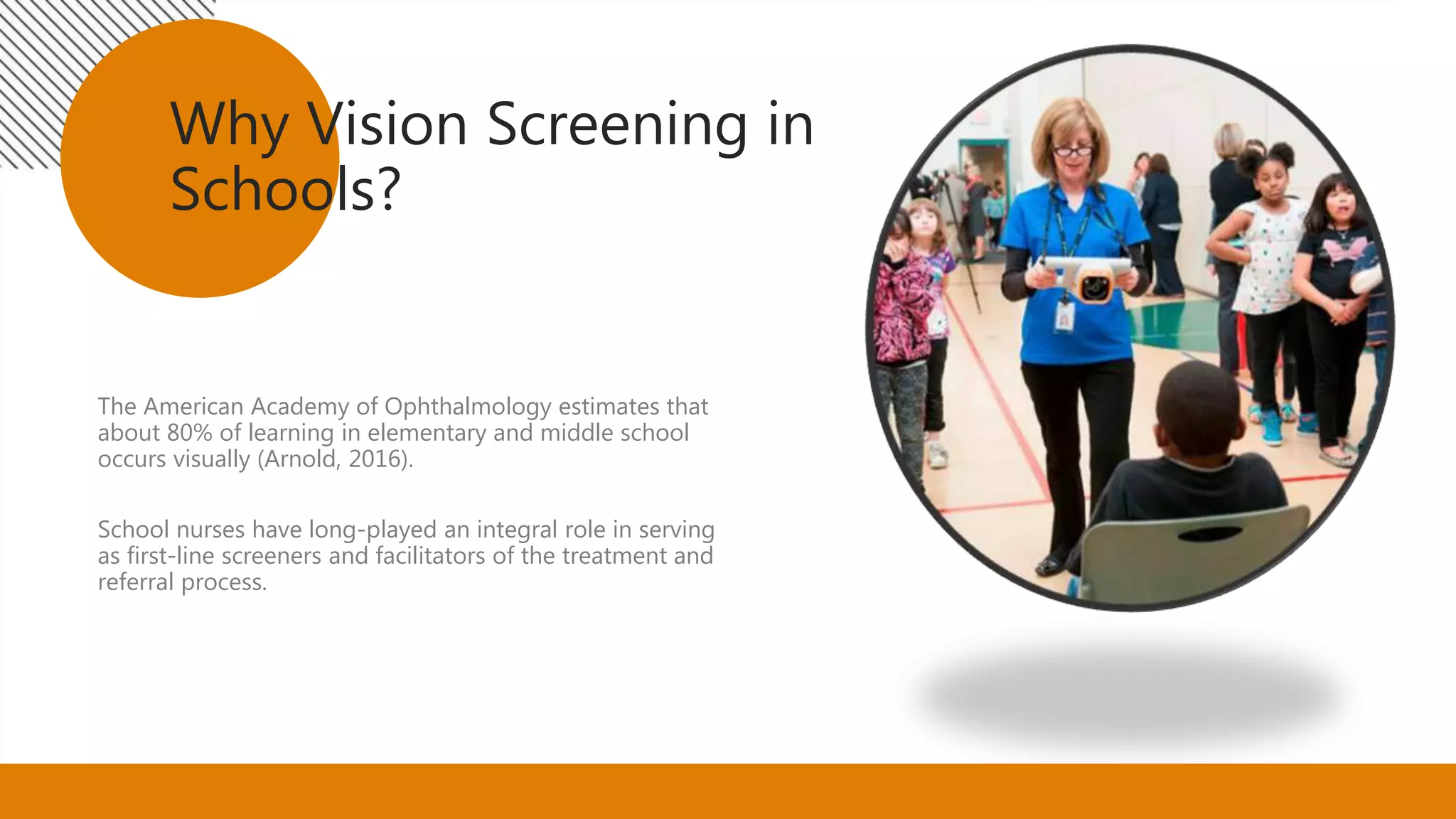
The American Academy of Ophthalmology estimates that
about 80% of learning in elementary and middle school
occurs visually (Arnold, 2016).
School nurses have long-played an integral role in serving
as first-line screeners and facilitators of the treatment and
referral process.
Why Vision Screening in
Schools?
Recently, the importance of vision screening in schools has
been brought to the forefront with the help of public
health campaigns such as Healthy People 2010 and
Healthy People 2020.
Current State of Evidence
To improve these initiatives, there have been numerous updates to the
previous vision screening guidelines.
In 2016, the American Academy of Pediatrics, American Association for
Pediatric Ophthalmology and Strabismus, American Academy of
Ophthalmology, and American Association of Certified Orthoptists
joined together to create updated vision screening guidelines
(Donahue et al., 2016).
Numerous practice updates directly impact the school nurse as it
relates to vision screening.
Current State of
Evidence
Updated Vision Screening
Guidelines
Exam Set-Up & Environment
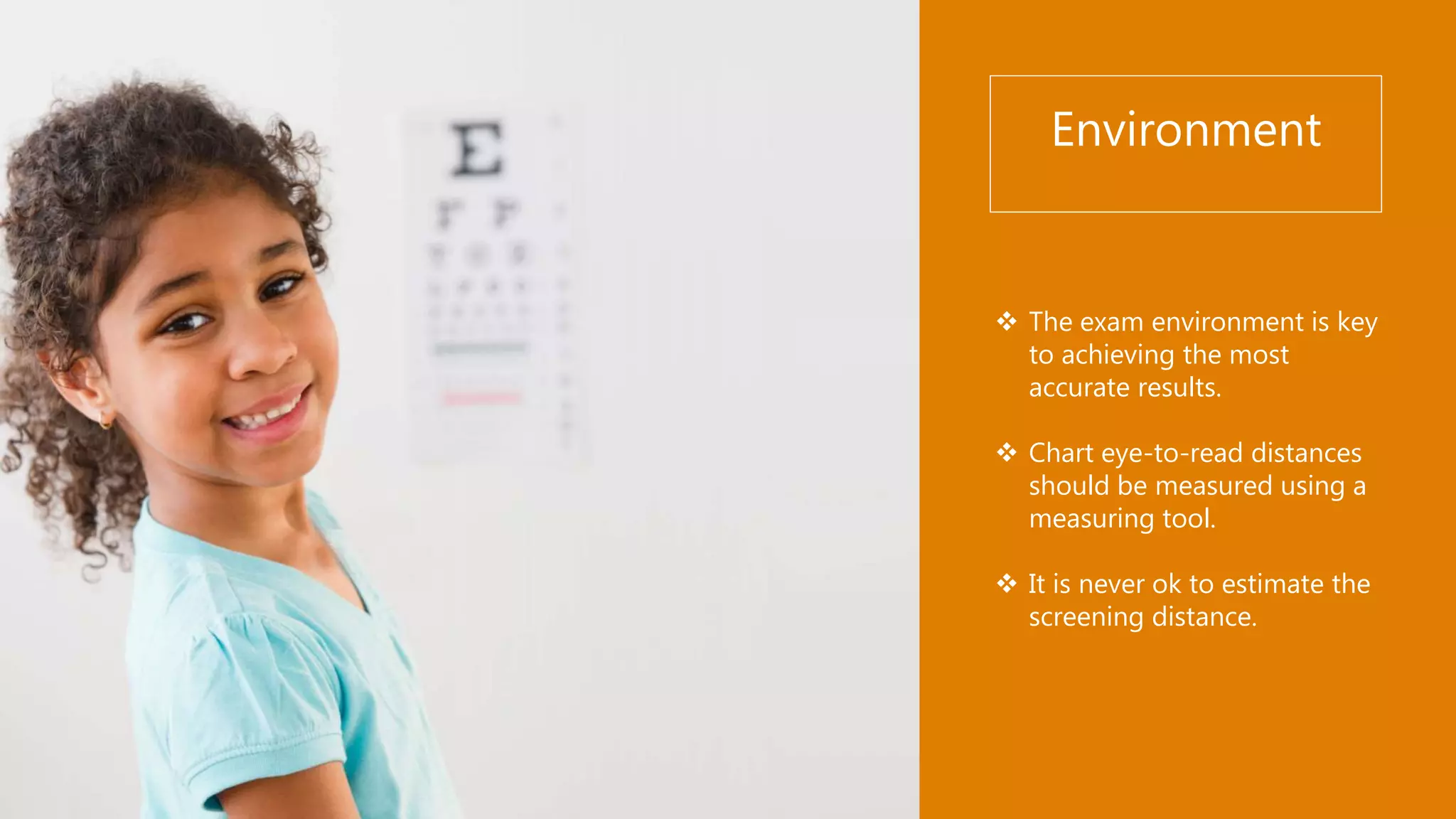
 The exam environment is key
to achieving the most
accurate results.
 Chart eye-to-read distances
should be measured using a
measuring tool.
 It is never ok to estimate the
screening distance.
Environment
How should I set up the screening?
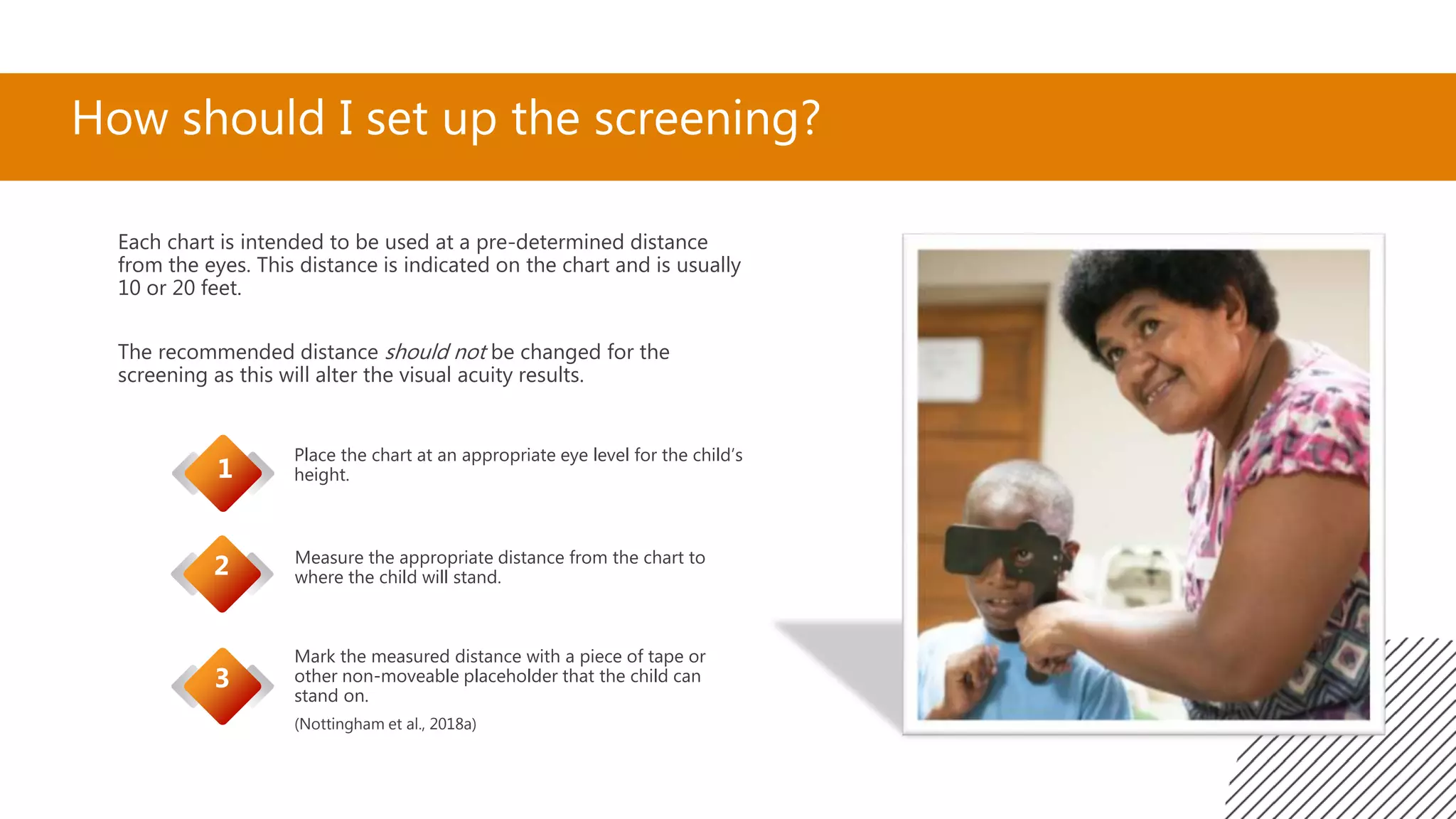
Each chart is intended to be used at a pre-determined distance
from the eyes. This distance is indicated on the chart and is usually
10 or 20 feet.
The recommended distance should not be changed for the
screening as this will alter the visual acuity results.
1
Place the chart at an appropriate eye level for the child’s
height.
2 Measure the appropriate distance from the chart to
where the child will stand.
3
Mark the measured distance with a piece of tape or
other non-moveable placeholder that the child can
stand on.
(Nottingham et al., 2018a)
Screening Line
10 or 20 feet
Set Up
Where should the
child stand?
 The screening distance is
measured from the child’s eye to
the chart.
 The line should indicate the
distance from eye-to-chart.
 Therefore, the child should stand
with the arches of both feet on
the indicated screening line.
Nottingham et al., 2018a
Screening Line
Occlusion Techniques
An essential part of the eye exam is properly
occluding the eye that is not being tested.
Children are experts in adaptation. If there is a
discrepancy in visual acuity, the stronger eye will
compensate and assist in the exam.
Therefore, effective occlusion methods that prevent
peeking must be employed.
Occlusion Techniques
No Peeking!
What NOT to Use
Some commonly used methods of
occlusion include:
These methods do not properly occlude the
eye and do not prevent peeking.
Adult hands to occlude child’s eyes
Child’s own hands
Paper
Tissues
Cups
What SHOULD I use
to cover the child’s
eye during the exam?
Donahue et al., 2016
All Ages Pre-Schoolers up to
10 years of age
Children 10 years
and above
Adhesive patches Adhesive patches Adhesive patches
2 inch wide
surgical tape
Specialty
occluder
glasses
Lollypop cover
panels
Adult hands to occlude child’s eyes
Child’s own hands
Paper
Tissues
Cups
What to use What NOT to Use
Lollipop cover panelsSpecialty occluder glasses
Adhesive patches 2 in wide surgical tape
Screening Tips
Screening Tips
There is no need to test for distance with both eyes.
Distance screening should occur using one eye at a time (monocularly)
It is ok if the child uses both eyes to get comfortable with the screening
process prior to testing.
A practice test with both eyes open may increase comfort and compliance.
However, once the exam begins, it must be administered monocularly
(Nottingham et al., 2018c)
Ensure that the children who have prescription glasses are wearing them at
the time of the exam (Nottingham et al., 2018c)
Place the occlusive patch underneath the glasses.
Choosing the Appropriate Testing Chart
Testing Chart Updates
The use of eye charts is still the gold standard for visual
acuity testing
(Donahue et al., 2016).
1
Each age group has different developmental needs,
and testing charts should be specifically chosen to
meet those needs.
2
There have been various practice updates regarding
which eye charts should be used during the screening
process.
3
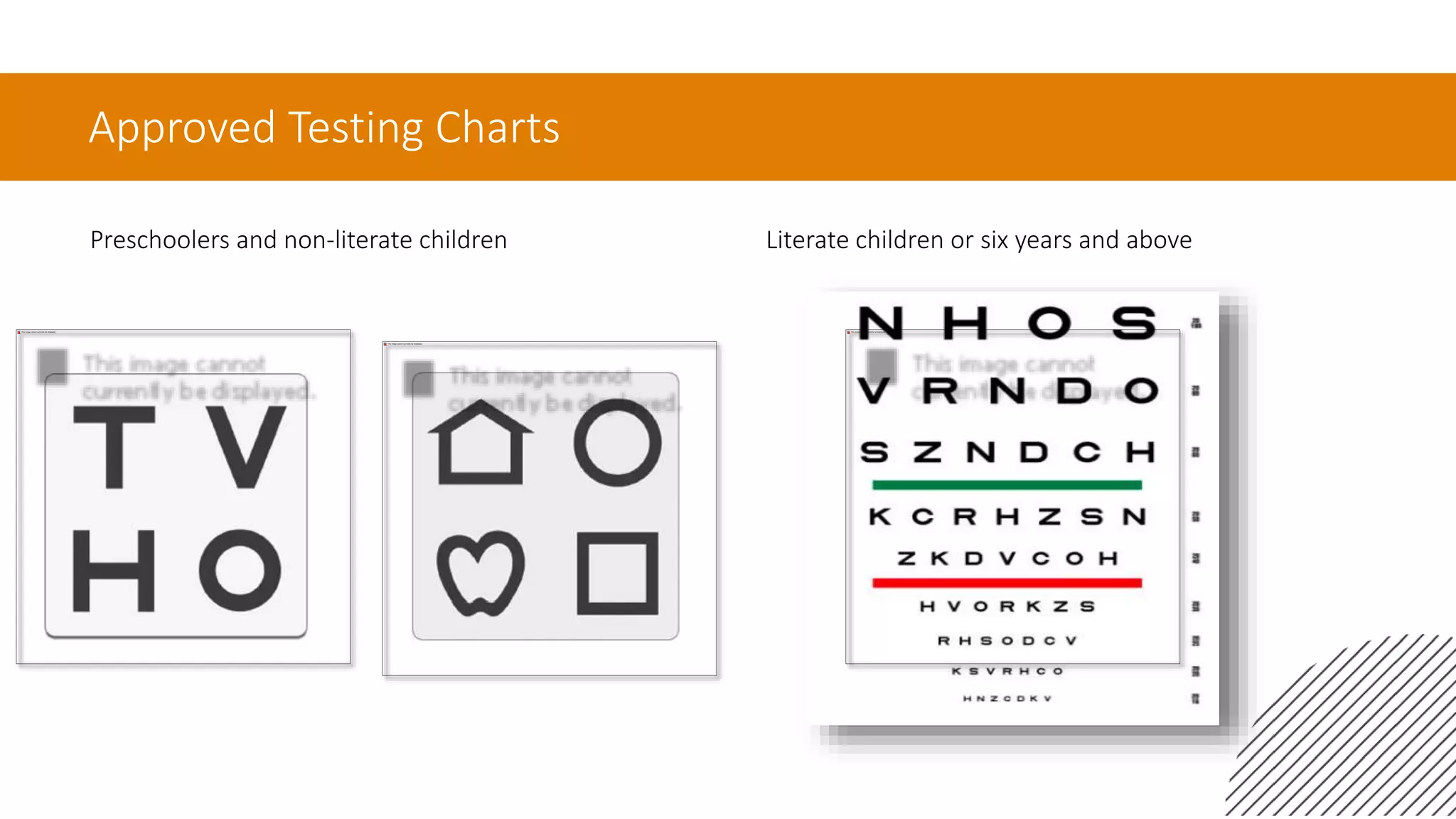
Preschoolers & non-
literate children
Donahue et al., 2016
Practice Recommendations
Use LEA or HOVT charts for
preschoolers and non-literate children
Preschoolers and non-literate children
Donahue et al., 2016
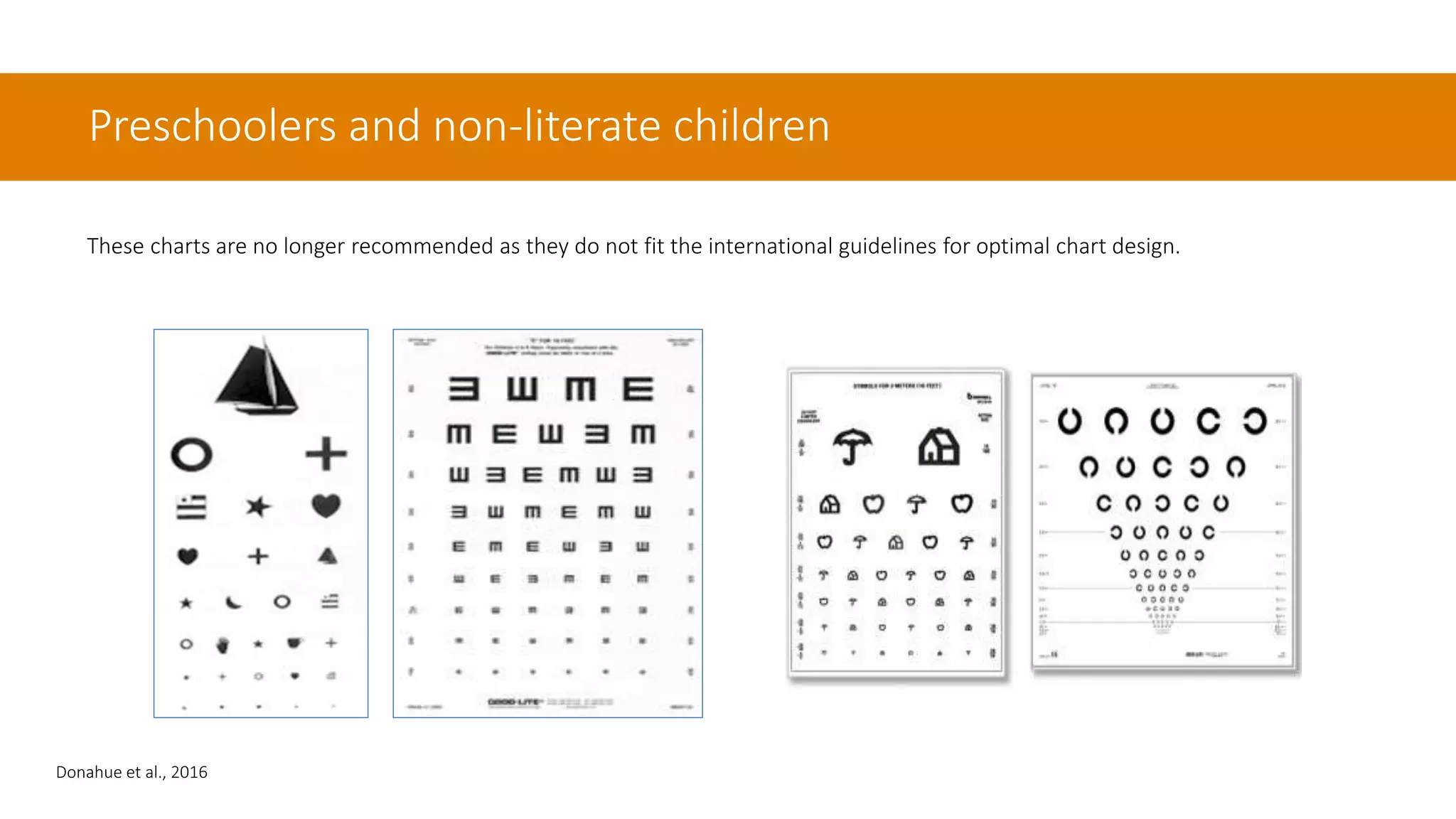
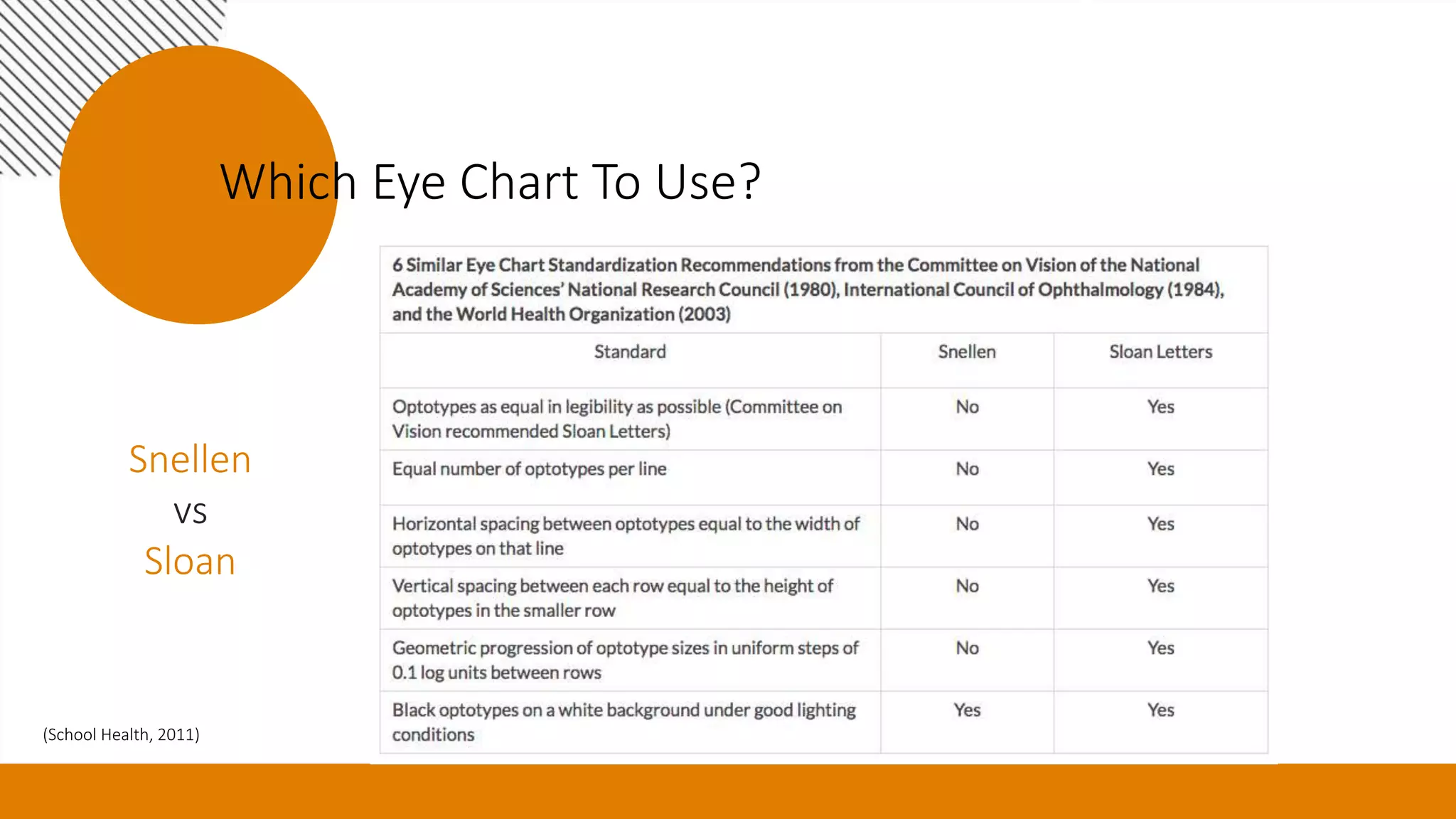
These charts are no longer recommended as they do not fit the international guidelines for optimal chart design.
For a long time, the Snellen Chart has been
used for pediatric visual acuity testing.
The updated 2016 vision screening
guidelines no longer support the use of the
Snellen Chart in children.
Instead, the SLOAN chart is recommended
as it complies with national and
international optimal chart design.
Testing Charts:
Children who are literate or 6 years and above
Donahue et al., 2016, Nottingham et al., 2018a
Which Eye Chart To Use?
Snellen
vs
Sloan
(School Health, 2011)
Children who are literate or 6 years and above
Snellen Sloan
Approved Testing Charts
Preschoolers and non-literate children Literate children or six years and above
Near Vision Acuity Screening
Near Visual Acuity Screening
Testing Near Vision is not
currently recommended.
There are no specific guidelines
recommending that near-vision
testing should be conducted at
school.
Color Vision Screening
School-based screening for color vision is controversial. However, color
vision screening is still required in some schools.
If a child fails a color screen, they should be referred to an eye vision
professional.
Instrument-Based Screening
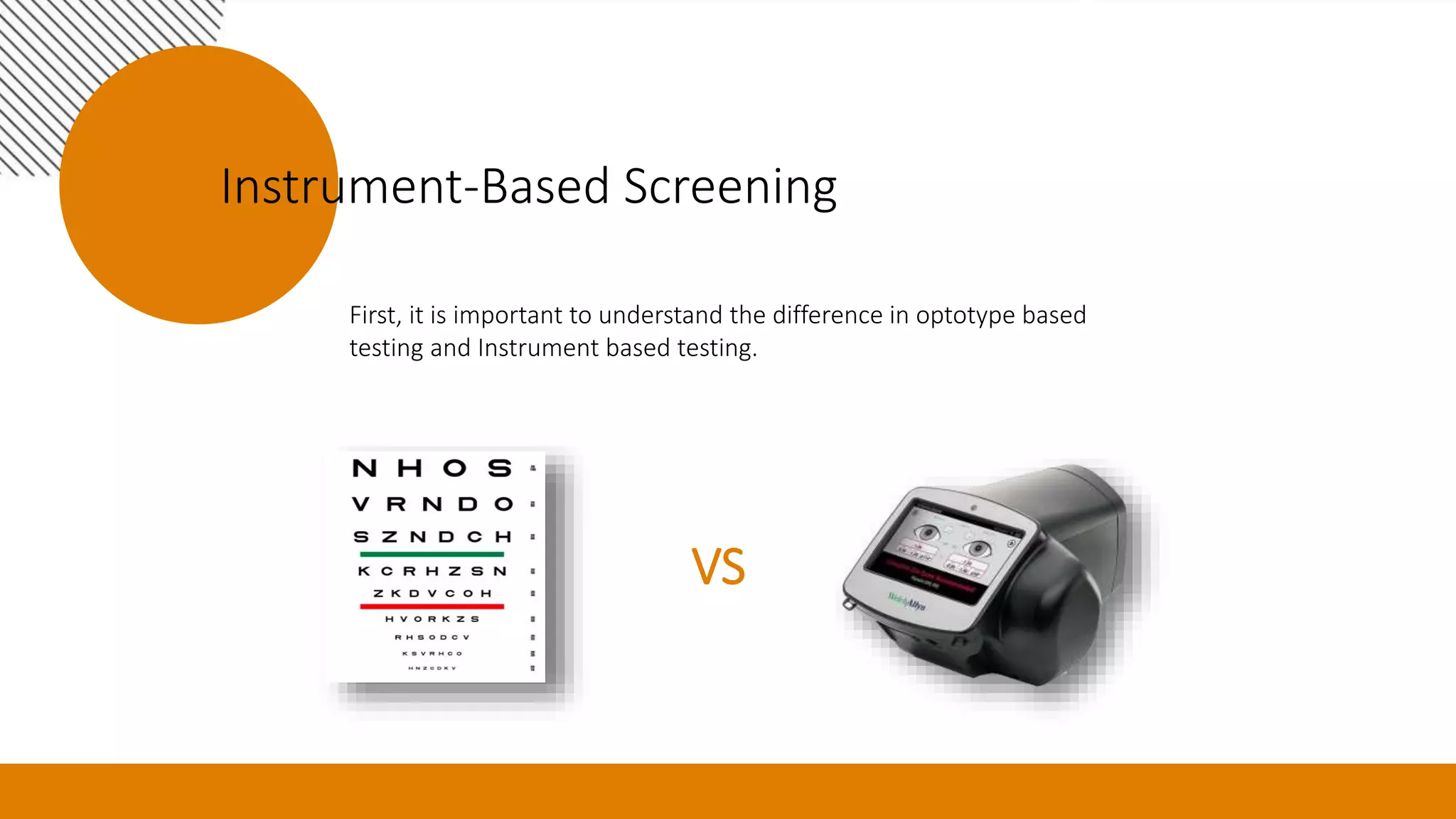
First, it is important to understand the difference in optotype based
testing and Instrument based testing.
VS
Instrument-
Based
screening
As optotype testing and
instrument based testing both
provide different types of
information, ideally, both would
be integrated in a screening
program. However, visual acuity
testing remains the gold standard
for children aged 3 and above.
(Donahue et al., 2016)
Optotype
Testing (Eye Chart)
Instrument-Based
Screening
Measures visual acuity as interpreted by the
brain
Does NOT measure visual acuity
Creates a quantifiable measurement that can
be recorded and tracked
Use digital images to determine if the eyes
have risk factors for amblyopia, including
“significant refractive error” and
misalignment.
(Nottingham, 2018a)
This measurement is derived from the
clearness of vision while identifying “black
optotypes on a white background using
specific sizes at a standardized distance”
(Nottingham et al., 2018a)
The American Academy of
Pediatrics, the American
Association for Pediatric
Ophthalmology and Strabismus, the
American Academy of
Ophthalmology, & the American
Association of Orthoptists concur
that instrument based screening
can begin at 12 months, with better
results at 18 months of age.
(Donahue et al., 2016)
For children who are able to
communicate, generally 3 and
above, visual acuity testing with
optotypes remains the gold
standard.
A recent review concluded that
currently there is not enough data
to support instrument-based vision
screening in children aged 6 and
above.
(Nottingham et al., 2018a)
Instrument-based screening: Recommendations
Instrument-
Based
Screening:
Summary of
Guidelines
(Cotter et al., 2015,
Donahue et a;., 2016,
Nottingham et al., 2018c)
1 It is appropriate for children aged 1 to 2
2 Can be used alternatively to optoype screening in children aged
3, 4, & 5 years of age
3 Should only be used in children 6 and above if they cannot
participate in an optotype-based exam
Threshold vs Critical Line Screening Methods
Threshold vs Critical Line Screening Method
No Peeking!
Threshold Visual Acuity Screening
Involves beginning at the top of the eye chart and
reading each line down the chart until the child can
no longer identify the letters.
Critical Line Acuity Screening
Uses the passing line that corresponds with the child’s
age.
Which is better, threshold or critical line testing?
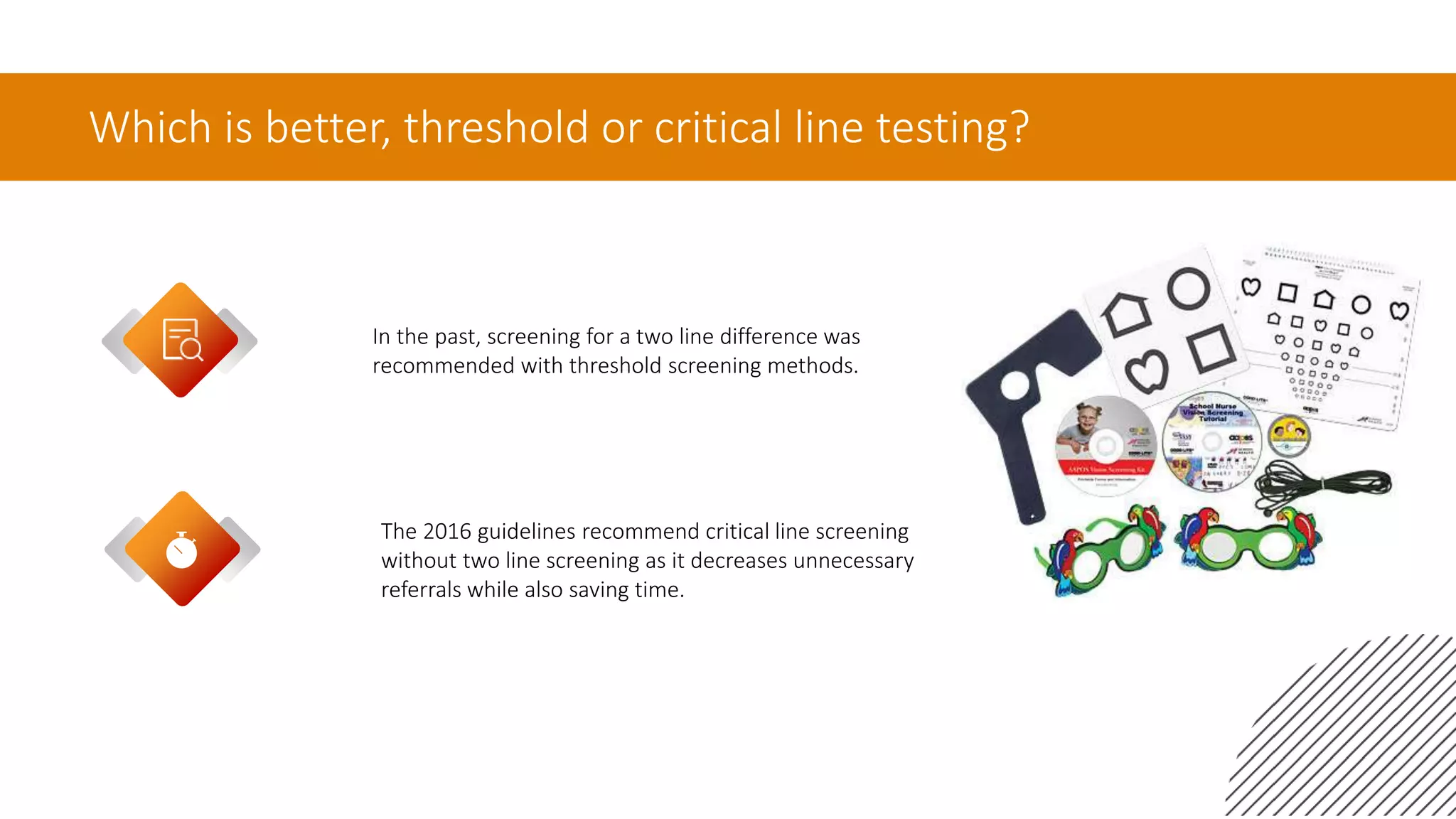
In the past, screening for a two line difference was
recommended with threshold screening methods.
The 2016 guidelines recommend critical line screening
without two line screening as it decreases unnecessary
referrals while also saving time.
2 Line Testing
Some schools still require two
line testing.
If your school still requires two-
line testing, the updated
guidelines recommend referral
even if a child passes visual
acuity with each eye.
(Donahue et al., 2016)
Case Study
2-line Difference Case Study
Take a look at this example published in the September, 2016
National Association of School Nurses Journal.
A six-year old student is screened by the school nurse.
1st eye: 20/20
2nd eye: 20/32
(**insert arrow to the right) – where should the arrow point?
2-line Difference Case Study (cont.)
As there is a 2 line difference between the first and
second eye-a referral is needed
If the 1st eye was 20/20 , and the 2nd eye 20/25-
that would be a 1 line difference and NO referral
would be needed
Summary of Testing
Methods
Critical line testing is recommended
Over the threshold method.
However, if the threshold method is
mandated by your school, refer a child for
follow-up if a two-line difference is seen
with testing.
(Donahue et al., 2016)
Thank you
Post Test
Post-Module Questionnaire for
CE certificate
What are appropriate eye charts for screening in pre-school
or non-literate children?
4
If using the threshold method, when should a child be referred for follow-up care?
8
1
When a child is being screened for visual acuity, where should
they stand in relation to the eye chart?
2 What are some appropriate methods for occluding the eye
during visual acuity testing?
3 Should visual acuity testing occur with one eye or two? What
about if the child wears glasses?
5
Which testing chart should be used in literate or children aged 6 and
above?
6 When should instrument-based screening be used?
7
Which is better, the threshold or critical line testing method when screening
for vision?
To receive your 1.5 CNE credits, please email your responses to the pre and post- test, name, and license
number to aszmania@Nevada.unr.edu.
Resources
1. National certification in vision screening by Prevent Blindness
2. Link: https://www.preventblindness.org/prevent-blindness-childrens-vision-screening-certification-course
3. American Academy of Pediatrics Clinical Report – Pediatrics. January 2016. Volume 137. Issue 1
4. Link: http://pediatrics.aappublications.org.unr.idm.oclc.org/content/pediatrics/137/1/e20153596.full.pdf
5. Please see the National Association of School Nurses Journals from March, July, September, & November of 2018 for
more commonly asked questions regarding vision screening.
6. Submit any vision screening questions to: Nottingham@preventblindness.org
References
• Arnold, C. (2016). Children’s success in school affected by vision. John Hopkins magazine. Retrieved from
https://hub.jhu.edu/magazine/2016/fall/baltimore-kids-eyeglasses-program/
• Cotter, S. A., Cyert, L. A., Miller, J. M., & Quinn, G. E. for the National Expert Panel to the National Center for Children’s
Vision and Eye Health. (2015). Vision screening for children 36 to <72 months: Recommended practices. Optometry and
Vision Science, 92(1), 6-16. Retrieved from http://www.ncbi.nlm.nih.gov/pmc/articles/PMC4274336/pdf/opx-92-06.pdf
• Donahue, S. & Nixon, C. (2016). Visual system assessment in infants, children, and young adults by pediatricians.
American Academy of Pediatrics, 137(1), 28. doi: 10.1542/peds.2015-3596
• Nottingham Chaplin, P. K., Baldonado, K., Bradford, G. E., Cotter, S., & Moore, B. (2018a). An eye on vision: 20
questions about vision screening and eye health. NASN School Nurse, 33(2), 87-92.
• Nottingham Chaplin, P. K., Baldonado, K., Cotter, S., Moore, B., & Bradford, G. E. (2018b). An eye on vision: Five
questions about vision screening and eye health-part 2. NASN School Nurse (Print), 33(4), 210-213.
References (Cont)
• Nottingham Chaplin, P. K., Baldonado, K., Cotter, S., Moore, B., & Bradford, G. E. (2018c). An eye on vision: Five questions
about vision screening and eye health-part 3. NASN School Nurse (Print), 33(5), 279-283.
• Nottingham Chaplin, P. K., Baldonado, K., Cotter, S., Moore, B., & Bradford, G. E. (2018d). An eye on vision: Seven
questions about vision screening and eye health-part 4. NASN School Nurse (Print), 33(6), 351-354.
• Rodriguez, E., Srivastava, A., & Landau, M. (2018). Increasing screening follow-up for vulnerable children: A partnership
with school nurses. International Journal of Environmental Research and Public Health, 15(8), 1572.
doi:10.3390/ijerph15081572
• School Health. (2011). Selecting an eye chart-SLOAN vs Snellen? Retrieved from:
https://www.schoolhealth.com/blog/selecting-an-eye-chart-sloan-letters-or-snellen/

Enhancing Vision Through Screening: Improving Vision Deficit Detection Through School-Based Screening Programs New Guidelines for School-Based Testing

  • 1.
    Enhancing Vision ThroughScreening Improving Vision Deficit Detection Through School-Based Screening Programs New Guidelines for School-Based Testing BY: ASHLEY SZMANIA
  • 2.
    This module wascreated in partnership with the the University of Nevada-Reno as part of a Doctor of Nursing Practice project. The author has no conflict of interests. Disclosures
  • 3.
    “The only thingworse than being blind is having sight, but no vision.” -HELEN KELLER
  • 4.
    Background Questions How longhave you worked as a school nurse?1 What would help you as a school nurse feel more comfortable and competent to perform vision screenings? 2
  • 5.
    Knowledge Assessment What areappropriate eye charts for screening in pre-school or non-literate children? 4 If using the threshold method, when should a child be referred for follow-up care? 8 1 When a child is being screened for visual acuity, where should they stand in relation to the eye chart? 2 What are some appropriate methods for occluding the eye during visual acuity testing? 3 Should visual acuity testing occur with one eye or two? What about if the child wears glasses? 5 Which testing chart should be used in literate or children aged 6 and above? 6 When should instrument-based screening be used? 7 Which is better, the threshold or critical line testing method when screening for vision?
  • 6.
    Thank you for yourparticipation in the pre-knowledge questionnaire.
  • 7.
    Enhancing Vision Through Screening: NewGuidelines for School-Based Testing
  • 8.
    Due to therecent update of the referenced guidelines some states have not yet updated their screening guidelines and requirements. To aid in this discrepancy, the National Association of School Nurses (NASN) (2018) published a four-part series which addressed the new screening guidelines and answered many questions commonly asked by the school nurse. This module is intended to inform and summarize best practice guidelines for school vision screening using a high-yield approach for school nurses. Objectives Identify best screening practices for visual acuity testing of school-age children 1. Determine which vision charts are most helpful during the screening process 2. Identify new practice updates 3.
  • 9.
    Table of Contents 1.Why Vision Screening in Schools? 10 2. Current State of Evidence 12 3. Exam Set-up & Environment 14 4. How should I set up the vision screening? 16 5. Occlusion Techniques 19 6. Screening Tips 25 7. Testing Chart Updates 27 8. Which Eye Chart to Use? 31 9. Near Vision Acuity Screening 34 10. Color Vision Screening 35 11. Instrument-Based Screening 36 12. Threshold vs Critical Line Screening Methods 40 13. Case Study 44 14. Post-test 48
  • 10.
  • 11.
    The American Academyof Ophthalmology estimates that about 80% of learning in elementary and middle school occurs visually (Arnold, 2016). School nurses have long-played an integral role in serving as first-line screeners and facilitators of the treatment and referral process. Why Vision Screening in Schools?
  • 12.
    Recently, the importanceof vision screening in schools has been brought to the forefront with the help of public health campaigns such as Healthy People 2010 and Healthy People 2020.
  • 13.
  • 14.
    To improve theseinitiatives, there have been numerous updates to the previous vision screening guidelines. In 2016, the American Academy of Pediatrics, American Association for Pediatric Ophthalmology and Strabismus, American Academy of Ophthalmology, and American Association of Certified Orthoptists joined together to create updated vision screening guidelines (Donahue et al., 2016). Numerous practice updates directly impact the school nurse as it relates to vision screening. Current State of Evidence
  • 15.
  • 16.
    Exam Set-Up &Environment
  • 17.
     The examenvironment is key to achieving the most accurate results.  Chart eye-to-read distances should be measured using a measuring tool.  It is never ok to estimate the screening distance. Environment
  • 18.
    How should Iset up the screening? Each chart is intended to be used at a pre-determined distance from the eyes. This distance is indicated on the chart and is usually 10 or 20 feet. The recommended distance should not be changed for the screening as this will alter the visual acuity results. 1 Place the chart at an appropriate eye level for the child’s height. 2 Measure the appropriate distance from the chart to where the child will stand. 3 Mark the measured distance with a piece of tape or other non-moveable placeholder that the child can stand on. (Nottingham et al., 2018a)
  • 19.
    Screening Line 10 or20 feet Set Up
  • 20.
    Where should the childstand?  The screening distance is measured from the child’s eye to the chart.  The line should indicate the distance from eye-to-chart.  Therefore, the child should stand with the arches of both feet on the indicated screening line. Nottingham et al., 2018a Screening Line
  • 21.
  • 22.
    An essential partof the eye exam is properly occluding the eye that is not being tested. Children are experts in adaptation. If there is a discrepancy in visual acuity, the stronger eye will compensate and assist in the exam. Therefore, effective occlusion methods that prevent peeking must be employed. Occlusion Techniques No Peeking!
  • 23.
    What NOT toUse Some commonly used methods of occlusion include: These methods do not properly occlude the eye and do not prevent peeking. Adult hands to occlude child’s eyes Child’s own hands Paper Tissues Cups
  • 24.
    What SHOULD Iuse to cover the child’s eye during the exam? Donahue et al., 2016 All Ages Pre-Schoolers up to 10 years of age Children 10 years and above Adhesive patches Adhesive patches Adhesive patches 2 inch wide surgical tape Specialty occluder glasses Lollypop cover panels
  • 25.
    Adult hands toocclude child’s eyes Child’s own hands Paper Tissues Cups What to use What NOT to Use Lollipop cover panelsSpecialty occluder glasses Adhesive patches 2 in wide surgical tape
  • 26.
  • 27.
    Screening Tips There isno need to test for distance with both eyes. Distance screening should occur using one eye at a time (monocularly) It is ok if the child uses both eyes to get comfortable with the screening process prior to testing. A practice test with both eyes open may increase comfort and compliance. However, once the exam begins, it must be administered monocularly (Nottingham et al., 2018c) Ensure that the children who have prescription glasses are wearing them at the time of the exam (Nottingham et al., 2018c) Place the occlusive patch underneath the glasses.
  • 28.
  • 29.
  • 30.
    Testing Chart Updates Theuse of eye charts is still the gold standard for visual acuity testing (Donahue et al., 2016). 1 Each age group has different developmental needs, and testing charts should be specifically chosen to meet those needs. 2 There have been various practice updates regarding which eye charts should be used during the screening process. 3
  • 31.
    Preschoolers & non- literatechildren Donahue et al., 2016 Practice Recommendations Use LEA or HOVT charts for preschoolers and non-literate children
  • 32.
    Preschoolers and non-literatechildren Donahue et al., 2016 These charts are no longer recommended as they do not fit the international guidelines for optimal chart design.
  • 33.
    For a longtime, the Snellen Chart has been used for pediatric visual acuity testing. The updated 2016 vision screening guidelines no longer support the use of the Snellen Chart in children. Instead, the SLOAN chart is recommended as it complies with national and international optimal chart design. Testing Charts: Children who are literate or 6 years and above Donahue et al., 2016, Nottingham et al., 2018a
  • 34.
  • 35.
    Which Eye ChartTo Use? Snellen vs Sloan (School Health, 2011)
  • 36.
    Children who areliterate or 6 years and above Snellen Sloan
  • 37.
    Approved Testing Charts Preschoolersand non-literate children Literate children or six years and above
  • 38.
  • 39.
    Near Visual AcuityScreening Testing Near Vision is not currently recommended. There are no specific guidelines recommending that near-vision testing should be conducted at school.
  • 40.
  • 41.
    Color Vision Screening School-basedscreening for color vision is controversial. However, color vision screening is still required in some schools. If a child fails a color screen, they should be referred to an eye vision professional.
  • 42.
  • 43.
    Instrument-Based Screening First, itis important to understand the difference in optotype based testing and Instrument based testing. VS
  • 44.
    Instrument- Based screening As optotype testingand instrument based testing both provide different types of information, ideally, both would be integrated in a screening program. However, visual acuity testing remains the gold standard for children aged 3 and above. (Donahue et al., 2016) Optotype Testing (Eye Chart) Instrument-Based Screening Measures visual acuity as interpreted by the brain Does NOT measure visual acuity Creates a quantifiable measurement that can be recorded and tracked Use digital images to determine if the eyes have risk factors for amblyopia, including “significant refractive error” and misalignment. (Nottingham, 2018a) This measurement is derived from the clearness of vision while identifying “black optotypes on a white background using specific sizes at a standardized distance” (Nottingham et al., 2018a)
  • 45.
    The American Academyof Pediatrics, the American Association for Pediatric Ophthalmology and Strabismus, the American Academy of Ophthalmology, & the American Association of Orthoptists concur that instrument based screening can begin at 12 months, with better results at 18 months of age. (Donahue et al., 2016) For children who are able to communicate, generally 3 and above, visual acuity testing with optotypes remains the gold standard. A recent review concluded that currently there is not enough data to support instrument-based vision screening in children aged 6 and above. (Nottingham et al., 2018a) Instrument-based screening: Recommendations
  • 46.
    Instrument- Based Screening: Summary of Guidelines (Cotter etal., 2015, Donahue et a;., 2016, Nottingham et al., 2018c) 1 It is appropriate for children aged 1 to 2 2 Can be used alternatively to optoype screening in children aged 3, 4, & 5 years of age 3 Should only be used in children 6 and above if they cannot participate in an optotype-based exam
  • 47.
    Threshold vs CriticalLine Screening Methods
  • 48.
    Threshold vs CriticalLine Screening Method No Peeking! Threshold Visual Acuity Screening Involves beginning at the top of the eye chart and reading each line down the chart until the child can no longer identify the letters. Critical Line Acuity Screening Uses the passing line that corresponds with the child’s age.
  • 49.
    Which is better,threshold or critical line testing? In the past, screening for a two line difference was recommended with threshold screening methods. The 2016 guidelines recommend critical line screening without two line screening as it decreases unnecessary referrals while also saving time.
  • 50.
    2 Line Testing Someschools still require two line testing. If your school still requires two- line testing, the updated guidelines recommend referral even if a child passes visual acuity with each eye. (Donahue et al., 2016)
  • 51.
  • 52.
    2-line Difference CaseStudy Take a look at this example published in the September, 2016 National Association of School Nurses Journal. A six-year old student is screened by the school nurse. 1st eye: 20/20 2nd eye: 20/32 (**insert arrow to the right) – where should the arrow point?
  • 53.
    2-line Difference CaseStudy (cont.) As there is a 2 line difference between the first and second eye-a referral is needed If the 1st eye was 20/20 , and the 2nd eye 20/25- that would be a 1 line difference and NO referral would be needed
  • 54.
    Summary of Testing Methods Criticalline testing is recommended Over the threshold method. However, if the threshold method is mandated by your school, refer a child for follow-up if a two-line difference is seen with testing. (Donahue et al., 2016)
  • 55.
  • 56.
  • 57.
    Post-Module Questionnaire for CEcertificate What are appropriate eye charts for screening in pre-school or non-literate children? 4 If using the threshold method, when should a child be referred for follow-up care? 8 1 When a child is being screened for visual acuity, where should they stand in relation to the eye chart? 2 What are some appropriate methods for occluding the eye during visual acuity testing? 3 Should visual acuity testing occur with one eye or two? What about if the child wears glasses? 5 Which testing chart should be used in literate or children aged 6 and above? 6 When should instrument-based screening be used? 7 Which is better, the threshold or critical line testing method when screening for vision?
  • 58.
    To receive your1.5 CNE credits, please email your responses to the pre and post- test, name, and license number to aszmania@Nevada.unr.edu.
  • 59.
    Resources 1. National certificationin vision screening by Prevent Blindness 2. Link: https://www.preventblindness.org/prevent-blindness-childrens-vision-screening-certification-course 3. American Academy of Pediatrics Clinical Report – Pediatrics. January 2016. Volume 137. Issue 1 4. Link: http://pediatrics.aappublications.org.unr.idm.oclc.org/content/pediatrics/137/1/e20153596.full.pdf 5. Please see the National Association of School Nurses Journals from March, July, September, & November of 2018 for more commonly asked questions regarding vision screening. 6. Submit any vision screening questions to: Nottingham@preventblindness.org
  • 60.
    References • Arnold, C.(2016). Children’s success in school affected by vision. John Hopkins magazine. Retrieved from https://hub.jhu.edu/magazine/2016/fall/baltimore-kids-eyeglasses-program/ • Cotter, S. A., Cyert, L. A., Miller, J. M., & Quinn, G. E. for the National Expert Panel to the National Center for Children’s Vision and Eye Health. (2015). Vision screening for children 36 to <72 months: Recommended practices. Optometry and Vision Science, 92(1), 6-16. Retrieved from http://www.ncbi.nlm.nih.gov/pmc/articles/PMC4274336/pdf/opx-92-06.pdf • Donahue, S. & Nixon, C. (2016). Visual system assessment in infants, children, and young adults by pediatricians. American Academy of Pediatrics, 137(1), 28. doi: 10.1542/peds.2015-3596 • Nottingham Chaplin, P. K., Baldonado, K., Bradford, G. E., Cotter, S., & Moore, B. (2018a). An eye on vision: 20 questions about vision screening and eye health. NASN School Nurse, 33(2), 87-92. • Nottingham Chaplin, P. K., Baldonado, K., Cotter, S., Moore, B., & Bradford, G. E. (2018b). An eye on vision: Five questions about vision screening and eye health-part 2. NASN School Nurse (Print), 33(4), 210-213.
  • 61.
    References (Cont) • NottinghamChaplin, P. K., Baldonado, K., Cotter, S., Moore, B., & Bradford, G. E. (2018c). An eye on vision: Five questions about vision screening and eye health-part 3. NASN School Nurse (Print), 33(5), 279-283. • Nottingham Chaplin, P. K., Baldonado, K., Cotter, S., Moore, B., & Bradford, G. E. (2018d). An eye on vision: Seven questions about vision screening and eye health-part 4. NASN School Nurse (Print), 33(6), 351-354. • Rodriguez, E., Srivastava, A., & Landau, M. (2018). Increasing screening follow-up for vulnerable children: A partnership with school nurses. International Journal of Environmental Research and Public Health, 15(8), 1572. doi:10.3390/ijerph15081572 • School Health. (2011). Selecting an eye chart-SLOAN vs Snellen? Retrieved from: https://www.schoolhealth.com/blog/selecting-an-eye-chart-sloan-letters-or-snellen/