This document provides an overview of myopia, including its prevalence, causes, and current management strategies for controlling its progression. It highlights increasing rates of myopia globally, particularly in East Asia, and discusses various interventions such as optical, pharmaceutical, and surgical methods. The conclusion emphasizes the urgent need for further research and collaboration to address the growing myopia epidemic.

![Introduction
• Myopia , an error of visual focusing that makes distant objects
appear blurred , not just imposes refractive ramifications but
poses a serious risk for threatening ocular complications
• World health organization defines (WHO) defines high myopia
as -5.00 D or greater , and is associated with irreversible
blindness
• Myopia has become a global public health and socio-
economic problems predominantly in east Asia
• Global efforts to study myopia and the race to find out the
most effective methods to control myopia is ongoing
. IAPB: WHO - Global Initiative for the Elimination of Blindness. https://www.iapb.org/resources/who-global-initiative-for-the-elimination-of-blindness/ (cited on 5th May 2020)2. Li FF,
.Yam JC. Low-concentration atropine eye drops for myopia progression. Asia Pac J Ophthalmol (Phila) 2019;8(5):360–365. [PMC free article]](https://image.slidesharecdn.com/myopiaclassificationandcontrolstrategies-210819060646/85/Myopia-classification-prevalence-pathological-myopia-its-control-strategies-4-320.jpg)
![Myopia prevalence
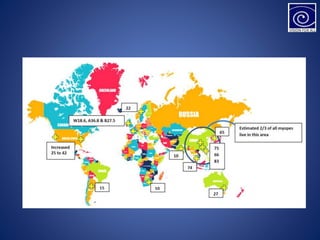
• East Asia , have high prevalence of Myopia & it continues to
increase
• Highest in China, Japan , Republic of Korea and Singapore
reporting a prevalence of 50%
• Relatively lower prevalence in Australia, Europe and North and
South America
• Prevalent in 36.4% children of 8 years in Taiwan in 2016 & 2.4%
in the Netherlands among 6 years old children in 2018
11. Chen M, Wu AM, Zhang LN, Wang W, Chen XY, Yu XN, Wang KJ. The increasing prevalence of myopia and high myopia among high school students in Fenghua City, Eastern
China: a 15-year population-based survey. BMC Ophthalmol. 2018;18(1):159. [PMC free article] [PubMed] [Google Scholar]
12. Morgan IG. What public policies should be developed to deal with the epidemic of myopia? Optom Vis Sci. 2016;93(9):1058–1060. [PubMed] [Google Scholar]](https://image.slidesharecdn.com/myopiaclassificationandcontrolstrategies-210819060646/85/Myopia-classification-prevalence-pathological-myopia-its-control-strategies-5-320.jpg)
![Cont.
• High myopia is estimated to range between 2%-5% in white
population & between 5% - 10% in Asian population
• Prevalence of pathologic myopia is estimated to be 1% in
whites & 1% - 3% in Asians
• Myopia prevalence has significantly from 79.5% to 87.7%
Moderate myopia (38.8% to 45.7%)
Severe myopia (7.9% to 16.6%)
Terminal myopia (0.08% - 0.92%)
. Wu L, Sun X, Zhou X, Weng C. Causes and 3-year-incidence of blindness in Jing-An District, Shanghai, China 2001-2009. BMC Ophthalmol. 2011;11:10. [PMC free
article] [PubMed] [Google Scholar]yopia (0.08% - 0.92%)](https://image.slidesharecdn.com/myopiaclassificationandcontrolstrategies-210819060646/85/Myopia-classification-prevalence-pathological-myopia-its-control-strategies-7-320.jpg)
![Classification
• Myopia
Based on
degree
Anatomical
features
Age of onset
Progression
rate Pathological
low
Medium
High
Axial
Refractive
Congenital
Youth onset
Early adult onset
Late adult onset
Stationary
Temporary progressive
Permanently progressive
Ohno-Matsui K, Lai TY, Lai CC, Cheung CM. Updates of pathologic myopia. Prog Retin Eye Res. 2016;52:156–187. [PubMed] [Google Scholar]](https://image.slidesharecdn.com/myopiaclassificationandcontrolstrategies-210819060646/85/Myopia-classification-prevalence-pathological-myopia-its-control-strategies-8-320.jpg)
![Etiology and risk factors
• Age ( an important determinant factor )
• Gender (predilection is conflicting )
• Race (predominance among Asian population )
• Heredity (more risk of developing myopia if parents were myopic )
• Environmental factors (near work ,socioeconomic status etc. )
Tideman JWL, Polling JR, Hofman A, Jaddoe VW, Mackenbach JP, Klaver CC. Environmental factors explain socioeconomic prevalence differences in myopia in 6-year-old
children. Br Ophthalmol. 2018;102(2):243–247. [PubMed] [Google Scholar]
Atkinson J. Braddick O. Infant precursors of later visual disorders: Correlation or causality? Minnesota Symposium on Child Psychology. 1988;20:35–65. [Google
Scholar]](https://image.slidesharecdn.com/myopiaclassificationandcontrolstrategies-210819060646/85/Myopia-classification-prevalence-pathological-myopia-its-control-strategies-9-320.jpg)
![Pathologic myopia & Pathophysiology
• Pathologic myopia is generally high myopia accompanied by
visual dysfunctions & describes the situation of pathologic
consequences
• These myopias are rapidly progressive ,with early onset
resulting in high myopia in adulthood
• Pathophysiology of myopia is multifactorial and still poorly
understood
Wilson JR, Sherman SM. Differential effects of early monocular deprivation on binocular and monocular segments of cat striate cortex. J Neurophysiol. 1977;40(4):891–
903. [PubMed] [Google Scholar] Smith EL., 3rd Spectacle lenses and emmetropization: the role of optical defocus in regulating ocular development. Optom Vis
Sci. 1998;75(6):388–398. [PubMed] [Google Scholar]](https://image.slidesharecdn.com/myopiaclassificationandcontrolstrategies-210819060646/85/Myopia-classification-prevalence-pathological-myopia-its-control-strategies-10-320.jpg)
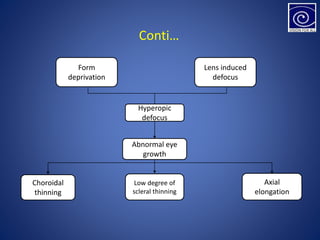
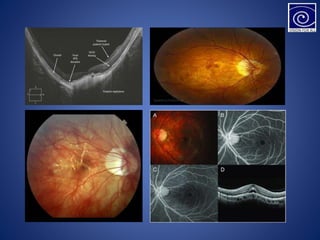
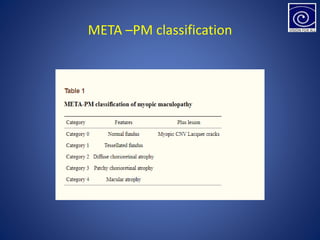
![Myopic Maculopathy
• Most common cause of visual impairment
• Signs
Posterior staphyloma
Patchy or diffuse chorioretinal atrophy
Lacquer cracks
Myopic macular retinoschisis
Dome shaped macula & choroidal neovascularization
108. Ohno-Matsui K, Lai TY, Lai CC, Cheung CM. Updates of pathologic myopia. Prog Retin Eye Res. 2016;52:156–187. [PubMed] [Google Scholar]
109. Ohno-Matsui K, Kawasaki R, Jonas JB, et al. International photographic classification and grading system for myopic maculopathy. Am J Ophthalmol. 2015;159(5):877–
883.e7. [PubMed] [Google Scholar]](https://image.slidesharecdn.com/myopiaclassificationandcontrolstrategies-210819060646/85/Myopia-classification-prevalence-pathological-myopia-its-control-strategies-12-320.jpg)
![High myopia & cataract surgery
• High myopia posses a significant challenges during cataract
surgery
• Biometry becomes extremely important.
• Inaccuracy of axial length measurements and incorrect choice
of lens formula can lead to unpredicted refractive outcome
• Patient with high myopia , adequate counseling , preoperative
planning and appropriate IOL choice are important
123. Jeon S, Kim HS. Clinical characteristics and outcomes of cataract surgery in highly myopic Koreans. Korean J Ophthalmol. 2011;25(2):84–89. [PMC free
article] [PubMed] [Google Scholar]
124. Morgan IG, Ohno-Matsui K, Saw SM. Myopia. Lancet. 2012;379(9827):1739–1748. [PubMed] [Google Scholar]](https://image.slidesharecdn.com/myopiaclassificationandcontrolstrategies-210819060646/85/Myopia-classification-prevalence-pathological-myopia-its-control-strategies-15-320.jpg)
![Methods of myopia control
• Myopia control strategies can be divided into following :-
1. Optical intervention
2. Pharmaceutical intervention
3. Surgical intervention
126. Hasebe S, Ohtsuki H, Nonaka T, Nakatsuka C, Miyata M, Hamasaki I, Kimura S. Effect of progressive addition lenses on myopia progression in
Japanese children: a prospective, randomized, double-masked, crossover trial. Invest Ophthalmol Vis Sci. 2008;49(7):2781–2789. [PubMed] [Google Scholar]](https://image.slidesharecdn.com/myopiaclassificationandcontrolstrategies-210819060646/85/Myopia-classification-prevalence-pathological-myopia-its-control-strategies-16-320.jpg)
![Optical intervention
1. Bifocals and multifocal lenses
• Near prescription of these lenses halt myopia progression
• RCT showed that with bifocals myopia progression during
study of 2.5 y slowed by 20 %
• COMET – 2 study showed sought that PALs of 2.00 D resulted
in reduction of myopia progression by 24% in 3y study
2. Peripheral defocusing lenses
• Reduction of peripheral hyperopia
• Peripheral defocus modifying contact lenses are more effective
than tested spectacle designs
128. Fulk GW, Cyert LA, Parker DE. A randomized trial of the effect of single-vision vs. bifocal lenses on myopia progression in children with esophoria. Optom Vis
Sci. 2000;77(8):395–401. [PubMed] [Google Scholar]](https://image.slidesharecdn.com/myopiaclassificationandcontrolstrategies-210819060646/85/Myopia-classification-prevalence-pathological-myopia-its-control-strategies-17-320.jpg)
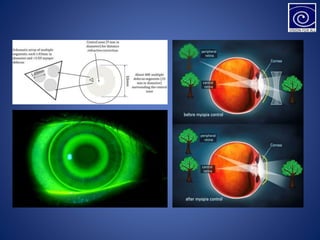
![Cont.
3. Defocus incorporated multiple segments(DIMS)
• DIMS comprises a central optic zone & multiple segment of
constant myopic defocus (+3.50)
• DIMS showed 52% lesser myopia & 62% lesser axial
elongation
4. Orthokeratology
• Ortho k lenses changes corneal shape to an oblate shape
which results in a peripheral refraction that has less hyperopic
defocus
• Overall treatment effect around 50%
132. Cho P, Cheung SW. Retardation of myopia in Orthokeratology (ROMIO) study: a 2-year randomized clinical trial. Invest Ophthalmol Vis Sci. 2012;53(11):7077–
7085. [PubMed] [Google Scholar]
133. Sun Y, Xu F, Zhang T, Liu ML, Wang DY, Chen YL, Liu Q. Orthokeratology to control myopia progression: a meta-analysis. PLoS One. 2015;10(4):e0124535. [PMC free
article] [PubMed] [Google Scholar]](https://image.slidesharecdn.com/myopiaclassificationandcontrolstrategies-210819060646/85/Myopia-classification-prevalence-pathological-myopia-its-control-strategies-18-320.jpg)
![Pharmaceutical intervention
• Includes daily application of low dose atropine
• Plausible mechanism is thought to be through modulation of
atropine
• ATOM -1 study by Chua et al concluded that 1% atropine
shows 77% efficacy following 2 year treatment
• ATOM -2 study determine efficacy of 0.5%, 0.1% , 0.01%
atropine with mean myopia progression is to be :-
Concentration of atropine Mean axial elongation Mean myopia progression
0.5% 0.27 mm -0.30 D
0.1% 0.28 mm -0.38 D
0.01% 0.41 mm -0.49 D
149. Trier K, Munk Ribel-Madsen S, Cui DM, Brøgger Christensen S. Systemic 7-methylxanthine in retarding axial eye growth and myopia progression: a 36-month
pilot study. J Ocul Biol Dis Infor. 2008;1(2-4):85–93. [PMC free article] [PubMed] [Google Scholar]](https://image.slidesharecdn.com/myopiaclassificationandcontrolstrategies-210819060646/85/Myopia-classification-prevalence-pathological-myopia-its-control-strategies-20-320.jpg)
![Cont..
• Recently the LAMP study also evaluated the efficacy and safety
of low concentration atropine
• 7- methyl xanthine also entered human trials .
• No serious side were noted but drug cessation leads to axial
lengthening normally
• Siatkowski et al and team, received that 2% pirenzepine group
has mean myopia progression of -0.26 D following 1 year
instillation.
Concentration of atropine Mean axial elongation Mean myopia progression
0.05% 0.20 mm -0.27 D
0.025% 0.29 mm -0.46 D
0.01% 0.36 mm -0.59 D
151. Siatkowski RM, Cotter SA, Crockett RS, Miller JM, Novack GD, Zadnik K, U.S. Pirenzepine Study Group Two-year multicenter, randomized, double-masked, placebo-
controlled, parallel safety and efficacy study of 2% pirenzepine ophthalmic gel in children with myopia. J AAPOS. 2008;12(4):332–339. [PubMed] [Google Scholar]](https://image.slidesharecdn.com/myopiaclassificationandcontrolstrategies-210819060646/85/Myopia-classification-prevalence-pathological-myopia-its-control-strategies-21-320.jpg)
![Surgical intervention
• Surgical intervention like Laser corneal refractive surgery , IOL
implantation and implantable collamer lens can are
established to treat myopia
• But these surgical methods don't halt progression
• Sub scleral injection of mesenchymal stem cells and dopamine
are latest surgical strategies
• Posterior scleral reinforcement to halt axial elongation
155. Xue AQ, Bao FJ, Zheng LY, Wang QM, Cheng LY, Qu J. Posterior scleral reinforcement on progressive high myopic young patients. Optom Vis Sci. 2014;91(4):412–
418. [PubMed] [Google Scholar]
156. Xue AQ, Zheng LY, Tan GL, Wu SQ, Wu Y, Cheng LY, Qu J. Genipin-crosslinked donor sclera for posterior scleral contraction/reinforcement to fight progressive
myopia. Invest Ophthalmol Vis Sci. 2018;59(8):3564–3573. [PubMed] [Google Scholar]](https://image.slidesharecdn.com/myopiaclassificationandcontrolstrategies-210819060646/85/Myopia-classification-prevalence-pathological-myopia-its-control-strategies-22-320.jpg)




![CASE_PRESENTATION_ON_subdural_hematoma(SDH)[1 FINAL PPT]-1.pptx](https://cdn.slidesharecdn.com/ss_thumbnails/casepresentationonsubduralhematomasdh1finalppt-1-260129172522-d405d375-thumbnail.jpg?width=640&height=640&fit=bounds)

