Reduction of irradiation of the
      Belgian population
which progress has been made?


           Guy Marchal
Strategic committee
              starting point

Over the last years the level of irradiation of the
Belgian population has increased dramatically
due to diagnostic examinations.
As a result Belgium is one of the world champions
in this regard.
Overall objectives
• The first objective of the strategic committee is to reduce
  this growth and to bring the irradiation level back to the
  level of the neighboring countries .
• The second objective of the strategic committee is to
  improve the quality of the examinations performed.
• Pure cost savings can not be the goal. The money saved will
  be needed to preserve the quality of the diagnostic imaging
  service. (equipment that is needed but not fully used)
• In addition it is important to keep up with the fast
  technological evolution in medical imaging. The new
  technologies offer not only new diagnostic possibilities, but
  are often also less invasive and potentially less irradiating.
Strategy
• To act efficiently, a well defined long term strategy is
  needed. This strategy is defined by a strategic
  committee.
• The strategic committee is composed by
  representatives of different parties and analyses
  potential difficulties that could arise during the
  practical implementation and suggests possible
  solutions.
• The strategic committee refers to three subcommittees
  for the practical implementation of the overall
  objectives. Members of the strategic committee are
  also part of the core of the different subcommittees.
Subcommittee “guidelines”
• The task of this subcommittee is to formulate
  guidelines for the proper use of ionizing
  irradiation for diagnostic purposes.
• This group is composed by members of the FOD,
  the RIZIV, the FANC, the Consilium Radiologicum,
  BELNUC, representatives of other user groups,
  and the Belgian society of hospital Physicists.
• Current members of the committee : Guy Marchal
  (president), Lodewijk Van Bladel, Wim Janssens,
  Aldo Perissino and Nils Reynders-Frederix
Current situation
• Initial document:
  existing French guidelines (2005)
• Actualization (2010) by
   – Sections of KBVR
   – BELNUC
• Radiology :
  Differences between Flemish and French versions. Correlation
  needed as well as complete rewriting of Flemish version.

  Nuclear medicine:
  Document not ready yet
• Further correlation between two documents probably not
  feasible.
Current situation
• Initial document:
  existing French guidelines (2005)
• Actualization (2010) by
   – Sections of KBVR
   – BELNUC
• Radiology :
  Differences between Flemish and French versions. Correlation
  needed as well as complete rewriting of Flemish version.
  Nuclear medicine:
  Document not ready yet
• Further correlation between two documents probably not
  feasible.
   Potential negative financial impact of guidelines remains a major problem
                          for many to fully collaborate!
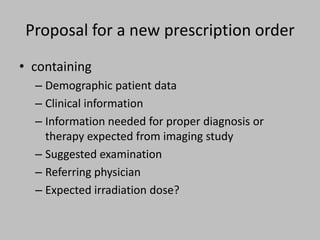
Proposal for a new prescription order
• containing
  – Demographic patient data
  – Clinical information
  – Information needed for proper diagnosis or
    therapy expected from imaging study
  – Suggested examination
  – Referring physician
  – Expected irradiation dose?
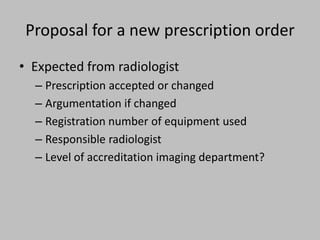
Proposal for a new prescription order
• Expected from radiologist
  – Prescription accepted or changed
  – Argumentation if changed
  – Registration number of equipment used
  – Responsible radiologist
  – Level of accreditation imaging department?
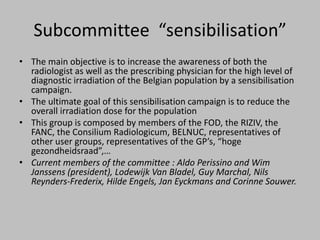
Subcommittee “sensibilisation”
• The main objective is to increase the awareness of both the
  radiologist as well as the prescribing physician for the high level of
  diagnostic irradiation of the Belgian population by a sensibilisation
  campaign.
• The ultimate goal of this sensibilisation campaign is to reduce the
  overall irradiation dose for the population
• This group is composed by members of the FOD, the RIZIV, the
  FANC, the Consilium Radiologicum, BELNUC, representatives of
  other user groups, representatives of the GP’s, “hoge
  gezondheidsraad”,…
• Current members of the committee : Aldo Perissino and Wim
  Janssens (president), Lodewijk Van Bladel, Guy Marchal, Nils
  Reynders-Frederix, Hilde Engels, Jan Eyckmans and Corinne Souwer.
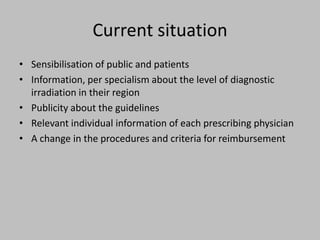
Current situation
• Sensibilisation of public and patients
• Information, per specialism about the level of diagnostic
  irradiation in their region
• Publicity about the guidelines
• Relevant individual information of each prescribing physician
• A change in the procedures and criteria for reimbursement
Current situation
• Sensibilisation of public and patients
• Information, per specialism about the level of diagnostic
  irradiation in their region
   – The level of irradiation per inhabitant
   – The relative contribution of each specialism in the
      prescription of the irradiating examinations
   – The examinations that contribute most to the irradiation per
      specialism
• Publicity about the guidelines
• Relevant individual information of each prescribing physician
• A change in the procedures and criteria for reimbursement
Current situation
• Sensibilisation of public and patients
• Information, per specialism about the level of diagnostic
  irradiation in their region
• Publicity about the guidelines
   – Integration in the software of the medical record management (2010 )
   – Didactic brochures (2011)
   – Involvement of medical faculties, high schools medical technology
• Relevant individual information of each prescribing physician
• A change in the procedures and criteria for reimbursement
Current situation
• Sensibilisation of public and patients
• Information, per specialism about the level of diagnostic
  irradiation in their region
• Publicity about the guidelines
• Relevant individual information of each prescribing physician
   – The principle of precaution
   – The unnecessary examinations
   – The useless prescriptions
   – The erroneous prescriptions
• A change in the procedures and criteria for reimbursement
Current situation
• Sensibilisation of public and patients
• Information, per specialism about the level of diagnostic
  irradiation in their region
• Publicity about the guidelines
• Relevant individual information of each prescribing physician
• A change in the procedures and criteria for reimbursement
   – Standardized prescription form
   – Electronic communication of reports towards referring physicians
   – The patient management software must allow to calculate the
     cumulative patient dose (2010 ).
   – Possibility for radiologists to change requests in function of existing
     guidelines (2010).
Subcommittee
     accreditation and optimalisation
• This workgroup will try to formulate incentives to
  motivate the hospitals to promote dose reduction.
  These incentives are needed to support the use of the
  guidelines and to reach the strategic goals.
• This group is composed by members of the FOD, the
  mutualities, the RIZIV, the FANC, the Consilium
  Radiologicum, medical physicists.
• Current members of the committee : Guy Marchal
  (president), Aldo Perisinno, Greet Haelterman, An
  Fremout, Pascal Meeus, Nils Reynders-Frederix,
  Françoise Malchair, Julien Struyven, Denis Tack and
  Hilde Bosmans.
Financial incentives?
• Alternative for current mainly “fee for service
  model” towards a larger degree of
  forfaitarisation?
• Financial co-responsabilisation of prescribers?
• Extra financial compensation in function of
  quality parameters.
• ….
Current situation
• Optimalisation both by improved techniques
  as well as better training and optimal use
  • Collaboration between FANC, physicists, academia,
    radiologists, via working groups, round tables, etc..
• Accreditation
  – COMPREHENSIVE CLINICAL AUDITS OF DIAGNOSTIC RADIOLOGY
    PRACTICES (IAEA)
Proposed audit tool
         COMPREHENSIVE CLINICAL AUDITS OF DIAGNOSTIC
                   RADIOLOGY PRACTICES:

                A TOOL FOR QUALITY IMPROVEMENT
                    QUALITY ASSURANCE AUDIT
FOR DIAGNOSTIC RADIOLOGY IMPROVEMENT AND LEARNING (QUAADRIL)

            INTERNATIONAL ATOMIC ENERGY AGENCY
                       VIENNA, 2010
COMPREHENSIVE CLINICAL AUDITS OF DIAGNOSTIC
              RADIOLOGY PRACTICES

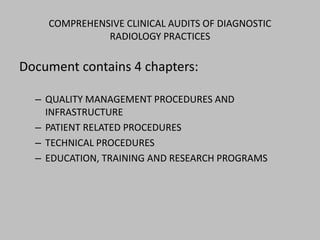
Document contains 4 chapters:

  – QUALITY MANAGEMENT PROCEDURES AND
    INFRASTRUCTURE
  – PATIENT RELATED PROCEDURES
  – TECHNICAL PROCEDURES
  – EDUCATION, TRAINING AND RESEARCH PROGRAMS
COMPREHENSIVE CLINICAL AUDITS OF DIAGNOSTIC
                RADIOLOGY PRACTICES

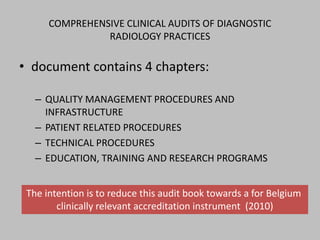
• document contains 4 chapters:

   – QUALITY MANAGEMENT PROCEDURES AND
     INFRASTRUCTURE
   – PATIENT RELATED PROCEDURES
   – TECHNICAL PROCEDURES
   – EDUCATION, TRAINING AND RESEARCH PROGRAMS


 The intention is to reduce this audit book towards a for Belgium
        clinically relevant accreditation instrument (2010)
Conclusion
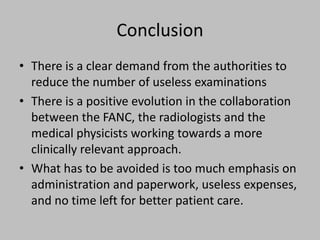
• There is a clear demand from the authorities to
  reduce the number of useless examinations
• There is a positive evolution in the collaboration
  between the FANC, the radiologists and the
  medical physicists working towards a more
  clinically relevant approach.
• What has to be avoided is too much emphasis on
  administration and paperwork, useless expenses,
  and no time left for better patient care.

2474

  • 1.
    Reduction of irradiationof the Belgian population which progress has been made? Guy Marchal
  • 2.
    Strategic committee starting point Over the last years the level of irradiation of the Belgian population has increased dramatically due to diagnostic examinations. As a result Belgium is one of the world champions in this regard.
  • 3.
    Overall objectives • Thefirst objective of the strategic committee is to reduce this growth and to bring the irradiation level back to the level of the neighboring countries . • The second objective of the strategic committee is to improve the quality of the examinations performed. • Pure cost savings can not be the goal. The money saved will be needed to preserve the quality of the diagnostic imaging service. (equipment that is needed but not fully used) • In addition it is important to keep up with the fast technological evolution in medical imaging. The new technologies offer not only new diagnostic possibilities, but are often also less invasive and potentially less irradiating.
  • 4.
    Strategy • To actefficiently, a well defined long term strategy is needed. This strategy is defined by a strategic committee. • The strategic committee is composed by representatives of different parties and analyses potential difficulties that could arise during the practical implementation and suggests possible solutions. • The strategic committee refers to three subcommittees for the practical implementation of the overall objectives. Members of the strategic committee are also part of the core of the different subcommittees.
  • 5.
    Subcommittee “guidelines” • Thetask of this subcommittee is to formulate guidelines for the proper use of ionizing irradiation for diagnostic purposes. • This group is composed by members of the FOD, the RIZIV, the FANC, the Consilium Radiologicum, BELNUC, representatives of other user groups, and the Belgian society of hospital Physicists. • Current members of the committee : Guy Marchal (president), Lodewijk Van Bladel, Wim Janssens, Aldo Perissino and Nils Reynders-Frederix
  • 6.
    Current situation • Initialdocument: existing French guidelines (2005) • Actualization (2010) by – Sections of KBVR – BELNUC • Radiology : Differences between Flemish and French versions. Correlation needed as well as complete rewriting of Flemish version. Nuclear medicine: Document not ready yet • Further correlation between two documents probably not feasible.
  • 7.
    Current situation • Initialdocument: existing French guidelines (2005) • Actualization (2010) by – Sections of KBVR – BELNUC • Radiology : Differences between Flemish and French versions. Correlation needed as well as complete rewriting of Flemish version. Nuclear medicine: Document not ready yet • Further correlation between two documents probably not feasible. Potential negative financial impact of guidelines remains a major problem for many to fully collaborate!
  • 8.
    Proposal for anew prescription order • containing – Demographic patient data – Clinical information – Information needed for proper diagnosis or therapy expected from imaging study – Suggested examination – Referring physician – Expected irradiation dose?
  • 9.
    Proposal for anew prescription order • Expected from radiologist – Prescription accepted or changed – Argumentation if changed – Registration number of equipment used – Responsible radiologist – Level of accreditation imaging department?
  • 10.
    Subcommittee “sensibilisation” • Themain objective is to increase the awareness of both the radiologist as well as the prescribing physician for the high level of diagnostic irradiation of the Belgian population by a sensibilisation campaign. • The ultimate goal of this sensibilisation campaign is to reduce the overall irradiation dose for the population • This group is composed by members of the FOD, the RIZIV, the FANC, the Consilium Radiologicum, BELNUC, representatives of other user groups, representatives of the GP’s, “hoge gezondheidsraad”,… • Current members of the committee : Aldo Perissino and Wim Janssens (president), Lodewijk Van Bladel, Guy Marchal, Nils Reynders-Frederix, Hilde Engels, Jan Eyckmans and Corinne Souwer.
  • 11.
    Current situation • Sensibilisationof public and patients • Information, per specialism about the level of diagnostic irradiation in their region • Publicity about the guidelines • Relevant individual information of each prescribing physician • A change in the procedures and criteria for reimbursement
  • 12.
    Current situation • Sensibilisationof public and patients • Information, per specialism about the level of diagnostic irradiation in their region – The level of irradiation per inhabitant – The relative contribution of each specialism in the prescription of the irradiating examinations – The examinations that contribute most to the irradiation per specialism • Publicity about the guidelines • Relevant individual information of each prescribing physician • A change in the procedures and criteria for reimbursement
  • 13.
    Current situation • Sensibilisationof public and patients • Information, per specialism about the level of diagnostic irradiation in their region • Publicity about the guidelines – Integration in the software of the medical record management (2010 ) – Didactic brochures (2011) – Involvement of medical faculties, high schools medical technology • Relevant individual information of each prescribing physician • A change in the procedures and criteria for reimbursement
  • 14.
    Current situation • Sensibilisationof public and patients • Information, per specialism about the level of diagnostic irradiation in their region • Publicity about the guidelines • Relevant individual information of each prescribing physician – The principle of precaution – The unnecessary examinations – The useless prescriptions – The erroneous prescriptions • A change in the procedures and criteria for reimbursement
  • 15.
    Current situation • Sensibilisationof public and patients • Information, per specialism about the level of diagnostic irradiation in their region • Publicity about the guidelines • Relevant individual information of each prescribing physician • A change in the procedures and criteria for reimbursement – Standardized prescription form – Electronic communication of reports towards referring physicians – The patient management software must allow to calculate the cumulative patient dose (2010 ). – Possibility for radiologists to change requests in function of existing guidelines (2010).
  • 16.
    Subcommittee accreditation and optimalisation • This workgroup will try to formulate incentives to motivate the hospitals to promote dose reduction. These incentives are needed to support the use of the guidelines and to reach the strategic goals. • This group is composed by members of the FOD, the mutualities, the RIZIV, the FANC, the Consilium Radiologicum, medical physicists. • Current members of the committee : Guy Marchal (president), Aldo Perisinno, Greet Haelterman, An Fremout, Pascal Meeus, Nils Reynders-Frederix, Françoise Malchair, Julien Struyven, Denis Tack and Hilde Bosmans.
  • 17.
    Financial incentives? • Alternativefor current mainly “fee for service model” towards a larger degree of forfaitarisation? • Financial co-responsabilisation of prescribers? • Extra financial compensation in function of quality parameters. • ….
  • 18.
    Current situation • Optimalisationboth by improved techniques as well as better training and optimal use • Collaboration between FANC, physicists, academia, radiologists, via working groups, round tables, etc.. • Accreditation – COMPREHENSIVE CLINICAL AUDITS OF DIAGNOSTIC RADIOLOGY PRACTICES (IAEA)
  • 19.
    Proposed audit tool COMPREHENSIVE CLINICAL AUDITS OF DIAGNOSTIC RADIOLOGY PRACTICES: A TOOL FOR QUALITY IMPROVEMENT QUALITY ASSURANCE AUDIT FOR DIAGNOSTIC RADIOLOGY IMPROVEMENT AND LEARNING (QUAADRIL) INTERNATIONAL ATOMIC ENERGY AGENCY VIENNA, 2010
  • 20.
    COMPREHENSIVE CLINICAL AUDITSOF DIAGNOSTIC RADIOLOGY PRACTICES Document contains 4 chapters: – QUALITY MANAGEMENT PROCEDURES AND INFRASTRUCTURE – PATIENT RELATED PROCEDURES – TECHNICAL PROCEDURES – EDUCATION, TRAINING AND RESEARCH PROGRAMS
  • 21.
    COMPREHENSIVE CLINICAL AUDITSOF DIAGNOSTIC RADIOLOGY PRACTICES • document contains 4 chapters: – QUALITY MANAGEMENT PROCEDURES AND INFRASTRUCTURE – PATIENT RELATED PROCEDURES – TECHNICAL PROCEDURES – EDUCATION, TRAINING AND RESEARCH PROGRAMS The intention is to reduce this audit book towards a for Belgium clinically relevant accreditation instrument (2010)
  • 22.
    Conclusion • There isa clear demand from the authorities to reduce the number of useless examinations • There is a positive evolution in the collaboration between the FANC, the radiologists and the medical physicists working towards a more clinically relevant approach. • What has to be avoided is too much emphasis on administration and paperwork, useless expenses, and no time left for better patient care.