1
Quality Function
Deployment
2
The American Society for Quality Control
defines quality function deployment as
a "structured method in which
customer requirements are translated
into appropriate technical requirements
for each stage of product development
and production. The QFD process is
often referred to as listening to the
voice of the customer" (Bemowski,
1992).
QFD Defined
3
Tangible & Intangible Benefits of QFD
© Oxford University Press 2008. All rights reserved.
4
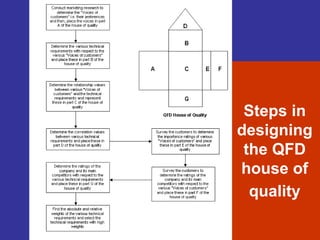
Steps in
designing
the QFD
house of
quality
House Of Quality
6. Technical assessment and
target values
1. Customer
requirements
4. Relationship
matrix
3. Product
characteristics
Importance
2. Competitive
assessment
5. Tradeoff
matrix
QFD Matrix
Absolute Weight and Percent
Prioritized Technical
Descriptors
Degree of Technical Difficulty
Relative Weight and Percent
Target Value
Customer
Requirements
Prioritized
Customer
Requirements
Technical
Descriptors
Primary
Primary
Secondary
Secondary
Technical
Competitive
Assessment
Customer
Competitive
Assessment
Our
A’s
B’s
Customer
Importance
Target
Value
Scale-up
Factor
Sales
Point
Absolute
Weight
Our
A’s
B’s
Relationship between
Customer Requirements
and
Technical Descriptors
WHATs vs. HOWs
Strong
Medium
Weak
+9
+3
+1
Strong Positive
Positive
Negative
Strong Negative
+9
+3
-3
-9
Interrelationship between
Technical Descriptors
(correlation matrix)
HOWs vs. HOWs
© Oxford University Press 2008. All rights reserved.
7
Kano’s Model

Quality Function Deployment.ppt

  • 1.
  • 2.
    2 The American Societyfor Quality Control defines quality function deployment as a "structured method in which customer requirements are translated into appropriate technical requirements for each stage of product development and production. The QFD process is often referred to as listening to the voice of the customer" (Bemowski, 1992). QFD Defined
  • 3.
    3 Tangible & IntangibleBenefits of QFD
  • 4.
    © Oxford UniversityPress 2008. All rights reserved. 4 Steps in designing the QFD house of quality
  • 5.
    House Of Quality 6.Technical assessment and target values 1. Customer requirements 4. Relationship matrix 3. Product characteristics Importance 2. Competitive assessment 5. Tradeoff matrix
  • 6.
    QFD Matrix Absolute Weightand Percent Prioritized Technical Descriptors Degree of Technical Difficulty Relative Weight and Percent Target Value Customer Requirements Prioritized Customer Requirements Technical Descriptors Primary Primary Secondary Secondary Technical Competitive Assessment Customer Competitive Assessment Our A’s B’s Customer Importance Target Value Scale-up Factor Sales Point Absolute Weight Our A’s B’s Relationship between Customer Requirements and Technical Descriptors WHATs vs. HOWs Strong Medium Weak +9 +3 +1 Strong Positive Positive Negative Strong Negative +9 +3 -3 -9 Interrelationship between Technical Descriptors (correlation matrix) HOWs vs. HOWs
  • 7.
    © Oxford UniversityPress 2008. All rights reserved. 7 Kano’s Model