EVALUATION QUESTION 6
What have you learnt about technologies from the process
of constructing this product?
HARDWARE
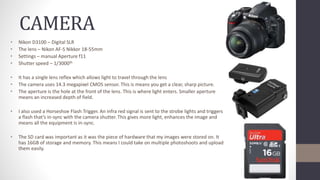
CAMERA
• Nikon D3100 – Digital SLR
• The lens – Nikon AF-S Nikkor 18-55mm
• Settings – manual Aperture f11
• Shutter speed – 1/3000th
• It has a single lens reflex which allows light to travel through the lens
• The camera uses 14.3 megapixel CMOS sensor. This is means you get a clear, sharp picture.
• The aperture is the hole at the front of the lens. This is where light enters. Smaller aperture
means an increased depth of field.
• I also used a Horseshoe Flash Trigger. An infra red signal is sent to the strobe lights and triggers
a flash that’s in-sync with the camera shutter. This gives more light, enhances the image and
means all the equipment is in-sync.
• The SD card was important as it was the piece of hardware that my images were stored on. It
has 16GB of storage and memory. This means I could take on multiple photoshoots and upload
them easily.
THE STUDIO
• SOFT BOXES – The model light uses soft boxes. They disperse light and
give a softer, rounder light on the subject. This makes the lighting less
harsh and gives better images by diffusing the light of the harsh light of
the strobe lights.
• HEMISPHERE 300 (STROBE LIGHTS) – The dial on the back adjusts the
output – modeling light on. Auxiliary lights set to slave (triggered in-
sync with by built in light sensor or Horseshoe Flash trigger). Lighting is
one of the most important things in photography, especially with model
photography as you need to be able to see the person and
showing/highlighting adds effect and depth – making a better
photograph.
• THE BACKDROP – This is lit by more strobe lights on full power to create
a high exposure, white background. This means it is a basic background
which is useful if you’re going to use the whole picture instead of
cutting out the model. It’s also useful if you are cutting the model as
you will clearly be able to see where the model ends and the
background begins, leaving a clean cut image.
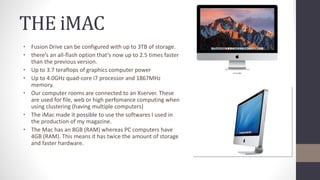
THE iMAC
• Fusion Drive can be configured with up to 3TB of storage.
• there’s an all-flash option that’s now up to 2.5 times faster
than the previous version.
• Up to 3.7 teraflops of graphics computer power
• Up to 4.0GHz quad-core i7 processor and 1867MHz
memory.
• Our computer rooms are connected to an Xserver. These
are used for file, web or high perfomance computing when
using clustering (having multiple computers)
• The iMac made it possible to use the softwares I used in
the production of my magazine.
• The Mac has an 8GB (RAM) whereas PC computers have
4GB (RAM). This means it has twice the amount of storage
and faster hardware.
SOFTWARE
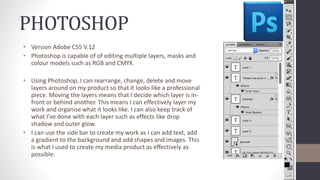
PHOTOSHOP
• Version Adobe CS5 V.12
• Photoshop is capable of of editing multiple layers, masks and
colour models such as RGB and CMYK
• Using Photoshop, I can rearrange, change, delete and move
layers around on my product so that it looks like a professional
piece. Moving the layers means that I decide which layer is in-
front or behind another. This means I can effectively layer my
work and organise what it looks like. I can also keep track of
what I’ve done with each layer such as effects like drop
shadow and outer glow.
• I can use the side bar to create my work as I can add text, add
a gradient to the background and add shapes and images. This
is what I used to create my media product as effectively as
possible.
• Photoshop was also useful for editing
images. I was able to use such tools
as Healing Brush Tool and I was able
to change the brightness, vibrancy
and contrast. All of these tools
enabled me to create a professional,
finished piece that looks crisp and
clean. Overall adding to the effect of
my magazine.
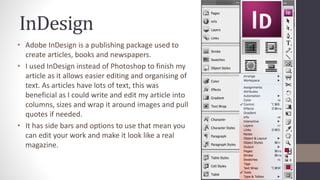
InDesign
• Adobe InDesign is a publishing package used to
create articles, books and newspapers.
• I used InDesign instead of Photoshop to finish my
article as it allows easier editing and organising of
text. As articles have lots of text, this was
beneficial as I could write and edit my article into
columns, sizes and wrap it around images and pull
quotes if needed.
• It has side bars and options to use that mean you
can edit your work and make it look like a real
magazine.
WORDPRESS
• Wordpress is the site I have presented all my work on. I
have customised my own media blog where I am able to
organise, present and show my own work clearly and
neatly. I have added pages so that my finished magazine
piece and evaluation are easily accessible for myself and
others who wish to look at my work.
• On this site I have embedded all my work with Prezi,
Powerpoint and my own writing.
• This is the link for my Wordpress blog -
https://amyheywoodmedia.wordpress.com/
• I’ve also put a link to my media Twitter account where I
show different photographers I like and I’ve retweeted
photographs and even added my finished magazine on my
feed.
PREZI
• I’ve used Prezi as a visual presentation of my work. It was useful
as I wanted different ways of presenting my work other than
writing and posting it on my Wordpress.
• During these evaluation questions, I’ve learnt how to use Prezi
effectively as I’d never used it before.
• You can see my Prezi evaluation questions for Q2 and Q5 of my
blog
https://amyheywoodmedia.wordpress.com/evaluation/
MICROSOFT POWERPOINT
• I also used Powerpoint as a different way of presenting my
work.
• I am able to build and present large presentations full of
lots of information and also make it visual.
• There are many things you can add such as images, links
and videos which I have embedded in my work. Each time
I’ve used this software, I have used a different background
and style to add variety to my work.
• I’ve used powerpoint for questions 1,3 and 6; all of which
can be found on the evaluation page of my blog.
https://amyheywoodmedia.wordpress.com/evaluatio
n/
SAFARI
• Safari is a preinstalled software on the Mac
and it is exclusive to Apple.
• This is the software I used to do most of my
research. Using this application, I could
research facts, images and examples.
• Without Safari, I would not have been able to
get my visual work and theory work to as high
a standard as I have.

Evaluation Q6

  • 1.
    EVALUATION QUESTION 6 Whathave you learnt about technologies from the process of constructing this product?
  • 2.
  • 3.
    CAMERA • Nikon D3100– Digital SLR • The lens – Nikon AF-S Nikkor 18-55mm • Settings – manual Aperture f11 • Shutter speed – 1/3000th • It has a single lens reflex which allows light to travel through the lens • The camera uses 14.3 megapixel CMOS sensor. This is means you get a clear, sharp picture. • The aperture is the hole at the front of the lens. This is where light enters. Smaller aperture means an increased depth of field. • I also used a Horseshoe Flash Trigger. An infra red signal is sent to the strobe lights and triggers a flash that’s in-sync with the camera shutter. This gives more light, enhances the image and means all the equipment is in-sync. • The SD card was important as it was the piece of hardware that my images were stored on. It has 16GB of storage and memory. This means I could take on multiple photoshoots and upload them easily.
  • 4.
    THE STUDIO • SOFTBOXES – The model light uses soft boxes. They disperse light and give a softer, rounder light on the subject. This makes the lighting less harsh and gives better images by diffusing the light of the harsh light of the strobe lights. • HEMISPHERE 300 (STROBE LIGHTS) – The dial on the back adjusts the output – modeling light on. Auxiliary lights set to slave (triggered in- sync with by built in light sensor or Horseshoe Flash trigger). Lighting is one of the most important things in photography, especially with model photography as you need to be able to see the person and showing/highlighting adds effect and depth – making a better photograph. • THE BACKDROP – This is lit by more strobe lights on full power to create a high exposure, white background. This means it is a basic background which is useful if you’re going to use the whole picture instead of cutting out the model. It’s also useful if you are cutting the model as you will clearly be able to see where the model ends and the background begins, leaving a clean cut image.
  • 5.
    THE iMAC • FusionDrive can be configured with up to 3TB of storage. • there’s an all-flash option that’s now up to 2.5 times faster than the previous version. • Up to 3.7 teraflops of graphics computer power • Up to 4.0GHz quad-core i7 processor and 1867MHz memory. • Our computer rooms are connected to an Xserver. These are used for file, web or high perfomance computing when using clustering (having multiple computers) • The iMac made it possible to use the softwares I used in the production of my magazine. • The Mac has an 8GB (RAM) whereas PC computers have 4GB (RAM). This means it has twice the amount of storage and faster hardware.
  • 6.
  • 7.
    PHOTOSHOP • Version AdobeCS5 V.12 • Photoshop is capable of of editing multiple layers, masks and colour models such as RGB and CMYK • Using Photoshop, I can rearrange, change, delete and move layers around on my product so that it looks like a professional piece. Moving the layers means that I decide which layer is in- front or behind another. This means I can effectively layer my work and organise what it looks like. I can also keep track of what I’ve done with each layer such as effects like drop shadow and outer glow. • I can use the side bar to create my work as I can add text, add a gradient to the background and add shapes and images. This is what I used to create my media product as effectively as possible.
  • 8.
    • Photoshop wasalso useful for editing images. I was able to use such tools as Healing Brush Tool and I was able to change the brightness, vibrancy and contrast. All of these tools enabled me to create a professional, finished piece that looks crisp and clean. Overall adding to the effect of my magazine.
  • 9.
    InDesign • Adobe InDesignis a publishing package used to create articles, books and newspapers. • I used InDesign instead of Photoshop to finish my article as it allows easier editing and organising of text. As articles have lots of text, this was beneficial as I could write and edit my article into columns, sizes and wrap it around images and pull quotes if needed. • It has side bars and options to use that mean you can edit your work and make it look like a real magazine.
  • 10.
    WORDPRESS • Wordpress isthe site I have presented all my work on. I have customised my own media blog where I am able to organise, present and show my own work clearly and neatly. I have added pages so that my finished magazine piece and evaluation are easily accessible for myself and others who wish to look at my work. • On this site I have embedded all my work with Prezi, Powerpoint and my own writing. • This is the link for my Wordpress blog - https://amyheywoodmedia.wordpress.com/ • I’ve also put a link to my media Twitter account where I show different photographers I like and I’ve retweeted photographs and even added my finished magazine on my feed.
  • 11.
    PREZI • I’ve usedPrezi as a visual presentation of my work. It was useful as I wanted different ways of presenting my work other than writing and posting it on my Wordpress. • During these evaluation questions, I’ve learnt how to use Prezi effectively as I’d never used it before. • You can see my Prezi evaluation questions for Q2 and Q5 of my blog https://amyheywoodmedia.wordpress.com/evaluation/
  • 12.
    MICROSOFT POWERPOINT • Ialso used Powerpoint as a different way of presenting my work. • I am able to build and present large presentations full of lots of information and also make it visual. • There are many things you can add such as images, links and videos which I have embedded in my work. Each time I’ve used this software, I have used a different background and style to add variety to my work. • I’ve used powerpoint for questions 1,3 and 6; all of which can be found on the evaluation page of my blog. https://amyheywoodmedia.wordpress.com/evaluatio n/
  • 13.
    SAFARI • Safari isa preinstalled software on the Mac and it is exclusive to Apple. • This is the software I used to do most of my research. Using this application, I could research facts, images and examples. • Without Safari, I would not have been able to get my visual work and theory work to as high a standard as I have.