SCIENCE 7
Balanced and
unbalanced forces
Balanced and unbalanced forces
CONTENT
The learners learn that Scientists and engineers
analyze forces to predict their effects on
movement.
LEARNING
STANDARD
The learners will identify that forces act between
objects and can be measured.
LEARNING
COMPETENCY
By the end of the lesson, the 80 percent of
the learners will be able to:
1. Distinguish between balanced and unbalanced
forces.
2. Explain the effects of balanced and unbalanced
forces on the motion of objects.
3. Appreciate the role of balanced and unbalanced
forces in everyday life by answering the reflection of
learning.
OBJECTIVES
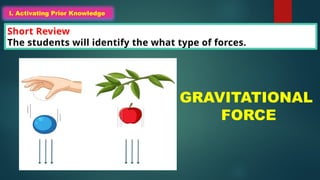
I. Activating Prior Knowledge
Short Review
The students will identify the what type of forces.
I. Activating Prior Knowledge
GRAVITATIONAL
FORCE
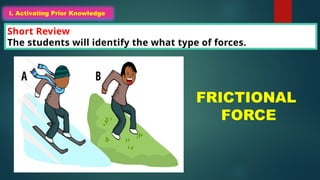
I. Activating Prior Knowledge
Short Review
The students will identify the what type of forces.
I. Activating Prior Knowledge
FRICTIONAL
FORCE
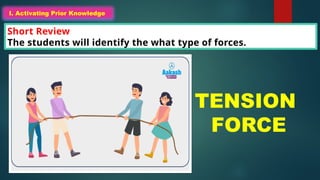
I. Activating Prior Knowledge
Short Review
The students will identify the what type of forces.
I. Activating Prior Knowledge
TENSION
FORCE
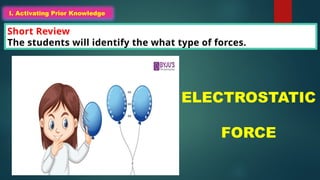
I. Activating Prior Knowledge
Short Review
The students will identify the what type of forces.
I. Activating Prior Knowledge
ELECTROSTATIC
FORCE
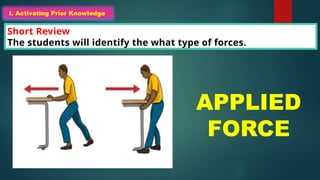
I. Activating Prior Knowledge
Short Review
The students will identify the what type of forces.
I. Activating Prior Knowledge
APPLIED
FORCE
1. Distinguish between balanced and unbalanced
forces.
2. Explain the effects of balanced and unbalanced
forces on the motion of objects.
3. Appreciate the role of balanced and unbalanced
forces in everyday life by answering the reflection of
learning.
B. Establishing Purpose of the Lesson
1. LESSON PURPOSE
B. Establishing Purpose of the Lesson
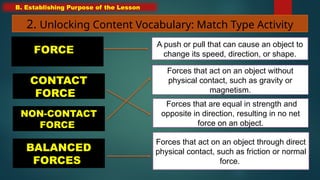
2. Unlocking Content Vocabulary: Match Type Activity
CONTACT
FORCE
NON-CONTACT
FORCE
BALANCED
FORCES
Forces that are equal in strength and
opposite in direction, resulting in no net
force on an object.
Forces that act on an object without
physical contact, such as gravity or
magnetism.
Forces that act on an object through direct
physical contact, such as friction or normal
force.
FORCE
A push or pull that can cause an object to
change its speed, direction, or shape.
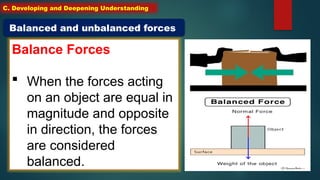
Balance Forces
 When the forces acting
on an object are equal in
magnitude and opposite
in direction, the forces
are considered
balanced.
Balanced and unbalanced forces
C. Developing and Deepening Understanding
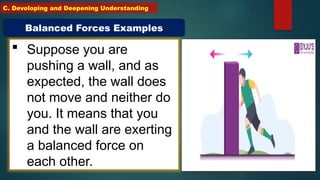
 Suppose you are
pushing a wall, and as
expected, the wall does
not move and neither do
you. It means that you
and the wall are exerting
a balanced force on
each other.
Balanced Forces Examples
C. Developing and Deepening Understanding
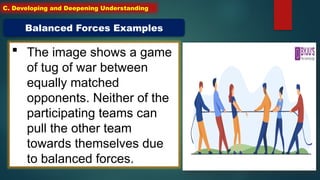
 The image shows a game
of tug of war between
equally matched
opponents. Neither of the
participating teams can
pull the other team
towards themselves due
to balanced forces.
Balanced Forces Examples
C. Developing and Deepening Understanding
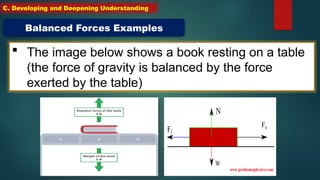
 The image below shows a book resting on a table
(the force of gravity is balanced by the force
exerted by the table)
Balanced Forces Examples
C. Developing and Deepening Understanding
Balance Forces
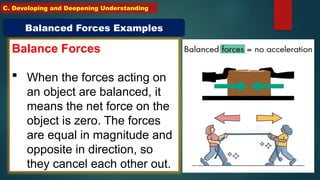
 When the forces acting on
an object are balanced, it
means the net force on the
object is zero. The forces
are equal in magnitude and
opposite in direction, so
they cancel each other out.
Balanced Forces Examples
C. Developing and Deepening Understanding
Balance Forces
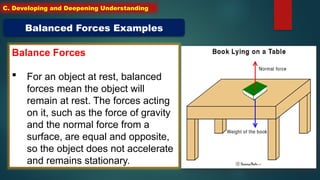
 For an object at rest, balanced
forces mean the object will
remain at rest. The forces acting
on it, such as the force of gravity
and the normal force from a
surface, are equal and opposite,
so the object does not accelerate
and remains stationary.
Balanced Forces Examples
C. Developing and Deepening Understanding
Balance Forces
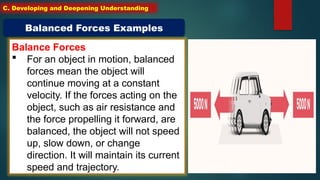
 For an object in motion, balanced
forces mean the object will
continue moving at a constant
velocity. If the forces acting on the
object, such as air resistance and
the force propelling it forward, are
balanced, the object will not speed
up, slow down, or change
direction. It will maintain its current
speed and trajectory.
Balanced Forces Examples
C. Developing and Deepening Understanding
Balance Forces
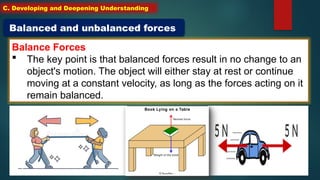
 The key point is that balanced forces result in no change to an
object's motion. The object will either stay at rest or continue
moving at a constant velocity, as long as the forces acting on it
remain balanced.
Balanced and unbalanced forces
C. Developing and Deepening Understanding
Unbalance Forces
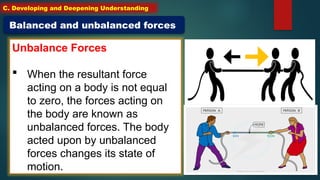
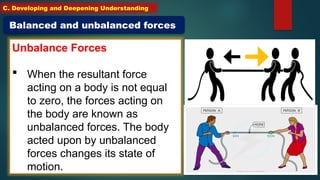
 When the resultant force
acting on a body is not equal
to zero, the forces acting on
the body are known as
unbalanced forces. The body
acted upon by unbalanced
forces changes its state of
motion.
Balanced and unbalanced forces
C. Developing and Deepening Understanding
Unbalance Forces
 When the resultant force
acting on a body is not equal
to zero, the forces acting on
the body are known as
unbalanced forces. The body
acted upon by unbalanced
forces changes its state of
motion.
Balanced and unbalanced forces
C. Developing and Deepening Understanding
Unbalance Forces
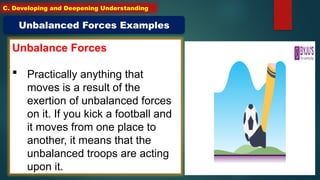
 Practically anything that
moves is a result of the
exertion of unbalanced forces
on it. If you kick a football and
it moves from one place to
another, it means that the
unbalanced troops are acting
upon it.
Unbalanced Forces Examples
C. Developing and Deepening Understanding
Unbalance Forces
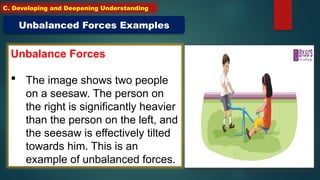
 The image shows two people
on a seesaw. The person on
the right is significantly heavier
than the person on the left, and
the seesaw is effectively tilted
towards him. This is an
example of unbalanced forces.
Unbalanced Forces Examples
C. Developing and Deepening Understanding
Differences Between Balanced and Unbalanced Forces
C. Developing and Deepening Understanding
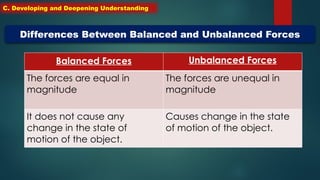
Balanced Forces Unbalanced Forces
The forces are equal in
magnitude
The forces are unequal in
magnitude
It does not cause any
change in the state of
motion of the object.
Causes change in the state
of motion of the object.
C. Developing and Deepening Understanding
Worked Example
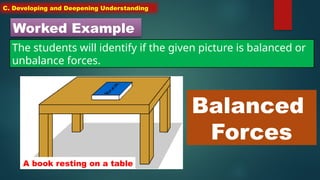
The students will identify if the given picture is balanced or
unbalance forces.
A book resting on a table
Balanced
Forces
C. Developing and Deepening Understanding
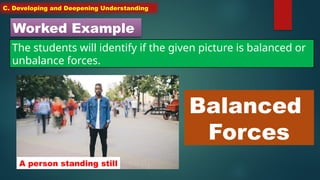
Worked Example
The students will identify if the given picture is balanced or
unbalance forces.
A person standing still
Balanced
Forces
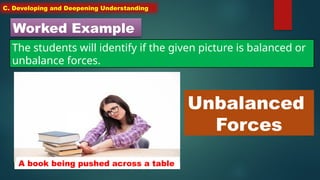
C. Developing and Deepening Understanding
Worked Example
The students will identify if the given picture is balanced or
unbalance forces.
A book being pushed across a table
Unbalanced
Forces
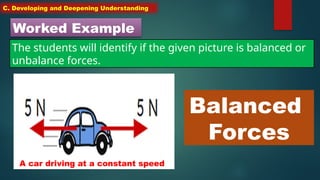
C. Developing and Deepening Understanding
Worked Example
The students will identify if the given picture is balanced or
unbalance forces.
A car driving at a constant speed
Balanced
Forces
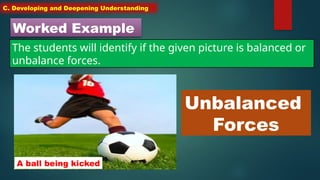
C. Developing and Deepening Understanding
Worked Example
The students will identify if the given picture is balanced or
unbalance forces.
A ball being kicked
Unbalanced
Forces
D. MAKING GENERALIZATION
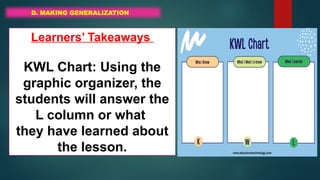
Learners’ Takeaways
KWL Chart: Using the
graphic organizer, the
students will answer the
L column or what
they have learned about
the lesson.
D. MAKING GENERALIZATION
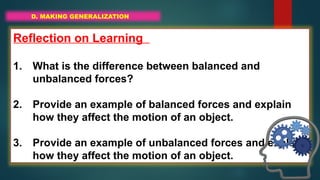
Reflection on Learning
1. What is the difference between balanced and
unbalanced forces?
2. Provide an example of balanced forces and explain
how they affect the motion of an object.
3. Provide an example of unbalanced forces and explain
how they affect the motion of an object.
E. EVALUATING LEARNING
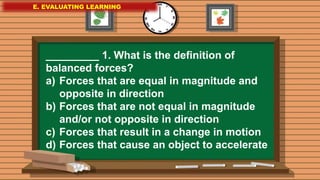
_________ 1. What is the definition of
balanced forces?
a) Forces that are equal in magnitude and
opposite in direction
b) Forces that are not equal in magnitude
and/or not opposite in direction
c) Forces that result in a change in motion
d) Forces that cause an object to accelerate
E. EVALUATING LEARNING
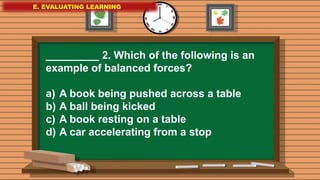
_________ 2. Which of the following is an
example of balanced forces?
a) A book being pushed across a table
b) A ball being kicked
c) A book resting on a table
d) A car accelerating from a stop
E. EVALUATING LEARNING
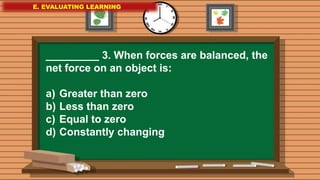
_________ 3. When forces are balanced, the
net force on an object is:
a) Greater than zero
b) Less than zero
c) Equal to zero
d) Constantly changing
E. EVALUATING LEARNING
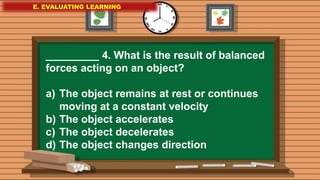
_________ 4. What is the result of balanced
forces acting on an object?
a) The object remains at rest or continues
moving at a constant velocity
b) The object accelerates
c) The object decelerates
d) The object changes direction
E. EVALUATING LEARNING
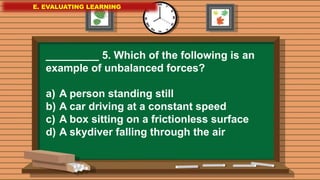
_________ 5. Which of the following is an
example of unbalanced forces?
a) A person standing still
b) A car driving at a constant speed
c) A box sitting on a frictionless surface
d) A skydiver falling through the air
E. EVALUATING LEARNING
_________ 6. When forces are unbalanced,
the object will:
a) Remain at rest
b) Continue moving at a constant velocity
c) Accelerate or decelerate
d) Change direction randomly
E. EVALUATING LEARNING
_________ 7. How do unbalanced forces
affect the motion of an object?
a) They have no effect on the object's
motion
b) They cause the object to remain at rest
c) They cause the object to move at a
constant velocity
d) They cause the object to change its
speed or direction
E. EVALUATING LEARNING
_________ 8. Which of the following is a
characteristic of balanced forces?
a) The net force is greater than zero
b) The object will accelerate
c) The object will change direction
d) The object will remain at rest or continue
moving at a constant velocity
E. EVALUATING LEARNING
_________ 9. In a tug-of-war game, the
forces exerted by the two teams are:
a) Balanced
b) Unbalanced
c) Constant
d) Random
E. EVALUATING LEARNING
_________ 10. Which of the following is
NOT a consequence of unbalanced forces?
a) The object remains at rest
b) The object accelerates or decelerates
c) The object changes direction
d) The object continues moving at a
constant velocity
E. EVALUATING LEARNING
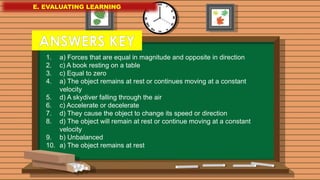
1. a) Forces that are equal in magnitude and opposite in direction
2. c) A book resting on a table
3. c) Equal to zero
4. a) The object remains at rest or continues moving at a constant
velocity
5. d) A skydiver falling through the air
6. c) Accelerate or decelerate
7. d) They cause the object to change its speed or direction
8. d) The object will remain at rest or continue moving at a constant
velocity
9. b) Unbalanced
10. a) The object remains at rest
ANSWERS KEY
Reference :
•SCIENCE 7 LESSON EXEMPLAR
GCSE Physics Revision “Resolving Forces” Retrieved from
https://www.youtube.com/watch?
v=8RI2_gJy0L0&list=PL9IouNCPbCxUrQkFLoPwB67nDbhw2NfAO&in
dex=6 The Physics Classroom. Accessed from
https://www.physicsclassroom.com/Physics-Interactives/Newtons-
Laws/Free-Body
Diagrams/Free-Body-Diagram-Interactive
Ling, J.S., Sanny, J., & Moebs, B. (2016). University Physics Volume 1.
Retrieved from https://openstax.org/details/books/university
physics-volume-1
Hewitt, P.G. (2014). Conceptual physics. 12th Ed. Pearson
DepEd. (n.d). Project EASE: Integrated Science I Module 7.
https://byjus.com/physics/balanced-force/

Q3-SCIENCE 7-LC 1 (B).pptx third quarter

  • 2.
  • 3.
    Balanced and unbalancedforces CONTENT The learners learn that Scientists and engineers analyze forces to predict their effects on movement. LEARNING STANDARD The learners will identify that forces act between objects and can be measured. LEARNING COMPETENCY
  • 4.
    By the endof the lesson, the 80 percent of the learners will be able to: 1. Distinguish between balanced and unbalanced forces. 2. Explain the effects of balanced and unbalanced forces on the motion of objects. 3. Appreciate the role of balanced and unbalanced forces in everyday life by answering the reflection of learning. OBJECTIVES
  • 5.
    I. Activating PriorKnowledge Short Review The students will identify the what type of forces. I. Activating Prior Knowledge GRAVITATIONAL FORCE
  • 6.
    I. Activating PriorKnowledge Short Review The students will identify the what type of forces. I. Activating Prior Knowledge FRICTIONAL FORCE
  • 7.
    I. Activating PriorKnowledge Short Review The students will identify the what type of forces. I. Activating Prior Knowledge TENSION FORCE
  • 8.
    I. Activating PriorKnowledge Short Review The students will identify the what type of forces. I. Activating Prior Knowledge ELECTROSTATIC FORCE
  • 9.
    I. Activating PriorKnowledge Short Review The students will identify the what type of forces. I. Activating Prior Knowledge APPLIED FORCE
  • 10.
    1. Distinguish betweenbalanced and unbalanced forces. 2. Explain the effects of balanced and unbalanced forces on the motion of objects. 3. Appreciate the role of balanced and unbalanced forces in everyday life by answering the reflection of learning. B. Establishing Purpose of the Lesson 1. LESSON PURPOSE
  • 11.
    B. Establishing Purposeof the Lesson 2. Unlocking Content Vocabulary: Match Type Activity CONTACT FORCE NON-CONTACT FORCE BALANCED FORCES Forces that are equal in strength and opposite in direction, resulting in no net force on an object. Forces that act on an object without physical contact, such as gravity or magnetism. Forces that act on an object through direct physical contact, such as friction or normal force. FORCE A push or pull that can cause an object to change its speed, direction, or shape.
  • 12.
    Balance Forces  Whenthe forces acting on an object are equal in magnitude and opposite in direction, the forces are considered balanced. Balanced and unbalanced forces C. Developing and Deepening Understanding
  • 13.
     Suppose youare pushing a wall, and as expected, the wall does not move and neither do you. It means that you and the wall are exerting a balanced force on each other. Balanced Forces Examples C. Developing and Deepening Understanding
  • 14.
     The imageshows a game of tug of war between equally matched opponents. Neither of the participating teams can pull the other team towards themselves due to balanced forces. Balanced Forces Examples C. Developing and Deepening Understanding
  • 15.
     The imagebelow shows a book resting on a table (the force of gravity is balanced by the force exerted by the table) Balanced Forces Examples C. Developing and Deepening Understanding
  • 16.
    Balance Forces  Whenthe forces acting on an object are balanced, it means the net force on the object is zero. The forces are equal in magnitude and opposite in direction, so they cancel each other out. Balanced Forces Examples C. Developing and Deepening Understanding
  • 17.
    Balance Forces  Foran object at rest, balanced forces mean the object will remain at rest. The forces acting on it, such as the force of gravity and the normal force from a surface, are equal and opposite, so the object does not accelerate and remains stationary. Balanced Forces Examples C. Developing and Deepening Understanding
  • 18.
    Balance Forces  Foran object in motion, balanced forces mean the object will continue moving at a constant velocity. If the forces acting on the object, such as air resistance and the force propelling it forward, are balanced, the object will not speed up, slow down, or change direction. It will maintain its current speed and trajectory. Balanced Forces Examples C. Developing and Deepening Understanding
  • 19.
    Balance Forces  Thekey point is that balanced forces result in no change to an object's motion. The object will either stay at rest or continue moving at a constant velocity, as long as the forces acting on it remain balanced. Balanced and unbalanced forces C. Developing and Deepening Understanding
  • 20.
    Unbalance Forces  Whenthe resultant force acting on a body is not equal to zero, the forces acting on the body are known as unbalanced forces. The body acted upon by unbalanced forces changes its state of motion. Balanced and unbalanced forces C. Developing and Deepening Understanding
  • 21.
    Unbalance Forces  Whenthe resultant force acting on a body is not equal to zero, the forces acting on the body are known as unbalanced forces. The body acted upon by unbalanced forces changes its state of motion. Balanced and unbalanced forces C. Developing and Deepening Understanding
  • 22.
    Unbalance Forces  Practicallyanything that moves is a result of the exertion of unbalanced forces on it. If you kick a football and it moves from one place to another, it means that the unbalanced troops are acting upon it. Unbalanced Forces Examples C. Developing and Deepening Understanding
  • 23.
    Unbalance Forces  Theimage shows two people on a seesaw. The person on the right is significantly heavier than the person on the left, and the seesaw is effectively tilted towards him. This is an example of unbalanced forces. Unbalanced Forces Examples C. Developing and Deepening Understanding
  • 24.
    Differences Between Balancedand Unbalanced Forces C. Developing and Deepening Understanding Balanced Forces Unbalanced Forces The forces are equal in magnitude The forces are unequal in magnitude It does not cause any change in the state of motion of the object. Causes change in the state of motion of the object.
  • 25.
    C. Developing andDeepening Understanding Worked Example The students will identify if the given picture is balanced or unbalance forces. A book resting on a table Balanced Forces
  • 26.
    C. Developing andDeepening Understanding Worked Example The students will identify if the given picture is balanced or unbalance forces. A person standing still Balanced Forces
  • 27.
    C. Developing andDeepening Understanding Worked Example The students will identify if the given picture is balanced or unbalance forces. A book being pushed across a table Unbalanced Forces
  • 28.
    C. Developing andDeepening Understanding Worked Example The students will identify if the given picture is balanced or unbalance forces. A car driving at a constant speed Balanced Forces
  • 29.
    C. Developing andDeepening Understanding Worked Example The students will identify if the given picture is balanced or unbalance forces. A ball being kicked Unbalanced Forces
  • 30.
    D. MAKING GENERALIZATION Learners’Takeaways KWL Chart: Using the graphic organizer, the students will answer the L column or what they have learned about the lesson.
  • 31.
    D. MAKING GENERALIZATION Reflectionon Learning 1. What is the difference between balanced and unbalanced forces? 2. Provide an example of balanced forces and explain how they affect the motion of an object. 3. Provide an example of unbalanced forces and explain how they affect the motion of an object.
  • 32.
    E. EVALUATING LEARNING E.EVALUATING LEARNING E. EVALUATING LEARNING _________ 1. What is the definition of balanced forces? a) Forces that are equal in magnitude and opposite in direction b) Forces that are not equal in magnitude and/or not opposite in direction c) Forces that result in a change in motion d) Forces that cause an object to accelerate
  • 33.
    E. EVALUATING LEARNING E.EVALUATING LEARNING E. EVALUATING LEARNING _________ 2. Which of the following is an example of balanced forces? a) A book being pushed across a table b) A ball being kicked c) A book resting on a table d) A car accelerating from a stop
  • 34.
    E. EVALUATING LEARNING E.EVALUATING LEARNING E. EVALUATING LEARNING _________ 3. When forces are balanced, the net force on an object is: a) Greater than zero b) Less than zero c) Equal to zero d) Constantly changing
  • 35.
    E. EVALUATING LEARNING E.EVALUATING LEARNING E. EVALUATING LEARNING _________ 4. What is the result of balanced forces acting on an object? a) The object remains at rest or continues moving at a constant velocity b) The object accelerates c) The object decelerates d) The object changes direction
  • 36.
    E. EVALUATING LEARNING E.EVALUATING LEARNING E. EVALUATING LEARNING _________ 5. Which of the following is an example of unbalanced forces? a) A person standing still b) A car driving at a constant speed c) A box sitting on a frictionless surface d) A skydiver falling through the air
  • 37.
    E. EVALUATING LEARNING E.EVALUATING LEARNING E. EVALUATING LEARNING _________ 6. When forces are unbalanced, the object will: a) Remain at rest b) Continue moving at a constant velocity c) Accelerate or decelerate d) Change direction randomly
  • 38.
    E. EVALUATING LEARNING E.EVALUATING LEARNING E. EVALUATING LEARNING _________ 7. How do unbalanced forces affect the motion of an object? a) They have no effect on the object's motion b) They cause the object to remain at rest c) They cause the object to move at a constant velocity d) They cause the object to change its speed or direction
  • 39.
    E. EVALUATING LEARNING E.EVALUATING LEARNING E. EVALUATING LEARNING _________ 8. Which of the following is a characteristic of balanced forces? a) The net force is greater than zero b) The object will accelerate c) The object will change direction d) The object will remain at rest or continue moving at a constant velocity
  • 40.
    E. EVALUATING LEARNING E.EVALUATING LEARNING E. EVALUATING LEARNING _________ 9. In a tug-of-war game, the forces exerted by the two teams are: a) Balanced b) Unbalanced c) Constant d) Random
  • 41.
    E. EVALUATING LEARNING E.EVALUATING LEARNING E. EVALUATING LEARNING _________ 10. Which of the following is NOT a consequence of unbalanced forces? a) The object remains at rest b) The object accelerates or decelerates c) The object changes direction d) The object continues moving at a constant velocity
  • 42.
    E. EVALUATING LEARNING E.EVALUATING LEARNING E. EVALUATING LEARNING 1. a) Forces that are equal in magnitude and opposite in direction 2. c) A book resting on a table 3. c) Equal to zero 4. a) The object remains at rest or continues moving at a constant velocity 5. d) A skydiver falling through the air 6. c) Accelerate or decelerate 7. d) They cause the object to change its speed or direction 8. d) The object will remain at rest or continue moving at a constant velocity 9. b) Unbalanced 10. a) The object remains at rest ANSWERS KEY
  • 43.
    Reference : •SCIENCE 7LESSON EXEMPLAR GCSE Physics Revision “Resolving Forces” Retrieved from https://www.youtube.com/watch? v=8RI2_gJy0L0&list=PL9IouNCPbCxUrQkFLoPwB67nDbhw2NfAO&in dex=6 The Physics Classroom. Accessed from https://www.physicsclassroom.com/Physics-Interactives/Newtons- Laws/Free-Body Diagrams/Free-Body-Diagram-Interactive Ling, J.S., Sanny, J., & Moebs, B. (2016). University Physics Volume 1. Retrieved from https://openstax.org/details/books/university physics-volume-1 Hewitt, P.G. (2014). Conceptual physics. 12th Ed. Pearson DepEd. (n.d). Project EASE: Integrated Science I Module 7. https://byjus.com/physics/balanced-force/