SCIENCE 7
Lesson 1:
Meiosis and Gamete
Formation
Sexual Reproduction and Meiosis
CONTENT
Cells are the basic unit of
life and mitosis, and
meiosis are the basic forms of cell
division.
LEARNING
STANDARD
Explain that genetic information is
passed on to offspring from both
parents by
the process of meiosis and fertilization;
LEARNING
COMPETENCY
By the end of the lesson, the 80 percent of
the learners will be able to:
1. Explain the process of meiosis and its significance in the
production of gametes.
2. Model the stages of meiosis using appropriate visual aids
or simulations.
3. Appreciate the importance of meiosis in maintaining
genetic diversity and ensuring the successful
reproduction of organisms by using KWL charts.
OBJECTIVES
I. Activating Prior Knowledge
Short Review
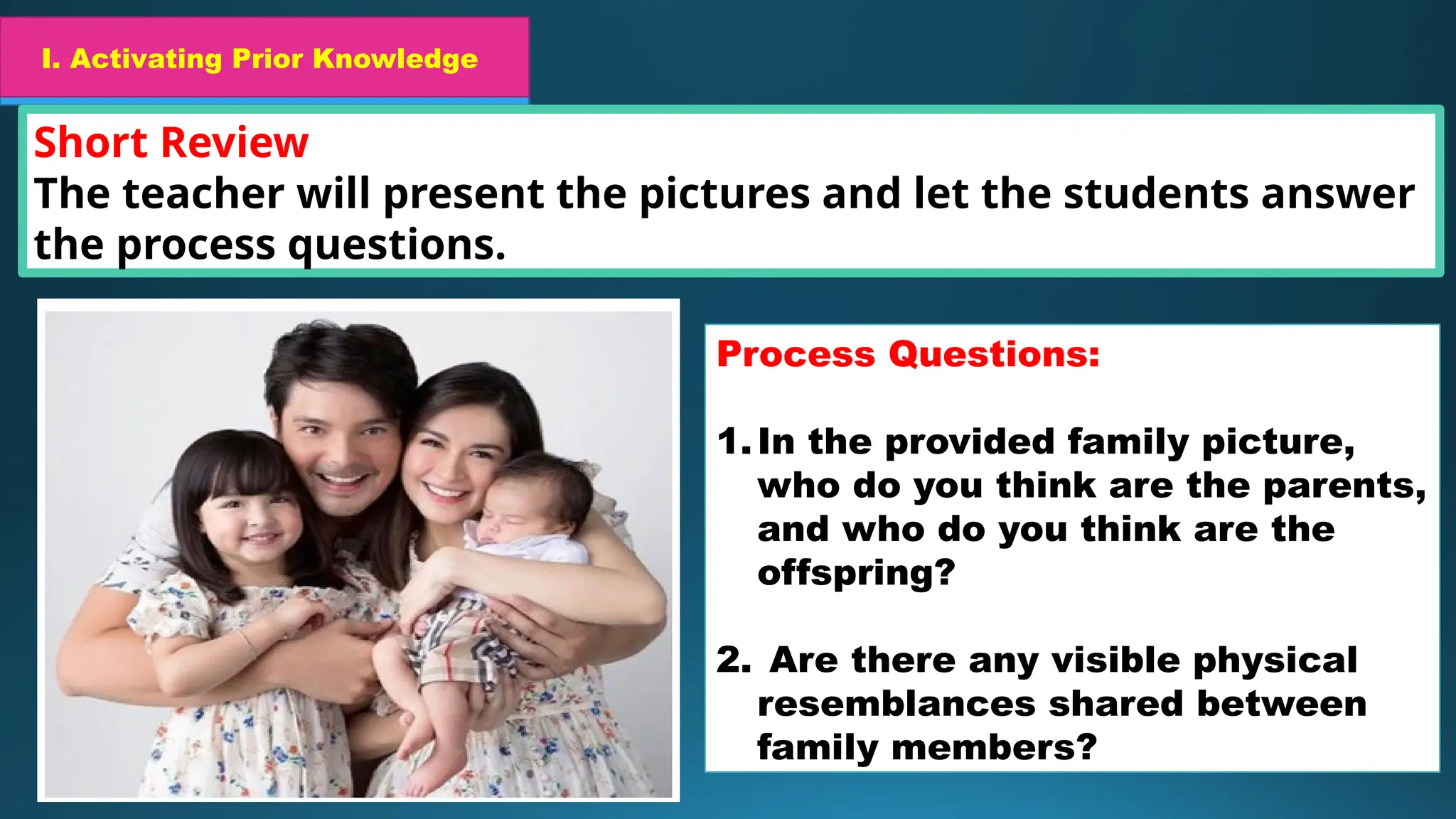
The teacher will present the pictures and let the students answer
the process questions.
I. Activating Prior Knowledge
Process Questions:
1.In the provided family picture,
who do you think are the parents,
and who do you think are the
offspring?
2. Are there any visible physical
resemblances shared between
family members?
1. Explain the process of meiosis and its significance in the
production of gametes.
2. Model the stages of meiosis using appropriate visual aids or
simulations.
3. Appreciate the importance of meiosis in maintaining genetic
diversity and ensuring the successful reproduction of
organisms by using KWL charts.
B. Establishing Purpose of the Lesson
1. LESSON PURPOSE
B. Establishing Purpose of the Lesson
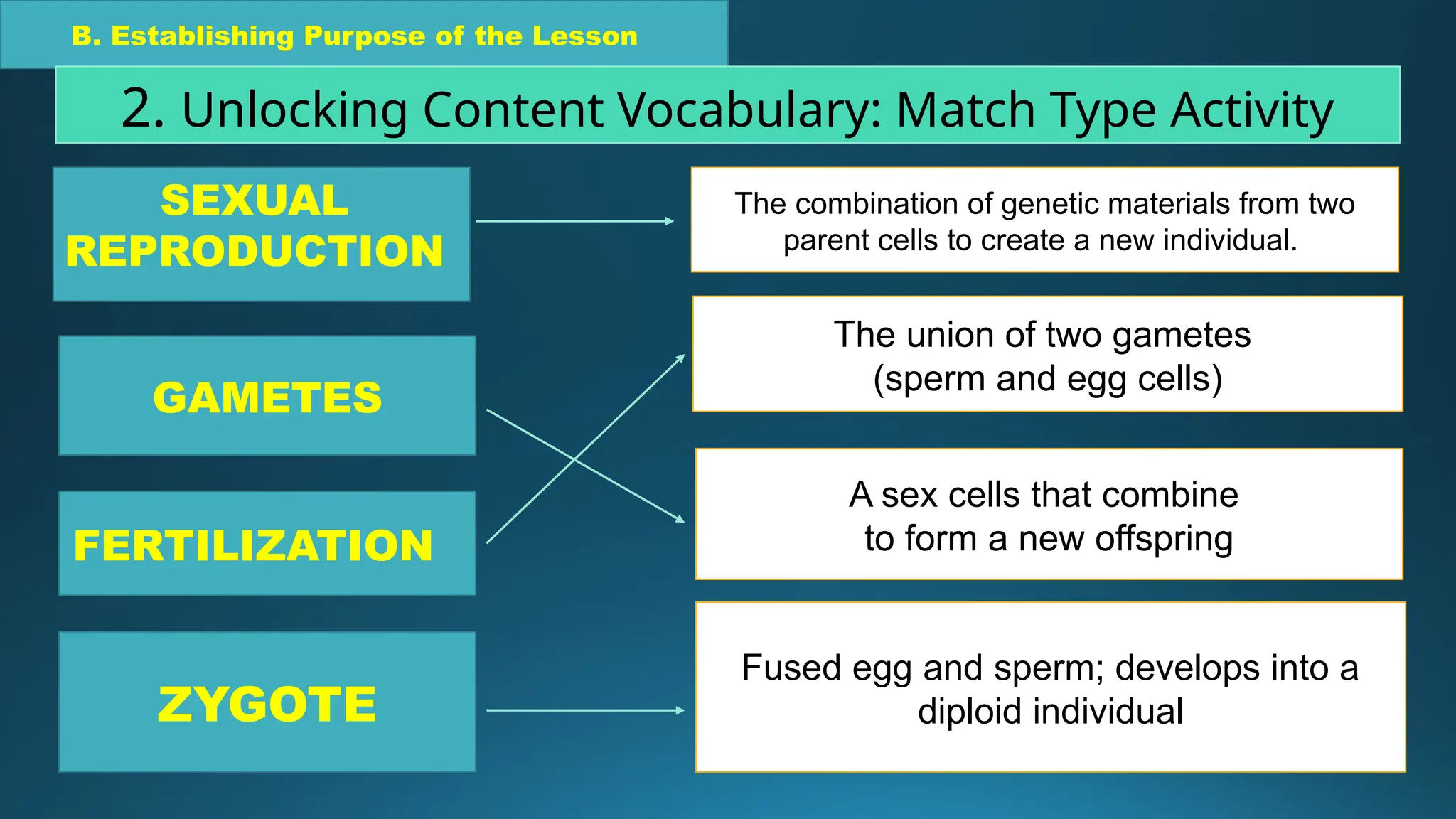
2. Unlocking Content Vocabulary: Match Type Activity
GAMETES
FERTILIZATION
ZYGOTE
A sex cells that combine
to form a new offspring
The union of two gametes
(sperm and egg cells)
Fused egg and sperm; develops into a
diploid individual
SEXUAL
REPRODUCTION
The combination of genetic materials from two
parent cells to create a new individual..
C. Developing and Deepening Understanding
Meiosis in Males
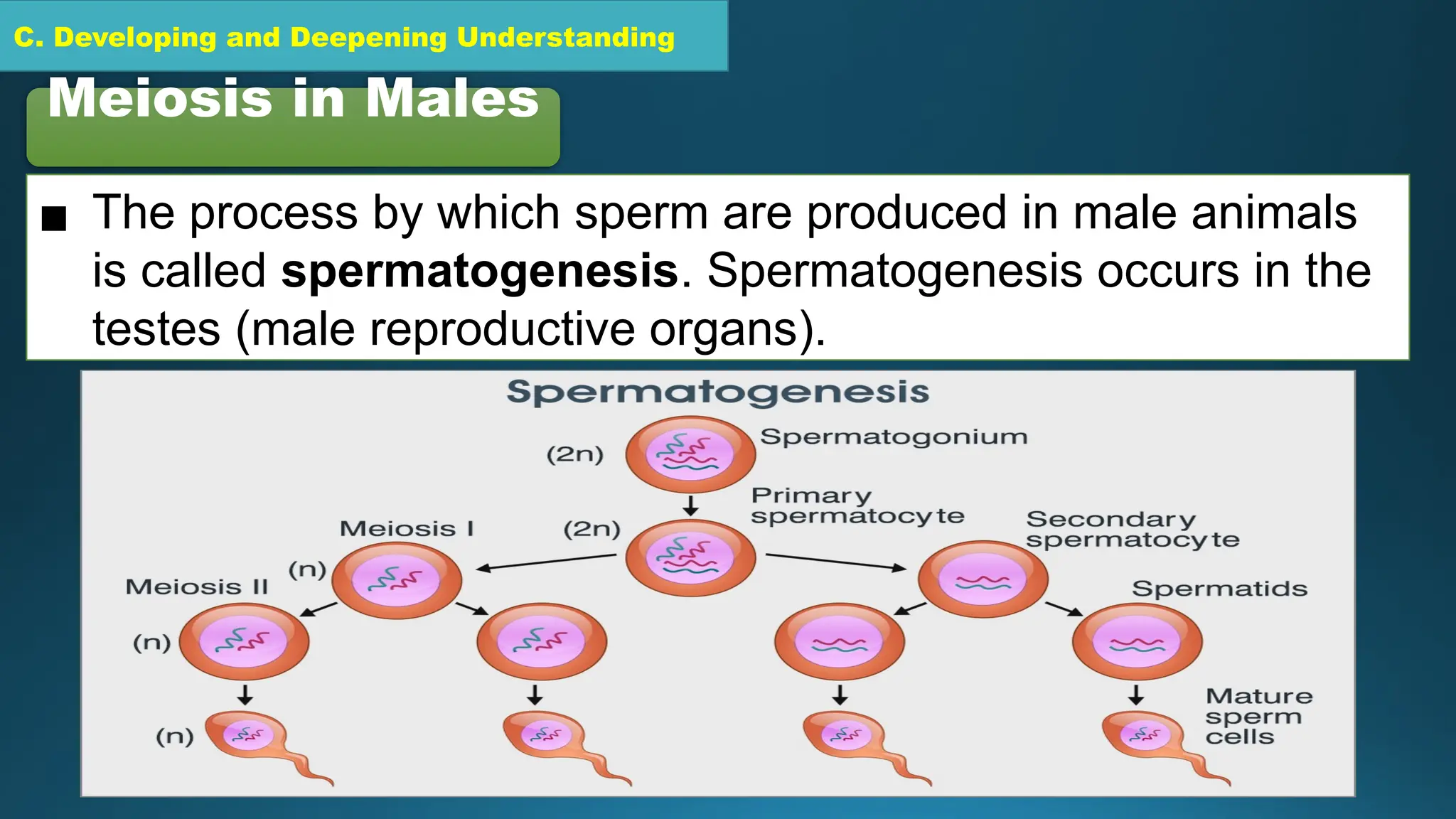
▪ The process by which sperm are produced in male animals
is called spermatogenesis. Spermatogenesis occurs in the
testes (male reproductive organs).
C. Developing and Deepening Understanding
Meiosis in Males
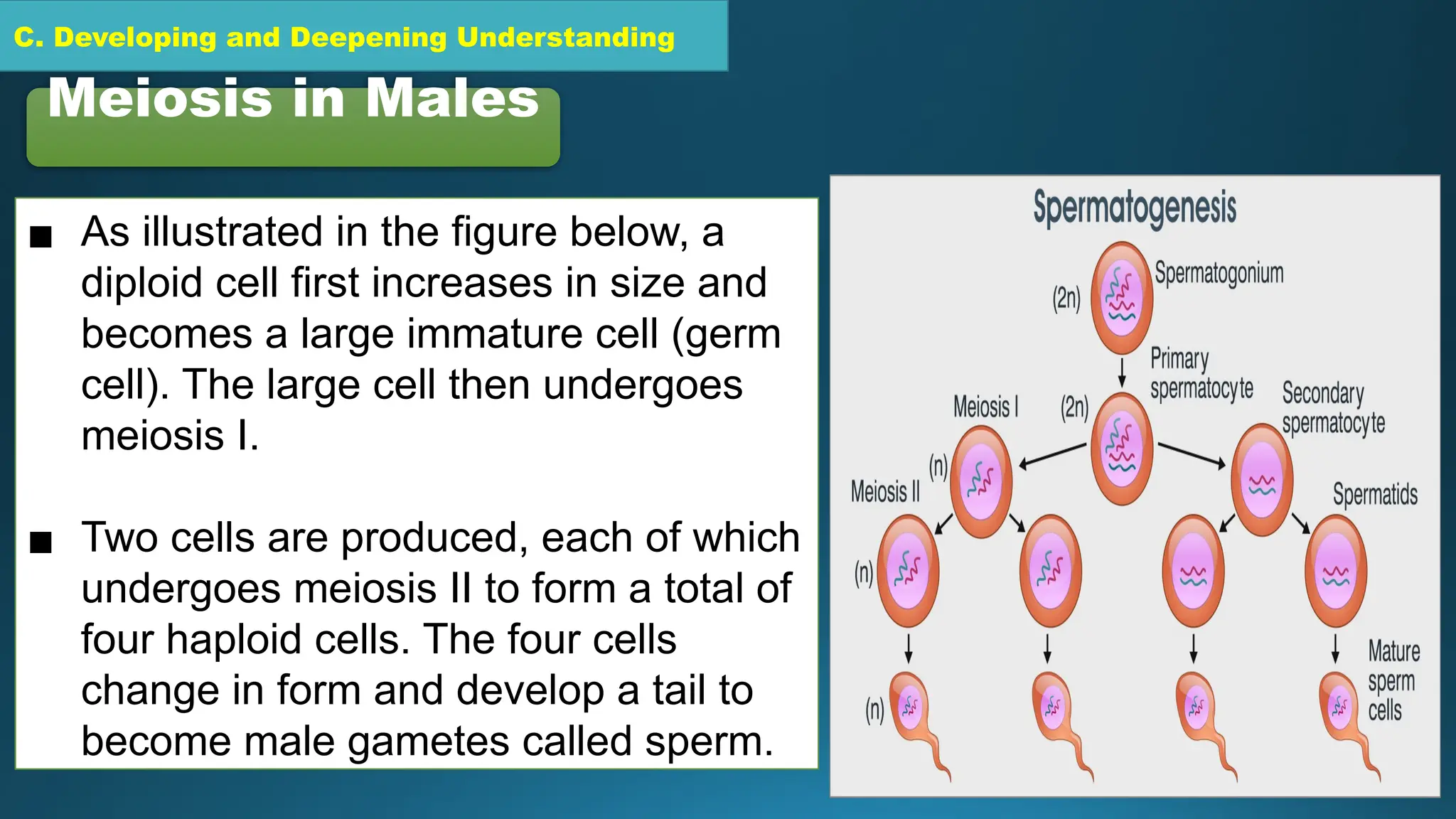
▪ As illustrated in the figure below, a
diploid cell first increases in size and
becomes a large immature cell (germ
cell). The large cell then undergoes
meiosis I.
▪ Two cells are produced, each of which
undergoes meiosis II to form a total of
four haploid cells. The four cells
change in form and develop a tail to
become male gametes called sperm.
C. Developing and Deepening Understanding
Meiosis in Males
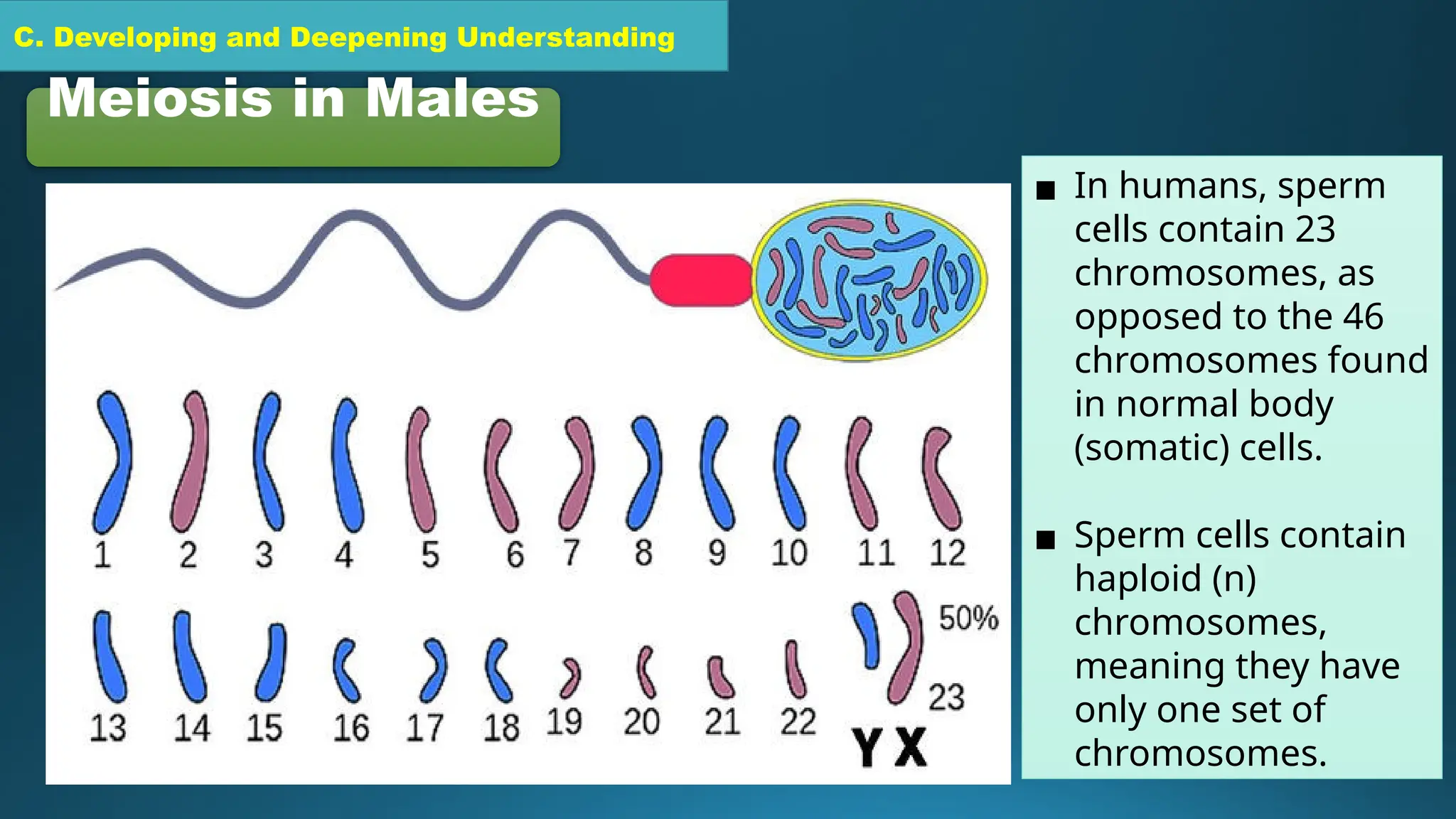
▪ In humans, sperm
cells contain 23
chromosomes, as
opposed to the 46
chromosomes found
in normal body
(somatic) cells.
▪ Sperm cells contain
haploid (n)
chromosomes,
meaning they have
only one set of
chromosomes.
C. Developing and Deepening Understanding
Meiosis in Females
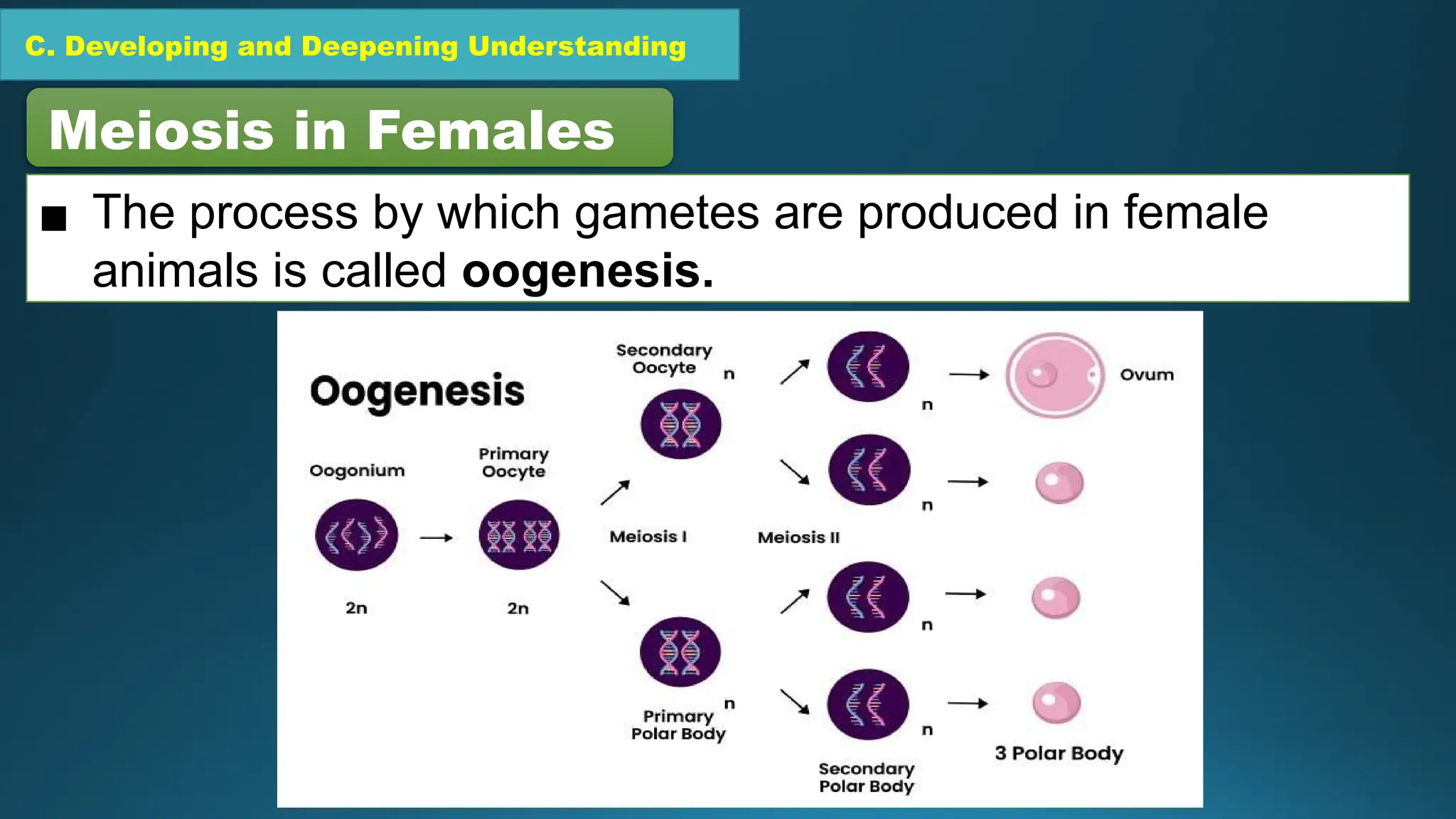
▪ The process by which gametes are produced in female
animals is called oogenesis.
C. Developing and Deepening Understanding
Meiosis in Females
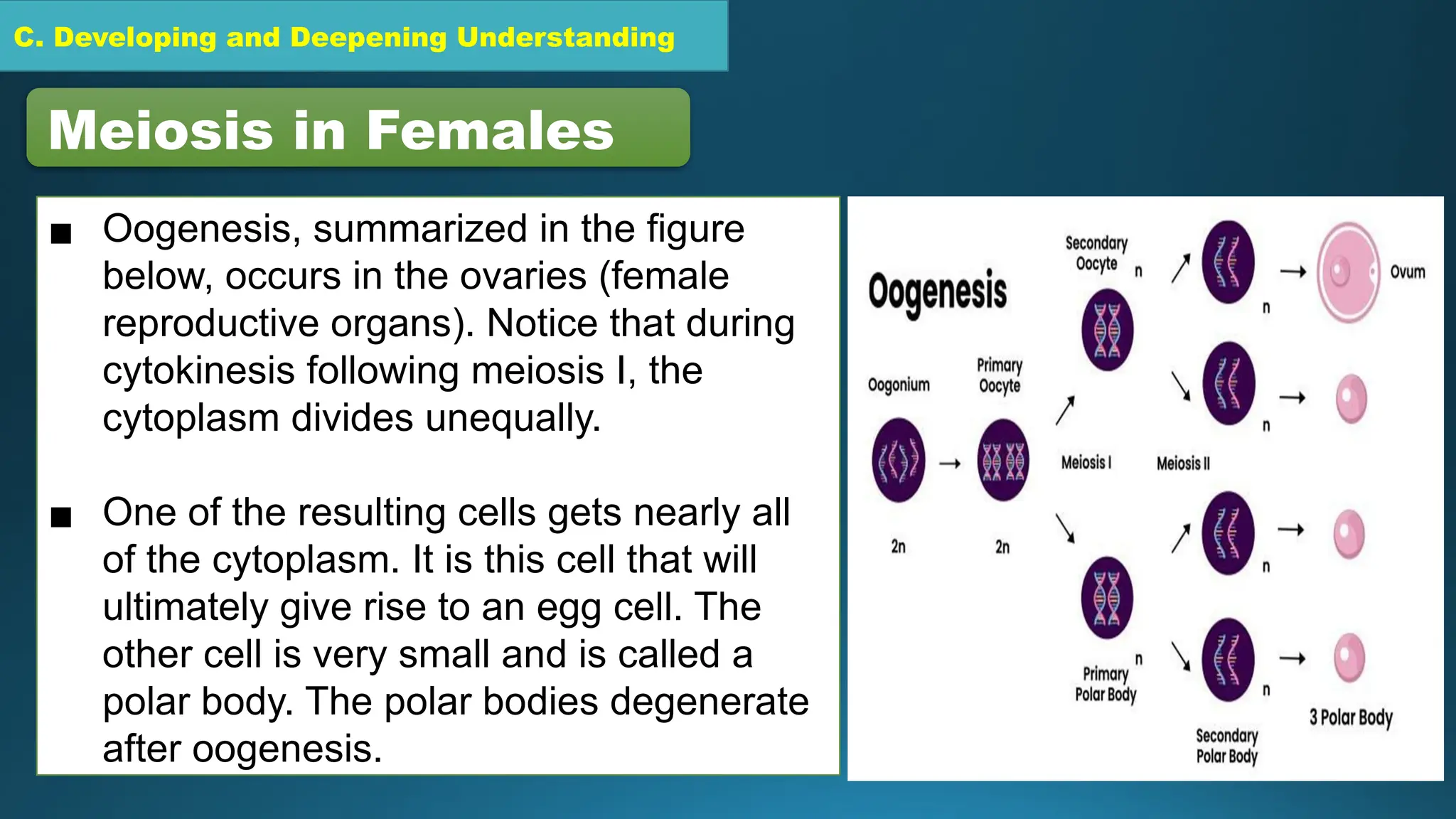
▪ Oogenesis, summarized in the figure
below, occurs in the ovaries (female
reproductive organs). Notice that during
cytokinesis following meiosis I, the
cytoplasm divides unequally.
▪ One of the resulting cells gets nearly all
of the cytoplasm. It is this cell that will
ultimately give rise to an egg cell. The
other cell is very small and is called a
polar body. The polar bodies degenerate
after oogenesis.
C. Developing and Deepening Understanding
SPERM AND EGG CELL
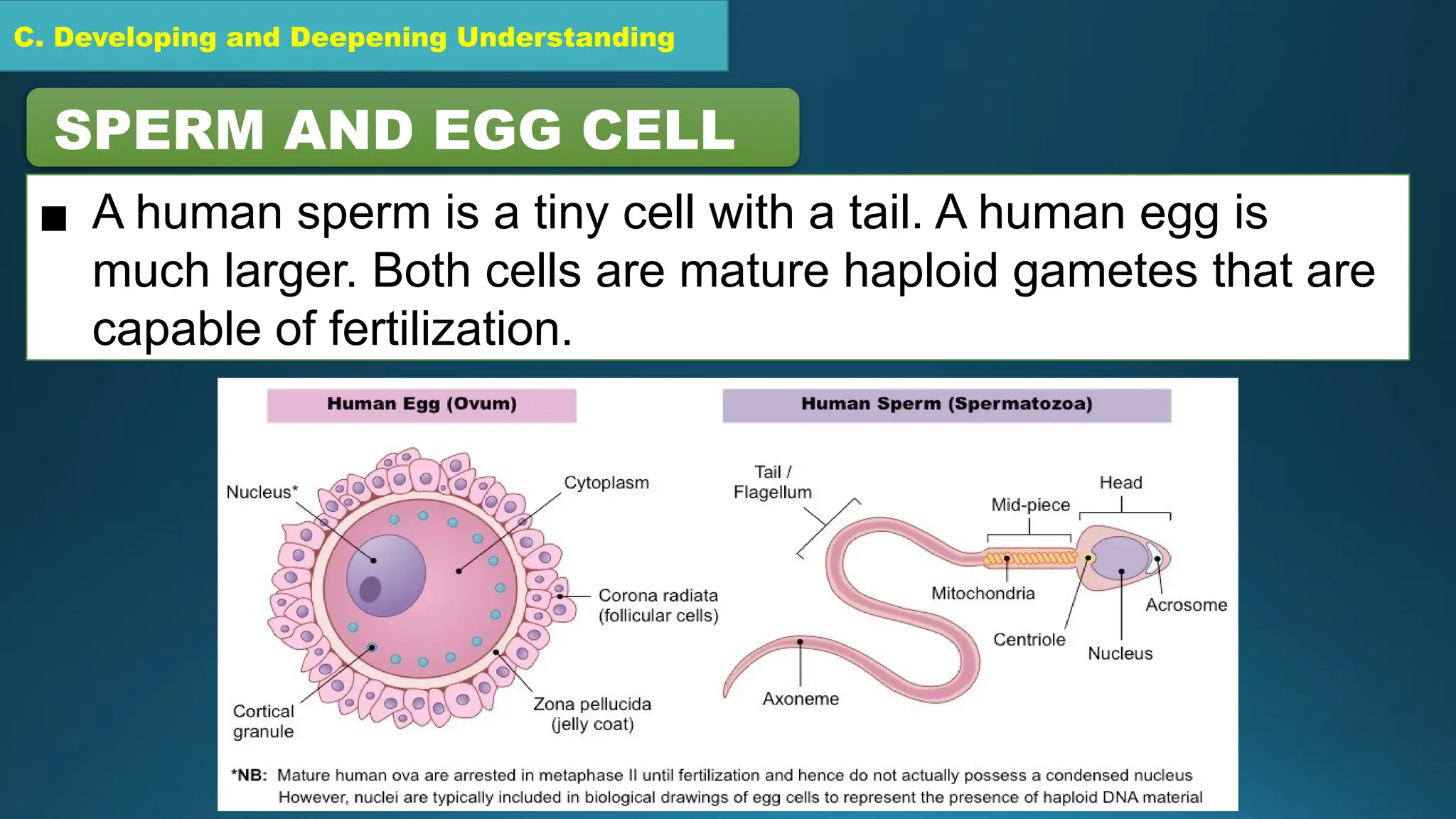
▪ A human sperm is a tiny cell with a tail. A human egg is
much larger. Both cells are mature haploid gametes that are
capable of fertilization.
C. Developing and Deepening Understanding
Worked Example
Read each statement carefully. Determine if the statement
is true or false
1. Meiosis is a type of cell division that produces
genetically identical daughter cells. True or
False?
False. Meiosis is a type of cell division that
produces genetically unique, haploid daughter
cells.
C. Developing and Deepening Understanding
Worked Example
Read each statement carefully. Determine if the statement
is true or false
2. During meiosis I, homologous chromosomes
separate and move to opposite poles of the cell.
True or False?
True. During meiosis I, homologous
chromosomes pair up and then separate,
moving to opposite poles of the cell.
C. Developing and Deepening Understanding
Worked Example
Read each statement carefully. Determine if the statement
is true or false
3. The end result of meiosis is the
production of four haploid gamete cells.
True or False?
True. The end result of meiosis is the production
of four haploid gamete cells.
C. Developing and Deepening Understanding
Worked Example
Read each statement carefully. Determine if the statement
is true or false
4. Genetic recombination occurs during
meiosis, increasing genetic diversity. True
or False? _____
True. Genetic recombination occurs during
meiosis, increasing genetic diversity.
C. Developing and Deepening Understanding
Worked Example
Read each statement carefully. Determine if the statement
is true or false
5. Spermatogenesis is the process of sperm
cell formation, while oogenesis is the
process of egg cell formation. True or False?
True. Spermatogenesis is the process of sperm
cell formation, while oogenesis is the process of
egg cell formation.
C. Developing and Deepening Understanding
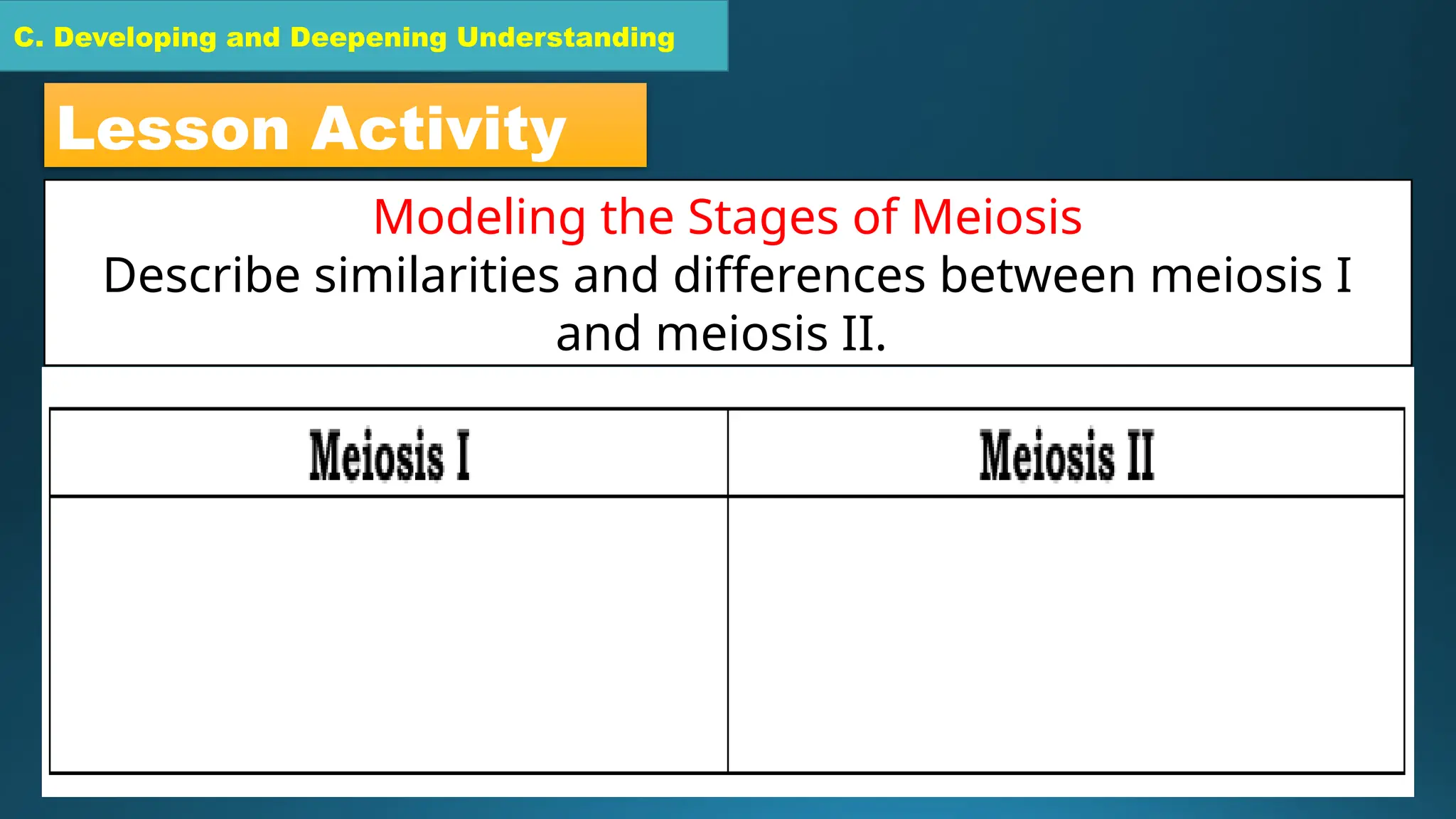
Lesson Activity
Modeling the Stages of Meiosis
Objective: Students will be able to model the key stages of meiosis
using manipulatives, demonstrating their understanding of the
differences between the two cell division processes.
Materials:
• Pipe cleaners or modeling clay (to represent chromosomes)
• Beads or small balls (to represent cells)
• Scissors (to represent cell division)
• Meiosis stage cards
C. Developing and Deepening Understanding
Lesson Activity
Modeling the Stages of Meiosis
Instructions:
1. Divide the class into small groups of 3-4 students.
2. Provide each group with the necessary materials (pipe cleaners/modeling
clay, beads/balls, scissors, and stage cards).
3. Explain the activity:
o Each group will model the stages of mitosis and meiosis using the provided
materials.
o They will start with a single "parent cell" (bead/ball) and use the pipe
cleaners/modeling clay to represent the chromosomes.
o As they progress through the stages, they will manipulate the materials to
demonstrate the changes occurring in the cell.
C. Developing and Deepening Understanding
Lesson Activity
Modeling the Stages of Meiosis
Instructions:
5. Once the groups have completed both the mitosis and meiosis
models, have them present their work to the class.
o Each group should explain the key differences they observed
between the meiosis I and meiosis II.
o Encourage other students to ask questions and provide feedback.
C. Developing and Deepening Understanding
Lesson Activity
Modeling the Stages of Meiosis
Describe similarities and differences between meiosis I
and meiosis II.
D. MAKING GENERALIZATION
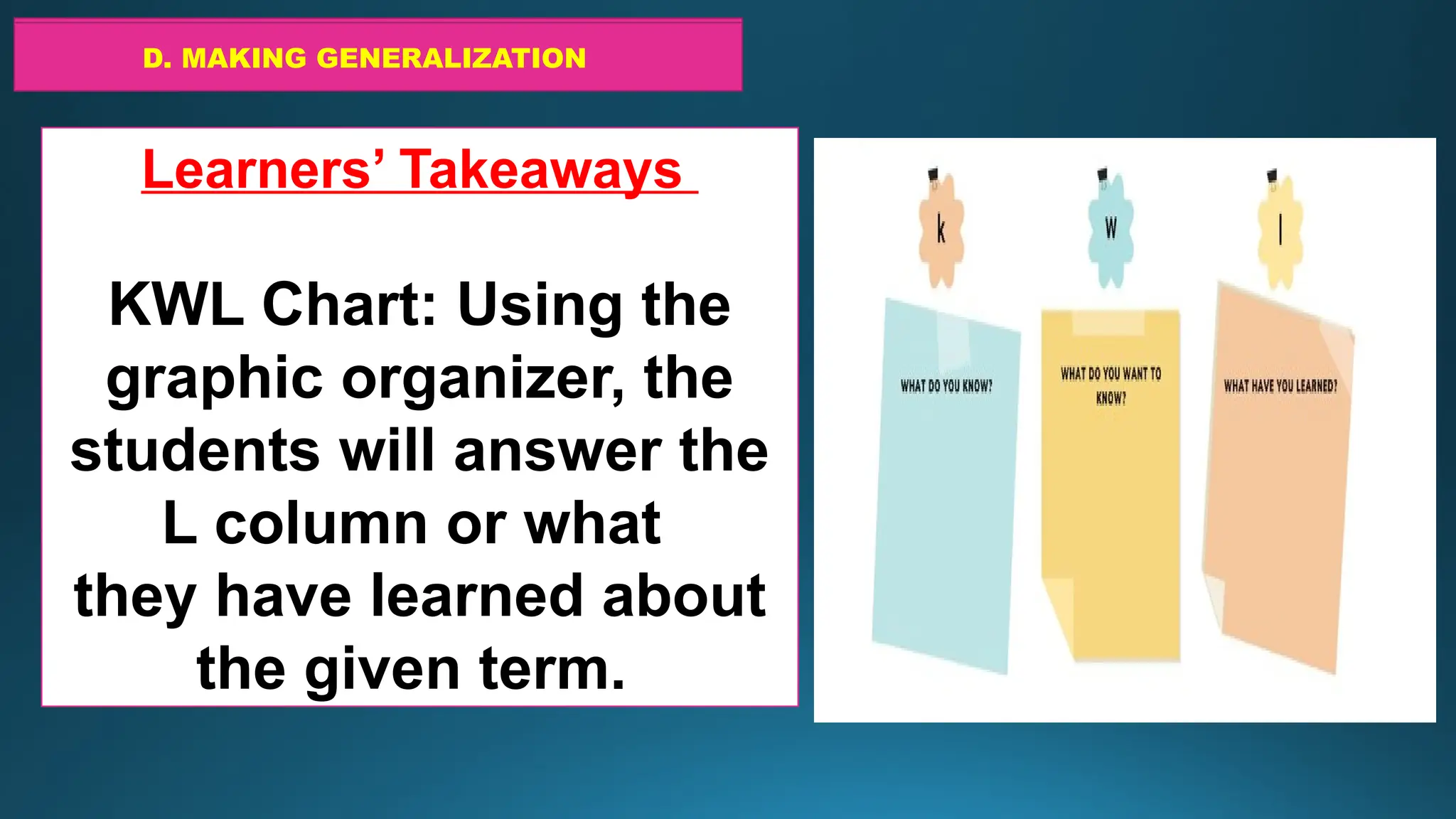
Learners’ Takeaways
KWL Chart: Using the
graphic organizer, the
students will answer the
L column or what
they have learned about
the given term.
E. EVALUATING LEARNING
_________ 1. Which of the following is a key
difference between meiosis and mitosis?
a) Meiosis produces haploid cells, while mitosis
produces diploid cells.
b) Meiosis involves two cell divisions, while
mitosis involves one.
c) Meiosis results in genetic recombination, while
mitosis does not.
d) All of the above.
E. EVALUATING LEARNING
_________ 2. During meiosis, genetic
recombination occurs primarily during which
stage?
a) Prophase I
b) Metaphase I
c) Anaphase I
d) Telophase II
E. EVALUATING LEARNING
_________ 3. Which of the following is a function
of meiosis in sexual reproduction?
a) Maintaining the correct chromosome number
in offspring
b) Increasing genetic diversity within a
population
c) Ensuring the successful fusion of gametes
d) All of the above
E. EVALUATING LEARNING
_________ 4. In humans, how many
chromosomes are present in a gamete (sperm or
egg cell)?
a) 23
b) 46
c) 92
d) 184
E. EVALUATING LEARNING
_________ 5. Which of the following events
occurs during meiosis I but not meiosis II?
a) Chromosome pairing and crossing over
b) Separation of sister chromatids
c) Reduction in chromosome number
d) All of the above
E. EVALUATING LEARNING
_________ 6. The process of genetic
recombination during meiosis is important
because it:
a) Increases genetic diversity within a population
b) Ensures the correct chromosome number in
gametes
c) Facilitates the fusion of gametes during
fertilization
d) Both a and c
E. EVALUATING LEARNING
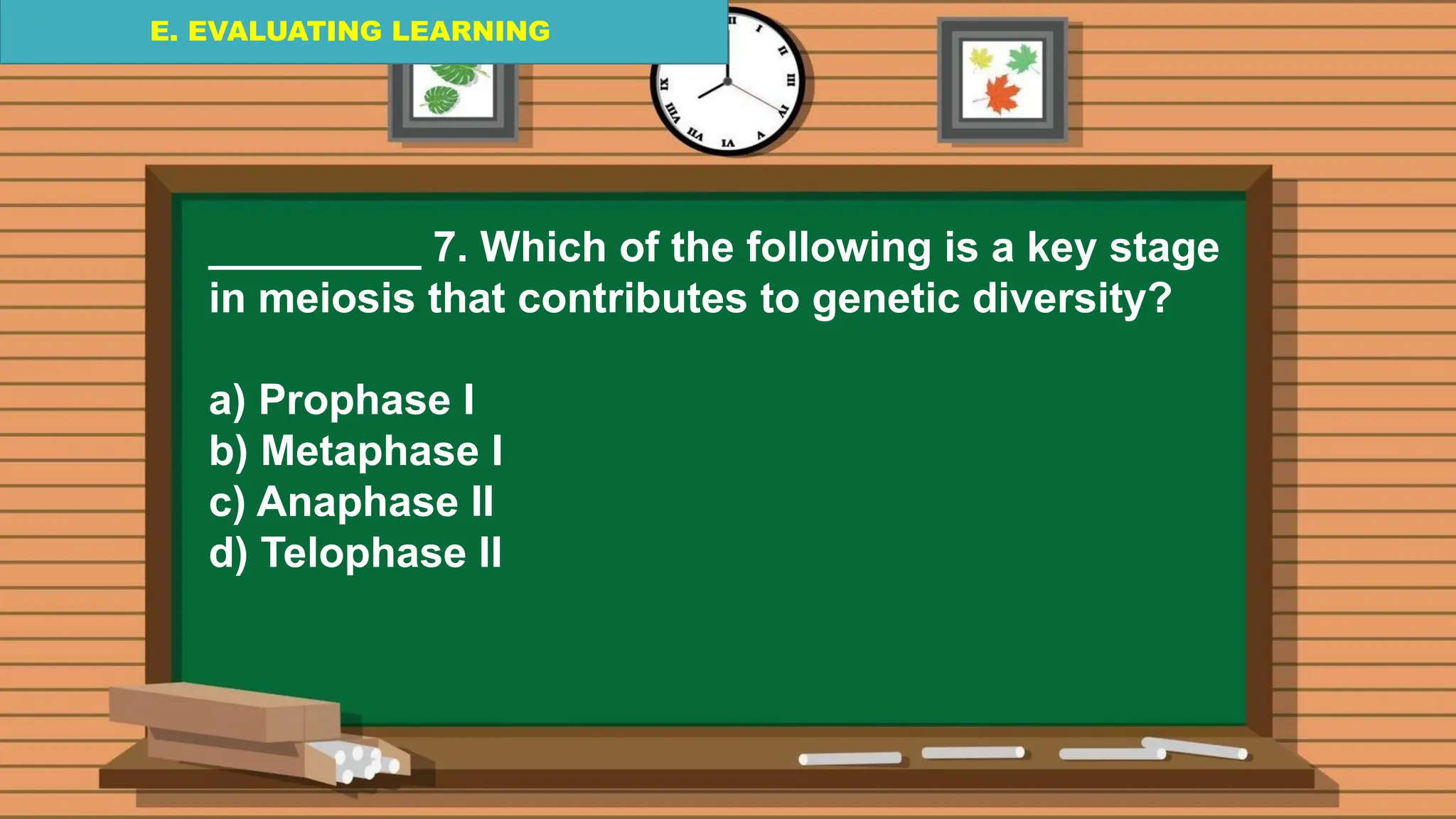
_________ 7. Which of the following is a key stage
in meiosis that contributes to genetic diversity?
a) Prophase I
b) Metaphase I
c) Anaphase II
d) Telophase II
E. EVALUATING LEARNING
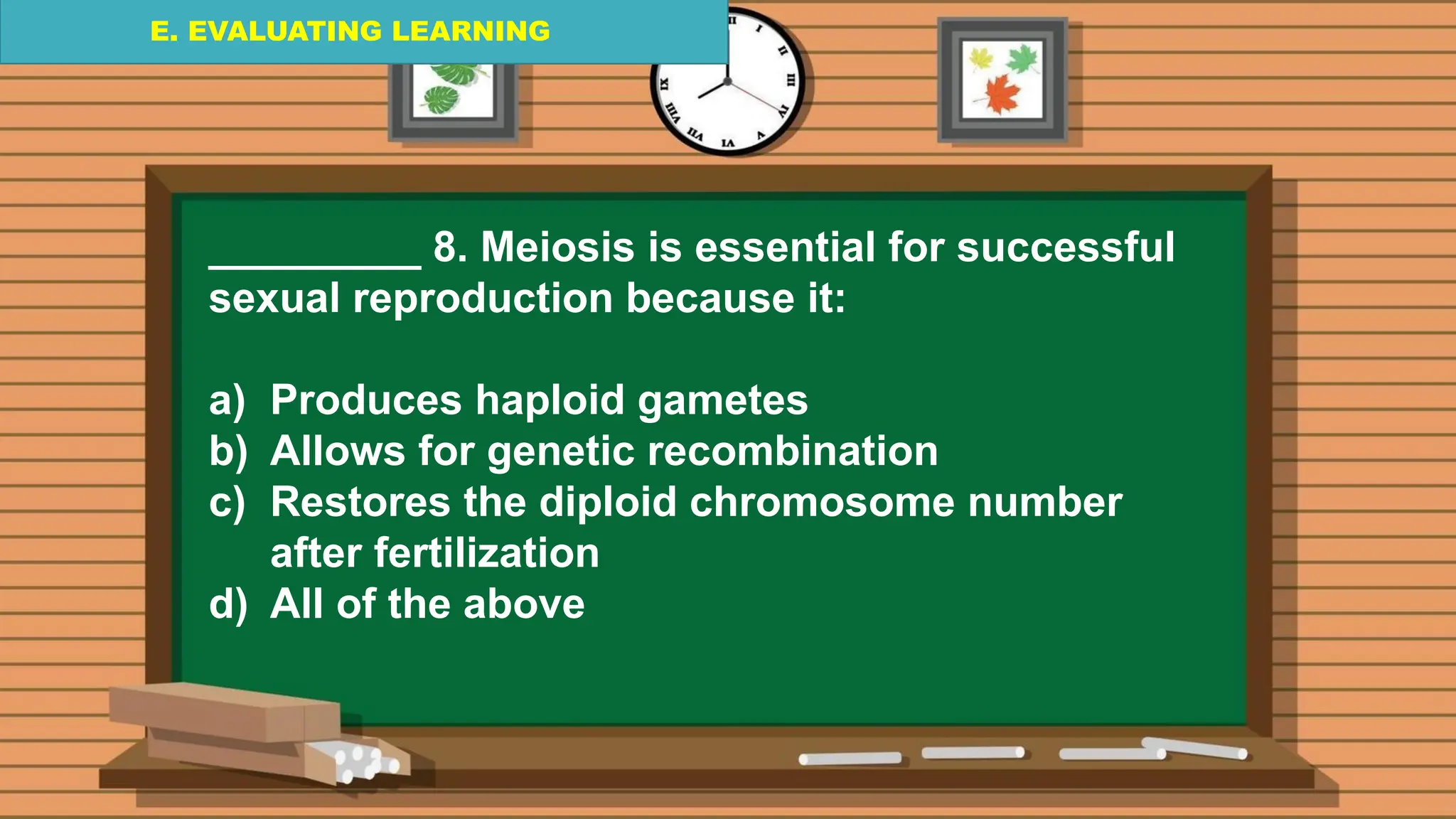
_________ 8. Meiosis is essential for successful
sexual reproduction because it:
a) Produces haploid gametes
b) Allows for genetic recombination
c) Restores the diploid chromosome number
after fertilization
d) All of the above
E. EVALUATING LEARNING
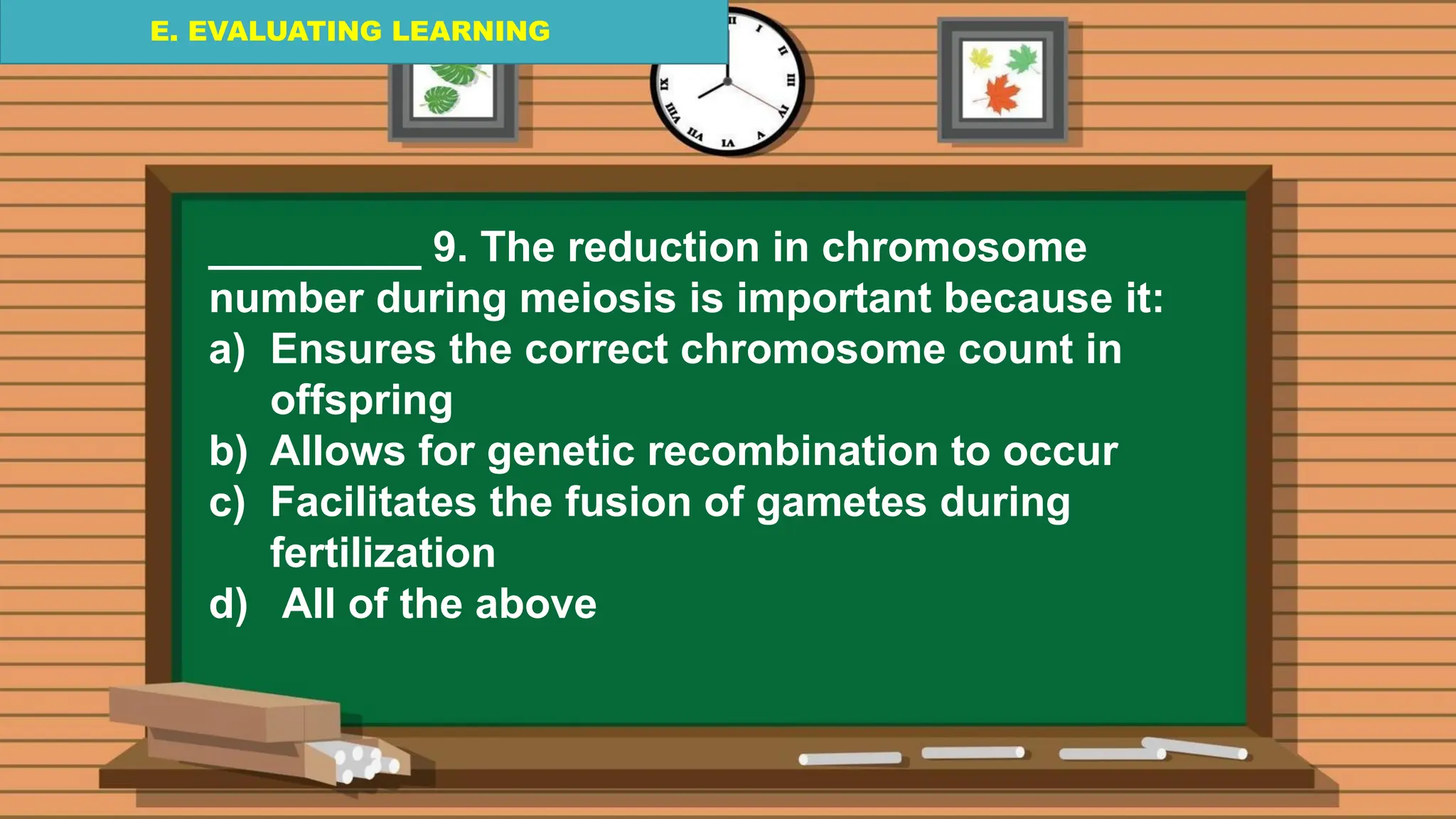
_________ 9. The reduction in chromosome
number during meiosis is important because it:
a) Ensures the correct chromosome count in
offspring
b) Allows for genetic recombination to occur
c) Facilitates the fusion of gametes during
fertilization
d) All of the above
E. EVALUATING LEARNING
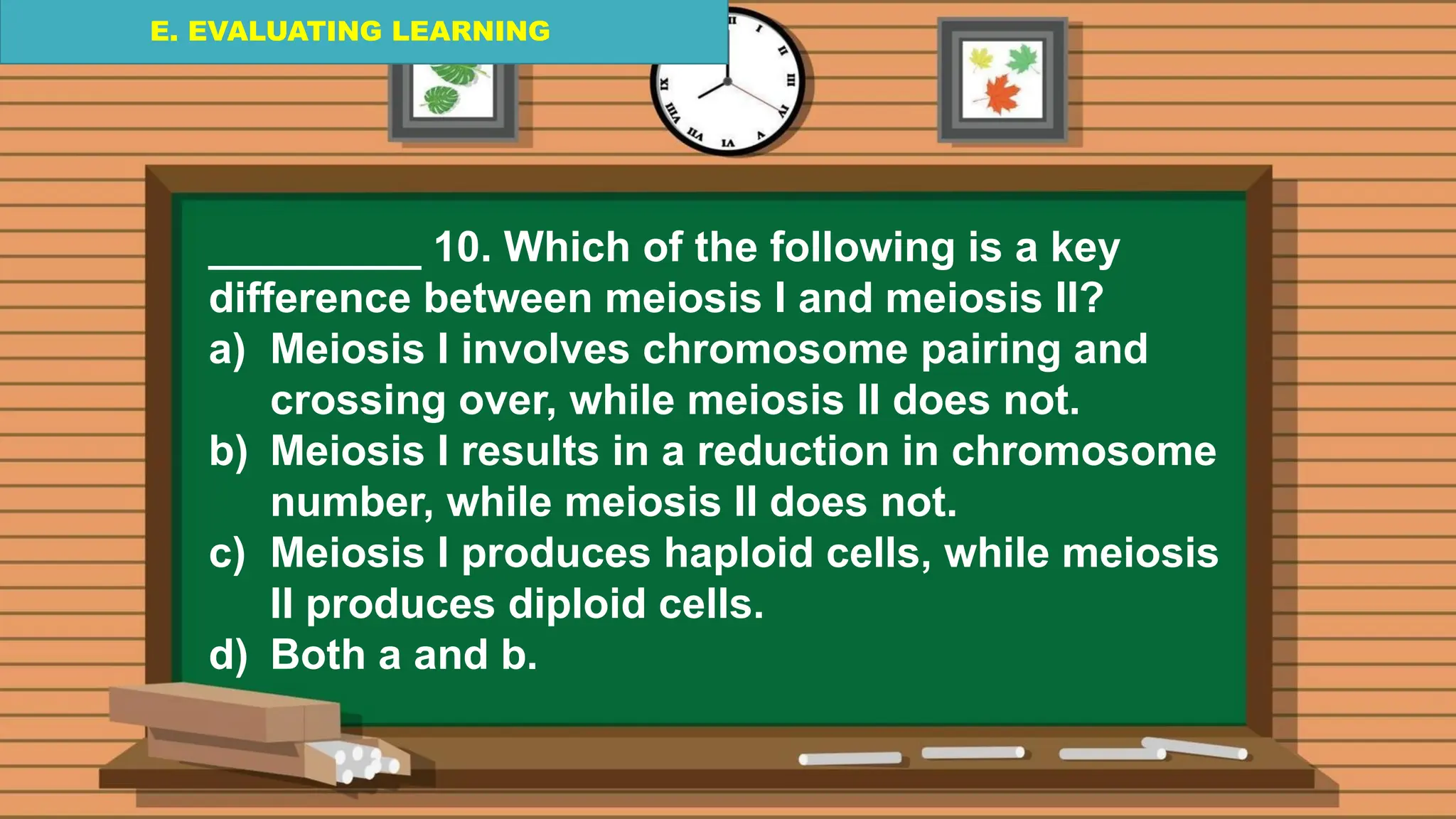
_________ 10. Which of the following is a key
difference between meiosis I and meiosis II?
a) Meiosis I involves chromosome pairing and
crossing over, while meiosis II does not.
b) Meiosis I results in a reduction in chromosome
number, while meiosis II does not.
c) Meiosis I produces haploid cells, while meiosis
II produces diploid cells.
d) Both a and b.
E. EVALUATING LEARNING
Answers key:
1. d) All of the above.
2. a) Prophase I
3. d) All of the above
4. a) 23
5. a) Chromosome pairing and crossing over
6. d) Both a and c
7. a) Prophase I
8. d) All of the above
9. d) All of the above
10.d) Both a and b
Reference :
•SCIENCE 7 LESSON EXEMPLAR
Textbook References:
Alberts, B. et al. (2015). Molecular Biology of the Cell (6th ed.). Garland Science.
Lodish, H. et al. (2016). Molecular Cell Biology (8th ed.). W.H. Freeman.
Klug, W. S. et al. (2019). Concepts of Genetics (12th ed.). Pearson.
Journal Article References:
Petronczki, M. et al. (2003). Dividing the Ultime Cell - Small Molecule Approaches to the Study of Cell Division. Annual
Review of Genetics, 37, 421-449.
Marston, A. L. (2014). Shugoshin - a guardian of genome stability. Genes & Development, 28(1), 2-7.
Hassold, T. & Hunt, P. (2001). To err (meiotically) is human: the genesis of human aneuploidy. Nature Reviews Genetics,
2, 280-291.
Online References:
"Meiosis Overview" from the National Human Genome Research Institute: https://www.genome.gov/genetics-
glossary/Meiosis
"The Stages of Meiosis" from the University of Arizona's Biology Project:
http://www.biology.arizona.edu/cell_bio/tutorials/meiosis/main.html
"Meiosis" from the Genetic Science Learning Center at the University of Utah:
https://learn.genetics.utah.edu/content/chromosomes/meiosis/

Q2-SCIENCE 7-LC6 LESSON 1 (1).pptx lesson

Q2-SCIENCE 7-LC6 LESSON 1 (1).pptx lesson

  • 2.
    SCIENCE 7 Lesson 1: Meiosisand Gamete Formation
  • 3.
    Sexual Reproduction andMeiosis CONTENT Cells are the basic unit of life and mitosis, and meiosis are the basic forms of cell division. LEARNING STANDARD Explain that genetic information is passed on to offspring from both parents by the process of meiosis and fertilization; LEARNING COMPETENCY
  • 4.
    By the endof the lesson, the 80 percent of the learners will be able to: 1. Explain the process of meiosis and its significance in the production of gametes. 2. Model the stages of meiosis using appropriate visual aids or simulations. 3. Appreciate the importance of meiosis in maintaining genetic diversity and ensuring the successful reproduction of organisms by using KWL charts. OBJECTIVES
  • 5.
    I. Activating PriorKnowledge Short Review The teacher will present the pictures and let the students answer the process questions. I. Activating Prior Knowledge Process Questions: 1.In the provided family picture, who do you think are the parents, and who do you think are the offspring? 2. Are there any visible physical resemblances shared between family members?
  • 6.
    1. Explain theprocess of meiosis and its significance in the production of gametes. 2. Model the stages of meiosis using appropriate visual aids or simulations. 3. Appreciate the importance of meiosis in maintaining genetic diversity and ensuring the successful reproduction of organisms by using KWL charts. B. Establishing Purpose of the Lesson 1. LESSON PURPOSE
  • 7.
    B. Establishing Purposeof the Lesson 2. Unlocking Content Vocabulary: Match Type Activity GAMETES FERTILIZATION ZYGOTE A sex cells that combine to form a new offspring The union of two gametes (sperm and egg cells) Fused egg and sperm; develops into a diploid individual SEXUAL REPRODUCTION The combination of genetic materials from two parent cells to create a new individual..
  • 8.
    C. Developing andDeepening Understanding Meiosis in Males ▪ The process by which sperm are produced in male animals is called spermatogenesis. Spermatogenesis occurs in the testes (male reproductive organs).
  • 9.
    C. Developing andDeepening Understanding Meiosis in Males ▪ As illustrated in the figure below, a diploid cell first increases in size and becomes a large immature cell (germ cell). The large cell then undergoes meiosis I. ▪ Two cells are produced, each of which undergoes meiosis II to form a total of four haploid cells. The four cells change in form and develop a tail to become male gametes called sperm.
  • 10.
    C. Developing andDeepening Understanding Meiosis in Males ▪ In humans, sperm cells contain 23 chromosomes, as opposed to the 46 chromosomes found in normal body (somatic) cells. ▪ Sperm cells contain haploid (n) chromosomes, meaning they have only one set of chromosomes.
  • 11.
    C. Developing andDeepening Understanding Meiosis in Females ▪ The process by which gametes are produced in female animals is called oogenesis.
  • 12.
    C. Developing andDeepening Understanding Meiosis in Females ▪ Oogenesis, summarized in the figure below, occurs in the ovaries (female reproductive organs). Notice that during cytokinesis following meiosis I, the cytoplasm divides unequally. ▪ One of the resulting cells gets nearly all of the cytoplasm. It is this cell that will ultimately give rise to an egg cell. The other cell is very small and is called a polar body. The polar bodies degenerate after oogenesis.
  • 13.
    C. Developing andDeepening Understanding SPERM AND EGG CELL ▪ A human sperm is a tiny cell with a tail. A human egg is much larger. Both cells are mature haploid gametes that are capable of fertilization.
  • 14.
    C. Developing andDeepening Understanding Worked Example Read each statement carefully. Determine if the statement is true or false 1. Meiosis is a type of cell division that produces genetically identical daughter cells. True or False? False. Meiosis is a type of cell division that produces genetically unique, haploid daughter cells.
  • 15.
    C. Developing andDeepening Understanding Worked Example Read each statement carefully. Determine if the statement is true or false 2. During meiosis I, homologous chromosomes separate and move to opposite poles of the cell. True or False? True. During meiosis I, homologous chromosomes pair up and then separate, moving to opposite poles of the cell.
  • 16.
    C. Developing andDeepening Understanding Worked Example Read each statement carefully. Determine if the statement is true or false 3. The end result of meiosis is the production of four haploid gamete cells. True or False? True. The end result of meiosis is the production of four haploid gamete cells.
  • 17.
    C. Developing andDeepening Understanding Worked Example Read each statement carefully. Determine if the statement is true or false 4. Genetic recombination occurs during meiosis, increasing genetic diversity. True or False? _____ True. Genetic recombination occurs during meiosis, increasing genetic diversity.
  • 18.
    C. Developing andDeepening Understanding Worked Example Read each statement carefully. Determine if the statement is true or false 5. Spermatogenesis is the process of sperm cell formation, while oogenesis is the process of egg cell formation. True or False? True. Spermatogenesis is the process of sperm cell formation, while oogenesis is the process of egg cell formation.
  • 19.
    C. Developing andDeepening Understanding C. Developing and Deepening Understanding Lesson Activity Modeling the Stages of Meiosis Objective: Students will be able to model the key stages of meiosis using manipulatives, demonstrating their understanding of the differences between the two cell division processes. Materials: • Pipe cleaners or modeling clay (to represent chromosomes) • Beads or small balls (to represent cells) • Scissors (to represent cell division) • Meiosis stage cards
  • 20.
    C. Developing andDeepening Understanding C. Developing and Deepening Understanding Lesson Activity Modeling the Stages of Meiosis Instructions: 1. Divide the class into small groups of 3-4 students. 2. Provide each group with the necessary materials (pipe cleaners/modeling clay, beads/balls, scissors, and stage cards). 3. Explain the activity: o Each group will model the stages of mitosis and meiosis using the provided materials. o They will start with a single "parent cell" (bead/ball) and use the pipe cleaners/modeling clay to represent the chromosomes. o As they progress through the stages, they will manipulate the materials to demonstrate the changes occurring in the cell.
  • 21.
    C. Developing andDeepening Understanding C. Developing and Deepening Understanding Lesson Activity Modeling the Stages of Meiosis Instructions: 5. Once the groups have completed both the mitosis and meiosis models, have them present their work to the class. o Each group should explain the key differences they observed between the meiosis I and meiosis II. o Encourage other students to ask questions and provide feedback.
  • 22.
    C. Developing andDeepening Understanding C. Developing and Deepening Understanding Lesson Activity Modeling the Stages of Meiosis Describe similarities and differences between meiosis I and meiosis II.
  • 23.
    D. MAKING GENERALIZATION D.MAKING GENERALIZATION Learners’ Takeaways KWL Chart: Using the graphic organizer, the students will answer the L column or what they have learned about the given term.
  • 24.
    E. EVALUATING LEARNING E.EVALUATING LEARNING E. EVALUATING LEARNING _________ 1. Which of the following is a key difference between meiosis and mitosis? a) Meiosis produces haploid cells, while mitosis produces diploid cells. b) Meiosis involves two cell divisions, while mitosis involves one. c) Meiosis results in genetic recombination, while mitosis does not. d) All of the above.
  • 25.
    E. EVALUATING LEARNING E.EVALUATING LEARNING E. EVALUATING LEARNING _________ 2. During meiosis, genetic recombination occurs primarily during which stage? a) Prophase I b) Metaphase I c) Anaphase I d) Telophase II
  • 26.
    E. EVALUATING LEARNING E.EVALUATING LEARNING E. EVALUATING LEARNING _________ 3. Which of the following is a function of meiosis in sexual reproduction? a) Maintaining the correct chromosome number in offspring b) Increasing genetic diversity within a population c) Ensuring the successful fusion of gametes d) All of the above
  • 27.
    E. EVALUATING LEARNING E.EVALUATING LEARNING E. EVALUATING LEARNING _________ 4. In humans, how many chromosomes are present in a gamete (sperm or egg cell)? a) 23 b) 46 c) 92 d) 184
  • 28.
    E. EVALUATING LEARNING E.EVALUATING LEARNING E. EVALUATING LEARNING _________ 5. Which of the following events occurs during meiosis I but not meiosis II? a) Chromosome pairing and crossing over b) Separation of sister chromatids c) Reduction in chromosome number d) All of the above
  • 29.
    E. EVALUATING LEARNING E.EVALUATING LEARNING E. EVALUATING LEARNING _________ 6. The process of genetic recombination during meiosis is important because it: a) Increases genetic diversity within a population b) Ensures the correct chromosome number in gametes c) Facilitates the fusion of gametes during fertilization d) Both a and c
  • 30.
    E. EVALUATING LEARNING E.EVALUATING LEARNING E. EVALUATING LEARNING _________ 7. Which of the following is a key stage in meiosis that contributes to genetic diversity? a) Prophase I b) Metaphase I c) Anaphase II d) Telophase II
  • 31.
    E. EVALUATING LEARNING E.EVALUATING LEARNING E. EVALUATING LEARNING _________ 8. Meiosis is essential for successful sexual reproduction because it: a) Produces haploid gametes b) Allows for genetic recombination c) Restores the diploid chromosome number after fertilization d) All of the above
  • 32.
    E. EVALUATING LEARNING E.EVALUATING LEARNING E. EVALUATING LEARNING _________ 9. The reduction in chromosome number during meiosis is important because it: a) Ensures the correct chromosome count in offspring b) Allows for genetic recombination to occur c) Facilitates the fusion of gametes during fertilization d) All of the above
  • 33.
    E. EVALUATING LEARNING E.EVALUATING LEARNING E. EVALUATING LEARNING _________ 10. Which of the following is a key difference between meiosis I and meiosis II? a) Meiosis I involves chromosome pairing and crossing over, while meiosis II does not. b) Meiosis I results in a reduction in chromosome number, while meiosis II does not. c) Meiosis I produces haploid cells, while meiosis II produces diploid cells. d) Both a and b.
  • 34.
    E. EVALUATING LEARNING E.EVALUATING LEARNING E. EVALUATING LEARNING Answers key: 1. d) All of the above. 2. a) Prophase I 3. d) All of the above 4. a) 23 5. a) Chromosome pairing and crossing over 6. d) Both a and c 7. a) Prophase I 8. d) All of the above 9. d) All of the above 10.d) Both a and b
  • 35.
    Reference : •SCIENCE 7LESSON EXEMPLAR Textbook References: Alberts, B. et al. (2015). Molecular Biology of the Cell (6th ed.). Garland Science. Lodish, H. et al. (2016). Molecular Cell Biology (8th ed.). W.H. Freeman. Klug, W. S. et al. (2019). Concepts of Genetics (12th ed.). Pearson. Journal Article References: Petronczki, M. et al. (2003). Dividing the Ultime Cell - Small Molecule Approaches to the Study of Cell Division. Annual Review of Genetics, 37, 421-449. Marston, A. L. (2014). Shugoshin - a guardian of genome stability. Genes & Development, 28(1), 2-7. Hassold, T. & Hunt, P. (2001). To err (meiotically) is human: the genesis of human aneuploidy. Nature Reviews Genetics, 2, 280-291. Online References: "Meiosis Overview" from the National Human Genome Research Institute: https://www.genome.gov/genetics- glossary/Meiosis "The Stages of Meiosis" from the University of Arizona's Biology Project: http://www.biology.arizona.edu/cell_bio/tutorials/meiosis/main.html "Meiosis" from the Genetic Science Learning Center at the University of Utah: https://learn.genetics.utah.edu/content/chromosomes/meiosis/