SCIENCE 7
Unbalanced Forces
and Motion
Unbalanced Forces and Motion
CONTENT
The learners learn that Scientists and engineers
analyze forces to predict their effects on
movement.
LEARNING
STANDARD
The learners will identify that forces act between
objects and can be measured.
LEARNING
COMPETENCY
By the end of the lesson, the 80 percent of the learners will be
able to:
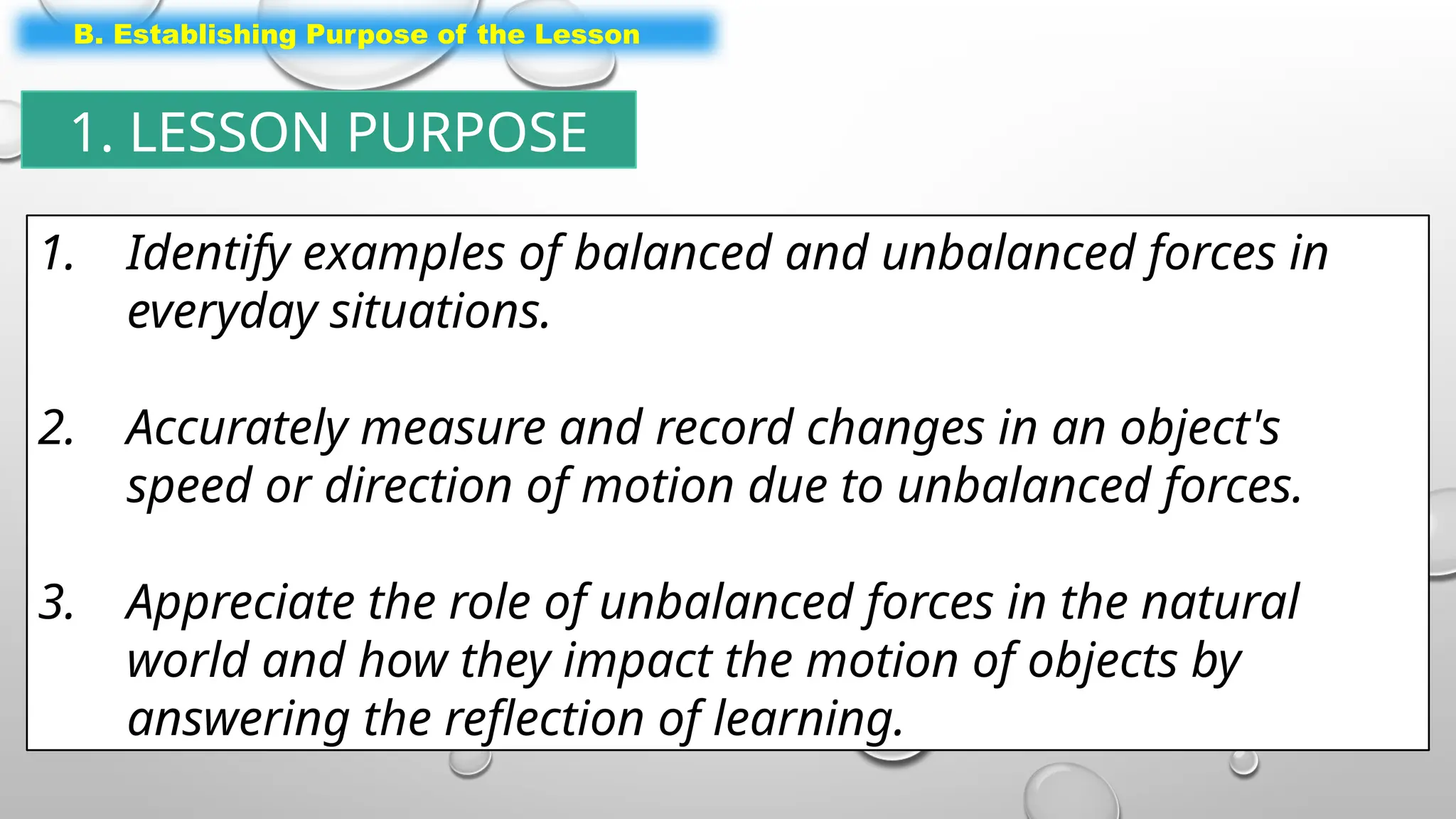
1. Identify examples of balanced and unbalanced forces in
everyday situations.
2. Accurately measure and record changes in an object's
speed or direction of motion due to unbalanced forces.
3. Appreciate the role of unbalanced forces in the natural world
and how they impact the motion of objects by answering the
reflection of learning.
OBJECTIVES
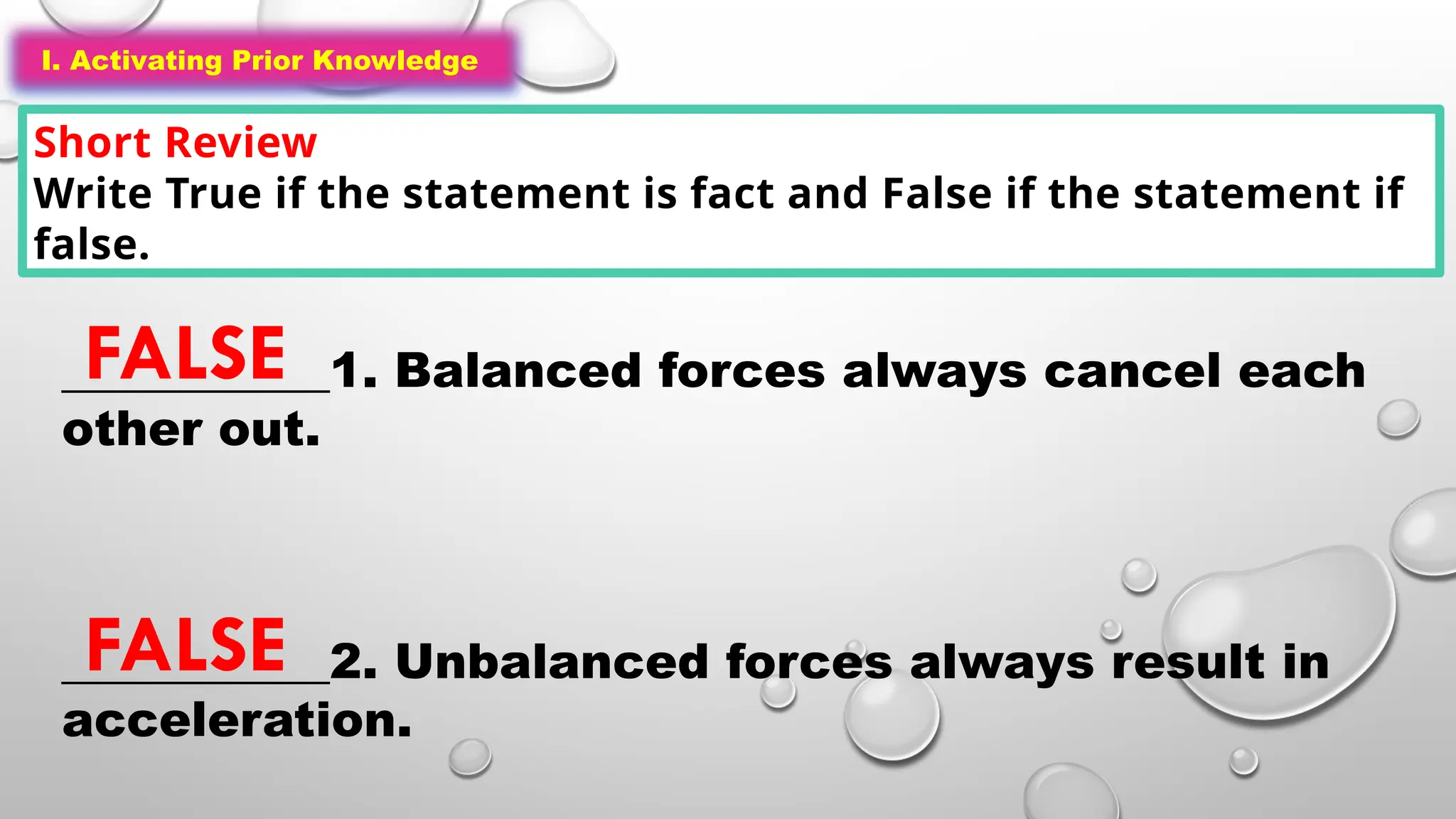
I. Activating Prior Knowledge
Short Review
Write True if the statement is fact and False if the statement if
false.
I. Activating Prior Knowledge
___________1. Balanced forces always cancel each
other out.
___________2. Unbalanced forces always result in
acceleration.
FALSE
FALSE
I. Activating Prior Knowledge
Short Review
Write True if the statement is fact and False if the statement if
false.
I. Activating Prior Knowledge
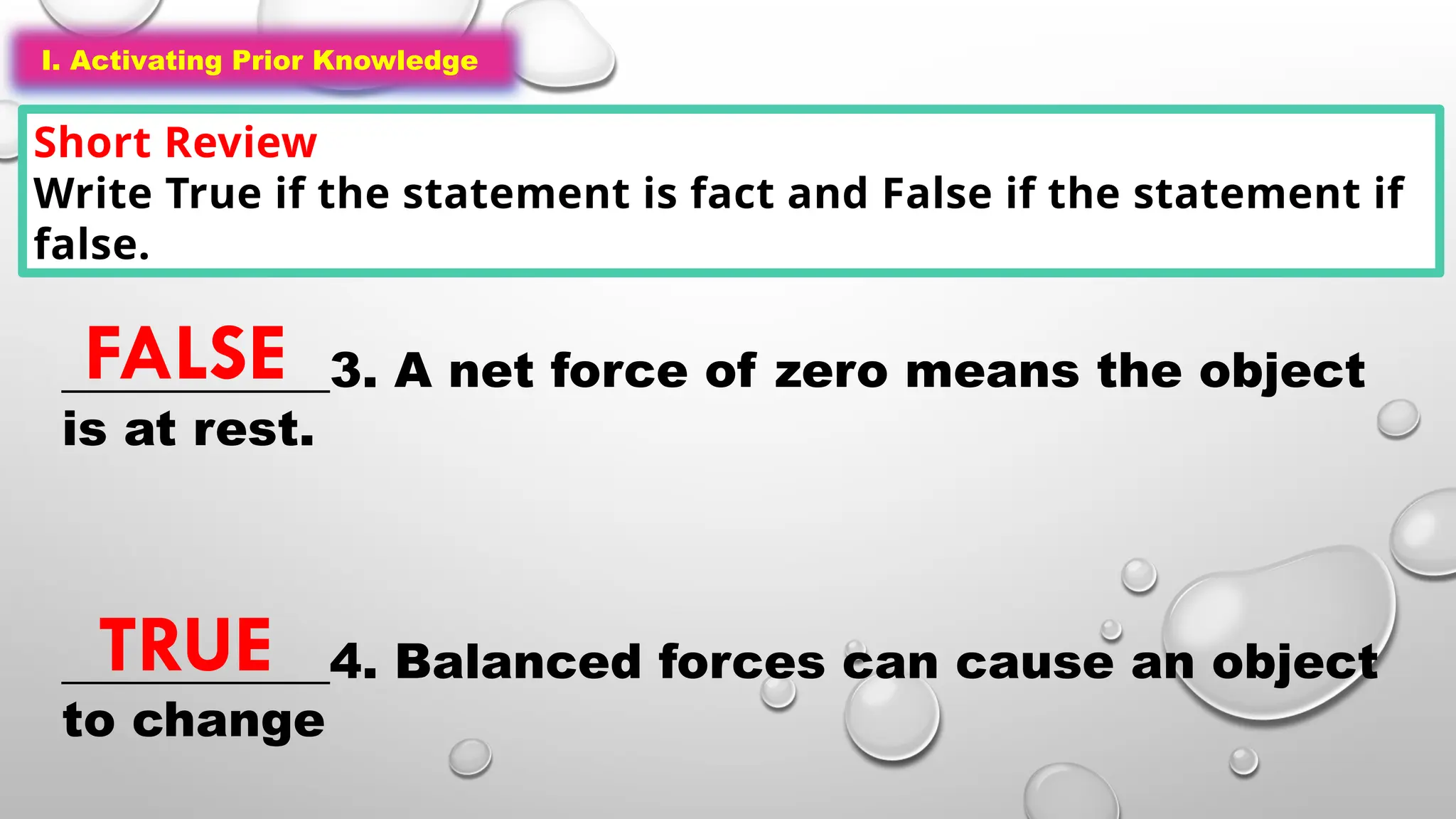
___________3. A net force of zero means the object
is at rest.
___________4. Balanced forces can cause an object
to change
FALSE
TRUE
I. Activating Prior Knowledge
Short Review
Write True if the statement is fact and False if the statement if
false.
I. Activating Prior Knowledge
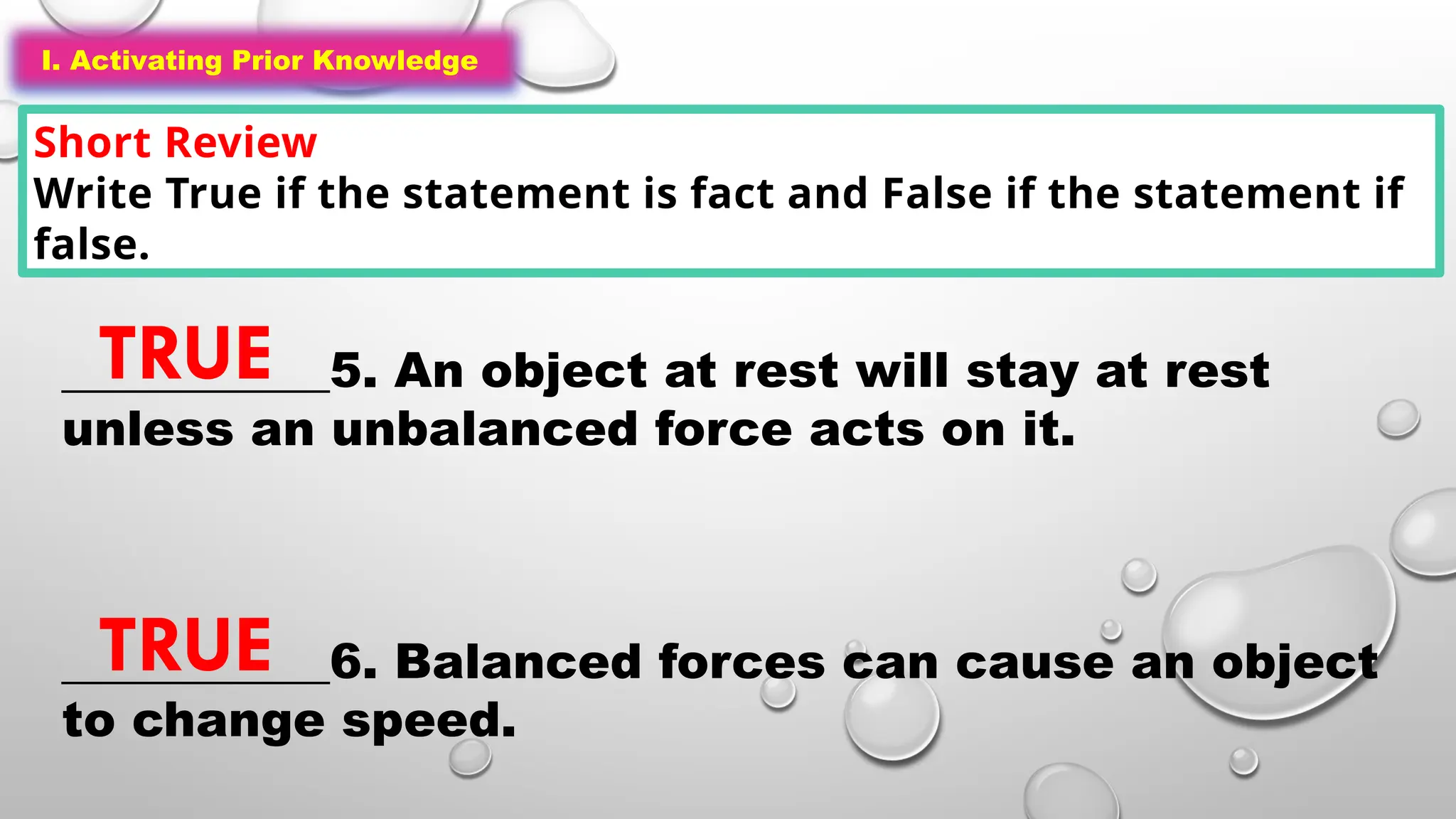
___________5. An object at rest will stay at rest
unless an unbalanced force acts on it.
___________6. Balanced forces can cause an object
to change speed.
TRUE
TRUE
I. Activating Prior Knowledge
Short Review
Write True if the statement is fact and False if the statement if
false.
I. Activating Prior Knowledge
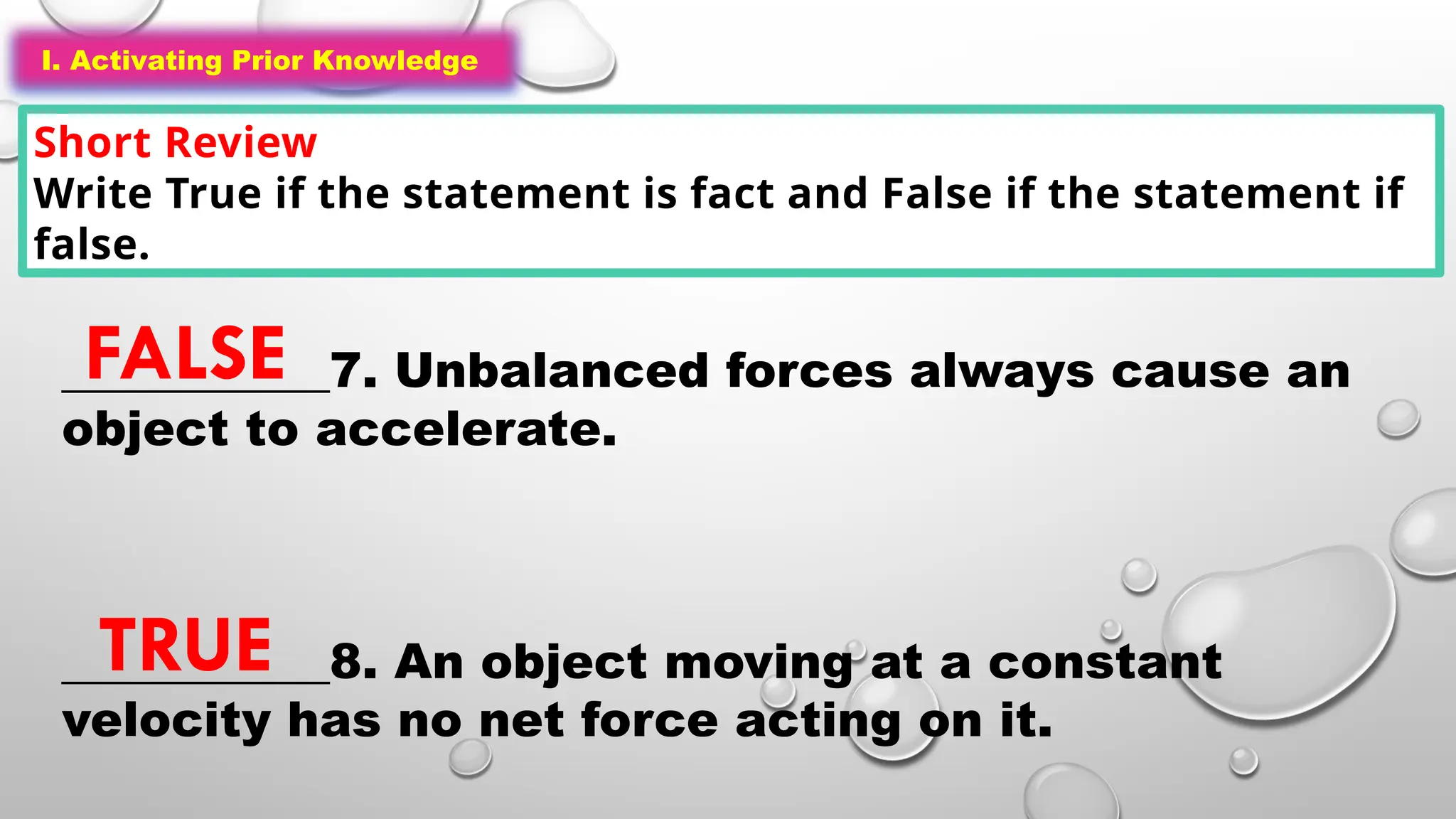
___________7. Unbalanced forces always cause an
object to accelerate.
___________8. An object moving at a constant
velocity has no net force acting on it.
FALSE
TRUE
I. Activating Prior Knowledge
Short Review
Write True if the statement is fact and False if the statement if
false.
I. Activating Prior Knowledge
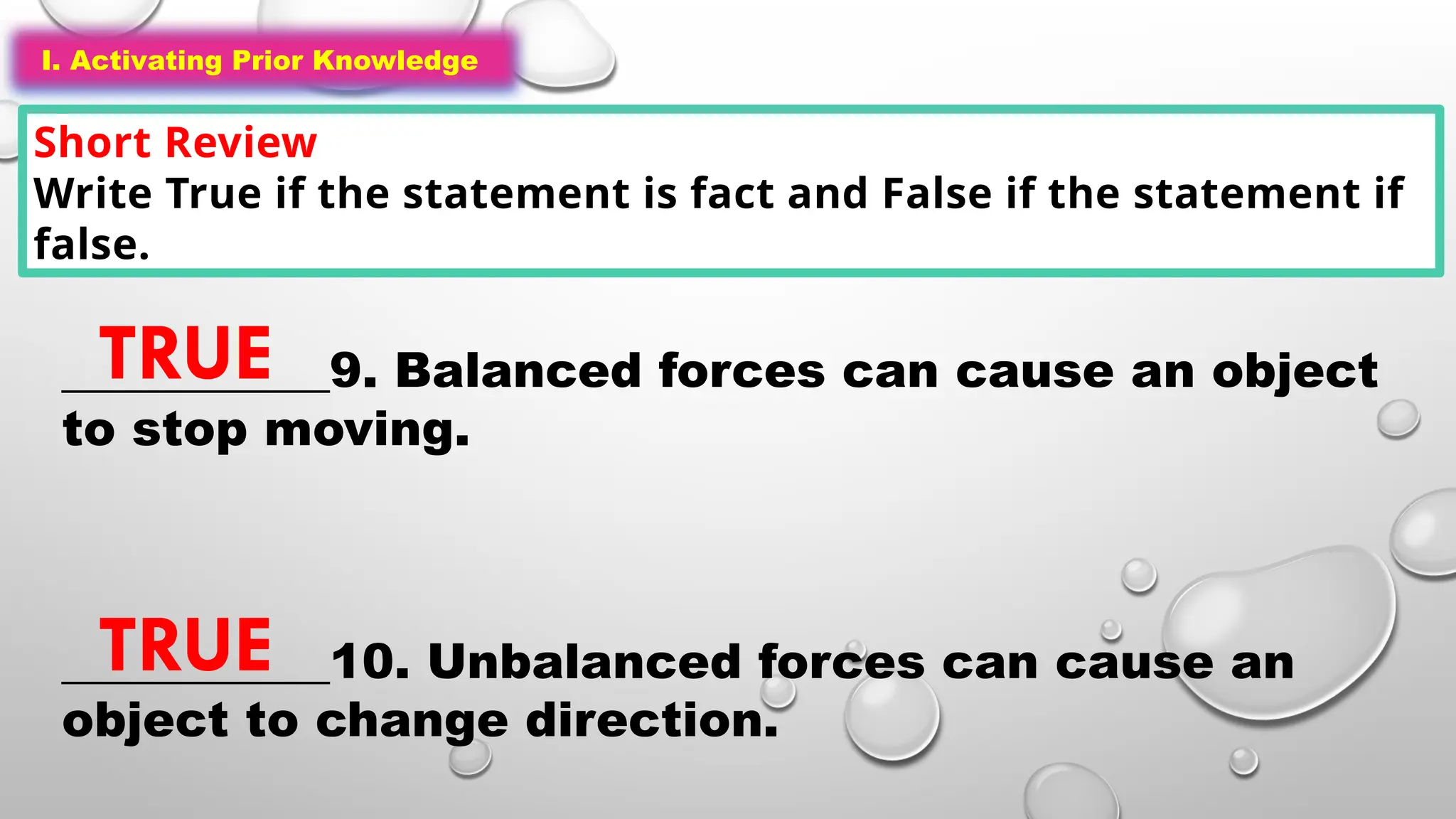
___________9. Balanced forces can cause an object
to stop moving.
___________10. Unbalanced forces can cause an
object to change direction.
TRUE
TRUE
1. Identify examples of balanced and unbalanced forces in
everyday situations.
2. Accurately measure and record changes in an object's
speed or direction of motion due to unbalanced forces.
3. Appreciate the role of unbalanced forces in the natural
world and how they impact the motion of objects by
answering the reflection of learning.
B. Establishing Purpose of the Lesson
1. LESSON PURPOSE
B. Establishing Purpose of the Lesson
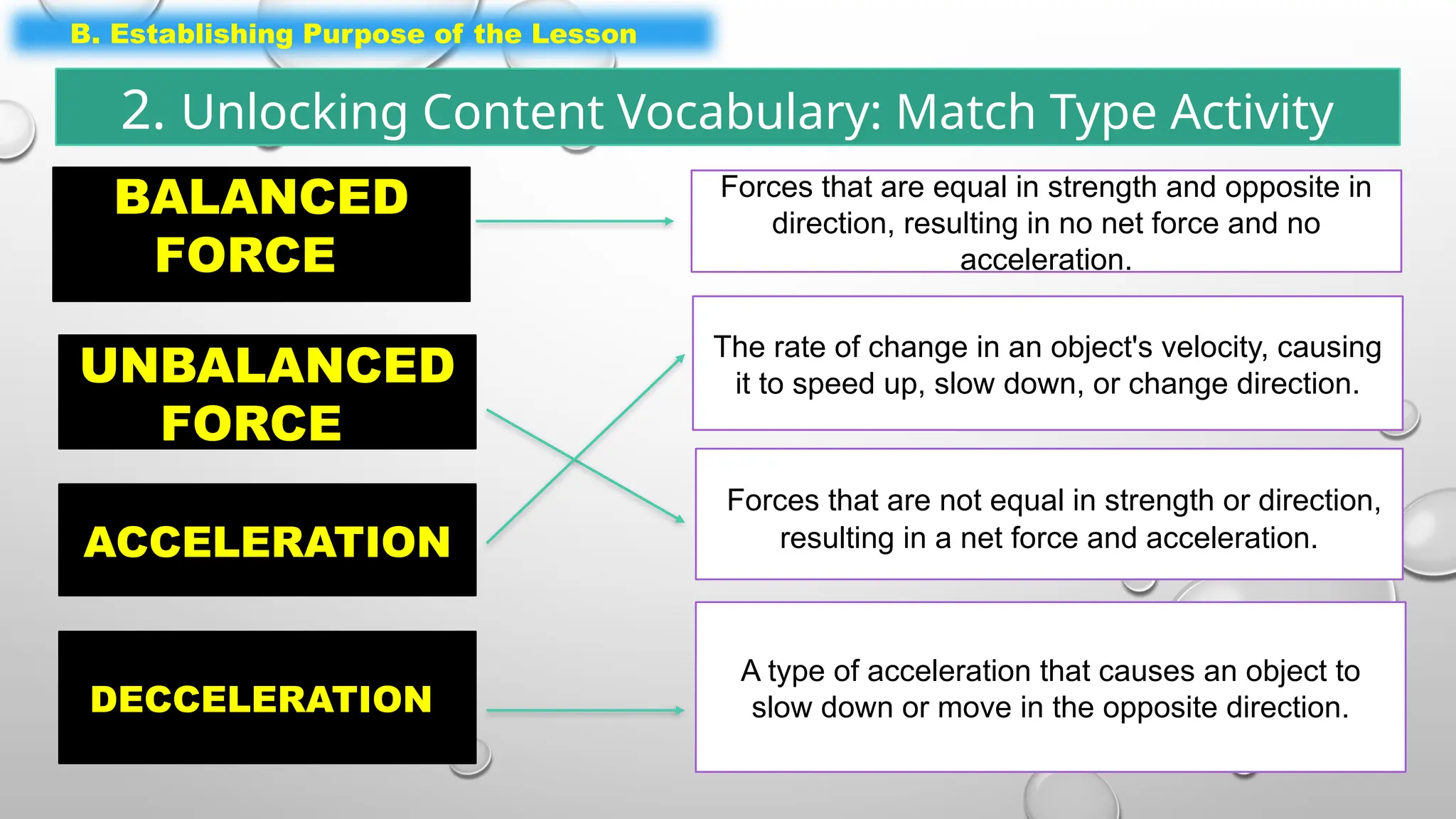
2. Unlocking Content Vocabulary: Match Type Activity
UNBALANCED
FORCE
ACCELERATION
DECCELERATION
Forces that are not equal in strength or direction,
resulting in a net force and acceleration.
The rate of change in an object's velocity, causing
it to speed up, slow down, or change direction.
A type of acceleration that causes an object to
slow down or move in the opposite direction.
BALANCED
FORCE
Forces that are equal in strength and opposite in
direction, resulting in no net force and no
acceleration.
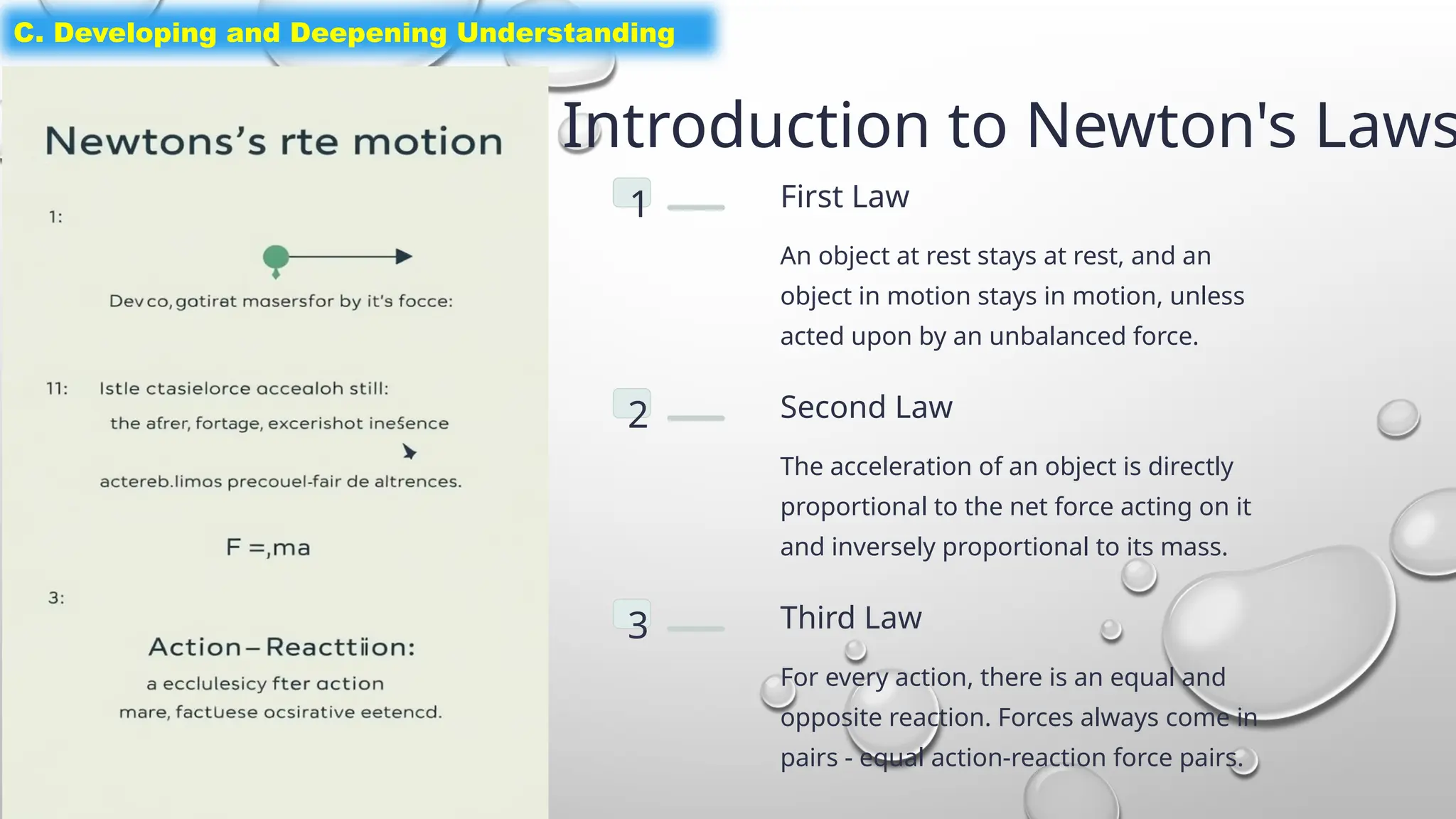
Introduction to Newton's Laws
1 First Law
An object at rest stays at rest, and an
object in motion stays in motion, unless
acted upon by an unbalanced force.
2 Second Law
The acceleration of an object is directly
proportional to the net force acting on it
and inversely proportional to its mass.
3 Third Law
For every action, there is an equal and
opposite reaction. Forces always come in
pairs - equal action-reaction force pairs.
C. Developing and Deepening Understanding
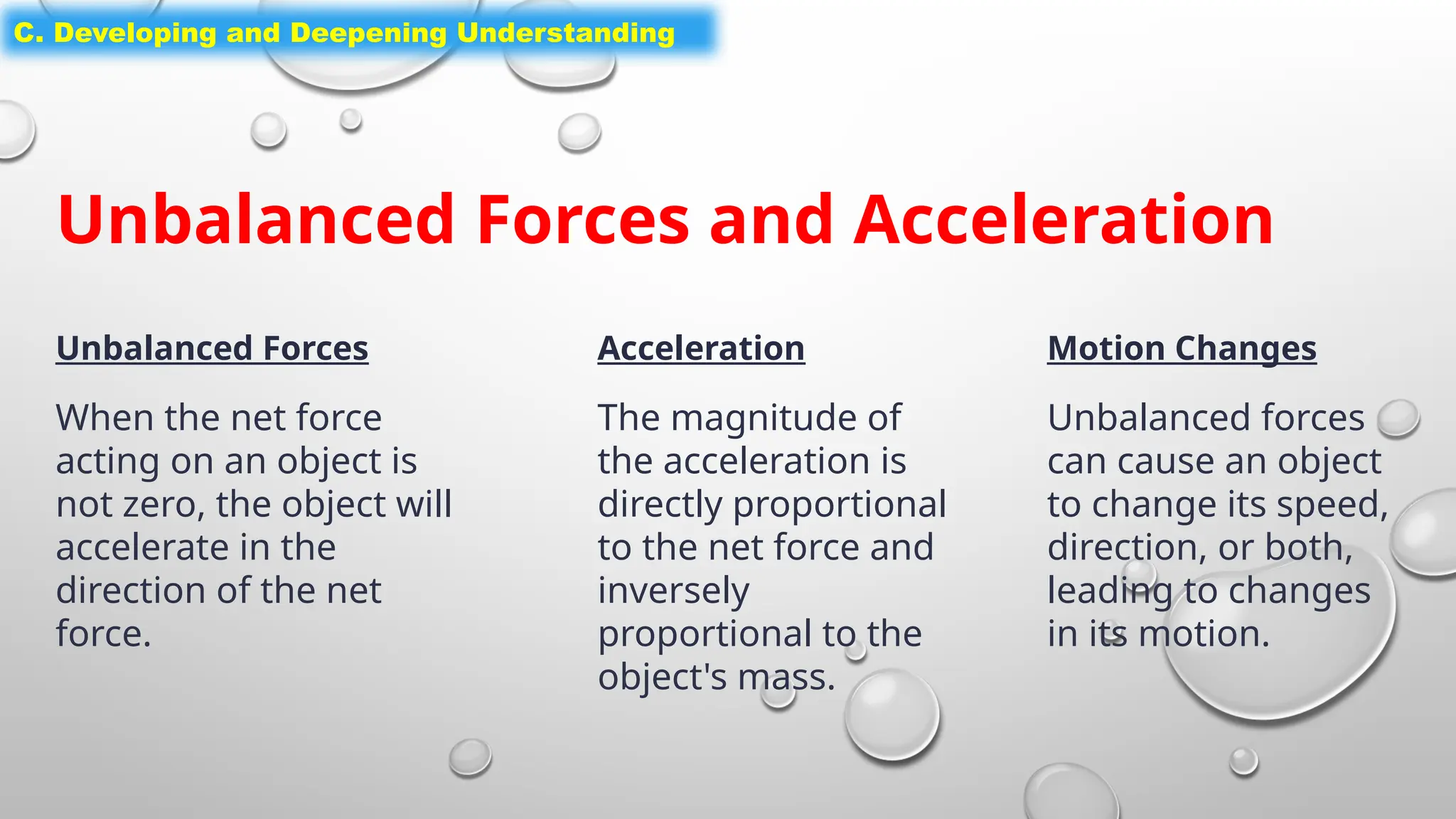
Unbalanced Forces and Acceleration
Unbalanced Forces
When the net force
acting on an object is
not zero, the object will
accelerate in the
direction of the net
force.
Acceleration
The magnitude of
the acceleration is
directly proportional
to the net force and
inversely
proportional to the
object's mass.
Motion Changes
Unbalanced forces
can cause an object
to change its speed,
direction, or both,
leading to changes
in its motion.
C. Developing and Deepening Understanding
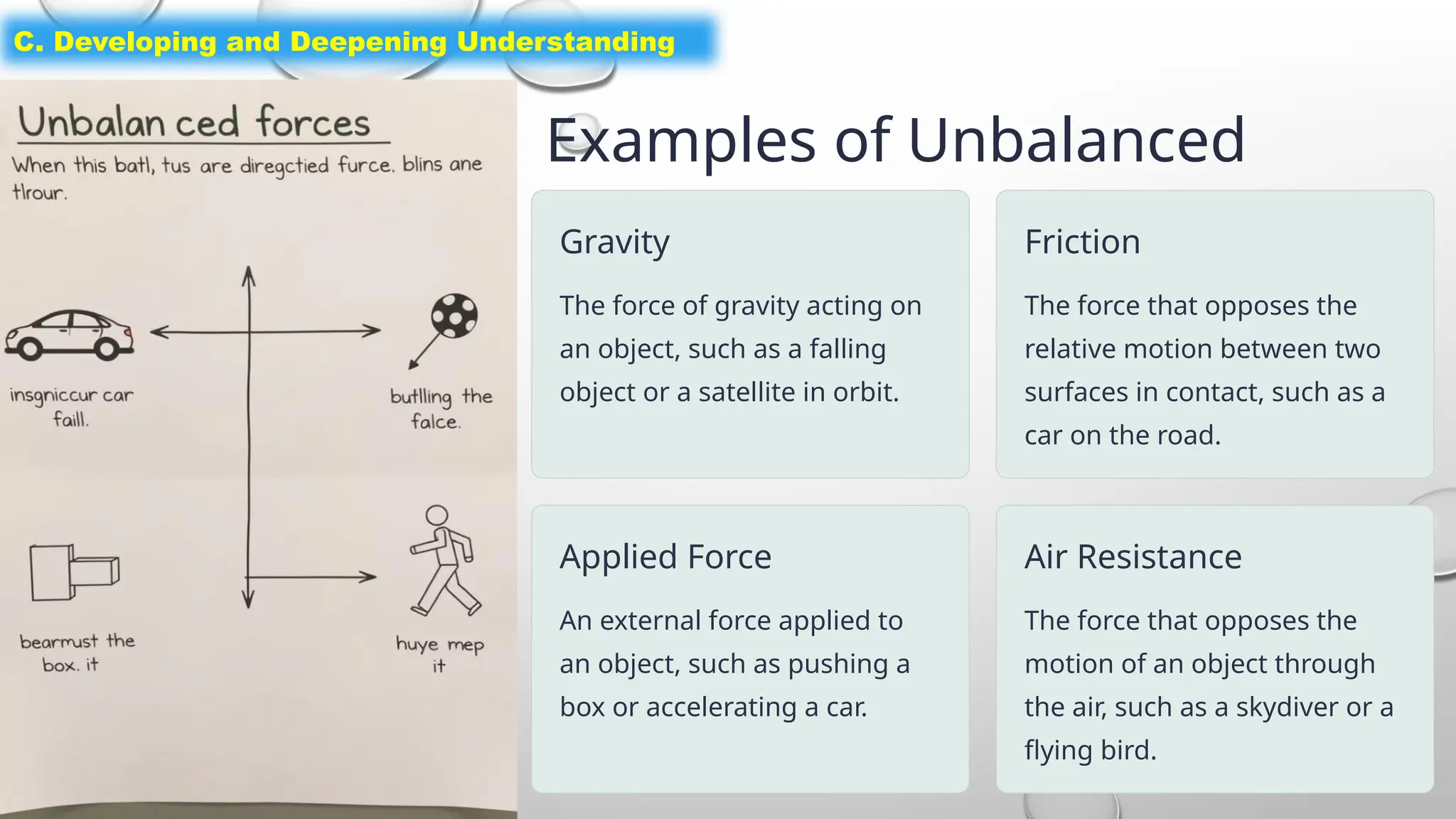
Examples of Unbalanced
Forces
Gravity
The force of gravity acting on
an object, such as a falling
object or a satellite in orbit.
Friction
The force that opposes the
relative motion between two
surfaces in contact, such as a
car on the road.
Applied Force
An external force applied to
an object, such as pushing a
box or accelerating a car.
Air Resistance
The force that opposes the
motion of an object through
the air, such as a skydiver or a
flying bird.
C. Developing and Deepening Understanding
Calculating Net Force and Acceleration
1 Net Force
The vector sum of
all the forces acting
on an object, which
determines the
object's
acceleration.
2 Newton's Second Law
The relationship
between net force,
mass, and
acceleration: F_net =
m * a.
3 Problem-Solving
Applying the
principles of
unbalanced forces to
calculate the net
force and
acceleration for
various scenarios.
C. Developing and Deepening Understanding
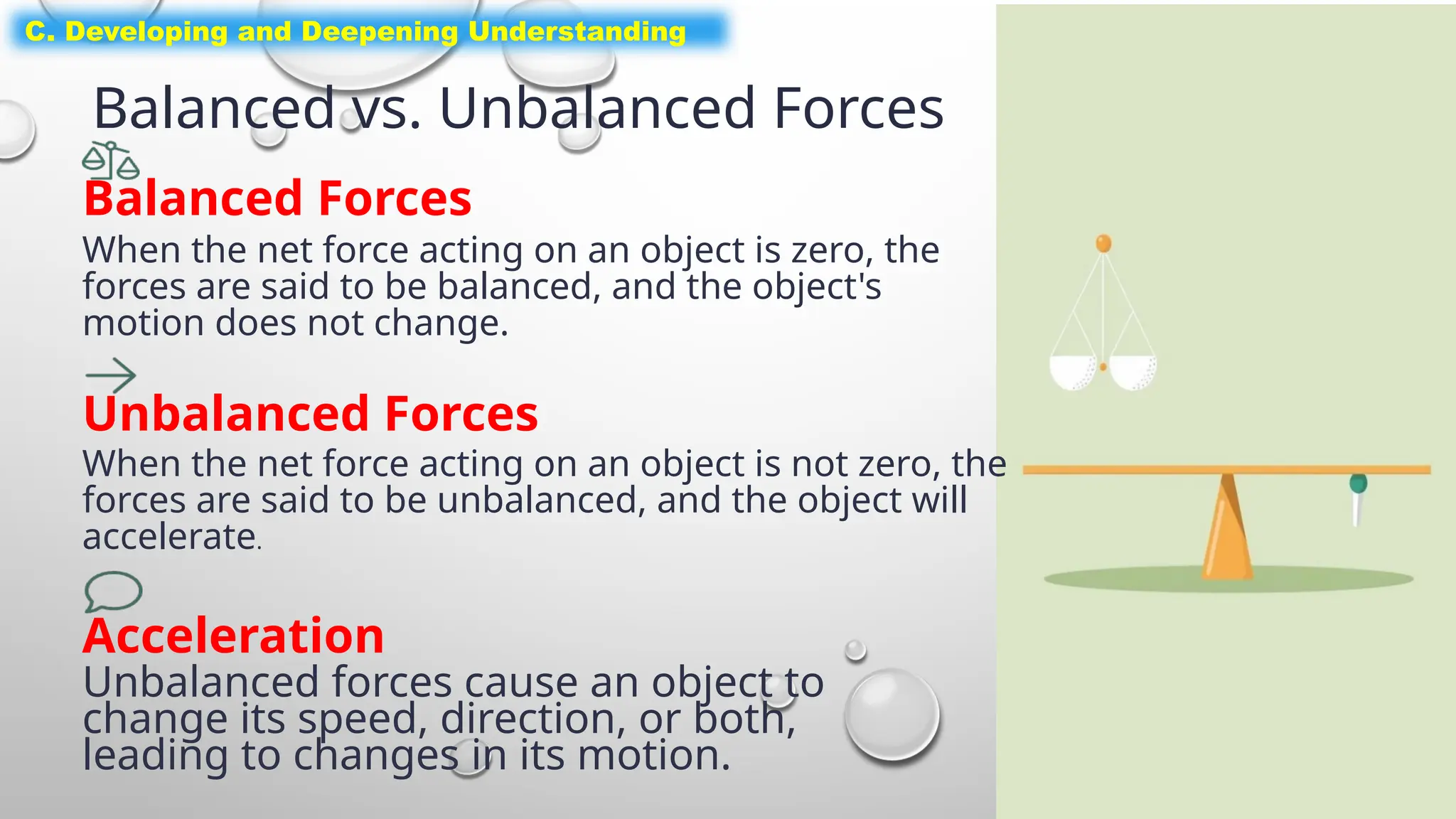
Balanced vs. Unbalanced Forces
Balanced Forces
When the net force acting on an object is zero, the
forces are said to be balanced, and the object's
motion does not change.
Unbalanced Forces
When the net force acting on an object is not zero, the
forces are said to be unbalanced, and the object will
accelerate.
Acceleration
Unbalanced forces cause an object to
change its speed, direction, or both,
leading to changes in its motion.
C. Developing and Deepening Understanding
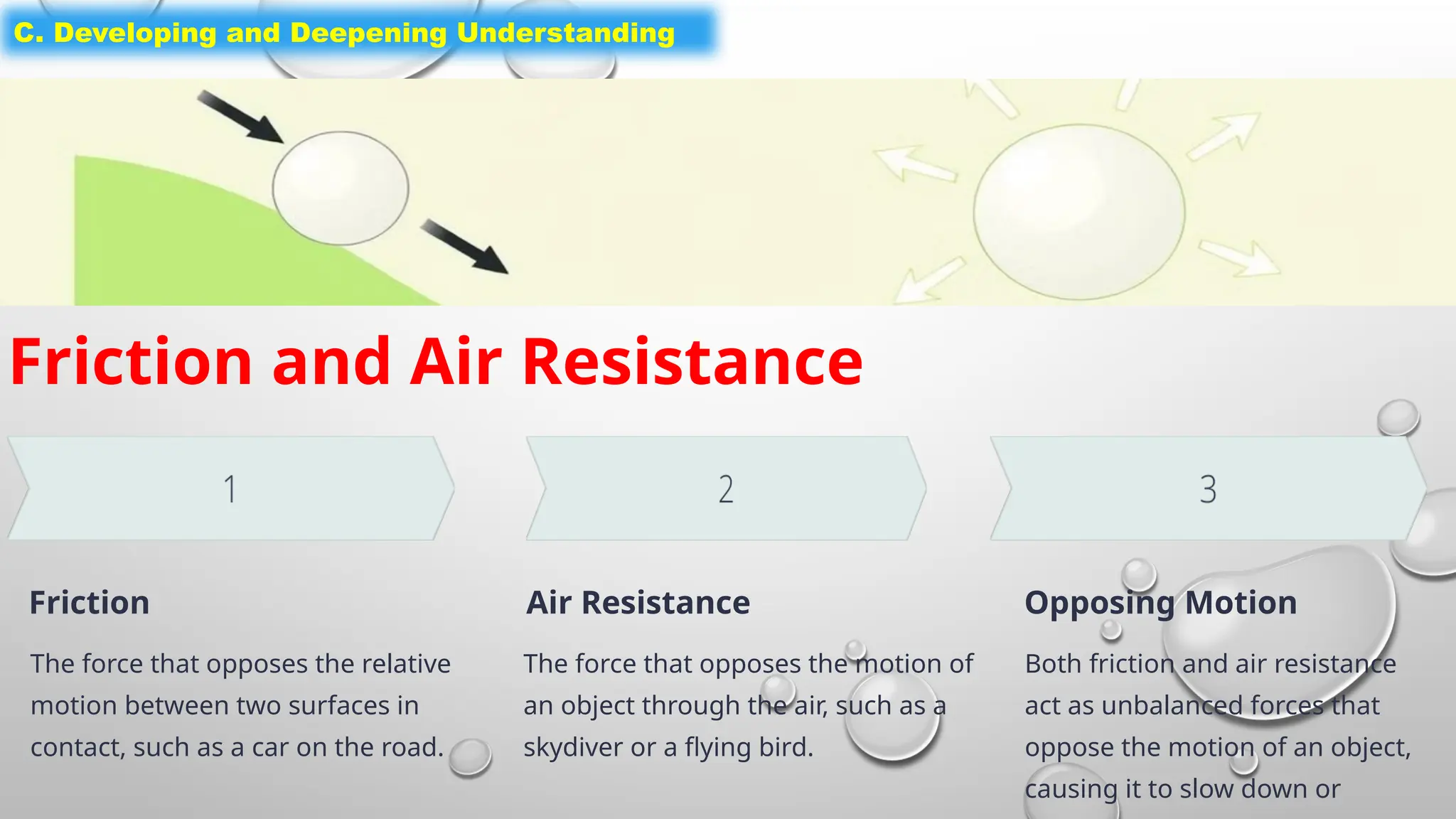
Friction and Air Resistance
Friction
The force that opposes the relative
motion between two surfaces in
contact, such as a car on the road.
Air Resistance
The force that opposes the motion of
an object through the air, such as a
skydiver or a flying bird.
Opposing Motion
Both friction and air resistance
act as unbalanced forces that
oppose the motion of an object,
causing it to slow down or
C. Developing and Deepening Understanding
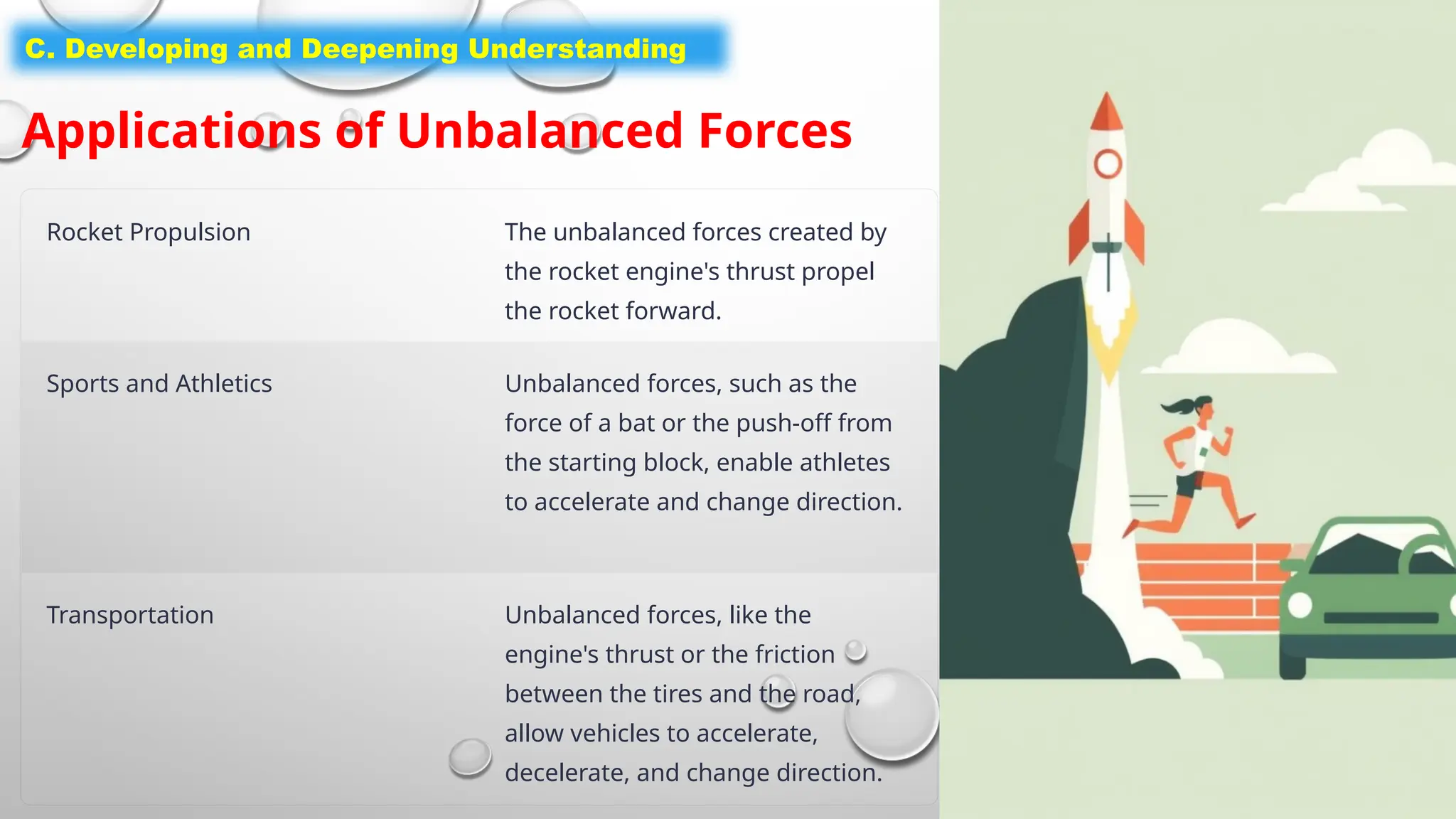
Applications of Unbalanced Forces
Rocket Propulsion The unbalanced forces created by
the rocket engine's thrust propel
the rocket forward.
Sports and Athletics Unbalanced forces, such as the
force of a bat or the push-off from
the starting block, enable athletes
to accelerate and change direction.
Transportation Unbalanced forces, like the
engine's thrust or the friction
between the tires and the road,
allow vehicles to accelerate,
decelerate, and change direction.
WORKED EXAMPLE
Read each statement below and determine if it is true or
false.
C. Developing and Deepening Understanding
1. Unbalanced forces are only
responsible for causing objects to
accelerate.
Explanations:
False - Unbalanced forces can cause objects to
accelerate, decelerate, or change direction.
WORKED EXAMPLE
Read each statement below and determine if it is true or
false.
C. Developing and Deepening Understanding
2. When braking a car, the unbalanced
force of friction causes the car to
decelerate.
Explanations:
True - The unbalanced force of friction between
the brake pads and wheels causes the car to
decelerate.
WORKED EXAMPLE
Read each statement below and determine if it is true or
false.
C. Developing and Deepening Understanding
3. Throwing a ball involves only
balanced forces, as the ball's motion is
constant.
Explanations:
False - Throwing a ball involves unbalanced
forces, as the initial muscular contraction and air
resistance cause changes in the ball's motion.
WORKED EXAMPLE
Read each statement below and determine if it is true or
false.
C. Developing and Deepening Understanding
4. Riding a bicycle uphill involves only
unbalanced forces, as the bicycle is
constantly accelerating.
Explanations:
True - Riding a bicycle uphill involves unbalanced
forces, as the force of gravity is greater than the force
of the pedals, causing the bicycle to decelerate.
WORKED EXAMPLE
Read each statement below and determine if it is true or
false.
C. Developing and Deepening Understanding
5. Opening a door requires an
unbalanced force to overcome the
door's initial inertia.
Explanations:
True - The unbalanced force of a person's push
or pull on the door overcomes the door's initial
inertia.
WORKED EXAMPLE
Read each statement below and determine if it is true or
false.
C. Developing and Deepening Understanding
6. During a rocket launch, air resistance
is the only unbalanced force acting on
the rocket.
Explanations:
False - During a rocket launch, the unbalanced
force of the rocket's thrust is the dominant force,
not just air resistance.
WORKED EXAMPLE
Read each statement below and determine if it is true or
false.
C. Developing and Deepening Understanding
7. Jumping involves only the unbalanced
force of gravity, as the person
accelerates downward.
Explanations:
False - Jumping involves both the unbalanced
force of the person's muscular contraction and the
unbalanced force of gravity.
WORKED EXAMPLE
Read each statement below and determine if it is true or
false.
C. Developing and Deepening Understanding
8. Unbalanced forces can cause objects
to change both speed and direction of
motion.
Explanations:
True - Unbalanced forces can cause changes in
both the speed and direction of an object's
motion.
WORKED EXAMPLE
Read each statement below and determine if it is true or
false.
C. Developing and Deepening Understanding
9. Balanced forces can never cause an
object to change direction.
Explanations:
False - Balanced forces can cause an object to
change direction, even if its speed remains
constant.
WORKED EXAMPLE
Read each statement below and determine if it is true or
false.
C. Developing and Deepening Understanding
10. Unbalanced forces are always
necessary for an object to maintain a
constant velocity.
Explanations:
True - Unbalanced forces are necessary for an object
to maintain a constant velocity, as balanced forces
would cause the object to remain at rest.
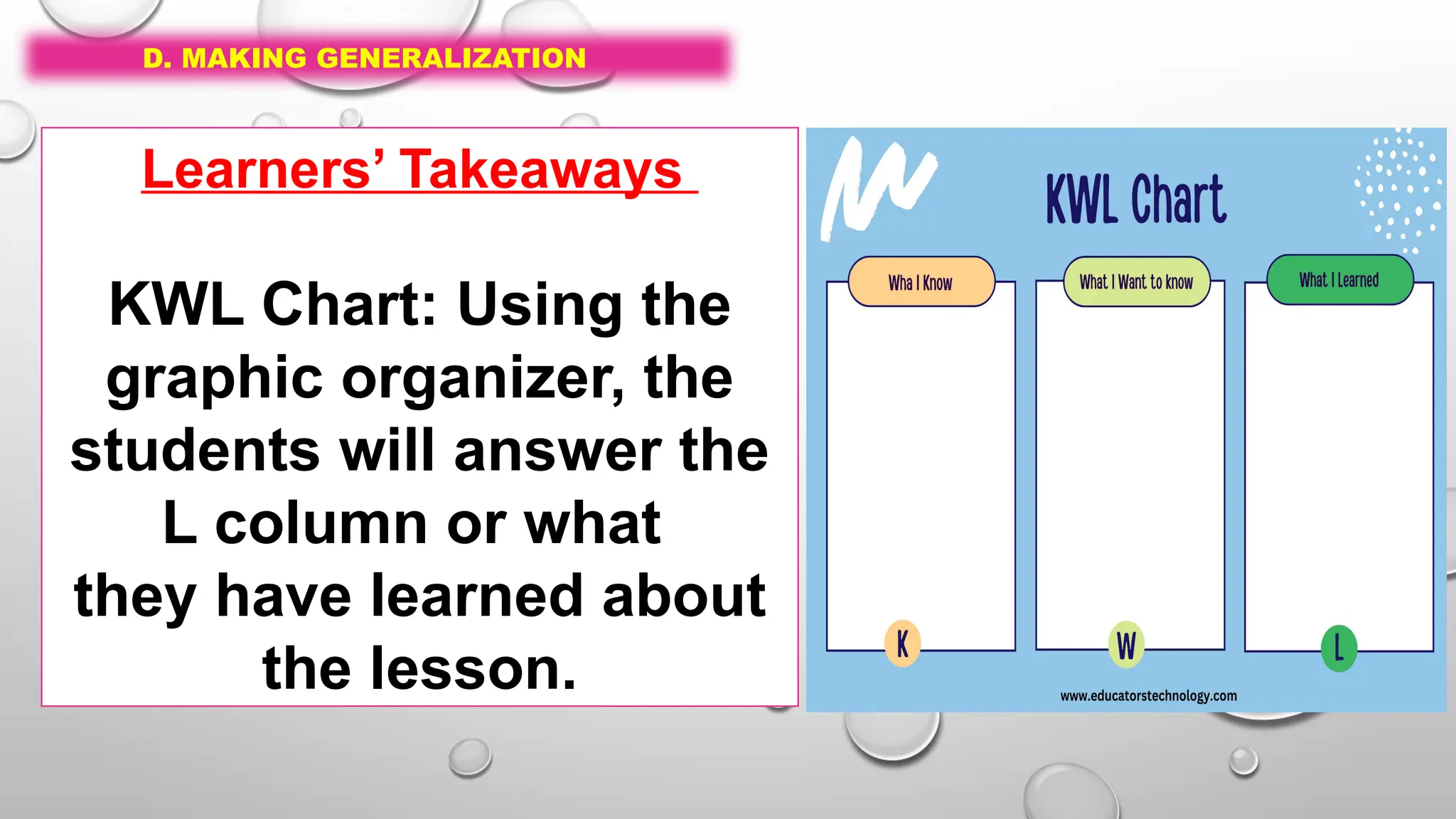
D. MAKING GENERALIZATION
Learners’ Takeaways
KWL Chart: Using the
graphic organizer, the
students will answer the
L column or what
they have learned about
the lesson.
D. MAKING GENERALIZATION
Reflection on Learning
1. How do unbalanced forces differ from balanced forces in
terms of their effects on an object's motion?
2. Provide an example of a scenario where unbalanced forces
cause an object to accelerate, and another example where
unbalanced forces cause an object to decelerate.
3. Explain how the concept of unbalanced forces can be applied
in real-world situations, such as braking a car or throwing a
ball.
E. EVALUATING LEARNING
_________ 1. What is the primary effect of
unbalanced forces on an object's motion?
a) They always cause the object to accelerate.
b) They always cause the object to decelerate.
c) They can cause the object to accelerate,
decelerate, or change direction.
d) They have no effect on the object's motion.
E. EVALUATING LEARNING
_________ 2. An object moving at a constant
velocity has:
a) Balanced forces acting on it.
b) No net force acting on it.
c) Both balanced and unbalanced forces acting
on it.
d) A net force of zero.
E. EVALUATING LEARNING
_________ 3. Balanced forces can cause an
object to:
a) Change speed only.
b) Change direction.
c) Both change speed and change direction.
d) Remain at rest
E. EVALUATING LEARNING
_________ 4. Unbalanced forces are responsible
for:
a) Keeping an object at rest.
b) Causing an object to accelerate or decelerate.
c) Canceling each other out.
d) Causing an object to change direction.
E. EVALUATING LEARNING
_________ 5. When braking a car, the
unbalanced force of:
a) Gravity
b) Friction
c) Air resistance
d) Thrust
E. EVALUATING LEARNING
_________ 6. When throwing a ball, the
unbalanced force that initially accelerates
the ball is the:
a) Force of gravity
b) Muscular contraction
c) Air resistance
d) Thrust
E. EVALUATING LEARNING
_________ 7. Riding a bicycle uphill
involves:
a) Only balanced forces
b) Unbalanced forces
c) Neither balanced nor unbalanced forces
d) Both balanced and unbalanced forces
E. EVALUATING LEARNING
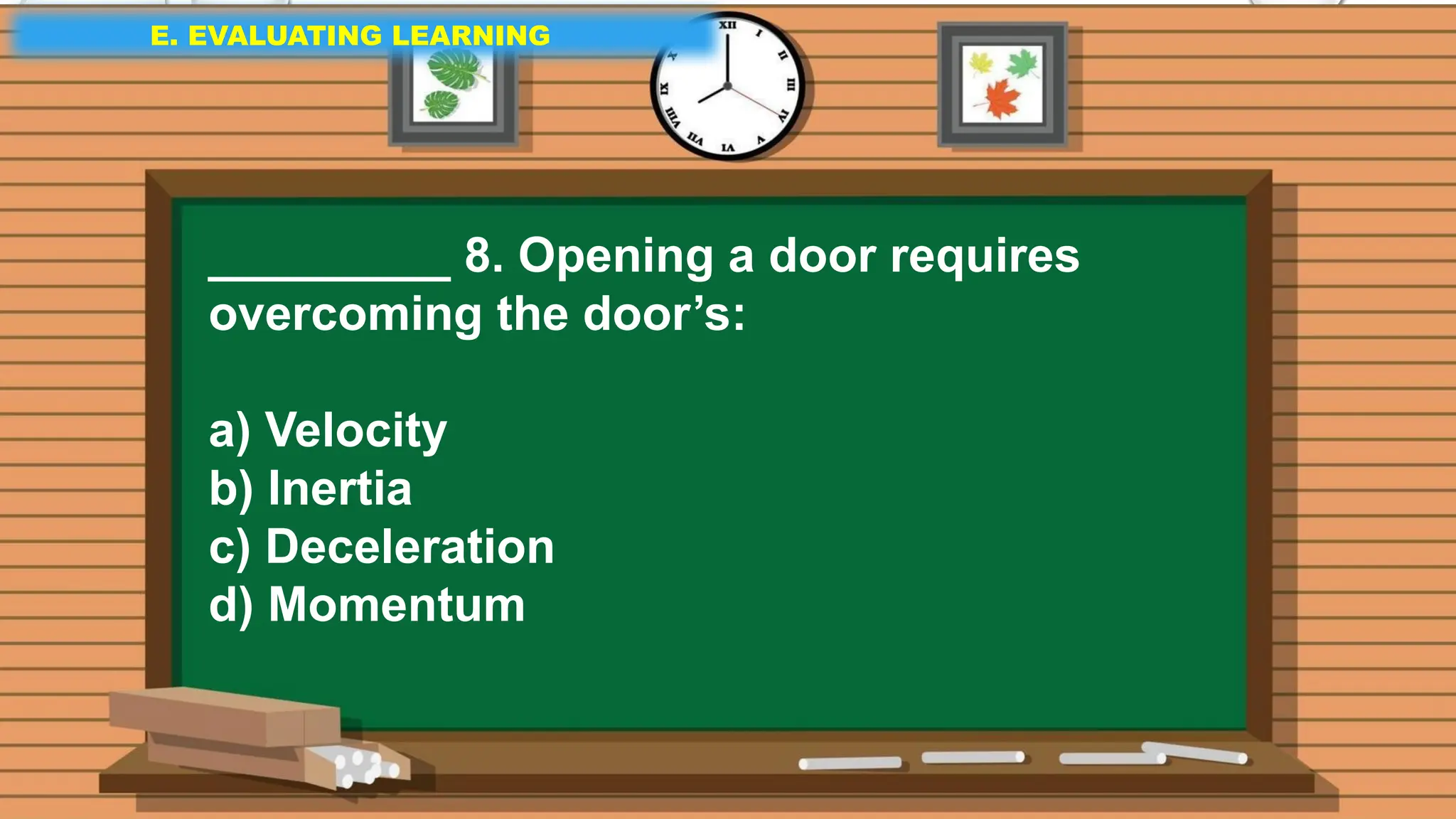
_________ 8. Opening a door requires
overcoming the door’s:
a) Velocity
b) Inertia
c) Deceleration
d) Momentum
E. EVALUATING LEARNING
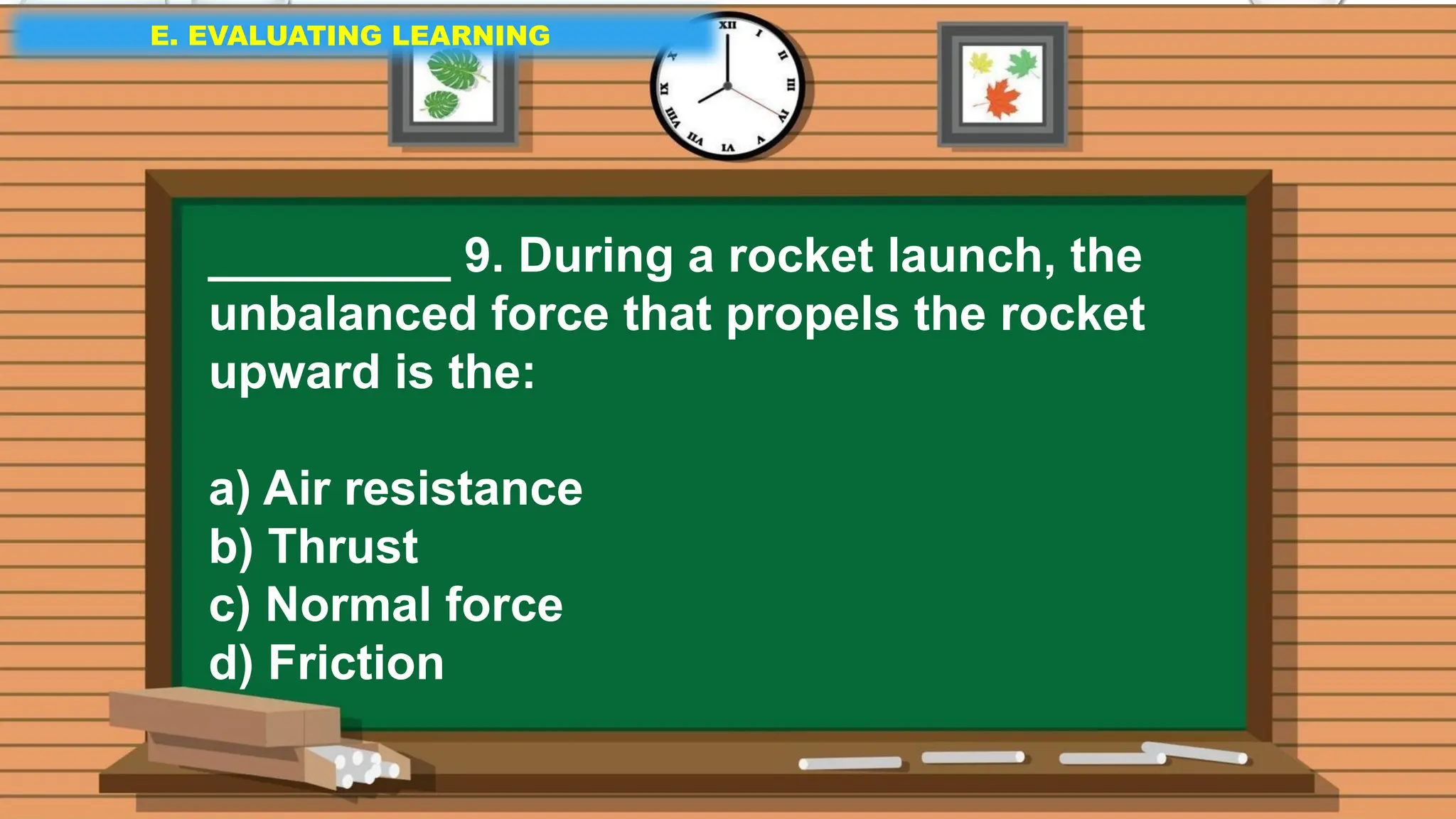
_________ 9. During a rocket launch, the
unbalanced force that propels the rocket
upward is the:
a) Air resistance
b) Thrust
c) Normal force
d) Friction
E. EVALUATING LEARNING
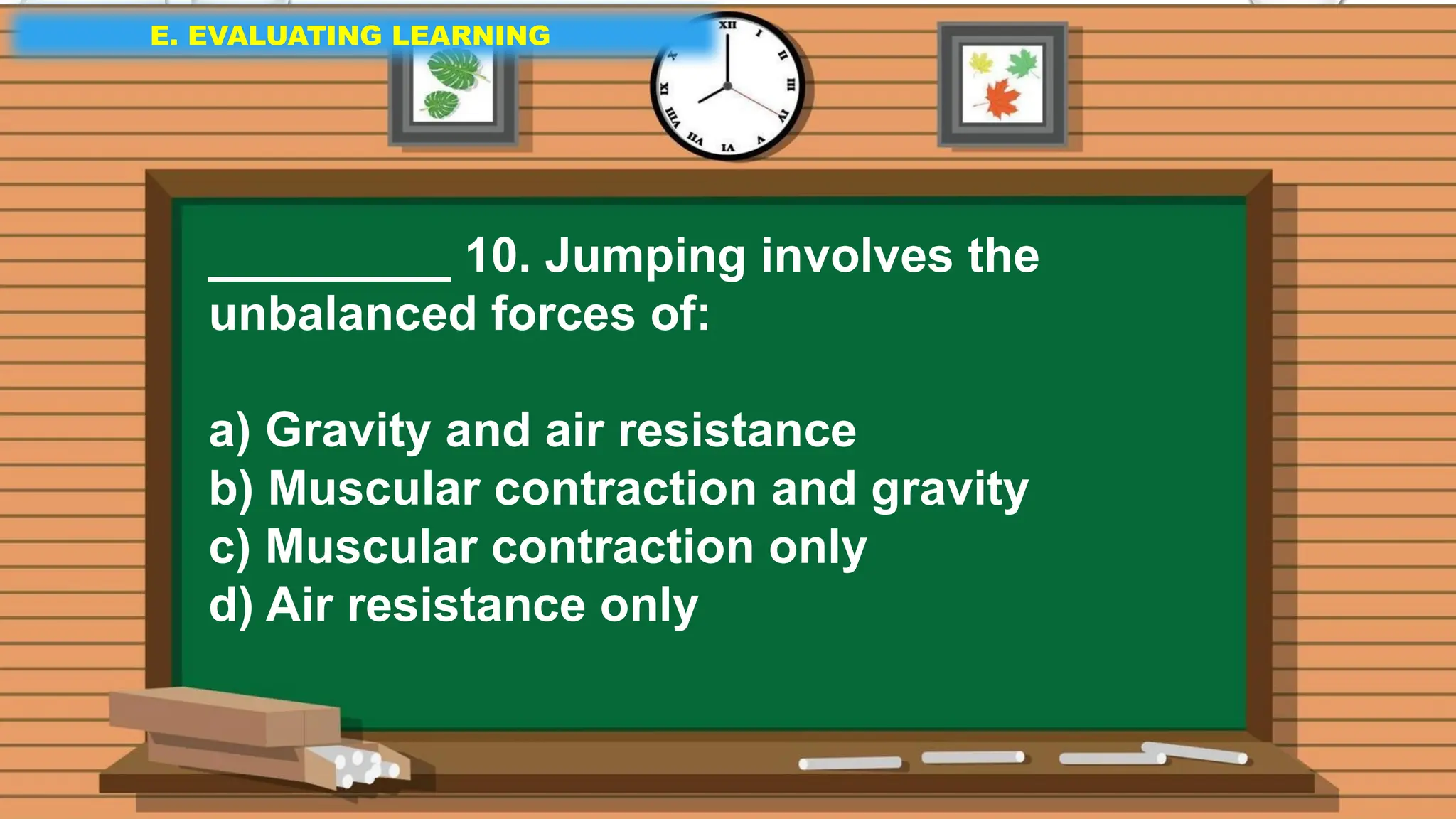
_________ 10. Jumping involves the
unbalanced forces of:
a) Gravity and air resistance
b) Muscular contraction and gravity
c) Muscular contraction only
d) Air resistance only
E. EVALUATING LEARNING
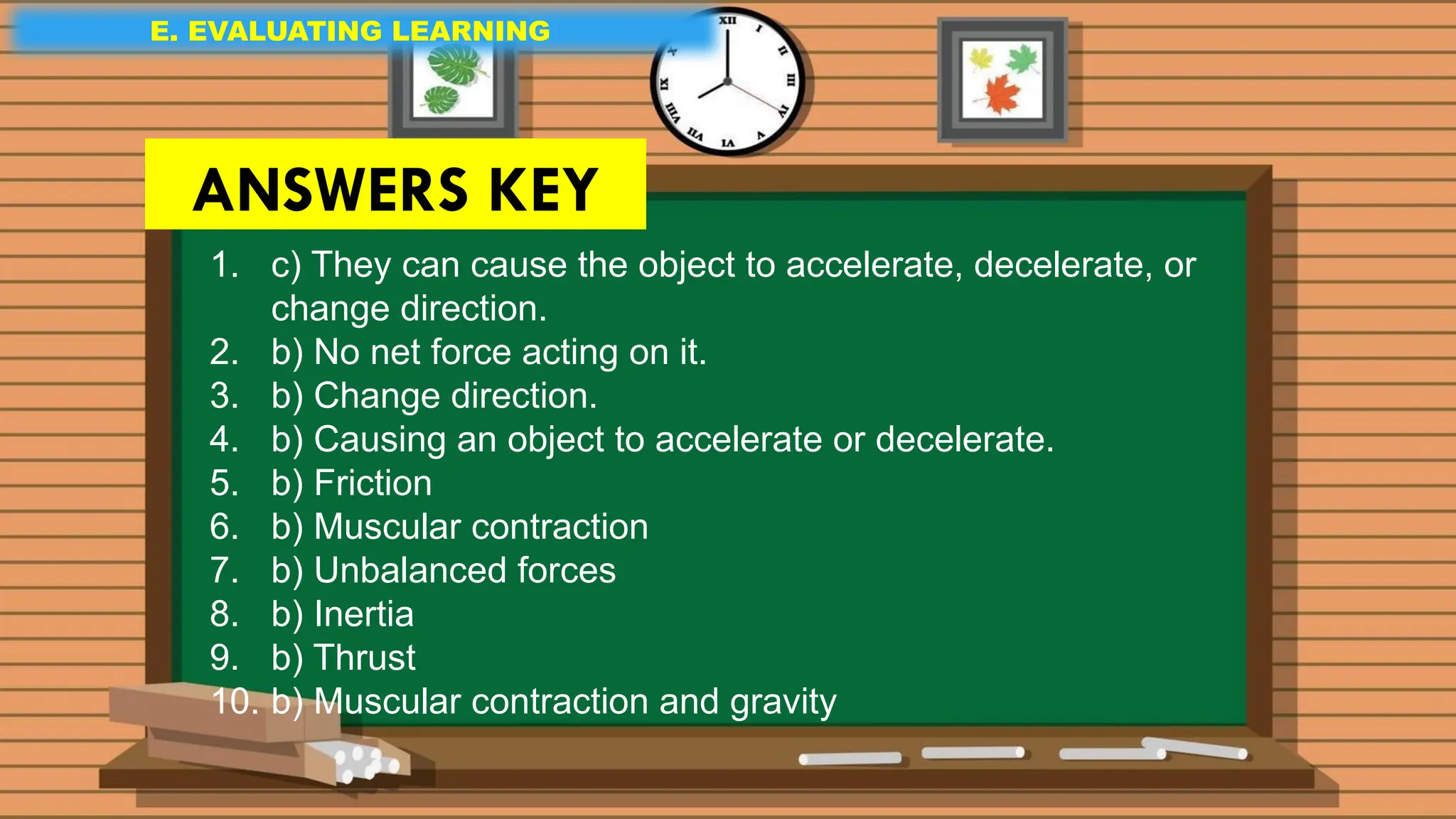
1. c) They can cause the object to accelerate, decelerate, or
change direction.
2. b) No net force acting on it.
3. b) Change direction.
4. b) Causing an object to accelerate or decelerate.
5. b) Friction
6. b) Muscular contraction
7. b) Unbalanced forces
8. b) Inertia
9. b) Thrust
10. b) Muscular contraction and gravity
ANSWERS KEY
Reference :
•Newton's Laws of Motion - This foundational physics concept explains how unbalanced forces cause
changes in an object's motion.
•Kinematics Equations - These equations describe the relationships between position, velocity,
acceleration, and time, which are all affected by unbalanced forces.
•Friction and Normal Forces - Understanding these two types of forces and how they interact is crucial for
analyzing unbalanced force scenarios.
•Inertia and Momentum - The concepts of inertia and momentum help explain how unbalanced forces
overcome an object's initial state of motion.
•Real-World Applications of Unbalanced Forces - Exploring examples like braking, throwing, and rocket
launches can reinforce the practical relevance of this topic.
•PhET Interactive Simulations - These online simulations allow students to explore the effects of balanced
and unbalanced forces on an object's motion.
•Textbooks or Online Resources on Introductory Physics - Comprehensive sources that cover the
fundamental principles of forces and motion in detail.

Q3-SCIENCE 7-LC 4.pptx physical sciences

  • 2.
  • 3.
    Unbalanced Forces andMotion CONTENT The learners learn that Scientists and engineers analyze forces to predict their effects on movement. LEARNING STANDARD The learners will identify that forces act between objects and can be measured. LEARNING COMPETENCY
  • 4.
    By the endof the lesson, the 80 percent of the learners will be able to: 1. Identify examples of balanced and unbalanced forces in everyday situations. 2. Accurately measure and record changes in an object's speed or direction of motion due to unbalanced forces. 3. Appreciate the role of unbalanced forces in the natural world and how they impact the motion of objects by answering the reflection of learning. OBJECTIVES
  • 10.
    I. Activating PriorKnowledge Short Review Write True if the statement is fact and False if the statement if false. I. Activating Prior Knowledge ___________1. Balanced forces always cancel each other out. ___________2. Unbalanced forces always result in acceleration. FALSE FALSE
  • 11.
    I. Activating PriorKnowledge Short Review Write True if the statement is fact and False if the statement if false. I. Activating Prior Knowledge ___________3. A net force of zero means the object is at rest. ___________4. Balanced forces can cause an object to change FALSE TRUE
  • 12.
    I. Activating PriorKnowledge Short Review Write True if the statement is fact and False if the statement if false. I. Activating Prior Knowledge ___________5. An object at rest will stay at rest unless an unbalanced force acts on it. ___________6. Balanced forces can cause an object to change speed. TRUE TRUE
  • 13.
    I. Activating PriorKnowledge Short Review Write True if the statement is fact and False if the statement if false. I. Activating Prior Knowledge ___________7. Unbalanced forces always cause an object to accelerate. ___________8. An object moving at a constant velocity has no net force acting on it. FALSE TRUE
  • 14.
    I. Activating PriorKnowledge Short Review Write True if the statement is fact and False if the statement if false. I. Activating Prior Knowledge ___________9. Balanced forces can cause an object to stop moving. ___________10. Unbalanced forces can cause an object to change direction. TRUE TRUE
  • 15.
    1. Identify examplesof balanced and unbalanced forces in everyday situations. 2. Accurately measure and record changes in an object's speed or direction of motion due to unbalanced forces. 3. Appreciate the role of unbalanced forces in the natural world and how they impact the motion of objects by answering the reflection of learning. B. Establishing Purpose of the Lesson 1. LESSON PURPOSE
  • 16.
    B. Establishing Purposeof the Lesson 2. Unlocking Content Vocabulary: Match Type Activity UNBALANCED FORCE ACCELERATION DECCELERATION Forces that are not equal in strength or direction, resulting in a net force and acceleration. The rate of change in an object's velocity, causing it to speed up, slow down, or change direction. A type of acceleration that causes an object to slow down or move in the opposite direction. BALANCED FORCE Forces that are equal in strength and opposite in direction, resulting in no net force and no acceleration.
  • 17.
    Introduction to Newton'sLaws 1 First Law An object at rest stays at rest, and an object in motion stays in motion, unless acted upon by an unbalanced force. 2 Second Law The acceleration of an object is directly proportional to the net force acting on it and inversely proportional to its mass. 3 Third Law For every action, there is an equal and opposite reaction. Forces always come in pairs - equal action-reaction force pairs. C. Developing and Deepening Understanding
  • 18.
    C. Developing andDeepening Understanding Unbalanced Forces and Acceleration Unbalanced Forces When the net force acting on an object is not zero, the object will accelerate in the direction of the net force. Acceleration The magnitude of the acceleration is directly proportional to the net force and inversely proportional to the object's mass. Motion Changes Unbalanced forces can cause an object to change its speed, direction, or both, leading to changes in its motion.
  • 19.
    C. Developing andDeepening Understanding Examples of Unbalanced Forces Gravity The force of gravity acting on an object, such as a falling object or a satellite in orbit. Friction The force that opposes the relative motion between two surfaces in contact, such as a car on the road. Applied Force An external force applied to an object, such as pushing a box or accelerating a car. Air Resistance The force that opposes the motion of an object through the air, such as a skydiver or a flying bird.
  • 20.
    C. Developing andDeepening Understanding Calculating Net Force and Acceleration 1 Net Force The vector sum of all the forces acting on an object, which determines the object's acceleration. 2 Newton's Second Law The relationship between net force, mass, and acceleration: F_net = m * a. 3 Problem-Solving Applying the principles of unbalanced forces to calculate the net force and acceleration for various scenarios.
  • 21.
    C. Developing andDeepening Understanding Balanced vs. Unbalanced Forces Balanced Forces When the net force acting on an object is zero, the forces are said to be balanced, and the object's motion does not change. Unbalanced Forces When the net force acting on an object is not zero, the forces are said to be unbalanced, and the object will accelerate. Acceleration Unbalanced forces cause an object to change its speed, direction, or both, leading to changes in its motion.
  • 22.
    C. Developing andDeepening Understanding Friction and Air Resistance Friction The force that opposes the relative motion between two surfaces in contact, such as a car on the road. Air Resistance The force that opposes the motion of an object through the air, such as a skydiver or a flying bird. Opposing Motion Both friction and air resistance act as unbalanced forces that oppose the motion of an object, causing it to slow down or
  • 23.
    C. Developing andDeepening Understanding Applications of Unbalanced Forces Rocket Propulsion The unbalanced forces created by the rocket engine's thrust propel the rocket forward. Sports and Athletics Unbalanced forces, such as the force of a bat or the push-off from the starting block, enable athletes to accelerate and change direction. Transportation Unbalanced forces, like the engine's thrust or the friction between the tires and the road, allow vehicles to accelerate, decelerate, and change direction.
  • 24.
    WORKED EXAMPLE Read eachstatement below and determine if it is true or false. C. Developing and Deepening Understanding 1. Unbalanced forces are only responsible for causing objects to accelerate. Explanations: False - Unbalanced forces can cause objects to accelerate, decelerate, or change direction.
  • 25.
    WORKED EXAMPLE Read eachstatement below and determine if it is true or false. C. Developing and Deepening Understanding 2. When braking a car, the unbalanced force of friction causes the car to decelerate. Explanations: True - The unbalanced force of friction between the brake pads and wheels causes the car to decelerate.
  • 26.
    WORKED EXAMPLE Read eachstatement below and determine if it is true or false. C. Developing and Deepening Understanding 3. Throwing a ball involves only balanced forces, as the ball's motion is constant. Explanations: False - Throwing a ball involves unbalanced forces, as the initial muscular contraction and air resistance cause changes in the ball's motion.
  • 27.
    WORKED EXAMPLE Read eachstatement below and determine if it is true or false. C. Developing and Deepening Understanding 4. Riding a bicycle uphill involves only unbalanced forces, as the bicycle is constantly accelerating. Explanations: True - Riding a bicycle uphill involves unbalanced forces, as the force of gravity is greater than the force of the pedals, causing the bicycle to decelerate.
  • 28.
    WORKED EXAMPLE Read eachstatement below and determine if it is true or false. C. Developing and Deepening Understanding 5. Opening a door requires an unbalanced force to overcome the door's initial inertia. Explanations: True - The unbalanced force of a person's push or pull on the door overcomes the door's initial inertia.
  • 29.
    WORKED EXAMPLE Read eachstatement below and determine if it is true or false. C. Developing and Deepening Understanding 6. During a rocket launch, air resistance is the only unbalanced force acting on the rocket. Explanations: False - During a rocket launch, the unbalanced force of the rocket's thrust is the dominant force, not just air resistance.
  • 30.
    WORKED EXAMPLE Read eachstatement below and determine if it is true or false. C. Developing and Deepening Understanding 7. Jumping involves only the unbalanced force of gravity, as the person accelerates downward. Explanations: False - Jumping involves both the unbalanced force of the person's muscular contraction and the unbalanced force of gravity.
  • 31.
    WORKED EXAMPLE Read eachstatement below and determine if it is true or false. C. Developing and Deepening Understanding 8. Unbalanced forces can cause objects to change both speed and direction of motion. Explanations: True - Unbalanced forces can cause changes in both the speed and direction of an object's motion.
  • 32.
    WORKED EXAMPLE Read eachstatement below and determine if it is true or false. C. Developing and Deepening Understanding 9. Balanced forces can never cause an object to change direction. Explanations: False - Balanced forces can cause an object to change direction, even if its speed remains constant.
  • 33.
    WORKED EXAMPLE Read eachstatement below and determine if it is true or false. C. Developing and Deepening Understanding 10. Unbalanced forces are always necessary for an object to maintain a constant velocity. Explanations: True - Unbalanced forces are necessary for an object to maintain a constant velocity, as balanced forces would cause the object to remain at rest.
  • 34.
    D. MAKING GENERALIZATION Learners’Takeaways KWL Chart: Using the graphic organizer, the students will answer the L column or what they have learned about the lesson.
  • 35.
    D. MAKING GENERALIZATION Reflectionon Learning 1. How do unbalanced forces differ from balanced forces in terms of their effects on an object's motion? 2. Provide an example of a scenario where unbalanced forces cause an object to accelerate, and another example where unbalanced forces cause an object to decelerate. 3. Explain how the concept of unbalanced forces can be applied in real-world situations, such as braking a car or throwing a ball.
  • 36.
    E. EVALUATING LEARNING E.EVALUATING LEARNING E. EVALUATING LEARNING _________ 1. What is the primary effect of unbalanced forces on an object's motion? a) They always cause the object to accelerate. b) They always cause the object to decelerate. c) They can cause the object to accelerate, decelerate, or change direction. d) They have no effect on the object's motion.
  • 37.
    E. EVALUATING LEARNING E.EVALUATING LEARNING E. EVALUATING LEARNING _________ 2. An object moving at a constant velocity has: a) Balanced forces acting on it. b) No net force acting on it. c) Both balanced and unbalanced forces acting on it. d) A net force of zero.
  • 38.
    E. EVALUATING LEARNING E.EVALUATING LEARNING E. EVALUATING LEARNING _________ 3. Balanced forces can cause an object to: a) Change speed only. b) Change direction. c) Both change speed and change direction. d) Remain at rest
  • 39.
    E. EVALUATING LEARNING E.EVALUATING LEARNING E. EVALUATING LEARNING _________ 4. Unbalanced forces are responsible for: a) Keeping an object at rest. b) Causing an object to accelerate or decelerate. c) Canceling each other out. d) Causing an object to change direction.
  • 40.
    E. EVALUATING LEARNING E.EVALUATING LEARNING E. EVALUATING LEARNING _________ 5. When braking a car, the unbalanced force of: a) Gravity b) Friction c) Air resistance d) Thrust
  • 41.
    E. EVALUATING LEARNING E.EVALUATING LEARNING E. EVALUATING LEARNING _________ 6. When throwing a ball, the unbalanced force that initially accelerates the ball is the: a) Force of gravity b) Muscular contraction c) Air resistance d) Thrust
  • 42.
    E. EVALUATING LEARNING E.EVALUATING LEARNING E. EVALUATING LEARNING _________ 7. Riding a bicycle uphill involves: a) Only balanced forces b) Unbalanced forces c) Neither balanced nor unbalanced forces d) Both balanced and unbalanced forces
  • 43.
    E. EVALUATING LEARNING E.EVALUATING LEARNING E. EVALUATING LEARNING _________ 8. Opening a door requires overcoming the door’s: a) Velocity b) Inertia c) Deceleration d) Momentum
  • 44.
    E. EVALUATING LEARNING E.EVALUATING LEARNING E. EVALUATING LEARNING _________ 9. During a rocket launch, the unbalanced force that propels the rocket upward is the: a) Air resistance b) Thrust c) Normal force d) Friction
  • 45.
    E. EVALUATING LEARNING E.EVALUATING LEARNING E. EVALUATING LEARNING _________ 10. Jumping involves the unbalanced forces of: a) Gravity and air resistance b) Muscular contraction and gravity c) Muscular contraction only d) Air resistance only
  • 46.
    E. EVALUATING LEARNING E.EVALUATING LEARNING E. EVALUATING LEARNING 1. c) They can cause the object to accelerate, decelerate, or change direction. 2. b) No net force acting on it. 3. b) Change direction. 4. b) Causing an object to accelerate or decelerate. 5. b) Friction 6. b) Muscular contraction 7. b) Unbalanced forces 8. b) Inertia 9. b) Thrust 10. b) Muscular contraction and gravity ANSWERS KEY
  • 47.
    Reference : •Newton's Lawsof Motion - This foundational physics concept explains how unbalanced forces cause changes in an object's motion. •Kinematics Equations - These equations describe the relationships between position, velocity, acceleration, and time, which are all affected by unbalanced forces. •Friction and Normal Forces - Understanding these two types of forces and how they interact is crucial for analyzing unbalanced force scenarios. •Inertia and Momentum - The concepts of inertia and momentum help explain how unbalanced forces overcome an object's initial state of motion. •Real-World Applications of Unbalanced Forces - Exploring examples like braking, throwing, and rocket launches can reinforce the practical relevance of this topic. •PhET Interactive Simulations - These online simulations allow students to explore the effects of balanced and unbalanced forces on an object's motion. •Textbooks or Online Resources on Introductory Physics - Comprehensive sources that cover the fundamental principles of forces and motion in detail.