Q Feature Article Analysis
By Meghan
General
The article doesn’t reveal a specific reason as to why the magazine could be interviewing her, as the article at this point is merely talking about her history.
However, they may be doing an article on her so that people can understand where she came from and what she’s trying to do with her music. The magazine
reflects the pop genre due to the artist that is being interviewed and the use of serif fonts, as pop music is usually associated with women and this is a more
feminine font. The red is a brighter red than rock magazines, which further demonstrates the pop genre as pop is usually about bright colours. The target
audience is probably young women from about 20, up to anybody who knows who the artist is. The article would be boring to anyone older, if they didn’t know
who the artist was, and the article talks about some problematic things which probably shouldn’t be read by anyone younger unless they’re mature.
The dps doesn’t specify if it is part of a regular feature, so we can assume it is not. However, we could also assume it is part of a regular spot where other
artists will do very similar things.
Mode of Address
The article seems to be quite formal and not very lighthearted, especially when talking about Lady Gaga’s life. There is lots of description of Lady Gaga and how
she looks during the article, as well as the setting they’re in. You don’t need to know a lot about Lady Gaga as the author is describing her life and things that she
has done, so you get a good picture of her. There is some taboo language, but only through quotes of what Lady Gaga is saying. There is mostly quotes directly
from the artist when it comes to what Lady Gaga is saying. However, there is very little that Lady Gaga says, and the majority is what the artist is saying about her.
There doesn’t seem to be any specific semantic fields in the text, and the only slang comes from Lady Gaga herself. For example, she calls herself a “nutter”.
Layout
The article is split into three columns of text, which allows more text to be able to go on the page. There seems to be an equal amount of text to pictures, as there
is a page of one photograph and all of the text. However, you could say that this means there is less photographs than text. There are no text wraps or bleeds
here. The questions in the text are implied which makes the artist seem more open, as if they’re talking to the readers directly.
On this page there is no title or subtitle. This happened on the previous page, where the title and subtitle took up the entire page(with another picture of Gaga on
the right hand side). By putting it on an entire page, the headline is definitely noticeable (the article was called She’s the Man, which is a popular phrase but is
being used here to reference the rumours that Lady Gaga is a hermaphrodite).
There are no bylines on this page. There are two drop caps here, however, you could also call the huge L a drop cap as it is the first letter of the article. The
article is extremely long and goes on to another page, with the sentence unfinished at the bottom. There are no box outs.
Images
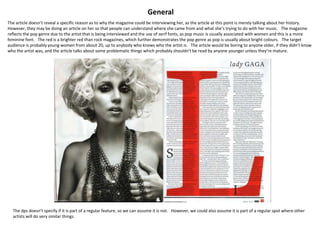
There is one huge mid shot here, taking up the entire page. It is a black and white studio shot with direct address being used. The picture highlights Lady Gaga as
being wrapped in chains, which could demonstrate how she feel she is not free to do what she wants to. As the picture takes up an entire page, the location of
the image demonstrates that it is one of the most important pictures from the photo shoot and needs to be seen in full glory. There is only one image on the
page, which demonstrates that it is the most important because it is by itself. There isn’t any kind of caption.
Small Details
There is a page number- the double page spread goes across page 46 and 47. The masthead itself is in a corner, next to the page number, as well as the date of
the issue. There is a small footer which contains the name of the website so that more people will go online.
The Article
Q Article
She’s the man.
Lady Gaga’s appearance at the Royal Variety Performance in December 2009 was
one of the most thrilling, audacious and unexpected moments of pop theatre. In
front of the Queen, Gaga sang Speechless while sitting at a surreal 13-foot-high,
spindle-legged piano. Perhaps even more outrageous was the outfit she wore
while playing it: a neon scarlet Queen Elizabeth 1- style S&M latex number,
complete with chin-high ruff and comedy 20 foot train. Even more bizarrely, the
official photos of Lady Gaga meeting the current Queen show that Her Majesty was
definitely amused.
Today, though, she has a less monarch-tickling idea for her increasingly subversive
crusade.
“I want to wear a dick strapped to my vagina,” she announces cheerfully, puffing a
Marlboro Light in the penthouse suite of London’s May Fair hotel. “We all know
one of the biggest talking points of the year was that I have a dick, so why not give
them what they want? I want to comment on that in a beautiful, artistic way. How I
wanna show it. And I want to call this piece Lady Gaga Dies Hard.”
In the 16 months since Lady Gaga released her debut album, the Fame, she has
confounded the mores of contemporary pop by wearing, variously, a coat made of
Kermit The Frog dolls, a lightbulb-festooned catsuit and a face obliterating black
PVC gimp mask. But what’s unusual here is not that Lady Gaga is about to wear a
strap-on penis for her first Q cover shoot- itself a response to the rumours that
she’s either a hermaphrodite or a bloke- but that she has, at 23, become so
artistically confident that she intends to commandeer it with not only her own
photographic concept but the title of the story itself.
“It’d be a real fucking story, right?” she says with a smile. “Come on, come see me
try to persuade everyone to let me wear a penis.”
Since her debut single, Just Dance, crashed to Earth with the force of a meteorite
in 2008, Lady Gaga has become both the biggest and the most extreme pop star on
the planet. With more than eight million albums sales and three global Number 1s
to her name, she is mainstream culture’s most controversial “nutter”, a wilfully
preposterous cartoon amalgam of a Tate Modern Madonna, Salvador Dali, Marilyn
Monroe, David Bowie, Francis Bacon and the special effects department of Doctor
Who on hallucinogenic narcotics. She’s friends with Beyoncé, Kanye West, been
shot by stellar photographers Mario Testino and David LaChapelle, and influenced
fashion itself, from Jean Paul Gautier’s sci-fi themed collection to the increasingly
outré-styles of Rihanna and Lily Allen.
But none of this would have happened without those euphoric, globe-throttling
singles, each eclipsing the last until Bad Romance eclipsed just about everything. A
pan-dimensional disco epic about falling in love with your best friend and
celebrating the human “inner psycho”, its futuristic kidnap video, as Gaga puts it,
“explores how the entertainment industry stimulates human trafficking, the
woman as commodity.”
Right now, the Diva of Dada sits cross-legged on a silvery L-shaped velvet sofa, as
serene as an alabaster sculpture. Today is out first meeting; the plan is to follow it
up by going on the road with her on her Monster Ball tour. She wears nothing on
her head but a wig (a bouffant ‘70s disco-meets-Marilyn Monroe marvel). She
stares straight at you with enormous brown eyes, bewitchingly younger and
prettier in the flesh, with a glorious Jewish nose. Her black silk dressing gown
continually edges apart, exposing her small, real and undeniably female bare
breasts. We are discussing the “Lady Gaga is a hermaphrodite” rumours. It is, she
decides, an example of an old story, namely the public savaging of highly sexual
women- something that happened before with Madonna.
“When a guy says, Oh, I fucked all these chicks this week, there a high-five and
giggling,” notes Gaga, puffing away on her cigarette. “But when a woman does it
and it’s publicised or she’s open about her sexuality or she’s free, or liberated, it’s
Oh, she must have a dick. There’s a threat. I also carry myself onstage in a
masculine way and sing in a low register. This is not out of nowhere, right?”
Lady Gaga is mental, in every sense of the term: cerebral, earnest, comically
pretentious, unapologetically cryptic and continuously in deference to “my
beautiful fans”, more befitting a 70-year-old showbiz veteran. But then she’s been
a star-in-waiting for most of her life. Born Stefani Joanne Angelina Germanotta to
a middle-class New York Italian-American family (her dad Joseph, 53, a sometime
long-haired rock ‘n’ roll bar musician, became a wealthy internet entrepreneur),
she was prodigiously talented child who learnt piano by ear at age four. She was
educated at a Catholic high school, the Convent Of The Sacred Heart, where she
was a straight-A student, albeit one who defied the nuns’ strictures by wearing her
skirts “really high” and worshipping Judy Garland, David Bowie and Led Zeppelin.
“I wanted to be Boy George,” she notes. “I was a freak, a little bit insecure, my
personality didn’t fit it- and I guess that what I’m all about.”
By 15 she was already singing and playing piano in nightclubs, and at 17 and was
accepted into the prestigious Tisch School of the Arts (alumni: Woody Allen,
Angelina Jolie, Martin Scorsese), one of only 20 students in its 45-year history to
enrol early. At 19, determined to make her own money, she waitressed and gog-
go danced in New York dive bars, had sexual relationships with women (although
she says she only fell in love with men) and developed a cocaine habit. This
involved having “bags and bags of cocaine” delivered to her apartment, where
she’d snort the drug alone for hours, listening to The Cure and making herself up as
classic David Bowie.
The Article (continued
Q Article
She’s the man.
By 2006, she had signed a publishing deal with Interscope (an earlier deal with Def
Jam, when she was 19, ended when she was dropped) to write songs for other
people, including Britney Spears, Pussycat Dolls, and Fergie of The Black Eyed Peas.
But she was still supplementing her earnings performing as one half of burlesque
cavalcade Lady Gaga and The Starlight Revue. Her artistic partner was Lady
Starlight, a philosophy graduate and metal-obsessed DJ. Gaga had suggested the
pair create a pop/metal hybrid, combining Gaga’s pop spectacle with Starlight’s
heavier rock sensibility. Gaga performed in front of bawdy rock crowds, dressed n
$10 cheetah-print bikinis and native American head-dresses, wielding hatchets as
she flailed along to Iron Maiden’s Run To The Hills.
“She was in the commercial pop world, which didn’t encourage risk,” Starlight tells
Q, “but she has absolutely a rock ‘n’ roll mentality. So I encouraged her: If you have
an idea, however ridiculous, do it. All the way. Rock ‘n’ roll is supposed to stun. And
appal. She wanted to shake up the industry, and I’d compare her to Bowie way
before Madonna in terms of bringing alternative culture into the mainstream. She
is anarcho- punk!”
By 2007, she’d given up both go-go dancing and cocaine to focus on writing music
and to appease her beloved father, who’d stopped talking to her convinced she
was insane (“I was panicking more on the drugs than I was sober”). Interscope
signed her as a fully-fledged artist, and she decided that her future lay in electronic
pop. “I thought, if I wanna be really revolutionary, I’ll make pop music.”
In 2008, after playing “every club in New York, hustling my life forward,” her
manager introduced her to producer RedOne, who worked with Gaga on the three
of the singles that would make her name: Just Dance, Poker Face and Bad
Romance. “Every part of Bad Romance has a hook, like The Beatles,” marvels
RedOne today. “Her brain is so fast it has magic inspirations.”
Gaga, meanwhile, was “finally free”. Of course, there’s nothing quite like a self-
assured woman who purports to embody freedom to cause thundering
subconscious resentment in those who somehow have none. In September 2009,
she performed at the MTV Music Video Awards, hanging herself from the roof and
dripping fake blood as she sang Paparazzi, and dedicating her Best New Artist
award to “God and the gays” while wearing a red lace body stocking, matching-face
sock and spiky hell crown. It unleashed a torrent of venomous mockery, which
proved just what Lady Gaga intends to expose through her shock art provocation.
One male host on US entertainment website theyoungturks.com was particularly
appalled, deeming Gaga “an attention whore” with “a busted face” who “gains
attention for her bullshit songs by putting birds’ nests on her face.” “It’s the way
she expresses herself,” countered his female co-host, “and I know you’re against
that.” “The way expresses herself!” came the withering response. “Oh, please.”
(The rest carries on to other pages)

Q Feature Article Analysis

  • 1.
    Q Feature ArticleAnalysis By Meghan
  • 2.
    General The article doesn’treveal a specific reason as to why the magazine could be interviewing her, as the article at this point is merely talking about her history. However, they may be doing an article on her so that people can understand where she came from and what she’s trying to do with her music. The magazine reflects the pop genre due to the artist that is being interviewed and the use of serif fonts, as pop music is usually associated with women and this is a more feminine font. The red is a brighter red than rock magazines, which further demonstrates the pop genre as pop is usually about bright colours. The target audience is probably young women from about 20, up to anybody who knows who the artist is. The article would be boring to anyone older, if they didn’t know who the artist was, and the article talks about some problematic things which probably shouldn’t be read by anyone younger unless they’re mature. The dps doesn’t specify if it is part of a regular feature, so we can assume it is not. However, we could also assume it is part of a regular spot where other artists will do very similar things.
  • 3.
    Mode of Address Thearticle seems to be quite formal and not very lighthearted, especially when talking about Lady Gaga’s life. There is lots of description of Lady Gaga and how she looks during the article, as well as the setting they’re in. You don’t need to know a lot about Lady Gaga as the author is describing her life and things that she has done, so you get a good picture of her. There is some taboo language, but only through quotes of what Lady Gaga is saying. There is mostly quotes directly from the artist when it comes to what Lady Gaga is saying. However, there is very little that Lady Gaga says, and the majority is what the artist is saying about her. There doesn’t seem to be any specific semantic fields in the text, and the only slang comes from Lady Gaga herself. For example, she calls herself a “nutter”.
  • 4.
    Layout The article issplit into three columns of text, which allows more text to be able to go on the page. There seems to be an equal amount of text to pictures, as there is a page of one photograph and all of the text. However, you could say that this means there is less photographs than text. There are no text wraps or bleeds here. The questions in the text are implied which makes the artist seem more open, as if they’re talking to the readers directly. On this page there is no title or subtitle. This happened on the previous page, where the title and subtitle took up the entire page(with another picture of Gaga on the right hand side). By putting it on an entire page, the headline is definitely noticeable (the article was called She’s the Man, which is a popular phrase but is being used here to reference the rumours that Lady Gaga is a hermaphrodite). There are no bylines on this page. There are two drop caps here, however, you could also call the huge L a drop cap as it is the first letter of the article. The article is extremely long and goes on to another page, with the sentence unfinished at the bottom. There are no box outs.
  • 5.
    Images There is onehuge mid shot here, taking up the entire page. It is a black and white studio shot with direct address being used. The picture highlights Lady Gaga as being wrapped in chains, which could demonstrate how she feel she is not free to do what she wants to. As the picture takes up an entire page, the location of the image demonstrates that it is one of the most important pictures from the photo shoot and needs to be seen in full glory. There is only one image on the page, which demonstrates that it is the most important because it is by itself. There isn’t any kind of caption.
  • 6.
    Small Details There isa page number- the double page spread goes across page 46 and 47. The masthead itself is in a corner, next to the page number, as well as the date of the issue. There is a small footer which contains the name of the website so that more people will go online.
  • 7.
    The Article Q Article She’sthe man. Lady Gaga’s appearance at the Royal Variety Performance in December 2009 was one of the most thrilling, audacious and unexpected moments of pop theatre. In front of the Queen, Gaga sang Speechless while sitting at a surreal 13-foot-high, spindle-legged piano. Perhaps even more outrageous was the outfit she wore while playing it: a neon scarlet Queen Elizabeth 1- style S&M latex number, complete with chin-high ruff and comedy 20 foot train. Even more bizarrely, the official photos of Lady Gaga meeting the current Queen show that Her Majesty was definitely amused. Today, though, she has a less monarch-tickling idea for her increasingly subversive crusade. “I want to wear a dick strapped to my vagina,” she announces cheerfully, puffing a Marlboro Light in the penthouse suite of London’s May Fair hotel. “We all know one of the biggest talking points of the year was that I have a dick, so why not give them what they want? I want to comment on that in a beautiful, artistic way. How I wanna show it. And I want to call this piece Lady Gaga Dies Hard.” In the 16 months since Lady Gaga released her debut album, the Fame, she has confounded the mores of contemporary pop by wearing, variously, a coat made of Kermit The Frog dolls, a lightbulb-festooned catsuit and a face obliterating black PVC gimp mask. But what’s unusual here is not that Lady Gaga is about to wear a strap-on penis for her first Q cover shoot- itself a response to the rumours that she’s either a hermaphrodite or a bloke- but that she has, at 23, become so artistically confident that she intends to commandeer it with not only her own photographic concept but the title of the story itself. “It’d be a real fucking story, right?” she says with a smile. “Come on, come see me try to persuade everyone to let me wear a penis.” Since her debut single, Just Dance, crashed to Earth with the force of a meteorite in 2008, Lady Gaga has become both the biggest and the most extreme pop star on the planet. With more than eight million albums sales and three global Number 1s to her name, she is mainstream culture’s most controversial “nutter”, a wilfully preposterous cartoon amalgam of a Tate Modern Madonna, Salvador Dali, Marilyn Monroe, David Bowie, Francis Bacon and the special effects department of Doctor Who on hallucinogenic narcotics. She’s friends with Beyoncé, Kanye West, been shot by stellar photographers Mario Testino and David LaChapelle, and influenced fashion itself, from Jean Paul Gautier’s sci-fi themed collection to the increasingly outré-styles of Rihanna and Lily Allen. But none of this would have happened without those euphoric, globe-throttling singles, each eclipsing the last until Bad Romance eclipsed just about everything. A pan-dimensional disco epic about falling in love with your best friend and celebrating the human “inner psycho”, its futuristic kidnap video, as Gaga puts it, “explores how the entertainment industry stimulates human trafficking, the woman as commodity.” Right now, the Diva of Dada sits cross-legged on a silvery L-shaped velvet sofa, as serene as an alabaster sculpture. Today is out first meeting; the plan is to follow it up by going on the road with her on her Monster Ball tour. She wears nothing on her head but a wig (a bouffant ‘70s disco-meets-Marilyn Monroe marvel). She stares straight at you with enormous brown eyes, bewitchingly younger and prettier in the flesh, with a glorious Jewish nose. Her black silk dressing gown continually edges apart, exposing her small, real and undeniably female bare breasts. We are discussing the “Lady Gaga is a hermaphrodite” rumours. It is, she decides, an example of an old story, namely the public savaging of highly sexual women- something that happened before with Madonna. “When a guy says, Oh, I fucked all these chicks this week, there a high-five and giggling,” notes Gaga, puffing away on her cigarette. “But when a woman does it and it’s publicised or she’s open about her sexuality or she’s free, or liberated, it’s Oh, she must have a dick. There’s a threat. I also carry myself onstage in a masculine way and sing in a low register. This is not out of nowhere, right?” Lady Gaga is mental, in every sense of the term: cerebral, earnest, comically pretentious, unapologetically cryptic and continuously in deference to “my beautiful fans”, more befitting a 70-year-old showbiz veteran. But then she’s been a star-in-waiting for most of her life. Born Stefani Joanne Angelina Germanotta to a middle-class New York Italian-American family (her dad Joseph, 53, a sometime long-haired rock ‘n’ roll bar musician, became a wealthy internet entrepreneur), she was prodigiously talented child who learnt piano by ear at age four. She was educated at a Catholic high school, the Convent Of The Sacred Heart, where she was a straight-A student, albeit one who defied the nuns’ strictures by wearing her skirts “really high” and worshipping Judy Garland, David Bowie and Led Zeppelin. “I wanted to be Boy George,” she notes. “I was a freak, a little bit insecure, my personality didn’t fit it- and I guess that what I’m all about.” By 15 she was already singing and playing piano in nightclubs, and at 17 and was accepted into the prestigious Tisch School of the Arts (alumni: Woody Allen, Angelina Jolie, Martin Scorsese), one of only 20 students in its 45-year history to enrol early. At 19, determined to make her own money, she waitressed and gog- go danced in New York dive bars, had sexual relationships with women (although she says she only fell in love with men) and developed a cocaine habit. This involved having “bags and bags of cocaine” delivered to her apartment, where she’d snort the drug alone for hours, listening to The Cure and making herself up as classic David Bowie.
  • 8.
    The Article (continued QArticle She’s the man. By 2006, she had signed a publishing deal with Interscope (an earlier deal with Def Jam, when she was 19, ended when she was dropped) to write songs for other people, including Britney Spears, Pussycat Dolls, and Fergie of The Black Eyed Peas. But she was still supplementing her earnings performing as one half of burlesque cavalcade Lady Gaga and The Starlight Revue. Her artistic partner was Lady Starlight, a philosophy graduate and metal-obsessed DJ. Gaga had suggested the pair create a pop/metal hybrid, combining Gaga’s pop spectacle with Starlight’s heavier rock sensibility. Gaga performed in front of bawdy rock crowds, dressed n $10 cheetah-print bikinis and native American head-dresses, wielding hatchets as she flailed along to Iron Maiden’s Run To The Hills. “She was in the commercial pop world, which didn’t encourage risk,” Starlight tells Q, “but she has absolutely a rock ‘n’ roll mentality. So I encouraged her: If you have an idea, however ridiculous, do it. All the way. Rock ‘n’ roll is supposed to stun. And appal. She wanted to shake up the industry, and I’d compare her to Bowie way before Madonna in terms of bringing alternative culture into the mainstream. She is anarcho- punk!” By 2007, she’d given up both go-go dancing and cocaine to focus on writing music and to appease her beloved father, who’d stopped talking to her convinced she was insane (“I was panicking more on the drugs than I was sober”). Interscope signed her as a fully-fledged artist, and she decided that her future lay in electronic pop. “I thought, if I wanna be really revolutionary, I’ll make pop music.” In 2008, after playing “every club in New York, hustling my life forward,” her manager introduced her to producer RedOne, who worked with Gaga on the three of the singles that would make her name: Just Dance, Poker Face and Bad Romance. “Every part of Bad Romance has a hook, like The Beatles,” marvels RedOne today. “Her brain is so fast it has magic inspirations.” Gaga, meanwhile, was “finally free”. Of course, there’s nothing quite like a self- assured woman who purports to embody freedom to cause thundering subconscious resentment in those who somehow have none. In September 2009, she performed at the MTV Music Video Awards, hanging herself from the roof and dripping fake blood as she sang Paparazzi, and dedicating her Best New Artist award to “God and the gays” while wearing a red lace body stocking, matching-face sock and spiky hell crown. It unleashed a torrent of venomous mockery, which proved just what Lady Gaga intends to expose through her shock art provocation. One male host on US entertainment website theyoungturks.com was particularly appalled, deeming Gaga “an attention whore” with “a busted face” who “gains attention for her bullshit songs by putting birds’ nests on her face.” “It’s the way she expresses herself,” countered his female co-host, “and I know you’re against that.” “The way expresses herself!” came the withering response. “Oh, please.” (The rest carries on to other pages)