
Nov 6, 2014
Python 
By 
AAddddrreessss:: 
KK11// 44,, SSeeccoonndd fflloooorr,, 
SSeeccttoorr--1155//1166 MMaarrkkeett,, 
VVaasshhii,, NNaavvii MMuummbbaaii 
MMoobb NNoo:: 
99889922990000110033 
99889922990000117733
Introduction 
 Most recent popular 
(scripting/extension) language 
 although origin ~1991 
 heritage: teaching language (ABC) 
 Tcl: shell 
 perl: string (regex) processing 
 object-oriented 
 rather than add-on (OOTcl)
Python philosophy 
 Coherence 
 not hard to read, write and maintain 
 power 
 scope 
 rapid development + large systems 
 objects 
 integration 
 hybrid systems
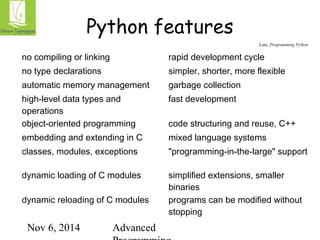
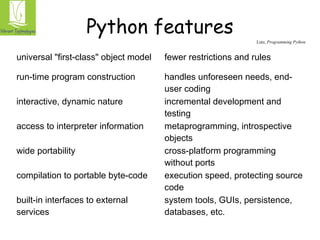
Python features 
no compiling or linking rapid development cycle 
no type declarations simpler, shorter, more flexible 
automatic memory management garbage collection 
high-level data types and 
operations 
object-oriented programming code structuring and reuse, C++ 
embedding and extending in C mixed language systems 
classes, modules, exceptions "programming-in-the-large" support 
dynamic loading of C modules simplified extensions, smaller 
dynamic reloading of C modules programs can be modified without 
Nov 6, 2014 Advanced 
fast development 
binaries 
stopping 
Programming 
Lutz, Programming Python
Python features 
Lutz, Programming Python 
universal "first-class" object model fewer restrictions and rules 
run-time program construction handles unforeseen needs, end-user 
coding 
interactive, dynamic nature incremental development and 
testing 
access to interpreter information metaprogramming, introspective 
objects 
wide portability cross-platform programming 
without ports 
compilation to portable byte-code execution speed, protecting source 
code 
built-in interfaces to external 
services 
system tools, GUIs, persistence, 
databases, etc.
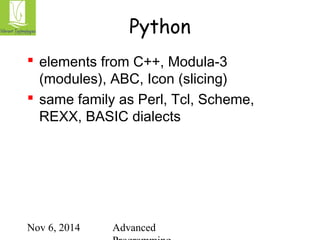
Python 
 elements from C++, Modula-3 
(modules), ABC, Icon (slicing) 
 same family as Perl, Tcl, Scheme, 
REXX, BASIC dialects 
Nov 6, 2014 Advanced 
Programming
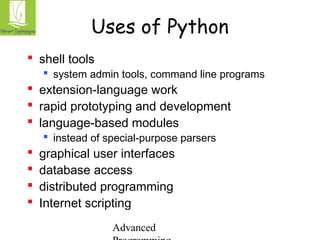
Uses of Python 
Advanced 
Programming 
 shell tools 
 system admin tools, command line programs 
 extension-language work 
 rapid prototyping and development 
 language-based modules 
 instead of special-purpose parsers 
 graphical user interfaces 
 database access 
 distributed programming 
 Internet scripting
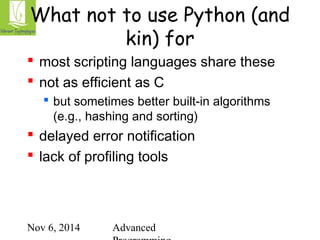
What not to use Python (and 
kin) for 
 most scripting languages share these 
 not as efficient as C 
 but sometimes better built-in algorithms 
(e.g., hashing and sorting) 
 delayed error notification 
 lack of profiling tools 
Nov 6, 2014 Advanced 
Programming
Using python 
 /usr/local/bin/python 
 #! /usr/bin/env python 
 interactive use 
Python 1.6 (#1, Sep 24 2000, 20:40:45) [GCC 2.95.1 19990816 (release)] on sunos5 
Copyright (c) 1995-2000 Corporation for National Research Initiatives. 
All Rights Reserved. 
Copyright (c) 1991-1995 Stichting Mathematisch Centrum, Amsterdam. 
All Rights Reserved. 
>>> 
 python –c command [arg] ... 
 python –i script 
 read script first, then interactive 
Nov 6, 2014 Advanced 
Programming
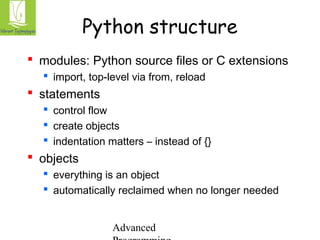
Python structure 
 modules: Python source files or C extensions 
 import, top-level via from, reload 
Advanced 
Programming 
 statements 
 control flow 
 create objects 
 indentation matters – instead of {} 
 objects 
 everything is an object 
 automatically reclaimed when no longer needed
First example 
#!/usr/local/bin/python 
# import systems module 
import sys 
marker = '::::::' 
for name in sys.argv[1:]: 
input = open(name, 'r') 
print marker + name 
print input.read() 
Nov 6, 2014 Advanced 
Programming
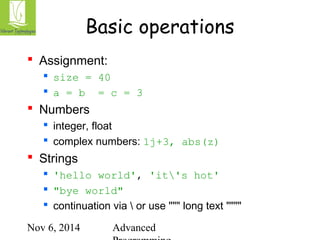
Basic operations 
Nov 6, 2014 Advanced 
Programming 
 Assignment: 
 size = 40 
 a = b = c = 3 
 Numbers 
 integer, float 
 complex numbers: 1j+3, abs(z) 
 Strings 
 'hello world', 'it's hot' 
 "bye world" 
 continuation via  or use """ long text """"
String operations 
 concatenate with + or neighbors 
 word = 'Help' + x 
 word = 'Help' 'a' 
 subscripting of strings 
 'Hello'[2]  'l' 
 slice: 'Hello'[1:2]  'el' 
 word[-1]  last character 
 len(word)  5 
 immutable: cannot assign to subscript 
Advanced 
Programming
Lists 
 lists can be heterogeneous 
 a = ['spam', 'eggs', 100, 1234, 2*2] 
 Lists can be indexed and sliced: 
 a[0]  spam 
 a[:2]  ['spam', 'eggs'] 
 Lists can be manipulated 
 a[2] = a[2] + 23 
 a[0:2] = [1,12] 
 a[0:0] = [] 
 len(a)  5 
Nov 6, 2014 Advanced 
Programming
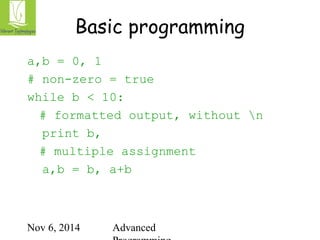
Basic programming 
a,b = 0, 1 
# non-zero = true 
while b < 10: 
# formatted output, without n 
print b, 
# multiple assignment 
a,b = b, a+b 
Nov 6, 2014 Advanced 
Programming
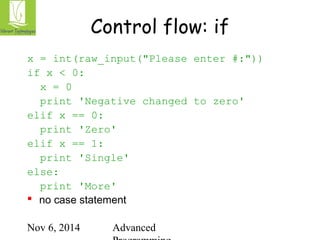
Control flow: if 
x = int(raw_input("Please enter #:")) 
if x < 0: 
x = 0 
print 'Negative changed to zero' 
Nov 6, 2014 Advanced 
Programming 
elif x == 0: 
print 'Zero' 
elif x == 1: 
print 'Single' 
else: 
print 'More' 
 no case statement
Control flow: for 
a = ['cat', 'window', 'defenestrate'] 
for x in a: 
print x, len(x) 
 no arithmetic progression, but 
 range(10)  [0, 1, 2, 3, 4, 5, 6, 7, 8, 9] 
 for i in range(len(a)): 
print i, a[i] 
 do not modify the sequence being iterated 
over 
Nov 6, 2014 Advanced 
Programming
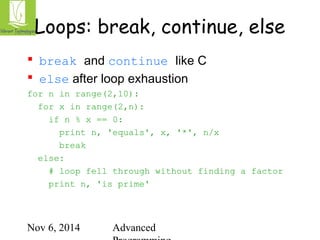
Loops: break, continue, else 
 break and continue like C 
 else after loop exhaustion 
for n in range(2,10): 
for x in range(2,n): 
if n % x == 0: 
print n, 'equals', x, '*', n/x 
break 
Nov 6, 2014 Advanced 
Programming 
else: 
# loop fell through without finding a factor 
print n, 'is prime'
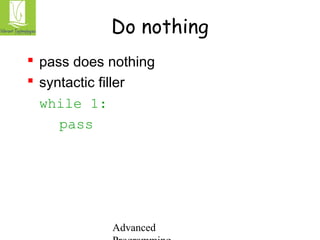
Do nothing 
 pass does nothing 
 syntactic filler 
while 1: 
Advanced 
Programming 
pass
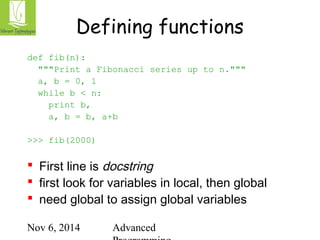
Defining functions 
Nov 6, 2014 Advanced 
Programming 
def fib(n): 
"""Print a Fibonacci series up to n.""" 
a, b = 0, 1 
while b < n: 
print b, 
a, b = b, a+b 
>>> fib(2000) 
 First line is docstring 
 first look for variables in local, then global 
 need global to assign global variables
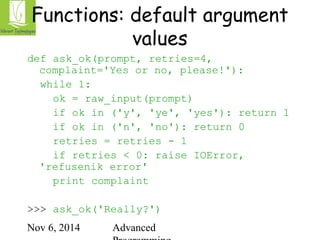
Functions: default argument 
values 
def ask_ok(prompt, retries=4, 
complaint='Yes or no, please!'): 
Nov 6, 2014 Advanced 
Programming 
while 1: 
ok = raw_input(prompt) 
if ok in ('y', 'ye', 'yes'): return 1 
if ok in ('n', 'no'): return 0 
retries = retries - 1 
if retries < 0: raise IOError, 
'refusenik error' 
print complaint 
>>> ask_ok('Really?')
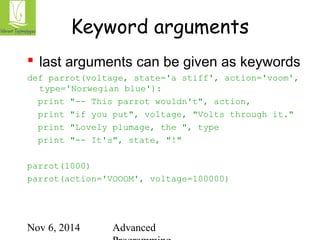
Keyword arguments 
 last arguments can be given as keywords 
def parrot(voltage, state='a stiff', action='voom', 
type='Norwegian blue'): 
print "-- This parrot wouldn't", action, 
print "if you put", voltage, "Volts through it." 
print "Lovely plumage, the ", type 
print "-- It's", state, "!" 
parrot(1000) 
parrot(action='VOOOM', voltage=100000) 
Nov 6, 2014 Advanced 
Programming
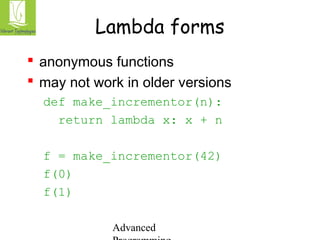
Lambda forms 
 anonymous functions 
 may not work in older versions 
def make_incrementor(n): 
return lambda x: x + n 
f = make_incrementor(42) 
f(0) 
f(1) 
Advanced 
Programming
List methods 
Nov 6, 2014 Advanced 
Programming 
 append(x) 
 extend(L) 
 append all items in list (like Tcl lappend) 
 insert(i,x) 
 remove(x) 
 pop([i]), pop() 
 create stack (FIFO), or queue (LIFO)  pop(0) 
 index(x) 
 return the index for value x
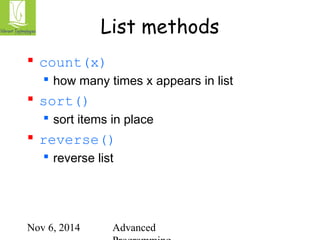
List methods 
Nov 6, 2014 Advanced 
Programming 
 count(x) 
 how many times x appears in list 
 sort() 
 sort items in place 
 reverse() 
 reverse list
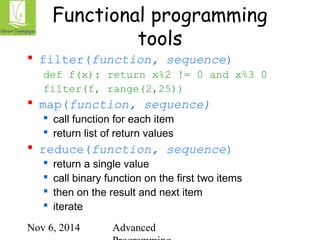
Functional programming 
tools 
 filter(function, sequence) 
def f(x): return x%2 != 0 and x%3 0 
filter(f, range(2,25)) 
 map(function, sequence) 
 call function for each item 
 return list of return values 
 reduce(function, sequence) 
 return a single value 
 call binary function on the first two items 
 then on the result and next item 
 iterate 
Nov 6, 2014 Advanced 
Programming
List comprehensions (2.0) 
 Create lists without map(), 
filter(), lambda 
 = expression followed by for clause + 
zero or more for or of clauses 
>>> vec = [2,4,6] 
>>> [3*x for x in vec] 
[6, 12, 18] 
>>> [{x: x**2} for x in vec} 
[{2: 4}, {4: 16}, {6: 36}] 
Nov 6, 2014 Advanced 
Programming
List comprehensions 
 cross products: 
>>> vec1 = [2,4,6] 
>>> vec2 = [4,3,-9] 
>>> [x*y for x in vec1 for y in vec2] 
[8,6,-18, 16,12,-36, 24,18,-54] 
>>> [x+y for x in vec1 and y in vec2] 
[6,5,-7,8,7,-5,10,9,-3] 
>>> [vec1[i]*vec2[i] for i in 
range(len(vec1))] 
[8,12,-54] 
Nov 6, 2014 Advanced 
Programming
List comprehensions 
 can also use if: 
>>> [3*x for x in vec if x > 3] 
[12, 18] 
>>> [3*x for x in vec if x < 2] 
[] 
Nov 6, 2014 Advanced 
Programming
del – removing list items 
 remove by index, not value 
 remove slices from list (rather than by 
assigning an empty list) 
>>> a = [-1,1,66.6,333,333,1234.5] 
>>> del a[0] 
>>> a 
[1,66.6,333,333,1234.5] 
>>> del a[2:4] 
>>> a 
[1,66.6,1234.5] 
Nov 6, 2014 Advanced 
Programming
Tuples and sequences 
 lists, strings, tuples: examples of 
sequence type 
 tuple = values separated by commas 
>>> t = 123, 543, 'bar' 
>>> t[0] 
123 
>>> t 
(123, 543, 'bar') 
Nov 6, 2014 Advanced 
Programming
Tuples 
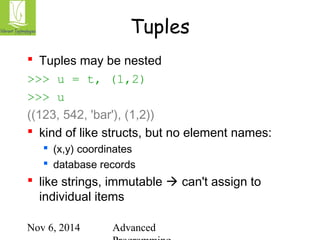
 Tuples may be nested 
>>> u = t, (1,2) 
>>> u 
((123, 542, 'bar'), (1,2)) 
 kind of like structs, but no element names: 
 (x,y) coordinates 
 database records 
 like strings, immutable  can't assign to 
individual items 
Nov 6, 2014 Advanced 
Programming
Tuples 
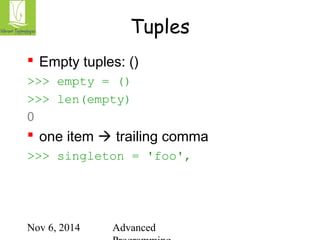
 Empty tuples: () 
>>> empty = () 
>>> len(empty) 
0 
 one item  trailing comma 
>>> singleton = 'foo', 
Nov 6, 2014 Advanced 
Programming
Tuples 
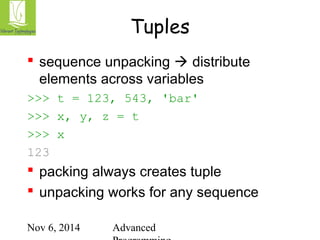
 sequence unpacking  distribute 
elements across variables 
>>> t = 123, 543, 'bar' 
>>> x, y, z = t 
>>> x 
123 
 packing always creates tuple 
 unpacking works for any sequence 
Nov 6, 2014 Advanced 
Programming
Dictionaries 
 like Tcl or awk associative arrays 
 indexed by keys 
 keys are any immutable type: e.g., tuples 
 but not lists (mutable!) 
 uses 'key: value' notation 
>>> tel = {'hgs' : 7042, 'lennox': 7018} 
>>> tel['cs'] = 7000 
>>> tel 
Nov 6, 2014 Advanced 
Programming
Dictionaries 
 no particular order 
 delete elements with del 
>>> del tel['foo'] 
 keys() method  unsorted list of keys 
>>> tel.keys() 
['cs', 'lennox', 'hgs'] 
 use has_key() to check for existence 
>>> tel.has_key('foo') 
0 
Nov 6, 2014 Advanced 
Programming
Conditions 
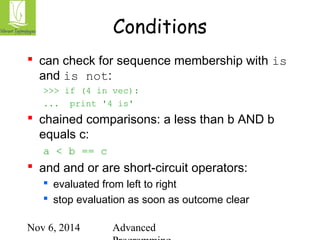
 can check for sequence membership with is 
and is not: 
>>> if (4 in vec): 
... print '4 is' 
 chained comparisons: a less than b AND b 
equals c: 
Nov 6, 2014 Advanced 
Programming 
a < b == c 
 and and or are short-circuit operators: 
 evaluated from left to right 
 stop evaluation as soon as outcome clear
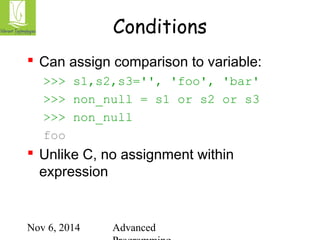
Conditions 
 Can assign comparison to variable: 
>>> s1,s2,s3='', 'foo', 'bar' 
>>> non_null = s1 or s2 or s3 
>>> non_null 
foo 
 Unlike C, no assignment within 
expression 
Nov 6, 2014 Advanced 
Programming
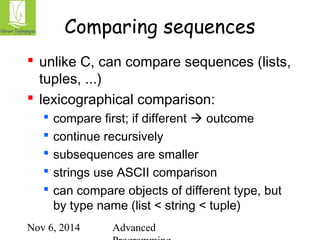
Comparing sequences 
 unlike C, can compare sequences (lists, 
tuples, ...) 
 lexicographical comparison: 
 compare first; if different  outcome 
 continue recursively 
 subsequences are smaller 
 strings use ASCII comparison 
 can compare objects of different type, but 
by type name (list < string < tuple) 
Nov 6, 2014 Advanced 
Programming
Comparing sequences 
(1,2,3) < (1,2,4) 
[1,2,3] < [1,2,4] 
'ABC' < 'C' < 'Pascal' < 'Python' 
(1,2,3) == (1.0,2.0,3.0) 
(1,2) < (1,2,-1) 
Nov 6, 2014 Advanced 
Programming
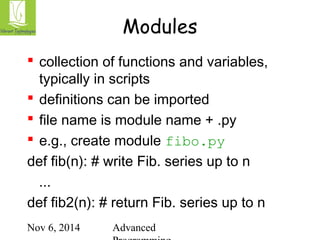
Modules 
 collection of functions and variables, 
typically in scripts 
 definitions can be imported 
 file name is module name + .py 
 e.g., create module fibo.py 
def fib(n): # write Fib. series up to n 
... 
def fib2(n): # return Fib. series up to n 
Nov 6, 2014 Advanced 
Programming
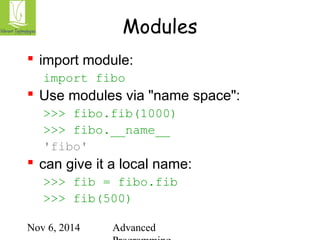
Modules 
 import module: 
import fibo 
 Use modules via "name space": 
>>> fibo.fib(1000) 
>>> fibo.__name__ 
'fibo' 
 can give it a local name: 
>>> fib = fibo.fib 
>>> fib(500) 
Nov 6, 2014 Advanced 
Programming
Modules 
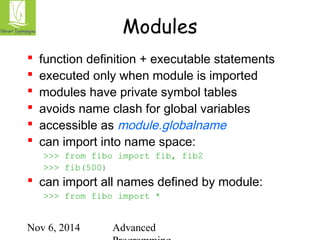
 function definition + executable statements 
 executed only when module is imported 
 modules have private symbol tables 
 avoids name clash for global variables 
 accessible as module.globalname 
 can import into name space: 
>>> from fibo import fib, fib2 
>>> fib(500) 
 can import all names defined by module: 
>>> from fibo import * 
Nov 6, 2014 Advanced 
Programming
Module search path 
 current directory 
 list of directories specified in PYTHONPATH 
environment variable 
 uses installation-default if not defined, e.g., 
.:/usr/local/lib/python 
 uses sys.path 
>>> import sys 
>>> sys.path 
['', 'C:PROGRA~1Python2.2', 'C:Program 
FilesPython2.2DLLs', 'C:Program 
FilesPython2.2lib', 'C:Program 
FilesPython2.2liblib-tk', 'C:Program 
FilesPython2.2', 'C:Program FilesPython2.2libsite-packages'] 
Nov 6, 2014 Advanced 
Programming
Compiled Python files 
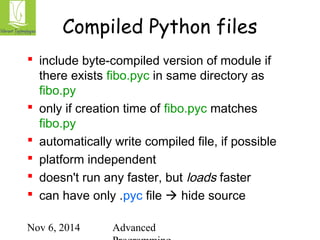
 include byte-compiled version of module if 
there exists fibo.pyc in same directory as 
fibo.py 
 only if creation time of fibo.pyc matches 
fibo.py 
 automatically write compiled file, if possible 
 platform independent 
 doesn't run any faster, but loads faster 
 can have only .pyc file  hide source 
Nov 6, 2014 Advanced 
Programming
Standard modules 
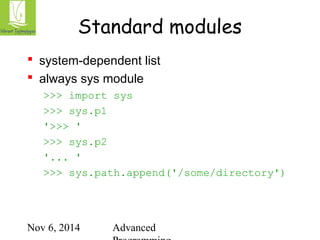
 system-dependent list 
 always sys module 
>>> import sys 
>>> sys.p1 
'>>> ' 
>>> sys.p2 
'... ' 
>>> sys.path.append('/some/directory') 
Nov 6, 2014 Advanced 
Programming
Module listing 
 use dir() for each module 
>>> dir(fibo) 
['___name___', 'fib', 'fib2'] 
>>> dir(sys) 
['__displayhook__', '__doc__', '__excepthook__', '__name__', '__stderr__', '__st 
din__', '__stdout__', '_getframe', 'argv', 'builtin_module_names', 'byteorder', 
'copyright', 'displayhook', 'dllhandle', 'exc_info', 'exc_type', 'excepthook', ' 
exec_prefix', 'executable', 'exit', 'getdefaultencoding', 'getrecursionlimit', ' 
getrefcount', 'hexversion', 'last_type', 'last_value', 'maxint', 'maxunicode', ' 
modules', 'path', 'platform', 'prefix', 'ps1', 'ps2', 'setcheckinterval', 'setpr 
ofile', 'setrecursionlimit', 'settrace', 'stderr', 'stdin', 'stdout', 'version', 
'version_info', 'warnoptions', 'winver'] 
Nov 6, 2014 Advanced 
Programming
Classes 
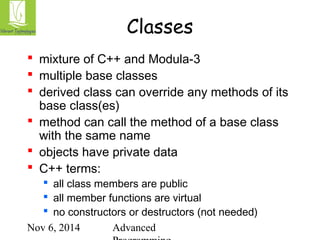
 mixture of C++ and Modula-3 
 multiple base classes 
 derived class can override any methods of its 
base class(es) 
 method can call the method of a base class 
with the same name 
 objects have private data 
 C++ terms: 
 all class members are public 
 all member functions are virtual 
 no constructors or destructors (not needed) 
Nov 6, 2014 Advanced 
Programming
Classes 
 classes (and data types) are objects 
 built-in types cannot be used as base 
classes by user 
 arithmetic operators, subscripting can 
be redefined for class instances (like C+ 
+, unlike Java) 
Nov 6, 2014 Advanced 
Programming
Class definitions 
Class ClassName: 
<statement-1> 
... 
<statement-N> 
 must be executed 
 can be executed conditionally (see Tcl) 
 creates new namespace 
Nov 6, 2014 Advanced 
Programming
Namespaces 
 mapping from name to object: 
 built-in names (abs()) 
 global names in module 
 local names in function invocation 
 attributes = any following a dot 
 z.real, z.imag 
 attributes read-only or writable 
 module attributes are writeable 
Nov 6, 2014 Advanced 
Programming
Namespaces 
 scope = textual region of Python program 
where a namespace is directly accessible 
(without dot) 
 innermost scope (first) = local names 
 middle scope = current module's global names 
 outermost scope (last) = built-in names 
 assignments always affect innermost scope 
 don't copy, just create name bindings to objects 
 global indicates name is in global scope 
Nov 6, 2014 Advanced 
Programming
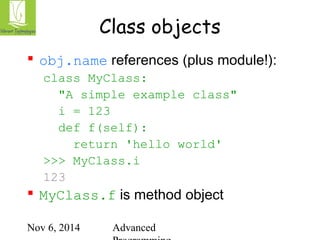
Class objects 
 obj.name references (plus module!): 
class MyClass: 
"A simple example class" 
i = 123 
def f(self): 
return 'hello world' 
>>> MyClass.i 
123 
 MyClass.f is method object 
Nov 6, 2014 Advanced 
Programming
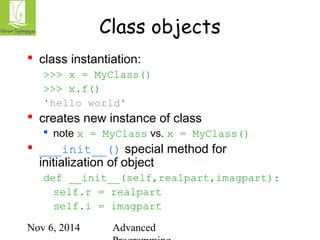
Class objects 
 class instantiation: 
>>> x = MyClass() 
>>> x.f() 
'hello world' 
 creates new instance of class 
 note x = MyClass vs. x = MyClass() 
 ___init__() special method for 
initialization of object 
def __init__(self,realpart,imagpart): 
self.r = realpart 
self.i = imagpart 
Nov 6, 2014 Advanced 
Programming
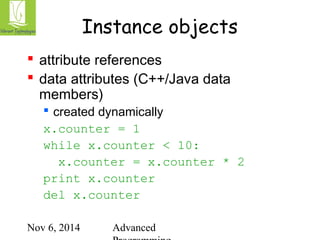
Instance objects 
 attribute references 
 data attributes (C++/Java data 
members) 
 created dynamically 
x.counter = 1 
while x.counter < 10: 
x.counter = x.counter * 2 
print x.counter 
del x.counter 
Nov 6, 2014 Advanced 
Programming
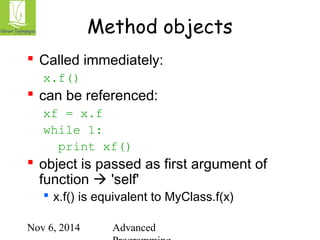
Method objects 
 Called immediately: 
x.f() 
 can be referenced: 
Nov 6, 2014 Advanced 
Programming 
xf = x.f 
while 1: 
print xf() 
 object is passed as first argument of 
function  'self' 
 x.f() is equivalent to MyClass.f(x)
Notes on classes 
 Data attributes override method 
attributes with the same name 
 no real hiding  not usable to 
implement pure abstract data types 
 clients (users) of an object can add data 
attributes 
 first argument of method usually called 
self 
 'self' has no special meaning (cf. Java) 
Nov 6, 2014 Advanced 
Programming
Another example 
Nov 6, 2014 Advanced 
Programming 
 bag.py 
class Bag: 
def __init__(self): 
self.data = [] 
def add(self, x): 
self.data.append(x) 
def addtwice(self,x): 
self.add(x) 
self.add(x)
Another example, cont'd. 
Nov 6, 2014 Advanced 
Programming 
 invoke: 
>>> from bag import * 
>>> l = Bag() 
>>> l.add('first') 
>>> l.add('second') 
>>> l.data 
['first', 'second']
Inheritance 
class DerivedClassName(BaseClassName) 
<statement-1> 
... 
<statement-N> 
 search class attribute, descending 
chain of base classes 
 may override methods in the base class 
 call directly via BaseClassName.method 
Nov 6, 2014 Advanced 
Programming
Multiple inheritance 
class DerivedClass(Base1,Base2,Base3): 
<statement> 
 depth-first, left-to-right 
 problem: class derived from two classes 
with a common base class 
Nov 6, 2014 Advanced 
Programming
Private variables 
 No real support, but textual 
replacement (name mangling) 
 __var is replaced by 
_classname_var 
 prevents only accidental modification, 
not true protection 
Advanced 
Programming
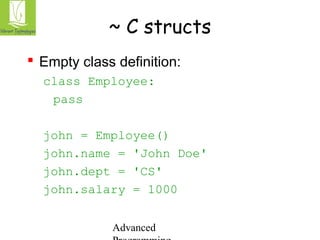
~ C structs 
 Empty class definition: 
class Employee: 
pass 
john = Employee() 
john.name = 'John Doe' 
john.dept = 'CS' 
john.salary = 1000 
Advanced 
Programming
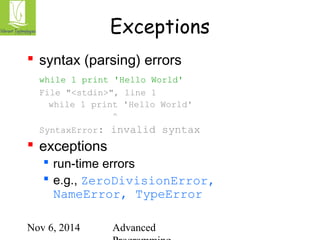
Exceptions 
 syntax (parsing) errors 
while 1 print 'Hello World' 
File "<stdin>", line 1 
while 1 print 'Hello World' 
^ 
SyntaxError: invalid syntax 
 exceptions 
 run-time errors 
 e.g., ZeroDivisionError, 
NameError, TypeError 
Nov 6, 2014 Advanced 
Programming
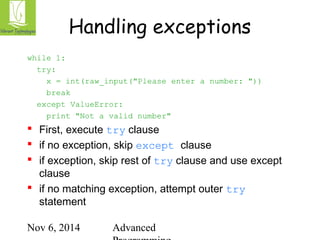
Handling exceptions 
Nov 6, 2014 Advanced 
Programming 
while 1: 
try: 
x = int(raw_input("Please enter a number: ")) 
break 
except ValueError: 
print "Not a valid number" 
 First, execute try clause 
 if no exception, skip except clause 
 if exception, skip rest of try clause and use except 
clause 
 if no matching exception, attempt outer try 
statement
Handling exceptions 
 try.py 
import sys 
for arg in sys.argv[1:]: 
try: 
f = open(arg, 'r') 
except IOError: 
print 'cannot open', arg 
else: 
print arg, 'lines:', len(f.readlines()) 
f.close 
 e.g., as python try.py *.py
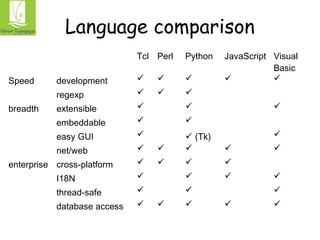
Language comparison 
Tcl Perl Python JavaScript Visual 
Basic 
Speed development      
regexp    
breadth extensible    
embeddable   
easy GUI   (Tk)  
net/web      
enterprise cross-platform     
I18N     
thread-safe    
database access     
Thank You !!!

Python classes in mumbai

  • 1.
  • 2.
    Python By AAddddrreessss:: KK11// 44,, SSeeccoonndd fflloooorr,, SSeeccttoorr--1155//1166 MMaarrkkeett,, VVaasshhii,, NNaavvii MMuummbbaaii MMoobb NNoo:: 99889922990000110033 99889922990000117733
  • 3.
    Introduction  Mostrecent popular (scripting/extension) language  although origin ~1991  heritage: teaching language (ABC)  Tcl: shell  perl: string (regex) processing  object-oriented  rather than add-on (OOTcl)
  • 4.
    Python philosophy Coherence  not hard to read, write and maintain  power  scope  rapid development + large systems  objects  integration  hybrid systems
  • 5.
    Python features nocompiling or linking rapid development cycle no type declarations simpler, shorter, more flexible automatic memory management garbage collection high-level data types and operations object-oriented programming code structuring and reuse, C++ embedding and extending in C mixed language systems classes, modules, exceptions "programming-in-the-large" support dynamic loading of C modules simplified extensions, smaller dynamic reloading of C modules programs can be modified without Nov 6, 2014 Advanced fast development binaries stopping Programming Lutz, Programming Python
  • 6.
    Python features Lutz,Programming Python universal "first-class" object model fewer restrictions and rules run-time program construction handles unforeseen needs, end-user coding interactive, dynamic nature incremental development and testing access to interpreter information metaprogramming, introspective objects wide portability cross-platform programming without ports compilation to portable byte-code execution speed, protecting source code built-in interfaces to external services system tools, GUIs, persistence, databases, etc.
  • 7.
    Python  elementsfrom C++, Modula-3 (modules), ABC, Icon (slicing)  same family as Perl, Tcl, Scheme, REXX, BASIC dialects Nov 6, 2014 Advanced Programming
  • 8.
    Uses of Python Advanced Programming  shell tools  system admin tools, command line programs  extension-language work  rapid prototyping and development  language-based modules  instead of special-purpose parsers  graphical user interfaces  database access  distributed programming  Internet scripting
  • 9.
    What not touse Python (and kin) for  most scripting languages share these  not as efficient as C  but sometimes better built-in algorithms (e.g., hashing and sorting)  delayed error notification  lack of profiling tools Nov 6, 2014 Advanced Programming
  • 10.
    Using python /usr/local/bin/python  #! /usr/bin/env python  interactive use Python 1.6 (#1, Sep 24 2000, 20:40:45) [GCC 2.95.1 19990816 (release)] on sunos5 Copyright (c) 1995-2000 Corporation for National Research Initiatives. All Rights Reserved. Copyright (c) 1991-1995 Stichting Mathematisch Centrum, Amsterdam. All Rights Reserved. >>>  python –c command [arg] ...  python –i script  read script first, then interactive Nov 6, 2014 Advanced Programming
  • 11.
    Python structure modules: Python source files or C extensions  import, top-level via from, reload Advanced Programming  statements  control flow  create objects  indentation matters – instead of {}  objects  everything is an object  automatically reclaimed when no longer needed
  • 12.
    First example #!/usr/local/bin/python # import systems module import sys marker = '::::::' for name in sys.argv[1:]: input = open(name, 'r') print marker + name print input.read() Nov 6, 2014 Advanced Programming
  • 13.
    Basic operations Nov6, 2014 Advanced Programming  Assignment:  size = 40  a = b = c = 3  Numbers  integer, float  complex numbers: 1j+3, abs(z)  Strings  'hello world', 'it's hot'  "bye world"  continuation via or use """ long text """"
  • 14.
    String operations concatenate with + or neighbors  word = 'Help' + x  word = 'Help' 'a'  subscripting of strings  'Hello'[2]  'l'  slice: 'Hello'[1:2]  'el'  word[-1]  last character  len(word)  5  immutable: cannot assign to subscript Advanced Programming
  • 15.
    Lists  listscan be heterogeneous  a = ['spam', 'eggs', 100, 1234, 2*2]  Lists can be indexed and sliced:  a[0]  spam  a[:2]  ['spam', 'eggs']  Lists can be manipulated  a[2] = a[2] + 23  a[0:2] = [1,12]  a[0:0] = []  len(a)  5 Nov 6, 2014 Advanced Programming
  • 16.
    Basic programming a,b= 0, 1 # non-zero = true while b < 10: # formatted output, without n print b, # multiple assignment a,b = b, a+b Nov 6, 2014 Advanced Programming
  • 17.
    Control flow: if x = int(raw_input("Please enter #:")) if x < 0: x = 0 print 'Negative changed to zero' Nov 6, 2014 Advanced Programming elif x == 0: print 'Zero' elif x == 1: print 'Single' else: print 'More'  no case statement
  • 18.
    Control flow: for a = ['cat', 'window', 'defenestrate'] for x in a: print x, len(x)  no arithmetic progression, but  range(10)  [0, 1, 2, 3, 4, 5, 6, 7, 8, 9]  for i in range(len(a)): print i, a[i]  do not modify the sequence being iterated over Nov 6, 2014 Advanced Programming
  • 19.
    Loops: break, continue,else  break and continue like C  else after loop exhaustion for n in range(2,10): for x in range(2,n): if n % x == 0: print n, 'equals', x, '*', n/x break Nov 6, 2014 Advanced Programming else: # loop fell through without finding a factor print n, 'is prime'
  • 20.
    Do nothing pass does nothing  syntactic filler while 1: Advanced Programming pass
  • 21.
    Defining functions Nov6, 2014 Advanced Programming def fib(n): """Print a Fibonacci series up to n.""" a, b = 0, 1 while b < n: print b, a, b = b, a+b >>> fib(2000)  First line is docstring  first look for variables in local, then global  need global to assign global variables
  • 22.
    Functions: default argument values def ask_ok(prompt, retries=4, complaint='Yes or no, please!'): Nov 6, 2014 Advanced Programming while 1: ok = raw_input(prompt) if ok in ('y', 'ye', 'yes'): return 1 if ok in ('n', 'no'): return 0 retries = retries - 1 if retries < 0: raise IOError, 'refusenik error' print complaint >>> ask_ok('Really?')
  • 23.
    Keyword arguments last arguments can be given as keywords def parrot(voltage, state='a stiff', action='voom', type='Norwegian blue'): print "-- This parrot wouldn't", action, print "if you put", voltage, "Volts through it." print "Lovely plumage, the ", type print "-- It's", state, "!" parrot(1000) parrot(action='VOOOM', voltage=100000) Nov 6, 2014 Advanced Programming
  • 24.
    Lambda forms anonymous functions  may not work in older versions def make_incrementor(n): return lambda x: x + n f = make_incrementor(42) f(0) f(1) Advanced Programming
  • 25.
    List methods Nov6, 2014 Advanced Programming  append(x)  extend(L)  append all items in list (like Tcl lappend)  insert(i,x)  remove(x)  pop([i]), pop()  create stack (FIFO), or queue (LIFO)  pop(0)  index(x)  return the index for value x
  • 26.
    List methods Nov6, 2014 Advanced Programming  count(x)  how many times x appears in list  sort()  sort items in place  reverse()  reverse list
  • 27.
    Functional programming tools  filter(function, sequence) def f(x): return x%2 != 0 and x%3 0 filter(f, range(2,25))  map(function, sequence)  call function for each item  return list of return values  reduce(function, sequence)  return a single value  call binary function on the first two items  then on the result and next item  iterate Nov 6, 2014 Advanced Programming
  • 28.
    List comprehensions (2.0)  Create lists without map(), filter(), lambda  = expression followed by for clause + zero or more for or of clauses >>> vec = [2,4,6] >>> [3*x for x in vec] [6, 12, 18] >>> [{x: x**2} for x in vec} [{2: 4}, {4: 16}, {6: 36}] Nov 6, 2014 Advanced Programming
  • 29.
    List comprehensions cross products: >>> vec1 = [2,4,6] >>> vec2 = [4,3,-9] >>> [x*y for x in vec1 for y in vec2] [8,6,-18, 16,12,-36, 24,18,-54] >>> [x+y for x in vec1 and y in vec2] [6,5,-7,8,7,-5,10,9,-3] >>> [vec1[i]*vec2[i] for i in range(len(vec1))] [8,12,-54] Nov 6, 2014 Advanced Programming
  • 30.
    List comprehensions can also use if: >>> [3*x for x in vec if x > 3] [12, 18] >>> [3*x for x in vec if x < 2] [] Nov 6, 2014 Advanced Programming
  • 31.
    del – removinglist items  remove by index, not value  remove slices from list (rather than by assigning an empty list) >>> a = [-1,1,66.6,333,333,1234.5] >>> del a[0] >>> a [1,66.6,333,333,1234.5] >>> del a[2:4] >>> a [1,66.6,1234.5] Nov 6, 2014 Advanced Programming
  • 32.
    Tuples and sequences  lists, strings, tuples: examples of sequence type  tuple = values separated by commas >>> t = 123, 543, 'bar' >>> t[0] 123 >>> t (123, 543, 'bar') Nov 6, 2014 Advanced Programming
  • 33.
    Tuples  Tuplesmay be nested >>> u = t, (1,2) >>> u ((123, 542, 'bar'), (1,2))  kind of like structs, but no element names:  (x,y) coordinates  database records  like strings, immutable  can't assign to individual items Nov 6, 2014 Advanced Programming
  • 34.
    Tuples  Emptytuples: () >>> empty = () >>> len(empty) 0  one item  trailing comma >>> singleton = 'foo', Nov 6, 2014 Advanced Programming
  • 35.
    Tuples  sequenceunpacking  distribute elements across variables >>> t = 123, 543, 'bar' >>> x, y, z = t >>> x 123  packing always creates tuple  unpacking works for any sequence Nov 6, 2014 Advanced Programming
  • 36.
    Dictionaries  likeTcl or awk associative arrays  indexed by keys  keys are any immutable type: e.g., tuples  but not lists (mutable!)  uses 'key: value' notation >>> tel = {'hgs' : 7042, 'lennox': 7018} >>> tel['cs'] = 7000 >>> tel Nov 6, 2014 Advanced Programming
  • 37.
    Dictionaries  noparticular order  delete elements with del >>> del tel['foo']  keys() method  unsorted list of keys >>> tel.keys() ['cs', 'lennox', 'hgs']  use has_key() to check for existence >>> tel.has_key('foo') 0 Nov 6, 2014 Advanced Programming
  • 38.
    Conditions  cancheck for sequence membership with is and is not: >>> if (4 in vec): ... print '4 is'  chained comparisons: a less than b AND b equals c: Nov 6, 2014 Advanced Programming a < b == c  and and or are short-circuit operators:  evaluated from left to right  stop evaluation as soon as outcome clear
  • 39.
    Conditions  Canassign comparison to variable: >>> s1,s2,s3='', 'foo', 'bar' >>> non_null = s1 or s2 or s3 >>> non_null foo  Unlike C, no assignment within expression Nov 6, 2014 Advanced Programming
  • 40.
    Comparing sequences unlike C, can compare sequences (lists, tuples, ...)  lexicographical comparison:  compare first; if different  outcome  continue recursively  subsequences are smaller  strings use ASCII comparison  can compare objects of different type, but by type name (list < string < tuple) Nov 6, 2014 Advanced Programming
  • 41.
    Comparing sequences (1,2,3)< (1,2,4) [1,2,3] < [1,2,4] 'ABC' < 'C' < 'Pascal' < 'Python' (1,2,3) == (1.0,2.0,3.0) (1,2) < (1,2,-1) Nov 6, 2014 Advanced Programming
  • 42.
    Modules  collectionof functions and variables, typically in scripts  definitions can be imported  file name is module name + .py  e.g., create module fibo.py def fib(n): # write Fib. series up to n ... def fib2(n): # return Fib. series up to n Nov 6, 2014 Advanced Programming
  • 43.
    Modules  importmodule: import fibo  Use modules via "name space": >>> fibo.fib(1000) >>> fibo.__name__ 'fibo'  can give it a local name: >>> fib = fibo.fib >>> fib(500) Nov 6, 2014 Advanced Programming
  • 44.
    Modules  functiondefinition + executable statements  executed only when module is imported  modules have private symbol tables  avoids name clash for global variables  accessible as module.globalname  can import into name space: >>> from fibo import fib, fib2 >>> fib(500)  can import all names defined by module: >>> from fibo import * Nov 6, 2014 Advanced Programming
  • 45.
    Module search path  current directory  list of directories specified in PYTHONPATH environment variable  uses installation-default if not defined, e.g., .:/usr/local/lib/python  uses sys.path >>> import sys >>> sys.path ['', 'C:PROGRA~1Python2.2', 'C:Program FilesPython2.2DLLs', 'C:Program FilesPython2.2lib', 'C:Program FilesPython2.2liblib-tk', 'C:Program FilesPython2.2', 'C:Program FilesPython2.2libsite-packages'] Nov 6, 2014 Advanced Programming
  • 46.
    Compiled Python files  include byte-compiled version of module if there exists fibo.pyc in same directory as fibo.py  only if creation time of fibo.pyc matches fibo.py  automatically write compiled file, if possible  platform independent  doesn't run any faster, but loads faster  can have only .pyc file  hide source Nov 6, 2014 Advanced Programming
  • 47.
    Standard modules system-dependent list  always sys module >>> import sys >>> sys.p1 '>>> ' >>> sys.p2 '... ' >>> sys.path.append('/some/directory') Nov 6, 2014 Advanced Programming
  • 48.
    Module listing use dir() for each module >>> dir(fibo) ['___name___', 'fib', 'fib2'] >>> dir(sys) ['__displayhook__', '__doc__', '__excepthook__', '__name__', '__stderr__', '__st din__', '__stdout__', '_getframe', 'argv', 'builtin_module_names', 'byteorder', 'copyright', 'displayhook', 'dllhandle', 'exc_info', 'exc_type', 'excepthook', ' exec_prefix', 'executable', 'exit', 'getdefaultencoding', 'getrecursionlimit', ' getrefcount', 'hexversion', 'last_type', 'last_value', 'maxint', 'maxunicode', ' modules', 'path', 'platform', 'prefix', 'ps1', 'ps2', 'setcheckinterval', 'setpr ofile', 'setrecursionlimit', 'settrace', 'stderr', 'stdin', 'stdout', 'version', 'version_info', 'warnoptions', 'winver'] Nov 6, 2014 Advanced Programming
  • 49.
    Classes  mixtureof C++ and Modula-3  multiple base classes  derived class can override any methods of its base class(es)  method can call the method of a base class with the same name  objects have private data  C++ terms:  all class members are public  all member functions are virtual  no constructors or destructors (not needed) Nov 6, 2014 Advanced Programming
  • 50.
    Classes  classes(and data types) are objects  built-in types cannot be used as base classes by user  arithmetic operators, subscripting can be redefined for class instances (like C+ +, unlike Java) Nov 6, 2014 Advanced Programming
  • 51.
    Class definitions ClassClassName: <statement-1> ... <statement-N>  must be executed  can be executed conditionally (see Tcl)  creates new namespace Nov 6, 2014 Advanced Programming
  • 52.
    Namespaces  mappingfrom name to object:  built-in names (abs())  global names in module  local names in function invocation  attributes = any following a dot  z.real, z.imag  attributes read-only or writable  module attributes are writeable Nov 6, 2014 Advanced Programming
  • 53.
    Namespaces  scope= textual region of Python program where a namespace is directly accessible (without dot)  innermost scope (first) = local names  middle scope = current module's global names  outermost scope (last) = built-in names  assignments always affect innermost scope  don't copy, just create name bindings to objects  global indicates name is in global scope Nov 6, 2014 Advanced Programming
  • 54.
    Class objects obj.name references (plus module!): class MyClass: "A simple example class" i = 123 def f(self): return 'hello world' >>> MyClass.i 123  MyClass.f is method object Nov 6, 2014 Advanced Programming
  • 55.
    Class objects class instantiation: >>> x = MyClass() >>> x.f() 'hello world'  creates new instance of class  note x = MyClass vs. x = MyClass()  ___init__() special method for initialization of object def __init__(self,realpart,imagpart): self.r = realpart self.i = imagpart Nov 6, 2014 Advanced Programming
  • 56.
    Instance objects attribute references  data attributes (C++/Java data members)  created dynamically x.counter = 1 while x.counter < 10: x.counter = x.counter * 2 print x.counter del x.counter Nov 6, 2014 Advanced Programming
  • 57.
    Method objects Called immediately: x.f()  can be referenced: Nov 6, 2014 Advanced Programming xf = x.f while 1: print xf()  object is passed as first argument of function  'self'  x.f() is equivalent to MyClass.f(x)
  • 58.
    Notes on classes  Data attributes override method attributes with the same name  no real hiding  not usable to implement pure abstract data types  clients (users) of an object can add data attributes  first argument of method usually called self  'self' has no special meaning (cf. Java) Nov 6, 2014 Advanced Programming
  • 59.
    Another example Nov6, 2014 Advanced Programming  bag.py class Bag: def __init__(self): self.data = [] def add(self, x): self.data.append(x) def addtwice(self,x): self.add(x) self.add(x)
  • 60.
    Another example, cont'd. Nov 6, 2014 Advanced Programming  invoke: >>> from bag import * >>> l = Bag() >>> l.add('first') >>> l.add('second') >>> l.data ['first', 'second']
  • 61.
    Inheritance class DerivedClassName(BaseClassName) <statement-1> ... <statement-N>  search class attribute, descending chain of base classes  may override methods in the base class  call directly via BaseClassName.method Nov 6, 2014 Advanced Programming
  • 62.
    Multiple inheritance classDerivedClass(Base1,Base2,Base3): <statement>  depth-first, left-to-right  problem: class derived from two classes with a common base class Nov 6, 2014 Advanced Programming
  • 63.
    Private variables No real support, but textual replacement (name mangling)  __var is replaced by _classname_var  prevents only accidental modification, not true protection Advanced Programming
  • 64.
    ~ C structs  Empty class definition: class Employee: pass john = Employee() john.name = 'John Doe' john.dept = 'CS' john.salary = 1000 Advanced Programming
  • 65.
    Exceptions  syntax(parsing) errors while 1 print 'Hello World' File "<stdin>", line 1 while 1 print 'Hello World' ^ SyntaxError: invalid syntax  exceptions  run-time errors  e.g., ZeroDivisionError, NameError, TypeError Nov 6, 2014 Advanced Programming
  • 66.
    Handling exceptions Nov6, 2014 Advanced Programming while 1: try: x = int(raw_input("Please enter a number: ")) break except ValueError: print "Not a valid number"  First, execute try clause  if no exception, skip except clause  if exception, skip rest of try clause and use except clause  if no matching exception, attempt outer try statement
  • 67.
    Handling exceptions try.py import sys for arg in sys.argv[1:]: try: f = open(arg, 'r') except IOError: print 'cannot open', arg else: print arg, 'lines:', len(f.readlines()) f.close  e.g., as python try.py *.py
  • 68.
    Language comparison TclPerl Python JavaScript Visual Basic Speed development      regexp    breadth extensible    embeddable   easy GUI   (Tk)  net/web      enterprise cross-platform     I18N     thread-safe    database access     
  • 69.