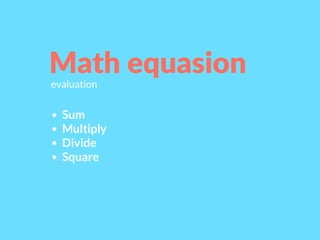
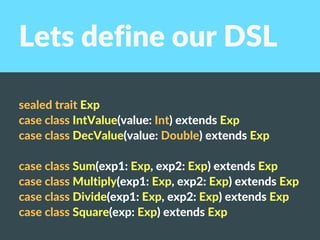
This document discusses recursion schemes and fixed point data types in Scala. It begins by introducing recursion as a way to structure programs using nested function calls. It then provides examples of recursion in various domains like lists, trees, and file systems. The document proposes using fixed point types to define a domain specific language (DSL) for mathematical expressions in a cleaner way by avoiding nested types. It demonstrates how to define the DSL algebraically and use catamorphisms to evaluate expressions by folding over the structure. Catamorphisms, anamorphisms, and hylomorphisms are also briefly introduced. In summary, the document explains how fixed point types and recursion schemes allow for defining composable DSLs in a functional

![a method for structuring programs mainly
as sequences of possibly nested function
procedure calls.
programmingFunctional
((x: Array[Byte]) => x)
.andThen(encodeBase64)
.andThen(name => s"Hello $name")
.andThen(println)](https://image.slidesharecdn.com/recursionschemesinscala-161206140408/85/Recursion-schemes-in-Scala-3-320.jpg)





![Generalize it
sealed trait Exp[T]
case class IntValue[T](value: Int) extends Exp[T]
case class DecValue[T](value: Double) extends Exp[T]
case class Sum[T](exp1: T, exp2: T) extends Exp[T]
case class Multiply[T](exp1: T, exp2: T) extends Exp[T]
case class Divide[T](exp1: T, exp2: T) extends Exp[T]
case class Square[T](exp: T) extends Exp[T]](https://image.slidesharecdn.com/recursionschemesinscala-161206140408/85/Recursion-schemes-in-Scala-15-320.jpg)
![val expression: Exp[Exp[Exp[Unit]]] =
Sum[Exp[Exp[Unit]]](
Square[Exp[Unit]](
IntValue[Unit](4)
),
Multiply[Exp[Unit]](
DecValue[Unit](3.3),
IntValue[Unit](4)
)
)
Nesting types issue](https://image.slidesharecdn.com/recursionschemesinscala-161206140408/85/Recursion-schemes-in-Scala-16-320.jpg)

![F[_] is a generic type with a hole, after
wrapping of Exp with that we will have
Fix[Exp] type.
let's add
typehack
case class Fix[F[_]](unFix: F[Fix[F]])](https://image.slidesharecdn.com/recursionschemesinscala-161206140408/85/Recursion-schemes-in-Scala-18-320.jpg)
![val expression: Fix[Exp] = Fix(Sum(
Fix(Square(
Fix(IntValue(4))
)),
Fix(Multiply(
Fix(DecValue(3.3)),
Fix(IntValue(4))
))
))
Hacked code](https://image.slidesharecdn.com/recursionschemesinscala-161206140408/85/Recursion-schemes-in-Scala-19-320.jpg)
 extends Exp[T]
object Square {
def apply(fixExp: Exp[Fix[Exp]]) = Fix[Exp](fixExp)
}
val expression: Fix[Exp] = Square(
Square(
Square(
IntValue(4)
)))
Let's do it cleaner](https://image.slidesharecdn.com/recursionschemesinscala-161206140408/85/Recursion-schemes-in-Scala-20-320.jpg)

![def map[F[_], A, B](fa: F[A])(f: A=>B): F[B]
Functor 911](https://image.slidesharecdn.com/recursionschemesinscala-161206140408/85/Recursion-schemes-in-Scala-22-320.jpg)

implicit val functor = new Functor[Container] {
override def map[A, B](fa: Container[A])
(f: A => B): Container[B] =
Container(f(fa.data))
}
functor.map(Container(1))(_.toString) // "1"
For cats you will have same code](https://image.slidesharecdn.com/recursionschemesinscala-161206140408/85/Recursion-schemes-in-Scala-23-320.jpg)
![implicit val functor = new Functor[Exp] {
override def map[A, B](fa: Exp[A])(f: A => B): Exp[B] =
fa match {
case IntValue(v) => IntValue(v)
case DecValue(v) => DecValue(v)
case Sum(v1, v2) => Sum(f(v1), f(v2))
case Multiply(v1, v2) => Multiply(f(v1), f(v2))
case Divide(v1, v2) => Divide(f(v1), f(v2))
case Square(v) => Square(f(v))
}
}](https://image.slidesharecdn.com/recursionschemesinscala-161206140408/85/Recursion-schemes-in-Scala-24-320.jpg)

![Lets define
Algebra
type Algebra[F[_], A] = F[A] => A
val evaluate: Algebra[Exp, Double] = {
case IntValue(v) => v.toDouble
case DecValue(v) => v
case Sum(v1, v2) => v1 + v2
case Multiply(v1, v2) => v1 * v2
case Divide(v1, v2) => v1 / v2
case Square(v) => Math.sqrt(v)
}](https://image.slidesharecdn.com/recursionschemesinscala-161206140408/85/Recursion-schemes-in-Scala-27-320.jpg)
![So as a result
val expression: Fix[Exp] = Sum(
Multiply(IntValue(4), IntValue(4)),
Multiply(DecValue(3.3), IntValue(4))
)
import matryoshka.implicits._
expression.cata(evaluate) // 29.2](https://image.slidesharecdn.com/recursionschemesinscala-161206140408/85/Recursion-schemes-in-Scala-28-320.jpg)
![do you remember about partial interpretation?
Extra profit
val optimize: Algebra[Exp, Fix[Exp]] = {
case Multiply(Fix(exp), Fix(exp2)) if exp == exp2 =>
Fix(Square(exp))
case other => Fix[Exp](other)
}
import matryoshka.implicits._
expression.cata(optimize).cata(stringify) // 4 ^ 2 + 3.3 * 4](https://image.slidesharecdn.com/recursionschemesinscala-161206140408/85/Recursion-schemes-in-Scala-29-320.jpg)
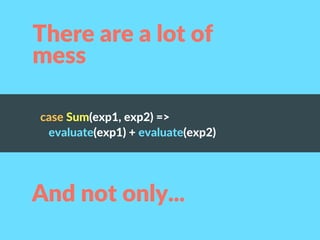
![val evaluate: Exp => Double = {
case DecValue(value) => value
case IntValue(value) => value.toDouble
case Sum(exp1, exp2) =>
evaluate(exp1) + evaluate(exp2)
case Multiply(exp1, exp2) =>
evaluate(exp1) * evaluate(exp2)
case Divide(exp1, exp2) =>
evaluate(exp1) / evaluate(exp2)
case Square(exp) =>
val v = evaluate(exp)
v * v
}
type Algebra[F[_], A]
val evaluate: Algebra[Exp, Double] = {
case IntValue(v) => v.toDouble
case DecValue(v) => v
case Sum(v1, v2) => v1 + v2
case Multiply(v1, v2) => v1 * v2
case Divide(v1, v2) => v1 / v2
case Square(v) => Math.sqrt(v)
}](https://image.slidesharecdn.com/recursionschemesinscala-161206140408/85/Recursion-schemes-in-Scala-30-320.jpg)
![catamorphism: F[_] => A
anamorphism: A => F[_]
hylomorphism: F[_] => A => F[_]
Just good to
know](https://image.slidesharecdn.com/recursionschemesinscala-161206140408/85/Recursion-schemes-in-Scala-31-320.jpg)