Big Data Architecture and Cluster
Optimization with Python
By: Chetan Khatri
Principal Big Data Engineer, Nazara Technologies.
Data Science & Machine Learning Curricula Advisor,
University of Kachchh, Gujarat.
Pycon India 2016
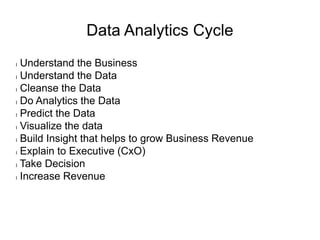
Data Analytics Cycle
l Understand the Business
l Understand the Data
l Cleanse the Data
l Do Analytics the Data
l Predict the Data
l Visualize the data
l Build Insight that helps to grow Business Revenue
l Explain to Executive (CxO)
l Take Decision
l Increase Revenue
Capacity Planning (Cluster Sizing)
lTelecom Business:
l122 Operators , 4 Region(INDIA, Africa, ME, Latin America.
l12 TB of Data per Year
l11,00,000 Transactions per day.
lGaming Business:
l6 Billion events per month = (near by) 15 TB of Data per year.
lTotal: 27 TB of Data per year
Predictive Modeling Cycle
1. Data Quality (Removing Noisy, Missing Data)
2. Feature Engineering
3. Choosing Best Model: " based on culture of Data, For ex. If continues data-
points go with Linear Regression , If categorical binomial prediction requires
then go with Logistic Regression, For Random sample of data(Feature
randomization) and have better generalization performance. other like Gradient
Boosting Trees for optimal linear combination of trees and weighted sum of
predictions of individual trees."
Try from Linear Regression to Deep Learning (RNN, CNN)
4. Ensemble Model (Regression + Random Forest + XGBoost)
5. Tune Hyper-parameters(For ex in Deep Neural Network, Needs to tune mini-
batch size, learning rate, epoch, hidden layers)
6. Model Compression - Port model to embedded / mobile devices using
Compress matrices(Sparsify, Shrink, Break, Quantize)
7. Run on smart-phone
Big Data Cluster Tuning – OS Parameters
TPS (Transaction Per Second) - throughput for every Jobs.
Time Wait Interval - TCP - For ex. 4 min
Max.port
max.connection
sysctl net.ipv4.ip_local_port_range
sysctl net.ipv4.tcp_fin_timeout
Max Thread - sysctl -a | grep threads_max
echo 120000 > /proc/sys/kernal/threads_max
echo 600000 > /proc/sys
cat /proc/sys/kernal/threads_max
Number of Thread = Total Virtual Memory / (Stacksize * 1024 * 2024)
java.lang.OutOfMemoryError: Java
heap space !
lList Ram: free -m
lStorage: df -h
lulimit -s // Stack memory
lulimit -v // Virtual Memory
lecho 120000 > /proc/sys/kernal/threads_max
lecho 600000 > /proc/sys/kernal/max_map_count
lecho 200000 > /proc/sys/kernal/pid_max
Virtual Memory Configuration – swap
configuration
lsudo fallocate -l 20G /swapfile
lsudo chmod 600 /swapfile
lsudo mkswap /swapfile
lsudo swapon /swapfile
lsudo swapon -s
lsudo nano /etc/fstab
l/swapfile none swap sw 0 0
Maximum number of open files
lulimit -n
lsudo nano /etc/security/limits.conf
l* soft nofile 64000
l* hard nofile 64000
lroot soft nofile 64000
lroot hard nofile 64000
lsudo nano /etc/pam.d/common-session
lsession required pam_limits.so
lsudo nano /etc/pam.d/common-session-noninteractive
lsession required pam_limits.so
Big Data Optimization: Tune kafka Cluster
lbuffer.memory: default
lbatch.size: "655357"
llinger.ms: "5"
lcompression.type: lz4
lretries: default
lsend.buffer.bytes: default
lconnections.max.idle.ms: default
lbootstrap.servers
lbatch.size
llinger.ms
lconnections.max.idle.ms = 10000
lcompression.type
lretries
Spark Cluster Hyper parameter Tuning
l1) ./spark-shell --conf
l--conf spark.executor.memory=50g
l--conf spark.driver.memory=150g
l--conf spark.kryoserializer.buffer.max=256
l--conf spark.driver.maxResultSize=1g
l--conf spark.dynamicAllocation.enabled=true
l--conf spark.shuffle.service.enabled=true
l--conf spark.rpc.askTimeout=300s
l--conf spark.dynamicAllocation.minExecutors=5
l--conf spark.sql.shuffle.partitions=1024
Spark Cluster Hyper parameter Tuning
l2) Configuration in spark-defaults.conf at /usr/local/spark-1.6.1/conf
Spark Cluster Hyper parameter Tuning
lspark.master spark://master.prod.chetan.com:7077
lspark.serializer org.apache.spark.serializer.KryoSerializer
lspark.eventLog.enabled true
lspark.history.fs.logDirectory file:/data/tmp/spark-events
l#spark.eventLog.dir=hdfs://namenode_host:namenode_port/user/spark/applicationHistor
y4
lspark.eventLog.dir file:/data/tmp/spark-events
lPySpark with Hadoop Demo
PySpark with Hadoop Demo- MapReduce with
wordcount
l>>> textFile = sc.textFile("file:///home/chetan306/inputfile.txt")
l>>> textFile.count()
l>>> textFile.first()
l>>> wordCounts = textFile.flatMap(lambda line: line.split()).map(lambda
word: (word, 1)).reduceByKey(lambda a, b: a+b)
l>>> wordCounts.collect()
Data Science in University Education Initiative
lData Science Lab, Computer Science Department – University of
Kachchh.
Data Science in University Education Initiative
l- Machine learning / Data Science with Python
Questions ?
Resources
https://github.com/dskskv/pycon-india-2016
chetan@kutchuni.edu.in
Twitter: @khatri_chetan

Pycon 2016-open-space

  • 1.
    Big Data Architectureand Cluster Optimization with Python By: Chetan Khatri Principal Big Data Engineer, Nazara Technologies. Data Science & Machine Learning Curricula Advisor, University of Kachchh, Gujarat. Pycon India 2016
  • 2.
    Data Analytics Cycle lUnderstand the Business l Understand the Data l Cleanse the Data l Do Analytics the Data l Predict the Data l Visualize the data l Build Insight that helps to grow Business Revenue l Explain to Executive (CxO) l Take Decision l Increase Revenue
  • 3.
    Capacity Planning (ClusterSizing) lTelecom Business: l122 Operators , 4 Region(INDIA, Africa, ME, Latin America. l12 TB of Data per Year l11,00,000 Transactions per day. lGaming Business: l6 Billion events per month = (near by) 15 TB of Data per year. lTotal: 27 TB of Data per year
  • 5.
    Predictive Modeling Cycle 1.Data Quality (Removing Noisy, Missing Data) 2. Feature Engineering 3. Choosing Best Model: " based on culture of Data, For ex. If continues data- points go with Linear Regression , If categorical binomial prediction requires then go with Logistic Regression, For Random sample of data(Feature randomization) and have better generalization performance. other like Gradient Boosting Trees for optimal linear combination of trees and weighted sum of predictions of individual trees." Try from Linear Regression to Deep Learning (RNN, CNN) 4. Ensemble Model (Regression + Random Forest + XGBoost) 5. Tune Hyper-parameters(For ex in Deep Neural Network, Needs to tune mini- batch size, learning rate, epoch, hidden layers) 6. Model Compression - Port model to embedded / mobile devices using Compress matrices(Sparsify, Shrink, Break, Quantize) 7. Run on smart-phone
  • 6.
    Big Data ClusterTuning – OS Parameters TPS (Transaction Per Second) - throughput for every Jobs. Time Wait Interval - TCP - For ex. 4 min Max.port max.connection sysctl net.ipv4.ip_local_port_range sysctl net.ipv4.tcp_fin_timeout Max Thread - sysctl -a | grep threads_max echo 120000 > /proc/sys/kernal/threads_max echo 600000 > /proc/sys cat /proc/sys/kernal/threads_max Number of Thread = Total Virtual Memory / (Stacksize * 1024 * 2024)
  • 7.
    java.lang.OutOfMemoryError: Java heap space! lList Ram: free -m lStorage: df -h lulimit -s // Stack memory lulimit -v // Virtual Memory lecho 120000 > /proc/sys/kernal/threads_max lecho 600000 > /proc/sys/kernal/max_map_count lecho 200000 > /proc/sys/kernal/pid_max
  • 8.
    Virtual Memory Configuration– swap configuration lsudo fallocate -l 20G /swapfile lsudo chmod 600 /swapfile lsudo mkswap /swapfile lsudo swapon /swapfile lsudo swapon -s lsudo nano /etc/fstab l/swapfile none swap sw 0 0
  • 9.
    Maximum number ofopen files lulimit -n lsudo nano /etc/security/limits.conf l* soft nofile 64000 l* hard nofile 64000 lroot soft nofile 64000 lroot hard nofile 64000 lsudo nano /etc/pam.d/common-session lsession required pam_limits.so lsudo nano /etc/pam.d/common-session-noninteractive lsession required pam_limits.so
  • 10.
    Big Data Optimization:Tune kafka Cluster lbuffer.memory: default lbatch.size: "655357" llinger.ms: "5" lcompression.type: lz4 lretries: default lsend.buffer.bytes: default lconnections.max.idle.ms: default lbootstrap.servers lbatch.size llinger.ms lconnections.max.idle.ms = 10000 lcompression.type lretries
  • 11.
    Spark Cluster Hyperparameter Tuning l1) ./spark-shell --conf l--conf spark.executor.memory=50g l--conf spark.driver.memory=150g l--conf spark.kryoserializer.buffer.max=256 l--conf spark.driver.maxResultSize=1g l--conf spark.dynamicAllocation.enabled=true l--conf spark.shuffle.service.enabled=true l--conf spark.rpc.askTimeout=300s l--conf spark.dynamicAllocation.minExecutors=5 l--conf spark.sql.shuffle.partitions=1024
  • 12.
    Spark Cluster Hyperparameter Tuning l2) Configuration in spark-defaults.conf at /usr/local/spark-1.6.1/conf
  • 13.
    Spark Cluster Hyperparameter Tuning lspark.master spark://master.prod.chetan.com:7077 lspark.serializer org.apache.spark.serializer.KryoSerializer lspark.eventLog.enabled true lspark.history.fs.logDirectory file:/data/tmp/spark-events l#spark.eventLog.dir=hdfs://namenode_host:namenode_port/user/spark/applicationHistor y4 lspark.eventLog.dir file:/data/tmp/spark-events
  • 14.
  • 15.
    PySpark with HadoopDemo- MapReduce with wordcount l>>> textFile = sc.textFile("file:///home/chetan306/inputfile.txt") l>>> textFile.count() l>>> textFile.first() l>>> wordCounts = textFile.flatMap(lambda line: line.split()).map(lambda word: (word, 1)).reduceByKey(lambda a, b: a+b) l>>> wordCounts.collect()
  • 16.
    Data Science inUniversity Education Initiative lData Science Lab, Computer Science Department – University of Kachchh.
  • 17.
    Data Science inUniversity Education Initiative l- Machine learning / Data Science with Python
  • 18.
  • 19.