
An Adaptive PVD based Secret Data
Hiding
BY
ABHISHEK DHARA
Introduction
Ways of sending information
encryption steganograhy
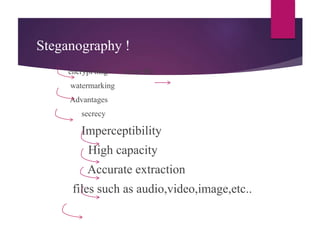
Steganography !
encrypt msg cover file
watermarking
Advantages
secrecy
Imperceptibility
High capacity
Accurate extraction
files such as audio,video,image,etc..
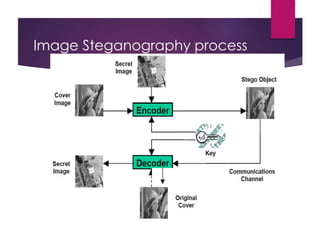
Image Steganography process
Classical Methods
 ZZTS Technique
 PVD Technique
 LSB substitution technique
 OPAP technique
Objective of proposed
method
 Most of the data is embedded into the
edged areas.
 Pixels around an edge area will have
larger differences where as pixels at a
smooth area will have smaller
differences; thus enhancing embedding
capacity of image.
IMPLEMENTATION OF PVD
 Embedding Algorithm : In this data to be hidden is embedded
into a color image and thus resulting into a stego image.
 Extraction Algorithm : In this hidden data and the color image
is extracted from the stego image.
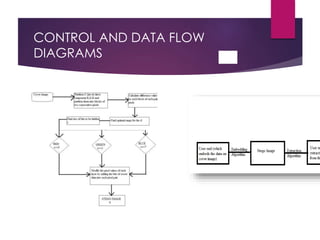
CONTROL AND DATA FLOW
DIAGRAMS
Advantages :
 High hiding capacity compared to LSB Substitution
technique.
 We get good quality of the stego image.
 Provides maximum possible payload.
 Embedded data is imperceptible to the observer.
Limitations :.
 Requires a lot of overhead to hide a relatively
bits of information.
This can be overcome by using HIGH SPEED
COMPUTERS.
Applications
 In secret communication system.
 Military applications.
 Hiding and protecting of secret data in industry.
 Navy and Air force.
 Business Deals
Results and Discussions
 Lena and baboon 256 × 256 × 3 colour digital
images
Range Cover image
Max bits that can
be embedded
(payload)
No of bits
embedded
Capacity
(bits/pixel
)
PSNR
Range1
Lena 653149
51360 3.8016 44.9412
4768 3.141 55.5705
115360 3.2268 40.8688
Baboon 609524
51360 3.2927 44.7668
4768 3.2 54.8287
115360 3.0352 41.7503
Range2
Lena 693700
51360 3.624 43.494
4768 3.7338 53.4812
115360 3.6078 40.3313
Baboon 700087
51360 3.6488 43.2479
4768 3.7192 53.6941
115360 3.5019 40.2084
The input cover image
0
200
400
600
The histogram of input cover image
0 100 200
The output stego image
0
200
400
600
800
The histogram of stego image
0 100 200
Experimental result using Range1 for Baboon cover image
The input cover image
0
200
400
600
800
The histogram of input cover image
0 100 200
The output stego image
0
500
1000
The histogram of stego image
0 100 200
Experimental result using Range2 for Lena cover image
Conclusion
 Enhanced embedding capacity of image .
 Embeded the hidden information in the cover
image and use digital signature using a key to verify
the integrity from the stego-image.
 Experimental results verify that the proposed model
is effective and efficient.
References
 1.A.L.Khade. B.G.Hogde, V B Gaikwad. “Secret Communication via Image Hiding In Image by Pixel Value Differencing”, ICWET‟,
February 2010, 437-438.
 2. H.B. Kekre, Archana Athawale, Pallavi N. Halarnkar, “Performance Evaluation of Pixel Value Differencing and Kekre‟s Modified
Algorithm for Information Hiding in Images”, International Conference on Advances in Computing, Communication and Control
(ICAC3‟09) .
 3.H.C. Wu, N.I. Wu, C.S. Tsai and M.S. Hwang, “Image steganographic scheme based on pixel value differencing and LSB replacement
method”, IEEE Proceedings on Vision, Image and Signal processing, Vol. 152, No. 5,pp. 611-615, 2005
 4. Han-ling ZHANG, Guang-zhi GENG, Cai-qiong Xing, 2009.“Image Steganography using Pixel-Value Differencing”, IEEE DOI
10.1109/ISECS.2009.139), 109–112.
 5. J.K. Mandal, Debashis Das “Steganography Using Adaptive Pixel Value Differencing(APVD) for Gray Images through Exclusion of
Underflow/Overflow ”, Computer Science & Information Series, ISBN : 978-1-921987-03-8, pp. 93-102, 2012
 6. J. K. Mandal and Debashis Das, “Colour Image Steganography Based on Pixel Value Differencing in Spatial Domain”, International
Journal of Information Sciences and Techniques (IJIST) Vol.2, No.4, July 2012, 83-93 .
 7. Reena M. Patel & D. J. Shah. “Data Hiding Using Pixel Pair Differencing Technique”.
 COMPUTECH: An International Journal of Computer Sciences (ISSN: 2229-4589). (Globe Publications: Delhi) Vol. 3, No. 6 (January 2013):
25-3.
 8. www.wikipedia.com
 9. www.programmer2programmer.com
THANK YOU

PVD BASED STEGNO.

  • 1.
    An Adaptive PVDbased Secret Data Hiding BY ABHISHEK DHARA
  • 2.
    Introduction Ways of sendinginformation encryption steganograhy
  • 3.
    Steganography ! encrypt msgcover file watermarking Advantages secrecy Imperceptibility High capacity Accurate extraction files such as audio,video,image,etc..
  • 4.
  • 5.
    Classical Methods  ZZTSTechnique  PVD Technique  LSB substitution technique  OPAP technique
  • 6.
    Objective of proposed method Most of the data is embedded into the edged areas.  Pixels around an edge area will have larger differences where as pixels at a smooth area will have smaller differences; thus enhancing embedding capacity of image.
  • 7.
    IMPLEMENTATION OF PVD Embedding Algorithm : In this data to be hidden is embedded into a color image and thus resulting into a stego image.  Extraction Algorithm : In this hidden data and the color image is extracted from the stego image.
  • 8.
    CONTROL AND DATAFLOW DIAGRAMS
  • 9.
    Advantages :  Highhiding capacity compared to LSB Substitution technique.  We get good quality of the stego image.  Provides maximum possible payload.  Embedded data is imperceptible to the observer. Limitations :.  Requires a lot of overhead to hide a relatively bits of information. This can be overcome by using HIGH SPEED COMPUTERS.
  • 10.
    Applications  In secretcommunication system.  Military applications.  Hiding and protecting of secret data in industry.  Navy and Air force.  Business Deals
  • 11.
    Results and Discussions Lena and baboon 256 × 256 × 3 colour digital images Range Cover image Max bits that can be embedded (payload) No of bits embedded Capacity (bits/pixel ) PSNR Range1 Lena 653149 51360 3.8016 44.9412 4768 3.141 55.5705 115360 3.2268 40.8688 Baboon 609524 51360 3.2927 44.7668 4768 3.2 54.8287 115360 3.0352 41.7503 Range2 Lena 693700 51360 3.624 43.494 4768 3.7338 53.4812 115360 3.6078 40.3313 Baboon 700087 51360 3.6488 43.2479 4768 3.7192 53.6941 115360 3.5019 40.2084
  • 12.
    The input coverimage 0 200 400 600 The histogram of input cover image 0 100 200 The output stego image 0 200 400 600 800 The histogram of stego image 0 100 200 Experimental result using Range1 for Baboon cover image
  • 13.
    The input coverimage 0 200 400 600 800 The histogram of input cover image 0 100 200 The output stego image 0 500 1000 The histogram of stego image 0 100 200 Experimental result using Range2 for Lena cover image
  • 14.
    Conclusion  Enhanced embeddingcapacity of image .  Embeded the hidden information in the cover image and use digital signature using a key to verify the integrity from the stego-image.  Experimental results verify that the proposed model is effective and efficient.
  • 15.
    References  1.A.L.Khade. B.G.Hogde,V B Gaikwad. “Secret Communication via Image Hiding In Image by Pixel Value Differencing”, ICWET‟, February 2010, 437-438.  2. H.B. Kekre, Archana Athawale, Pallavi N. Halarnkar, “Performance Evaluation of Pixel Value Differencing and Kekre‟s Modified Algorithm for Information Hiding in Images”, International Conference on Advances in Computing, Communication and Control (ICAC3‟09) .  3.H.C. Wu, N.I. Wu, C.S. Tsai and M.S. Hwang, “Image steganographic scheme based on pixel value differencing and LSB replacement method”, IEEE Proceedings on Vision, Image and Signal processing, Vol. 152, No. 5,pp. 611-615, 2005  4. Han-ling ZHANG, Guang-zhi GENG, Cai-qiong Xing, 2009.“Image Steganography using Pixel-Value Differencing”, IEEE DOI 10.1109/ISECS.2009.139), 109–112.  5. J.K. Mandal, Debashis Das “Steganography Using Adaptive Pixel Value Differencing(APVD) for Gray Images through Exclusion of Underflow/Overflow ”, Computer Science & Information Series, ISBN : 978-1-921987-03-8, pp. 93-102, 2012  6. J. K. Mandal and Debashis Das, “Colour Image Steganography Based on Pixel Value Differencing in Spatial Domain”, International Journal of Information Sciences and Techniques (IJIST) Vol.2, No.4, July 2012, 83-93 .  7. Reena M. Patel & D. J. Shah. “Data Hiding Using Pixel Pair Differencing Technique”.  COMPUTECH: An International Journal of Computer Sciences (ISSN: 2229-4589). (Globe Publications: Delhi) Vol. 3, No. 6 (January 2013): 25-3.  8. www.wikipedia.com  9. www.programmer2programmer.com
  • 16.