Manthan Topic:
STEPPING STONES:
Enhancing The Quality Of Primary Education
TEAM DETAILS:
Sri Harsha Jilludumudi, Surya Teja Maddikonda, Lakshman Tadury,
Tejaswini Vuyyuru, Prathyusha Patta
REFORMED EDUCATION:
A WAY TO PRESERVE QUANTITY AND AUGMENT QUALITY
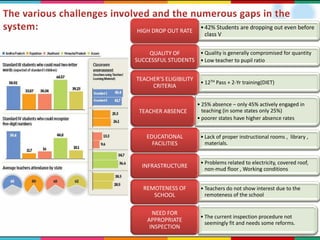
•42% Students are dropping out even before
class V
HIGH DROP OUT RATE
• Quality is generally compromised for quantity
• Low teacher to pupil ratio
QUALITY OF
SUCCESSFUL STUDENTS
• 12TH Pass + 2-Yr training(DIET)
TEACHER’S ELIGIBILITY
CRITERIA
• 25% absence – only 45% actively engaged in
teaching (in some states only 25%)
• poorer states have higher absence rates
TEACHER ABSENCE
• Lack of proper instructional rooms , library ,
materials.
EDUCATIONAL
FACILITIES
• Problems related to electricity, covered roof,
non-mud floor , Working conditions
INFRASTRUCTURE
• Teachers do not show interest due to the
remoteness of the school
REMOTENESS OF
SCHOOL
• The current inspection procedure not
seemingly fit and needs some reforms.
NEED FOR
APPROPRIATE
INSPECTION
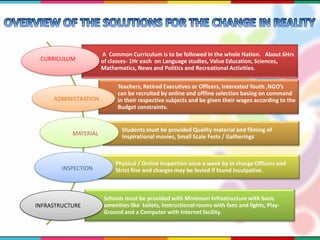
A Common Curriculum is to be followed in the whole Nation. About 6Hrs
of classes- 1Hr each on Language studies, Value Education, Sciences,
Mathematics, News and Politics and Recreational Activities.
Teachers, Retired Executives or Officers, Interested Youth ,NGO’s
can be recruited by online and offline selection basing on command
in their respective subjects and be given their wages according to the
Budget constraints.
Students must be provided Quality material and filming of
Inspirational movies, Small Scale Fests / Gatherings
Physical / Online Inspection once a week by In charge Officers and
Strict fine and charges may be levied if found inculpative.
Schools must be provided with Minimum Infrastructure with basic
amenities like toilets, Instructional rooms with fans and lights, Play-
Ground and a Computer with Internet facility.
CURRICULUM
ADMINISTRATION
MATERIAL
INSPECTION
INFRASTRUCTURE
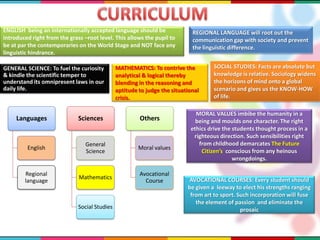
Languages
English
Regional
language
Sciences
General
Science
Mathematics
Social Studies
Others
Moral values
Avocational
Course
ENGLISH being an internationally accepted language should be
introduced right from the grass –root level. This allows the pupil to
be at par the contemporaries on the World Stage and NOT face any
linguistic hindrance.
REGIONAL LANGUAGE will root out the
communication gap with society and prevent
the linguistic difference.
MORAL VALUES imbibe the humanity in a
being and moulds one character. The right
ethics drive the students thought process in a
righteous direction. Such sensibilities right
from childhood demarcates The Future
Citizen’s conscious from any heinous
wrongdoings.
AVOCATIONAL COURSES: Every student should
be given a leeway to elect his strengths ranging
from art to sport. Such incorporation will fuse
the element of passion and eliminate the
prosaic
GENERAL SCIENCE: To fuel the curiosity
& kindle the scientific temper to
understand its omnipresent laws in our
daily life.
MATHEMATICS: To contrive the
analytical & logical thereby
blending in the reasoning and
aptitude to judge the situational
crisis.
SOCIAL STUDIES: Facts are absolute but
knowledge is relative. Sociology widens
the horizons of mind onto a global
scenario and gives us the KNOW-HOW
of life.
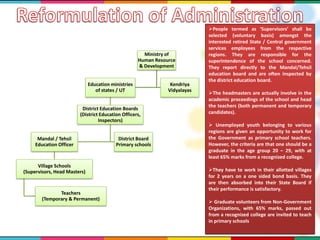
Ministry of
Human Resource
& Development
Education ministries
of states / UT
District Education Boards
(District Education Officers,
Inspectors)
Mandal / Tehsil
Education Officer
Village Schools
(Supervisors, Head Masters)
Teachers
(Temporary & Permanent)
District Board
Primary schools
Kendriya
Vidyalayas
People termed as ‘Supervisors’ shall be
selected (voluntary basis) amongst the
interested retired State / Central government
services employees from the respective
regions. They are responsible for the
superintendence of the school concerned.
They report directly to the Mandal/Tehsil
education board and are often inspected by
the district education board.
The headmasters are actually involve in the
academic proceedings of the school and head
the teachers (both permanent and temporary
candidates).
 Unemployed youth belonging to various
regions are given an opportunity to work for
the Government as primary school teachers.
However, the criteria are that one should be a
graduate in the age group 20 – 29, with at
least 65% marks from a recognized college.
They have to work in their allotted villages
for 2 years on a one sided bond basis. They
are then absorbed into their State Board if
their performance is satisfactory.
 Graduate volunteers from Non-Government
Organizations, with 65% marks, passed out
from a recognized college are invited to teach
in primary schools
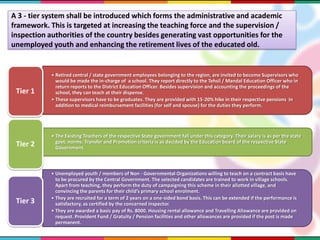
A 3 - tier system shall be introduced which forms the administrative and academic
framework. This is targeted at increasing the teaching force and the supervision /
inspection authorities of the country besides generating vast opportunities for the
unemployed youth and enhancing the retirement lives of the educated old.
• Retired central / state government employees belonging to the region, are invited to become Supervisors who
would be made the in-charge of a school. They report directly to the Tehsil / Mandal Education Officer who in
return reports to the District Education Officer. Besides supervision and accounting the proceedings of the
school, they can teach at their dispense.
• These supervisors have to be graduates. They are provided with 15-20% hike in their respective pensions in
addition to medical reimbursement facilities (for self and spouse) for the duties they perform.
Tier 1
• The Existing Teachers of the respective State government fall under this category. Their salary is as per the state
govt. norms. Transfer and Promotion criteria is as decided by the Education board of the respective State
Government.
Tier 2
• Unemployed youth / members of Non - Governmental Organizations willing to teach on a contract basis have
to be procured by the Central Government. The selected candidates are trained to work in village schools.
Apart from teaching, they perform the duty of campaigning this scheme in their allotted village, and
convincing the parents for their child’s primary school enrolment.
• They are recruited for a term of 2 years on a one-sided bond basis. This can be extended if the performance is
satisfactory, as certified by the concerned inspector.
• They are awarded a basic pay of Rs. 8000. Housing rental allowance and Travelling Allowance are provided on
request. Provident Fund / Gratuity / Pension facilities and other allowances are provided if the post is made
permanent.
Tier 3
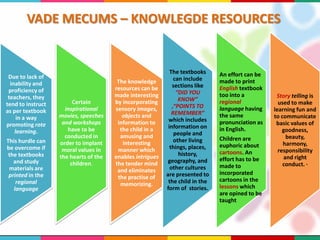
VADE MECUMS – KNOWLEGDE RESOURCES
Due to lack of
inability and
proficiency of
teachers, they
tend to instruct
as per textbook
in a way
promoting rote
learning.
This hurdle can
be overcome if
the textbooks
and study
materials are
printed in the
regional
language
Certain
inspirational
movies, speeches
and workshops
have to be
conducted in
order to implant
moral values in
the hearts of the
children.
The knowledge
resources can be
made interesting
by incorporating
sensory images,
objects and
information to
the child in a
amusing and
interesting
manner which
enables intrigues
the tender mind
and eliminates
the practise of
memorizing.
The textbooks
can include
sections like
“DID YOU
KNOW”
,“POINTS TO
REMEMBER”
which includes
information on
people and
other living
things, places,
history,
geography, and
other cultures
are presented to
the child in the
form of stories.
An effort can be
made to print
English textbook
too into a
regional
language having
the same
pronunciation as
in English.
Children are
euphoric about
cartoons. An
effort has to be
made to
incorporated
cartoons in the
lessons which
are opined to be
taught
Story telling is
used to make
learning fun and
to communicate
basic values of
goodness,
beauty,
harmony,
responsibility
and right
conduct. ·
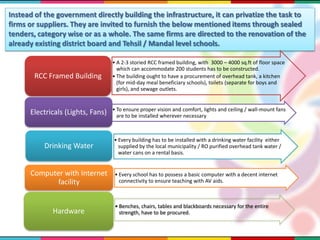
Instead of the government directly building the infrastructure, it can privatize the task to
firms or suppliers. They are invited to furnish the below mentioned items through sealed
tenders, category wise or as a whole. The same firms are directed to the renovation of the
already existing district board and Tehsil / Mandal level schools.
• A 2-3 storied RCC framed building, with 3000 – 4000 sq.ft of floor space
which can accommodate 200 students has to be constructed.
• The building ought to have a procurement of overhead tank, a kitchen
(for mid-day meal beneficiary schools), toilets (separate for boys and
girls), and sewage outlets.
RCC Framed Building
• To ensure proper vision and comfort, lights and ceiling / wall-mount fans
are to be installed wherever necessary
Electricals (Lights, Fans)
• Every building has to be installed with a drinking water facility either
supplied by the local municipality / RO purified overhead tank water /
water cans on a rental basis.
Drinking Water
• Every school has to possess a basic computer with a decent internet
connectivity to ensure teaching with AV aids.
Computer with Internet
facility
• Benches, chairs, tables and blackboards necessary for the entire
strength, have to be procured.Hardware
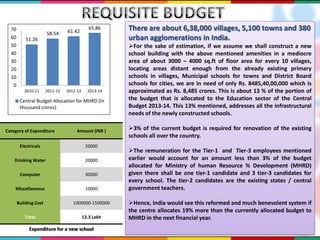
51.26
58.54 61.42
65.86
0
10
20
30
40
50
60
70
2010-11 2011-12 2012-13 2013-14
Central Budget Allocation for MHRD (In
thousand crores)
Category of Expenditure Amount (INR )
Electricals 20000
Drinking Water 20000
Computer 30000
Miscellaneous 10000
Building Cost 1000000-1500000
Total 13.3 Lakh
There are about 6,38,000 villages, 5,100 towns and 380
urban agglomerations in India.
For the sake of estimation, if we assume we shall construct a new
school building with the above mentioned amenities in a mediocre
area of about 3000 – 4000 sq.ft of floor area for every 10 villages,
locating areas distant enough from the already existing primary
schools in villages, Municipal schools for towns and District Board
schools for cities, we are in need of only Rs. 8485,40,00,000 which is
approximated as Rs. 8,485 crores. This is about 13 % of the portion of
the budget that is allocated to the Education sector of the Central
Budget 2013-14. This 13% mentioned, addresses all the infrastructural
needs of the newly constructed schools.
3% of the current budget is required for renovation of the existing
schools all over the country.
The remuneration for the Tier-1 and Tier-3 employees mentioned
earlier would account for an amount less than 3% of the budget
allocated for Ministry of human Resource % Development (MHRD)
given there shall be one tier-1 candidate and 3 tier-3 candidates for
every school. The tier-2 candidates are the existing states / central
government teachers.
Hence, India would see this reformed and much benevolent system if
the centre allocates 19% more than the currently allocated budget to
MHRD in the next financial year.
Expenditure for a new school
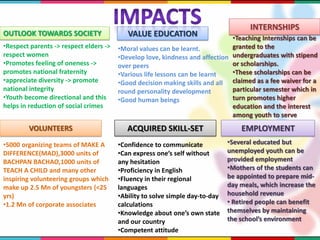
•Respect parents -> respect elders ->
respect women
•Promotes feeling of oneness ->
promotes national fraternity
•appreciate diversity -> promote
national integrity
•Youth become directional and this
helps in reduction of social crimes
OUTLOOK TOWARDS SOCIETY
•Moral values can be learnt.
•Develop love, kindness and affection
over peers
•Various life lessons can be learnt
•Good decision making skills and all
round personality development
•Good human beings
VALUE EDUCATION
•5000 organizing teams of MAKE A
DIFFERENCE(MAD),3000 units of
BACHPAN BACHAO,1000 units of
TEACH A CHILD and many other
inspiring volunteering groups which
make up 2.5 Mn of youngsters (<25
yrs)
•1.2 Mn of corporate associates
VOLUNTEERS
•Confidence to communicate
•Can express one’s self without
any hesitation
•Proficiency in English
•Fluency in their regional
languages
•Ability to solve simple day-to-day
calculations
•Knowledge about one’s own state
and our country
•Competent attitude
ACQUIRED SKILL-SET
•Several educated but
unemployed youth can be
provided employment
•Mothers of the students can
be appointed to prepare mid-
day meals, which increase the
household revenue
• Retired people can benefit
themselves by maintaining
the school’s environment
EMPLOYMENT
•Teaching Internships can be
granted to the
undergraduates with stipend
or scholarships.
•These scholarships can be
claimed as a fee waiver for a
particular semester which in
turn promotes higher
education and the interest
among youth to serve
INTERNSHIPS
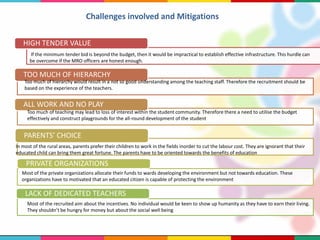
HIGH TENDER VALUE
TOO MUCH OF HIERARCHY
ALL WORK AND NO PLAY
PARENTS’ CHOICE
PRIVATE ORGANIZATIONS
LACK OF DEDICATED TEACHERS
If the minimum tender bid is beyond the budget, then it would be impractical to establish effective infrastructure.
This hurdle can be overcome if the MRO officers are honest enough.
Too much of hierarchy would result in a not so good understanding among the teaching staff. Therefore the
recruitment should be based on the experience of the teachers.
Too much of teaching may lead to loss of interest within the student community. Therefore there a need to
utilise the budget effectively and construct playgrounds for the all-round development of the student
In most of the rural areas, parents prefer their children to work in the fields inorder to cut the labour cost. They are ignoran
that their educated child can bring them great fortune. The parents have to be oriented towards the benefits of education
Most of the private organizations allocate their funds to wards developing the environment but not towards
education. These organizations have to motivated that an educated citizen is capable of protecting the
environment
Most of the recruited aim about the incentives. No individual would be keen to show up humanity as they have
to earn their living. They shouldn’t be hungry for money but about the social well being
HIGH TENDER VALUE
TOO MUCH OF HIERARCHY
ALL WORK AND NO PLAY
PARENTS’ CHOICE
PRIVATE ORGANIZATIONS
LACK OF DEDICATED TEACHERS
If the minimum tender bid is beyond the budget, then it would be impractical to establish effective infrastructure. This hurdle can
be overcome if the MRO officers are honest enough.
Too much of hierarchy would result in a not so good understanding among the teaching staff. Therefore the recruitment should be
based on the experience of the teachers.
Too much of teaching may lead to loss of interest within the student community. Therefore there a need to utilise the budget
effectively and construct playgrounds for the all-round development of the student
In most of the rural areas, parents prefer their children to work in the fields inorder to cut the labour cost. They are ignorant that their
educated child can bring them great fortune. The parents have to be oriented towards the benefits of education
Most of the private organizations allocate their funds to wards developing the environment but not towards education. These
organizations have to motivated that an educated citizen is capable of protecting the environment
Most of the recruited aim about the incentives. No individual would be keen to show up humanity as they have to earn their living.
They shouldn’t be hungry for money but about the social well being
Challenges involved and Mitigations
References
http://en.wikipedia.org/wiki/Indian_education
http://www.ssa.nic.in/
http://en.wikipedia.org/wiki/Sarva_Shiksha_Abhiyan
Education in Emerging Indian Society : The Challenges and Issues GHOSH, SUNANDA
Blackwell, Fritz (2004), India: A Global Studies Handbook, United States of America
Elder, Joseph W. (2006), "Caste System", Encyclopedia of India (vol. 1) edited by Stanley Wolpert, 223–229, Thomson
Gale.
India 2009: A Reference Annual (53rd edition), New Delhi: Additional Director General (ADG), Publications Division,
Ministry of Information and Broadcasting, Government of India
Raman, S.A. (2006). "Women's Education", Encyclopedia of India (vol. 4), edited by Stanley Wolpert, 235–239, Thomson
Gale
Setty, E.D. and Ross, E.L. (1987), "A Case Study in Applied Education in Rural India", Community Development Journal
Sripati, V. and Thiruvengadam, A.K. (2004), "India: Constitutional Amendment Making The Right to Education a
Fundamental Right", International Journal of Constitutional Law, 2 (1): 148–158, Oxford University Press.
Vrat, Prem (2006), "Indian Institutes of Technology", Encyclopedia of India (vol. 2) edited by Stanley Wolpert, 229–231,
Thomson Gale
Prabhu, Joseph (2006), "Educational Institutions and Philosophies, Traditional and Modern", Encyclopedia of India (vol.
2) edited by Stanley Wolpert, 23–28,

PUSHKAL

  • 1.
    Manthan Topic: STEPPING STONES: EnhancingThe Quality Of Primary Education TEAM DETAILS: Sri Harsha Jilludumudi, Surya Teja Maddikonda, Lakshman Tadury, Tejaswini Vuyyuru, Prathyusha Patta REFORMED EDUCATION: A WAY TO PRESERVE QUANTITY AND AUGMENT QUALITY
  • 2.
    •42% Students aredropping out even before class V HIGH DROP OUT RATE • Quality is generally compromised for quantity • Low teacher to pupil ratio QUALITY OF SUCCESSFUL STUDENTS • 12TH Pass + 2-Yr training(DIET) TEACHER’S ELIGIBILITY CRITERIA • 25% absence – only 45% actively engaged in teaching (in some states only 25%) • poorer states have higher absence rates TEACHER ABSENCE • Lack of proper instructional rooms , library , materials. EDUCATIONAL FACILITIES • Problems related to electricity, covered roof, non-mud floor , Working conditions INFRASTRUCTURE • Teachers do not show interest due to the remoteness of the school REMOTENESS OF SCHOOL • The current inspection procedure not seemingly fit and needs some reforms. NEED FOR APPROPRIATE INSPECTION
  • 3.
    A Common Curriculumis to be followed in the whole Nation. About 6Hrs of classes- 1Hr each on Language studies, Value Education, Sciences, Mathematics, News and Politics and Recreational Activities. Teachers, Retired Executives or Officers, Interested Youth ,NGO’s can be recruited by online and offline selection basing on command in their respective subjects and be given their wages according to the Budget constraints. Students must be provided Quality material and filming of Inspirational movies, Small Scale Fests / Gatherings Physical / Online Inspection once a week by In charge Officers and Strict fine and charges may be levied if found inculpative. Schools must be provided with Minimum Infrastructure with basic amenities like toilets, Instructional rooms with fans and lights, Play- Ground and a Computer with Internet facility. CURRICULUM ADMINISTRATION MATERIAL INSPECTION INFRASTRUCTURE
  • 4.
    Languages English Regional language Sciences General Science Mathematics Social Studies Others Moral values Avocational Course ENGLISHbeing an internationally accepted language should be introduced right from the grass –root level. This allows the pupil to be at par the contemporaries on the World Stage and NOT face any linguistic hindrance. REGIONAL LANGUAGE will root out the communication gap with society and prevent the linguistic difference. MORAL VALUES imbibe the humanity in a being and moulds one character. The right ethics drive the students thought process in a righteous direction. Such sensibilities right from childhood demarcates The Future Citizen’s conscious from any heinous wrongdoings. AVOCATIONAL COURSES: Every student should be given a leeway to elect his strengths ranging from art to sport. Such incorporation will fuse the element of passion and eliminate the prosaic GENERAL SCIENCE: To fuel the curiosity & kindle the scientific temper to understand its omnipresent laws in our daily life. MATHEMATICS: To contrive the analytical & logical thereby blending in the reasoning and aptitude to judge the situational crisis. SOCIAL STUDIES: Facts are absolute but knowledge is relative. Sociology widens the horizons of mind onto a global scenario and gives us the KNOW-HOW of life.
  • 5.
    Ministry of Human Resource &Development Education ministries of states / UT District Education Boards (District Education Officers, Inspectors) Mandal / Tehsil Education Officer Village Schools (Supervisors, Head Masters) Teachers (Temporary & Permanent) District Board Primary schools Kendriya Vidyalayas People termed as ‘Supervisors’ shall be selected (voluntary basis) amongst the interested retired State / Central government services employees from the respective regions. They are responsible for the superintendence of the school concerned. They report directly to the Mandal/Tehsil education board and are often inspected by the district education board. The headmasters are actually involve in the academic proceedings of the school and head the teachers (both permanent and temporary candidates).  Unemployed youth belonging to various regions are given an opportunity to work for the Government as primary school teachers. However, the criteria are that one should be a graduate in the age group 20 – 29, with at least 65% marks from a recognized college. They have to work in their allotted villages for 2 years on a one sided bond basis. They are then absorbed into their State Board if their performance is satisfactory.  Graduate volunteers from Non-Government Organizations, with 65% marks, passed out from a recognized college are invited to teach in primary schools
  • 6.
    A 3 -tier system shall be introduced which forms the administrative and academic framework. This is targeted at increasing the teaching force and the supervision / inspection authorities of the country besides generating vast opportunities for the unemployed youth and enhancing the retirement lives of the educated old. • Retired central / state government employees belonging to the region, are invited to become Supervisors who would be made the in-charge of a school. They report directly to the Tehsil / Mandal Education Officer who in return reports to the District Education Officer. Besides supervision and accounting the proceedings of the school, they can teach at their dispense. • These supervisors have to be graduates. They are provided with 15-20% hike in their respective pensions in addition to medical reimbursement facilities (for self and spouse) for the duties they perform. Tier 1 • The Existing Teachers of the respective State government fall under this category. Their salary is as per the state govt. norms. Transfer and Promotion criteria is as decided by the Education board of the respective State Government. Tier 2 • Unemployed youth / members of Non - Governmental Organizations willing to teach on a contract basis have to be procured by the Central Government. The selected candidates are trained to work in village schools. Apart from teaching, they perform the duty of campaigning this scheme in their allotted village, and convincing the parents for their child’s primary school enrolment. • They are recruited for a term of 2 years on a one-sided bond basis. This can be extended if the performance is satisfactory, as certified by the concerned inspector. • They are awarded a basic pay of Rs. 8000. Housing rental allowance and Travelling Allowance are provided on request. Provident Fund / Gratuity / Pension facilities and other allowances are provided if the post is made permanent. Tier 3
  • 7.
    VADE MECUMS –KNOWLEGDE RESOURCES Due to lack of inability and proficiency of teachers, they tend to instruct as per textbook in a way promoting rote learning. This hurdle can be overcome if the textbooks and study materials are printed in the regional language Certain inspirational movies, speeches and workshops have to be conducted in order to implant moral values in the hearts of the children. The knowledge resources can be made interesting by incorporating sensory images, objects and information to the child in a amusing and interesting manner which enables intrigues the tender mind and eliminates the practise of memorizing. The textbooks can include sections like “DID YOU KNOW” ,“POINTS TO REMEMBER” which includes information on people and other living things, places, history, geography, and other cultures are presented to the child in the form of stories. An effort can be made to print English textbook too into a regional language having the same pronunciation as in English. Children are euphoric about cartoons. An effort has to be made to incorporated cartoons in the lessons which are opined to be taught Story telling is used to make learning fun and to communicate basic values of goodness, beauty, harmony, responsibility and right conduct. ·
  • 8.
    Instead of thegovernment directly building the infrastructure, it can privatize the task to firms or suppliers. They are invited to furnish the below mentioned items through sealed tenders, category wise or as a whole. The same firms are directed to the renovation of the already existing district board and Tehsil / Mandal level schools. • A 2-3 storied RCC framed building, with 3000 – 4000 sq.ft of floor space which can accommodate 200 students has to be constructed. • The building ought to have a procurement of overhead tank, a kitchen (for mid-day meal beneficiary schools), toilets (separate for boys and girls), and sewage outlets. RCC Framed Building • To ensure proper vision and comfort, lights and ceiling / wall-mount fans are to be installed wherever necessary Electricals (Lights, Fans) • Every building has to be installed with a drinking water facility either supplied by the local municipality / RO purified overhead tank water / water cans on a rental basis. Drinking Water • Every school has to possess a basic computer with a decent internet connectivity to ensure teaching with AV aids. Computer with Internet facility • Benches, chairs, tables and blackboards necessary for the entire strength, have to be procured.Hardware
  • 9.
    51.26 58.54 61.42 65.86 0 10 20 30 40 50 60 70 2010-11 2011-122012-13 2013-14 Central Budget Allocation for MHRD (In thousand crores) Category of Expenditure Amount (INR ) Electricals 20000 Drinking Water 20000 Computer 30000 Miscellaneous 10000 Building Cost 1000000-1500000 Total 13.3 Lakh There are about 6,38,000 villages, 5,100 towns and 380 urban agglomerations in India. For the sake of estimation, if we assume we shall construct a new school building with the above mentioned amenities in a mediocre area of about 3000 – 4000 sq.ft of floor area for every 10 villages, locating areas distant enough from the already existing primary schools in villages, Municipal schools for towns and District Board schools for cities, we are in need of only Rs. 8485,40,00,000 which is approximated as Rs. 8,485 crores. This is about 13 % of the portion of the budget that is allocated to the Education sector of the Central Budget 2013-14. This 13% mentioned, addresses all the infrastructural needs of the newly constructed schools. 3% of the current budget is required for renovation of the existing schools all over the country. The remuneration for the Tier-1 and Tier-3 employees mentioned earlier would account for an amount less than 3% of the budget allocated for Ministry of human Resource % Development (MHRD) given there shall be one tier-1 candidate and 3 tier-3 candidates for every school. The tier-2 candidates are the existing states / central government teachers. Hence, India would see this reformed and much benevolent system if the centre allocates 19% more than the currently allocated budget to MHRD in the next financial year. Expenditure for a new school
  • 10.
    •Respect parents ->respect elders -> respect women •Promotes feeling of oneness -> promotes national fraternity •appreciate diversity -> promote national integrity •Youth become directional and this helps in reduction of social crimes OUTLOOK TOWARDS SOCIETY •Moral values can be learnt. •Develop love, kindness and affection over peers •Various life lessons can be learnt •Good decision making skills and all round personality development •Good human beings VALUE EDUCATION •5000 organizing teams of MAKE A DIFFERENCE(MAD),3000 units of BACHPAN BACHAO,1000 units of TEACH A CHILD and many other inspiring volunteering groups which make up 2.5 Mn of youngsters (<25 yrs) •1.2 Mn of corporate associates VOLUNTEERS •Confidence to communicate •Can express one’s self without any hesitation •Proficiency in English •Fluency in their regional languages •Ability to solve simple day-to-day calculations •Knowledge about one’s own state and our country •Competent attitude ACQUIRED SKILL-SET •Several educated but unemployed youth can be provided employment •Mothers of the students can be appointed to prepare mid- day meals, which increase the household revenue • Retired people can benefit themselves by maintaining the school’s environment EMPLOYMENT •Teaching Internships can be granted to the undergraduates with stipend or scholarships. •These scholarships can be claimed as a fee waiver for a particular semester which in turn promotes higher education and the interest among youth to serve INTERNSHIPS
  • 11.
    HIGH TENDER VALUE TOOMUCH OF HIERARCHY ALL WORK AND NO PLAY PARENTS’ CHOICE PRIVATE ORGANIZATIONS LACK OF DEDICATED TEACHERS If the minimum tender bid is beyond the budget, then it would be impractical to establish effective infrastructure. This hurdle can be overcome if the MRO officers are honest enough. Too much of hierarchy would result in a not so good understanding among the teaching staff. Therefore the recruitment should be based on the experience of the teachers. Too much of teaching may lead to loss of interest within the student community. Therefore there a need to utilise the budget effectively and construct playgrounds for the all-round development of the student In most of the rural areas, parents prefer their children to work in the fields inorder to cut the labour cost. They are ignoran that their educated child can bring them great fortune. The parents have to be oriented towards the benefits of education Most of the private organizations allocate their funds to wards developing the environment but not towards education. These organizations have to motivated that an educated citizen is capable of protecting the environment Most of the recruited aim about the incentives. No individual would be keen to show up humanity as they have to earn their living. They shouldn’t be hungry for money but about the social well being HIGH TENDER VALUE TOO MUCH OF HIERARCHY ALL WORK AND NO PLAY PARENTS’ CHOICE PRIVATE ORGANIZATIONS LACK OF DEDICATED TEACHERS If the minimum tender bid is beyond the budget, then it would be impractical to establish effective infrastructure. This hurdle can be overcome if the MRO officers are honest enough. Too much of hierarchy would result in a not so good understanding among the teaching staff. Therefore the recruitment should be based on the experience of the teachers. Too much of teaching may lead to loss of interest within the student community. Therefore there a need to utilise the budget effectively and construct playgrounds for the all-round development of the student In most of the rural areas, parents prefer their children to work in the fields inorder to cut the labour cost. They are ignorant that their educated child can bring them great fortune. The parents have to be oriented towards the benefits of education Most of the private organizations allocate their funds to wards developing the environment but not towards education. These organizations have to motivated that an educated citizen is capable of protecting the environment Most of the recruited aim about the incentives. No individual would be keen to show up humanity as they have to earn their living. They shouldn’t be hungry for money but about the social well being Challenges involved and Mitigations
  • 12.
    References http://en.wikipedia.org/wiki/Indian_education http://www.ssa.nic.in/ http://en.wikipedia.org/wiki/Sarva_Shiksha_Abhiyan Education in EmergingIndian Society : The Challenges and Issues GHOSH, SUNANDA Blackwell, Fritz (2004), India: A Global Studies Handbook, United States of America Elder, Joseph W. (2006), "Caste System", Encyclopedia of India (vol. 1) edited by Stanley Wolpert, 223–229, Thomson Gale. India 2009: A Reference Annual (53rd edition), New Delhi: Additional Director General (ADG), Publications Division, Ministry of Information and Broadcasting, Government of India Raman, S.A. (2006). "Women's Education", Encyclopedia of India (vol. 4), edited by Stanley Wolpert, 235–239, Thomson Gale Setty, E.D. and Ross, E.L. (1987), "A Case Study in Applied Education in Rural India", Community Development Journal Sripati, V. and Thiruvengadam, A.K. (2004), "India: Constitutional Amendment Making The Right to Education a Fundamental Right", International Journal of Constitutional Law, 2 (1): 148–158, Oxford University Press. Vrat, Prem (2006), "Indian Institutes of Technology", Encyclopedia of India (vol. 2) edited by Stanley Wolpert, 229–231, Thomson Gale Prabhu, Joseph (2006), "Educational Institutions and Philosophies, Traditional and Modern", Encyclopedia of India (vol. 2) edited by Stanley Wolpert, 23–28,