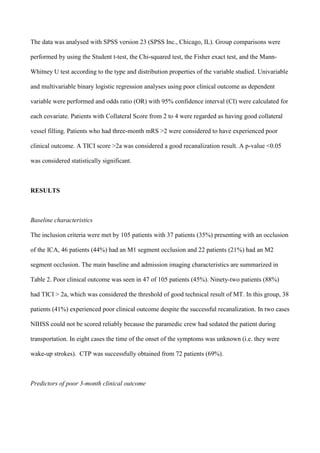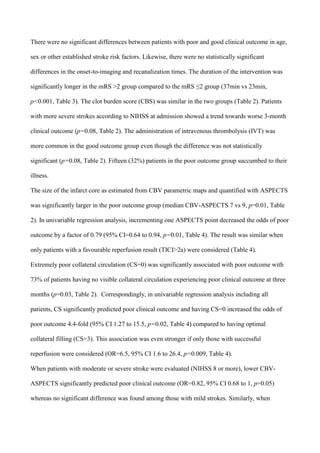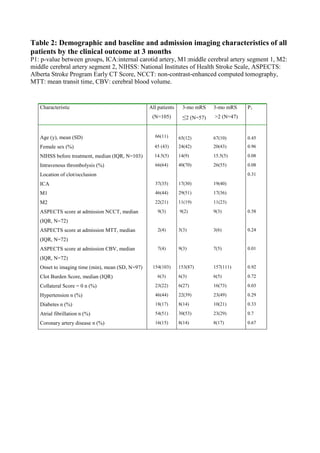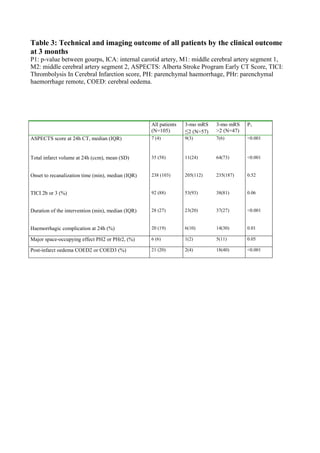






SARA PROTTO
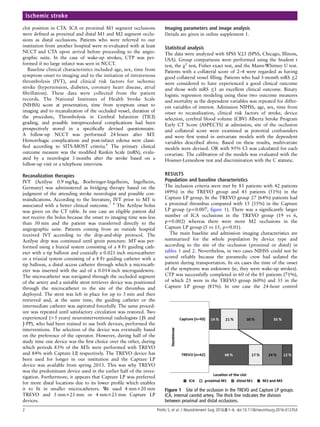
Mechanical Thrombectomy
in Acute Anterior
Circulation Stroke
Acta Universitatis Tamperensis 2303
SARAPROTTOMechanicalThrombectomyinAcuteAnteriorCirculationStroke	AUT2303
SARA PROTTO
Mechanical Thrombectomy
in Acute Anterior
Circulation Stroke
ACADEMIC DISSERTATION
To be presented, with the permission of
the Faculty Council of the Faculty of Medicine and Life Sciences
of the University of Tampere,
for public discussion in the auditorium F115 of the Arvo building,
Arvo Ylpön katu 34, Tampere,
on 6 October 2017, at 12 o’clock.
UNIVERSITY OF TAMPERE
SARA PROTTO
Mechanical Thrombectomy
in Acute Anterior
Circulation Stroke
Acta Universitatis Tamperensis 2303
Tampere University Press
Tampere 2017
ACADEMIC DISSERTATION
University of Tampere, Faculty of Medicine and Life Sciences
Finland
Reviewed by	
Professor Hannu Manninen
University of Eastern Finland
Finland
Professor Riitta Parkkola
University of Turku
Finland
Supervised by	
Docent Irina Rinta-Kiikka
University of Tampere
Finland
D.Med.Sc. Niko Sillanpää
Tampere University Hospital
Finland
Copyright ©2017 Tampere University Press and the author
Cover design by
Mikko Reinikka
Acta Universitatis Tamperensis 2303	 Acta Electronica Universitatis Tamperensis 1807
ISBN 978-952-03-0509-3 (print)	 ISBN 978-952-03-0510-9 (pdf)
ISSN-L 1455-1616	 ISSN 1456-954X
ISSN 1455-1616	 http://tampub.uta.fi
Suomen Yliopistopaino Oy – Juvenes Print
Tampere 2017 441 729
Painotuote
The originality of this thesis has been checked using the Turnitin OriginalityCheck service
in accordance with the quality management system of the University of Tampere.
A mio papá,
Mi hai dato tutto senza chiedere mai nulla in cambio.
Mi manchi ogni ora, ogni minuto, ogni secondo.
Contents
Abstract........................................................................................................................................ 7
Tiivistelmä ................................................................................................................................... 9
ABBREVIATIONS................................................................................................................. 11
LIST OF ORIGINAL COMMUNICATIONS ................................................................. 15
1 INTRODUCTION........................................................................................................ 16
2 REVIEW OF THE LITERATURE ........................................................................... 18
2.1 ACUTE ISCHEMIC STROKE.......................................................................... 18
2.1.1 Pathophysiology and etiology ..................................................................... 18
2.1.2 Risk factors .................................................................................................... 20
2.1.3 Vascular anatomy and the brain vascular territories................................ 22
2.1.4 Functional outcome measures.................................................................... 26
2.2 DIAGNOSIS OF ISCHEMIC STROKE......................................................... 27
2.2.1 Symptoms and signs of acute ischemic stroke......................................... 27
2.2.2 Imaging of acute ischemic stroke............................................................... 29
2.3 ACUTE ISCHEMIC STROKE MANAGEMENT ....................................... 41
2.3.1 Intravenous thrombolysis............................................................................ 42
2.3.2 Intra-arterial therapy..................................................................................... 44
3 AIMS OF THE STYDY................................................................................................ 51
4 SUBJECTS, MATERIALS AND METHODS......................................................... 52
4.1 Overview ................................................................................................................. 52
4.2 Subjects, study population and baseline characteristics................................... 54
4.2.1 Mechanical thrombectomy patients (I,III)................................................ 55
4.2.2 Mechanical thrombectomy patients treated with TREVO® or Capture
LP™ (II) 56
4.2.3 Mechanical thrombectomy patients with onset-to-imaging time less
than 3h (IV)...................................................................................................................... 57
4.2.4 IVT Patients between January 2004 and December 2007 (IV)............ 57
4.3 Clinical variables..................................................................................................... 57
4.4 Imaging parameters ............................................................................................... 58
4.5 Image analysis......................................................................................................... 59
4.6 Statistical analysis ................................................................................................... 60
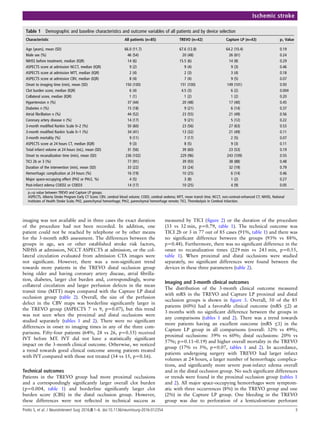
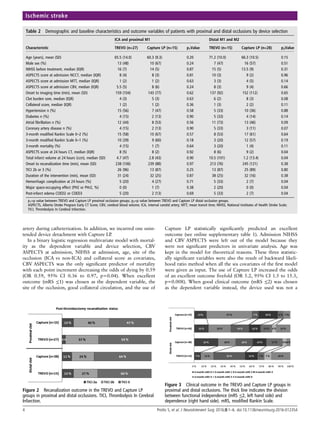
5 RESULTS......................................................................................................................... 61
5.1 Impact of the site of the occlusion on technical and clinical outcomes (I-II,
IV) 61
5.1.1 The site of the occlusion seems not to significantly affect clinical or
technical outcomes of MT (I) ....................................................................................... 61
5.1.2 The clinical benefit of MT is highest for proximal large vessel
occlusions (IV)................................................................................................................. 64
5.1.3 The technical outcome of MT is not significantly influenced by the
selection of the stent retriever. (II)............................................................................... 67
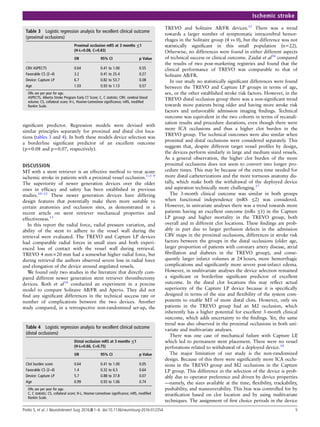
5.2 Low CBV-ASPECTS is a predictor of poor clinical outcome in mechanical
thrombectomy (III) ............................................................................................................. 68
6 DISCUSSION................................................................................................................. 70
6.1 The effect of the occlusion site and the revascularization treatment type on
the outcome of stroke......................................................................................................... 70
6.2 Influence of the device choice on technical and clinical outcomes............... 75
6.3 Predicting the outcome of acute ischemic stroke independent of the type of
the revascularization therapy.............................................................................................. 76
6.4 Limitations .............................................................................................................. 78
7 SUMMARY AND CONCLUSIONS ......................................................................... 79
ACKNOWLEDGEMETS..................................................................................................... 81
REFERENCES........................................................................................................................ 83
ORIGINAL COMMUNICATIONS.................................................................................103
Abstract
Stroke continues to be one of the leading causes of morbidity and mortality
worldwide. Acute ischemic stroke is caused by insufficient blood flow to the brain
tissue and it most often due to occlusion of an intracranial artery by a thrombus.
There have been great advances in the treatment of this condition recently with the
development of the stentretriever-based techniques that allow rapid restoration of
perfusion to the ischemic area. The superiority of these mechanical thrombectomy
(MT) techniques over the previous pharmacological therapies (intravenous
thrombolysis, IVT) has been demonstrated in recent randomized trials. However,
the introduction of interventional techniques has amplified the need to improve
our ability to more precisely stratify risk and refine the treatment decision-making
process to select the correct treatment for patients among these diverse therapeutic
modalities.
This thesis examines in a prospectively collected, observational cohort the principal
parameters that influence the technical and clinical outcomes in patients presenting
acute anterior circulation stroke and treated via MT between January 2013 and
December 2014 in Tampere University Hospital. The 3-month modified Rankin
Scale (mRS) was used as the primary functional outcome measure and the
Thrombolysis in Cerebral Infarction scale (TICI) was used to describe the technical
outcome. The parameters studied included the location of the clot in computed
tomography angiography (CTA) and the device used to perform the intervention.
We also investigated the prognostic value of data derived from perfusion CT
studies (CTP), especially the utility of cerebral blood volume maps (CBV).
Moreover, we compared the results of patients at our institution treated with only
IVT to those treated with MT to assess the differences in clinical outcomes and to
clarify the patient subgroups for which MT outperforms IVT.
Mechanical thrombectomy was clearly superior to IVT in the treatment of
proximal large vessel occlusions whereas neither therapy outperformed the other in
distal large vessel occlusions. In our cohorts, surviving an internal carotid artery
(ICA) or a proximal M1 segment of the middle cerebral artery (MCA) occlusion
without any disability-causing neurological deficits required MT. The site of the
occlusion does not seem to have a significant effect on the technical success rates
of MT. Further, the selection of the newer generation stent retriever does not
appear to result in differences in technical or clinical outcomes. This supports the
notion that the decision of which device to use should be left to the operator based
on his/her own experience.
Cerebral blood volume mapping assessed semiquantitatively with the Alberta
Stroke Program Early CT score (ASPECTS) is an established predictor of outcome
in a variety of clinical settings. In our study, a low CBV-ASPECTS score at
admission was associated with a large infarct core in follow-up imaging and was a
significant predictor of poor clinical outcome, especially in the setting of poor
collateral circulation and/or moderate or severe stroke. The collateral score was
also a significant predictive factor. Having no visible collateral circulation in the
admission CTA was specifically related to poor clinical outcome.
Keywords: ASPECTS, mechanical thrombectomy, intravenous thrombolysis, stroke,
computed tomography perfusion, collateral score, modified Rankin scale,
Thrombolysis in Cerebral Infarction scale.
Tiivistelmä
Aivoinfarkti on yksi johtavista sairastavuuden ja kuolleisuuden aiheuttajista
maailmanlaajuisesti. Äkillinen iskeminen aivoinfarkti aiheutuu riittämättömästä
verenkierrosta aivoihin, joka yleensä johtuu verihyytymän aiheuttamasta
kallonsisäisen valtimon tukkeutumisesta. Viime vuosina äkillisen iskemisen
aivoinfarktin valtimonsisäiset hoidot ovat kehittyneet huomattavasti. Nämä hoidot
mahdollistavat veren virtauksen nopean palauttamisen iskemiselle alueelle.
Viimeaikaisissa satunnaistetuissa tutkimuksissa erityisesti mekaaninen verihyytymän
poisto takaisin vedettävällä stentillä on osoitettu ylivertaiseksi hoidoksi verrattuna
lääkkeelliseen hoitoon eli laskimonsisäiseen verihyytymän liuotukseen. Näiden
tekniikoiden käyttöönotto kuitenkin vaati välineitä tarkempien ennusteiden ja siten
oikeiden hoitopäätösten tekemiseksi.
Tässä väitöstutkimuksessa tutkiin havainnoivassa asetelmassa prospektiivisesti
Tampereen yliopistollisessa sairaalassa tammikuun 2013 ja joulukuun 2014 välillä
kerättyä kohorttia potilaita, jotka olivat sairastuneet äkilliseen etukierron valtion
tukkeutumisesta aiheutuneeseen aivoinfarktiin, jota hoidettiin mekaanisella
verihyytymän poistolla. Tutkimuksen tavoite oli tunnistaa muuttujia, jotka
vaikuttavat hoidon teknisiin ja kliinisiin lopputuloksiin. Kliinisen lopputuloksen
ensisijaisena mittarina käytettiin muokatun Rankinin asteikon (mRS, modified
Rankin Scale) tulosta kolmen kuukauden kohdalla sairastumisesta. Teknisen
lopputuloksen mittarina käytettiin Thrombolysis in Cerebral Ischemia (TICI) -
asteikkoa. Näiden ennustemuuttujina tutkittiin verihyytymän sijaintia
tietokonetomografiatutkimuksessa, hyytymän poistamiseen käytetyn välineen
valinnan vaikutusta, tietokonetomografia perfuusiotutkimuksen parametreja
(erityisesti aivojen veritilavuus, Cerebral Bloob Volume, CBV) sekä
kollateraalikierron tilaa. Lisäksi vertasimme laskimonsisäisellä liuotushoidolla ja
mekaaniselle verihyytymän poistolla hoidettujen potilaiden tuloksia
selventääksemme minkä potilasryhmisen hoitoon mekaaninen verihyytymän poisto
sopii paremmin kuin liuotushoito.
Mekaaninen verihyytymän poisto osoittautui selvästi paremmaksi kuin
laskimonsisäinen liuotushoito erityisesti proksimaalisen suuren suonen tukosten
(sisempi kaulavaltimo tai keskimmäisen aivovaltimon M1-segmentin
proksimaaliosa) hoidossa siinä missä kumpikaan näistä hoidoista ei ollut selvästi
toista parempi distaalisen suuren suonen tukosten (keskimmäisen aivovaltimon
M1-segmentin distaaliosa tai M2-segmentti) hoidossa. Lisäksi havaitsimme, että
proksimaalisesta suuren suonen tukoksesta selviytyminen ilman merkittävää
pysyvää haittaavaa oiretta edellytti mekaanista verihyytymän poistoa. Tukoksen
sijainnilla ei ollut merkittävää vaikutusta toimenpiteen tekniseen onnistumiseen.
Myöskään takaisinvedettävän stentin valinta ei näytä vaikuttavan tekniseen
onnistumiseen tai kliiniseen lopputulokseen. Aivojen veritilavuutta arvioitiin
ASPECTS-pisteytyksellä (Alberta Stroke Program Early CT Score). Matalat
ASPECTS-pisteet tulovaiheessa ennustivat kookasta infarktia
seurantakuvantamisissa ja huonoa kliinistä lopputulosta erityisesti, jos
kollateraaliverenkierto oli heikko ja/tai infarktioireisto oli vaikeusasteeltaan
kohtalainen tai vakava. Kollateraalikierron tila osoittautui myös tärkeäksi
ennustavaksi tekijäksi: Jos potilaan kollateraalikierto oli lähtötilanteessa heikko,
kliininen lopputulos oli yleensä huono.
Avainsanat: ASPECTS, mekaaninen verihyytymän poisto, laskimonsisäinen
liuotushoito, aivoinfarkti, tietokonetomografiaperfuusio, kollateraalikierto, muokattu
Rankinin asteikko, Thrombolysis in Cerebral Infarction -asteikko.
ABBREVIATIONS
2D two-dimensional
3D three-dimensional
A1 A1 segment of the anterior cerebral artery
ACA anterior cerebral artery
ACommA anterior communicating artery
AF Atrial Fibrillation
AHA American Heart Association
AIS acute ischemic stroke
aPTT activated partial thromboplastin time
ASPECTS Alberta Stroke Program Early CT Score
BA basilar artery
BMI body mass index
CBF Cerebral Blood Flow
CBS clot burden score
CBV Cerebral Blood Volume
CCS Causative Classification System for Ischemic Stroke
CI confidence interval
CNS central nervous system
CT Computed Tomography
CTA computed tomography angiography
CTA-SI computed tomography angiography source images
CTP Computed Tomography Perfusion
CW circle of Willis
DALY Disability-Adjusted Life Year
DEFUSE Diffusion-weighted imaging Evaluation For Understanding Stroke
Evolution
DSA digital subtraction angiography
DWI diffusion-weighted imaging
EIC early ischemic change
FDA Food and Drug Administration
HIS hyperacute ischemic stroke
HMCAS the hyperdense MCA sign
H-L Hosmer-Lemeshow
IAT intra-arterial thrombolysis
ICA internal carotid artery
ICH intracranial hemorrhage
IQR interquartile range
IMS Interventional Management of Stroke
INR International Normalized Ratio
IS ischemic stroke
IVT intravenous thrombolysis
LVO large vessel occlusion
M1 M1 segment of the middle cerebral artery
M1D distal M1 segment of the middle cerebral artery
M1P proximal M1 segment of the middle cerebral artery
M2 M2 segment of the middle cerebral artery
M3 M3 segment of the middle cerebral artery
M4 M4 segment of the middle cerebral artery
MCA middle cerebral artery
MIP maximum intensity projection
MRI magnetic resonance imaging
mRS modified Rankin Scale
MT Mechanical Thrombectomy
MTT mean transit time
NECT nonenhanced computed tomography
NIHSS National Institutes of Health Stroke Scale
NNT number needed to treat
OR odds ratio
PAR Population Attributable Risk
PCA posterior cerebral artery
PCommA posterior communicating artery
PS Penumbra System
ROC receiver-operating characteristic curve
r-proUK recombinant prourokinase
RR risk ratio
rtPA recombinant tissue plasminogen activator
SPSS Statistical Package for the Social Sciences
TIA Transient Ischemic Attack
TICI Thrombolysis in Cerebral Infarction Scale
tPA tissue plasminogen activator
TTP time to peak
VA vertebral artery
LIST OF ORIGINAL COMMUNICATIONS
This thesis is based on the following publications, referred to in the text by their
Roman numeral:
I. Stent Retriever Thrombectomy in Different Thrombus Locations of
Anterior Cerebral Circulation. Protto S, Sillanpää N, Pienimäki JP,
Matkaselkä I, Seppänen J, Numminen H. Cardiovasc Intervent Radiol.
2016 Jul;39(7):988-93. doi: 10.1007/s00270-016-1315-4.
II. TREVO and Capture LP have equal technical success rates in
mechanical thrombectomy of proximal and distal anterior circulation
occlusions. Protto S, Pienimäki JP, Seppänen J, Matkaselkä I, Ollikainen
J, Numminen H, Sillanpää N. J Neurointerv Surg. 2016 Jun 17. pii:
neurintsurg-2016-012354. doi: 10.1136/neurintsurg-2016-012354. [Epub
ahead of print]
III. Low Cerebral Blood Volume Identifies Poor Outcome in Stent
Retriever Thrombectomy. Protto, S., Pienimäki, JP., Seppänen, J. et al.
Cardiovasc Intervent Radiol (2017) 40: 502. doi:10.1007/s00270-016-1532-x
IV. Internal Carotid Artery and the Proximal M1 Segment are Optimal
Targets for Mechanical Thrombectomy. Sillanpää N, Protto S,
Saarinen J, T, Pienimäki J, -P, Seppänen J, Numminen H, Rusanen H.
Intervent Neurol 2017;6:207-218
16
1 INTRODUCTION
Stroke is one of the largest contributors to death and disability worldwide and
furthermore has a major impact to the economy. Stroke is the third-leading cause
of disease burden as measured in disability-adjusted life years (DALYs) in
developed countries and the second leading cause of DALYs in developing
countries [1]. According to the Global Burden of Disease: 2004 Update, stroke
continues to be the second leading cause of death among people aged 15 years and
over.
The Global Burden of Stroke study estimated 6.5 million deaths from stroke and
10.3 million new strokes in 2013. Although the number of people who have
suffered a stroke has increased every year, the global incidence, mortality and the
number of DALYs lost are decreasing. However, this trend is more evident in
developed countries, while the people in developing countries carry a higher
burden of stroke. [1]
In Finland, the number of first-ever stroke episodes in 2007 was 10338. The yearly
medical expenses attributable to the treatment of stroke patients were close to 1.6
billion €, which corresponds to 7 % of all healthcare expenditure. [2]
Most strokes (87%) have an ischemic etiology meaning that they are caused by
insufficient blood flow to the brain tissue. The remainder of strokes is hemorrhagic
in origin, with 10% caused by intracerebral bleedings and 3% by subarachnoidal
hemorrhages [3, 4]. Ischemic stroke (IS) is generally due to a thrombotic or
embolic event in an intracerebral artery, which significantly decreases blood flow to
the tissue distal to the occlusion inducing cell death. Typically, patients present a
sudden onset of symptoms, the most common symptoms being motor disruption,
hemiparesis with or without hemisensory deficits, facial droop, ataxia, aphasia,
dysarthria, visual impairment, and variable decrease of consciousness.
Ischemic stroke is operationally defined as a neurological deficit lasting more than
24 h or an imaging finding in a patient with transient symptoms. Correspondingly,
a transient ischemic attack (TIA) is defined as a self-limiting episode of
17
neurological dysfunction caused by focal brain, spinal cord, or retinal ischemia,
without acute infarction, lasting less than 24 h. [5] Thus, imaging has a central role
in the evaluation of patients with acute stroke. Generally, multimodal computed
tomography (CT) is performed because it is widely available in most centers and a
fast imaging technique, but stroke magnetic resonance imaging (MRI) has also
been used extensively [6]. Both imaging techniques enable the differential diagnosis
between intracranial or subarachnoidal hemorrhage and ischemic stroke and allow
evaluation of the anatomy of the cerebral and cervical vasculature, the location of
the occlusive lesion and the extent of irreversible and/or reversible changes [7-9].
Prompt and effective revascularization of the affected area is crucial for improving
the patient´s prognosis. The time window between symptom onset and treatment
is a pivotal factor in determining the final outcome [10]. Therefore, in recent
decades, several therapies have been developed, namely, intravenous thrombolysis
(IVT) and intra-arterial interventions that aim to rapidly restore perfusion to the
affected areas. While IVT has been endorsed by different stroke treatment
guidelines for almost two decades, the efficacy of intra-arterial therapy was
demonstrated only recently [11-17]. Based on diverse technical approaches, stent
retriever-based mechanical thrombectomy (MT) provided a breakthrough in the
efficacy and safety of intra-arterial treatment of IS [18].
To better understand the role of the innovative stent retriever technique, this thesis
reports a prospectively collected, observational cohort of patients with acute
anterior circulation stroke who were treated via mechanical thrombectomy (MT)
with a focus on the clinical and imaging parameters that influence the technical and
clinical outcomes. These factors included the location of the clot on admission
computed tomography angiography (CTA) and type of the stent retriever device
used during the intervention. We also investigated the prognostic performance of
data derived from perfusion CT studies (CTP), especially cerebral blood volume
maps (CBV). Moreover, we compared the results in patients treated in our
institution with only IVT to those treated with MT to assess the differences in
clinical outcomes and to clarify the patient subgroups for which MT outperforms
IVT. The 3-month modified Rankin Scale (mRS) was used as the functional
outcome measure and the Thrombolysis in Cerebral Infarction scale (TICI) was
used to define the technical outcome.
18
2 REVIEW OF THE LITERATURE
2.1 ACUTE ISCHEMIC STROKE
2.1.1 Pathophysiology and etiology
Acute ischemic stroke results from a sudden reduction of cerebral blood flow
(CBF) to the brain parenchyma. Typically, this decrease in blood flow follows
thrombosis or embolism in the artery supplying a part of the brain, inducing
insufficient delivery of oxygen and glucose which leads to cell death in the absence
of sufficient collateral circulation or revascularization (Figure 1). The decrease in
perfusion triggers a cascade of events in cells, which eventually results in
irreversible changes: inhibition of protein synthesis, anaerobic glycolysis,
inflammation, release of excitatory neurotransmitters, disturbance of energy
metabolism and oxidative/nitrative stress, and finally anoxic depolarization and
loss of membrane integrity [19]. In the core of the ischemic area, where the CBF is
drastically impaired (<15 ml/100 g/min), neuronal cell death occurs within a few
minutes, whereas in the periphery, the events leading to irreversible changes take
more time. The so-called ischemic penumbra is an area of the brain parenchyma
where blood flow is moderately reduced (15-20 ml/100 g/min) but the tissue
remains viable if restoration of normal flow is achieved in sufficiently short time.
Benign oligemia (20-55 ml/100 g/min) defines the volume of mild hypoperfusion,
which normally does not lead to infarction even without revascularization. [20, 21]
Hypoperfusion and irreversible ischemic damages can also be caused or aggravated
by systemic hypotension. Hence it is important to control the blood pressure in
patients suffering from IS in order to maintain or improve both antegrade and
collateral circulation. [22]
Ischemic stroke etiology is classified based on the mechanism of the injury. The
Trial of Org 10172 in Acute Stroke Treatment (TOAST) classification defines five
stroke subtypes: large-artery atherosclerotic infarction (19%), embolism from a
cardiac source (9%), small-vessel disease (44%), stroke of other determined
19
etiology (5%), and infarcts of undetermined cause (23%) [23]. However, because of
the evolution and the precision of the diagnostic tools, more than one cause of
stroke can often be recognized in a single patient. For instance, a potential source
of cardiac embolism can be detected using echocardiography in 50 to 70% of
ischemic stroke patients. Further, 12% of patients with a cardiac source of
embolism and 22% of patients with a lacunar infarction harbor ipsilateral large
artery atherosclerosis causing a narrowing of greater than 50% of the vessel
diameter [24]. Application of the TOAST classification criteria often results in
most strokes being classified to the undetermined category, which led to the
development of new, more refined classification systems. The Stop Stroke Study
TOAST (SSS-TOAST) system uses the same five etiological categories, but based
on the weight of evidence, further classifies each category into “evident”,
“probable” or “possible” [24]. The Causative Classification of Ischemic Stroke
(CCS) is an automated version of SSS-TOAST that maximizes inter-examiner
reliability and limits inter-examiner variability in the classification. [25] The
distribution of ischemic stroke subtypes varies largely between different
populations and reports and is dependent on the availability of modern diagnostic
tools and the age distribution of the population. Recently, an increase in the
prevalence of some stroke subtype over others has been observed, with the
cardioembolic category now being the dominant etiology in western countries (e.g.
48% in Sweden). [3]
20
Figure 1. Occlusion of the right M1 segment of the MCA. Adapted from
http://www.strokecenter.org/patients/about-stroke/ischemic-stroke/
2.1.2 Risk factors
Numerous risk factors are associated with ischemic stroke. Modifiable risk factors
play an important role in the prevention of stroke. The INTERSTROKE study
recently conducted in 32 countries demonstrated that ten preventable risk factors
(hypertension, current smoking, abdominal obesity, unhealthy diet, lack of regular
physical activity, high alcohol intake, psychosocial stress and depression, cardiac
disease, diabetes mellitus and unfavorable lipid profile) contribute to 91.5% of the
total risk of ischemic stroke. [26] These findings corroborated the results of the
Global Burden of Disease 2013 (GBD) study, in which 90.5% of the stroke burden
(measured in DALYs) was attributable to modifiable risk factors. Both studies
identified hypertension as the most significant factor influencing the Population
Attributable Risk (PAR) with estimates for the parameter ranging from 47.9 to
64.1%.
There is strong evidence that cigarette smoke is intimately related to stroke with a
greater risk for women or younger smokers. Ex-smokers have double the risk of
21
experiencing a stroke before the age of 75 compared to lifetime non-smokers. [27-
29] The INTERSTROKE study estimated the PAR of cigarette smoking at 12.4%.
[26]
Obesity is also correlated with stroke risk. In the upper body mass index (BMI)
bracket (25 to 50 kg/m2), each 5 kg/m2 increment is associated with 40% higher
stroke mortality. Similar to cigarette smoking, the association of BMI with stroke is
stronger among the younger population. [30-32] Physical activity and healthy
lifestyle have been shown to reduce the risk of stroke. Compared with sedentary
lifestyle, the risk reduction for active individuals has been estimated at 26%. [33,
34] Using the American Heart Association (AHA) recommendation (2.5 hours or
more of exercise per week), increased physical activity was associated with a
reduction in all stroke risk (OR 0.41 [0.35–0.48], PAR 53.0% [47.0–59.0]). [26]
High alcohol consumption increases the risk of all stroke subtypes. However, the
association of alcohol intake and stroke risk appears to be J-shaped. [35] In a recent
study on monozygotic twins, heavy alcohol consumption shortened the time to
first stroke by 5 years. [36]
Psychosocial stress and depression, defined in the INTERHEART study as a
combination of stress (life and work), life events and depression [37], is also
associated with higher risk of stroke. [26] A recent study found that in diabetic
patients there was an association between elevated stress or depressive symptoms
and increased incidence of stroke (Hazard Ratio 1.57 [95% CI 1.05, 2.33]). [38]
Atrial fibrillation (AF), coronary artery disease, and cardiac failure are all well-
known risk factors for stroke [39]. In the INSTROKE study AF was significantly
associated with ischemic stroke (PAR ranging from 3.1% in southern Asia to
17.1% in western Europe, North America and Australia). According to recent
studies, coronary artery calcification (CAC) is a predictor of IS in both genders,
especially among younger patients, independently of AF. CAC was a good
discriminator of stroke risk particularly in subjects presenting a low or intermediate
(< 20%) Framingham risk score. [40, 41]
The relation between diabetes mellitus (DM) and stroke has been widely
demonstrated [42, 43] Many risk factors for stroke such as hypertension,
hypercholesterolemia, ischemic heart disease, and vascular claudication are more
prevalent among diabetic individuals. Subcortical and lacunar infarctions are more
frequent in diabetic patients than in their non-diabetic counterparts. [44]
22
Several studies have shown that there is also a correlation between atherogenic
lipid profiles and stroke risk. In particular, low levels of high-density lipoprotein
(HDL), high levels of total cholesterol (TC) and a high TC-HDL ratio increase the
risk of IS in both men and women. [45, 46]
Interestingly, at younger age, all the risk factors seem to exert a stronger negative
effect. [26, 47] Pregnancy has been demonstrated to increase risk especially during
the third trimester and the post-partum period, probably because of hormonal
changes and hypercoagulability due to activated protein C resistance, lower levels
of protein S, increased fibrinogen, pregnancy-related hypertension and venous
stasis. [48]
An important non-modifiable risk marker is age, with increased risks each year
after the age of 19 of 9% for men and 10% for women. [47] Previous history of
stroke or TIA, family history of stroke and male gender are associated with
increased risk of IS. [49-51].
2.1.3 Vascular anatomy and the brain vascular territories
Blood supply to the brain is generally divided into anterior and posterior
circulation. The anterior circulation consists of the middle cerebral artery (MCA)
and the anterior cerebral artery (ACA). The posterior circulation comprises
infratentorially the basilar artery (BA), which branches in the supratentorial space
into the posterior cerebral arteries (PCA). The anterior circulation is supplied by
the common carotid arteries (CCA), which typically originates on the right side
from the brachiocephalic trunk and on the left side directly from the aortic arch.
The common carotid artery is divided into the external carotid artery (ECA) and
the internal carotid artery (ICA), which eventually supplies the intracranial anterior
circulation. The posterior circulation is supplied by the vertebral arteries in both
sides (VA), which usually originate from the subclavian arteries (SA). Normally,
there are many connecting vessels that enable collateral flow and a communication
between the carotid and the vertebrobasilar systems. The ACAs are connected by
the anterior communicating artery (ACommA) and the ICAs and the posterior
cerebral arteries are connected by the posterior communicating arteries
(PCommA). Overall the communicating arteries form the circle of Willis (CW)
23
together with parts of the ACA, ICA and PCA (Figure 2). The ACA supplies the
medial part of the frontal and parietal lobes. The MCA is divided in named
segments based on distal subdivisions: M1, M2, M3, and M4. The MCA mainly
supplies a large part of the lateral cerebral cortex, the temporal lobes and the
insular cortex, the lateral parts of the frontal cortex and the anterior parts of the
parietal cortex. The lenticulostriate perforating arteries, which perfuse the basal
ganglia, originate from the M1, or sphenoidal, segment. This segment can be
further divided into proximal M1 (M1P) and distal M1 (M1D) subsegments [52,
53]. The M2 segments are variable: The M1 segment normally bifurcates into
superior and inferior divisions but sometimes trifurcates into temporal, parietal and
frontal branches. The M3 and M4 segments are more distal and supply the cortex.
The posterior cerebral arteries (PCAs) supply the occipital lobes and the
posteromedial temporal lobes. The branches of the BA and VAs supply the
cerebellum, the medulla oblongata and the pons. Anatomical variations in the
cerebral vasculature are commonplace. [54, 55] Each artery supplies, in a near end-
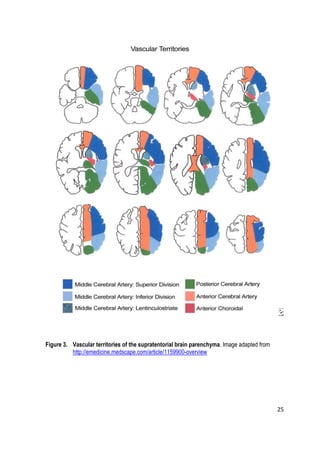
artery fashion, a different area of the brain, i.e. their vascular territories [56, 57]
(Figure 3). There is a clear correlation between the vascular territory affected by
stroke and the symptoms presented by the patient. [58-60]
24
Figure 2. Classical circle of Willis. (1) ACommA, anterior communicating artery, (2)
A1, precommunicating segment of the anterior cerebral artery (ACA), (3)
PCommA, posterior communicating artery, (4) P1, precommunicating
segment of the posterior cerebral artery (PCA), (5) BA, basilar artery, (6)
P2, postcommunicating segment of the PCA, (7) ICA, internal carotid
artery, (8) MCA, middle cerebral artery, (9) A2, postcommunicating
segment of the ACA, and (10) SCA, superior cerebellar artery. From
Gunnal et al. [55]
25
Figure 3. Vascular territories of the supratentorial brain parenchyma. Image adapted from
http://emedicine.medscape.com/article/1159900-overview
26
2.1.4 Functional outcome measures
The modified Rankin Scale (mRs) is the most commonly used measure of global
disability when evaluating recovery from stroke. Thus, it is also used as a primary
functional outcome measure in the majority of randomized clinical trials (64%)
[61,62]. The evaluation is usually performed at different time points (1-, 3-, and 6-
months) after the onset of the episode. The scale consists of 6 categories as
depicted in Table 1. The score is often dichotomized using mRS=2 as a cut-off
value because it differentiates between functional independence and dependence.
Thus, mRS≤2 in considered to indicate good clinical outcome. Excellent clinical
outcome is indicated by a mRS ≤1. The use of structured templates for interview
improves the inter-rater reliability [61]. Another rather common score system
(41%) is the Barthel activities of daily living (ADL) index [62]. The
dichotomization cut-off is generally ≥ 90 points.
Table 1. The modified Rankin scale (mRS). mRS is a 6-point scale, with higher scores indicating
a worse functional outcome
27
2.2 DIAGNOSIS OF ISCHEMIC STROKE
Ischemic stroke is a serious condition that requires fast diagnosis and treatment.
Acute ischemic stroke is generally diagnosed based on signs and symptoms
revealed during neurological and physical examinations, the anamnesis of the
patients and imaging findings. Patients suffering from stroke should be prioritized
in the triage in the emergency department in a similar manner to patients with
hemodynamically significant bleeding or myocardial infarction.
2.2.1 Symptoms and signs of acute ischemic stroke
Typical signs and symptoms of stroke are motor disruption, such as hemiparesis
with or without hemisensory deficits, monocular vision loss, visual field deficits,
diplopia, dysarthria and/or aphasia, facial droop, ataxia, a decrease in the level of
consciousness and vertigo. These symptoms can be better depicted and evaluated
during a fast neurological and physical examination with a standardized, systematic
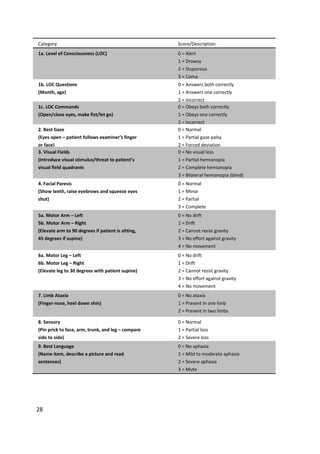
and uniform stroke scale [63, 64]. The National Institutes of Health Stroke Scale
(NIHSS) is the most widely used assessment tool for evaluating stroke patients
(Table 2). This scale is a 42-point scoring system that quantifies neurological
deficits in 11 categories. A higher score indicates worse deficits; severe stroke is
defined as NIHSS >16, moderate as NIHSS between 8 and 16 and mild as NIHSS
<8. When a patient is suspected of having IS, other possible conditions that can
mimic neurovascular syndrome (i.e., “stroke mimics”) must be excluded. [65-67]
The most common conditions that mimic stroke are postictal states, sepsis,
tumors, toxic and metabolic disturbances, syncope, intracranial abscesses, migraine,
hypoglycemia, hypertensive encephalopathy, neuroimmunologic disease,
polyradiculitis and myasthenia gravis [65-67]
28
Category Score/Description
1a. Level of Consciousness (LOC) 0 = Alert
1 = Drowsy
2 = Stuporous
3 = Coma
1b. LOC Questions
(Month, age)
0 = Answers both correctly
1 = Answers one correctly
2 = Incorrect
1c. LOC Commands
(Open/close eyes, make fist/let go)
0 = Obeys both correctly
1 = Obeys one correctly
2 = Incorrect
2. Best Gaze
(Eyes open – patient follows examiner’s finger
or face)
0 = Normal
1 = Partial gaze palsy
2 = Forced deviation
3. Visual Fields
(Introduce visual stimulus/threat to patient’s
visual field quadrants
0 = No visual loss
1 = Partial hemianopia
2 = Complete hemianopia
3 = Bilateral hemianopia (blind)
4. Facial Paresis
(Show teeth, raise eyebrows and squeeze eyes
shut)
0 = Normal
1 = Minor
2 = Partial
3 = Complete
5a. Motor Arm – Left
5b. Motor Arm – Right
(Elevate arm to 90 degrees if patient is sitting,
45 degrees if supine)
0 = No drift
1 = Drift
2 = Cannot resist gravity
3 = No effort against gravity
4 = No movement
X = Untestable (limb amputation etc.)6a. Motor Leg – Left
6b. Motor Leg – Right
(Elevate leg to 30 degrees with patient supine)
0 = No drift
1 = Drift
2 = Cannot resist gravity
3 = No effort against gravity
4 = No movement
X = Untestable (limb amputation etc.)7. Limb Ataxia
(Finger-nose, heel down shin)
0 = No ataxia
1 = Present in one limb
2 = Present in two limbs
8. Sensory
(Pin prick to face, arm, trunk, and leg – compare
side to side)
0 = Normal
1 = Partial loss
2 = Severe loss
9. Best Language
(Name item, describe a picture and read
sentences)
0 = No aphasia
1 = Mild to moderate aphasia
2 = Severe aphasia
3 = Mute
29
10. Dysarthria
(Evaluate speech clarity by patient repeating
listed words)
0 = Normal articulation
1 = Mild to moderate slurring of words
2 = Near unintelligible or worse
X = Intubated or other physical barrier
11. Extinction and Inattention
(Use information from prior testing to identify
neglect or double simultaneous stimuli testing)
0 = No neglect
1 = Partial neglect
2 = Complete neglect
Table 2. The National Institute of Health Stroke Scale (NIHSS). The NIHSS quantifies
neurological deficits into 11 categories. Higher scores indicate greater deficits. Adapted
from Richardson et al. [68]
2.2.2 Imaging of acute ischemic stroke
Primarily, imaging of a patient suffering symptoms of stroke is performed to
distinguish between hemorrhagic and ischemic stroke, as these categories have
completely different general treatment approaches. Other important information
that can be obtained with imaging includes the extent of the ischemic brain
parenchyma, the site of the occlusion, and an estimate of the volume of the
irreversibly damaged parenchyma.
Diagnostic imaging of acute IS is performed with multimodal computed
tomography (MCT) or MRI [69]. Due to the widespread availability and shorter
scanning durations MCT is used more frequently [70, 71]. MCT is based on a
multidetector technology, which allows continuous scanning of thin section-widths
in a short time. MCT consists of three modalities: 1) non-enhanced CT (NECT),
which permits the exclusion of hemorrhage and highlights early ischemic changes
(EICs); 2) CT angiography (CTA), which gives information about the intra- and
extracerebral vasculature, the location of the clot and possible stenosis of large
vessels; and 3) CT perfusion (CTP), which provides a functional perspective of the
brain circulation by providing information on the perfusion of the parenchyma and
on the regional hemodynamic status.
30
2.2.2.1 Non-enhanced CT and Alberta Stroke Program Early CT Score (ASPECTS)
NECT is the first imaging modality obtained using an MCT protocol. The main
purpose of the study is to discriminate between hemorrhagic and ischemic stroke.
Secondarily, NECT can be used to detect EICs and to exclude pathologies, which
could mimic a stroke, such as central nervous system (CNS) tumors. NECT can to
some degree predict the possibility of post-treatment hemorrhagic complications
following IVT or intra-arterial interventions. [72-74]
EICs observed in an NECT scan within 8 h of symptom onset include 1) loss of
visualization of the gray-white matter interface, which operationally constitutes
subtle parenchymal hypoattenuation with or without swelling, 2) isolated
parenchymal swelling without hypoattenuation, and 3) focal hyperattenuation of an
arterial trunk, which is an additional sign that can be considered a surrogate for
ongoing parenchymal ischemia. These categories include some well-known imaging
signs such as the dense media sign or hyperdense middle cerebral artery sign
(HMCAS), which indicates M1 and proximal M2 segment thrombosis, the MCA
dot sign, which may indicate thrombosis in the insular branches of the MCA (the
distal M2 and M3 segments), and the insular ribbon sign, which indicates loss of
definition of the gray-white interface of the insula and the obscuration or partial
disappearance of the lentiform nucleus. Unfortunately, the interobserver agreement
and reproducibility of EICs is poor and they are insensitive for detecting acute
ischemic stroke especially in the hyperacute phase (onset to imaging time < 3h).
[73] The presence of EICs depends on the duration of the hypoperfusion. [75]
Nevertheless, these findings cannot reliably differentiate between irreversibly
damaged brain tissue and penumbra. However, isolated focal swelling is associated
with penumbra and frank parenchymal hypoattenuation with the infarct core and
thus poor functional outcome [75-80]. The extent EICs is predictive of the risk of
hemorrhagic transformation. [72-74, 81, 82] The issues arising from the difficulties
to reliably detect EICs have been in part overcome with the use of standardized
semiquantitative methods such as the Alberta Stroke Program Early CT Score
(ASPECTS). This method is an algorithmic, topographically structured scoring
system that allows semiquantitative assessment of the extent of acute ischemic
changes in the anterior circulation. [83-85] Only parenchymal hypoattenuation is
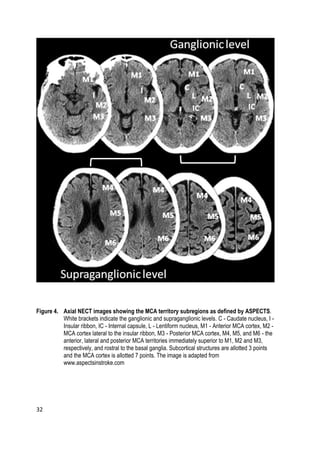
considered a finding in the scoring system. Each hemisphere is divided into 10
regions (Figure 4) and each of these regions can be scored 1 point. This point is
deducted if the region shows EICs. Thus, a full negative finding yields a score of
10, and extensive ischemia covering the entire MCA region yields a score of 0. If
31
the ASPECTS score is ≤6, based on volumetric correlates more than one-third of
the MCA territory is affected. When the ASPECTS score is ≤7 (3 or more regions
affected) the patient is unlikely to achieve an independent functional outcome. [86]
Overall, ASPECTS applied to NECT images is predictive of the clinical outcome,
the effectiveness of IVT and IAT and the rate of hemorrhagic complications but
remains a suboptimal technique for intra-arterial treatment decision making
because of the inherent insensitivity of NECT. [84, 87-90]
32
Figure 4. Axial NECT images showing the MCA territory subregions as defined by ASPECTS.
White brackets indicate the ganglionic and supraganglionic levels. C - Caudate nucleus, I -
Insular ribbon, IC - Internal capsule, L - Lentiform nucleus, M1 - Anterior MCA cortex, M2 -
MCA cortex lateral to the insular ribbon, M3 - Posterior MCA cortex, M4, M5, and M6 - the
anterior, lateral and posterior MCA territories immediately superior to M1, M2 and M3,
respectively, and rostral to the basal ganglia. Subcortical structures are allotted 3 points
and the MCA cortex is allotted 7 points. The image is adapted from
www.aspectsinstroke.com
33
2.2.2.2 Computed tomography angiography
CTA is generally the second modality acquired in a multimodal CT protocol.
Typically, a volume from the aortic arch up to the vertex of the skull is obtained to
cover both the intra- and extracerebral vasculature. Thin-section slices of isotropic
spatial resolution are calculated to enable the reconstruction of two-dimensional
(2D) reformatted images in arbitrary planes, maximum intensity projection (MIP)
images and three-dimensional (3D) images. They provide detailed information on
the cerebral vasculature that is comparable with that obtained using digital-
subtraction angiography (DSA) [91-96]. Hence, large- and small vessel occlusions
and stenosis can be detected by CTA highly accurately (95-99%) both intracranially
and extracranially [23, 23, 97, 98].
The importance of this imaging tool in the triage of acute stroke patients to
different revascularization therapies was recently demonstrated in five randomized
and controlled trials, which assessed the possible superiority of MT over IVT
treatment. All these trials used vascular imaging with CTA as a diagnostic tool in
their protocol [13-17]. CTA not only allows the detection of a thrombus in the
intracerebral vasculature but also enables the evaluation of the length and density
of the clot, which plays a role in the treatment decision-making process. [95] These
are all independent prognostic factors of acute ischemic stroke for which proximal,
high-volume, organized clots predict poor clinical outcomes compared with distal,
low-volume, fresh clots. [99-101] This is related to the rate of recanalization with
IVT, which is lower in proximal vessel positions, with high clot burden and clots
with lower average Hounsfield Unit (HU) values. These intrinsic factors also
influence the recanalization rate with IAT and should guide therapeutic decision
making and the choice between IVT, intra-arterial interventions or refraining from
revascularization therapy [52, 101-111]
To simplify the evaluation of the location and extent of the thrombus a
semiquantitative clot burden score (CBS) has been developed. [110, 112] The CBS
is a 10-point scoring system. Points are assigned based on the number and location
of arterial segments affected in the anterior circulation (Figure 5). Similar to
ASPECTS, a higher score indicates a lower clot burden. CBS correlates with
technical and clinical outcomes. Patients with higher scores are more likely to
experience better functional outcomes, smaller infarct volumes, and lower
hemorrhagic complication rates. [109, 110, 112]
34
Other important roles of CTA are facilitating proper planning of the endovascular
procedure for device selection and enabling shorter intervention durations [113,
114] Limitation of CTA include the use of ionized radiation and the use of
iodinated contrast medium, which in rare cases, can lead to contrast induced
nephropathy (CIN).
Figure 5. Schematic representation of the clot burden score (CBS). One or two points each are
subtracted from a total score of 10 when no contrast opacity is detected using CTA in the
infraclinoid ICA (1 point), supraclinoid ICA (2 points), proximal M1 segment (2 points),
distal M1 segment (2 points), M2 segment branches (1 point each) and A1 segment (1
point), as indicated by the numbers next to the corresponding vessel segments. CBS
applies only to the symptomatic hemisphere. From Puetz et al. [110]
2.2.2.3 Computed tomography angiography source images
Unprocessed source images of CTA (CTA-SI) can also be used to estimate EICs
and have increased sensitivity compared to NECT. [115] When capturing the
steady state of the contrast agent, CTA-SI is a surrogate of CBV and, thus,
approximates the extent of irreversible ischemic damage [116, 117]. The
35
attenuation values for brain tissue are directly proportional to the amount of
contrast material that has arrived within the parenchyma at the time of imaging.
The reduction and/or delay of blood supply to the ischemic area leads to
hypoattenuation in CTA-SI in contrast to later cytotoxic edema on NECT
[118](Figure 6). Therefore, CTA-SI is more sensitive to acute ischemia than NECT
and subsequently more precise in the prediction of infarct extension, hemorrhagic
complications and clinical outcome. [115, 116, 118-121] Rapid CTA image
acquisition at an early time point precludes the contrast agent from fully traversing
collateral vessels and reaching the distal vascular bed, thereby increasing the
volume and severity of hypoattenuation in the ischemic parenchyma and leading to
overestimation of the infarct core [122-124]. In contrast, frank hypoattenuation on
NECT is highly specific for irreversible tissue damage suggesting that CTA-SI
must be interpreted carefully in relation to NECT findings in addition to adjusting
CTA protocols to minimize the overestimation problem [75-80].
Figure 6. Baseline NECT (A) showing early ischemic changes in the right MCA territory (arrows).
CTA-SI image (B) reveals hypoattenuation in the right MCA territory (arrows), which
corresponds to the final infarct (C) on follow-up CT scan (arrows). NECT indicates
noncontrast CT; MCA, middle cerebral artery; CTA-SI, CT angiography source image.
From Bhatia et al. [116]
2.2.2.4 Evaluation of the collateral circulation
The cerebral collateral circulation is a dynamic, interconnected vascular system that
preserves the brain parenchyma from ischemic damage. There is large variation in
this vascular network among individuals. Collateral vasculature can be divided into
primary and secondary pathways. The former pathways make up a system that
36
allows communication between the two hemispheres and consists of artery-to-
artery communications, i.e., the circle of Willis. The latter pathways become
evident during the occlusion of large intracranial vessels and include the vascular
network between the internal and external carotid arteries and the leptomeningeal
pial arteriolar anastomoses. Sufficient flow through the collateral pathways allows
the brain tissue to remain viable even if the normal antegrade flow supplying the
tissue volume is diminished or interrupted [125-128]. The most important factor
influencing the integrity of collaterals is age, each 10-year increment in patient age
increases the odds of inadequate collateral circulation by 1.8-fold [129-131].
Smoking, hypertension, elevated uric acid and glucose levels at the time of
presentation are other factors that negatively influence the development of
collateral circulation [130, 132]. Even though digital subtraction angiography
(DSA) is the gold standard for anatomical and functional evaluation of collateral
vessels [133], collateral circulation can also be assessed non-invasively. Typically,
CTA is used to evaluate the collateral network before stroke therapy. Many
collateral scoring (CS) systems have been proposed. One of the more widely
adopted systems is that described by Souza et al., which is based on the evaluation
of maximum intensity projection (MIP) reconstructions (Figure 7)[134].
Figure 7. CS system: 0 = absent collaterals >50% of an M2 territory; 1 = diminished collaterals
>50% M2 territory; 2 = diminished collaterals <50% M2 territory; 3 = collaterals equal to
contralateral side; 4 = increased collaterals. From Souza et al. [134]
Adequate collateral flow reduces the baseline infarct core and the expansion of the
core, decreases the risk of hemorrhagic transformation and increases the odds of a
37
good clinical outcome in-hospital, at discharge and six months after the stroke.
[112, 132, 135-140] The richness of the collateral network predicts the final infarct
volume in both patients with persistent arterial occlusion and those experiencing
recanalization [132, 141, 142]. Two recent randomized trials (ESCAPE and
EXTEND-IA)[14, 17] validate the concept of CS as a central feature in the
evaluation of stroke patients who were candidates for MT by employing CTP
instead of single-phase CTA. Single-phase CTA does not provide temporal
resolution. Therefore, collateral status may be mischaracterized in many patients
and is usually underestimated. Dynamic CTA is a technique that derives time
resolved images of pial arterial filling from CTP images; however, dynamic CTA
requires postprocessing and whole-brain CTP. As an alternative, multiphase
(arterial, arteriovenous, and venous phases) dynamic CTA rapidly provides easily
interpretable information regarding the degree and extent of pial arterial filling in
the whole of brain parenchyma in a time-resolved manner. Supporting this
concept, the inter-rater reliability for multiphase CTA is excellent. In multiphase
collateral scoring (ranging 0 to 5) collateral status on the affected side is considered
to be poor compared to same arterial trunks in the asymptomatic contralateral
hemisphere when there are no vessels visible in any phase within the occluded
vascular territory, only a few vessels visible, or minimal to no collaterals visible in a
region greater than 50% of the MCA territory [143-146].
2.2.2.5 Computed tomography perfusion
The third and final modality acquired in a multimodal protocol is CTP, a dynamic
imaging modality that provides information on cerebral hemodynamics. CTP
consists of serial CT imaging of a volume of brain parenchyma in rapid succession
after an injection of an iodinated contrast agent. This procedure enables
quantification of capillary level phenomena of cerebral blood flow. The
concentration of the iodinated contrast agent in the brain parenchyma and, hence,
the CT density changes time-dependently as depicted by time-density curves. These
curves are used to derive CTP parametric maps, which reflect different aspects
hemodynamics [147-151]:
1) Cerebral Blood Flow (CBF): the volume of blood moving through a brain
volume (mass) of interest per unit time ([CBF] = ml/100 g/min).
38
2) Cerebral Blood Volume (CBV): the total volume of blood in a given brain
volume (mass) of interest ([CBV] = ml/100 g). This volume includes the
intracellular, intravascular and extravascular interstitial spaces.
3) Mean Transit Time (MTT): the average difference in time between the
arterial inflow and the venous outflow of a brain region-of interest ([MTT]
= s). This time is dependent on the average distance travelled. MTT can be
calculated from the CBF and CBV based on the central volume principle
[152]: MTT = CBV/CBF.
4) Time to Peak (TTP): the time from the beginning of the arterial
enhancement to the peak of the enhancement curve ([TTP] = s).
There is a large variety of algorithms available to calculate the different perfusion
parametric maps from the raw CT data. These algorithms can be classified as 1)
non-deconvolution or 2) deconvolution techniques [150]. Non-deconvolution
techniques use first-pass contrast agent measurements and apply several simplifying
assumptions, which lower the accuracy of the results. Deconvolution techniques
discard some of these assumptions and also take into consideration recirculation of
the contrast agent, collateral flow, delays in the delivery of the contrast agent and
venous output. Thus, the deconvolution algorithms are more complex and
sensitive [153-155]. There are also differences in image acquisition protocols.
Standardization and validation of the quantitation of perfusion parameters across
different vendor platforms or even across different platforms from the same
vendor remain ongoing processes [153, 156-158]. Further, different manual, semi-
automated and fully automated image reconstruction workflows add to the
variation caused by differences in algorithms. In particular, the selection of arterial
input and venous output vessels may vary. Generally, the A2 segment of the
anterior cerebral artery and the sagittal sinus are chosen as arterial input and
venous output because this seems to minimize problems caused by volume
averaging [159-161].
The main goal of an acute stroke perfusion study is to assess the viability of the
ischemic tissue, i.e., to identify the irreversibly damaged tissue (the infarct core), the
tissue that is at risk for progression to infarction if reperfusion is not achieved (the
penumbra) and the normally perfused, benignly hypoperfused or hyperemic tissue
[151, 156, 162, 163]. Experimental studies have demonstrated that these
hemodynamic states are characterized by different functionally defined CBF
thresholds, as follows: 1) The threshold below which cortical function ceases
without an increase in extracellular potassium or reduction in pH (the penumbra)
39
and 2) the threshold below which there is disruption of cellular integrity (the core)
[20]. These functional definitions have been correlated with advanced
neuroimaging findings— perfusion parametric maps—to define a more clinically
relevant operational penumbra identified as hypoperfused but potentially
salvageable tissue. [162, 164-167] The operational penumbra is the mismatch
(subtraction) volume between the CBF or MTT (or TTP) and the CBV, in which
the CBV lesion reflects the infarct core and the CBF or MTT (or TTP) lesion
reflects the boundaries of the hypoperfused penumbral tissue [153]. This concept
was initially validated for MRI, and MRI and CT results were later correlated [121,
168]. The perfusion parameters that best define the core and the penumbra remain
a topic of discussion. This task is challenging, as both regions are dynamic in
character because of the nature of the disease process. MTT maps potentially
overestimate the size of perfusion defects, while CBV maps may overestimate or
underestimate the volume of the irreversibly damaged brain parenchyma [157,
169]. Some studies suggest that threshold CBF values may assess the core more
accurately than CBV cut-offs [154, 158, 170, 171] and that TTP could be more
closely related to penumbra than MTT [172].
Accurate evaluation of the infarct core at presentation seems to be one of the most
valuable imaging–based prognostic factors. An infarct core volume of 70-100 ml
strongly indicates poor outcome regardless of recanalization and penumbra volume
[173-176]. Moreover, even successful large vessel recanalization reperfusion at the
capillary level can be insufficient. This could be due to downstream embolization
and microvascular obstruction or cytotoxic edema within the penumbral region
precluding tissue perfusion. Hence, the predictive role of penumbra volume at
presentation remains partly unclear and it only becomes a relevant predictive factor
if evaluated in the context of recanalization data [176-180].
In two of the recent pivotal randomized trials comparing MT to IVT (EXTEND-
IA and SWIFT PRIME [15, 16]) CTP evaluation of the size of the infarct core and
the volume of salvageable tissue was successfully used as inclusion criteria.
The ASPECTS scheme has been validated for CTP parametric maps, which
provides another method for quantifying CTP findings in the anterior circulation,
including calculating the perfusion mismatch [21, 180-184]. CTP-ASPECTS,
especially CBV-ASPECTS, better predicts clinical outcome compared to admission
NECT and CTA-SI [17, 86, 86, 180, 185]. Kloska et al. suggested that the optimal
threshold value for CBV-ASPECTS that best differentiated between good and
40
poor clinical outcomes was ≤7. Furthermore, Aviv et al. found that no patients
with CBV-ASPECTS ≤7 achieved good clinical outcome [21, 89]. In our previous
study patients having CBV-ASPECTS ≥7 performed best in an ROC analysis
[184].
2.2.2.6 Evaluation of recanalization
The Thrombolysis in Cerebral Infarction (TICI) score grading system was
originally described in 2003 by Higashida et al. [133] to evaluate the grade of
reperfusion following IVT in patients suffering from acute stroke. In
neurointerventional radiology, TICI scores are commonly applied to grade the
DSA control runs of endovascularly-performed recanalization.
The original definition was based on the angiographic post-intervention
appearance of the site of the occlusion and the distal branches:
• TICI 0: no perfusion
• TICI 1: penetration of the contrast agent with minimal perfusion
• TICI 2: partial perfusion
o 2a: only partial filling (less than two-thirds) of the entire vascular
territory is visualized
o 2b: complete filling of all of the expected vascular territory is
visualized but the filling is slower than normal
• TICI 3: complete perfusion
Because of marked variability in the application of this score, in 2013 a consensus
paper from three collaborative groups [53] proposed a modified scale, the m-TICI
score:
• m-TICI 0: no perfusion
• m-TICI 1: antegrade reperfusion past the initial occlusion, but limited
distal branch filling with little or slow distal reperfusion
• m-TICI 2:
41
o 2a: antegrade reperfusion of less than half of the previously
occluded target artery ischemic territory
o 2b: antegrade reperfusion of more than half of the previously
occluded target artery ischemic territory
• m-TICI 3: complete antegrade reperfusion of the previously occluded
target artery ischemic territory, with absence of visualized occlusion in all distal
branches
2.3 ACUTE ISCHEMIC STROKE MANAGEMENT
Acute stroke therapy aims to 1) restore perfusion of the ischemic brain tissue as
rapidly as possible [186-188], 2) limit the amount of damage to the ischemic tissue
whether caused by primary (hypoperfusion) or secondary (for example,
hyperglycemia or hyperthermia) mechanisms, and 3) decrease the probability of
complications (such as hemorrhagic transformation) [189]. Based on data from
both experimental models and clinical trials, the duration and severity of ischemia
determines the extent of irreversible damage [10, 186, 190]. However, potentially
viable ischemic tissue (i.e., the penumbra) has been demonstrated to exist for at
least 24 h after symptom onset [191, 192]. Overall, the time elapsed from the onset
of the symptoms to treatment is a critical determinant of the outcome, which
guides decision–making processes and pre- and in-hospital management. [10, 193-
195]
The following interventions have been explicitly proven to improve the prognosis
after acute IS: 1) management of the patient in a stroke unit [196, 197], 2) use of
aspirin within the first 48 h from onset [198-200], 3) decompressive surgery
(hemicraniectomy) for supratentorial malignant hemispheric cerebral infarction
[201, 202], 4) administration of IVT within 4.5 h from symptom onset [201-203],
and 5) MT with a stent retriever in the case of large vessel occlusion (up to the M1
segment) [204-207]. The goal of the last two therapies is to achieve a prompt
revascularization and reperfusion of the ischemic area by pharmacologically or
mechanically disrupting the occluding thrombus.
Currently available revascularization therapies include IVT, intra-arterial
thrombolysis (IAT) possibly assisted with balloon angioplasty, IVT followed by an
intra-arterial intervention, MT using aspiration, stent retrievers, other specific
42
retrieval devices or a combination of these therapies, and bypass stenting.
Recently, the completion of five randomized trials on MT performed with stent
retrievers led to a shift in treatment paradigm towards intra-arterial therapies as a
first-line approach [13-17].
2.3.1 Intravenous thrombolysis
IVT is a well-established treatment of acute IS that was approved by the Food and
Drug Administration (FDA) in 1996. It essentially entails the intravenous
administration of a tissue plasminogen activator (TPA), a serine protease that elicits
dissolution of the clot by activating plasmin by conversion of plasminogen [208].
Streptokinase and urokinase were originally used for this purpose, but they were
subsequently replaced by a new generation of recombinant tissue plasminogen
activators (r-tPAs) that selectively activate fibrin-bound plasminogen and thus have
better efficacy and specificity [209].
The most relevant trials on IVT are the Neurological Disorders and Stroke Trial
(NINDS), which proved the feasibility and efficacy of IVT in a time window of 3 h
from symptom onset [203], The European Cooperative Acute Stroke Study
(ECASS), ECASS II, and the Alteplase Thrombolysis for Acute Noninterventional
Therapy in Ischemic Stroke (ATLANTIS) study, which evaluated the efficacy and
safety of IVT within a time window up to 6 h, but did not demonstrate treatment
benefit [210-212]. Nonetheless, two later studies, ECASS III and the Safe
Implementation of Thrombolysis in Stroke–International Stroke Treatment
Registry (SITS-ISTR), succeeded in demonstrating efficacy and safety of IVT
within a prolonged time window of 4.5 h [213, 214]. Further studies have examined
the feasibility of IVT beyond the 4.5 h window using MRI to evaluate the ischemic
penumbra. The Desmoteplase in Acute Ischemic Stroke (DIAS) study used an
extended the time window of 9 h and failed to demonstrate efficacy [215-217]. The
Diffusion-weighted Imaging Evaluation For Understanding Stroke Evolution
(DEFUSE) study demonstrated the utility of different MRI mismatch profiles for
evaluating patients who are likely to have good outcome after IVT when treated
between 3 h and 6 h from symptom onset [218]. The Echoplanar Imaging
Thrombolytic Evaluation Trial (EPITHET) and the Third International Stroke
Trial (IST-3) also evaluated a treatment time window beyond 4.5 h with no positive
results. Recently, the introduction of new MT devices has reduced the interest in
an IVT-only approach [219-224].
43
A feared complication of IVT is intracerebral hemorrhage (ICH), which can be
fatal [203, 213]. Other potential adverse effects include systemic bleeding,
myocardial rupture if IVT is administered within a few days of AMI, and
immunological reactions such as anaphylaxis or orolingual angioedema, although
these events are rare [65]. Exclusion criteria have been defined to minimize the
possibility of complications (Table 3).
The relative exclusion criteria for IVT include minor or spontaneously rapidly
improving symptoms, pregnancy, seizure at onset with postictal residual
neurological impairments, major surgery or serious trauma within the previous 14
days, recent gastrointestinal or urinary tract hemorrhage (within the previous 21
days) and recent AMI (within the previous 3 months) [65]. Further, relative
exclusion criteria within 3 to 4.5 h after symptom onset include >80 years of age,
severe stroke (NIHSS>25), taking an oral anticoagulant regardless of INR and
histories of both diabetes and prior to IS [65]
Exclusion criteria
Significant head trauma or prior stroke in previous 3 months
Symptoms suggest subarachnoid hemorrhage
Arterial puncture at noncompressible site in previous 7 days
History of previous intracranial hemorrhage
Intracranial neoplasm, arteriovenous malformation, or aneurysm
Recent intracranial or intraspinal surgery
Elevated blood pressure (systolic >185 mm Hg or diastolic >110 mm Hg)
Active internal bleeding, acute bleeding diathesis, including but not limited to
Platelet count <100000/mm
Heparin received within 48 h, resulting in abnormally elevated aPTT greater
than the upper limit of normal
44
Current use of anticoagulant with INR >1.7 or PT >15 s
Current use of direct thrombin inhibitors or direct factor Xa inhibitors with
elevated sensitive laboratory tests
Blood glucose concentration <50 mg/dL (2.7 mmol/L)
CT demonstrates multilobar infarction (hypodensity >1/3 cerebral
hemisphere)
Table 3. IVT exclusion criteria. Absolute exclusion criteria for patients with ischemic stroke who
could be treated with IVT within 4.5 h of symptom onset
2.3.2 Intra-arterial therapy
The options for endovascular treatment to elicit recanalization of an intracranial or
extracranial artery supplying the brain tissue include balloon angioplasty, (bypass)
stenting, intra-arterial thrombolysis (IAT) and mechanical thrombectomy (MT)
with either aspiration-based or stent-based devices.
Angioplasty and stenting of extracranial ICA are predominantly performed for
secondary or primary prevention rather than to treat acute IS but may be combined
with MT in some cases: when the primary cause of stroke is acute attenuation or
cessation of flow in the extracranial ICA, such as from total or near-total occlusion
caused by an active, severe atherosclerotic lesion or dissection or when catheter
access to an intracranial clot is impeded by severe stenosis of the extracranial ICA
and angioplasty/stenting of the ICA is required prior to treatment of a more distal
intracranial occlusion [189, 225].
Two of the most important studies on IAT were the phase two Prolyse in Acute
Cerebral Thromboembolism (PROACT) and PROACT II trials [11, 12]. In both
studies, the pharmacological intervention consisted of intra-arterial injection of
recombinant prourokinase (r-proUK) with or without intravenous heparin, which
were both administered within 6 h of symptom onset. The recanalization rates and
clinical outcome were better than with IVT only; however, the probability of
intracranial hemorrhagic complication was higher. The Middle Cerebral Artery
Embolism Local Fibrinolytic Intervention Trial (MELT) also suggested the trend
that excellent clinical outcomes were achieved more often with IAT [226]. Further
45
studies on IAT included the Interventional Management of Stroke (IMS) trials I
and II [227, 228]. They combined intra-arterial and intravenous thrombolysis with
r-tPA administration within the 3-h time window and compared the results with
the NINDS study population. The investigators reported that the 3-month
outcome was significantly better compared to the NINDS placebo arm, whereas
there was only a trend toward improved outcomes compared with the NINDS r-
tPA arm. The Interventional Management of Stroke III (IMS III) trial patients
were administered IVT within 3-h of symptom onset and then randomly assigned
to receive IVT alone or IVT followed by endovascular therapy. Despite the higher
rate of partial or complete recanalization at 24 h in the endovascular group, clinical
outcomes of the two groups were similar, and the trial was stopped early due to
futility [229]. Vagal et al., using the data from the IMS III, demonstrated in a post
hoc model that endovascular therapy after IVT is preferable to IVT alone if the
reperfusion time was less than 347 min [230]. These findings highlight the
importance of developing new techniques to achieve faster and more efficient
recanalization with intra-arterial devices.
The introduction of stent retrievers launched a period of a great progress regarding
the intra-arterial treatment of acute IS. Stent retrievers are soft nitinol stents that
are deployed within the thrombus to push the thrombus against the vessel wall,
immediately reperfusing the distal brain tissue. After a short incubation period,
which is suggested to be up to 5 minutes [231], the thrombus usually adheres to the
struts of the stent, and the stent is then retrieved along with the clot by
withdrawing the stent under aspiration from a more proximal catheter. Removal of
the stent also eliminates the need for acute double-antiplatelet therapy, which is
needed for permanent stent placement in the cerebral vasculature (Figure 8).
46
A
Figure 8. A timeline depicting the strategies and techniques employed over the time to achieve
recanalization of a large vessel occlusionan ELVO in the setting of acute ischemic stroke.
Adapted, From Spiotta A.M. et al. [232, 233]
Stent retriever technology was preceded by the MERCI retriever system introduced
in the early 2000s (Figure 8). This device included most of the mechanisms of
action of stent retrievers, but the design was not stent-based. The Mechanical
Embolus Removal in Cerebral Ischemia (MERCI) trial was a single-arm study that
included patients between 3-8 h from symptom onset or within 3 h if there was a
contraindication to IVT or if the treatment had failed [234]. This trial was extended
in the Multi MERCI study, an international, multicenter study in which a newer
device (the L5 retriever) was used if available [235]. In the late 2000s, a second
device was approved, the Penumbra endovascular aspiration device. In the
Penumbra Pivotal Stroke Trial 81% of patients achieved recanalization of the
occluded vessel but only 25% had mRS≤2 at three months [236]. Penumbra caused
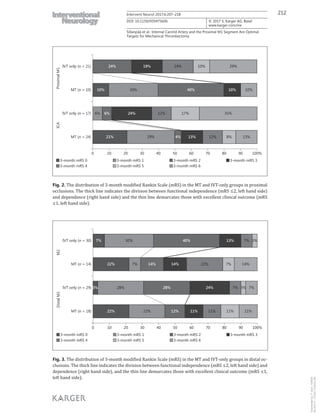
fewer hemorrhagic complications than MERCI but corresponded to worse
neurological outcome, possibly due to distal embolization [237]. The Mechanical
Retrieval and Recanalization of Stroke Clots Using Embolectomy (MR RESCUE)
trial compared thrombectomy (performed using MERCI or a Penumbra device) to
47
IVT, and no statistical significant difference was found between the two groups,
but the rate of TICI grade 2b/3 recanalization was low (25%) and the onset to
groin puncture time was 381 +/- 74 (mean+/-SD) [238]. Overall, sufficient proof
of efficacy of these devices was not obtained in these studies or meta-analyses
thereof.
During the past eight years, a number of studies and trials have investigated the
feasibility, safety and efficacy of MT with newer generation stent-based
thrombectomy devices [239-243]. This effort culminated in six multi-center,
prospective, randomized and controlled trials (MPRCTs), which were set up to
compare MT in association with IVT to IVT alone. As a result of these trials,
endovascular therapy with stent retriever thrombectomy is now the standard of
care for patients with acute large-vessel occlusion in the anterior circulation [189].
The first of those trials, the Multicenter Randomized Clinical Trial of Endovascular
Treatment for Acute Ischemic Stroke in the Netherlands (MR CLEAN) enrolled
500 patients. Retrievable stents were used in 190 of the 233 patients (82%) in the
intervention group, and simultaneous acute cervical carotid stenting was performed
in 30 patients (13%). Good reperfusion rate was achieved in 59% of patients in the
intervention group, and there was a significant shift in the distribution of mRS
scores of 0-5 at 90 days in favor of the intervention, regardless of age. There was
no difference in the complication rate. However, in the presence of extracranial
ICA occlusion, admission NECT ASPECTS of <8 or NIHSS <20, the adjusted
odds ratios (ORs) were accompanied by wide confidence intervals (CIs) [13].
In the Endovascular Treatment for Small Core and Anterior Circulation Proximal
Occlusion with Emphasis on Minimizing CT to Recanalization Times (ESCAPE)
trial imaging was used to exclude participants with a large infarct core and/or poor
collateral circulation. Stent retrievers were used in 130 of the 151 participants
(86%) who underwent an endovascular procedure, and the rate of the good
reperfusion was 72%. In contrast, in the control group, successful recanalization
was observed in 43 of 110 patients (31%). The proportion of patients with mRS≤2
at 90 days was 53% in the intervention group and 29% in the control group, and
mortality at 90 days was 10% in the intervention group and 19% in the control
group. However, for the presence of a carotid T- or L- occlusion, admission
NECT ASPECTS of <8 or patient age >80 years, the adjusted ORs were
accompanied by wide CIs. The study was suspended prematurely because of high
efficacy in the intervention group [14].
48
The Extending the Time for Thrombolysis in Emergency Neurological Deficits —
Intra-Arterial (EXTEND-IA) trial was also stopped early because of high efficacy
in the intervention group. The trial had recruited just 70 patients, 35 in each group.
This study used CT perfusion to identify salvageable brain tissue. The rate of
successful revascularization immediately after the procedure was 86% (with a
restoration of flow of >50% of the affected vascular territory), and the reperfusion
rate at the 24 h follow-up was 100%. In the IVT-only group, the recanalization rate
was 15 of 35 (43%). In addition, early neurologic improvement was observed
significantly more often in the intervention group (80% vs. 37%). Endovascular
therapy improved the functional outcome at 90 days with a significantly larger
proportion of patients achieving functional independence (71% vs. 40%).
Subgroup analyses could not be performed given the small number of patients [17].
The Solitaire with the Intention for Thrombectomy as Primary Endovascular
Treatment (SWIFT PRIME) trial compared IVT followed by MT with the Solitaire FR
or Solitaire 2 stent retriever to IVT alone. The study was also stopped early because of
efficacy and it enrolled 196 patients from 39 different centers, (98 patients in each
group) Similar to EXTEND-IA, viable tissue demonstrated in CTP was an inclusion
criterion. Eighty-eight percent of patients treated with MT exhibited substantial or
complete reperfusion defined as perfusion of 50% or more of the vascular distribution
of the occluded artery. Functional independence at 90 days was significantly more
common in the intervention group compared to the control group (60% vs. 35%).
There was no evidence of heterogeneity in the treatment effect in the subgroups. In
the subgroup corresponding to patients admitted with NECT ASPECTS of 6-7, 10 of
24 patients were independent in the intervention group compared to 5 of 19 in the
IVT-only group [16].
The Randomized Trial of Revascularization with Solitaire FR Device versus Best
Medical Therapy in the Treatment of Acute Stroke Due to an Anterior Circulation
Large Vessel Occlusion Presenting within Eight Hours of Symptom Onset
(REVASCAT) trial compared MT with medical therapy alone in eligible patients
who received IVT within 4.5 h after the onset of symptoms without
revascularization after 30 min of t-PA infusion or who exhibited a contraindication
to IVT. Two-hundred-six patients were enrolled, 103 in each group. A NECT
ASPECTS less than 7 or an MRI ASPECTS less than 6 were exclusion criteria.
Substantial or complete reperfusion in the MT group was achieved in 67 of 102
(66%) patients. The absolute between-group difference in the proportion of
patients who were functionally independent was 15.5%, favoring MT (43.7% vs.
49
28.2%). The benefits appeared to be least consistent in subgroups with advanced
age (≥70 years) or a long time window after symptoms unset (>4.5 h from onset to
randomization) [15].
The Randomized, Concurrent Controlled Trial to Assess the Penumbra System’s
Safety and Effectiveness in the Treatment of Acute Stroke (THERAPHY) trial is
another notable study and is the only randomized study that utilized an aspiration-
based thrombectomy technique. This trial compared MT and IVT to IVT only.
The trial was terminated when the results of other studies were published and MT
became the standard of care for acute IS. Seventy percent of patients treated with
aspiration only achieved successful reperfusion; the results suggest a potential for
benefit for aspiration thrombectomy compared to IVT only but had a low
statistical power because of early termination. [244]
A recent randomized controlled multicenter trial published in 2016, the
THRombectomie des Artères CErebrales (THRACE) trial compared standard
treatment to IVT plus MT within 4 h of symptom onset. In total 412 patients were
enrolled, 208 in the IVT only group and 204 in the IVT+MT group. This study
had a broad patient selection with randomization within 20 min after the
administration of IVT. The reperfusion rate was 69%, and good clinical outcome
was obtained for 53% of patients in the MT group. This study also demonstrated
the superiority of MT combined with IVT over IVT alone and was terminated
early, because a second unplanned interim analysis showed significantly better
results in the intervention group [245].
In all the trials utilizing stent retrievers mentioned above, there was no sign of
increased risk of bleeding compared to IVT alone. There was an overall trend
toward a reduction in stroke-related mortality in all of the trials [14-17, 244-246].
While the efficacy and safety of MT has now been robustly demonstrated [204-
207], it is still of great interest to study whether there are differences in technical
and clinical outcomes with respect to the site of occlusion, the stent retriever type
used and the evaluation of the admission imaging along with other subgroup
analyses based on different clinical and imaging markers. These data can facilitate
patient selection, avoid unnecessary treatment and improve results by making best
use of devices in relation to the patient imaging and clinical details. The type of
anesthesia (general anesthesia or conscious sedation) used during the
thrombectomy procedure may also influence the patient outcome. This is still an
50
open issue with some reports supporting the use of conscious sedation. The only
randomized trial so far did not find any significant difference in clinical outcome
between these two types of anesthesia [232, 247-249].
For a comprehensive guideline regarding the selection of patients with acute
ischemic stroke, different revascularization therapies, performing endovascular
procedures, and setting up systems of care to facilitate endovascular treatment,
please refer to the 2015 American Heart Association/American Stroke Association
Focused Update of the 2013 Guidelines for the Early Management of Patients
With Acute Ischemic Stroke Regarding Endovascular Treatment [189].
51
3 AIMS OF THE STYDY
The aims of this study were as follows:
I. To analyze the impact of the location of the thrombus, visualized by means
of CTA and DSA in the anterior circulation, on the technical and clinical
outcomes of IS patients treated with MT.
II. To analyze the influence of two commonly used stent retriever devices on
technical and clinical outcomes.
III. To clarify which clinical and imaging variables can predict poor clinical
outcome (mRS>2) in patients presenting acute anterior circulation stroke
and to improve patient selection.
IV. To compare the clinical outcomes of MT with or without IVT to IVT
alone for the treatment of hyperacute anterior circulation stroke (<3h from
symptom onset) in the subgroups of patients with proximal (ICA and the
proximal M1 segment) and distal (the distal M1 and M2 segments) large
vessel occlusions.
52
4 SUBJECTS, MATERIALS AND METHODS
4.1 Overview
All studies (I-IV) had an observational prospective cohort design. We prospectively
collected and analyzed the clinical and imaging data of consecutive patients
admitted to Tampere University Hospital from January 2013 to December 2014
due to acute ischemic stroke symptoms and who underwent clinical and imaging
evaluation and proceeded to digital subtraction angiography (DSA) with an
intention to perform MT. In addition, study IV had a retrospective observational
IVT-only cohort as a control group. This cohort had been collected between
January 2004 and December 2007 at our institution [52].
The general inclusion criteria for the studies were occlusion of the internal carotid
artery (ICA) and/or middle cerebral artery (MCA) up to the M2 segment and MT
performed with a stent retriever. The initial imaging evaluation consisted of
NECT, CTA and CTP in the majority of patients. The selection of patients as
candidates for MT was based on absence of extensive irreversible ischemic changes
(frank hypodensity more than 1/3 of the MCA territory) and hemorrhage in
NECT, evaluation of the amount of salvageable tissue in CTP imaging (when
performed) and proximal clot position in CTA (evaluated with raw data and MIP
reconstructions). The decision to proceed to MT was multidisciplinary (stroke
neurologist and neurointerventional radiologist). Patients referred to our institution
from other hospitals were re-evaluated with at least NECT and CTA upon arrival
before proceeding to the angiographic suite to rule out bleeding and extensive
irreversible ischemic lesions. In the case of wake-up strokes, CTP was performed if
no large infarct was seen in NECT. IVT was administered as a bridging therapy to
patients with no contraindications. The r-tPA bolus was given on the CT table. In
one case the bolus was withdrawn, because the time interval between symptom
onset and groin puncture was expected to be minimal (i.e., an inpatient during
office hours). Patients coming from an outside hospital received IVT according to
drip-and-ship protocol. IVT was continued until groin puncture. Majority of
patients were treated under conscious sedation: Dexmedetomidine was chosen in
53
51 cases (47%) and other combinations of drugs in 33 patients (31%). General
anaesthesia was preferred if the patient was restless rendering the procedure
difficult to perform (21 patients, 20%).
The technical outcome was measured with TICI (Thrombolysis in Cerebral
Ischemia), evaluated with DSA at the end of the procedure. The clinical outcome
measure was the modified Rankin Scale (mRS), evaluated three months after the
stroke based on a follow-up visit with a neurologist or a phone interview with a
neurologist. One patient could not be reached for this control. A follow-up NECT
was performed for all patients 24 h after treatment to assess the infarct volume and
possible hemorrhagic complications.
IVT was administered according to guidelines of the American Heart Association
(AHA) [250]: Actilyse® (Boehringer-Ingelheim, Ingelheim, Germany), total dose
0.9 mg/kg, was administered in a 10% bolus and continued, if necessary, until
groin puncture. Mechanical thrombectomy procedures were performed with
different stent retrievers and sometimes with multiple devices based on the
judgment of the operator. The used devices were TREVO® (Stryker
Neurovascular/Concentric Medical, Mountain View, CA, USA), CAPTURE LP™
(eV3/ COVIDIEN/Medtronic, Santa Rosa, CA, USA), ERIC® (MicroVention,
Tustin, CA,USA), Aperio® (Acandis, Pforzheim, Germany) and REVIVE®
(Codman &Shurtleff, Raynham, MA, USA).
54
4.2 Subjects, study population and baseline characteristics
I. IMPACT OF CLOT
LOCATION
II. DEVICE
INFLUENCE
III. PREDICTORS OF
POOR PROGNOSIS
IV. COMPARISON
BETWEEN MT AND
IVT
ICA M1 M2 TREVO®
Capture
LP™
3-mo
mRS ≤2
3-mo
mRS >2
MT IVT
Patients 37 46 22 42 43 58 47 67 98
Total 105 85 105 165
AGE, mean (SD)
64.8
(10)
65.3
(13)
69.8
(9)
68 (13) 64 (10) 65 (12) 67(10) 68(10) 69(14)
Total 66 (11) 66 (12) 66 (11) 67(12)
Female sex (%)
14
(38)
16
(35)
15
(68)
22 (52) 17 (39) 24(42) 20(43) 37(55) 43(44)
Total 45 (43) 39 (46) 45 (43) 80(48)
ASPECT-CBV at
admission,
(IQR)
7 (5) 7(5) 9 (2) 7(4) 9(5) 9(7) 3(5) 7(4) 8(4)
Total 7 (4) 8(4) 7 (4) 8(3)
CBS, median
(IQR)
3(4) 6(1) 8(1) 5 (3) 6 (2) 6(3) 6(5) 6(4) 6(4)
Total 6 (3) 6 (4) 6(3) 6(4)
CS >1 n (%)
11
(32)
14
(29)
18
(82)
1(2) 1(2) 23(22) 6(27) 1(2) 2(3)
Total 43 (41) 1 (1) 43(41) 1(3)
NIHSS at
admission,
median (IQR)
15
(7)
14
(6)
14
(6)
16(6) 14(8) 14(9) 16(5) 14(5) 14(9)
55
Table 4. Baseline characteristics of the different populations of the studies.
MT patients (I,
III)
MT patients
(II)
MT patients
(IV)
IVT patients
(IV)
Excluded 251
251
+202
251
+383
2154
Included 105 85 67 98
Total
population
130 130 130 313
Table 5. The study populations and the excluded patients. 1) 8 patients had posterior
circulation stroke, one patient had occlusion of the A3 segment and one of the M3
segment, and 15 patients had no clot visible in DSA (spontaneous dissolution of the clot).
2) 20 patients were treated with stent retrievers other than TREVO® 42 or Capture LP™
or a combination of different devices. 3) 38 patients in the MT group had onset-to-imaging
times >3h. 4) 215 patients in the IVT group did not have an anterior circulation clot visible
in CTA or had contraindications to IVT or had clots beyond the M2 segment or in ACA.
4.2.1 Mechanical thrombectomy patients (I,III)
The clinical and imaging data of 130 consecutive patients presenting anterior
circulation stroke symptoms, admitted between January 2013 and December 2014
Total 15(5) 14 (6) 15(5) 14(9)
Stroke risk
factors
Atrial
fibrillation
No statistical
differences
No statistical
difference
No statistical
difference
37(55) 37(38)
Coronary
disease
11(16) 34(35)
Hypertension
No statistical
difference
Diabetes
56
to Tampere University Hospital with an intention to perform MT, were collected.
For population baseline characteristics and inclusion criteria please refer to Tables
4 and 5. A complete multimodal CT protocol was completed in 72 of the 105
patients (69%) who received MT, and incompleteness was mainly because CTP
was not successfully performed for every patient. NECT and CTA were assessed
for all patients. Based on CTA scans, thrombus location, clot burden score and
collateral score were recorded. The median NIHSS at admission was 14.5
(interquartile range, IQR, 5) and slightly higher than expected among the M2
occlusion patients (Table 4). In two patients, evaluation of NIHSS was not possible
because of sedation during transportation by the ambulance crew. Also the mean
age was higher in the M2 occlusion group (Table 4). Sixty-six of the 105 patients
(64%) received IVT; the remaining patients were denied of IVT because of
contraindications (i.e., anticoagulation, wake-up strokes, history of recent surgery),
and one was treated with MT without any previous r-tPA bolus. There was no
statistically difference in mean time from onset of symptoms to imaging or in the
mean time from onset to recanalization. The median duration of the intervention
measured from groin puncture was also similar between the groups. The mRS
score was missing for one patient who could not be reached.
4.2.2 Mechanical thrombectomy patients treated with TREVO® or Capture
LP™ (II)
Clinical and imaging data of 85 consecutive patients who were treated with MT
using solely TREVO® or Capture LP™ between January 2013 and December
2014 in the University Hospital of Tampere were collected. Forty-two patients
(49%) were treated with TREVO®. For baseline characteristics and inclusion
criteria, please refer to Tables 4 and 5. In the TREVO® group, there was a non-
significant trend towards more patients with distal occlusions (the distal M1 or the
M2 segments). CTP was successfully completed in 60 of the 85 patients (71%), of
which 25 were in the TREVO® group (60%) and 35 were in the Capture LP™
group (81%).
57
4.2.3 Mechanical thrombectomy patients with onset-to-imaging time less
than 3h (IV)
We prospectively collected and analyzed clinical and imaging data of 130
consecutive patients admitted to Tampere University Hospital from January 2013
to December 2014 because of acute ischemic stroke symptoms and who
underwent clinical and imaging evaluation and proceeded to digital subtraction
angiography (DSA) with an intention to perform MT. For baseline characteristics
and inclusion criteria, please refer to Tables 4 and 5. CTP was successfully obtained
from 42 patients (63%). NIHSS, CBV-ASPECTS, clot burden score and collateral
score were collected (Table 4). In one case, NIHSS could not be reliably scored
because the paramedic crew had sedated the patient during transportation. The
mean time from onset of symptoms to imaging was 90 min (SD 44).
4.2.4 IVT Patients between January 2004 and December 2007 (IV)
A total of 313 anterior or posterior circulation ischemic stroke patients from
January 2004 to December 2007 were treated with IVT only and had a 3-month
follow-up after thrombolysis. There were 105 (37%) patients who met the
inclusion criterion. Ninety-eight of the 105 patients remained in this group after
patients with occlusions distal to the M2 segment were removed (Table 5). CTP
was successfully obtained in 76 patients (77%). NIHSS upon admission, CBS,
collateral score and CBV-ASPECT were collected (Table 4). The mean time from
onset of symptoms to imaging was 90 min (SD 26). The median preictal mRS was
1. For the other baseline characteristics, please refer to Table 4.
4.3 Clinical variables
The baseline clinical characteristics included age, gender, clinical risk factors for
ischemic stroke (hypertension, diabetes, coronary heart disease, atrial fibrillation)
and time from symptom onset to initiation of IVT. These data were collected from
the patient records. National Institutes of Health Stroke Scale (NIHSS) score at
presentation, the times from symptom onset to imaging and to recanalization of
the occluded vessel, the duration of the procedure, TICI grading evaluated via
DSA at the end of the procedure, and procedural complications were prospectively
58
stored. Follow-up NECT and NIHSS scoring were performed for all of the
patients 24 h after treatment.
The primary clinical outcome measure in all studies was the modified Rankin Scale
(mRS), evaluated three months after stroke based on a follow-up visit with a
neurologist or a phone interview with a neurologist. A mRS ≤2 was considered
good clinical outcome. The primary technical outcome was the TICI score
evaluated via DSA (I, II, IV). TICI > 2a was set as the threshold for good technical
outcome.
4.4 Imaging parameters
CT scans were obtained using a 64-row multidetector CT scanner (General Electric
LightSpeed VCT, GE Healthcare, Milwaukee, WI, USA). MR imaging at
admission was not performed to any patient.
The parameters for brain NCCT were 120 kV with AUTO mA and SMART mA
technique, noise index of 3.3, collimation of 4x5 mm, 40% adaptive statistical
iterative reconstruction (ASIR), and rotation of 0.5 s. Images were obtained axially
(0.625-mm-thick slices), and then, contiguous axial slices were reconstructed to a
thickness of 5 mm and coronal slices to a thickness of 2 mm.
CTA was performed via a helical technique using a scanning range from the aortic
arch to the vertex of the skull. The imaging parameters were 100 kV, AUTO mA
and SMART mA, noise index of 9, 40% ASIR, collimation of 40x0.625 mm,
rotation of 0.5 s, and pitch factor of 0.984. Seventy milliliters of contrast agent
(iomeprol, 350 mg I/ml, IOMERON, Bracco, Milan, Italy) was administered via an
antecubital vein with an 18-gauge cannula using a double-piston power injector at a
flow rate of 5 ml/s followed by flushing with 50 ml saline. An automatic bolus
triggered from the aortic arch was used.
CTP was performed using the parameters 80 kV, 250 mA, 50% ASIR, collimation
of 8x5 mm, and rotation of 0.4s, and 272 slices covering a range of 80 mm were
generated in 46 s using an alternating toggle table protocol to increase the z-axis
coverage. Contiguous slices were reconstructed to a thickness of 5 mm at even
intervals. The imaging range was positioned such that the ASPECTS level was
covered. Forty milliliters of contrast agent (IOMERON 350 mg I/ml) was
administered via an antecubital vein with an 18-gauge cannula using a double-
59
piston power injector at a flow rate of 5 ml/s followed by flushing with 40 ml
saline.
Digital subtraction angiographic images were obtained using an Artis Z
angiographic equipment (Siemens, Munich, Germany) with the parameters 102 kV,
AUTOmA and SMARTmA.
4.5 Image analysis
NECT, CTA and CTP examinations were reviewed using dedicated medical
imaging workstations. Parametric perfusion maps that included the mean transit
time (MTT), cerebral blood flow (CBF), and cerebral blood volume (CBV) were
generated with CT Perfusion 4 software (GE Healthcare, Milwaukee, WI, USA),
which uses a deconvolution-based algorithm. The ACA was used as a source for
the arterial input function (AIF), and the region of interest for the venous output
function (VOF) was positioned in the superior sagittal sinus. CTA images were
reviewed by examining both the raw data and the maximum intensity projection
images. The Alberta Stroke Program Early CT Score (ASPECTS) was assessed
from admission and follow-up NECT images and from MTT and CBV maps. The
principles of the ASPECTS scoring of NECT and CTP maps are described in
Section 2.2.2.1. The infarct core was estimated using the CBV map, and the full
extent of the perfusion defect was interpreted from the MTT map. The presence
of a perfusion defect was evaluated visually from the color-coded maps by
comparing the appearance of the affected locus to that of healthy tissue in the
contralateral hemisphere.
CTA was used to evaluate the site of the occlusion, the clot burden score, CTA-SI
ASPECTS and the collateral score, as described in Sections 2.2.2.2 - 2.2.2.4. The
location of the clot was recorded based on the most proximal position of the
occlusion. The M1 segment was further divided in two parts of equal length, the
proximal part designated M1P and the distal designated M1D.
The examinations were reviewed in the following order, paralleling the clinical
workflow: NECT, CTA, and finally CTP. Two radiologists were assigned
ASPECTS, CBS and CS. In cases when the scoring or the assignment differed, a
consensus opinion was agreed on. The reviewers were blinded to the clinical data
apart from the side and nature of the acute symptoms. One radiologist measured
60
final infarct volumes two times. The boundaries of the affected areas on NECT
were determined visually. Volume was calculated by multiplying the measured area
with the slice thickness.
4.6 Statistical analysis
The data were analyzed with SPSS version 21 (SPSS Inc., Chicago, IL). In all
studies, group comparisons were performed by using Student’s t-test, the Chi-
squared test, Fisher’s exact test, the Kruskal-Wallis test, and the Mann-Whitney U
test where theoretically appropriate. Patients with collateral scores from 2 to 4 were
regarded as having good collateral vessel filling. Patients who had three-month
mRS≤2 were considered to have experienced good clinical outcome and those with
mRS≤1 as excellent outcome. A p-value <0.05 was considered statistically
significant.
Binary logistic regression modeling using good and excellent clinical outcome
measures as dependent variables was repeated for different variables of interest in
studies II and IV. In study II, mortality was also used as a dependent variable. In
this study, admission NIHSS, age, gender, time from onset to recanalization,
clinical risk factors of stroke, device selection, CBV-ASPECTS at admission, site of
the occlusion and collateral score were examined as potential confounders and
were first tested in univariate models with the dependent variables as described.
Based on these results, multivariate models were devised. In study IV, binary
logistic regression analyses were performed in order to control for the effect of
differing average patient age, onset-to-imaging times and admission NIHSS
between the MT and IVT-only groups for different sites of the occlusion. The
calibration of the models was evaluated with the Hosmer-Lemeshow test, and
discrimination was assessed with the C statistic. In study III, univariable and
multivariable binary logistic regression analyses using poor clinical outcome as the
dependent variable were performed, and the odds ratio (OR) with the 95%
confidence interval (CI) were calculated for each covariate.
61
5 RESULTS
5.1 Impact of the site of the occlusion on technical and clinical
outcomes (I-II, IV)
The impact of the site of the occlusion on technical and clinical outcomes was
studied in the context of MT in the anterior circulation. Furthermore, we evaluated
the efficacy of MT compared to that of IVT alone to clarify which treatment
offered the highest potential benefit to the patient in different locations of the clot.
5.1.1 The site of the occlusion seems not to significantly affect clinical or
technical outcomes of MT (I)
The patients who underwent MT during the study period were analyzed for
possible differential technical and/or clinical outcomes based on the site of the
occlusion. Thirty-seven patients (35%) presented with an occlusion of the ICA, of
which only one was stented to treat stenosis of the proximal ICA during the MT
procedure, 46 patients (44%) presented M1 segment occlusion, and 22 patients
(21%) presented M2 segment occlusion. There was a trend towards patients having
lower NIHSS at admission in the M2 group, but the difference was not statistically
significant. The size of the perfusion defect in CBV maps was significantly larger in
the ICA and M1 groups compared to the M2 group (median CBV-ASPECTS 7 vs.
7 vs. 9, p=0.005). The collateral score was also significantly higher, and the overall
size of the perfusion defect, as described by MTT-ASPECTS, was smaller in the
distal occlusion group. The time between the onset of symptoms and imaging was
similar between groups.
The recanalization outcome was TICI 2b or 3 in 92 out of 105 cases (88%). Even
though there was no statistically significant difference in the recanalization rates
between the sites of occlusion, there was a trend towards a better result in the
more proximal clot locations (TICI>2a: 87% in ICA, 94% in M1 and 77% in M2)
although the CBS was significantly higher in the proximal locations. This was
62
mainly due to a lower number of patients with TICI 2b in the M2 group, as
depicted in Figure 9. The ASPECTS score at 24 h NECT was significantly higher
in the M2 group (7 vs. 8 vs. 9), which also translated into a smaller infarct volume
in the control CT imaging. However, there was no significant difference between
groups in the 3-month mRS. When excellent outcome (≤1) at three months was
considered, we observed a trend towards achieving a better result in the more
proximal locations (16 patients, 44% in the ICA group vs. 19 patients, 41% in the
M1 vs. 5 patients, 23% in the M2, p=0.22) with just 1 patient having mRS=1 (5%)
in the M2 group (Figure 10). Overall, 57 of the 105 patients (55%) experienced
favorable clinical outcome (mRS≤2) at three months with no significant difference
between groups. At 24 h, 20 of the 105 patients (19%) presented a hemorrhagic
complication, of which 30% involved major space occupying PH2 or PHr2
hemorrhage. There was no difference in mortality or complication rates between
the sites of the occlusion.
63
Figure 9. TICI scores by the thrombus location ICA: internal carotid artery, M1: middle cerebral
artery segment 1, M2: middle cerebral artery segment 2. TICI: Thrombolysis In Cerebral
Infarction.
64
Figure 10. Three-month mRs by the thrombus location. ICA:internal carotid artery, M1:middle
cerebral artery segment 1, M2: middle cerebral artery segment 2. mRS: modified Rankin
Scale.
5.1.2 The clinical benefit of MT is highest for proximal large vessel
occlusions (IV)
Continuing along the lines of location based analysis of study I, in study IV we
further divided the M1 segment in to subsegments of equal length as proposed by
Zaidat et al. [53]. This cut-off location was applied to classify large vessel
65
occlusions into proximal (ICA and M1P) and distal (M1D and M2). The
performance of MT and IVT to treat hyperacute (<3h) stroke was compared in
these two locations. There were 67 patients in the MT group and 98 patients in the
IVT-only group. In the IVT-only group, there was a slightly larger proportion of
distal thrombi, whereas in the MT group, the proximal location was predominant.
As expected from the distribution of clot locations in the two groups, the overall
CBS was higher and perfusion defects depicted by MTT-ASPECTS was
significantly smaller in the IVT-only group, which was reflected in a trend toward
smaller CBV perfusion defects in the IVT-only group (median CBV-ASPECTS 7
vs. 8, p=0.10). The recanalization outcome was TICI 2b or 3 in 59 cases out of 67
(88%) treated with MT. Interestingly, the technical results were best in the
proximal M1 segment (100% TICI 2b or 3) and worst in the most distal location,
corresponding to 79% in the M2. The mean duration of the procedure was 34 min
(SD 21 min). The mean onset-to-reperfusion time was 182 min (SD 57 min). The
overall clinical outcomes in the two groups after three months were nearly
equivalent: 56 % of patients in the MT group and 49% in the IVT-only group
experienced good clinical outcome (mRS≤2)
However, there was a significantly larger number of patients who experienced
excellent clinical outcome (mRS≤1) in the MT group (28 patients, 42% vs. 21
patients, 22%, p=0.005). Correspondingly, patients who received IVT-only had a
significantly larger final infarct volumes in the follow-up NECT at 24 h (57 vs.
27ccm, p=0.005), even though they presented a higher percentage of distal
occlusions. The two groups did not differ in mortality and hemorrhagic
complication rates.
66
Excellent outcome
(mRS≤1)
Good outcome (mRS≤2)
Clot location
Odds
ratio
CI 95% p1
Odds
ratio
CI 95% p2
ICA 9.0 0.9–89.8 0.06 4.9 0.77–31.5 0.09
proximal M1 n/a n/a n/a 11.9 1.6–90.1 0.02
distal M1 1.9 0.49–7.6 0.37 1.0 0.26–3.7 0.96
M2 0.51 0.07–3.7 0.50 0.30 0.05–1.9 0.20
ICA and proximal M1 28.0
3.4–
233.8
0.002 6.0 1.9–18.3 0.002
distal M1 and M2 1.1 0.37–3.1 0.90 0.54 0.16–1.5 0.24
Table 6. Excellent and good clinical outcome in the MT group compared to the IVT-only
group in different clot locations P1, P2: significance of the MT vs. IVT-only covariate in
the binary logistic regression model, ICA:internal carotid artery, M1:middle cerebral artery
segment 1, M2: middle cerebral artery segment 2, n/a not available because there were no
patients with mRS=1 or better in the IVT-only group in the corresponding clot location.
We could not demonstrate any statistically significant difference in outcome between
the two groups in the distal LVOs after controlling for the confounders. However,
there was a trend toward better clinical outcome in the IVT-only group when M2
occlusions were evaluated. This difference was statistically significant (p=0.03) before
accounting for confounding factors.
At 24 h in the MT group, 14% of patients were diagnosed with a hemorrhagic
complication. In 6% of patients, the resulting hematoma had a major space occupying
effect. In the IVT group, a hemorrhagic complication was detected in 7 cases (7%),
and a hemorrhage with a major space-occupying effect was detected in 3 patients (3%).
67
5.1.3 The technical outcome of MT is not significantly influenced by the
selection of the stent retriever. (II)
The performance of two newer generation stent retrievers, TREVO® and Capture
LP™, were compared overall and considering different sites of the occlusion. Proximal
LVOs (ICA or M1P) and distal LVOs (M1D, M2 or M3) were analyzed separately.
Twenty-seven patients (64%) in the TREVO® group and 15 (35%) patients in the
Capture LP™ group had a proximal LVO (p=0.007). The TREVO® group had
significantly more ICA occlusions (19 vs. 6, p=0.002), whereas there were more M2
occlusions in the Capture LP™ group (5 vs. 15, p=0.01). The technical outcome was
TICI 2b or 3 in 77 out of 85 cases (91%), and there was no significant difference
between the groups (93% vs. 88%, p=0.48), even though the TREVO® group
presented lower CBS and more proximal occlusions. The recanalization rates were
similar in both groups also when different clot locations were studied separately. The
duration of the procedure (33 vs. 32 min, p=0.79) and the onset-to-reperfusion times
(229 min vs. 243 min, p=0.55) were also similar. When proximal and distal occlusions
were studied separately, no significant differences were found between the devices in
these last two parameters. The infarct volume at 24 h was similar in the two groups
except in the distal LVO population, for which patients in the TREVO® group had
significantly larger infarct volumes (10.5 ccm vs. 1.2 ccm, p=0.04). Regarding the
clinical outcome there was a trend toward more patients having excellent outcome
(mRS≤1) in the Capture LP™ group in all comparisons (overall: 32% vs. 49%;
proximal occlusions: 39% vs. 60%; distal occlusions: 20% vs. 57%; p-values 0.11-0.19).
A borderline significantly higher overall mortality (17% vs. 5%, p=0.07) and
significantly more severe overall post-infarct edema based on the presence of COED2
or COED3 was found in the TREVO® group (25% vs 9%, p=0.05). At 24 h 19% of
all patients presented a hemorrhagic complication with 5% exhibiting bleeding having
a notable space occupying effect. The proportion of hemorrhagic complications was
significantly higher in the distal LVOs in the TREVO® group (33% vs. 7%, p=0.04).
In a binary logistic regression multivariate model with excellent outcome as the
dependent variable, the device selection, the site of occlusion and the collateral score
were statistically significant predictors, with Capture LP™ increasing the odds of
excellent outcome more than five-fold (OR=5.2, 95% CI 1.5-17.3, p=0.008, Table 7).
If good clinical outcome (mRS≤2) was instead chosen as the dependent variable, the
device used was not a significant predictor. When proximal and distal LVOs were
evaluated separately in regression models, device selection was a borderline significant
predictor of excellent outcome (p=0.08 and p=0.07, correspondingly).
68
Overall
mRS at three months ≤1
(H-L = 0.84, C = 0.77)
Odds
ratio CI 95% p value
Clot location - 0.002
ICA ref ref -
M1 30.8 4.5 - 211.2 <0.001
M2 12.6 2.3 - 67.9 0.003
Favorable CS (2-4) 4.5 1.3 - 15.3 0.02
Device: Capture LP 5.2 1.5 - 17.3 0.008
Age 1.00 0.96 - 1.05 0.79
Table 7. Logistic regression analysis for excellent clinical outcome (all patients). Odds ratios
are per year for age. H-L= Hosmer-Lemeshow significance, C=C statistic, CS=Collateral
Score, ICA=internal carotid artery, ref=reference location.
5.2 Low CBV-ASPECTS is a predictor of poor clinical outcome in
mechanical thrombectomy (III)
The predictors of poor clinical outcome were evaluated among patients treated
with MT. Following exclusions, 105 patients were eligible for analysis. Ninety-two
patients (88%) had TICI > 2a, which was considered the threshold of good
technical result of MT. Among those patients, 38 (41%) experienced poor clinical
69
outcome despite successful recanalization. Overall, poor clinical outcome was seen
in 47 of the 105 patients (45%). No statistically significant difference was found in
the baseline characteristics or in the stroke risk factors between the poor and good
outcome groups. High NIHSS at presentation was borderline significantly
associated with worse outcomes (14 vs. 15.5, p=0.08). Not receiving IVT was
correlated with poor outcomes (p=0.08). The main factor correlated with poor
clinical outcome at 3 months was the size of the infarct core evaluated with the
ASPECTS in the admission CBV perfusion maps. The score was significantly
lower in the poor outcome group (9 vs. 7, p=0.01). This finding was also validated
by univariate regression analysis, which showed that an increment of 1 ASPECTS
point in the CBV map lowered the odds of poor outcome by a factor of 0.79 (95%
CI=0.64 to 0.94, p=0.01). This finding did not change when only the successfully
recanalized patients were evaluated (OR=0.74, 95% CI=0.6 to 0.9, p=0.004). Poor
collateral circulation was also correlated to poor clinical outcome at 3 months: 73%
of patients with CS=0 experienced poor clinical outcome (p=0.03). In univariable
regression analysis, having CS=0 increased the odds of poor clinical outcome 4.4-
fold (95% CI 1.27 to 15.5, p=0.02), and when only patients with a favourable
reperfusion result (TICI>2a) were considered, the result was even more significant
(p=0.009). A low CBV-APECTS score demonstrated a strong association with
poor clinical outcome especially among those patients presenting moderate to
severe strokes (NIHSS 8 or more, OR=0.82, 95% CI 0.68 to 1 p=0.05) or with
malignant CS (0-1): OR=0.66, 95% CI 0.48 to 0.90 (p=0.009). No statistically
significant difference was found among those with mild strokes or good CS.
Finally, a binary logistic multivariate model using backwards likelihood method was
devised with poor 3-month clinical outcome as the dependent variable. Lower
CBV-ASPECTS (OR=0.77, 95% CI=0.63 to 0.95, p=0.01) and not receiving IVT
(OR=3.2, 95% CI=1.1 to 9.4, p=0.04) emerged as the only statistically significant
predictors of poor outcome in the final model.
70
6 DISCUSSION
Acute ischemic stroke is a common disease and its natural history, if no treatment
is delivered, often leads to high-grade morbidity and mortality [1]. Even though the
evolution of the disease condition is highly dynamic and somewhat unpredictable
because of its dependence on multiple factors, such as pathophysiological aspects
and promptness of treatment, evaluating the parameters that influence the clinical
and technical outcomes is crucial. Studying the factors related to outcome facilitate
improving our ability to administer more efficient therapies to those patients who
will have the largest benefits from the treatment. The introduction of
interventional radiology techniques with efficacies superior to intravenous
thrombolysis (IVT) has amplified the need to refine our diagnostic methods to
permit more precise risk stratification and treatment decision-making. Technical,
clinical and imaging variables can predict the outcome of the patient and can
provide important information on who would not be a good candidate for diverse
revascularization therapies. While the overall superiority of MT with new
generation stent retrievers over IVT has been largely demonstrated by numerous
randomized trials [13-17, 245], it remains partly unclear if all patients with LVO
and acute ischemic stroke symptoms benefit from MT or if there are subgroups to
whom IVT could be the best first choice of treatment. Furthermore, it has not yet
been unequivocally demonstrated whether different clot locations or device
selection influence the result.
6.1 The effect of the occlusion site and the revascularization
treatment type on the outcome of stroke
In study I, we evaluated the effect of the site of occlusion on the technical and
clinical outcomes of patients presenting anterior circulation occlusion and who
were treated with newer generation stent retrievers. In our study, a statistically
significant difference in the technical and clinical outcomes in different clot
location could not be demonstrated.
71
In recent randomized trials, the majority of the patients treated with MT had
occlusion of the M1 segment, whereas far fewer patients had a clot in the M2
segment [13-17, 245]. Only some of these trials reported results that were stratified
according to the location of the clot. In the ESCAPE trial, the clinical outcomes
for different clot locations were comparable to our results. However, we had
slightly better outcomes with ICA occlusions: the proportion of patients with
mRS=0 at three months was 15% in our study vs. 13% in the ESCAPE study,
mRS=1: 31% vs. 16%, and mRS=2: 17% vs. 22%, respectively. The finding was
also similar when comparing to the results of the REVASCAT study. In particular,
we had fewer patients who experienced a dismal outcome (mRS 5-6) in the ICA
group (23% in our study vs. 46% in REVASCAT). In the recent THRACE study,
outcomes with respect to the location of the clot were evaluated only for ICA and
M1, where the M2 occlusions were included in the M1 group. Compared to this
trial, our results were slightly better regarding ICA occlusions: mRS=0-2 47% in
our study vs. 23% in the THRACE study. However, these differences may be
partly due to longer average onset-to-recanalization times in these randomized
trials and slightly better recanalization rates in our study. The overall recanalization
rate in our study was 88% vs. 72% in ESCAPE, 66% in REVASCAT, and 69% in
THRACE [13-17, 245].
Coutinho et al. collected the results from SWIFT, STAR and SWIFT PRIME trials
and evaluated the technical and clinical outcomes in M1 and M2 occlusions [251].
They did not find any significant differences between the two locations in terms of
technical or clinical outcomes, and even the complication rate was similar.
Modified TICI >2a was seen in 85% of patients with M2 occlusion and excellent
clinical outcome was achieved in 50% of patients, while in our study we observed
TICI >2a in 77% of patients and mRS 0–1 in just 23% of patients. Further, Dorn
et al. recently showed better technical and clinical outcome in patients presenting
with distal clot, with a recanalization rate in of 76% for M1 occlusions and 93% for
M2 occlusions. The proportions of patients with good clinical outcome at 3
months were 43% and 60%, respectively [252]. Unexpectedly, in our study, there
were no significant differences in the 3-month clinical outcome among the
different clot locations, despite significantly larger thrombus burden and worse
collateral circulation in the more proximal occlusions. In contrary, there was a
trend towards worse results in the M2 group when excellent clinical outcome
(mRS≤1) was considered. Correspondingly, the recanalization outcomes were also
slightly worse in the M2 population (77%). In contrast to the populations of Dorn
72
et al. and Coutinho et al., in our study the M2 occlusion group had more severe
strokes (median NIHSS 14) than expected based on the literature [52]. In addition,
compared with the other populations, there was a higher average age and a slight
female predominance in the M2 group. Therefore, more symptomatic patients,
patients with occlusions of multiple M2 branches and non-responders to IVT may
have been selected for MT treatment in our population. Finally, the worse technical
outcome may be due to increased tortuosity of the vessels, involvement of multiple
vessel branches, a smaller proportion of patients who had received IVT, and a
thrombus composition less amenable to MT and/or IVT [113, 253]. Nevertheless,
the duration of the intervention was similar in all clot locations and total infarct
volume after 24 h was smaller in the M2 group, as expected. However, this was not
statistically significantly reflected in the 3-month clinical outcome.
These findings emphasize the importance and efficacy of MT for the proximal clot
locations where IVT has been demonstrated to be less effective. However, the role
of MT in more distal occlusions remains somewhat unclear.
We readdressed this problem in study IV, in which we compared our MT results
with the findings from a historical population treated in our hospital with IVT only
and limited the analysis to only those patients with the treatment decision made
within 3 h from symptom onset. In the analysis, we divided the M1 segment in two
subsegments – the proximal M1 and the distal M1, as suggested by a current
consensus statement [53] – and classified occlusions proximal to this point of
division as proximal LVOs and those distal to this point as distal LVOs.
We found that MT was close to equally effective in the treatment of both proximal
and distal LVOs with more than 50% of patients experiencing good clinical
outcome. While MT proved to be superior to IVT in the treatment of proximal
occlusions (ICA and M1P), superiority of MT over IVT in more distal occlusions
was not demonstrated.
Numerous studies have demonstrated the feasibility and efficacy of MT with newer
generation stent retrievers in the M2 segment of the MCA, with reperfusion rates
up to 93% and the proportion of good clinical outcome up to 60% [251, 252, 254,
255]. Four of the recent pivotal randomized trials on MT reported their results
regarding occlusion of the M2 segment. In the MR CLEAN trial 91% of patients in
the control group received IVT [13]. M2 occlusion was seen in 18 patients in the
MT group and 21 patients in the control group. A subgroup analysis with M2
73
occlusion included in the stratification criteria was not reported. In the ESCAPE
study 79% of patients in the control group were administered IVT [14]. Only six
patients in the intervention group had an isolated M2 occlusion whereas patients
with occlusion of all M2 segment arteries were pooled with M1 occlusions. The
authors stated that the treatment effect (showing benefit from MT) was similar in
the location-based subgroup analyses, but details were not provided. In the SWIFT
PRIME trial, 18 patients had an M2 occlusion, 13 of whom were included in the
intra-arterial intervention group and 5 in the control group corresponding to 53%
and 40% of patients experiencing good clinical outcome, respectively [16]. In the
REVASCAT study 78% of patients in the control group received IVT [15]. Ten
patients in the MT group and 8 in the control group had an M2 occlusion. The
clinical outcome for this clot location was not detailed. Neither of the
abovementioned MT trials had a sufficient number of patients with an M2
occlusion to elucidate the best technique for distal occlusions. Recently, Goyal et
al. published a meta-analysis of 5 randomized trials. When pooled together, there
were 51 patients with an M2 occlusion in the MT population and 44 in the control
population [207]. In this study, the direction of the effect favored MT but the
adjusted OR was not significant (OR=1.28, 95% CI 0.51-3.21). Similar results were
found in a meta-analysis of older studies (OR=1.5, 95% CI 0.8-3.0) [256].
In line with previous studies, our study also could not demonstrate superiority of
MT over IVT (or vice versa) for the treatment of distal MCA occlusions.
Interestingly, in our study, after adjusting for confounders, we observed a non-
significant trend toward worse clinical outcome in the MT group, which was also
observed when the M2 and the distal M1 segments were pooled together (Table 6).
This could be explained by the lower NIHSS, indicating milder stroke in the IVT-
only group (median NIHSS 10 vs. 14); however, the trend remained unchanged
when patients with mild strokes (NIHSS<8) were excluded. Moreover, successful
recanalization of an M2 segment occlusion with MT was achieved in 79% of
subjects, which is comparable to the literature but not optimal. In our data, 77% of
M2 occlusion patients treated with only IVT experienced good clinical outcome, a
considerably higher proportion than in the IMS III trial (44.5%) [100]. This along
with the somewhat suboptimal reperfusion rate in our MT group and the inclusion
of patients with moderate and severe strokes to in the MT group likely led to a
pessimistic estimation of the efficacy of MT. Notwithstanding, there is no
indication in our data that MT would outperform IVT for the treatment of M2
occlusions in a hyperacute setting.
74
None of the randomized trials reported the distinction of a proximal and distal part
of the M1 segment in their analysis. However, the IMS III trial used this
characterization and 64% of subjects in the IVT-only arm compared to 55% in the
endovascular arm had good clinical outcome of a distal M1 occlusion [100]. The
difference was not statistically significant. According to a recent retrospective study
61% of subjects treated for a distal M1 occlusion with MT experienced good
clinical outcome, and 44% had excellent outcome [257]. These findings are
compatible with our results in that the efficacy of MT and IVT were roughly
equivalent with nearly 60% of patients achieving good clinical outcome in both
groups. When the M1 segment was analyzed as a whole, the result was borderline
significant in favor of MT (OR=2.6, CI 95% 0.90-7.8, p=0.08). This is in line with
the results of a recent meta-analysis considering that, in our study, two-thirds of
the M1 occlusions were in the distal subsegment [207, 256].
Almost half of the patients in the MT group who had a proximal occlusion
experienced excellent clinical outcome compared to only one patient (3%) in the
IVT-only group. Thus, it appears that surviving an ICA or proximal M1 occlusion
without any disability-causing neurological deficits essentially requires MT. This
finding has potential implications, especially in the management of patients with
low pre-stroke mRS (0-1) who are often younger patients in their working years.
We restricted our analysis to hyperacute strokes. The time window of IVT was
extended to 4.5 h in 2008. The efficacy of IVT deteriorates rapidly in the first few
hours resulting in a large number-needed-to-treat figure of 14.9 in the 3- to 4.5 h
time window [258]. Considering the superior reperfusion rates of MT, one would
expect the performance of MT to be at least at the level of IVT in the extended
time window. Extrapolating from the results of a recent meta-analysis, this appears
to be the case [207].
75
6.2 Influence of the device choice on technical and clinical
outcomes
The superiority of newer generation stent retrievers over older devices in efficacy
and safety has been established in previous studies [240, 242, 243]. Newer
generation devices have different design features that potentially make them more
suitable to certain anatomies and occlusion sites. In the literature, only few studies
have evaluated the differences between newer generation devices. Roth et al.
compared Solitaire AB/FR™ and Aperio™ in a porcine model [259]. They did not
find any significant difference in technical success or in complications between the
two devices. Another study, in a retrospective, non-randomized setup, compared
TREVO® and Solitaire AB/FR™ [260]. Technical and clinical outcomes were
similar in the two groups. Interestingly, there was a trend toward a larger number
of symptomatic ICHs in the Solitaire group (4 vs. 0), but due to the small
population (n=22) the difference was not statistically significant. Zaidat et al.
compared the results of two post-marketing registries and found that the clinical
performance of TREVO® is comparable to that of Solitaire AB/FR™ [261].
In accordance with the literature, there were also no significant differences between
the two stent retrievers in technical and clinical outcomes in our study. Although,
there was a higher clot burden and, thus, potentially more difficult thrombus
removal in the TREVO® group, the average duration of the procedure and the
technical results were similar. This may be because, in a distal position, the
tortuous anatomy and the more difficult catheterization can influence the
deployment and withdrawal of the stent, making the procedure more challenging
and time consuming [113]. Moreover, the technical outcomes were also similar
when proximal and distal occlusions were considered separately. This suggests that
despite different target vessel profiles intended by the manufacturer, the devices
perform similarly in large- and medium- sized vessels.
The 3-month clinical outcome was equivalent in both groups when functional
independence (mRS≤2) was considered. However, in the univariate analyses there
was a trend towards more patients having excellent outcome (mRs≤1) in the
Capture LP™ group and higher mortality in the TREVO® group both overall and
for different clot locations. These findings are likely partially due to larger
perfusion defects in the admission CBV maps in the proximal occlusions,
differences in stroke risk factors between the groups in the distal occlusions, and
76
consequently larger infarct volumes at 24 h, more hemorrhagic complications and
significantly more severe post-infarct edema. However, in the multivariate analyses
the device selection remained a significant or borderline significant predictor of
excellent outcome. For distal clot locations this may reflect the actual superiority of
Capture LP™, which is specifically designed in terms of size and flexibility of the
system components to enable MT of more distal clots. However, only 6 patients in
the TREVO® group had an M2 occlusion, which inherently has a higher potential
for an excellent 3-month clinical outcome, thus adding uncertainty. However, the
same trend could also be observed for the proximal occlusions in both the
univariate and multivariate analyses.
These results have to be interpreted in the temporal and device specific context, i.e.
only two stent retrievers were compared out of the many in market at the time of
the study and currently. Further, the results may be influenced by the details of the
MT procedure, for example aspiration from a balloon tipped guiding catheter as
opposed to distal access catheter and the type of anesthesia.
6.3 Predicting the outcome of acute ischemic stroke independent
of the type of the revascularization therapy
In study III, we evaluated which factors could influence the clinical outcome of
patients presenting large vessel anterior circulation ischemic stroke to identify
possible factors that predict poor outcome regardless of whether reperfusion is
achieved. Many studies have focused on evaluating factors that predict good
outcome, whereas fewer studies have primarily addressed factors related to poor
clinical outcome at 3 months [180, 262-266]. Most of the setup have been
evaluated factors associated with poor clinical outcome despite successful
recanalization. In contrast, the goal of our study was to understand which factors,
known at the time that the clinical decision to perform MT is made, could predict
poor outcome. It appeared that these two approaches yield very similar results.
CBV-ASPECTS emerged as the most important imaging parameter in predicting
the outcome in patients being evaluated for MT, while we could not demonstrate a
significant difference in NECT-ASPECTS scores at admission between those with
good and poor 3-month outcomes. The lack of sensitivity of NECT could be
partly explained by the relatively short average onset-to-imaging times. The
superior performance of CTP-CBV compared to NECT is in agreement with
77
previous results regarding both IVT and MT. [17, 173, 173, 180, 267-269, 269-271]
As demonstrated in previous studies on IVT, a CBV-ASPECTS threshold of 7
or 8 best differentiates patients with good and poor outcomes [21, 184]. In our
study, the median CBV-ASPECTS in the poor outcome group was 7. CBV-
ASPECTS did not significantly predict poor clinical outcome among patients
with mild strokes (NIHSS<8) or good collateral circulation (CS 2-4,) whereas
low CBV-ASPECTS was significantly associated with poor outcome among
those suffering from moderate or severe stroke and/or having poor collateral
circulation. A mild stroke entails less extensive and severe ischemia, which
considering a mean onset-to-imaging time of less than 3 h, translates into a
small infarct core especially if an aggregating quantification method such as
ASPECTS is used. Similarly, good collateral circulation is related to smaller
infarct core in this short timeframe. In a recent meta-analysis, MT did not
significantly improve the clinical outcome of patients with NIHSS<10
compared to IVT [207]. These findings imply that perfusion imaging in the
context of MT can be targeted to specific subgroups (i.e. those with moderate
or severe symptoms and/or poor collateral circulation in CTA), even if we
believe that there likely is a benefit to routinely performing CTP in all patients
presenting stroke symptoms and no bleeding in the initial NECT scan. CTP
was still not performed or was of low quality in about 30% of acute stroke
patients. Often the restless and least co-operating patients are those with
more severe strokes. This problem may in the future be in part addressed with
the development of imaging systems with faster scanning time and better
movement artefact correction algorithms.
It has been suggested that the type of anesthesia used during the thrombectomy
procedure could significantly influence the patient outcome. The majorities of the
studies reported in the literature are retrospective and shows better results with
conscious sedation compared to general anesthesia [247-249]. In these studies
patients who received conscious sedation had lower in-hospital mortality and lower
rate of pneumonia, shorter hospital stays and the costs were also lower compared
to patients who had general anesthesia. However, a recent randomized controlled
trial, the SIESTA study, failed to demonstrate an advantage for the use of
conscious sedation [232]. We did not directly address this problem in our studies.
In our institution conscious sedation is preferred over general anesthesia, because it
permits monitoring the neurological status of the patient, enables fast initiation of
the intervention and allows a better blood pressure control.
78
6.4 Limitations
All the observational studies reported here have various limitations. A major
limitation is the retrospective nature of the studies, although all the data were
collected and recorded prospectively according to a preset protocol. The non-
randomized design could have generated differences between groups, even though
in all studies, the risk factor for stroke and the baseline characteristics were largely
similar between groups. In study I, the uneven distribution of patients between
different clot locations could have influenced the results; however, such a
distribution reflects the clinical reality, with the largest number of proximal
occlusions occurring in the M1 segment. In addition, there was a higher average
age and a slight female predominance in the distal occlusion group. Additionally, in
study II, because of non-randomization, there was an imbalance between groups,
with a larger number of ICA occlusion patients in the TREVO® group. This
difference in the selection of the device is probably due to operator preference and
driven by device properties, namely, the sizes available at the time, flexibility,
trackability, pushability, and maneuverability. The generalizability of the results is
limited by the procedural details of the MT techniques used (out of many
alternatives) and the comparison of only two stent retrievers. In study IV, there
may have been a greater selection of patients with more severe symptoms for MT,
especially for distal occlusions and conversely, those with milder symptoms may
not have an invasive procedure. Patients who responded to IVT or experienced
significant and sustained spontaneous resolution of symptoms between admission
imaging and groin puncture (median interval 48 min) were not included in the MT
group, whereas those with contraindications to IVT were obviously not in the
IVT-only group. The latter reason explains why the proportion of patients with
atrial fibrillation was larger in the MT group. However, all these biases act to
diminish the perceived efficacy of MT in relation to IVT only. Finally, the small
study population can be a limiting factor, diminishing the value of all subgroup
analyses.
79
7 SUMMARY AND CONCLUSIONS
Driven by the recent technological advances in MT and the results of several
randomized trials confirming the superiority of MT over older therapies for
patients suffering from acute stroke due to anterior circulation LVO, this thesis
investigated the role and effect of different clinical and imaging parameters on the
technical and clinical outcomes of patients treated with MT. Moreover, this thesis
aims to clarify the factors that could improve the treatment decision-making
process and the evaluation of which patients may benefit most from MT.
The position of the clot is an established, independent factor that predicts the outcome
of ischemic stroke. We found that the technical outcome seems not to be significantly
dependent on the anatomical location of clot. Thus, the varying technical challenge of
thrombectomy seems not to significantly contribute to the differential clinical outcome
in the different anatomical locations of the clot. However, this finding may in part
reflect the details of the MT technique used in our study. For proximal clot positions,
MT is clearly superior to IVT, while these treatment modalities have no statistically
significant difference in performance among patients with a distal occlusion. The
division into proximal and distal M1 segments best indicates the cutoff where MT
supersedes IVT. The findings reported here even suggest that surviving an ICA or
proximal M1 occlusion without any disability-causing neurological deficits requires
MT.
The selection between two popular newer generation stent retrievers did not have a
significant effect on the technical and clinical outcomes. This implies that the
decision of which device to use may be left to the operator based on his/her own
judgment and experience of the individual devices.
CBV-ASPECTS is a robust predictor of poor clinical outcome at the time that the
decision to use MT is made. It is more sensitive and precise than evaluations with
NECT only. A low CBV-ASPECTS score, which is associated with a large infarct
core, is a significant predictor of poor clinical outcome, especially in settings of
poor collateral circulation and/or moderate or severe stroke. The status of
80
collateral circulation is also an important predictive factor, and non-existent
collateral circulation at presentation is specifically related to poor clinical outcome.
81
ACKNOWLEDGEMETS
The studies were carried out at the Medical Imaging Center and Department of
Neurology, Tampere University Hospital and the University of Tampere, Medical
School during the years 2014-2017.
I would like to thank my supervisors, Professor Antti Pakkala MD, PhD, Docent
Irina Rinta-Kikka, MD, PhD, and Docent Veikko Kähärä, MD, PhD, for their
support over the years.
I am deeply grateful to my colleague, friend and guide Niko Sillanpää, MD, PhD,
for his continue help and indispensable guidance, without him I would have never
completed this challenging project.
I wish to express my gratitude to the reviewers, Professor Hannu Manninen, MD,
PhD, and Professor Riitta Parkkola, MD, PhD, for their constructive advices and
valuable evaluation.
I sincerely thank Docent Heikki Numminen, MD, PhD for his collaboration and
careful reviewing of the manuscripts, Doctor Jyrkki Ollikainen, MD, for the
collaboration in study II and Ira Matkaselkä for the collaboration in collecting the
data.
I am profoundly thankful to my co-authors Janne Seppänen, MD, Juha-Pekka
Pienimäki, MD, and to the other IR colleagues from Tampere University Hospital
Janne Korhonen, MD, Martti Leppänen, MD, Milla Ylitalo, MD and Tero Hinkka,
MD, for the support, the endless teaching and their friendship.
I would like to thank the IR colleagues from the University of Pavia, Lorenzo
Moramarco, MD, Nicola Cionfoli, MD, and Pietro Quaretti, MD, for the valuable
advices and for their long-lasting friendship.
A special mention for the dearest friends someone could hope for: Arianna,
Camilla, Carlo, Giulia, Irene and Luca. I wish to thank you for the support over the
82
years, before and during this project, to have been always present, to have given me
strength also during the recent difficult time.
Many thanks go to my Finnish friends, who have made me feel like home: the
members of “Noitapiiri” and “GpDoc”, Annukka Salminen, Katja Hannola,
Marika Uslin, Marlene Tarvainen, Nele Veskioja and the “GoGo team” Anni, Ines,
Ransku and Vuokko.
I am deeply grateful to my grandparents, my brother Simone, my husband Mikko
and my parents, Marisa e Memo. You are my strength, my happiness and my love.
You are my family. There are no words I could use to picture what you mean for
me.
A special thought to you, who are going to change everything without knowing it.
This study was supported by the Competitive State Research Financing of the
Expert Responsibility Area of Tampere University Hospital, Grant Number:
9S061
The articles appended to this thesis are reproduced with permissions from the
publishers of the original communications, Springer Verlag GmbH (study I and
study III), BMJ (study II) and S. Karger AG (study IV).
The American Journal Expert performed the language editing.
Tampere, July 2017
Sara Protto
83
REFERENCES
1. Feigin VL, Krishnamurthi RV, Parmar P, et al. (2015) Update on the Global Burden of
Ischemic and Hemorrhagic Stroke in 1990-2013: The GBD 2013 Study. Neuroepidemiology 45:
161-176
2. Meretoja A, Kaste M, Roine RO, et al. (2011) Direct costs of patients with stroke can be
continuously monitored on a national level: performance, effectiveness, and Costs of Treatment
episodes in Stroke (PERFECT Stroke) Database in Finland. Stroke 42: 2007-2012
3. Bogiatzi C, Hackam DG, McLeod AI, et al. (2014) Secular trends in ischemic stroke
subtypes and stroke risk factors. Stroke 45: 3208-3213
4. Go AS, Mozaffarian D, Roger VL, et al. (2013) Heart disease and stroke statistics--2013
update: a report from the American Heart Association. Circulation 127: e6-e245
5. Kernan WN, Ovbiagele B, Black HR, et al. (2014) Guidelines for the prevention of stroke
in patients with stroke and transient ischemic attack: a guideline for healthcare professionals
from the American Heart Association/American Stroke Association. Stroke 45: 2160-2236
6. Campbell BC, Christensen S, Levi CR, et al. (2012) Comparison of computed
tomography perfusion and magnetic resonance imaging perfusion-diffusion mismatch in
ischemic stroke. Stroke 43: 2648-2653
7. Merino JG and Warach S. (2010) Imaging of acute stroke. Nat.Rev.Neurol. 6: 560-571
8. Zlatareva DK and Traykova NI. (2014) Modern imaging modalities in the assessment of
acute stroke. Folia.Med.(Plovdiv) 56: 81-87
9. Sandhu GS and Sunshine JL. (2012) Advanced neuroimaging to guide acute stroke
therapy. Curr.Cardiol.Rep. 14: 741-753
10. Lees KR, Bluhmki E, von Kummer R, et al. (2010) Time to treatment with intravenous
alteplase and outcome in stroke: an updated pooled analysis of ECASS, ATLANTIS, NINDS,
and EPITHET trials. Lancet 375: 1695-1703
11. del Zoppo GJ, Higashida RT, Furlan AJ, et al. (1998) PROACT: a phase II randomized
trial of recombinant pro-urokinase by direct arterial delivery in acute middle cerebral artery
stroke. PROACT Investigators. Prolyse in Acute Cerebral Thromboembolism. Stroke 29: 4-11
12. Furlan A, Higashida R, Wechsler L, et al. (1999) Intra-arterial prourokinase for acute
ischemic stroke. The PROACT II study: a randomized controlled trial. Prolyse in Acute
Cerebral Thromboembolism. JAMA 282: 2003-2011
84
13. Berkhemer OA, Fransen PS, Beumer D, et al. (2015) A randomized trial of intraarterial
treatment for acute ischemic stroke. N.Engl.J.Med. 372: 11-20
14. Goyal M, Demchuk AM, Menon BK, et al. (2015) Randomized assessment of rapid
endovascular treatment of ischemic stroke. N.Engl.J.Med. 372: 1019-1030
15. Jovin TG, Chamorro A, Cobo E, et al. (2015) Thrombectomy within 8 hours after
symptom onset in ischemic stroke. N.Engl.J.Med. 372: 2296-2306
16. Saver JL, Goyal M, Bonafe A, et al. (2015) Stent-retriever thrombectomy after
intravenous t-PA vs. t-PA alone in stroke. N.Engl.J.Med. 372: 2285-2295
17. Campbell BC, Mitchell PJ, Kleinig TJ, et al. (2015) Endovascular therapy for ischemic
stroke with perfusion-imaging selection. N.Engl.J.Med. 372: 1009-1018
18. Ding D. (2015) Endovascular Mechanical Thrombectomy for Acute Ischemic Stroke: A
New Standard of Care. J.Stroke 17: 123-126
19. Lo EH, Dalkara T and Moskowitz MA. (2003) Mechanisms, challenges and
opportunities in stroke. Nat.Rev.Neurosci. 4: 399-415
20. Astrup J, Siesjo BK and Symon L. (1981) Thresholds in cerebral ischemia - the ischemic
penumbra. Stroke 12: 723-725
21. Aviv RI, Mandelcorn J, Chakraborty S, et al. (2007) Alberta Stroke Program Early CT
Scoring of CT perfusion in early stroke visualization and assessment. AJNR Am.J.Neuroradiol.
28: 1975-1980
22. Leonardi-Bee J, Bath PM, Phillips SJ, et al. (2002) Blood pressure and clinical outcomes
in the International Stroke Trial. Stroke 33: 1315-1320
23. Adams HP,Jr, Bendixen BH, Kappelle LJ, et al. (1993) Classification of subtype of acute
ischemic stroke. Definitions for use in a multicenter clinical trial. TOAST. Trial of Org 10172 in
Acute Stroke Treatment. Stroke 24: 35-41
24. Ay H, Furie KL, Singhal A, et al. (2005) An evidence-based causative classification
system for acute ischemic stroke. Ann.Neurol. 58: 688-697
25. Arsava EM, Ballabio E, Benner T, et al. (2010) The Causative Classification of Stroke
system: an international reliability and optimization study. Neurology 75: 1277-1284
26. O'Donnell MJ, Chin SL, Rangarajan S, et al. (2016) Global and regional effects of
potentially modifiable risk factors associated with acute stroke in 32 countries
(INTERSTROKE): a case-control study. Lancet 388: 761-775
27. Rodriguez BL, D'Agostino R, Abbott RD, et al. (2002) Risk of hospitalized stroke in
men enrolled in the Honolulu Heart Program and the Framingham Study: A comparison of
incidence and risk factor effects. Stroke 33: 230-236
28. Shinton R and Beevers G. (1989) Meta-analysis of relation between cigarette smoking
and stroke. BMJ 298: 789-794
85
29. Wolf PA, D'Agostino RB, Kannel WB, et al. (1988) Cigarette smoking as a risk factor
for stroke. The Framingham Study. JAMA 259: 1025-1029
30. Prospective Studies Collaboration, Whitlock G, Lewington S, et al. (2009) Body-mass
index and cause-specific mortality in 900 000 adults: collaborative analyses of 57 prospective
studies. Lancet 373: 1083-1096
31. Rexrode KM, Hennekens CH, Willett WC, et al. (1997) A prospective study of body
mass index, weight change, and risk of stroke in women. JAMA 277: 1539-1545
32. Kurth T, Gaziano JM, Berger K, et al. (2002) Body mass index and the risk of stroke in
men. Arch.Intern.Med. 162: 2557-2562
33. Kyu HH, Bachman VF, Alexander LT, et al. (2016) Physical activity and risk of breast
cancer, colon cancer, diabetes, ischemic heart disease, and ischemic stroke events: systematic
review and dose-response meta-analysis for the Global Burden of Disease Study 2013. BMJ
354: i3857
34. Lee CD, Folsom AR and Blair SN. (2003) Physical activity and stroke risk: a meta-
analysis. Stroke 34: 2475-2481
35. Zhang C, Qin YY, Chen Q, et al. (2014) Alcohol intake and risk of stroke: a dose-
response meta-analysis of prospective studies. Int.J.Cardiol. 174: 669-677
36. Kadlecova P, Andel R, Mikulik R, et al. (2015) Alcohol consumption at midlife and risk
of stroke during 43 years of follow-up: cohort and twin analyses. Stroke 46: 627-633
37. Yusuf S, Hawken S, Ounpuu S, et al. (2004) Effect of potentially modifiable risk factors
associated with myocardial infarction in 52 countries (the INTERHEART study): case-control
study. Lancet 364: 937-952
38. Cummings DM, Kirian K, Howard G, et al. (2016) Consequences of Comorbidity of
Elevated Stress and/or Depressive Symptoms and Incident Cardiovascular Outcomes in
Diabetes: Results From the REasons for Geographic And Racial Differences in Stroke
(REGARDS) Study. Diabetes Care 39: 101-109
39. Wolf PA, Abbott RD and Kannel WB. (1991) Atrial fibrillation as an independent risk
factor for stroke: the Framingham Study. Stroke 22: 983-988
40. Gibson AO, Blaha MJ, Arnan MK, et al. (2014) Coronary artery calcium and incident
cerebrovascular events in an asymptomatic cohort. The MESA Study. JACC
Cardiovasc.Imaging 7: 1108-1115
41. Hermann DM, Gronewold J, Lehmann N, et al. (2013) Coronary artery calcification is
an independent stroke predictor in the general population. Stroke 44: 1008-1013
42. Kannel WB and McGee DL. (1979) Diabetes and cardiovascular disease. The
Framingham study. JAMA 241: 2035-2038
86
43. Giles WH, Kittner SJ, Hebel JR, et al. (1995) Determinants of black-white differences in
the risk of cerebral infarction. The National Health and Nutrition Examination Survey
Epidemiologic Follow-up Study. Arch.Intern.Med. 155: 1319-1324
44. Karapanayiotides T, Piechowski-Jozwiak B, van Melle G, et al. (2004) Stroke patterns,
etiology, and prognosis in patients with diabetes mellitus. Neurology 62: 1558-1562
45. Zhang Y, Tuomilehto J, Jousilahti P, et al. (2012) Total and high-density lipoprotein
cholesterol and stroke risk. Stroke 43: 1768-1774
46. Pikula A, Beiser AS, Wang J, et al. (2015) Lipid and lipoprotein measurements and the
risk of ischemic vascular events: Framingham Study. Neurology 84: 472-479
47. Asplund K, Karvanen J, Giampaoli S, et al. (2009) Relative risks for stroke by age, sex,
and population based on follow-up of 18 European populations in the MORGAM Project.
Stroke 40: 2319-2326
48. Scott CA, Bewley S, Rudd A, et al. (2012) Incidence, risk factors, management, and
outcomes of stroke in pregnancy. Obstet.Gynecol. 120: 318-324
49. Meschia JF, Bushnell C, Boden-Albala B, et al. (2014) Guidelines for the primary
prevention of stroke: a statement for healthcare professionals from the American Heart
Association/American Stroke Association. Stroke 45: 3754-3832
50. Lovett JK, Dennis MS, Sandercock PA, et al. (2003) Very early risk of stroke after a first
transient ischemic attack. Stroke 34: e138-40
51. Coull AJ, Lovett JK, Rothwell PM, et al. (2004) Population based study of early risk of
stroke after transient ischaemic attack or minor stroke: implications for public education and
organisation of services. BMJ 328: 326
52. Saarinen JT, Sillanpaa N, Rusanen H, et al. (2012) The mid-M1 segment of the middle
cerebral artery is a cutoff clot location for good outcome in intravenous thrombolysis.
Eur.J.Neurol. 19: 1121-1127
53. Zaidat OO, Yoo AJ, Khatri P, et al. (2013) Recommendations on angiographic
revascularization grading standards for acute ischemic stroke: a consensus statement. Stroke 44:
2650-2663
54. Raybaud C. (2010) Normal and abnormal embryology and development of the
intracranial vascular system. Neurosurg.Clin.N.Am. 21: 399-426
55. Gunnal SA, Farooqui MS and Wabale RN. (2014) Anatomical variations of the circulus
arteriosus in cadaveric human brains. Neurol.Res.Int. 2014: 687281
56. Tatu L, Moulin T, Vuillier F, et al. (2012) Arterial territories of the human brain.
Front.Neurol.Neurosci. 30: 99-110
57. Tatu L, Moulin T, Bogousslavsky J, et al. (1998) Arterial territories of the human brain:
cerebral hemispheres. Neurology 50: 1699-1708
87
58. Berman SA, Hayman LA and Hinck VC. (1980) Correlation of CT cerebral vascular
territories with function: I. Anterior cerebral artery. AJR Am.J.Roentgenol. 135: 253-257
59. Hayman LA, Berman SA and Hinck VC. (1981) Correlation of CT cerebral vascular
territories with function: II. Posterior cerebral artery. AJR Am.J.Roentgenol. 137: 13-19
60. Berman SA, Hayman LA and Hinck VC. (1984) Correlation of CT cerebral vascular
territories with function: 3. Middle cerebral artery. AJR Am.J.Roentgenol. 142: 1035-1040
61. Quinn TJ, Dawson J, Walters MR, et al. (2009) Functional outcome measures in
contemporary stroke trials. Int.J.Stroke 4: 200-205
62. Banks JL and Marotta CA. (2007) Outcomes validity and reliability of the modified
Rankin scale: implications for stroke clinical trials: a literature review and synthesis. Stroke 38:
1091-1096
63. Goldstein LB and Samsa GP. (1997) Reliability of the National Institutes of Health
Stroke Scale. Extension to non-neurologists in the context of a clinical trial. Stroke 28: 307-310
64. Heldner MR, Zubler C, Mattle HP, et al. (2013) National Institutes of Health stroke
scale score and vessel occlusion in 2152 patients with acute ischemic stroke. Stroke 44: 1153-
1157
65. Jauch EC, Saver JL, Adams HP,Jr, et al. (2013) Guidelines for the early management of
patients with acute ischemic stroke: a guideline for healthcare professionals from the American
Heart Association/American Stroke Association. Stroke 44: 870-947
66. Libman RB, Wirkowski E, Alvir J, et al. (1995) Conditions that mimic stroke in the
emergency department. Implications for acute stroke trials. Arch.Neurol. 52: 1119-1122
67. Kose A, Inal T, Armagan E, et al. (2013) Conditions that mimic stroke in elderly
patients admitted to the emergency department. J.Stroke Cerebrovasc Dis. 22: e522-7
68. Richardson J, Murray D, House CK, et al. (2006) Successful implementation of the
National Institutes of Health Stroke Scale on a stroke/neurovascular unit. J.Neurosci.Nurs. 38:
309-315
69. Koroshetz WJ and Gonzales RG. (1999) Imaging stroke in progress: magnetic
resonance advances but computed tomography is poised for counterattack. Ann.Neurol. 46:
556-558
70. McCollough CH and Zink FE. (1999) Performance evaluation of a multi-slice CT
system. Med.Phys. 26: 2223-2230
71. Wintermark M, Reichhart M, Thiran JP, et al. (2002) Prognostic accuracy of cerebral
blood flow measurement by perfusion computed tomography, at the time of emergency room
admission, in acute stroke patients. Ann.Neurol. 51: 417-432
72. Vu D and Lev MH. (2005) Noncontrast CT in acute stroke. Semin.Ultrasound CT MR
26: 380-386
88
73. Ledezma CJ and Wintermark M. (2009) Multimodal CT in stroke imaging: new
concepts. Radiol.Clin.North Am. 47: 109-116
74. Larrue V, von Kummer RR, Muller A, et al. (2001) Risk factors for severe hemorrhagic
transformation in ischemic stroke patients treated with recombinant tissue plasminogen
activator: a secondary analysis of the European-Australasian Acute Stroke Study (ECASS II).
Stroke 32: 438-441
75. Hirano T, Yonehara T, Inatomi Y, et al. (2005) Presence of early ischemic changes on
computed tomography depends on severity and the duration of hypoperfusion: a single photon
emission-computed tomographic study. Stroke 36: 2601-2608
76. Parsons MW, Pepper EM, Bateman GA, et al. (2007) Identification of the penumbra
and infarct core on hyperacute noncontrast and perfusion CT. Neurology 68: 730-736
77. Na DG, Kim EY, Ryoo JW, et al. (2005) CT sign of brain swelling without concomitant
parenchymal hypoattenuation: comparison with diffusion- and perfusion-weighted MR imaging.
Radiology 235: 992-948
78. von Kummer R, Bourquain H, Bastianello S, et al. (2001) Early prediction of irreversible
brain damage after ischemic stroke at CT. Radiology 219: 95-100
79. Grond M, von Kummer R, Sobesky J, et al. (1997) Early computed-tomography
abnormalities in acute stroke. Lancet 350: 1595-1596
80. Moulin T, Cattin F, Crepin-Leblond T, et al. (1996) Early CT signs in acute middle
cerebral artery infarction: predictive value for subsequent infarct locations and outcome.
Neurology 47: 366-375
81. Dzialowski I, Hill MD, Coutts SB, et al. (2006) Extent of early ischemic changes on
computed tomography (CT) before thrombolysis: prognostic value of the Alberta Stroke
Program Early CT Score in ECASS II. Stroke 37: 973-978
82. Tanne D, Kasner SE, Demchuk AM, et al. (2002) Markers of increased risk of
intracerebral hemorrhage after intravenous recombinant tissue plasminogen activator therapy
for acute ischemic stroke in clinical practice: the Multicenter rt-PA Stroke Survey. Circulation
105: 1679-1685
83. Menon BK, Puetz V, Kochar P, et al. (2011) ASPECTS and other neuroimaging scores
in the triage and prediction of outcome in acute stroke patients. Neuroimaging Clin.N.Am. 21:
407-23, xii
84. Gupta AC, Schaefer PW, Chaudhry ZA, et al. (2012) Interobserver reliability of baseline
noncontrast CT Alberta Stroke Program Early CT Score for intra-arterial stroke treatment
selection. AJNR Am.J.Neuroradiol. 33: 1046-1049
85. Barber PA, Demchuk AM, Zhang J, et al. (2000) Validity and reliability of a quantitative
computed tomography score in predicting outcome of hyperacute stroke before thrombolytic
therapy. ASPECTS Study Group. Alberta Stroke Programme Early CT Score. Lancet 355:
1670-1674
89
86. Parsons MW, Pepper EM, Chan V, et al. (2005) Perfusion computed tomography:
prediction of final infarct extent and stroke outcome. Ann.Neurol. 58: 672-679
87. Farzin B, Fahed R, Guilbert F, et al. (2016) Early CT changes in patients admitted for
thrombectomy: Intrarater and interrater agreement. Neurology 87: 249-256
88. Hopyan J, Ciarallo A, Dowlatshahi D, et al. (2010) Certainty of stroke diagnosis:
incremental benefit with CT perfusion over noncontrast CT and CT angiography. Radiology
255: 142-153
89. Kloska SP, Dittrich R, Fischer T, et al. (2007) Perfusion CT in acute stroke: prediction
of vessel recanalization and clinical outcome in intravenous thrombolytic therapy. Eur.Radiol.
17: 2491-2498
90. Goyal M, Menon BK, Coutts SB, et al. (2011) Effect of baseline CT scan appearance
and time to recanalization on clinical outcomes in endovascular thrombectomy of acute
ischemic strokes. Stroke 42: 93-97
91. Prokop M, Shin HO, Schanz A, et al. (1997) Use of maximum intensity projections in
CT angiography: a basic review. Radiographics 17: 433-451
92. Fishman EK, Ney DR, Heath DG, et al. (2006) Volume rendering versus maximum
intensity projection in CT angiography: what works best, when, and why. Radiographics 26:
905-922
93. Lell MM, Anders K, Uder M, et al. (2006) New techniques in CT angiography.
Radiographics 26 Suppl 1: S45-62
94. Vieco PT. (1998) CT angiography of the intracranial circulation. Neuroimaging
Clin.N.Am. 8: 577-592
95. Qazi E, Al-Ajlan FS, Najm M, et al. (2016) The Role of Vascular Imaging in the Initial
Assessment of Patients with Acute Ischemic Stroke. Curr.Neurol.Neurosci.Rep. 16: 32-016-
0632-y
96. Eswaradass P, Appireddy R, Evans J, et al. (2016) Imaging in acute stroke. Expert
Rev.Cardiovasc.Ther. 14: 963-975
97. Tan JC, Dillon WP, Liu S, et al. (2007) Systematic comparison of perfusion-CT and CT-
angiography in acute stroke patients. Ann.Neurol. 61: 533-543
98. Randoux B, Marro B, Koskas F, et al. (2001) Carotid artery stenosis: prospective
comparison of CT, three-dimensional gadolinium-enhanced MR, and conventional
angiography. Radiology 220: 179-185
99. Riedel CH, Zimmermann P, Jensen-Kondering U, et al. (2011) The importance of size:
successful recanalization by intravenous thrombolysis in acute anterior stroke depends on
thrombus length. Stroke 42: 1775-1777
90
100. Demchuk AM, Goyal M, Yeatts SD, et al. (2014) Recanalization and clinical outcome
of occlusion sites at baseline CT angiography in the Interventional Management of Stroke III
trial. Radiology 273: 202-210
101. Mishra SM, Dykeman J, Sajobi TT, et al. (2014) Early reperfusion rates with IV tPA are
determined by CTA clot characteristics. AJNR Am.J.Neuroradiol. 35: 2265-2272
102. Bhatia R, Hill MD, Shobha N, et al. (2010) Low rates of acute recanalization with
intravenous recombinant tissue plasminogen activator in ischemic stroke: real-world experience
and a call for action. Stroke 41: 2254-2258
103. Saqqur M, Uchino K, Demchuk AM, et al. (2007) Site of arterial occlusion identified by
transcranial Doppler predicts the response to intravenous thrombolysis for stroke. Stroke 38:
948-954
104. del Zoppo GJ, Poeck K, Pessin MS, et al. (1992) Recombinant tissue plasminogen
activator in acute thrombotic and embolic stroke. Ann.Neurol. 32: 78-86
105. Zangerle A, Kiechl S, Spiegel M, et al. (2007) Recanalization after thrombolysis in
stroke patients: predictors and prognostic implications. Neurology 68: 39-44
106. Gralla J, Burkhardt M, Schroth G, et al. (2008) Occlusion length is a crucial
determinant of efficiency and complication rate in thrombectomy for acute ischemic stroke.
AJNR Am.J.Neuroradiol. 29: 247-252
107. Linfante I, Llinas RH, Selim M, et al. (2002) Clinical and vascular outcome in internal
carotid artery versus middle cerebral artery occlusions after intravenous tissue plasminogen
activator. Stroke 33: 2066-2071
108. Smith WS, Tsao JW, Billings ME, et al. (2006) Prognostic significance of
angiographically confirmed large vessel intracranial occlusion in patients presenting with acute
brain ischemia. Neurocrit Care. 4: 14-17
109. Puetz V, Dzialowski I, Hill MD, et al. (2010) Malignant profile detected by CT
angiographic information predicts poor prognosis despite thrombolysis within three hours from
symptom onset. Cerebrovasc.Dis. 29: 584-591
110. Puetz V, Dzialowski I, Hill MD, et al. (2008) Intracranial thrombus extent predicts
clinical outcome, final infarct size and hemorrhagic transformation in ischemic stroke: the clot
burden score. Int.J.Stroke 3: 230-236
111. Sims JR, Rordorf G, Smith EE, et al. (2005) Arterial occlusion revealed by CT
angiography predicts NIH stroke score and acute outcomes after IV tPA treatment. AJNR
Am.J.Neuroradiol. 26: 246-251
112. Tan IY, Demchuk AM, Hopyan J, et al. (2009) CT angiography clot burden score and
collateral score: correlation with clinical and radiologic outcomes in acute middle cerebral artery
infarct. AJNR Am.J.Neuroradiol. 30: 525-531
91
113. Schwaiger BJ, Gersing AS, Zimmer C, et al. (2015) The Curved MCA: Influence of
Vessel Anatomy on Recanalization Results of Mechanical Thrombectomy after Acute Ischemic
Stroke. AJNR Am.J.Neuroradiol. 36: 971-976
114. Appireddy RM, Demchuk AM, Goyal M, et al. (2015) Endovascular therapy for
ischemic stroke. J.Clin.Neurol. 11: 1-8
115. Coutts SB, Lev MH, Eliasziw M, et al. (2004) ASPECTS on CTA source images versus
unenhanced CT: added value in predicting final infarct extent and clinical outcome. Stroke 35:
2472-2476
116. Bhatia R, Bal SS, Shobha N, et al. (2011) CT angiographic source images predict
outcome and final infarct volume better than noncontrast CT in proximal vascular occlusions.
Stroke 42: 1575-1580
117. Hamberg LM, Hunter GJ, Kierstead D, et al. (1996) Measurement of cerebral blood
volume with subtraction three-dimensional functional CT. AJNR Am.J.Neuroradiol. 17: 1861-
1869
118. Aviv RI, Shelef I, Malam S, et al. (2007) Early stroke detection and extent: impact of
experience and the role of computed tomography angiography source images. Clin.Radiol. 62:
447-452
119. Lin K, Rapalino O, Law M, et al. (2008) Accuracy of the Alberta Stroke Program Early
CT Score during the first 3 hours of middle cerebral artery stroke: comparison of noncontrast
CT, CT angiography source images, and CT perfusion. AJNR Am.J.Neuroradiol. 29: 931-936
120. Camargo EC, Furie KL, Singhal AB, et al. (2007) Acute brain infarct: detection and
delineation with CT angiographic source images versus nonenhanced CT scans. Radiology 244:
541-548
121. Schramm P, Schellinger PD, Fiebach JB, et al. (2002) Comparison of CT and CT
angiography source images with diffusion-weighted imaging in patients with acute stroke within
6 hours after onset. Stroke 33: 2426-2432
122. Yoo AJ, Hu R, Hakimelahi R, et al. (2012) CT angiography source images acquired
with a fast-acquisition protocol overestimate infarct core on diffusion weighted images in acute
ischemic stroke. J.Neuroimaging 22: 329-335
123. Pulli B, Schaefer PW, Hakimelahi R, et al. (2012) Acute ischemic stroke: infarct core
estimation on CT angiography source images depends on CT angiography protocol. Radiology
262: 593-604
124. Sharma M, Fox AJ, Symons S, et al. (2011) CT angiographic source images: flow- or
volume-weighted?. AJNR Am.J.Neuroradiol. 32: 359-364
125. Brozici M, van der Zwan A and Hillen B. (2003) Anatomy and functionality of
leptomeningeal anastomoses: a review. Stroke 34: 2750-2762
126. Liebeskind DS. (2009) Stroke: the currency of collateral circulation in acute ischemic
stroke. Nat.Rev.Neurol. 5: 645-646
92
127. Duvernoy HM, Delon S and Vannson JL. (1981) Cortical blood vessels of the human
brain. Brain Res.Bull. 7: 519-579
128. Menon BK, O'Brien B, Bivard A, et al. (2013) Assessment of leptomeningeal collaterals
using dynamic CT angiography in patients with acute ischemic stroke. J.Cereb.Blood Flow
Metab. 33: 365-371
129. Arsava EM, Vural A, Akpinar E, et al. (2014) The detrimental effect of aging on
leptomeningeal collaterals in ischemic stroke. J.Stroke Cerebrovasc Dis. 23: 421-426
130. Menon BK, Smith EE, Coutts SB, et al. (2013) Leptomeningeal collaterals are
associated with modifiable metabolic risk factors. Ann.Neurol. 74: 241-248
131. Faber JE, Zhang H, Lassance-Soares RM, et al. (2011) Aging causes collateral
rarefaction and increased severity of ischemic injury in multiple tissues.
Arterioscler.Thromb.Vasc.Biol. 31: 1748-1756
132. Liebeskind DS, Jahan R, Nogueira RG, et al. (2014) Impact of collaterals on successful
revascularization in Solitaire FR with the intention for thrombectomy. Stroke 45: 2036-2040
133. Higashida RT, Furlan AJ, Roberts H, et al. (2003) Trial design and reporting standards
for intra-arterial cerebral thrombolysis for acute ischemic stroke. Stroke 34: e109-37
134. Souza LC, Yoo AJ, Chaudhry ZA, et al. (2012) Malignant CTA collateral profile is
highly specific for large admission DWI infarct core and poor outcome in acute stroke. AJNR
Am.J.Neuroradiol. 33: 1331-1336
135. Bang OY, Saver JL, Kim SJ, et al. (2011) Collateral flow predicts response to
endovascular therapy for acute ischemic stroke. Stroke 42: 693-699
136. Ribo M, Flores A, Rubiera M, et al. (2011) Extending the time window for
endovascular procedures according to collateral pial circulation. Stroke 42: 3465-3469
137. Sheth SA and Liebeskind DS. (2015) Collaterals in endovascular therapy for stroke.
Curr.Opin.Neurol. 28: 10-15
138. Lin MP, Tsivgoulis G, Alexandrov AV, et al. (2015) Factors affecting clinical outcome
in large-vessel occlusive ischemic strokes. Int.J.Stroke 10: 479-484
139. Bang OY, Saver JL, Kim SJ, et al. (2011) Collateral flow averts hemorrhagic
transformation after endovascular therapy for acute ischemic stroke. Stroke 42: 2235-2239
140. Beretta S, Cuccione E, Versace A, et al. (2015) Cerebral collateral flow defines
topography and evolution of molecular penumbra in experimental ischemic stroke.
Neurobiol.Dis. 74: 305-313
141. Elijovich L, Goyal N, Mainali S, et al. (2016) CTA collateral score predicts infarct
volume and clinical outcome after endovascular therapy for acute ischemic stroke: a
retrospective chart review. J.Neurointerv Surg. 8: 559-562
93
142. Nambiar V, Sohn SI, Almekhlafi MA, et al. (2014) CTA collateral status and response
to recanalization in patients with acute ischemic stroke. AJNR Am.J.Neuroradiol. 35: 884-890
143. van den Wijngaard IR, Holswilder G, Wermer MJ, et al. (2016) Assessment of
Collateral Status by Dynamic CT Angiography in Acute MCA Stroke: Timing of Acquisition
and Relationship with Final Infarct Volume. AJNR Am.J.Neuroradiol. 37: 1231-1236
144. Frolich AM, Wolff SL, Psychogios MN, et al. (2014) Time-resolved assessment of
collateral flow using 4D CT angiography in large-vessel occlusion stroke. Eur.Radiol. 24: 390-
396
145. Menon BK, d'Esterre CD, Qazi EM, et al. (2015) Multiphase CT Angiography: A New
Tool for the Imaging Triage of Patients with Acute Ischemic Stroke. Radiology 275: 510-520
146. Kaschka IN, Kloska SP, Struffert T, et al. (2016) Clot Burden and Collaterals in
Anterior Circulation Stroke: Differences Between Single-Phase CTA and Multi-phase 4D-CTA.
Clin.Neuroradiol. 26: 309-315
147. Heit JJ and Wintermark M. (2016) Perfusion Computed Tomography for the
Evaluation of Acute Ischemic Stroke: Strengths and Pitfalls. Stroke 47: 1153-1158
148. Axel L. (1980) Cerebral blood flow determination by rapid-sequence computed
tomography: theoretical analysis. Radiology 137: 679-686
149. Wintermark M, Smith WS, Ko NU, et al. (2004) Dynamic perfusion CT: optimizing the
temporal resolution and contrast volume for calculation of perfusion CT parameters in stroke
patients. AJNR Am.J.Neuroradiol. 25: 720-729
150. Konstas AA, Goldmakher GV, Lee TY, et al. (2009) Theoretic basis and technical
implementations of CT perfusion in acute ischemic stroke, part 1: Theoretic basis. AJNR
Am.J.Neuroradiol. 30: 662-668
151. Konstas AA, Wintermark M and Lev MH. (2011) CT perfusion imaging in acute
stroke. Neuroimaging Clin.N.Am. 21: 215-38, ix
152. Roberts GW, Larson KB and Spaeth EE. (1973) The interpretation of mean transit
time measurements for multiphase tissue systems. J.Theor.Biol. 39: 447-475
153. Bivard A, Levi C, Spratt N, et al. (2013) Perfusion CT in acute stroke: a comprehensive
analysis of infarct and penumbra. Radiology 267: 543-550
154. Kamalian S, Kamalian S, Konstas AA, et al. (2012) CT perfusion mean transit time
maps optimally distinguish benign oligemia from true "at-risk" ischemic penumbra, but
thresholds vary by postprocessing technique. AJNR Am.J.Neuroradiol. 33: 545-549
155. Abels B, Villablanca JP, Tomandl BF, et al. (2012) Acute stroke: a comparison of
different CT perfusion algorithms and validation of ischaemic lesions by follow-up imaging.
Eur.Radiol. 22: 2559-2567
94
156. Fahmi F, Marquering HA, Streekstra GJ, et al. (2012) Differences in CT perfusion
summary maps for patients with acute ischemic stroke generated by 2 software packages. AJNR
Am.J.Neuroradiol. 33: 2074-2080
157. Konstas AA and Lev MH. (2010) CT perfusion imaging of acute stroke: the need for
arrival time, delay insensitive, and standardized postprocessing algorithms?. Radiology 254: 22-
25
158. Kudo K, Sasaki M, Yamada K, et al. (2010) Differences in CT perfusion maps
generated by different commercial software: quantitative analysis by using identical source data
of acute stroke patients. Radiology 254: 200-209
159. Soares BP, Dankbaar JW, Bredno J, et al. (2009) Automated versus manual post-
processing of perfusion-CT data in patients with acute cerebral ischemia: influence on
interobserver variability. Neuroradiology 51: 445-451
160. Wintermark M, Lau BC, Chien J, et al. (2008) The anterior cerebral artery is an
appropriate arterial input function for perfusion-CT processing in patients with acute stroke.
Neuroradiology 50: 227-236
161. Sanelli PC, Lev MH, Eastwood JD, et al. (2004) The effect of varying user-selected
input parameters on quantitative values in CT perfusion maps. Acad.Radiol. 11: 1085-1092
162. Warach S. (2003) Measurement of the ischemic penumbra with MRI: it's about time.
Stroke 34: 2533-2534
163. McLeod DD, Parsons MW, Hood R, et al. (2015) Perfusion computed tomography
thresholds defining ischemic penumbra and infarct core: studies in a rat stroke model.
Int.J.Stroke 10: 553-559
164. Murphy BD, Fox AJ, Lee DH, et al. (2006) Identification of penumbra and infarct in
acute ischemic stroke using computed tomography perfusion-derived blood flow and blood
volume measurements. Stroke 37: 1771-1777
165. Schlaug G, Benfield A, Baird AE, et al. (1999) The ischemic penumbra: operationally
defined by diffusion and perfusion MRI. Neurology 53: 1528-1537
166. Sorensen AG, Copen WA, Ostergaard L, et al. (1999) Hyperacute stroke: simultaneous
measurement of relative cerebral blood volume, relative cerebral blood flow, and mean tissue
transit time. Radiology 210: 519-527
167. Lin L, Bivard A, Krishnamurthy V, et al. (2016) Whole-Brain CT Perfusion to Quantify
Acute Ischemic Penumbra and Core. Radiology 279: 876-887
168. Wintermark M, Meuli R, Browaeys P, et al. (2007) Comparison of CT perfusion and
angiography and MRI in selecting stroke patients for acute treatment. Neurology 68: 694-697
169. Boned S, Padroni M, Rubiera M, et al. (2016) Admission CT perfusion may
overestimate initial infarct core: the ghost infarct core concept. J.Neurointerv Surg.
95
170. Kamalian S, Kamalian S, Maas MB, et al. (2011) CT cerebral blood flow maps
optimally correlate with admission diffusion-weighted imaging in acute stroke but thresholds
vary by postprocessing platform. Stroke 42: 1923-1928
171. Campbell BC, Christensen S, Levi CR, et al. (2011) Cerebral blood flow is the optimal
CT perfusion parameter for assessing infarct core. Stroke 42: 3435-3440
172. Warach SJ, Luby M, Albers GW, et al. (2016) Acute Stroke Imaging Research
Roadmap III Imaging Selection and Outcomes in Acute Stroke Reperfusion Clinical Trials:
Consensus Recommendations and Further Research Priorities. Stroke 47: 1389-1398
173. Gasparotti R, Grassi M, Mardighian D, et al. (2009) Perfusion CT in patients with
acute ischemic stroke treated with intra-arterial thrombolysis: predictive value of infarct core
size on clinical outcome. AJNR Am.J.Neuroradiol. 30: 722-727
174. Nighoghossian N, Hermier M, Adeleine P, et al. (2003) Baseline magnetic resonance
imaging parameters and stroke outcome in patients treated by intravenous tissue plasminogen
activator. Stroke 34: 458-463
175. Lev MH, Segal AZ, Farkas J, et al. (2001) Utility of perfusion-weighted CT imaging in
acute middle cerebral artery stroke treated with intra-arterial thrombolysis: prediction of final
infarct volume and clinical outcome. Stroke 32: 2021-2028
176. Sanak D, Nosal' V, Horak D, et al. (2006) Impact of diffusion-weighted MRI-measured
initial cerebral infarction volume on clinical outcome in acute stroke patients with middle
cerebral artery occlusion treated by thrombolysis. Neuroradiology 48: 632-639
177. Soares BP, Tong E, Hom J, et al. (2010) Reperfusion is a more accurate predictor of
follow-up infarct volume than recanalization: a proof of concept using CT in acute ischemic
stroke patients. Stroke 41: e34-40
178. De Silva DA, Fink JN, Christensen S, et al. (2009) Assessing reperfusion and
recanalization as markers of clinical outcomes after intravenous thrombolysis in the echoplanar
imaging thrombolytic evaluation trial (EPITHET). Stroke 40: 2872-2874
179. Zhu G, Michel P, Aghaebrahim A, et al. (2013) Prediction of recanalization trumps
prediction of tissue fate: the penumbra: a dual-edged sword. Stroke 44: 1014-1019
180. Espinosa de Rueda M, Parrilla G, Manzano-Fernandez S, et al. (2015) Combined
Multimodal Computed Tomography Score Correlates With Futile Recanalization After
Thrombectomy in Patients With Acute Stroke. Stroke 46: 2517-2522
181. Lin K, Rapalino O, Lee B, et al. (2009) Correlation of volumetric mismatch and
mismatch of Alberta Stroke Program Early CT Scores on CT perfusion maps. Neuroradiology
51: 17-23
182. Lassalle L, Turc G, Tisserand M, et al. (2016) ASPECTS (Alberta Stroke Program
Early CT Score) Assessment of the Perfusion-Diffusion Mismatch. Stroke
183. Sillanpaa N, Saarinen JT, Rusanen H, et al. (2012) The clot burden score, the Boston
Acute Stroke Imaging Scale, the cerebral blood volume ASPECTS, and two novel imaging
96
parameters in the prediction of clinical outcome of ischemic stroke patients receiving
intravenous thrombolytic therapy. Neuroradiology 54: 663-672
184. Sillanpaa N, Saarinen JT, Rusanen H, et al. (2011) CT Perfusion ASPECTS in the
Evaluation of Acute Ischemic Stroke: Thrombolytic Therapy Perspective. Cerebrovasc
Dis.Extra. 1: 6-16
185. Kim JT, Park MS, Choi KH, et al. (2010) The CBV-ASPECT Score as a predictor of
fatal stroke in a hyperacute state. Eur.Neurol. 63: 357-363
186. He AH, Churilov L, Mitchell PJ, et al. (2015) Every 15-min delay in recanalization by
intra-arterial therapy in acute ischemic stroke increases risk of poor outcome. Int.J.Stroke 10:
1062-1067
187. Todo K, Sakai N, Kono T, et al. (2016) National Institutes of Health Stroke Scale-
Time Score Predicts Outcome after Endovascular Therapy in Acute Ischemic Stroke: A
Retrospective Single-Center Study. J.Stroke Cerebrovasc Dis. 25: 1187-1191
188. Aoki J, Kimura K, Koga M, et al. (2013) NIHSS-time score easily predicts outcomes in
rt-PA patients: the SAMURAI rt-PA registry. J.Neurol.Sci. 327: 6-11
189. Powers WJ, Derdeyn CP, Biller J, et al. (2015) 2015 American Heart
Association/American Stroke Association Focused Update of the 2013 Guidelines for the Early
Management of Patients With Acute Ischemic Stroke Regarding Endovascular Treatment: A
Guideline for Healthcare Professionals From the American Heart Association/American
Stroke Association. Stroke 46: 3020-3035
190. Jones TH, Morawetz RB, Crowell RM, et al. (1981) Thresholds of focal cerebral
ischemia in awake monkeys. J.Neurosurg. 54: 773-782
191. Darby DG, Barber PA, Gerraty RP, et al. (1999) Pathophysiological topography of
acute ischemia by combined diffusion-weighted and perfusion MRI. Stroke 30: 2043-2052
192. Markus R, Reutens DC, Kazui S, et al. (2004) Hypoxic tissue in ischaemic stroke:
persistence and clinical consequences of spontaneous survival. Brain 127: 1427-1436
193. Emberson J, Lees KR, Lyden P, et al. (2014) Effect of treatment delay, age, and stroke
severity on the effects of intravenous thrombolysis with alteplase for acute ischaemic stroke: a
meta-analysis of individual patient data from randomised trials. Lancet 384: 1929-1935
194. Goyal M, Almekhlafi MA, Fan L, et al. (2014) Evaluation of interval times from onset
to reperfusion in patients undergoing endovascular therapy in the Interventional Management
of Stroke III trial. Circulation 130: 265-272
195. Khatri P, Yeatts SD, Mazighi M, et al. (2014) Time to angiographic reperfusion and
clinical outcome after acute ischaemic stroke: an analysis of data from the Interventional
Management of Stroke (IMS III) phase 3 trial. Lancet Neurol. 13: 567-574
196. Indredavik B, Bakke F, Solberg R, et al. (1991) Benefit of a stroke unit: a randomized
controlled trial. Stroke 22: 1026-1031
97
197. Stroke Unit Trialists' Collaboration. (2013) Organised inpatient (stroke unit) care for
stroke. Cochrane Database Syst.Rev. (9):CD000197. doi: CD000197
198. Anonymous . (1997) CAST: randomised placebo-controlled trial of early aspirin use in
20,000 patients with acute ischaemic stroke. CAST (Chinese Acute Stroke Trial) Collaborative
Group. Lancet 349: 1641-1649
199. Sandercock PA, Counsell C, Tseng MC, et al. (2014) Oral antiplatelet therapy for acute
ischaemic stroke. Cochrane Database Syst.Rev. (3):CD000029. doi: CD000029
200. Chen ZM, Sandercock P, Pan HC, et al. (2000) Indications for early aspirin use in acute
ischemic stroke : A combined analysis of 40 000 randomized patients from the chinese acute
stroke trial and the international stroke trial. On behalf of the CAST and IST collaborative
groups. Stroke 31: 1240-1249
201. Vahedi K, Hofmeijer J, Juettler E, et al. (2007) Early decompressive surgery in
malignant infarction of the middle cerebral artery: a pooled analysis of three randomised
controlled trials. Lancet Neurol. 6: 215-222
202. Lu X, Huang B, Zheng J, et al. (2014) Decompressive craniectomy for the treatment of
malignant infarction of the middle cerebral artery. Sci.Rep. 4: 7070
203. Anonymous . (1995) Tissue plasminogen activator for acute ischemic stroke. The
National Institute of Neurological Disorders and Stroke rt-PA Stroke Study Group.
N.Engl.J.Med. 333: 1581-1587
204. Rodrigues FB, Neves JB, Caldeira D, et al. (2016) Endovascular treatment versus
medical care alone for ischaemic stroke: systematic review and meta-analysis. BMJ 353: i1754
205. Sardar P, Chatterjee S, Giri J, et al. (2015) Endovascular therapy for acute ischaemic
stroke: a systematic review and meta-analysis of randomized trials. Eur.Heart J. 36: 2373-2380
206. Badhiwala JH, Nassiri F, Alhazzani W, et al. (2015) Endovascular Thrombectomy for
Acute Ischemic Stroke: A Meta-analysis. JAMA 314: 1832-1843
207. Goyal M, Menon BK, van Zwam WH, et al. (2016) Endovascular thrombectomy after
large-vessel ischaemic stroke: a meta-analysis of individual patient data from five randomised
trials. Lancet 387: 1723-1731
208. Hoylaerts M, Rijken DC, Lijnen HR, et al. (1982) Kinetics of the activation of
plasminogen by human tissue plasminogen activator. Role of fibrin. J.Biol.Chem. 257: 2912-
2919
209. Wechsler LR. (2011) Intravenous thrombolytic therapy for acute ischemic stroke.
N.Engl.J.Med. 364: 2138-2146
210. Clark WM, Wissman S, Albers GW, et al. (1999) Recombinant tissue-type plasminogen
activator (Alteplase) for ischemic stroke 3 to 5 hours after symptom onset. The ATLANTIS
Study: a randomized controlled trial. Alteplase Thrombolysis for Acute Noninterventional
Therapy in Ischemic Stroke. JAMA 282: 2019-2026
98
211. Hacke W, Kaste M, Fieschi C, et al. (1998) Randomised double-blind placebo-
controlled trial of thrombolytic therapy with intravenous alteplase in acute ischaemic stroke
(ECASS II). Second European-Australasian Acute Stroke Study Investigators. Lancet 352:
1245-1251
212. Hacke W, Kaste M, Fieschi C, et al. (1995) Intravenous thrombolysis with recombinant
tissue plasminogen activator for acute hemispheric stroke. The European Cooperative Acute
Stroke Study (ECASS). JAMA 274: 1017-1025
213. Hacke W, Kaste M, Bluhmki E, et al. (2008) Thrombolysis with alteplase 3 to 4.5 hours
after acute ischemic stroke. N.Engl.J.Med. 359: 1317-1329
214. Wahlgren N, Ahmed N, Davalos A, et al. (2008) Thrombolysis with alteplase 3-4.5 h
after acute ischaemic stroke (SITS-ISTR): an observational study. Lancet 372: 1303-1309
215. Furlan AJ, Eyding D, Albers GW, et al. (2006) Dose Escalation of Desmoteplase for
Acute Ischemic Stroke (DEDAS): evidence of safety and efficacy 3 to 9 hours after stroke
onset. Stroke 37: 1227-1231
216. Hacke W, Albers G, Al-Rawi Y, et al. (2005) The Desmoteplase in Acute Ischemic
Stroke Trial (DIAS): a phase II MRI-based 9-hour window acute stroke thrombolysis trial with
intravenous desmoteplase. Stroke 36: 66-73
217. Hacke W, Furlan AJ, Al-Rawi Y, et al. (2009) Intravenous desmoteplase in patients
with acute ischaemic stroke selected by MRI perfusion-diffusion weighted imaging or perfusion
CT (DIAS-2): a prospective, randomised, double-blind, placebo-controlled study. Lancet
Neurol. 8: 141-150
218. Albers GW, Thijs VN, Wechsler L, et al. (2006) Magnetic resonance imaging profiles
predict clinical response to early reperfusion: the diffusion and perfusion imaging evaluation for
understanding stroke evolution (DEFUSE) study. Ann.Neurol. 60: 508-517
219. Davis SM, Donnan GA, Parsons MW, et al. (2008) Effects of alteplase beyond 3 h
after stroke in the Echoplanar Imaging Thrombolytic Evaluation Trial (EPITHET): a placebo-
controlled randomised trial. Lancet Neurol. 7: 299-309
220. Nagakane Y, Christensen S, Brekenfeld C, et al. (2011) EPITHET: Positive Result
After Reanalysis Using Baseline Diffusion-Weighted Imaging/Perfusion-Weighted Imaging Co-
Registration. Stroke 42: 59-64
221. Ogata T, Christensen S, Nagakane Y, et al. (2013) The effects of alteplase 3 to 6 hours
after stroke in the EPITHET-DEFUSE combined dataset: post hoc case-control study. Stroke
44: 87-93
222. Sandercock P, Lindley R, Wardlaw J, et al. (2011) Update on the third international
stroke trial (IST-3) of thrombolysis for acute ischaemic stroke and baseline features of the 3035
patients recruited. Trials 12: 252-6215-12-252
223. IST-3 collaborative group, Sandercock P, Wardlaw JM, et al. (2012) The benefits and
harms of intravenous thrombolysis with recombinant tissue plasminogen activator within 6 h of
99
acute ischaemic stroke (the third international stroke trial [IST-3]): a randomised controlled
trial. Lancet 379: 2352-2363
224. IST-3 collaborative group. (2013) Effect of thrombolysis with alteplase within 6 h of
acute ischaemic stroke on long-term outcomes (the third International Stroke Trial [IST-3]): 18-
month follow-up of a randomised controlled trial. Lancet Neurol. 12: 768-776
225. Cohen JE, Gomori JM, Rajz G, et al. (2015) Extracranial carotid artery stenting
followed by intracranial stent-based thrombectomy for acute tandem occlusive disease.
J.Neurointerv Surg. 7: 412-417
226. Ogawa A, Mori E, Minematsu K, et al. (2007) Randomized trial of intraarterial infusion
of urokinase within 6 hours of middle cerebral artery stroke: the middle cerebral artery
embolism local fibrinolytic intervention trial (MELT) Japan. Stroke 38: 2633-2639
227. IMS Study Investigators. (2004) Combined intravenous and intra-arterial recanalization
for acute ischemic stroke: the Interventional Management of Stroke Study. Stroke 35: 904-911
228. IMS II Trial Investigators. (2007) The Interventional Management of Stroke (IMS) II
Study. Stroke 38: 2127-2135
229. Broderick JP, Palesch YY, Demchuk AM, et al. (2013) Endovascular therapy after
intravenous t-PA versus t-PA alone for stroke. N.Engl.J.Med. 368: 893-903
230. Vagal AS, Khatri P, Broderick JP, et al. (2014) Time to angiographic reperfusion in
acute ischemic stroke: decision analysis. Stroke 45: 3625-3630
231. van der Marel K, Chueh JY, Brooks OW, et al. (2016) Quantitative assessment of
device-clot interaction for stent retriever thrombectomy. J.Neurointerv Surg.
232. Schonenberger S, Uhlmann L, Hacke W, et al. (2016) Effect of Conscious Sedation vs
General Anesthesia on Early Neurological Improvement Among Patients With Ischemic Stroke
Undergoing Endovascular Thrombectomy: A Randomized Clinical Trial. JAMA 316: 1986-
1996
233. ALEJANDRO M. SPIOTTA M, KYLE M. FARGEN, MD, MPH, IMRAN
CHAUDRY M, et al. (2016) A Direct AspirationFirst Pass Technique. Endovascular today 15:
68-70
234. Smith WS, Sung G, Starkman S, et al. (2005) Safety and efficacy of mechanical
embolectomy in acute ischemic stroke: results of the MERCI trial. Stroke 36: 1432-1438
235. Smith WS, Sung G, Saver J, et al. (2008) Mechanical thrombectomy for acute ischemic
stroke: final results of the Multi MERCI trial. Stroke 39: 1205-1212
236. Penumbra Pivotal Stroke Trial Investigators. (2009) The penumbra pivotal stroke trial:
safety and effectiveness of a new generation of mechanical devices for clot removal in
intracranial large vessel occlusive disease. Stroke 40: 2761-2768
100
237. Tenser MS, Amar AP and Mack WJ. (2011) Mechanical thrombectomy for acute
ischemic stroke using the MERCI retriever and penumbra aspiration systems. World
Neurosurg. 76: S16-23
238. Kidwell CS, Jahan R, Gornbein J, et al. (2013) A trial of imaging selection and
endovascular treatment for ischemic stroke. N.Engl.J.Med. 368: 914-923
239. Levy EI, Siddiqui AH, Crumlish A, et al. (2009) First Food and Drug Administration-
approved prospective trial of primary intracranial stenting for acute stroke: SARIS (stent-
assisted recanalization in acute ischemic stroke). Stroke 40: 3552-3556
240. Saver JL, Jahan R, Levy EI, et al. (2012) Solitaire flow restoration device versus the
Merci Retriever in patients with acute ischaemic stroke (SWIFT): a randomised, parallel-group,
non-inferiority trial. Lancet 380: 1241-1249
241. Jansen O, Macho JM, Killer-Oberpfalzer M, et al. (2013) Neurothrombectomy for the
treatment of acute ischemic stroke: results from the TREVO study. Cerebrovasc.Dis. 36: 218-
225
242. Nogueira RG, Lutsep HL, Gupta R, et al. (2012) Trevo versus Merci retrievers for
thrombectomy revascularisation of large vessel occlusions in acute ischaemic stroke (TREVO
2): a randomised trial. Lancet 380: 1231-1240
243. Broussalis E, Trinka E, Hitzl W, et al. (2013) Comparison of stent-retriever devices
versus the Merci retriever for endovascular treatment of acute stroke. AJNR Am.J.Neuroradiol.
34: 366-372
244. Mocco J, Zaidat OO, von Kummer R, et al. (2016) Aspiration Thrombectomy After
Intravenous Alteplase Versus Intravenous Alteplase Alone. Stroke 47: 2331-2338
245. Bracard S, Ducrocq X, Mas JL, et al. (2016) Mechanical thrombectomy after
intravenous alteplase versus alteplase alone after stroke (THRACE): a randomised controlled
trial. Lancet Neurol. 15: 1138-1147
246. Berkhemer OA, Jansen IG, Beumer D, et al. (2016) Collateral Status on Baseline
Computed Tomographic Angiography and Intra-Arterial Treatment Effect in Patients With
Proximal Anterior Circulation Stroke. Stroke 47: 768-776
247. Brinjikji W, Murad MH, Rabinstein AA, et al. (2015) Conscious sedation versus general
anesthesia during endovascular acute ischemic stroke treatment: a systematic review and meta-
analysis. AJNR Am.J.Neuroradiol. 36: 525-529
248. Bekelis K, Missios S, MacKenzie TA, et al. (2017) Anesthesia Technique and
Outcomes of Mechanical Thrombectomy in Patients With Acute Ischemic Stroke. Stroke 48:
361-366
249. McDonald JS, Brinjikji W, Rabinstein AA, et al. (2015) Conscious sedation versus
general anaesthesia during mechanical thrombectomy for stroke: a propensity score analysis.
J.Neurointerv Surg. 7: 789-794
101
250. Adams HP,Jr, Brott TG, Furlan AJ, et al. (1996) Guidelines for thrombolytic therapy
for acute stroke: a supplement to the guidelines for the management of patients with acute
ischemic stroke. A statement for healthcare professionals from a Special Writing Group of the
Stroke Council, American Heart Association. Circulation 94: 1167-1174
251. Coutinho JM, Liebeskind DS, Slater LA, et al. (2016) Mechanical Thrombectomy for
Isolated M2 Occlusions: A Post Hoc Analysis of the STAR, SWIFT, and SWIFT PRIME
Studies. AJNR Am.J.Neuroradiol. 37: 667-672
252. Dorn F, Lockau H, Stetefeld H, et al. (2015) Mechanical Thrombectomy of M2-
Occlusion. J.Stroke Cerebrovasc Dis. 24: 1465-1470
253. Boeckh-Behrens T, Schubert M, Forschler A, et al. (2016) The Impact of Histological
Clot Composition in Embolic Stroke. Clin.Neuroradiol. 26: 189-197
254. Sheth SA, Yoo B, Saver JL, et al. (2015) M2 occlusions as targets for endovascular
therapy: comprehensive analysis of diffusion/perfusion MRI, angiography, and clinical
outcomes. J.Neurointerv Surg. 7: 478-483
255. Flores A, Tomasello A, Cardona P, et al. (2015) Endovascular treatment for M2
occlusions in the era of stentrievers: a descriptive multicenter experience. J.Neurointerv Surg. 7:
234-237
256. Lemmens R, Hamilton SA, Liebeskind DS, et al. (2016) Effect of endovascular
reperfusion in relation to site of arterial occlusion. Neurology 86: 762-770
257. Behme D, Kowoll A, Weber W, et al. (2015) M1 is not M1 in ischemic stroke: the
disability-free survival after mechanical thrombectomy differs significantly between proximal
and distal occlusions of the middle cerebral artery M1 segment. J.Neurointerv Surg. 7: 559-563
258. Donnan GA, Davis SM, Parsons MW, et al. (2011) How to make better use of
thrombolytic therapy in acute ischemic stroke. Nat.Rev.Neurol. 7: 400-409
259. Roth C, Junk D, Papanagiotou P, et al. (2012) A comparison of 2 stroke devices: the
new Aperio clot-removal device and the solitaire AB/FR. AJNR Am.J.Neuroradiol. 33: 1317-
1320
260. Mendonca N, Flores A, Pagola J, et al. (2014) Trevo versus solitaire a head-to-head
comparison between two heavy weights of clot retrieval. J.Neuroimaging 24: 167-170
261. Zaidat OO, Castonguay AC, Gupta R, et al. (2014) North American Solitaire Stent
Retriever Acute Stroke registry: post-marketing revascularization and clinical outcome results.
J.Neurointerv Surg. 6: 584-588
262. Soize S, Barbe C, Kadziolka K, et al. (2013) Predictive factors of outcome and
hemorrhage after acute ischemic stroke treated by mechanical thrombectomy with a stent-
retriever. Neuroradiology 55: 977-987
263. Linfante I, Starosciak AK, Walker GR, et al. (2016) Predictors of poor outcome despite
recanalization: a multiple regression analysis of the NASA registry. J.Neurointerv Surg. 8: 224-
229
102
264. Linfante I, Walker GR, Castonguay AC, et al. (2015) Predictors of Mortality in Acute
Ischemic Stroke Intervention: Analysis of the North American Solitaire Acute Stroke Registry.
Stroke 46: 2305-2308
265. Shi ZS, Liebeskind DS, Xiang B, et al. (2014) Predictors of functional dependence
despite successful revascularization in large-vessel occlusion strokes. Stroke 45: 1977-1984
266. Sarraj A, Albright K, Barreto AD, et al. (2013) Optimizing prediction scores for poor
outcome after intra-arterial therapy in anterior circulation acute ischemic stroke. Stroke 44:
3324-3330
267. van Seeters T, Biessels GJ, Kappelle LJ, et al. (2015) The Prognostic Value of CT
Angiography and CT Perfusion in Acute Ischemic Stroke. Cerebrovasc.Dis. 40: 258-269
268. Turk AS, Nyberg EM, Chaudry MI, et al. (2013) Utilization of CT perfusion patient
selection for mechanical thrombectomy irrespective of time: a comparison of functional
outcomes and complications. J.Neurointerv Surg. 5: 518-522
269. Turk AS, Magarick JA, Frei D, et al. (2013) CT perfusion-guided patient selection for
endovascular recanalization in acute ischemic stroke: a multicenter study. J.Neurointerv Surg. 5:
523-527
270. Tsogkas I, Knauth M, Schregel K, et al. (2016) Added value of CT perfusion compared
to CT angiography in predicting clinical outcomes of stroke patients treated with mechanical
thrombectomy. Eur.Radiol. 26: 4213-4219
271. Lum C, Ahmed ME, Patro S, et al. (2014) Computed tomographic angiography and
cerebral blood volume can predict final infarct volume and outcome after recanalization. Stroke
45: 2683-2688
103
ORIGINAL COMMUNICATIONS
Stent Retriever Thrombectomy in
Different Thrombus Locations of
Anterior Cerebral Circulation
Cover title: Stent retriever thrombectomy in different thrombus locations of anterior cerebral
circulation
Sara Protto, MD; Niko Sillanpää, MD, PhD; Juha-Pekka Pienimäki, MD; Ira Matkaselkä, B. A.
Janne Seppänen, MD; Heikki Numminen MD, PhD
From the Department of Neurology, Tampere University Hospital, Oulu (H.N.) and Medical
Imaging Center, Tampere University Hospital, Tampere, Finland (S.P., J-P.P., J.S., I.M., N.S.).
Correspondence to Niko Sillanpää, MD, PhD, Medical Imaging Center, Tampere University
Hospital, PL 2000, 33521, Tampere, Finland. Telephone: +358 3 311 64628. Fax: +358 3 311
65501.
E-mail: niko.sillanpaa@pshp.fi
Abbreviations: ASPECTS = Alberta Stroke Program Early CT Score; CBV = cerebral blood
volume; ICA = internal carotid artery; IV = intravenous; MCA = middle cerebral artery; MT =
Mechanical thrombectomy; MTT = mean transit time; NIHSS = National Institutes of Health
Stroke Scale; TICI = thrombolysis in cerebral infarction
Keywords: interventional radiology; ischemic stroke; mechanical thrombectomy; stent retriever
ABSTRACT
Background: Mechanical thrombectomy (MT) is a safe and efficient treatment for acute
ischemic stroke in patients with proximal anterior occlusion and large penumbra. We evaluated
the technical and clinical success of MT in relation to the location of the occlusion (internal
carotid artery, M1 and M2 segments of the middle cerebral artery).
Methods: We prospectively reviewed 130 patients of whom 105 met the inclusion criteria.
Baseline clinical, procedural and imaging variables, technical outcome (TICI, thrombolysis in
cerebral infarction), 24h imaging outcome and three-month clinical outcome (mRS, modified
Rankin Scale) were recorded. Differences between the groups were studied with statistical tests
according to the type of the variable.
Results: There were 37, 46 and 22 patients in the internal carotid artery (ICA), M1 and M2
groups, respectively. TICI 2b or 3 was achieved in 92 cases (88%) with a non-significant trend
towards a better recanalization outcome in the ICA and M1 groups. Overall, 57 of the 105
patients (55%) experienced favorable clinical outcome (mRS≤2) with no significant differences
between the groups. Excellent outcome (mRS≤1) was seen in 40 patients (39%) and there
proportionally more patients with excellent outcome in the ICA and M1 groups (ICA: 44%, M1:
41%, M2: 23% of patients, p=0.22).
Conclusions: There were no statistically significant differences in the technical or clinical
outcomes between the different sites of occlusion (ICA, M1 or M2). There was a non-significant
trend towards achieving excellent clinical outcome (3-month mRS≤1) more often and better
recanalization results in the two more proximal locations.
INTRODUCTION
Mechanical thrombectomy (MT) is a safe and efficient treatment for acute ischemic stroke in
patients with large penumbra and good collateral circulation as established by several recent
randomized studies [1-6].
The success of the intervention depends among other factors on achieving the reperfusion of the
ischemic brain tissue quickly after groin puncture. The technical success is usually measured
using the Thrombolysis in Cerebral Infarction score (TICI) [7, 8].
According to previous studies the location and volume of the clot are critical determinants of the
success in intravenous thrombolysis (IVT). The recanalization results are poor in proximal clot
locations with a higher clot burden [9-11]. The location of the occlusion and the anatomy of the
vessels can influence the recanalization rate and the clinical outcome also in MT. Vessel anatomy
can have an effect on MT with extensive tortuosity and acute angles in the vessel bends being
more difficult to treat [12]. These challenges have been partly addressed by newer generation
retrievable stent-based MT devices which seem to be easier to use and have better technical and
clinical outcomes compared to the older generation devices [13-16].
Our study aimed to evaluate the success of MT in different clot locations using the TICI score
and the duration of the procedure as indicators of technical outcome and the 3-month modified
Rankin Scale (mRs) as a measure of clinical outcome.
METHODS
Overview, participants and variables
We prospectively collected and analyzed the clinical and imaging data of 130 consecutive
patients, who were admitted to Tampere University Hospital between January 2013 and
December 2014 because of acute ischemic stroke symptoms and who underwent clinical and
imaging evaluation and proceeded to digital subtraction angiography (DSA) with an intention to
perform MT. The inclusion criteria were occlusion of the internal carotid artery (ICA) and/or the
M1 or M2 segment of the middle cerebral artery (MCA) and MT with a stent retriever. 105
patients met these criteria. Eight patients were excluded because of posterior circulation stroke,
one patient had occlusion of the A3 segment, and another in the M3 segment. In 15 cases
thrombectomy was not performed either because the clot had dissolved or there was no access to
the thrombus or only aspiration thrombectomy was done. MT was performed with different stent
retrievers and sometimes with multiple devices. The initial imaging evaluation consisted of non-
contrast-enhanced computed tomography (NCCT), CT angiography (CTA) and CT perfusion
(CTP). The selection of patients as candidates for MT was based on absence of extensive
irreversible ischemic changes and hemorrhage in NCCT, evaluation of the amount of salvageable
tissue in CTP imaging and proximal clot position in CTA. Patients that were referred to our
institution from another hospital were re-evaluated with at least NCCT and CTA upon arrival. In
the case of wake-up strokes, CTP was performed if no large infarct was seen in NCCT.		
Baseline clinical characteristics included age, sex, and clinical risk factors for ischemic stroke
(hypertension, diabetes, coronary heart disease, atrial fibrillation). This data was collected from
the patient records. National Institutes of Health Stroke Scale (NIHSS) score at the presentation,
time from symptom onset to imaging and recanalization of the occluded vessel, the duration of
the procedure, TICI grading, and possible intraprocedural complications had been prospectively
stored to a specifically devised questionnaire. A follow-up NCCT was performed 24h after MT.
Hemorrhagic complications and postinfarct oedema were classified according to SITS-MOST
criteria [17].
Revascularization was evaluated with TICI, which was scored from the final DSA control runs of
the intervention. The clinical outcome measure was mRS, evaluated three months after the stroke
based on a follow-up visit to a neurologist or a phone interview by a neurologist. The imaging
outcome measure was infarct volume evaluated 24h after the intervention.
Recanalization therapies
MT was performed using a bi-axial system consisting of an 8F or 9F guiding catheter with a tip
balloon and coaxially a 0.021” micro-catheter or a tri-axial system consisting of an 8F guiding
catheter, a distal access catheter through which a micro-catheter was inserted with the aid of a
0.014” micro-guidewire. The micro-catheter was navigated through the occluded segment of the
artery and a suitable stent retriever was positioned trough the micro-catheter to the site of the
thrombus and deployed. The stent was left in place for 4 minutes and then retrieved and at the
same time the guiding catheter or the intermediate catheter was aspirated forcefully. The same
procedure was repeated until satisfactory circulation was restored. Different stent retriever
devices were used based on the preference and judgment of the operator. TREVO® (Stryker
Neurovascular/Concentric Medical, Mountain View, CA, USA) was used in 40 % of cases,
CAPTURE LP™ (eV3/ COVIDIEN/Medtronic, Santa Rosa, CA, USA) in 40%, ERIC®
(MicroVention, Tustin, CA, USA) in 9%, Aperio® (Acandis, Pforzheim, Germany) and
REVIVE® (Codman &Shurtleff, Raynham, MA, USA) in 1% respectively and in 10% of cases
multiple device types were used. The diameters of the devices used varied between 3mm and
6mm with a 4mm device being most commonly used. Intravenous thrombolysis (Actilyse®
0,9mg/kg, Boehringer-Ingelheim, Ingelheim, Germany) was administered as bridging therapy
based on the judgment of the attending stroke neurologist and possible contraindications.
Actilyse® bolus was given on the CT table. If the delay from the symptom onset to groin
puncture was expected to be minimal, e.g. in the case of an inpatient during office hours, IVT
was not necessarily given. Patients coming from an outside hospital received IVT according to
drip-and-ship protocol. Actilyse® drip was continued until groin puncture.
Imaging parameters
CT scans were obtained using a 64-row multidetector CT scanner (General Electric LightSpeed
VCT, GE Healthcare, Milwaukee, WI, USA). Brain NCCT was performed using the parameters
120kV with AUTOmA and SMARTmA technic, noise index 3.3, collimation 4x5mm, 40%
adaptive statistical iterative reconstruction (ASIR), and rotation 0.5s. Images were obtained
axially (0.625mm thick slices) and then contiguous axial slices were reconstructed to the
thickness of 5mm and coronal slices to the thickness of 2 mm. CTA was performed with helical
technique using a scanning range from the aortic arch to the vertex of the skull. The imaging
parameters were 100kV, AUTOmA and SMARTmA, noise index 9, 40% ASIR, collimation
40x0.625mm, rotation 0.5s, pitch factor 0.984. The contrast agent (iomeprol, 350mg I/ml,
IOMERON, Bracco, Milan, Italy) was administered via an antecubital vein with 18-gauge
cannula using a double-piston power injector with a flow rate of 5ml/s using 70ml contrast agent
followed by a 50ml saline flush. Automatic bolus triggering from the aortic arch was used. CTP
was performed using the parameters 80kV, 250mA, 50% ASIR, collimation 8x5mm, and rotation
0.4s. 272 slices covering a range of 80mm were generated in 46s using alternating toggle table
protocol to increase the z-axis coverage. Contiguous slices were reconstructed to a thickness of
5mm at even intervals. The contrast agent (IOMERON 350mg I/ml) was administered via an
antecubital vein with an 18-G cannula using a double-piston power injector with flow rate of
5ml/s using 40ml of contrast agent followed by a 40ml saline flush. Digital subtraction
angiographic images were obtained using the Artis Z angiographer (Siemens, Munich, Germany)
using the parameters 102kV, AUTOmA and SMARTmA
Image analysis
NCCT, CTA and CTP examinations were reviewed using dedicated medical imaging
workstations. Parametric perfusion maps – mean transit time (MTT), cerebral blood flow (CBF),
and cerebral blood volume (CBV) – were generated with CT Perfusion 4 software (GE
Healthcare, Milwaukee, WI, USA). CTA images were reviewed by examining both the raw data
and maximum intensity projection images. The Alberta Stroke Program Early CT Score
(ASPECTS) was assessed from admission and follow-up NCCT images, and MTT and CBV
maps as described in our previous article	[18]. CTA was used to evaluate the occlusion site, the
Clot Burden Score (CBS) and the Collateral Score (CS) as described in our previous report [19].
The location of the clot was recorded based on the most proximal position of the occlusion. The
examinations were reviewed in the order NCCT, CTA, and finally CTP, paralleling that of the
clinical work flow. Two radiologists assigned ASPECTS, CBS and CS. In cases where the
scoring or the assignment differed, a consensus opinion was agreed on. The reviewers were
blinded to the clinical data apart from the side and nature of the acute symptoms. Final infarct
volumes were measured by one radiologist. The boundaries of the affected areas were determined
visually. Volume was calculated by multiplying the measured area with the slice thickness.
Validation of the measurements including intraclass correlation coefficients (ICC) and Cohen’s
kappa values can be found in the above mentioned previous publications.
Statistics
The data was analyzed with SPSS version 21 (SPSS Inc., Chicago, IL). Group comparisons were
performed by using the Student t-test, the Chi-squared test, the Fisher exact test, and the Mann-
Whitney U test. Patients with Collateral Score from 2 to 4 were regarded as having good
collateral vessel filling. Patients who had three-month mRS≤2 were considered to have
experienced good clinical outcome and those with mRS≤1 excellent outcome. A TICI score >2a
was considered a good recanalization result. A p-value <0.05 was considered statistically
significant.
RESULTS
Population and baseline characteristics
The inclusion criteria were met by 105 patients with 37 patients (35%) presenting with an
occlusion of the ICA, 46 patients (44%) had M1 segment occlusion and 22 patients (21%) had
M2 segment occlusion.
The main baseline and admission imaging characteristics are summarized in Table 1. In two cases
NIHSS could not be scored reliably because the paramedic crew had sedated the patient during
transportation. In six cases the time of the onset of the symptoms was unknown (i.e. they were
wake-up strokes). CTP was successfully obtained from 72 patients (69%). There were no
significant differences between the groups in age or the other established stroke risk factors apart
from there being significantly larger number of women in the M2 group (Table 1). There was a
trend towards patients having lower NIHSS at admission in the more distal clot locations but the
difference was not statistically significant. The size of the perfusion defect in CBV maps was
significantly larger in the ICA and M1 groups compared to the M2 group (median CBV-
ASPECTS 7 vs 7 vs 9, respectively, p=0.005). Correspondingly, NCCT-ASPECTS scores at
admission were significantly more favorable in the M2 occlusion group when compared to other
sites (median NCCT-ASPECTS 9 vs 9 vs 10, respectively, p=0.04). Also the Collateral Score and
the CBS were significantly higher and the overall size of the perfusion defect as described by
MTT-ASPECTS smaller in the M2 group. There were no statistically significant differences in
the onset-to-imaging times. Sixty-seven patients (63%) received IVT before the procedure with a
slightly higher proportion in the ICA group (73%).
Technical outcome and the three-month clinical outcome
The recanalization outcome was TICI 2b or 3 in 92 out of 105 cases (88%, Table 2), with a non-
significant trend towards better results in the ICA and M1 groups (87% vs 94% vs 77%, p=0.16,
Table 2) even though these groups had a significantly larger clot burden (p<0.001, Table 1). The
differing clot burden was not reflected in the duration of the intervention (35min vs 25min vs
32min, p=0.20, Table 2) nor the onset-to-recanalization times (242min vs 245min vs 210min,
p=0.36, Table 2). There was a slightly larger proportion of patients in the M2 group who had low
TICI (2a or worse) compared to the others groups. This was mostly due to a smaller number of
patients with TICI 2b (Figure 1).
The distribution of the 3-month mRS scores in the ICA, M1 and M2 groups is depicted in Figure
2. The proportion of patients with different mRS scores is quite similar in the three sites of
occlusion apart from there being only one patient with mRS=2 in the ICA group and only one
patient with mRS=1 in the M2 group with correspondingly smaller proportions. However, the
proportions even up when all the adjacent scores (mRS 0-3) are considered: 67% vs 72% vs 64%
(Figure 2). Overall, 57 of 105 patients (55%) experienced favorable clinical outcome (mRS≤2) at
three months with no significant difference between the groups (Table 2). However, excellent
outcome (mRS≤1) was seen in 40 patients (39%) and there was a trend towards more patients
having excellent outcome in the ICA and M1 groups (16 patients, 44% vs 19 patients, 41% vs 5
patients, 23%, p=0.22, Table 2) with only 5% of patients having mRS=1 in the M2 group (Figure
3). However, the ASPECTS score at 24h was significantly higher in the M2 group (median
ASPECTS 7 vs 8 vs 9, p=0.02, Table 2). In accordance, patients in the M2 group presented with
smaller infarct volumes in the 24h follow-up NCCT (Table 2, p=0.03). There were 20 patients
(19%) with parenchymal bleeding postoperatively and 21 patients (20%) suffered from post-
infarct oedema graded COED 2 or 3, but no significant differences were found in the occurrence
of these between the three clot locations. Also the mortality rates were similar with an overall
three-month mortality of 14% (p=0.89, Table 2).
DISCUSSION
With the advent of the third generation stent retrievers, superior to the previous generation
devices in efficacy and safety, and the results from recent randomized trials, the treatment of
anterior circulation acute stroke is dramatically changing [1-6, 13-15]. We evaluated in an
observational prospective study setup the technical and clinical outcome of MT, performed with
the new generation devices, in different sites of the occlusion in patients presenting with acute
anterior circulation stroke.
In the recent randomized trials, the majority of the patients treated with MT had occlusion of the
M1 segment whereas far fewer patients had a clot in the M2 segment [1-5]. Only some of these
trials reported their results stratified according to the location of the clot. In the ESCAPE trial the
clinical outcomes in different clot locations were comparable to ours. However, we had slightly
better outcomes with ICA occlusions: the proportion of patients with mRS=0 at three months was
15% in our study vs 13% in the ESCAPE study, mRS=1: 31% vs 16%, and mRS=2: 17% vs
22%, respectively. The finding was similar also when comparing to the results of the
REVASCAT study. Especially, we had fewer patients that experienced dismal outcome (mRS 5-
6) in the ICA group (23% in our study vs 46% in REVASCAT). However, these differences may
be partly due to longer average onset-to-recanalization times in both of these randomized trials.
Overall, considering the differences in study populations and delays, our results are compatible
with those of these trials.
Whether occlusions distal to the M1 segment should be treated with MT is still an open issue.
Unexpectedly considering the literature, in our study there were no statistically significant
differences in the 3-month clinical outcome between the different clot locations despite
significantly larger thrombus burden, worse collateral circulation and larger perfusion defects in
the more proximal occlusions (Table 1). On the contrary, there was a trend towards worse results
in the M2 group when attaining excellent clinical outcome (mRS≤1) was considered.
Correspondingly, also the recanalization outcomes were somewhat poorer in the M2 group.
These findings may be because patients in the M2 group had more severe strokes (median NIHSS
14) than expected from the literature [20]. In addition, there was higher average age and slight
female predominance in the M2 group. There may be selection of more symptomatic patients,
patients with occlusions of multiple M2 branches and non-responders to IVT into treatment with
MT. Finally, the worse technical outcome may be due to increased tortuosity of the vessels,
involvement of multiple vessel branches, a smaller proportion of patients that had received IVT,
and a thrombus composition less amenable to MT and/or IVT. However, there were no
statistically significant differences in the duration of the intervention between the three groups.
The total infarct volume at 24h was, as expected, significantly smaller in the M2 group. This was
not reflected in the 3-month clinical outcome. This may be due to quite small infarct volumes
also in the ICA and M1 groups and a relatively small number of patients in the M2 group (Table
2).
Taking together these findings, the good technical feasibility and the comparatively favorable
outcomes in the more proximal anterior circulation (ICA and M1 segment) and the more complex
picture in the M2 segment, these results highlight the importance of MT in the most proximal
occlusions.
The major limitation of our study is the non-randomized design. Another limitation is the
somewhat small study population, which decreases the value of subgroup analyses, and the
uneven distribution of patients in thrombus locations. However, the latter reflects clinical reality
with the largest number of proximal occlusions occurring in the M1 segment.
In conclusion, we did not find statistically significant differences in the technical or clinical
outcomes between different locations of the clot in the anterior circulation (ICA, M1 or M2)
despite significantly larger thrombus burden and worse collateral circulation in the more
proximal sites. Interestingly, there was a trend towards achieving excellent clinical outcome (3-
month mRS≤1) more often and better recanalization results in the two more proximal locations.
These findings emphasize the importance and efficacy of MT in the proximal clot locations. MT
in the M2 segment requires further research.
Conflict of Interest Disclosure Statement
All authors declare that they have no conflicts of interest relevant to this manuscript.
All procedures performed were in accordance with the ethical standards of the institutional and/or
national research committee and with the 1964 Helsinki declarationand its later amendments or
comparable ethical standards.	For this type of study formal consent is not required.
REFERENCES	
1. Berkhemer OA, Fransen PS, Beumer D, et al. (2015) A randomized trial of intraarterial
treatment for acute ischemic stroke. N.Engl.J.Med. 372: 11-20
2. Goyal M, Demchuk AM, Menon BK, et al. (2015) Randomized assessment of rapid
endovascular treatment of ischemic stroke. N.Engl.J.Med. 372: 1019-1030
3. Jovin TG, Chamorro A, Cobo E, et al. (2015) Thrombectomy within 8 hours after symptom
onset in ischemic stroke. N.Engl.J.Med. 372: 2296-2306
4. Saver JL, Goyal M, Bonafe A, et al. (2015) Stent-retriever thrombectomy after intravenous t-
PA vs. t-PA alone in stroke. N.Engl.J.Med. 372: 2285-2295
5. Campbell BC, Mitchell PJ, Kleinig TJ, et al. (2015) Endovascular therapy for ischemic stroke
with perfusion-imaging selection. N.Engl.J.Med. 372: 1009-1018
6. Ding D. (2015) Endovascular Mechanical Thrombectomy for Acute Ischemic Stroke: A New
Standard of Care. J.Stroke 17: 123-126
7. Nogueira RG, Lutsep HL, Gupta R, et al. (2012) Trevo versus Merci retrievers for
thrombectomy revascularisation of large vessel occlusions in acute ischaemic stroke (TREVO 2):
a randomised trial. Lancet 380: 1231-1240
8. Zaidat OO, Castonguay AC, Gupta R, et al. (2014) North American Solitaire Stent Retriever
Acute Stroke registry: post-marketing revascularization and clinical outcome results.
J.Neurointerv Surg. 6: 584-588
9. Saqqur M, Uchino K, Demchuk AM, et al. (2007) Site of arterial occlusion identified by
transcranial Doppler predicts the response to intravenous thrombolysis for stroke. Stroke 38: 948-
954
10. Zangerle A, Kiechl S, Spiegel M, et al. (2007) Recanalization after thrombolysis in stroke
patients: predictors and prognostic implications. Neurology 68: 39-44
11. del Zoppo GJ, Poeck K, Pessin MS, et al. (1992) Recombinant tissue plasminogen activator
in acute thrombotic and embolic stroke. Ann.Neurol. 32: 78-86
12. Schwaiger BJ, Gersing AS, Zimmer C, et al. (2015) The Curved MCA: Influence of Vessel
Anatomy on Recanalization Results of Mechanical Thrombectomy after Acute Ischemic Stroke.
AJNR Am.J.Neuroradiol. 36: 971-976
13. Deshaies EM, Singla A, Villwock MR, et al. (2014) Early experience with stent retrievers and
comparison with previous-generation mechanical thrombectomy devices for acute ischemic
stroke. J.Neurosurg. 121: 12-17
14. Nogueira RG, Lutsep HL, Gupta R, et al. (2012) Trevo versus Merci retrievers for
thrombectomy revascularisation of large vessel occlusions in acute ischaemic stroke (TREVO 2):
a randomised trial. Lancet 380: 1231-1240
15. Saver JL, Jahan R, Levy EI, et al. (2012) Solitaire flow restoration device versus the Merci
Retriever in patients with acute ischaemic stroke (SWIFT): a randomised, parallel-group, non-
inferiority trial. Lancet 380: 1241-1249
16. Broussalis E, Trinka E, Hitzl W, et al. (2013) Comparison of stent-retriever devices versus
the Merci retriever for endovascular treatment of acute stroke. AJNR Am.J.Neuroradiol. 34: 366-
372
17. Toni D, Lorenzano S, Puca E, et al. (2006) The SITS-MOST registry. Neurol.Sci. 27 Suppl 3:
S260-2
18. Saarinen JT, Rusanen H, Sillanpaa N. Collateral score complements clot location in
predicting the outcome of intravenous thrombolysis. AJNR Am J Neuroradiol. 2014;35:1892–6.
19. Saarinen JT, Sillanpaa N, Rusanen H, et al. (2012) The mid-M1 segment of the middle
cerebral artery is a cutoff clot location for good outcome in intravenous thrombolysis.
Eur.J.Neurol. 19: 1121-1127
Figure 1: TICI scores by the thrombus location
ICA:internal carotid artery, M1:middle cerebral artery segment 1, M2: middle cerebral artery
segment 2. TICI: Thrombolysis In Cerebral Infarction.
Figure 2: Three-month mRs by the thrombus location
ICA:internal carotid artery, M1:middle cerebral artery segment 1, M2: middle cerebral artery
segment 2. mRS: modified Rankin Scale.
Table 1: Demographic and baseline and admission imaging characteristics of
all patients by the thrombus location
P1: p-value between gourps, ICA:internal carotid artery, M1:middle cerebral artery segment 1,
M2: middle cerebral artery segment 2, NIHSS: National Institutes of Health Stroke Scale,
.ASPECTS: Alberta Stroke Program Early CT Score, NCCT: non-contrast-enhanced computed
tomography, MTT: mean transit time, CBV: cerebral blood volume.
Characteristic All patients
(N=105)
ICA
(N=37, 35%)
M1
(N=46, 44%)
M2
(N=22,
21%)
P1
Age (y), mean (SD) 66.1 (11.2) 64.8 (10) 65.3 (12.8) 69.8 (9.3) 0.22
Female sex (%) 45 (43) 14 (38) 16 (35) 15 (68) 0.03
NIHSS before treatment, median (IQR) 14.5 (5) 15 (7) 14 (6) 14 (6) 0.7
Intravenous thrombolysis (%) 67 (65) 27 (73) 30 (65) 10 (45) 0.1
ASPECTS score at admission NCCT, median
(IQR)
9 (3) 9 (2) 9 (3) 10 (1) 0.04
ASPECTS score at admission MTT, median
(IQR)
2 (4) 1 (2) 2 (3) 5 (3) <0.001
ASPECTS score at admission CBV, median
(IQR)
7 (4) 7 (5) 7 (5) 9 (2) 0.005
Onset to imaging time (min), mean (SD) 154 (103) 150 (97) 160 (100) 148 (122) 0.88
Clot Burden Score, median (IQR) 6 (3) 3 (4) 6 (1) 8 (1) <0.001
Collateral Score >1 n (%) 43 (41) 11 (32) 14 (29) 18 (82) <0.001
Hypertension n (%) 46 (44) 16 (43) 21 (46) 9 (41) 0.93
Diabetes n (%) 18 (17) 4 (12) 10 (20) 4 (12) 0.42
Atrial fibrillation n (%) 54 (51) 18 (49) 25 (54) 11 (50) 0.87
Coronary artery disease n (%) 16 (15) 3 (9) 10 (20) 3 (14) 0.22
Table 2: Technical and imaging outcome of all patients by the thrombus
location
P1: p-value between gourps,, ICA:internal carotid artery, M1:middle cerebral artery segment 1,
M2: middle cerebral artery segment 2, ASPECTS: Alberta Stroke Program Early CT Score,
TICI: Thrombolysis In Cerebral Infarction score, PH: parenchymal hemorrhage, PHr:
parenchymal hemorrhage remote, COED: cerebral oedema.
	
Characteristic All patients
(N=105)
ICA
(N=37)
M1
(N=46)
M2
(N=22)
P1
3-month modified Rankin Scale 0-2 (%) 57 (55) 17 (47) 29 (63) 11 (50) 0.32
3-month modified Rankin Scale 0-1 (%) 40 (39) 16 (44) 19 (41) 5 (23) 0.22
3-month mortality (%) 15 (14) 6 (17) 6 (13) 3 (14) 0.89
ASPECTS score at 24h CT, median (IQR) 7 (4) 7(4) 8 (4) 9 (2) 0.02
Total infarct volume at 24h (ccm), mean (SD) 35 (58) 46 (64) 36 (61) 15 ( 31) 0.03
Onset to recanalization time (min), mean (SD) 238 (103) 242 (97) 246 (110) 211 (99) 0.36
TICI 2b or 3 (%) 92 (88) 32 (87) 43 (94) 17 (77) 0.16
Duration of the intervention (min), median
(IQR)
28 (27) 35 (34) 25 (24) 32 (21) 0.2
Hemorrhagic complication at 24h (%) 20 (19) 8 (22) 8 (18) 4 (18) 0.9
Major space-occupying effect PH2 or PHr2,
(%)
6 (6) 1 (3) 3 (7) 2 (9) 0.56
Post-infarct oedema COED2 or COED3 (%) 21 (20) 9 (24) 7 (16) 5 (23) 0.62
ORIGINAL RESEARCH
TREVO and Capture LP have equal technical success
rates in mechanical thrombectomy of proximal and
distal anterior circulation occlusions
Sara Protto,1
Juha-Pekka Pienimäki,1
Janne Seppänen,1
Ira Matkaselkä,1
Jyrki Ollikainen,2
Heikki Numminen,2
Niko Sillanpää1
▸ Additional material is
published online only. To view
please visit the journal online
(http://dx.doi.org/10.1136/
neurintsurg-2016-012354).
1
Medical Imaging Center,
Tampere University Hospital,
Tampere, Finland
2
Department of Neurology,
Tampere University Hospital,
Tampere, Finland
Correspondence to
Dr Sara Protto, Medical
Imaging Center, Tampere
University Hospital, PL 2000,
Tampere 33521, Finland;
sara.protto@pshp.fi
Received 1 March 2016
Revised 16 May 2016
Accepted 23 May 2016
To cite: Protto S,
Pienimäki J-P, Seppänen J,
et al. J NeuroIntervent Surg
Published Online First:
[please include Day Month
Year] doi:10.1136/
neurintsurg-2016-012354
ABSTRACT
Purpose Mechanical thrombectomy (MT) is a proven
method to treat large vessel occlusions in acute anterior
circulation stroke. We compared the technical, imaging,
and clinical outcomes of MT performed with either
TREVO or Capture LP devices.
Methods There were 42 and 43 patients in the TREVO
and Capture LP groups, respectively. Baseline variables,
technical outcome (Thrombolysis In Cerebral Infarction,
TICI), 24 hours imaging outcome, and 3-month clinical
outcome (modified Rankin Scale, mRS) were
prospectively recorded. The patients were stratified
according to clot location, groups compared, and logistic
regression models devised to study the effect of device
selection on the clinical outcome.
Results The technical success rates were equal in both
proximal (internal carotid artery and proximal M1
segment) and distal occlusions (distal M1 and M2
segments). The proportion of TICI 2b or 3 was 96% and
87% with TREVO and 87% and 89% with Capture LP
(p=0.25 and p=0.80, respectively). Device selection did
not significantly predict good clinical outcome (mRS ≤2)
in either proximal or distal occlusions. In multivariate
analysis, selecting Capture LP borderline significantly
increased the odds of an excellent outcome close to
sixfold both in proximal and distal occlusions (OR 6.7,
95% CI 0.82 to 53.7, p=0.08 and OR 5.7, 95%
CI 0.88 to 37.8, p=0.07, respectively).
Conclusions TREVO and Capture LP perform equally
well in proximal and distal occlusions in the anterior
circulation when technical and good clinical outcome are
considered. Capture LP may have a small advantage in
reaching mRS ≤1 at 3 months. However, this needs to
be confirmed in a randomized study.
INTRODUCTION
Recent randomized studies have established the effi-
cacy and safety of mechanical thrombectomy (MT)
as treatment for acute anterior circulation stroke in
patients having a proximal vessel occlusion with
substantial penumbra in perfusion imaging, a rea-
sonably small infarct core, and adequate collateral
circulation.1–5
There are a number of newer generation retriev-
able stent-based MT devices in the market. Among
the more popular of these systems are TREVO
ProVue (Stryker Neurovascular/Concentric
Medical, Mountain View, California, USA) and
Capture LP (eV3/ Covidien/Medtronic, Santa Rosa,
California, USA). However, currently only a few
studies have compared the different retrievable
stent systems.
The TREVO Retriever is a thrombectomy device
designed to optimize the integration of the clot,
especially in intracranial proximal large vessel
occlusions. It is a retrievable, hydrophilic coated,
closed cell stent-like system. This device has con-
ventional stent characteristics with optimized orien-
tation of the struts, which aims at better thrombus
incorporation. Capture LP is a laser-cut stent
attached to a nitinol wire. The device is specially
designed to fit in smaller microcatheters to allow
thrombectomy in distal and more tortuous vessels.
Our study aimed to compare the efficacy and
safety of two different newer generation stent
retriever devices with different target vessel profiles
—the TREVO Retriever and Capture LP—in the
treatment of both proximal and distal occlusions in
the anterior circulation.
METHODS
Overview, participants and variables
We prospectively collected and analyzed the clinical
and imaging data of 130 consecutive patients who
were admitted to Tampere University Hospital
between January 2013 and December 2014 with
acute ischemic stroke. Patients underwent clinical
and imaging evaluation and proceeded to digital
subtraction angiography with an intention to
perform MT. The inclusion criteria for this study
were occlusion of the internal carotid artery (ICA)
and/or middle cerebral artery and MT with either
TREVO or Capture LP. These criteria were met by
85 patients and 45 patients were excluded. Eight
were excluded because they had posterior circula-
tion stroke and one patient had an occlusion of the
A3 segment of the anterior cerebral artery. In 15
cases thrombectomy with a stent retriever device
was not performed either because the clot had dis-
solved, there was no access to the thrombus, or
only aspiration thrombectomy was done. In 10
patients more than one device type was used and in
11 cases the device used was neither TREVO nor
Capture LP.
The initial imaging evaluation consisted of
non-contrast-enhanced CT (NCCT), CT angiog-
raphy (CTA), and CT perfusion (CTP). The selec-
tion of patients as candidates for MT was based on
absence of extensive irreversible ischemic changes
and hemorrhage in NCCT, evaluation of the
amount of salvageable tissue in CTP imaging and
Protto S, et al. J NeuroIntervent Surg 2016;0:1–6. doi:10.1136/neurintsurg-2016-012354 1
Ischemic stroke
clot position in CTA. ICA or proximal M1 segment occlusions
were defined as proximal and distal M1 and M2 segment occlu-
sions as distal occlusions. Patients who were referred to our
institution from another hospital were re-evaluated with at least
NCCT and CTA upon arrival before proceeding to the angio-
graphic suite. In the case of wake-up strokes, CTP was per-
formed if no large infarct was seen in NCCT.
Baseline clinical characteristics included age, sex, time from
symptom onset to imaging and to the initiation of intravenous
thrombolysis (IVT), and clinical risk factors for ischemic
stroke (hypertension, diabetes, coronary heart disease, atrial
fibrillation). These data were collected from the patient
records. The National Institutes of Health Stroke Scale
(NIHSS) score at presentation, time from symptom onset to
imaging and to recanalization of the occluded vessel, duration of
the procedure, Thrombolysis in Cerebral Infarction (TICI)
grading, and possible intraprocedural complications had been
prospectively stored in a specifically devised questionnaire.
A follow-up NCCT was performed 24 hours after MT.
Hemorrhagic complications and post-infarct edema were classi-
fied according to SITS-MOST criteria.6
The primary clinical
outcome measure was the modified Rankin Scale (mRS), evalu-
ated by a neurologist 3 months after the stroke based on a
follow-up visit or a telephone interview.
Recanalization therapies
IVT (Actilyse 0.9 mg/kg, Boehringer-Ingelheim, Ingelheim,
Germany) was administered as bridging therapy based on the
judgment of the attending stroke neurologist and possible con-
traindications. According to the literature, IVT prior to MT is
associated with a better clinical outcome.7 8
The Actilyse bolus
was given on the CT table. In one case an eligible patient did
not receive the bolus because the onset to imaging time was less
than 30 min and the patient was transferred directly to the
angiographic suite. Patients coming from an outside hospital
received IVT according to the drip-and-ship protocol. The
Actilyse drip was continued until groin puncture. MT was per-
formed using a biaxial system consisting of a 8 Fr guiding cath-
eter with a tip balloon and coaxially a 0.021 inch microcatheter
or a triaxial system consisting of a 8 Fr guiding catheter with a
tip balloon, a distal access catheter through which a microcath-
eter was inserted with the aid of a 0.014 inch microguidewire.
The microcatheter was navigated through the occluded segment
of the artery and a suitable stent retriever device was positioned
through the microcatheter to the site of the thrombus and
deployed. The stent was left in place for up to 3 min and then
retrieved and, at the same time, the guiding catheter or the
intermediate catheter was aspirated forcefully. The same proced-
ure was repeated until satisfactory circulation was restored. Two
experienced (>5 years) neurointerventional radiologists ( JS and
J-PP), who had been trained to use both devices, performed the
interventions. The selection of the device was eventually based
on the preference of the operator. However, during half of the
study time one device was the first choice over the other, during
which periods 83% of the MTs were performed with TREVO
and 84% with Capture LP, respectively. The TREVO device has
been used for longer in our institution and the Capture LP
device was available from spring 2013. This was why TREVO
was the predominant device used in the earlier half of the inves-
tigation. Furthermore, it appears that Capture LP was preferred
for more distal locations due to its lower profile which enables
it to fit in smaller microcatheters. We used 4 mm×20 mm
TREVO and 3 mm×23 mm or 4 mm×23 mm Capture LP
devices.
Imaging parameters and image analysis
Details are given in online supplement 1.
Statistical analysis
The data were analyzed with SPSS V.23 (SPSS, Chicago, Illinois,
USA). Group comparisons were performed using the Student t
test, the χ2
test, Fisher exact test, and the Mann-Whitney U test.
Patients with a collateral score of 2–4 were regarded as having
good collateral vessel filling. Patients who had 3-month mRS ≤2
were considered to have experienced a good clinical outcome
and those with mRS ≤1 an excellent clinical outcome. Binary
logistic regression modeling using these two outcome measures
and mortality as the dependent variables was repeated for differ-
ent variables of interest. Admission NIHSS, age, sex, time from
onset to recanalization, clinical risk factors of stroke, device
selection, cerebral blood volume (CBV) Alberta Stroke Program
Early CT Score (ASPECTS) at admission, site of the occlusion
and collateral score were examined as potential confounders
and were first tested in univariate models with the dependent
variables described above. Based on these results, multivariate
models were devised. OR with 95% CI was calculated for each
covariate. The calibration of the models was evaluated with the
Hosmer-Lemeshow test and discrimination with the C statistic.
RESULTS
Population and baseline characteristics
The inclusion criteria were met by 85 patients with 42 patients
(49%) in the TREVO group and 43 patients (51%) in the
Capture LP group. In the TREVO group 27 (64%) patients had
a proximal thrombus compared with 15 (35%) in the Capture
LP group (p=0.007, figure 1). There was a significantly larger
number of ICA occlusions in the TREVO group (19 vs 6,
p=0.002) whereas there were more M2 occlusions in the
Capture LP group (5 vs 15, p=0.01).
The main baseline and admission imaging characteristics are
summarized for the whole population by device type and
according to the site of the occlusion (proximal or distal) in
tables 1 and 2. Nevertheless, in two cases NIHSS could not be
scored reliably because the paramedic crew had sedated the
patient during transportation. In six cases the time of the onset
of the symptoms was unknown (ie, they were wake-up strokes).
CTP was successfully completed in 60 of the 85 patients (71%),
of which 25 were in the TREVO group (60%) and 35 in the
Capture LP group (81%). In one case the 24-hour control
Figure 1 Site of the occlusion in the TREVO and Capture LP groups.
ICA, internal carotid artery. The thick line indicates the division
between proximal and distal occlusions.
2 Protto S, et al. J NeuroIntervent Surg 2016;0:1–6. doi:10.1136/neurintsurg-2016-012354
Ischemic stroke
imaging was not available and in three cases the exact duration
of the procedure had not been recorded. In addition, one
patient could not be reached by telephone or by other means
for the 3-month mRS assessment. The differences between the
groups in age, sex or other established stroke risk factors,
NIHSS at admission, NCCT ASPECTS at admission, or the col-
lateral circulation evaluated from admission CTA images were
not significant. However, there was a non-significant trend
towards more patients in the TREVO distal occlusion group
being older and having coronary artery disease, atrial fibrilla-
tion, diabetes, larger clot burden and, correspondingly, worse
collateral circulation and larger perfusion defects in the mean
transit time (MTT) maps compared with the Capture LP distal
occlusion group (table 2). Overall, the size of the perfusion
defect in the CBV maps was borderline significantly larger in
the TREVO group (ASPECTS 7 vs 9, p=0.07), but this trend
was not seen when the proximal and distal occlusions were
studied separately (tables 1 and 2). There were no significant
differences in onset to imaging times in any of the three com-
parisons. Fifty-four patients (64%, 28 vs 26, p=0.55) received
IVT before MT. IVT did not have a statistically significant
impact on the 3-month clinical outcome. Otherwise, we noticed
a trend towards good clinical outcome among patients treated
with IVT compared with those not treated (34 vs 15, p=0.16).
Technical outcomes
Patients in the TREVO group had more proximal occlusions
and a correspondingly significantly larger overall clot burden
(p=0.004, table 1) and borderline significantly larger clot
burden score (CBS) in the distal occlusion group. However,
these differences were not reflected in technical success as
measured by TICI (figure 2) or the duration of the procedure
(33 vs 32 min, p=0.79, table 1). The technical outcome was
TICI 2b or 3 in 77 out of 85 cases (91%, table 1) and there was
no significant difference between the groups (93% vs 88%,
p=0.48). Furthermore, there was no significant difference in the
onset to recanalization times (229 min vs 243 min, p=0.55,
table 1). When proximal and distal occlusions were studied
separately, no significant differences were found between the
devices in these three parameters (table 2).
Imaging and 3-month clinical outcomes
The distribution of the 3-month clinical outcome measured
with mRS in the TREVO and Capture LP proximal and distal
occlusion groups is shown in figure 3. Overall, 50 of the 85
patients (60%) had a favorable clinical outcome (mRS ≤2) at
3 months with no significant difference between the groups in
any comparisons (tables 1 and 2). There was a trend towards
more patients having an excellent outcome (mRS ≤1) in the
Capture LP group in all comparisons (overall: 32% vs 49%;
proximal occlusions: 39% vs 60%; distal occlusions: 20% vs
57%; p=0.11–0.19) and higher overall mortality in the TREVO
group (17% vs 5%, p=0.07, tables 1 and 2). In accordance,
patients undergoing surgery with TREVO had larger infarct
volumes at 24 hours, a larger number of hemorrhagic complica-
tions, and significantly more severe post-infarct edema overall
and in the distal occlusion group. No such significant differences
or trends were found in the proximal occlusion group (tables 1
and 2). All major space-occupying hemorrhages were symptom-
atic with three occurrences (8%) in the TREVO group and one
(2%) in the Capture LP group. One bleeding in the TREVO
group was due to perforation of a lenticulostriate perforant
Table 1 Demographic and baseline characteristics and outcome variables of all patients and by device selection
Characteristic All patients (n=85) TREVO (n=42) Capture LP (n=43) p1 Value
Age (years), mean (SD) 66.0 (11.7) 67.6 (12.8) 64.2 (10.4) 0.19
Male sex (%) 46 (54) 20 (48) 26 (61) 0.24
NIHSS before treatment, median (IQR) 14 (6) 15.5 (6) 14 (8) 0.29
ASPECTS score at admission NCCT, median (IQR) 9 (2) 9 (4) 9 (3) 0.46
ASPECTS score at admission MTT, median (IQR) 2 (4) 2 (3) 3 (4) 0.18
ASPECTS score at admission CBV, median (IQR) 8 (4) 7 (4) 9 (5) 0.07
Onset to imaging time (min), mean (SD) 150 (100) 151 (100) 149 (101) 0.93
Clot burden score, median (IQR) 6 (4) 4.5 (3) 6 (2) 0.004
Collateral score, median (IQR) 1 (1) 1 (2) 1 (2) 0.20
Hypertension n (%) 37 (44) 20 (48) 17 (40) 0.45
Diabetes n (%) 15 (18) 9 (21) 6 (14) 0.37
Atrial fibrillation n (%) 44 (52) 23 (55) 21 (49) 0.56
Coronary artery disease n (%) 14 (17) 9 (21) 5 (12) 0.22
3-month modified Rankin Scale 0–2 (%) 50 (60) 23 (56) 27 (63) 0.53
3-month modified Rankin Scale 0–1 (%) 34 (41) 13 (32) 21 (49) 0.11
3-month mortality (%) 9 (11) 7 (17) 2 (5) 0.07
ASPECTS score at 24 hours CT, median (IQR) 9 (3) 8 (5) 9 (3) 0.11
Total infarct volume at 24 hours (mL), mean (SD) 31 (56) 39 (60) 23 (53) 0.19
Onset to recanalization time (min), mean (SD) 236 (102) 229 (96) 243 (109) 0.55
TICI 2b or 3 (%) 77 (91) 39 (93) 38 (88) 0.48
Duration of the intervention (min), mean (SD) 33 (22) 33 (24) 32 (19) 0.79
Hemorrhagic complication at 24 hours (%) 16 (19) 10 (25) 6 (14) 0.46
Major space-occupying effect (PH2 or PHr2, %) 4 (5) 3 (8) 1 (2) 0.27
Post-infarct edema COED2 or COED3 14 (17) 10 (25) 4 (9) 0.05
p1=p value between TREVO and Capture LP groups.
ASPECTS, Alberta Stroke Program Early CT Score; CBV, cerebral blood volume; COED, cerebral oedema; MTT, mean transit time; NCCT, non-contrast-enhanced CT; NIHSS, National
Institutes of Health Stroke Scale; PH2, parenchymal hemorrhage; PHr2, parenchymal hemorrhage remote; TICI, Thrombolysis In Cerebral Infarction.
Protto S, et al. J NeuroIntervent Surg 2016;0:1–6. doi:10.1136/neurintsurg-2016-012354 3
Ischemic stroke
artery during catheterization. In addition, we incurred one unin-
tended device detachment with Capture LP.
In a binary logistic regression multivariate model with mortal-
ity as the dependent variable and device selection, CBV
ASPECTS at admission, NIHSS at admission, age, site of the
occlusion (ICA vs non-ICA) and collateral score as covariates,
CBV ASPECTS was the only significant predictor of mortality
with each point increment decreasing the odds of dying by 0.59
(OR 0.59, 95% CI 0.36 to 0.97, p=0.04). When excellent
outcome (mRS ≤1) was chosen as the dependent variable, the
site of the occlusion, good collateral circulation, and the use of
Capture LP statistically significantly predicted an excellent
outcome (see online supplementary table 1). Admission NIHSS
and CBV ASPECTS were left out of the model because they
were not significant predictors in univariate analysis. Age was
kept in the model for theoretical reasons. These three statistic-
ally significant variables were also the result of backward likeli-
hood ratio method when all the six covariates of the first model
were given as input. The use of Capture LP increased the odds
of an excellent outcome fivefold (OR 5.2, 95% CI 1.5 to 15.3,
p=0.008). When good clinical outcome (mRS ≤2) was chosen
as the dependent variable instead, the device used was not a
Table 2 Demographic and baseline characteristics and outcome variables of patients with proximal and distal occlusions by device selection
ICA and proximal M1 Distal M1 and M2
Characteristic TREVO (n=27) Capture LP (n=15) p1Value TREVO (n=15) Capture LP (n=28) p2Value
Age (years), mean (SD) 65.5 (14.0) 60.3 (9.3) 0.20 71.2 (10.0) 66.3 (10.5) 0.15
Male sex (%) 13 (48) 10 (67) 0.24 7 (47) 16 (57) 0.51
NIHSS before treatment, median (IQR) 16 (7) 14 (5) 0.87 15 (5) 13.5 (9) 0.31
ASPECTS score at admission NCCT, median (IQR) 8 (4) 8 (3) 0.81 10 (3) 9 (2) 0.96
ASPECTS score at admission MTT, median (IQR) 1 (2) 1 (2) 0.63 3 (3) 4 (5) 0.14
ASPECTS score at admission CBV, median (IQR) 5.5 (5) 8 (6) 0.24 8 (3) 9 (4) 0.66
Onset to imaging time (min), mean (SD) 159 (104) 143 (77) 0.62 137 (92) 152 (112) 0.65
Clot burden sore, median (IQR) 4 (3) 5 (3) 0.63 6 (2) 8 (3) 0.08
Collateral score, median (IQR) 1 (2) 1 (2) 0.36 1 (3) 2 (2) 0.11
Hypertension n (%) 15 (56) 7 (47) 0.58 5 (33) 10 (36) 0.88
Diabetes n (%) 4 (15) 2 (13) 0.90 5 (33) 4 (14) 0.14
Atrial fibrillation n (%) 12 (44) 8 (53) 0.56 11 (73) 13 (46) 0.09
Coronary artery disease n (%) 4 (15) 2 (13) 0.90 5 (33) 3 (11) 0.07
3-month modified Rankin Scale 0–2 (%) 15 (58) 10 (67) 0.57 8 (53) 17 (61) 0.64
3-month modified Rankin Scale 0–1 (%) 10 (39) 9 (60) 0.18 3 (20) 12 (57) 0.19
3-month mortality (%) 4 (15) 1 (7) 0.64 3 (20) 1 (4) 0.11
ASPECTS score at 24 hours CT, median (IQR) 8 (5) 8 (2) 0.92 8 (6) 9 (2) 0.04
Total infarct volume at 24 hours (ccm), median (SD) 4.7 (47) 2.8 (43) 0.90 10.5 (101) 1.2 (13.4) 0.04
Onset to recanalization time (min), mean (SD) 238 (106) 239 (88) 0.97 213 (76) 245 (121) 0.38
TICI 2b or 3 (%) 26 (96) 13 (87) 0.25 13 (87) 25 (89) 0.80
Duration of the intervention (min), mean (SD) 31 (24) 32 (25) 0.87 38 (25) 32 (16) 0.38
Hemorrhagic complication at 24 hours (%) 5 (20) 4 (27) 0.71 5 (33) 2 (7) 0.04
Major space-occupying effect (PH2 or PHr2, %) 0 (0) 1 (7) 0.38 2 (20) 0 (0) 0.04
Post-infarct edema COED2 or COED3 5 (20) 2 (13) 0.69 5 (33) 2 (7) 0.04
p1=p value between TREVO and Capture LP proximal occlusion groups; p2=p value between TREVO and Capture LP distal occlusion groups.
ASPECTS, Alberta Stroke Program Early CT Score; CBV, cerebral blood volume; ICA, internal carotid artery; MTT, mean transit time; NIHSS, National Institutes of Health Stroke Scale;
TICI, Thrombolysis In Cerebral Infarction.
Figure 2 Recanalization outcome in the TREVO and Capture LP
groups in proximal and distal occlusions. TICI, Thrombolysis In Cerebral
Infarction.
Figure 3 Clinical outcome in the TREVO and Capture LP groups in
proximal and distal occlusions. The thick line indicates the division
between functional independence (mRS ≤2, left hand side) and
dependence (right hand side). mRS, modified Rankin Scale.
4 Protto S, et al. J NeuroIntervent Surg 2016;0:1–6. doi:10.1136/neurintsurg-2016-012354
Ischemic stroke
significant predictor. Regression models were devised with
similar principles separately for proximal and distal clot loca-
tions (tables 3 and 4). In both these models device selection was
a borderline significant predictor of an excellent outcome
(p=0.08 and p=0.07, respectively).
DISCUSSION
MT with a stent retriever is an effective method to treat acute
ischemic stroke in patients with a proximal vessel occlusion.1–5 9
The superiority of newer generation devices over the older
ones in efficacy and safety has been established in previous
studies.10–12
These newer generation devices have differing
design features that potentially make them more suitable to
certain anatomies and occlusion sites, as demonstrated in a
recent article on stent retriever mechanical properties and
effectiveness.13
In this report the radial force, radial pressure variation, and
ability of the stent to adhere to the vessel wall during the
retrieval were evaluated. The TREVO and Capture LP devices
had comparable radial forces in small sizes and both experi-
enced loss of contact with the vessel wall during retrieval.
TREVO 4 mm×20 mm had a somewhat higher radial force, but
during retrieval the authors observed severe loss in radial force
and elongation of the device around angulated vessels.
We found only two studies in the literature that directly com-
pared different newer generation stent retriever thrombectomy
devices. Roth et al14
conducted an experiment in a porcine
model to compare Solitaire AB/FR and Aperio. They did not
find any significant differences in the technical success rate or
number of complications between the two devices. Another
study compared, in a retrospective non-randomized set-up, the
TREVO and Solitaire AB/FR devices.15
There was a trend
towards a larger number of symptomatic intracerebral hemor-
rhages in the Solitaire group (4 vs 0), but the difference was not
statistically significant in this small population (n=22).
Otherwise, no differences were found in either different aspects
of technical success or clinical outcome. Zaidat et al16
compared
the results of two post-marketing registries and found that the
clinical performance of TREVO was comparable to that of
Solitaire AB/FR.
In our study no statistically significant differences were found
between the TREVO and Capture LP groups in terms of age,
sex, or the other established stroke risk factors. However, in the
TREVO distal occlusion group there was a non-significant trend
towards more patients being older and having more stroke risk
factors and unfavorable admission imaging findings. Technical
outcome was equivalent in the two cohorts in terms of recanali-
zation results and procedure durations, even though there were
more ICA occlusions and thus a higher clot burden in the
TREVO group. The technical outcomes were also similar when
proximal and distal occlusions were considered separately. This
suggests that, despite different target vessel profiles by design,
the devices perform similarly in large and medium sized vessels.
As a general observation, the higher clot burden of the more
proximal occlusions does not seem to convert into longer pro-
cedure times. This may be because of the extra time needed for
more distal catheterizations and the more tortuous anatomy dis-
tally, which make both the withdrawal of the deployed device
and aspiration technically more challenging.17
The 3-month clinical outcome was similar in both groups
when functional independence (mRS ≤2) was considered.
However, in univariate analyses there was a trend towards more
patients having an excellent outcome (mRs ≤1) in the Capture
LP group and higher mortality in the TREVO group, both
overall and in different clot locations. These findings are prob-
ably in part due to larger perfusion defects in the admission
CBV maps in the proximal occlusions, differences in stroke risk
factors between the groups in the distal occlusions (older age,
larger proportion of patients with coronary artery disease, atrial
fibrillation and diabetes in the TREVO group), and conse-
quently larger infarct volumes at 24 hours, more hemorrhagic
complications and significantly more severe post-infarct edema.
However, in multivariate analyses the device selection remained
a significant or borderline significant predictor of excellent
outcome. In the distal clot locations this may reflect actual
superiority of the Capture LP device because it is specifically
designed in terms of the size and flexibility of the system com-
ponents to enable MT of more distal clots. However, only six
patients in the TREVO group had an M2 occlusion, which
inherently has a higher potential for excellent 3-month clinical
outcome, which adds uncertainty to the findings. Yet, the same
trend was also observed in the proximal occlusions in both uni-
variate and multivariate analyses.
There was one case of mechanical failure with Capture LP,
which led to permanent stent placement. There were no vessel
perforations related to withdrawal of a deployed device.18
The major limitation of our study is the non-randomized
design. Because of this there were significantly more ICA occlu-
sions in the TREVO group and M2 occlusions in the Capture
LP group. This difference in the selection of the device is prob-
ably due to operator preference and driven by device properties
—namely, the sizes available at the time, flexibility, trackability,
pushability, and maneuverability. This bias was controlled for by
stratification based on clot location and by using multivariate
techniques. The assignment of first choice periods in the device
Table 3 Logistic regression analysis for excellent clinical outcome
(proximal occlusions)
Proximal occlusion mRS at 3 months ≤1
(H-L=0.08, C=0.83)
OR 95% CI p Value
CBV ASPECTS 0.64 0.41 to 1.00 0.55
Favorable CS (2–4) 3.2 0.41 to 25.4 0.27
Device: Capture LP 6.7 0.82 to 53.7 0.08
Age 1.03 0.93 to 1.13 0.57
ORs are per year for age.
ASPECTS, Alberta Stroke Program Early CT Score; C, C statistic; CBV, cerebral blood
volume; CS, collateral score; H-L, Hosmer-Lemeshow significance; mRS, modified
Rankin Scale.
Table 4 Logistic regression analysis for excellent clinical outcome
(distal occlusions)
Distal occlusion mRS at 3 months ≤1
(H-L=0.66, C=0.75)
OR 95% CI p Value
Clot burden score 0.64 0.41 to 1.00 0.05
Favorable CS (2–4) 1.4 0.32 to 6.5 0.64
Device: Capture LP 5.7 0.88 to 37.8 0.07
Age 0.99 0.93 to 1.06 0.74
ORs are per year for age.
C, C statistic; CS, collateral score; H-L, Hosmer-Lemeshow significance; mRS, modified
Rankin Scale.
Protto S, et al. J NeuroIntervent Surg 2016;0:1–6. doi:10.1136/neurintsurg-2016-012354 5
Ischemic stroke
selection during which 83% of the procedures were performed
with the TREVO device and 84% with the Capture LP device,
respectively, further offsets the bias. Another limitation was the
somewhat small study population, which decreases the value of
subgroup analyses.
In conclusion, TREVO and Capture LP perform equally well
in proximal and distal occlusions in the anterior circulation
when technical and good clinical outcome are considered.
Capture LP may have a small advantage in reaching mRS ≤1 at
3 months. However, this needs to be confirmed in a randomized
study or comparisons of large multicenter registries.
Acknowledgements We thank Jari Hakomäki for image interpretation.
Contributors Planning: SP, HN, NS. Conduct: JS, J-PP, IM, JO, SP, NS. Reporting:
SP, NS.
Funding This study was financially supported by the Competitive State Research
Financing of the Expert Responsibility Area of Tampere University Hospital (grant
9S061).
Competing interests None declared.
Ethics approval University of Tampere scientific board.
Provenance and peer review Not commissioned; externally peer reviewed.
REFERENCES
1 Berkhemer OA, Fransen PS, Beumer D, et al. A randomized trial of intraarterial
treatment for acute ischemic stroke. N Engl J Med 2015;372:11–20.
2 Goyal M, Demchuk AM, Menon BK, et al. Randomized assessment of rapid
endovascular treatment of ischemic stroke. N Engl J Med 2015;372:1019–30.
3 Jovin TG, Chamorro A, Cobo E, et al. Thrombectomy within 8 hours after symptom
onset in ischemic stroke. N Engl J Med 2015;372:2296–306.
4 Saver JL, Goyal M, Bonafe A, et al. Stent-retriever thrombectomy after intravenous
t-PA vs. t-PA alone in stroke. N Engl J Med 2015;372:2285–95.
5 Campbell BC, Mitchell PJ, Kleinig TJ, et al. Endovascular therapy for ischemic stroke
with perfusion-imaging selection. N Engl J Med 2015;372:1009–18.
6 Toni D, Lorenzano S, Puca E, et al. The SITS-MOST registry. Neurol Sci 2006;27
(Suppl 3):S260–2.
7 Behme D, Kabbasch C, Kowoll A, et al. Intravenous thrombolysis facilitates
successful recanalization with stent-retriever mechanical thrombectomy
in middle cerebral artery occlusions. J Stroke Cerebrovasc Dis 2016;25:
954–9.
8 Desilles JP, Loyau S, Syvannarath V, et al. Alteplase reduces downstream
microvascular thrombosis and improves the benefit of large artery recanalization in
stroke. Stroke 2015;46:3241–8.
9 Ding D. Endovascular mechanical thrombectomy for acute ischemic stroke: a new
standard of care. J Stroke 2015;17:123–6.
10 Nogueira RG, Lutsep HL, Gupta R, et al. Trevo versus Merci retrievers for
thrombectomy revascularisation of large vessel occlusions in acute ischaemic stroke
(TREVO 2): a randomised trial. Lancet 2012;380:1231–40.
11 Broussalis E, Trinka E, Hitzl W, et al. Comparison of stent-retriever devices versus
the Merci retriever for endovascular treatment of acute stroke. AJNR Am J
Neuroradiol 2013;34:366–72.
12 Saver JL, Jahan R, Levy EI, et al. Solitaire flow restoration device versus the Merci
retriever in patients with acute ischaemic stroke (SWIFT): a randomised,
parallel-group, non-inferiority trial. Lancet 2012;380:1241–9.
13 Machi P, Jourdan F, Ambard D, et al. Experimental evaluation of stent retrievers’
mechanical properties and effectiveness. J Neurointerv Surg. Published Online First:
25 Mar 2016.
14 Roth C, Junk D, Papanagiotou P, et al. A comparison of 2 stroke devices: the new
Aperio clot-removal device and the Solitaire AB/FR. AJNR Am J Neuroradiol
2012;33:1317–20.
15 Mendonça N, Flores A, Pagola J, et al. Trevo versus Solitaire a head-to-head
comparison between two heavy weights of clot retrieval. J Neuroimaging
2014;24:167–70.
16 Zaidat OO, Castonguay AC, Gupta R, et al. North American Solitaire Stent Retriever
Acute Stroke registry: post-marketing revascularization and clinical outcome results.
J Neurointerv Surg 2014;6:584–8.
17 Schwaiger BJ, Gersing AS, Zimmer C, et al. The curved MCA: influence of vessel
anatomy on recanalization results of mechanical thrombectomy after acute ischemic
stroke. AJNR Am J Neuroradiol 2015;36:971–6.
18 Leishangthem L, Satti SR. Vessel perforation during withdrawal of Trevo ProVue
stent retriever during mechanical thrombectomy for acute ischemic stroke.
J Neurosurg 2014;121:995–8.
6 Protto S, et al. J NeuroIntervent Surg 2016;0:1–6. doi:10.1136/neurintsurg-2016-012354
Ischemic stroke
Low Cerebral Blood Volume Identifies Poor Outcome in
Stent Retriever Thrombectomy
Clinical Investigations
Cover title: Poor outcome in mechanical thrombectomy
Sara Protto, MD; Juha-Pekka Pienimäki, MD; Janne Seppänen, MD; Heikki Numminen MD, PhD;
Niko Sillanpää, MD, PhD
From The Medical Imaging Center, Tampere University Hospital, Tampere, Finland (S.P., J-P.P.,
J.S., I.M., N.S.) and the Department of Neurology, Tampere University Hospital, Tampere (H.N.)
Correspondence to Sara Protto, MD, Medical Imaging Center, Tampere University Hospital,
PL2000, 33521, Tampere, Finland. Telephone: +358 3 311 64628. Fax: +358 3 311 65501.
E-mail: sara.protto@pshp.fi
ABSTRACT
Background: Mechanical thrombectomy (MT) is an efficient treatment of acute stroke caused by
large-vessel occlusion. We evaluated the factors predicting poor clinical outcome (3-month
modified Rankin Scale, mRS>2) despite MT performed with modern stent retrievers.
Methods: We prospectively collected the clinical and imaging data of 105 consecutive anterior
circulation stroke patients who underwent MT after multimodal CT imaging. Patients with
occlusion of the internal carotid artery (ICA) and/or middle cerebral artery (MCA) up to the M2
segment were included. We recorded baseline clinical, procedural and imaging variables, technical
outcome, 24h imaging outcome and the clinical outcome. Differences between the groups were
studied with appropriate statistical tests and binary logistic regression analysis.
Results: Low Cerebral Blood Volume Alberta Stroke Program Early CT score (CBV-ASPECTS)
was associated with poor clinical outcome (median 7 vs 9, p=0.01). Lower Collateral Score (CS)
significantly predicted poor outcome in regression modelling with CS=0 increasing the odds of
poor outcome 4.4-fold compared to CS=3 (95% CI 1.27-15.5, p=0.02). Lower CBV-ASPECTS
significantly predicted poor clinical outcome among those with moderate or severe stroke
(OR=0.82, 95% CI 0.68-1, p=0.05) or poor collateral circulation (CS 0-1, OR=0.66, 95% CI 0.48-
0.90, p=0.009) but not among those with mild strokes or good collaterals.
Conclusions: CBV-ASPECTS estimating infarct core is a significant predictor of poor clinical
outcome among anterior circulation stroke patients treated with MT, especially in the setting of
poor collateral circulation and/or moderate or severe stroke.
Abbreviations: ASPECTS = Alberta Stroke Program Early CT Score; CBV = cerebral blood
volume; COED = Cerebral oedema; CS = Collateral Score; ICA = internal carotid artery; IVT =
intravenous thrombolysis; MCA = middle cerebral artery; MT = Mechanical thrombectomy; MTT =
mean transit time; NIHSS = National Institutes of Health Stroke Scale; TICI = Thrombolysis In
Cerebral Infarction
Keywords: interventional radiology; ischemic stroke; mechanical thrombectomy; perfusion CT.
INTRODUCTION
Mechanical thrombectomy (MT) is an efficient treatment of acute stroke caused by large-vessel
occlusion in patients presenting with favourable results in imaging evaluation [1-7]. Good clinical
outcome, as signified by three-month modified Rankin score (mRS) ≤2, has been reported in
roughly half of patients treated with MT despite high rates of successful reperfusion achieved with
newer generation stent retrievers [3-7]. Thus, identification of patients with poor prognosis despite
reperfusion is of central importance in improving the effectiveness of MT.
Fast and effective recanalization of the occluded vessel with restoration of normal antegrade
circulation has a crucial effect on the clinical outcome of acute stroke. However, it is not the only
important factor [8, 9]. Multiple studies have mapped both clinical and imaging variables that
predict favourable clinical outcome while those that directly address predictors of poor outcome in
different settings are far fewer in number [9, 10, 10-13].
The objective of this investigation was to clarify which clinical and imaging variables predict poor
clinical outcome (mRS>2) in patients with anterior circulation stroke who underwent MT.
METHODS
Participants and variables
The study was approved by the institutional review board. We prospectively collected and analysed
the clinical and imaging data of 130 consecutive patients presenting with stroke symptoms admitted
between January 2013 and December 2014 to Tampere University Hospital. They underwent
clinical and imaging evaluation and proceeded to digital subtraction angiography (DSA) with an
intention to perform MT. The inclusion criteria for this study were occlusion of the internal carotid
artery (ICA) and/or middle cerebral artery (MCA) up to the M2 segment, and MT with stent
retriever. 105 patients met these criteria and 25 patients were excluded: eight patients because they
had posterior circulation stroke, one patient had an occlusion of the A3 segment of the anterior
cerebral artery and another of the M3 segment. In 15 cases thrombectomy with a stent retriever
device was not performed because the clot had dissolved, there was no access to the thrombus or
only aspiration thrombectomy was done. The baseline clinical characteristics included age, sex,
clinical risk factors for ischemic stroke (hypertension, diabetes, coronary heart disease, atrial
fibrillation), time from symptom onset to imaging and to initiation of IVT. This data was collected
from the patient records. National Institutes of Health Stroke Scale (NIHSS) score at the
presentation, time from symptom onset to imaging and to recanalization of the occluded vessel, the
duration of the procedure, TICI (Thrombolysis in Cerebral Ischemia) grading evaluated with DSA
at the end of the procedure, and procedural complications had been prospectively stored. A follow-
up NCCT was performed 24h after MT. Haemorrhagic complications and post-infarct oedema were
classified according to SITS-MOST criteria [14]. The clinical outcome measure was the modified
Rankin Scale (mRS), evaluated three months after the stroke based on a follow-up visit to
neurologist or a phone interview by neurologist. One patient could not be reached for this control.
Imaging protocol, clinical decision making and image analysis
The initial imaging evaluation consisted of non-contrast-enhanced computed tomography (NCCT),
CT angiography (CTA) and CT perfusion (CTP). The selection of patients as candidates for MT
was based on absence of extensive irreversible ischemic changes (frank hypodensity more than 1/3
of the MCA territory) and haemorrhage in NCCT, evaluation of the amount of salvageable tissue in
CTP imaging and proximal clot position in CTA. The decision to proceed to MT was
multidisciplinary (stroke neurologist and neurointerventional radiologist). Patients referred to our
institution from other hospitals were re-evaluated with at least NCCT and CTA upon arrival before
proceeding to the angiographic suite to rule out bleeding and extensive irreversible ischemic lesion.
In the case of wake-up strokes, CTP was performed if no large infarct was seen in NCCT. NCCT,
CTA and CTP examinations were reviewed using dedicated medical imaging workstations.
Parametric perfusion maps – mean transit time (MTT), cerebral blood flow (CBF), and cerebral
blood volume (CBV) – were generated with the CT Perfusion 4 software that uses a delay
insensitive deconvolution based algorithm (GE Healthcare). CTA images were reviewed by
examining both the raw data and maximum intensity projection images. The Alberta Stroke
Program Early CT Score (ASPECTS) was assessed from admission and follow-up 24h NCCT
images, and from MTT and CBV maps as described in our previous article [15]. CTA was used to
evaluate the occlusion site, the Clot Burden Score (CBS) and the Collateral Score (CS) as described
in our previous report [16] and Table 1. The location of the clot was recorded based on the most
proximal position of the occlusion. The examinations were reviewed in the order NCCT, CTA, and
finally CTP, paralleling that of the clinical work flow. Two radiologists assigned ASPECTS, CBS
and CS. In cases the scoring or the assignment differed, a consensus opinion was agreed on. The
reviewers were blinded to the clinical data apart from the side and nature of the acute symptoms.
One radiologist measured the final infarct volumes on the 24h NCCT. The boundaries of the
affected areas were determined visually. Volume was calculated by multiplying the measured area
with the slice thickness. Validation of the measurements including intraclass correlation coefficients
(ICC) and Cohen’s kappa values can be found in the above-mentioned previous publications.
Recanalization therapies
MT was performed with different stent retrievers and sometimes with multiple devices based on the
judgment of the operator. We used a bi-axial system consisting of an 8F or 9F guiding catheter with
a tip balloon and coaxially a 0.021” micro-catheter or a tri-axial system consisting of an 8F guiding
catheter, a distal access catheter trough which a micro-catheter was inserted with the aid of a 0.014”
micro-guidewire. The micro-catheter was navigated through the occluded segment of the artery and
a suitable stent retriever device was positioned trough the micro-catheter to the site of the thrombus
and deployed. The stent was left in place for 4 minutes and then retrieved and at the same time the
guiding catheter or the intermediate catheter was aspirated forcefully. The same procedure was
repeated until satisfactory circulation was restored. Different stent retriever devices were used based
on the preference and judgment of the operator with size of the vessel and tortuosity of the
vasculature as main selection criteria. The TREVO® device (Stryker Neurovascular/Concentric
Medical, Mountain View, CA, USA) was used in 40 % of cases, CAPTURE LP™ (eV3/
COVIDIEN/Medtronic, Santa Rosa, CA, USA) in 40%, ERIC® (MicroVention, Tustin, CA,USA)
in 9%, Aperio® (Acandis, Pforzheim, Germany) and REVIVE® (Codman &Shurtleff, Raynham,
MA, USA) in 1% respectively and in 10% of cases multiple device types were used. Intravenous
thrombolysis (Actilyse® 0,9mg/kg, Boehringer-Ingelheim, Ingelheim, Germany) was administered
as bridging therapy to patients with no contraindications. The Actilyse® bolus was given on the CT
table. If the delay from the symptom onset to groin puncture was expected to be minimal, i. e. in the
case of an inpatient during office hours, IVT was not necessarily given. Patients coming from an
outside hospital received IVT according to drip-and-ship protocol. Actilyse® drip was continued
until groin puncture.
Imaging parameters
Please see online supplementary material.
Statistics
The data was analysed with SPSS version 23 (SPSS Inc., Chicago, IL). Group comparisons were
performed by using the Student t-test, the Chi-squared test, the Fisher exact test, and the Mann-
Whitney U test according to the type and distribution properties of the variable studied. Univariable
and multivariable binary logistic regression analyses using poor clinical outcome as dependent
variable were performed and odds ratio (OR) with 95% confidence interval (CI) were calculated for
each covariate. Patients with Collateral Score from 2 to 4 were regarded as having good collateral
vessel filling. Patients who had three-month mRS >2 were considered to have experienced poor
clinical outcome. A TICI score >2a was considered a good recanalization result. A p-value <0.05
was considered statistically significant.
RESULTS
Baseline characteristics
The inclusion criteria were met by 105 patients with 37 patients (35%) presenting with an occlusion
of the ICA, 46 patients (44%) had an M1 segment occlusion and 22 patients (21%) had an M2
segment occlusion. The main baseline and admission imaging characteristics are summarized in
Table 2. Poor clinical outcome was seen in 47 of 105 patients (45%). Ninety-two patients (88%)
had TICI > 2a, which was considered the threshold of good technical result of MT. In this group, 38
patients (41%) experienced poor clinical outcome despite the successful recanalization. In two cases
NIHSS could not be scored reliably because the paramedic crew had sedated the patient during
transportation. In eight cases the time of the onset of the symptoms was unknown (i.e. they were
wake-up strokes). CTP was successfully obtained from 72 patients (69%).
Predictors of poor 3-month clinical outcome
There were no significant differences between patients with poor and good clinical outcome in age,
sex or other established stroke risk factors. Likewise, there were no statistically significant
differences in the onset-to-imaging and recanalization times. The duration of the intervention was
significantly longer in the mRS >2 group compared to the mRS ≤2 group (37min vs 23min,
p<0.001, Table 3). The clot burden score (CBS) was similar in the two groups (Table 2). Patients
with more severe strokes according to NIHSS at admission showed a trend towards worse 3-month
clinical outcome (p=0.08, Table 2). The administration of intravenous thrombolysis (IVT) was
more common in the good outcome group even though the difference was not statistically
significant (p=0.08, Table 2). Fifteen (32%) patients in the poor outcome group succumbed to their
illness.
The size of the infarct core as estimated from CBV parametric maps and quantified with ASPECTS
was significantly larger in the poor outcome group (median CBV-ASPECTS 7 vs 9, p=0.01, Table
2). In univariable regression analysis, incrementing one ASPECTS point decreased the odds of poor
outcome by a factor of 0.79 (95% CI=0.64 to 0.94, p=0.01, Table 4). The result was similar when
only patients with a favourable reperfusion result (TICI>2a) were considered (Table 4).
Extremely poor collateral circulation (CS=0) was significantly associated with poor outcome with
73% of patients having no visible collateral circulation experiencing poor clinical outcome at three
months (p=0.03, Table 2). Correspondingly, in univariable regression analysis including all
patients, CS significantly predicted poor clinical outcome and having CS=0 increased the odds of
poor outcome 4.4-fold (95% CI 1.27 to 15.5, p=0.02, Table 4) compared to having optimal
collateral filling (CS=3). This association was even stronger if only those with successful
reperfusion were considered (OR=6.5, 95% CI 1.6 to 26.4, p=0.009, Table 4).
When patients with moderate or severe stroke were evaluated (NIHSS 8 or more), lower CBV-
ASPECTS significantly predicted poor clinical outcome (OR=0.82, 95% CI 0.68 to 1, p=0.05)
whereas no significant difference was found among those with mild strokes. Similarly, when
restricting the analysis to patients with poor collateral circulation (CS 0-1), incrementing one CBV-
ASPECTS point significantly decreased the odds of poor prognosis (OR=0.66, 95% CI 0.48-0.90,
p=0.009) whereas no significant difference was found among those with good collaterals. Patients
with reperfusion result TICI=2a or worse showed a trend to poorer outcome (OR=3.14, 95%
CI=0.9-11. p=0.07, Table 4).
Finally, a binary logistic multivariable model using backwards likelihood method was devised with
poor 3-month clinical outcome as the dependent variable and variables with p<0.1 in the
univariable analysis included as covariates. Lower CBV-ASPECTS (OR=0.77, 95% CI=0.63 to
0.95, p=0.01) and not receiving IVT (OR=3.2, 95% CI=1.1 to 9.4, p=0.04) emerged as the only
statistically significant predictors of poor outcome in the final model.
Imaging outcome
ASPECTS was markedly lower in the 24h-follow-up NCCT of patients with a mRS >2 (7 vs 9,
p<0.001, Table 3). Correspondingly, the total infarct volume was larger among those with poor
outcome (64 ccm vs 11 ccm, p<0.001, Table 3). Furthermore, the number of haemorrhagic
complications and the extent of post-infarct oedema were significantly larger among these patients:
the proportion of those with a haemorrhagic complication at 24 hours 14% vs 6% (p=0.01, Table
3), major space occupying haemorrhage type PH2 or PHr2 5% vs 2% (p=0.05), and post-infarct
oedema grade COED 2 or 3 18% vs 2% (p<0.001).
DISCUSSION
Rapid and effective recanalization of the occluded vessel is a crucial predictor of good clinical
outcome in the treatment of acute anterior circulation ischemic stroke [9, 12]. It is still unclear
which patients with a large-vessel occlusion should be denied of MT because of poor prognosis
regardless of the type of reperfusion therapy. A number of studies have focused on evaluating the
factors predicting good outcome, whereas fewer studies have primarily addressed the factors related
to poor clinical outcome at 3 months [11, 17-21]. The setup of the majority of these studies has
been the evaluation of factors associated with poor clinical outcome despite successful
recanalization. In contrast, we studied all consecutive patients presenting with anterior circulation
stroke who underwent MT with a goal to understand which factors that are known at the time of the
clinical decision making to perform MT predict poor outcome. However, a subgroup analysis
including only patients with successful recanalization revealed that these factors are essentially the
same as in the entire study population. This finding was somewhat expected because of the high
recanalization rate (88%).
Higher NIHSS score at admission signifying more severe stroke, proximal site of occlusion and
absence of IVT treatment are closely associated with a poor 3-month outcome among patients
undergoing MT [17, 19, 20]. In our study we saw similar trends but these findings were borderline
statistically non-significant apart from the last. Interestingly, according to a meta-analysis of the
five recent randomized studies that established MT as the treatment of choice in large-vessel
occlusions, MT increased the odds of good clinical outcome regardless of IVT [2]. In our study
also the location of the occlusion was not a significant predictor of outcome which can in part be
due to worse recanalization outcomes among those with an M2 occlusion compared to those with
more proximal occlusions [22]. Moreover, patients with an M2 occlusion had more severe strokes
(median NIHSS 14) than expected from the literature [23] and somewhat higher average age (69.8
years vs. 64.8 and 65.3 years among patients with ICA and M1 occlusions, respectively). On the
other hand, age was not significantly related to a poor outcome in our study. This may be because
only a small number of patients in our study were 80 years of age or older, which has been
demonstrated to be related to a poorer outcome. [17, 19]
There was no significant difference in NCCT-ASPECTS scores at admission between those with
good and poor outcome. This needs to be interpreted in the context of relatively short average onset-
to-imaging times. However, where NCCT-ASPECTS lacks sensitivity, CBV-ASPECTS emerged as
an important imaging parameter with lower scores predicting poor outcome (Table 2, Figure 1).
This is compatible with previous results regarding both IVT and MT [4, 21, 24-29]. As
demonstrated in previous studies on IVT a CBV-ASPECTS threshold of 7 or 8 best
differentiates good and poor outcome. [15, 30] In our study the median CBV-ASPECTS in the
poor outcome group was 7.
The status of the collateral circulation as measured with Collateral Score has been shown to be an
important predictor of clinical outcome [31-33]. In our study having no visible collateral circulation
at all (CS=0) was specifically related to poor outcome.
CBV-ASPECTS did not significantly predict poor clinical outcome among patients with mild
strokes (NIHSS<8) or good collateral circulation (CS 2-4) whereas low CBV-ASPECTS was
significantly associated with poor outcome among those suffering from moderate or severe
stroke and/or having poor collateral circulation. A mild stroke entails less extensive and severe
ischemia which considering the mean onset-to-imaging time of less than 3 hours translates into
a small infarct core especially if an aggregating quantification method like ASPECTS is used.
Similarly, good collateral circulation is related to smaller infarct core in this short timeframe.
In a recent meta-analysis, MT did not significantly improve the clinical outcome of patients
with NIHSS<10 compared to IVT [2]. These findings imply that perfusion imaging in the
context of MT may be targeted to specific subgroups if not performed routinely to all patients
presenting with stroke symptoms. This would also reduce the total radiation dose incurred in
diagnostic imaging.
Our study has limitations. Firstly, as the formation of the MT cohort was clinically driven and thus
non-randomized, there can be selection biases. Further, due to relatively small number of patients,
subgroup analyses may be underpowered to detect small differences between the subgroups.
CONCLUSIONS
Clinical variables and NCCT at admission are lacking in precision in the detection of patients with
poor prognosis regardless of MT. A low CBV-ASPECTS score associated with large infarct core is
a significant predictor of poor clinical outcome among these patients especially in the setting of
poor collateral circulation and/or moderate or severe stroke. Thus, perfusion imaging should be
considered in the evaluation of acute anterior circulation stroke patients who are candidates to
undergo MT.
Acknowledgements: Ira Matkaselkä, B. A., for data collection.
Figure 1: A 82-year old male with type 2 diabetes mellitus and chronic hypertension was brought
to the emergency department because of right-sided hemiparesis. NCCT revealed minor ischemic
changes (ASPECTS=9, only one level shown, Panel A). There was an occlusion of the left distal
M1 segment in CTA (Panel B). CBV-ASPECTS was scored 7 and MTT-ASPECTS 5 (Panels D
and E. White arrows indicate the boundaries of the lesion). Revascularization was achieved with
MT (TICI=2b, Panel C). In the 24h control NCCT ASPECTS was 7. The 3-month mRS was 3
(Panel F).
Table 1: Collateral Score
Collateral Score (CS) was evaluated from single-phase CTA using a modified score as defined by
Souza et al. (2012). [34]
COLLATERAL SCORE DEFINITION
0 Absent collaterals in > 50% of the MCA territory
1 Diminished collaterals in > 50% of the MCA territory
2 Diminished collaterals in < 50% of the MCA territory
3 Collaterals equals to the contralateral territory
4 Increased collaterals
Table 2: Demographic and baseline and admission imaging characteristics of all
patients by the clinical outcome at 3 months
P1: p-value between groups, ICA:internal carotid artery, M1:middle cerebral artery segment 1, M2:
middle cerebral artery segment 2, NIHSS: National Institutes of Health Stroke Scale, ASPECTS:
Alberta Stroke Program Early CT Score, NCCT: non-contrast-enhanced computed tomography,
MTT: mean transit time, CBV: cerebral blood volume.
Characteristic All patients
(N=105)
3-mo mRS
≤2 (N=57)
3-mo mRS
>2 (N=47)
P1
Age (y), mean (SD) 66(11) 65(12) 67(10) 0.45
Female sex (%) 45 (43) 24(42) 20(43) 0.96
NIHSS before treatment, median (IQR, N=103) 14.5(5) 14(9) 15.5(5) 0.08
Intravenous thrombolysis (%) 66(64) 40(70) 26(55) 0.08
Location of clot/occlusion 0.31
ICA 37(35) 17(30) 19(40)
M1 46(44) 29(51) 17(36)
M2 22(21) 11(19) 11(23)
ASPECTS score at admission NCCT, median
(IQR, N=72)
9(3) 9(2) 9(3) 0.58
ASPECTS score at admission MTT, median
(IQR, N=72)
2(4) 3(3) 3(6) 0.24
ASPECTS score at admission CBV, median
(IQR, N=72)
7(4) 9(3) 7(5) 0.01
Onset to imaging time (min), mean (SD, N=97) 154(103) 153(87) 157(111) 0.92
Clot Burden Score, median (IQR) 6(3) 6(3) 6(5) 0.72
Collateral Score = 0 n (%) 23(22) 6(27) 16(73) 0.03
Hypertension n (%) 46(44) 22(39) 23(49) 0.29
Diabetes n (%) 18(17) 8(14) 10(21) 0.33
Atrial fibrillation n (%) 54(51) 30(53) 23(29) 0.7
Coronary artery disease n (%) 16(15) 8(14) 8(17) 0.67
Table 3: Technical and imaging outcome of all patients by the clinical outcome
at 3 months
P1: p-value between gourps, ICA: internal carotid artery, M1: middle cerebral artery segment 1,
M2: middle cerebral artery segment 2, ASPECTS: Alberta Stroke Program Early CT Score, TICI:
Thrombolysis In Cerebral Infarction score, PH: parenchymal haemorrhage, PHr: parenchymal
haemorrhage remote, COED: cerebral oedema.
All patients
(N=105)
3-mo mRS
≤2 (N=57)
3-mo mRS
>2 (N=47)
P1
ASPECTS score at 24h CT, median (IQR) 7 (4) 9(3) 7(6) <0.001
Total infarct volume at 24h (ccm), mean (SD) 35 (58) 11(24) 64(73) <0.001
Onset to recanalization time (min), median (IQR) 238 (103) 205(112) 235(187) 0.52
TICI 2b or 3 (%) 92 (88) 53(93) 38(81) 0.06
Duration of the intervention (min), median (IQR) 28 (27) 23(20) 37(27) <0.001
Haemorrhagic complication at 24h (%) 20 (19) 6(10) 14(30) 0.01
Major space-occupying effect PH2 or PHr2, (%) 6 (6) 1(2) 5(11) 0.05
Post-infarct oedema COED2 or COED3 (%) 21 (20) 2(4) 18(40) <0.001
Table 4: Univariate logistic regression analysis of poor clinical outcome at 3
months (mRs>2) in all patients and successfully reperfused patients (TICI>2a)
P1: p-value in overall population, P2: p-value in succesfully recanalized patients, ASPECTS:
Alberta Stroke Program Early CT Score, CBV: cerebral blood volume, CS: Collateral Score, ICA:
internal carotid artery, M1: middle cerebral artery segment 1, M2: middle cerebral artery segment 2,
NCCT: non-contrast-enhanced computed tomography, NIHSS: National Institutes of Health Stroke
Scale, MTT: mean transit time, TICI: Thrombolysis In Cerebral Infarction score
All patients Successfully reperfused
Characteristic Unadjusted
OR
95% CI P1 Unadjusted
OR
95% CI P2
Age (y) 1.01 (0.98 to 1.05) 0.45 1.02 (1 to 1.1) 0.3
Female sex 1.02 (0.47 to 2.22) 0.96 0.9 (0.4 to 2) 0.7
NIHSS before treatment 1.07 (0.99 to 1.17) 0.097 1.1 (1 to 1.2) 0.09
Intravenous thrombolysis 0.48 (0.22 to 1.08) 0.08 1.7 (0.7 to 4) 0.24
Location of clot/occlusion
ICA REF 0.32 0.55
M1 0.53 (0.22 to 1.3) 0.15 0.6 (0.2 to 1.5) 0.26
M2 0.9 (0.31 to 2.59) 0.84 0.7 (0.2 to 2.4) 0.57
ASPECTS score at admission NCCT 0.96 (0.75 to 1.22) 0.74 0.9 (0.7 to 1.15) 0.34
ASPECTS score at admission MTT 0.96 (0.78 to 1.16) 0.68 0.9 (0.7 to 1.08) 0.2
ASPECTS score at admission CBV 0.79 (0.64 to 0.94) 0.01 0.74 (0.6 to 0.9) 0.004
Onset to imaging time (min) 1 (1 to 1) 0.83 1 (1 to 1) 1
Clot Burden Score 0.95 (0.8 to 1.11) 0.51 1 (0.8 to 1.2) 0.74
Collateral Score (CS)
CS 3 REF 0.05 0.06
CS 0 4.44 (1.27 to 15.5) 0.02 6.5 (1.6 to 26.4) 0.009
CS1 0.93 (0.33 to 2.68) 0.9 2 (0.6 to 6.76) 0.26
CS2 1.212 (0.35 to 4.15) 0.76 1.64 (0.4 to 6.76) 0.5
Onset to reperfusion 1 (1 to 1.01) 0.39 1 (1 to 1.01) 0.5
TICI 0-2a 3.14 (0.9 to 11) 0.07 - --- -
Total infarct volume (ccm) at 24h 1.03 (1.02 to 1.05) <0.001 1.03 (1.01 to 1.05) <0.001
Hypertension 1.53 (0.7 to 3.3) 0.3 2.2 (0.9 to 5.1) 0.08
Diabetes 1.66 (0.6 to 4.6) 0.33 1.8 (0.6 to 5.3) 0.3
Atrial fibrillation 0.86 (0.4 to 1.87) 0.71 0.77 (0.3 to 1.8) 0.5
Coronary artery disease 1.26 (0.4 to 3.7) 0.68 0.9 (0.26 to 2.8) 0.8
1. Ding D. (2015) Endovascular Mechanical Thrombectomy for Acute Ischemic Stroke: A New
Standard of Care. J.Stroke 17: 123-126
2. Goyal M, Menon BK, van Zwam WH, et al. (2016) Endovascular thrombectomy after large-
vessel ischaemic stroke: a meta-analysis of individual patient data from five randomised trials.
Lancet
3. Berkhemer OA, Fransen PS, Beumer D, et al. (2015) A randomized trial of intraarterial treatment
for acute ischemic stroke. N.Engl.J.Med. 372: 11-20
4. Campbell BC, Mitchell PJ, Kleinig TJ, et al. (2015) Endovascular therapy for ischemic stroke
with perfusion-imaging selection. N.Engl.J.Med. 372: 1009-1018
5. Goyal M, Demchuk AM, Menon BK, et al. (2015) Randomized assessment of rapid endovascular
treatment of ischemic stroke. N.Engl.J.Med. 372: 1019-1030
6. Saver JL, Goyal M, Bonafe A, et al. (2015) Stent-retriever thrombectomy after intravenous t-PA
vs. t-PA alone in stroke. N.Engl.J.Med. 372: 2285-2295
7. Jovin TG, Chamorro A, Cobo E, et al. (2015) Thrombectomy within 8 hours after symptom onset
in ischemic stroke. N.Engl.J.Med. 372: 2296-2306
8. Zangerle A, Kiechl S, Spiegel M, et al. (2007) Recanalization after thrombolysis in stroke
patients: predictors and prognostic implications. Neurology 68: 39-44
9. Rha JH and Saver JL. (2007) The impact of recanalization on ischemic stroke outcome: a meta-
analysis. Stroke 38: 967-973
10. Nogueira RG, Liebeskind DS, Sung G, et al. (2009) Predictors of good clinical outcomes,
mortality, and successful revascularization in patients with acute ischemic stroke undergoing
thrombectomy: pooled analysis of the Mechanical Embolus Removal in Cerebral Ischemia
(MERCI) and Multi MERCI Trials. Stroke 40: 3777-3783
11. Soize S, Barbe C, Kadziolka K, et al. (2013) Predictive factors of outcome and hemorrhage after
acute ischemic stroke treated by mechanical thrombectomy with a stent-retriever. Neuroradiology
55: 977-987
12. Fields JD, Lutsep HL, Smith WS, et al. (2011) Higher degrees of recanalization after
mechanical thrombectomy for acute stroke are associated with improved outcome and decreased
mortality: pooled analysis of the MERCI and Multi MERCI trials. AJNR Am.J.Neuroradiol. 32:
2170-2174
13. Zaidat OO, Castonguay AC, Gupta R, et al. (2014) North American Solitaire Stent Retriever
Acute Stroke registry: post-marketing revascularization and clinical outcome results. J.Neurointerv
Surg. 6: 584-588
14. Toni D, Lorenzano S, Puca E, et al. (2006) The SITS-MOST registry. Neurol.Sci. 27 Suppl 3:
S260-2
15. Sillanpaa N, Saarinen JT, Rusanen H, et al. (2011) CT Perfusion ASPECTS in the Evaluation of
Acute Ischemic Stroke: Thrombolytic Therapy Perspective. Cerebrovasc Dis.Extra. 1: 6-16
16. Saarinen JT, Rusanen H and Sillanpaa N. (2014) Collateral score complements clot location in
predicting the outcome of intravenous thrombolysis. AJNR Am.J.Neuroradiol. 35: 1892-1896
17. Linfante I, Starosciak AK, Walker GR, et al. (2016) Predictors of poor outcome despite
recanalization: a multiple regression analysis of the NASA registry. J.Neurointerv Surg. 8: 224-229
18. Linfante I, Walker GR, Castonguay AC, et al. (2015) Predictors of Mortality in Acute Ischemic
Stroke Intervention: Analysis of the North American Solitaire Acute Stroke Registry. Stroke 46:
2305-2308
19. Shi ZS, Liebeskind DS, Xiang B, et al. (2014) Predictors of functional dependence despite
successful revascularization in large-vessel occlusion strokes. Stroke 45: 1977-1984
20. Sarraj A, Albright K, Barreto AD, et al. (2013) Optimizing prediction scores for poor outcome
after intra-arterial therapy in anterior circulation acute ischemic stroke. Stroke 44: 3324-3330
21. Espinosa de Rueda M, Parrilla G, Manzano-Fernandez S, et al. (2015) Combined Multimodal
Computed Tomography Score Correlates With Futile Recanalization After Thrombectomy in
Patients With Acute Stroke. Stroke 46: 2517-2522
22. Protto S, Sillanpaa N, Pienimaki JP, et al. (2016) Stent Retriever Thrombectomy in Different
Thrombus Locations of Anterior Cerebral Circulation. Cardiovasc.Intervent.Radiol. 39: 988-993
23. Saarinen JT, Sillanpaa N, Rusanen H, et al. (2012) The mid-M1 segment of the middle cerebral
artery is a cutoff clot location for good outcome in intravenous thrombolysis. Eur.J.Neurol. 19:
1121-1127
24. van Seeters T, Biessels GJ, Kappelle LJ, et al. (2015) The Prognostic Value of CT Angiography
and CT Perfusion in Acute Ischemic Stroke. Cerebrovasc.Dis. 40: 258-269
25. Turk AS, Nyberg EM, Chaudry MI, et al. (2013) Utilization of CT perfusion patient selection
for mechanical thrombectomy irrespective of time: a comparison of functional outcomes and
complications. J.Neurointerv Surg. 5: 518-522
26. Tsogkas I, Knauth M, Schregel K, et al. (2016) Added value of CT perfusion compared to CT
angiography in predicting clinical outcomes of stroke patients treated with mechanical
thrombectomy. Eur.Radiol.
27. Gasparotti R, Grassi M, Mardighian D, et al. (2009) Perfusion CT in patients with acute
ischemic stroke treated with intra-arterial thrombolysis: predictive value of infarct core size on
clinical outcome. AJNR Am.J.Neuroradiol. 30: 722-727
28. Lum C, Ahmed ME, Patro S, et al. (2014) Computed tomographic angiography and cerebral
blood volume can predict final infarct volume and outcome after recanalization. Stroke 45: 2683-
2688
29. Turk AS, Magarick JA, Frei D, et al. (2013) CT perfusion-guided patient selection for
endovascular recanalization in acute ischemic stroke: a multicenter study. J.Neurointerv Surg. 5:
523-527
30. Aviv RI, Mandelcorn J, Chakraborty S, et al. (2007) Alberta Stroke Program Early CT Scoring
of CT perfusion in early stroke visualization and assessment. AJNR Am.J.Neuroradiol. 28: 1975-
1980
31. Pereira VM, Gralla J, Davalos A, et al. (2013) Prospective, multicenter, single-arm study of
mechanical thrombectomy using Solitaire Flow Restoration in acute ischemic stroke. Stroke 44:
2802-2807
32. Tan IY, Demchuk AM, Hopyan J, et al. (2009) CT angiography clot burden score and collateral
score: correlation with clinical and radiologic outcomes in acute middle cerebral artery infarct.
AJNR Am.J.Neuroradiol. 30: 525-531
33. Beretta S, Cuccione E, Versace A, et al. (2015) Cerebral collateral flow defines topography and
evolution of molecular penumbra in experimental ischemic stroke. Neurobiol.Dis. 74: 305-313
34. Souza LC, Yoo AJ, Chaudhry ZA, et al. (2012) Malignant CTA collateral profile is highly
specific for large admission DWI infarct core and poor outcome in acute stroke. AJNR
Am.J.Neuroradiol. 33: 1331-1336
© 2017 S. Karger AG, Basel
Original Paper
Intervent Neurol 2017;6:207–218
Internal Carotid Artery and the
Proximal M1 Segment Are Optimal
Targets for Mechanical Thrombectomy
Niko Sillanpääd
Sara Prottod
Jukka T. Saarinenc
Juha-Pekka Pienimäkid
Janne Seppänend
Heikki Numminena
Harri Rusanenb
aDepartment of Neurology, Tampere University Hospital, Tampere, bDepartment of
Neurology, Oulu University Hospital, Oulu, c
Vaasa Central Hospital, Vaasa, and d
Medical
Imaging Center, Tampere University Hospital, Tampere, Finland
Keywords
Intravenous thrombolysis · Ischemic stroke · Mechanical thrombectomy · Revascularization ·
Stent retriever
Abstract
Background and Purpose: Mechanical thrombectomy (MT) is an established treatment of
acute anterior circulation stroke caused by large vessel occlusion (LVO). We compared the
clinical outcome (3-month modified Rankin Scale, mRS) in hyperacute (<3h from the onset of
symptoms) ischemic stroke between an MT and an intravenous thrombolysis (IVT) cohort in
proximal (ICA and the proximal M1 segment of the middle cerebral artery) and distal (the dis-
tal M1 and the M2 segment) LVOs. Methods: We prospectively reviewed 67 patients who un-
derwent MT with newer-generation stent retrievers. The IVT cohort consisted of 98 patients
who received IVT without MT. We recorded baseline clinical, procedural and imaging vari-
ables, technical outcome, 24-h imaging outcome, and the clinical outcome. Differences be-
tween the groups were studied with theoretically appropriate statistical tests and binary lo-
gistic regression analysis. Results: The proportion of patients who had a proximal LVO and
experienced good (mRS ≤2) or excellent (mRS ≤1) clinical outcome was significantly larger in
the MT group (62 vs. 7%, p < 0.001; 47 vs. 3%, p < 0.001, respectively). In a regression model
including relevant confounding variables, good clinical outcome was seen significantly more
often among patients with proximal occlusions (OR = 6.0, CI 95% 1.9–18.3, p = 0.002). In a
similar model, no statistically significant differences were observed in patients with more dis-
tal occlusions. Conclusions: MT is superior to IVT in achieving good clinical outcome in hy-
peracute anterior circulation stroke in the most proximal occlusions (ICA and proximal M1
segment). In the distal M1 and M2 segments neither of these therapies clearly outperforms
the other. © 2017 S. Karger AG, Basel
Published online: May 19, 2017
Niko Sillanpää, MD, PhD
Medical Imaging Center, Tampere University Hospital
PL 2000
FI–33521 Tampere (Finland)
E-Mail niko.sillanpaa@pshp.fi
www.karger.com/ine
DOI: 10.1159/000475606
Downloadedby:P.Sara-436829
85.76.9.17-7/7/20178:28:32AM
208Intervent Neurol 2017;6:207–218
DOI: 10.1159/000475606
Sillanpää et al.: Internal Carotid Artery and the Proximal M1 Segment Are Optimal
Targets for Mechanical Thrombectomy
www.karger.com/ine
© 2017 S. Karger AG, Basel
Introduction
Mechanical thrombectomy (MT) is a safe and efficient treatment for acute ischemic
stroke caused by large vessel occlusion (LVO) with sufficiently small infarct volume on
admission imaging as established by several recent randomized studies [1–5]. Based on these
trials there is convincing evidence that MT yields better results compared to revascular-
ization with intravenous thrombolysis (IVT) only if the occlusion is located in the distal
internal carotid artery (ICA) including the different conformations carotid I, L and T, or the
M1 segment of the middle cerebral artery (MCA). It is still unclear if MT outperforms IVT in
the M2 segment because of the small number and heterogeneousness of patients with M2
occlusions in the randomized trials and other previous research [6–8]. Further, according to
a recent recommendation and previous reports, the proximal and distal halves of the M1
segments should be examined separately because these vessel subsegments have differing
properties that seem to influence the potential for good clinical outcome and the efficacy of
revascularization therapies [8–12].
We compared the clinical outcome measured with 3-month modified Rankin Scale (mRS)
in hyperacute (<3 h from the onset of symptoms) ischemic stroke between an MT and an IVT
cohort in different sites of occlusion: ICA, the proximal M1 (M1P), the distal M1 (M1D), and
the M2 segment of the MCA. The first two sites were considered proximal LVOs and the latter
two distal LVOs.
Methods
Overview, Participants, and Variables
We prospectively collected and analyzed the clinical and imaging data of 130 consecutive patients, who
were admitted to Tampere University Hospital from January 2013 to December 2014 because of acute ischemic
stroke symptoms and who underwent clinical and imaging evaluation and proceeded to digital subtraction angi-
ography (DSA) with an intention to perform MT. The inclusion criteria were occlusion of ICA (the intracranial
part with possible extension to the extracranial part) and/or the M1 or M2 segment of the MCA, MT with a stent
retriever, and onset-to-imaging time 3 h or less. Sixty-seven patients met these criteria. An anterior circulation
occlusion IVT-only cohort was used as a control group. This cohort has been extensively characterized in our
previous report [12]. Ninety-eight from 105 patients remained in this group after patients with occlusions distal
to the M2 segment were removed. The IVT-only cohort includes all patients treated with IVT from 2004 to 2007
for anterior circulation stroke and who had a clot visible in CT angiography (CTA). Starting from 2008 with the
advent of the first generation MT devices we began to treat selected patients with MT. By 2012, we had estab-
lished a stroke protocol where all anterior circulation stroke patients being evaluated for IVT were also eval-
uated for MT if there was a clot visible in CTA. The inclusion criteria to treat LVO (ICA and the M1 and M2
segments) with MT paralleled those of IVT apart from the time limit from the onset of symptoms that was <12 h
with MT, and therapy-related differences in contraindications. The prestroke mRS was required to be ≤2. In the
current study, only onset-to-imaging times <3 h were included to maintain congruence with the IVT-only cohort.
The initial imaging evaluation consisted of non-contrast-enhanced computed tomography (NCCT), CTA,
and CT perfusion (CTP). CTP could be dropped to save time at discretion of the attending neurologist. The
selection of patients as candidates for MT was based on absence of extensive irreversible ischemic changes
(frank hypodensity spanning more than one-third the volume of MCA vascular territory) and hemorrhage in
NCCT, presence of a proximal clot in CTA, and evaluation of the amount of salvageable tissue in CTP imaging
(if available).
Baseline clinical characteristics included age, sex, and clinical risk factors for ischemic stroke (hyper-
tension, diabetes, coronary heart disease, atrial fibrillation). These data were collected from the patient
records. National Institutes of Health Stroke Scale (NIHSS) score at the presentation, time from symptom
onset to imaging and recanalization of the occluded vessel, the duration of the procedure, the Thrombolysis
in Cerebral Infarction (TICI) score, and possible complications had been prospectively stored to a specifically
devised questionnaire. A follow-up NCCT was performed 24 h after revascularization. Hemorrhagic compli-
cations and cerebral edema (COED) were classified according to the SITS-MOST criteria.
Downloadedby:P.Sara-436829
85.76.9.17-7/7/20178:28:32AM
209Intervent Neurol 2017;6:207–218
DOI: 10.1159/000475606
Sillanpää et al.: Internal Carotid Artery and the Proximal M1 Segment Are Optimal
Targets for Mechanical Thrombectomy
www.karger.com/ine
© 2017 S. Karger AG, Basel
Reperfusion was evaluated with TICI, which was scored from the final DSA control runs of the inter-
vention. The clinical outcome measure was mRS, evaluated 3 months after the stroke based on a follow-up
visit to a neurologist or a phone interview by a neurologist. The imaging outcome measure was infarct volume
evaluated 24 h after the intervention.
All procedures performed were in accordance with the ethical standards of the institutional and/or
national research committee. For this type of study, formal consent is not required.
Revascularization Therapies
MT was performed using a bi-axial system consisting of an 8-Fr or 9-Fr guiding catheter with a tip
balloon and coaxially a 0.021′′ micro-catheter or a tri-axial system consisting of an 8-Fr guiding catheter, a
distal access catheter through which a micro-catheter was inserted with the aid of a 0.014′′ micro-guidewire.
The micro-catheter was navigated through the occluded segment of the artery, and a suitable stent retriever
was positioned trough the micro-catheter to the site of the thrombus and deployed. The stent was left in place
for 4 min and then retrieved and at the same time the guiding or the intermediate catheter was aspirated
forcefully. The same procedure was repeated until satisfactory circulation was restored. Different stent
retrievers were used based on the preference and judgment of the operator. TREVO® (Stryker Neurovas-
cular/Concentric Medical, Mountain View, CA, USA) was used in 40% of cases, CAPTURE LPTM (eV3/
COVIDIEN/Medtronic, Santa Rosa, CA, USA) in 40%, ERIC® (MicroVention, Tustin, CA, USA) in 9%, Aperio®
(Acandis, Pforzheim, Germany) and REVIVE®
(Codman & Shurtleff, Raynham, MA, USA) in 1%, respectively,
and in 10% of cases multiple device types were used. The diameters used varied from 3 to 6 mm with a 4-mm
device being most commonly used. IVT (Actilyse® 0.9 mg/kg, Boehringer-Ingelheim, Ingelheim, Germany)
was administered based on the judgment of the attending stroke neurologist and possible contraindications.
Actilyse®
bolus was given on the CT table. Actilyse®
drip was continued until groin puncture or full dose.
Imaging Parameters
The imaging parameters are characterized in the Appendix.
Image Analysis
The details of image analysis and validation of the measurements are described in the Appendix.
Statistics
The data were analyzed with SPSS version 20 (SPSS Inc., Chicago, IL, USA). Group comparisons were
performed by using the Student t test, the χ2
test, the Fisher exact test, and the Mann-Whitney U test. Binary
logistic regression analyses using good and excellent clinical outcomes as dependent variables were
performed in order to control for the effect of differences in NIHSS and, when analyzing proximal LVOs, the
presence of coronary artery disease and/or atrial fibrillation, or when analyzing distal LVOs, the presence of
chronic hypertension, the onset-to-imaging time and the clot burden score between the MT and IVT-only
groups. These variables were selected based on the results of univariate analyses and theoretical consider-
ations. Odds ratio (OR) with 95% confidence interval (CI) was calculated for each covariate. Patients who had
3-month mRS ≤2 were considered to have experienced good clinical outcome and those with mRS ≤1
excellentoutcome.OcclusionsinICAand/orM1PweredefinedasproximalandthoseinM1DandM2segment
as distal. A p value <0.05 was considered statistically significant.
Results
Baseline Characteristics
The inclusion criteria were met by 67 patients in the MT group and 98 patients in the
IVT-only group. In the MT cohort 38 patients were excluded because of onset-to-imaging time
(time to treatment decision making) longer than 3 h; 8 patients had posterior circulation
strokes, 1 patient had occlusion of the A3 segment of the anterior cerebral artery, and another
clot in the M3 segment. In 15 cases, MT was not performed either because the clot had
dissolved or there was no access to the thrombus. The baseline and admission imaging char-
acteristics for all patients and both groups are summarized in the Appendix. In one case,
Downloadedby:P.Sara-436829
85.76.9.17-7/7/20178:28:32AM
210Intervent Neurol 2017;6:207–218
DOI: 10.1159/000475606
Sillanpää et al.: Internal Carotid Artery and the Proximal M1 Segment Are Optimal
Targets for Mechanical Thrombectomy
www.karger.com/ine
© 2017 S. Karger AG, Basel
NIHSS could not be scored reliably because of sedation during transportation. CTP was
successfully obtained from 42 patients (63%) in the MT group and 76 patients (77%) in the
IVT-only group. The reperfusion outcome was TICI 2b or 3 in 59 out of 67 cases (88%). The
results were nonsignificantly above average in the M1P segment (100%) and worse in the M2
segment (79%). The median duration of the procedure was 30 min (IQR 28 min) and the
median onset-to-reperfusion time was 180 min (IQR 75 min). The median interval between
admission imaging and groin puncture was 48 min (IQR 50 min). The distribution of locations
of the clots is depicted in Figure 1. The proportion of patients with distal thrombi was larger
in the IVT-only group (48 vs. 62%). Thus, proximal (ICA and M1P) and distal (M1D and M2)
LVOs were studied separately.
Among those with proximal LVOs, there were no significant differences between the
groups in age or the other established stroke risk factors apart from there being significantly
larger number of atrial fibrillation in the MT group and ischemic heart disease in the IVT-only
group (Table 1). Those who received only IVT had significantly smaller lesions on mean
transit time (MTT) maps.
Among those with distal LVOs, the strokes were less severe in the IVT-only group based
on NIHSS, and the clot burden and the sizes of the perfusion defects on MTT maps were corre-
spondingly significantly smaller (Table 1). There were no statistically significant differences
in onset-to-imaging times.
Outcomes in Different Sites of Occlusion
The distributions of the 3-month mRS scores in both groups in different sites of occlusion
are depicted in Figures 2 and 3. The proportion of patients who had a proximal LVO and expe-
rienced good or excellent clinical outcome was significantly larger in the MT group (62 vs. 7%,
p < 0.001; 47 vs. 3%, p < 0.001, respectively; Tables 2, 3). The results were similar when ICA and
M1P occlusions were analyzed separately. Binary logistic regression analyses with good or
excellent clinical outcome as dependent variables were performed to control for potential
confounding variables. MT increased the odds of good clinical outcome 6-fold among patients
with proximal LVOs (OR = 6.0, CI 95% 1.9–18.3, p < 0.001; Table 2). Again, the results were
similar with borderline significance when ICA and M1P occlusions were analyzed separately
(OR = 4.9, CI 95% 0.77–31.5, p = 0.09; and OR = 11.9, CI 95% 1.6–90.1, p = 0.02, respectively)
or excellent clinical outcome was the outcome measure (OR = 28.0, CI 95% 3.4–233.8, p < 0.001;
Table 3). Mortality was significantly higher in the IVT-only group (12 vs. 32%, p = 0.04; Table 1).
Those who received IVT-only to treat a proximal LVO had almost triple the mean infarct volume
(35 vs. 96 cm3, p = 0.003; Table 1) at 24 h. Linked to the larger infarct volumes, these patients
more often suffered from COED grade 2 or 3 postinfarct edema (24 vs. 53%, p = 0.01; Table 1).
IVT only (n = 98)
MT (n = 67)
17% 21% 30% 32%
37% 15% 27% 21%
Location of the clot
ICA M2Distal M1Proximal M1
Fig. 1. Clot locations in the MT
and IVT-only groups. ICA, internal
carotid artery; M1, middle cere-
bral artery segment 1; M2, middle
cerebral artery segment 2.
Downloadedby:P.Sara-436829
85.76.9.17-7/7/20178:28:32AM
211Intervent Neurol 2017;6:207–218
DOI: 10.1159/000475606
Sillanpää et al.: Internal Carotid Artery and the Proximal M1 Segment Are Optimal
Targets for Mechanical Thrombectomy
www.karger.com/ine
© 2017 S. Karger AG, Basel
There were no statistically significant differences in clinical outcome between the MT
and IVT-only groups when distal LVOs were considered after controlling for confounders
(Tables 2, 3). However, there was a trend toward patients treated with MT for an M2 occlusion
more often experiencing unfavorable clinical outcome (Fig. 3; Tables 2, 3). This difference
was statistically significant (p = 0.03) before confounding was accounted for.
Sixty-three percent (42 of 67) of the patients who underwent MT received IVT before the
procedure. Twenty-six of these (62%) experienced good clinical outcome compared to 12
patients (48%) among those without IVT (p = 0.27).
Discussion
We compared the 3-month clinical outcome of MT performed with third-generation stent
retrievers and IVT only in the treatment of hyperacute ischemic stroke in different sites of
occlusion: ICA, the M1P, the M1D, and the M2 segments of the MCA. Our study confirms the
findings of the recent randomized trials [1–5, 13, 14] that MT is clearly superior to IVT in the
treatmentICAandM1Pocclusions(proximalLVOs).Only12and24%,respectively,ofpatients
who received only IVT experienced good clinical outcome (mRS ≤2) compared to 54 and 80%
among those treated with MT. However, we did not find a significant difference in favor of
either revascularization therapy in the treatment of M1D or M2 occlusions (distal LVOs).
Table 1. Baseline and admission imaging characteristics and the clinical and imaging outcomes of patients with proximal and
distal large vessel occlusions in the MT and IVT-only groups
Characteristic ICA and proximal M1 segment Distal M1 and M2 segments
MT
(n = 35)
IVT only
(n = 38)
p1 MT
(n = 32)
IVT only
(n = 60)
p2
Age, years 67.4±9.4 65.7±15.2 0.64 68.4±10.4 70.7±12.8 0.21
Male sex 18 (51) 27 (71) 0.09 12 (38) 28 (47) 0.51
NIHSS before treatment 14.5 [5] 17.5 [7] 0.12 14 [6] 11 [10] 0.01
ASPECTS score at admission NCCT 9 [2] 9 [3] 0.66 10 [1] 10 [2] 0.68
ASPECTS score at admission MTT 1 [2] 3 [4] 0.001 3.5 [(5] 6 [3] 0.04
ASPECTS score at admission CBV 6.5 [6] 7 [5] 0.43 8.5 [(3] 8 [3] 0.53
Onset to imaging time, min 94 [79] 87 [40] 0.22 75 [58] 92 [31] 0.04
Clot burden score 4 [3] 4 [2] 0.27 6 [2] 8 [3] 0.01
Collateral score 1 [2] 1 [3] 0.91 2 [2] 2 [2] 0.90
Hypertension 20 (57) 22 (58) 0.95 15 (47) 40 (67) 0.08
Diabetes 3 (7) 8 (21) 0.14 7 (22) 8 (13) 0.38
Atrial fibrillation 19 (54) 12 (32) 0.05 18 (56) 25 (42) 0.20
Coronary artery disease 6 (17) 16 (42) 0.01 5 (16) 18 (30) 0.21
ASPECTS score at 24-h CT 8 [4] 4 [5] 0.001 9 [3] 8 [4] 0.17
Total infarct volume at 24 h, cm3 4.5 [45.7] 59.4 [153.1] 0.001 2.5 [24.3] 8.3 [38.7] 0.32
Hemorrhagic complication at 24 h 5 (15) 4 (11) 0.73 4 (13) 3 (5) 0.23
Major space-occupying effect (PH2 or PHr2) 2 (6) 2 (5) 0.93 2 (6) 1 (2) 0.28
Postinfarct edema COED2 or COED3 8 (24) 19 (53) 0.01 6 (19) 10 (17) 0.78
Three-month mortality 4 (12) 12 (32) 0.04 4 (13) 2 (3) 0.18
Data are presented as mean ± SD, n (%), or median [IQR]. P1, P2: p values between groups; ASPECTS: Alberta Stroke Program
Early CT Score; CBV, cerebral blood volume; COED, cerebral edema; MTT, mean transit time; NCCT, non-contrast-enhanced
computed tomography; NIHSS, National Institutes of Health Stroke Scale; PH, parenchymal hemorrhage; PHr, parenchymal
hemorrhage remote.
Downloadedby:P.Sara-436829
85.76.9.17-7/7/20178:28:32AM
212Intervent Neurol 2017;6:207–218
DOI: 10.1159/000475606
Sillanpää et al.: Internal Carotid Artery and the Proximal M1 Segment Are Optimal
Targets for Mechanical Thrombectomy
www.karger.com/ine
© 2017 S. Karger AG, Basel
IVT only (n = 21)
MT (n = 10)
ProximalM1
IVT only (n = 17)
MT (n = 24)
ICA
24% 19% 19% 10% 29%
10% 30% 40% 10% 10%
21% 29% 4% 12%13% 8% 13%
24% 12% 17% 35%6% 6%
0 10 20 30 40 50 60 70 80 90 100%
3-month mRS 0 3-month mRS 1 3-month mRS 2 3-month mRS 3
3-month mRS 4 3-month mRS 5 3-month mRS 6
Fig. 2. The distribution of 3-month modified Rankin Scale (mRS) in the MT and IVT-only groups in proximal
occlusions. The thick line indicates the division between functional independence (mRS ≤2, left hand side)
and dependence (right hand side) and the thin line demarcates those with excellent clinical outcome (mRS
≤1, left hand side).
IVT only (n = 30)
MT (n = 14)
M2
IVT only (n = 29)
MT (n = 18)
DistalM1
30%7% 40% 13% 7% 3%
22% 7% 14% 14% 22% 7% 14%
22% 22% 12% 11%11% 11% 11%
7%24%28% 3% 7%3% 28%
0 10 20 30 40 50 60 70 80 90 100%
3-month mRS 0 3-month mRS 1 3-month mRS 2 3-month mRS 3
3-month mRS 4 3-month mRS 5 3-month mRS 6
Fig. 3. The distribution of 3-month modified Rankin Scale (mRS) in the MT and IVT-only groups in distal oc-
clusions. The thick line indicates the division between functional independence (mRS ≤2, left hand side) and
dependence (right hand side), and the thin line demarcates those with excellent clinical outcome (mRS ≤1,
left hand side).
Downloadedby:P.Sara-436829
85.76.9.17-7/7/20178:28:32AM
213Intervent Neurol 2017;6:207–218
DOI: 10.1159/000475606
Sillanpää et al.: Internal Carotid Artery and the Proximal M1 Segment Are Optimal
Targets for Mechanical Thrombectomy
www.karger.com/ine
© 2017 S. Karger AG, Basel
A current consensus statement recommends that the M1 segment should be divided into
proximal and distal subsegments [9]. None of the recent randomized trials reported this
distinction in their published analyses. In the earlier IMS 3 trial, 64% of subjects in the
IVT-only arm compared to 55% in the endovascular arm had good clinical outcome of an M1D
occlusion [8]. The difference was not statistically significant. According to a recent retro-
spective study, 61% of subjects treated for M1D occlusion with MT experienced good clinical
outcome and 44% had excellent outcome [10]. These findings are in alignment with our
results (Fig. 3). When we analyzed the whole M1 segment, MT borderline significantly
improved the outcome (OR = 2.6, CI 95% 0.94–7.2, p = 0.07). This is compatible with the
results of recent meta-analyses [14, 15].
The feasibility and efficacy of MT of the M2 segment has been demonstrated in a few
studies [6, 7, 16]. Successful reperfusion rates range from 78.5 to 93.3%, and up to 60% of
patients achieved good clinical outcome. Four of the 5 recent randomized trials reported
results on the M2 segment. In the ESCAPE study, 79% of patients in the control group received
IVT [3]. Only 6 patients in the intervention group had an isolated M2 occlusion and patients
with occlusion of all M2 segment arteries were pooled with M1 occlusions. The authors state
that the treatment effect (showing benefit from MT) was similar in location-based subgroup
Table 2. Good clinical outcome in the MT and IVT-only groups
Clot location MT
mRS ≤2
IVT only
mRS ≤2
p1 Odds ratio 95% CI p2
ICA 13 (54%) 2 (12%) 0.008 4.9 0.77–31.5 0.09
Proximal M1 8 (80%) 5 (24%) 0.006 11.9 1.6–90.1 0.02
Distal M1 10 (56%) 17 (59%) 0.84 1.0 0.26–3.7 0.96
M2 6 (43%) 23 (77%) 0.03 0.30 0.05–1.9 0.20
ICA and proximal M1 21 (62%) 7 (18%) <0.001 6.0 1.9–18.3 0.002
Distal M1 and M2 16 (50%) 40 (69%) 0.12 0.54 0.16–1.5 0.24
P1, p value between groups; P2, significance of the covariate in binary logistic regression model; CI,
confidence interval; ICA, internal carotid artery; M1, middle cerebral artery segment 1; M2, middle cerebral
artery segment 2.
Table 3. Excellent clinical outcome in the MT and IVT-only groups
Clot location MT
mRS ≤1
IVT only
mRS ≤1
p1 Odds ratio 95% CI p2
ICA 12 (50%) 1 (6%) 0.005 9.0 0.9–89.8 0.06
Proximal M1 4 (40%) 0 0.007 n.a. n.a. n.a.
Distal M1 8 (44%) 9 (31%) 0.35 1.9 0.49–7.6 0.37
M2 4 (29%) 11 (37%) 0.73 0.51 0.07–3.7 0.50
ICA and proximal M1 16 (47%) 1 (3%) <0.001 28.0 3.4–233.8 0.002
Distal M1 and M2 12 (38%) 20 (34%) 0.82 1.1 0.37–3.1 0.90
P1, p value between groups; P2, significance of the covariate in binary logistic regression model; CI,
confidence interval; ICA, internal carotid artery; M1, middle cerebral artery segment 1; M2, middle cerebral
artery segment 2.
Downloadedby:P.Sara-436829
85.76.9.17-7/7/20178:28:32AM
214Intervent Neurol 2017;6:207–218
DOI: 10.1159/000475606
Sillanpää et al.: Internal Carotid Artery and the Proximal M1 Segment Are Optimal
Targets for Mechanical Thrombectomy
www.karger.com/ine
© 2017 S. Karger AG, Basel
analyses but details are not provided. The SWIFT PRIME trial had 18 patients with an M2
occlusion [5]. Thirteen of them were in the MT and IVT group, and 5 in the IVT group with 53
and 40% experiencing good clinical outcome, respectively. The difference was not statisti-
cally significant. In the REVASCAT study, 78% of patients in the control group received IVT
[4]. Ten patients in the MT group and 8 in the control group had an M2 occlusion whose
clinical outcome was not detailed. In the MR CLEAN trial, 91% of patients in the control group
were administered IVT [1]. Eighteen patients in the MT group and 21 patients in the control
group had an M2 occlusion. A subgroup analysis of M2 occlusions was not reported. A meta-
analysis of these trials has been published recently [14]. Pooled together, there were 51
eligible patients with an M2 occlusion in the MT group and 44 in the control group. The
direction of the effect favored MT but the adjusted OR was not significant (OR = 1.28, 95% CI
0.51–3.21). Another meta-analysis of somewhat older studies reported similar results (OR =
1.5, 95% CI 0.8–3.0) [15].
The recanalization rate of an M2 segment occlusion with MT was 79% in our study, which
is comparable to the literature but not optimal. After adjusting for confounders, there was a
nonsignificant trend toward worse clinical outcome in the MT group which was observed also
when the M2 and M1D segments were analyzed together (Table 2). The M2 occlusion patients
in the IVT-only group had milder strokes compared to the MT group (median NIHSS 10 vs.
14). However, the trend remained unchanged when patients with mild strokes (NIHSS <8)
were excluded (data not shown). The reported recanalization rates of M2 occlusions with IVT
are reasonably high at 44–79% and correspondingly the clinical outcomes better compared
to proximal LVOs [8, 17–19]. In our data, 77% of M2 occlusion patients treated with only IVT
experienced good clinical outcome (Fig. 3), a considerably higher proportion than in the IMS
3 trial (44.5%) [8]. This along with the somewhat suboptimal reperfusion rate in our MT
group and selection of moderate and severe strokes to the MT group probably leads to too
pessimistic an estimate of the efficacy of MT. That withstanding, there is no indication in our
data that MT would outperform IVT in the treatment of hyperacute M2 occlusions. A very
recent multicenter retrospective analysis comparing modern endovascular therapy with best
medical management reported a substantial (OR 3.2, CI 2–5.2, p < 0.001) advantage in favor
of endovascular therapy [20]. However, this result is not directly comparable to ours because
not all patients were treated with MT in the endovascular group and IVT in the medical
management group. Further, patients presenting up to 8 h from the onset were included in
the study.
Almost half of the patients in the MT group who had proximal LVO experienced excellent
clinical outcome compared to only 1 patient (3%) in the IVT-only group. Thus, it appears that
surviving an ICA or M1P occlusion without any disability-causing neurological deficits essen-
tially requires MT. This has potential implications especially in the management of patients
with low prestroke mRS (0–1).
We restricted our analysis to hyperacute strokes. The time window of IVT was extended
to 4.5 h in 2008. The efficacy of IVT deteriorates rapidly in the first few hours resulting in a
sizeable number-needed-to-treat figure of 14.9 in the 3- to 4.5-h time window [21]. Consid-
ering the superior reperfusion rates of MT, one would expect the performance of MT to be at
least at par with IVT in the extended time window. Extrapolating from the results of a recent
meta-analysis, this appears to be the case [14].
Our observational study has several limitations: a major limitation is its retrospective
nature,althoughthedataforbothgroupswerecollectedandrecordedprospectivelyaccording
to a preset protocol. There may be a selection of patients with more severe symptoms to MT
especially in distal occlusions, and conversely those with milder symptoms may have been
denied an invasive procedure. Patients that responded to IVT or experienced significant and
sustained spontaneous resolution of symptoms between admission imaging and groin
Downloadedby:P.Sara-436829
85.76.9.17-7/7/20178:28:32AM
215Intervent Neurol 2017;6:207–218
DOI: 10.1159/000475606
Sillanpää et al.: Internal Carotid Artery and the Proximal M1 Segment Are Optimal
Targets for Mechanical Thrombectomy
www.karger.com/ine
© 2017 S. Karger AG, Basel
puncture were not included in the MT group, whereas those with contraindications to IVT
were obviously not in the IVT-only group. The latter is the reason why the proportion of
patients with atrial fibrillation was larger in the MT group. However, all these biases act to
diminish the perceived efficacy of MT in relation to IVT only. Further, the somewhat small
study population decreases the value of subgroup analyses. Patient level data on prestroke
mRS were available only in the IVT-only group (the median mRS was 1). Several different
stent retrievers or a combination of them were used in varying proportions in different clot
locations based on the preference of the operator, which may lead to a bias between the
proximal and distal LVOs. However, there were no significant differences in technical success
between the two main devices that were used [22]. Finally, the technical details (primary
stent retriever thrombectomy with a balloon-tipped guiding catheter) limit the generaliz-
ability of the results.
In conclusion, our study shows that MT is superior to IVT in achieving good clinical
outcome in the treatment of hyperacute anterior circulation stroke in the most proximal
occlusions, i.e. ICA or the M1P segment. In the distal M1 segment or the M2 segment, neither
of these therapies clearly outperforms the other.
Acknowledgments
The authors are grateful to Jari Hakomäki, MD, for image interpretation and Ira Matkaselkä, BA, for data
collection.
Disclosure Statement
All authors declare that they have no conflicts of interest relevant to this work.
Funding Sources
This study was financially supported by the Competitive State Research Financing of the Expert Respon-
sibility Area of Tampere University Hospital (Grant 9S061).
Appendix
Imaging Parameters
In the MT cohort, the CT scans were obtained using a 64-row multidetector CT scanner (General Electric
LightSpeed VCT, GE Healthcare, Milwaukee, WI, USA). Brain NCCT was performed using the parameters 120
kV with AUTOmA and SMARTmA technic, noise index 3.3, collimation 4 × 5 mm, 40% adaptive statistical
iterative reconstruction (ASIR), and rotation 0.5 s. Images were obtained axially (0.625-mm-thick slices), and
then contiguous axial slices were reconstructed to the thickness of 5 mm and coronal slices to the thickness
of 2 mm. CTA was performed with helical technique using a scanning range from the aortic arch to the vertex
of the skull. The imaging parameters were 100 kV, AUTOmA and SMARTmA, noise index 9, 40% ASIR, colli-
mation 40 × 0.625 mm, rotation 0.5 s, pitch factor 0.984. The contrast agent (iomeprol, 350 mg I/mL;
IOMERON, Bracco, Milan, Italy) was administered via an antecubital vein with 18-gauge cannula using a
double-piston power injector with a flow rate of 5 mL/s using 70 mL contrast agent followed by a 50 mL
saline flush. Automatic bolus triggering from the aortic arch was used. CTP was performed using the param-
eters 80 kV, 250 mA, 50% ASIR, collimation 8 × 5 mm, and rotation 0.4 s. 272 slices covering a range of 80
mm were generated in 46 s using alternating toggle table protocol to increase the z-axis coverage. Contiguous
slices were reconstructed to a thickness of 5 mm at even intervals. The contrast agent (IOMERON 350 mg I/
mL) was administered via an antecubital vein with an 18-gauge cannula using a double-piston power injector
with flow rate of 5 mL/s using 40 mL of contrast agent followed by a 40 mL saline flush. DSA images were
Downloadedby:P.Sara-436829
85.76.9.17-7/7/20178:28:32AM
216Intervent Neurol 2017;6:207–218
DOI: 10.1159/000475606
Sillanpää et al.: Internal Carotid Artery and the Proximal M1 Segment Are Optimal
Targets for Mechanical Thrombectomy
www.karger.com/ine
© 2017 S. Karger AG, Basel
obtained using the Artis Z angiographer (Siemens, Munich, Germany) using the parameters 102 kV, AUTOmA
and SMARTmA.
In the IVT cohort, imaging was performed using two different multidetector scanners: General Electric
LightSpeed 16-row (GE Healthcare, Milwaukee, WI, USA) and Philips Brilliance 64-row (Philips, Cleveland,
OH, USA). Brain NCCT was performed using the parameters 120 kV, 430 mAs, collimation 12 × 1.25 mm,
rotation 1.5 s (64-row) or 120 kV, 320 mAs, collimation 16 × 1.25 mm, rotation 1 s (16-row). Contiguous
slices were reconstructed to the thickness of 5 mm in the whole scanning range (64-row) or to the thickness
of 5 mm in the skull base and 7.5 mm in the supratentorial region (16-row). CTA was performed using a
scanning range extending from the C2-vertebra to the vertex of the skull. The imaging parameters were 120
kV, 212 mAs (using dynamic tube current modulation), collimation 64 × 0.625 mm, rotation 0.75 s, pitch
factor 0.923 (64-row) or 120 kV, 160 mAs, collimation 16 × 0.625 mm, rotation 0.8 s, pitch factor 0.938
(16-row). Contiguous slices were reconstructed to the thickness of 0.9 mm with a 0.45 mm overlap (64-row)
or to the thickness of 1.25 mm (16-row). The contrast agent (iobitridol, Xenetix 350 mg I/mL; Aulnay-sous-
Bois, France) was administered through an antecubital 18-gauge cannula using a double-piston power
injector with a flow rate of 4 mL/s using 70 mL of contrast agent followed by a 50 mL saline flush. Manual
bolus triggering was used. CTP was performed using the parameters 80 kV, 200 mAs (effective), collimation
32 × 1.25 mm, rotation 0.4 s (64-row) or 80 kV, 200 mAs, collimation 8 × 2.5 mm, rotation 1 s (16-row). 120
slices covering a range of 80 mm were generated in 55 s using an alternating toggle table protocol (64-row),
or 200 slices covering a range of 20 mm were generated in 50 s with a stationary gantry position (16-row).
Contiguous slices were reconstructed to the thickness of 10 mm (64-row) or to the thickness of 5 mm
(16-row) at even time intervals. The imaging range was positioned so that the ASPECTS levels (the level of
the basal ganglia and the supraganglionic level) were always covered. The rest of the 80 mm range (64-row)
was positioned both cranial and caudal to the ASPECTS planes with the exact balancing depending on the
clinical presentation. The contrast agent (Xenetix 350 mg I/mL) was administered through an antecubital
18-gauge cannula using a double-piston power injector with a flow rate of 5 mL/s using 60 mL of contrast
agent followed by a 40 mL saline flush.
Image Analysis
NCCT, CTA, and CTP examinations were reviewed using dedicated medical imaging workstations. Para-
metric perfusion maps – mean transit time (MTT), cerebral blood flow (CBF), and cerebral blood volume
(CBV) – were generated with the CT Perfusion 4 software that uses a delay insensitive deconvolution-based
algorithm (GE Healthcare). CTA images were reviewed by examining both the raw data and maximum
intensity projection images. The Alberta Stroke Program Early CT Score (ASPECTS) was assessed from
admission and follow-up 24-h NCCT images and from MTT and CBV maps, and CTA was used to evaluate the
occlusion site, the Clot Burden Score (CBS) and the Collateral Score (CS) as described in previous reports [23,
24]. The location of the clot was recorded based on the most proximal position of the occlusion. The M1
segment of the MCA was divided in two parts of equal length: the proximal and the distal half as described
previously (M1P and M1D, respectively) [25]. The examinations were reviewed in the order NCCT, CTA, and
finally CTP, paralleling that of the clinical work flow. Two radiologists assigned ASPECTS, CBS, and CS. In
cases where the scoring or the assignment differed, a consensus opinion was agreed on. The reviewers were
blinded to the clinical data apart from the side and nature of the acute symptoms. One radiologist measured
the final infarct volumes. The boundaries of the affected areas were determined visually. Volume was calcu-
lated by multiplying the measured area with the slice thickness. TICI was evaluated and recorded prospec-
tively to a questionnaire by the interventional neuroradiologist that performed the procedure. Intraclass
correlation coefficients (ICC) between staff radiologists and an experienced neuroradiologist were calcu-
lated for ASPECTS assignments in a test sample (n = 20): ICCNCCT = 0.86, ICCMTT = 0.79, ICCCBV = 0.73, and
ICCNCCT 24 h = 0.93. Median interobserver agreement indices for areas and volumes were AREAMTT: 68%,
AREACBV: 90% and VOLUMEINFARCT: 80%. ICC for CS was 0.87. Cohen’s kappa was 0.94 for the location of the
clot and 0.68 for the collateral score (0.90 after dichotomization 0–1 vs. 2–4).
Downloadedby:P.Sara-436829
85.76.9.17-7/7/20178:28:32AM
217Intervent Neurol 2017;6:207–218
DOI: 10.1159/000475606
Sillanpää et al.: Internal Carotid Artery and the Proximal M1 Segment Are Optimal
Targets for Mechanical Thrombectomy
www.karger.com/ine
© 2017 S. Karger AG, Basel
Results
Baseline and admission imaging characteristics and the clinical and imaging outcomes of all patients and
patients in the MT and IVT-only groups
Characteristic All patients
(n = 165)
MT
(n = 67)
IVT only
(n = 98)
p1
Age, years 68.5±12.4 67.9±9.7 68.9±13.8 0.60
Male sex 85 (52) 30 (45) 55 (56) 0.18
NIHSS before treatment 13.5 [9] 14 (5) 14 (9) 0.26
ASPECTS score at admission NCCT 10 [2] 9 (2) 10 (2) 0.34
ASPECTS score at admission MTT 4 [4] 2 (4) 5 (4) <0.001
ASPECTS score at admission CBV 8 [3] 7 (4) 8 (4) 0.10
Onset to imaging time, min 90±34 86±64 90±34 0.58
Clot burden score 6 [4] 6 (4) 6 (4) 0.03
Collateral score 1 [3] 1 (2) 2 (3) 0.58
Hypertension 97 (59) 35 (52) 62 (64) 0.16
Diabetes 26 (16) 10 (15) 16 (16) 0.81
Atrial fibrillation 74 (45) 37 (55) 37 (38) 0.04
Coronary artery disease 45 (27) 11 (16) 34 (35) 0.01
Three-month modified Rankin scale 0–2 84 (52) 37 (56) 47 (49) 0.34
Three-month modified Rankin scale 0–1 49 (30) 28 (42) 21 (22) 0.005
Three-month mortality 22 (13) 8 (12) 14 (14) 0.67
ASPECTS score at 24-h CT 7.5 [5] 8 (3) 7 (5) 0.007
Total infarct volume at 24 h, cm3
45±75 27±52 57±85 0.005
Hemorrhagic complication at 24 h 16 (19) 9 (14) 7 (7) 0.18
Major space-occupying effect (PH2 or PHr2) 7 (4) 4 (6) 3 (3) 0.44
Postinfarct edema COED2 or COED3 43 (26) 14 (21) 29 (30) 0.20
Data are presented as mean ± SD, n (%), or median [IQR]. p1, p value between groups; ASPECTS, Alberta
Stroke Program Early CT Score; CBV, cerebral blood volume; COED, cerebral edema; MTT, mean transit time;
NCCT, non-contrast-enhanced computed tomography; NIHSS, National Institutes of Health Stroke Scale; PH,
parenchymal hemorrhage; PHr, parenchymal hemorrhage remote.
References
 1 Berkhemer OA, Fransen PS, Beumer D, van den Berg LA, et al: A randomized trial of intraarterial treatment for
acute ischemic stroke. N Engl J Med 2015;372:11–20.
 2 CampbellBC,MitchellPJ,KleinigTJ,DeweyHM,etal:Endovasculartherapyforischemicstrokewithperfusion-
imaging selection. N Engl J Med 2015;372:1009–1018.
 3 Goyal M, Demchuk AM, Menon BK, Eesa M, et al: Randomized assessment of rapid endovascular treatment of
ischemic stroke. N Engl J Med 2015;372:1019–1030.
 4 Jovin TG, Chamorro A, Cobo E, de Miquel MA, et al: Thrombectomy within 8 hours after symptom onset in
ischemic stroke. N Engl J Med 2015;372:2296–2306.
 5 Saver JL, Goyal M, Bonafe A, Diener HC, et al: Stent-retriever thrombectomy after intravenous t-PA vs. t-PA
alone in stroke. N Engl J Med 2015;372:2285–2295.
 6 Dorn F, Lockau H, Stetefeld H, Kabbasch C, Kraus B, Dohmen C, Henning T, Mpotsaris A, Liebig T: Mechanical
thrombectomy of M2-occlusion. J Stroke Cerebrovasc Dis 2015;24:1465–1470.
 7 Flores A, Tomasello A, Cardona P, de Miquel MA, Gomis M, Garcia Bermejo P, Obach V, Urra X, Marti-Fabregas
J, Canovas D, Roquer J, Abilleira S, Ribo M; Catalan Stroke Code and Reperfusion Consortium Cat-SCR: Endo-
vascular treatment for M2 occlusions in the era of stentrievers: a descriptive multicenter experience. J Neuro-
interv Surg 2015;7:234–237.
 8 Demchuk AM, Goyal M, Yeatts SD, Carrozzella J, Foster LD, Qazi E, Hill MD, Jovin TG, Ribo M, Yan B, Zaidat OO,
Frei D, von Kummer R, Cockroft KM, Khatri P, Liebeskind DS, Tomsick TA, Palesch YY, Broderick JP; IMS III
Investigators: Recanalization and clinical outcome of occlusion sites at baseline CT angiography in the Inter-
ventional Management of Stroke III trial. Radiology 2014;273:202–210.
Downloadedby:P.Sara-436829
85.76.9.17-7/7/20178:28:32AM
218Intervent Neurol 2017;6:207–218
DOI: 10.1159/000475606
Sillanpää et al.: Internal Carotid Artery and the Proximal M1 Segment Are Optimal
Targets for Mechanical Thrombectomy
www.karger.com/ine
© 2017 S. Karger AG, Basel
 9 Zaidat OO, Yoo AJ, Khatri P, Tomsick TA, et al: Recommendations on angiographic revascularization grading
standards for acute ischemic stroke: a consensus statement. Stroke 2013;44:2650–2663.
10 Behme D, Kowoll A, Weber W, Mpotsaris A: M1 is not M1 in ischemic stroke: the disability-free survival after
mechanical thrombectomy differs significantly between proximal and distal occlusions of the middle cerebral
artery M1 segment. J Neurointerv Surg 2015;7:559–563.
11 Friedrich B, Gawlitza M, Schob S, Hobohm C, Raviolo M, Hoffmann KT, Lobsien D: Distance to thrombus in acute
middle cerebral artery occlusion: a predictor of outcome after intravenous thrombolysis for acute ischemic
stroke. Stroke 2015;46:692–696.
12 Saarinen JT, Sillanpaa N, Rusanen H, Hakomaki J, Huhtala H, Lahteela A, Dastidar P, Soimakallio S, Elovaara I:
The mid-M1 segment of the middle cerebral artery is a cutoff clot location for good outcome in intravenous
thrombolysis. Eur J Neurol 2012;19:1121–1127.
13 Ding D: Endovascular mechanical thrombectomy for acute ischemic stroke: a new standard of care. J Stroke
2015;17:123–126.
14 Goyal M, Menon BK, van Zwam WH, Dippel DW, et al: Endovascular thrombectomy after large-vessel ischaemic
stroke: a meta-analysis of individual patient data from five randomised trials. Lancet 2016;387:1723–1731.
15 Lemmens R, Hamilton SA, Liebeskind DS, Tomsick TA, et al: Effect of endovascular reperfusion in relation to
site of arterial occlusion. Neurology 2016;86:762–770.
16 Sheth SA, Yoo B, Saver JL, Starkman S, Ali LK, Kim D, Gonzalez NR, Jahan R, Tateshima S, Duckwiler G, Vinuela
F, Liebeskind DS; UCLA Comprehensive Stroke Center: M2 occlusions as targets for endovascular therapy:
comprehensive analysis of diffusion/perfusion MRI, angiography, and clinical outcomes. J Neurointerv Surg
2015;7:478–483.
17 Zangerle A, Kiechl S, Spiegel M, Furtner M, Knoflach M, Werner P, Mair A, Wille G, Schmidauer C, Gautsch K,
Gotwald T, Felber S, Poewe W, Willeit J: Recanalization after thrombolysis in stroke patients: predictors and
prognostic implications. Neurology 2007;68:39–44.
18 Saqqur M, Uchino K, Demchuk AM, Molina CA, Garami Z, Calleja S, Akhtar N, Orouk FO, Salam A, Shuaib A, Alex-
androv AV; CLOTBUST Investigators: Site of arterial occlusion identified by transcranial Doppler predicts the
response to intravenous thrombolysis for stroke. Stroke 2007;38:948–954.
19 del Zoppo GJ, Poeck K, Pessin MS, Wolpert SM, Furlan AJ, Ferbert A, Alberts MJ, Zivin JA, Wechsler L, Busse O:
Recombinant tissue plasminogen activator in acute thrombotic and embolic stroke. Ann Neurol 1992;32:
78–86.
20 Sarraj A, Sangha N, Hussain MS, Wisco D, et al: Endovascular therapy for acute ischemic stroke with occlusion
of the middle cerebral artery M2 segment. JAMA Neurol 2016;73:1291–1296.
21 Donnan GA, Davis SM, Parsons MW, Ma H, Dewey HM, Howells DW: How to make better use of thrombolytic
therapy in acute ischemic stroke. Nat Rev Neurol 2011;7:400–409.
22 Protto S, Pienimaki JP, Seppanen J, Matkaselka I, Ollikainen J, Numminen H, Sillanpaa N: TREVO and Capture
LP have equal technical success rates in mechanical thrombectomy of proximal and distal anterior circulation
occlusions. J Neurointerv Surg, Epub ahead of print.
23 Saarinen JT, Rusanen H, Sillanpaa N: Collateral score complements clot location in predicting the outcome of
intravenous thrombolysis. AJNR Am J Neuroradiol 2014;35:1892–1896.
24 Sillanpaa N, Saarinen JT, Rusanen H, Hakomaki J, Lahteela A, Numminen H, et al: CT perfusion ASPECTS in the
evaluation of acute ischemic stroke: thrombolytic therapy perspective. Cerebrovasc Dis Extra 2011;1:6–16.
25 Zaidat OO, Yoo AJ, Khatri P, Tomsick TA, von Kummer R, Saver JL, et al: Recommendations on angiographic
revascularization grading standards for acute ischemic stroke: a consensus statement. Stroke 2013;44:2650–
2663.
Downloadedby:P.Sara-436829
85.76.9.17-7/7/20178:28:32AM

Stroke thrombectomy

  • 1.
    SARA PROTTO Mechanical Thrombectomy inAcute Anterior Circulation Stroke Acta Universitatis Tamperensis 2303 SARAPROTTOMechanicalThrombectomyinAcuteAnteriorCirculationStroke AUT2303
  • 2.
    SARA PROTTO Mechanical Thrombectomy inAcute Anterior Circulation Stroke ACADEMIC DISSERTATION To be presented, with the permission of the Faculty Council of the Faculty of Medicine and Life Sciences of the University of Tampere, for public discussion in the auditorium F115 of the Arvo building, Arvo Ylpön katu 34, Tampere, on 6 October 2017, at 12 o’clock. UNIVERSITY OF TAMPERE
  • 3.
    SARA PROTTO Mechanical Thrombectomy inAcute Anterior Circulation Stroke Acta Universitatis Tamperensis 2303 Tampere University Press Tampere 2017
  • 4.
    ACADEMIC DISSERTATION University ofTampere, Faculty of Medicine and Life Sciences Finland Reviewed by Professor Hannu Manninen University of Eastern Finland Finland Professor Riitta Parkkola University of Turku Finland Supervised by Docent Irina Rinta-Kiikka University of Tampere Finland D.Med.Sc. Niko Sillanpää Tampere University Hospital Finland Copyright ©2017 Tampere University Press and the author Cover design by Mikko Reinikka Acta Universitatis Tamperensis 2303 Acta Electronica Universitatis Tamperensis 1807 ISBN 978-952-03-0509-3 (print) ISBN 978-952-03-0510-9 (pdf) ISSN-L 1455-1616 ISSN 1456-954X ISSN 1455-1616 http://tampub.uta.fi Suomen Yliopistopaino Oy – Juvenes Print Tampere 2017 441 729 Painotuote The originality of this thesis has been checked using the Turnitin OriginalityCheck service in accordance with the quality management system of the University of Tampere.
  • 5.
    A mio papá, Mihai dato tutto senza chiedere mai nulla in cambio. Mi manchi ogni ora, ogni minuto, ogni secondo.
  • 7.
    Contents Abstract........................................................................................................................................ 7 Tiivistelmä ...................................................................................................................................9 ABBREVIATIONS................................................................................................................. 11 LIST OF ORIGINAL COMMUNICATIONS ................................................................. 15 1 INTRODUCTION........................................................................................................ 16 2 REVIEW OF THE LITERATURE ........................................................................... 18 2.1 ACUTE ISCHEMIC STROKE.......................................................................... 18 2.1.1 Pathophysiology and etiology ..................................................................... 18 2.1.2 Risk factors .................................................................................................... 20 2.1.3 Vascular anatomy and the brain vascular territories................................ 22 2.1.4 Functional outcome measures.................................................................... 26 2.2 DIAGNOSIS OF ISCHEMIC STROKE......................................................... 27 2.2.1 Symptoms and signs of acute ischemic stroke......................................... 27 2.2.2 Imaging of acute ischemic stroke............................................................... 29 2.3 ACUTE ISCHEMIC STROKE MANAGEMENT ....................................... 41 2.3.1 Intravenous thrombolysis............................................................................ 42 2.3.2 Intra-arterial therapy..................................................................................... 44 3 AIMS OF THE STYDY................................................................................................ 51 4 SUBJECTS, MATERIALS AND METHODS......................................................... 52 4.1 Overview ................................................................................................................. 52 4.2 Subjects, study population and baseline characteristics................................... 54 4.2.1 Mechanical thrombectomy patients (I,III)................................................ 55 4.2.2 Mechanical thrombectomy patients treated with TREVO® or Capture LP™ (II) 56
  • 8.
    4.2.3 Mechanical thrombectomypatients with onset-to-imaging time less than 3h (IV)...................................................................................................................... 57 4.2.4 IVT Patients between January 2004 and December 2007 (IV)............ 57 4.3 Clinical variables..................................................................................................... 57 4.4 Imaging parameters ............................................................................................... 58 4.5 Image analysis......................................................................................................... 59 4.6 Statistical analysis ................................................................................................... 60 5 RESULTS......................................................................................................................... 61 5.1 Impact of the site of the occlusion on technical and clinical outcomes (I-II, IV) 61 5.1.1 The site of the occlusion seems not to significantly affect clinical or technical outcomes of MT (I) ....................................................................................... 61 5.1.2 The clinical benefit of MT is highest for proximal large vessel occlusions (IV)................................................................................................................. 64 5.1.3 The technical outcome of MT is not significantly influenced by the selection of the stent retriever. (II)............................................................................... 67 5.2 Low CBV-ASPECTS is a predictor of poor clinical outcome in mechanical thrombectomy (III) ............................................................................................................. 68 6 DISCUSSION................................................................................................................. 70 6.1 The effect of the occlusion site and the revascularization treatment type on the outcome of stroke......................................................................................................... 70 6.2 Influence of the device choice on technical and clinical outcomes............... 75 6.3 Predicting the outcome of acute ischemic stroke independent of the type of the revascularization therapy.............................................................................................. 76 6.4 Limitations .............................................................................................................. 78 7 SUMMARY AND CONCLUSIONS ......................................................................... 79 ACKNOWLEDGEMETS..................................................................................................... 81 REFERENCES........................................................................................................................ 83 ORIGINAL COMMUNICATIONS.................................................................................103
  • 9.
    Abstract Stroke continues tobe one of the leading causes of morbidity and mortality worldwide. Acute ischemic stroke is caused by insufficient blood flow to the brain tissue and it most often due to occlusion of an intracranial artery by a thrombus. There have been great advances in the treatment of this condition recently with the development of the stentretriever-based techniques that allow rapid restoration of perfusion to the ischemic area. The superiority of these mechanical thrombectomy (MT) techniques over the previous pharmacological therapies (intravenous thrombolysis, IVT) has been demonstrated in recent randomized trials. However, the introduction of interventional techniques has amplified the need to improve our ability to more precisely stratify risk and refine the treatment decision-making process to select the correct treatment for patients among these diverse therapeutic modalities. This thesis examines in a prospectively collected, observational cohort the principal parameters that influence the technical and clinical outcomes in patients presenting acute anterior circulation stroke and treated via MT between January 2013 and December 2014 in Tampere University Hospital. The 3-month modified Rankin Scale (mRS) was used as the primary functional outcome measure and the Thrombolysis in Cerebral Infarction scale (TICI) was used to describe the technical outcome. The parameters studied included the location of the clot in computed tomography angiography (CTA) and the device used to perform the intervention. We also investigated the prognostic value of data derived from perfusion CT studies (CTP), especially the utility of cerebral blood volume maps (CBV). Moreover, we compared the results of patients at our institution treated with only IVT to those treated with MT to assess the differences in clinical outcomes and to clarify the patient subgroups for which MT outperforms IVT.
  • 10.
    Mechanical thrombectomy wasclearly superior to IVT in the treatment of proximal large vessel occlusions whereas neither therapy outperformed the other in distal large vessel occlusions. In our cohorts, surviving an internal carotid artery (ICA) or a proximal M1 segment of the middle cerebral artery (MCA) occlusion without any disability-causing neurological deficits required MT. The site of the occlusion does not seem to have a significant effect on the technical success rates of MT. Further, the selection of the newer generation stent retriever does not appear to result in differences in technical or clinical outcomes. This supports the notion that the decision of which device to use should be left to the operator based on his/her own experience. Cerebral blood volume mapping assessed semiquantitatively with the Alberta Stroke Program Early CT score (ASPECTS) is an established predictor of outcome in a variety of clinical settings. In our study, a low CBV-ASPECTS score at admission was associated with a large infarct core in follow-up imaging and was a significant predictor of poor clinical outcome, especially in the setting of poor collateral circulation and/or moderate or severe stroke. The collateral score was also a significant predictive factor. Having no visible collateral circulation in the admission CTA was specifically related to poor clinical outcome. Keywords: ASPECTS, mechanical thrombectomy, intravenous thrombolysis, stroke, computed tomography perfusion, collateral score, modified Rankin scale, Thrombolysis in Cerebral Infarction scale.
  • 11.
    Tiivistelmä Aivoinfarkti on yksijohtavista sairastavuuden ja kuolleisuuden aiheuttajista maailmanlaajuisesti. Äkillinen iskeminen aivoinfarkti aiheutuu riittämättömästä verenkierrosta aivoihin, joka yleensä johtuu verihyytymän aiheuttamasta kallonsisäisen valtimon tukkeutumisesta. Viime vuosina äkillisen iskemisen aivoinfarktin valtimonsisäiset hoidot ovat kehittyneet huomattavasti. Nämä hoidot mahdollistavat veren virtauksen nopean palauttamisen iskemiselle alueelle. Viimeaikaisissa satunnaistetuissa tutkimuksissa erityisesti mekaaninen verihyytymän poisto takaisin vedettävällä stentillä on osoitettu ylivertaiseksi hoidoksi verrattuna lääkkeelliseen hoitoon eli laskimonsisäiseen verihyytymän liuotukseen. Näiden tekniikoiden käyttöönotto kuitenkin vaati välineitä tarkempien ennusteiden ja siten oikeiden hoitopäätösten tekemiseksi. Tässä väitöstutkimuksessa tutkiin havainnoivassa asetelmassa prospektiivisesti Tampereen yliopistollisessa sairaalassa tammikuun 2013 ja joulukuun 2014 välillä kerättyä kohorttia potilaita, jotka olivat sairastuneet äkilliseen etukierron valtion tukkeutumisesta aiheutuneeseen aivoinfarktiin, jota hoidettiin mekaanisella verihyytymän poistolla. Tutkimuksen tavoite oli tunnistaa muuttujia, jotka vaikuttavat hoidon teknisiin ja kliinisiin lopputuloksiin. Kliinisen lopputuloksen ensisijaisena mittarina käytettiin muokatun Rankinin asteikon (mRS, modified Rankin Scale) tulosta kolmen kuukauden kohdalla sairastumisesta. Teknisen lopputuloksen mittarina käytettiin Thrombolysis in Cerebral Ischemia (TICI) - asteikkoa. Näiden ennustemuuttujina tutkittiin verihyytymän sijaintia tietokonetomografiatutkimuksessa, hyytymän poistamiseen käytetyn välineen valinnan vaikutusta, tietokonetomografia perfuusiotutkimuksen parametreja (erityisesti aivojen veritilavuus, Cerebral Bloob Volume, CBV) sekä kollateraalikierron tilaa. Lisäksi vertasimme laskimonsisäisellä liuotushoidolla ja mekaaniselle verihyytymän poistolla hoidettujen potilaiden tuloksia selventääksemme minkä potilasryhmisen hoitoon mekaaninen verihyytymän poisto sopii paremmin kuin liuotushoito. Mekaaninen verihyytymän poisto osoittautui selvästi paremmaksi kuin laskimonsisäinen liuotushoito erityisesti proksimaalisen suuren suonen tukosten
  • 12.
    (sisempi kaulavaltimo taikeskimmäisen aivovaltimon M1-segmentin proksimaaliosa) hoidossa siinä missä kumpikaan näistä hoidoista ei ollut selvästi toista parempi distaalisen suuren suonen tukosten (keskimmäisen aivovaltimon M1-segmentin distaaliosa tai M2-segmentti) hoidossa. Lisäksi havaitsimme, että proksimaalisesta suuren suonen tukoksesta selviytyminen ilman merkittävää pysyvää haittaavaa oiretta edellytti mekaanista verihyytymän poistoa. Tukoksen sijainnilla ei ollut merkittävää vaikutusta toimenpiteen tekniseen onnistumiseen. Myöskään takaisinvedettävän stentin valinta ei näytä vaikuttavan tekniseen onnistumiseen tai kliiniseen lopputulokseen. Aivojen veritilavuutta arvioitiin ASPECTS-pisteytyksellä (Alberta Stroke Program Early CT Score). Matalat ASPECTS-pisteet tulovaiheessa ennustivat kookasta infarktia seurantakuvantamisissa ja huonoa kliinistä lopputulosta erityisesti, jos kollateraaliverenkierto oli heikko ja/tai infarktioireisto oli vaikeusasteeltaan kohtalainen tai vakava. Kollateraalikierron tila osoittautui myös tärkeäksi ennustavaksi tekijäksi: Jos potilaan kollateraalikierto oli lähtötilanteessa heikko, kliininen lopputulos oli yleensä huono. Avainsanat: ASPECTS, mekaaninen verihyytymän poisto, laskimonsisäinen liuotushoito, aivoinfarkti, tietokonetomografiaperfuusio, kollateraalikierto, muokattu Rankinin asteikko, Thrombolysis in Cerebral Infarction -asteikko.
  • 13.
    ABBREVIATIONS 2D two-dimensional 3D three-dimensional A1A1 segment of the anterior cerebral artery ACA anterior cerebral artery ACommA anterior communicating artery AF Atrial Fibrillation AHA American Heart Association AIS acute ischemic stroke aPTT activated partial thromboplastin time ASPECTS Alberta Stroke Program Early CT Score BA basilar artery BMI body mass index CBF Cerebral Blood Flow CBS clot burden score CBV Cerebral Blood Volume CCS Causative Classification System for Ischemic Stroke CI confidence interval CNS central nervous system CT Computed Tomography
  • 14.
    CTA computed tomographyangiography CTA-SI computed tomography angiography source images CTP Computed Tomography Perfusion CW circle of Willis DALY Disability-Adjusted Life Year DEFUSE Diffusion-weighted imaging Evaluation For Understanding Stroke Evolution DSA digital subtraction angiography DWI diffusion-weighted imaging EIC early ischemic change FDA Food and Drug Administration HIS hyperacute ischemic stroke HMCAS the hyperdense MCA sign H-L Hosmer-Lemeshow IAT intra-arterial thrombolysis ICA internal carotid artery ICH intracranial hemorrhage IQR interquartile range IMS Interventional Management of Stroke INR International Normalized Ratio IS ischemic stroke IVT intravenous thrombolysis LVO large vessel occlusion
  • 15.
    M1 M1 segmentof the middle cerebral artery M1D distal M1 segment of the middle cerebral artery M1P proximal M1 segment of the middle cerebral artery M2 M2 segment of the middle cerebral artery M3 M3 segment of the middle cerebral artery M4 M4 segment of the middle cerebral artery MCA middle cerebral artery MIP maximum intensity projection MRI magnetic resonance imaging mRS modified Rankin Scale MT Mechanical Thrombectomy MTT mean transit time NECT nonenhanced computed tomography NIHSS National Institutes of Health Stroke Scale NNT number needed to treat OR odds ratio PAR Population Attributable Risk PCA posterior cerebral artery PCommA posterior communicating artery PS Penumbra System ROC receiver-operating characteristic curve r-proUK recombinant prourokinase RR risk ratio
  • 16.
    rtPA recombinant tissueplasminogen activator SPSS Statistical Package for the Social Sciences TIA Transient Ischemic Attack TICI Thrombolysis in Cerebral Infarction Scale tPA tissue plasminogen activator TTP time to peak VA vertebral artery
  • 17.
    LIST OF ORIGINALCOMMUNICATIONS This thesis is based on the following publications, referred to in the text by their Roman numeral: I. Stent Retriever Thrombectomy in Different Thrombus Locations of Anterior Cerebral Circulation. Protto S, Sillanpää N, Pienimäki JP, Matkaselkä I, Seppänen J, Numminen H. Cardiovasc Intervent Radiol. 2016 Jul;39(7):988-93. doi: 10.1007/s00270-016-1315-4. II. TREVO and Capture LP have equal technical success rates in mechanical thrombectomy of proximal and distal anterior circulation occlusions. Protto S, Pienimäki JP, Seppänen J, Matkaselkä I, Ollikainen J, Numminen H, Sillanpää N. J Neurointerv Surg. 2016 Jun 17. pii: neurintsurg-2016-012354. doi: 10.1136/neurintsurg-2016-012354. [Epub ahead of print] III. Low Cerebral Blood Volume Identifies Poor Outcome in Stent Retriever Thrombectomy. Protto, S., Pienimäki, JP., Seppänen, J. et al. Cardiovasc Intervent Radiol (2017) 40: 502. doi:10.1007/s00270-016-1532-x IV. Internal Carotid Artery and the Proximal M1 Segment are Optimal Targets for Mechanical Thrombectomy. Sillanpää N, Protto S, Saarinen J, T, Pienimäki J, -P, Seppänen J, Numminen H, Rusanen H. Intervent Neurol 2017;6:207-218
  • 18.
    16 1 INTRODUCTION Stroke isone of the largest contributors to death and disability worldwide and furthermore has a major impact to the economy. Stroke is the third-leading cause of disease burden as measured in disability-adjusted life years (DALYs) in developed countries and the second leading cause of DALYs in developing countries [1]. According to the Global Burden of Disease: 2004 Update, stroke continues to be the second leading cause of death among people aged 15 years and over. The Global Burden of Stroke study estimated 6.5 million deaths from stroke and 10.3 million new strokes in 2013. Although the number of people who have suffered a stroke has increased every year, the global incidence, mortality and the number of DALYs lost are decreasing. However, this trend is more evident in developed countries, while the people in developing countries carry a higher burden of stroke. [1] In Finland, the number of first-ever stroke episodes in 2007 was 10338. The yearly medical expenses attributable to the treatment of stroke patients were close to 1.6 billion €, which corresponds to 7 % of all healthcare expenditure. [2] Most strokes (87%) have an ischemic etiology meaning that they are caused by insufficient blood flow to the brain tissue. The remainder of strokes is hemorrhagic in origin, with 10% caused by intracerebral bleedings and 3% by subarachnoidal hemorrhages [3, 4]. Ischemic stroke (IS) is generally due to a thrombotic or embolic event in an intracerebral artery, which significantly decreases blood flow to the tissue distal to the occlusion inducing cell death. Typically, patients present a sudden onset of symptoms, the most common symptoms being motor disruption, hemiparesis with or without hemisensory deficits, facial droop, ataxia, aphasia, dysarthria, visual impairment, and variable decrease of consciousness. Ischemic stroke is operationally defined as a neurological deficit lasting more than 24 h or an imaging finding in a patient with transient symptoms. Correspondingly, a transient ischemic attack (TIA) is defined as a self-limiting episode of
  • 19.
    17 neurological dysfunction causedby focal brain, spinal cord, or retinal ischemia, without acute infarction, lasting less than 24 h. [5] Thus, imaging has a central role in the evaluation of patients with acute stroke. Generally, multimodal computed tomography (CT) is performed because it is widely available in most centers and a fast imaging technique, but stroke magnetic resonance imaging (MRI) has also been used extensively [6]. Both imaging techniques enable the differential diagnosis between intracranial or subarachnoidal hemorrhage and ischemic stroke and allow evaluation of the anatomy of the cerebral and cervical vasculature, the location of the occlusive lesion and the extent of irreversible and/or reversible changes [7-9]. Prompt and effective revascularization of the affected area is crucial for improving the patient´s prognosis. The time window between symptom onset and treatment is a pivotal factor in determining the final outcome [10]. Therefore, in recent decades, several therapies have been developed, namely, intravenous thrombolysis (IVT) and intra-arterial interventions that aim to rapidly restore perfusion to the affected areas. While IVT has been endorsed by different stroke treatment guidelines for almost two decades, the efficacy of intra-arterial therapy was demonstrated only recently [11-17]. Based on diverse technical approaches, stent retriever-based mechanical thrombectomy (MT) provided a breakthrough in the efficacy and safety of intra-arterial treatment of IS [18]. To better understand the role of the innovative stent retriever technique, this thesis reports a prospectively collected, observational cohort of patients with acute anterior circulation stroke who were treated via mechanical thrombectomy (MT) with a focus on the clinical and imaging parameters that influence the technical and clinical outcomes. These factors included the location of the clot on admission computed tomography angiography (CTA) and type of the stent retriever device used during the intervention. We also investigated the prognostic performance of data derived from perfusion CT studies (CTP), especially cerebral blood volume maps (CBV). Moreover, we compared the results in patients treated in our institution with only IVT to those treated with MT to assess the differences in clinical outcomes and to clarify the patient subgroups for which MT outperforms IVT. The 3-month modified Rankin Scale (mRS) was used as the functional outcome measure and the Thrombolysis in Cerebral Infarction scale (TICI) was used to define the technical outcome.
  • 20.
    18 2 REVIEW OFTHE LITERATURE 2.1 ACUTE ISCHEMIC STROKE 2.1.1 Pathophysiology and etiology Acute ischemic stroke results from a sudden reduction of cerebral blood flow (CBF) to the brain parenchyma. Typically, this decrease in blood flow follows thrombosis or embolism in the artery supplying a part of the brain, inducing insufficient delivery of oxygen and glucose which leads to cell death in the absence of sufficient collateral circulation or revascularization (Figure 1). The decrease in perfusion triggers a cascade of events in cells, which eventually results in irreversible changes: inhibition of protein synthesis, anaerobic glycolysis, inflammation, release of excitatory neurotransmitters, disturbance of energy metabolism and oxidative/nitrative stress, and finally anoxic depolarization and loss of membrane integrity [19]. In the core of the ischemic area, where the CBF is drastically impaired (<15 ml/100 g/min), neuronal cell death occurs within a few minutes, whereas in the periphery, the events leading to irreversible changes take more time. The so-called ischemic penumbra is an area of the brain parenchyma where blood flow is moderately reduced (15-20 ml/100 g/min) but the tissue remains viable if restoration of normal flow is achieved in sufficiently short time. Benign oligemia (20-55 ml/100 g/min) defines the volume of mild hypoperfusion, which normally does not lead to infarction even without revascularization. [20, 21] Hypoperfusion and irreversible ischemic damages can also be caused or aggravated by systemic hypotension. Hence it is important to control the blood pressure in patients suffering from IS in order to maintain or improve both antegrade and collateral circulation. [22] Ischemic stroke etiology is classified based on the mechanism of the injury. The Trial of Org 10172 in Acute Stroke Treatment (TOAST) classification defines five stroke subtypes: large-artery atherosclerotic infarction (19%), embolism from a cardiac source (9%), small-vessel disease (44%), stroke of other determined
  • 21.
    19 etiology (5%), andinfarcts of undetermined cause (23%) [23]. However, because of the evolution and the precision of the diagnostic tools, more than one cause of stroke can often be recognized in a single patient. For instance, a potential source of cardiac embolism can be detected using echocardiography in 50 to 70% of ischemic stroke patients. Further, 12% of patients with a cardiac source of embolism and 22% of patients with a lacunar infarction harbor ipsilateral large artery atherosclerosis causing a narrowing of greater than 50% of the vessel diameter [24]. Application of the TOAST classification criteria often results in most strokes being classified to the undetermined category, which led to the development of new, more refined classification systems. The Stop Stroke Study TOAST (SSS-TOAST) system uses the same five etiological categories, but based on the weight of evidence, further classifies each category into “evident”, “probable” or “possible” [24]. The Causative Classification of Ischemic Stroke (CCS) is an automated version of SSS-TOAST that maximizes inter-examiner reliability and limits inter-examiner variability in the classification. [25] The distribution of ischemic stroke subtypes varies largely between different populations and reports and is dependent on the availability of modern diagnostic tools and the age distribution of the population. Recently, an increase in the prevalence of some stroke subtype over others has been observed, with the cardioembolic category now being the dominant etiology in western countries (e.g. 48% in Sweden). [3]
  • 22.
    20 Figure 1. Occlusionof the right M1 segment of the MCA. Adapted from http://www.strokecenter.org/patients/about-stroke/ischemic-stroke/ 2.1.2 Risk factors Numerous risk factors are associated with ischemic stroke. Modifiable risk factors play an important role in the prevention of stroke. The INTERSTROKE study recently conducted in 32 countries demonstrated that ten preventable risk factors (hypertension, current smoking, abdominal obesity, unhealthy diet, lack of regular physical activity, high alcohol intake, psychosocial stress and depression, cardiac disease, diabetes mellitus and unfavorable lipid profile) contribute to 91.5% of the total risk of ischemic stroke. [26] These findings corroborated the results of the Global Burden of Disease 2013 (GBD) study, in which 90.5% of the stroke burden (measured in DALYs) was attributable to modifiable risk factors. Both studies identified hypertension as the most significant factor influencing the Population Attributable Risk (PAR) with estimates for the parameter ranging from 47.9 to 64.1%. There is strong evidence that cigarette smoke is intimately related to stroke with a greater risk for women or younger smokers. Ex-smokers have double the risk of
  • 23.
    21 experiencing a strokebefore the age of 75 compared to lifetime non-smokers. [27- 29] The INTERSTROKE study estimated the PAR of cigarette smoking at 12.4%. [26] Obesity is also correlated with stroke risk. In the upper body mass index (BMI) bracket (25 to 50 kg/m2), each 5 kg/m2 increment is associated with 40% higher stroke mortality. Similar to cigarette smoking, the association of BMI with stroke is stronger among the younger population. [30-32] Physical activity and healthy lifestyle have been shown to reduce the risk of stroke. Compared with sedentary lifestyle, the risk reduction for active individuals has been estimated at 26%. [33, 34] Using the American Heart Association (AHA) recommendation (2.5 hours or more of exercise per week), increased physical activity was associated with a reduction in all stroke risk (OR 0.41 [0.35–0.48], PAR 53.0% [47.0–59.0]). [26] High alcohol consumption increases the risk of all stroke subtypes. However, the association of alcohol intake and stroke risk appears to be J-shaped. [35] In a recent study on monozygotic twins, heavy alcohol consumption shortened the time to first stroke by 5 years. [36] Psychosocial stress and depression, defined in the INTERHEART study as a combination of stress (life and work), life events and depression [37], is also associated with higher risk of stroke. [26] A recent study found that in diabetic patients there was an association between elevated stress or depressive symptoms and increased incidence of stroke (Hazard Ratio 1.57 [95% CI 1.05, 2.33]). [38] Atrial fibrillation (AF), coronary artery disease, and cardiac failure are all well- known risk factors for stroke [39]. In the INSTROKE study AF was significantly associated with ischemic stroke (PAR ranging from 3.1% in southern Asia to 17.1% in western Europe, North America and Australia). According to recent studies, coronary artery calcification (CAC) is a predictor of IS in both genders, especially among younger patients, independently of AF. CAC was a good discriminator of stroke risk particularly in subjects presenting a low or intermediate (< 20%) Framingham risk score. [40, 41] The relation between diabetes mellitus (DM) and stroke has been widely demonstrated [42, 43] Many risk factors for stroke such as hypertension, hypercholesterolemia, ischemic heart disease, and vascular claudication are more prevalent among diabetic individuals. Subcortical and lacunar infarctions are more frequent in diabetic patients than in their non-diabetic counterparts. [44]
  • 24.
    22 Several studies haveshown that there is also a correlation between atherogenic lipid profiles and stroke risk. In particular, low levels of high-density lipoprotein (HDL), high levels of total cholesterol (TC) and a high TC-HDL ratio increase the risk of IS in both men and women. [45, 46] Interestingly, at younger age, all the risk factors seem to exert a stronger negative effect. [26, 47] Pregnancy has been demonstrated to increase risk especially during the third trimester and the post-partum period, probably because of hormonal changes and hypercoagulability due to activated protein C resistance, lower levels of protein S, increased fibrinogen, pregnancy-related hypertension and venous stasis. [48] An important non-modifiable risk marker is age, with increased risks each year after the age of 19 of 9% for men and 10% for women. [47] Previous history of stroke or TIA, family history of stroke and male gender are associated with increased risk of IS. [49-51]. 2.1.3 Vascular anatomy and the brain vascular territories Blood supply to the brain is generally divided into anterior and posterior circulation. The anterior circulation consists of the middle cerebral artery (MCA) and the anterior cerebral artery (ACA). The posterior circulation comprises infratentorially the basilar artery (BA), which branches in the supratentorial space into the posterior cerebral arteries (PCA). The anterior circulation is supplied by the common carotid arteries (CCA), which typically originates on the right side from the brachiocephalic trunk and on the left side directly from the aortic arch. The common carotid artery is divided into the external carotid artery (ECA) and the internal carotid artery (ICA), which eventually supplies the intracranial anterior circulation. The posterior circulation is supplied by the vertebral arteries in both sides (VA), which usually originate from the subclavian arteries (SA). Normally, there are many connecting vessels that enable collateral flow and a communication between the carotid and the vertebrobasilar systems. The ACAs are connected by the anterior communicating artery (ACommA) and the ICAs and the posterior cerebral arteries are connected by the posterior communicating arteries (PCommA). Overall the communicating arteries form the circle of Willis (CW)
  • 25.
    23 together with partsof the ACA, ICA and PCA (Figure 2). The ACA supplies the medial part of the frontal and parietal lobes. The MCA is divided in named segments based on distal subdivisions: M1, M2, M3, and M4. The MCA mainly supplies a large part of the lateral cerebral cortex, the temporal lobes and the insular cortex, the lateral parts of the frontal cortex and the anterior parts of the parietal cortex. The lenticulostriate perforating arteries, which perfuse the basal ganglia, originate from the M1, or sphenoidal, segment. This segment can be further divided into proximal M1 (M1P) and distal M1 (M1D) subsegments [52, 53]. The M2 segments are variable: The M1 segment normally bifurcates into superior and inferior divisions but sometimes trifurcates into temporal, parietal and frontal branches. The M3 and M4 segments are more distal and supply the cortex. The posterior cerebral arteries (PCAs) supply the occipital lobes and the posteromedial temporal lobes. The branches of the BA and VAs supply the cerebellum, the medulla oblongata and the pons. Anatomical variations in the cerebral vasculature are commonplace. [54, 55] Each artery supplies, in a near end- artery fashion, a different area of the brain, i.e. their vascular territories [56, 57] (Figure 3). There is a clear correlation between the vascular territory affected by stroke and the symptoms presented by the patient. [58-60]
  • 26.
    24 Figure 2. Classicalcircle of Willis. (1) ACommA, anterior communicating artery, (2) A1, precommunicating segment of the anterior cerebral artery (ACA), (3) PCommA, posterior communicating artery, (4) P1, precommunicating segment of the posterior cerebral artery (PCA), (5) BA, basilar artery, (6) P2, postcommunicating segment of the PCA, (7) ICA, internal carotid artery, (8) MCA, middle cerebral artery, (9) A2, postcommunicating segment of the ACA, and (10) SCA, superior cerebellar artery. From Gunnal et al. [55]
  • 27.
    25 Figure 3. Vascularterritories of the supratentorial brain parenchyma. Image adapted from http://emedicine.medscape.com/article/1159900-overview
  • 28.
    26 2.1.4 Functional outcomemeasures The modified Rankin Scale (mRs) is the most commonly used measure of global disability when evaluating recovery from stroke. Thus, it is also used as a primary functional outcome measure in the majority of randomized clinical trials (64%) [61,62]. The evaluation is usually performed at different time points (1-, 3-, and 6- months) after the onset of the episode. The scale consists of 6 categories as depicted in Table 1. The score is often dichotomized using mRS=2 as a cut-off value because it differentiates between functional independence and dependence. Thus, mRS≤2 in considered to indicate good clinical outcome. Excellent clinical outcome is indicated by a mRS ≤1. The use of structured templates for interview improves the inter-rater reliability [61]. Another rather common score system (41%) is the Barthel activities of daily living (ADL) index [62]. The dichotomization cut-off is generally ≥ 90 points. Table 1. The modified Rankin scale (mRS). mRS is a 6-point scale, with higher scores indicating a worse functional outcome
  • 29.
    27 2.2 DIAGNOSIS OFISCHEMIC STROKE Ischemic stroke is a serious condition that requires fast diagnosis and treatment. Acute ischemic stroke is generally diagnosed based on signs and symptoms revealed during neurological and physical examinations, the anamnesis of the patients and imaging findings. Patients suffering from stroke should be prioritized in the triage in the emergency department in a similar manner to patients with hemodynamically significant bleeding or myocardial infarction. 2.2.1 Symptoms and signs of acute ischemic stroke Typical signs and symptoms of stroke are motor disruption, such as hemiparesis with or without hemisensory deficits, monocular vision loss, visual field deficits, diplopia, dysarthria and/or aphasia, facial droop, ataxia, a decrease in the level of consciousness and vertigo. These symptoms can be better depicted and evaluated during a fast neurological and physical examination with a standardized, systematic and uniform stroke scale [63, 64]. The National Institutes of Health Stroke Scale (NIHSS) is the most widely used assessment tool for evaluating stroke patients (Table 2). This scale is a 42-point scoring system that quantifies neurological deficits in 11 categories. A higher score indicates worse deficits; severe stroke is defined as NIHSS >16, moderate as NIHSS between 8 and 16 and mild as NIHSS <8. When a patient is suspected of having IS, other possible conditions that can mimic neurovascular syndrome (i.e., “stroke mimics”) must be excluded. [65-67] The most common conditions that mimic stroke are postictal states, sepsis, tumors, toxic and metabolic disturbances, syncope, intracranial abscesses, migraine, hypoglycemia, hypertensive encephalopathy, neuroimmunologic disease, polyradiculitis and myasthenia gravis [65-67]
  • 30.
    28 Category Score/Description 1a. Levelof Consciousness (LOC) 0 = Alert 1 = Drowsy 2 = Stuporous 3 = Coma 1b. LOC Questions (Month, age) 0 = Answers both correctly 1 = Answers one correctly 2 = Incorrect 1c. LOC Commands (Open/close eyes, make fist/let go) 0 = Obeys both correctly 1 = Obeys one correctly 2 = Incorrect 2. Best Gaze (Eyes open – patient follows examiner’s finger or face) 0 = Normal 1 = Partial gaze palsy 2 = Forced deviation 3. Visual Fields (Introduce visual stimulus/threat to patient’s visual field quadrants 0 = No visual loss 1 = Partial hemianopia 2 = Complete hemianopia 3 = Bilateral hemianopia (blind) 4. Facial Paresis (Show teeth, raise eyebrows and squeeze eyes shut) 0 = Normal 1 = Minor 2 = Partial 3 = Complete 5a. Motor Arm – Left 5b. Motor Arm – Right (Elevate arm to 90 degrees if patient is sitting, 45 degrees if supine) 0 = No drift 1 = Drift 2 = Cannot resist gravity 3 = No effort against gravity 4 = No movement X = Untestable (limb amputation etc.)6a. Motor Leg – Left 6b. Motor Leg – Right (Elevate leg to 30 degrees with patient supine) 0 = No drift 1 = Drift 2 = Cannot resist gravity 3 = No effort against gravity 4 = No movement X = Untestable (limb amputation etc.)7. Limb Ataxia (Finger-nose, heel down shin) 0 = No ataxia 1 = Present in one limb 2 = Present in two limbs 8. Sensory (Pin prick to face, arm, trunk, and leg – compare side to side) 0 = Normal 1 = Partial loss 2 = Severe loss 9. Best Language (Name item, describe a picture and read sentences) 0 = No aphasia 1 = Mild to moderate aphasia 2 = Severe aphasia 3 = Mute
  • 31.
    29 10. Dysarthria (Evaluate speechclarity by patient repeating listed words) 0 = Normal articulation 1 = Mild to moderate slurring of words 2 = Near unintelligible or worse X = Intubated or other physical barrier 11. Extinction and Inattention (Use information from prior testing to identify neglect or double simultaneous stimuli testing) 0 = No neglect 1 = Partial neglect 2 = Complete neglect Table 2. The National Institute of Health Stroke Scale (NIHSS). The NIHSS quantifies neurological deficits into 11 categories. Higher scores indicate greater deficits. Adapted from Richardson et al. [68] 2.2.2 Imaging of acute ischemic stroke Primarily, imaging of a patient suffering symptoms of stroke is performed to distinguish between hemorrhagic and ischemic stroke, as these categories have completely different general treatment approaches. Other important information that can be obtained with imaging includes the extent of the ischemic brain parenchyma, the site of the occlusion, and an estimate of the volume of the irreversibly damaged parenchyma. Diagnostic imaging of acute IS is performed with multimodal computed tomography (MCT) or MRI [69]. Due to the widespread availability and shorter scanning durations MCT is used more frequently [70, 71]. MCT is based on a multidetector technology, which allows continuous scanning of thin section-widths in a short time. MCT consists of three modalities: 1) non-enhanced CT (NECT), which permits the exclusion of hemorrhage and highlights early ischemic changes (EICs); 2) CT angiography (CTA), which gives information about the intra- and extracerebral vasculature, the location of the clot and possible stenosis of large vessels; and 3) CT perfusion (CTP), which provides a functional perspective of the brain circulation by providing information on the perfusion of the parenchyma and on the regional hemodynamic status.
  • 32.
    30 2.2.2.1 Non-enhanced CTand Alberta Stroke Program Early CT Score (ASPECTS) NECT is the first imaging modality obtained using an MCT protocol. The main purpose of the study is to discriminate between hemorrhagic and ischemic stroke. Secondarily, NECT can be used to detect EICs and to exclude pathologies, which could mimic a stroke, such as central nervous system (CNS) tumors. NECT can to some degree predict the possibility of post-treatment hemorrhagic complications following IVT or intra-arterial interventions. [72-74] EICs observed in an NECT scan within 8 h of symptom onset include 1) loss of visualization of the gray-white matter interface, which operationally constitutes subtle parenchymal hypoattenuation with or without swelling, 2) isolated parenchymal swelling without hypoattenuation, and 3) focal hyperattenuation of an arterial trunk, which is an additional sign that can be considered a surrogate for ongoing parenchymal ischemia. These categories include some well-known imaging signs such as the dense media sign or hyperdense middle cerebral artery sign (HMCAS), which indicates M1 and proximal M2 segment thrombosis, the MCA dot sign, which may indicate thrombosis in the insular branches of the MCA (the distal M2 and M3 segments), and the insular ribbon sign, which indicates loss of definition of the gray-white interface of the insula and the obscuration or partial disappearance of the lentiform nucleus. Unfortunately, the interobserver agreement and reproducibility of EICs is poor and they are insensitive for detecting acute ischemic stroke especially in the hyperacute phase (onset to imaging time < 3h). [73] The presence of EICs depends on the duration of the hypoperfusion. [75] Nevertheless, these findings cannot reliably differentiate between irreversibly damaged brain tissue and penumbra. However, isolated focal swelling is associated with penumbra and frank parenchymal hypoattenuation with the infarct core and thus poor functional outcome [75-80]. The extent EICs is predictive of the risk of hemorrhagic transformation. [72-74, 81, 82] The issues arising from the difficulties to reliably detect EICs have been in part overcome with the use of standardized semiquantitative methods such as the Alberta Stroke Program Early CT Score (ASPECTS). This method is an algorithmic, topographically structured scoring system that allows semiquantitative assessment of the extent of acute ischemic changes in the anterior circulation. [83-85] Only parenchymal hypoattenuation is considered a finding in the scoring system. Each hemisphere is divided into 10 regions (Figure 4) and each of these regions can be scored 1 point. This point is deducted if the region shows EICs. Thus, a full negative finding yields a score of 10, and extensive ischemia covering the entire MCA region yields a score of 0. If
  • 33.
    31 the ASPECTS scoreis ≤6, based on volumetric correlates more than one-third of the MCA territory is affected. When the ASPECTS score is ≤7 (3 or more regions affected) the patient is unlikely to achieve an independent functional outcome. [86] Overall, ASPECTS applied to NECT images is predictive of the clinical outcome, the effectiveness of IVT and IAT and the rate of hemorrhagic complications but remains a suboptimal technique for intra-arterial treatment decision making because of the inherent insensitivity of NECT. [84, 87-90]
  • 34.
    32 Figure 4. AxialNECT images showing the MCA territory subregions as defined by ASPECTS. White brackets indicate the ganglionic and supraganglionic levels. C - Caudate nucleus, I - Insular ribbon, IC - Internal capsule, L - Lentiform nucleus, M1 - Anterior MCA cortex, M2 - MCA cortex lateral to the insular ribbon, M3 - Posterior MCA cortex, M4, M5, and M6 - the anterior, lateral and posterior MCA territories immediately superior to M1, M2 and M3, respectively, and rostral to the basal ganglia. Subcortical structures are allotted 3 points and the MCA cortex is allotted 7 points. The image is adapted from www.aspectsinstroke.com
  • 35.
    33 2.2.2.2 Computed tomographyangiography CTA is generally the second modality acquired in a multimodal CT protocol. Typically, a volume from the aortic arch up to the vertex of the skull is obtained to cover both the intra- and extracerebral vasculature. Thin-section slices of isotropic spatial resolution are calculated to enable the reconstruction of two-dimensional (2D) reformatted images in arbitrary planes, maximum intensity projection (MIP) images and three-dimensional (3D) images. They provide detailed information on the cerebral vasculature that is comparable with that obtained using digital- subtraction angiography (DSA) [91-96]. Hence, large- and small vessel occlusions and stenosis can be detected by CTA highly accurately (95-99%) both intracranially and extracranially [23, 23, 97, 98]. The importance of this imaging tool in the triage of acute stroke patients to different revascularization therapies was recently demonstrated in five randomized and controlled trials, which assessed the possible superiority of MT over IVT treatment. All these trials used vascular imaging with CTA as a diagnostic tool in their protocol [13-17]. CTA not only allows the detection of a thrombus in the intracerebral vasculature but also enables the evaluation of the length and density of the clot, which plays a role in the treatment decision-making process. [95] These are all independent prognostic factors of acute ischemic stroke for which proximal, high-volume, organized clots predict poor clinical outcomes compared with distal, low-volume, fresh clots. [99-101] This is related to the rate of recanalization with IVT, which is lower in proximal vessel positions, with high clot burden and clots with lower average Hounsfield Unit (HU) values. These intrinsic factors also influence the recanalization rate with IAT and should guide therapeutic decision making and the choice between IVT, intra-arterial interventions or refraining from revascularization therapy [52, 101-111] To simplify the evaluation of the location and extent of the thrombus a semiquantitative clot burden score (CBS) has been developed. [110, 112] The CBS is a 10-point scoring system. Points are assigned based on the number and location of arterial segments affected in the anterior circulation (Figure 5). Similar to ASPECTS, a higher score indicates a lower clot burden. CBS correlates with technical and clinical outcomes. Patients with higher scores are more likely to experience better functional outcomes, smaller infarct volumes, and lower hemorrhagic complication rates. [109, 110, 112]
  • 36.
    34 Other important rolesof CTA are facilitating proper planning of the endovascular procedure for device selection and enabling shorter intervention durations [113, 114] Limitation of CTA include the use of ionized radiation and the use of iodinated contrast medium, which in rare cases, can lead to contrast induced nephropathy (CIN). Figure 5. Schematic representation of the clot burden score (CBS). One or two points each are subtracted from a total score of 10 when no contrast opacity is detected using CTA in the infraclinoid ICA (1 point), supraclinoid ICA (2 points), proximal M1 segment (2 points), distal M1 segment (2 points), M2 segment branches (1 point each) and A1 segment (1 point), as indicated by the numbers next to the corresponding vessel segments. CBS applies only to the symptomatic hemisphere. From Puetz et al. [110] 2.2.2.3 Computed tomography angiography source images Unprocessed source images of CTA (CTA-SI) can also be used to estimate EICs and have increased sensitivity compared to NECT. [115] When capturing the steady state of the contrast agent, CTA-SI is a surrogate of CBV and, thus, approximates the extent of irreversible ischemic damage [116, 117]. The
  • 37.
    35 attenuation values forbrain tissue are directly proportional to the amount of contrast material that has arrived within the parenchyma at the time of imaging. The reduction and/or delay of blood supply to the ischemic area leads to hypoattenuation in CTA-SI in contrast to later cytotoxic edema on NECT [118](Figure 6). Therefore, CTA-SI is more sensitive to acute ischemia than NECT and subsequently more precise in the prediction of infarct extension, hemorrhagic complications and clinical outcome. [115, 116, 118-121] Rapid CTA image acquisition at an early time point precludes the contrast agent from fully traversing collateral vessels and reaching the distal vascular bed, thereby increasing the volume and severity of hypoattenuation in the ischemic parenchyma and leading to overestimation of the infarct core [122-124]. In contrast, frank hypoattenuation on NECT is highly specific for irreversible tissue damage suggesting that CTA-SI must be interpreted carefully in relation to NECT findings in addition to adjusting CTA protocols to minimize the overestimation problem [75-80]. Figure 6. Baseline NECT (A) showing early ischemic changes in the right MCA territory (arrows). CTA-SI image (B) reveals hypoattenuation in the right MCA territory (arrows), which corresponds to the final infarct (C) on follow-up CT scan (arrows). NECT indicates noncontrast CT; MCA, middle cerebral artery; CTA-SI, CT angiography source image. From Bhatia et al. [116] 2.2.2.4 Evaluation of the collateral circulation The cerebral collateral circulation is a dynamic, interconnected vascular system that preserves the brain parenchyma from ischemic damage. There is large variation in this vascular network among individuals. Collateral vasculature can be divided into primary and secondary pathways. The former pathways make up a system that
  • 38.
    36 allows communication betweenthe two hemispheres and consists of artery-to- artery communications, i.e., the circle of Willis. The latter pathways become evident during the occlusion of large intracranial vessels and include the vascular network between the internal and external carotid arteries and the leptomeningeal pial arteriolar anastomoses. Sufficient flow through the collateral pathways allows the brain tissue to remain viable even if the normal antegrade flow supplying the tissue volume is diminished or interrupted [125-128]. The most important factor influencing the integrity of collaterals is age, each 10-year increment in patient age increases the odds of inadequate collateral circulation by 1.8-fold [129-131]. Smoking, hypertension, elevated uric acid and glucose levels at the time of presentation are other factors that negatively influence the development of collateral circulation [130, 132]. Even though digital subtraction angiography (DSA) is the gold standard for anatomical and functional evaluation of collateral vessels [133], collateral circulation can also be assessed non-invasively. Typically, CTA is used to evaluate the collateral network before stroke therapy. Many collateral scoring (CS) systems have been proposed. One of the more widely adopted systems is that described by Souza et al., which is based on the evaluation of maximum intensity projection (MIP) reconstructions (Figure 7)[134]. Figure 7. CS system: 0 = absent collaterals >50% of an M2 territory; 1 = diminished collaterals >50% M2 territory; 2 = diminished collaterals <50% M2 territory; 3 = collaterals equal to contralateral side; 4 = increased collaterals. From Souza et al. [134] Adequate collateral flow reduces the baseline infarct core and the expansion of the core, decreases the risk of hemorrhagic transformation and increases the odds of a
  • 39.
    37 good clinical outcomein-hospital, at discharge and six months after the stroke. [112, 132, 135-140] The richness of the collateral network predicts the final infarct volume in both patients with persistent arterial occlusion and those experiencing recanalization [132, 141, 142]. Two recent randomized trials (ESCAPE and EXTEND-IA)[14, 17] validate the concept of CS as a central feature in the evaluation of stroke patients who were candidates for MT by employing CTP instead of single-phase CTA. Single-phase CTA does not provide temporal resolution. Therefore, collateral status may be mischaracterized in many patients and is usually underestimated. Dynamic CTA is a technique that derives time resolved images of pial arterial filling from CTP images; however, dynamic CTA requires postprocessing and whole-brain CTP. As an alternative, multiphase (arterial, arteriovenous, and venous phases) dynamic CTA rapidly provides easily interpretable information regarding the degree and extent of pial arterial filling in the whole of brain parenchyma in a time-resolved manner. Supporting this concept, the inter-rater reliability for multiphase CTA is excellent. In multiphase collateral scoring (ranging 0 to 5) collateral status on the affected side is considered to be poor compared to same arterial trunks in the asymptomatic contralateral hemisphere when there are no vessels visible in any phase within the occluded vascular territory, only a few vessels visible, or minimal to no collaterals visible in a region greater than 50% of the MCA territory [143-146]. 2.2.2.5 Computed tomography perfusion The third and final modality acquired in a multimodal protocol is CTP, a dynamic imaging modality that provides information on cerebral hemodynamics. CTP consists of serial CT imaging of a volume of brain parenchyma in rapid succession after an injection of an iodinated contrast agent. This procedure enables quantification of capillary level phenomena of cerebral blood flow. The concentration of the iodinated contrast agent in the brain parenchyma and, hence, the CT density changes time-dependently as depicted by time-density curves. These curves are used to derive CTP parametric maps, which reflect different aspects hemodynamics [147-151]: 1) Cerebral Blood Flow (CBF): the volume of blood moving through a brain volume (mass) of interest per unit time ([CBF] = ml/100 g/min).
  • 40.
    38 2) Cerebral BloodVolume (CBV): the total volume of blood in a given brain volume (mass) of interest ([CBV] = ml/100 g). This volume includes the intracellular, intravascular and extravascular interstitial spaces. 3) Mean Transit Time (MTT): the average difference in time between the arterial inflow and the venous outflow of a brain region-of interest ([MTT] = s). This time is dependent on the average distance travelled. MTT can be calculated from the CBF and CBV based on the central volume principle [152]: MTT = CBV/CBF. 4) Time to Peak (TTP): the time from the beginning of the arterial enhancement to the peak of the enhancement curve ([TTP] = s). There is a large variety of algorithms available to calculate the different perfusion parametric maps from the raw CT data. These algorithms can be classified as 1) non-deconvolution or 2) deconvolution techniques [150]. Non-deconvolution techniques use first-pass contrast agent measurements and apply several simplifying assumptions, which lower the accuracy of the results. Deconvolution techniques discard some of these assumptions and also take into consideration recirculation of the contrast agent, collateral flow, delays in the delivery of the contrast agent and venous output. Thus, the deconvolution algorithms are more complex and sensitive [153-155]. There are also differences in image acquisition protocols. Standardization and validation of the quantitation of perfusion parameters across different vendor platforms or even across different platforms from the same vendor remain ongoing processes [153, 156-158]. Further, different manual, semi- automated and fully automated image reconstruction workflows add to the variation caused by differences in algorithms. In particular, the selection of arterial input and venous output vessels may vary. Generally, the A2 segment of the anterior cerebral artery and the sagittal sinus are chosen as arterial input and venous output because this seems to minimize problems caused by volume averaging [159-161]. The main goal of an acute stroke perfusion study is to assess the viability of the ischemic tissue, i.e., to identify the irreversibly damaged tissue (the infarct core), the tissue that is at risk for progression to infarction if reperfusion is not achieved (the penumbra) and the normally perfused, benignly hypoperfused or hyperemic tissue [151, 156, 162, 163]. Experimental studies have demonstrated that these hemodynamic states are characterized by different functionally defined CBF thresholds, as follows: 1) The threshold below which cortical function ceases without an increase in extracellular potassium or reduction in pH (the penumbra)
  • 41.
    39 and 2) thethreshold below which there is disruption of cellular integrity (the core) [20]. These functional definitions have been correlated with advanced neuroimaging findings— perfusion parametric maps—to define a more clinically relevant operational penumbra identified as hypoperfused but potentially salvageable tissue. [162, 164-167] The operational penumbra is the mismatch (subtraction) volume between the CBF or MTT (or TTP) and the CBV, in which the CBV lesion reflects the infarct core and the CBF or MTT (or TTP) lesion reflects the boundaries of the hypoperfused penumbral tissue [153]. This concept was initially validated for MRI, and MRI and CT results were later correlated [121, 168]. The perfusion parameters that best define the core and the penumbra remain a topic of discussion. This task is challenging, as both regions are dynamic in character because of the nature of the disease process. MTT maps potentially overestimate the size of perfusion defects, while CBV maps may overestimate or underestimate the volume of the irreversibly damaged brain parenchyma [157, 169]. Some studies suggest that threshold CBF values may assess the core more accurately than CBV cut-offs [154, 158, 170, 171] and that TTP could be more closely related to penumbra than MTT [172]. Accurate evaluation of the infarct core at presentation seems to be one of the most valuable imaging–based prognostic factors. An infarct core volume of 70-100 ml strongly indicates poor outcome regardless of recanalization and penumbra volume [173-176]. Moreover, even successful large vessel recanalization reperfusion at the capillary level can be insufficient. This could be due to downstream embolization and microvascular obstruction or cytotoxic edema within the penumbral region precluding tissue perfusion. Hence, the predictive role of penumbra volume at presentation remains partly unclear and it only becomes a relevant predictive factor if evaluated in the context of recanalization data [176-180]. In two of the recent pivotal randomized trials comparing MT to IVT (EXTEND- IA and SWIFT PRIME [15, 16]) CTP evaluation of the size of the infarct core and the volume of salvageable tissue was successfully used as inclusion criteria. The ASPECTS scheme has been validated for CTP parametric maps, which provides another method for quantifying CTP findings in the anterior circulation, including calculating the perfusion mismatch [21, 180-184]. CTP-ASPECTS, especially CBV-ASPECTS, better predicts clinical outcome compared to admission NECT and CTA-SI [17, 86, 86, 180, 185]. Kloska et al. suggested that the optimal threshold value for CBV-ASPECTS that best differentiated between good and
  • 42.
    40 poor clinical outcomeswas ≤7. Furthermore, Aviv et al. found that no patients with CBV-ASPECTS ≤7 achieved good clinical outcome [21, 89]. In our previous study patients having CBV-ASPECTS ≥7 performed best in an ROC analysis [184]. 2.2.2.6 Evaluation of recanalization The Thrombolysis in Cerebral Infarction (TICI) score grading system was originally described in 2003 by Higashida et al. [133] to evaluate the grade of reperfusion following IVT in patients suffering from acute stroke. In neurointerventional radiology, TICI scores are commonly applied to grade the DSA control runs of endovascularly-performed recanalization. The original definition was based on the angiographic post-intervention appearance of the site of the occlusion and the distal branches: • TICI 0: no perfusion • TICI 1: penetration of the contrast agent with minimal perfusion • TICI 2: partial perfusion o 2a: only partial filling (less than two-thirds) of the entire vascular territory is visualized o 2b: complete filling of all of the expected vascular territory is visualized but the filling is slower than normal • TICI 3: complete perfusion Because of marked variability in the application of this score, in 2013 a consensus paper from three collaborative groups [53] proposed a modified scale, the m-TICI score: • m-TICI 0: no perfusion • m-TICI 1: antegrade reperfusion past the initial occlusion, but limited distal branch filling with little or slow distal reperfusion • m-TICI 2:
  • 43.
    41 o 2a: antegradereperfusion of less than half of the previously occluded target artery ischemic territory o 2b: antegrade reperfusion of more than half of the previously occluded target artery ischemic territory • m-TICI 3: complete antegrade reperfusion of the previously occluded target artery ischemic territory, with absence of visualized occlusion in all distal branches 2.3 ACUTE ISCHEMIC STROKE MANAGEMENT Acute stroke therapy aims to 1) restore perfusion of the ischemic brain tissue as rapidly as possible [186-188], 2) limit the amount of damage to the ischemic tissue whether caused by primary (hypoperfusion) or secondary (for example, hyperglycemia or hyperthermia) mechanisms, and 3) decrease the probability of complications (such as hemorrhagic transformation) [189]. Based on data from both experimental models and clinical trials, the duration and severity of ischemia determines the extent of irreversible damage [10, 186, 190]. However, potentially viable ischemic tissue (i.e., the penumbra) has been demonstrated to exist for at least 24 h after symptom onset [191, 192]. Overall, the time elapsed from the onset of the symptoms to treatment is a critical determinant of the outcome, which guides decision–making processes and pre- and in-hospital management. [10, 193- 195] The following interventions have been explicitly proven to improve the prognosis after acute IS: 1) management of the patient in a stroke unit [196, 197], 2) use of aspirin within the first 48 h from onset [198-200], 3) decompressive surgery (hemicraniectomy) for supratentorial malignant hemispheric cerebral infarction [201, 202], 4) administration of IVT within 4.5 h from symptom onset [201-203], and 5) MT with a stent retriever in the case of large vessel occlusion (up to the M1 segment) [204-207]. The goal of the last two therapies is to achieve a prompt revascularization and reperfusion of the ischemic area by pharmacologically or mechanically disrupting the occluding thrombus. Currently available revascularization therapies include IVT, intra-arterial thrombolysis (IAT) possibly assisted with balloon angioplasty, IVT followed by an intra-arterial intervention, MT using aspiration, stent retrievers, other specific
  • 44.
    42 retrieval devices ora combination of these therapies, and bypass stenting. Recently, the completion of five randomized trials on MT performed with stent retrievers led to a shift in treatment paradigm towards intra-arterial therapies as a first-line approach [13-17]. 2.3.1 Intravenous thrombolysis IVT is a well-established treatment of acute IS that was approved by the Food and Drug Administration (FDA) in 1996. It essentially entails the intravenous administration of a tissue plasminogen activator (TPA), a serine protease that elicits dissolution of the clot by activating plasmin by conversion of plasminogen [208]. Streptokinase and urokinase were originally used for this purpose, but they were subsequently replaced by a new generation of recombinant tissue plasminogen activators (r-tPAs) that selectively activate fibrin-bound plasminogen and thus have better efficacy and specificity [209]. The most relevant trials on IVT are the Neurological Disorders and Stroke Trial (NINDS), which proved the feasibility and efficacy of IVT in a time window of 3 h from symptom onset [203], The European Cooperative Acute Stroke Study (ECASS), ECASS II, and the Alteplase Thrombolysis for Acute Noninterventional Therapy in Ischemic Stroke (ATLANTIS) study, which evaluated the efficacy and safety of IVT within a time window up to 6 h, but did not demonstrate treatment benefit [210-212]. Nonetheless, two later studies, ECASS III and the Safe Implementation of Thrombolysis in Stroke–International Stroke Treatment Registry (SITS-ISTR), succeeded in demonstrating efficacy and safety of IVT within a prolonged time window of 4.5 h [213, 214]. Further studies have examined the feasibility of IVT beyond the 4.5 h window using MRI to evaluate the ischemic penumbra. The Desmoteplase in Acute Ischemic Stroke (DIAS) study used an extended the time window of 9 h and failed to demonstrate efficacy [215-217]. The Diffusion-weighted Imaging Evaluation For Understanding Stroke Evolution (DEFUSE) study demonstrated the utility of different MRI mismatch profiles for evaluating patients who are likely to have good outcome after IVT when treated between 3 h and 6 h from symptom onset [218]. The Echoplanar Imaging Thrombolytic Evaluation Trial (EPITHET) and the Third International Stroke Trial (IST-3) also evaluated a treatment time window beyond 4.5 h with no positive results. Recently, the introduction of new MT devices has reduced the interest in an IVT-only approach [219-224].
  • 45.
    43 A feared complicationof IVT is intracerebral hemorrhage (ICH), which can be fatal [203, 213]. Other potential adverse effects include systemic bleeding, myocardial rupture if IVT is administered within a few days of AMI, and immunological reactions such as anaphylaxis or orolingual angioedema, although these events are rare [65]. Exclusion criteria have been defined to minimize the possibility of complications (Table 3). The relative exclusion criteria for IVT include minor or spontaneously rapidly improving symptoms, pregnancy, seizure at onset with postictal residual neurological impairments, major surgery or serious trauma within the previous 14 days, recent gastrointestinal or urinary tract hemorrhage (within the previous 21 days) and recent AMI (within the previous 3 months) [65]. Further, relative exclusion criteria within 3 to 4.5 h after symptom onset include >80 years of age, severe stroke (NIHSS>25), taking an oral anticoagulant regardless of INR and histories of both diabetes and prior to IS [65] Exclusion criteria Significant head trauma or prior stroke in previous 3 months Symptoms suggest subarachnoid hemorrhage Arterial puncture at noncompressible site in previous 7 days History of previous intracranial hemorrhage Intracranial neoplasm, arteriovenous malformation, or aneurysm Recent intracranial or intraspinal surgery Elevated blood pressure (systolic >185 mm Hg or diastolic >110 mm Hg) Active internal bleeding, acute bleeding diathesis, including but not limited to Platelet count <100000/mm Heparin received within 48 h, resulting in abnormally elevated aPTT greater than the upper limit of normal
  • 46.
    44 Current use ofanticoagulant with INR >1.7 or PT >15 s Current use of direct thrombin inhibitors or direct factor Xa inhibitors with elevated sensitive laboratory tests Blood glucose concentration <50 mg/dL (2.7 mmol/L) CT demonstrates multilobar infarction (hypodensity >1/3 cerebral hemisphere) Table 3. IVT exclusion criteria. Absolute exclusion criteria for patients with ischemic stroke who could be treated with IVT within 4.5 h of symptom onset 2.3.2 Intra-arterial therapy The options for endovascular treatment to elicit recanalization of an intracranial or extracranial artery supplying the brain tissue include balloon angioplasty, (bypass) stenting, intra-arterial thrombolysis (IAT) and mechanical thrombectomy (MT) with either aspiration-based or stent-based devices. Angioplasty and stenting of extracranial ICA are predominantly performed for secondary or primary prevention rather than to treat acute IS but may be combined with MT in some cases: when the primary cause of stroke is acute attenuation or cessation of flow in the extracranial ICA, such as from total or near-total occlusion caused by an active, severe atherosclerotic lesion or dissection or when catheter access to an intracranial clot is impeded by severe stenosis of the extracranial ICA and angioplasty/stenting of the ICA is required prior to treatment of a more distal intracranial occlusion [189, 225]. Two of the most important studies on IAT were the phase two Prolyse in Acute Cerebral Thromboembolism (PROACT) and PROACT II trials [11, 12]. In both studies, the pharmacological intervention consisted of intra-arterial injection of recombinant prourokinase (r-proUK) with or without intravenous heparin, which were both administered within 6 h of symptom onset. The recanalization rates and clinical outcome were better than with IVT only; however, the probability of intracranial hemorrhagic complication was higher. The Middle Cerebral Artery Embolism Local Fibrinolytic Intervention Trial (MELT) also suggested the trend that excellent clinical outcomes were achieved more often with IAT [226]. Further
  • 47.
    45 studies on IATincluded the Interventional Management of Stroke (IMS) trials I and II [227, 228]. They combined intra-arterial and intravenous thrombolysis with r-tPA administration within the 3-h time window and compared the results with the NINDS study population. The investigators reported that the 3-month outcome was significantly better compared to the NINDS placebo arm, whereas there was only a trend toward improved outcomes compared with the NINDS r- tPA arm. The Interventional Management of Stroke III (IMS III) trial patients were administered IVT within 3-h of symptom onset and then randomly assigned to receive IVT alone or IVT followed by endovascular therapy. Despite the higher rate of partial or complete recanalization at 24 h in the endovascular group, clinical outcomes of the two groups were similar, and the trial was stopped early due to futility [229]. Vagal et al., using the data from the IMS III, demonstrated in a post hoc model that endovascular therapy after IVT is preferable to IVT alone if the reperfusion time was less than 347 min [230]. These findings highlight the importance of developing new techniques to achieve faster and more efficient recanalization with intra-arterial devices. The introduction of stent retrievers launched a period of a great progress regarding the intra-arterial treatment of acute IS. Stent retrievers are soft nitinol stents that are deployed within the thrombus to push the thrombus against the vessel wall, immediately reperfusing the distal brain tissue. After a short incubation period, which is suggested to be up to 5 minutes [231], the thrombus usually adheres to the struts of the stent, and the stent is then retrieved along with the clot by withdrawing the stent under aspiration from a more proximal catheter. Removal of the stent also eliminates the need for acute double-antiplatelet therapy, which is needed for permanent stent placement in the cerebral vasculature (Figure 8).
  • 48.
    46 A Figure 8. Atimeline depicting the strategies and techniques employed over the time to achieve recanalization of a large vessel occlusionan ELVO in the setting of acute ischemic stroke. Adapted, From Spiotta A.M. et al. [232, 233] Stent retriever technology was preceded by the MERCI retriever system introduced in the early 2000s (Figure 8). This device included most of the mechanisms of action of stent retrievers, but the design was not stent-based. The Mechanical Embolus Removal in Cerebral Ischemia (MERCI) trial was a single-arm study that included patients between 3-8 h from symptom onset or within 3 h if there was a contraindication to IVT or if the treatment had failed [234]. This trial was extended in the Multi MERCI study, an international, multicenter study in which a newer device (the L5 retriever) was used if available [235]. In the late 2000s, a second device was approved, the Penumbra endovascular aspiration device. In the Penumbra Pivotal Stroke Trial 81% of patients achieved recanalization of the occluded vessel but only 25% had mRS≤2 at three months [236]. Penumbra caused fewer hemorrhagic complications than MERCI but corresponded to worse neurological outcome, possibly due to distal embolization [237]. The Mechanical Retrieval and Recanalization of Stroke Clots Using Embolectomy (MR RESCUE) trial compared thrombectomy (performed using MERCI or a Penumbra device) to
  • 49.
    47 IVT, and nostatistical significant difference was found between the two groups, but the rate of TICI grade 2b/3 recanalization was low (25%) and the onset to groin puncture time was 381 +/- 74 (mean+/-SD) [238]. Overall, sufficient proof of efficacy of these devices was not obtained in these studies or meta-analyses thereof. During the past eight years, a number of studies and trials have investigated the feasibility, safety and efficacy of MT with newer generation stent-based thrombectomy devices [239-243]. This effort culminated in six multi-center, prospective, randomized and controlled trials (MPRCTs), which were set up to compare MT in association with IVT to IVT alone. As a result of these trials, endovascular therapy with stent retriever thrombectomy is now the standard of care for patients with acute large-vessel occlusion in the anterior circulation [189]. The first of those trials, the Multicenter Randomized Clinical Trial of Endovascular Treatment for Acute Ischemic Stroke in the Netherlands (MR CLEAN) enrolled 500 patients. Retrievable stents were used in 190 of the 233 patients (82%) in the intervention group, and simultaneous acute cervical carotid stenting was performed in 30 patients (13%). Good reperfusion rate was achieved in 59% of patients in the intervention group, and there was a significant shift in the distribution of mRS scores of 0-5 at 90 days in favor of the intervention, regardless of age. There was no difference in the complication rate. However, in the presence of extracranial ICA occlusion, admission NECT ASPECTS of <8 or NIHSS <20, the adjusted odds ratios (ORs) were accompanied by wide confidence intervals (CIs) [13]. In the Endovascular Treatment for Small Core and Anterior Circulation Proximal Occlusion with Emphasis on Minimizing CT to Recanalization Times (ESCAPE) trial imaging was used to exclude participants with a large infarct core and/or poor collateral circulation. Stent retrievers were used in 130 of the 151 participants (86%) who underwent an endovascular procedure, and the rate of the good reperfusion was 72%. In contrast, in the control group, successful recanalization was observed in 43 of 110 patients (31%). The proportion of patients with mRS≤2 at 90 days was 53% in the intervention group and 29% in the control group, and mortality at 90 days was 10% in the intervention group and 19% in the control group. However, for the presence of a carotid T- or L- occlusion, admission NECT ASPECTS of <8 or patient age >80 years, the adjusted ORs were accompanied by wide CIs. The study was suspended prematurely because of high efficacy in the intervention group [14].
  • 50.
    48 The Extending theTime for Thrombolysis in Emergency Neurological Deficits — Intra-Arterial (EXTEND-IA) trial was also stopped early because of high efficacy in the intervention group. The trial had recruited just 70 patients, 35 in each group. This study used CT perfusion to identify salvageable brain tissue. The rate of successful revascularization immediately after the procedure was 86% (with a restoration of flow of >50% of the affected vascular territory), and the reperfusion rate at the 24 h follow-up was 100%. In the IVT-only group, the recanalization rate was 15 of 35 (43%). In addition, early neurologic improvement was observed significantly more often in the intervention group (80% vs. 37%). Endovascular therapy improved the functional outcome at 90 days with a significantly larger proportion of patients achieving functional independence (71% vs. 40%). Subgroup analyses could not be performed given the small number of patients [17]. The Solitaire with the Intention for Thrombectomy as Primary Endovascular Treatment (SWIFT PRIME) trial compared IVT followed by MT with the Solitaire FR or Solitaire 2 stent retriever to IVT alone. The study was also stopped early because of efficacy and it enrolled 196 patients from 39 different centers, (98 patients in each group) Similar to EXTEND-IA, viable tissue demonstrated in CTP was an inclusion criterion. Eighty-eight percent of patients treated with MT exhibited substantial or complete reperfusion defined as perfusion of 50% or more of the vascular distribution of the occluded artery. Functional independence at 90 days was significantly more common in the intervention group compared to the control group (60% vs. 35%). There was no evidence of heterogeneity in the treatment effect in the subgroups. In the subgroup corresponding to patients admitted with NECT ASPECTS of 6-7, 10 of 24 patients were independent in the intervention group compared to 5 of 19 in the IVT-only group [16]. The Randomized Trial of Revascularization with Solitaire FR Device versus Best Medical Therapy in the Treatment of Acute Stroke Due to an Anterior Circulation Large Vessel Occlusion Presenting within Eight Hours of Symptom Onset (REVASCAT) trial compared MT with medical therapy alone in eligible patients who received IVT within 4.5 h after the onset of symptoms without revascularization after 30 min of t-PA infusion or who exhibited a contraindication to IVT. Two-hundred-six patients were enrolled, 103 in each group. A NECT ASPECTS less than 7 or an MRI ASPECTS less than 6 were exclusion criteria. Substantial or complete reperfusion in the MT group was achieved in 67 of 102 (66%) patients. The absolute between-group difference in the proportion of patients who were functionally independent was 15.5%, favoring MT (43.7% vs.
  • 51.
    49 28.2%). The benefitsappeared to be least consistent in subgroups with advanced age (≥70 years) or a long time window after symptoms unset (>4.5 h from onset to randomization) [15]. The Randomized, Concurrent Controlled Trial to Assess the Penumbra System’s Safety and Effectiveness in the Treatment of Acute Stroke (THERAPHY) trial is another notable study and is the only randomized study that utilized an aspiration- based thrombectomy technique. This trial compared MT and IVT to IVT only. The trial was terminated when the results of other studies were published and MT became the standard of care for acute IS. Seventy percent of patients treated with aspiration only achieved successful reperfusion; the results suggest a potential for benefit for aspiration thrombectomy compared to IVT only but had a low statistical power because of early termination. [244] A recent randomized controlled multicenter trial published in 2016, the THRombectomie des Artères CErebrales (THRACE) trial compared standard treatment to IVT plus MT within 4 h of symptom onset. In total 412 patients were enrolled, 208 in the IVT only group and 204 in the IVT+MT group. This study had a broad patient selection with randomization within 20 min after the administration of IVT. The reperfusion rate was 69%, and good clinical outcome was obtained for 53% of patients in the MT group. This study also demonstrated the superiority of MT combined with IVT over IVT alone and was terminated early, because a second unplanned interim analysis showed significantly better results in the intervention group [245]. In all the trials utilizing stent retrievers mentioned above, there was no sign of increased risk of bleeding compared to IVT alone. There was an overall trend toward a reduction in stroke-related mortality in all of the trials [14-17, 244-246]. While the efficacy and safety of MT has now been robustly demonstrated [204- 207], it is still of great interest to study whether there are differences in technical and clinical outcomes with respect to the site of occlusion, the stent retriever type used and the evaluation of the admission imaging along with other subgroup analyses based on different clinical and imaging markers. These data can facilitate patient selection, avoid unnecessary treatment and improve results by making best use of devices in relation to the patient imaging and clinical details. The type of anesthesia (general anesthesia or conscious sedation) used during the thrombectomy procedure may also influence the patient outcome. This is still an
  • 52.
    50 open issue withsome reports supporting the use of conscious sedation. The only randomized trial so far did not find any significant difference in clinical outcome between these two types of anesthesia [232, 247-249]. For a comprehensive guideline regarding the selection of patients with acute ischemic stroke, different revascularization therapies, performing endovascular procedures, and setting up systems of care to facilitate endovascular treatment, please refer to the 2015 American Heart Association/American Stroke Association Focused Update of the 2013 Guidelines for the Early Management of Patients With Acute Ischemic Stroke Regarding Endovascular Treatment [189].
  • 53.
    51 3 AIMS OFTHE STYDY The aims of this study were as follows: I. To analyze the impact of the location of the thrombus, visualized by means of CTA and DSA in the anterior circulation, on the technical and clinical outcomes of IS patients treated with MT. II. To analyze the influence of two commonly used stent retriever devices on technical and clinical outcomes. III. To clarify which clinical and imaging variables can predict poor clinical outcome (mRS>2) in patients presenting acute anterior circulation stroke and to improve patient selection. IV. To compare the clinical outcomes of MT with or without IVT to IVT alone for the treatment of hyperacute anterior circulation stroke (<3h from symptom onset) in the subgroups of patients with proximal (ICA and the proximal M1 segment) and distal (the distal M1 and M2 segments) large vessel occlusions.
  • 54.
    52 4 SUBJECTS, MATERIALSAND METHODS 4.1 Overview All studies (I-IV) had an observational prospective cohort design. We prospectively collected and analyzed the clinical and imaging data of consecutive patients admitted to Tampere University Hospital from January 2013 to December 2014 due to acute ischemic stroke symptoms and who underwent clinical and imaging evaluation and proceeded to digital subtraction angiography (DSA) with an intention to perform MT. In addition, study IV had a retrospective observational IVT-only cohort as a control group. This cohort had been collected between January 2004 and December 2007 at our institution [52]. The general inclusion criteria for the studies were occlusion of the internal carotid artery (ICA) and/or middle cerebral artery (MCA) up to the M2 segment and MT performed with a stent retriever. The initial imaging evaluation consisted of NECT, CTA and CTP in the majority of patients. The selection of patients as candidates for MT was based on absence of extensive irreversible ischemic changes (frank hypodensity more than 1/3 of the MCA territory) and hemorrhage in NECT, evaluation of the amount of salvageable tissue in CTP imaging (when performed) and proximal clot position in CTA (evaluated with raw data and MIP reconstructions). The decision to proceed to MT was multidisciplinary (stroke neurologist and neurointerventional radiologist). Patients referred to our institution from other hospitals were re-evaluated with at least NECT and CTA upon arrival before proceeding to the angiographic suite to rule out bleeding and extensive irreversible ischemic lesions. In the case of wake-up strokes, CTP was performed if no large infarct was seen in NECT. IVT was administered as a bridging therapy to patients with no contraindications. The r-tPA bolus was given on the CT table. In one case the bolus was withdrawn, because the time interval between symptom onset and groin puncture was expected to be minimal (i.e., an inpatient during office hours). Patients coming from an outside hospital received IVT according to drip-and-ship protocol. IVT was continued until groin puncture. Majority of patients were treated under conscious sedation: Dexmedetomidine was chosen in
  • 55.
    53 51 cases (47%)and other combinations of drugs in 33 patients (31%). General anaesthesia was preferred if the patient was restless rendering the procedure difficult to perform (21 patients, 20%). The technical outcome was measured with TICI (Thrombolysis in Cerebral Ischemia), evaluated with DSA at the end of the procedure. The clinical outcome measure was the modified Rankin Scale (mRS), evaluated three months after the stroke based on a follow-up visit with a neurologist or a phone interview with a neurologist. One patient could not be reached for this control. A follow-up NECT was performed for all patients 24 h after treatment to assess the infarct volume and possible hemorrhagic complications. IVT was administered according to guidelines of the American Heart Association (AHA) [250]: Actilyse® (Boehringer-Ingelheim, Ingelheim, Germany), total dose 0.9 mg/kg, was administered in a 10% bolus and continued, if necessary, until groin puncture. Mechanical thrombectomy procedures were performed with different stent retrievers and sometimes with multiple devices based on the judgment of the operator. The used devices were TREVO® (Stryker Neurovascular/Concentric Medical, Mountain View, CA, USA), CAPTURE LP™ (eV3/ COVIDIEN/Medtronic, Santa Rosa, CA, USA), ERIC® (MicroVention, Tustin, CA,USA), Aperio® (Acandis, Pforzheim, Germany) and REVIVE® (Codman &Shurtleff, Raynham, MA, USA).
  • 56.
    54 4.2 Subjects, studypopulation and baseline characteristics I. IMPACT OF CLOT LOCATION II. DEVICE INFLUENCE III. PREDICTORS OF POOR PROGNOSIS IV. COMPARISON BETWEEN MT AND IVT ICA M1 M2 TREVO® Capture LP™ 3-mo mRS ≤2 3-mo mRS >2 MT IVT Patients 37 46 22 42 43 58 47 67 98 Total 105 85 105 165 AGE, mean (SD) 64.8 (10) 65.3 (13) 69.8 (9) 68 (13) 64 (10) 65 (12) 67(10) 68(10) 69(14) Total 66 (11) 66 (12) 66 (11) 67(12) Female sex (%) 14 (38) 16 (35) 15 (68) 22 (52) 17 (39) 24(42) 20(43) 37(55) 43(44) Total 45 (43) 39 (46) 45 (43) 80(48) ASPECT-CBV at admission, (IQR) 7 (5) 7(5) 9 (2) 7(4) 9(5) 9(7) 3(5) 7(4) 8(4) Total 7 (4) 8(4) 7 (4) 8(3) CBS, median (IQR) 3(4) 6(1) 8(1) 5 (3) 6 (2) 6(3) 6(5) 6(4) 6(4) Total 6 (3) 6 (4) 6(3) 6(4) CS >1 n (%) 11 (32) 14 (29) 18 (82) 1(2) 1(2) 23(22) 6(27) 1(2) 2(3) Total 43 (41) 1 (1) 43(41) 1(3) NIHSS at admission, median (IQR) 15 (7) 14 (6) 14 (6) 16(6) 14(8) 14(9) 16(5) 14(5) 14(9)
  • 57.
    55 Table 4. Baselinecharacteristics of the different populations of the studies. MT patients (I, III) MT patients (II) MT patients (IV) IVT patients (IV) Excluded 251 251 +202 251 +383 2154 Included 105 85 67 98 Total population 130 130 130 313 Table 5. The study populations and the excluded patients. 1) 8 patients had posterior circulation stroke, one patient had occlusion of the A3 segment and one of the M3 segment, and 15 patients had no clot visible in DSA (spontaneous dissolution of the clot). 2) 20 patients were treated with stent retrievers other than TREVO® 42 or Capture LP™ or a combination of different devices. 3) 38 patients in the MT group had onset-to-imaging times >3h. 4) 215 patients in the IVT group did not have an anterior circulation clot visible in CTA or had contraindications to IVT or had clots beyond the M2 segment or in ACA. 4.2.1 Mechanical thrombectomy patients (I,III) The clinical and imaging data of 130 consecutive patients presenting anterior circulation stroke symptoms, admitted between January 2013 and December 2014 Total 15(5) 14 (6) 15(5) 14(9) Stroke risk factors Atrial fibrillation No statistical differences No statistical difference No statistical difference 37(55) 37(38) Coronary disease 11(16) 34(35) Hypertension No statistical difference Diabetes
  • 58.
    56 to Tampere UniversityHospital with an intention to perform MT, were collected. For population baseline characteristics and inclusion criteria please refer to Tables 4 and 5. A complete multimodal CT protocol was completed in 72 of the 105 patients (69%) who received MT, and incompleteness was mainly because CTP was not successfully performed for every patient. NECT and CTA were assessed for all patients. Based on CTA scans, thrombus location, clot burden score and collateral score were recorded. The median NIHSS at admission was 14.5 (interquartile range, IQR, 5) and slightly higher than expected among the M2 occlusion patients (Table 4). In two patients, evaluation of NIHSS was not possible because of sedation during transportation by the ambulance crew. Also the mean age was higher in the M2 occlusion group (Table 4). Sixty-six of the 105 patients (64%) received IVT; the remaining patients were denied of IVT because of contraindications (i.e., anticoagulation, wake-up strokes, history of recent surgery), and one was treated with MT without any previous r-tPA bolus. There was no statistically difference in mean time from onset of symptoms to imaging or in the mean time from onset to recanalization. The median duration of the intervention measured from groin puncture was also similar between the groups. The mRS score was missing for one patient who could not be reached. 4.2.2 Mechanical thrombectomy patients treated with TREVO® or Capture LP™ (II) Clinical and imaging data of 85 consecutive patients who were treated with MT using solely TREVO® or Capture LP™ between January 2013 and December 2014 in the University Hospital of Tampere were collected. Forty-two patients (49%) were treated with TREVO®. For baseline characteristics and inclusion criteria, please refer to Tables 4 and 5. In the TREVO® group, there was a non- significant trend towards more patients with distal occlusions (the distal M1 or the M2 segments). CTP was successfully completed in 60 of the 85 patients (71%), of which 25 were in the TREVO® group (60%) and 35 were in the Capture LP™ group (81%).
  • 59.
    57 4.2.3 Mechanical thrombectomypatients with onset-to-imaging time less than 3h (IV) We prospectively collected and analyzed clinical and imaging data of 130 consecutive patients admitted to Tampere University Hospital from January 2013 to December 2014 because of acute ischemic stroke symptoms and who underwent clinical and imaging evaluation and proceeded to digital subtraction angiography (DSA) with an intention to perform MT. For baseline characteristics and inclusion criteria, please refer to Tables 4 and 5. CTP was successfully obtained from 42 patients (63%). NIHSS, CBV-ASPECTS, clot burden score and collateral score were collected (Table 4). In one case, NIHSS could not be reliably scored because the paramedic crew had sedated the patient during transportation. The mean time from onset of symptoms to imaging was 90 min (SD 44). 4.2.4 IVT Patients between January 2004 and December 2007 (IV) A total of 313 anterior or posterior circulation ischemic stroke patients from January 2004 to December 2007 were treated with IVT only and had a 3-month follow-up after thrombolysis. There were 105 (37%) patients who met the inclusion criterion. Ninety-eight of the 105 patients remained in this group after patients with occlusions distal to the M2 segment were removed (Table 5). CTP was successfully obtained in 76 patients (77%). NIHSS upon admission, CBS, collateral score and CBV-ASPECT were collected (Table 4). The mean time from onset of symptoms to imaging was 90 min (SD 26). The median preictal mRS was 1. For the other baseline characteristics, please refer to Table 4. 4.3 Clinical variables The baseline clinical characteristics included age, gender, clinical risk factors for ischemic stroke (hypertension, diabetes, coronary heart disease, atrial fibrillation) and time from symptom onset to initiation of IVT. These data were collected from the patient records. National Institutes of Health Stroke Scale (NIHSS) score at presentation, the times from symptom onset to imaging and to recanalization of the occluded vessel, the duration of the procedure, TICI grading evaluated via DSA at the end of the procedure, and procedural complications were prospectively
  • 60.
    58 stored. Follow-up NECTand NIHSS scoring were performed for all of the patients 24 h after treatment. The primary clinical outcome measure in all studies was the modified Rankin Scale (mRS), evaluated three months after stroke based on a follow-up visit with a neurologist or a phone interview with a neurologist. A mRS ≤2 was considered good clinical outcome. The primary technical outcome was the TICI score evaluated via DSA (I, II, IV). TICI > 2a was set as the threshold for good technical outcome. 4.4 Imaging parameters CT scans were obtained using a 64-row multidetector CT scanner (General Electric LightSpeed VCT, GE Healthcare, Milwaukee, WI, USA). MR imaging at admission was not performed to any patient. The parameters for brain NCCT were 120 kV with AUTO mA and SMART mA technique, noise index of 3.3, collimation of 4x5 mm, 40% adaptive statistical iterative reconstruction (ASIR), and rotation of 0.5 s. Images were obtained axially (0.625-mm-thick slices), and then, contiguous axial slices were reconstructed to a thickness of 5 mm and coronal slices to a thickness of 2 mm. CTA was performed via a helical technique using a scanning range from the aortic arch to the vertex of the skull. The imaging parameters were 100 kV, AUTO mA and SMART mA, noise index of 9, 40% ASIR, collimation of 40x0.625 mm, rotation of 0.5 s, and pitch factor of 0.984. Seventy milliliters of contrast agent (iomeprol, 350 mg I/ml, IOMERON, Bracco, Milan, Italy) was administered via an antecubital vein with an 18-gauge cannula using a double-piston power injector at a flow rate of 5 ml/s followed by flushing with 50 ml saline. An automatic bolus triggered from the aortic arch was used. CTP was performed using the parameters 80 kV, 250 mA, 50% ASIR, collimation of 8x5 mm, and rotation of 0.4s, and 272 slices covering a range of 80 mm were generated in 46 s using an alternating toggle table protocol to increase the z-axis coverage. Contiguous slices were reconstructed to a thickness of 5 mm at even intervals. The imaging range was positioned such that the ASPECTS level was covered. Forty milliliters of contrast agent (IOMERON 350 mg I/ml) was administered via an antecubital vein with an 18-gauge cannula using a double-
  • 61.
    59 piston power injectorat a flow rate of 5 ml/s followed by flushing with 40 ml saline. Digital subtraction angiographic images were obtained using an Artis Z angiographic equipment (Siemens, Munich, Germany) with the parameters 102 kV, AUTOmA and SMARTmA. 4.5 Image analysis NECT, CTA and CTP examinations were reviewed using dedicated medical imaging workstations. Parametric perfusion maps that included the mean transit time (MTT), cerebral blood flow (CBF), and cerebral blood volume (CBV) were generated with CT Perfusion 4 software (GE Healthcare, Milwaukee, WI, USA), which uses a deconvolution-based algorithm. The ACA was used as a source for the arterial input function (AIF), and the region of interest for the venous output function (VOF) was positioned in the superior sagittal sinus. CTA images were reviewed by examining both the raw data and the maximum intensity projection images. The Alberta Stroke Program Early CT Score (ASPECTS) was assessed from admission and follow-up NECT images and from MTT and CBV maps. The principles of the ASPECTS scoring of NECT and CTP maps are described in Section 2.2.2.1. The infarct core was estimated using the CBV map, and the full extent of the perfusion defect was interpreted from the MTT map. The presence of a perfusion defect was evaluated visually from the color-coded maps by comparing the appearance of the affected locus to that of healthy tissue in the contralateral hemisphere. CTA was used to evaluate the site of the occlusion, the clot burden score, CTA-SI ASPECTS and the collateral score, as described in Sections 2.2.2.2 - 2.2.2.4. The location of the clot was recorded based on the most proximal position of the occlusion. The M1 segment was further divided in two parts of equal length, the proximal part designated M1P and the distal designated M1D. The examinations were reviewed in the following order, paralleling the clinical workflow: NECT, CTA, and finally CTP. Two radiologists were assigned ASPECTS, CBS and CS. In cases when the scoring or the assignment differed, a consensus opinion was agreed on. The reviewers were blinded to the clinical data apart from the side and nature of the acute symptoms. One radiologist measured
  • 62.
    60 final infarct volumestwo times. The boundaries of the affected areas on NECT were determined visually. Volume was calculated by multiplying the measured area with the slice thickness. 4.6 Statistical analysis The data were analyzed with SPSS version 21 (SPSS Inc., Chicago, IL). In all studies, group comparisons were performed by using Student’s t-test, the Chi- squared test, Fisher’s exact test, the Kruskal-Wallis test, and the Mann-Whitney U test where theoretically appropriate. Patients with collateral scores from 2 to 4 were regarded as having good collateral vessel filling. Patients who had three-month mRS≤2 were considered to have experienced good clinical outcome and those with mRS≤1 as excellent outcome. A p-value <0.05 was considered statistically significant. Binary logistic regression modeling using good and excellent clinical outcome measures as dependent variables was repeated for different variables of interest in studies II and IV. In study II, mortality was also used as a dependent variable. In this study, admission NIHSS, age, gender, time from onset to recanalization, clinical risk factors of stroke, device selection, CBV-ASPECTS at admission, site of the occlusion and collateral score were examined as potential confounders and were first tested in univariate models with the dependent variables as described. Based on these results, multivariate models were devised. In study IV, binary logistic regression analyses were performed in order to control for the effect of differing average patient age, onset-to-imaging times and admission NIHSS between the MT and IVT-only groups for different sites of the occlusion. The calibration of the models was evaluated with the Hosmer-Lemeshow test, and discrimination was assessed with the C statistic. In study III, univariable and multivariable binary logistic regression analyses using poor clinical outcome as the dependent variable were performed, and the odds ratio (OR) with the 95% confidence interval (CI) were calculated for each covariate.
  • 63.
    61 5 RESULTS 5.1 Impactof the site of the occlusion on technical and clinical outcomes (I-II, IV) The impact of the site of the occlusion on technical and clinical outcomes was studied in the context of MT in the anterior circulation. Furthermore, we evaluated the efficacy of MT compared to that of IVT alone to clarify which treatment offered the highest potential benefit to the patient in different locations of the clot. 5.1.1 The site of the occlusion seems not to significantly affect clinical or technical outcomes of MT (I) The patients who underwent MT during the study period were analyzed for possible differential technical and/or clinical outcomes based on the site of the occlusion. Thirty-seven patients (35%) presented with an occlusion of the ICA, of which only one was stented to treat stenosis of the proximal ICA during the MT procedure, 46 patients (44%) presented M1 segment occlusion, and 22 patients (21%) presented M2 segment occlusion. There was a trend towards patients having lower NIHSS at admission in the M2 group, but the difference was not statistically significant. The size of the perfusion defect in CBV maps was significantly larger in the ICA and M1 groups compared to the M2 group (median CBV-ASPECTS 7 vs. 7 vs. 9, p=0.005). The collateral score was also significantly higher, and the overall size of the perfusion defect, as described by MTT-ASPECTS, was smaller in the distal occlusion group. The time between the onset of symptoms and imaging was similar between groups. The recanalization outcome was TICI 2b or 3 in 92 out of 105 cases (88%). Even though there was no statistically significant difference in the recanalization rates between the sites of occlusion, there was a trend towards a better result in the more proximal clot locations (TICI>2a: 87% in ICA, 94% in M1 and 77% in M2) although the CBS was significantly higher in the proximal locations. This was
  • 64.
    62 mainly due toa lower number of patients with TICI 2b in the M2 group, as depicted in Figure 9. The ASPECTS score at 24 h NECT was significantly higher in the M2 group (7 vs. 8 vs. 9), which also translated into a smaller infarct volume in the control CT imaging. However, there was no significant difference between groups in the 3-month mRS. When excellent outcome (≤1) at three months was considered, we observed a trend towards achieving a better result in the more proximal locations (16 patients, 44% in the ICA group vs. 19 patients, 41% in the M1 vs. 5 patients, 23% in the M2, p=0.22) with just 1 patient having mRS=1 (5%) in the M2 group (Figure 10). Overall, 57 of the 105 patients (55%) experienced favorable clinical outcome (mRS≤2) at three months with no significant difference between groups. At 24 h, 20 of the 105 patients (19%) presented a hemorrhagic complication, of which 30% involved major space occupying PH2 or PHr2 hemorrhage. There was no difference in mortality or complication rates between the sites of the occlusion.
  • 65.
    63 Figure 9. TICIscores by the thrombus location ICA: internal carotid artery, M1: middle cerebral artery segment 1, M2: middle cerebral artery segment 2. TICI: Thrombolysis In Cerebral Infarction.
  • 66.
    64 Figure 10. Three-monthmRs by the thrombus location. ICA:internal carotid artery, M1:middle cerebral artery segment 1, M2: middle cerebral artery segment 2. mRS: modified Rankin Scale. 5.1.2 The clinical benefit of MT is highest for proximal large vessel occlusions (IV) Continuing along the lines of location based analysis of study I, in study IV we further divided the M1 segment in to subsegments of equal length as proposed by Zaidat et al. [53]. This cut-off location was applied to classify large vessel
  • 67.
    65 occlusions into proximal(ICA and M1P) and distal (M1D and M2). The performance of MT and IVT to treat hyperacute (<3h) stroke was compared in these two locations. There were 67 patients in the MT group and 98 patients in the IVT-only group. In the IVT-only group, there was a slightly larger proportion of distal thrombi, whereas in the MT group, the proximal location was predominant. As expected from the distribution of clot locations in the two groups, the overall CBS was higher and perfusion defects depicted by MTT-ASPECTS was significantly smaller in the IVT-only group, which was reflected in a trend toward smaller CBV perfusion defects in the IVT-only group (median CBV-ASPECTS 7 vs. 8, p=0.10). The recanalization outcome was TICI 2b or 3 in 59 cases out of 67 (88%) treated with MT. Interestingly, the technical results were best in the proximal M1 segment (100% TICI 2b or 3) and worst in the most distal location, corresponding to 79% in the M2. The mean duration of the procedure was 34 min (SD 21 min). The mean onset-to-reperfusion time was 182 min (SD 57 min). The overall clinical outcomes in the two groups after three months were nearly equivalent: 56 % of patients in the MT group and 49% in the IVT-only group experienced good clinical outcome (mRS≤2) However, there was a significantly larger number of patients who experienced excellent clinical outcome (mRS≤1) in the MT group (28 patients, 42% vs. 21 patients, 22%, p=0.005). Correspondingly, patients who received IVT-only had a significantly larger final infarct volumes in the follow-up NECT at 24 h (57 vs. 27ccm, p=0.005), even though they presented a higher percentage of distal occlusions. The two groups did not differ in mortality and hemorrhagic complication rates.
  • 68.
    66 Excellent outcome (mRS≤1) Good outcome(mRS≤2) Clot location Odds ratio CI 95% p1 Odds ratio CI 95% p2 ICA 9.0 0.9–89.8 0.06 4.9 0.77–31.5 0.09 proximal M1 n/a n/a n/a 11.9 1.6–90.1 0.02 distal M1 1.9 0.49–7.6 0.37 1.0 0.26–3.7 0.96 M2 0.51 0.07–3.7 0.50 0.30 0.05–1.9 0.20 ICA and proximal M1 28.0 3.4– 233.8 0.002 6.0 1.9–18.3 0.002 distal M1 and M2 1.1 0.37–3.1 0.90 0.54 0.16–1.5 0.24 Table 6. Excellent and good clinical outcome in the MT group compared to the IVT-only group in different clot locations P1, P2: significance of the MT vs. IVT-only covariate in the binary logistic regression model, ICA:internal carotid artery, M1:middle cerebral artery segment 1, M2: middle cerebral artery segment 2, n/a not available because there were no patients with mRS=1 or better in the IVT-only group in the corresponding clot location. We could not demonstrate any statistically significant difference in outcome between the two groups in the distal LVOs after controlling for the confounders. However, there was a trend toward better clinical outcome in the IVT-only group when M2 occlusions were evaluated. This difference was statistically significant (p=0.03) before accounting for confounding factors. At 24 h in the MT group, 14% of patients were diagnosed with a hemorrhagic complication. In 6% of patients, the resulting hematoma had a major space occupying effect. In the IVT group, a hemorrhagic complication was detected in 7 cases (7%), and a hemorrhage with a major space-occupying effect was detected in 3 patients (3%).
  • 69.
    67 5.1.3 The technicaloutcome of MT is not significantly influenced by the selection of the stent retriever. (II) The performance of two newer generation stent retrievers, TREVO® and Capture LP™, were compared overall and considering different sites of the occlusion. Proximal LVOs (ICA or M1P) and distal LVOs (M1D, M2 or M3) were analyzed separately. Twenty-seven patients (64%) in the TREVO® group and 15 (35%) patients in the Capture LP™ group had a proximal LVO (p=0.007). The TREVO® group had significantly more ICA occlusions (19 vs. 6, p=0.002), whereas there were more M2 occlusions in the Capture LP™ group (5 vs. 15, p=0.01). The technical outcome was TICI 2b or 3 in 77 out of 85 cases (91%), and there was no significant difference between the groups (93% vs. 88%, p=0.48), even though the TREVO® group presented lower CBS and more proximal occlusions. The recanalization rates were similar in both groups also when different clot locations were studied separately. The duration of the procedure (33 vs. 32 min, p=0.79) and the onset-to-reperfusion times (229 min vs. 243 min, p=0.55) were also similar. When proximal and distal occlusions were studied separately, no significant differences were found between the devices in these last two parameters. The infarct volume at 24 h was similar in the two groups except in the distal LVO population, for which patients in the TREVO® group had significantly larger infarct volumes (10.5 ccm vs. 1.2 ccm, p=0.04). Regarding the clinical outcome there was a trend toward more patients having excellent outcome (mRS≤1) in the Capture LP™ group in all comparisons (overall: 32% vs. 49%; proximal occlusions: 39% vs. 60%; distal occlusions: 20% vs. 57%; p-values 0.11-0.19). A borderline significantly higher overall mortality (17% vs. 5%, p=0.07) and significantly more severe overall post-infarct edema based on the presence of COED2 or COED3 was found in the TREVO® group (25% vs 9%, p=0.05). At 24 h 19% of all patients presented a hemorrhagic complication with 5% exhibiting bleeding having a notable space occupying effect. The proportion of hemorrhagic complications was significantly higher in the distal LVOs in the TREVO® group (33% vs. 7%, p=0.04). In a binary logistic regression multivariate model with excellent outcome as the dependent variable, the device selection, the site of occlusion and the collateral score were statistically significant predictors, with Capture LP™ increasing the odds of excellent outcome more than five-fold (OR=5.2, 95% CI 1.5-17.3, p=0.008, Table 7). If good clinical outcome (mRS≤2) was instead chosen as the dependent variable, the device used was not a significant predictor. When proximal and distal LVOs were evaluated separately in regression models, device selection was a borderline significant predictor of excellent outcome (p=0.08 and p=0.07, correspondingly).
  • 70.
    68 Overall mRS at threemonths ≤1 (H-L = 0.84, C = 0.77) Odds ratio CI 95% p value Clot location - 0.002 ICA ref ref - M1 30.8 4.5 - 211.2 <0.001 M2 12.6 2.3 - 67.9 0.003 Favorable CS (2-4) 4.5 1.3 - 15.3 0.02 Device: Capture LP 5.2 1.5 - 17.3 0.008 Age 1.00 0.96 - 1.05 0.79 Table 7. Logistic regression analysis for excellent clinical outcome (all patients). Odds ratios are per year for age. H-L= Hosmer-Lemeshow significance, C=C statistic, CS=Collateral Score, ICA=internal carotid artery, ref=reference location. 5.2 Low CBV-ASPECTS is a predictor of poor clinical outcome in mechanical thrombectomy (III) The predictors of poor clinical outcome were evaluated among patients treated with MT. Following exclusions, 105 patients were eligible for analysis. Ninety-two patients (88%) had TICI > 2a, which was considered the threshold of good technical result of MT. Among those patients, 38 (41%) experienced poor clinical
  • 71.
    69 outcome despite successfulrecanalization. Overall, poor clinical outcome was seen in 47 of the 105 patients (45%). No statistically significant difference was found in the baseline characteristics or in the stroke risk factors between the poor and good outcome groups. High NIHSS at presentation was borderline significantly associated with worse outcomes (14 vs. 15.5, p=0.08). Not receiving IVT was correlated with poor outcomes (p=0.08). The main factor correlated with poor clinical outcome at 3 months was the size of the infarct core evaluated with the ASPECTS in the admission CBV perfusion maps. The score was significantly lower in the poor outcome group (9 vs. 7, p=0.01). This finding was also validated by univariate regression analysis, which showed that an increment of 1 ASPECTS point in the CBV map lowered the odds of poor outcome by a factor of 0.79 (95% CI=0.64 to 0.94, p=0.01). This finding did not change when only the successfully recanalized patients were evaluated (OR=0.74, 95% CI=0.6 to 0.9, p=0.004). Poor collateral circulation was also correlated to poor clinical outcome at 3 months: 73% of patients with CS=0 experienced poor clinical outcome (p=0.03). In univariable regression analysis, having CS=0 increased the odds of poor clinical outcome 4.4- fold (95% CI 1.27 to 15.5, p=0.02), and when only patients with a favourable reperfusion result (TICI>2a) were considered, the result was even more significant (p=0.009). A low CBV-APECTS score demonstrated a strong association with poor clinical outcome especially among those patients presenting moderate to severe strokes (NIHSS 8 or more, OR=0.82, 95% CI 0.68 to 1 p=0.05) or with malignant CS (0-1): OR=0.66, 95% CI 0.48 to 0.90 (p=0.009). No statistically significant difference was found among those with mild strokes or good CS. Finally, a binary logistic multivariate model using backwards likelihood method was devised with poor 3-month clinical outcome as the dependent variable. Lower CBV-ASPECTS (OR=0.77, 95% CI=0.63 to 0.95, p=0.01) and not receiving IVT (OR=3.2, 95% CI=1.1 to 9.4, p=0.04) emerged as the only statistically significant predictors of poor outcome in the final model.
  • 72.
    70 6 DISCUSSION Acute ischemicstroke is a common disease and its natural history, if no treatment is delivered, often leads to high-grade morbidity and mortality [1]. Even though the evolution of the disease condition is highly dynamic and somewhat unpredictable because of its dependence on multiple factors, such as pathophysiological aspects and promptness of treatment, evaluating the parameters that influence the clinical and technical outcomes is crucial. Studying the factors related to outcome facilitate improving our ability to administer more efficient therapies to those patients who will have the largest benefits from the treatment. The introduction of interventional radiology techniques with efficacies superior to intravenous thrombolysis (IVT) has amplified the need to refine our diagnostic methods to permit more precise risk stratification and treatment decision-making. Technical, clinical and imaging variables can predict the outcome of the patient and can provide important information on who would not be a good candidate for diverse revascularization therapies. While the overall superiority of MT with new generation stent retrievers over IVT has been largely demonstrated by numerous randomized trials [13-17, 245], it remains partly unclear if all patients with LVO and acute ischemic stroke symptoms benefit from MT or if there are subgroups to whom IVT could be the best first choice of treatment. Furthermore, it has not yet been unequivocally demonstrated whether different clot locations or device selection influence the result. 6.1 The effect of the occlusion site and the revascularization treatment type on the outcome of stroke In study I, we evaluated the effect of the site of occlusion on the technical and clinical outcomes of patients presenting anterior circulation occlusion and who were treated with newer generation stent retrievers. In our study, a statistically significant difference in the technical and clinical outcomes in different clot location could not be demonstrated.
  • 73.
    71 In recent randomizedtrials, the majority of the patients treated with MT had occlusion of the M1 segment, whereas far fewer patients had a clot in the M2 segment [13-17, 245]. Only some of these trials reported results that were stratified according to the location of the clot. In the ESCAPE trial, the clinical outcomes for different clot locations were comparable to our results. However, we had slightly better outcomes with ICA occlusions: the proportion of patients with mRS=0 at three months was 15% in our study vs. 13% in the ESCAPE study, mRS=1: 31% vs. 16%, and mRS=2: 17% vs. 22%, respectively. The finding was also similar when comparing to the results of the REVASCAT study. In particular, we had fewer patients who experienced a dismal outcome (mRS 5-6) in the ICA group (23% in our study vs. 46% in REVASCAT). In the recent THRACE study, outcomes with respect to the location of the clot were evaluated only for ICA and M1, where the M2 occlusions were included in the M1 group. Compared to this trial, our results were slightly better regarding ICA occlusions: mRS=0-2 47% in our study vs. 23% in the THRACE study. However, these differences may be partly due to longer average onset-to-recanalization times in these randomized trials and slightly better recanalization rates in our study. The overall recanalization rate in our study was 88% vs. 72% in ESCAPE, 66% in REVASCAT, and 69% in THRACE [13-17, 245]. Coutinho et al. collected the results from SWIFT, STAR and SWIFT PRIME trials and evaluated the technical and clinical outcomes in M1 and M2 occlusions [251]. They did not find any significant differences between the two locations in terms of technical or clinical outcomes, and even the complication rate was similar. Modified TICI >2a was seen in 85% of patients with M2 occlusion and excellent clinical outcome was achieved in 50% of patients, while in our study we observed TICI >2a in 77% of patients and mRS 0–1 in just 23% of patients. Further, Dorn et al. recently showed better technical and clinical outcome in patients presenting with distal clot, with a recanalization rate in of 76% for M1 occlusions and 93% for M2 occlusions. The proportions of patients with good clinical outcome at 3 months were 43% and 60%, respectively [252]. Unexpectedly, in our study, there were no significant differences in the 3-month clinical outcome among the different clot locations, despite significantly larger thrombus burden and worse collateral circulation in the more proximal occlusions. In contrary, there was a trend towards worse results in the M2 group when excellent clinical outcome (mRS≤1) was considered. Correspondingly, the recanalization outcomes were also slightly worse in the M2 population (77%). In contrast to the populations of Dorn
  • 74.
    72 et al. andCoutinho et al., in our study the M2 occlusion group had more severe strokes (median NIHSS 14) than expected based on the literature [52]. In addition, compared with the other populations, there was a higher average age and a slight female predominance in the M2 group. Therefore, more symptomatic patients, patients with occlusions of multiple M2 branches and non-responders to IVT may have been selected for MT treatment in our population. Finally, the worse technical outcome may be due to increased tortuosity of the vessels, involvement of multiple vessel branches, a smaller proportion of patients who had received IVT, and a thrombus composition less amenable to MT and/or IVT [113, 253]. Nevertheless, the duration of the intervention was similar in all clot locations and total infarct volume after 24 h was smaller in the M2 group, as expected. However, this was not statistically significantly reflected in the 3-month clinical outcome. These findings emphasize the importance and efficacy of MT for the proximal clot locations where IVT has been demonstrated to be less effective. However, the role of MT in more distal occlusions remains somewhat unclear. We readdressed this problem in study IV, in which we compared our MT results with the findings from a historical population treated in our hospital with IVT only and limited the analysis to only those patients with the treatment decision made within 3 h from symptom onset. In the analysis, we divided the M1 segment in two subsegments – the proximal M1 and the distal M1, as suggested by a current consensus statement [53] – and classified occlusions proximal to this point of division as proximal LVOs and those distal to this point as distal LVOs. We found that MT was close to equally effective in the treatment of both proximal and distal LVOs with more than 50% of patients experiencing good clinical outcome. While MT proved to be superior to IVT in the treatment of proximal occlusions (ICA and M1P), superiority of MT over IVT in more distal occlusions was not demonstrated. Numerous studies have demonstrated the feasibility and efficacy of MT with newer generation stent retrievers in the M2 segment of the MCA, with reperfusion rates up to 93% and the proportion of good clinical outcome up to 60% [251, 252, 254, 255]. Four of the recent pivotal randomized trials on MT reported their results regarding occlusion of the M2 segment. In the MR CLEAN trial 91% of patients in the control group received IVT [13]. M2 occlusion was seen in 18 patients in the MT group and 21 patients in the control group. A subgroup analysis with M2
  • 75.
    73 occlusion included inthe stratification criteria was not reported. In the ESCAPE study 79% of patients in the control group were administered IVT [14]. Only six patients in the intervention group had an isolated M2 occlusion whereas patients with occlusion of all M2 segment arteries were pooled with M1 occlusions. The authors stated that the treatment effect (showing benefit from MT) was similar in the location-based subgroup analyses, but details were not provided. In the SWIFT PRIME trial, 18 patients had an M2 occlusion, 13 of whom were included in the intra-arterial intervention group and 5 in the control group corresponding to 53% and 40% of patients experiencing good clinical outcome, respectively [16]. In the REVASCAT study 78% of patients in the control group received IVT [15]. Ten patients in the MT group and 8 in the control group had an M2 occlusion. The clinical outcome for this clot location was not detailed. Neither of the abovementioned MT trials had a sufficient number of patients with an M2 occlusion to elucidate the best technique for distal occlusions. Recently, Goyal et al. published a meta-analysis of 5 randomized trials. When pooled together, there were 51 patients with an M2 occlusion in the MT population and 44 in the control population [207]. In this study, the direction of the effect favored MT but the adjusted OR was not significant (OR=1.28, 95% CI 0.51-3.21). Similar results were found in a meta-analysis of older studies (OR=1.5, 95% CI 0.8-3.0) [256]. In line with previous studies, our study also could not demonstrate superiority of MT over IVT (or vice versa) for the treatment of distal MCA occlusions. Interestingly, in our study, after adjusting for confounders, we observed a non- significant trend toward worse clinical outcome in the MT group, which was also observed when the M2 and the distal M1 segments were pooled together (Table 6). This could be explained by the lower NIHSS, indicating milder stroke in the IVT- only group (median NIHSS 10 vs. 14); however, the trend remained unchanged when patients with mild strokes (NIHSS<8) were excluded. Moreover, successful recanalization of an M2 segment occlusion with MT was achieved in 79% of subjects, which is comparable to the literature but not optimal. In our data, 77% of M2 occlusion patients treated with only IVT experienced good clinical outcome, a considerably higher proportion than in the IMS III trial (44.5%) [100]. This along with the somewhat suboptimal reperfusion rate in our MT group and the inclusion of patients with moderate and severe strokes to in the MT group likely led to a pessimistic estimation of the efficacy of MT. Notwithstanding, there is no indication in our data that MT would outperform IVT for the treatment of M2 occlusions in a hyperacute setting.
  • 76.
    74 None of therandomized trials reported the distinction of a proximal and distal part of the M1 segment in their analysis. However, the IMS III trial used this characterization and 64% of subjects in the IVT-only arm compared to 55% in the endovascular arm had good clinical outcome of a distal M1 occlusion [100]. The difference was not statistically significant. According to a recent retrospective study 61% of subjects treated for a distal M1 occlusion with MT experienced good clinical outcome, and 44% had excellent outcome [257]. These findings are compatible with our results in that the efficacy of MT and IVT were roughly equivalent with nearly 60% of patients achieving good clinical outcome in both groups. When the M1 segment was analyzed as a whole, the result was borderline significant in favor of MT (OR=2.6, CI 95% 0.90-7.8, p=0.08). This is in line with the results of a recent meta-analysis considering that, in our study, two-thirds of the M1 occlusions were in the distal subsegment [207, 256]. Almost half of the patients in the MT group who had a proximal occlusion experienced excellent clinical outcome compared to only one patient (3%) in the IVT-only group. Thus, it appears that surviving an ICA or proximal M1 occlusion without any disability-causing neurological deficits essentially requires MT. This finding has potential implications, especially in the management of patients with low pre-stroke mRS (0-1) who are often younger patients in their working years. We restricted our analysis to hyperacute strokes. The time window of IVT was extended to 4.5 h in 2008. The efficacy of IVT deteriorates rapidly in the first few hours resulting in a large number-needed-to-treat figure of 14.9 in the 3- to 4.5 h time window [258]. Considering the superior reperfusion rates of MT, one would expect the performance of MT to be at least at the level of IVT in the extended time window. Extrapolating from the results of a recent meta-analysis, this appears to be the case [207].
  • 77.
    75 6.2 Influence ofthe device choice on technical and clinical outcomes The superiority of newer generation stent retrievers over older devices in efficacy and safety has been established in previous studies [240, 242, 243]. Newer generation devices have different design features that potentially make them more suitable to certain anatomies and occlusion sites. In the literature, only few studies have evaluated the differences between newer generation devices. Roth et al. compared Solitaire AB/FR™ and Aperio™ in a porcine model [259]. They did not find any significant difference in technical success or in complications between the two devices. Another study, in a retrospective, non-randomized setup, compared TREVO® and Solitaire AB/FR™ [260]. Technical and clinical outcomes were similar in the two groups. Interestingly, there was a trend toward a larger number of symptomatic ICHs in the Solitaire group (4 vs. 0), but due to the small population (n=22) the difference was not statistically significant. Zaidat et al. compared the results of two post-marketing registries and found that the clinical performance of TREVO® is comparable to that of Solitaire AB/FR™ [261]. In accordance with the literature, there were also no significant differences between the two stent retrievers in technical and clinical outcomes in our study. Although, there was a higher clot burden and, thus, potentially more difficult thrombus removal in the TREVO® group, the average duration of the procedure and the technical results were similar. This may be because, in a distal position, the tortuous anatomy and the more difficult catheterization can influence the deployment and withdrawal of the stent, making the procedure more challenging and time consuming [113]. Moreover, the technical outcomes were also similar when proximal and distal occlusions were considered separately. This suggests that despite different target vessel profiles intended by the manufacturer, the devices perform similarly in large- and medium- sized vessels. The 3-month clinical outcome was equivalent in both groups when functional independence (mRS≤2) was considered. However, in the univariate analyses there was a trend towards more patients having excellent outcome (mRs≤1) in the Capture LP™ group and higher mortality in the TREVO® group both overall and for different clot locations. These findings are likely partially due to larger perfusion defects in the admission CBV maps in the proximal occlusions, differences in stroke risk factors between the groups in the distal occlusions, and
  • 78.
    76 consequently larger infarctvolumes at 24 h, more hemorrhagic complications and significantly more severe post-infarct edema. However, in the multivariate analyses the device selection remained a significant or borderline significant predictor of excellent outcome. For distal clot locations this may reflect the actual superiority of Capture LP™, which is specifically designed in terms of size and flexibility of the system components to enable MT of more distal clots. However, only 6 patients in the TREVO® group had an M2 occlusion, which inherently has a higher potential for an excellent 3-month clinical outcome, thus adding uncertainty. However, the same trend could also be observed for the proximal occlusions in both the univariate and multivariate analyses. These results have to be interpreted in the temporal and device specific context, i.e. only two stent retrievers were compared out of the many in market at the time of the study and currently. Further, the results may be influenced by the details of the MT procedure, for example aspiration from a balloon tipped guiding catheter as opposed to distal access catheter and the type of anesthesia. 6.3 Predicting the outcome of acute ischemic stroke independent of the type of the revascularization therapy In study III, we evaluated which factors could influence the clinical outcome of patients presenting large vessel anterior circulation ischemic stroke to identify possible factors that predict poor outcome regardless of whether reperfusion is achieved. Many studies have focused on evaluating factors that predict good outcome, whereas fewer studies have primarily addressed factors related to poor clinical outcome at 3 months [180, 262-266]. Most of the setup have been evaluated factors associated with poor clinical outcome despite successful recanalization. In contrast, the goal of our study was to understand which factors, known at the time that the clinical decision to perform MT is made, could predict poor outcome. It appeared that these two approaches yield very similar results. CBV-ASPECTS emerged as the most important imaging parameter in predicting the outcome in patients being evaluated for MT, while we could not demonstrate a significant difference in NECT-ASPECTS scores at admission between those with good and poor 3-month outcomes. The lack of sensitivity of NECT could be partly explained by the relatively short average onset-to-imaging times. The superior performance of CTP-CBV compared to NECT is in agreement with
  • 79.
    77 previous results regardingboth IVT and MT. [17, 173, 173, 180, 267-269, 269-271] As demonstrated in previous studies on IVT, a CBV-ASPECTS threshold of 7 or 8 best differentiates patients with good and poor outcomes [21, 184]. In our study, the median CBV-ASPECTS in the poor outcome group was 7. CBV- ASPECTS did not significantly predict poor clinical outcome among patients with mild strokes (NIHSS<8) or good collateral circulation (CS 2-4,) whereas low CBV-ASPECTS was significantly associated with poor outcome among those suffering from moderate or severe stroke and/or having poor collateral circulation. A mild stroke entails less extensive and severe ischemia, which considering a mean onset-to-imaging time of less than 3 h, translates into a small infarct core especially if an aggregating quantification method such as ASPECTS is used. Similarly, good collateral circulation is related to smaller infarct core in this short timeframe. In a recent meta-analysis, MT did not significantly improve the clinical outcome of patients with NIHSS<10 compared to IVT [207]. These findings imply that perfusion imaging in the context of MT can be targeted to specific subgroups (i.e. those with moderate or severe symptoms and/or poor collateral circulation in CTA), even if we believe that there likely is a benefit to routinely performing CTP in all patients presenting stroke symptoms and no bleeding in the initial NECT scan. CTP was still not performed or was of low quality in about 30% of acute stroke patients. Often the restless and least co-operating patients are those with more severe strokes. This problem may in the future be in part addressed with the development of imaging systems with faster scanning time and better movement artefact correction algorithms. It has been suggested that the type of anesthesia used during the thrombectomy procedure could significantly influence the patient outcome. The majorities of the studies reported in the literature are retrospective and shows better results with conscious sedation compared to general anesthesia [247-249]. In these studies patients who received conscious sedation had lower in-hospital mortality and lower rate of pneumonia, shorter hospital stays and the costs were also lower compared to patients who had general anesthesia. However, a recent randomized controlled trial, the SIESTA study, failed to demonstrate an advantage for the use of conscious sedation [232]. We did not directly address this problem in our studies. In our institution conscious sedation is preferred over general anesthesia, because it permits monitoring the neurological status of the patient, enables fast initiation of the intervention and allows a better blood pressure control.
  • 80.
    78 6.4 Limitations All theobservational studies reported here have various limitations. A major limitation is the retrospective nature of the studies, although all the data were collected and recorded prospectively according to a preset protocol. The non- randomized design could have generated differences between groups, even though in all studies, the risk factor for stroke and the baseline characteristics were largely similar between groups. In study I, the uneven distribution of patients between different clot locations could have influenced the results; however, such a distribution reflects the clinical reality, with the largest number of proximal occlusions occurring in the M1 segment. In addition, there was a higher average age and a slight female predominance in the distal occlusion group. Additionally, in study II, because of non-randomization, there was an imbalance between groups, with a larger number of ICA occlusion patients in the TREVO® group. This difference in the selection of the device is probably due to operator preference and driven by device properties, namely, the sizes available at the time, flexibility, trackability, pushability, and maneuverability. The generalizability of the results is limited by the procedural details of the MT techniques used (out of many alternatives) and the comparison of only two stent retrievers. In study IV, there may have been a greater selection of patients with more severe symptoms for MT, especially for distal occlusions and conversely, those with milder symptoms may not have an invasive procedure. Patients who responded to IVT or experienced significant and sustained spontaneous resolution of symptoms between admission imaging and groin puncture (median interval 48 min) were not included in the MT group, whereas those with contraindications to IVT were obviously not in the IVT-only group. The latter reason explains why the proportion of patients with atrial fibrillation was larger in the MT group. However, all these biases act to diminish the perceived efficacy of MT in relation to IVT only. Finally, the small study population can be a limiting factor, diminishing the value of all subgroup analyses.
  • 81.
    79 7 SUMMARY ANDCONCLUSIONS Driven by the recent technological advances in MT and the results of several randomized trials confirming the superiority of MT over older therapies for patients suffering from acute stroke due to anterior circulation LVO, this thesis investigated the role and effect of different clinical and imaging parameters on the technical and clinical outcomes of patients treated with MT. Moreover, this thesis aims to clarify the factors that could improve the treatment decision-making process and the evaluation of which patients may benefit most from MT. The position of the clot is an established, independent factor that predicts the outcome of ischemic stroke. We found that the technical outcome seems not to be significantly dependent on the anatomical location of clot. Thus, the varying technical challenge of thrombectomy seems not to significantly contribute to the differential clinical outcome in the different anatomical locations of the clot. However, this finding may in part reflect the details of the MT technique used in our study. For proximal clot positions, MT is clearly superior to IVT, while these treatment modalities have no statistically significant difference in performance among patients with a distal occlusion. The division into proximal and distal M1 segments best indicates the cutoff where MT supersedes IVT. The findings reported here even suggest that surviving an ICA or proximal M1 occlusion without any disability-causing neurological deficits requires MT. The selection between two popular newer generation stent retrievers did not have a significant effect on the technical and clinical outcomes. This implies that the decision of which device to use may be left to the operator based on his/her own judgment and experience of the individual devices. CBV-ASPECTS is a robust predictor of poor clinical outcome at the time that the decision to use MT is made. It is more sensitive and precise than evaluations with NECT only. A low CBV-ASPECTS score, which is associated with a large infarct core, is a significant predictor of poor clinical outcome, especially in settings of poor collateral circulation and/or moderate or severe stroke. The status of
  • 82.
    80 collateral circulation isalso an important predictive factor, and non-existent collateral circulation at presentation is specifically related to poor clinical outcome.
  • 83.
    81 ACKNOWLEDGEMETS The studies werecarried out at the Medical Imaging Center and Department of Neurology, Tampere University Hospital and the University of Tampere, Medical School during the years 2014-2017. I would like to thank my supervisors, Professor Antti Pakkala MD, PhD, Docent Irina Rinta-Kikka, MD, PhD, and Docent Veikko Kähärä, MD, PhD, for their support over the years. I am deeply grateful to my colleague, friend and guide Niko Sillanpää, MD, PhD, for his continue help and indispensable guidance, without him I would have never completed this challenging project. I wish to express my gratitude to the reviewers, Professor Hannu Manninen, MD, PhD, and Professor Riitta Parkkola, MD, PhD, for their constructive advices and valuable evaluation. I sincerely thank Docent Heikki Numminen, MD, PhD for his collaboration and careful reviewing of the manuscripts, Doctor Jyrkki Ollikainen, MD, for the collaboration in study II and Ira Matkaselkä for the collaboration in collecting the data. I am profoundly thankful to my co-authors Janne Seppänen, MD, Juha-Pekka Pienimäki, MD, and to the other IR colleagues from Tampere University Hospital Janne Korhonen, MD, Martti Leppänen, MD, Milla Ylitalo, MD and Tero Hinkka, MD, for the support, the endless teaching and their friendship. I would like to thank the IR colleagues from the University of Pavia, Lorenzo Moramarco, MD, Nicola Cionfoli, MD, and Pietro Quaretti, MD, for the valuable advices and for their long-lasting friendship. A special mention for the dearest friends someone could hope for: Arianna, Camilla, Carlo, Giulia, Irene and Luca. I wish to thank you for the support over the
  • 84.
    82 years, before andduring this project, to have been always present, to have given me strength also during the recent difficult time. Many thanks go to my Finnish friends, who have made me feel like home: the members of “Noitapiiri” and “GpDoc”, Annukka Salminen, Katja Hannola, Marika Uslin, Marlene Tarvainen, Nele Veskioja and the “GoGo team” Anni, Ines, Ransku and Vuokko. I am deeply grateful to my grandparents, my brother Simone, my husband Mikko and my parents, Marisa e Memo. You are my strength, my happiness and my love. You are my family. There are no words I could use to picture what you mean for me. A special thought to you, who are going to change everything without knowing it. This study was supported by the Competitive State Research Financing of the Expert Responsibility Area of Tampere University Hospital, Grant Number: 9S061 The articles appended to this thesis are reproduced with permissions from the publishers of the original communications, Springer Verlag GmbH (study I and study III), BMJ (study II) and S. Karger AG (study IV). The American Journal Expert performed the language editing. Tampere, July 2017 Sara Protto
  • 85.
    83 REFERENCES 1. Feigin VL,Krishnamurthi RV, Parmar P, et al. (2015) Update on the Global Burden of Ischemic and Hemorrhagic Stroke in 1990-2013: The GBD 2013 Study. Neuroepidemiology 45: 161-176 2. Meretoja A, Kaste M, Roine RO, et al. (2011) Direct costs of patients with stroke can be continuously monitored on a national level: performance, effectiveness, and Costs of Treatment episodes in Stroke (PERFECT Stroke) Database in Finland. Stroke 42: 2007-2012 3. Bogiatzi C, Hackam DG, McLeod AI, et al. (2014) Secular trends in ischemic stroke subtypes and stroke risk factors. Stroke 45: 3208-3213 4. Go AS, Mozaffarian D, Roger VL, et al. (2013) Heart disease and stroke statistics--2013 update: a report from the American Heart Association. Circulation 127: e6-e245 5. Kernan WN, Ovbiagele B, Black HR, et al. (2014) Guidelines for the prevention of stroke in patients with stroke and transient ischemic attack: a guideline for healthcare professionals from the American Heart Association/American Stroke Association. Stroke 45: 2160-2236 6. Campbell BC, Christensen S, Levi CR, et al. (2012) Comparison of computed tomography perfusion and magnetic resonance imaging perfusion-diffusion mismatch in ischemic stroke. Stroke 43: 2648-2653 7. Merino JG and Warach S. (2010) Imaging of acute stroke. Nat.Rev.Neurol. 6: 560-571 8. Zlatareva DK and Traykova NI. (2014) Modern imaging modalities in the assessment of acute stroke. Folia.Med.(Plovdiv) 56: 81-87 9. Sandhu GS and Sunshine JL. (2012) Advanced neuroimaging to guide acute stroke therapy. Curr.Cardiol.Rep. 14: 741-753 10. Lees KR, Bluhmki E, von Kummer R, et al. (2010) Time to treatment with intravenous alteplase and outcome in stroke: an updated pooled analysis of ECASS, ATLANTIS, NINDS, and EPITHET trials. Lancet 375: 1695-1703 11. del Zoppo GJ, Higashida RT, Furlan AJ, et al. (1998) PROACT: a phase II randomized trial of recombinant pro-urokinase by direct arterial delivery in acute middle cerebral artery stroke. PROACT Investigators. Prolyse in Acute Cerebral Thromboembolism. Stroke 29: 4-11 12. Furlan A, Higashida R, Wechsler L, et al. (1999) Intra-arterial prourokinase for acute ischemic stroke. The PROACT II study: a randomized controlled trial. Prolyse in Acute Cerebral Thromboembolism. JAMA 282: 2003-2011
  • 86.
    84 13. Berkhemer OA,Fransen PS, Beumer D, et al. (2015) A randomized trial of intraarterial treatment for acute ischemic stroke. N.Engl.J.Med. 372: 11-20 14. Goyal M, Demchuk AM, Menon BK, et al. (2015) Randomized assessment of rapid endovascular treatment of ischemic stroke. N.Engl.J.Med. 372: 1019-1030 15. Jovin TG, Chamorro A, Cobo E, et al. (2015) Thrombectomy within 8 hours after symptom onset in ischemic stroke. N.Engl.J.Med. 372: 2296-2306 16. Saver JL, Goyal M, Bonafe A, et al. (2015) Stent-retriever thrombectomy after intravenous t-PA vs. t-PA alone in stroke. N.Engl.J.Med. 372: 2285-2295 17. Campbell BC, Mitchell PJ, Kleinig TJ, et al. (2015) Endovascular therapy for ischemic stroke with perfusion-imaging selection. N.Engl.J.Med. 372: 1009-1018 18. Ding D. (2015) Endovascular Mechanical Thrombectomy for Acute Ischemic Stroke: A New Standard of Care. J.Stroke 17: 123-126 19. Lo EH, Dalkara T and Moskowitz MA. (2003) Mechanisms, challenges and opportunities in stroke. Nat.Rev.Neurosci. 4: 399-415 20. Astrup J, Siesjo BK and Symon L. (1981) Thresholds in cerebral ischemia - the ischemic penumbra. Stroke 12: 723-725 21. Aviv RI, Mandelcorn J, Chakraborty S, et al. (2007) Alberta Stroke Program Early CT Scoring of CT perfusion in early stroke visualization and assessment. AJNR Am.J.Neuroradiol. 28: 1975-1980 22. Leonardi-Bee J, Bath PM, Phillips SJ, et al. (2002) Blood pressure and clinical outcomes in the International Stroke Trial. Stroke 33: 1315-1320 23. Adams HP,Jr, Bendixen BH, Kappelle LJ, et al. (1993) Classification of subtype of acute ischemic stroke. Definitions for use in a multicenter clinical trial. TOAST. Trial of Org 10172 in Acute Stroke Treatment. Stroke 24: 35-41 24. Ay H, Furie KL, Singhal A, et al. (2005) An evidence-based causative classification system for acute ischemic stroke. Ann.Neurol. 58: 688-697 25. Arsava EM, Ballabio E, Benner T, et al. (2010) The Causative Classification of Stroke system: an international reliability and optimization study. Neurology 75: 1277-1284 26. O'Donnell MJ, Chin SL, Rangarajan S, et al. (2016) Global and regional effects of potentially modifiable risk factors associated with acute stroke in 32 countries (INTERSTROKE): a case-control study. Lancet 388: 761-775 27. Rodriguez BL, D'Agostino R, Abbott RD, et al. (2002) Risk of hospitalized stroke in men enrolled in the Honolulu Heart Program and the Framingham Study: A comparison of incidence and risk factor effects. Stroke 33: 230-236 28. Shinton R and Beevers G. (1989) Meta-analysis of relation between cigarette smoking and stroke. BMJ 298: 789-794
  • 87.
    85 29. Wolf PA,D'Agostino RB, Kannel WB, et al. (1988) Cigarette smoking as a risk factor for stroke. The Framingham Study. JAMA 259: 1025-1029 30. Prospective Studies Collaboration, Whitlock G, Lewington S, et al. (2009) Body-mass index and cause-specific mortality in 900 000 adults: collaborative analyses of 57 prospective studies. Lancet 373: 1083-1096 31. Rexrode KM, Hennekens CH, Willett WC, et al. (1997) A prospective study of body mass index, weight change, and risk of stroke in women. JAMA 277: 1539-1545 32. Kurth T, Gaziano JM, Berger K, et al. (2002) Body mass index and the risk of stroke in men. Arch.Intern.Med. 162: 2557-2562 33. Kyu HH, Bachman VF, Alexander LT, et al. (2016) Physical activity and risk of breast cancer, colon cancer, diabetes, ischemic heart disease, and ischemic stroke events: systematic review and dose-response meta-analysis for the Global Burden of Disease Study 2013. BMJ 354: i3857 34. Lee CD, Folsom AR and Blair SN. (2003) Physical activity and stroke risk: a meta- analysis. Stroke 34: 2475-2481 35. Zhang C, Qin YY, Chen Q, et al. (2014) Alcohol intake and risk of stroke: a dose- response meta-analysis of prospective studies. Int.J.Cardiol. 174: 669-677 36. Kadlecova P, Andel R, Mikulik R, et al. (2015) Alcohol consumption at midlife and risk of stroke during 43 years of follow-up: cohort and twin analyses. Stroke 46: 627-633 37. Yusuf S, Hawken S, Ounpuu S, et al. (2004) Effect of potentially modifiable risk factors associated with myocardial infarction in 52 countries (the INTERHEART study): case-control study. Lancet 364: 937-952 38. Cummings DM, Kirian K, Howard G, et al. (2016) Consequences of Comorbidity of Elevated Stress and/or Depressive Symptoms and Incident Cardiovascular Outcomes in Diabetes: Results From the REasons for Geographic And Racial Differences in Stroke (REGARDS) Study. Diabetes Care 39: 101-109 39. Wolf PA, Abbott RD and Kannel WB. (1991) Atrial fibrillation as an independent risk factor for stroke: the Framingham Study. Stroke 22: 983-988 40. Gibson AO, Blaha MJ, Arnan MK, et al. (2014) Coronary artery calcium and incident cerebrovascular events in an asymptomatic cohort. The MESA Study. JACC Cardiovasc.Imaging 7: 1108-1115 41. Hermann DM, Gronewold J, Lehmann N, et al. (2013) Coronary artery calcification is an independent stroke predictor in the general population. Stroke 44: 1008-1013 42. Kannel WB and McGee DL. (1979) Diabetes and cardiovascular disease. The Framingham study. JAMA 241: 2035-2038
  • 88.
    86 43. Giles WH,Kittner SJ, Hebel JR, et al. (1995) Determinants of black-white differences in the risk of cerebral infarction. The National Health and Nutrition Examination Survey Epidemiologic Follow-up Study. Arch.Intern.Med. 155: 1319-1324 44. Karapanayiotides T, Piechowski-Jozwiak B, van Melle G, et al. (2004) Stroke patterns, etiology, and prognosis in patients with diabetes mellitus. Neurology 62: 1558-1562 45. Zhang Y, Tuomilehto J, Jousilahti P, et al. (2012) Total and high-density lipoprotein cholesterol and stroke risk. Stroke 43: 1768-1774 46. Pikula A, Beiser AS, Wang J, et al. (2015) Lipid and lipoprotein measurements and the risk of ischemic vascular events: Framingham Study. Neurology 84: 472-479 47. Asplund K, Karvanen J, Giampaoli S, et al. (2009) Relative risks for stroke by age, sex, and population based on follow-up of 18 European populations in the MORGAM Project. Stroke 40: 2319-2326 48. Scott CA, Bewley S, Rudd A, et al. (2012) Incidence, risk factors, management, and outcomes of stroke in pregnancy. Obstet.Gynecol. 120: 318-324 49. Meschia JF, Bushnell C, Boden-Albala B, et al. (2014) Guidelines for the primary prevention of stroke: a statement for healthcare professionals from the American Heart Association/American Stroke Association. Stroke 45: 3754-3832 50. Lovett JK, Dennis MS, Sandercock PA, et al. (2003) Very early risk of stroke after a first transient ischemic attack. Stroke 34: e138-40 51. Coull AJ, Lovett JK, Rothwell PM, et al. (2004) Population based study of early risk of stroke after transient ischaemic attack or minor stroke: implications for public education and organisation of services. BMJ 328: 326 52. Saarinen JT, Sillanpaa N, Rusanen H, et al. (2012) The mid-M1 segment of the middle cerebral artery is a cutoff clot location for good outcome in intravenous thrombolysis. Eur.J.Neurol. 19: 1121-1127 53. Zaidat OO, Yoo AJ, Khatri P, et al. (2013) Recommendations on angiographic revascularization grading standards for acute ischemic stroke: a consensus statement. Stroke 44: 2650-2663 54. Raybaud C. (2010) Normal and abnormal embryology and development of the intracranial vascular system. Neurosurg.Clin.N.Am. 21: 399-426 55. Gunnal SA, Farooqui MS and Wabale RN. (2014) Anatomical variations of the circulus arteriosus in cadaveric human brains. Neurol.Res.Int. 2014: 687281 56. Tatu L, Moulin T, Vuillier F, et al. (2012) Arterial territories of the human brain. Front.Neurol.Neurosci. 30: 99-110 57. Tatu L, Moulin T, Bogousslavsky J, et al. (1998) Arterial territories of the human brain: cerebral hemispheres. Neurology 50: 1699-1708
  • 89.
    87 58. Berman SA,Hayman LA and Hinck VC. (1980) Correlation of CT cerebral vascular territories with function: I. Anterior cerebral artery. AJR Am.J.Roentgenol. 135: 253-257 59. Hayman LA, Berman SA and Hinck VC. (1981) Correlation of CT cerebral vascular territories with function: II. Posterior cerebral artery. AJR Am.J.Roentgenol. 137: 13-19 60. Berman SA, Hayman LA and Hinck VC. (1984) Correlation of CT cerebral vascular territories with function: 3. Middle cerebral artery. AJR Am.J.Roentgenol. 142: 1035-1040 61. Quinn TJ, Dawson J, Walters MR, et al. (2009) Functional outcome measures in contemporary stroke trials. Int.J.Stroke 4: 200-205 62. Banks JL and Marotta CA. (2007) Outcomes validity and reliability of the modified Rankin scale: implications for stroke clinical trials: a literature review and synthesis. Stroke 38: 1091-1096 63. Goldstein LB and Samsa GP. (1997) Reliability of the National Institutes of Health Stroke Scale. Extension to non-neurologists in the context of a clinical trial. Stroke 28: 307-310 64. Heldner MR, Zubler C, Mattle HP, et al. (2013) National Institutes of Health stroke scale score and vessel occlusion in 2152 patients with acute ischemic stroke. Stroke 44: 1153- 1157 65. Jauch EC, Saver JL, Adams HP,Jr, et al. (2013) Guidelines for the early management of patients with acute ischemic stroke: a guideline for healthcare professionals from the American Heart Association/American Stroke Association. Stroke 44: 870-947 66. Libman RB, Wirkowski E, Alvir J, et al. (1995) Conditions that mimic stroke in the emergency department. Implications for acute stroke trials. Arch.Neurol. 52: 1119-1122 67. Kose A, Inal T, Armagan E, et al. (2013) Conditions that mimic stroke in elderly patients admitted to the emergency department. J.Stroke Cerebrovasc Dis. 22: e522-7 68. Richardson J, Murray D, House CK, et al. (2006) Successful implementation of the National Institutes of Health Stroke Scale on a stroke/neurovascular unit. J.Neurosci.Nurs. 38: 309-315 69. Koroshetz WJ and Gonzales RG. (1999) Imaging stroke in progress: magnetic resonance advances but computed tomography is poised for counterattack. Ann.Neurol. 46: 556-558 70. McCollough CH and Zink FE. (1999) Performance evaluation of a multi-slice CT system. Med.Phys. 26: 2223-2230 71. Wintermark M, Reichhart M, Thiran JP, et al. (2002) Prognostic accuracy of cerebral blood flow measurement by perfusion computed tomography, at the time of emergency room admission, in acute stroke patients. Ann.Neurol. 51: 417-432 72. Vu D and Lev MH. (2005) Noncontrast CT in acute stroke. Semin.Ultrasound CT MR 26: 380-386
  • 90.
    88 73. Ledezma CJand Wintermark M. (2009) Multimodal CT in stroke imaging: new concepts. Radiol.Clin.North Am. 47: 109-116 74. Larrue V, von Kummer RR, Muller A, et al. (2001) Risk factors for severe hemorrhagic transformation in ischemic stroke patients treated with recombinant tissue plasminogen activator: a secondary analysis of the European-Australasian Acute Stroke Study (ECASS II). Stroke 32: 438-441 75. Hirano T, Yonehara T, Inatomi Y, et al. (2005) Presence of early ischemic changes on computed tomography depends on severity and the duration of hypoperfusion: a single photon emission-computed tomographic study. Stroke 36: 2601-2608 76. Parsons MW, Pepper EM, Bateman GA, et al. (2007) Identification of the penumbra and infarct core on hyperacute noncontrast and perfusion CT. Neurology 68: 730-736 77. Na DG, Kim EY, Ryoo JW, et al. (2005) CT sign of brain swelling without concomitant parenchymal hypoattenuation: comparison with diffusion- and perfusion-weighted MR imaging. Radiology 235: 992-948 78. von Kummer R, Bourquain H, Bastianello S, et al. (2001) Early prediction of irreversible brain damage after ischemic stroke at CT. Radiology 219: 95-100 79. Grond M, von Kummer R, Sobesky J, et al. (1997) Early computed-tomography abnormalities in acute stroke. Lancet 350: 1595-1596 80. Moulin T, Cattin F, Crepin-Leblond T, et al. (1996) Early CT signs in acute middle cerebral artery infarction: predictive value for subsequent infarct locations and outcome. Neurology 47: 366-375 81. Dzialowski I, Hill MD, Coutts SB, et al. (2006) Extent of early ischemic changes on computed tomography (CT) before thrombolysis: prognostic value of the Alberta Stroke Program Early CT Score in ECASS II. Stroke 37: 973-978 82. Tanne D, Kasner SE, Demchuk AM, et al. (2002) Markers of increased risk of intracerebral hemorrhage after intravenous recombinant tissue plasminogen activator therapy for acute ischemic stroke in clinical practice: the Multicenter rt-PA Stroke Survey. Circulation 105: 1679-1685 83. Menon BK, Puetz V, Kochar P, et al. (2011) ASPECTS and other neuroimaging scores in the triage and prediction of outcome in acute stroke patients. Neuroimaging Clin.N.Am. 21: 407-23, xii 84. Gupta AC, Schaefer PW, Chaudhry ZA, et al. (2012) Interobserver reliability of baseline noncontrast CT Alberta Stroke Program Early CT Score for intra-arterial stroke treatment selection. AJNR Am.J.Neuroradiol. 33: 1046-1049 85. Barber PA, Demchuk AM, Zhang J, et al. (2000) Validity and reliability of a quantitative computed tomography score in predicting outcome of hyperacute stroke before thrombolytic therapy. ASPECTS Study Group. Alberta Stroke Programme Early CT Score. Lancet 355: 1670-1674
  • 91.
    89 86. Parsons MW,Pepper EM, Chan V, et al. (2005) Perfusion computed tomography: prediction of final infarct extent and stroke outcome. Ann.Neurol. 58: 672-679 87. Farzin B, Fahed R, Guilbert F, et al. (2016) Early CT changes in patients admitted for thrombectomy: Intrarater and interrater agreement. Neurology 87: 249-256 88. Hopyan J, Ciarallo A, Dowlatshahi D, et al. (2010) Certainty of stroke diagnosis: incremental benefit with CT perfusion over noncontrast CT and CT angiography. Radiology 255: 142-153 89. Kloska SP, Dittrich R, Fischer T, et al. (2007) Perfusion CT in acute stroke: prediction of vessel recanalization and clinical outcome in intravenous thrombolytic therapy. Eur.Radiol. 17: 2491-2498 90. Goyal M, Menon BK, Coutts SB, et al. (2011) Effect of baseline CT scan appearance and time to recanalization on clinical outcomes in endovascular thrombectomy of acute ischemic strokes. Stroke 42: 93-97 91. Prokop M, Shin HO, Schanz A, et al. (1997) Use of maximum intensity projections in CT angiography: a basic review. Radiographics 17: 433-451 92. Fishman EK, Ney DR, Heath DG, et al. (2006) Volume rendering versus maximum intensity projection in CT angiography: what works best, when, and why. Radiographics 26: 905-922 93. Lell MM, Anders K, Uder M, et al. (2006) New techniques in CT angiography. Radiographics 26 Suppl 1: S45-62 94. Vieco PT. (1998) CT angiography of the intracranial circulation. Neuroimaging Clin.N.Am. 8: 577-592 95. Qazi E, Al-Ajlan FS, Najm M, et al. (2016) The Role of Vascular Imaging in the Initial Assessment of Patients with Acute Ischemic Stroke. Curr.Neurol.Neurosci.Rep. 16: 32-016- 0632-y 96. Eswaradass P, Appireddy R, Evans J, et al. (2016) Imaging in acute stroke. Expert Rev.Cardiovasc.Ther. 14: 963-975 97. Tan JC, Dillon WP, Liu S, et al. (2007) Systematic comparison of perfusion-CT and CT- angiography in acute stroke patients. Ann.Neurol. 61: 533-543 98. Randoux B, Marro B, Koskas F, et al. (2001) Carotid artery stenosis: prospective comparison of CT, three-dimensional gadolinium-enhanced MR, and conventional angiography. Radiology 220: 179-185 99. Riedel CH, Zimmermann P, Jensen-Kondering U, et al. (2011) The importance of size: successful recanalization by intravenous thrombolysis in acute anterior stroke depends on thrombus length. Stroke 42: 1775-1777
  • 92.
    90 100. Demchuk AM,Goyal M, Yeatts SD, et al. (2014) Recanalization and clinical outcome of occlusion sites at baseline CT angiography in the Interventional Management of Stroke III trial. Radiology 273: 202-210 101. Mishra SM, Dykeman J, Sajobi TT, et al. (2014) Early reperfusion rates with IV tPA are determined by CTA clot characteristics. AJNR Am.J.Neuroradiol. 35: 2265-2272 102. Bhatia R, Hill MD, Shobha N, et al. (2010) Low rates of acute recanalization with intravenous recombinant tissue plasminogen activator in ischemic stroke: real-world experience and a call for action. Stroke 41: 2254-2258 103. Saqqur M, Uchino K, Demchuk AM, et al. (2007) Site of arterial occlusion identified by transcranial Doppler predicts the response to intravenous thrombolysis for stroke. Stroke 38: 948-954 104. del Zoppo GJ, Poeck K, Pessin MS, et al. (1992) Recombinant tissue plasminogen activator in acute thrombotic and embolic stroke. Ann.Neurol. 32: 78-86 105. Zangerle A, Kiechl S, Spiegel M, et al. (2007) Recanalization after thrombolysis in stroke patients: predictors and prognostic implications. Neurology 68: 39-44 106. Gralla J, Burkhardt M, Schroth G, et al. (2008) Occlusion length is a crucial determinant of efficiency and complication rate in thrombectomy for acute ischemic stroke. AJNR Am.J.Neuroradiol. 29: 247-252 107. Linfante I, Llinas RH, Selim M, et al. (2002) Clinical and vascular outcome in internal carotid artery versus middle cerebral artery occlusions after intravenous tissue plasminogen activator. Stroke 33: 2066-2071 108. Smith WS, Tsao JW, Billings ME, et al. (2006) Prognostic significance of angiographically confirmed large vessel intracranial occlusion in patients presenting with acute brain ischemia. Neurocrit Care. 4: 14-17 109. Puetz V, Dzialowski I, Hill MD, et al. (2010) Malignant profile detected by CT angiographic information predicts poor prognosis despite thrombolysis within three hours from symptom onset. Cerebrovasc.Dis. 29: 584-591 110. Puetz V, Dzialowski I, Hill MD, et al. (2008) Intracranial thrombus extent predicts clinical outcome, final infarct size and hemorrhagic transformation in ischemic stroke: the clot burden score. Int.J.Stroke 3: 230-236 111. Sims JR, Rordorf G, Smith EE, et al. (2005) Arterial occlusion revealed by CT angiography predicts NIH stroke score and acute outcomes after IV tPA treatment. AJNR Am.J.Neuroradiol. 26: 246-251 112. Tan IY, Demchuk AM, Hopyan J, et al. (2009) CT angiography clot burden score and collateral score: correlation with clinical and radiologic outcomes in acute middle cerebral artery infarct. AJNR Am.J.Neuroradiol. 30: 525-531
  • 93.
    91 113. Schwaiger BJ,Gersing AS, Zimmer C, et al. (2015) The Curved MCA: Influence of Vessel Anatomy on Recanalization Results of Mechanical Thrombectomy after Acute Ischemic Stroke. AJNR Am.J.Neuroradiol. 36: 971-976 114. Appireddy RM, Demchuk AM, Goyal M, et al. (2015) Endovascular therapy for ischemic stroke. J.Clin.Neurol. 11: 1-8 115. Coutts SB, Lev MH, Eliasziw M, et al. (2004) ASPECTS on CTA source images versus unenhanced CT: added value in predicting final infarct extent and clinical outcome. Stroke 35: 2472-2476 116. Bhatia R, Bal SS, Shobha N, et al. (2011) CT angiographic source images predict outcome and final infarct volume better than noncontrast CT in proximal vascular occlusions. Stroke 42: 1575-1580 117. Hamberg LM, Hunter GJ, Kierstead D, et al. (1996) Measurement of cerebral blood volume with subtraction three-dimensional functional CT. AJNR Am.J.Neuroradiol. 17: 1861- 1869 118. Aviv RI, Shelef I, Malam S, et al. (2007) Early stroke detection and extent: impact of experience and the role of computed tomography angiography source images. Clin.Radiol. 62: 447-452 119. Lin K, Rapalino O, Law M, et al. (2008) Accuracy of the Alberta Stroke Program Early CT Score during the first 3 hours of middle cerebral artery stroke: comparison of noncontrast CT, CT angiography source images, and CT perfusion. AJNR Am.J.Neuroradiol. 29: 931-936 120. Camargo EC, Furie KL, Singhal AB, et al. (2007) Acute brain infarct: detection and delineation with CT angiographic source images versus nonenhanced CT scans. Radiology 244: 541-548 121. Schramm P, Schellinger PD, Fiebach JB, et al. (2002) Comparison of CT and CT angiography source images with diffusion-weighted imaging in patients with acute stroke within 6 hours after onset. Stroke 33: 2426-2432 122. Yoo AJ, Hu R, Hakimelahi R, et al. (2012) CT angiography source images acquired with a fast-acquisition protocol overestimate infarct core on diffusion weighted images in acute ischemic stroke. J.Neuroimaging 22: 329-335 123. Pulli B, Schaefer PW, Hakimelahi R, et al. (2012) Acute ischemic stroke: infarct core estimation on CT angiography source images depends on CT angiography protocol. Radiology 262: 593-604 124. Sharma M, Fox AJ, Symons S, et al. (2011) CT angiographic source images: flow- or volume-weighted?. AJNR Am.J.Neuroradiol. 32: 359-364 125. Brozici M, van der Zwan A and Hillen B. (2003) Anatomy and functionality of leptomeningeal anastomoses: a review. Stroke 34: 2750-2762 126. Liebeskind DS. (2009) Stroke: the currency of collateral circulation in acute ischemic stroke. Nat.Rev.Neurol. 5: 645-646
  • 94.
    92 127. Duvernoy HM,Delon S and Vannson JL. (1981) Cortical blood vessels of the human brain. Brain Res.Bull. 7: 519-579 128. Menon BK, O'Brien B, Bivard A, et al. (2013) Assessment of leptomeningeal collaterals using dynamic CT angiography in patients with acute ischemic stroke. J.Cereb.Blood Flow Metab. 33: 365-371 129. Arsava EM, Vural A, Akpinar E, et al. (2014) The detrimental effect of aging on leptomeningeal collaterals in ischemic stroke. J.Stroke Cerebrovasc Dis. 23: 421-426 130. Menon BK, Smith EE, Coutts SB, et al. (2013) Leptomeningeal collaterals are associated with modifiable metabolic risk factors. Ann.Neurol. 74: 241-248 131. Faber JE, Zhang H, Lassance-Soares RM, et al. (2011) Aging causes collateral rarefaction and increased severity of ischemic injury in multiple tissues. Arterioscler.Thromb.Vasc.Biol. 31: 1748-1756 132. Liebeskind DS, Jahan R, Nogueira RG, et al. (2014) Impact of collaterals on successful revascularization in Solitaire FR with the intention for thrombectomy. Stroke 45: 2036-2040 133. Higashida RT, Furlan AJ, Roberts H, et al. (2003) Trial design and reporting standards for intra-arterial cerebral thrombolysis for acute ischemic stroke. Stroke 34: e109-37 134. Souza LC, Yoo AJ, Chaudhry ZA, et al. (2012) Malignant CTA collateral profile is highly specific for large admission DWI infarct core and poor outcome in acute stroke. AJNR Am.J.Neuroradiol. 33: 1331-1336 135. Bang OY, Saver JL, Kim SJ, et al. (2011) Collateral flow predicts response to endovascular therapy for acute ischemic stroke. Stroke 42: 693-699 136. Ribo M, Flores A, Rubiera M, et al. (2011) Extending the time window for endovascular procedures according to collateral pial circulation. Stroke 42: 3465-3469 137. Sheth SA and Liebeskind DS. (2015) Collaterals in endovascular therapy for stroke. Curr.Opin.Neurol. 28: 10-15 138. Lin MP, Tsivgoulis G, Alexandrov AV, et al. (2015) Factors affecting clinical outcome in large-vessel occlusive ischemic strokes. Int.J.Stroke 10: 479-484 139. Bang OY, Saver JL, Kim SJ, et al. (2011) Collateral flow averts hemorrhagic transformation after endovascular therapy for acute ischemic stroke. Stroke 42: 2235-2239 140. Beretta S, Cuccione E, Versace A, et al. (2015) Cerebral collateral flow defines topography and evolution of molecular penumbra in experimental ischemic stroke. Neurobiol.Dis. 74: 305-313 141. Elijovich L, Goyal N, Mainali S, et al. (2016) CTA collateral score predicts infarct volume and clinical outcome after endovascular therapy for acute ischemic stroke: a retrospective chart review. J.Neurointerv Surg. 8: 559-562
  • 95.
    93 142. Nambiar V,Sohn SI, Almekhlafi MA, et al. (2014) CTA collateral status and response to recanalization in patients with acute ischemic stroke. AJNR Am.J.Neuroradiol. 35: 884-890 143. van den Wijngaard IR, Holswilder G, Wermer MJ, et al. (2016) Assessment of Collateral Status by Dynamic CT Angiography in Acute MCA Stroke: Timing of Acquisition and Relationship with Final Infarct Volume. AJNR Am.J.Neuroradiol. 37: 1231-1236 144. Frolich AM, Wolff SL, Psychogios MN, et al. (2014) Time-resolved assessment of collateral flow using 4D CT angiography in large-vessel occlusion stroke. Eur.Radiol. 24: 390- 396 145. Menon BK, d'Esterre CD, Qazi EM, et al. (2015) Multiphase CT Angiography: A New Tool for the Imaging Triage of Patients with Acute Ischemic Stroke. Radiology 275: 510-520 146. Kaschka IN, Kloska SP, Struffert T, et al. (2016) Clot Burden and Collaterals in Anterior Circulation Stroke: Differences Between Single-Phase CTA and Multi-phase 4D-CTA. Clin.Neuroradiol. 26: 309-315 147. Heit JJ and Wintermark M. (2016) Perfusion Computed Tomography for the Evaluation of Acute Ischemic Stroke: Strengths and Pitfalls. Stroke 47: 1153-1158 148. Axel L. (1980) Cerebral blood flow determination by rapid-sequence computed tomography: theoretical analysis. Radiology 137: 679-686 149. Wintermark M, Smith WS, Ko NU, et al. (2004) Dynamic perfusion CT: optimizing the temporal resolution and contrast volume for calculation of perfusion CT parameters in stroke patients. AJNR Am.J.Neuroradiol. 25: 720-729 150. Konstas AA, Goldmakher GV, Lee TY, et al. (2009) Theoretic basis and technical implementations of CT perfusion in acute ischemic stroke, part 1: Theoretic basis. AJNR Am.J.Neuroradiol. 30: 662-668 151. Konstas AA, Wintermark M and Lev MH. (2011) CT perfusion imaging in acute stroke. Neuroimaging Clin.N.Am. 21: 215-38, ix 152. Roberts GW, Larson KB and Spaeth EE. (1973) The interpretation of mean transit time measurements for multiphase tissue systems. J.Theor.Biol. 39: 447-475 153. Bivard A, Levi C, Spratt N, et al. (2013) Perfusion CT in acute stroke: a comprehensive analysis of infarct and penumbra. Radiology 267: 543-550 154. Kamalian S, Kamalian S, Konstas AA, et al. (2012) CT perfusion mean transit time maps optimally distinguish benign oligemia from true "at-risk" ischemic penumbra, but thresholds vary by postprocessing technique. AJNR Am.J.Neuroradiol. 33: 545-549 155. Abels B, Villablanca JP, Tomandl BF, et al. (2012) Acute stroke: a comparison of different CT perfusion algorithms and validation of ischaemic lesions by follow-up imaging. Eur.Radiol. 22: 2559-2567
  • 96.
    94 156. Fahmi F,Marquering HA, Streekstra GJ, et al. (2012) Differences in CT perfusion summary maps for patients with acute ischemic stroke generated by 2 software packages. AJNR Am.J.Neuroradiol. 33: 2074-2080 157. Konstas AA and Lev MH. (2010) CT perfusion imaging of acute stroke: the need for arrival time, delay insensitive, and standardized postprocessing algorithms?. Radiology 254: 22- 25 158. Kudo K, Sasaki M, Yamada K, et al. (2010) Differences in CT perfusion maps generated by different commercial software: quantitative analysis by using identical source data of acute stroke patients. Radiology 254: 200-209 159. Soares BP, Dankbaar JW, Bredno J, et al. (2009) Automated versus manual post- processing of perfusion-CT data in patients with acute cerebral ischemia: influence on interobserver variability. Neuroradiology 51: 445-451 160. Wintermark M, Lau BC, Chien J, et al. (2008) The anterior cerebral artery is an appropriate arterial input function for perfusion-CT processing in patients with acute stroke. Neuroradiology 50: 227-236 161. Sanelli PC, Lev MH, Eastwood JD, et al. (2004) The effect of varying user-selected input parameters on quantitative values in CT perfusion maps. Acad.Radiol. 11: 1085-1092 162. Warach S. (2003) Measurement of the ischemic penumbra with MRI: it's about time. Stroke 34: 2533-2534 163. McLeod DD, Parsons MW, Hood R, et al. (2015) Perfusion computed tomography thresholds defining ischemic penumbra and infarct core: studies in a rat stroke model. Int.J.Stroke 10: 553-559 164. Murphy BD, Fox AJ, Lee DH, et al. (2006) Identification of penumbra and infarct in acute ischemic stroke using computed tomography perfusion-derived blood flow and blood volume measurements. Stroke 37: 1771-1777 165. Schlaug G, Benfield A, Baird AE, et al. (1999) The ischemic penumbra: operationally defined by diffusion and perfusion MRI. Neurology 53: 1528-1537 166. Sorensen AG, Copen WA, Ostergaard L, et al. (1999) Hyperacute stroke: simultaneous measurement of relative cerebral blood volume, relative cerebral blood flow, and mean tissue transit time. Radiology 210: 519-527 167. Lin L, Bivard A, Krishnamurthy V, et al. (2016) Whole-Brain CT Perfusion to Quantify Acute Ischemic Penumbra and Core. Radiology 279: 876-887 168. Wintermark M, Meuli R, Browaeys P, et al. (2007) Comparison of CT perfusion and angiography and MRI in selecting stroke patients for acute treatment. Neurology 68: 694-697 169. Boned S, Padroni M, Rubiera M, et al. (2016) Admission CT perfusion may overestimate initial infarct core: the ghost infarct core concept. J.Neurointerv Surg.
  • 97.
    95 170. Kamalian S,Kamalian S, Maas MB, et al. (2011) CT cerebral blood flow maps optimally correlate with admission diffusion-weighted imaging in acute stroke but thresholds vary by postprocessing platform. Stroke 42: 1923-1928 171. Campbell BC, Christensen S, Levi CR, et al. (2011) Cerebral blood flow is the optimal CT perfusion parameter for assessing infarct core. Stroke 42: 3435-3440 172. Warach SJ, Luby M, Albers GW, et al. (2016) Acute Stroke Imaging Research Roadmap III Imaging Selection and Outcomes in Acute Stroke Reperfusion Clinical Trials: Consensus Recommendations and Further Research Priorities. Stroke 47: 1389-1398 173. Gasparotti R, Grassi M, Mardighian D, et al. (2009) Perfusion CT in patients with acute ischemic stroke treated with intra-arterial thrombolysis: predictive value of infarct core size on clinical outcome. AJNR Am.J.Neuroradiol. 30: 722-727 174. Nighoghossian N, Hermier M, Adeleine P, et al. (2003) Baseline magnetic resonance imaging parameters and stroke outcome in patients treated by intravenous tissue plasminogen activator. Stroke 34: 458-463 175. Lev MH, Segal AZ, Farkas J, et al. (2001) Utility of perfusion-weighted CT imaging in acute middle cerebral artery stroke treated with intra-arterial thrombolysis: prediction of final infarct volume and clinical outcome. Stroke 32: 2021-2028 176. Sanak D, Nosal' V, Horak D, et al. (2006) Impact of diffusion-weighted MRI-measured initial cerebral infarction volume on clinical outcome in acute stroke patients with middle cerebral artery occlusion treated by thrombolysis. Neuroradiology 48: 632-639 177. Soares BP, Tong E, Hom J, et al. (2010) Reperfusion is a more accurate predictor of follow-up infarct volume than recanalization: a proof of concept using CT in acute ischemic stroke patients. Stroke 41: e34-40 178. De Silva DA, Fink JN, Christensen S, et al. (2009) Assessing reperfusion and recanalization as markers of clinical outcomes after intravenous thrombolysis in the echoplanar imaging thrombolytic evaluation trial (EPITHET). Stroke 40: 2872-2874 179. Zhu G, Michel P, Aghaebrahim A, et al. (2013) Prediction of recanalization trumps prediction of tissue fate: the penumbra: a dual-edged sword. Stroke 44: 1014-1019 180. Espinosa de Rueda M, Parrilla G, Manzano-Fernandez S, et al. (2015) Combined Multimodal Computed Tomography Score Correlates With Futile Recanalization After Thrombectomy in Patients With Acute Stroke. Stroke 46: 2517-2522 181. Lin K, Rapalino O, Lee B, et al. (2009) Correlation of volumetric mismatch and mismatch of Alberta Stroke Program Early CT Scores on CT perfusion maps. Neuroradiology 51: 17-23 182. Lassalle L, Turc G, Tisserand M, et al. (2016) ASPECTS (Alberta Stroke Program Early CT Score) Assessment of the Perfusion-Diffusion Mismatch. Stroke 183. Sillanpaa N, Saarinen JT, Rusanen H, et al. (2012) The clot burden score, the Boston Acute Stroke Imaging Scale, the cerebral blood volume ASPECTS, and two novel imaging
  • 98.
    96 parameters in theprediction of clinical outcome of ischemic stroke patients receiving intravenous thrombolytic therapy. Neuroradiology 54: 663-672 184. Sillanpaa N, Saarinen JT, Rusanen H, et al. (2011) CT Perfusion ASPECTS in the Evaluation of Acute Ischemic Stroke: Thrombolytic Therapy Perspective. Cerebrovasc Dis.Extra. 1: 6-16 185. Kim JT, Park MS, Choi KH, et al. (2010) The CBV-ASPECT Score as a predictor of fatal stroke in a hyperacute state. Eur.Neurol. 63: 357-363 186. He AH, Churilov L, Mitchell PJ, et al. (2015) Every 15-min delay in recanalization by intra-arterial therapy in acute ischemic stroke increases risk of poor outcome. Int.J.Stroke 10: 1062-1067 187. Todo K, Sakai N, Kono T, et al. (2016) National Institutes of Health Stroke Scale- Time Score Predicts Outcome after Endovascular Therapy in Acute Ischemic Stroke: A Retrospective Single-Center Study. J.Stroke Cerebrovasc Dis. 25: 1187-1191 188. Aoki J, Kimura K, Koga M, et al. (2013) NIHSS-time score easily predicts outcomes in rt-PA patients: the SAMURAI rt-PA registry. J.Neurol.Sci. 327: 6-11 189. Powers WJ, Derdeyn CP, Biller J, et al. (2015) 2015 American Heart Association/American Stroke Association Focused Update of the 2013 Guidelines for the Early Management of Patients With Acute Ischemic Stroke Regarding Endovascular Treatment: A Guideline for Healthcare Professionals From the American Heart Association/American Stroke Association. Stroke 46: 3020-3035 190. Jones TH, Morawetz RB, Crowell RM, et al. (1981) Thresholds of focal cerebral ischemia in awake monkeys. J.Neurosurg. 54: 773-782 191. Darby DG, Barber PA, Gerraty RP, et al. (1999) Pathophysiological topography of acute ischemia by combined diffusion-weighted and perfusion MRI. Stroke 30: 2043-2052 192. Markus R, Reutens DC, Kazui S, et al. (2004) Hypoxic tissue in ischaemic stroke: persistence and clinical consequences of spontaneous survival. Brain 127: 1427-1436 193. Emberson J, Lees KR, Lyden P, et al. (2014) Effect of treatment delay, age, and stroke severity on the effects of intravenous thrombolysis with alteplase for acute ischaemic stroke: a meta-analysis of individual patient data from randomised trials. Lancet 384: 1929-1935 194. Goyal M, Almekhlafi MA, Fan L, et al. (2014) Evaluation of interval times from onset to reperfusion in patients undergoing endovascular therapy in the Interventional Management of Stroke III trial. Circulation 130: 265-272 195. Khatri P, Yeatts SD, Mazighi M, et al. (2014) Time to angiographic reperfusion and clinical outcome after acute ischaemic stroke: an analysis of data from the Interventional Management of Stroke (IMS III) phase 3 trial. Lancet Neurol. 13: 567-574 196. Indredavik B, Bakke F, Solberg R, et al. (1991) Benefit of a stroke unit: a randomized controlled trial. Stroke 22: 1026-1031
  • 99.
    97 197. Stroke UnitTrialists' Collaboration. (2013) Organised inpatient (stroke unit) care for stroke. Cochrane Database Syst.Rev. (9):CD000197. doi: CD000197 198. Anonymous . (1997) CAST: randomised placebo-controlled trial of early aspirin use in 20,000 patients with acute ischaemic stroke. CAST (Chinese Acute Stroke Trial) Collaborative Group. Lancet 349: 1641-1649 199. Sandercock PA, Counsell C, Tseng MC, et al. (2014) Oral antiplatelet therapy for acute ischaemic stroke. Cochrane Database Syst.Rev. (3):CD000029. doi: CD000029 200. Chen ZM, Sandercock P, Pan HC, et al. (2000) Indications for early aspirin use in acute ischemic stroke : A combined analysis of 40 000 randomized patients from the chinese acute stroke trial and the international stroke trial. On behalf of the CAST and IST collaborative groups. Stroke 31: 1240-1249 201. Vahedi K, Hofmeijer J, Juettler E, et al. (2007) Early decompressive surgery in malignant infarction of the middle cerebral artery: a pooled analysis of three randomised controlled trials. Lancet Neurol. 6: 215-222 202. Lu X, Huang B, Zheng J, et al. (2014) Decompressive craniectomy for the treatment of malignant infarction of the middle cerebral artery. Sci.Rep. 4: 7070 203. Anonymous . (1995) Tissue plasminogen activator for acute ischemic stroke. The National Institute of Neurological Disorders and Stroke rt-PA Stroke Study Group. N.Engl.J.Med. 333: 1581-1587 204. Rodrigues FB, Neves JB, Caldeira D, et al. (2016) Endovascular treatment versus medical care alone for ischaemic stroke: systematic review and meta-analysis. BMJ 353: i1754 205. Sardar P, Chatterjee S, Giri J, et al. (2015) Endovascular therapy for acute ischaemic stroke: a systematic review and meta-analysis of randomized trials. Eur.Heart J. 36: 2373-2380 206. Badhiwala JH, Nassiri F, Alhazzani W, et al. (2015) Endovascular Thrombectomy for Acute Ischemic Stroke: A Meta-analysis. JAMA 314: 1832-1843 207. Goyal M, Menon BK, van Zwam WH, et al. (2016) Endovascular thrombectomy after large-vessel ischaemic stroke: a meta-analysis of individual patient data from five randomised trials. Lancet 387: 1723-1731 208. Hoylaerts M, Rijken DC, Lijnen HR, et al. (1982) Kinetics of the activation of plasminogen by human tissue plasminogen activator. Role of fibrin. J.Biol.Chem. 257: 2912- 2919 209. Wechsler LR. (2011) Intravenous thrombolytic therapy for acute ischemic stroke. N.Engl.J.Med. 364: 2138-2146 210. Clark WM, Wissman S, Albers GW, et al. (1999) Recombinant tissue-type plasminogen activator (Alteplase) for ischemic stroke 3 to 5 hours after symptom onset. The ATLANTIS Study: a randomized controlled trial. Alteplase Thrombolysis for Acute Noninterventional Therapy in Ischemic Stroke. JAMA 282: 2019-2026
  • 100.
    98 211. Hacke W,Kaste M, Fieschi C, et al. (1998) Randomised double-blind placebo- controlled trial of thrombolytic therapy with intravenous alteplase in acute ischaemic stroke (ECASS II). Second European-Australasian Acute Stroke Study Investigators. Lancet 352: 1245-1251 212. Hacke W, Kaste M, Fieschi C, et al. (1995) Intravenous thrombolysis with recombinant tissue plasminogen activator for acute hemispheric stroke. The European Cooperative Acute Stroke Study (ECASS). JAMA 274: 1017-1025 213. Hacke W, Kaste M, Bluhmki E, et al. (2008) Thrombolysis with alteplase 3 to 4.5 hours after acute ischemic stroke. N.Engl.J.Med. 359: 1317-1329 214. Wahlgren N, Ahmed N, Davalos A, et al. (2008) Thrombolysis with alteplase 3-4.5 h after acute ischaemic stroke (SITS-ISTR): an observational study. Lancet 372: 1303-1309 215. Furlan AJ, Eyding D, Albers GW, et al. (2006) Dose Escalation of Desmoteplase for Acute Ischemic Stroke (DEDAS): evidence of safety and efficacy 3 to 9 hours after stroke onset. Stroke 37: 1227-1231 216. Hacke W, Albers G, Al-Rawi Y, et al. (2005) The Desmoteplase in Acute Ischemic Stroke Trial (DIAS): a phase II MRI-based 9-hour window acute stroke thrombolysis trial with intravenous desmoteplase. Stroke 36: 66-73 217. Hacke W, Furlan AJ, Al-Rawi Y, et al. (2009) Intravenous desmoteplase in patients with acute ischaemic stroke selected by MRI perfusion-diffusion weighted imaging or perfusion CT (DIAS-2): a prospective, randomised, double-blind, placebo-controlled study. Lancet Neurol. 8: 141-150 218. Albers GW, Thijs VN, Wechsler L, et al. (2006) Magnetic resonance imaging profiles predict clinical response to early reperfusion: the diffusion and perfusion imaging evaluation for understanding stroke evolution (DEFUSE) study. Ann.Neurol. 60: 508-517 219. Davis SM, Donnan GA, Parsons MW, et al. (2008) Effects of alteplase beyond 3 h after stroke in the Echoplanar Imaging Thrombolytic Evaluation Trial (EPITHET): a placebo- controlled randomised trial. Lancet Neurol. 7: 299-309 220. Nagakane Y, Christensen S, Brekenfeld C, et al. (2011) EPITHET: Positive Result After Reanalysis Using Baseline Diffusion-Weighted Imaging/Perfusion-Weighted Imaging Co- Registration. Stroke 42: 59-64 221. Ogata T, Christensen S, Nagakane Y, et al. (2013) The effects of alteplase 3 to 6 hours after stroke in the EPITHET-DEFUSE combined dataset: post hoc case-control study. Stroke 44: 87-93 222. Sandercock P, Lindley R, Wardlaw J, et al. (2011) Update on the third international stroke trial (IST-3) of thrombolysis for acute ischaemic stroke and baseline features of the 3035 patients recruited. Trials 12: 252-6215-12-252 223. IST-3 collaborative group, Sandercock P, Wardlaw JM, et al. (2012) The benefits and harms of intravenous thrombolysis with recombinant tissue plasminogen activator within 6 h of
  • 101.
    99 acute ischaemic stroke(the third international stroke trial [IST-3]): a randomised controlled trial. Lancet 379: 2352-2363 224. IST-3 collaborative group. (2013) Effect of thrombolysis with alteplase within 6 h of acute ischaemic stroke on long-term outcomes (the third International Stroke Trial [IST-3]): 18- month follow-up of a randomised controlled trial. Lancet Neurol. 12: 768-776 225. Cohen JE, Gomori JM, Rajz G, et al. (2015) Extracranial carotid artery stenting followed by intracranial stent-based thrombectomy for acute tandem occlusive disease. J.Neurointerv Surg. 7: 412-417 226. Ogawa A, Mori E, Minematsu K, et al. (2007) Randomized trial of intraarterial infusion of urokinase within 6 hours of middle cerebral artery stroke: the middle cerebral artery embolism local fibrinolytic intervention trial (MELT) Japan. Stroke 38: 2633-2639 227. IMS Study Investigators. (2004) Combined intravenous and intra-arterial recanalization for acute ischemic stroke: the Interventional Management of Stroke Study. Stroke 35: 904-911 228. IMS II Trial Investigators. (2007) The Interventional Management of Stroke (IMS) II Study. Stroke 38: 2127-2135 229. Broderick JP, Palesch YY, Demchuk AM, et al. (2013) Endovascular therapy after intravenous t-PA versus t-PA alone for stroke. N.Engl.J.Med. 368: 893-903 230. Vagal AS, Khatri P, Broderick JP, et al. (2014) Time to angiographic reperfusion in acute ischemic stroke: decision analysis. Stroke 45: 3625-3630 231. van der Marel K, Chueh JY, Brooks OW, et al. (2016) Quantitative assessment of device-clot interaction for stent retriever thrombectomy. J.Neurointerv Surg. 232. Schonenberger S, Uhlmann L, Hacke W, et al. (2016) Effect of Conscious Sedation vs General Anesthesia on Early Neurological Improvement Among Patients With Ischemic Stroke Undergoing Endovascular Thrombectomy: A Randomized Clinical Trial. JAMA 316: 1986- 1996 233. ALEJANDRO M. SPIOTTA M, KYLE M. FARGEN, MD, MPH, IMRAN CHAUDRY M, et al. (2016) A Direct AspirationFirst Pass Technique. Endovascular today 15: 68-70 234. Smith WS, Sung G, Starkman S, et al. (2005) Safety and efficacy of mechanical embolectomy in acute ischemic stroke: results of the MERCI trial. Stroke 36: 1432-1438 235. Smith WS, Sung G, Saver J, et al. (2008) Mechanical thrombectomy for acute ischemic stroke: final results of the Multi MERCI trial. Stroke 39: 1205-1212 236. Penumbra Pivotal Stroke Trial Investigators. (2009) The penumbra pivotal stroke trial: safety and effectiveness of a new generation of mechanical devices for clot removal in intracranial large vessel occlusive disease. Stroke 40: 2761-2768
  • 102.
    100 237. Tenser MS,Amar AP and Mack WJ. (2011) Mechanical thrombectomy for acute ischemic stroke using the MERCI retriever and penumbra aspiration systems. World Neurosurg. 76: S16-23 238. Kidwell CS, Jahan R, Gornbein J, et al. (2013) A trial of imaging selection and endovascular treatment for ischemic stroke. N.Engl.J.Med. 368: 914-923 239. Levy EI, Siddiqui AH, Crumlish A, et al. (2009) First Food and Drug Administration- approved prospective trial of primary intracranial stenting for acute stroke: SARIS (stent- assisted recanalization in acute ischemic stroke). Stroke 40: 3552-3556 240. Saver JL, Jahan R, Levy EI, et al. (2012) Solitaire flow restoration device versus the Merci Retriever in patients with acute ischaemic stroke (SWIFT): a randomised, parallel-group, non-inferiority trial. Lancet 380: 1241-1249 241. Jansen O, Macho JM, Killer-Oberpfalzer M, et al. (2013) Neurothrombectomy for the treatment of acute ischemic stroke: results from the TREVO study. Cerebrovasc.Dis. 36: 218- 225 242. Nogueira RG, Lutsep HL, Gupta R, et al. (2012) Trevo versus Merci retrievers for thrombectomy revascularisation of large vessel occlusions in acute ischaemic stroke (TREVO 2): a randomised trial. Lancet 380: 1231-1240 243. Broussalis E, Trinka E, Hitzl W, et al. (2013) Comparison of stent-retriever devices versus the Merci retriever for endovascular treatment of acute stroke. AJNR Am.J.Neuroradiol. 34: 366-372 244. Mocco J, Zaidat OO, von Kummer R, et al. (2016) Aspiration Thrombectomy After Intravenous Alteplase Versus Intravenous Alteplase Alone. Stroke 47: 2331-2338 245. Bracard S, Ducrocq X, Mas JL, et al. (2016) Mechanical thrombectomy after intravenous alteplase versus alteplase alone after stroke (THRACE): a randomised controlled trial. Lancet Neurol. 15: 1138-1147 246. Berkhemer OA, Jansen IG, Beumer D, et al. (2016) Collateral Status on Baseline Computed Tomographic Angiography and Intra-Arterial Treatment Effect in Patients With Proximal Anterior Circulation Stroke. Stroke 47: 768-776 247. Brinjikji W, Murad MH, Rabinstein AA, et al. (2015) Conscious sedation versus general anesthesia during endovascular acute ischemic stroke treatment: a systematic review and meta- analysis. AJNR Am.J.Neuroradiol. 36: 525-529 248. Bekelis K, Missios S, MacKenzie TA, et al. (2017) Anesthesia Technique and Outcomes of Mechanical Thrombectomy in Patients With Acute Ischemic Stroke. Stroke 48: 361-366 249. McDonald JS, Brinjikji W, Rabinstein AA, et al. (2015) Conscious sedation versus general anaesthesia during mechanical thrombectomy for stroke: a propensity score analysis. J.Neurointerv Surg. 7: 789-794
  • 103.
    101 250. Adams HP,Jr,Brott TG, Furlan AJ, et al. (1996) Guidelines for thrombolytic therapy for acute stroke: a supplement to the guidelines for the management of patients with acute ischemic stroke. A statement for healthcare professionals from a Special Writing Group of the Stroke Council, American Heart Association. Circulation 94: 1167-1174 251. Coutinho JM, Liebeskind DS, Slater LA, et al. (2016) Mechanical Thrombectomy for Isolated M2 Occlusions: A Post Hoc Analysis of the STAR, SWIFT, and SWIFT PRIME Studies. AJNR Am.J.Neuroradiol. 37: 667-672 252. Dorn F, Lockau H, Stetefeld H, et al. (2015) Mechanical Thrombectomy of M2- Occlusion. J.Stroke Cerebrovasc Dis. 24: 1465-1470 253. Boeckh-Behrens T, Schubert M, Forschler A, et al. (2016) The Impact of Histological Clot Composition in Embolic Stroke. Clin.Neuroradiol. 26: 189-197 254. Sheth SA, Yoo B, Saver JL, et al. (2015) M2 occlusions as targets for endovascular therapy: comprehensive analysis of diffusion/perfusion MRI, angiography, and clinical outcomes. J.Neurointerv Surg. 7: 478-483 255. Flores A, Tomasello A, Cardona P, et al. (2015) Endovascular treatment for M2 occlusions in the era of stentrievers: a descriptive multicenter experience. J.Neurointerv Surg. 7: 234-237 256. Lemmens R, Hamilton SA, Liebeskind DS, et al. (2016) Effect of endovascular reperfusion in relation to site of arterial occlusion. Neurology 86: 762-770 257. Behme D, Kowoll A, Weber W, et al. (2015) M1 is not M1 in ischemic stroke: the disability-free survival after mechanical thrombectomy differs significantly between proximal and distal occlusions of the middle cerebral artery M1 segment. J.Neurointerv Surg. 7: 559-563 258. Donnan GA, Davis SM, Parsons MW, et al. (2011) How to make better use of thrombolytic therapy in acute ischemic stroke. Nat.Rev.Neurol. 7: 400-409 259. Roth C, Junk D, Papanagiotou P, et al. (2012) A comparison of 2 stroke devices: the new Aperio clot-removal device and the solitaire AB/FR. AJNR Am.J.Neuroradiol. 33: 1317- 1320 260. Mendonca N, Flores A, Pagola J, et al. (2014) Trevo versus solitaire a head-to-head comparison between two heavy weights of clot retrieval. J.Neuroimaging 24: 167-170 261. Zaidat OO, Castonguay AC, Gupta R, et al. (2014) North American Solitaire Stent Retriever Acute Stroke registry: post-marketing revascularization and clinical outcome results. J.Neurointerv Surg. 6: 584-588 262. Soize S, Barbe C, Kadziolka K, et al. (2013) Predictive factors of outcome and hemorrhage after acute ischemic stroke treated by mechanical thrombectomy with a stent- retriever. Neuroradiology 55: 977-987 263. Linfante I, Starosciak AK, Walker GR, et al. (2016) Predictors of poor outcome despite recanalization: a multiple regression analysis of the NASA registry. J.Neurointerv Surg. 8: 224- 229
  • 104.
    102 264. Linfante I,Walker GR, Castonguay AC, et al. (2015) Predictors of Mortality in Acute Ischemic Stroke Intervention: Analysis of the North American Solitaire Acute Stroke Registry. Stroke 46: 2305-2308 265. Shi ZS, Liebeskind DS, Xiang B, et al. (2014) Predictors of functional dependence despite successful revascularization in large-vessel occlusion strokes. Stroke 45: 1977-1984 266. Sarraj A, Albright K, Barreto AD, et al. (2013) Optimizing prediction scores for poor outcome after intra-arterial therapy in anterior circulation acute ischemic stroke. Stroke 44: 3324-3330 267. van Seeters T, Biessels GJ, Kappelle LJ, et al. (2015) The Prognostic Value of CT Angiography and CT Perfusion in Acute Ischemic Stroke. Cerebrovasc.Dis. 40: 258-269 268. Turk AS, Nyberg EM, Chaudry MI, et al. (2013) Utilization of CT perfusion patient selection for mechanical thrombectomy irrespective of time: a comparison of functional outcomes and complications. J.Neurointerv Surg. 5: 518-522 269. Turk AS, Magarick JA, Frei D, et al. (2013) CT perfusion-guided patient selection for endovascular recanalization in acute ischemic stroke: a multicenter study. J.Neurointerv Surg. 5: 523-527 270. Tsogkas I, Knauth M, Schregel K, et al. (2016) Added value of CT perfusion compared to CT angiography in predicting clinical outcomes of stroke patients treated with mechanical thrombectomy. Eur.Radiol. 26: 4213-4219 271. Lum C, Ahmed ME, Patro S, et al. (2014) Computed tomographic angiography and cerebral blood volume can predict final infarct volume and outcome after recanalization. Stroke 45: 2683-2688
  • 105.
  • 106.
    Stent Retriever Thrombectomyin Different Thrombus Locations of Anterior Cerebral Circulation Cover title: Stent retriever thrombectomy in different thrombus locations of anterior cerebral circulation Sara Protto, MD; Niko Sillanpää, MD, PhD; Juha-Pekka Pienimäki, MD; Ira Matkaselkä, B. A. Janne Seppänen, MD; Heikki Numminen MD, PhD From the Department of Neurology, Tampere University Hospital, Oulu (H.N.) and Medical Imaging Center, Tampere University Hospital, Tampere, Finland (S.P., J-P.P., J.S., I.M., N.S.). Correspondence to Niko Sillanpää, MD, PhD, Medical Imaging Center, Tampere University Hospital, PL 2000, 33521, Tampere, Finland. Telephone: +358 3 311 64628. Fax: +358 3 311 65501. E-mail: niko.sillanpaa@pshp.fi Abbreviations: ASPECTS = Alberta Stroke Program Early CT Score; CBV = cerebral blood volume; ICA = internal carotid artery; IV = intravenous; MCA = middle cerebral artery; MT = Mechanical thrombectomy; MTT = mean transit time; NIHSS = National Institutes of Health Stroke Scale; TICI = thrombolysis in cerebral infarction Keywords: interventional radiology; ischemic stroke; mechanical thrombectomy; stent retriever
  • 107.
    ABSTRACT Background: Mechanical thrombectomy(MT) is a safe and efficient treatment for acute ischemic stroke in patients with proximal anterior occlusion and large penumbra. We evaluated the technical and clinical success of MT in relation to the location of the occlusion (internal carotid artery, M1 and M2 segments of the middle cerebral artery). Methods: We prospectively reviewed 130 patients of whom 105 met the inclusion criteria. Baseline clinical, procedural and imaging variables, technical outcome (TICI, thrombolysis in cerebral infarction), 24h imaging outcome and three-month clinical outcome (mRS, modified Rankin Scale) were recorded. Differences between the groups were studied with statistical tests according to the type of the variable. Results: There were 37, 46 and 22 patients in the internal carotid artery (ICA), M1 and M2 groups, respectively. TICI 2b or 3 was achieved in 92 cases (88%) with a non-significant trend towards a better recanalization outcome in the ICA and M1 groups. Overall, 57 of the 105 patients (55%) experienced favorable clinical outcome (mRS≤2) with no significant differences between the groups. Excellent outcome (mRS≤1) was seen in 40 patients (39%) and there proportionally more patients with excellent outcome in the ICA and M1 groups (ICA: 44%, M1: 41%, M2: 23% of patients, p=0.22). Conclusions: There were no statistically significant differences in the technical or clinical outcomes between the different sites of occlusion (ICA, M1 or M2). There was a non-significant trend towards achieving excellent clinical outcome (3-month mRS≤1) more often and better recanalization results in the two more proximal locations.
  • 108.
    INTRODUCTION Mechanical thrombectomy (MT)is a safe and efficient treatment for acute ischemic stroke in patients with large penumbra and good collateral circulation as established by several recent randomized studies [1-6]. The success of the intervention depends among other factors on achieving the reperfusion of the ischemic brain tissue quickly after groin puncture. The technical success is usually measured using the Thrombolysis in Cerebral Infarction score (TICI) [7, 8]. According to previous studies the location and volume of the clot are critical determinants of the success in intravenous thrombolysis (IVT). The recanalization results are poor in proximal clot locations with a higher clot burden [9-11]. The location of the occlusion and the anatomy of the vessels can influence the recanalization rate and the clinical outcome also in MT. Vessel anatomy can have an effect on MT with extensive tortuosity and acute angles in the vessel bends being more difficult to treat [12]. These challenges have been partly addressed by newer generation retrievable stent-based MT devices which seem to be easier to use and have better technical and clinical outcomes compared to the older generation devices [13-16]. Our study aimed to evaluate the success of MT in different clot locations using the TICI score and the duration of the procedure as indicators of technical outcome and the 3-month modified Rankin Scale (mRs) as a measure of clinical outcome. METHODS Overview, participants and variables
  • 109.
    We prospectively collectedand analyzed the clinical and imaging data of 130 consecutive patients, who were admitted to Tampere University Hospital between January 2013 and December 2014 because of acute ischemic stroke symptoms and who underwent clinical and imaging evaluation and proceeded to digital subtraction angiography (DSA) with an intention to perform MT. The inclusion criteria were occlusion of the internal carotid artery (ICA) and/or the M1 or M2 segment of the middle cerebral artery (MCA) and MT with a stent retriever. 105 patients met these criteria. Eight patients were excluded because of posterior circulation stroke, one patient had occlusion of the A3 segment, and another in the M3 segment. In 15 cases thrombectomy was not performed either because the clot had dissolved or there was no access to the thrombus or only aspiration thrombectomy was done. MT was performed with different stent retrievers and sometimes with multiple devices. The initial imaging evaluation consisted of non- contrast-enhanced computed tomography (NCCT), CT angiography (CTA) and CT perfusion (CTP). The selection of patients as candidates for MT was based on absence of extensive irreversible ischemic changes and hemorrhage in NCCT, evaluation of the amount of salvageable tissue in CTP imaging and proximal clot position in CTA. Patients that were referred to our institution from another hospital were re-evaluated with at least NCCT and CTA upon arrival. In the case of wake-up strokes, CTP was performed if no large infarct was seen in NCCT. Baseline clinical characteristics included age, sex, and clinical risk factors for ischemic stroke (hypertension, diabetes, coronary heart disease, atrial fibrillation). This data was collected from the patient records. National Institutes of Health Stroke Scale (NIHSS) score at the presentation, time from symptom onset to imaging and recanalization of the occluded vessel, the duration of the procedure, TICI grading, and possible intraprocedural complications had been prospectively stored to a specifically devised questionnaire. A follow-up NCCT was performed 24h after MT.
  • 110.
    Hemorrhagic complications andpostinfarct oedema were classified according to SITS-MOST criteria [17]. Revascularization was evaluated with TICI, which was scored from the final DSA control runs of the intervention. The clinical outcome measure was mRS, evaluated three months after the stroke based on a follow-up visit to a neurologist or a phone interview by a neurologist. The imaging outcome measure was infarct volume evaluated 24h after the intervention. Recanalization therapies MT was performed using a bi-axial system consisting of an 8F or 9F guiding catheter with a tip balloon and coaxially a 0.021” micro-catheter or a tri-axial system consisting of an 8F guiding catheter, a distal access catheter through which a micro-catheter was inserted with the aid of a 0.014” micro-guidewire. The micro-catheter was navigated through the occluded segment of the artery and a suitable stent retriever was positioned trough the micro-catheter to the site of the thrombus and deployed. The stent was left in place for 4 minutes and then retrieved and at the same time the guiding catheter or the intermediate catheter was aspirated forcefully. The same procedure was repeated until satisfactory circulation was restored. Different stent retriever devices were used based on the preference and judgment of the operator. TREVO® (Stryker Neurovascular/Concentric Medical, Mountain View, CA, USA) was used in 40 % of cases, CAPTURE LP™ (eV3/ COVIDIEN/Medtronic, Santa Rosa, CA, USA) in 40%, ERIC® (MicroVention, Tustin, CA, USA) in 9%, Aperio® (Acandis, Pforzheim, Germany) and REVIVE® (Codman &Shurtleff, Raynham, MA, USA) in 1% respectively and in 10% of cases multiple device types were used. The diameters of the devices used varied between 3mm and 6mm with a 4mm device being most commonly used. Intravenous thrombolysis (Actilyse® 0,9mg/kg, Boehringer-Ingelheim, Ingelheim, Germany) was administered as bridging therapy
  • 111.
    based on thejudgment of the attending stroke neurologist and possible contraindications. Actilyse® bolus was given on the CT table. If the delay from the symptom onset to groin puncture was expected to be minimal, e.g. in the case of an inpatient during office hours, IVT was not necessarily given. Patients coming from an outside hospital received IVT according to drip-and-ship protocol. Actilyse® drip was continued until groin puncture. Imaging parameters CT scans were obtained using a 64-row multidetector CT scanner (General Electric LightSpeed VCT, GE Healthcare, Milwaukee, WI, USA). Brain NCCT was performed using the parameters 120kV with AUTOmA and SMARTmA technic, noise index 3.3, collimation 4x5mm, 40% adaptive statistical iterative reconstruction (ASIR), and rotation 0.5s. Images were obtained axially (0.625mm thick slices) and then contiguous axial slices were reconstructed to the thickness of 5mm and coronal slices to the thickness of 2 mm. CTA was performed with helical technique using a scanning range from the aortic arch to the vertex of the skull. The imaging parameters were 100kV, AUTOmA and SMARTmA, noise index 9, 40% ASIR, collimation 40x0.625mm, rotation 0.5s, pitch factor 0.984. The contrast agent (iomeprol, 350mg I/ml, IOMERON, Bracco, Milan, Italy) was administered via an antecubital vein with 18-gauge cannula using a double-piston power injector with a flow rate of 5ml/s using 70ml contrast agent followed by a 50ml saline flush. Automatic bolus triggering from the aortic arch was used. CTP was performed using the parameters 80kV, 250mA, 50% ASIR, collimation 8x5mm, and rotation 0.4s. 272 slices covering a range of 80mm were generated in 46s using alternating toggle table protocol to increase the z-axis coverage. Contiguous slices were reconstructed to a thickness of 5mm at even intervals. The contrast agent (IOMERON 350mg I/ml) was administered via an antecubital vein with an 18-G cannula using a double-piston power injector with flow rate of
  • 112.
    5ml/s using 40mlof contrast agent followed by a 40ml saline flush. Digital subtraction angiographic images were obtained using the Artis Z angiographer (Siemens, Munich, Germany) using the parameters 102kV, AUTOmA and SMARTmA Image analysis NCCT, CTA and CTP examinations were reviewed using dedicated medical imaging workstations. Parametric perfusion maps – mean transit time (MTT), cerebral blood flow (CBF), and cerebral blood volume (CBV) – were generated with CT Perfusion 4 software (GE Healthcare, Milwaukee, WI, USA). CTA images were reviewed by examining both the raw data and maximum intensity projection images. The Alberta Stroke Program Early CT Score (ASPECTS) was assessed from admission and follow-up NCCT images, and MTT and CBV maps as described in our previous article [18]. CTA was used to evaluate the occlusion site, the Clot Burden Score (CBS) and the Collateral Score (CS) as described in our previous report [19]. The location of the clot was recorded based on the most proximal position of the occlusion. The examinations were reviewed in the order NCCT, CTA, and finally CTP, paralleling that of the clinical work flow. Two radiologists assigned ASPECTS, CBS and CS. In cases where the scoring or the assignment differed, a consensus opinion was agreed on. The reviewers were blinded to the clinical data apart from the side and nature of the acute symptoms. Final infarct volumes were measured by one radiologist. The boundaries of the affected areas were determined visually. Volume was calculated by multiplying the measured area with the slice thickness. Validation of the measurements including intraclass correlation coefficients (ICC) and Cohen’s kappa values can be found in the above mentioned previous publications. Statistics
  • 113.
    The data wasanalyzed with SPSS version 21 (SPSS Inc., Chicago, IL). Group comparisons were performed by using the Student t-test, the Chi-squared test, the Fisher exact test, and the Mann- Whitney U test. Patients with Collateral Score from 2 to 4 were regarded as having good collateral vessel filling. Patients who had three-month mRS≤2 were considered to have experienced good clinical outcome and those with mRS≤1 excellent outcome. A TICI score >2a was considered a good recanalization result. A p-value <0.05 was considered statistically significant. RESULTS Population and baseline characteristics The inclusion criteria were met by 105 patients with 37 patients (35%) presenting with an occlusion of the ICA, 46 patients (44%) had M1 segment occlusion and 22 patients (21%) had M2 segment occlusion. The main baseline and admission imaging characteristics are summarized in Table 1. In two cases NIHSS could not be scored reliably because the paramedic crew had sedated the patient during transportation. In six cases the time of the onset of the symptoms was unknown (i.e. they were wake-up strokes). CTP was successfully obtained from 72 patients (69%). There were no significant differences between the groups in age or the other established stroke risk factors apart from there being significantly larger number of women in the M2 group (Table 1). There was a trend towards patients having lower NIHSS at admission in the more distal clot locations but the difference was not statistically significant. The size of the perfusion defect in CBV maps was significantly larger in the ICA and M1 groups compared to the M2 group (median CBV-
  • 114.
    ASPECTS 7 vs7 vs 9, respectively, p=0.005). Correspondingly, NCCT-ASPECTS scores at admission were significantly more favorable in the M2 occlusion group when compared to other sites (median NCCT-ASPECTS 9 vs 9 vs 10, respectively, p=0.04). Also the Collateral Score and the CBS were significantly higher and the overall size of the perfusion defect as described by MTT-ASPECTS smaller in the M2 group. There were no statistically significant differences in the onset-to-imaging times. Sixty-seven patients (63%) received IVT before the procedure with a slightly higher proportion in the ICA group (73%). Technical outcome and the three-month clinical outcome The recanalization outcome was TICI 2b or 3 in 92 out of 105 cases (88%, Table 2), with a non- significant trend towards better results in the ICA and M1 groups (87% vs 94% vs 77%, p=0.16, Table 2) even though these groups had a significantly larger clot burden (p<0.001, Table 1). The differing clot burden was not reflected in the duration of the intervention (35min vs 25min vs 32min, p=0.20, Table 2) nor the onset-to-recanalization times (242min vs 245min vs 210min, p=0.36, Table 2). There was a slightly larger proportion of patients in the M2 group who had low TICI (2a or worse) compared to the others groups. This was mostly due to a smaller number of patients with TICI 2b (Figure 1). The distribution of the 3-month mRS scores in the ICA, M1 and M2 groups is depicted in Figure 2. The proportion of patients with different mRS scores is quite similar in the three sites of occlusion apart from there being only one patient with mRS=2 in the ICA group and only one patient with mRS=1 in the M2 group with correspondingly smaller proportions. However, the proportions even up when all the adjacent scores (mRS 0-3) are considered: 67% vs 72% vs 64% (Figure 2). Overall, 57 of 105 patients (55%) experienced favorable clinical outcome (mRS≤2) at three months with no significant difference between the groups (Table 2). However, excellent
  • 115.
    outcome (mRS≤1) wasseen in 40 patients (39%) and there was a trend towards more patients having excellent outcome in the ICA and M1 groups (16 patients, 44% vs 19 patients, 41% vs 5 patients, 23%, p=0.22, Table 2) with only 5% of patients having mRS=1 in the M2 group (Figure 3). However, the ASPECTS score at 24h was significantly higher in the M2 group (median ASPECTS 7 vs 8 vs 9, p=0.02, Table 2). In accordance, patients in the M2 group presented with smaller infarct volumes in the 24h follow-up NCCT (Table 2, p=0.03). There were 20 patients (19%) with parenchymal bleeding postoperatively and 21 patients (20%) suffered from post- infarct oedema graded COED 2 or 3, but no significant differences were found in the occurrence of these between the three clot locations. Also the mortality rates were similar with an overall three-month mortality of 14% (p=0.89, Table 2). DISCUSSION With the advent of the third generation stent retrievers, superior to the previous generation devices in efficacy and safety, and the results from recent randomized trials, the treatment of anterior circulation acute stroke is dramatically changing [1-6, 13-15]. We evaluated in an observational prospective study setup the technical and clinical outcome of MT, performed with the new generation devices, in different sites of the occlusion in patients presenting with acute anterior circulation stroke. In the recent randomized trials, the majority of the patients treated with MT had occlusion of the M1 segment whereas far fewer patients had a clot in the M2 segment [1-5]. Only some of these trials reported their results stratified according to the location of the clot. In the ESCAPE trial the clinical outcomes in different clot locations were comparable to ours. However, we had slightly better outcomes with ICA occlusions: the proportion of patients with mRS=0 at three months was
  • 116.
    15% in ourstudy vs 13% in the ESCAPE study, mRS=1: 31% vs 16%, and mRS=2: 17% vs 22%, respectively. The finding was similar also when comparing to the results of the REVASCAT study. Especially, we had fewer patients that experienced dismal outcome (mRS 5- 6) in the ICA group (23% in our study vs 46% in REVASCAT). However, these differences may be partly due to longer average onset-to-recanalization times in both of these randomized trials. Overall, considering the differences in study populations and delays, our results are compatible with those of these trials. Whether occlusions distal to the M1 segment should be treated with MT is still an open issue. Unexpectedly considering the literature, in our study there were no statistically significant differences in the 3-month clinical outcome between the different clot locations despite significantly larger thrombus burden, worse collateral circulation and larger perfusion defects in the more proximal occlusions (Table 1). On the contrary, there was a trend towards worse results in the M2 group when attaining excellent clinical outcome (mRS≤1) was considered. Correspondingly, also the recanalization outcomes were somewhat poorer in the M2 group. These findings may be because patients in the M2 group had more severe strokes (median NIHSS 14) than expected from the literature [20]. In addition, there was higher average age and slight female predominance in the M2 group. There may be selection of more symptomatic patients, patients with occlusions of multiple M2 branches and non-responders to IVT into treatment with MT. Finally, the worse technical outcome may be due to increased tortuosity of the vessels, involvement of multiple vessel branches, a smaller proportion of patients that had received IVT, and a thrombus composition less amenable to MT and/or IVT. However, there were no statistically significant differences in the duration of the intervention between the three groups. The total infarct volume at 24h was, as expected, significantly smaller in the M2 group. This was not reflected in the 3-month clinical outcome. This may be due to quite small infarct volumes
  • 117.
    also in theICA and M1 groups and a relatively small number of patients in the M2 group (Table 2). Taking together these findings, the good technical feasibility and the comparatively favorable outcomes in the more proximal anterior circulation (ICA and M1 segment) and the more complex picture in the M2 segment, these results highlight the importance of MT in the most proximal occlusions. The major limitation of our study is the non-randomized design. Another limitation is the somewhat small study population, which decreases the value of subgroup analyses, and the uneven distribution of patients in thrombus locations. However, the latter reflects clinical reality with the largest number of proximal occlusions occurring in the M1 segment. In conclusion, we did not find statistically significant differences in the technical or clinical outcomes between different locations of the clot in the anterior circulation (ICA, M1 or M2) despite significantly larger thrombus burden and worse collateral circulation in the more proximal sites. Interestingly, there was a trend towards achieving excellent clinical outcome (3- month mRS≤1) more often and better recanalization results in the two more proximal locations. These findings emphasize the importance and efficacy of MT in the proximal clot locations. MT in the M2 segment requires further research. Conflict of Interest Disclosure Statement All authors declare that they have no conflicts of interest relevant to this manuscript. All procedures performed were in accordance with the ethical standards of the institutional and/or national research committee and with the 1964 Helsinki declarationand its later amendments or comparable ethical standards. For this type of study formal consent is not required.
  • 118.
    REFERENCES 1. Berkhemer OA,Fransen PS, Beumer D, et al. (2015) A randomized trial of intraarterial treatment for acute ischemic stroke. N.Engl.J.Med. 372: 11-20 2. Goyal M, Demchuk AM, Menon BK, et al. (2015) Randomized assessment of rapid endovascular treatment of ischemic stroke. N.Engl.J.Med. 372: 1019-1030 3. Jovin TG, Chamorro A, Cobo E, et al. (2015) Thrombectomy within 8 hours after symptom onset in ischemic stroke. N.Engl.J.Med. 372: 2296-2306 4. Saver JL, Goyal M, Bonafe A, et al. (2015) Stent-retriever thrombectomy after intravenous t- PA vs. t-PA alone in stroke. N.Engl.J.Med. 372: 2285-2295 5. Campbell BC, Mitchell PJ, Kleinig TJ, et al. (2015) Endovascular therapy for ischemic stroke with perfusion-imaging selection. N.Engl.J.Med. 372: 1009-1018 6. Ding D. (2015) Endovascular Mechanical Thrombectomy for Acute Ischemic Stroke: A New Standard of Care. J.Stroke 17: 123-126 7. Nogueira RG, Lutsep HL, Gupta R, et al. (2012) Trevo versus Merci retrievers for thrombectomy revascularisation of large vessel occlusions in acute ischaemic stroke (TREVO 2): a randomised trial. Lancet 380: 1231-1240 8. Zaidat OO, Castonguay AC, Gupta R, et al. (2014) North American Solitaire Stent Retriever Acute Stroke registry: post-marketing revascularization and clinical outcome results. J.Neurointerv Surg. 6: 584-588 9. Saqqur M, Uchino K, Demchuk AM, et al. (2007) Site of arterial occlusion identified by transcranial Doppler predicts the response to intravenous thrombolysis for stroke. Stroke 38: 948- 954
  • 119.
    10. Zangerle A,Kiechl S, Spiegel M, et al. (2007) Recanalization after thrombolysis in stroke patients: predictors and prognostic implications. Neurology 68: 39-44 11. del Zoppo GJ, Poeck K, Pessin MS, et al. (1992) Recombinant tissue plasminogen activator in acute thrombotic and embolic stroke. Ann.Neurol. 32: 78-86 12. Schwaiger BJ, Gersing AS, Zimmer C, et al. (2015) The Curved MCA: Influence of Vessel Anatomy on Recanalization Results of Mechanical Thrombectomy after Acute Ischemic Stroke. AJNR Am.J.Neuroradiol. 36: 971-976 13. Deshaies EM, Singla A, Villwock MR, et al. (2014) Early experience with stent retrievers and comparison with previous-generation mechanical thrombectomy devices for acute ischemic stroke. J.Neurosurg. 121: 12-17 14. Nogueira RG, Lutsep HL, Gupta R, et al. (2012) Trevo versus Merci retrievers for thrombectomy revascularisation of large vessel occlusions in acute ischaemic stroke (TREVO 2): a randomised trial. Lancet 380: 1231-1240 15. Saver JL, Jahan R, Levy EI, et al. (2012) Solitaire flow restoration device versus the Merci Retriever in patients with acute ischaemic stroke (SWIFT): a randomised, parallel-group, non- inferiority trial. Lancet 380: 1241-1249 16. Broussalis E, Trinka E, Hitzl W, et al. (2013) Comparison of stent-retriever devices versus the Merci retriever for endovascular treatment of acute stroke. AJNR Am.J.Neuroradiol. 34: 366- 372 17. Toni D, Lorenzano S, Puca E, et al. (2006) The SITS-MOST registry. Neurol.Sci. 27 Suppl 3: S260-2 18. Saarinen JT, Rusanen H, Sillanpaa N. Collateral score complements clot location in predicting the outcome of intravenous thrombolysis. AJNR Am J Neuroradiol. 2014;35:1892–6. 19. Saarinen JT, Sillanpaa N, Rusanen H, et al. (2012) The mid-M1 segment of the middle
  • 120.
    cerebral artery isa cutoff clot location for good outcome in intravenous thrombolysis. Eur.J.Neurol. 19: 1121-1127 Figure 1: TICI scores by the thrombus location ICA:internal carotid artery, M1:middle cerebral artery segment 1, M2: middle cerebral artery segment 2. TICI: Thrombolysis In Cerebral Infarction.
  • 121.
    Figure 2: Three-monthmRs by the thrombus location ICA:internal carotid artery, M1:middle cerebral artery segment 1, M2: middle cerebral artery segment 2. mRS: modified Rankin Scale.
  • 122.
    Table 1: Demographicand baseline and admission imaging characteristics of all patients by the thrombus location P1: p-value between gourps, ICA:internal carotid artery, M1:middle cerebral artery segment 1, M2: middle cerebral artery segment 2, NIHSS: National Institutes of Health Stroke Scale, .ASPECTS: Alberta Stroke Program Early CT Score, NCCT: non-contrast-enhanced computed tomography, MTT: mean transit time, CBV: cerebral blood volume. Characteristic All patients (N=105) ICA (N=37, 35%) M1 (N=46, 44%) M2 (N=22, 21%) P1 Age (y), mean (SD) 66.1 (11.2) 64.8 (10) 65.3 (12.8) 69.8 (9.3) 0.22 Female sex (%) 45 (43) 14 (38) 16 (35) 15 (68) 0.03 NIHSS before treatment, median (IQR) 14.5 (5) 15 (7) 14 (6) 14 (6) 0.7 Intravenous thrombolysis (%) 67 (65) 27 (73) 30 (65) 10 (45) 0.1 ASPECTS score at admission NCCT, median (IQR) 9 (3) 9 (2) 9 (3) 10 (1) 0.04 ASPECTS score at admission MTT, median (IQR) 2 (4) 1 (2) 2 (3) 5 (3) <0.001 ASPECTS score at admission CBV, median (IQR) 7 (4) 7 (5) 7 (5) 9 (2) 0.005 Onset to imaging time (min), mean (SD) 154 (103) 150 (97) 160 (100) 148 (122) 0.88 Clot Burden Score, median (IQR) 6 (3) 3 (4) 6 (1) 8 (1) <0.001 Collateral Score >1 n (%) 43 (41) 11 (32) 14 (29) 18 (82) <0.001 Hypertension n (%) 46 (44) 16 (43) 21 (46) 9 (41) 0.93 Diabetes n (%) 18 (17) 4 (12) 10 (20) 4 (12) 0.42 Atrial fibrillation n (%) 54 (51) 18 (49) 25 (54) 11 (50) 0.87 Coronary artery disease n (%) 16 (15) 3 (9) 10 (20) 3 (14) 0.22
  • 123.
    Table 2: Technicaland imaging outcome of all patients by the thrombus location P1: p-value between gourps,, ICA:internal carotid artery, M1:middle cerebral artery segment 1, M2: middle cerebral artery segment 2, ASPECTS: Alberta Stroke Program Early CT Score, TICI: Thrombolysis In Cerebral Infarction score, PH: parenchymal hemorrhage, PHr: parenchymal hemorrhage remote, COED: cerebral oedema. Characteristic All patients (N=105) ICA (N=37) M1 (N=46) M2 (N=22) P1 3-month modified Rankin Scale 0-2 (%) 57 (55) 17 (47) 29 (63) 11 (50) 0.32 3-month modified Rankin Scale 0-1 (%) 40 (39) 16 (44) 19 (41) 5 (23) 0.22 3-month mortality (%) 15 (14) 6 (17) 6 (13) 3 (14) 0.89 ASPECTS score at 24h CT, median (IQR) 7 (4) 7(4) 8 (4) 9 (2) 0.02 Total infarct volume at 24h (ccm), mean (SD) 35 (58) 46 (64) 36 (61) 15 ( 31) 0.03 Onset to recanalization time (min), mean (SD) 238 (103) 242 (97) 246 (110) 211 (99) 0.36 TICI 2b or 3 (%) 92 (88) 32 (87) 43 (94) 17 (77) 0.16 Duration of the intervention (min), median (IQR) 28 (27) 35 (34) 25 (24) 32 (21) 0.2 Hemorrhagic complication at 24h (%) 20 (19) 8 (22) 8 (18) 4 (18) 0.9 Major space-occupying effect PH2 or PHr2, (%) 6 (6) 1 (3) 3 (7) 2 (9) 0.56 Post-infarct oedema COED2 or COED3 (%) 21 (20) 9 (24) 7 (16) 5 (23) 0.62
  • 124.
    ORIGINAL RESEARCH TREVO andCapture LP have equal technical success rates in mechanical thrombectomy of proximal and distal anterior circulation occlusions Sara Protto,1 Juha-Pekka Pienimäki,1 Janne Seppänen,1 Ira Matkaselkä,1 Jyrki Ollikainen,2 Heikki Numminen,2 Niko Sillanpää1 ▸ Additional material is published online only. To view please visit the journal online (http://dx.doi.org/10.1136/ neurintsurg-2016-012354). 1 Medical Imaging Center, Tampere University Hospital, Tampere, Finland 2 Department of Neurology, Tampere University Hospital, Tampere, Finland Correspondence to Dr Sara Protto, Medical Imaging Center, Tampere University Hospital, PL 2000, Tampere 33521, Finland; sara.protto@pshp.fi Received 1 March 2016 Revised 16 May 2016 Accepted 23 May 2016 To cite: Protto S, Pienimäki J-P, Seppänen J, et al. J NeuroIntervent Surg Published Online First: [please include Day Month Year] doi:10.1136/ neurintsurg-2016-012354 ABSTRACT Purpose Mechanical thrombectomy (MT) is a proven method to treat large vessel occlusions in acute anterior circulation stroke. We compared the technical, imaging, and clinical outcomes of MT performed with either TREVO or Capture LP devices. Methods There were 42 and 43 patients in the TREVO and Capture LP groups, respectively. Baseline variables, technical outcome (Thrombolysis In Cerebral Infarction, TICI), 24 hours imaging outcome, and 3-month clinical outcome (modified Rankin Scale, mRS) were prospectively recorded. The patients were stratified according to clot location, groups compared, and logistic regression models devised to study the effect of device selection on the clinical outcome. Results The technical success rates were equal in both proximal (internal carotid artery and proximal M1 segment) and distal occlusions (distal M1 and M2 segments). The proportion of TICI 2b or 3 was 96% and 87% with TREVO and 87% and 89% with Capture LP (p=0.25 and p=0.80, respectively). Device selection did not significantly predict good clinical outcome (mRS ≤2) in either proximal or distal occlusions. In multivariate analysis, selecting Capture LP borderline significantly increased the odds of an excellent outcome close to sixfold both in proximal and distal occlusions (OR 6.7, 95% CI 0.82 to 53.7, p=0.08 and OR 5.7, 95% CI 0.88 to 37.8, p=0.07, respectively). Conclusions TREVO and Capture LP perform equally well in proximal and distal occlusions in the anterior circulation when technical and good clinical outcome are considered. Capture LP may have a small advantage in reaching mRS ≤1 at 3 months. However, this needs to be confirmed in a randomized study. INTRODUCTION Recent randomized studies have established the effi- cacy and safety of mechanical thrombectomy (MT) as treatment for acute anterior circulation stroke in patients having a proximal vessel occlusion with substantial penumbra in perfusion imaging, a rea- sonably small infarct core, and adequate collateral circulation.1–5 There are a number of newer generation retriev- able stent-based MT devices in the market. Among the more popular of these systems are TREVO ProVue (Stryker Neurovascular/Concentric Medical, Mountain View, California, USA) and Capture LP (eV3/ Covidien/Medtronic, Santa Rosa, California, USA). However, currently only a few studies have compared the different retrievable stent systems. The TREVO Retriever is a thrombectomy device designed to optimize the integration of the clot, especially in intracranial proximal large vessel occlusions. It is a retrievable, hydrophilic coated, closed cell stent-like system. This device has con- ventional stent characteristics with optimized orien- tation of the struts, which aims at better thrombus incorporation. Capture LP is a laser-cut stent attached to a nitinol wire. The device is specially designed to fit in smaller microcatheters to allow thrombectomy in distal and more tortuous vessels. Our study aimed to compare the efficacy and safety of two different newer generation stent retriever devices with different target vessel profiles —the TREVO Retriever and Capture LP—in the treatment of both proximal and distal occlusions in the anterior circulation. METHODS Overview, participants and variables We prospectively collected and analyzed the clinical and imaging data of 130 consecutive patients who were admitted to Tampere University Hospital between January 2013 and December 2014 with acute ischemic stroke. Patients underwent clinical and imaging evaluation and proceeded to digital subtraction angiography with an intention to perform MT. The inclusion criteria for this study were occlusion of the internal carotid artery (ICA) and/or middle cerebral artery and MT with either TREVO or Capture LP. These criteria were met by 85 patients and 45 patients were excluded. Eight were excluded because they had posterior circula- tion stroke and one patient had an occlusion of the A3 segment of the anterior cerebral artery. In 15 cases thrombectomy with a stent retriever device was not performed either because the clot had dis- solved, there was no access to the thrombus, or only aspiration thrombectomy was done. In 10 patients more than one device type was used and in 11 cases the device used was neither TREVO nor Capture LP. The initial imaging evaluation consisted of non-contrast-enhanced CT (NCCT), CT angiog- raphy (CTA), and CT perfusion (CTP). The selec- tion of patients as candidates for MT was based on absence of extensive irreversible ischemic changes and hemorrhage in NCCT, evaluation of the amount of salvageable tissue in CTP imaging and Protto S, et al. J NeuroIntervent Surg 2016;0:1–6. doi:10.1136/neurintsurg-2016-012354 1 Ischemic stroke
  • 125.
    clot position inCTA. ICA or proximal M1 segment occlusions were defined as proximal and distal M1 and M2 segment occlu- sions as distal occlusions. Patients who were referred to our institution from another hospital were re-evaluated with at least NCCT and CTA upon arrival before proceeding to the angio- graphic suite. In the case of wake-up strokes, CTP was per- formed if no large infarct was seen in NCCT. Baseline clinical characteristics included age, sex, time from symptom onset to imaging and to the initiation of intravenous thrombolysis (IVT), and clinical risk factors for ischemic stroke (hypertension, diabetes, coronary heart disease, atrial fibrillation). These data were collected from the patient records. The National Institutes of Health Stroke Scale (NIHSS) score at presentation, time from symptom onset to imaging and to recanalization of the occluded vessel, duration of the procedure, Thrombolysis in Cerebral Infarction (TICI) grading, and possible intraprocedural complications had been prospectively stored in a specifically devised questionnaire. A follow-up NCCT was performed 24 hours after MT. Hemorrhagic complications and post-infarct edema were classi- fied according to SITS-MOST criteria.6 The primary clinical outcome measure was the modified Rankin Scale (mRS), evalu- ated by a neurologist 3 months after the stroke based on a follow-up visit or a telephone interview. Recanalization therapies IVT (Actilyse 0.9 mg/kg, Boehringer-Ingelheim, Ingelheim, Germany) was administered as bridging therapy based on the judgment of the attending stroke neurologist and possible con- traindications. According to the literature, IVT prior to MT is associated with a better clinical outcome.7 8 The Actilyse bolus was given on the CT table. In one case an eligible patient did not receive the bolus because the onset to imaging time was less than 30 min and the patient was transferred directly to the angiographic suite. Patients coming from an outside hospital received IVT according to the drip-and-ship protocol. The Actilyse drip was continued until groin puncture. MT was per- formed using a biaxial system consisting of a 8 Fr guiding cath- eter with a tip balloon and coaxially a 0.021 inch microcatheter or a triaxial system consisting of a 8 Fr guiding catheter with a tip balloon, a distal access catheter through which a microcath- eter was inserted with the aid of a 0.014 inch microguidewire. The microcatheter was navigated through the occluded segment of the artery and a suitable stent retriever device was positioned through the microcatheter to the site of the thrombus and deployed. The stent was left in place for up to 3 min and then retrieved and, at the same time, the guiding catheter or the intermediate catheter was aspirated forcefully. The same proced- ure was repeated until satisfactory circulation was restored. Two experienced (>5 years) neurointerventional radiologists ( JS and J-PP), who had been trained to use both devices, performed the interventions. The selection of the device was eventually based on the preference of the operator. However, during half of the study time one device was the first choice over the other, during which periods 83% of the MTs were performed with TREVO and 84% with Capture LP, respectively. The TREVO device has been used for longer in our institution and the Capture LP device was available from spring 2013. This was why TREVO was the predominant device used in the earlier half of the inves- tigation. Furthermore, it appears that Capture LP was preferred for more distal locations due to its lower profile which enables it to fit in smaller microcatheters. We used 4 mm×20 mm TREVO and 3 mm×23 mm or 4 mm×23 mm Capture LP devices. Imaging parameters and image analysis Details are given in online supplement 1. Statistical analysis The data were analyzed with SPSS V.23 (SPSS, Chicago, Illinois, USA). Group comparisons were performed using the Student t test, the χ2 test, Fisher exact test, and the Mann-Whitney U test. Patients with a collateral score of 2–4 were regarded as having good collateral vessel filling. Patients who had 3-month mRS ≤2 were considered to have experienced a good clinical outcome and those with mRS ≤1 an excellent clinical outcome. Binary logistic regression modeling using these two outcome measures and mortality as the dependent variables was repeated for differ- ent variables of interest. Admission NIHSS, age, sex, time from onset to recanalization, clinical risk factors of stroke, device selection, cerebral blood volume (CBV) Alberta Stroke Program Early CT Score (ASPECTS) at admission, site of the occlusion and collateral score were examined as potential confounders and were first tested in univariate models with the dependent variables described above. Based on these results, multivariate models were devised. OR with 95% CI was calculated for each covariate. The calibration of the models was evaluated with the Hosmer-Lemeshow test and discrimination with the C statistic. RESULTS Population and baseline characteristics The inclusion criteria were met by 85 patients with 42 patients (49%) in the TREVO group and 43 patients (51%) in the Capture LP group. In the TREVO group 27 (64%) patients had a proximal thrombus compared with 15 (35%) in the Capture LP group (p=0.007, figure 1). There was a significantly larger number of ICA occlusions in the TREVO group (19 vs 6, p=0.002) whereas there were more M2 occlusions in the Capture LP group (5 vs 15, p=0.01). The main baseline and admission imaging characteristics are summarized for the whole population by device type and according to the site of the occlusion (proximal or distal) in tables 1 and 2. Nevertheless, in two cases NIHSS could not be scored reliably because the paramedic crew had sedated the patient during transportation. In six cases the time of the onset of the symptoms was unknown (ie, they were wake-up strokes). CTP was successfully completed in 60 of the 85 patients (71%), of which 25 were in the TREVO group (60%) and 35 in the Capture LP group (81%). In one case the 24-hour control Figure 1 Site of the occlusion in the TREVO and Capture LP groups. ICA, internal carotid artery. The thick line indicates the division between proximal and distal occlusions. 2 Protto S, et al. J NeuroIntervent Surg 2016;0:1–6. doi:10.1136/neurintsurg-2016-012354 Ischemic stroke
  • 126.
    imaging was notavailable and in three cases the exact duration of the procedure had not been recorded. In addition, one patient could not be reached by telephone or by other means for the 3-month mRS assessment. The differences between the groups in age, sex or other established stroke risk factors, NIHSS at admission, NCCT ASPECTS at admission, or the col- lateral circulation evaluated from admission CTA images were not significant. However, there was a non-significant trend towards more patients in the TREVO distal occlusion group being older and having coronary artery disease, atrial fibrilla- tion, diabetes, larger clot burden and, correspondingly, worse collateral circulation and larger perfusion defects in the mean transit time (MTT) maps compared with the Capture LP distal occlusion group (table 2). Overall, the size of the perfusion defect in the CBV maps was borderline significantly larger in the TREVO group (ASPECTS 7 vs 9, p=0.07), but this trend was not seen when the proximal and distal occlusions were studied separately (tables 1 and 2). There were no significant differences in onset to imaging times in any of the three com- parisons. Fifty-four patients (64%, 28 vs 26, p=0.55) received IVT before MT. IVT did not have a statistically significant impact on the 3-month clinical outcome. Otherwise, we noticed a trend towards good clinical outcome among patients treated with IVT compared with those not treated (34 vs 15, p=0.16). Technical outcomes Patients in the TREVO group had more proximal occlusions and a correspondingly significantly larger overall clot burden (p=0.004, table 1) and borderline significantly larger clot burden score (CBS) in the distal occlusion group. However, these differences were not reflected in technical success as measured by TICI (figure 2) or the duration of the procedure (33 vs 32 min, p=0.79, table 1). The technical outcome was TICI 2b or 3 in 77 out of 85 cases (91%, table 1) and there was no significant difference between the groups (93% vs 88%, p=0.48). Furthermore, there was no significant difference in the onset to recanalization times (229 min vs 243 min, p=0.55, table 1). When proximal and distal occlusions were studied separately, no significant differences were found between the devices in these three parameters (table 2). Imaging and 3-month clinical outcomes The distribution of the 3-month clinical outcome measured with mRS in the TREVO and Capture LP proximal and distal occlusion groups is shown in figure 3. Overall, 50 of the 85 patients (60%) had a favorable clinical outcome (mRS ≤2) at 3 months with no significant difference between the groups in any comparisons (tables 1 and 2). There was a trend towards more patients having an excellent outcome (mRS ≤1) in the Capture LP group in all comparisons (overall: 32% vs 49%; proximal occlusions: 39% vs 60%; distal occlusions: 20% vs 57%; p=0.11–0.19) and higher overall mortality in the TREVO group (17% vs 5%, p=0.07, tables 1 and 2). In accordance, patients undergoing surgery with TREVO had larger infarct volumes at 24 hours, a larger number of hemorrhagic complica- tions, and significantly more severe post-infarct edema overall and in the distal occlusion group. No such significant differences or trends were found in the proximal occlusion group (tables 1 and 2). All major space-occupying hemorrhages were symptom- atic with three occurrences (8%) in the TREVO group and one (2%) in the Capture LP group. One bleeding in the TREVO group was due to perforation of a lenticulostriate perforant Table 1 Demographic and baseline characteristics and outcome variables of all patients and by device selection Characteristic All patients (n=85) TREVO (n=42) Capture LP (n=43) p1 Value Age (years), mean (SD) 66.0 (11.7) 67.6 (12.8) 64.2 (10.4) 0.19 Male sex (%) 46 (54) 20 (48) 26 (61) 0.24 NIHSS before treatment, median (IQR) 14 (6) 15.5 (6) 14 (8) 0.29 ASPECTS score at admission NCCT, median (IQR) 9 (2) 9 (4) 9 (3) 0.46 ASPECTS score at admission MTT, median (IQR) 2 (4) 2 (3) 3 (4) 0.18 ASPECTS score at admission CBV, median (IQR) 8 (4) 7 (4) 9 (5) 0.07 Onset to imaging time (min), mean (SD) 150 (100) 151 (100) 149 (101) 0.93 Clot burden score, median (IQR) 6 (4) 4.5 (3) 6 (2) 0.004 Collateral score, median (IQR) 1 (1) 1 (2) 1 (2) 0.20 Hypertension n (%) 37 (44) 20 (48) 17 (40) 0.45 Diabetes n (%) 15 (18) 9 (21) 6 (14) 0.37 Atrial fibrillation n (%) 44 (52) 23 (55) 21 (49) 0.56 Coronary artery disease n (%) 14 (17) 9 (21) 5 (12) 0.22 3-month modified Rankin Scale 0–2 (%) 50 (60) 23 (56) 27 (63) 0.53 3-month modified Rankin Scale 0–1 (%) 34 (41) 13 (32) 21 (49) 0.11 3-month mortality (%) 9 (11) 7 (17) 2 (5) 0.07 ASPECTS score at 24 hours CT, median (IQR) 9 (3) 8 (5) 9 (3) 0.11 Total infarct volume at 24 hours (mL), mean (SD) 31 (56) 39 (60) 23 (53) 0.19 Onset to recanalization time (min), mean (SD) 236 (102) 229 (96) 243 (109) 0.55 TICI 2b or 3 (%) 77 (91) 39 (93) 38 (88) 0.48 Duration of the intervention (min), mean (SD) 33 (22) 33 (24) 32 (19) 0.79 Hemorrhagic complication at 24 hours (%) 16 (19) 10 (25) 6 (14) 0.46 Major space-occupying effect (PH2 or PHr2, %) 4 (5) 3 (8) 1 (2) 0.27 Post-infarct edema COED2 or COED3 14 (17) 10 (25) 4 (9) 0.05 p1=p value between TREVO and Capture LP groups. ASPECTS, Alberta Stroke Program Early CT Score; CBV, cerebral blood volume; COED, cerebral oedema; MTT, mean transit time; NCCT, non-contrast-enhanced CT; NIHSS, National Institutes of Health Stroke Scale; PH2, parenchymal hemorrhage; PHr2, parenchymal hemorrhage remote; TICI, Thrombolysis In Cerebral Infarction. Protto S, et al. J NeuroIntervent Surg 2016;0:1–6. doi:10.1136/neurintsurg-2016-012354 3 Ischemic stroke
  • 127.
    artery during catheterization.In addition, we incurred one unin- tended device detachment with Capture LP. In a binary logistic regression multivariate model with mortal- ity as the dependent variable and device selection, CBV ASPECTS at admission, NIHSS at admission, age, site of the occlusion (ICA vs non-ICA) and collateral score as covariates, CBV ASPECTS was the only significant predictor of mortality with each point increment decreasing the odds of dying by 0.59 (OR 0.59, 95% CI 0.36 to 0.97, p=0.04). When excellent outcome (mRS ≤1) was chosen as the dependent variable, the site of the occlusion, good collateral circulation, and the use of Capture LP statistically significantly predicted an excellent outcome (see online supplementary table 1). Admission NIHSS and CBV ASPECTS were left out of the model because they were not significant predictors in univariate analysis. Age was kept in the model for theoretical reasons. These three statistic- ally significant variables were also the result of backward likeli- hood ratio method when all the six covariates of the first model were given as input. The use of Capture LP increased the odds of an excellent outcome fivefold (OR 5.2, 95% CI 1.5 to 15.3, p=0.008). When good clinical outcome (mRS ≤2) was chosen as the dependent variable instead, the device used was not a Table 2 Demographic and baseline characteristics and outcome variables of patients with proximal and distal occlusions by device selection ICA and proximal M1 Distal M1 and M2 Characteristic TREVO (n=27) Capture LP (n=15) p1Value TREVO (n=15) Capture LP (n=28) p2Value Age (years), mean (SD) 65.5 (14.0) 60.3 (9.3) 0.20 71.2 (10.0) 66.3 (10.5) 0.15 Male sex (%) 13 (48) 10 (67) 0.24 7 (47) 16 (57) 0.51 NIHSS before treatment, median (IQR) 16 (7) 14 (5) 0.87 15 (5) 13.5 (9) 0.31 ASPECTS score at admission NCCT, median (IQR) 8 (4) 8 (3) 0.81 10 (3) 9 (2) 0.96 ASPECTS score at admission MTT, median (IQR) 1 (2) 1 (2) 0.63 3 (3) 4 (5) 0.14 ASPECTS score at admission CBV, median (IQR) 5.5 (5) 8 (6) 0.24 8 (3) 9 (4) 0.66 Onset to imaging time (min), mean (SD) 159 (104) 143 (77) 0.62 137 (92) 152 (112) 0.65 Clot burden sore, median (IQR) 4 (3) 5 (3) 0.63 6 (2) 8 (3) 0.08 Collateral score, median (IQR) 1 (2) 1 (2) 0.36 1 (3) 2 (2) 0.11 Hypertension n (%) 15 (56) 7 (47) 0.58 5 (33) 10 (36) 0.88 Diabetes n (%) 4 (15) 2 (13) 0.90 5 (33) 4 (14) 0.14 Atrial fibrillation n (%) 12 (44) 8 (53) 0.56 11 (73) 13 (46) 0.09 Coronary artery disease n (%) 4 (15) 2 (13) 0.90 5 (33) 3 (11) 0.07 3-month modified Rankin Scale 0–2 (%) 15 (58) 10 (67) 0.57 8 (53) 17 (61) 0.64 3-month modified Rankin Scale 0–1 (%) 10 (39) 9 (60) 0.18 3 (20) 12 (57) 0.19 3-month mortality (%) 4 (15) 1 (7) 0.64 3 (20) 1 (4) 0.11 ASPECTS score at 24 hours CT, median (IQR) 8 (5) 8 (2) 0.92 8 (6) 9 (2) 0.04 Total infarct volume at 24 hours (ccm), median (SD) 4.7 (47) 2.8 (43) 0.90 10.5 (101) 1.2 (13.4) 0.04 Onset to recanalization time (min), mean (SD) 238 (106) 239 (88) 0.97 213 (76) 245 (121) 0.38 TICI 2b or 3 (%) 26 (96) 13 (87) 0.25 13 (87) 25 (89) 0.80 Duration of the intervention (min), mean (SD) 31 (24) 32 (25) 0.87 38 (25) 32 (16) 0.38 Hemorrhagic complication at 24 hours (%) 5 (20) 4 (27) 0.71 5 (33) 2 (7) 0.04 Major space-occupying effect (PH2 or PHr2, %) 0 (0) 1 (7) 0.38 2 (20) 0 (0) 0.04 Post-infarct edema COED2 or COED3 5 (20) 2 (13) 0.69 5 (33) 2 (7) 0.04 p1=p value between TREVO and Capture LP proximal occlusion groups; p2=p value between TREVO and Capture LP distal occlusion groups. ASPECTS, Alberta Stroke Program Early CT Score; CBV, cerebral blood volume; ICA, internal carotid artery; MTT, mean transit time; NIHSS, National Institutes of Health Stroke Scale; TICI, Thrombolysis In Cerebral Infarction. Figure 2 Recanalization outcome in the TREVO and Capture LP groups in proximal and distal occlusions. TICI, Thrombolysis In Cerebral Infarction. Figure 3 Clinical outcome in the TREVO and Capture LP groups in proximal and distal occlusions. The thick line indicates the division between functional independence (mRS ≤2, left hand side) and dependence (right hand side). mRS, modified Rankin Scale. 4 Protto S, et al. J NeuroIntervent Surg 2016;0:1–6. doi:10.1136/neurintsurg-2016-012354 Ischemic stroke
  • 128.
    significant predictor. Regressionmodels were devised with similar principles separately for proximal and distal clot loca- tions (tables 3 and 4). In both these models device selection was a borderline significant predictor of an excellent outcome (p=0.08 and p=0.07, respectively). DISCUSSION MT with a stent retriever is an effective method to treat acute ischemic stroke in patients with a proximal vessel occlusion.1–5 9 The superiority of newer generation devices over the older ones in efficacy and safety has been established in previous studies.10–12 These newer generation devices have differing design features that potentially make them more suitable to certain anatomies and occlusion sites, as demonstrated in a recent article on stent retriever mechanical properties and effectiveness.13 In this report the radial force, radial pressure variation, and ability of the stent to adhere to the vessel wall during the retrieval were evaluated. The TREVO and Capture LP devices had comparable radial forces in small sizes and both experi- enced loss of contact with the vessel wall during retrieval. TREVO 4 mm×20 mm had a somewhat higher radial force, but during retrieval the authors observed severe loss in radial force and elongation of the device around angulated vessels. We found only two studies in the literature that directly com- pared different newer generation stent retriever thrombectomy devices. Roth et al14 conducted an experiment in a porcine model to compare Solitaire AB/FR and Aperio. They did not find any significant differences in the technical success rate or number of complications between the two devices. Another study compared, in a retrospective non-randomized set-up, the TREVO and Solitaire AB/FR devices.15 There was a trend towards a larger number of symptomatic intracerebral hemor- rhages in the Solitaire group (4 vs 0), but the difference was not statistically significant in this small population (n=22). Otherwise, no differences were found in either different aspects of technical success or clinical outcome. Zaidat et al16 compared the results of two post-marketing registries and found that the clinical performance of TREVO was comparable to that of Solitaire AB/FR. In our study no statistically significant differences were found between the TREVO and Capture LP groups in terms of age, sex, or the other established stroke risk factors. However, in the TREVO distal occlusion group there was a non-significant trend towards more patients being older and having more stroke risk factors and unfavorable admission imaging findings. Technical outcome was equivalent in the two cohorts in terms of recanali- zation results and procedure durations, even though there were more ICA occlusions and thus a higher clot burden in the TREVO group. The technical outcomes were also similar when proximal and distal occlusions were considered separately. This suggests that, despite different target vessel profiles by design, the devices perform similarly in large and medium sized vessels. As a general observation, the higher clot burden of the more proximal occlusions does not seem to convert into longer pro- cedure times. This may be because of the extra time needed for more distal catheterizations and the more tortuous anatomy dis- tally, which make both the withdrawal of the deployed device and aspiration technically more challenging.17 The 3-month clinical outcome was similar in both groups when functional independence (mRS ≤2) was considered. However, in univariate analyses there was a trend towards more patients having an excellent outcome (mRs ≤1) in the Capture LP group and higher mortality in the TREVO group, both overall and in different clot locations. These findings are prob- ably in part due to larger perfusion defects in the admission CBV maps in the proximal occlusions, differences in stroke risk factors between the groups in the distal occlusions (older age, larger proportion of patients with coronary artery disease, atrial fibrillation and diabetes in the TREVO group), and conse- quently larger infarct volumes at 24 hours, more hemorrhagic complications and significantly more severe post-infarct edema. However, in multivariate analyses the device selection remained a significant or borderline significant predictor of excellent outcome. In the distal clot locations this may reflect actual superiority of the Capture LP device because it is specifically designed in terms of the size and flexibility of the system com- ponents to enable MT of more distal clots. However, only six patients in the TREVO group had an M2 occlusion, which inherently has a higher potential for excellent 3-month clinical outcome, which adds uncertainty to the findings. Yet, the same trend was also observed in the proximal occlusions in both uni- variate and multivariate analyses. There was one case of mechanical failure with Capture LP, which led to permanent stent placement. There were no vessel perforations related to withdrawal of a deployed device.18 The major limitation of our study is the non-randomized design. Because of this there were significantly more ICA occlu- sions in the TREVO group and M2 occlusions in the Capture LP group. This difference in the selection of the device is prob- ably due to operator preference and driven by device properties —namely, the sizes available at the time, flexibility, trackability, pushability, and maneuverability. This bias was controlled for by stratification based on clot location and by using multivariate techniques. The assignment of first choice periods in the device Table 3 Logistic regression analysis for excellent clinical outcome (proximal occlusions) Proximal occlusion mRS at 3 months ≤1 (H-L=0.08, C=0.83) OR 95% CI p Value CBV ASPECTS 0.64 0.41 to 1.00 0.55 Favorable CS (2–4) 3.2 0.41 to 25.4 0.27 Device: Capture LP 6.7 0.82 to 53.7 0.08 Age 1.03 0.93 to 1.13 0.57 ORs are per year for age. ASPECTS, Alberta Stroke Program Early CT Score; C, C statistic; CBV, cerebral blood volume; CS, collateral score; H-L, Hosmer-Lemeshow significance; mRS, modified Rankin Scale. Table 4 Logistic regression analysis for excellent clinical outcome (distal occlusions) Distal occlusion mRS at 3 months ≤1 (H-L=0.66, C=0.75) OR 95% CI p Value Clot burden score 0.64 0.41 to 1.00 0.05 Favorable CS (2–4) 1.4 0.32 to 6.5 0.64 Device: Capture LP 5.7 0.88 to 37.8 0.07 Age 0.99 0.93 to 1.06 0.74 ORs are per year for age. C, C statistic; CS, collateral score; H-L, Hosmer-Lemeshow significance; mRS, modified Rankin Scale. Protto S, et al. J NeuroIntervent Surg 2016;0:1–6. doi:10.1136/neurintsurg-2016-012354 5 Ischemic stroke
  • 129.
    selection during which83% of the procedures were performed with the TREVO device and 84% with the Capture LP device, respectively, further offsets the bias. Another limitation was the somewhat small study population, which decreases the value of subgroup analyses. In conclusion, TREVO and Capture LP perform equally well in proximal and distal occlusions in the anterior circulation when technical and good clinical outcome are considered. Capture LP may have a small advantage in reaching mRS ≤1 at 3 months. However, this needs to be confirmed in a randomized study or comparisons of large multicenter registries. Acknowledgements We thank Jari Hakomäki for image interpretation. Contributors Planning: SP, HN, NS. Conduct: JS, J-PP, IM, JO, SP, NS. Reporting: SP, NS. Funding This study was financially supported by the Competitive State Research Financing of the Expert Responsibility Area of Tampere University Hospital (grant 9S061). Competing interests None declared. Ethics approval University of Tampere scientific board. Provenance and peer review Not commissioned; externally peer reviewed. REFERENCES 1 Berkhemer OA, Fransen PS, Beumer D, et al. A randomized trial of intraarterial treatment for acute ischemic stroke. N Engl J Med 2015;372:11–20. 2 Goyal M, Demchuk AM, Menon BK, et al. Randomized assessment of rapid endovascular treatment of ischemic stroke. N Engl J Med 2015;372:1019–30. 3 Jovin TG, Chamorro A, Cobo E, et al. Thrombectomy within 8 hours after symptom onset in ischemic stroke. N Engl J Med 2015;372:2296–306. 4 Saver JL, Goyal M, Bonafe A, et al. Stent-retriever thrombectomy after intravenous t-PA vs. t-PA alone in stroke. N Engl J Med 2015;372:2285–95. 5 Campbell BC, Mitchell PJ, Kleinig TJ, et al. Endovascular therapy for ischemic stroke with perfusion-imaging selection. N Engl J Med 2015;372:1009–18. 6 Toni D, Lorenzano S, Puca E, et al. The SITS-MOST registry. Neurol Sci 2006;27 (Suppl 3):S260–2. 7 Behme D, Kabbasch C, Kowoll A, et al. Intravenous thrombolysis facilitates successful recanalization with stent-retriever mechanical thrombectomy in middle cerebral artery occlusions. J Stroke Cerebrovasc Dis 2016;25: 954–9. 8 Desilles JP, Loyau S, Syvannarath V, et al. Alteplase reduces downstream microvascular thrombosis and improves the benefit of large artery recanalization in stroke. Stroke 2015;46:3241–8. 9 Ding D. Endovascular mechanical thrombectomy for acute ischemic stroke: a new standard of care. J Stroke 2015;17:123–6. 10 Nogueira RG, Lutsep HL, Gupta R, et al. Trevo versus Merci retrievers for thrombectomy revascularisation of large vessel occlusions in acute ischaemic stroke (TREVO 2): a randomised trial. Lancet 2012;380:1231–40. 11 Broussalis E, Trinka E, Hitzl W, et al. Comparison of stent-retriever devices versus the Merci retriever for endovascular treatment of acute stroke. AJNR Am J Neuroradiol 2013;34:366–72. 12 Saver JL, Jahan R, Levy EI, et al. Solitaire flow restoration device versus the Merci retriever in patients with acute ischaemic stroke (SWIFT): a randomised, parallel-group, non-inferiority trial. Lancet 2012;380:1241–9. 13 Machi P, Jourdan F, Ambard D, et al. Experimental evaluation of stent retrievers’ mechanical properties and effectiveness. J Neurointerv Surg. Published Online First: 25 Mar 2016. 14 Roth C, Junk D, Papanagiotou P, et al. A comparison of 2 stroke devices: the new Aperio clot-removal device and the Solitaire AB/FR. AJNR Am J Neuroradiol 2012;33:1317–20. 15 Mendonça N, Flores A, Pagola J, et al. Trevo versus Solitaire a head-to-head comparison between two heavy weights of clot retrieval. J Neuroimaging 2014;24:167–70. 16 Zaidat OO, Castonguay AC, Gupta R, et al. North American Solitaire Stent Retriever Acute Stroke registry: post-marketing revascularization and clinical outcome results. J Neurointerv Surg 2014;6:584–8. 17 Schwaiger BJ, Gersing AS, Zimmer C, et al. The curved MCA: influence of vessel anatomy on recanalization results of mechanical thrombectomy after acute ischemic stroke. AJNR Am J Neuroradiol 2015;36:971–6. 18 Leishangthem L, Satti SR. Vessel perforation during withdrawal of Trevo ProVue stent retriever during mechanical thrombectomy for acute ischemic stroke. J Neurosurg 2014;121:995–8. 6 Protto S, et al. J NeuroIntervent Surg 2016;0:1–6. doi:10.1136/neurintsurg-2016-012354 Ischemic stroke
  • 130.
    Low Cerebral BloodVolume Identifies Poor Outcome in Stent Retriever Thrombectomy Clinical Investigations Cover title: Poor outcome in mechanical thrombectomy Sara Protto, MD; Juha-Pekka Pienimäki, MD; Janne Seppänen, MD; Heikki Numminen MD, PhD; Niko Sillanpää, MD, PhD From The Medical Imaging Center, Tampere University Hospital, Tampere, Finland (S.P., J-P.P., J.S., I.M., N.S.) and the Department of Neurology, Tampere University Hospital, Tampere (H.N.) Correspondence to Sara Protto, MD, Medical Imaging Center, Tampere University Hospital, PL2000, 33521, Tampere, Finland. Telephone: +358 3 311 64628. Fax: +358 3 311 65501. E-mail: sara.protto@pshp.fi
  • 131.
    ABSTRACT Background: Mechanical thrombectomy(MT) is an efficient treatment of acute stroke caused by large-vessel occlusion. We evaluated the factors predicting poor clinical outcome (3-month modified Rankin Scale, mRS>2) despite MT performed with modern stent retrievers. Methods: We prospectively collected the clinical and imaging data of 105 consecutive anterior circulation stroke patients who underwent MT after multimodal CT imaging. Patients with occlusion of the internal carotid artery (ICA) and/or middle cerebral artery (MCA) up to the M2 segment were included. We recorded baseline clinical, procedural and imaging variables, technical outcome, 24h imaging outcome and the clinical outcome. Differences between the groups were studied with appropriate statistical tests and binary logistic regression analysis. Results: Low Cerebral Blood Volume Alberta Stroke Program Early CT score (CBV-ASPECTS) was associated with poor clinical outcome (median 7 vs 9, p=0.01). Lower Collateral Score (CS) significantly predicted poor outcome in regression modelling with CS=0 increasing the odds of poor outcome 4.4-fold compared to CS=3 (95% CI 1.27-15.5, p=0.02). Lower CBV-ASPECTS significantly predicted poor clinical outcome among those with moderate or severe stroke (OR=0.82, 95% CI 0.68-1, p=0.05) or poor collateral circulation (CS 0-1, OR=0.66, 95% CI 0.48- 0.90, p=0.009) but not among those with mild strokes or good collaterals. Conclusions: CBV-ASPECTS estimating infarct core is a significant predictor of poor clinical outcome among anterior circulation stroke patients treated with MT, especially in the setting of poor collateral circulation and/or moderate or severe stroke. Abbreviations: ASPECTS = Alberta Stroke Program Early CT Score; CBV = cerebral blood volume; COED = Cerebral oedema; CS = Collateral Score; ICA = internal carotid artery; IVT = intravenous thrombolysis; MCA = middle cerebral artery; MT = Mechanical thrombectomy; MTT =
  • 132.
    mean transit time;NIHSS = National Institutes of Health Stroke Scale; TICI = Thrombolysis In Cerebral Infarction Keywords: interventional radiology; ischemic stroke; mechanical thrombectomy; perfusion CT. INTRODUCTION Mechanical thrombectomy (MT) is an efficient treatment of acute stroke caused by large-vessel occlusion in patients presenting with favourable results in imaging evaluation [1-7]. Good clinical outcome, as signified by three-month modified Rankin score (mRS) ≤2, has been reported in roughly half of patients treated with MT despite high rates of successful reperfusion achieved with newer generation stent retrievers [3-7]. Thus, identification of patients with poor prognosis despite reperfusion is of central importance in improving the effectiveness of MT. Fast and effective recanalization of the occluded vessel with restoration of normal antegrade circulation has a crucial effect on the clinical outcome of acute stroke. However, it is not the only important factor [8, 9]. Multiple studies have mapped both clinical and imaging variables that predict favourable clinical outcome while those that directly address predictors of poor outcome in different settings are far fewer in number [9, 10, 10-13]. The objective of this investigation was to clarify which clinical and imaging variables predict poor clinical outcome (mRS>2) in patients with anterior circulation stroke who underwent MT. METHODS Participants and variables The study was approved by the institutional review board. We prospectively collected and analysed the clinical and imaging data of 130 consecutive patients presenting with stroke symptoms admitted
  • 133.
    between January 2013and December 2014 to Tampere University Hospital. They underwent clinical and imaging evaluation and proceeded to digital subtraction angiography (DSA) with an intention to perform MT. The inclusion criteria for this study were occlusion of the internal carotid artery (ICA) and/or middle cerebral artery (MCA) up to the M2 segment, and MT with stent retriever. 105 patients met these criteria and 25 patients were excluded: eight patients because they had posterior circulation stroke, one patient had an occlusion of the A3 segment of the anterior cerebral artery and another of the M3 segment. In 15 cases thrombectomy with a stent retriever device was not performed because the clot had dissolved, there was no access to the thrombus or only aspiration thrombectomy was done. The baseline clinical characteristics included age, sex, clinical risk factors for ischemic stroke (hypertension, diabetes, coronary heart disease, atrial fibrillation), time from symptom onset to imaging and to initiation of IVT. This data was collected from the patient records. National Institutes of Health Stroke Scale (NIHSS) score at the presentation, time from symptom onset to imaging and to recanalization of the occluded vessel, the duration of the procedure, TICI (Thrombolysis in Cerebral Ischemia) grading evaluated with DSA at the end of the procedure, and procedural complications had been prospectively stored. A follow- up NCCT was performed 24h after MT. Haemorrhagic complications and post-infarct oedema were classified according to SITS-MOST criteria [14]. The clinical outcome measure was the modified Rankin Scale (mRS), evaluated three months after the stroke based on a follow-up visit to neurologist or a phone interview by neurologist. One patient could not be reached for this control. Imaging protocol, clinical decision making and image analysis The initial imaging evaluation consisted of non-contrast-enhanced computed tomography (NCCT), CT angiography (CTA) and CT perfusion (CTP). The selection of patients as candidates for MT was based on absence of extensive irreversible ischemic changes (frank hypodensity more than 1/3 of the MCA territory) and haemorrhage in NCCT, evaluation of the amount of salvageable tissue in CTP imaging and proximal clot position in CTA. The decision to proceed to MT was
  • 134.
    multidisciplinary (stroke neurologistand neurointerventional radiologist). Patients referred to our institution from other hospitals were re-evaluated with at least NCCT and CTA upon arrival before proceeding to the angiographic suite to rule out bleeding and extensive irreversible ischemic lesion. In the case of wake-up strokes, CTP was performed if no large infarct was seen in NCCT. NCCT, CTA and CTP examinations were reviewed using dedicated medical imaging workstations. Parametric perfusion maps – mean transit time (MTT), cerebral blood flow (CBF), and cerebral blood volume (CBV) – were generated with the CT Perfusion 4 software that uses a delay insensitive deconvolution based algorithm (GE Healthcare). CTA images were reviewed by examining both the raw data and maximum intensity projection images. The Alberta Stroke Program Early CT Score (ASPECTS) was assessed from admission and follow-up 24h NCCT images, and from MTT and CBV maps as described in our previous article [15]. CTA was used to evaluate the occlusion site, the Clot Burden Score (CBS) and the Collateral Score (CS) as described in our previous report [16] and Table 1. The location of the clot was recorded based on the most proximal position of the occlusion. The examinations were reviewed in the order NCCT, CTA, and finally CTP, paralleling that of the clinical work flow. Two radiologists assigned ASPECTS, CBS and CS. In cases the scoring or the assignment differed, a consensus opinion was agreed on. The reviewers were blinded to the clinical data apart from the side and nature of the acute symptoms. One radiologist measured the final infarct volumes on the 24h NCCT. The boundaries of the affected areas were determined visually. Volume was calculated by multiplying the measured area with the slice thickness. Validation of the measurements including intraclass correlation coefficients (ICC) and Cohen’s kappa values can be found in the above-mentioned previous publications. Recanalization therapies MT was performed with different stent retrievers and sometimes with multiple devices based on the judgment of the operator. We used a bi-axial system consisting of an 8F or 9F guiding catheter with
  • 135.
    a tip balloonand coaxially a 0.021” micro-catheter or a tri-axial system consisting of an 8F guiding catheter, a distal access catheter trough which a micro-catheter was inserted with the aid of a 0.014” micro-guidewire. The micro-catheter was navigated through the occluded segment of the artery and a suitable stent retriever device was positioned trough the micro-catheter to the site of the thrombus and deployed. The stent was left in place for 4 minutes and then retrieved and at the same time the guiding catheter or the intermediate catheter was aspirated forcefully. The same procedure was repeated until satisfactory circulation was restored. Different stent retriever devices were used based on the preference and judgment of the operator with size of the vessel and tortuosity of the vasculature as main selection criteria. The TREVO® device (Stryker Neurovascular/Concentric Medical, Mountain View, CA, USA) was used in 40 % of cases, CAPTURE LP™ (eV3/ COVIDIEN/Medtronic, Santa Rosa, CA, USA) in 40%, ERIC® (MicroVention, Tustin, CA,USA) in 9%, Aperio® (Acandis, Pforzheim, Germany) and REVIVE® (Codman &Shurtleff, Raynham, MA, USA) in 1% respectively and in 10% of cases multiple device types were used. Intravenous thrombolysis (Actilyse® 0,9mg/kg, Boehringer-Ingelheim, Ingelheim, Germany) was administered as bridging therapy to patients with no contraindications. The Actilyse® bolus was given on the CT table. If the delay from the symptom onset to groin puncture was expected to be minimal, i. e. in the case of an inpatient during office hours, IVT was not necessarily given. Patients coming from an outside hospital received IVT according to drip-and-ship protocol. Actilyse® drip was continued until groin puncture. Imaging parameters Please see online supplementary material. Statistics
  • 136.
    The data wasanalysed with SPSS version 23 (SPSS Inc., Chicago, IL). Group comparisons were performed by using the Student t-test, the Chi-squared test, the Fisher exact test, and the Mann- Whitney U test according to the type and distribution properties of the variable studied. Univariable and multivariable binary logistic regression analyses using poor clinical outcome as dependent variable were performed and odds ratio (OR) with 95% confidence interval (CI) were calculated for each covariate. Patients with Collateral Score from 2 to 4 were regarded as having good collateral vessel filling. Patients who had three-month mRS >2 were considered to have experienced poor clinical outcome. A TICI score >2a was considered a good recanalization result. A p-value <0.05 was considered statistically significant. RESULTS Baseline characteristics The inclusion criteria were met by 105 patients with 37 patients (35%) presenting with an occlusion of the ICA, 46 patients (44%) had an M1 segment occlusion and 22 patients (21%) had an M2 segment occlusion. The main baseline and admission imaging characteristics are summarized in Table 2. Poor clinical outcome was seen in 47 of 105 patients (45%). Ninety-two patients (88%) had TICI > 2a, which was considered the threshold of good technical result of MT. In this group, 38 patients (41%) experienced poor clinical outcome despite the successful recanalization. In two cases NIHSS could not be scored reliably because the paramedic crew had sedated the patient during transportation. In eight cases the time of the onset of the symptoms was unknown (i.e. they were wake-up strokes). CTP was successfully obtained from 72 patients (69%). Predictors of poor 3-month clinical outcome
  • 137.
    There were nosignificant differences between patients with poor and good clinical outcome in age, sex or other established stroke risk factors. Likewise, there were no statistically significant differences in the onset-to-imaging and recanalization times. The duration of the intervention was significantly longer in the mRS >2 group compared to the mRS ≤2 group (37min vs 23min, p<0.001, Table 3). The clot burden score (CBS) was similar in the two groups (Table 2). Patients with more severe strokes according to NIHSS at admission showed a trend towards worse 3-month clinical outcome (p=0.08, Table 2). The administration of intravenous thrombolysis (IVT) was more common in the good outcome group even though the difference was not statistically significant (p=0.08, Table 2). Fifteen (32%) patients in the poor outcome group succumbed to their illness. The size of the infarct core as estimated from CBV parametric maps and quantified with ASPECTS was significantly larger in the poor outcome group (median CBV-ASPECTS 7 vs 9, p=0.01, Table 2). In univariable regression analysis, incrementing one ASPECTS point decreased the odds of poor outcome by a factor of 0.79 (95% CI=0.64 to 0.94, p=0.01, Table 4). The result was similar when only patients with a favourable reperfusion result (TICI>2a) were considered (Table 4). Extremely poor collateral circulation (CS=0) was significantly associated with poor outcome with 73% of patients having no visible collateral circulation experiencing poor clinical outcome at three months (p=0.03, Table 2). Correspondingly, in univariable regression analysis including all patients, CS significantly predicted poor clinical outcome and having CS=0 increased the odds of poor outcome 4.4-fold (95% CI 1.27 to 15.5, p=0.02, Table 4) compared to having optimal collateral filling (CS=3). This association was even stronger if only those with successful reperfusion were considered (OR=6.5, 95% CI 1.6 to 26.4, p=0.009, Table 4). When patients with moderate or severe stroke were evaluated (NIHSS 8 or more), lower CBV- ASPECTS significantly predicted poor clinical outcome (OR=0.82, 95% CI 0.68 to 1, p=0.05) whereas no significant difference was found among those with mild strokes. Similarly, when
  • 138.
    restricting the analysisto patients with poor collateral circulation (CS 0-1), incrementing one CBV- ASPECTS point significantly decreased the odds of poor prognosis (OR=0.66, 95% CI 0.48-0.90, p=0.009) whereas no significant difference was found among those with good collaterals. Patients with reperfusion result TICI=2a or worse showed a trend to poorer outcome (OR=3.14, 95% CI=0.9-11. p=0.07, Table 4). Finally, a binary logistic multivariable model using backwards likelihood method was devised with poor 3-month clinical outcome as the dependent variable and variables with p<0.1 in the univariable analysis included as covariates. Lower CBV-ASPECTS (OR=0.77, 95% CI=0.63 to 0.95, p=0.01) and not receiving IVT (OR=3.2, 95% CI=1.1 to 9.4, p=0.04) emerged as the only statistically significant predictors of poor outcome in the final model. Imaging outcome ASPECTS was markedly lower in the 24h-follow-up NCCT of patients with a mRS >2 (7 vs 9, p<0.001, Table 3). Correspondingly, the total infarct volume was larger among those with poor outcome (64 ccm vs 11 ccm, p<0.001, Table 3). Furthermore, the number of haemorrhagic complications and the extent of post-infarct oedema were significantly larger among these patients: the proportion of those with a haemorrhagic complication at 24 hours 14% vs 6% (p=0.01, Table 3), major space occupying haemorrhage type PH2 or PHr2 5% vs 2% (p=0.05), and post-infarct oedema grade COED 2 or 3 18% vs 2% (p<0.001). DISCUSSION Rapid and effective recanalization of the occluded vessel is a crucial predictor of good clinical outcome in the treatment of acute anterior circulation ischemic stroke [9, 12]. It is still unclear which patients with a large-vessel occlusion should be denied of MT because of poor prognosis regardless of the type of reperfusion therapy. A number of studies have focused on evaluating the
  • 139.
    factors predicting goodoutcome, whereas fewer studies have primarily addressed the factors related to poor clinical outcome at 3 months [11, 17-21]. The setup of the majority of these studies has been the evaluation of factors associated with poor clinical outcome despite successful recanalization. In contrast, we studied all consecutive patients presenting with anterior circulation stroke who underwent MT with a goal to understand which factors that are known at the time of the clinical decision making to perform MT predict poor outcome. However, a subgroup analysis including only patients with successful recanalization revealed that these factors are essentially the same as in the entire study population. This finding was somewhat expected because of the high recanalization rate (88%). Higher NIHSS score at admission signifying more severe stroke, proximal site of occlusion and absence of IVT treatment are closely associated with a poor 3-month outcome among patients undergoing MT [17, 19, 20]. In our study we saw similar trends but these findings were borderline statistically non-significant apart from the last. Interestingly, according to a meta-analysis of the five recent randomized studies that established MT as the treatment of choice in large-vessel occlusions, MT increased the odds of good clinical outcome regardless of IVT [2]. In our study also the location of the occlusion was not a significant predictor of outcome which can in part be due to worse recanalization outcomes among those with an M2 occlusion compared to those with more proximal occlusions [22]. Moreover, patients with an M2 occlusion had more severe strokes (median NIHSS 14) than expected from the literature [23] and somewhat higher average age (69.8 years vs. 64.8 and 65.3 years among patients with ICA and M1 occlusions, respectively). On the other hand, age was not significantly related to a poor outcome in our study. This may be because only a small number of patients in our study were 80 years of age or older, which has been demonstrated to be related to a poorer outcome. [17, 19] There was no significant difference in NCCT-ASPECTS scores at admission between those with good and poor outcome. This needs to be interpreted in the context of relatively short average onset-
  • 140.
    to-imaging times. However,where NCCT-ASPECTS lacks sensitivity, CBV-ASPECTS emerged as an important imaging parameter with lower scores predicting poor outcome (Table 2, Figure 1). This is compatible with previous results regarding both IVT and MT [4, 21, 24-29]. As demonstrated in previous studies on IVT a CBV-ASPECTS threshold of 7 or 8 best differentiates good and poor outcome. [15, 30] In our study the median CBV-ASPECTS in the poor outcome group was 7. The status of the collateral circulation as measured with Collateral Score has been shown to be an important predictor of clinical outcome [31-33]. In our study having no visible collateral circulation at all (CS=0) was specifically related to poor outcome. CBV-ASPECTS did not significantly predict poor clinical outcome among patients with mild strokes (NIHSS<8) or good collateral circulation (CS 2-4) whereas low CBV-ASPECTS was significantly associated with poor outcome among those suffering from moderate or severe stroke and/or having poor collateral circulation. A mild stroke entails less extensive and severe ischemia which considering the mean onset-to-imaging time of less than 3 hours translates into a small infarct core especially if an aggregating quantification method like ASPECTS is used. Similarly, good collateral circulation is related to smaller infarct core in this short timeframe. In a recent meta-analysis, MT did not significantly improve the clinical outcome of patients with NIHSS<10 compared to IVT [2]. These findings imply that perfusion imaging in the context of MT may be targeted to specific subgroups if not performed routinely to all patients presenting with stroke symptoms. This would also reduce the total radiation dose incurred in diagnostic imaging. Our study has limitations. Firstly, as the formation of the MT cohort was clinically driven and thus non-randomized, there can be selection biases. Further, due to relatively small number of patients, subgroup analyses may be underpowered to detect small differences between the subgroups.
  • 141.
    CONCLUSIONS Clinical variables andNCCT at admission are lacking in precision in the detection of patients with poor prognosis regardless of MT. A low CBV-ASPECTS score associated with large infarct core is a significant predictor of poor clinical outcome among these patients especially in the setting of poor collateral circulation and/or moderate or severe stroke. Thus, perfusion imaging should be considered in the evaluation of acute anterior circulation stroke patients who are candidates to undergo MT. Acknowledgements: Ira Matkaselkä, B. A., for data collection.
  • 142.
    Figure 1: A82-year old male with type 2 diabetes mellitus and chronic hypertension was brought to the emergency department because of right-sided hemiparesis. NCCT revealed minor ischemic changes (ASPECTS=9, only one level shown, Panel A). There was an occlusion of the left distal M1 segment in CTA (Panel B). CBV-ASPECTS was scored 7 and MTT-ASPECTS 5 (Panels D and E. White arrows indicate the boundaries of the lesion). Revascularization was achieved with MT (TICI=2b, Panel C). In the 24h control NCCT ASPECTS was 7. The 3-month mRS was 3 (Panel F). Table 1: Collateral Score Collateral Score (CS) was evaluated from single-phase CTA using a modified score as defined by Souza et al. (2012). [34] COLLATERAL SCORE DEFINITION 0 Absent collaterals in > 50% of the MCA territory 1 Diminished collaterals in > 50% of the MCA territory 2 Diminished collaterals in < 50% of the MCA territory
  • 143.
    3 Collaterals equalsto the contralateral territory 4 Increased collaterals
  • 144.
    Table 2: Demographicand baseline and admission imaging characteristics of all patients by the clinical outcome at 3 months P1: p-value between groups, ICA:internal carotid artery, M1:middle cerebral artery segment 1, M2: middle cerebral artery segment 2, NIHSS: National Institutes of Health Stroke Scale, ASPECTS: Alberta Stroke Program Early CT Score, NCCT: non-contrast-enhanced computed tomography, MTT: mean transit time, CBV: cerebral blood volume. Characteristic All patients (N=105) 3-mo mRS ≤2 (N=57) 3-mo mRS >2 (N=47) P1 Age (y), mean (SD) 66(11) 65(12) 67(10) 0.45 Female sex (%) 45 (43) 24(42) 20(43) 0.96 NIHSS before treatment, median (IQR, N=103) 14.5(5) 14(9) 15.5(5) 0.08 Intravenous thrombolysis (%) 66(64) 40(70) 26(55) 0.08 Location of clot/occlusion 0.31 ICA 37(35) 17(30) 19(40) M1 46(44) 29(51) 17(36) M2 22(21) 11(19) 11(23) ASPECTS score at admission NCCT, median (IQR, N=72) 9(3) 9(2) 9(3) 0.58 ASPECTS score at admission MTT, median (IQR, N=72) 2(4) 3(3) 3(6) 0.24 ASPECTS score at admission CBV, median (IQR, N=72) 7(4) 9(3) 7(5) 0.01 Onset to imaging time (min), mean (SD, N=97) 154(103) 153(87) 157(111) 0.92 Clot Burden Score, median (IQR) 6(3) 6(3) 6(5) 0.72 Collateral Score = 0 n (%) 23(22) 6(27) 16(73) 0.03 Hypertension n (%) 46(44) 22(39) 23(49) 0.29 Diabetes n (%) 18(17) 8(14) 10(21) 0.33 Atrial fibrillation n (%) 54(51) 30(53) 23(29) 0.7 Coronary artery disease n (%) 16(15) 8(14) 8(17) 0.67
  • 145.
    Table 3: Technicaland imaging outcome of all patients by the clinical outcome at 3 months P1: p-value between gourps, ICA: internal carotid artery, M1: middle cerebral artery segment 1, M2: middle cerebral artery segment 2, ASPECTS: Alberta Stroke Program Early CT Score, TICI: Thrombolysis In Cerebral Infarction score, PH: parenchymal haemorrhage, PHr: parenchymal haemorrhage remote, COED: cerebral oedema. All patients (N=105) 3-mo mRS ≤2 (N=57) 3-mo mRS >2 (N=47) P1 ASPECTS score at 24h CT, median (IQR) 7 (4) 9(3) 7(6) <0.001 Total infarct volume at 24h (ccm), mean (SD) 35 (58) 11(24) 64(73) <0.001 Onset to recanalization time (min), median (IQR) 238 (103) 205(112) 235(187) 0.52 TICI 2b or 3 (%) 92 (88) 53(93) 38(81) 0.06 Duration of the intervention (min), median (IQR) 28 (27) 23(20) 37(27) <0.001 Haemorrhagic complication at 24h (%) 20 (19) 6(10) 14(30) 0.01 Major space-occupying effect PH2 or PHr2, (%) 6 (6) 1(2) 5(11) 0.05 Post-infarct oedema COED2 or COED3 (%) 21 (20) 2(4) 18(40) <0.001
  • 146.
    Table 4: Univariatelogistic regression analysis of poor clinical outcome at 3 months (mRs>2) in all patients and successfully reperfused patients (TICI>2a) P1: p-value in overall population, P2: p-value in succesfully recanalized patients, ASPECTS: Alberta Stroke Program Early CT Score, CBV: cerebral blood volume, CS: Collateral Score, ICA: internal carotid artery, M1: middle cerebral artery segment 1, M2: middle cerebral artery segment 2, NCCT: non-contrast-enhanced computed tomography, NIHSS: National Institutes of Health Stroke Scale, MTT: mean transit time, TICI: Thrombolysis In Cerebral Infarction score All patients Successfully reperfused Characteristic Unadjusted OR 95% CI P1 Unadjusted OR 95% CI P2 Age (y) 1.01 (0.98 to 1.05) 0.45 1.02 (1 to 1.1) 0.3 Female sex 1.02 (0.47 to 2.22) 0.96 0.9 (0.4 to 2) 0.7 NIHSS before treatment 1.07 (0.99 to 1.17) 0.097 1.1 (1 to 1.2) 0.09 Intravenous thrombolysis 0.48 (0.22 to 1.08) 0.08 1.7 (0.7 to 4) 0.24 Location of clot/occlusion ICA REF 0.32 0.55 M1 0.53 (0.22 to 1.3) 0.15 0.6 (0.2 to 1.5) 0.26 M2 0.9 (0.31 to 2.59) 0.84 0.7 (0.2 to 2.4) 0.57 ASPECTS score at admission NCCT 0.96 (0.75 to 1.22) 0.74 0.9 (0.7 to 1.15) 0.34 ASPECTS score at admission MTT 0.96 (0.78 to 1.16) 0.68 0.9 (0.7 to 1.08) 0.2 ASPECTS score at admission CBV 0.79 (0.64 to 0.94) 0.01 0.74 (0.6 to 0.9) 0.004 Onset to imaging time (min) 1 (1 to 1) 0.83 1 (1 to 1) 1 Clot Burden Score 0.95 (0.8 to 1.11) 0.51 1 (0.8 to 1.2) 0.74 Collateral Score (CS) CS 3 REF 0.05 0.06 CS 0 4.44 (1.27 to 15.5) 0.02 6.5 (1.6 to 26.4) 0.009 CS1 0.93 (0.33 to 2.68) 0.9 2 (0.6 to 6.76) 0.26 CS2 1.212 (0.35 to 4.15) 0.76 1.64 (0.4 to 6.76) 0.5 Onset to reperfusion 1 (1 to 1.01) 0.39 1 (1 to 1.01) 0.5 TICI 0-2a 3.14 (0.9 to 11) 0.07 - --- - Total infarct volume (ccm) at 24h 1.03 (1.02 to 1.05) <0.001 1.03 (1.01 to 1.05) <0.001 Hypertension 1.53 (0.7 to 3.3) 0.3 2.2 (0.9 to 5.1) 0.08 Diabetes 1.66 (0.6 to 4.6) 0.33 1.8 (0.6 to 5.3) 0.3 Atrial fibrillation 0.86 (0.4 to 1.87) 0.71 0.77 (0.3 to 1.8) 0.5 Coronary artery disease 1.26 (0.4 to 3.7) 0.68 0.9 (0.26 to 2.8) 0.8
  • 147.
    1. Ding D.(2015) Endovascular Mechanical Thrombectomy for Acute Ischemic Stroke: A New Standard of Care. J.Stroke 17: 123-126 2. Goyal M, Menon BK, van Zwam WH, et al. (2016) Endovascular thrombectomy after large- vessel ischaemic stroke: a meta-analysis of individual patient data from five randomised trials. Lancet 3. Berkhemer OA, Fransen PS, Beumer D, et al. (2015) A randomized trial of intraarterial treatment for acute ischemic stroke. N.Engl.J.Med. 372: 11-20 4. Campbell BC, Mitchell PJ, Kleinig TJ, et al. (2015) Endovascular therapy for ischemic stroke with perfusion-imaging selection. N.Engl.J.Med. 372: 1009-1018 5. Goyal M, Demchuk AM, Menon BK, et al. (2015) Randomized assessment of rapid endovascular treatment of ischemic stroke. N.Engl.J.Med. 372: 1019-1030 6. Saver JL, Goyal M, Bonafe A, et al. (2015) Stent-retriever thrombectomy after intravenous t-PA vs. t-PA alone in stroke. N.Engl.J.Med. 372: 2285-2295 7. Jovin TG, Chamorro A, Cobo E, et al. (2015) Thrombectomy within 8 hours after symptom onset in ischemic stroke. N.Engl.J.Med. 372: 2296-2306 8. Zangerle A, Kiechl S, Spiegel M, et al. (2007) Recanalization after thrombolysis in stroke patients: predictors and prognostic implications. Neurology 68: 39-44 9. Rha JH and Saver JL. (2007) The impact of recanalization on ischemic stroke outcome: a meta- analysis. Stroke 38: 967-973 10. Nogueira RG, Liebeskind DS, Sung G, et al. (2009) Predictors of good clinical outcomes, mortality, and successful revascularization in patients with acute ischemic stroke undergoing thrombectomy: pooled analysis of the Mechanical Embolus Removal in Cerebral Ischemia (MERCI) and Multi MERCI Trials. Stroke 40: 3777-3783
  • 148.
    11. Soize S,Barbe C, Kadziolka K, et al. (2013) Predictive factors of outcome and hemorrhage after acute ischemic stroke treated by mechanical thrombectomy with a stent-retriever. Neuroradiology 55: 977-987 12. Fields JD, Lutsep HL, Smith WS, et al. (2011) Higher degrees of recanalization after mechanical thrombectomy for acute stroke are associated with improved outcome and decreased mortality: pooled analysis of the MERCI and Multi MERCI trials. AJNR Am.J.Neuroradiol. 32: 2170-2174 13. Zaidat OO, Castonguay AC, Gupta R, et al. (2014) North American Solitaire Stent Retriever Acute Stroke registry: post-marketing revascularization and clinical outcome results. J.Neurointerv Surg. 6: 584-588 14. Toni D, Lorenzano S, Puca E, et al. (2006) The SITS-MOST registry. Neurol.Sci. 27 Suppl 3: S260-2 15. Sillanpaa N, Saarinen JT, Rusanen H, et al. (2011) CT Perfusion ASPECTS in the Evaluation of Acute Ischemic Stroke: Thrombolytic Therapy Perspective. Cerebrovasc Dis.Extra. 1: 6-16 16. Saarinen JT, Rusanen H and Sillanpaa N. (2014) Collateral score complements clot location in predicting the outcome of intravenous thrombolysis. AJNR Am.J.Neuroradiol. 35: 1892-1896 17. Linfante I, Starosciak AK, Walker GR, et al. (2016) Predictors of poor outcome despite recanalization: a multiple regression analysis of the NASA registry. J.Neurointerv Surg. 8: 224-229 18. Linfante I, Walker GR, Castonguay AC, et al. (2015) Predictors of Mortality in Acute Ischemic Stroke Intervention: Analysis of the North American Solitaire Acute Stroke Registry. Stroke 46: 2305-2308 19. Shi ZS, Liebeskind DS, Xiang B, et al. (2014) Predictors of functional dependence despite successful revascularization in large-vessel occlusion strokes. Stroke 45: 1977-1984 20. Sarraj A, Albright K, Barreto AD, et al. (2013) Optimizing prediction scores for poor outcome after intra-arterial therapy in anterior circulation acute ischemic stroke. Stroke 44: 3324-3330
  • 149.
    21. Espinosa deRueda M, Parrilla G, Manzano-Fernandez S, et al. (2015) Combined Multimodal Computed Tomography Score Correlates With Futile Recanalization After Thrombectomy in Patients With Acute Stroke. Stroke 46: 2517-2522 22. Protto S, Sillanpaa N, Pienimaki JP, et al. (2016) Stent Retriever Thrombectomy in Different Thrombus Locations of Anterior Cerebral Circulation. Cardiovasc.Intervent.Radiol. 39: 988-993 23. Saarinen JT, Sillanpaa N, Rusanen H, et al. (2012) The mid-M1 segment of the middle cerebral artery is a cutoff clot location for good outcome in intravenous thrombolysis. Eur.J.Neurol. 19: 1121-1127 24. van Seeters T, Biessels GJ, Kappelle LJ, et al. (2015) The Prognostic Value of CT Angiography and CT Perfusion in Acute Ischemic Stroke. Cerebrovasc.Dis. 40: 258-269 25. Turk AS, Nyberg EM, Chaudry MI, et al. (2013) Utilization of CT perfusion patient selection for mechanical thrombectomy irrespective of time: a comparison of functional outcomes and complications. J.Neurointerv Surg. 5: 518-522 26. Tsogkas I, Knauth M, Schregel K, et al. (2016) Added value of CT perfusion compared to CT angiography in predicting clinical outcomes of stroke patients treated with mechanical thrombectomy. Eur.Radiol. 27. Gasparotti R, Grassi M, Mardighian D, et al. (2009) Perfusion CT in patients with acute ischemic stroke treated with intra-arterial thrombolysis: predictive value of infarct core size on clinical outcome. AJNR Am.J.Neuroradiol. 30: 722-727 28. Lum C, Ahmed ME, Patro S, et al. (2014) Computed tomographic angiography and cerebral blood volume can predict final infarct volume and outcome after recanalization. Stroke 45: 2683- 2688 29. Turk AS, Magarick JA, Frei D, et al. (2013) CT perfusion-guided patient selection for endovascular recanalization in acute ischemic stroke: a multicenter study. J.Neurointerv Surg. 5: 523-527
  • 150.
    30. Aviv RI,Mandelcorn J, Chakraborty S, et al. (2007) Alberta Stroke Program Early CT Scoring of CT perfusion in early stroke visualization and assessment. AJNR Am.J.Neuroradiol. 28: 1975- 1980 31. Pereira VM, Gralla J, Davalos A, et al. (2013) Prospective, multicenter, single-arm study of mechanical thrombectomy using Solitaire Flow Restoration in acute ischemic stroke. Stroke 44: 2802-2807 32. Tan IY, Demchuk AM, Hopyan J, et al. (2009) CT angiography clot burden score and collateral score: correlation with clinical and radiologic outcomes in acute middle cerebral artery infarct. AJNR Am.J.Neuroradiol. 30: 525-531 33. Beretta S, Cuccione E, Versace A, et al. (2015) Cerebral collateral flow defines topography and evolution of molecular penumbra in experimental ischemic stroke. Neurobiol.Dis. 74: 305-313 34. Souza LC, Yoo AJ, Chaudhry ZA, et al. (2012) Malignant CTA collateral profile is highly specific for large admission DWI infarct core and poor outcome in acute stroke. AJNR Am.J.Neuroradiol. 33: 1331-1336
  • 151.
    © 2017 S.Karger AG, Basel Original Paper Intervent Neurol 2017;6:207–218 Internal Carotid Artery and the Proximal M1 Segment Are Optimal Targets for Mechanical Thrombectomy Niko Sillanpääd Sara Prottod Jukka T. Saarinenc Juha-Pekka Pienimäkid Janne Seppänend Heikki Numminena Harri Rusanenb aDepartment of Neurology, Tampere University Hospital, Tampere, bDepartment of Neurology, Oulu University Hospital, Oulu, c Vaasa Central Hospital, Vaasa, and d Medical Imaging Center, Tampere University Hospital, Tampere, Finland Keywords Intravenous thrombolysis · Ischemic stroke · Mechanical thrombectomy · Revascularization · Stent retriever Abstract Background and Purpose: Mechanical thrombectomy (MT) is an established treatment of acute anterior circulation stroke caused by large vessel occlusion (LVO). We compared the clinical outcome (3-month modified Rankin Scale, mRS) in hyperacute (<3h from the onset of symptoms) ischemic stroke between an MT and an intravenous thrombolysis (IVT) cohort in proximal (ICA and the proximal M1 segment of the middle cerebral artery) and distal (the dis- tal M1 and the M2 segment) LVOs. Methods: We prospectively reviewed 67 patients who un- derwent MT with newer-generation stent retrievers. The IVT cohort consisted of 98 patients who received IVT without MT. We recorded baseline clinical, procedural and imaging vari- ables, technical outcome, 24-h imaging outcome, and the clinical outcome. Differences be- tween the groups were studied with theoretically appropriate statistical tests and binary lo- gistic regression analysis. Results: The proportion of patients who had a proximal LVO and experienced good (mRS ≤2) or excellent (mRS ≤1) clinical outcome was significantly larger in the MT group (62 vs. 7%, p < 0.001; 47 vs. 3%, p < 0.001, respectively). In a regression model including relevant confounding variables, good clinical outcome was seen significantly more often among patients with proximal occlusions (OR = 6.0, CI 95% 1.9–18.3, p = 0.002). In a similar model, no statistically significant differences were observed in patients with more dis- tal occlusions. Conclusions: MT is superior to IVT in achieving good clinical outcome in hy- peracute anterior circulation stroke in the most proximal occlusions (ICA and proximal M1 segment). In the distal M1 and M2 segments neither of these therapies clearly outperforms the other. © 2017 S. Karger AG, Basel Published online: May 19, 2017 Niko Sillanpää, MD, PhD Medical Imaging Center, Tampere University Hospital PL 2000 FI–33521 Tampere (Finland) E-Mail niko.sillanpaa@pshp.fi www.karger.com/ine DOI: 10.1159/000475606 Downloadedby:P.Sara-436829 85.76.9.17-7/7/20178:28:32AM
  • 152.
    208Intervent Neurol 2017;6:207–218 DOI:10.1159/000475606 Sillanpää et al.: Internal Carotid Artery and the Proximal M1 Segment Are Optimal Targets for Mechanical Thrombectomy www.karger.com/ine © 2017 S. Karger AG, Basel Introduction Mechanical thrombectomy (MT) is a safe and efficient treatment for acute ischemic stroke caused by large vessel occlusion (LVO) with sufficiently small infarct volume on admission imaging as established by several recent randomized studies [1–5]. Based on these trials there is convincing evidence that MT yields better results compared to revascular- ization with intravenous thrombolysis (IVT) only if the occlusion is located in the distal internal carotid artery (ICA) including the different conformations carotid I, L and T, or the M1 segment of the middle cerebral artery (MCA). It is still unclear if MT outperforms IVT in the M2 segment because of the small number and heterogeneousness of patients with M2 occlusions in the randomized trials and other previous research [6–8]. Further, according to a recent recommendation and previous reports, the proximal and distal halves of the M1 segments should be examined separately because these vessel subsegments have differing properties that seem to influence the potential for good clinical outcome and the efficacy of revascularization therapies [8–12]. We compared the clinical outcome measured with 3-month modified Rankin Scale (mRS) in hyperacute (<3 h from the onset of symptoms) ischemic stroke between an MT and an IVT cohort in different sites of occlusion: ICA, the proximal M1 (M1P), the distal M1 (M1D), and the M2 segment of the MCA. The first two sites were considered proximal LVOs and the latter two distal LVOs. Methods Overview, Participants, and Variables We prospectively collected and analyzed the clinical and imaging data of 130 consecutive patients, who were admitted to Tampere University Hospital from January 2013 to December 2014 because of acute ischemic stroke symptoms and who underwent clinical and imaging evaluation and proceeded to digital subtraction angi- ography (DSA) with an intention to perform MT. The inclusion criteria were occlusion of ICA (the intracranial part with possible extension to the extracranial part) and/or the M1 or M2 segment of the MCA, MT with a stent retriever, and onset-to-imaging time 3 h or less. Sixty-seven patients met these criteria. An anterior circulation occlusion IVT-only cohort was used as a control group. This cohort has been extensively characterized in our previous report [12]. Ninety-eight from 105 patients remained in this group after patients with occlusions distal to the M2 segment were removed. The IVT-only cohort includes all patients treated with IVT from 2004 to 2007 for anterior circulation stroke and who had a clot visible in CT angiography (CTA). Starting from 2008 with the advent of the first generation MT devices we began to treat selected patients with MT. By 2012, we had estab- lished a stroke protocol where all anterior circulation stroke patients being evaluated for IVT were also eval- uated for MT if there was a clot visible in CTA. The inclusion criteria to treat LVO (ICA and the M1 and M2 segments) with MT paralleled those of IVT apart from the time limit from the onset of symptoms that was <12 h with MT, and therapy-related differences in contraindications. The prestroke mRS was required to be ≤2. In the current study, only onset-to-imaging times <3 h were included to maintain congruence with the IVT-only cohort. The initial imaging evaluation consisted of non-contrast-enhanced computed tomography (NCCT), CTA, and CT perfusion (CTP). CTP could be dropped to save time at discretion of the attending neurologist. The selection of patients as candidates for MT was based on absence of extensive irreversible ischemic changes (frank hypodensity spanning more than one-third the volume of MCA vascular territory) and hemorrhage in NCCT, presence of a proximal clot in CTA, and evaluation of the amount of salvageable tissue in CTP imaging (if available). Baseline clinical characteristics included age, sex, and clinical risk factors for ischemic stroke (hyper- tension, diabetes, coronary heart disease, atrial fibrillation). These data were collected from the patient records. National Institutes of Health Stroke Scale (NIHSS) score at the presentation, time from symptom onset to imaging and recanalization of the occluded vessel, the duration of the procedure, the Thrombolysis in Cerebral Infarction (TICI) score, and possible complications had been prospectively stored to a specifically devised questionnaire. A follow-up NCCT was performed 24 h after revascularization. Hemorrhagic compli- cations and cerebral edema (COED) were classified according to the SITS-MOST criteria. Downloadedby:P.Sara-436829 85.76.9.17-7/7/20178:28:32AM
  • 153.
    209Intervent Neurol 2017;6:207–218 DOI:10.1159/000475606 Sillanpää et al.: Internal Carotid Artery and the Proximal M1 Segment Are Optimal Targets for Mechanical Thrombectomy www.karger.com/ine © 2017 S. Karger AG, Basel Reperfusion was evaluated with TICI, which was scored from the final DSA control runs of the inter- vention. The clinical outcome measure was mRS, evaluated 3 months after the stroke based on a follow-up visit to a neurologist or a phone interview by a neurologist. The imaging outcome measure was infarct volume evaluated 24 h after the intervention. All procedures performed were in accordance with the ethical standards of the institutional and/or national research committee. For this type of study, formal consent is not required. Revascularization Therapies MT was performed using a bi-axial system consisting of an 8-Fr or 9-Fr guiding catheter with a tip balloon and coaxially a 0.021′′ micro-catheter or a tri-axial system consisting of an 8-Fr guiding catheter, a distal access catheter through which a micro-catheter was inserted with the aid of a 0.014′′ micro-guidewire. The micro-catheter was navigated through the occluded segment of the artery, and a suitable stent retriever was positioned trough the micro-catheter to the site of the thrombus and deployed. The stent was left in place for 4 min and then retrieved and at the same time the guiding or the intermediate catheter was aspirated forcefully. The same procedure was repeated until satisfactory circulation was restored. Different stent retrievers were used based on the preference and judgment of the operator. TREVO® (Stryker Neurovas- cular/Concentric Medical, Mountain View, CA, USA) was used in 40% of cases, CAPTURE LPTM (eV3/ COVIDIEN/Medtronic, Santa Rosa, CA, USA) in 40%, ERIC® (MicroVention, Tustin, CA, USA) in 9%, Aperio® (Acandis, Pforzheim, Germany) and REVIVE® (Codman & Shurtleff, Raynham, MA, USA) in 1%, respectively, and in 10% of cases multiple device types were used. The diameters used varied from 3 to 6 mm with a 4-mm device being most commonly used. IVT (Actilyse® 0.9 mg/kg, Boehringer-Ingelheim, Ingelheim, Germany) was administered based on the judgment of the attending stroke neurologist and possible contraindications. Actilyse® bolus was given on the CT table. Actilyse® drip was continued until groin puncture or full dose. Imaging Parameters The imaging parameters are characterized in the Appendix. Image Analysis The details of image analysis and validation of the measurements are described in the Appendix. Statistics The data were analyzed with SPSS version 20 (SPSS Inc., Chicago, IL, USA). Group comparisons were performed by using the Student t test, the χ2 test, the Fisher exact test, and the Mann-Whitney U test. Binary logistic regression analyses using good and excellent clinical outcomes as dependent variables were performed in order to control for the effect of differences in NIHSS and, when analyzing proximal LVOs, the presence of coronary artery disease and/or atrial fibrillation, or when analyzing distal LVOs, the presence of chronic hypertension, the onset-to-imaging time and the clot burden score between the MT and IVT-only groups. These variables were selected based on the results of univariate analyses and theoretical consider- ations. Odds ratio (OR) with 95% confidence interval (CI) was calculated for each covariate. Patients who had 3-month mRS ≤2 were considered to have experienced good clinical outcome and those with mRS ≤1 excellentoutcome.OcclusionsinICAand/orM1PweredefinedasproximalandthoseinM1DandM2segment as distal. A p value <0.05 was considered statistically significant. Results Baseline Characteristics The inclusion criteria were met by 67 patients in the MT group and 98 patients in the IVT-only group. In the MT cohort 38 patients were excluded because of onset-to-imaging time (time to treatment decision making) longer than 3 h; 8 patients had posterior circulation strokes, 1 patient had occlusion of the A3 segment of the anterior cerebral artery, and another clot in the M3 segment. In 15 cases, MT was not performed either because the clot had dissolved or there was no access to the thrombus. The baseline and admission imaging char- acteristics for all patients and both groups are summarized in the Appendix. In one case, Downloadedby:P.Sara-436829 85.76.9.17-7/7/20178:28:32AM
  • 154.
    210Intervent Neurol 2017;6:207–218 DOI:10.1159/000475606 Sillanpää et al.: Internal Carotid Artery and the Proximal M1 Segment Are Optimal Targets for Mechanical Thrombectomy www.karger.com/ine © 2017 S. Karger AG, Basel NIHSS could not be scored reliably because of sedation during transportation. CTP was successfully obtained from 42 patients (63%) in the MT group and 76 patients (77%) in the IVT-only group. The reperfusion outcome was TICI 2b or 3 in 59 out of 67 cases (88%). The results were nonsignificantly above average in the M1P segment (100%) and worse in the M2 segment (79%). The median duration of the procedure was 30 min (IQR 28 min) and the median onset-to-reperfusion time was 180 min (IQR 75 min). The median interval between admission imaging and groin puncture was 48 min (IQR 50 min). The distribution of locations of the clots is depicted in Figure 1. The proportion of patients with distal thrombi was larger in the IVT-only group (48 vs. 62%). Thus, proximal (ICA and M1P) and distal (M1D and M2) LVOs were studied separately. Among those with proximal LVOs, there were no significant differences between the groups in age or the other established stroke risk factors apart from there being significantly larger number of atrial fibrillation in the MT group and ischemic heart disease in the IVT-only group (Table 1). Those who received only IVT had significantly smaller lesions on mean transit time (MTT) maps. Among those with distal LVOs, the strokes were less severe in the IVT-only group based on NIHSS, and the clot burden and the sizes of the perfusion defects on MTT maps were corre- spondingly significantly smaller (Table 1). There were no statistically significant differences in onset-to-imaging times. Outcomes in Different Sites of Occlusion The distributions of the 3-month mRS scores in both groups in different sites of occlusion are depicted in Figures 2 and 3. The proportion of patients who had a proximal LVO and expe- rienced good or excellent clinical outcome was significantly larger in the MT group (62 vs. 7%, p < 0.001; 47 vs. 3%, p < 0.001, respectively; Tables 2, 3). The results were similar when ICA and M1P occlusions were analyzed separately. Binary logistic regression analyses with good or excellent clinical outcome as dependent variables were performed to control for potential confounding variables. MT increased the odds of good clinical outcome 6-fold among patients with proximal LVOs (OR = 6.0, CI 95% 1.9–18.3, p < 0.001; Table 2). Again, the results were similar with borderline significance when ICA and M1P occlusions were analyzed separately (OR = 4.9, CI 95% 0.77–31.5, p = 0.09; and OR = 11.9, CI 95% 1.6–90.1, p = 0.02, respectively) or excellent clinical outcome was the outcome measure (OR = 28.0, CI 95% 3.4–233.8, p < 0.001; Table 3). Mortality was significantly higher in the IVT-only group (12 vs. 32%, p = 0.04; Table 1). Those who received IVT-only to treat a proximal LVO had almost triple the mean infarct volume (35 vs. 96 cm3, p = 0.003; Table 1) at 24 h. Linked to the larger infarct volumes, these patients more often suffered from COED grade 2 or 3 postinfarct edema (24 vs. 53%, p = 0.01; Table 1). IVT only (n = 98) MT (n = 67) 17% 21% 30% 32% 37% 15% 27% 21% Location of the clot ICA M2Distal M1Proximal M1 Fig. 1. Clot locations in the MT and IVT-only groups. ICA, internal carotid artery; M1, middle cere- bral artery segment 1; M2, middle cerebral artery segment 2. Downloadedby:P.Sara-436829 85.76.9.17-7/7/20178:28:32AM
  • 155.
    211Intervent Neurol 2017;6:207–218 DOI:10.1159/000475606 Sillanpää et al.: Internal Carotid Artery and the Proximal M1 Segment Are Optimal Targets for Mechanical Thrombectomy www.karger.com/ine © 2017 S. Karger AG, Basel There were no statistically significant differences in clinical outcome between the MT and IVT-only groups when distal LVOs were considered after controlling for confounders (Tables 2, 3). However, there was a trend toward patients treated with MT for an M2 occlusion more often experiencing unfavorable clinical outcome (Fig. 3; Tables 2, 3). This difference was statistically significant (p = 0.03) before confounding was accounted for. Sixty-three percent (42 of 67) of the patients who underwent MT received IVT before the procedure. Twenty-six of these (62%) experienced good clinical outcome compared to 12 patients (48%) among those without IVT (p = 0.27). Discussion We compared the 3-month clinical outcome of MT performed with third-generation stent retrievers and IVT only in the treatment of hyperacute ischemic stroke in different sites of occlusion: ICA, the M1P, the M1D, and the M2 segments of the MCA. Our study confirms the findings of the recent randomized trials [1–5, 13, 14] that MT is clearly superior to IVT in the treatmentICAandM1Pocclusions(proximalLVOs).Only12and24%,respectively,ofpatients who received only IVT experienced good clinical outcome (mRS ≤2) compared to 54 and 80% among those treated with MT. However, we did not find a significant difference in favor of either revascularization therapy in the treatment of M1D or M2 occlusions (distal LVOs). Table 1. Baseline and admission imaging characteristics and the clinical and imaging outcomes of patients with proximal and distal large vessel occlusions in the MT and IVT-only groups Characteristic ICA and proximal M1 segment Distal M1 and M2 segments MT (n = 35) IVT only (n = 38) p1 MT (n = 32) IVT only (n = 60) p2 Age, years 67.4±9.4 65.7±15.2 0.64 68.4±10.4 70.7±12.8 0.21 Male sex 18 (51) 27 (71) 0.09 12 (38) 28 (47) 0.51 NIHSS before treatment 14.5 [5] 17.5 [7] 0.12 14 [6] 11 [10] 0.01 ASPECTS score at admission NCCT 9 [2] 9 [3] 0.66 10 [1] 10 [2] 0.68 ASPECTS score at admission MTT 1 [2] 3 [4] 0.001 3.5 [(5] 6 [3] 0.04 ASPECTS score at admission CBV 6.5 [6] 7 [5] 0.43 8.5 [(3] 8 [3] 0.53 Onset to imaging time, min 94 [79] 87 [40] 0.22 75 [58] 92 [31] 0.04 Clot burden score 4 [3] 4 [2] 0.27 6 [2] 8 [3] 0.01 Collateral score 1 [2] 1 [3] 0.91 2 [2] 2 [2] 0.90 Hypertension 20 (57) 22 (58) 0.95 15 (47) 40 (67) 0.08 Diabetes 3 (7) 8 (21) 0.14 7 (22) 8 (13) 0.38 Atrial fibrillation 19 (54) 12 (32) 0.05 18 (56) 25 (42) 0.20 Coronary artery disease 6 (17) 16 (42) 0.01 5 (16) 18 (30) 0.21 ASPECTS score at 24-h CT 8 [4] 4 [5] 0.001 9 [3] 8 [4] 0.17 Total infarct volume at 24 h, cm3 4.5 [45.7] 59.4 [153.1] 0.001 2.5 [24.3] 8.3 [38.7] 0.32 Hemorrhagic complication at 24 h 5 (15) 4 (11) 0.73 4 (13) 3 (5) 0.23 Major space-occupying effect (PH2 or PHr2) 2 (6) 2 (5) 0.93 2 (6) 1 (2) 0.28 Postinfarct edema COED2 or COED3 8 (24) 19 (53) 0.01 6 (19) 10 (17) 0.78 Three-month mortality 4 (12) 12 (32) 0.04 4 (13) 2 (3) 0.18 Data are presented as mean ± SD, n (%), or median [IQR]. P1, P2: p values between groups; ASPECTS: Alberta Stroke Program Early CT Score; CBV, cerebral blood volume; COED, cerebral edema; MTT, mean transit time; NCCT, non-contrast-enhanced computed tomography; NIHSS, National Institutes of Health Stroke Scale; PH, parenchymal hemorrhage; PHr, parenchymal hemorrhage remote. Downloadedby:P.Sara-436829 85.76.9.17-7/7/20178:28:32AM
  • 156.
    212Intervent Neurol 2017;6:207–218 DOI:10.1159/000475606 Sillanpää et al.: Internal Carotid Artery and the Proximal M1 Segment Are Optimal Targets for Mechanical Thrombectomy www.karger.com/ine © 2017 S. Karger AG, Basel IVT only (n = 21) MT (n = 10) ProximalM1 IVT only (n = 17) MT (n = 24) ICA 24% 19% 19% 10% 29% 10% 30% 40% 10% 10% 21% 29% 4% 12%13% 8% 13% 24% 12% 17% 35%6% 6% 0 10 20 30 40 50 60 70 80 90 100% 3-month mRS 0 3-month mRS 1 3-month mRS 2 3-month mRS 3 3-month mRS 4 3-month mRS 5 3-month mRS 6 Fig. 2. The distribution of 3-month modified Rankin Scale (mRS) in the MT and IVT-only groups in proximal occlusions. The thick line indicates the division between functional independence (mRS ≤2, left hand side) and dependence (right hand side) and the thin line demarcates those with excellent clinical outcome (mRS ≤1, left hand side). IVT only (n = 30) MT (n = 14) M2 IVT only (n = 29) MT (n = 18) DistalM1 30%7% 40% 13% 7% 3% 22% 7% 14% 14% 22% 7% 14% 22% 22% 12% 11%11% 11% 11% 7%24%28% 3% 7%3% 28% 0 10 20 30 40 50 60 70 80 90 100% 3-month mRS 0 3-month mRS 1 3-month mRS 2 3-month mRS 3 3-month mRS 4 3-month mRS 5 3-month mRS 6 Fig. 3. The distribution of 3-month modified Rankin Scale (mRS) in the MT and IVT-only groups in distal oc- clusions. The thick line indicates the division between functional independence (mRS ≤2, left hand side) and dependence (right hand side), and the thin line demarcates those with excellent clinical outcome (mRS ≤1, left hand side). Downloadedby:P.Sara-436829 85.76.9.17-7/7/20178:28:32AM
  • 157.
    213Intervent Neurol 2017;6:207–218 DOI:10.1159/000475606 Sillanpää et al.: Internal Carotid Artery and the Proximal M1 Segment Are Optimal Targets for Mechanical Thrombectomy www.karger.com/ine © 2017 S. Karger AG, Basel A current consensus statement recommends that the M1 segment should be divided into proximal and distal subsegments [9]. None of the recent randomized trials reported this distinction in their published analyses. In the earlier IMS 3 trial, 64% of subjects in the IVT-only arm compared to 55% in the endovascular arm had good clinical outcome of an M1D occlusion [8]. The difference was not statistically significant. According to a recent retro- spective study, 61% of subjects treated for M1D occlusion with MT experienced good clinical outcome and 44% had excellent outcome [10]. These findings are in alignment with our results (Fig. 3). When we analyzed the whole M1 segment, MT borderline significantly improved the outcome (OR = 2.6, CI 95% 0.94–7.2, p = 0.07). This is compatible with the results of recent meta-analyses [14, 15]. The feasibility and efficacy of MT of the M2 segment has been demonstrated in a few studies [6, 7, 16]. Successful reperfusion rates range from 78.5 to 93.3%, and up to 60% of patients achieved good clinical outcome. Four of the 5 recent randomized trials reported results on the M2 segment. In the ESCAPE study, 79% of patients in the control group received IVT [3]. Only 6 patients in the intervention group had an isolated M2 occlusion and patients with occlusion of all M2 segment arteries were pooled with M1 occlusions. The authors state that the treatment effect (showing benefit from MT) was similar in location-based subgroup Table 2. Good clinical outcome in the MT and IVT-only groups Clot location MT mRS ≤2 IVT only mRS ≤2 p1 Odds ratio 95% CI p2 ICA 13 (54%) 2 (12%) 0.008 4.9 0.77–31.5 0.09 Proximal M1 8 (80%) 5 (24%) 0.006 11.9 1.6–90.1 0.02 Distal M1 10 (56%) 17 (59%) 0.84 1.0 0.26–3.7 0.96 M2 6 (43%) 23 (77%) 0.03 0.30 0.05–1.9 0.20 ICA and proximal M1 21 (62%) 7 (18%) <0.001 6.0 1.9–18.3 0.002 Distal M1 and M2 16 (50%) 40 (69%) 0.12 0.54 0.16–1.5 0.24 P1, p value between groups; P2, significance of the covariate in binary logistic regression model; CI, confidence interval; ICA, internal carotid artery; M1, middle cerebral artery segment 1; M2, middle cerebral artery segment 2. Table 3. Excellent clinical outcome in the MT and IVT-only groups Clot location MT mRS ≤1 IVT only mRS ≤1 p1 Odds ratio 95% CI p2 ICA 12 (50%) 1 (6%) 0.005 9.0 0.9–89.8 0.06 Proximal M1 4 (40%) 0 0.007 n.a. n.a. n.a. Distal M1 8 (44%) 9 (31%) 0.35 1.9 0.49–7.6 0.37 M2 4 (29%) 11 (37%) 0.73 0.51 0.07–3.7 0.50 ICA and proximal M1 16 (47%) 1 (3%) <0.001 28.0 3.4–233.8 0.002 Distal M1 and M2 12 (38%) 20 (34%) 0.82 1.1 0.37–3.1 0.90 P1, p value between groups; P2, significance of the covariate in binary logistic regression model; CI, confidence interval; ICA, internal carotid artery; M1, middle cerebral artery segment 1; M2, middle cerebral artery segment 2. Downloadedby:P.Sara-436829 85.76.9.17-7/7/20178:28:32AM
  • 158.
    214Intervent Neurol 2017;6:207–218 DOI:10.1159/000475606 Sillanpää et al.: Internal Carotid Artery and the Proximal M1 Segment Are Optimal Targets for Mechanical Thrombectomy www.karger.com/ine © 2017 S. Karger AG, Basel analyses but details are not provided. The SWIFT PRIME trial had 18 patients with an M2 occlusion [5]. Thirteen of them were in the MT and IVT group, and 5 in the IVT group with 53 and 40% experiencing good clinical outcome, respectively. The difference was not statisti- cally significant. In the REVASCAT study, 78% of patients in the control group received IVT [4]. Ten patients in the MT group and 8 in the control group had an M2 occlusion whose clinical outcome was not detailed. In the MR CLEAN trial, 91% of patients in the control group were administered IVT [1]. Eighteen patients in the MT group and 21 patients in the control group had an M2 occlusion. A subgroup analysis of M2 occlusions was not reported. A meta- analysis of these trials has been published recently [14]. Pooled together, there were 51 eligible patients with an M2 occlusion in the MT group and 44 in the control group. The direction of the effect favored MT but the adjusted OR was not significant (OR = 1.28, 95% CI 0.51–3.21). Another meta-analysis of somewhat older studies reported similar results (OR = 1.5, 95% CI 0.8–3.0) [15]. The recanalization rate of an M2 segment occlusion with MT was 79% in our study, which is comparable to the literature but not optimal. After adjusting for confounders, there was a nonsignificant trend toward worse clinical outcome in the MT group which was observed also when the M2 and M1D segments were analyzed together (Table 2). The M2 occlusion patients in the IVT-only group had milder strokes compared to the MT group (median NIHSS 10 vs. 14). However, the trend remained unchanged when patients with mild strokes (NIHSS <8) were excluded (data not shown). The reported recanalization rates of M2 occlusions with IVT are reasonably high at 44–79% and correspondingly the clinical outcomes better compared to proximal LVOs [8, 17–19]. In our data, 77% of M2 occlusion patients treated with only IVT experienced good clinical outcome (Fig. 3), a considerably higher proportion than in the IMS 3 trial (44.5%) [8]. This along with the somewhat suboptimal reperfusion rate in our MT group and selection of moderate and severe strokes to the MT group probably leads to too pessimistic an estimate of the efficacy of MT. That withstanding, there is no indication in our data that MT would outperform IVT in the treatment of hyperacute M2 occlusions. A very recent multicenter retrospective analysis comparing modern endovascular therapy with best medical management reported a substantial (OR 3.2, CI 2–5.2, p < 0.001) advantage in favor of endovascular therapy [20]. However, this result is not directly comparable to ours because not all patients were treated with MT in the endovascular group and IVT in the medical management group. Further, patients presenting up to 8 h from the onset were included in the study. Almost half of the patients in the MT group who had proximal LVO experienced excellent clinical outcome compared to only 1 patient (3%) in the IVT-only group. Thus, it appears that surviving an ICA or M1P occlusion without any disability-causing neurological deficits essen- tially requires MT. This has potential implications especially in the management of patients with low prestroke mRS (0–1). We restricted our analysis to hyperacute strokes. The time window of IVT was extended to 4.5 h in 2008. The efficacy of IVT deteriorates rapidly in the first few hours resulting in a sizeable number-needed-to-treat figure of 14.9 in the 3- to 4.5-h time window [21]. Consid- ering the superior reperfusion rates of MT, one would expect the performance of MT to be at least at par with IVT in the extended time window. Extrapolating from the results of a recent meta-analysis, this appears to be the case [14]. Our observational study has several limitations: a major limitation is its retrospective nature,althoughthedataforbothgroupswerecollectedandrecordedprospectivelyaccording to a preset protocol. There may be a selection of patients with more severe symptoms to MT especially in distal occlusions, and conversely those with milder symptoms may have been denied an invasive procedure. Patients that responded to IVT or experienced significant and sustained spontaneous resolution of symptoms between admission imaging and groin Downloadedby:P.Sara-436829 85.76.9.17-7/7/20178:28:32AM
  • 159.
    215Intervent Neurol 2017;6:207–218 DOI:10.1159/000475606 Sillanpää et al.: Internal Carotid Artery and the Proximal M1 Segment Are Optimal Targets for Mechanical Thrombectomy www.karger.com/ine © 2017 S. Karger AG, Basel puncture were not included in the MT group, whereas those with contraindications to IVT were obviously not in the IVT-only group. The latter is the reason why the proportion of patients with atrial fibrillation was larger in the MT group. However, all these biases act to diminish the perceived efficacy of MT in relation to IVT only. Further, the somewhat small study population decreases the value of subgroup analyses. Patient level data on prestroke mRS were available only in the IVT-only group (the median mRS was 1). Several different stent retrievers or a combination of them were used in varying proportions in different clot locations based on the preference of the operator, which may lead to a bias between the proximal and distal LVOs. However, there were no significant differences in technical success between the two main devices that were used [22]. Finally, the technical details (primary stent retriever thrombectomy with a balloon-tipped guiding catheter) limit the generaliz- ability of the results. In conclusion, our study shows that MT is superior to IVT in achieving good clinical outcome in the treatment of hyperacute anterior circulation stroke in the most proximal occlusions, i.e. ICA or the M1P segment. In the distal M1 segment or the M2 segment, neither of these therapies clearly outperforms the other. Acknowledgments The authors are grateful to Jari Hakomäki, MD, for image interpretation and Ira Matkaselkä, BA, for data collection. Disclosure Statement All authors declare that they have no conflicts of interest relevant to this work. Funding Sources This study was financially supported by the Competitive State Research Financing of the Expert Respon- sibility Area of Tampere University Hospital (Grant 9S061). Appendix Imaging Parameters In the MT cohort, the CT scans were obtained using a 64-row multidetector CT scanner (General Electric LightSpeed VCT, GE Healthcare, Milwaukee, WI, USA). Brain NCCT was performed using the parameters 120 kV with AUTOmA and SMARTmA technic, noise index 3.3, collimation 4 × 5 mm, 40% adaptive statistical iterative reconstruction (ASIR), and rotation 0.5 s. Images were obtained axially (0.625-mm-thick slices), and then contiguous axial slices were reconstructed to the thickness of 5 mm and coronal slices to the thickness of 2 mm. CTA was performed with helical technique using a scanning range from the aortic arch to the vertex of the skull. The imaging parameters were 100 kV, AUTOmA and SMARTmA, noise index 9, 40% ASIR, colli- mation 40 × 0.625 mm, rotation 0.5 s, pitch factor 0.984. The contrast agent (iomeprol, 350 mg I/mL; IOMERON, Bracco, Milan, Italy) was administered via an antecubital vein with 18-gauge cannula using a double-piston power injector with a flow rate of 5 mL/s using 70 mL contrast agent followed by a 50 mL saline flush. Automatic bolus triggering from the aortic arch was used. CTP was performed using the param- eters 80 kV, 250 mA, 50% ASIR, collimation 8 × 5 mm, and rotation 0.4 s. 272 slices covering a range of 80 mm were generated in 46 s using alternating toggle table protocol to increase the z-axis coverage. Contiguous slices were reconstructed to a thickness of 5 mm at even intervals. The contrast agent (IOMERON 350 mg I/ mL) was administered via an antecubital vein with an 18-gauge cannula using a double-piston power injector with flow rate of 5 mL/s using 40 mL of contrast agent followed by a 40 mL saline flush. DSA images were Downloadedby:P.Sara-436829 85.76.9.17-7/7/20178:28:32AM
  • 160.
    216Intervent Neurol 2017;6:207–218 DOI:10.1159/000475606 Sillanpää et al.: Internal Carotid Artery and the Proximal M1 Segment Are Optimal Targets for Mechanical Thrombectomy www.karger.com/ine © 2017 S. Karger AG, Basel obtained using the Artis Z angiographer (Siemens, Munich, Germany) using the parameters 102 kV, AUTOmA and SMARTmA. In the IVT cohort, imaging was performed using two different multidetector scanners: General Electric LightSpeed 16-row (GE Healthcare, Milwaukee, WI, USA) and Philips Brilliance 64-row (Philips, Cleveland, OH, USA). Brain NCCT was performed using the parameters 120 kV, 430 mAs, collimation 12 × 1.25 mm, rotation 1.5 s (64-row) or 120 kV, 320 mAs, collimation 16 × 1.25 mm, rotation 1 s (16-row). Contiguous slices were reconstructed to the thickness of 5 mm in the whole scanning range (64-row) or to the thickness of 5 mm in the skull base and 7.5 mm in the supratentorial region (16-row). CTA was performed using a scanning range extending from the C2-vertebra to the vertex of the skull. The imaging parameters were 120 kV, 212 mAs (using dynamic tube current modulation), collimation 64 × 0.625 mm, rotation 0.75 s, pitch factor 0.923 (64-row) or 120 kV, 160 mAs, collimation 16 × 0.625 mm, rotation 0.8 s, pitch factor 0.938 (16-row). Contiguous slices were reconstructed to the thickness of 0.9 mm with a 0.45 mm overlap (64-row) or to the thickness of 1.25 mm (16-row). The contrast agent (iobitridol, Xenetix 350 mg I/mL; Aulnay-sous- Bois, France) was administered through an antecubital 18-gauge cannula using a double-piston power injector with a flow rate of 4 mL/s using 70 mL of contrast agent followed by a 50 mL saline flush. Manual bolus triggering was used. CTP was performed using the parameters 80 kV, 200 mAs (effective), collimation 32 × 1.25 mm, rotation 0.4 s (64-row) or 80 kV, 200 mAs, collimation 8 × 2.5 mm, rotation 1 s (16-row). 120 slices covering a range of 80 mm were generated in 55 s using an alternating toggle table protocol (64-row), or 200 slices covering a range of 20 mm were generated in 50 s with a stationary gantry position (16-row). Contiguous slices were reconstructed to the thickness of 10 mm (64-row) or to the thickness of 5 mm (16-row) at even time intervals. The imaging range was positioned so that the ASPECTS levels (the level of the basal ganglia and the supraganglionic level) were always covered. The rest of the 80 mm range (64-row) was positioned both cranial and caudal to the ASPECTS planes with the exact balancing depending on the clinical presentation. The contrast agent (Xenetix 350 mg I/mL) was administered through an antecubital 18-gauge cannula using a double-piston power injector with a flow rate of 5 mL/s using 60 mL of contrast agent followed by a 40 mL saline flush. Image Analysis NCCT, CTA, and CTP examinations were reviewed using dedicated medical imaging workstations. Para- metric perfusion maps – mean transit time (MTT), cerebral blood flow (CBF), and cerebral blood volume (CBV) – were generated with the CT Perfusion 4 software that uses a delay insensitive deconvolution-based algorithm (GE Healthcare). CTA images were reviewed by examining both the raw data and maximum intensity projection images. The Alberta Stroke Program Early CT Score (ASPECTS) was assessed from admission and follow-up 24-h NCCT images and from MTT and CBV maps, and CTA was used to evaluate the occlusion site, the Clot Burden Score (CBS) and the Collateral Score (CS) as described in previous reports [23, 24]. The location of the clot was recorded based on the most proximal position of the occlusion. The M1 segment of the MCA was divided in two parts of equal length: the proximal and the distal half as described previously (M1P and M1D, respectively) [25]. The examinations were reviewed in the order NCCT, CTA, and finally CTP, paralleling that of the clinical work flow. Two radiologists assigned ASPECTS, CBS, and CS. In cases where the scoring or the assignment differed, a consensus opinion was agreed on. The reviewers were blinded to the clinical data apart from the side and nature of the acute symptoms. One radiologist measured the final infarct volumes. The boundaries of the affected areas were determined visually. Volume was calcu- lated by multiplying the measured area with the slice thickness. TICI was evaluated and recorded prospec- tively to a questionnaire by the interventional neuroradiologist that performed the procedure. Intraclass correlation coefficients (ICC) between staff radiologists and an experienced neuroradiologist were calcu- lated for ASPECTS assignments in a test sample (n = 20): ICCNCCT = 0.86, ICCMTT = 0.79, ICCCBV = 0.73, and ICCNCCT 24 h = 0.93. Median interobserver agreement indices for areas and volumes were AREAMTT: 68%, AREACBV: 90% and VOLUMEINFARCT: 80%. ICC for CS was 0.87. Cohen’s kappa was 0.94 for the location of the clot and 0.68 for the collateral score (0.90 after dichotomization 0–1 vs. 2–4). Downloadedby:P.Sara-436829 85.76.9.17-7/7/20178:28:32AM
  • 161.
    217Intervent Neurol 2017;6:207–218 DOI:10.1159/000475606 Sillanpää et al.: Internal Carotid Artery and the Proximal M1 Segment Are Optimal Targets for Mechanical Thrombectomy www.karger.com/ine © 2017 S. Karger AG, Basel Results Baseline and admission imaging characteristics and the clinical and imaging outcomes of all patients and patients in the MT and IVT-only groups Characteristic All patients (n = 165) MT (n = 67) IVT only (n = 98) p1 Age, years 68.5±12.4 67.9±9.7 68.9±13.8 0.60 Male sex 85 (52) 30 (45) 55 (56) 0.18 NIHSS before treatment 13.5 [9] 14 (5) 14 (9) 0.26 ASPECTS score at admission NCCT 10 [2] 9 (2) 10 (2) 0.34 ASPECTS score at admission MTT 4 [4] 2 (4) 5 (4) <0.001 ASPECTS score at admission CBV 8 [3] 7 (4) 8 (4) 0.10 Onset to imaging time, min 90±34 86±64 90±34 0.58 Clot burden score 6 [4] 6 (4) 6 (4) 0.03 Collateral score 1 [3] 1 (2) 2 (3) 0.58 Hypertension 97 (59) 35 (52) 62 (64) 0.16 Diabetes 26 (16) 10 (15) 16 (16) 0.81 Atrial fibrillation 74 (45) 37 (55) 37 (38) 0.04 Coronary artery disease 45 (27) 11 (16) 34 (35) 0.01 Three-month modified Rankin scale 0–2 84 (52) 37 (56) 47 (49) 0.34 Three-month modified Rankin scale 0–1 49 (30) 28 (42) 21 (22) 0.005 Three-month mortality 22 (13) 8 (12) 14 (14) 0.67 ASPECTS score at 24-h CT 7.5 [5] 8 (3) 7 (5) 0.007 Total infarct volume at 24 h, cm3 45±75 27±52 57±85 0.005 Hemorrhagic complication at 24 h 16 (19) 9 (14) 7 (7) 0.18 Major space-occupying effect (PH2 or PHr2) 7 (4) 4 (6) 3 (3) 0.44 Postinfarct edema COED2 or COED3 43 (26) 14 (21) 29 (30) 0.20 Data are presented as mean ± SD, n (%), or median [IQR]. p1, p value between groups; ASPECTS, Alberta Stroke Program Early CT Score; CBV, cerebral blood volume; COED, cerebral edema; MTT, mean transit time; NCCT, non-contrast-enhanced computed tomography; NIHSS, National Institutes of Health Stroke Scale; PH, parenchymal hemorrhage; PHr, parenchymal hemorrhage remote. References  1 Berkhemer OA, Fransen PS, Beumer D, van den Berg LA, et al: A randomized trial of intraarterial treatment for acute ischemic stroke. N Engl J Med 2015;372:11–20.  2 CampbellBC,MitchellPJ,KleinigTJ,DeweyHM,etal:Endovasculartherapyforischemicstrokewithperfusion- imaging selection. N Engl J Med 2015;372:1009–1018.  3 Goyal M, Demchuk AM, Menon BK, Eesa M, et al: Randomized assessment of rapid endovascular treatment of ischemic stroke. N Engl J Med 2015;372:1019–1030.  4 Jovin TG, Chamorro A, Cobo E, de Miquel MA, et al: Thrombectomy within 8 hours after symptom onset in ischemic stroke. N Engl J Med 2015;372:2296–2306.  5 Saver JL, Goyal M, Bonafe A, Diener HC, et al: Stent-retriever thrombectomy after intravenous t-PA vs. t-PA alone in stroke. N Engl J Med 2015;372:2285–2295.  6 Dorn F, Lockau H, Stetefeld H, Kabbasch C, Kraus B, Dohmen C, Henning T, Mpotsaris A, Liebig T: Mechanical thrombectomy of M2-occlusion. J Stroke Cerebrovasc Dis 2015;24:1465–1470.  7 Flores A, Tomasello A, Cardona P, de Miquel MA, Gomis M, Garcia Bermejo P, Obach V, Urra X, Marti-Fabregas J, Canovas D, Roquer J, Abilleira S, Ribo M; Catalan Stroke Code and Reperfusion Consortium Cat-SCR: Endo- vascular treatment for M2 occlusions in the era of stentrievers: a descriptive multicenter experience. J Neuro- interv Surg 2015;7:234–237.  8 Demchuk AM, Goyal M, Yeatts SD, Carrozzella J, Foster LD, Qazi E, Hill MD, Jovin TG, Ribo M, Yan B, Zaidat OO, Frei D, von Kummer R, Cockroft KM, Khatri P, Liebeskind DS, Tomsick TA, Palesch YY, Broderick JP; IMS III Investigators: Recanalization and clinical outcome of occlusion sites at baseline CT angiography in the Inter- ventional Management of Stroke III trial. Radiology 2014;273:202–210. Downloadedby:P.Sara-436829 85.76.9.17-7/7/20178:28:32AM
  • 162.
    218Intervent Neurol 2017;6:207–218 DOI:10.1159/000475606 Sillanpää et al.: Internal Carotid Artery and the Proximal M1 Segment Are Optimal Targets for Mechanical Thrombectomy www.karger.com/ine © 2017 S. Karger AG, Basel  9 Zaidat OO, Yoo AJ, Khatri P, Tomsick TA, et al: Recommendations on angiographic revascularization grading standards for acute ischemic stroke: a consensus statement. Stroke 2013;44:2650–2663. 10 Behme D, Kowoll A, Weber W, Mpotsaris A: M1 is not M1 in ischemic stroke: the disability-free survival after mechanical thrombectomy differs significantly between proximal and distal occlusions of the middle cerebral artery M1 segment. J Neurointerv Surg 2015;7:559–563. 11 Friedrich B, Gawlitza M, Schob S, Hobohm C, Raviolo M, Hoffmann KT, Lobsien D: Distance to thrombus in acute middle cerebral artery occlusion: a predictor of outcome after intravenous thrombolysis for acute ischemic stroke. Stroke 2015;46:692–696. 12 Saarinen JT, Sillanpaa N, Rusanen H, Hakomaki J, Huhtala H, Lahteela A, Dastidar P, Soimakallio S, Elovaara I: The mid-M1 segment of the middle cerebral artery is a cutoff clot location for good outcome in intravenous thrombolysis. Eur J Neurol 2012;19:1121–1127. 13 Ding D: Endovascular mechanical thrombectomy for acute ischemic stroke: a new standard of care. J Stroke 2015;17:123–126. 14 Goyal M, Menon BK, van Zwam WH, Dippel DW, et al: Endovascular thrombectomy after large-vessel ischaemic stroke: a meta-analysis of individual patient data from five randomised trials. Lancet 2016;387:1723–1731. 15 Lemmens R, Hamilton SA, Liebeskind DS, Tomsick TA, et al: Effect of endovascular reperfusion in relation to site of arterial occlusion. Neurology 2016;86:762–770. 16 Sheth SA, Yoo B, Saver JL, Starkman S, Ali LK, Kim D, Gonzalez NR, Jahan R, Tateshima S, Duckwiler G, Vinuela F, Liebeskind DS; UCLA Comprehensive Stroke Center: M2 occlusions as targets for endovascular therapy: comprehensive analysis of diffusion/perfusion MRI, angiography, and clinical outcomes. J Neurointerv Surg 2015;7:478–483. 17 Zangerle A, Kiechl S, Spiegel M, Furtner M, Knoflach M, Werner P, Mair A, Wille G, Schmidauer C, Gautsch K, Gotwald T, Felber S, Poewe W, Willeit J: Recanalization after thrombolysis in stroke patients: predictors and prognostic implications. Neurology 2007;68:39–44. 18 Saqqur M, Uchino K, Demchuk AM, Molina CA, Garami Z, Calleja S, Akhtar N, Orouk FO, Salam A, Shuaib A, Alex- androv AV; CLOTBUST Investigators: Site of arterial occlusion identified by transcranial Doppler predicts the response to intravenous thrombolysis for stroke. Stroke 2007;38:948–954. 19 del Zoppo GJ, Poeck K, Pessin MS, Wolpert SM, Furlan AJ, Ferbert A, Alberts MJ, Zivin JA, Wechsler L, Busse O: Recombinant tissue plasminogen activator in acute thrombotic and embolic stroke. Ann Neurol 1992;32: 78–86. 20 Sarraj A, Sangha N, Hussain MS, Wisco D, et al: Endovascular therapy for acute ischemic stroke with occlusion of the middle cerebral artery M2 segment. JAMA Neurol 2016;73:1291–1296. 21 Donnan GA, Davis SM, Parsons MW, Ma H, Dewey HM, Howells DW: How to make better use of thrombolytic therapy in acute ischemic stroke. Nat Rev Neurol 2011;7:400–409. 22 Protto S, Pienimaki JP, Seppanen J, Matkaselka I, Ollikainen J, Numminen H, Sillanpaa N: TREVO and Capture LP have equal technical success rates in mechanical thrombectomy of proximal and distal anterior circulation occlusions. J Neurointerv Surg, Epub ahead of print. 23 Saarinen JT, Rusanen H, Sillanpaa N: Collateral score complements clot location in predicting the outcome of intravenous thrombolysis. AJNR Am J Neuroradiol 2014;35:1892–1896. 24 Sillanpaa N, Saarinen JT, Rusanen H, Hakomaki J, Lahteela A, Numminen H, et al: CT perfusion ASPECTS in the evaluation of acute ischemic stroke: thrombolytic therapy perspective. Cerebrovasc Dis Extra 2011;1:6–16. 25 Zaidat OO, Yoo AJ, Khatri P, Tomsick TA, von Kummer R, Saver JL, et al: Recommendations on angiographic revascularization grading standards for acute ischemic stroke: a consensus statement. Stroke 2013;44:2650– 2663. Downloadedby:P.Sara-436829 85.76.9.17-7/7/20178:28:32AM