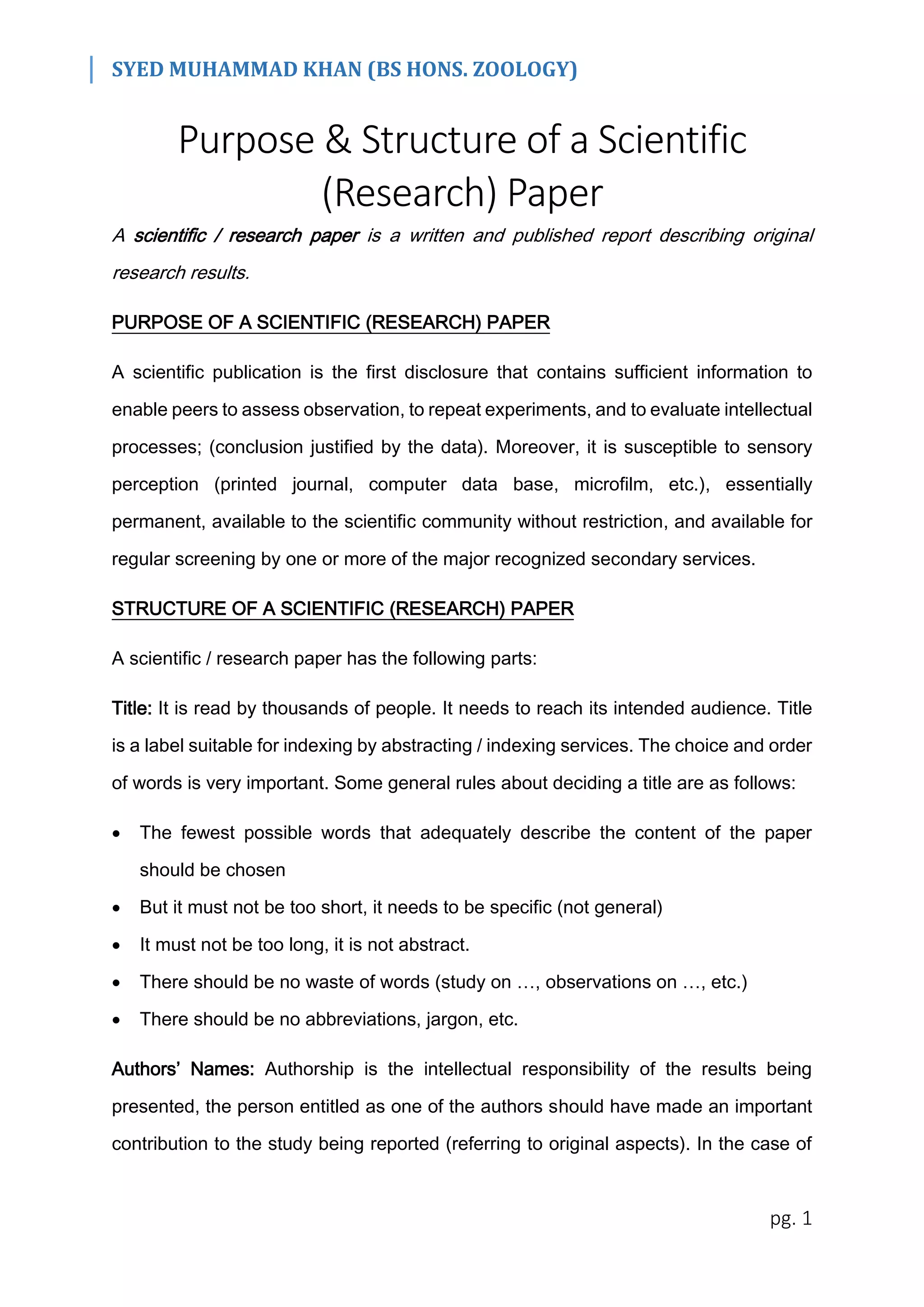
SYED MUHAMMAD KHAN (BS HONS. ZOOLOGY)
pg. 1
Purpose & Structure of a Scientific
(Research) Paper
A scientific / research paper is a written and published report describing original
research results.
PURPOSE OF A SCIENTIFIC (RESEARCH) PAPER
A scientific publication is the first disclosure that contains sufficient information to
enable peers to assess observation, to repeat experiments, and to evaluate intellectual
processes; (conclusion justified by the data). Moreover, it is susceptible to sensory
perception (printed journal, computer data base, microfilm, etc.), essentially
permanent, available to the scientific community without restriction, and available for
regular screening by one or more of the major recognized secondary services.
STRUCTURE OF A SCIENTIFIC (RESEARCH) PAPER
A scientific / research paper has the following parts:
Title: It is read by thousands of people. It needs to reach its intended audience. Title
is a label suitable for indexing by abstracting / indexing services. The choice and order
of words is very important. Some general rules about deciding a title are as follows:
 The fewest possible words that adequately describe the content of the paper
should be chosen
 But it must not be too short, it needs to be specific (not general)
 It must not be too long, it is not abstract.
 There should be no waste of words (study on …, observations on …, etc.)
 There should be no abbreviations, jargon, etc.
Authors’ Names: Authorship is the intellectual responsibility of the results being
presented, the person entitled as one of the authors should have made an important
contribution to the study being reported (referring to original aspects). In the case of
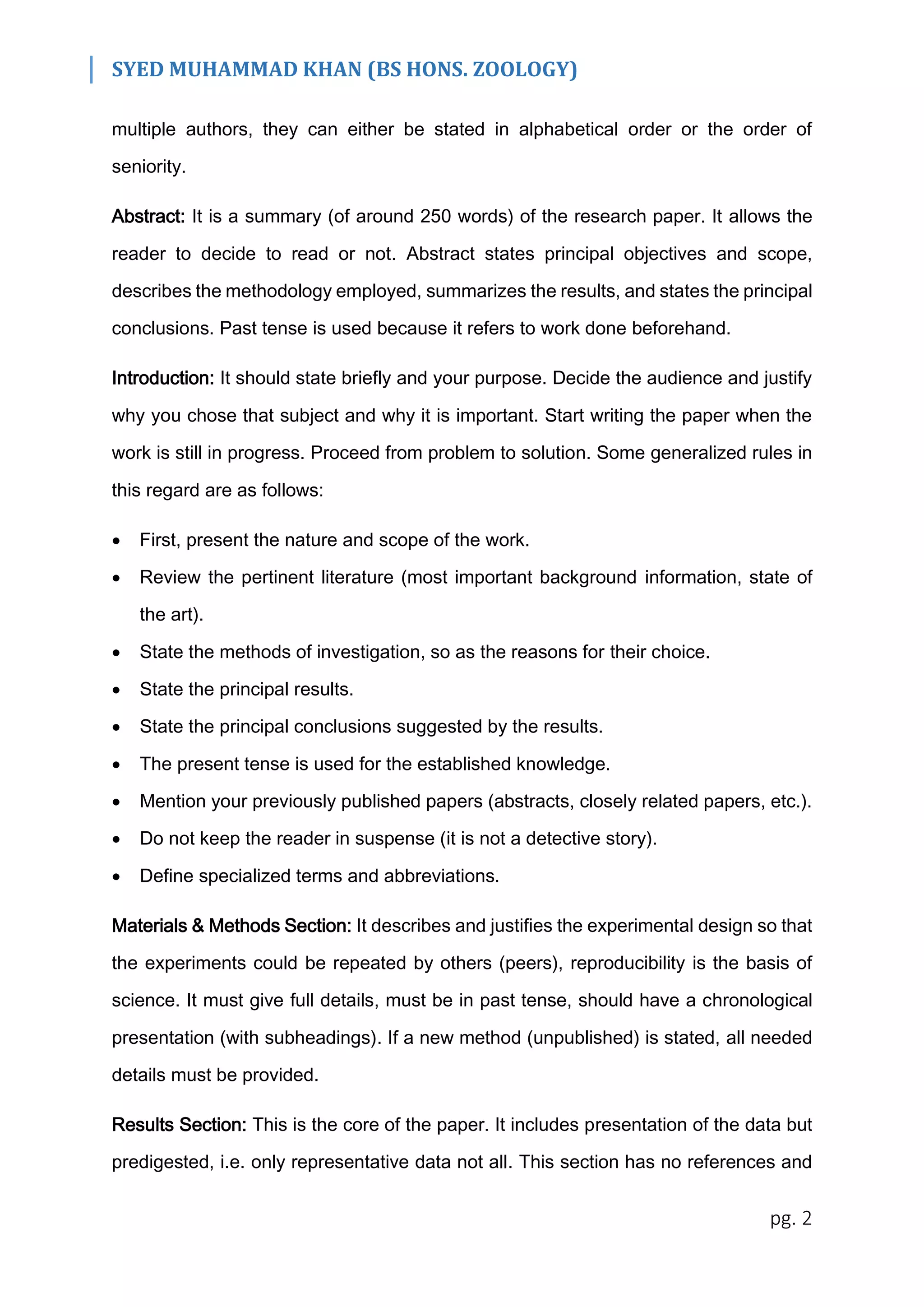
SYED MUHAMMAD KHAN (BS HONS. ZOOLOGY)
pg. 2
multiple authors, they can either be stated in alphabetical order or the order of
seniority.
Abstract: It is a summary (of around 250 words) of the research paper. It allows the
reader to decide to read or not. Abstract states principal objectives and scope,
describes the methodology employed, summarizes the results, and states the principal
conclusions. Past tense is used because it refers to work done beforehand.
Introduction: It should state briefly and your purpose. Decide the audience and justify
why you chose that subject and why it is important. Start writing the paper when the
work is still in progress. Proceed from problem to solution. Some generalized rules in
this regard are as follows:
 First, present the nature and scope of the work.
 Review the pertinent literature (most important background information, state of
the art).
 State the methods of investigation, so as the reasons for their choice.
 State the principal results.
 State the principal conclusions suggested by the results.
 The present tense is used for the established knowledge.
 Mention your previously published papers (abstracts, closely related papers, etc.).
 Do not keep the reader in suspense (it is not a detective story).
 Define specialized terms and abbreviations.
Materials & Methods Section: It describes and justifies the experimental design so that
the experiments could be repeated by others (peers), reproducibility is the basis of
science. It must give full details, must be in past tense, should have a chronological
presentation (with subheadings). If a new method (unpublished) is stated, all needed
details must be provided.
Results Section: This is the core of the paper. It includes presentation of the data but
predigested, i.e. only representative data not all. This section has no references and
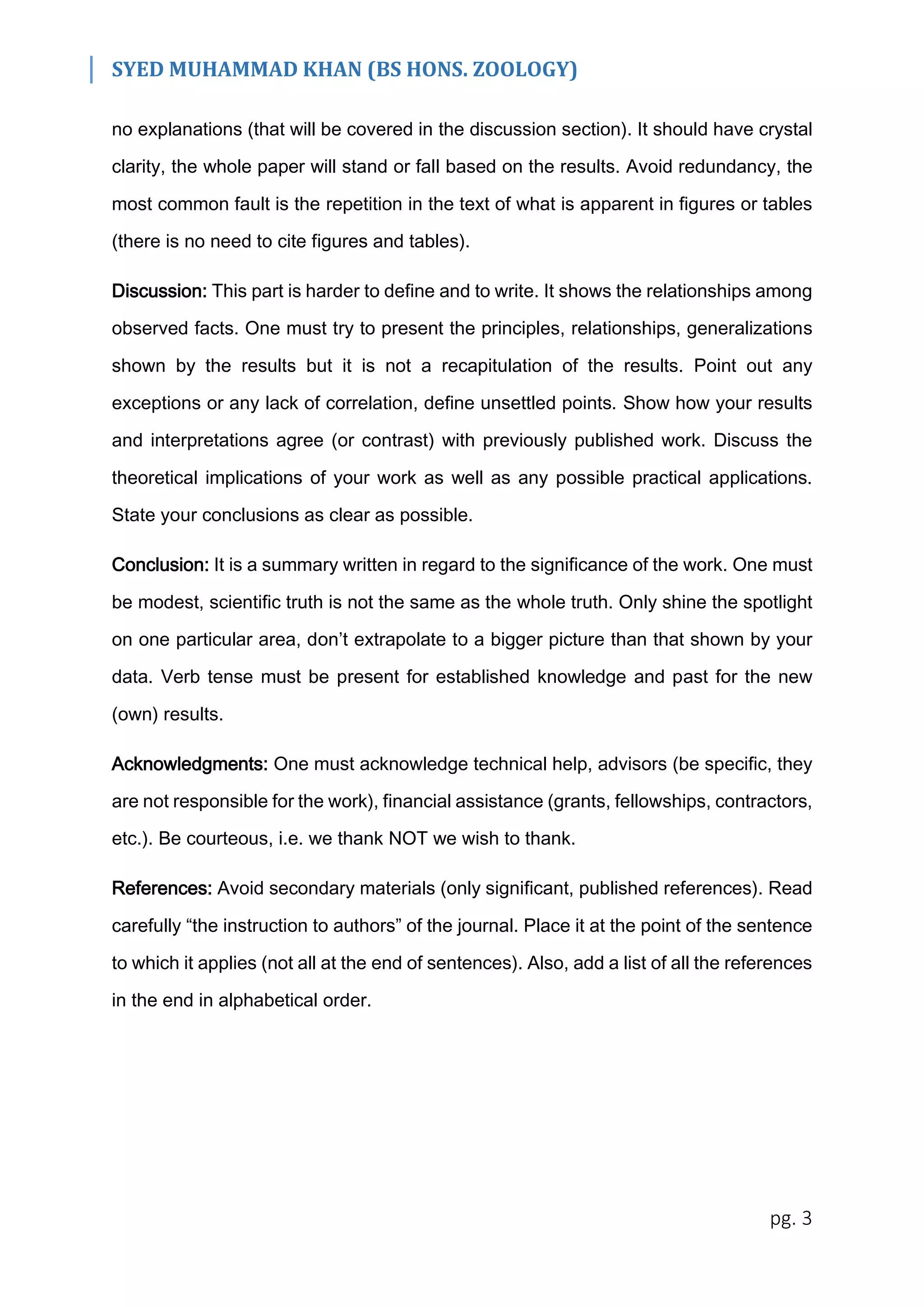
SYED MUHAMMAD KHAN (BS HONS. ZOOLOGY)
pg. 3
no explanations (that will be covered in the discussion section). It should have crystal
clarity, the whole paper will stand or fall based on the results. Avoid redundancy, the
most common fault is the repetition in the text of what is apparent in figures or tables
(there is no need to cite figures and tables).
Discussion: This part is harder to define and to write. It shows the relationships among
observed facts. One must try to present the principles, relationships, generalizations
shown by the results but it is not a recapitulation of the results. Point out any
exceptions or any lack of correlation, define unsettled points. Show how your results
and interpretations agree (or contrast) with previously published work. Discuss the
theoretical implications of your work as well as any possible practical applications.
State your conclusions as clear as possible.
Conclusion: It is a summary written in regard to the significance of the work. One must
be modest, scientific truth is not the same as the whole truth. Only shine the spotlight
on one particular area, don’t extrapolate to a bigger picture than that shown by your
data. Verb tense must be present for established knowledge and past for the new
(own) results.
Acknowledgments: One must acknowledge technical help, advisors (be specific, they
are not responsible for the work), financial assistance (grants, fellowships, contractors,
etc.). Be courteous, i.e. we thank NOT we wish to thank.
References: Avoid secondary materials (only significant, published references). Read
carefully “the instruction to authors” of the journal. Place it at the point of the sentence
to which it applies (not all at the end of sentences). Also, add a list of all the references
in the end in alphabetical order.

Purpose & Structure of a Scientific (Research) Paper

  • 1.
    SYED MUHAMMAD KHAN(BS HONS. ZOOLOGY) pg. 1 Purpose & Structure of a Scientific (Research) Paper A scientific / research paper is a written and published report describing original research results. PURPOSE OF A SCIENTIFIC (RESEARCH) PAPER A scientific publication is the first disclosure that contains sufficient information to enable peers to assess observation, to repeat experiments, and to evaluate intellectual processes; (conclusion justified by the data). Moreover, it is susceptible to sensory perception (printed journal, computer data base, microfilm, etc.), essentially permanent, available to the scientific community without restriction, and available for regular screening by one or more of the major recognized secondary services. STRUCTURE OF A SCIENTIFIC (RESEARCH) PAPER A scientific / research paper has the following parts: Title: It is read by thousands of people. It needs to reach its intended audience. Title is a label suitable for indexing by abstracting / indexing services. The choice and order of words is very important. Some general rules about deciding a title are as follows:  The fewest possible words that adequately describe the content of the paper should be chosen  But it must not be too short, it needs to be specific (not general)  It must not be too long, it is not abstract.  There should be no waste of words (study on …, observations on …, etc.)  There should be no abbreviations, jargon, etc. Authors’ Names: Authorship is the intellectual responsibility of the results being presented, the person entitled as one of the authors should have made an important contribution to the study being reported (referring to original aspects). In the case of
  • 2.
    SYED MUHAMMAD KHAN(BS HONS. ZOOLOGY) pg. 2 multiple authors, they can either be stated in alphabetical order or the order of seniority. Abstract: It is a summary (of around 250 words) of the research paper. It allows the reader to decide to read or not. Abstract states principal objectives and scope, describes the methodology employed, summarizes the results, and states the principal conclusions. Past tense is used because it refers to work done beforehand. Introduction: It should state briefly and your purpose. Decide the audience and justify why you chose that subject and why it is important. Start writing the paper when the work is still in progress. Proceed from problem to solution. Some generalized rules in this regard are as follows:  First, present the nature and scope of the work.  Review the pertinent literature (most important background information, state of the art).  State the methods of investigation, so as the reasons for their choice.  State the principal results.  State the principal conclusions suggested by the results.  The present tense is used for the established knowledge.  Mention your previously published papers (abstracts, closely related papers, etc.).  Do not keep the reader in suspense (it is not a detective story).  Define specialized terms and abbreviations. Materials & Methods Section: It describes and justifies the experimental design so that the experiments could be repeated by others (peers), reproducibility is the basis of science. It must give full details, must be in past tense, should have a chronological presentation (with subheadings). If a new method (unpublished) is stated, all needed details must be provided. Results Section: This is the core of the paper. It includes presentation of the data but predigested, i.e. only representative data not all. This section has no references and
  • 3.
    SYED MUHAMMAD KHAN(BS HONS. ZOOLOGY) pg. 3 no explanations (that will be covered in the discussion section). It should have crystal clarity, the whole paper will stand or fall based on the results. Avoid redundancy, the most common fault is the repetition in the text of what is apparent in figures or tables (there is no need to cite figures and tables). Discussion: This part is harder to define and to write. It shows the relationships among observed facts. One must try to present the principles, relationships, generalizations shown by the results but it is not a recapitulation of the results. Point out any exceptions or any lack of correlation, define unsettled points. Show how your results and interpretations agree (or contrast) with previously published work. Discuss the theoretical implications of your work as well as any possible practical applications. State your conclusions as clear as possible. Conclusion: It is a summary written in regard to the significance of the work. One must be modest, scientific truth is not the same as the whole truth. Only shine the spotlight on one particular area, don’t extrapolate to a bigger picture than that shown by your data. Verb tense must be present for established knowledge and past for the new (own) results. Acknowledgments: One must acknowledge technical help, advisors (be specific, they are not responsible for the work), financial assistance (grants, fellowships, contractors, etc.). Be courteous, i.e. we thank NOT we wish to thank. References: Avoid secondary materials (only significant, published references). Read carefully “the instruction to authors” of the journal. Place it at the point of the sentence to which it applies (not all at the end of sentences). Also, add a list of all the references in the end in alphabetical order.