Strategic Sourcing:
Walking the Tightrope
in Developing Sourcing Strategy
for

Thomas L. Tanel, C.P.M., CTL, CCA, CISCM, President and CEO
CATTAN Services Group, Inc., College Station, TX
979-260-7200
www.cattan.com
© 2010 CATTAN Services Group, Inc.
The Agenda
• Introduction
• Developing Sourcing
Strategy-5 Phases
• Detailed Five Phase
Process
• Conclusions
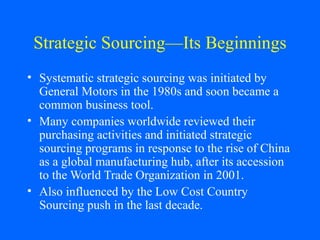
Strategic Sourcing—Its Beginnings
• Systematic strategic sourcing was initiated by
General Motors in the 1980s and soon became a
common business tool.
• Many companies worldwide reviewed their
purchasing activities and initiated strategic
sourcing programs in response to the rise of China
as a global manufacturing hub, after its accession
to the World Trade Organization in 2001.
• Also influenced by the Low Cost Country
Sourcing push in the last decade.
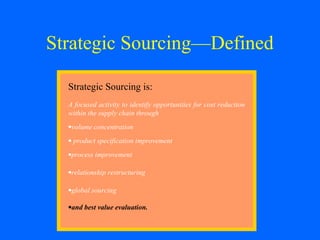
Strategic Sourcing—Defined
Strategic Sourcing is:
A focused activity to identify opportunities for cost reduction
within the supply chain through
•volume concentration
• product specification improvement
•process improvement
•relationship restructuring
•global sourcing
•and best value evaluation.
Develop Sourcing Strategy—
Five Phase Process
1.
2.
3.
4.
5.

Develop sourcing strategies differentiated by
expenditure category and based on market dynamics.
Deeply involve end-users in sourcing for knowledge and
buy-in.
Apply a rigorous sourcing approach that examines
internal needs against supply market options to find the
lowest total cost.
Challenge specifications and usage patterns to ensure
that each expenditure is providing the best value for the
company.
Identify, analyze, select, and negotiate with strategically
advantaged suppliers, not just the ones with the lowest
price today.
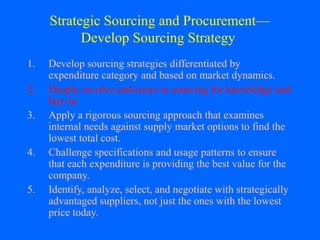
Strategic Sourcing and Procurement—
Develop Sourcing Strategy
1.
2.
3.
4.
5.

Develop sourcing strategies differentiated by
expenditure category and based on market dynamics.
Deeply involve end-users in sourcing for knowledge and
buy-in.
Apply a rigorous sourcing approach that examines
internal needs against supply market options to find the
lowest total cost.
Challenge specifications and usage patterns to ensure
that each expenditure is providing the best value for the
company.
Identify, analyze, select, and negotiate with strategically
advantaged suppliers, not just the ones with the lowest
price today.
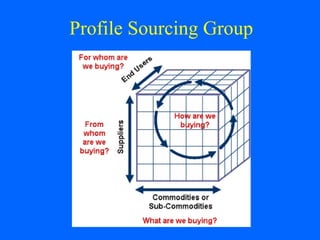
Profile Sourcing Group
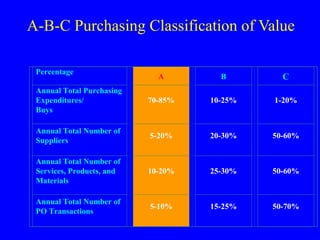
A-B-C Purchasing Classification of Value
Percentage

A

B

C

Annual Total Purchasing
Expenditures/
Buys

70-85%

10-25%

1-20%

Annual Total Number of
Suppliers

5-20%

20-30%

50-60%

Annual Total Number of
Services, Products, and
Materials

10-20%

25-30%

50-60%

Annual Total Number of
PO Transactions

5-10%

15-25%

50-70%
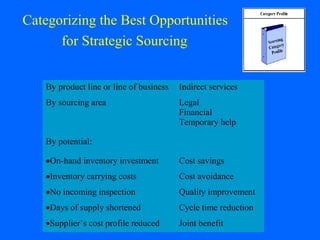
Categorizing the Best Opportunities
for Strategic Sourcing
By product line or line of business

Indirect services

By sourcing area

Legal
Financial
Temporary help

By potential:
•On-hand inventory investment

Cost savings

•Inventory carrying costs

Cost avoidance

•No incoming inspection

Quality improvement

•Days of supply shortened

Cycle time reduction

•Supplier’s cost profile reduced

Joint benefit
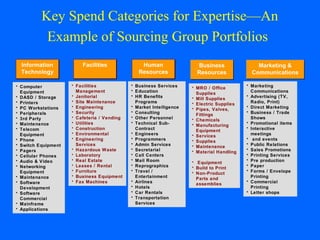
Key Spend Categories for Expertise—An
Example of Sourcing Group Portfolios
Information
Technology
• Computer
Equipment
• DASD / Storage
• Printers
• PC Workstations
• Peripherals
• 3rd Party
• Maintenance
• Telecom
Equipment
• Phone
• Switch Equipment
• Pagers
• Cellular Phones
• Audio & Video
• Networking
Equipment
• Maintenance
• Software
Development
• Software
Commercial
• Mainframe
• Applications

Facilities

• Facilities
Management
• Janitorial
• Site Maintenance
• Engineering
• Security
• Cafeteria / Vending
• Utilities
• Construction
• Environmental
• Engineering
Services
• Hazardous W aste
• Laboratory
• Real Estate
• Leases / Rental
• Furniture
• Business Equipment
• Fax Machines

Human
Resources
• Business Services
• Education
• HR Benefits
Programs
• Market Intelligence
• Consulting
• Other Personnel
• Technical SubContract
• Engineers
• Programmers
• Admin Services
• Secretarial
• Call Centers
• Mail Room
• Reprographics
• Travel /
Entertainment
• Airlines
• Hotels
• Car Rentals
• Transportation
Services

Business
Resources
• MRO / Office
Supplies
• Mill Supplies
• Electric Supplies
• Pipes, Valves,
Fittings
• Chemicals
• Manufacturing
Equipment
• Services
• Supplies
• Maintenance
• Material Handling
• Equipment
• Build to Print
• Non-Product
Parts and
assemblies

Marketing &
Communications
• Marketing
Communications
• Advertising (TV,
Radio, Print)
• Direct Marketing
• Business / Trade
Shows
• Promotional items
• Interactive
meetings
• and events
• Public Relations
• Sales Promotions
• Printing Services
• Pre production
• Paper
• Forms / Envelope
Printing
• Commercial
Printing
• Letter shops
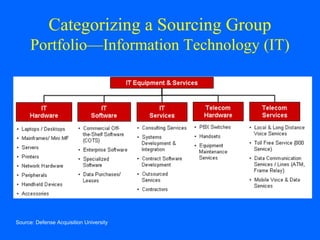
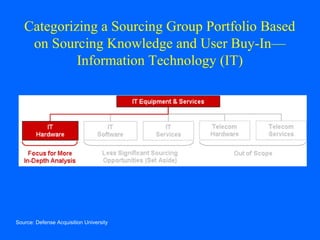
Categorizing a Sourcing Group
Portfolio—Information Technology (IT)

Source: Defense Acquisition University
Strategic Sourcing and Procurement—
Develop Sourcing Strategy
1.
2.
3.
4.
5.

Develop sourcing strategies differentiated by
expenditure category and based on market dynamics.
Deeply involve end-users in sourcing for knowledge and
buy-in.
Apply a rigorous sourcing approach that examines
internal needs against supply market options to find the
lowest total cost.
Challenge specifications and usage patterns to ensure
that each expenditure is providing the best value for the
company.
Identify, analyze, select, and negotiate with strategically
advantaged suppliers, not just the ones with the lowest
price today.
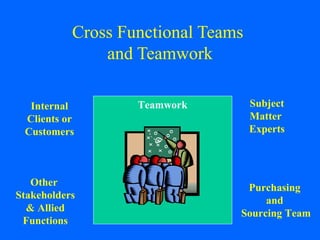
Cross Functional Teams
and Teamwork
Internal
Clients or
Customers

Other
Stakeholders
& Allied
Functions

Teamwork

Subject
Matter
Experts

Purchasing
and
Sourcing Team
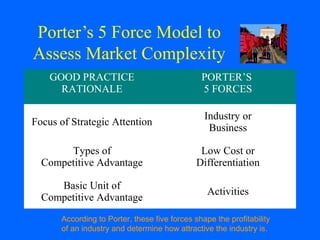
Porter’s 5 Force Model to
Assess Market Complexity
GOOD PRACTICE
RATIONALE

PORTER’S
5 FORCES

Focus of Strategic Attention

Industry or
Business

Types of
Competitive Advantage

Low Cost or
Differentiation

Basic Unit of
Competitive Advantage

Activities

According to Porter, these five forces shape the profitability
of an industry and determine how attractive the industry is.
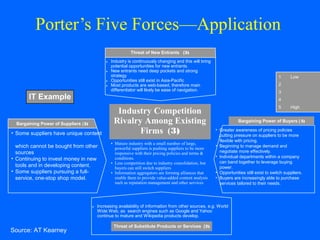
Porter’s Five Forces—Application
Threat of New Entrants (2)
• Industry is continuously changing and this will bring
potential opportunities for new entrants.
• New entrants need deep pockets and strong
strategy
• Opportunities still exist in Asia-Pacific
• Most products are web-based, therefore main
differentiator will likely be ease of navigation.

IT Example

1
2
3
4

Bargaining Power of Suppliers (3)

• Some suppliers have unique content
which cannot be bought from other
sources
• Continuing to invest money in new
tools and in developing content.
• Some suppliers pursuing a fullservice, one-stop shop model.

Industry Competition
Rivalry Among Existing
Firms (3)
• Mature industry with a small number of large,
powerful suppliers is pushing suppliers to be more
responsive with their pricing policies and terms &
conditions.
• Less competition due to industry consolidation, but
buyers can still switch suppliers
• Information aggregators are forming alliances that
enable them to provide value-added content analysis
such as reputation management and other services

5

Threat of Substitute Products or Services (2)

High

Bargaining Power of Buyers (4)
• Greater awareness of pricing policies
putting pressure on suppliers to be more
flexible with pricing.
• Beginning to manage demand and
negotiate more effectively.
• Individual departments within a company
can band together to leverage buying
power.
• Opportunities still exist to switch suppliers.
• Buyers are increasingly able to purchase
services tailored to their needs.

• Increasing availability of information from other sources, e.g. World
Wide Web, as search engines such as Google and Yahoo
continue to mature and Wikipedia products develop.

Source: AT Kearney

Low
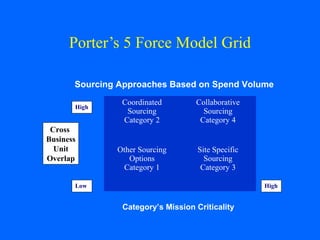
Porter’s 5 Force Model Grid
Sourcing Approaches Based on Spend Volume
High

Cross
Business
Unit
Overlap

Coordinated
Sourcing
Category 2

Collaborative
Sourcing
Category 4

Other Sourcing
Options
Category 1

Site Specific
Sourcing
Category 3

Low

High

Category’s Mission Criticality
Categorizing a Sourcing Group Portfolio Based
on Sourcing Knowledge and User Buy-In—
Information Technology (IT)

Source: Defense Acquisition University
Strategic Sourcing and Procurement—
Develop Sourcing Strategy
1.
2.
3.
4.
5.

Develop sourcing strategies differentiated by
expenditure category and based on market dynamics.
Deeply involve end-users in sourcing for knowledge and
buy-in.
Apply a rigorous sourcing approach that examines
internal needs against supply market options to find the
lowest total cost.
Challenge specifications and usage patterns to ensure
that each expenditure is providing the best value for the
company.
Identify, analyze, select, and negotiate with strategically
advantaged suppliers, not just the ones with the lowest
price today.
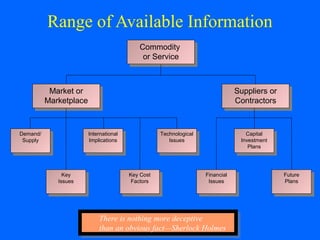
Range of Available Information
Commodity
Commodity
or Service
or Service

Market or
Market or
Marketplace
Marketplace

Demand/
Demand/
Supply
Supply

Suppliers or
Suppliers or
Contractors
Contractors

International
International
Implications
Implications

Key
Key
Issues
Issues

Technological
Technological
Issues
Issues

Key Cost
Key Cost
Factors
Factors

Capital
Capital
Investment
Investment
Plans
Plans

Financial
Financial
Issues
Issues

There is nothing more deceptive
than an obvious fact—Sherlock Holmes


Future
Future
Plans
Plans
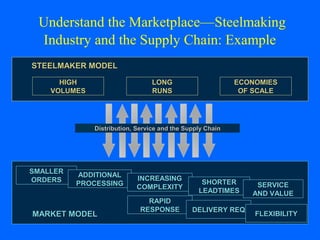
Understand the Marketplace—Steelmaking
Industry and the Supply Chain: Example
STEELMAKER MODEL
HIGH
VOLUMES

LONG
RUNS

ECONOMIES
OF SCALE

Distribution, Service and the Supply Chain

SMALLER
ORDERS

ADDITIONAL
PROCESSING

MARKET MODEL

INCREASING
COMPLEXITY
RAPID
RESPONSE

SHORTER
LEADTIMES
DELIVERY REQ

SERVICE
AND VALUE
FLEXIBILITY
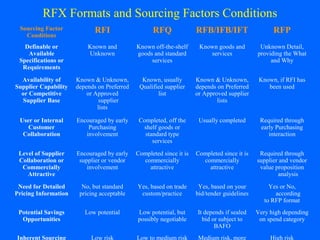
RFX Formats and Sourcing Factors Conditions
Sourcing Factor
Conditions

RFI

RFQ

RFB/IFB/IFT

RFP

Definable or
Available
Specifications or
Requirements

Known and
Unknown

Known off-the-shelf
goods and standard
services

Known goods and
services

Unknown Detail,
providing the What
and Why

Availability of
Supplier Capability
or Competitive
Supplier Base

Known & Unknown,
depends on Preferred
or Approved
supplier
lists

Known, usually
Qualified supplier
list

Known & Unknown,
depends on Preferred
or Approved supplier
lists

Known, if RFI has
been used

User or Internal
Customer
Collaboration

Encouraged by early
Purchasing
involvement

Completed, off the
shelf goods or
standard type
services

Usually completed

Required through
early Purchasing
interaction

Level of Supplier
Collaboration or
Commercially
Attractive

Encouraged by early
supplier or vendor
involvement

Completed since it is
commercially
attractive

Completed since it is
commercially
attractive

Required through
supplier and vendor
value proposition
analysis

Need for Detailed
Pricing Information

No, but standard
pricing acceptable

Yes, based on trade
custom/practice

Yes, based on your
bid/tender guidelines

Yes or No,
according
to RFP format

Potential Savings
Opportunities

Low potential

Low potential, but
possibly negotiable

It depends if sealed
bid or subject to
BAFO

Very high depending
on spend category

Inherent Sourcing

Low risk

Low to medium risk

Medium risk, more

High risk
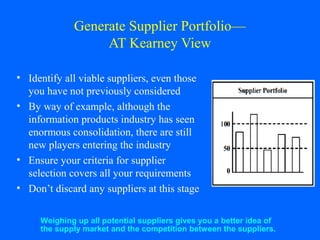
Generate Supplier Portfolio—
AT Kearney View
• Identify all viable suppliers, even those
you have not previously considered
• By way of example, although the
information products industry has seen
enormous consolidation, there are still
new players entering the industry
• Ensure your criteria for supplier
selection covers all your requirements
• Don’t discard any suppliers at this stage
Weighing up all potential suppliers gives you a better idea of
the supply market and the competition between the suppliers.
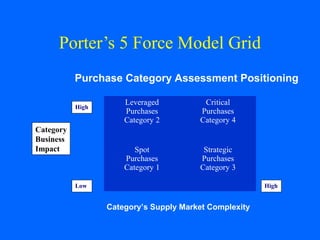
Porter’s 5 Force Model Grid
Purchase Category Assessment Positioning

Category
Business
Impact

Leveraged
Purchases
Category 2

Critical
Purchases
Category 4

Spot
Purchases
Category 1

High

Strategic
Purchases
Category 3

Low

High

Category’s Supply Market Complexity
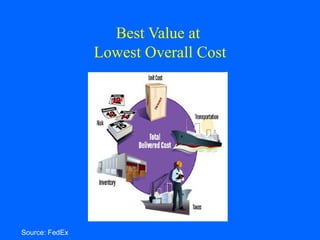
Best Value at
Lowest Overall Cost

Source: FedEx
Strategic Sourcing and Procurement—
Develop Sourcing Strategy
1.
2.
3.
4.
5.

Develop sourcing strategies differentiated by
expenditure category and based on market dynamics.
Deeply involve end-users in sourcing for knowledge and
buy-in.
Apply a rigorous sourcing approach that examines
internal needs against supply market options to find the
lowest total cost.
Challenge specifications and usage patterns to ensure
that each expenditure is providing the best value for the
company.
Identify, analyze, select, and negotiate with strategically
advantaged suppliers, not just the ones with the lowest
price today.
Challenge Specifications
• Simplification and variety reduction techniques can help in
reducing costs and in obtaining better value.
• Simplification and variety reduction in a specification
requires the elimination of complexities in design by
omitting different types, sizes, grades etc. of products.
• At its simplest, this might be seen as:
– The reduction in the number of colors in which an item is
purchased, or
– In the sizes of envelopes which are purchased and kept in stock

• For example, many companies have dramatically reduced
travel costs by imposing more restrictive travel policies,
such as enforcing advanced ticket purchases, mandating
economy class on all but the longest flights, and tightening
constraints on the use of non-preferred airlines.
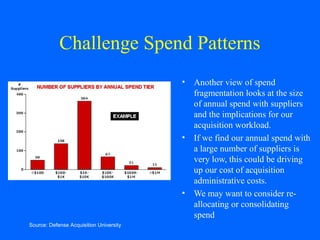
Challenge Spend Patterns
•

•

•

Source: Defense Acquisition University

Another view of spend
fragmentation looks at the size
of annual spend with suppliers
and the implications for our
acquisition workload.
If we find our annual spend with
a large number of suppliers is
very low, this could be driving
up our cost of acquisition
administrative costs.
We may want to consider reallocating or consolidating
spend
Challenge Usage Patterns
• Companies buy the same or similar products/services from many
different suppliers which means:
– they are not leveraging total company buying power
– and are managing more suppliers than necessary

• Companies have not:
– fully defined product/service requirements
– or established standard SKUs for many items
– or service templates for standard-types

• Companies have not:
– established formal supplier agreements for a large number of sourcing
groups
– or optimized their sourcing efforts by challenging usage patterns and
engaging a reduced supplier base.
– or forced compliance with preferred suppliers
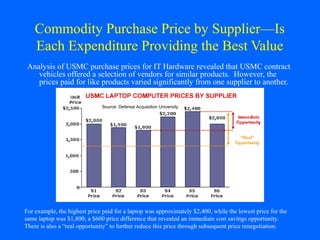
Commodity Purchase Price by Supplier—Is
Each Expenditure Providing the Best Value
Analysis of USMC purchase prices for IT Hardware revealed that USMC contract
vehicles offered a selection of vendors for similar products. However, the
prices paid for like products varied significantly from one supplier to another.
Source: Defense Acquisition University

For example, the highest price paid for a laptop was approximately $2,400, while the lowest price for the
same laptop was $1,800; a $600 price difference that revealed an immediate cost savings opportunity.
There is also a “real opportunity” to further reduce this price through subsequent price renegotiation.
Strategic Sourcing and Procurement—
Develop Sourcing Strategy
1.
2.
3.
4.
5.

Develop sourcing strategies differentiated by
expenditure category and based on market dynamics.
Deeply involve end-users in sourcing for knowledge and
buy-in.
Apply a rigorous sourcing approach that examines
internal needs against supply market options to find the
lowest total cost.
Challenge specifications and usage patterns to ensure
that each expenditure is providing the best value for the
company.
Identify, analyze, select, and negotiate with strategically
advantaged suppliers, not just the ones with the lowest
price today.
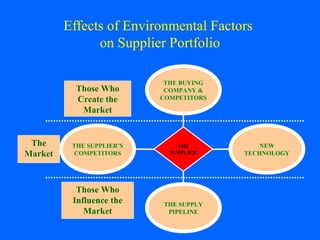
Effects of Environmental Factors
on Supplier Portfolio
Those Who
Create the
Market

The
Market

THE BUYING
COMPANY &
COMPETITORS

THE SUPPLIER’S
COMPETITORS

THE
SUPPLIER

Those Who
Influence the
Market

THE SUPPLY
PIPELINE

NEW
TECHNOLOGY
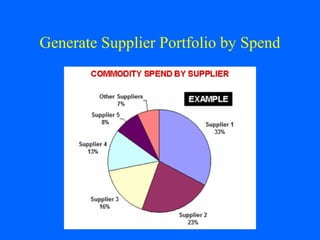
Generate Supplier Portfolio by Spend
Negotiation Planning Focus
• Focus on Pareto’s Law—20% of your
sourcing groups constitute 80% of your
purchase spend.
• Focus on alliances, partners, preferred
suppliers, and strategic sources.
• More extensive negotiations are appropriate
for higher dollar value procurements, because
the dollar savings are potentially larger.
Conclusions: Let’s Review Our Strategic
Sourcing Framework Versus Yours
A four-step process of
implementation involves a
cross-functional team and
various internal resources to
“think outside the box”
Strategic Sourcing—A Proven Framework
1. Research the industry economics and dynamics of the
teams assigned commodity or service (time frame = 2 to
3 months).
2. Evaluate sourcing strategies and suppliers’ capabilities
(time frame = 1 to 1½ months).
3. Structure the supply relationship jointly with suppliers
and develop action plans to build the required
infrastructure (time frame = 2 to 3 months).
4. Implement the plan and organize for continuous
improvement (time frame = 6 to 12 months).
Thank You !

Strategic Sourcing: Walking the Tightrope in Developing Sourcing Strategy

  • 1.
    Strategic Sourcing: Walking theTightrope in Developing Sourcing Strategy for Thomas L. Tanel, C.P.M., CTL, CCA, CISCM, President and CEO CATTAN Services Group, Inc., College Station, TX 979-260-7200 www.cattan.com © 2010 CATTAN Services Group, Inc.
  • 2.
    The Agenda • Introduction •Developing Sourcing Strategy-5 Phases • Detailed Five Phase Process • Conclusions
  • 3.
    Strategic Sourcing—Its Beginnings •Systematic strategic sourcing was initiated by General Motors in the 1980s and soon became a common business tool. • Many companies worldwide reviewed their purchasing activities and initiated strategic sourcing programs in response to the rise of China as a global manufacturing hub, after its accession to the World Trade Organization in 2001. • Also influenced by the Low Cost Country Sourcing push in the last decade.
  • 4.
    Strategic Sourcing—Defined Strategic Sourcingis: A focused activity to identify opportunities for cost reduction within the supply chain through •volume concentration • product specification improvement •process improvement •relationship restructuring •global sourcing •and best value evaluation.
  • 5.
    Develop Sourcing Strategy— FivePhase Process 1. 2. 3. 4. 5. Develop sourcing strategies differentiated by expenditure category and based on market dynamics. Deeply involve end-users in sourcing for knowledge and buy-in. Apply a rigorous sourcing approach that examines internal needs against supply market options to find the lowest total cost. Challenge specifications and usage patterns to ensure that each expenditure is providing the best value for the company. Identify, analyze, select, and negotiate with strategically advantaged suppliers, not just the ones with the lowest price today.
  • 6.
    Strategic Sourcing andProcurement— Develop Sourcing Strategy 1. 2. 3. 4. 5. Develop sourcing strategies differentiated by expenditure category and based on market dynamics. Deeply involve end-users in sourcing for knowledge and buy-in. Apply a rigorous sourcing approach that examines internal needs against supply market options to find the lowest total cost. Challenge specifications and usage patterns to ensure that each expenditure is providing the best value for the company. Identify, analyze, select, and negotiate with strategically advantaged suppliers, not just the ones with the lowest price today.
  • 7.
  • 8.
    A-B-C Purchasing Classificationof Value Percentage A B C Annual Total Purchasing Expenditures/ Buys 70-85% 10-25% 1-20% Annual Total Number of Suppliers 5-20% 20-30% 50-60% Annual Total Number of Services, Products, and Materials 10-20% 25-30% 50-60% Annual Total Number of PO Transactions 5-10% 15-25% 50-70%
  • 9.
    Categorizing the BestOpportunities for Strategic Sourcing By product line or line of business Indirect services By sourcing area Legal Financial Temporary help By potential: •On-hand inventory investment Cost savings •Inventory carrying costs Cost avoidance •No incoming inspection Quality improvement •Days of supply shortened Cycle time reduction •Supplier’s cost profile reduced Joint benefit
  • 10.
    Key Spend Categoriesfor Expertise—An Example of Sourcing Group Portfolios Information Technology • Computer Equipment • DASD / Storage • Printers • PC Workstations • Peripherals • 3rd Party • Maintenance • Telecom Equipment • Phone • Switch Equipment • Pagers • Cellular Phones • Audio & Video • Networking Equipment • Maintenance • Software Development • Software Commercial • Mainframe • Applications Facilities • Facilities Management • Janitorial • Site Maintenance • Engineering • Security • Cafeteria / Vending • Utilities • Construction • Environmental • Engineering Services • Hazardous W aste • Laboratory • Real Estate • Leases / Rental • Furniture • Business Equipment • Fax Machines Human Resources • Business Services • Education • HR Benefits Programs • Market Intelligence • Consulting • Other Personnel • Technical SubContract • Engineers • Programmers • Admin Services • Secretarial • Call Centers • Mail Room • Reprographics • Travel / Entertainment • Airlines • Hotels • Car Rentals • Transportation Services Business Resources • MRO / Office Supplies • Mill Supplies • Electric Supplies • Pipes, Valves, Fittings • Chemicals • Manufacturing Equipment • Services • Supplies • Maintenance • Material Handling • Equipment • Build to Print • Non-Product Parts and assemblies Marketing & Communications • Marketing Communications • Advertising (TV, Radio, Print) • Direct Marketing • Business / Trade Shows • Promotional items • Interactive meetings • and events • Public Relations • Sales Promotions • Printing Services • Pre production • Paper • Forms / Envelope Printing • Commercial Printing • Letter shops
  • 11.
    Categorizing a SourcingGroup Portfolio—Information Technology (IT) Source: Defense Acquisition University
  • 12.
    Strategic Sourcing andProcurement— Develop Sourcing Strategy 1. 2. 3. 4. 5. Develop sourcing strategies differentiated by expenditure category and based on market dynamics. Deeply involve end-users in sourcing for knowledge and buy-in. Apply a rigorous sourcing approach that examines internal needs against supply market options to find the lowest total cost. Challenge specifications and usage patterns to ensure that each expenditure is providing the best value for the company. Identify, analyze, select, and negotiate with strategically advantaged suppliers, not just the ones with the lowest price today.
  • 13.
    Cross Functional Teams andTeamwork Internal Clients or Customers Other Stakeholders & Allied Functions Teamwork Subject Matter Experts Purchasing and Sourcing Team
  • 14.
    Porter’s 5 ForceModel to Assess Market Complexity GOOD PRACTICE RATIONALE PORTER’S 5 FORCES Focus of Strategic Attention Industry or Business Types of Competitive Advantage Low Cost or Differentiation Basic Unit of Competitive Advantage Activities According to Porter, these five forces shape the profitability of an industry and determine how attractive the industry is.
  • 15.
    Porter’s Five Forces—Application Threatof New Entrants (2) • Industry is continuously changing and this will bring potential opportunities for new entrants. • New entrants need deep pockets and strong strategy • Opportunities still exist in Asia-Pacific • Most products are web-based, therefore main differentiator will likely be ease of navigation. IT Example 1 2 3 4 Bargaining Power of Suppliers (3) • Some suppliers have unique content which cannot be bought from other sources • Continuing to invest money in new tools and in developing content. • Some suppliers pursuing a fullservice, one-stop shop model. Industry Competition Rivalry Among Existing Firms (3) • Mature industry with a small number of large, powerful suppliers is pushing suppliers to be more responsive with their pricing policies and terms & conditions. • Less competition due to industry consolidation, but buyers can still switch suppliers • Information aggregators are forming alliances that enable them to provide value-added content analysis such as reputation management and other services 5 Threat of Substitute Products or Services (2) High Bargaining Power of Buyers (4) • Greater awareness of pricing policies putting pressure on suppliers to be more flexible with pricing. • Beginning to manage demand and negotiate more effectively. • Individual departments within a company can band together to leverage buying power. • Opportunities still exist to switch suppliers. • Buyers are increasingly able to purchase services tailored to their needs. • Increasing availability of information from other sources, e.g. World Wide Web, as search engines such as Google and Yahoo continue to mature and Wikipedia products develop. Source: AT Kearney Low
  • 16.
    Porter’s 5 ForceModel Grid Sourcing Approaches Based on Spend Volume High Cross Business Unit Overlap Coordinated Sourcing Category 2 Collaborative Sourcing Category 4 Other Sourcing Options Category 1 Site Specific Sourcing Category 3 Low High Category’s Mission Criticality
  • 17.
    Categorizing a SourcingGroup Portfolio Based on Sourcing Knowledge and User Buy-In— Information Technology (IT) Source: Defense Acquisition University
  • 18.
    Strategic Sourcing andProcurement— Develop Sourcing Strategy 1. 2. 3. 4. 5. Develop sourcing strategies differentiated by expenditure category and based on market dynamics. Deeply involve end-users in sourcing for knowledge and buy-in. Apply a rigorous sourcing approach that examines internal needs against supply market options to find the lowest total cost. Challenge specifications and usage patterns to ensure that each expenditure is providing the best value for the company. Identify, analyze, select, and negotiate with strategically advantaged suppliers, not just the ones with the lowest price today.
  • 19.
    Range of AvailableInformation Commodity Commodity or Service or Service Market or Market or Marketplace Marketplace Demand/ Demand/ Supply Supply Suppliers or Suppliers or Contractors Contractors International International Implications Implications Key Key Issues Issues Technological Technological Issues Issues Key Cost Key Cost Factors Factors Capital Capital Investment Investment Plans Plans Financial Financial Issues Issues There is nothing more deceptive There is nothing more deceptive than an obvious fact—Sherlock Holmes than an obvious fact—Sherlock Holmes Future Future Plans Plans
  • 20.
    Understand the Marketplace—Steelmaking Industryand the Supply Chain: Example STEELMAKER MODEL HIGH VOLUMES LONG RUNS ECONOMIES OF SCALE Distribution, Service and the Supply Chain SMALLER ORDERS ADDITIONAL PROCESSING MARKET MODEL INCREASING COMPLEXITY RAPID RESPONSE SHORTER LEADTIMES DELIVERY REQ SERVICE AND VALUE FLEXIBILITY
  • 21.
    RFX Formats andSourcing Factors Conditions Sourcing Factor Conditions RFI RFQ RFB/IFB/IFT RFP Definable or Available Specifications or Requirements Known and Unknown Known off-the-shelf goods and standard services Known goods and services Unknown Detail, providing the What and Why Availability of Supplier Capability or Competitive Supplier Base Known & Unknown, depends on Preferred or Approved supplier lists Known, usually Qualified supplier list Known & Unknown, depends on Preferred or Approved supplier lists Known, if RFI has been used User or Internal Customer Collaboration Encouraged by early Purchasing involvement Completed, off the shelf goods or standard type services Usually completed Required through early Purchasing interaction Level of Supplier Collaboration or Commercially Attractive Encouraged by early supplier or vendor involvement Completed since it is commercially attractive Completed since it is commercially attractive Required through supplier and vendor value proposition analysis Need for Detailed Pricing Information No, but standard pricing acceptable Yes, based on trade custom/practice Yes, based on your bid/tender guidelines Yes or No, according to RFP format Potential Savings Opportunities Low potential Low potential, but possibly negotiable It depends if sealed bid or subject to BAFO Very high depending on spend category Inherent Sourcing Low risk Low to medium risk Medium risk, more High risk
  • 22.
    Generate Supplier Portfolio— ATKearney View • Identify all viable suppliers, even those you have not previously considered • By way of example, although the information products industry has seen enormous consolidation, there are still new players entering the industry • Ensure your criteria for supplier selection covers all your requirements • Don’t discard any suppliers at this stage Weighing up all potential suppliers gives you a better idea of the supply market and the competition between the suppliers.
  • 23.
    Porter’s 5 ForceModel Grid Purchase Category Assessment Positioning Category Business Impact Leveraged Purchases Category 2 Critical Purchases Category 4 Spot Purchases Category 1 High Strategic Purchases Category 3 Low High Category’s Supply Market Complexity
  • 24.
    Best Value at LowestOverall Cost Source: FedEx
  • 25.
    Strategic Sourcing andProcurement— Develop Sourcing Strategy 1. 2. 3. 4. 5. Develop sourcing strategies differentiated by expenditure category and based on market dynamics. Deeply involve end-users in sourcing for knowledge and buy-in. Apply a rigorous sourcing approach that examines internal needs against supply market options to find the lowest total cost. Challenge specifications and usage patterns to ensure that each expenditure is providing the best value for the company. Identify, analyze, select, and negotiate with strategically advantaged suppliers, not just the ones with the lowest price today.
  • 26.
    Challenge Specifications • Simplificationand variety reduction techniques can help in reducing costs and in obtaining better value. • Simplification and variety reduction in a specification requires the elimination of complexities in design by omitting different types, sizes, grades etc. of products. • At its simplest, this might be seen as: – The reduction in the number of colors in which an item is purchased, or – In the sizes of envelopes which are purchased and kept in stock • For example, many companies have dramatically reduced travel costs by imposing more restrictive travel policies, such as enforcing advanced ticket purchases, mandating economy class on all but the longest flights, and tightening constraints on the use of non-preferred airlines.
  • 27.
    Challenge Spend Patterns • • • Source:Defense Acquisition University Another view of spend fragmentation looks at the size of annual spend with suppliers and the implications for our acquisition workload. If we find our annual spend with a large number of suppliers is very low, this could be driving up our cost of acquisition administrative costs. We may want to consider reallocating or consolidating spend
  • 28.
    Challenge Usage Patterns •Companies buy the same or similar products/services from many different suppliers which means: – they are not leveraging total company buying power – and are managing more suppliers than necessary • Companies have not: – fully defined product/service requirements – or established standard SKUs for many items – or service templates for standard-types • Companies have not: – established formal supplier agreements for a large number of sourcing groups – or optimized their sourcing efforts by challenging usage patterns and engaging a reduced supplier base. – or forced compliance with preferred suppliers
  • 29.
    Commodity Purchase Priceby Supplier—Is Each Expenditure Providing the Best Value Analysis of USMC purchase prices for IT Hardware revealed that USMC contract vehicles offered a selection of vendors for similar products. However, the prices paid for like products varied significantly from one supplier to another. Source: Defense Acquisition University For example, the highest price paid for a laptop was approximately $2,400, while the lowest price for the same laptop was $1,800; a $600 price difference that revealed an immediate cost savings opportunity. There is also a “real opportunity” to further reduce this price through subsequent price renegotiation.
  • 30.
    Strategic Sourcing andProcurement— Develop Sourcing Strategy 1. 2. 3. 4. 5. Develop sourcing strategies differentiated by expenditure category and based on market dynamics. Deeply involve end-users in sourcing for knowledge and buy-in. Apply a rigorous sourcing approach that examines internal needs against supply market options to find the lowest total cost. Challenge specifications and usage patterns to ensure that each expenditure is providing the best value for the company. Identify, analyze, select, and negotiate with strategically advantaged suppliers, not just the ones with the lowest price today.
  • 31.
    Effects of EnvironmentalFactors on Supplier Portfolio Those Who Create the Market The Market THE BUYING COMPANY & COMPETITORS THE SUPPLIER’S COMPETITORS THE SUPPLIER Those Who Influence the Market THE SUPPLY PIPELINE NEW TECHNOLOGY
  • 32.
  • 33.
    Negotiation Planning Focus •Focus on Pareto’s Law—20% of your sourcing groups constitute 80% of your purchase spend. • Focus on alliances, partners, preferred suppliers, and strategic sources. • More extensive negotiations are appropriate for higher dollar value procurements, because the dollar savings are potentially larger.
  • 34.
    Conclusions: Let’s ReviewOur Strategic Sourcing Framework Versus Yours A four-step process of implementation involves a cross-functional team and various internal resources to “think outside the box”
  • 35.
    Strategic Sourcing—A ProvenFramework 1. Research the industry economics and dynamics of the teams assigned commodity or service (time frame = 2 to 3 months). 2. Evaluate sourcing strategies and suppliers’ capabilities (time frame = 1 to 1½ months). 3. Structure the supply relationship jointly with suppliers and develop action plans to build the required infrastructure (time frame = 2 to 3 months). 4. Implement the plan and organize for continuous improvement (time frame = 6 to 12 months).
  • 36.