3
Definition
• A commoditysourcing strategy is a specific sourcing strategy for a
category or group of supplies or services (Rendon, 2005).
4.
4
Commodity procurement mechanisms
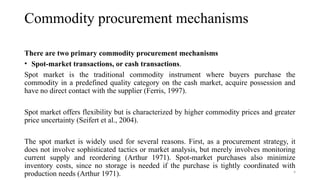
Thereare two primary commodity procurement mechanisms
• Spot-market transactions, or cash transactions.
Spot market is the traditional commodity instrument where buyers purchase the
commodity in a predefined quality category on the cash market, acquire possession and
have no direct contact with the supplier (Ferris, 1997).
Spot market offers flexibility but is characterized by higher commodity prices and greater
price uncertainty (Seifert et al., 2004).
The spot market is widely used for several rea
sons. First, as a procurement strategy, it
does not involve sophisticated tactics or market analysis, but merely involves monitoring
current supply and reordering (Arthur 1971). Spot-market purchases also minimize
inventory costs, since no storage is needed if the purchase is tightly coordinated with
production needs (Arthur 1971).
5.
5
Cont’d
• Forward purchasingmechanisms.
This commodity instrument is usually used by firms to secure the commodities
needed for future production. These can be categorized as forward purchasing
mechanisms, including forward buy and forward contracting.
• In a forward buy: Manufacturers purchase and take possession of a
commodity in advance of manufacturing needs at times when spot-market
prices are favourable. manufacturers can then establish a per-unit commodity
price, set final good prices and, hopefully, capture desired profit margins
6.
6
Cont’d
• In aforward contract: The supplier specifies delivery of a
commodity at a certain future date. Such contracts usually include all
of the transaction’s details, such as quantity to be traded, quality of the
commodity, delivery time and place, and price determination (Ferris,
1997).
Forward contracts offer the opportunity to procure commodities with
the desired qualities for future processing without holding physical
inventory and with little or no required payment in advance of delivery
7.
7
Developing commodity strategy
Acommodity strategy is the purchasing plan for a specific product or
service (commodities) that facilitates the management of the supplier
base, avoids and/or proactively solves potential problems, and is the
basis of future Postal Service business practices surrounding a purchase
of the commodity involved.
The strategies developed will focus on planned objectives, as well as the
tactics and resources necessary to achieve client satisfaction and
business success in the supply category in the coming year. It is
especially important that when developing commodity strategies,
identify the technological nature of the commodity (if any) and what
technology is needed to support the purchase throughout the life cycle.
8.
8
Cont’d
A commodity strategyis developed by evaluating, considering, and
leveraging data about the following:
• Requirements of the client.
• Value and risk assessments (quadrant analysis).
• Marketplace and market research.
• High-level logistics support.
• Final goals and benefits to be realized.
• Quadrant approach.
9.
9
Category management strategy
•To manage the total portfolio effectively, you need to assess the
demand elements and supply market positioning of each main
category at a strategic level
• Kraljic (1983) introduced the first comprehensive portfolio approach
for the determination of a set of differentiated purchasing strategies.
The portfolio matrix (Kraljic, 1983) is a purchasing approach to
manage supplier relationships. Its general idea is to minimize supply
risk and make the most of buying power. This explains the choice of
dimensions: accounting for risk on the one hand, and using buying
power on the other hand.
10.
10
Kraljic purchasing portfoliomanagement matrix
• Kraljic's approach includes the construction of a portfolio matrix that
classifies products on the basis of two dimensions: profit impact and
supply risk ("low" and "high"). The result is a 2x2 matrix and a
classification in four categories: bottleneck, non-critical, leverage, and
strategic items. Each category requires a distinctive approach towards
suppliers It is a useful tool to classify purchased goods and the
suppliers involved. Taking the complexity of the supplier market and
the financial relevance or impact into account, goods and suppliers can
be classified as leverage, routine, strategic and bottleneck items.
11.
11
Cont’d
• The strengthof the instrument is that it enables the purchaser to differentiate
between the various supplier relations and strategies that are appropriate for
each category. These are:
• strategic items: These are high-tech, high-volume products, which are often
supplied to customer specification. Only one source of supply is available,
which cannot be changed in the short term without incurring considerable costs.
Usually this type of product represents a high share in the cost price of the end
product. Examples are engines and gearboxes for automobile manufacturers,
turbines for the chemical industry and bottling equipment for breweries
12.
12
Cont’d
• leverage items:These are the products that can be obtained from
various suppliers at standard quality grades. They represent a
relatively large share of the end product’s cost price. A small change in
price has a relatively strong effect on the cost price of the end product.
Examples are bulk chemicals, steel and aluminum profiles, profiles
packaging, steel plate, raw materials and standard semi-manufactured
commodities.
13.
13
cont’d
• Bottleneck products.These items represent a relatively limited value in
terms of money but they are vulnerable in regard to their supply. They
can only be obtained from one supplier. Examples are catalytic products
for the chemical industry, pigments for the paint industry and natural
flavorings and vitamins for the food industry. Spare parts for equipment
also fall into this category.
• Routine products. These products produce few technical or commercial
problems from a purchasing point of view. They usually have a small
value per item and there are many alternative suppliers. In practice most
items fall into this category; examples are cleaning materials, office
supplies, maintenance supplies, fasteners, etc.
14.
14
Cont’d
• Depending onthe product segment of the portfolio, the supply strategy
will differ. The emphasis should lie with the strategic and leverage
products that are likely to offer the greatest performance improvement
opportunities.
• Once the commodity has been classified into one of these four
categories, those responsible for developing the strategy must closely
review the status of the commodity and match it to the objectives of
the business unit as a whole.
15.
15
Bottleneck products
* monopolisticmarket
* large entry barriers
Secure supply + search
for alternatives
Routine products
* large product variety
* high logistics complexity
* labor intensive
Systems contracting +
E-Procurement solutions
Strategic products
* critical for product’s cost price
* dependence on supplier
Performance based partnership
Leverage products
* alternative sources of supply available
* substitution possible
Competitive bidding
Purchasing’s
impact
on
financial
results
Low
Low
High
High
Supply risk
Purchasing product portfolio
16.
16
Cont’d
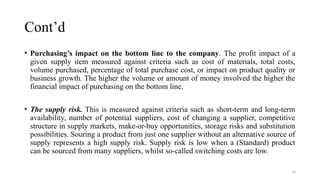
• Purchasing’s impacton the bottom line to the company. The profit impact of a
given supply item measured against criteria such as cost of materials, total costs,
volume purchased, percentage of total purchase cost, or impact on product quality or
business growth. The higher the volume or amount of money involved the higher the
financial impact of purchasing on the bottom line.
• The supply risk. This is measured against criteria such as short-term and long-term
availability, number of potential suppliers, cost of changing a supplier, competitive
structure in supply markets, make-or-buy opportunities, storage risks and substitution
possibilities. Souring a product from just one supplier without an alternative source of
supply represents a high supply risk. Supply risk is low when a (Standard) product
can be sourced from many suppliers, whilst so-called switching costs are low.
17.
17
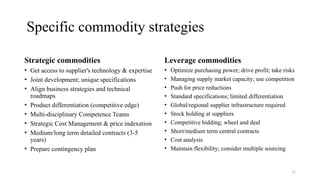
Specific commodity strategies
Strategiccommodities
• Get access to supplier's technology & expertise
• Joint development; unique specifications
• Align business strategies and technical
roadmaps
• Product differentiation (competitive edge)
• Multi-disciplinary Competence Teams
• Strategic Cost Management & price indexation
• Medium/long term detailed contracts (3-5
years)
• Prepare contingency plan
Leverage commodities
• Optimize purchasing power; drive profit; take risks
• Managing supply market capacity; use competition
• Push for price reductions
• Standard specifications; limited differentiation
• Global/regional supplier infrastructure required
• Stock holding at suppliers
• Competitive bidding; wheel and deal
• Short/medium term central contracts
• Cost analysis
• Maintain flexibility; consider multiple sourcing
18.
18
Cont’d
Routine commodities
• Leansupply; minimize acquisition costs
• Use industry standard specifications
(catalogues)
• Reduce supplier base: volume consolidation
• Minimize attention (supplier does
everything for you)
• Automation; E-procurement
• Negotiate discounts (on list prices)
• Blanket orders; local procurement/call-off
• Consider "delegated procurement"
Bottleneck commodities
• Second sourcing
• Ensure supplies and remove/minimize risks
• Buyer's specification; seek substitutes
• Seek alternative sources; encourage competition
• Standardize; reduce number of products
• Consider to keep stocks
• Normal negotiations; price is a lower priority
• Longer-term contracts with price indexation
• Strategic cost management
• Prepare contingency plan
19.
19
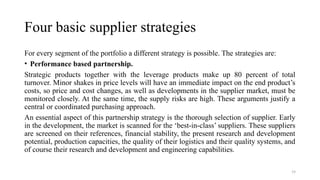
Four basic supplierstrategies
For every segment of the portfolio a different strategy is possible. The strategies are:
• Performance based partnership.
Strategic products together with the leverage products make up 80 percent of total
turnover. Minor shakes in price levels will have an immediate impact on the end product’s
costs, so price and cost changes, as well as developments in the supplier market, must be
monitored closely. At the same time, the supply risks are high. These arguments justify a
central or coordinated purchasing approach.
An essential aspect of this partnership strategy is the thorough selection of supplier. Early
in the development, the market is scanned for the ‘best-in-class’ suppliers. These suppliers
are screened on their references, financial stability, the present research and development
potential, production capacities, the quality of their logistics and their quality systems, and
of course their research and development and engineering capabilities.
20.
20
cont’d
• Competitive bidding.For leverage products a purchasing policy
based on principle of competitive bidding or tendering will be
pursued. Since the suppliers and products are basically
interchangeable, there will be, as a rule, no long-term supply contracts.
Long-term contracts and annual agreements will be combined with
“spot” purchasing. In most cases buyers will adopt a multiple sourcing
strategy. Buying at a minimum price while maintaining the required
quality level
21.
21
cont’d
• Securing continuityof supply. The purchasing policy concerning bottleneck
products has focused on securing continuity of supply, if necessary at additional cost.
At the same time activities are conducted aimed at reducing the dependence on these
suppliers. This is done by developing alternative products and suppliers. However,
the costs involved in these actions (for example, tests in laboratories) often exceed
the cost savings obtained, which is why management often has difficulty in
approving this type of action.
• Category management and e-procurement solution. For reason mentioned earlier,
routine products require a purchasing strategy, which is aimed at reducing
administrative and logistic complexity. Buyers will have to work out simple but
efficient ordering and administrative routines with the suppliers, in the form of
electronic catalogs, through which employees can order directly from the pre-
selected supplier.
22.
22
Conclusion
The Kraljic PortfolioPurchasing Model helps purchasers
understand where their products are classified in terms of supply
risk and profit contribution, and also know whether the balance of
power lies with them or with their suppliers. Once you know this,
you can select an appropriate commodity sourcing strategy.
Depending on the product segment of the portfolio, the supply
strategy will differ. The emphasis should lie with the strategic and
leverage products that are likely to offer the greatest performance
improvement opportunities. As such the majority of purchasing ‘s
efforts and resources should be spent on these types of
commodities. However, organizations will still require lower –
value, less critical items and services to operate. Steps must be
taken to develop strategies to manage acquisition and multiple –
type items so resources are available to manage value – added
goods and services.