What’s Puppet
Sysadmin en la onda DevOps
Drupal developer
10 años sysadmin
3 años con Puppet
8 años con Drupal
http://atlantic-canary.net
http://github.com/jonhattan
@_jonhattan_
Jonathan Araña Cruz (aka jonhattan)
Caballeros
What?
● Configuration management
● Written in Ruby
● Free software (Apache 2.0)
● Current version 3.6 - towards 4.0
● PuppetLabs, since 2005
● Other products
○ Puppet Enterprise
○ MCollective
Puppet CLI tool
root@chamber:~# puppet help
Usage: puppet <subcommand> [options] <action> [options]
…
root@chamber:~# puppet help <subcommand>
root@chamber:~# puppet man <subcommand>
=> man puppet-<subcommand>
Index
● Resource Abstraction Layer
● Puppet Language
● Modules
● Stored configuration
● Puppet Master
● Reporting
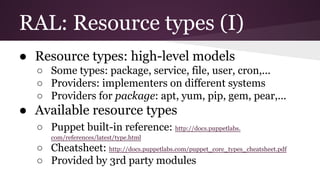
RAL: Resource types (I)
● Resource types: high-level models
○ Some types: package, service, file, user, cron,...
○ Providers: implementers on different systems
○ Providers for package: apt, yum, pip, gem, pear,...
● Available resource types
○ Puppet built-in reference: http://docs.puppetlabs.
com/references/latest/type.html
○ Cheatsheet: http://docs.puppetlabs.com/puppet_core_types_cheatsheet.pdf
○ Provided by 3rd party modules
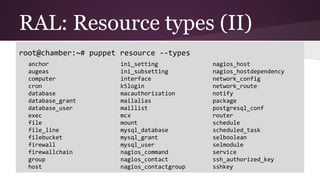
root@chamber:~# puppet resource --types
anchor
augeas
computer
cron
database
database_grant
database_user
exec
file
file_line
filebucket
firewall
firewallchain
group
host
ini_setting
ini_subsetting
interface
k5login
macauthorization
mailalias
maillist
mcx
mount
mysql_database
mysql_grant
mysql_user
nagios_command
nagios_contact
nagios_contactgroup
nagios_host
nagios_hostdependency
network_config
network_route
notify
package
postgresql_conf
router
schedule
scheduled_task
selboolean
selmodule
service
ssh_authorized_key
sshkey
RAL: Resource types (II)
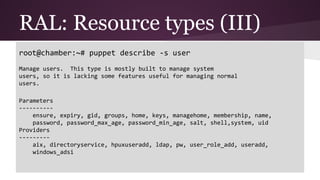
root@chamber:~# puppet describe -s user
Manage users. This type is mostly built to manage system
users, so it is lacking some features useful for managing normal
users.
Parameters
----------
ensure, expiry, gid, groups, home, keys, managehome, membership, name,
password, password_max_age, password_min_age, salt, shell,system, uid
Providers
---------
aix, directoryservice, hpuxuseradd, ldap, pw, user_role_add, useradd,
windows_adsi
RAL: Resource types (III)
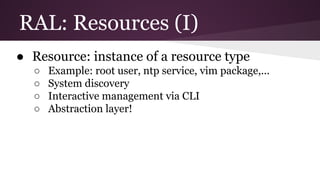
RAL: Resources (I)
● Resource: instance of a resource type
○ Example: root user, ntp service, vim package,...
○ System discovery
○ Interactive management via CLI
○ Abstraction layer!
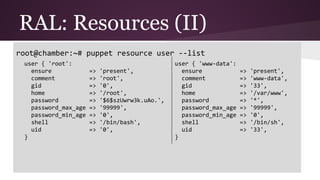
RAL: Resources (II)
root@chamber:~# puppet resource user --list
user { 'root':
ensure => 'present',
comment => 'root',
gid => '0',
home => '/root',
password => '$6$szUwrw3k.uAo.',
password_max_age => '99999',
password_min_age => '0',
shell => '/bin/bash',
uid => '0',
}
user { 'www-data':
ensure => 'present',
comment => 'www-data',
gid => '33',
home => '/var/www',
password => '*',
password_max_age => '99999',
password_min_age => '0',
shell => '/bin/sh',
uid => '33',
}
RAL: Resources (III)
root@chamber:~# puppet resource user root shell=/bin/dash
Notice: /User[root]/shell: shell changed '/bin/bash' to '/bin/dash'
user { 'root':
ensure => 'present',
shell => '/bin/dash',
}
root@chamber:~# puppet resource user root --edit
Index
● Resource Abstraction Layer
● => Puppet Language
● Modules
● Stored configuration
● Puppet Master
● Reporting
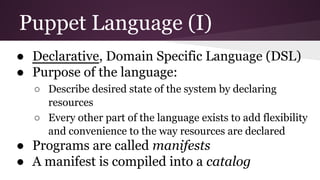
Puppet Language (I)
● Declarative, Domain Specific Language (DSL)
● Purpose of the language:
○ Describe desired state of the system by declaring
resources
○ Every other part of the language exists to add flexibility
and convenience to the way resources are declared
● Programs are called manifests
● A manifest is compiled into a catalog
Example manifest: Hello world
root@chamber:~# echo "notify {'hello world': }" > hello-world.pp
root@chamber:~# puppet apply hello-world.pp
Notice: Compiled catalog for chamber.faita.net in environment production in 0.02
seconds
Notice: hello world
Notice: /Stage[main]/Main/Notify[hello world]/message: defined 'message' as 'hello
world'
Notice: Finished catalog run in 3.15 seconds
Example manifest: “The trifecta”
case $operatingsystem {
centos, redhat: { $service_name = 'ntpd' }
debian, ubuntu: { $service_name = 'ntp' }
}
package { 'ntp':
ensure => installed,
}
service { 'ntp':
name => $service_name,
ensure => running,
enable => true,
subscribe => File['ntp.conf'],
}
file { '/etc/ntp.conf':
ensure => file,
require => Package['ntp'],
source => 'puppet:///modules/ntp/ntp.conf',
}
Puppet Language (II)
● Some language constructs
○ Nodes
○ Classes
○ Defines
○ Variables, Conditionals
○ Dependency relationships
○ Anchors, tags, collectors, run-stages,...
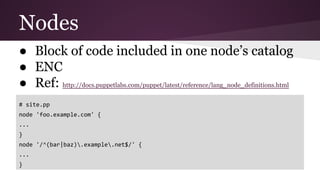
Nodes
● Block of code included in one node’s catalog
● ENC
● Ref: http://docs.puppetlabs.com/puppet/latest/reference/lang_node_definitions.html
# site.pp
node 'foo.example.com' {
...
}
node '/^(bar|baz).example.net$/' {
...
}
Classes (I)
● Block of code to group resources
● Parameterized
● Singleton
● Ref : http://docs.puppetlabs.com/puppet/latest/reference/lang_classes.html
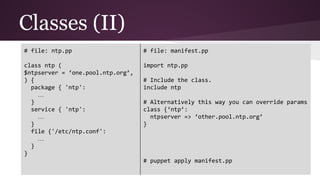
Classes (II)
# file: ntp.pp
class ntp (
$ntpserver = ‘one.pool.ntp.org’,
) {
package { 'ntp':
…
}
service { 'ntp':
…
}
file {'/etc/ntp.conf':
…
}
}
# file: manifest.pp
import ntp.pp
# Include the class.
include ntp
# Alternatively this way you can override params
class {‘ntp’:
ntpserver => ‘other.pool.ntp.org’
}
# puppet apply manifest.pp
Defines (I)
● Blocks of code that can be evaluated multiple
times with different parameters
● Once defined, they act like a new
(compound) resource type
Defines (II)
define apache::vhost ($port, $docroot, $servername = $title, $vhost_name = '*') {
include apache # contains Package['httpd'] and Service['httpd']
include apache::params # contains common config settings
$vhost_dir = $apache::params::vhost_dir
file { "${vhost_dir}/${servername}.conf":
content => template('apache/vhost-default.conf.erb'),
owner => 'www',
group => 'www',
mode => '644',
require => Package['httpd'],
notify => Service['httpd'],
}
}
Puppet Language (III)
● Other related components
○ Functions
○ Facter
○ Hiera
● Language reference: http://docs.puppetlabs.
com/puppet/latest/reference/index.html
Functions
● Implemented in ruby
● Enrich puppet language with handy features
● Examples:
○ include
○ template()
● Built-in functions: http://docs.puppetlabs.com/references/latest/function.
html
● Puppet stdlib:https://github.com/puppetlabs/puppetlabs-stdlib
● Custom: http://docs.puppetlabs.com/guides/custom_functions.html
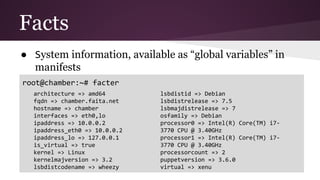
Facts
● System information, available as “global variables” in
manifests
root@chamber:~# facter
architecture => amd64
fqdn => chamber.faita.net
hostname => chamber
interfaces => eth0,lo
ipaddress => 10.0.0.2
ipaddress_eth0 => 10.0.0.2
ipaddress_lo => 127.0.0.1
is_virtual => true
kernel => Linux
kernelmajversion => 3.2
lsbdistcodename => wheezy
lsbdistid => Debian
lsbdistrelease => 7.5
lsbmajdistrelease => 7
osfamily => Debian
processor0 => Intel(R) Core(TM) i7-
3770 CPU @ 3.40GHz
processor1 => Intel(R) Core(TM) i7-
3770 CPU @ 3.40GHz
processorcount => 2
puppetversion => 3.6.0
virtual => xenu
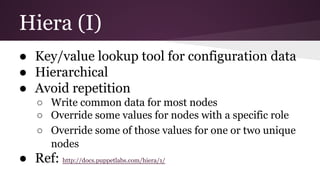
Hiera (I)
● Key/value lookup tool for configuration data
● Hierarchical
● Avoid repetition
○ Write common data for most nodes
○ Override some values for nodes with a specific role
○ Override some of those values for one or two unique
nodes
● Ref: http://docs.puppetlabs.com/hiera/1/
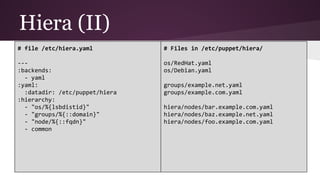
Hiera (II)
# file /etc/hiera.yaml
---
:backends:
- yaml
:yaml:
:datadir: /etc/puppet/hiera
:hierarchy:
- "os/%{lsbdistid}"
- "groups/%{::domain}"
- "node/%{::fqdn}"
- common
# Files in /etc/puppet/hiera/
os/RedHat.yaml
os/Debian.yaml
groups/example.net.yaml
groups/example.com.yaml
hiera/nodes/bar.example.com.yaml
hiera/nodes/baz.example.net.yaml
hiera/nodes/foo.example.com.yaml
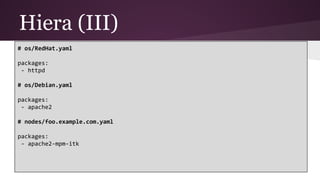
Hiera (III)
# os/RedHat.yaml
packages:
- httpd
# os/Debian.yaml
packages:
- apache2
# nodes/foo.example.com.yaml
packages:
- apache2-mpm-itk
Index
● Resource Abstraction Layer
● Puppet Language
● => Modules
● Stored configuration
● Puppet Master
● Reporting
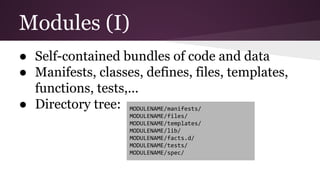
Modules (I)
● Self-contained bundles of code and data
● Manifests, classes, defines, files, templates,
functions, tests,...
● Directory tree: MODULENAME/manifests/
MODULENAME/files/
MODULENAME/templates/
MODULENAME/lib/
MODULENAME/facts.d/
MODULENAME/tests/
MODULENAME/spec/
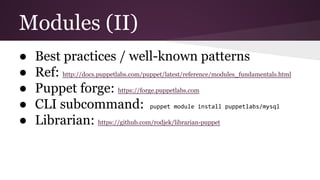
Modules (II)
● Best practices / well-known patterns
● Ref: http://docs.puppetlabs.com/puppet/latest/reference/modules_fundamentals.html
● Puppet forge: https://forge.puppetlabs.com
● CLI subcommand: puppet module install puppetlabs/mysql
● Librarian: https://github.com/rodjek/librarian-puppet
Index
● Resource Abstraction Layer
● Puppet Language
● Modules
● => Stored configuration
● Puppet Master
● Reporting
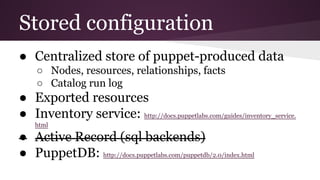
Stored configuration
● Centralized store of puppet-produced data
○ Nodes, resources, relationships, facts
○ Catalog run log
● Exported resources
● Inventory service: http://docs.puppetlabs.com/guides/inventory_service.
html
● Active Record (sql backends)
● PuppetDB: http://docs.puppetlabs.com/puppetdb/2.0/index.html
Index
● Resource Abstraction Layer
● Puppet Language
● Modules
● Stored configuration
● => Puppet Master
● Reporting
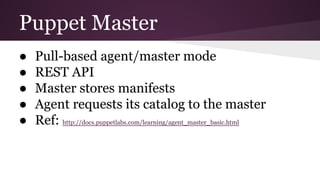
Puppet Master
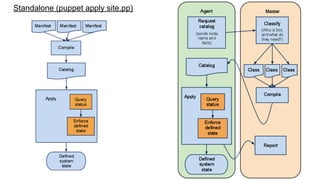
● Pull-based agent/master mode
● REST API
● Master stores manifests
● Agent requests its catalog to the master
● Ref: http://docs.puppetlabs.com/learning/agent_master_basic.html
Standalone (puppet apply site.pp)
Index
● Resource Abstraction Layer
● Puppet Language
● Modules
● Nodes, ENC
● Store configs, PuppetDB
● Puppet Master
● => Reporting
Reporting (I)
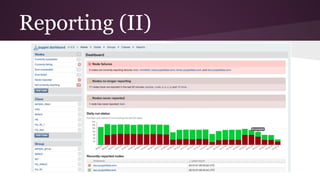
● Agent send reports at the end of every run
○ Logs
○ Metrics: time, resources, changes
● Report handlers: http, log, tagmail
● Ref: http://docs.puppetlabs.com/references/latest/report.html
● Puppet Dashboard: web interface
○ web interface: node classification and reporting
feature
○ Ref: https://github.com/sodabrew/puppet-dashboard
Reporting (II)
Questions?

Intro to-puppet

  • 1.
  • 2.
    Sysadmin en laonda DevOps Drupal developer 10 años sysadmin 3 años con Puppet 8 años con Drupal http://atlantic-canary.net http://github.com/jonhattan @_jonhattan_ Jonathan Araña Cruz (aka jonhattan)
  • 3.
  • 4.
    What? ● Configuration management ●Written in Ruby ● Free software (Apache 2.0) ● Current version 3.6 - towards 4.0 ● PuppetLabs, since 2005 ● Other products ○ Puppet Enterprise ○ MCollective
  • 5.
    Puppet CLI tool root@chamber:~#puppet help Usage: puppet <subcommand> [options] <action> [options] … root@chamber:~# puppet help <subcommand> root@chamber:~# puppet man <subcommand> => man puppet-<subcommand>
  • 6.
    Index ● Resource AbstractionLayer ● Puppet Language ● Modules ● Stored configuration ● Puppet Master ● Reporting
  • 7.
    RAL: Resource types(I) ● Resource types: high-level models ○ Some types: package, service, file, user, cron,... ○ Providers: implementers on different systems ○ Providers for package: apt, yum, pip, gem, pear,... ● Available resource types ○ Puppet built-in reference: http://docs.puppetlabs. com/references/latest/type.html ○ Cheatsheet: http://docs.puppetlabs.com/puppet_core_types_cheatsheet.pdf ○ Provided by 3rd party modules
  • 8.
    root@chamber:~# puppet resource--types anchor augeas computer cron database database_grant database_user exec file file_line filebucket firewall firewallchain group host ini_setting ini_subsetting interface k5login macauthorization mailalias maillist mcx mount mysql_database mysql_grant mysql_user nagios_command nagios_contact nagios_contactgroup nagios_host nagios_hostdependency network_config network_route notify package postgresql_conf router schedule scheduled_task selboolean selmodule service ssh_authorized_key sshkey RAL: Resource types (II)
  • 9.
    root@chamber:~# puppet describe-s user Manage users. This type is mostly built to manage system users, so it is lacking some features useful for managing normal users. Parameters ---------- ensure, expiry, gid, groups, home, keys, managehome, membership, name, password, password_max_age, password_min_age, salt, shell,system, uid Providers --------- aix, directoryservice, hpuxuseradd, ldap, pw, user_role_add, useradd, windows_adsi RAL: Resource types (III)
  • 10.
    RAL: Resources (I) ●Resource: instance of a resource type ○ Example: root user, ntp service, vim package,... ○ System discovery ○ Interactive management via CLI ○ Abstraction layer!
  • 11.
    RAL: Resources (II) root@chamber:~#puppet resource user --list user { 'root': ensure => 'present', comment => 'root', gid => '0', home => '/root', password => '$6$szUwrw3k.uAo.', password_max_age => '99999', password_min_age => '0', shell => '/bin/bash', uid => '0', } user { 'www-data': ensure => 'present', comment => 'www-data', gid => '33', home => '/var/www', password => '*', password_max_age => '99999', password_min_age => '0', shell => '/bin/sh', uid => '33', }
  • 12.
    RAL: Resources (III) root@chamber:~#puppet resource user root shell=/bin/dash Notice: /User[root]/shell: shell changed '/bin/bash' to '/bin/dash' user { 'root': ensure => 'present', shell => '/bin/dash', } root@chamber:~# puppet resource user root --edit
  • 13.
    Index ● Resource AbstractionLayer ● => Puppet Language ● Modules ● Stored configuration ● Puppet Master ● Reporting
  • 14.
    Puppet Language (I) ●Declarative, Domain Specific Language (DSL) ● Purpose of the language: ○ Describe desired state of the system by declaring resources ○ Every other part of the language exists to add flexibility and convenience to the way resources are declared ● Programs are called manifests ● A manifest is compiled into a catalog
  • 15.
    Example manifest: Helloworld root@chamber:~# echo "notify {'hello world': }" > hello-world.pp root@chamber:~# puppet apply hello-world.pp Notice: Compiled catalog for chamber.faita.net in environment production in 0.02 seconds Notice: hello world Notice: /Stage[main]/Main/Notify[hello world]/message: defined 'message' as 'hello world' Notice: Finished catalog run in 3.15 seconds
  • 16.
    Example manifest: “Thetrifecta” case $operatingsystem { centos, redhat: { $service_name = 'ntpd' } debian, ubuntu: { $service_name = 'ntp' } } package { 'ntp': ensure => installed, } service { 'ntp': name => $service_name, ensure => running, enable => true, subscribe => File['ntp.conf'], } file { '/etc/ntp.conf': ensure => file, require => Package['ntp'], source => 'puppet:///modules/ntp/ntp.conf', }
  • 17.
    Puppet Language (II) ●Some language constructs ○ Nodes ○ Classes ○ Defines ○ Variables, Conditionals ○ Dependency relationships ○ Anchors, tags, collectors, run-stages,...
  • 18.
    Nodes ● Block ofcode included in one node’s catalog ● ENC ● Ref: http://docs.puppetlabs.com/puppet/latest/reference/lang_node_definitions.html # site.pp node 'foo.example.com' { ... } node '/^(bar|baz).example.net$/' { ... }
  • 19.
    Classes (I) ● Blockof code to group resources ● Parameterized ● Singleton ● Ref : http://docs.puppetlabs.com/puppet/latest/reference/lang_classes.html
  • 20.
    Classes (II) # file:ntp.pp class ntp ( $ntpserver = ‘one.pool.ntp.org’, ) { package { 'ntp': … } service { 'ntp': … } file {'/etc/ntp.conf': … } } # file: manifest.pp import ntp.pp # Include the class. include ntp # Alternatively this way you can override params class {‘ntp’: ntpserver => ‘other.pool.ntp.org’ } # puppet apply manifest.pp
  • 21.
    Defines (I) ● Blocksof code that can be evaluated multiple times with different parameters ● Once defined, they act like a new (compound) resource type
  • 22.
    Defines (II) define apache::vhost($port, $docroot, $servername = $title, $vhost_name = '*') { include apache # contains Package['httpd'] and Service['httpd'] include apache::params # contains common config settings $vhost_dir = $apache::params::vhost_dir file { "${vhost_dir}/${servername}.conf": content => template('apache/vhost-default.conf.erb'), owner => 'www', group => 'www', mode => '644', require => Package['httpd'], notify => Service['httpd'], } }
  • 23.
    Puppet Language (III) ●Other related components ○ Functions ○ Facter ○ Hiera ● Language reference: http://docs.puppetlabs. com/puppet/latest/reference/index.html
  • 24.
    Functions ● Implemented inruby ● Enrich puppet language with handy features ● Examples: ○ include ○ template() ● Built-in functions: http://docs.puppetlabs.com/references/latest/function. html ● Puppet stdlib:https://github.com/puppetlabs/puppetlabs-stdlib ● Custom: http://docs.puppetlabs.com/guides/custom_functions.html
  • 25.
    Facts ● System information,available as “global variables” in manifests root@chamber:~# facter architecture => amd64 fqdn => chamber.faita.net hostname => chamber interfaces => eth0,lo ipaddress => 10.0.0.2 ipaddress_eth0 => 10.0.0.2 ipaddress_lo => 127.0.0.1 is_virtual => true kernel => Linux kernelmajversion => 3.2 lsbdistcodename => wheezy lsbdistid => Debian lsbdistrelease => 7.5 lsbmajdistrelease => 7 osfamily => Debian processor0 => Intel(R) Core(TM) i7- 3770 CPU @ 3.40GHz processor1 => Intel(R) Core(TM) i7- 3770 CPU @ 3.40GHz processorcount => 2 puppetversion => 3.6.0 virtual => xenu
  • 26.
    Hiera (I) ● Key/valuelookup tool for configuration data ● Hierarchical ● Avoid repetition ○ Write common data for most nodes ○ Override some values for nodes with a specific role ○ Override some of those values for one or two unique nodes ● Ref: http://docs.puppetlabs.com/hiera/1/
  • 27.
    Hiera (II) # file/etc/hiera.yaml --- :backends: - yaml :yaml: :datadir: /etc/puppet/hiera :hierarchy: - "os/%{lsbdistid}" - "groups/%{::domain}" - "node/%{::fqdn}" - common # Files in /etc/puppet/hiera/ os/RedHat.yaml os/Debian.yaml groups/example.net.yaml groups/example.com.yaml hiera/nodes/bar.example.com.yaml hiera/nodes/baz.example.net.yaml hiera/nodes/foo.example.com.yaml
  • 28.
    Hiera (III) # os/RedHat.yaml packages: -httpd # os/Debian.yaml packages: - apache2 # nodes/foo.example.com.yaml packages: - apache2-mpm-itk
  • 29.
    Index ● Resource AbstractionLayer ● Puppet Language ● => Modules ● Stored configuration ● Puppet Master ● Reporting
  • 30.
    Modules (I) ● Self-containedbundles of code and data ● Manifests, classes, defines, files, templates, functions, tests,... ● Directory tree: MODULENAME/manifests/ MODULENAME/files/ MODULENAME/templates/ MODULENAME/lib/ MODULENAME/facts.d/ MODULENAME/tests/ MODULENAME/spec/
  • 31.
    Modules (II) ● Bestpractices / well-known patterns ● Ref: http://docs.puppetlabs.com/puppet/latest/reference/modules_fundamentals.html ● Puppet forge: https://forge.puppetlabs.com ● CLI subcommand: puppet module install puppetlabs/mysql ● Librarian: https://github.com/rodjek/librarian-puppet
  • 32.
    Index ● Resource AbstractionLayer ● Puppet Language ● Modules ● => Stored configuration ● Puppet Master ● Reporting
  • 33.
    Stored configuration ● Centralizedstore of puppet-produced data ○ Nodes, resources, relationships, facts ○ Catalog run log ● Exported resources ● Inventory service: http://docs.puppetlabs.com/guides/inventory_service. html ● Active Record (sql backends) ● PuppetDB: http://docs.puppetlabs.com/puppetdb/2.0/index.html
  • 34.
    Index ● Resource AbstractionLayer ● Puppet Language ● Modules ● Stored configuration ● => Puppet Master ● Reporting
  • 35.
    Puppet Master ● Pull-basedagent/master mode ● REST API ● Master stores manifests ● Agent requests its catalog to the master ● Ref: http://docs.puppetlabs.com/learning/agent_master_basic.html
  • 36.
  • 37.
    Index ● Resource AbstractionLayer ● Puppet Language ● Modules ● Nodes, ENC ● Store configs, PuppetDB ● Puppet Master ● => Reporting
  • 38.
    Reporting (I) ● Agentsend reports at the end of every run ○ Logs ○ Metrics: time, resources, changes ● Report handlers: http, log, tagmail ● Ref: http://docs.puppetlabs.com/references/latest/report.html ● Puppet Dashboard: web interface ○ web interface: node classification and reporting feature ○ Ref: https://github.com/sodabrew/puppet-dashboard
  • 39.
  • 40.