
Test Driven Infrastructure
with Puppet, Docker, Test Kitchen and
Serverspec
About Me
Russian engineer living in Prague
● Yury Tsarev
● Mostly QA & Systems Engineering background
● Previously
○ Sysadmin in Russian bank
○ QA/Sr. SWE in SUSE Linux
○ Sr. QA Engineer in Cloud Infra team of GoodData
● Currently QA Architect in GoodData focusing on
○ Private cloud
○ Internal PaaS
○ Continuous Delivery
● Contacts
○ yury.tsarev@gooddata.com
○ https://github.com/ytsarev
○ https://linkedin.com/in/yurytsarev
○ https://twitter.com/xnullz
About GoodData
Information relevant to the talk
● GoodData runs cloud-based business intelligence (BI) and big data analytics
platform
● Operates on top of Openstack-based Private Cloud and Internal
Platform-as-a-Service
● Several datacenters, hundreds of hardware servers, thousands virtual machines,
internally complex distributed system to manage
● Relies on Puppet for Configuration Management
What to Expect From This Talk ?
● A real-life story of infrastructure development process evolution
● A practical guide with opinionated set of tools for testing
infrastructure at scale
● A framework which components are ready to be adjustable or
replaceable for your specific case
● No kittens, no unicorns, no Docker worship
Infrastructure as a Code
Puppet driven infra as a prerequisite
● Every infra change is tracked through puppet code, no exceptions
● Puppet code is stored in git
● Puppet code is a shared ground for whole DevOps organization
● Puppet code has quality problems
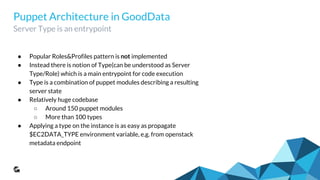
Puppet Architecture in GoodData
Server Type is an entrypoint
● Popular Roles&Profiles pattern is not implemented
● Instead there is notion of Type(can be understood as Server
Type/Role) which is a main entrypoint for code execution
● Type is a combination of puppet modules describing a resulting
server state
● Relatively huge codebase
○ Around 150 puppet modules
○ More than 100 types
● Applying a type on the instance is as easy as propagate
$EC2DATA_TYPE environment variable, e.g. from openstack
metadata endpoint
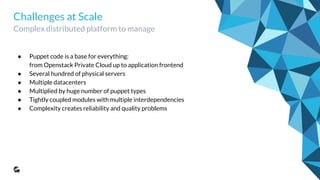
Challenges at Scale
Complex distributed platform to manage
● Puppet code is a base for everything:
from Openstack Private Cloud up to application frontend
● Several hundred of physical servers and thousands of VMs
● Multiple datacenters
● Multiplied by huge number of puppet types
● Tightly coupled modules with multiple interdependencies
● Complexity creates reliability and quality problems
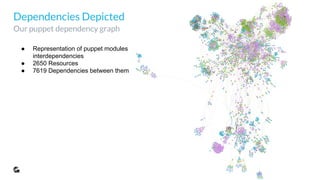
Dependencies Depicted
Our puppet dependency graph
● Representation of puppet modules
interdependencies
● 2650 Resources
● 7619 Dependencies between them
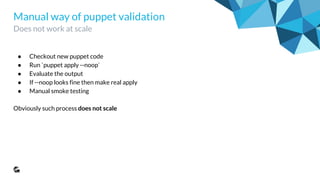
Manual way of puppet validation
Does not work at scale
● Checkout new puppet code
● Run `puppet apply --noop`
● Evaluate the output
● If --noop looks fine then make real apply
● Manual smoke testing
Obviously such process does not scale
Introducing Puppet Self Check
As we need some test before the merge
● Linting (puppet-lint)
● Puppet catalog compilation
● Automated --noop run in fakeroot
● Integration with Jenkins
● Detailed feedback right in Pull Request
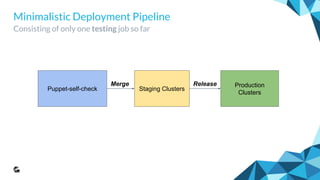
Minimalistic Deployment Pipeline
Consisting of only one testing job so far
Puppet-self-check Staging Clusters
Production
Clusters
Merge Release
Puppet Self Check is not enough
Crucial, but only initial coverage
● Covering
○ Style errors
○ Syntax errors
○ Catalog compilation errors like circular dependencies
● Missing
○ Configuration file errors
○ Ability to check if services/processes were able to start
○ No configuration testing
○ No service smoke testing
● We want to catch the issues way before the merge
○ Shifting testing left is great for quality and velocity
○ Staging should uncover minimal amount of complex
integration issues
Introducing Test Kitchen
Something more for the next step of test pipeline
● http://kitchen.ci/
● Advanced test orchestrator
● Open Source project
● Originated in Chef community
● Very pluggable on all levels
● Implemented in Ruby
● Configurable through simple single yaml file
● "Your infrastructure deserves tests too."
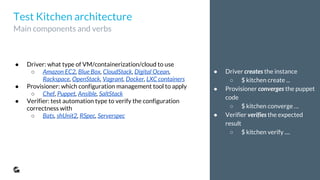
● Driver creates the instance
○ $ kitchen create ...
● Provisioner converges the puppet
code
○ $ kitchen converge …
● Verifier verifies the expected
result
○ $ kitchen verify ....
● Driver: what type of VM/containerization/cloud to use
○ Amazon EC2, Blue Box, CloudStack, Digital Ocean,
Rackspace, OpenStack, Vagrant, Docker, LXC containers
● Provisioner: which configuration management tool to apply
○ Chef, Puppet, Ansible, SaltStack
● Verifier: test automation type to verify the configuration
correctness with
○ Bats, shUnit2, RSpec, Serverspec
Test Kitchen architecture
Main components and verbs
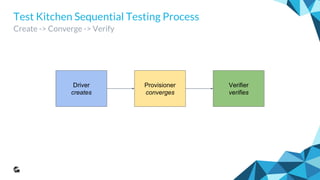
Test Kitchen Sequential Testing Process
Create -> Converge -> Verify
Driver
creates
Provisioner
converges
Verifier
verifies
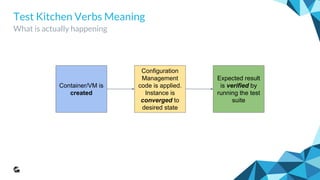
Test Kitchen Verbs Meaning
What is actually happening
Container/VM is
created
Configuration
Management
code is applied.
Instance is
converged to
desired state
Expected result
is verified by
running the test
suite
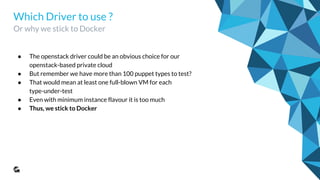
Which Driver to use ?
Or why we stick to Docker
● The openstack driver could be an obvious choice for our
openstack-based private cloud
● But remember we have more than 100 puppet types to test?
● That would mean at least one full-blown VM for each
type-under-test
● Even with minimum instance flavour it is too much
● Thus, we stick to Docker
“And it wasn’t smooth ride
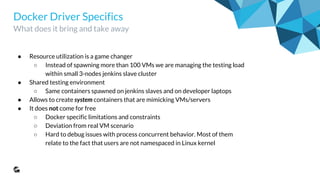
Docker Driver Specifics
What does it bring and take away
● Resource utilization is a game changer
○ Instead of spawning more than 100 VMs we are managing the testing load
within small 3-nodes jenkins slave cluster
● Shared testing environment
○ Same containers spawned on jenkins slaves and on developer laptops
● Allows to create system containers that are mimicking VMs/servers
● It does not come for free
○ Docker specific limitations and constraints
○ Deviation from real VM scenario
○ Hard to debug issues with process concurrent behavior. Most of them
relate to the fact that users are not namespaced in Linux kernel
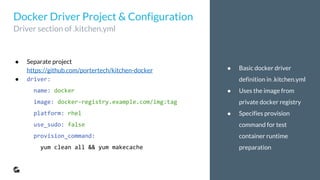
● Basic docker driver
definition in .kitchen.yml
● Uses the image from
private docker registry
● Specifies provision
command for test
container runtime
preparation
● Separate project
https://github.com/portertech/kitchen-docker
● driver:
name: docker
image: docker-registry.example.com/img:tag
platform: rhel
use_sudo: false
provision_command:
yum clean all && yum makecache
Docker Driver Project & Configuration
Driver section of .kitchen.yml
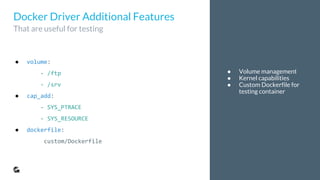
● Volume management
● Kernel capabilities
● Custom Dockerfile for
testing container
● volume:
- /ftp
- /srv
● cap_add:
- SYS_PTRACE
- SYS_RESOURCE
● dockerfile:
custom/Dockerfile
Docker Driver Additional Features
That are useful for testing
“Now we are fully prepared for Create stage.
`kitchen create` will spawn fresh testing
container.
Next one is Converge.
And Converge means Provisioner.
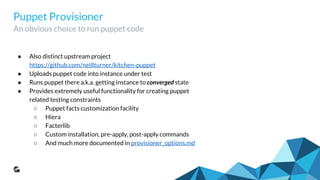
Puppet Provisioner
An obvious choice to run puppet code
● Also distinct upstream project
https://github.com/neillturner/kitchen-puppet
● Uploads puppet code into instance under test
● Runs puppet there a.k.a. getting instance to converged state
● Provides extremely useful functionality for creating puppet
related testing constraints
○ Puppet facts customization facility
○ Hiera
○ Facterlib
○ Custom installation, pre-apply, post-apply commands
○ And much more documented in provisioner_options.md
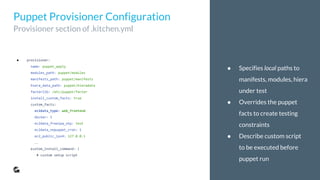
● Specifies local paths to
manifests, modules, hiera
under test
● Overrides the puppet
facts to create testing
constraints
● Describe custom script
to be executed before
puppet run
● provisioner:
name: puppet_apply
modules_path: puppet/modules
manifests_path: puppet/manifests
hiera_data_path: puppet/hieradata
facterlib: /etc/puppet/facter
install_custom_facts: true
custom_facts:
ec2data_type: web_frontend
docker: 1
ec2data_freeipa_otp: test
ec2data_nopuppet_cron: 1
ec2_public_ipv4: 127.0.0.1
…
custom_install_command: |
# custom setup script
Puppet Provisioner Configuration
Provisioner section of .kitchen.yml
“Looks like we are good with Provisioner and
can proceed to Verifier?
“NO.
The puppet run will
miserably fail.
External Dependencies
Or how to test in isolation
● Quite frequently puppet types under test will require some
external service to communicate with
● We want to avoid external communication in most cases
● Because we want fast and deterministic results
● And we do not want to spoil production services with test data
● Same goes for additional load
● Exceptions (the things that we still do want to communicate )can
be core services like ntp, rpm repository server, etc.
Introducing Shellmock
Extremely simple stub/mocking tool
● https://github.com/gooddata/shellmock
● Solution to external dependency problem a.k.a dependency
injection
● A simple ruby script that placed instead of package manager
strictly within testing instance
● Intercepts calls to package manager
● Installs a mock instead of real package if this mock is defined in
shellmock configuration
● If mock is not defined passes the request to real package manager
for real package installation
● Same trick is used to bypass number of docker limitations like
sysctl calls within container
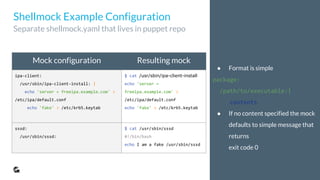
● Format is simple
package:
/path/to/executable:|
contents
● If no content specified the mock
defaults to simple message that
returns
exit code 0
Shellmock Example Configuration
Separate shellmock.yaml that lives in puppet repo
Mock configuration Resulting mock
ipa-client:
/usr/sbin/ipa-client-install: |
echo 'server = freeipa.example.com' >
/etc/ipa/default.conf
echo 'fake' > /etc/krb5.keytab
$ cat /usr/sbin/ipa-client-install
echo 'server =
freeipa.example.com' >
/etc/ipa/default.conf
echo 'fake' > /etc/krb5.keytab
sssd:
/usr/sbin/sssd:
$ cat /usr/sbin/sssd
#!/bin/bash
echo I am a fake /usr/sbin/sssd
“If all external dependencies are satisfied the
Converge will be passing.
`kitchen converge` will successfully apply
puppet.
Now it is time to deal with Verifier.
Verifier
A component that executes test framework
● Serves as tiny configuration for test execution
● Tests are written separately with the test framework of choice
● Out of the box support for Bats, shUnit2, RSpec, Serverspec, Cucumber
Why Serverspec?
Because it rocks
● Standalone open source project
http://serverspec.org/
● Rich resource library
http://serverspec.org/resource_types.html
● DSL to describe expected configuration state
● Based on famous RSpec framework
● Multi OS support
● Readable, flexible, extensible
● Low entry barrier
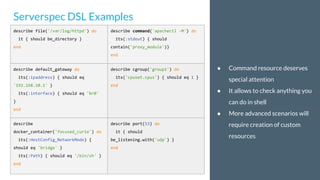
● Command resource deserves
special attention
● It allows to check anything you
can do in shell
● More advanced scenarios will
require creation of custom
resources
Serverspec DSL Examples
describe file('/var/log/httpd') do
it { should be_directory }
end
describe command('apachectl -M') do
its(:stdout) { should
contain('proxy_module')}
end
describe default_gateway do
its(:ipaddress) { should eq
'192.168.10.1' }
its(:interface) { should eq 'br0'
}
end
describe cgroup('group1') do
its('cpuset.cpus') { should eq 1 }
end
describe
docker_container('focused_curie') do
its(:HostConfig_NetworkMode) {
should eq 'bridge' }
its(:Path) { should eq '/bin/sh' }
end
describe port(53) do
it { should
be_listening.with('udp') }
end
What and How to Test?
A frequent question
● The most effective way to create a serverspec test is to think: “What would I
anyway manually check after server deployment?”
● Then express it in serverspec DSL
● Most powerful serverspec tests are covering not only puppet produced
configuration but testing the outcome
● The test that checks behaviour
of actual API endpoints after
instance converge
● Notice that the test is still
isolated within one instance
● Serverspec/RSpec is internal
DSL so you can easily use Ruby
right in the test definition
under_kerberos_auth = ['', 'status', 'status.json',
'status/payload', 'images/grey.png']
under_kerberos_auth.each do |path|
describe command("curl -k -X POST http://127.0.0.1/#{path}") do
its(:stdout) { should match(/301/) }
end
describe command("curl -k -X POST https://127.0.0.1/#{path}")
do
its(:stdout) { should match(/401/) }
its(:stdout) { should match(/Authorization Required/) }
end
end
Testing the Outcome
DSL plus a bit of basic Ruby
Test Suite Composition
There is no official reference
● Serverspec provides only DSL and abstraction over configuration
resources
● The test suite organization and composition is completely up to you
● Great example of advanced, yet simple setup
https://github.com/vincentbernat/serverspec-example
● GoodData implementations that were built on top of that example
○ https://github.com/gooddata/serverspec-core
○ https://github.com/gooddata/serverspec-ui
● These projects are only test executors, actual tests should be placed
together with the code, e.g. same git repo with puppet
What Was Added on Top of Serverspec
Tiny bits of functionality
● YAML based configuration to define
○ Environments, e.g. dev/prod or geographical data centers
○ Host to role/type assignment
● Tests are placed in the directory structure according to defined hierarchy
● Parallel execution
● Reporting in multiple formats
● Coding style for tests (rubocop)
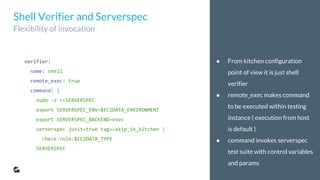
● From kitchen configuration
point of view it is just shell
verifier
● remote_exec makes command
to be executed within testing
instance ( execution from host
is default )
● command invokes serverspec
test suite with control variables
and params
verifier:
name: shell
remote_exec: true
command: |
sudo -s <<SERVERSPEC
export SERVERSPEC_ENV=$EC2DATA_ENVIRONMENT
export SERVERSPEC_BACKEND=exec
serverspec junit=true tag=~skip_in_kitchen 
check:role:$EC2DATA_TYPE
SERVERSPEC
Shell Verifier and Serverspec
Flexibility of invocation
“Create -> Converge -> Verify harness is ready.
`kitchen verify` will test the infra code.
But only for one puppet type.
How to describe multiple types?
Platforms and Suites
Additional structures in .kitchen.yml
● The way to create multiple test configurations
● Platforms are usually used to specify distribution/image to test on top of
● Suites are used to reflect semantics of test run
In our case it is puppet type
● The configuration options from main components of Driver/Provisioner/Verifier
can be overridden on Platform and Suite levels
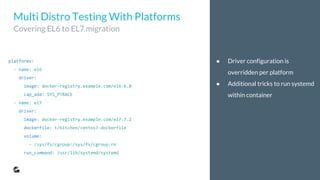
● Driver configuration is
overridden per platform
● Additional tricks to run systemd
within container
platforms:
- name: el6
driver:
image: docker-registry.example.com/el6:6.8
cap_add: SYS_PTRACE
- name: el7
driver:
image: docker-registry.example.com/el7:7.2
dockerfile: t/kitchen/centos7-dockerfile
volume:
- /sys/fs/cgroup:/sys/fs/cgroup:ro
run_command: /usr/lib/systemd/systemd
Multi Distro Testing With Platforms
Covering EL6 to EL7 migration
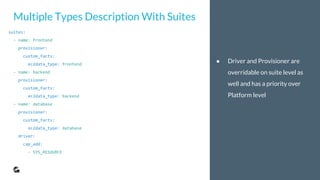
● Driver and Provisioner are
overridable on suite level as
well and has a priority over
Platform level
suites:
- name: frontend
provisioner:
custom_facts:
ec2data_type: frontend
- name: backend
provisioner:
custom_facts:
ec2data_type: backend
- name: database
provisioner:
custom_facts:
ec2data_type: database
driver:
cap_add:
- SYS_RESOURCE
Multiple Types Description With Suites
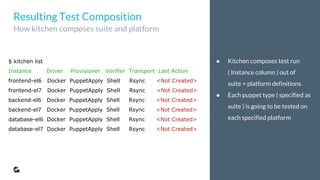
● Kitchen composes test run
( Instance column ) out of
suite + platform definitions
● Each puppet type ( specified as
suite ) is going to be tested on
each specified platform
$ kitchen list
Instance Driver Provisioner Verifier Transport Last Action
frontend-el6 Docker PuppetApply Shell Rsync <Not Created>
frontend-el7 Docker PuppetApply Shell Rsync <Not Created>
backend-el6 Docker PuppetApply Shell Rsync <Not Created>
backend-el7 Docker PuppetApply Shell Rsync <Not Created>
database-el6 Docker PuppetApply Shell Rsync <Not Created>
database-el7 Docker PuppetApply Shell Rsync <Not Created>
Resulting Test Composition
How kitchen composes suite and platform
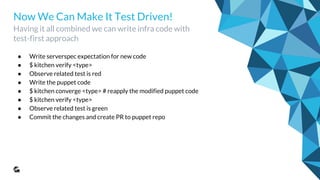
Now We Can Make It Test Driven!
Having it all combined we can write infra code with
test-first approach
● Write serverspec expectation for new code
● $ kitchen verify <type>
● Observe related test is red
● Write the puppet code
● $ kitchen converge <type> # reapply the modified puppet code
● $ kitchen verify <type>
● Observe related test is green
● Commit the changes and create PR to puppet repo
TDD Has to Scale
Technically and culturally
● Infrastructure testing should be integral part of development process and
supported by strong testing culture within organization
● We test on a developer desktop even before git commit
● After commit/PR but before the merge we need to trigger test pipeline
● Serverspec test suite should be reused later in the pipeline after the merge on
actual staging servers
● And ultimately test suite should travel to production servers after release for
continuous regression self-testing integrated with monitoring
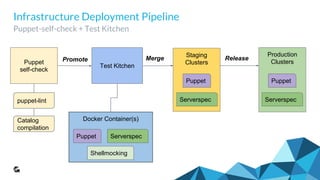
Infrastructure Deployment Pipeline
Puppet-self-check + Test Kitchen
Puppet
self-check
Staging
Clusters
Production
Clusters
Merge Release
Test Kitchen
Docker Container(s)
Puppet Serverspec
Shellmocking
Puppet
Serverspec
Puppet
Serverspec
Promote
puppet-lint
Catalog
compilation
Next Challenge: Test Only Affected Types
And spare resources and time for Pull Request testing
● We have more than 100 puppet types
● It is acceptable number for puppet-self-check because it is fast and does not
consumes lot of resources
● It is different for Test Kitchen: we cannot spawn more than 100 containers for
each Pull Request! It is suboptimal and resource demanding
● We need to figure out affected puppet types in automated way
Getting Diff From Puppet Code Change
How to actually deduct affected types?
● Puppet build complex graph out of
○ Interdependent modules
○ Hiera variables
○ Autogenerated custom facts
● So a mere file based diff will not help
● Puppet generated graph is too complex to reliably analyze
● Solution
○ Compare compiled catalogs
○ Create affected type list
○ Feed the list to Test Kitchen
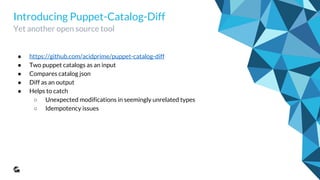
Introducing Puppet-Catalog-Diff
Yet another open source tool
● https://github.com/acidprime/puppet-catalog-diff
● Two puppet catalogs as an input
● Compares catalog json
● Diff as an output
● Helps to catch
○ Unexpected modifications in seemingly unrelated types
○ Idempotency issues
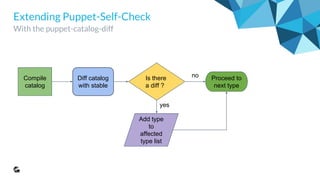
Extending Puppet-Self-Check
With the puppet-catalog-diff
Compile
catalog
Diff catalog
with stable
Is there
a diff ?
Proceed to
next type
Add type
to
affected
type list
yes
no
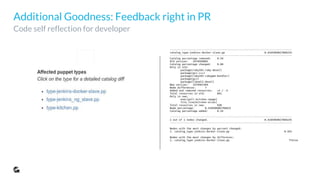
Additional Goodness: Feedback right in PR
Code self reflection for developer
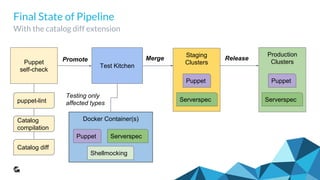
Final State of Pipeline
With the catalog diff extension
Puppet
self-check
Staging
Clusters
Production
Clusters
Merge Release
Test Kitchen
Docker Container(s)
Puppet Serverspec
Shellmocking
Puppet
Serverspec
Puppet
Serverspec
Promote
puppet-lint
Catalog
compilation
Catalog diff
Testing only
affected types
Side note on CI/CD tooling set
What do we use to orchestrate pipelines
● Jenkins - popular open source automation server
● Jenkins Job Builder - takes simple descriptions of Jenkins jobs in
YAML or JSON format and uses them to configure Jenkins
○ Everything under GIT version control
● Zuul is used to gate the source code repository of a project so that
changes are only merged if they pass tests.
○ Check pipeline for fast (most frequently unit) tests
○ Gate pipeline for longer resource demanding (integration)
tests before actual merge
○ Optimistic merge strategy enables testing multiple Pull
Requests in parallel
Replaceability
A note on agnostic approach
● Kitchen driver is agnostic to virtualization solution/cloud provider
● Kitchen provisioner is agnostic to configuration management solution
● Serverspec is agnostic to configuration type at all
● Capability to make brave movements in future!
○ Major upgrades like Puppet 3.x to 4.x
○ Change of configuration management solution
○ Using drivers other than Docker for different pipelines (e.g. openstack
driver to test VM image bootability and configuration)
● Same framework can be used for completely different projects and solutions
○ Chef, ansible, salt, different cloud providers and even different test
frameworks - the Test Kitchen approach will be still relevant
OSS, Upstream
Open source and contributions
● Multiple open source projects combined
○ Different upstreams diversifies the overall ecosystem
○ Different maintainers - different level of upstream response
○ Can be both good and bad
● GoodData has contributed multiple patches to related kitchen
projects and serverspec
● GoodData has open-sourced internal implementations
○ https://github.com/gooddata/serverspec-core
○ https://github.com/gooddata/serverspec-ui
○ https://github.com/gooddata/shellmock
What Could be Done Better
If we would start from scratch
● More modular Puppet, less interdependencies
● More investment into unit tests, see rspec-puppet
● Reduction of number of puppet types with Roles & Profiles
pattern
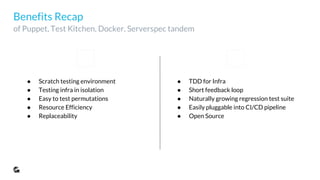
Benefits Recap
of Puppet, Test Kitchen, Docker, Serverspec tandem
● Scratch testing environment
● Testing infra in isolation
● Easy to test permutations
● Resource Efficiency
● Replaceability
● TDD for Infra
● Short feedback loop
● Naturally growing regression test suite
● Easily pluggable into CI/CD pipeline
● Open Source
“Now you know how we build test driven infra
with open source tool set.
You can reuse it fully or partially with
adaptation to your specific case.
Hopefully see you upstream!
We are hiring!
A clear conference time abuse
● If you like challenges described above visit
http://www.gooddata.com/company/careers
● In case you find something attractive don’t hesitate to drop me a
line directly to yury.tsarev@gooddata.com
Recommended Reading and Questions
To not to create useless ‘questions?’ slide
● Books that are full of practical wisdom
○ Puppet Best Practices
○ Infrastructure as Code
○ Test-Driven Infrastructure with Chef
● Thanks for not running away till the
end of the talk! Questions?

ContainerCon - Test Driven Infrastructure

  • 1.
    Test Driven Infrastructure withPuppet, Docker, Test Kitchen and Serverspec
  • 2.
    About Me Russian engineerliving in Prague ● Yury Tsarev ● Mostly QA & Systems Engineering background ● Previously ○ Sysadmin in Russian bank ○ QA/Sr. SWE in SUSE Linux ○ Sr. QA Engineer in Cloud Infra team of GoodData ● Currently QA Architect in GoodData focusing on ○ Private cloud ○ Internal PaaS ○ Continuous Delivery ● Contacts ○ yury.tsarev@gooddata.com ○ https://github.com/ytsarev ○ https://linkedin.com/in/yurytsarev ○ https://twitter.com/xnullz
  • 3.
    About GoodData Information relevantto the talk ● GoodData runs cloud-based business intelligence (BI) and big data analytics platform ● Operates on top of Openstack-based Private Cloud and Internal Platform-as-a-Service ● Several datacenters, hundreds of hardware servers, thousands virtual machines, internally complex distributed system to manage ● Relies on Puppet for Configuration Management
  • 4.
    What to ExpectFrom This Talk ? ● A real-life story of infrastructure development process evolution ● A practical guide with opinionated set of tools for testing infrastructure at scale ● A framework which components are ready to be adjustable or replaceable for your specific case ● No kittens, no unicorns, no Docker worship
  • 5.
    Infrastructure as aCode Puppet driven infra as a prerequisite ● Every infra change is tracked through puppet code, no exceptions ● Puppet code is stored in git ● Puppet code is a shared ground for whole DevOps organization ● Puppet code has quality problems
  • 6.
    Puppet Architecture inGoodData Server Type is an entrypoint ● Popular Roles&Profiles pattern is not implemented ● Instead there is notion of Type(can be understood as Server Type/Role) which is a main entrypoint for code execution ● Type is a combination of puppet modules describing a resulting server state ● Relatively huge codebase ○ Around 150 puppet modules ○ More than 100 types ● Applying a type on the instance is as easy as propagate $EC2DATA_TYPE environment variable, e.g. from openstack metadata endpoint
  • 7.
    Challenges at Scale Complexdistributed platform to manage ● Puppet code is a base for everything: from Openstack Private Cloud up to application frontend ● Several hundred of physical servers and thousands of VMs ● Multiple datacenters ● Multiplied by huge number of puppet types ● Tightly coupled modules with multiple interdependencies ● Complexity creates reliability and quality problems
  • 8.
    Dependencies Depicted Our puppetdependency graph ● Representation of puppet modules interdependencies ● 2650 Resources ● 7619 Dependencies between them
  • 9.
    Manual way ofpuppet validation Does not work at scale ● Checkout new puppet code ● Run `puppet apply --noop` ● Evaluate the output ● If --noop looks fine then make real apply ● Manual smoke testing Obviously such process does not scale
  • 10.
    Introducing Puppet SelfCheck As we need some test before the merge ● Linting (puppet-lint) ● Puppet catalog compilation ● Automated --noop run in fakeroot ● Integration with Jenkins ● Detailed feedback right in Pull Request
  • 11.
    Minimalistic Deployment Pipeline Consistingof only one testing job so far Puppet-self-check Staging Clusters Production Clusters Merge Release
  • 12.
    Puppet Self Checkis not enough Crucial, but only initial coverage ● Covering ○ Style errors ○ Syntax errors ○ Catalog compilation errors like circular dependencies ● Missing ○ Configuration file errors ○ Ability to check if services/processes were able to start ○ No configuration testing ○ No service smoke testing ● We want to catch the issues way before the merge ○ Shifting testing left is great for quality and velocity ○ Staging should uncover minimal amount of complex integration issues
  • 13.
    Introducing Test Kitchen Somethingmore for the next step of test pipeline ● http://kitchen.ci/ ● Advanced test orchestrator ● Open Source project ● Originated in Chef community ● Very pluggable on all levels ● Implemented in Ruby ● Configurable through simple single yaml file ● "Your infrastructure deserves tests too."
  • 14.
    ● Driver createsthe instance ○ $ kitchen create ... ● Provisioner converges the puppet code ○ $ kitchen converge … ● Verifier verifies the expected result ○ $ kitchen verify .... ● Driver: what type of VM/containerization/cloud to use ○ Amazon EC2, Blue Box, CloudStack, Digital Ocean, Rackspace, OpenStack, Vagrant, Docker, LXC containers ● Provisioner: which configuration management tool to apply ○ Chef, Puppet, Ansible, SaltStack ● Verifier: test automation type to verify the configuration correctness with ○ Bats, shUnit2, RSpec, Serverspec Test Kitchen architecture Main components and verbs
  • 15.
    Test Kitchen SequentialTesting Process Create -> Converge -> Verify Driver creates Provisioner converges Verifier verifies
  • 16.
    Test Kitchen VerbsMeaning What is actually happening Container/VM is created Configuration Management code is applied. Instance is converged to desired state Expected result is verified by running the test suite
  • 17.
    Which Driver touse ? Or why we stick to Docker ● The openstack driver could be an obvious choice for our openstack-based private cloud ● But remember we have more than 100 puppet types to test? ● That would mean at least one full-blown VM for each type-under-test ● Even with minimum instance flavour it is too much ● Thus, we stick to Docker
  • 18.
    “And it wasn’tsmooth ride
  • 19.
    Docker Driver Specifics Whatdoes it bring and take away ● Resource utilization is a game changer ○ Instead of spawning more than 100 VMs we are managing the testing load within small 3-nodes jenkins slave cluster ● Shared testing environment ○ Same containers spawned on jenkins slaves and on developer laptops ● Allows to create system containers that are mimicking VMs/servers ● It does not come for free ○ Docker specific limitations and constraints ○ Deviation from real VM scenario ○ Hard to debug issues with process concurrent behavior. Most of them relate to the fact that users are not namespaced in Linux kernel
  • 20.
    ● Basic dockerdriver definition in .kitchen.yml ● Uses the image from private docker registry ● Specifies provision command for test container runtime preparation ● Separate project https://github.com/portertech/kitchen-docker ● driver: name: docker image: docker-registry.example.com/img:tag platform: rhel use_sudo: false provision_command: yum clean all && yum makecache Docker Driver Project & Configuration Driver section of .kitchen.yml
  • 21.
    ● Volume management ●Kernel capabilities ● Custom Dockerfile for testing container ● volume: - /ftp - /srv ● cap_add: - SYS_PTRACE - SYS_RESOURCE ● dockerfile: custom/Dockerfile Docker Driver Additional Features That are useful for testing
  • 22.
    “Now we arefully prepared for Create stage. `kitchen create` will spawn fresh testing container. Next one is Converge. And Converge means Provisioner.
  • 23.
    Puppet Provisioner An obviouschoice to run puppet code ● Also distinct upstream project https://github.com/neillturner/kitchen-puppet ● Uploads puppet code into instance under test ● Runs puppet there a.k.a. getting instance to converged state ● Provides extremely useful functionality for creating puppet related testing constraints ○ Puppet facts customization facility ○ Hiera ○ Facterlib ○ Custom installation, pre-apply, post-apply commands ○ And much more documented in provisioner_options.md
  • 24.
    ● Specifies localpaths to manifests, modules, hiera under test ● Overrides the puppet facts to create testing constraints ● Describe custom script to be executed before puppet run ● provisioner: name: puppet_apply modules_path: puppet/modules manifests_path: puppet/manifests hiera_data_path: puppet/hieradata facterlib: /etc/puppet/facter install_custom_facts: true custom_facts: ec2data_type: web_frontend docker: 1 ec2data_freeipa_otp: test ec2data_nopuppet_cron: 1 ec2_public_ipv4: 127.0.0.1 … custom_install_command: | # custom setup script Puppet Provisioner Configuration Provisioner section of .kitchen.yml
  • 25.
    “Looks like weare good with Provisioner and can proceed to Verifier?
  • 26.
    “NO. The puppet runwill miserably fail.
  • 27.
    External Dependencies Or howto test in isolation ● Quite frequently puppet types under test will require some external service to communicate with ● We want to avoid external communication in most cases ● Because we want fast and deterministic results ● And we do not want to spoil production services with test data ● Same goes for additional load ● Exceptions (the things that we still do want to communicate )can be core services like ntp, rpm repository server, etc.
  • 28.
    Introducing Shellmock Extremely simplestub/mocking tool ● https://github.com/gooddata/shellmock ● Solution to external dependency problem a.k.a dependency injection ● A simple ruby script that placed instead of package manager strictly within testing instance ● Intercepts calls to package manager ● Installs a mock instead of real package if this mock is defined in shellmock configuration ● If mock is not defined passes the request to real package manager for real package installation ● Same trick is used to bypass number of docker limitations like sysctl calls within container
  • 29.
    ● Format issimple package: /path/to/executable:| contents ● If no content specified the mock defaults to simple message that returns exit code 0 Shellmock Example Configuration Separate shellmock.yaml that lives in puppet repo Mock configuration Resulting mock ipa-client: /usr/sbin/ipa-client-install: | echo 'server = freeipa.example.com' > /etc/ipa/default.conf echo 'fake' > /etc/krb5.keytab $ cat /usr/sbin/ipa-client-install echo 'server = freeipa.example.com' > /etc/ipa/default.conf echo 'fake' > /etc/krb5.keytab sssd: /usr/sbin/sssd: $ cat /usr/sbin/sssd #!/bin/bash echo I am a fake /usr/sbin/sssd
  • 30.
    “If all externaldependencies are satisfied the Converge will be passing. `kitchen converge` will successfully apply puppet. Now it is time to deal with Verifier.
  • 31.
    Verifier A component thatexecutes test framework ● Serves as tiny configuration for test execution ● Tests are written separately with the test framework of choice ● Out of the box support for Bats, shUnit2, RSpec, Serverspec, Cucumber
  • 32.
    Why Serverspec? Because itrocks ● Standalone open source project http://serverspec.org/ ● Rich resource library http://serverspec.org/resource_types.html ● DSL to describe expected configuration state ● Based on famous RSpec framework ● Multi OS support ● Readable, flexible, extensible ● Low entry barrier
  • 33.
    ● Command resourcedeserves special attention ● It allows to check anything you can do in shell ● More advanced scenarios will require creation of custom resources Serverspec DSL Examples describe file('/var/log/httpd') do it { should be_directory } end describe command('apachectl -M') do its(:stdout) { should contain('proxy_module')} end describe default_gateway do its(:ipaddress) { should eq '192.168.10.1' } its(:interface) { should eq 'br0' } end describe cgroup('group1') do its('cpuset.cpus') { should eq 1 } end describe docker_container('focused_curie') do its(:HostConfig_NetworkMode) { should eq 'bridge' } its(:Path) { should eq '/bin/sh' } end describe port(53) do it { should be_listening.with('udp') } end
  • 34.
    What and Howto Test? A frequent question ● The most effective way to create a serverspec test is to think: “What would I anyway manually check after server deployment?” ● Then express it in serverspec DSL ● Most powerful serverspec tests are covering not only puppet produced configuration but testing the outcome
  • 35.
    ● The testthat checks behaviour of actual API endpoints after instance converge ● Notice that the test is still isolated within one instance ● Serverspec/RSpec is internal DSL so you can easily use Ruby right in the test definition under_kerberos_auth = ['', 'status', 'status.json', 'status/payload', 'images/grey.png'] under_kerberos_auth.each do |path| describe command("curl -k -X POST http://127.0.0.1/#{path}") do its(:stdout) { should match(/301/) } end describe command("curl -k -X POST https://127.0.0.1/#{path}") do its(:stdout) { should match(/401/) } its(:stdout) { should match(/Authorization Required/) } end end Testing the Outcome DSL plus a bit of basic Ruby
  • 36.
    Test Suite Composition Thereis no official reference ● Serverspec provides only DSL and abstraction over configuration resources ● The test suite organization and composition is completely up to you ● Great example of advanced, yet simple setup https://github.com/vincentbernat/serverspec-example ● GoodData implementations that were built on top of that example ○ https://github.com/gooddata/serverspec-core ○ https://github.com/gooddata/serverspec-ui ● These projects are only test executors, actual tests should be placed together with the code, e.g. same git repo with puppet
  • 37.
    What Was Addedon Top of Serverspec Tiny bits of functionality ● YAML based configuration to define ○ Environments, e.g. dev/prod or geographical data centers ○ Host to role/type assignment ● Tests are placed in the directory structure according to defined hierarchy ● Parallel execution ● Reporting in multiple formats ● Coding style for tests (rubocop)
  • 38.
    ● From kitchenconfiguration point of view it is just shell verifier ● remote_exec makes command to be executed within testing instance ( execution from host is default ) ● command invokes serverspec test suite with control variables and params verifier: name: shell remote_exec: true command: | sudo -s <<SERVERSPEC export SERVERSPEC_ENV=$EC2DATA_ENVIRONMENT export SERVERSPEC_BACKEND=exec serverspec junit=true tag=~skip_in_kitchen check:role:$EC2DATA_TYPE SERVERSPEC Shell Verifier and Serverspec Flexibility of invocation
  • 39.
    “Create -> Converge-> Verify harness is ready. `kitchen verify` will test the infra code. But only for one puppet type. How to describe multiple types?
  • 40.
    Platforms and Suites Additionalstructures in .kitchen.yml ● The way to create multiple test configurations ● Platforms are usually used to specify distribution/image to test on top of ● Suites are used to reflect semantics of test run In our case it is puppet type ● The configuration options from main components of Driver/Provisioner/Verifier can be overridden on Platform and Suite levels
  • 41.
    ● Driver configurationis overridden per platform ● Additional tricks to run systemd within container platforms: - name: el6 driver: image: docker-registry.example.com/el6:6.8 cap_add: SYS_PTRACE - name: el7 driver: image: docker-registry.example.com/el7:7.2 dockerfile: t/kitchen/centos7-dockerfile volume: - /sys/fs/cgroup:/sys/fs/cgroup:ro run_command: /usr/lib/systemd/systemd Multi Distro Testing With Platforms Covering EL6 to EL7 migration
  • 42.
    ● Driver andProvisioner are overridable on suite level as well and has a priority over Platform level suites: - name: frontend provisioner: custom_facts: ec2data_type: frontend - name: backend provisioner: custom_facts: ec2data_type: backend - name: database provisioner: custom_facts: ec2data_type: database driver: cap_add: - SYS_RESOURCE Multiple Types Description With Suites
  • 43.
    ● Kitchen composestest run ( Instance column ) out of suite + platform definitions ● Each puppet type ( specified as suite ) is going to be tested on each specified platform $ kitchen list Instance Driver Provisioner Verifier Transport Last Action frontend-el6 Docker PuppetApply Shell Rsync <Not Created> frontend-el7 Docker PuppetApply Shell Rsync <Not Created> backend-el6 Docker PuppetApply Shell Rsync <Not Created> backend-el7 Docker PuppetApply Shell Rsync <Not Created> database-el6 Docker PuppetApply Shell Rsync <Not Created> database-el7 Docker PuppetApply Shell Rsync <Not Created> Resulting Test Composition How kitchen composes suite and platform
  • 44.
    Now We CanMake It Test Driven! Having it all combined we can write infra code with test-first approach ● Write serverspec expectation for new code ● $ kitchen verify <type> ● Observe related test is red ● Write the puppet code ● $ kitchen converge <type> # reapply the modified puppet code ● $ kitchen verify <type> ● Observe related test is green ● Commit the changes and create PR to puppet repo
  • 45.
    TDD Has toScale Technically and culturally ● Infrastructure testing should be integral part of development process and supported by strong testing culture within organization ● We test on a developer desktop even before git commit ● After commit/PR but before the merge we need to trigger test pipeline ● Serverspec test suite should be reused later in the pipeline after the merge on actual staging servers ● And ultimately test suite should travel to production servers after release for continuous regression self-testing integrated with monitoring
  • 46.
    Infrastructure Deployment Pipeline Puppet-self-check+ Test Kitchen Puppet self-check Staging Clusters Production Clusters Merge Release Test Kitchen Docker Container(s) Puppet Serverspec Shellmocking Puppet Serverspec Puppet Serverspec Promote puppet-lint Catalog compilation
  • 47.
    Next Challenge: TestOnly Affected Types And spare resources and time for Pull Request testing ● We have more than 100 puppet types ● It is acceptable number for puppet-self-check because it is fast and does not consumes lot of resources ● It is different for Test Kitchen: we cannot spawn more than 100 containers for each Pull Request! It is suboptimal and resource demanding ● We need to figure out affected puppet types in automated way
  • 48.
    Getting Diff FromPuppet Code Change How to actually deduct affected types? ● Puppet build complex graph out of ○ Interdependent modules ○ Hiera variables ○ Autogenerated custom facts ● So a mere file based diff will not help ● Puppet generated graph is too complex to reliably analyze ● Solution ○ Compare compiled catalogs ○ Create affected type list ○ Feed the list to Test Kitchen
  • 49.
    Introducing Puppet-Catalog-Diff Yet anotheropen source tool ● https://github.com/acidprime/puppet-catalog-diff ● Two puppet catalogs as an input ● Compares catalog json ● Diff as an output ● Helps to catch ○ Unexpected modifications in seemingly unrelated types ○ Idempotency issues
  • 50.
    Extending Puppet-Self-Check With thepuppet-catalog-diff Compile catalog Diff catalog with stable Is there a diff ? Proceed to next type Add type to affected type list yes no
  • 51.
    Additional Goodness: Feedbackright in PR Code self reflection for developer
  • 52.
    Final State ofPipeline With the catalog diff extension Puppet self-check Staging Clusters Production Clusters Merge Release Test Kitchen Docker Container(s) Puppet Serverspec Shellmocking Puppet Serverspec Puppet Serverspec Promote puppet-lint Catalog compilation Catalog diff Testing only affected types
  • 53.
    Side note onCI/CD tooling set What do we use to orchestrate pipelines ● Jenkins - popular open source automation server ● Jenkins Job Builder - takes simple descriptions of Jenkins jobs in YAML or JSON format and uses them to configure Jenkins ○ Everything under GIT version control ● Zuul is used to gate the source code repository of a project so that changes are only merged if they pass tests. ○ Check pipeline for fast (most frequently unit) tests ○ Gate pipeline for longer resource demanding (integration) tests before actual merge ○ Optimistic merge strategy enables testing multiple Pull Requests in parallel
  • 54.
    Replaceability A note onagnostic approach ● Kitchen driver is agnostic to virtualization solution/cloud provider ● Kitchen provisioner is agnostic to configuration management solution ● Serverspec is agnostic to configuration type at all ● Capability to make brave movements in future! ○ Major upgrades like Puppet 3.x to 4.x ○ Change of configuration management solution ○ Using drivers other than Docker for different pipelines (e.g. openstack driver to test VM image bootability and configuration) ● Same framework can be used for completely different projects and solutions ○ Chef, ansible, salt, different cloud providers and even different test frameworks - the Test Kitchen approach will be still relevant
  • 55.
    OSS, Upstream Open sourceand contributions ● Multiple open source projects combined ○ Different upstreams diversifies the overall ecosystem ○ Different maintainers - different level of upstream response ○ Can be both good and bad ● GoodData has contributed multiple patches to related kitchen projects and serverspec ● GoodData has open-sourced internal implementations ○ https://github.com/gooddata/serverspec-core ○ https://github.com/gooddata/serverspec-ui ○ https://github.com/gooddata/shellmock
  • 56.
    What Could beDone Better If we would start from scratch ● More modular Puppet, less interdependencies ● More investment into unit tests, see rspec-puppet ● Reduction of number of puppet types with Roles & Profiles pattern
  • 57.
    Benefits Recap of Puppet,Test Kitchen, Docker, Serverspec tandem ● Scratch testing environment ● Testing infra in isolation ● Easy to test permutations ● Resource Efficiency ● Replaceability ● TDD for Infra ● Short feedback loop ● Naturally growing regression test suite ● Easily pluggable into CI/CD pipeline ● Open Source
  • 58.
    “Now you knowhow we build test driven infra with open source tool set. You can reuse it fully or partially with adaptation to your specific case. Hopefully see you upstream!
  • 59.
    We are hiring! Aclear conference time abuse ● If you like challenges described above visit http://www.gooddata.com/company/careers ● In case you find something attractive don’t hesitate to drop me a line directly to yury.tsarev@gooddata.com
  • 60.
    Recommended Reading andQuestions To not to create useless ‘questions?’ slide ● Books that are full of practical wisdom ○ Puppet Best Practices ○ Infrastructure as Code ○ Test-Driven Infrastructure with Chef ● Thanks for not running away till the end of the talk! Questions?