Future of mobility :
Cars, Connectivity, and Urban Transportation
By: Ayush RVS
Introducation
The global automotive industry is undergoing a profound
transformation as the demand for smarter, sustainable, and
more efficient transportation systems increases. The future
of mobility is characterized by advancements in electric
vehicles (EVs), autonomous driving, shared mobility
services, and connectivity technologies. These innovations
are shaping how people and goods move within urban
environments.
Challenges for EV Adoption
● Infrastructure: Limited charging stations in
some areas.
● Battery Technology: High costs and concerns
about range.
● Consumer Awareness: Misconceptions about
EV performance and reliability.
Electric Vehicles (EVs): Driving
Sustainability
Growth of EVs
Electric vehicles are at the
forefront of sustainable
mobility. Governments and
automakers worldwide are
investing heavily in EV
technology to reduce
Challenges
● Competition with public transit systems.
● Concerns over data privacy and security.
● Need for robust regulatory frameworks.
Connectivity: The Role of Smart Technology
Connected Cars
Connected cars equipped with IoT devices, 5G, and advanced telematics enable
real-time data exchange. These technologies enhance driving experiences, improve
safety, and enable predictive maintenance.
future of mobility
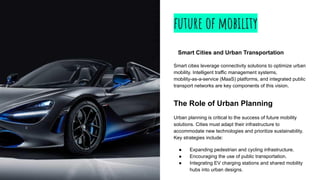
Smart Cities and Urban Transportation
Smart cities leverage connectivity solutions to optimize urban
mobility. Intelligent traffic management systems,
mobility-as-a-service (MaaS) platforms, and integrated public
transport networks are key components of this vision.
The Role of Urban Planning
Urban planning is critical to the success of future mobility
solutions. Cities must adapt their infrastructure to
accommodate new technologies and prioritize sustainability.
Key strategies include:
● Expanding pedestrian and cycling infrastructure.
● Encouraging the use of public transportation.
● Integrating EV charging stations and shared mobility
hubs into urban designs.
Conclusion
The future of mobility is a dynamic and
rapidly evolving landscape driven by
technological advancements and the need
for sustainable urban transportation
solutions. Collaboration between
governments, industries, and communities
will be essential to realize the full potential
of connected, efficient, and
environmentally friendly mobility systems.
Embracing these changes will not only
improve transportation but also enhance
the quality of life in urban areas
worldwide.
About:
website:https://ayush.imperi
alholidayz.com/
Contact : 7505216033
Email:rk3404151@gmail.com

future of mobility.pdfhttps://ayush.imperialholidayz.com/

  • 1.
    Future of mobility: Cars, Connectivity, and Urban Transportation By: Ayush RVS
  • 2.
    Introducation The global automotiveindustry is undergoing a profound transformation as the demand for smarter, sustainable, and more efficient transportation systems increases. The future of mobility is characterized by advancements in electric vehicles (EVs), autonomous driving, shared mobility services, and connectivity technologies. These innovations are shaping how people and goods move within urban environments.
  • 3.
    Challenges for EVAdoption ● Infrastructure: Limited charging stations in some areas. ● Battery Technology: High costs and concerns about range. ● Consumer Awareness: Misconceptions about EV performance and reliability.
  • 4.
    Electric Vehicles (EVs):Driving Sustainability Growth of EVs Electric vehicles are at the forefront of sustainable mobility. Governments and automakers worldwide are investing heavily in EV technology to reduce
  • 5.
    Challenges ● Competition withpublic transit systems. ● Concerns over data privacy and security. ● Need for robust regulatory frameworks. Connectivity: The Role of Smart Technology Connected Cars Connected cars equipped with IoT devices, 5G, and advanced telematics enable real-time data exchange. These technologies enhance driving experiences, improve safety, and enable predictive maintenance.
  • 6.
    future of mobility SmartCities and Urban Transportation Smart cities leverage connectivity solutions to optimize urban mobility. Intelligent traffic management systems, mobility-as-a-service (MaaS) platforms, and integrated public transport networks are key components of this vision. The Role of Urban Planning Urban planning is critical to the success of future mobility solutions. Cities must adapt their infrastructure to accommodate new technologies and prioritize sustainability. Key strategies include: ● Expanding pedestrian and cycling infrastructure. ● Encouraging the use of public transportation. ● Integrating EV charging stations and shared mobility hubs into urban designs.
  • 7.
    Conclusion The future ofmobility is a dynamic and rapidly evolving landscape driven by technological advancements and the need for sustainable urban transportation solutions. Collaboration between governments, industries, and communities will be essential to realize the full potential of connected, efficient, and environmentally friendly mobility systems. Embracing these changes will not only improve transportation but also enhance the quality of life in urban areas worldwide.
  • 8.