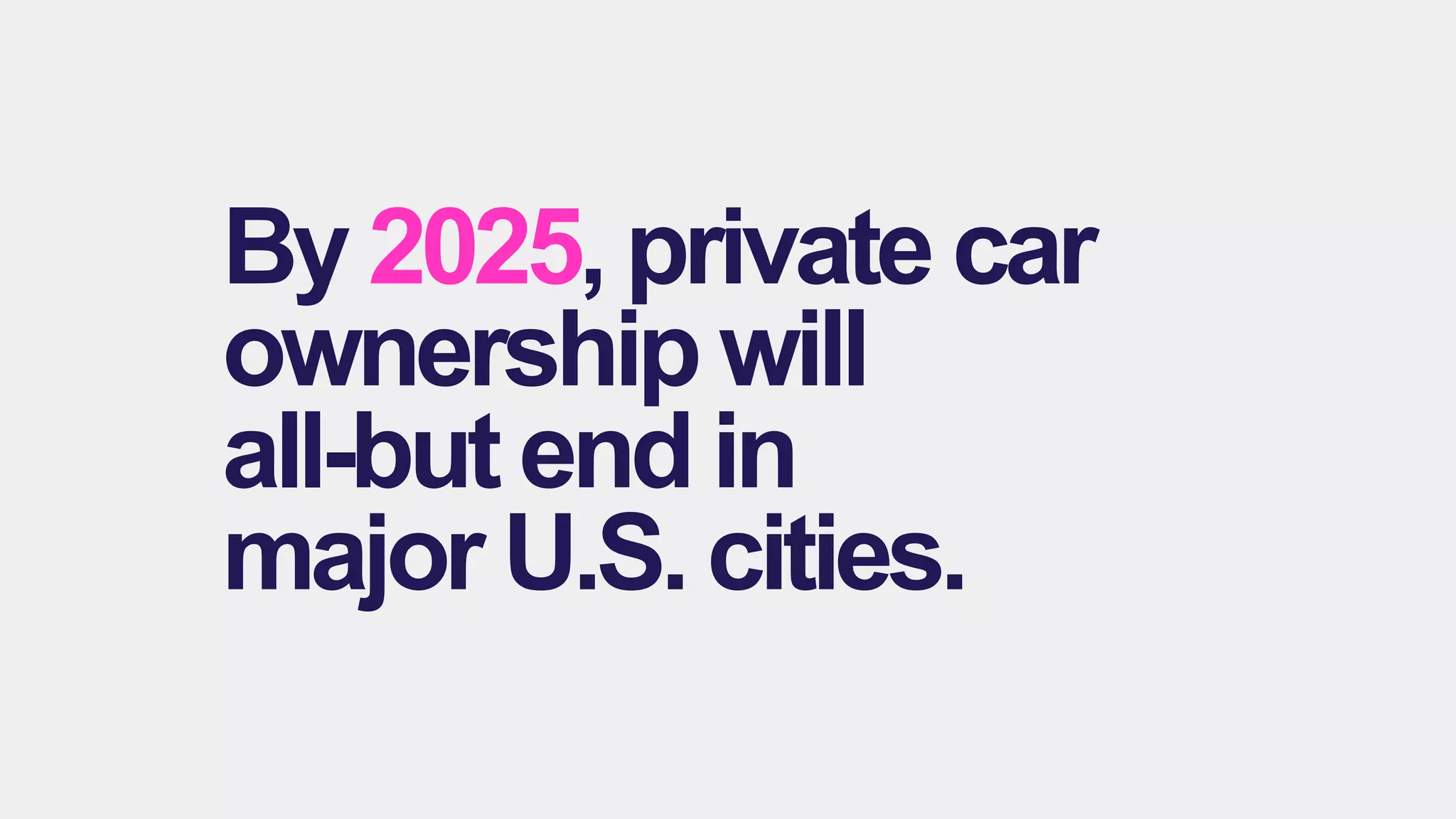
The document discusses the evolution of car sharing and hailing, highlighting a future where private car ownership diminishes in major U.S. cities by 2025, replaced by autonomous vehicle (AV) fleets integrated into a networked service. It explores how urban design can shift towards people-centric spaces with enhanced mobility options while examining user experience challenges and the necessary societal acceptance for successful AV integration. The importance of connectivity, advanced technology, and innovative business models is emphasized in realizing a sustainable and efficient mobility ecosystem.
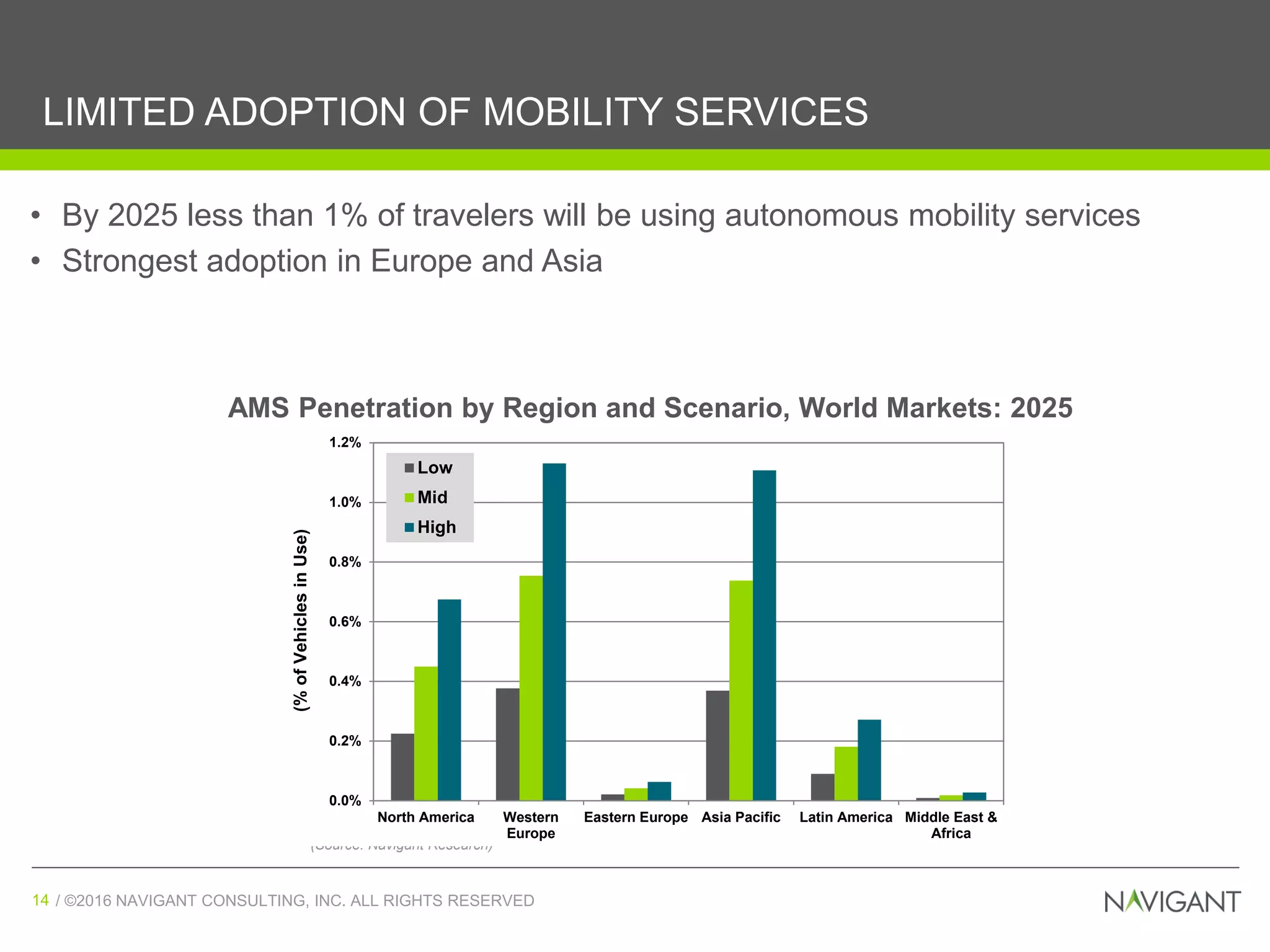
The emergence of car sharing and ride-hailing services as a key trend in urban transportation.
The emergence of car sharing and ride-hailing services as a key trend in urban transportation.
The emergence of car sharing and ride-hailing services as a key trend in urban transportation.
The emergence of car sharing and ride-hailing services as a key trend in urban transportation.
The emergence of car sharing and ride-hailing services as a key trend in urban transportation.
The emergence of car sharing and ride-hailing services as a key trend in urban transportation.
Exploration of user experience and design principles in the context of automated driving systems. The integration of autonomous vehicles into urban societies and the implications for social interactions.
The evolution of smart city designs and transportation networks in relation to emerging technologies.
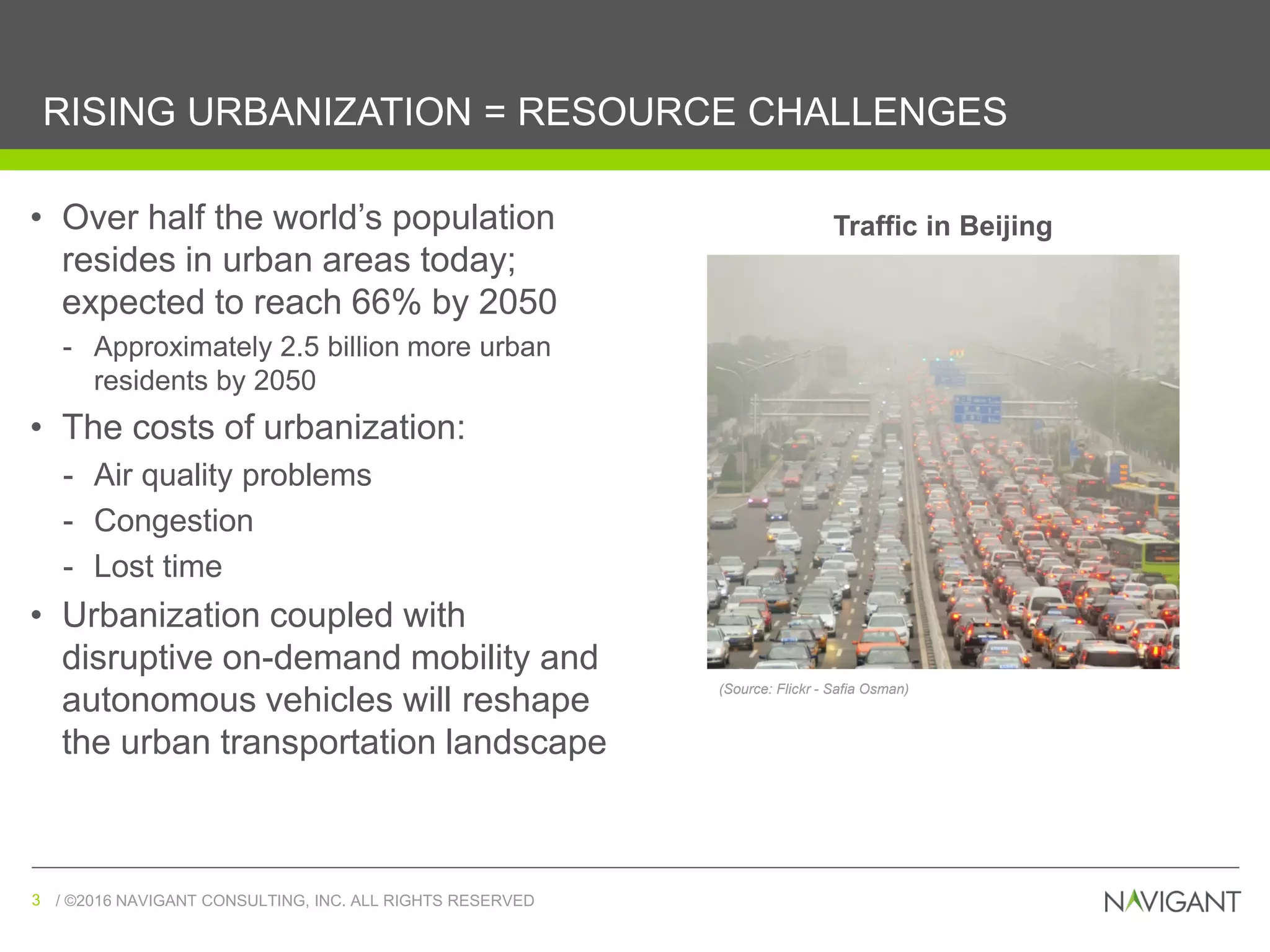
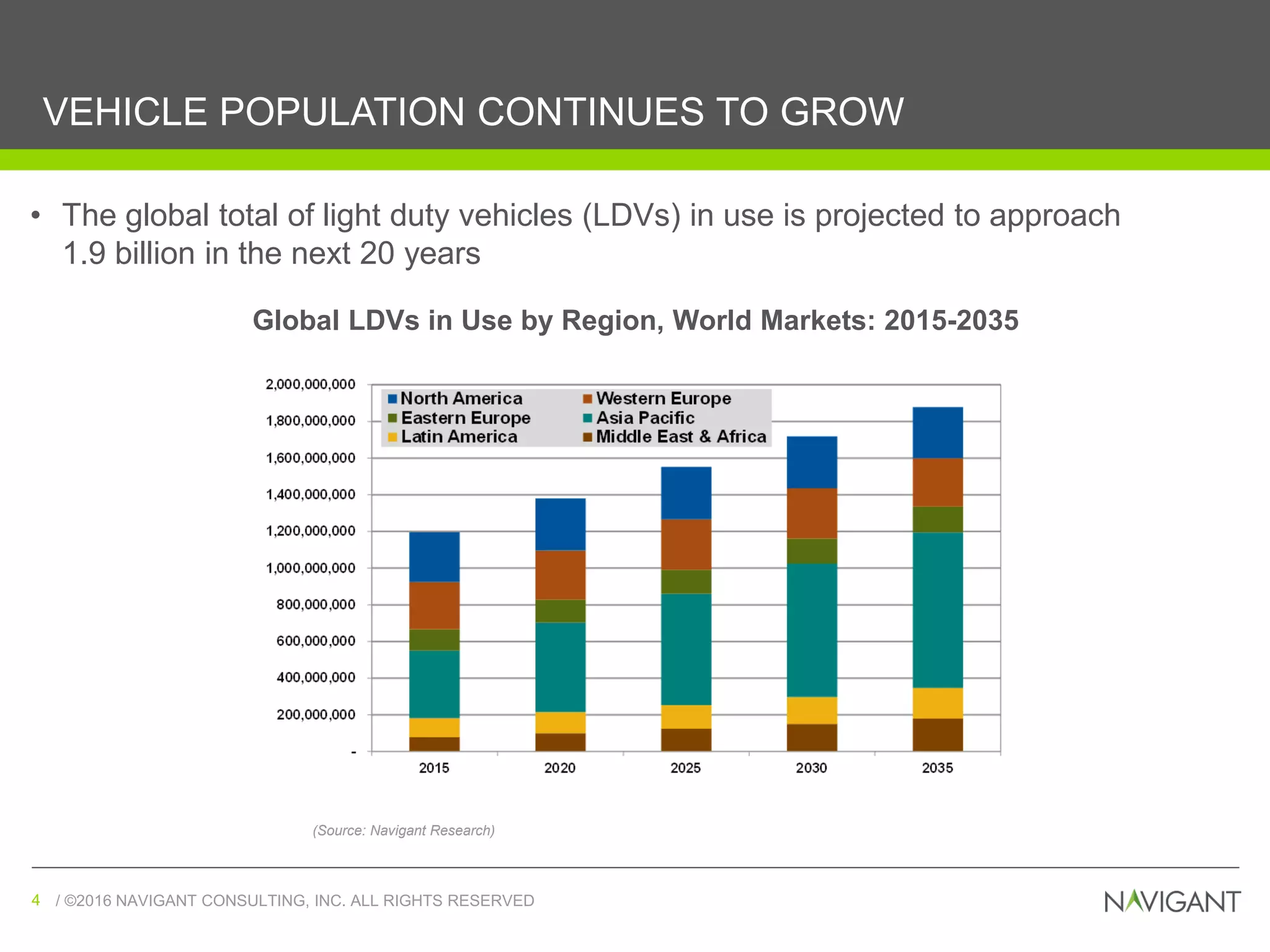
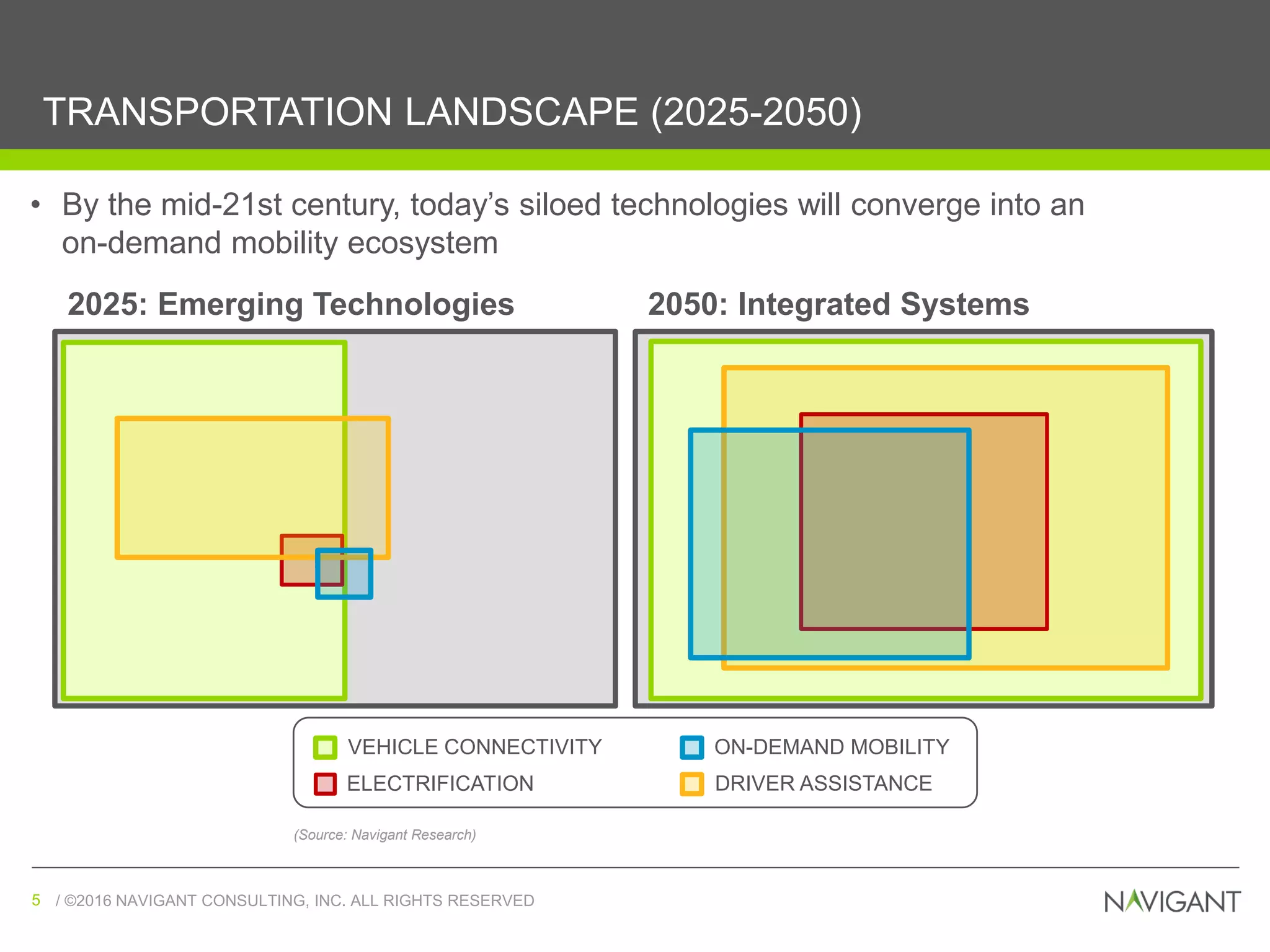
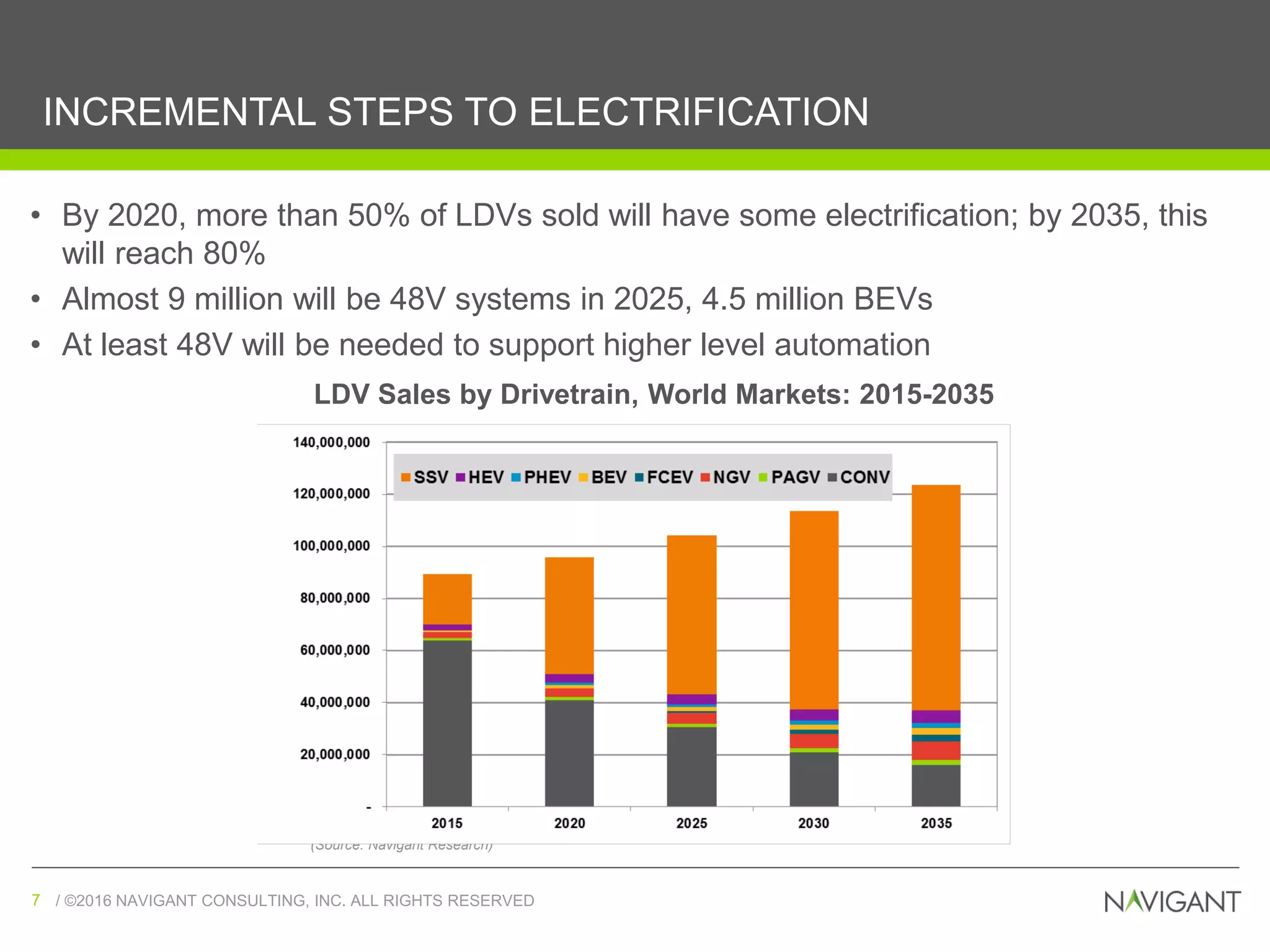
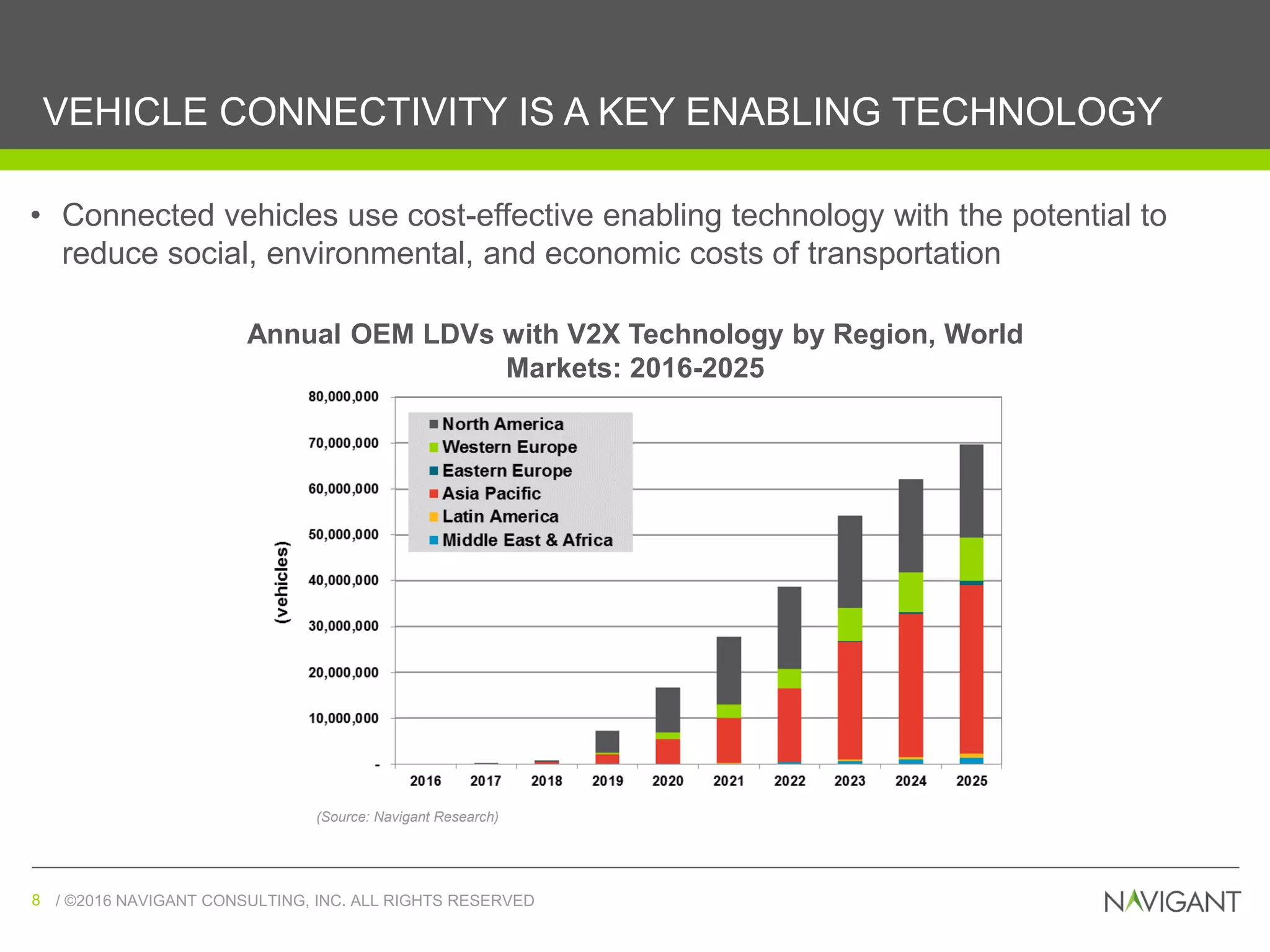
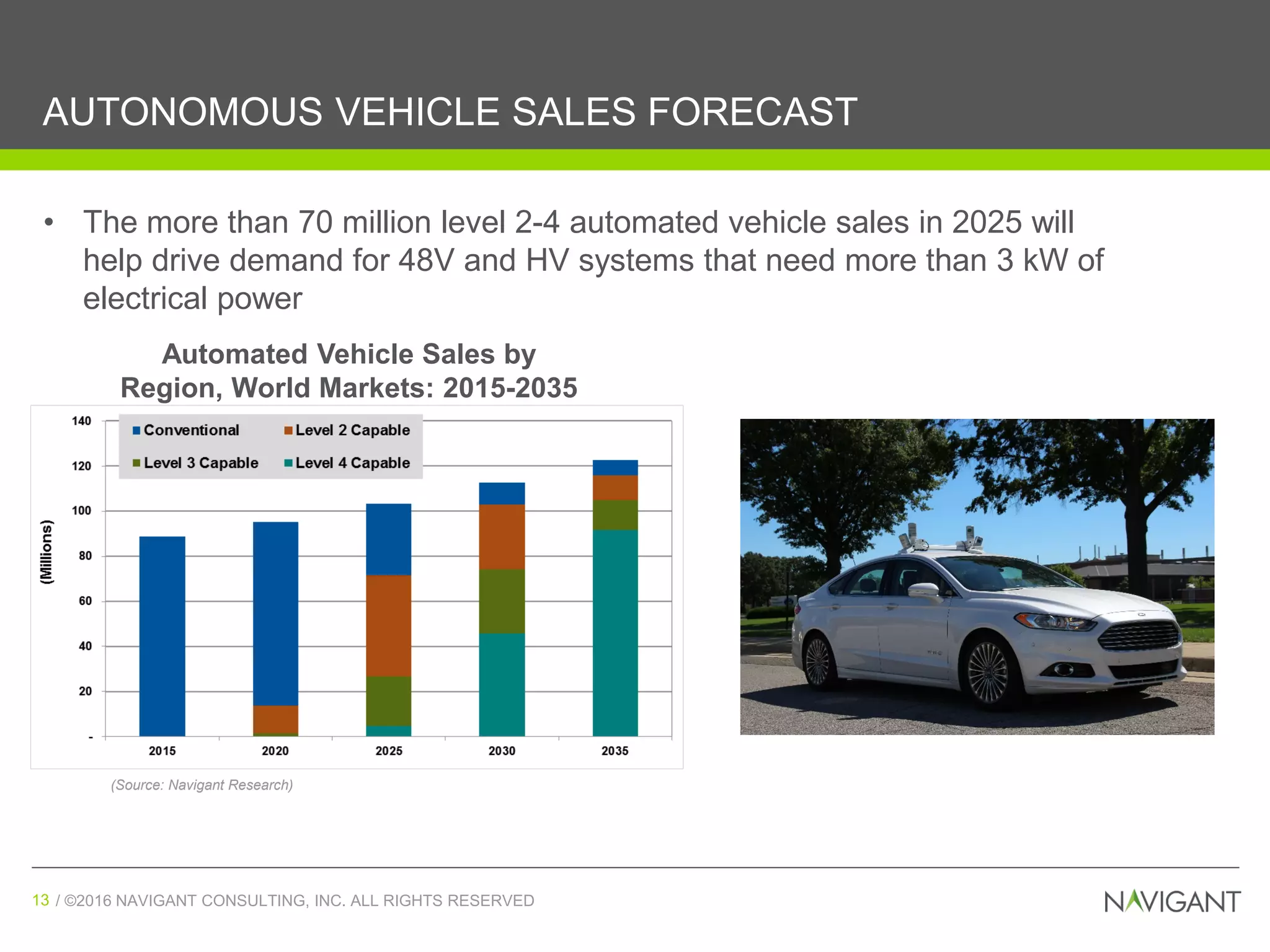
Forecast on urbanization, vehicle population growth, and the push toward connected and electrified mobility.
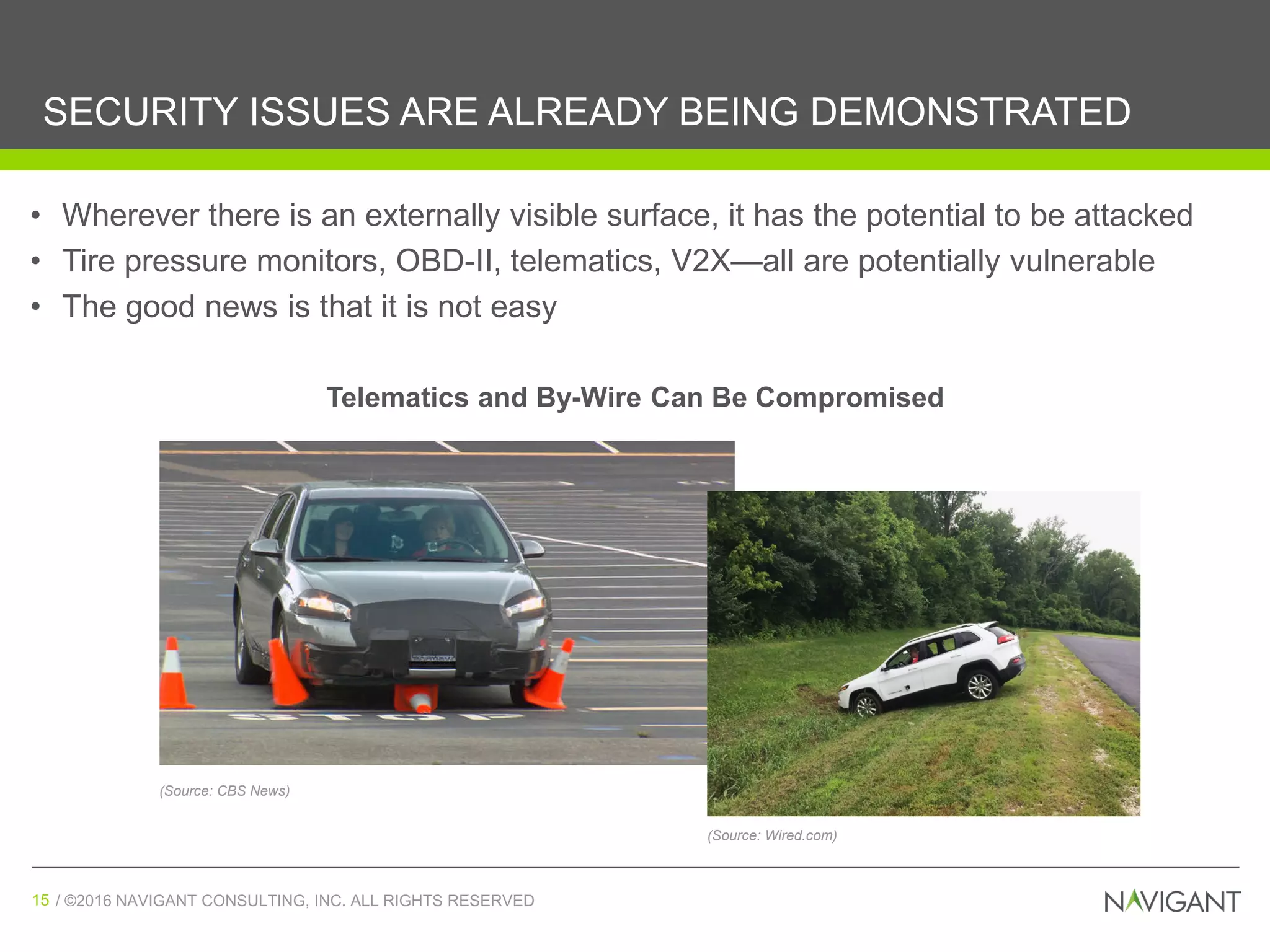
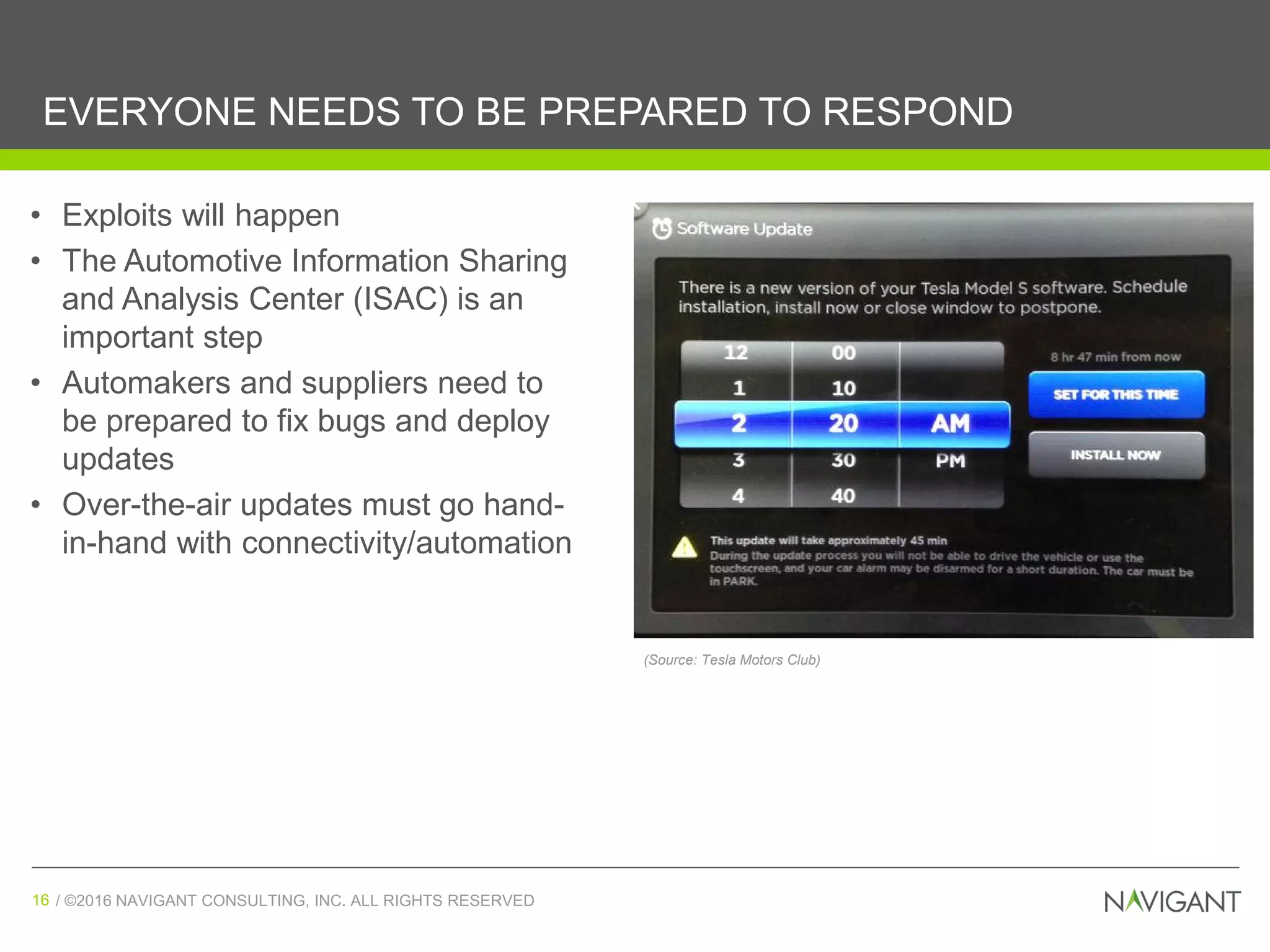
Concerns about security vulnerabilities in connected transportation and the necessity for robust safety measures.
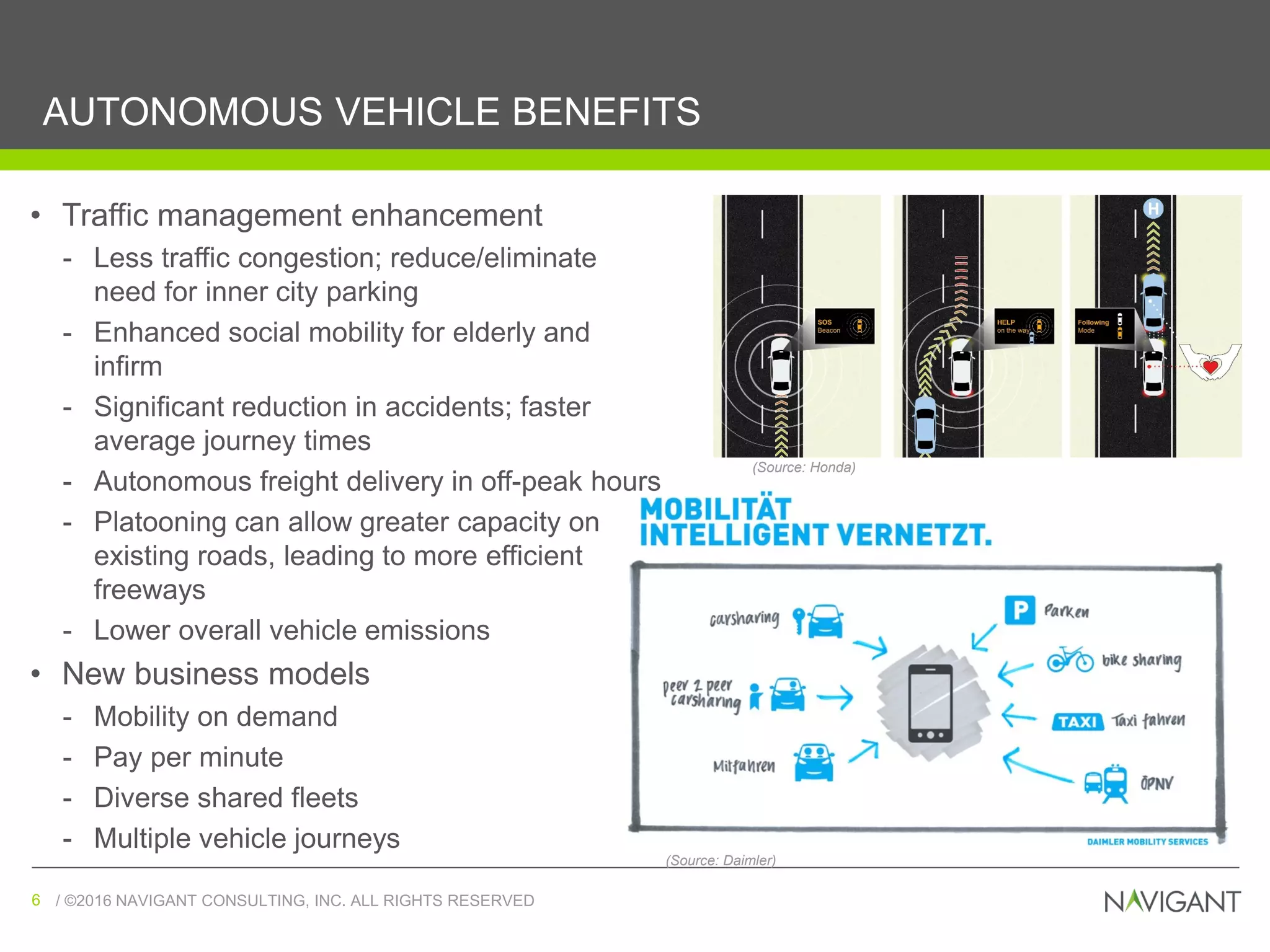
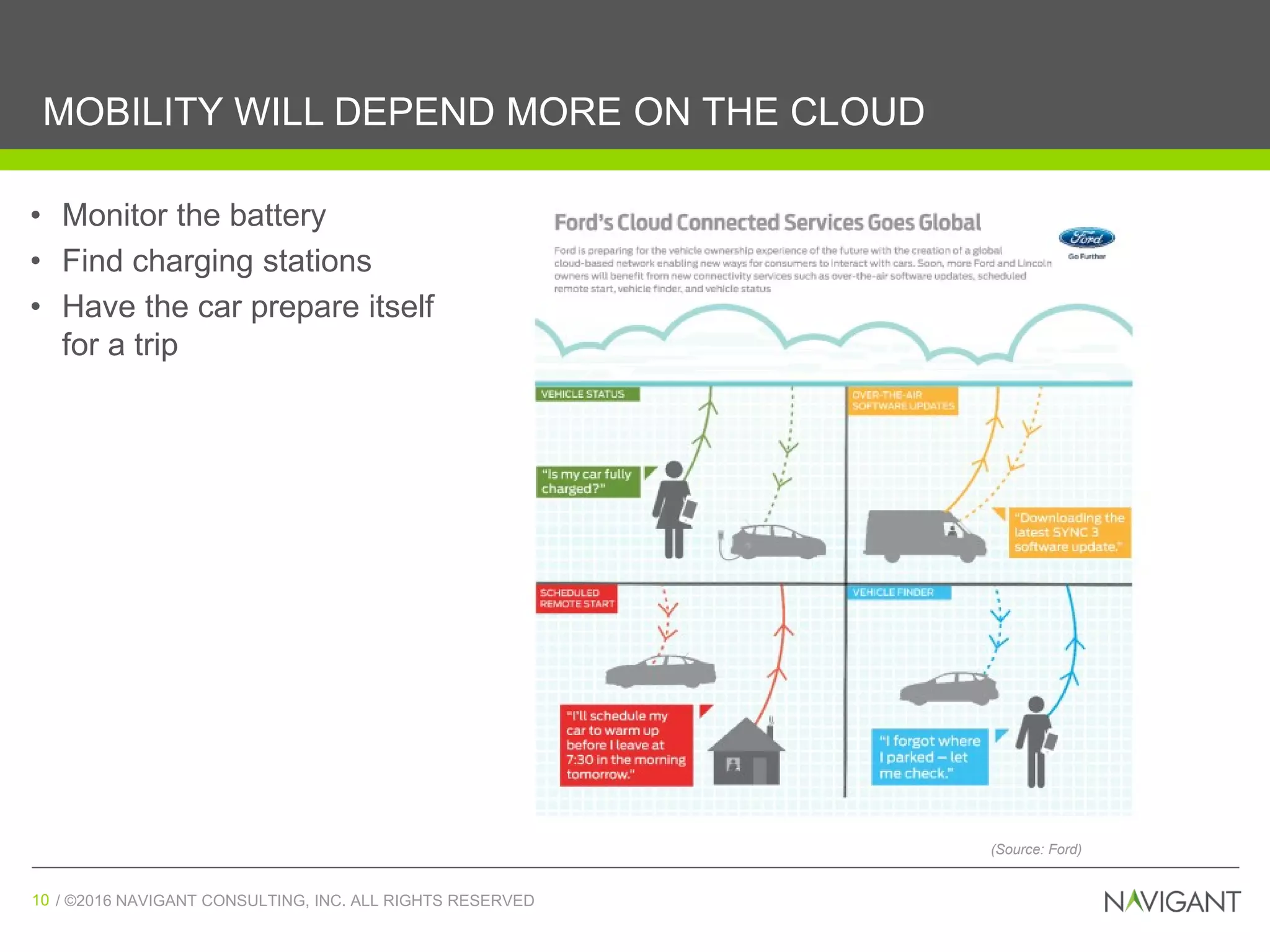
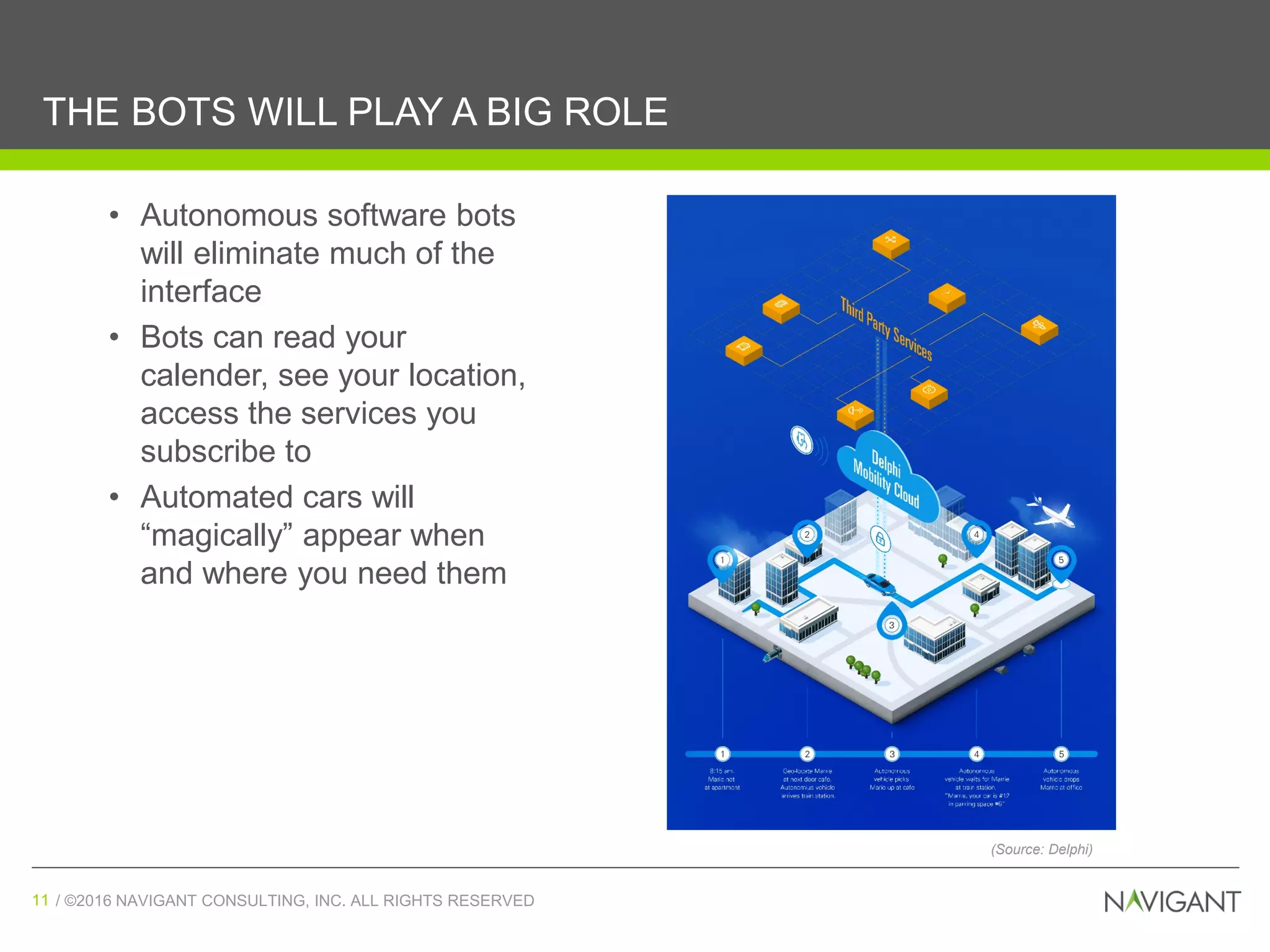
Automaker strategies for diversifying services around mobility, car sharing, and autonomous operations.
Requesting a Ride:
CarSharing and Car Hailing as
The Next Big Movement in
Autonomy
Annabel R. Chang, Director of Public Policy
2.
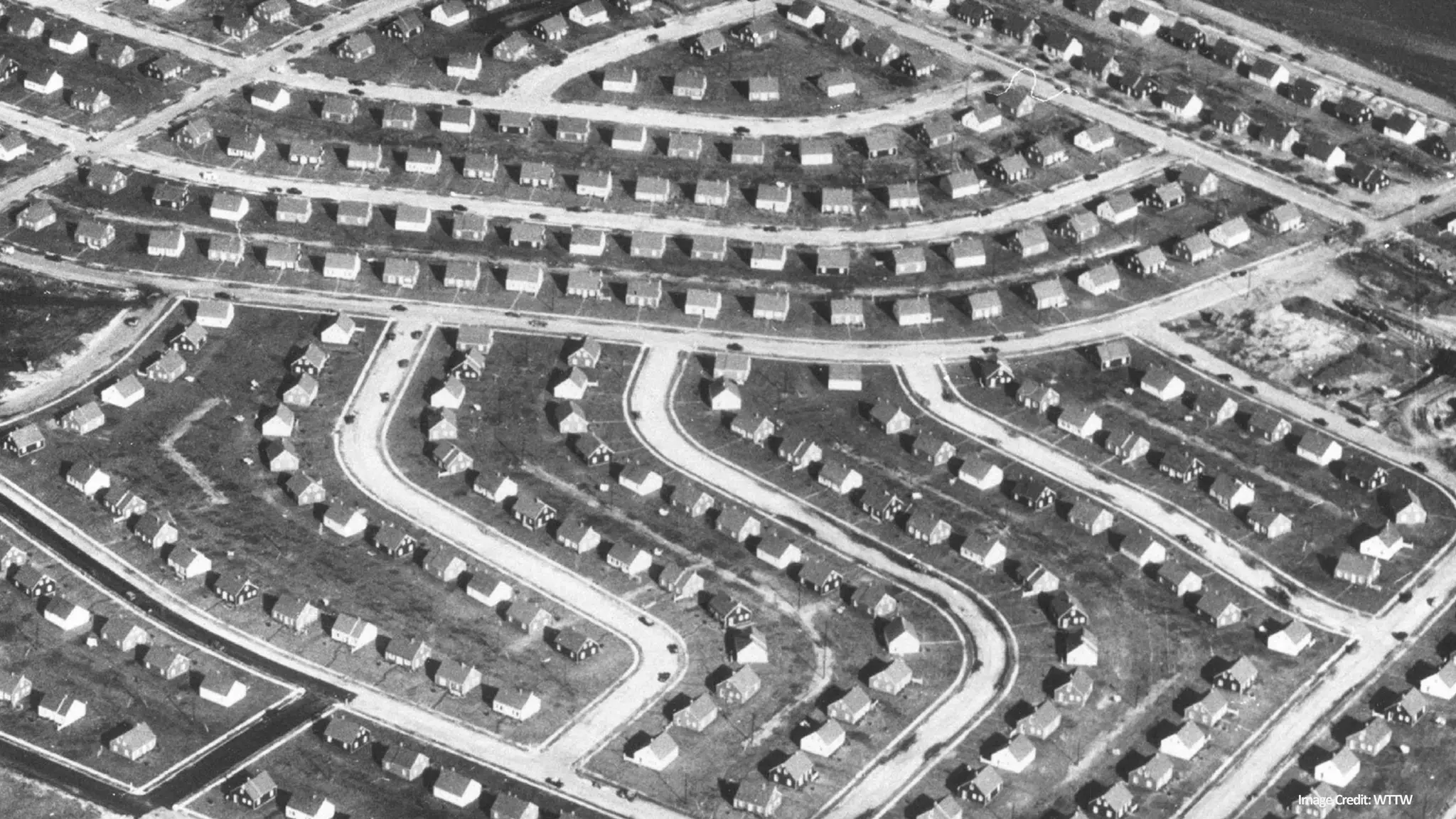
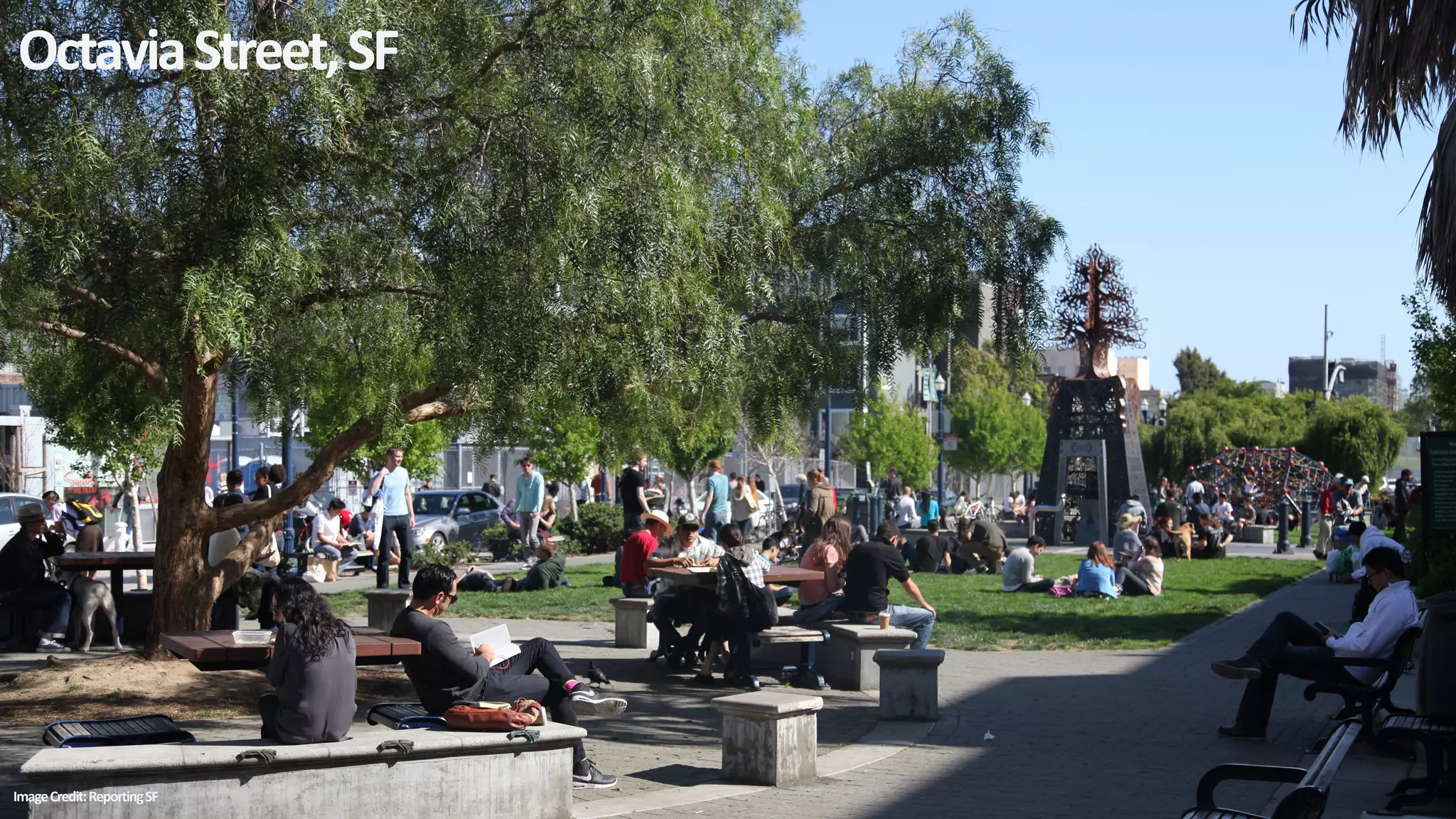
Imagine a neighborhoodthat has
no cars parked on the sides of the
streets. In a downtown area, you can
have wider sidewalks.
Cities can be built more around
people.
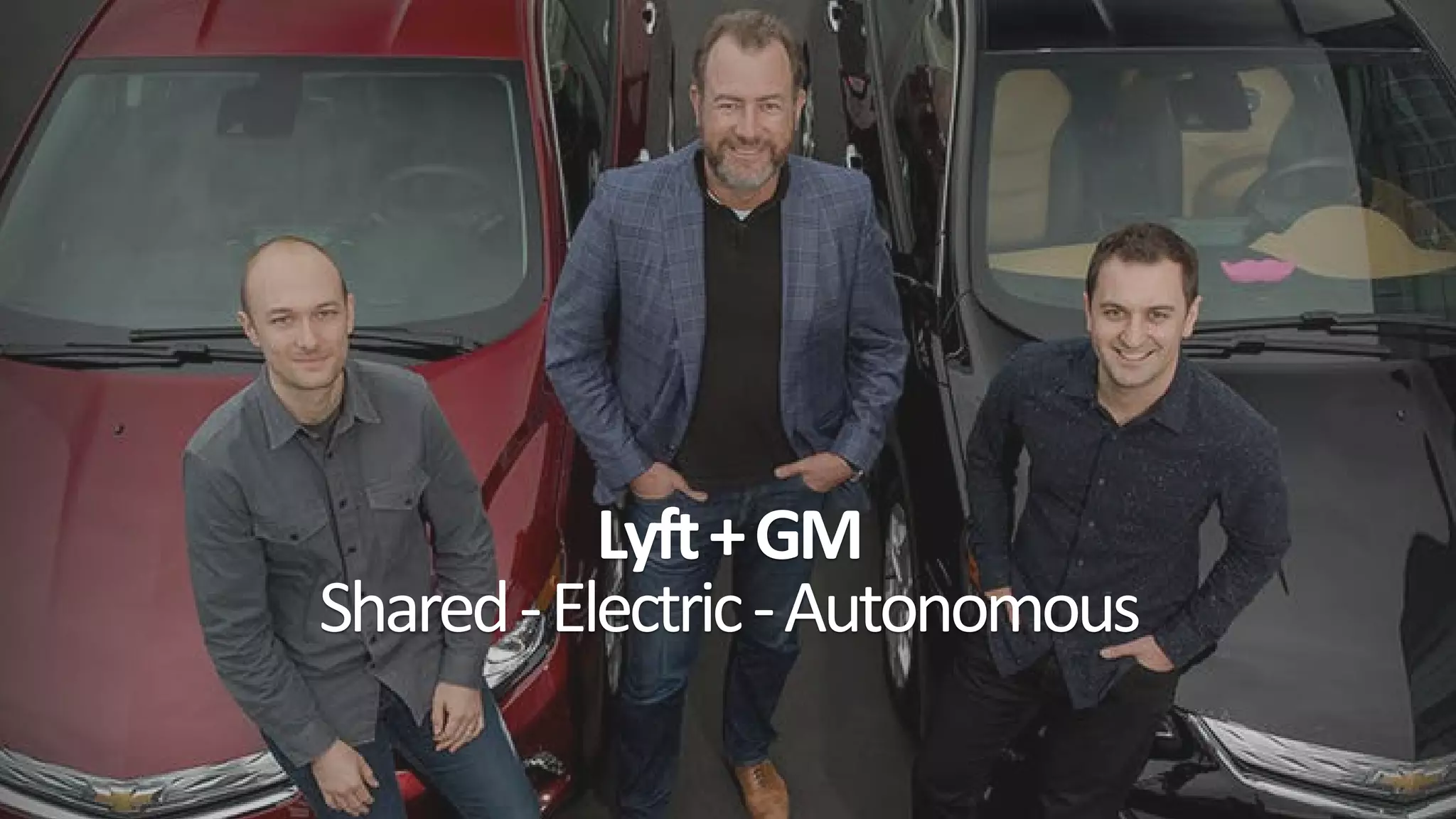
- Logan Green, Lyft CEO, Co-Founder
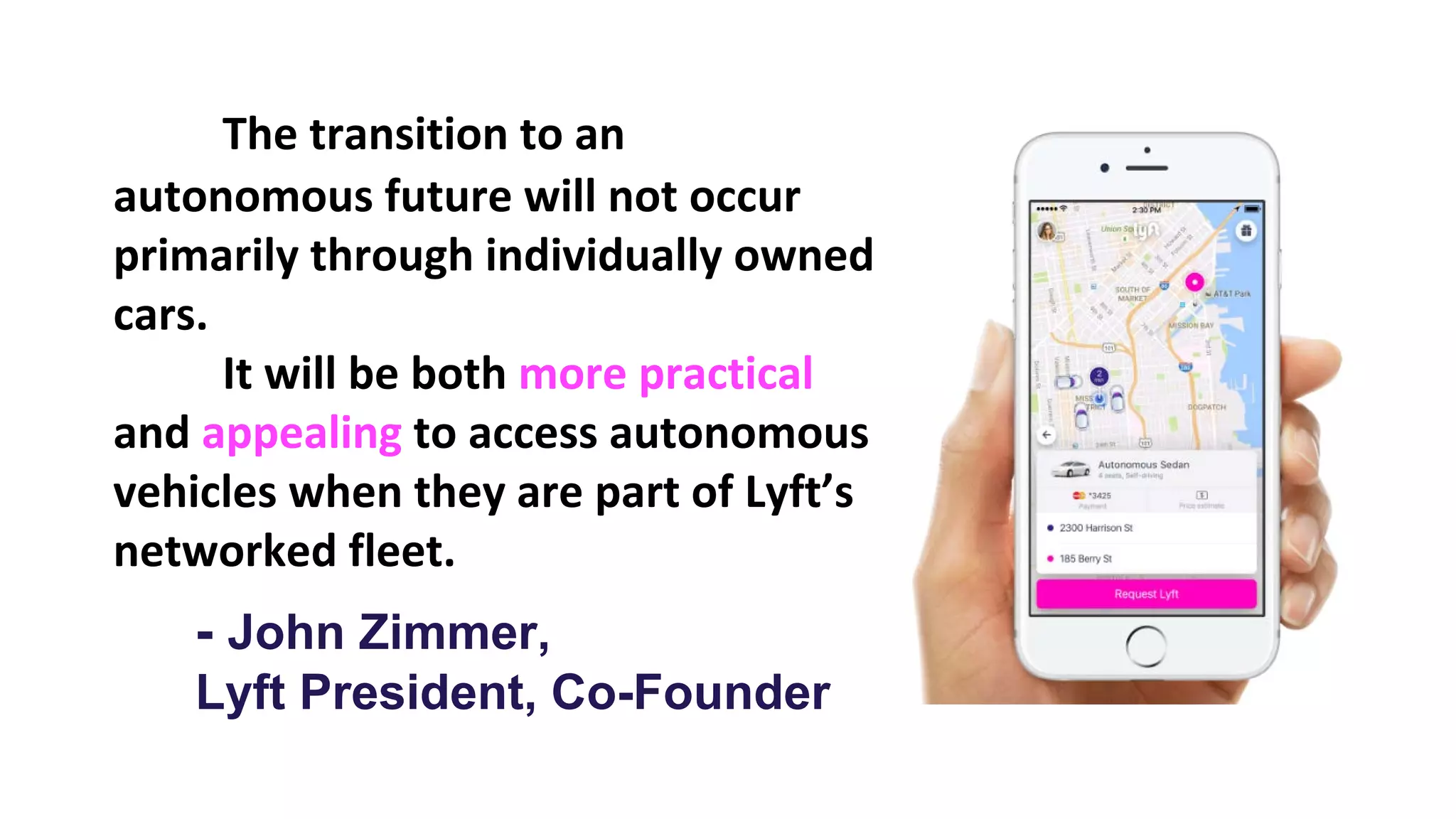
The transition toan
autonomous future will not occur
primarily through individually owned
cars.
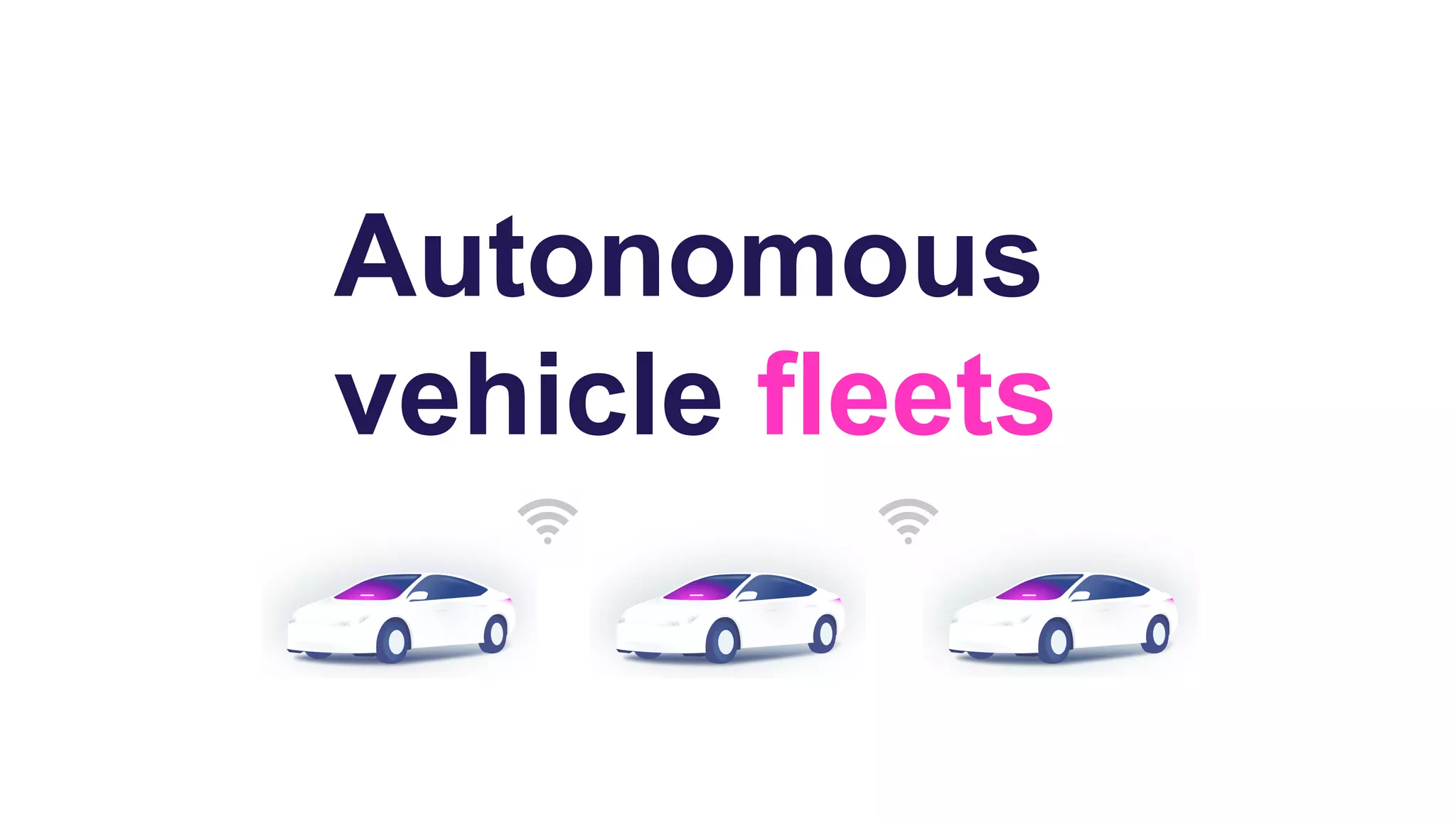
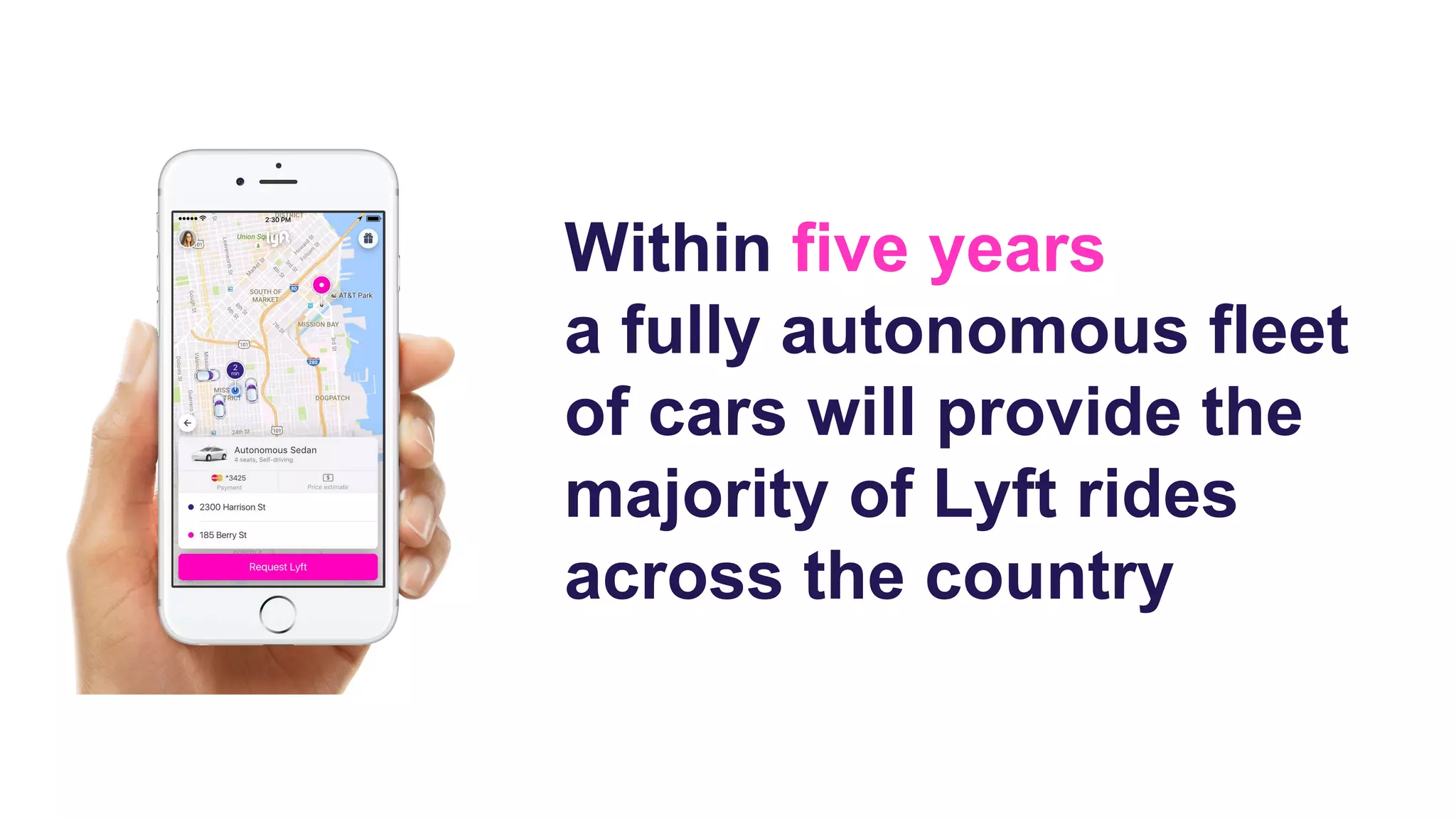
It will be both more practical
and appealing to access autonomous
vehicles when they are part of Lyft’s
networked fleet.
- John Zimmer,
Lyft President, Co-Founder
29.
User Experience inAutomated Driving
Glen W. De Vos
Chief Technology Officer and Senior Vice President
30.
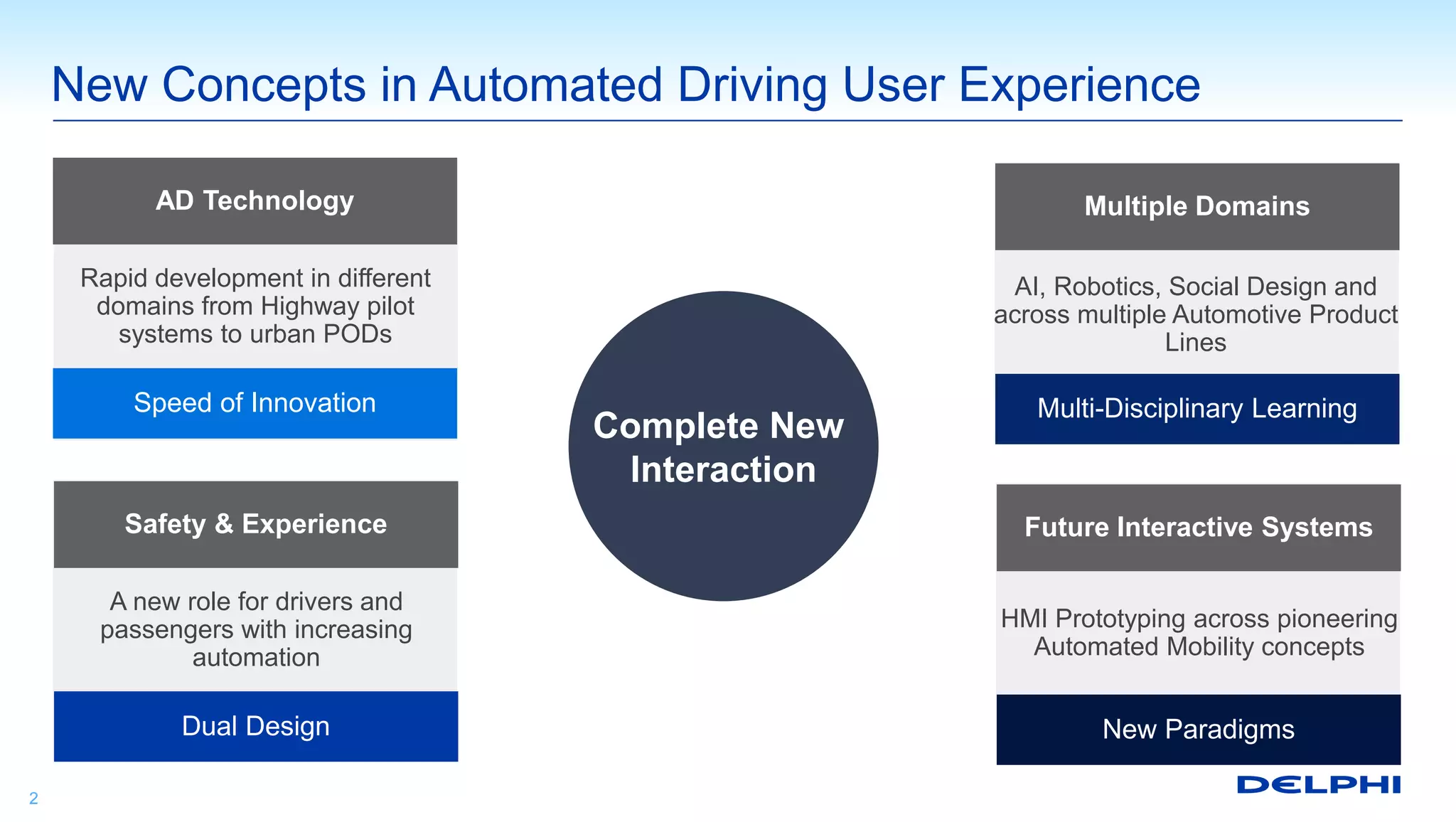
New Concepts inAutomated Driving User Experience
2
Rapid development in different
domains from Highway pilot
systems to urban PODs
AD Technology
Speed of Innovation
Complete New
Interaction
A new role for drivers and
passengers with increasing
automation
Safety & Experience
Dual Design
Multiple Domains
Multi-Disciplinary Learning
HMI Prototyping across pioneering
Automated Mobility concepts
Future Interactive Systems
New Paradigms
AI, Robotics, Social Design and
across multiple Automotive Product
Lines
31.
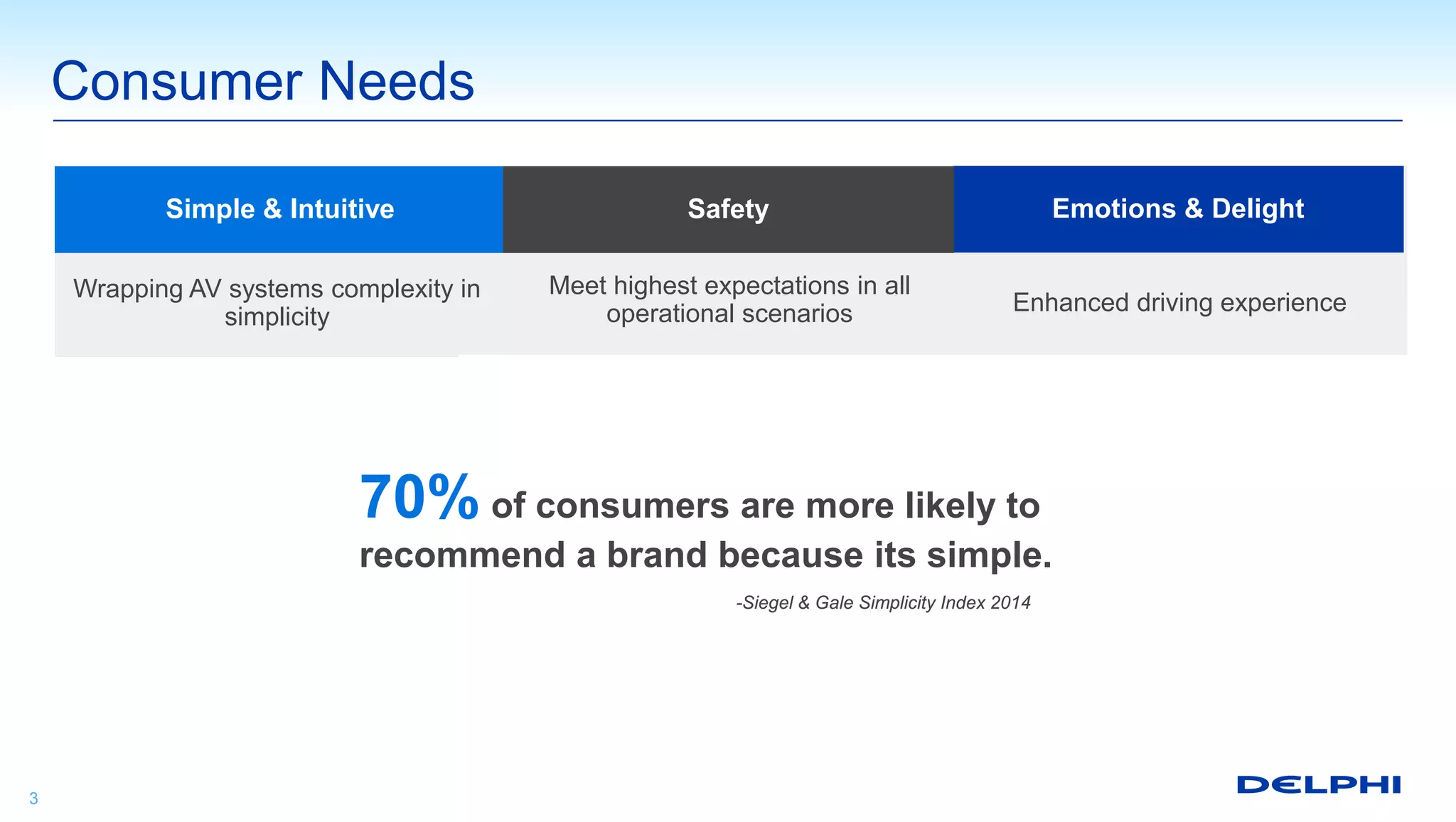
Consumer Needs
3
Simple &Intuitive
70% of consumers are more likely to
recommend a brand because its simple.
Emotions & DelightSafety
Wrapping AV systems complexity in
simplicity
Meet highest expectations in all
operational scenarios Enhanced driving experience
-Siegel & Gale Simplicity Index 2014
32.
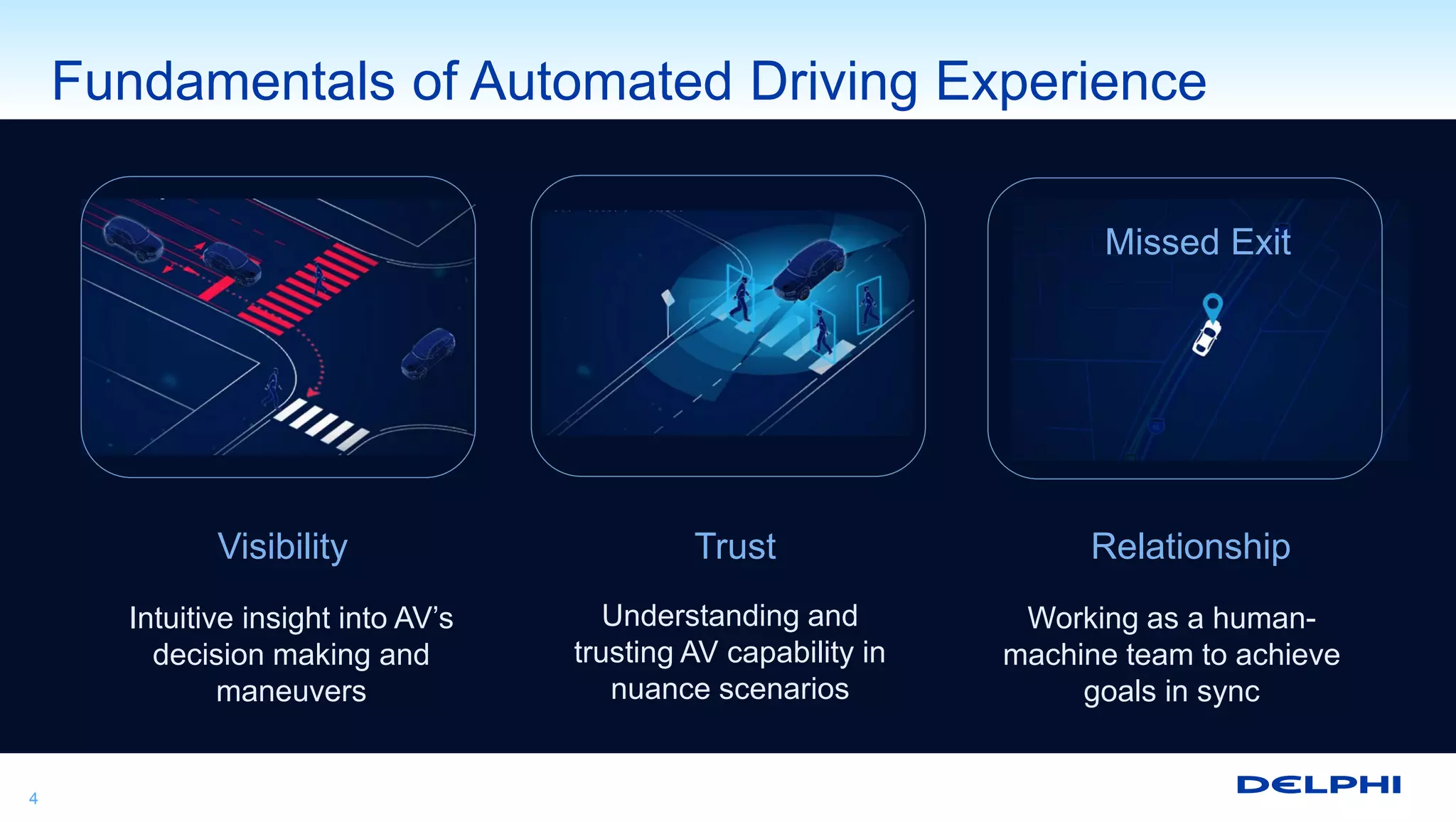
Fundamentals of AutomatedDriving Experience
4
Missed Exit
Visibility Trust Relationship
Intuitive insight into AV’s
decision making and
maneuvers
Understanding and
trusting AV capability in
nuance scenarios
Working as a human-
machine team to achieve
goals in sync
33.
Socializing New Technology
5
AcceptanceSociety Integration Enriching Passenger
Experience
Acceptance of new roles
and vehicle behaviors as
AD technology transitions
AV integration into a city
and its social interactions
with vehicles, pedestrians
Pre-Ride, Post Ride
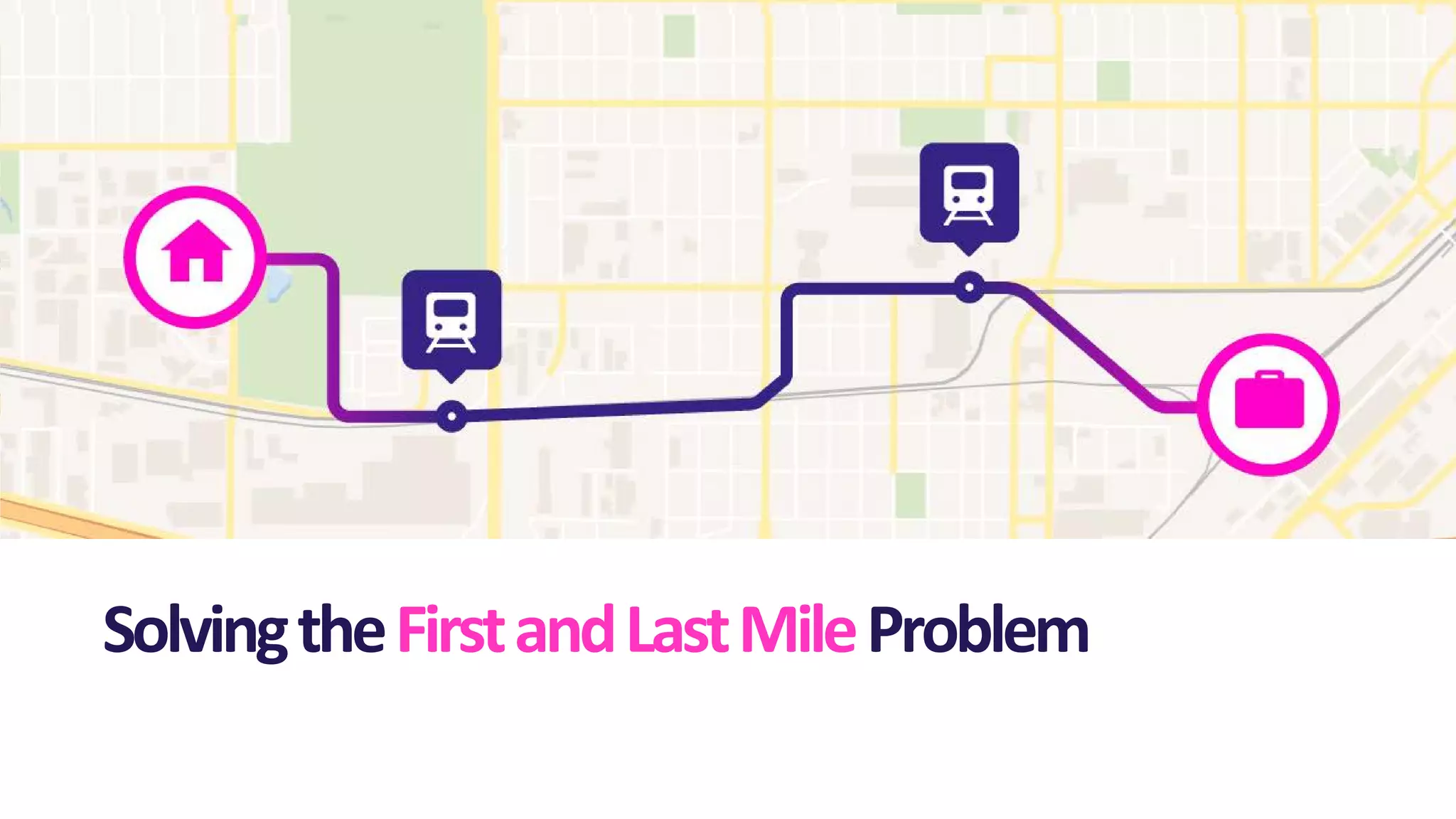
First Mile / Last Mile
Parking Pain Points
34.
Transitional Approach -Automated Driving Design
6
High
Low
Design
Sprints
Focus
Automated Vehicle Capability
Trust &
Relationship
Acceptance & Society
Integration Enriching travel experience
Building blocks based on priority and core fundamentals
Transitioning without oversimplification of human factors
Transitional Approach as AD Technology evolves
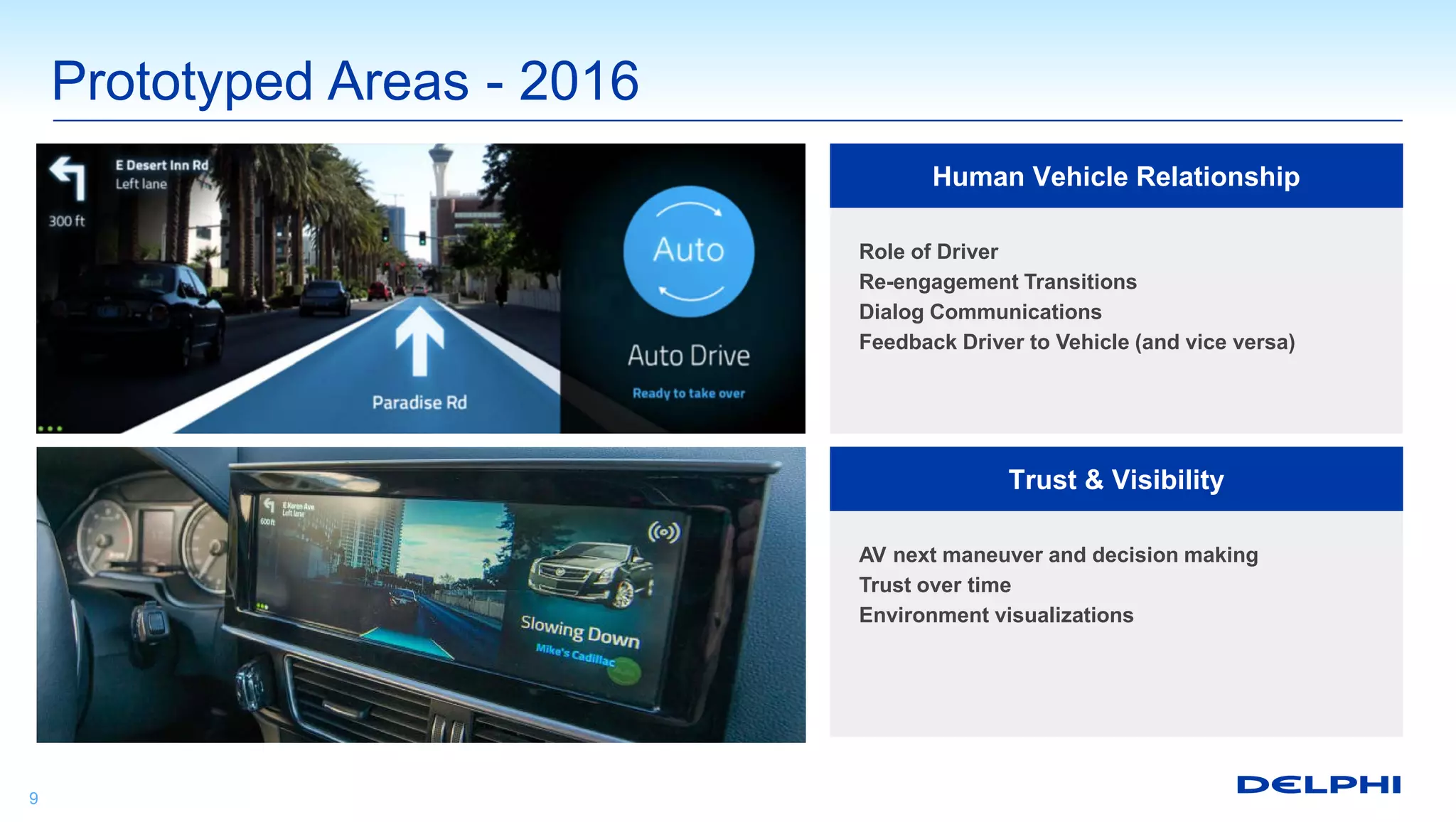
Prototyped Areas -2016
9
Human Vehicle Relationship
Role of Driver
Re-engagement Transitions
Dialog Communications
Feedback Driver to Vehicle (and vice versa)
Trust & Visibility
AV next maneuver and decision making
Trust over time
Environment visualizations
38.
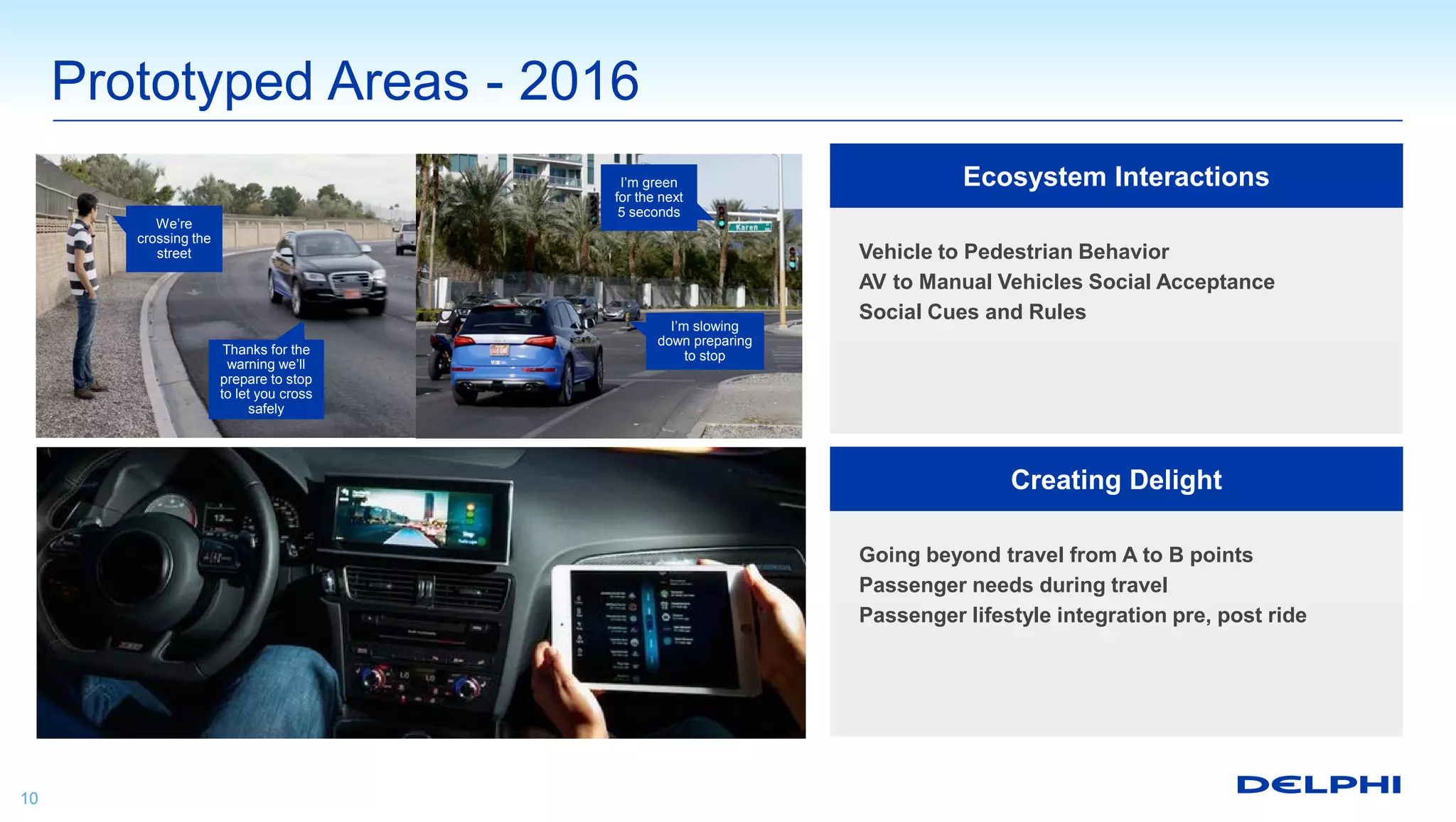
Prototyped Areas -2016
10
Ecosystem Interactions
Vehicle to Pedestrian Behavior
AV to Manual Vehicles Social Acceptance
Social Cues and Rules
Creating Delight
Going beyond travel from A to B points
Passenger needs during travel
Passenger lifestyle integration pre, post ride
We’re
crossing the
street
Thanks for the
warning we’ll
prepare to stop
to let you cross
safely
I’m green
for the next
5 seconds
I’m slowing
down preparing
to stop
39.
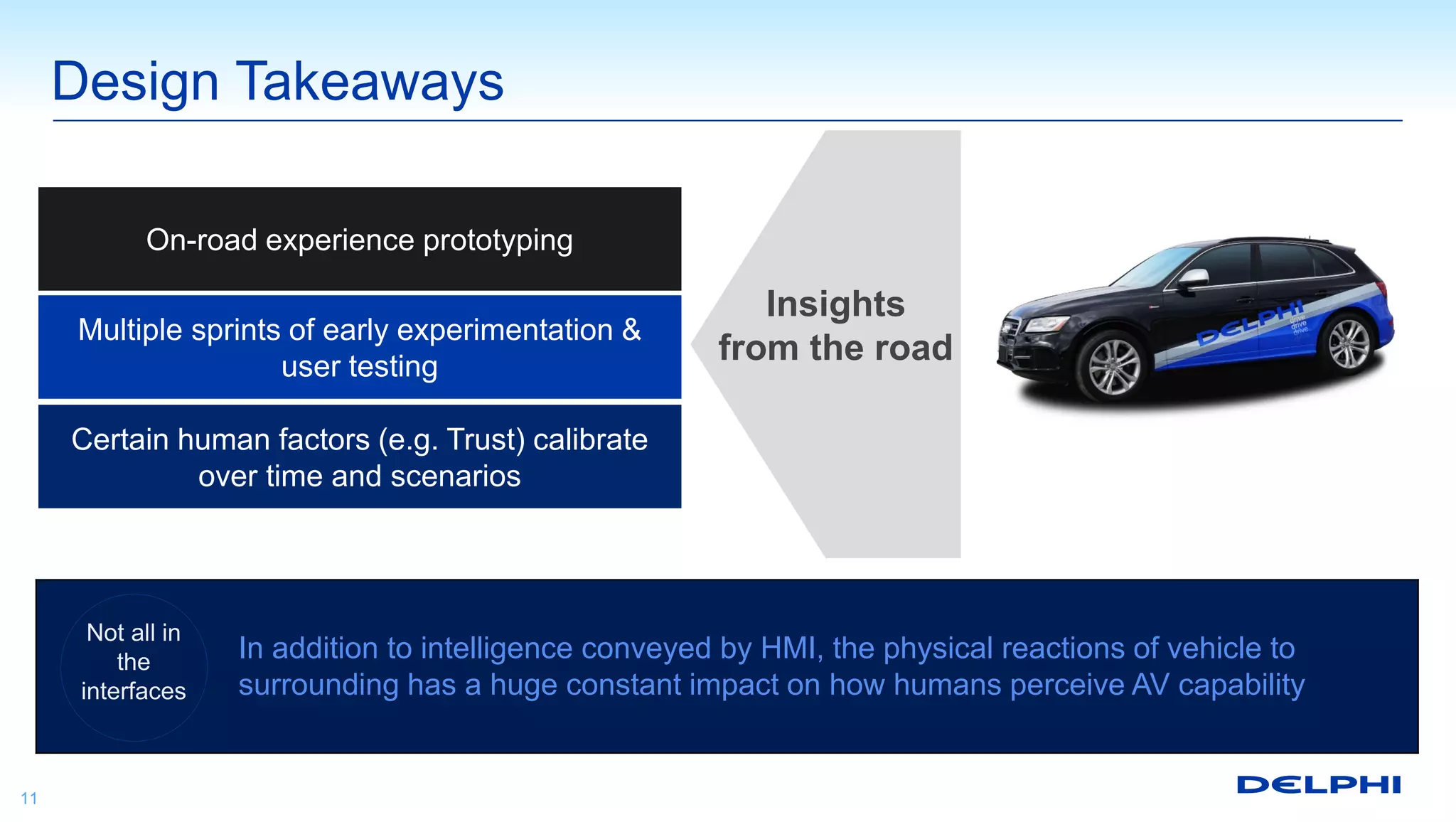
Design Takeaways
11
On-road experienceprototyping
Multiple sprints of early experimentation &
user testing
Certain human factors (e.g. Trust) calibrate
over time and scenarios
Insights
from the road
Not all in
the
interfaces
In addition to intelligence conveyed by HMI, the physical reactions of vehicle to
surrounding has a huge constant impact on how humans perceive AV capability
40.
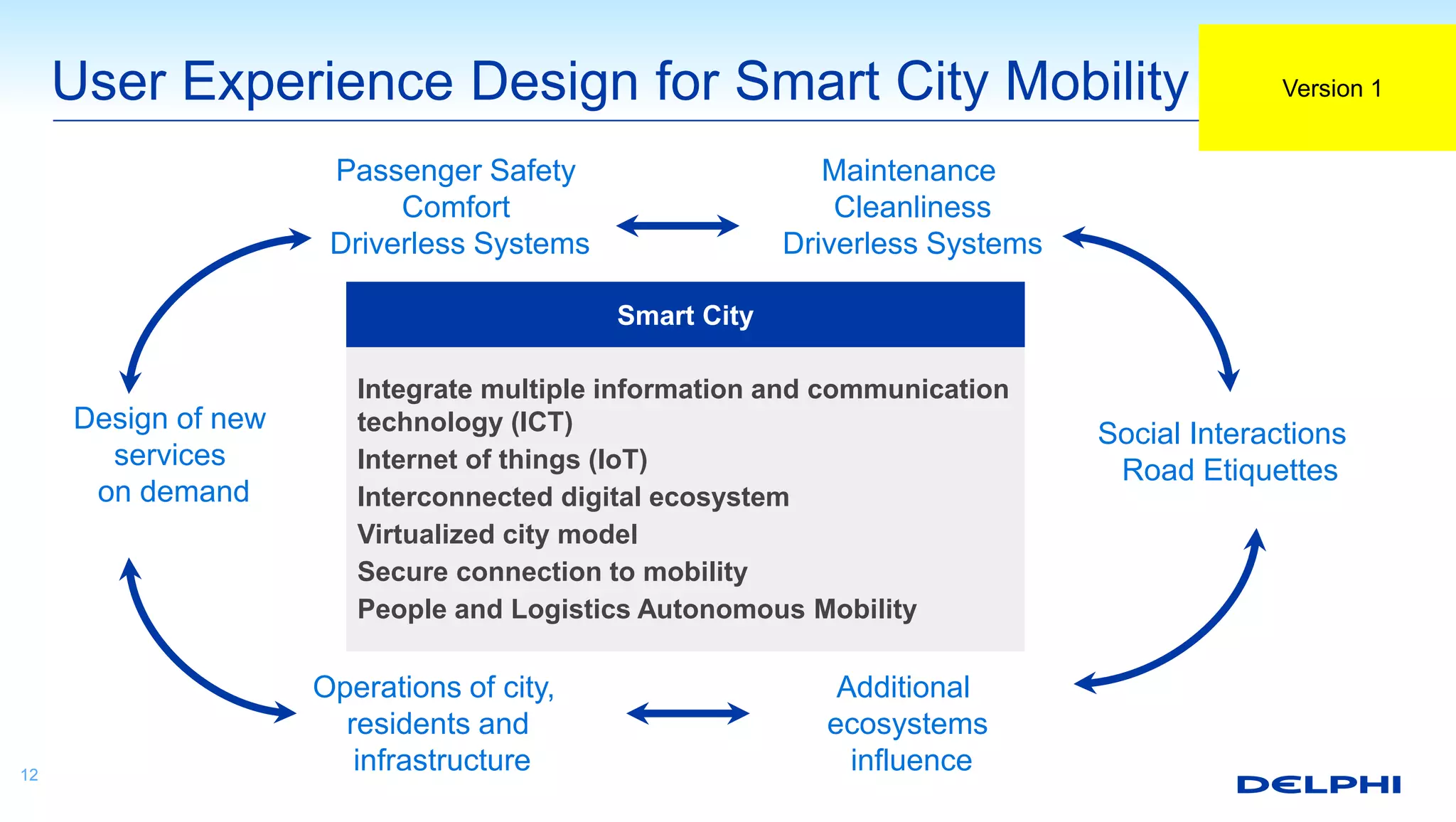
User Experience Designfor Smart City Mobility
12
Passenger Safety
Comfort
Driverless Systems
Maintenance
Cleanliness
Driverless Systems
Design of new
services
on demand
Social Interactions
Road Etiquettes
Operations of city,
residents and
infrastructure
Additional
ecosystems
influence
Smart City
Integrate multiple information and communication
technology (ICT)
Internet of things (IoT)
Interconnected digital ecosystem
Virtualized city model
Secure connection to mobility
People and Logistics Autonomous Mobility
Version 1
41.
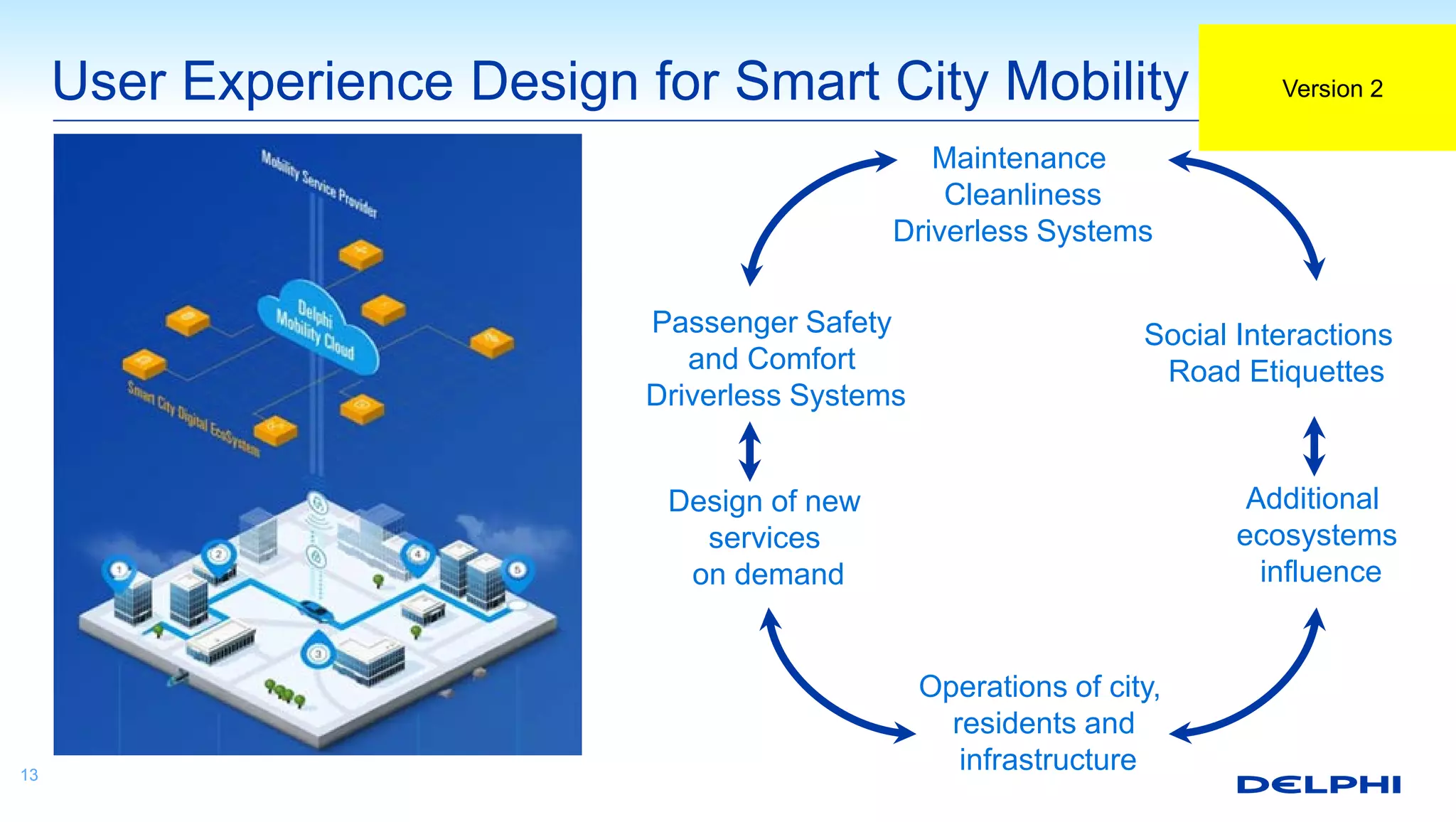
User Experience Designfor Smart City Mobility
13
Passenger Safety
and Comfort
Driverless Systems
Maintenance
Cleanliness
Driverless Systems
Design of new
services
on demand
Social Interactions
Road Etiquettes
Operations of city,
residents and
infrastructure
Additional
ecosystems
influence
Version 2
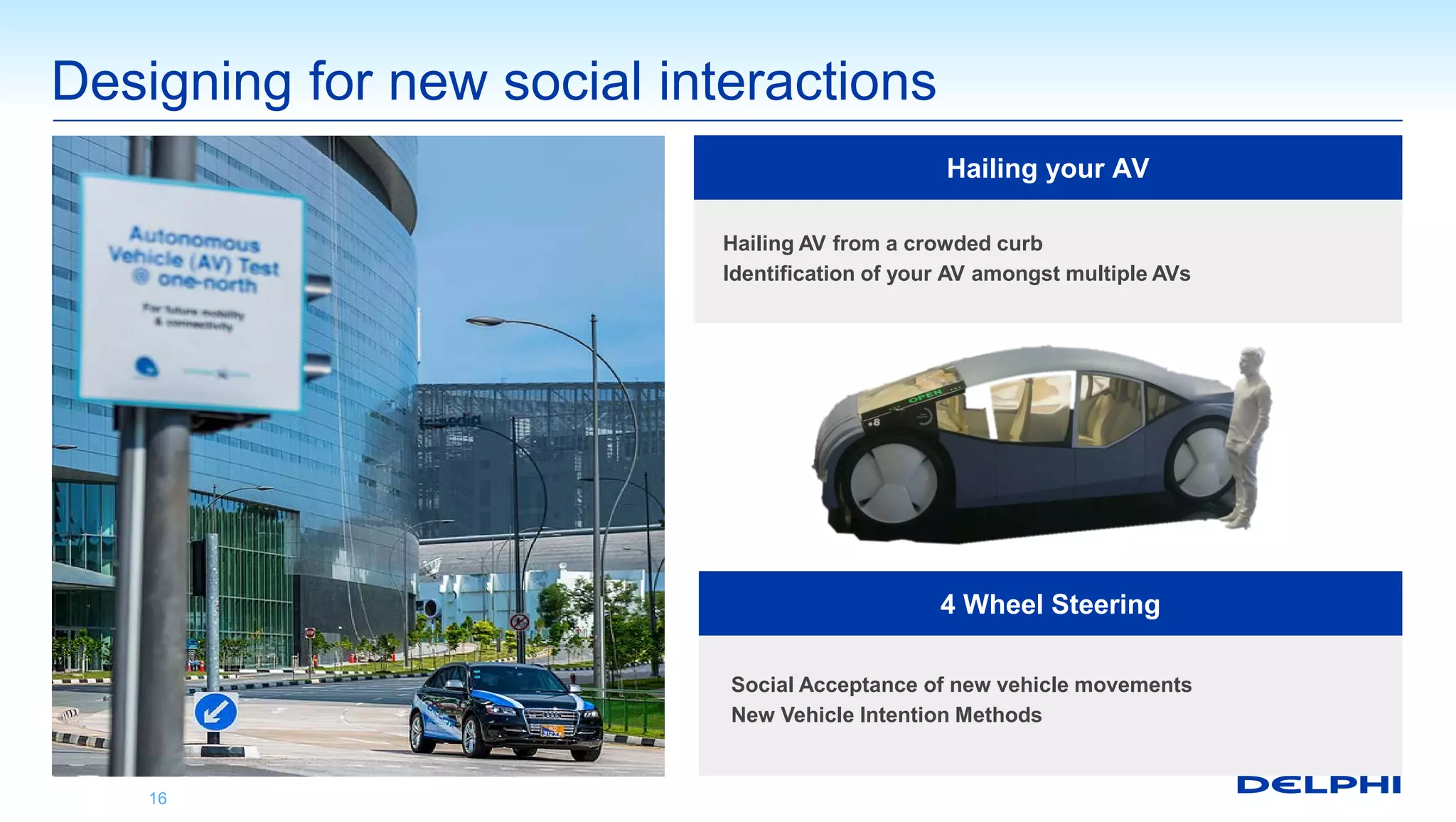
Designing for newsocial interactions
16
Hailing your AV
Hailing AV from a crowded curb
Identification of your AV amongst multiple AVs
4 Wheel Steering
Social Acceptance of new vehicle movements
New Vehicle Intention Methods
45.
Final Thoughts
17
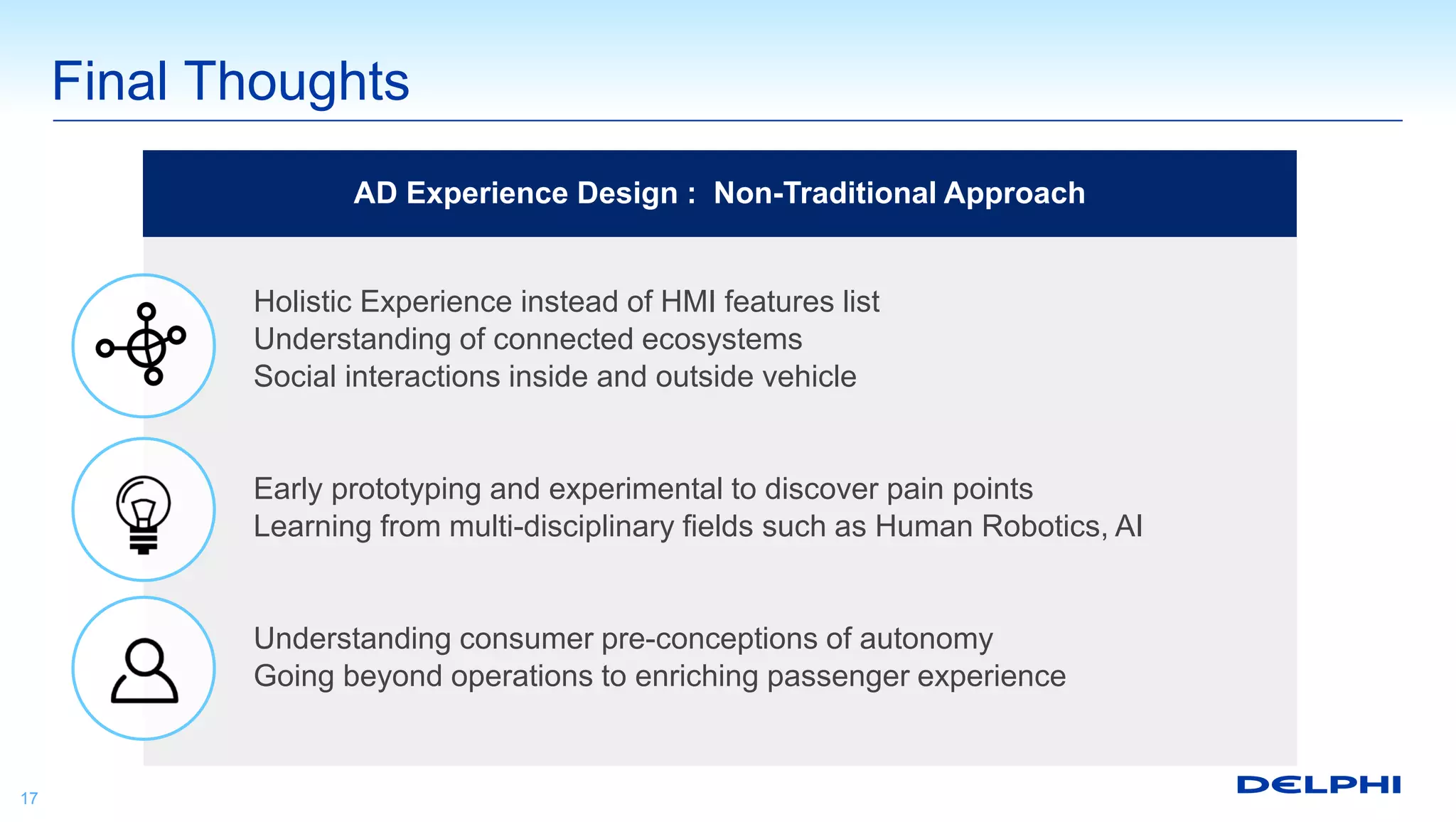
Holistic Experienceinstead of HMI features list
Understanding of connected ecosystems
Social interactions inside and outside vehicle
Early prototyping and experimental to discover pain points
Learning from multi-disciplinary fields such as Human Robotics, AI
Understanding consumer pre-conceptions of autonomy
Going beyond operations to enriching passenger experience
AD Experience Design : Non-Traditional Approach