Pumping Stations Design
For Infrastructure Master Program
Engineering Faculty-IUG
Dr. Fahid Rabah
Water and environment Engineering
frabah@iugaza.edu
Lecture 1: Introduction to pumping stations
1.1 Purpose and types of pumping stations
The main purpose of pumping stations is to transfer fluids from
low points to higher points.
The main types of pumping stations are:
„ Wastewater PS.
„ Water PS.
„ Sludge PS.
„ Storm water PS.
„
Lecture 1: Introduction to Pumping Stations
„
Lecture 1: Introduction to Pumping Stations
Grit
Removal
Wet
Well
Pump
House
Bar Screen
Service building Emergency power station
Pressure line
Inlet pipe
Typical Layout of Wastewater Pumping Station
„
Lecture 1: Introduction to Pumping Stations
Manual Bar Screen Mechanical Bar Screen
„
Lecture 1: Introduction to Pumping Stations
Grit Removal Channel
„
Lecture 1: Introduction to Pumping Stations
Wet well and Pump House
„
Lecture 1: Introduction to Pumping Stations
Dry well Pump House
„
Lecture 1: Introduction to Pumping Stations
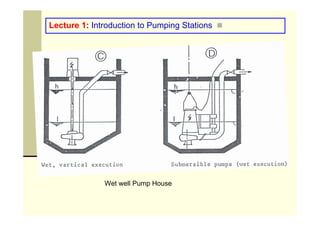
Wet well Pump House
„
Lecture 1: Introduction to Pumping Stations
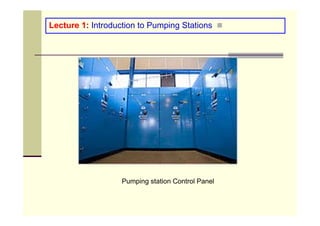
Pumping station Control Panel
„
Lecture 1: Introduction to Pumping Stations
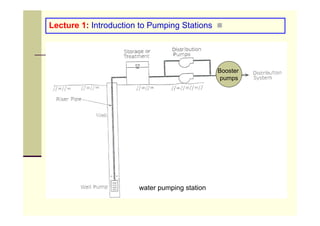
water pumping station
Booster
pumps
„
Lecture 1: Introduction to Pumping Stations
water pumping station
„
Lecture 1: Introduction to Pumping Stations
Booster pumping station
Inline Booster Pump
1.2 Types of pumps
Pumps are classified into two main categories:
„ Kinetic pumps.
o Centrifugal pumps ( radial, axial, mixed flow)
o Turbine (vertical) pumps
„ Positive displacement pumps.
o Rotary pumps ( screw, lobe)
o Reciprocating pumps (plunger)
„
Lecture 1: Introduction to Pumping Stations
„
Lecture 1: Introduction to Pumping Stations
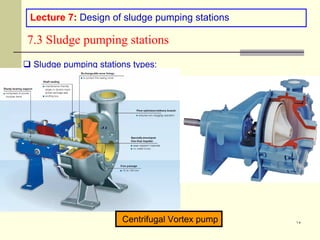
Impeller
Vanes
Impeller
Vanes
Casing
Casing
Suction Eye
Suction Eye Impeller
Impeller
Discharge
Discharge
Flow Expansion
Flow Expansion
Kinetic Pumps: Centrifugal Pump
The common feature of all centrifugal pumps is the Volute
Volute
„
Lecture 1: Introduction to Pumping Stations
Kinetic Pumps: Centrifugal Pump
„
Lecture 1: Introduction to Pumping Stations
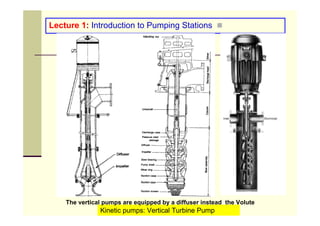
Kinetic pumps: Vertical Turbine Pump
The vertical pumps are equipped by a diffuser instead the Volute
„
Lecture 1: Introduction to Pumping Stations
Rotary Pump: Screw pumping station
„
Lecture 1: Introduction to Pumping Stations
Rotary Pump: Screw pumping station
„
In the screw pump a revolving shaft fitted with blades rotates in an inclined
trough and pushes the water up the trough.
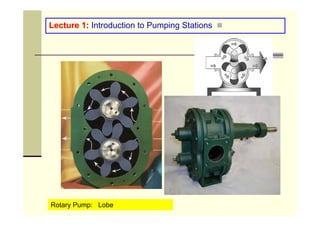
Rotary Pump: Lobe
„
Lecture 1: Introduction to Pumping Stations
„
Lecture 1: Introduction to Pumping Stations
Reciprocating Pump: Screw pumping station
• In the reciprocating pump a piston sucks the fluid into a cylinder then pushes it
up causing the water to rise.
Pumping Stations Design
For Infrastructure Master Program
Engineering Faculty-IUG
Dr. Fahid Rabah
Water and environment Engineering
frabah@iugaza.edu
Lecture 2: Pumping Hydraulics
٢
Lecture 2: Pumping Hydraulics
The main items that will be studied under the pumping hydraulics title are:
 Pumping pressure and head terminology
 Cavitation
 Pump characteristic curves
 Multiple pump operation
 Variable speed pumps
 Affinity laws
 Pump selection
٣
2.1 pumping pressure and head terminology
Lecture 2: Pumping Hydraulics
 Understanding pumping pressure and head terminology is essential in pumping
stations design.
 The pumping system consist mainly from :
•The pump
• A wet well containing the liquid to be pumped
• A suction pipe connecting the wet well and the pump.
• A delivery pipe
•A delivery tank or a delivery point
• Valves and fittings installed on the suction and delivery pipes
There are two cases for the pumping system that depend on the location of the
pump in reference to the wet well:
•Case 1: the pump centerline is lower than the level of the water surface in
the wet well.
•Case 2 : the pump centerline is higher than the level of the water surface in
the wet well.
The following is an explanation for pumping terminology for both cases.
٤
2.1 pumping pressure and head terminology
Lecture 2: Pumping Hydraulics
Figure 2.1 Case 1: Terminology for a pump with a positive suction head
H
t
hd
H
stat
h
s
H
ms
H
md
Datum pump
center line
h
fs
h
f
d
hgs
hgd
H
t
=
TDH
Hg
g
Vd 2
/
2
g
Vs 2
/
2
+
h
md
+
h
ms
٥
2.1 pumping pressure and head terminology
Lecture 2: Pumping Hydraulics
Figure 2.2 Case 2: Terminology for a pump with a negative suction head
H
stat
H
md
H
ms
hd
H
t
h
s
D a tu m p u m p
cen ter lin e
h
f
d
h
f
s
h
gd
h
gs
H
t
=
TDH
H
g
g
Vd 2
/
2
g
Vs 2
/
2
+
h
ms
+
h
md
٦
2.1 pumping pressure and head terminology
Lecture 2: Pumping Hydraulics
Definition of pumping head terms:
The terms that appear in figures 2.1 and 2.2 can be defined as the following:
 hs (Static suction head): It is the difference in elevation between the wet
well liquid level and the datum elevation passing through the pump impeller center.
 hd ( Static discharge head ): It is the difference in elevation between the
discharge liquid level and the datum elevation passing through the pump impeller
center.
 Hstat (Static discharge head): It is the difference (or sum) in elevation between
the static discharge and the static suction heads:
Note: it is (-) when the pump center is below the wet well liquid level.
and (+) when the pump center is above the wet well liquid level
H h h
stat d s
 
٧
2.1 pumping pressure and head terminology
Lecture 2: Pumping Hydraulics
Definition of pumping head terms…. Continued:
 hgs ( manometric ( or gage) suction head): It is the suction gage reading.
it is also the height to which the water will rise in a manometer installed at the
suction side of the pump.
 hgd (manometric ( or gage) discharge head): It is the discharge gage
reading. It is also the height to which the water will rise in a manometer installed
at the discharge side of the pump.
 Hg (manometric ( or gage) discharge head): It is the increase in pressure
head produced by the pump. It is calculated as follows:
) when the pump center is below the wet well liquid level.
-
it is (
Note:
and (+) when the pump center is above the wet well liquid level
gs
h
gd
h
g
H 

٨
2.1 pumping pressure and head terminology
Lecture 2: Pumping Hydraulics
Definition of pumping head terms…. Continued:
 ( velocity head at the delivery side): It is the kinetic energy in the liquid
in the discharge pipe.
g
Vd 2
/
2
 ( velocity head at the suction side): It is the kinetic energy in the liquid
in the suction pipe.
g
Vs 2
/
2
 hms ( minor losses at the suction side): They are the losses in head (pressure)
due to the eddies and turbulence created during liquid flow through valves and
fittings in the suction pipe.
 hmd( minor losses at the delivery side): They are the losses in head (pressure)
due to the eddies and turbulence created during liquid flow through valves and
fittings in the delivery pipe.
٩
2.1 pumping pressure and head terminology
)
2
(
2
2
2
g
V
h
g
V
h
H s
s
g
d
d
g
t 



Lecture 2: Pumping Hydraulics
Definition of pumping head terms…. Continued:
 Ht ( total dynamic head TDH): It is the total head that the pump should deliver.
It can be determined using the following formula:
Case 1
for
)
2
(
2
2
2
g
V
h
g
V
h
H s
s
g
d
d
g
t 


 for Case 2
……….(1)
……….(2)
١٠
2.1 pumping pressure and head terminology
dynamic
stat
t H
H
H 

g
V
h
h
h
h
H d
s
m
s
f
d
m
d
f
dynamic
2
2







Lecture 2: Pumping Hydraulics
Definition of pumping head terms…. Continued:
 Ht (TDH) can also be calculated using Equations 3 or 4 :
These equation are valid for case 1 and 2 .
……….(3)
……….(4)
where
 






g
V
h
h
h
h
H
H d
s
m
s
f
d
m
d
f
stat
t
2
2
١١
2.1 pumping pressure and head terminology
Lecture 2: Pumping Hydraulics
Definition of pumping head terms…. Continued:
 Friction losses ( hfd and hfs) are calculated using Hazen Williams equation:
85
.
1
87
.
4
7
.
10






 
C
Q
D
h f
Where:
hf = friction losses due to friction, m
D = pipe diameter, m
Q = flow rate, m3/s
C = Hazen Williams friction coefficient
Values of “ C” are given in hydraulic references. For example:
C = 150 for PVC pipes
= 145 for Steel pipes
Note: C for new pipes is larger than C for old pipes from the same
material. And C is inversely proportional to hf .
١٢
2.1 pumping pressure and head terminology
Lecture 2: Pumping Hydraulics
Definition of pumping head terms…. Continued:
 Minor losses ( hmd and hmfs) are calculated using the following equation:
Where:
hm = minor losses, m
g = gravitational acceleration, m/s2
V = liquid velocity, m/s
K = minor losses coefficient
Values of “ K” are given in hydraulic references. For example:
K = 0.1 – 0.40 gate valve
= 0.30 for 45o bend
g
V
K
hm
2
2

١٣
2.1 pumping pressure and head terminology
Lecture 2: Pumping Hydraulics
Definition of pumping head terms…. Continued:
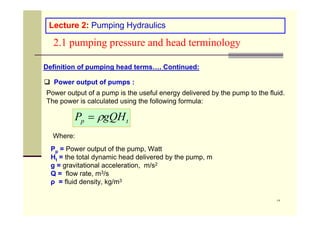
 Power output of pumps :
Power output of a pump is the useful energy delivered by the pump to the fluid.
The power is calculated using the following formula:
Pp = Power output of the pump, Watt
Ht = the total dynamic head delivered by the pump, m
g = gravitational acceleration, m/s2
Q = flow rate, m3/s
ρ = fluid density, kg/m3
t
p gQH
P 

Where:
١٤
2.1 pumping pressure and head terminology
i
t
i
p
p
P
gQH
P
P 
 

Lecture 2: Pumping Hydraulics
Definition of pumping head terms…. Continued:
 Pump Efficiency :
Pump efficiency is defined as the ratio between power output of the pump to the
power input supplied to the pump shaft:
ηp = pump efficiency
Pp = pump output power, Watt
Pi = input power to the pump, Watt
Where:
p
t
i
gQH
P



Or
Pi is the power supplied by the pump motor to the pump shaft and usually
called the brake power (bp)
١٥
2.1 pumping pressure and head terminology
m
i
m
P
P


Lecture 2: Pumping Hydraulics
Definition of pumping head terms…. Continued:
 Pump motor Efficiency :
Pump motor efficiency is defined as the ratio between power output of the pump
motor to the power input supplied to the pump impeller:
ηm = pump motor efficiency
Pm = input power to the pump motor, Watt
Where:
m
i
m
P
P


Or
Pm is the power supplied to the pump motor from an electricity source.
١٦
2.1 pumping pressure and head terminology
m
P
o
P
P


Lecture 2: Pumping Hydraulics
Definition of pumping head terms…. Continued:
 Overall System Efficiency :
Overall system efficiency is defined as the ratio between power output of the
entire system to the power input supplied by the electricity source:
ηO = Overall system efficiency
Where:
P
m
O 

 
Or
١٧
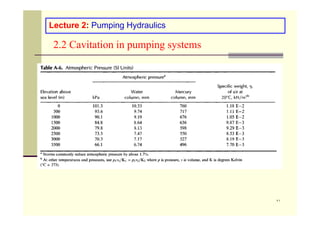
2.2 Cavitation in pumping systems
Lecture 2: Pumping Hydraulics
 Cavitation is the formation and collapse of vapor cavities within the pump.
 When Cavitation occurs in pumps it has the potential to cause:
1. Performance degradation : loss of head, capacity and efficiency.
2. Permanent damage due to erosion and mechanical failure of pump
component and structures.
3. Violet vibration and noise.
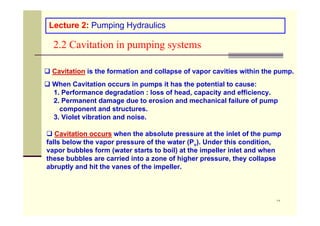
 Cavitation occurs when the absolute pressure at the inlet of the pump
falls below the vapor pressure of the water (Pv). Under this condition,
vapor bubbles form (water starts to boil) at the impeller inlet and when
these bubbles are carried into a zone of higher pressure, they collapse
abruptly and hit the vanes of the impeller.
١٨
2.2 Cavitation in pumping systems
Lecture 2: Pumping Hydraulics
Figure 2.3 Effect of Cavitation on pumps
١٩
2.2 Cavitation in pumping systems
g
V
g
P
g
P s
s
inlet
2
2




Lecture 2: Pumping Hydraulics
 To avoid Cavitation the total pressure available at the pump inlet
(Pinlet/ρg ) should be greater than the water vapor pressure (PV/ρg) .
In other words the difference between (Pinlet/ρg ) and (PVapor/ρg) should be
positive. This net head is called the net positive suction head (NPSH).
g
P
g
V
g
P
NPSH
vapor
s
s





2
2
 Knowing that the total pressure at the pump inlet is:
Then the NPSH mathematically is:
٢٠
2.2 Cavitation in pumping systems
Lecture 2: Pumping Hydraulics
(NPSH)A > (NPSH)R
 To avoid Cavitation the following condition should be maintained :
 




g
P
g
P
h
h
h
NPSH
vapor
atm
s
m
s
f
s
A



)
(
 (NPSH)A in the pumping systems shown in case 1 and case2 can be
calculated using the following formula:
Notes:
• (+) is used if hs is above the pump centerline (datum).
•Usually a factor of safety of 1.5 m on (NPSH)A is used
by subtracting 1.5m from the calculated value.
• Values of Patm and Pvapor are given in Tables A-6 and A-8
٢١
2.2 Cavitation in pumping systems
Lecture 2: Pumping Hydraulics
٢٢
2.2 Cavitation in pumping systems
Lecture 2: Pumping Hydraulics
٢٣
2.2 Cavitation in pumping systems
Lecture 2: Pumping Hydraulics
Cavitation constant:
The cavitation constant is defined as the ratio of NPSHi to the to Ht :
t
R
H
NPSH)
(


This constant is called Thoma’s cavitation constant
Where:
σ = cavitation constant
NPSHR = required net positive suction head, m
Ht = total dynamic head, m
٢٤
2.2 Cavitation in pumping systems
6
3
/
4
10
s
n
K 


Lecture 2: Pumping Hydraulics
Cavitation constant …. continued:
The cavitation constant can also be calculated by the following formula :
Where:
K = a constant that depends on pump efficiency.
ns = the pump specific speed
The pump specific speed can be calculated by the following formula:
4
3
2
1 
 t
s H
Q
n
n
Typical values of K are: 1726, 1210, and 796, for pumps efficiency of 70%, 80%
and 90%, respectively.
٢٥
2.2 Cavitation in pumping systems
Lecture 2: Pumping Hydraulics
Cavitation constant …. continued:
Where:
n = pump speed, revolution/s.
Q = pump flow rate, m3/s
study examples 10.5 and 10.6 in the Pumping Station design Reference book.
 Prevention and control of cavitation:
 To prevent cavitation keep the internal pressure of the pump above vapor pressure
 To solve an existing cavitation problem you may:
1. Decrease the suction lift (hs)
2. Decrease the suction losses (hsf , hsm)
3. Reduce the impeller speed
4. Change the pump or impeller
5. Add a booster pump on the suction side
Pumping Stations Design
For Infrastructure Master Program
Engineering Faculty-IUG
Lecture 4: Pumping Hydraulics
Dr. Fahid Rabah
Water and environment Engineering
frabah@iugaza.edu
Lecture 3: Pumping Hydraulics
The main items that will be studied under the pumping hydraulics title are:
 Pumping pressure and head terminology
 Cavitation
 Pump characteristic curves
 Multiple pump operation
2
 Multiple pump operation
 Variable speed pumps
 Affinity laws
 Pump selection
Lecture 3: Pumping Hydraulics
3.6 Pumps selection ( see Chapter 25)
 Use of specific speed in pump type selection:
Specific speed is defined as:
“The speed of an ideal pump geometrically similar to the actual pump, which when
running at this speed will raise a unit of volume, in a unit of time through a unit of
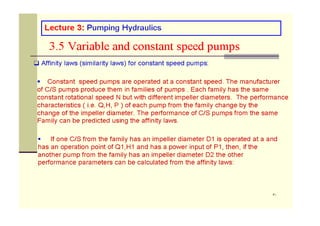
Specific speed is a term used to describe the geometry (shape) of a pump impeller.
3
4
3
t
2
1
s
H
Q
n
N 
running at this speed will raise a unit of volume, in a unit of time through a unit of
head."
Specific speed is calculated from the following formula:
Where:
Ns = specific speed (or type number)
n = pump rotational speed, rpm
Ht = total pump head, m
Q = pump discharge, m3/s
Lecture 3: Pumping Hydraulics
3.6 Pumps selection
4
Lecture 3: Pumping Hydraulics
3.6 Pumps selection
 Use of specific speed in pump type selection:
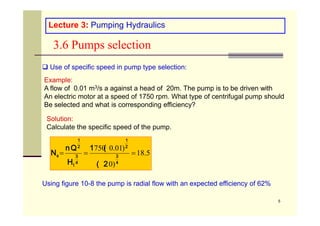
Example:
A flow of 0.01 m3/s a against a head of 20m. The pump is to be driven with
An electric motor at a speed of 1750 rpm. What type of centrifugal pump should
Be selected and what is corresponding efficiency?
5
5
.
18
)
0
)
01
.
0
750



4
3
2
1
4
3
t
2
1
s
(2
(
1
H
Q
n
N
Solution:
Calculate the specific speed of the pump.
Using figure 10-8 the pump is radial flow with an expected efficiency of 62%
Lecture 3: Pumping Hydraulics
3.6 Pumps selection
1. Type of the liquid to be pumped “ water, wastewater, sludge”.
2. Type of installation preferred“ submersible or dry”.
3. Pumps available in the market ( KSB, FLYGT, ABS,...).
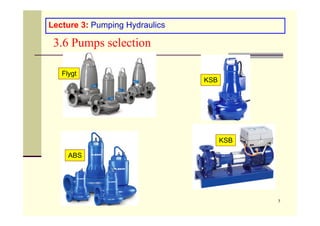
 In the selection process the following important information is needed:
 selection of the specific pump needed :
6
 selection of the specific pump needed :
1. Draw the system curve envelope and decide the operating point.
2. Decide the number of pumps needed ( see table 3.1).
3. Use the catalog of the manufacturers to select a suitable pump curve.
4. Draw the pump characteristics curve over the system curve.
5. Select a pump so that the Operating range of is within 60% to 115% of Q at BEP.
6. Compare pumps of different manufacturers for more economical choice.
Lecture 3: Pumping Hydraulics
3.6 Pumps selection
Flygt
KSB
7
ABS
KSB
Lecture 3: Pumping Hydraulics
3.6 Pumps selection
Standby pumps
No. of pumps
needed
Design flow
m3/h
1
1
Up to 160
Table 3.1 Recommended number of pumps in operation and their stand by.
8
1
2 or 3
160 -450
2
3 to 5
More than 450
Lecture 4: Water hammer phenomena (Hydraulic Transient)
4.1 General Introduction (See chapters 6 &7)
 What is water hammer?
Water hammer is a phenomena that occurs in pressurized pipe systems
when the flowing liquid is suddenly (instantaneously) obstructed by
(for example) closing a valve or by pump stoppage (failure). A laud
noise similar to hammer knocking noise occurs due to the collision of
the liquid mass with the obstruction body (valve or pump ) and the
9
the liquid mass with the obstruction body (valve or pump ) and the
internal walls of the pipe.
 What is water hammer scientifically?
Water hammer is a descriptive name of the phenomena but not scientific.
The scientific name is hydraulic transient. Hydraulics Transient means
temporary hydraulics since the phenomena last for a very short time.
During this short time the flow in the pipe is disturbed and consecutive
waves will be moving back and forth creating a very high pressure rise
in the pipe.
Lecture 4: Water hammer phenomena (Hydraulic Transient)
4.1 General Introduction (See chapters 6 &7)
 What is the problem with water hammer?
Hydraulic transient (water hammer) may cause disasters in pressurized liquid
systems such as:
1. Rupture of pipes and pump casings.
2. Vibration and high noise.
3. Excessive pipe displacements.
10
3. Excessive pipe displacements.
4. Vapor cavity formation.
5. Environmental pollution.
6. Life and economical losses.
 When water hammer occurs?
The most common cases where water hammer occurs are:
1. Pump failure.
2. Pump start up.
3. Sudden closure a valve.
4. Failure of flow or pressure regulators.
4.2 Water hammer pressure surge
Lecture 4: Water hammer phenomena (Hydraulic Transient)
To illustrate the pressure waves resulting from the hydraulic transient we will discuss
a tank, pipe, and valve system as an example. The figure below shows the normal
operation of the system before the valve closure.
11
H0
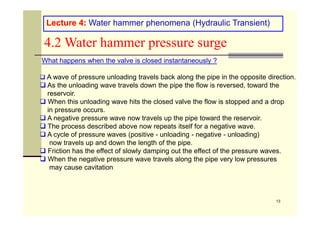
What happens when the valve is closed instantaneously ?
 When a valve is closed instantaneously the liquid next to the valve comes to a halt.
 This liquid is then compressed by the liquid upstream which is still flowing.
 This compression causes a local increase in the pressure on the fluid.
 The walls of the pipe around the fluid are stretched by the resulting excess pressure.
 A chain reaction then takes place along the length of the pipe, with each stationary
Lecture 4: Water hammer phenomena (Hydraulic Transient)
4.2 Water hammer pressure surge
12
 A chain reaction then takes place along the length of the pipe, with each stationary
 element of fluid being compressed by the flowing fluid upstream.
 This chain reaction results in a pressure wave which travels up the pipe with a
velocity “a “, which is called the celerity. (it may reach the speed of sound in
water (1484 m/s).
The pressure wave creates a transient hydraulic grade line (HGL) which is parallel
to the steady flow HGL, but at a height above it.
 The resulting increase in pressure is due to the water hammer surge.
 When the pressure wave reaches the reservoir the pressure cannot exceed
the water depth in the reservoir.
What happens when the valve is closed instantaneously ?
 A wave of pressure unloading travels back along the pipe in the opposite direction.
 As the unloading wave travels down the pipe the flow is reversed, toward the
reservoir.
 When this unloading wave hits the closed valve the flow is stopped and a drop
in pressure occurs.
Lecture 4: Water hammer phenomena (Hydraulic Transient)
4.2 Water hammer pressure surge
13
in pressure occurs.
 A negative pressure wave now travels up the pipe toward the reservoir.
 The process described above now repeats itself for a negative wave.
 A cycle of pressure waves (positive - unloading - negative - unloading)
now travels up and down the length of the pipe.
 Friction has the effect of slowly damping out the effect of the pressure waves.
 When the negative pressure wave travels along the pipe very low pressures
may cause cavitation
What are the factors affecting the wave speed and How it can be calculated ?
 The speed of pressure wave “a” depends on :
 the pipe wall material.
 the properties of the fluid.
 the anchorage method of the pipe.
Lecture 4: Water hammer phenomena (Hydraulic Transient)
4.2 Water hammer pressure surge
14
 For elastic pipes (steel, PVC,..) the wave speed is given by the following
formula:














e
D
E
K
C
K
a
1

What are the factors affecting the wave speed and How can it can be
calculated wave ? Continued …….
Where:
a = elastic wave speed in water contained in a pipe, m/s
K =Bulk modulus of elasticity of the liquid, N/m2 ,(K= 2.15X10⁹ N/m2 for water)
Lecture 4: Water hammer phenomena (Hydraulic Transient)
4.2 Water hammer pressure surge
15
E = Modulus of elasticity of pipe material, N/m2
D = Inside diameter of the pipe, m
e = Wall thickness of the pipe, m
ρ = Density of the fluid , kg/m3
C = Correction factor depending on the type of pipe restrain
= (1.25 -µ) for pipes anchored from one side only.
= (1.0-µ2) for pipes anchored against axial movements.
= 1.0 for pipes with expansion joints throughout.
µ = Poisson’s ratio of the pipe material
Lecture 4: Water hammer phenomena (Hydraulic Transient)
4.2 Water hammer pressure surge
What do we mean by instantaneous valve closure?
The time required for the pressure wave to travel from the valve to the reservoir
and back to the valve is:
Where:
L = length of the pipe (m)
a
L
t
2

16
L = length of the pipe (m)
a = speed of pressure wave, celerity (m/sec)
 If the valve time of closure is tc , then
 If the closure is considered gradual
 If the closure is considered instantaneous
a
L
tc
2

a
L
tc
2

Lecture 4: Water hammer phenomena (Hydraulic Transient)
4.2 Water hammer pressure surge
What is the value of the pressure surge?
There are two cases for pressure surge:
1. Gradual closure of the valve:
In this case and the pressure increase ( Δ H) is:
a
L
tc
2

Where:
17
2. Instantaneous closure of the valve:
In this case and the pressure increase ( Δ H) is:
t
g
V
L
H 0


g
V
a
H 0


a
L
tc
2

Where:
V0 = initial velocity of the fluid , m/s
g = gravitational acceleration, m2/s
t = closure time, s
L = pipe length, m
a = Wave speed, m/s
Note: that (Δ H) due to gradual closure is very
small compared with the instantaneous (Δ H).
Lecture 4: Water hammer phenomena
4.2 Water hammer pressure surge
18
Lecture 4: Water hammer phenomena
4.2 Water hammer pressure surge
19
Lecture 4: Pumping Hydraulics
4.2 Water hammer pressure surge
20
a
ΔH
4.2 Water hammer pressure surge
Lecture 4: Water hammer phenomena
21
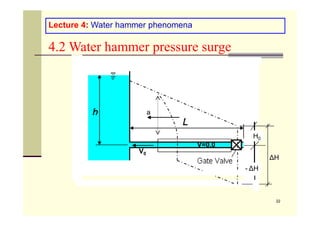
ΔH
H0
V0
V=0.0
4.2 Water hammer pressure surge
Lecture 4: Water hammer phenomena
a
22
- ΔH
H0
V0
V=0.0
a
ΔH
The time history of the pressure wave for a specific point on the pipe is a graph
that simply shows the relation between the pressure increase ( ΔH, or ΔP ) and
Time during the propagation of the water hammer pressure waves. The following
Figures illustrate the time history in the tank pipe system discussed previously.
Lecture 4: Water hammer phenomena (Hydraulic Transient)
4.3 Time history of pressure wave due to water hammer):
23
Lecture 4: Water hammer phenomena (Hydraulic Transient)
4.3 Time history of pressure wave due to water hammer):
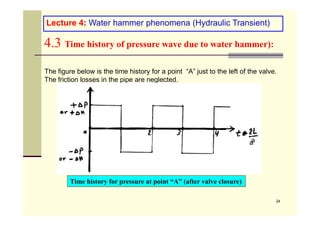
The figure below is the time history for a point “A” just to the left of the valve.
The friction losses in the pipe are neglected.
24
Time history for pressure at point “A” (after valve closure)
a
a
Lecture 4: Water hammer phenomena (Hydraulic Transient)
4.3 Time history of pressure wave due to water hammer):
The time history for point ”M“ (at midpoint of the pipe). The friction losses in the
pipe are neglected.
2a
25
Time history for pressure at point “M” (after valve closure)
a
Lecture 4: Water hammer phenomena (Hydraulic Transient)
4.3 Time history of pressure wave due to water hammer):
The time history for point B (at a distance x from the reservoir ) The friction losses
in the pipe are neglected.
a
26
Time history for pressure at point “B” (after valve closure)
Lecture 4: Water hammer phenomena (Hydraulic Transient)
4.3 Time history of pressure wave due to water hammer):
In real practice
In real practice friction effects are considered and hence a
damping effect occurs and the pressure wave dies out, i.e.;
energy is dissipated.
Damping effect of friction
27
Time history for pressure at point “A” (after valve closure) when friction losses
are included.
t*(2L/a)
Lecture 4: Pumping Hydraulics
4.4 water hammer in pumping mains
 Water hammer due to power failure:
As illustrated previously,
one of the serious
events that produce
water hammer in
delivery pipes of
28
delivery pipes of
pumping stations
is power failure.
Lecture 4: Pumping Hydraulics
4.4 water hammer in pumping mains
 Column separation due to power failure:
- What do we mean by column separation?
-After power failure a wave of negative pressure “down surge” occurs.
- If the hydraulic profile intersects the pressure pipe and falls below it for a
pressure less or equal to the vapor pressure, water vapor starts to accumulate
And large air pockets are formed.
29
And large air pockets are formed.
-The air pocket separates the water column in the pipe into to parts, upstream
column and down stream column. This phenomena is called column separation.
-Column separation is dangerous when the two water columns join again with
huge collision when the reflected wave comes back. This collision produce an
upsurge pressure that is much more than the first water hammer impulse
calculated from the equation discussed previously .
g
V
a
H 0


Lecture 4: Pumping Hydraulics
4.4 water hammer in pumping mains
 Column separation due to power failure:
- How to predict column separation?
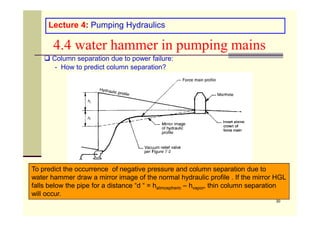
30
To predict the occurrence of negative pressure and column separation due to
water hammer draw a mirror image of the normal hydraulic profile . If the mirror HGL
falls below the pipe for a distance “d “ = hatmospheric – hvapor, thin column separation
will occur.
Lecture 4: Pumping Hydraulics
4.4 water hammer in pumping mains
a


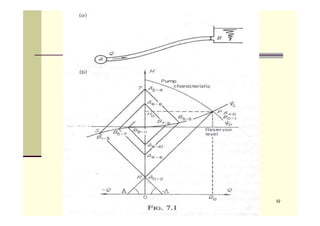
 Graphical solution to calculate the water hammer surge after power failure:
A. water hammer without column separation:
The figure in the next slide illustrates the surge development in a pumping
main after power failure. The following formulas are needed to understand
the method:
31
p
gA
a


tan
1
0
A : the subscripts 0-1 means the situation at point A
between time 0 and time 1, the same notation is used for point B.
Time 1 in this example is = L/a.
: Λ (Lambda) is the angle of inclination of the surge line PR, Ap
is the cross section area of the pressure line.

 tan
2 0
0
H
Q
Cp
: Cp is the pipe constant, (Q0,H0) is the operating point
before pump failure.
If Cp is <0.50 then the maximum pressure at the pump is positive as this case.
If Cp is > 0.50 then the maximum pressure at the pump is negative and column
separation will occur as the next case explained in B.
32
Lecture 4: Pumping Hydraulics
4.4 water hammer in pumping mains
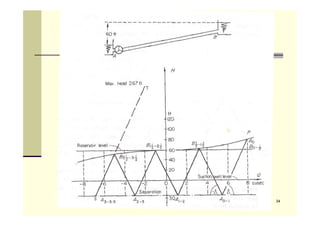
 Graphical solution to calculate the water hammer surge after power failure:
B. water hammer with column separation:
As indicated in Case A if Cp is > 0.50 then column separation occurs.
The following example illustrates this case.
33
34
Lecture 4: Pumping Hydraulics
4.4 Prevention of water hammer in pumping mains
 Methods of preventing or minimizing the water hammer surge:
A. Control Tanks:
- Open end surge tank or standpipe
- one way surge tank
- two way surge tank
- Air champers (hydropneumatic tanks)
35
- Air champers (hydropneumatic tanks)
B. Control valves:
- Vacuum relief valve
- Air release valves
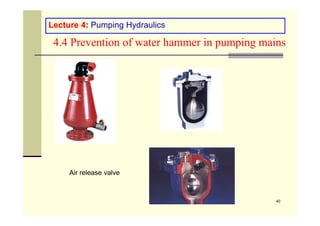
- Air release and vacuum relief valves
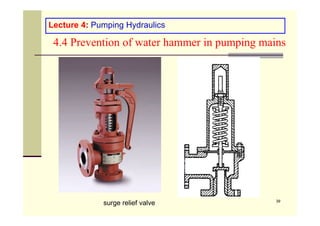
- surge relief valves
Lecture 4: Pumping Hydraulics
4.4 Prevention of water hammer in pumping mains
36
Lecture 4: Pumping Hydraulics
4.4 Prevention of water hammer in pumping mains
37
Horizontal Air chamber for water hammer prevention
Lecture 4: Pumping Hydraulics
4.4 Prevention of water hammer in pumping mains
38
Horizontal Air chamber for
water hammer prevention
Vertical Air chamber for
water hammer prevention
Lecture 4: Pumping Hydraulics
4.4 Prevention of water hammer in pumping mains
39
surge relief valve
Lecture 4: Pumping Hydraulics
4.4 Prevention of water hammer in pumping mains
40
Air release valve
Lecture 4: Pumping Hydraulics
4.4 Prevention of water hammer in pumping mains
41
Vacuum relief valve Air /Vacuum relief valve
Lecture 4: Pumping Hydraulics
4.4 Prevention of water hammer in pumping mains
 Using Air champers to prevent water hammer surge:
42
Fig 80
Lecture 4: Pumping Hydraulics
4.4 Prevention of water hammer in pumping mains
43
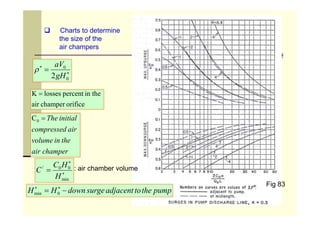
 Charts to determine
the size of the
air champers



0
0
2gH
aV

orifice
champer
air
in the
percent
losses
K 
orifice
champer
air
in the
percent
losses
K 
44
Fig 83
champer
air
the
in
volume
air
compressed
initial
The

0
C



min
0
0
/
H
H
C
C
pump
the
to
adjacent
surge
down
H
H 
 

0
min
: air chamber volume
Lecture 4: Pumping Hydraulics
4.4 Prevention of water hammer in pumping mains
 Using computer software for water hammer analysis:
There are many computer software for water hammer analysis such as:
- Hammer (Bently company)
- HiTran
- AFT
45
- AFT
- Pipe Expert
These software are not free , they are very expensive. However, you can
Download DEMO versions and get good benefit out of it. You can also search
For free software that I do not know.
Lecture 5: Design of wastewater pumping stations
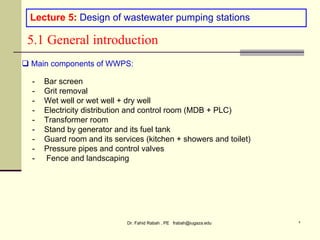
5.1 General introduction
 Main components of WWPS:
- Bar screen
- Grit removal
- Wet well or wet well + dry well
- Electricity distribution and control room (MDB + PLC)
- Transformer room
46
- Transformer room
- Stand by generator and its fuel tank
- Guard room and its services (kitchen + showers and toilet)
- Pressure pipes and control valves
- Fence and landscaping
Dr. Fahid Rabah , PE frabah@iugaza.edu ١
Pumping Stations Design
For Infrastructure Master Program
Engineering Faculty-IUG
Dr. Fahid Rabah
Water and environment Engineering
frabah@iugaza.edu
Lecture 5: Design of wastewater pumping stations
Dr. Fahid Rabah , PE frabah@iugaza.edu ٢
Lecture 5: Design of wastewater pumping stations
5.1 General introduction
 Main components of WWPS:
- Bar screen
- Grit removal
- Wet well or wet well + dry well
- Electricity distribution and control room (MDB + PLC)
- Transformer room
- Stand by generator and its fuel tank
- Guard room and its services (kitchen + showers and toilet)
- Pressure pipes and control valves
- Fence and landscaping
Dr. Fahid Rabah , PE frabah@iugaza.edu ٣
Grit
Removal
Wet
Well
Pump
House
Bar Screen
Service building Emergency power station
Pressure line
Inlet pipe
Fig 5.1 Typical Layout of Wastewater Pumping Station
5.2 Typical layout of WW pumping stations
Lecture 5: Design of wastewater pumping stations
Dr. Fahid Rabah , PE frabah@iugaza.edu ٤
Typical Layout of Wastewater Pumping Station
5.2 Typical layout of WW pumping stations
Lecture 5: Design of wastewater pumping stations
Fig. 5.2
Dr. Fahid Rabah , PE frabah@iugaza.edu ٥
Manual Bar Screen
Mechanical Bar Screen
Lecture 5: Design of wastewater pumping stations
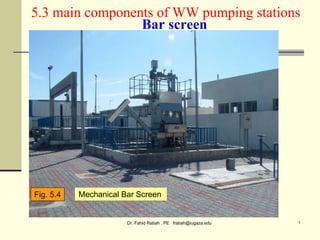
5.3 main components of WW pumping stations
Bar screen
Fig. 5.3
Dr. Fahid Rabah , PE frabah@iugaza.edu ٦
Mechanical Bar Screen
5.3 main components of WW pumping stations
Bar screen
Fig. 5.4
Dr. Fahid Rabah , PE frabah@iugaza.edu ٧
Grit Removal Channel
Grit Removal vortex type
5.3 main components of WW pumping station
Grit Removal
Fig. 5.5
Grit classifier
Dr. Fahid Rabah , PE frabah@iugaza.edu ٨
Wet well Pump House
5.3 main components of WW pumping station
Wet Well
Fig. 5.6
Dr. Fahid Rabah , PE frabah@iugaza.edu ٩
Wet well Pump House
5.3 main components of WW pumping station
Wet Well
Fig. 5.7
Dr. Fahid Rabah , PE frabah@iugaza.edu ١٠
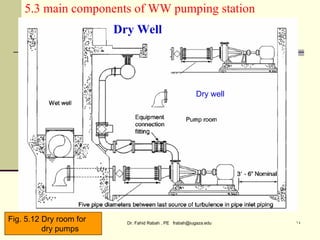
5.3 main components of WW pumping station
Dry Well
Fig. 5.8 Dry room for dry pumps
Dr. Fahid Rabah , PE frabah@iugaza.edu ١١
5.3 main components of WW pumping station
Dry Well
Fig. 5.9 Dry room for dry pumps
Dr. Fahid Rabah , PE frabah@iugaza.edu ١٢
5.3 main components of WW pumping station
Dry Well
Fig. 5.10 Dry room for dry pumps
Dr. Fahid Rabah , PE frabah@iugaza.edu ١٣
Wet well
Dry well
5.3 main components of WW pumping station
Dry Well
Fig. 5.11 Dry room for dry pumps
Dr. Fahid Rabah , PE frabah@iugaza.edu ١٤
Dry well
5.3 main components of WW pumping station
Dry Well
Fig. 5.12 Dry room for
dry pumps
Dr. Fahid Rabah , PE frabah@iugaza.edu ١٥
5.3 main components of WW pumping station
Dry Well
Fig. 5.13 Dry room for dry pumps
Dr. Fahid Rabah , PE frabah@iugaza.edu ١٦
5.3 main components of WW pumping station
Fig. 5.14 Electricity distribution and control room (MDB + PLC)
Dr. Fahid Rabah , PE frabah@iugaza.edu ١٧
Stand by generator
5.3 main components of WW pumping station
Stand by Generator
Fuel tank
Fig. 5.15 Standby generator and its fuel tank
Dr. Fahid Rabah , PE frabah@iugaza.edu ١٨
Transformer room
5.3 main components of WW pumping station
Transformer
Fig. 5.15 Electricity Transformer
Dr. Fahid Rabah , PE frabah@iugaza.edu ١٩
5.3 main components of WW pumping station
Service Building
Fig. 5.16 Service Building
Dr. Fahid Rabah , PE frabah@iugaza.edu ٢٠
5.3 main components of WW pumping station
Pumping station fence and gate
Fig. 5.17 Pumping station fence and gate
Dr. Fahid Rabah , PE frabah@iugaza.edu ٢١
5.3 main components of WW pumping station
Delivery Pipes , valves and manifold
Fig. 5.18 Delivery Pipes , valves and manifold in WWPS
Dr. Fahid Rabah , PE frabah@iugaza.edu ٢٢
Lecture 5: Design of wastewater pumping stations
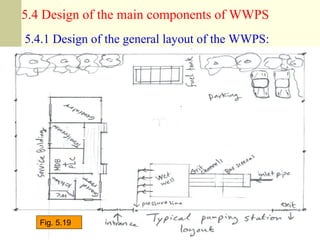
5.4 Design of the main components of WWPS
After the introduction to the main components of WWPS we will study the design
of the following components:
- Design of the general layout of the WWPS
- Design of Bar screen channel
- Design of Grit removal channels
- Design of Wet well for submersible pumps
- Design of Wet well and dry well for dry pumps
- Design of the delivery pipes and the pressure line
Dr. Fahid Rabah , PE frabah@iugaza.edu ٢٣
Typical Layout of Wastewater Pumping Station
5.4.1 Design of the general layout of the WWPS:
5.4 Design of the main components of WWPS
Fig. 5.19
Dr. Fahid Rabah , PE frabah@iugaza.edu ٢٤
5.4.2 Design of Bar screens
Screens are used in wastewater treatment for the removal of coarse solids.
Screens are either manually or mechanical cleaned.
Characteristics of manual bar
screen
• Bar spacing is in range of 2-5 cm
• The screen is mounted at an
angle of 30-45
• Bars are usually 1 cm thick, 2.5
wide
• Minimum approach velocity in
the bar screen channel is 0.45 m/s
to prevent grit deposition.
• Maximum velocity between the
bars is 0.9m/s to prevent washout
of solids through the bars.
Characteristics of mechanical bar
screen
• Bar spacing is in range of 1.5-4 cm
• The screen is mounted at an angle
of 30-75
• Bars are usually 1 cm thick, 2.5
wide
• Minimum approach velocity in the
bar screen channel is 0.45 m/s to
prevent grit deposition.
• Maximum velocity between the bars
is 0.9 m/s to prevent washout of
solids through the bars.
5.4 Design of the main components of WWPS
Dr. Fahid Rabah , PE frabah@iugaza.edu ٢٥
Design of the bar screen channel (Approach Channel)
The cross section of the bar screen channel is determined from the continuity
equation:
Qd = AcVa
Ac = Qd/ Va
Qd = design flow, m3/s
Ac = bar screen cross section, m2
Va = Velocity in the approach channel, m/s
Usually, rectangular channels are
used, and the ratio between depth
and width is taken as 1.5 to give
the most efficient section.
7
.
0
1
2
)
( 2
2



g
V
V
H
a
b
l
The head loss through the bar
screen
Hl = head loss
Va = approach velocity, m/s
Vb = Velocity through the openings,
m/s
g = acceleration due to gravity, m/s2
5.4.2 Design of Bar screens
5.4 Design of the main components of WWPS
Dr. Fahid Rabah , PE frabah@iugaza.edu ٢٦
Example
A manual bar screen is to be used in an approach channel with a maximum
velocity of 0.64 m/s, and a design flow of 300 L/s. the bars are 10 mm thick
and openings are 3 cm wide. Determine:
The cross section of the channel, and the dimension needed
The velocity between bars
The head loss in meters
The number of bars in the screen
1. Ac= Qd/Va= 0.3/0.64 = 0.47 m2
Ac= W x1.5W =1.5 W x W
W = 0.56 m, Depth (d) = 1.5 W = 0.84 m
bar
c
c
c
net
t
S
S
A
A


7
.
0
1
2
)
( 2
2



g
V
V
H
a
b
l
7
.
0
1
81
.
9
2
)
64
.
0
86
.
0
( 2
2




l
H
= 0.84 x 0.56 (3/3+1) = 0.35 m2
From continuity equation: Va Ac= Vb Anet
Vb= 0.64 x 0.56 x 0.84/0.35 = 0.86 m/s < 0.9 m/s ok
3. Head loss:
= 0.024 m
4. n tbar + (n-1)Sc = W
n x 1 + (n-1) x 3= 56
n= 14.75 = 15
Dr. Fahid Rabah , PE frabah@iugaza.edu ٢٧
Design a set of rectangular grit basins with proportional flow weir for a plant
which has a peak flow of 80,000 m3/day, an average flow of 50,000 m3/day and a
minimum flow of 20,000 m3/day. Use three basins. Make the peak depth equal to
the width. The design velocity (Vh) is 0.25 m/s, Vs = 0.021 m/s
Solution
The peak flow per channel will be 80,000/3 =
26,666 m3/day = 0.31 m3/s.
The average flow per channel will be
50,000/3= 16,666 m3/day = 0.19 m3/s.
The minimum flow per channel will be
20,000/3= 6,666 m3/day = 0.077 m3/s.
A = Q/Vh
A peak = 0.31/0.25 = 1.24 m2.
The water depth D = W = 1.114
Take W = 1.10 m.
Then D = 1.13 m at peak flow
Take the channel depth = 1.50 m
This would provide a freeboard of 37 cm at
peak flow.
L = D (Vh/Vs)
The length of the channel = 1.15 (0.25/0.021)
= 13.7 m
The weir must be shaped so that:
Q = 8.18 * 10-6 wy1.5
W = width of the proportional weir at depth y.
Q
(m3/min)
Y
(mm)
W
(mm)
4.62
280
120.50
11.4
691
76.70
15.0
909
66.90
18.6
1130
59.90
Note: Y= Q/(Vh*W)
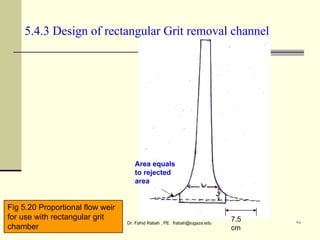
5.4.3 Design of rectangular Grit removal channel
Dr. Fahid Rabah , PE frabah@iugaza.edu ٢٨
7.5
cm
Fig 5.20 Proportional flow weir
for use with rectangular grit
chamber
5.4.3 Design of rectangular Grit removal channel
Area equals
to rejected
area
Dr. Fahid Rabah , PE frabah@iugaza.edu ٢٩
5.4 Design of the main components of WWPS
 Design of horizontal cross section of the wet well:
5.4.4 Design of the wet well for submersible pumps
• The dimensions of the horizontal cross section of the wet well depends on the
pump size and the recommended distance between the pumps.
• Figure 5.21 shows the recommended dimensions of the horizontal cross section
of the wet well . Note that the diameter of the pump casing “D” is the dimension
That decides the length of the wet well.
• The second needed distance is B, the distance between the wet well wall and the
center of the pump. The distance B is necessary to decide the width of the wet well.
The distances D and B is taken from the pump catalogs as those shown in
figures 15.23 and 15.22.
• An inlet channel inside the wet well opposite to the inlet pipe is usually needed to
As energy breaker to prevent turbulence in the wet well. The width of the channel
is usually 50 to 70 cm and its height is equal to the inlet pipe diameter plus 30 cm.
• Figure 15.25 shows a horizontal plan of the wet well at a level above the concrete
frame.
Dr. Fahid Rabah , PE frabah@iugaza.edu ٣٠
Fig. 5.21
Dr. Fahid Rabah , PE frabah@iugaza.edu ٣١
5.4 Design of the main components of WWPS
 Design of the vertical cross section of the wet well:
5.4.4 Design of the wet well for submersible pumps
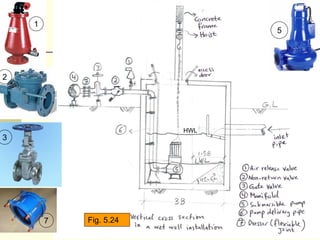
• Figure 5.24 shows a typical vertical cross section of the wet well.
• The LWL is taken from the manufacturer catalog of the pump. For example,
the LWL for the KSB is indicated as the distance “R” in figure 15. 22.
• The HWL is calculated from the active volume as will be indicated later. The
active volume is the volume between the LWL and the HWL.
• The HWL is taken as the level of the invert level of the inlet pipe as indicated
in figure 15.22. The distance from the HWL to the top of the roof of the wet well
depends on the ground level. It is usually preferred to take the level of the top
of roof the of the wet well as 50 cm higher than the ground level.
• As shown in figure 15.22, a hoist and chain should be located above the
pump to left it for maintenance. For this purpose a concrete frame should be
built to hang the electrical hoist on it. The capacity of the hoist is decided
according to the weight of each pump. The weight of the pump is taken from
the manufacturer catalog as in figure15.23.
• A rectangular benching is needed to prevent solids from settling away from
the pumps. The dimension of this triangle is shown in figure 15.24.
Dr. Fahid Rabah , PE frabah@iugaza.edu ٣٢
Fig. 5.22 Typical dimensions of a submersible KSB pump needed for the
design of the wet well
Dr. Fahid Rabah , PE frabah@iugaza.edu ٣٣
Fig. 5.23 Typical dimensions of a submersible KSB pump needed for the
design of the wet well
Dr. Fahid Rabah , PE frabah@iugaza.edu ٣٤
1
2
3
7
5
Fig. 5.24
HWL
Dr. Fahid Rabah , PE frabah@iugaza.edu ٣٥
1
2
3
7
Fig. 5.25
Dr. Fahid Rabah , PE frabah@iugaza.edu ٣٦
An example of a submersible pump installed in the wet well
Fig. 5.26
Dr. Fahid Rabah , PE frabah@iugaza.edu ٣٧
Fig. 5.27 A photo at the top of a wet well showing delivery pipes and valves
Dr. Fahid Rabah , PE frabah@iugaza.edu ٣٨
5.4 Design of the main components of WWPS
4
Tq
V 
 Determination of the wet well active volume:
5.4.4 Design of the wet well for submersible pumps
• The active volume in the wet well is the volume enclosed between the LWL
and the HWL.
• This volume depends on many factors such as the number of pumps, the
capacity of each pump and the raw WW influent flow rate.
• The active volume (V ) when one pump is in operation is calculated from the
following equation:
Where:
T: minimum cycle time between pump starts, min.
q : the pumping rate of a single pump in operation, m3/min
V: active volume for one pump in operation, m3
empty
to
time
fill
to
time
T 

Dr. Fahid Rabah , PE frabah@iugaza.edu ٣٩
5.4 Design of the main components of WWPS
 Determination of the wet well active volume:
5.4.4 Design of the wet well for submersible pumps
• The cycle time T depends on the pump type and the manufacturer
recommendations.
• Typical value of T 6 minutes. This will lead to 10 starts of the pump in 1 hour.
it is recommended to limit the number of pump starts to 12 as a maximum to
protect the pump and to increase its effective life span.
•If more than a pump is used, an additional 15 cm is added to the height of the
wet well for each pump other than the first.
Dr. Fahid Rabah , PE frabah@iugaza.edu ٤٠
5.4 Design of the main components of WWPS
 Determination of the wet well active volume:
5.4.4 Design of the wet well for submersible pumps
Example:
What is the active volume of a wet well that has 3 pumps working in parallel
plus one standby pump. The capacity of one pump when operating alone is
14.7 m3/min. Take T as 6 minutes. The area of the horizontal cross section of
the wet well is 15 m2 .
Solution:
V = (14.7*6)/4 = 22.05 m3
Water height = (22.05)/15 = 1.47 m
Total height of active volume = 1.47 + 2*0.15 = 1.77 m
Total active volume = 1.77 * 15 = 26.55 m3
Dr. Fahid Rabah , PE frabah@iugaza.edu ٤١
5.4 Design of the main components of WWPS
 Determination of the wet well active volume:
5.4.4 Design of the wet well for submersible pumps
The pumps operation sequence can be set according to the active volume
calculated in the previous example as indicated in the following figure.
Inlet pipe
15cm
15cm
147cm
15cm
Start P3
Start P2
Start P1 15cm
147cm
Stop P3
Stop P2
Stop P1
R
HWL
LWL
Fig. 5.28 Pumps operation sequence
Wet well
Dr. Fahid Rabah , PE frabah@iugaza.edu ٤٢
5.4 Design of the main components of WWPS
Dry well installation
1.5 m
7-10 d
1.5 m
2-3 m
Pump length
2-3 m
0.75 m
1.5 m
d
Fig. 5.29 Typical dimensions of the horizontal section of dry well installation
Dr. Fahid Rabah , PE frabah@iugaza.edu ٤٣
5.4 Design of the main components of WWPS
Dry well installation
2-3 m
2-3m
HWL
LWL
Inlet pipe
GL
GL
Gate
valve
Check
valve
Dresser
Gate
valve
Dresser
Reducer
D
D/2
5 d
d
Manifold
Fig. 5.30 Typical dimensions of the vertical section of dry well installation
Dr. Fahid Rabah , PE frabah@iugaza.edu ٤٤
5.4 Design of the main components of WWPS
 Figure 5.29 gives the typical dimensions of the the horizontal cross section
of the dry and wet well installation.
5.4.5 Design of the wet and dry wells for dry pumps
 Figure 5.30 gives the typical dimensions of the the vertical cross section
of the dry and wet well installation.
 The active volume and pump operation sequence is the same as for the
wet wall installation as discussed in the previous example.
Dr. Fahid Rabah , PE frabah@iugaza.edu ٤٥
5.4 Design of the main components of WWPS
 pressure line (selecting the most economical diameter)
delivery pipes
Valves on the pressure line
Thrust block
5.4.6 Design of the delivery pipes and the pressure line:
Dr. Fahid Rabah , PE frabah@iugaza.edu ٤٦
5.4 Design of the main components of WWPS
 Delivery pipes:
5.4.6 Design of the delivery pipes and the pressure line:
A delivery pipe is the pipe that connects the pump with the manifold. The
diameter of this pipe is determined using the Continuity equation:
2
1
4







V
Q
D
pump

Where:
D = pipe diameter, m
Q pump = discharge of one pump when operation alone, m3/d
V = flow velocity, m/s
The velocity in delivery pipes is usually assumed in the range of 2-2.5 m/s.
Q pump is the determined from the intersection between the system curve and
The characteristic curve of a single pump in operation.
Dr. Fahid Rabah , PE frabah@iugaza.edu ٤٧
5.4 Design of the main components of WWPS
852
.
1
87
.
4
*
7
.
10







C
Q
D
L
hf
5.4.6 Design of the delivery pipes and the pressure line:
• The friction losses in the delivery pipe are calculated using the Hazen
Williams equation :
• The material of the delivery pipes is usually steel, but some times UPVC pipes
are used. The Thickness of the pipe wall is determined according to the pressure
Exerted on the pipe, especially water hammer pressure.
g
V
k
hm
2
2

• The minor losses in the delivery pipe are calculated using the following
equation :
• The valves and fittings installed on the delivery pipe are shown on
Figures 15.24 and 15.25
Dr. Fahid Rabah , PE frabah@iugaza.edu ٤٨
5.4 Design of the main components of WWPS
 Manifold:
5.4.6 Design of the Manifold:
The manifold is the pipe that connects the delivery pipes with the main pressure
line. As shown on Figure 15.25 the diameter of the manifold is variable
diameter of this pipe is determined using the Continuity equation:
2
1
4







V
Q
D

Where:
D = pipe diameter (variable) according to the # of pumps in operation, m
Q = discharge (variable) according to the # of pumps in operation, m3/d
V = flow velocity (variable) according to the # of pumps in operation, m/s
• The velocity in the manifold is usually assumed in the range of 1 to 2 m/s.
Q is Q pump for the first segment (the smallest), and equals Q 2pumps for the
second segment and Q 3pumps for the second third segment and so on.
Some designers us constant diameter of the manifold designed for Q 3pumps .
Dr. Fahid Rabah , PE frabah@iugaza.edu ٤٩
5.4 Design of the main components of WWPS
852
.
1
87
.
4
*
7
.
10







C
Q
D
L
hf
5.4.6 Design of the Manifold :
• The friction losses in the manifold pipe are calculated using the Hazen
Williams equation :
• The material of the manifold pipes is usually steel, but some times UPVC pipes
are used. The Thickness of the pipe wall is determined according to the pressure
Exerted on the pipe, especially water hammer pressure.
g
V
k
hm
2
2

• The minor losses in the manifold pipe are calculated using the following
equation :
Dr. Fahid Rabah , PE frabah@iugaza.edu ٥٠
5.4 Design of the main components of WWPS
 Selecting the diameter:
5.4.6 Design of the main Pressure line (Rising main):
The main pressure line is the pipe that connects the manifold with ponit of
disposal. Its determined is determined using the Continuity equation:
2
1
4







V
Q
D
peak

Where:
D = pipe diameter (variable) according to the # of pumps in operation, m
Qpeak = discharge (variable) according to the # of pumps in operation, m3/d
V = flow velocity at peak flow, m/s
• The velocity at peak flow in the main pressure line is usually assumed
in the range of 1 to 2 m/s. However the velocity when one pump in operation
should not be less than 0.60 m/s.
Dr. Fahid Rabah , PE frabah@iugaza.edu ٥١
5.4 Design of the main components of WWPS
852
.
1
87
.
4
*
7
.
10







C
Q
D
L
hf
5.4.6 Design of the Manifold :
• The friction losses in the main pressure line are calculated using the
Hazen Williams equation :
• The material of the main pressure line is usually steel, but some times UPVC pipes
are used. The Thickness of the pipe wall is determined according to the pressure
Exerted on the pipe, especially water hammer pressure.
g
V
k
hm
2
2

• The minor losses in the main pressure line are calculated using the
following equation :
Dr. Fahid Rabah , PE frabah@iugaza.edu ٥٢
5.4 Design of the main components of WWPS
 Selecting the most economical diameter for the main pressure line:
5.4.6 Design of the main Pressure line (Rising main):
• As understood from the continuity equation, D is a function of V, so there are
many combinations of D and V that satisfy the equation. Since we , as engineers,
look for the most economical design we usually try to use the smallest pipe
Diameter, Unfortunately, when D decreases, V increases, consequently the
Power needed and the operation cost increases. So we need to select the most
Optimum combination between D and V. This is done using the graph shown
below (Figure 15.31).
• From figure 15.31, when we add up the capital cost and the operation cost we
get the concave up curve. The point of inflection indicates the minimum total
Cost. From this point draw a vertical line that will intersect the X-axis at the most
Optimum diameter.
• Notice that the running cost paid along the life span of the pump station and the
Pressure line so the values on figure 15.31 are the present worth value of the
Running cost. The capital cost is paid in one payment at the beginning of the
project.
Dr. Fahid Rabah , PE frabah@iugaza.edu ٥٣
5.4 Design of the main components of WWPS
 Selecting the most economical diameter for the main pressure line:
5.4.6 Design of the main Pressure line (Rising main):
Optimum pressure line diameter
0.00E+00
5.00E+05
1.00E+06
1.50E+06
2.00E+06
2.50E+06
3.00E+06
200 300 400 500 600 700 800
Diameter (m)
Cost
(US
$)
Running cost Capital cost Total cost
MIN. Total cost
Optimum D
Fig. 5.31 Optimum pipe diameter
Dr. Fahid Rabah , PE frabah@iugaza.edu ٥٤
5.4 Design of the main components of WWPS
 Valves and tanks installed on the main pressure line:
5.4.6 Design of the main Pressure line (Rising main):
• There are two main valves that are installed on the pressure lines:
1. Air release /Vacuum valves are installed at:
• All height points
•long rising segments at intervals of 750 to 1000 m
•long descending segments at intervals of 750 to 1000 m
2. Drainage valves are :
• All low point
• Long rising and flat pipes at intervals of 500 m
3. Pressure relief valves are installed at:
• Low points along the pipe where high pressure is expected
•locations related to water hammer waves such as before valves or after
pumps. If other tools are used to control water hammer, these valves
will be not necessary.
4. Surge tanks and Air champers are installed at:
• Just after the pumps.
• At high points a long the pipe to prevent column separation.
Dr. Fahid Rabah , PE frabah@iugaza.edu ٥٥
5.4 Design of the main components of WWPS
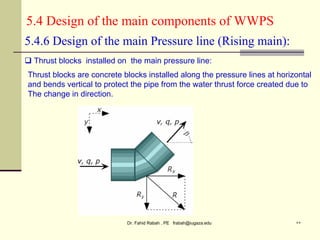
 Thrust blocks installed on the main pressure line:
5.4.6 Design of the main Pressure line (Rising main):
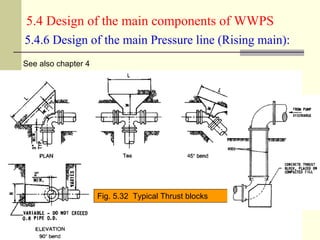
Thrust blocks are concrete blocks installed along the pressure lines at horizontal
and bends vertical to protect the pipe from the water thrust force created due to
The change in direction.
Dr. Fahid Rabah , PE frabah@iugaza.edu ٥٦
5.4 Design of the main components of WWPS
 

 cos
1
2
2
2








 V
d
Rx 
 sin
2
2
2
V
d
Ry 







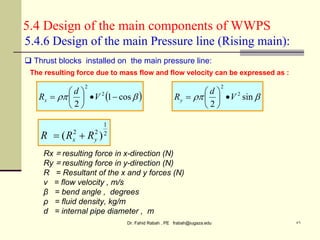
 Thrust blocks installed on the main pressure line:
5.4.6 Design of the main Pressure line (Rising main):
The resulting force due to mass flow and flow velocity can be expressed as :
2
1
2
2
)
( y
x R
R
R 

Rx = resulting force in x-direction (N)
Ry = resulting force in y-direction (N)
R = Resultant of the x and y forces (N)
v = flow velocity , m/s
β = bend angle , degrees
ρ = fluid density, kg/m
d = internal pipe diameter , m
Dr. Fahid Rabah , PE frabah@iugaza.edu ٥٧
5.4 Design of the main components of WWPS
 

 cos
1
2
2








d
P
Rx

 sin
2
2







d
P
Rpy
 Thrust blocks installed on the main pressure line:
5.4.6 Design of the main Pressure line (Rising main):
Resulting force due to Static Pressure:
2
1
2
2
)
( py
px
p R
R
R 

Rpx = resulting force due to pressure in x-direction ,N
Rpy = resulting force due to pressure in x-direction ,N
Rp= resultant force on the bend due to pressure, N
P = gauge pressure inside pipe (Pa, N/m2)
Dr. Fahid Rabah , PE frabah@iugaza.edu ٥٨
5.4 Design of the main components of WWPS
5.4.6 Design of the main Pressure line (Rising main):
Fig. 5.32 Typical Thrust blocks
See also chapter 4
Dr. Fahid Rabah , PE frabah@iugaza.edu ٥٩
5.4 Design of the main components of WWPS
5.4.6 Design of the main Pressure line (Rising main):
Fig. 5.33 Thrust block under construction
Dr. Fahid Rabah , PE frabah@iugaza.edu ٦٠
Typical dimensions and details of thrust blocks
Dr. Fahid Rabah , PE frabah@iugaza.edu ١
Pumping Stations Design
For Infrastructure Master Program
Engineering Faculty-IUG
Dr. Fahid Rabah
Water and environment Engineering
frabah@iugaza.edu
Lecture 6: Design of water supply pumping stations
Dr. Fahid Rabah , PE frabah@iugaza.edu ٢
Lecture 6: Design of waster supply pumping stations
6.1 General introduction
 Main Types of water pumping stations :
1. Wells pumping stations
2. Distribution pumping stations
3. Booster pumping stations
4. Surface water pumping stations
Dr. Fahid Rabah , PE frabah@iugaza.edu ٣
Lecture 6: Design of waster supply pumping stations
6.2 Well pumping stations
 Main components of well pumping stations :
1. Multi stage pumps ( connected in series)
2. Suction shaft (pipe)
3. Vertical motor ( above ground or submerged)
4. Delivery pipe
5. Valves
6. Cyclone
7. Surge vessel (air champer for water hammer protection)
8. Chlorination tank and chlorine injection pump.
9. Stand by generator and its fuel tank
10.Main electricity distribution panel and control
11.Service building.
Dr. Fahid Rabah , PE frabah@iugaza.edu ٤
P
U
M
P
L
E
N
G
T
H
2
.
4
0
m
4''? SCH 40
4''?
HOLLOW SHAFT ELECTRIC MOTOR
400V,50HZ,1450RPM
CAST IRAN ( CI )
DISCHARGE HEAD
STAINLESS STEEL
DRIVE SHAFT
WATER COOLED RUBBER BEARING
+ BRONZE LINER
+ BRONZE IMPELLERS
CAST IRAN FLANGED CONNECTED BOWLS
6.2 Well pumping stations
Multi stage pumps connected in series with a dry installation vertical motor
Dr. Fahid Rabah , PE frabah@iugaza.edu ٥
6.2 Well pumping stations
Multi stage pumps connected in series with dry or submersible motor
Dr. Fahid Rabah , PE frabah@iugaza.edu ٦
6.2 Well pumping stations
Multi stage pumps connected
in series with diesel motor
Dr. Fahid Rabah , PE frabah@iugaza.edu ٧
6.2 Well pumping stations
Multi stage pumps connected in series- submersible motor
Dr. Fahid Rabah , PE frabah@iugaza.edu ٨
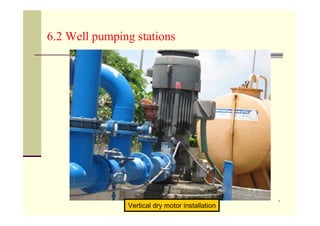
Vertical dry motor installation
6.2 Well pumping stations
Dr. Fahid Rabah , PE frabah@iugaza.edu ٩
Submersible type motor installation
6.2 Well pumping stations
Dr. Fahid Rabah , PE frabah@iugaza.edu ١٠
Air release valve
Hydro-Cyclone
Butter fly valve
Suction Pipe
Flow meter
Motor
Pressure Gage
Chlorine injection
Typical piping and valves arrangement for well pumping stations
6.2 Well pumping stations
Dr. Fahid Rabah , PE frabah@iugaza.edu ١١
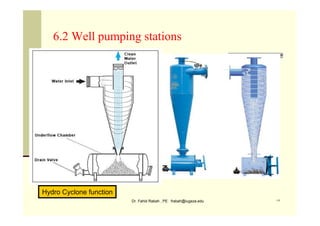
Hydro Cyclone
C
o
o
l
i
n
g
T
a
n
k
5
0
0
l
i
t
e
r
chlorine
Tank P.E
500liter
C
h
l
o
r
i
n
e
D
o
s
i
n
g
P
u
m
p
1
3
2
3 5
3
3
Pump well Delivery pipe Butterfly valve Check valve Flow meter
1 2 4
3 5
4
Well room
Typical layout of
6.2 Well pumping stations
Dr. Fahid Rabah , PE frabah@iugaza.edu ١٢
Delivery pipe , see the Hydro Cyclones and valves
6.2 Well pumping stations
Dr. Fahid Rabah , PE frabah@iugaza.edu ١٣
Hydro Cyclone function
6.2 Well pumping stations
Dr. Fahid Rabah , PE frabah@iugaza.edu ١٤
Delivery pipe , see the Hydro Cyclones and valves
6.2 Well pumping stations
Dr. Fahid Rabah , PE frabah@iugaza.edu ١٥
Standby generator
6.2 Well pumping stations
Dr. Fahid Rabah , PE frabah@iugaza.edu ١٦
Fuel tank for the standby generator
6.2 Well pumping stations
Dr. Fahid Rabah , PE frabah@iugaza.edu ١٧
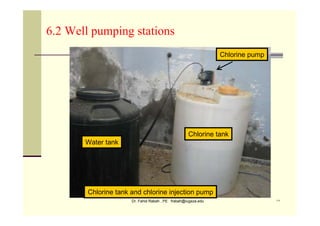
Water tank
Chlorine tank
Chlorine pump
Chlorine tank and chlorine injection pump
6.2 Well pumping stations
Dr. Fahid Rabah , PE frabah@iugaza.edu ١٨
chlorine injection point to the delivery pipe
6.2 Well pumping stations
Dr. Fahid Rabah , PE frabah@iugaza.edu ١٩
Delivery pipe , see the Hydro Cyclone , valves, fuel tank, service building
6.2 Well pumping stations
Dr. Fahid Rabah , PE frabah@iugaza.edu ٢٠
Delivery pipe , Hydro Cyclone ,
valves, fuel tank, generator
6.2 Well pumping stations
Dr. Fahid Rabah , PE frabah@iugaza.edu ٢١
6.2 Well pumping stations
Dr. Fahid Rabah , PE frabah@iugaza.edu ٢٢
6.2 Well pumping stations
Dr. Fahid Rabah , PE frabah@iugaza.edu ٢٣
6.2 Well pumping stations
 Types of well pumping stations :
1. Direct pumping from well pumps to the distribution system
 Most of Gaza wells are from this type
 Not recommended for long distribution systems and for cases where
more than one well pumping directly into the system. This system has
two problems: back pressure between wells and lower discharge from
each individual well.
2. Pumping from well pumps to a storage or distribution tank.
 This system is recommended and there is a trend in Gaza to use this
system
 This system solves the problem of back pressure associated with the
direct pumping discussed above. It also increase the pumping
efficiency from each pump (lower head losses leading to more flat
system curve and consequently more discharge)
Dr. Fahid Rabah , PE frabah@iugaza.edu ٢٤
6.2 Well pumping stations
Well pumping station discharging
into a storage tank
Dr. Fahid Rabah , PE frabah@iugaza.edu ٢٥
6.2 Well pumping stations
Note that for well pumps there is only one valid pump curve which is the
curve of the total pumps in operation.
Well pumping station are operated in series
Dr. Fahid Rabah , PE frabah@iugaza.edu ٢٦
Lecture 6: Design of waster supply pumping stations
6.3 Distribution pumping stations
 Main components of distribution pumping stations :
1. Dry pumps ( connected in parallel)
2. Suction shaft (pipe)
3. Storage and distribution tank
4. Delivery pipe
5. Valves
6. Surge vessel (air champer for water hammer protection)
7. Chlorination tank and chlorine injection pump.
8. Stand by generator and its fuel tank
9. Main electricity distribution panel and control
10.Service building.
Dr. Fahid Rabah , PE frabah@iugaza.edu ٢٧
Lecture 6: Design of waster supply pumping stations
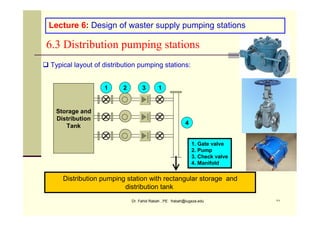
6.3 Distribution pumping stations
 Typical layout of distribution pumping stations:
Storage and
Distribution
Tank
1 3
2
4
1
Distribution pumping station with rectangular storage and
distribution tank
1. Gate valve
2. Pump
3. Check valve
4. Manifold
Dr. Fahid Rabah , PE frabah@iugaza.edu ٢٨
Lecture 6: Design of waster supply pumping stations
6.3 Distribution pumping stations
 Typical layout of distribution pumping stations:
5 1
3
2
1
Storage and
Distribution
Tank
4
Distribution pumping station with circular storage and distribution tank
1. Gate valve
2. Pump
3. Check valve
4. Manifold
5. Feeding Header
Dr. Fahid Rabah , PE frabah@iugaza.edu ٢٩
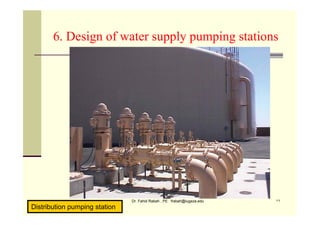
6. Design of water supply pumping stations
Distribution pumping station
Dr. Fahid Rabah , PE frabah@iugaza.edu ٣٠
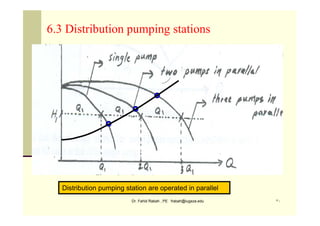
6.3 Distribution pumping stations
Distribution pumping station are operated in parallel
Dr. Fahid Rabah , PE frabah@iugaza.edu ٣١
6.3 Distribution pumping stations
 Control of distribution pumping stations :
1. Pressure switch at the discharge side of the pipe.
If the pressure in the network increases above a preset value (for example 6 bar )
the pumps will be shut down one after the other. The pressure on the delivery
pipe increases at low demands when many connections are closed.
2. Level switch connected to the water distribution tank.
If the level in the water distribution tank drops to the a pre assigned minimum
level the pumps are shut off one after the other with a pre assigned intervals.
The pumps will be started again one after the other when the water in the tank
reaches a pre assigned level. An ultra-sound level detector is usually used for
level detection.
Lecture 6: Design of waster supply pumping stations
Dr. Fahid Rabah , PE frabah@iugaza.edu ٣٢
Lecture 6: Design of waster supply pumping stations
6.4 Booster pumping stations
 Main components of booster pumping stations :
1. Dry pumps ( connected in series)
2. Suction connection (pipe)
3. Delivery pipe
4. Valves
5. Stand by generator and its fuel tank (for offline large stations only)
6. Main electricity distribution panel and control
7. Service building (for offline large stations only).
Dr. Fahid Rabah , PE frabah@iugaza.edu ٣٣
Lecture 6: Design of waster supply pumping stations
6.4 Booster pumping stations
 Main types of booster pumping stations :
1. Inline booster pumps
2. Offline booster pumps
Dr. Fahid Rabah , PE frabah@iugaza.edu ٣٤
Typical inline Booster Pump
6.4 Booster pumping stations
Lecture 6: Design of waster supply pumping stations
Dr. Fahid Rabah , PE frabah@iugaza.edu ٣٥
Inline Package Booster Pump
6.4 Booster pumping stations
Lecture 6: Design of waster supply pumping stations
Dr. Fahid Rabah , PE frabah@iugaza.edu ٣٦
Lecture 6: Design of waster supply pumping stations
6.4 Booster pumping stations
 Typical layouts of inline booster pumping stations:
Inline booster pumping station - two pumps in series
This layouts is used when two or three pumps are able to deliver the
required flow and head. If more than three pumps are needed or when
the pumps are large, we should go to an offline booster pumping station.
Dr. Fahid Rabah , PE frabah@iugaza.edu ٣٧
Lecture 6: Design of waster supply pumping stations
6.4 Booster pumping stations
 Typical layouts of inline booster pumping stations:
Inline booster pumping station - two pumps in parallel
This layouts is used when one pump is able to deliver the required head
but not able to deliver the required flow. In this case we use two or more
pumps in parallel. If more than three pumps are needed or when the
pumps get large, we should go to an offline booster pumping station.
Dr. Fahid Rabah , PE frabah@iugaza.edu ٣٨
Lecture 6: Design of waster supply pumping stations
6.4 Booster pumping stations
 Typical layout of offline booster pumping arrangements:
This configuration is used when one pump is able to give the required head but not
able to give the required flow, so we need more than one pump in parallel to deliver
the total flow.
5 1
3
2
1
4
offline booster pumping station - three pumps in parallel
Dr. Fahid Rabah , PE frabah@iugaza.edu ٣٩
Lecture 6: Design of waster supply pumping stations
6.4 Booster pumping stations
 Typical layout of offline booster pumping arrangements:
This configuration is used when one pump is able to give the required flow but not
able to give the required head alone, so we need more than one pump in series to
deliver the total head. Note that we use a bypass line to achieve flexibility in operation
When one or more pumps are out for maintenance.
offline booster pumping station - three pumps in series
Dr. Fahid Rabah , PE frabah@iugaza.edu ٤٠
Lecture 6: Design of waster supply pumping stations
6.5 Surface water pumping stations
1. Water Intake structure
2. Submersible or dry pumps ( connected in parallel)
3. Suction connection (pipe)
4. Delivery pipe
5. Valves
6. Stand by generator and its fuel tank
7. Main electricity distribution panel and control
8. Service building
 Main components of surface pumping stations :
Dr. Fahid Rabah , PE frabah@iugaza.edu ٤١
6.5 Surface water pumping stations
Lecture 6: Design of waster supply pumping stations
Movable Surface water intake
Dr. Fahid Rabah , PE frabah@iugaza.edu ٤٢
6.5 Surface water pumping stations
Lecture 6: Design of waster supply pumping stations
Surface water intake
Dr. Fahid Rabah , PE frabah@iugaza.edu ٤٣
6.5 Surface water pumping stations
Lecture 6: Design of waster supply pumping stations
Dry pumps and Surface water intake
Dr. Fahid Rabah , PE frabah@iugaza.edu ٤٤
Lecture 6: Design of waster supply pumping stations
Surface water Submersible pump
Dr. Fahid Rabah , PE frabah@iugaza.edu ٤٥
6.5 Surface water pumping stations
Lecture 6: Design of waster supply pumping stations
Surface water Submersible pump
Dr. Fahid Rabah , PE frabah@iugaza.edu ١
Pumping Stations Design
For Infrastructure Master Program
Engineering Faculty-IUG
Dr. Fahid Rabah
Water and environment Engineering
frabah@iugaza.edu
Lecture 7: Design of sludge pumping stations
Dr. Fahid Rabah , PE frabah@iugaza.edu ٢
Lecture 7: Design of sludge pumping stations
7.1 General introduction
Types of sludge :
1. Primary sludge ( solids concentration 3-5%)
2. Secondary sludge ( solids concentration 1-1.5%)
3. Digested sludge ( Solids concentration 6-7%)
4. Thickened sludge ( Solids concentration 8-10%)
 Sludge definition :
Sludge is a fluid composed of a mixture of water and solids.
Some of these solids are dissolved and some are suspended. The
suspended solids are the most important part and their concentration is
in the range of 1% to 10% according to sludge type.
Dr. Fahid Rabah , PE frabah@iugaza.edu ٣
Lecture 7: Design of sludge pumping stations
7.2 Hydraulics of Sludge pumping
The sludge is a non-Newtonian fluid, so its flow properties is different
from Newtonian fluids such as water and wastewater. Thus, the
equations used to determine the hydraulics of water and wastewater
doesn't apply for sludge.
 The main cause of classifying sludge as a non-Newtonian fluid is the
presence of solids in the range of 1% and above.
 The hydraulics of sludge pumping is highly dependent on the
concentration and properties of the solids in the sludge.
The sludge flow is classified into laminar flow or turbulent flow.
Dr. Fahid Rabah , PE frabah@iugaza.edu ٤
Lecture 7: Design of sludge pumping stations
7.2 Hydraulics of Sludge pumping
2
32
3
16
gD
V
g
D
s
L
h y





Where,
h = headless in the pipe, m
L = pipe length, m
sy = yield stress of the sludge, N/m2
ρ = sludge density , kg /m3
D = pipe diameter , m
g= gravitational acceleration,9.81 m/s2
η= coefficient of rigidity, kg/(m.s)
V = flow velocity, m/s
Laminar flow in sludge pumping systems:
Bingham equation is used for defining the hydraulics of sludge in the
laminar range:
Dr. Fahid Rabah , PE frabah@iugaza.edu ٥
Lecture 7: Design of sludge pumping stations
7.2 Hydraulics of Sludge pumping




D
D
s
V
y
lc
3000
/
1000
1000 2
2



Laminar flow in sludge pumping systems:
To apply the Bingham equation the flow should be laminar.
Bingham defined the lower critical velocity (Vlc) to check for laminar flow. If the
selected design velocity of sludge pumping is less or equal to Vlc then the
flow is laminar, otherwise the flow is turbulent.
Note:
• The values of sy and η are taken from figures 19.2 and 19.3.
•The Bingham equations are valid for laminar flow only.
Dr. Fahid Rabah , PE frabah@iugaza.edu ٦
Lecture 7: Design of sludge pumping stations
Dr. Fahid Rabah , PE frabah@iugaza.edu ٧
Lecture 7: Design of sludge pumping stations
Dr. Fahid Rabah , PE frabah@iugaza.edu ٨
Lecture 7: Design of sludge pumping stations
7.2 Hydraulics of Sludge pumping
gD
fV
L
H 2
 or
H = headless in the pipe, m
L = pipe length, m
Δ p = pressure drop, N/m2
ρ = sludge density , kg /m3
D = pipe diameter , m
G = gravitational acceleration,9.81 m/s2
ƒ = friction factor
V = flow velocity, m/s
D
LV
f
p

2


Where,
Turbulent flow in sludge pumping systems:
Hanks and Dadia equation is used for defining the hydraulics of sludge in
the turbulent range:
Dr. Fahid Rabah , PE frabah@iugaza.edu ٩
Lecture 7: Design of sludge pumping stations
7.2 Hydraulics of Sludge pumping
2
2


y
e
s
D
H 
Where,
He = Hedstrom number , dimensionless
R = Reynolds number , dimensionless
sy = yield stress of the sludge, N/m2
ρ = sludge density , kg /m3
D = pipe diameter , m
Η = coefficient of rigidity, kg/(m.s)
V= flow velocity, m/s


DV
R 
Hedstrom number:
Reynolds number:
The friction coefficient (ƒ ) is found from figure 19.6 after calculating (He)
and (R) from the following equations:
Dr. Fahid Rabah , PE frabah@iugaza.edu ١٠
Lecture 7: Design of sludge pumping stations
7.2 Hydraulics of Sludge pumping
Dr. Fahid Rabah , PE frabah@iugaza.edu ١١
Lecture 7: Design of sludge pumping stations
7.2 Hydraulics of Sludge pumping
Approximate method for
headless calculations
Figure 19.5 gives a the headless as
a factor of the headless calculated for
water or wastewater using the equation
of Hazen Williams with a coefficient of
Friction C=140.
Dr. Fahid Rabah , PE frabah@iugaza.edu ١٢
Lecture 7: Design of sludge pumping stations
7.2 Hydraulics of Sludge pumping
Typical sludge pumping system curve compared to water pumping
system curve
Using the headless equations
you can draw the system curve
For sludge systems.
Figure 19.10 is an example
of a system curve for a
6 in pipe.
Notice the difference between
The system curve for water and
For sludge having different
Solids concentrations.
Dr. Fahid Rabah , PE frabah@iugaza.edu ١٣
Lecture 7: Design of sludge pumping stations
7.2 Hydraulics of Sludge pumping
Sludge pressure pipes sizing:
 Max. design velocity is 1.8 m/s.
Min velocity is 0.6 m/s
Min. pipe diameter is 6 in.
Pump connections should not be less than 4 in.
Dr. Fahid Rabah , PE frabah@iugaza.edu ١٤
Lecture 7: Design of sludge pumping stations
7.3 Sludge pumping stations
 Sludge pumping stations types:
1. Submersible pumps
2. Dry pumps
Submersible pumps and dry pumps are similar to wastewater pumping
stations in terms of wet wells and dry wells and the piping layout
and valves.
 Types of pumps used for Sludge pumping :
1. Centrifugal Vortex pumps
2. Diaphragm pumps
3. Rotary pumps
4. Progressive cavity pumps
Dr. Fahid Rabah , PE frabah@iugaza.edu ١٥
Lecture 7: Design of sludge pumping stations
7.3 Sludge pumping stations
 Sludge pumping stations types:
Centrifugal Vortex pump
Dr. Fahid Rabah , PE frabah@iugaza.edu ١٦
Lecture 7: Design of sludge pumping stations
7.3 Sludge pumping stations
 Sludge pumps types:
Progressive cavity pump
Dr. Fahid Rabah , PE frabah@iugaza.edu ١٧
Lecture 7: Design of sludge pumping stations
7.3 Sludge pumping stations
 Sludge pumps types:
Diaphragm pump
Dr. Fahid Rabah , PE frabah@iugaza.edu ١٨
Lecture 7: Design of sludge pumping stations
7.3 Sludge pumping stations
 Sludge pumps types:
Rotary Lobe pump
Dr. Fahid Rabah , PE frabah@iugaza.edu ١٩
Lecture 7: Design of sludge pumping stations
7.4 Typical location of sludge pumping stations
Sedimentation Tank
Submersible sludge pumping station
Dr. Fahid Rabah , PE frabah@iugaza.edu ٢٠
Lecture 7: Design of sludge pumping stations
7.4 Typical location of sludge pumping stations
Dry well sludge pumping station
Sedimentation Tank

Pumping Stations Design.pdf

  • 1.
    Pumping Stations Design ForInfrastructure Master Program Engineering Faculty-IUG Dr. Fahid Rabah Water and environment Engineering frabah@iugaza.edu Lecture 1: Introduction to pumping stations
  • 2.
    1.1 Purpose andtypes of pumping stations The main purpose of pumping stations is to transfer fluids from low points to higher points. The main types of pumping stations are: „ Wastewater PS. „ Water PS. „ Sludge PS. „ Storm water PS. „ Lecture 1: Introduction to Pumping Stations
  • 3.
    „ Lecture 1: Introductionto Pumping Stations Grit Removal Wet Well Pump House Bar Screen Service building Emergency power station Pressure line Inlet pipe Typical Layout of Wastewater Pumping Station
  • 4.
    „ Lecture 1: Introductionto Pumping Stations Manual Bar Screen Mechanical Bar Screen
  • 5.
    „ Lecture 1: Introductionto Pumping Stations Grit Removal Channel
  • 6.
    „ Lecture 1: Introductionto Pumping Stations Wet well and Pump House
  • 7.
    „ Lecture 1: Introductionto Pumping Stations Dry well Pump House
  • 8.
    „ Lecture 1: Introductionto Pumping Stations Wet well Pump House
  • 9.
    „ Lecture 1: Introductionto Pumping Stations Pumping station Control Panel
  • 10.
    „ Lecture 1: Introductionto Pumping Stations water pumping station Booster pumps
  • 11.
    „ Lecture 1: Introductionto Pumping Stations water pumping station
  • 12.
    „ Lecture 1: Introductionto Pumping Stations Booster pumping station Inline Booster Pump
  • 13.
    1.2 Types ofpumps Pumps are classified into two main categories: „ Kinetic pumps. o Centrifugal pumps ( radial, axial, mixed flow) o Turbine (vertical) pumps „ Positive displacement pumps. o Rotary pumps ( screw, lobe) o Reciprocating pumps (plunger) „ Lecture 1: Introduction to Pumping Stations
  • 14.
    „ Lecture 1: Introductionto Pumping Stations Impeller Vanes Impeller Vanes Casing Casing Suction Eye Suction Eye Impeller Impeller Discharge Discharge Flow Expansion Flow Expansion Kinetic Pumps: Centrifugal Pump The common feature of all centrifugal pumps is the Volute Volute
  • 15.
    „ Lecture 1: Introductionto Pumping Stations Kinetic Pumps: Centrifugal Pump
  • 16.
    „ Lecture 1: Introductionto Pumping Stations Kinetic pumps: Vertical Turbine Pump The vertical pumps are equipped by a diffuser instead the Volute
  • 17.
    „ Lecture 1: Introductionto Pumping Stations Rotary Pump: Screw pumping station
  • 18.
    „ Lecture 1: Introductionto Pumping Stations Rotary Pump: Screw pumping station „ In the screw pump a revolving shaft fitted with blades rotates in an inclined trough and pushes the water up the trough.
  • 19.
    Rotary Pump: Lobe „ Lecture1: Introduction to Pumping Stations
  • 20.
    „ Lecture 1: Introductionto Pumping Stations Reciprocating Pump: Screw pumping station • In the reciprocating pump a piston sucks the fluid into a cylinder then pushes it up causing the water to rise.
  • 21.
    Pumping Stations Design ForInfrastructure Master Program Engineering Faculty-IUG Dr. Fahid Rabah Water and environment Engineering frabah@iugaza.edu Lecture 2: Pumping Hydraulics
  • 22.
    ٢ Lecture 2: PumpingHydraulics The main items that will be studied under the pumping hydraulics title are:  Pumping pressure and head terminology  Cavitation  Pump characteristic curves  Multiple pump operation  Variable speed pumps  Affinity laws  Pump selection
  • 23.
    ٣ 2.1 pumping pressureand head terminology Lecture 2: Pumping Hydraulics  Understanding pumping pressure and head terminology is essential in pumping stations design.  The pumping system consist mainly from : •The pump • A wet well containing the liquid to be pumped • A suction pipe connecting the wet well and the pump. • A delivery pipe •A delivery tank or a delivery point • Valves and fittings installed on the suction and delivery pipes There are two cases for the pumping system that depend on the location of the pump in reference to the wet well: •Case 1: the pump centerline is lower than the level of the water surface in the wet well. •Case 2 : the pump centerline is higher than the level of the water surface in the wet well. The following is an explanation for pumping terminology for both cases.
  • 24.
    ٤ 2.1 pumping pressureand head terminology Lecture 2: Pumping Hydraulics Figure 2.1 Case 1: Terminology for a pump with a positive suction head H t hd H stat h s H ms H md Datum pump center line h fs h f d hgs hgd H t = TDH Hg g Vd 2 / 2 g Vs 2 / 2 + h md + h ms
  • 25.
    ٥ 2.1 pumping pressureand head terminology Lecture 2: Pumping Hydraulics Figure 2.2 Case 2: Terminology for a pump with a negative suction head H stat H md H ms hd H t h s D a tu m p u m p cen ter lin e h f d h f s h gd h gs H t = TDH H g g Vd 2 / 2 g Vs 2 / 2 + h ms + h md
  • 26.
    ٦ 2.1 pumping pressureand head terminology Lecture 2: Pumping Hydraulics Definition of pumping head terms: The terms that appear in figures 2.1 and 2.2 can be defined as the following:  hs (Static suction head): It is the difference in elevation between the wet well liquid level and the datum elevation passing through the pump impeller center.  hd ( Static discharge head ): It is the difference in elevation between the discharge liquid level and the datum elevation passing through the pump impeller center.  Hstat (Static discharge head): It is the difference (or sum) in elevation between the static discharge and the static suction heads: Note: it is (-) when the pump center is below the wet well liquid level. and (+) when the pump center is above the wet well liquid level H h h stat d s  
  • 27.
    ٧ 2.1 pumping pressureand head terminology Lecture 2: Pumping Hydraulics Definition of pumping head terms…. Continued:  hgs ( manometric ( or gage) suction head): It is the suction gage reading. it is also the height to which the water will rise in a manometer installed at the suction side of the pump.  hgd (manometric ( or gage) discharge head): It is the discharge gage reading. It is also the height to which the water will rise in a manometer installed at the discharge side of the pump.  Hg (manometric ( or gage) discharge head): It is the increase in pressure head produced by the pump. It is calculated as follows: ) when the pump center is below the wet well liquid level. - it is ( Note: and (+) when the pump center is above the wet well liquid level gs h gd h g H  
  • 28.
    ٨ 2.1 pumping pressureand head terminology Lecture 2: Pumping Hydraulics Definition of pumping head terms…. Continued:  ( velocity head at the delivery side): It is the kinetic energy in the liquid in the discharge pipe. g Vd 2 / 2  ( velocity head at the suction side): It is the kinetic energy in the liquid in the suction pipe. g Vs 2 / 2  hms ( minor losses at the suction side): They are the losses in head (pressure) due to the eddies and turbulence created during liquid flow through valves and fittings in the suction pipe.  hmd( minor losses at the delivery side): They are the losses in head (pressure) due to the eddies and turbulence created during liquid flow through valves and fittings in the delivery pipe.
  • 29.
    ٩ 2.1 pumping pressureand head terminology ) 2 ( 2 2 2 g V h g V h H s s g d d g t     Lecture 2: Pumping Hydraulics Definition of pumping head terms…. Continued:  Ht ( total dynamic head TDH): It is the total head that the pump should deliver. It can be determined using the following formula: Case 1 for ) 2 ( 2 2 2 g V h g V h H s s g d d g t     for Case 2 ……….(1) ……….(2)
  • 30.
    ١٠ 2.1 pumping pressureand head terminology dynamic stat t H H H   g V h h h h H d s m s f d m d f dynamic 2 2        Lecture 2: Pumping Hydraulics Definition of pumping head terms…. Continued:  Ht (TDH) can also be calculated using Equations 3 or 4 : These equation are valid for case 1 and 2 . ……….(3) ……….(4) where         g V h h h h H H d s m s f d m d f stat t 2 2
  • 31.
    ١١ 2.1 pumping pressureand head terminology Lecture 2: Pumping Hydraulics Definition of pumping head terms…. Continued:  Friction losses ( hfd and hfs) are calculated using Hazen Williams equation: 85 . 1 87 . 4 7 . 10         C Q D h f Where: hf = friction losses due to friction, m D = pipe diameter, m Q = flow rate, m3/s C = Hazen Williams friction coefficient Values of “ C” are given in hydraulic references. For example: C = 150 for PVC pipes = 145 for Steel pipes Note: C for new pipes is larger than C for old pipes from the same material. And C is inversely proportional to hf .
  • 32.
    ١٢ 2.1 pumping pressureand head terminology Lecture 2: Pumping Hydraulics Definition of pumping head terms…. Continued:  Minor losses ( hmd and hmfs) are calculated using the following equation: Where: hm = minor losses, m g = gravitational acceleration, m/s2 V = liquid velocity, m/s K = minor losses coefficient Values of “ K” are given in hydraulic references. For example: K = 0.1 – 0.40 gate valve = 0.30 for 45o bend g V K hm 2 2 
  • 33.
    ١٣ 2.1 pumping pressureand head terminology Lecture 2: Pumping Hydraulics Definition of pumping head terms…. Continued:  Power output of pumps : Power output of a pump is the useful energy delivered by the pump to the fluid. The power is calculated using the following formula: Pp = Power output of the pump, Watt Ht = the total dynamic head delivered by the pump, m g = gravitational acceleration, m/s2 Q = flow rate, m3/s ρ = fluid density, kg/m3 t p gQH P   Where:
  • 34.
    ١٤ 2.1 pumping pressureand head terminology i t i p p P gQH P P     Lecture 2: Pumping Hydraulics Definition of pumping head terms…. Continued:  Pump Efficiency : Pump efficiency is defined as the ratio between power output of the pump to the power input supplied to the pump shaft: ηp = pump efficiency Pp = pump output power, Watt Pi = input power to the pump, Watt Where: p t i gQH P    Or Pi is the power supplied by the pump motor to the pump shaft and usually called the brake power (bp)
  • 35.
    ١٥ 2.1 pumping pressureand head terminology m i m P P   Lecture 2: Pumping Hydraulics Definition of pumping head terms…. Continued:  Pump motor Efficiency : Pump motor efficiency is defined as the ratio between power output of the pump motor to the power input supplied to the pump impeller: ηm = pump motor efficiency Pm = input power to the pump motor, Watt Where: m i m P P   Or Pm is the power supplied to the pump motor from an electricity source.
  • 36.
    ١٦ 2.1 pumping pressureand head terminology m P o P P   Lecture 2: Pumping Hydraulics Definition of pumping head terms…. Continued:  Overall System Efficiency : Overall system efficiency is defined as the ratio between power output of the entire system to the power input supplied by the electricity source: ηO = Overall system efficiency Where: P m O     Or
  • 37.
    ١٧ 2.2 Cavitation inpumping systems Lecture 2: Pumping Hydraulics  Cavitation is the formation and collapse of vapor cavities within the pump.  When Cavitation occurs in pumps it has the potential to cause: 1. Performance degradation : loss of head, capacity and efficiency. 2. Permanent damage due to erosion and mechanical failure of pump component and structures. 3. Violet vibration and noise.  Cavitation occurs when the absolute pressure at the inlet of the pump falls below the vapor pressure of the water (Pv). Under this condition, vapor bubbles form (water starts to boil) at the impeller inlet and when these bubbles are carried into a zone of higher pressure, they collapse abruptly and hit the vanes of the impeller.
  • 38.
    ١٨ 2.2 Cavitation inpumping systems Lecture 2: Pumping Hydraulics Figure 2.3 Effect of Cavitation on pumps
  • 39.
    ١٩ 2.2 Cavitation inpumping systems g V g P g P s s inlet 2 2     Lecture 2: Pumping Hydraulics  To avoid Cavitation the total pressure available at the pump inlet (Pinlet/ρg ) should be greater than the water vapor pressure (PV/ρg) . In other words the difference between (Pinlet/ρg ) and (PVapor/ρg) should be positive. This net head is called the net positive suction head (NPSH). g P g V g P NPSH vapor s s      2 2  Knowing that the total pressure at the pump inlet is: Then the NPSH mathematically is:
  • 40.
    ٢٠ 2.2 Cavitation inpumping systems Lecture 2: Pumping Hydraulics (NPSH)A > (NPSH)R  To avoid Cavitation the following condition should be maintained :       g P g P h h h NPSH vapor atm s m s f s A    ) (  (NPSH)A in the pumping systems shown in case 1 and case2 can be calculated using the following formula: Notes: • (+) is used if hs is above the pump centerline (datum). •Usually a factor of safety of 1.5 m on (NPSH)A is used by subtracting 1.5m from the calculated value. • Values of Patm and Pvapor are given in Tables A-6 and A-8
  • 41.
    ٢١ 2.2 Cavitation inpumping systems Lecture 2: Pumping Hydraulics
  • 42.
    ٢٢ 2.2 Cavitation inpumping systems Lecture 2: Pumping Hydraulics
  • 43.
    ٢٣ 2.2 Cavitation inpumping systems Lecture 2: Pumping Hydraulics Cavitation constant: The cavitation constant is defined as the ratio of NPSHi to the to Ht : t R H NPSH) (   This constant is called Thoma’s cavitation constant Where: σ = cavitation constant NPSHR = required net positive suction head, m Ht = total dynamic head, m
  • 44.
    ٢٤ 2.2 Cavitation inpumping systems 6 3 / 4 10 s n K    Lecture 2: Pumping Hydraulics Cavitation constant …. continued: The cavitation constant can also be calculated by the following formula : Where: K = a constant that depends on pump efficiency. ns = the pump specific speed The pump specific speed can be calculated by the following formula: 4 3 2 1   t s H Q n n Typical values of K are: 1726, 1210, and 796, for pumps efficiency of 70%, 80% and 90%, respectively.
  • 45.
    ٢٥ 2.2 Cavitation inpumping systems Lecture 2: Pumping Hydraulics Cavitation constant …. continued: Where: n = pump speed, revolution/s. Q = pump flow rate, m3/s study examples 10.5 and 10.6 in the Pumping Station design Reference book.  Prevention and control of cavitation:  To prevent cavitation keep the internal pressure of the pump above vapor pressure  To solve an existing cavitation problem you may: 1. Decrease the suction lift (hs) 2. Decrease the suction losses (hsf , hsm) 3. Reduce the impeller speed 4. Change the pump or impeller 5. Add a booster pump on the suction side
  • 81.
    Pumping Stations Design ForInfrastructure Master Program Engineering Faculty-IUG Lecture 4: Pumping Hydraulics Dr. Fahid Rabah Water and environment Engineering frabah@iugaza.edu
  • 82.
    Lecture 3: PumpingHydraulics The main items that will be studied under the pumping hydraulics title are:  Pumping pressure and head terminology  Cavitation  Pump characteristic curves  Multiple pump operation 2  Multiple pump operation  Variable speed pumps  Affinity laws  Pump selection
  • 83.
    Lecture 3: PumpingHydraulics 3.6 Pumps selection ( see Chapter 25)  Use of specific speed in pump type selection: Specific speed is defined as: “The speed of an ideal pump geometrically similar to the actual pump, which when running at this speed will raise a unit of volume, in a unit of time through a unit of Specific speed is a term used to describe the geometry (shape) of a pump impeller. 3 4 3 t 2 1 s H Q n N  running at this speed will raise a unit of volume, in a unit of time through a unit of head." Specific speed is calculated from the following formula: Where: Ns = specific speed (or type number) n = pump rotational speed, rpm Ht = total pump head, m Q = pump discharge, m3/s
  • 84.
    Lecture 3: PumpingHydraulics 3.6 Pumps selection 4
  • 85.
    Lecture 3: PumpingHydraulics 3.6 Pumps selection  Use of specific speed in pump type selection: Example: A flow of 0.01 m3/s a against a head of 20m. The pump is to be driven with An electric motor at a speed of 1750 rpm. What type of centrifugal pump should Be selected and what is corresponding efficiency? 5 5 . 18 ) 0 ) 01 . 0 750    4 3 2 1 4 3 t 2 1 s (2 ( 1 H Q n N Solution: Calculate the specific speed of the pump. Using figure 10-8 the pump is radial flow with an expected efficiency of 62%
  • 86.
    Lecture 3: PumpingHydraulics 3.6 Pumps selection 1. Type of the liquid to be pumped “ water, wastewater, sludge”. 2. Type of installation preferred“ submersible or dry”. 3. Pumps available in the market ( KSB, FLYGT, ABS,...).  In the selection process the following important information is needed:  selection of the specific pump needed : 6  selection of the specific pump needed : 1. Draw the system curve envelope and decide the operating point. 2. Decide the number of pumps needed ( see table 3.1). 3. Use the catalog of the manufacturers to select a suitable pump curve. 4. Draw the pump characteristics curve over the system curve. 5. Select a pump so that the Operating range of is within 60% to 115% of Q at BEP. 6. Compare pumps of different manufacturers for more economical choice.
  • 87.
    Lecture 3: PumpingHydraulics 3.6 Pumps selection Flygt KSB 7 ABS KSB
  • 88.
    Lecture 3: PumpingHydraulics 3.6 Pumps selection Standby pumps No. of pumps needed Design flow m3/h 1 1 Up to 160 Table 3.1 Recommended number of pumps in operation and their stand by. 8 1 2 or 3 160 -450 2 3 to 5 More than 450
  • 89.
    Lecture 4: Waterhammer phenomena (Hydraulic Transient) 4.1 General Introduction (See chapters 6 &7)  What is water hammer? Water hammer is a phenomena that occurs in pressurized pipe systems when the flowing liquid is suddenly (instantaneously) obstructed by (for example) closing a valve or by pump stoppage (failure). A laud noise similar to hammer knocking noise occurs due to the collision of the liquid mass with the obstruction body (valve or pump ) and the 9 the liquid mass with the obstruction body (valve or pump ) and the internal walls of the pipe.  What is water hammer scientifically? Water hammer is a descriptive name of the phenomena but not scientific. The scientific name is hydraulic transient. Hydraulics Transient means temporary hydraulics since the phenomena last for a very short time. During this short time the flow in the pipe is disturbed and consecutive waves will be moving back and forth creating a very high pressure rise in the pipe.
  • 90.
    Lecture 4: Waterhammer phenomena (Hydraulic Transient) 4.1 General Introduction (See chapters 6 &7)  What is the problem with water hammer? Hydraulic transient (water hammer) may cause disasters in pressurized liquid systems such as: 1. Rupture of pipes and pump casings. 2. Vibration and high noise. 3. Excessive pipe displacements. 10 3. Excessive pipe displacements. 4. Vapor cavity formation. 5. Environmental pollution. 6. Life and economical losses.  When water hammer occurs? The most common cases where water hammer occurs are: 1. Pump failure. 2. Pump start up. 3. Sudden closure a valve. 4. Failure of flow or pressure regulators.
  • 91.
    4.2 Water hammerpressure surge Lecture 4: Water hammer phenomena (Hydraulic Transient) To illustrate the pressure waves resulting from the hydraulic transient we will discuss a tank, pipe, and valve system as an example. The figure below shows the normal operation of the system before the valve closure. 11 H0
  • 92.
    What happens whenthe valve is closed instantaneously ?  When a valve is closed instantaneously the liquid next to the valve comes to a halt.  This liquid is then compressed by the liquid upstream which is still flowing.  This compression causes a local increase in the pressure on the fluid.  The walls of the pipe around the fluid are stretched by the resulting excess pressure.  A chain reaction then takes place along the length of the pipe, with each stationary Lecture 4: Water hammer phenomena (Hydraulic Transient) 4.2 Water hammer pressure surge 12  A chain reaction then takes place along the length of the pipe, with each stationary  element of fluid being compressed by the flowing fluid upstream.  This chain reaction results in a pressure wave which travels up the pipe with a velocity “a “, which is called the celerity. (it may reach the speed of sound in water (1484 m/s). The pressure wave creates a transient hydraulic grade line (HGL) which is parallel to the steady flow HGL, but at a height above it.  The resulting increase in pressure is due to the water hammer surge.  When the pressure wave reaches the reservoir the pressure cannot exceed the water depth in the reservoir.
  • 93.
    What happens whenthe valve is closed instantaneously ?  A wave of pressure unloading travels back along the pipe in the opposite direction.  As the unloading wave travels down the pipe the flow is reversed, toward the reservoir.  When this unloading wave hits the closed valve the flow is stopped and a drop in pressure occurs. Lecture 4: Water hammer phenomena (Hydraulic Transient) 4.2 Water hammer pressure surge 13 in pressure occurs.  A negative pressure wave now travels up the pipe toward the reservoir.  The process described above now repeats itself for a negative wave.  A cycle of pressure waves (positive - unloading - negative - unloading) now travels up and down the length of the pipe.  Friction has the effect of slowly damping out the effect of the pressure waves.  When the negative pressure wave travels along the pipe very low pressures may cause cavitation
  • 94.
    What are thefactors affecting the wave speed and How it can be calculated ?  The speed of pressure wave “a” depends on :  the pipe wall material.  the properties of the fluid.  the anchorage method of the pipe. Lecture 4: Water hammer phenomena (Hydraulic Transient) 4.2 Water hammer pressure surge 14  For elastic pipes (steel, PVC,..) the wave speed is given by the following formula:               e D E K C K a 1 
  • 95.
    What are thefactors affecting the wave speed and How can it can be calculated wave ? Continued ……. Where: a = elastic wave speed in water contained in a pipe, m/s K =Bulk modulus of elasticity of the liquid, N/m2 ,(K= 2.15X10⁹ N/m2 for water) Lecture 4: Water hammer phenomena (Hydraulic Transient) 4.2 Water hammer pressure surge 15 E = Modulus of elasticity of pipe material, N/m2 D = Inside diameter of the pipe, m e = Wall thickness of the pipe, m ρ = Density of the fluid , kg/m3 C = Correction factor depending on the type of pipe restrain = (1.25 -µ) for pipes anchored from one side only. = (1.0-µ2) for pipes anchored against axial movements. = 1.0 for pipes with expansion joints throughout. µ = Poisson’s ratio of the pipe material
  • 96.
    Lecture 4: Waterhammer phenomena (Hydraulic Transient) 4.2 Water hammer pressure surge What do we mean by instantaneous valve closure? The time required for the pressure wave to travel from the valve to the reservoir and back to the valve is: Where: L = length of the pipe (m) a L t 2  16 L = length of the pipe (m) a = speed of pressure wave, celerity (m/sec)  If the valve time of closure is tc , then  If the closure is considered gradual  If the closure is considered instantaneous a L tc 2  a L tc 2 
  • 97.
    Lecture 4: Waterhammer phenomena (Hydraulic Transient) 4.2 Water hammer pressure surge What is the value of the pressure surge? There are two cases for pressure surge: 1. Gradual closure of the valve: In this case and the pressure increase ( Δ H) is: a L tc 2  Where: 17 2. Instantaneous closure of the valve: In this case and the pressure increase ( Δ H) is: t g V L H 0   g V a H 0   a L tc 2  Where: V0 = initial velocity of the fluid , m/s g = gravitational acceleration, m2/s t = closure time, s L = pipe length, m a = Wave speed, m/s Note: that (Δ H) due to gradual closure is very small compared with the instantaneous (Δ H).
  • 98.
    Lecture 4: Waterhammer phenomena 4.2 Water hammer pressure surge 18
  • 99.
    Lecture 4: Waterhammer phenomena 4.2 Water hammer pressure surge 19
  • 100.
    Lecture 4: PumpingHydraulics 4.2 Water hammer pressure surge 20
  • 101.
    a ΔH 4.2 Water hammerpressure surge Lecture 4: Water hammer phenomena 21 ΔH H0 V0 V=0.0
  • 102.
    4.2 Water hammerpressure surge Lecture 4: Water hammer phenomena a 22 - ΔH H0 V0 V=0.0 a ΔH
  • 103.
    The time historyof the pressure wave for a specific point on the pipe is a graph that simply shows the relation between the pressure increase ( ΔH, or ΔP ) and Time during the propagation of the water hammer pressure waves. The following Figures illustrate the time history in the tank pipe system discussed previously. Lecture 4: Water hammer phenomena (Hydraulic Transient) 4.3 Time history of pressure wave due to water hammer): 23
  • 104.
    Lecture 4: Waterhammer phenomena (Hydraulic Transient) 4.3 Time history of pressure wave due to water hammer): The figure below is the time history for a point “A” just to the left of the valve. The friction losses in the pipe are neglected. 24 Time history for pressure at point “A” (after valve closure) a a
  • 105.
    Lecture 4: Waterhammer phenomena (Hydraulic Transient) 4.3 Time history of pressure wave due to water hammer): The time history for point ”M“ (at midpoint of the pipe). The friction losses in the pipe are neglected. 2a 25 Time history for pressure at point “M” (after valve closure) a
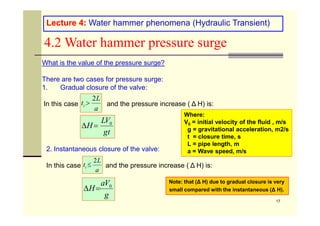
  • 106.
    Lecture 4: Waterhammer phenomena (Hydraulic Transient) 4.3 Time history of pressure wave due to water hammer): The time history for point B (at a distance x from the reservoir ) The friction losses in the pipe are neglected. a 26 Time history for pressure at point “B” (after valve closure)
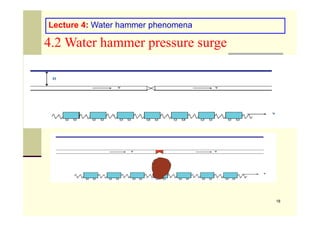
  • 107.
    Lecture 4: Waterhammer phenomena (Hydraulic Transient) 4.3 Time history of pressure wave due to water hammer): In real practice In real practice friction effects are considered and hence a damping effect occurs and the pressure wave dies out, i.e.; energy is dissipated. Damping effect of friction 27 Time history for pressure at point “A” (after valve closure) when friction losses are included. t*(2L/a)
  • 108.
    Lecture 4: PumpingHydraulics 4.4 water hammer in pumping mains  Water hammer due to power failure: As illustrated previously, one of the serious events that produce water hammer in delivery pipes of 28 delivery pipes of pumping stations is power failure.
  • 109.
    Lecture 4: PumpingHydraulics 4.4 water hammer in pumping mains  Column separation due to power failure: - What do we mean by column separation? -After power failure a wave of negative pressure “down surge” occurs. - If the hydraulic profile intersects the pressure pipe and falls below it for a pressure less or equal to the vapor pressure, water vapor starts to accumulate And large air pockets are formed. 29 And large air pockets are formed. -The air pocket separates the water column in the pipe into to parts, upstream column and down stream column. This phenomena is called column separation. -Column separation is dangerous when the two water columns join again with huge collision when the reflected wave comes back. This collision produce an upsurge pressure that is much more than the first water hammer impulse calculated from the equation discussed previously . g V a H 0  
  • 110.
    Lecture 4: PumpingHydraulics 4.4 water hammer in pumping mains  Column separation due to power failure: - How to predict column separation? 30 To predict the occurrence of negative pressure and column separation due to water hammer draw a mirror image of the normal hydraulic profile . If the mirror HGL falls below the pipe for a distance “d “ = hatmospheric – hvapor, thin column separation will occur.
  • 111.
    Lecture 4: PumpingHydraulics 4.4 water hammer in pumping mains a    Graphical solution to calculate the water hammer surge after power failure: A. water hammer without column separation: The figure in the next slide illustrates the surge development in a pumping main after power failure. The following formulas are needed to understand the method: 31 p gA a   tan 1 0 A : the subscripts 0-1 means the situation at point A between time 0 and time 1, the same notation is used for point B. Time 1 in this example is = L/a. : Λ (Lambda) is the angle of inclination of the surge line PR, Ap is the cross section area of the pressure line.   tan 2 0 0 H Q Cp : Cp is the pipe constant, (Q0,H0) is the operating point before pump failure. If Cp is <0.50 then the maximum pressure at the pump is positive as this case. If Cp is > 0.50 then the maximum pressure at the pump is negative and column separation will occur as the next case explained in B.
  • 112.
  • 113.
    Lecture 4: PumpingHydraulics 4.4 water hammer in pumping mains  Graphical solution to calculate the water hammer surge after power failure: B. water hammer with column separation: As indicated in Case A if Cp is > 0.50 then column separation occurs. The following example illustrates this case. 33
  • 114.
  • 115.
    Lecture 4: PumpingHydraulics 4.4 Prevention of water hammer in pumping mains  Methods of preventing or minimizing the water hammer surge: A. Control Tanks: - Open end surge tank or standpipe - one way surge tank - two way surge tank - Air champers (hydropneumatic tanks) 35 - Air champers (hydropneumatic tanks) B. Control valves: - Vacuum relief valve - Air release valves - Air release and vacuum relief valves - surge relief valves
  • 116.
    Lecture 4: PumpingHydraulics 4.4 Prevention of water hammer in pumping mains 36
  • 117.
    Lecture 4: PumpingHydraulics 4.4 Prevention of water hammer in pumping mains 37 Horizontal Air chamber for water hammer prevention
  • 118.
    Lecture 4: PumpingHydraulics 4.4 Prevention of water hammer in pumping mains 38 Horizontal Air chamber for water hammer prevention Vertical Air chamber for water hammer prevention
  • 119.
    Lecture 4: PumpingHydraulics 4.4 Prevention of water hammer in pumping mains 39 surge relief valve
  • 120.
    Lecture 4: PumpingHydraulics 4.4 Prevention of water hammer in pumping mains 40 Air release valve
  • 121.
    Lecture 4: PumpingHydraulics 4.4 Prevention of water hammer in pumping mains 41 Vacuum relief valve Air /Vacuum relief valve
  • 122.
    Lecture 4: PumpingHydraulics 4.4 Prevention of water hammer in pumping mains  Using Air champers to prevent water hammer surge: 42 Fig 80
  • 123.
    Lecture 4: PumpingHydraulics 4.4 Prevention of water hammer in pumping mains 43
  • 124.
     Charts todetermine the size of the air champers    0 0 2gH aV  orifice champer air in the percent losses K  orifice champer air in the percent losses K  44 Fig 83 champer air the in volume air compressed initial The  0 C    min 0 0 / H H C C pump the to adjacent surge down H H     0 min : air chamber volume
  • 125.
    Lecture 4: PumpingHydraulics 4.4 Prevention of water hammer in pumping mains  Using computer software for water hammer analysis: There are many computer software for water hammer analysis such as: - Hammer (Bently company) - HiTran - AFT 45 - AFT - Pipe Expert These software are not free , they are very expensive. However, you can Download DEMO versions and get good benefit out of it. You can also search For free software that I do not know.
  • 126.
    Lecture 5: Designof wastewater pumping stations 5.1 General introduction  Main components of WWPS: - Bar screen - Grit removal - Wet well or wet well + dry well - Electricity distribution and control room (MDB + PLC) - Transformer room 46 - Transformer room - Stand by generator and its fuel tank - Guard room and its services (kitchen + showers and toilet) - Pressure pipes and control valves - Fence and landscaping
  • 127.
    Dr. Fahid Rabah, PE frabah@iugaza.edu ١ Pumping Stations Design For Infrastructure Master Program Engineering Faculty-IUG Dr. Fahid Rabah Water and environment Engineering frabah@iugaza.edu Lecture 5: Design of wastewater pumping stations
  • 128.
    Dr. Fahid Rabah, PE frabah@iugaza.edu ٢ Lecture 5: Design of wastewater pumping stations 5.1 General introduction  Main components of WWPS: - Bar screen - Grit removal - Wet well or wet well + dry well - Electricity distribution and control room (MDB + PLC) - Transformer room - Stand by generator and its fuel tank - Guard room and its services (kitchen + showers and toilet) - Pressure pipes and control valves - Fence and landscaping
  • 129.
    Dr. Fahid Rabah, PE frabah@iugaza.edu ٣ Grit Removal Wet Well Pump House Bar Screen Service building Emergency power station Pressure line Inlet pipe Fig 5.1 Typical Layout of Wastewater Pumping Station 5.2 Typical layout of WW pumping stations Lecture 5: Design of wastewater pumping stations
  • 130.
    Dr. Fahid Rabah, PE frabah@iugaza.edu ٤ Typical Layout of Wastewater Pumping Station 5.2 Typical layout of WW pumping stations Lecture 5: Design of wastewater pumping stations Fig. 5.2
  • 131.
    Dr. Fahid Rabah, PE frabah@iugaza.edu ٥ Manual Bar Screen Mechanical Bar Screen Lecture 5: Design of wastewater pumping stations 5.3 main components of WW pumping stations Bar screen Fig. 5.3
  • 132.
    Dr. Fahid Rabah, PE frabah@iugaza.edu ٦ Mechanical Bar Screen 5.3 main components of WW pumping stations Bar screen Fig. 5.4
  • 133.
    Dr. Fahid Rabah, PE frabah@iugaza.edu ٧ Grit Removal Channel Grit Removal vortex type 5.3 main components of WW pumping station Grit Removal Fig. 5.5 Grit classifier
  • 134.
    Dr. Fahid Rabah, PE frabah@iugaza.edu ٨ Wet well Pump House 5.3 main components of WW pumping station Wet Well Fig. 5.6
  • 135.
    Dr. Fahid Rabah, PE frabah@iugaza.edu ٩ Wet well Pump House 5.3 main components of WW pumping station Wet Well Fig. 5.7
  • 136.
    Dr. Fahid Rabah, PE frabah@iugaza.edu ١٠ 5.3 main components of WW pumping station Dry Well Fig. 5.8 Dry room for dry pumps
  • 137.
    Dr. Fahid Rabah, PE frabah@iugaza.edu ١١ 5.3 main components of WW pumping station Dry Well Fig. 5.9 Dry room for dry pumps
  • 138.
    Dr. Fahid Rabah, PE frabah@iugaza.edu ١٢ 5.3 main components of WW pumping station Dry Well Fig. 5.10 Dry room for dry pumps
  • 139.
    Dr. Fahid Rabah, PE frabah@iugaza.edu ١٣ Wet well Dry well 5.3 main components of WW pumping station Dry Well Fig. 5.11 Dry room for dry pumps
  • 140.
    Dr. Fahid Rabah, PE frabah@iugaza.edu ١٤ Dry well 5.3 main components of WW pumping station Dry Well Fig. 5.12 Dry room for dry pumps
  • 141.
    Dr. Fahid Rabah, PE frabah@iugaza.edu ١٥ 5.3 main components of WW pumping station Dry Well Fig. 5.13 Dry room for dry pumps
  • 142.
    Dr. Fahid Rabah, PE frabah@iugaza.edu ١٦ 5.3 main components of WW pumping station Fig. 5.14 Electricity distribution and control room (MDB + PLC)
  • 143.
    Dr. Fahid Rabah, PE frabah@iugaza.edu ١٧ Stand by generator 5.3 main components of WW pumping station Stand by Generator Fuel tank Fig. 5.15 Standby generator and its fuel tank
  • 144.
    Dr. Fahid Rabah, PE frabah@iugaza.edu ١٨ Transformer room 5.3 main components of WW pumping station Transformer Fig. 5.15 Electricity Transformer
  • 145.
    Dr. Fahid Rabah, PE frabah@iugaza.edu ١٩ 5.3 main components of WW pumping station Service Building Fig. 5.16 Service Building
  • 146.
    Dr. Fahid Rabah, PE frabah@iugaza.edu ٢٠ 5.3 main components of WW pumping station Pumping station fence and gate Fig. 5.17 Pumping station fence and gate
  • 147.
    Dr. Fahid Rabah, PE frabah@iugaza.edu ٢١ 5.3 main components of WW pumping station Delivery Pipes , valves and manifold Fig. 5.18 Delivery Pipes , valves and manifold in WWPS
  • 148.
    Dr. Fahid Rabah, PE frabah@iugaza.edu ٢٢ Lecture 5: Design of wastewater pumping stations 5.4 Design of the main components of WWPS After the introduction to the main components of WWPS we will study the design of the following components: - Design of the general layout of the WWPS - Design of Bar screen channel - Design of Grit removal channels - Design of Wet well for submersible pumps - Design of Wet well and dry well for dry pumps - Design of the delivery pipes and the pressure line
  • 149.
    Dr. Fahid Rabah, PE frabah@iugaza.edu ٢٣ Typical Layout of Wastewater Pumping Station 5.4.1 Design of the general layout of the WWPS: 5.4 Design of the main components of WWPS Fig. 5.19
  • 150.
    Dr. Fahid Rabah, PE frabah@iugaza.edu ٢٤ 5.4.2 Design of Bar screens Screens are used in wastewater treatment for the removal of coarse solids. Screens are either manually or mechanical cleaned. Characteristics of manual bar screen • Bar spacing is in range of 2-5 cm • The screen is mounted at an angle of 30-45 • Bars are usually 1 cm thick, 2.5 wide • Minimum approach velocity in the bar screen channel is 0.45 m/s to prevent grit deposition. • Maximum velocity between the bars is 0.9m/s to prevent washout of solids through the bars. Characteristics of mechanical bar screen • Bar spacing is in range of 1.5-4 cm • The screen is mounted at an angle of 30-75 • Bars are usually 1 cm thick, 2.5 wide • Minimum approach velocity in the bar screen channel is 0.45 m/s to prevent grit deposition. • Maximum velocity between the bars is 0.9 m/s to prevent washout of solids through the bars. 5.4 Design of the main components of WWPS
  • 151.
    Dr. Fahid Rabah, PE frabah@iugaza.edu ٢٥ Design of the bar screen channel (Approach Channel) The cross section of the bar screen channel is determined from the continuity equation: Qd = AcVa Ac = Qd/ Va Qd = design flow, m3/s Ac = bar screen cross section, m2 Va = Velocity in the approach channel, m/s Usually, rectangular channels are used, and the ratio between depth and width is taken as 1.5 to give the most efficient section. 7 . 0 1 2 ) ( 2 2    g V V H a b l The head loss through the bar screen Hl = head loss Va = approach velocity, m/s Vb = Velocity through the openings, m/s g = acceleration due to gravity, m/s2 5.4.2 Design of Bar screens 5.4 Design of the main components of WWPS
  • 152.
    Dr. Fahid Rabah, PE frabah@iugaza.edu ٢٦ Example A manual bar screen is to be used in an approach channel with a maximum velocity of 0.64 m/s, and a design flow of 300 L/s. the bars are 10 mm thick and openings are 3 cm wide. Determine: The cross section of the channel, and the dimension needed The velocity between bars The head loss in meters The number of bars in the screen 1. Ac= Qd/Va= 0.3/0.64 = 0.47 m2 Ac= W x1.5W =1.5 W x W W = 0.56 m, Depth (d) = 1.5 W = 0.84 m bar c c c net t S S A A   7 . 0 1 2 ) ( 2 2    g V V H a b l 7 . 0 1 81 . 9 2 ) 64 . 0 86 . 0 ( 2 2     l H = 0.84 x 0.56 (3/3+1) = 0.35 m2 From continuity equation: Va Ac= Vb Anet Vb= 0.64 x 0.56 x 0.84/0.35 = 0.86 m/s < 0.9 m/s ok 3. Head loss: = 0.024 m 4. n tbar + (n-1)Sc = W n x 1 + (n-1) x 3= 56 n= 14.75 = 15
  • 153.
    Dr. Fahid Rabah, PE frabah@iugaza.edu ٢٧ Design a set of rectangular grit basins with proportional flow weir for a plant which has a peak flow of 80,000 m3/day, an average flow of 50,000 m3/day and a minimum flow of 20,000 m3/day. Use three basins. Make the peak depth equal to the width. The design velocity (Vh) is 0.25 m/s, Vs = 0.021 m/s Solution The peak flow per channel will be 80,000/3 = 26,666 m3/day = 0.31 m3/s. The average flow per channel will be 50,000/3= 16,666 m3/day = 0.19 m3/s. The minimum flow per channel will be 20,000/3= 6,666 m3/day = 0.077 m3/s. A = Q/Vh A peak = 0.31/0.25 = 1.24 m2. The water depth D = W = 1.114 Take W = 1.10 m. Then D = 1.13 m at peak flow Take the channel depth = 1.50 m This would provide a freeboard of 37 cm at peak flow. L = D (Vh/Vs) The length of the channel = 1.15 (0.25/0.021) = 13.7 m The weir must be shaped so that: Q = 8.18 * 10-6 wy1.5 W = width of the proportional weir at depth y. Q (m3/min) Y (mm) W (mm) 4.62 280 120.50 11.4 691 76.70 15.0 909 66.90 18.6 1130 59.90 Note: Y= Q/(Vh*W) 5.4.3 Design of rectangular Grit removal channel
  • 154.
    Dr. Fahid Rabah, PE frabah@iugaza.edu ٢٨ 7.5 cm Fig 5.20 Proportional flow weir for use with rectangular grit chamber 5.4.3 Design of rectangular Grit removal channel Area equals to rejected area
  • 155.
    Dr. Fahid Rabah, PE frabah@iugaza.edu ٢٩ 5.4 Design of the main components of WWPS  Design of horizontal cross section of the wet well: 5.4.4 Design of the wet well for submersible pumps • The dimensions of the horizontal cross section of the wet well depends on the pump size and the recommended distance between the pumps. • Figure 5.21 shows the recommended dimensions of the horizontal cross section of the wet well . Note that the diameter of the pump casing “D” is the dimension That decides the length of the wet well. • The second needed distance is B, the distance between the wet well wall and the center of the pump. The distance B is necessary to decide the width of the wet well. The distances D and B is taken from the pump catalogs as those shown in figures 15.23 and 15.22. • An inlet channel inside the wet well opposite to the inlet pipe is usually needed to As energy breaker to prevent turbulence in the wet well. The width of the channel is usually 50 to 70 cm and its height is equal to the inlet pipe diameter plus 30 cm. • Figure 15.25 shows a horizontal plan of the wet well at a level above the concrete frame.
  • 156.
    Dr. Fahid Rabah, PE frabah@iugaza.edu ٣٠ Fig. 5.21
  • 157.
    Dr. Fahid Rabah, PE frabah@iugaza.edu ٣١ 5.4 Design of the main components of WWPS  Design of the vertical cross section of the wet well: 5.4.4 Design of the wet well for submersible pumps • Figure 5.24 shows a typical vertical cross section of the wet well. • The LWL is taken from the manufacturer catalog of the pump. For example, the LWL for the KSB is indicated as the distance “R” in figure 15. 22. • The HWL is calculated from the active volume as will be indicated later. The active volume is the volume between the LWL and the HWL. • The HWL is taken as the level of the invert level of the inlet pipe as indicated in figure 15.22. The distance from the HWL to the top of the roof of the wet well depends on the ground level. It is usually preferred to take the level of the top of roof the of the wet well as 50 cm higher than the ground level. • As shown in figure 15.22, a hoist and chain should be located above the pump to left it for maintenance. For this purpose a concrete frame should be built to hang the electrical hoist on it. The capacity of the hoist is decided according to the weight of each pump. The weight of the pump is taken from the manufacturer catalog as in figure15.23. • A rectangular benching is needed to prevent solids from settling away from the pumps. The dimension of this triangle is shown in figure 15.24.
  • 158.
    Dr. Fahid Rabah, PE frabah@iugaza.edu ٣٢ Fig. 5.22 Typical dimensions of a submersible KSB pump needed for the design of the wet well
  • 159.
    Dr. Fahid Rabah, PE frabah@iugaza.edu ٣٣ Fig. 5.23 Typical dimensions of a submersible KSB pump needed for the design of the wet well
  • 160.
    Dr. Fahid Rabah, PE frabah@iugaza.edu ٣٤ 1 2 3 7 5 Fig. 5.24 HWL
  • 161.
    Dr. Fahid Rabah, PE frabah@iugaza.edu ٣٥ 1 2 3 7 Fig. 5.25
  • 162.
    Dr. Fahid Rabah, PE frabah@iugaza.edu ٣٦ An example of a submersible pump installed in the wet well Fig. 5.26
  • 163.
    Dr. Fahid Rabah, PE frabah@iugaza.edu ٣٧ Fig. 5.27 A photo at the top of a wet well showing delivery pipes and valves
  • 164.
    Dr. Fahid Rabah, PE frabah@iugaza.edu ٣٨ 5.4 Design of the main components of WWPS 4 Tq V   Determination of the wet well active volume: 5.4.4 Design of the wet well for submersible pumps • The active volume in the wet well is the volume enclosed between the LWL and the HWL. • This volume depends on many factors such as the number of pumps, the capacity of each pump and the raw WW influent flow rate. • The active volume (V ) when one pump is in operation is calculated from the following equation: Where: T: minimum cycle time between pump starts, min. q : the pumping rate of a single pump in operation, m3/min V: active volume for one pump in operation, m3 empty to time fill to time T  
  • 165.
    Dr. Fahid Rabah, PE frabah@iugaza.edu ٣٩ 5.4 Design of the main components of WWPS  Determination of the wet well active volume: 5.4.4 Design of the wet well for submersible pumps • The cycle time T depends on the pump type and the manufacturer recommendations. • Typical value of T 6 minutes. This will lead to 10 starts of the pump in 1 hour. it is recommended to limit the number of pump starts to 12 as a maximum to protect the pump and to increase its effective life span. •If more than a pump is used, an additional 15 cm is added to the height of the wet well for each pump other than the first.
  • 166.
    Dr. Fahid Rabah, PE frabah@iugaza.edu ٤٠ 5.4 Design of the main components of WWPS  Determination of the wet well active volume: 5.4.4 Design of the wet well for submersible pumps Example: What is the active volume of a wet well that has 3 pumps working in parallel plus one standby pump. The capacity of one pump when operating alone is 14.7 m3/min. Take T as 6 minutes. The area of the horizontal cross section of the wet well is 15 m2 . Solution: V = (14.7*6)/4 = 22.05 m3 Water height = (22.05)/15 = 1.47 m Total height of active volume = 1.47 + 2*0.15 = 1.77 m Total active volume = 1.77 * 15 = 26.55 m3
  • 167.
    Dr. Fahid Rabah, PE frabah@iugaza.edu ٤١ 5.4 Design of the main components of WWPS  Determination of the wet well active volume: 5.4.4 Design of the wet well for submersible pumps The pumps operation sequence can be set according to the active volume calculated in the previous example as indicated in the following figure. Inlet pipe 15cm 15cm 147cm 15cm Start P3 Start P2 Start P1 15cm 147cm Stop P3 Stop P2 Stop P1 R HWL LWL Fig. 5.28 Pumps operation sequence Wet well
  • 168.
    Dr. Fahid Rabah, PE frabah@iugaza.edu ٤٢ 5.4 Design of the main components of WWPS Dry well installation 1.5 m 7-10 d 1.5 m 2-3 m Pump length 2-3 m 0.75 m 1.5 m d Fig. 5.29 Typical dimensions of the horizontal section of dry well installation
  • 169.
    Dr. Fahid Rabah, PE frabah@iugaza.edu ٤٣ 5.4 Design of the main components of WWPS Dry well installation 2-3 m 2-3m HWL LWL Inlet pipe GL GL Gate valve Check valve Dresser Gate valve Dresser Reducer D D/2 5 d d Manifold Fig. 5.30 Typical dimensions of the vertical section of dry well installation
  • 170.
    Dr. Fahid Rabah, PE frabah@iugaza.edu ٤٤ 5.4 Design of the main components of WWPS  Figure 5.29 gives the typical dimensions of the the horizontal cross section of the dry and wet well installation. 5.4.5 Design of the wet and dry wells for dry pumps  Figure 5.30 gives the typical dimensions of the the vertical cross section of the dry and wet well installation.  The active volume and pump operation sequence is the same as for the wet wall installation as discussed in the previous example.
  • 171.
    Dr. Fahid Rabah, PE frabah@iugaza.edu ٤٥ 5.4 Design of the main components of WWPS  pressure line (selecting the most economical diameter) delivery pipes Valves on the pressure line Thrust block 5.4.6 Design of the delivery pipes and the pressure line:
  • 172.
    Dr. Fahid Rabah, PE frabah@iugaza.edu ٤٦ 5.4 Design of the main components of WWPS  Delivery pipes: 5.4.6 Design of the delivery pipes and the pressure line: A delivery pipe is the pipe that connects the pump with the manifold. The diameter of this pipe is determined using the Continuity equation: 2 1 4        V Q D pump  Where: D = pipe diameter, m Q pump = discharge of one pump when operation alone, m3/d V = flow velocity, m/s The velocity in delivery pipes is usually assumed in the range of 2-2.5 m/s. Q pump is the determined from the intersection between the system curve and The characteristic curve of a single pump in operation.
  • 173.
    Dr. Fahid Rabah, PE frabah@iugaza.edu ٤٧ 5.4 Design of the main components of WWPS 852 . 1 87 . 4 * 7 . 10        C Q D L hf 5.4.6 Design of the delivery pipes and the pressure line: • The friction losses in the delivery pipe are calculated using the Hazen Williams equation : • The material of the delivery pipes is usually steel, but some times UPVC pipes are used. The Thickness of the pipe wall is determined according to the pressure Exerted on the pipe, especially water hammer pressure. g V k hm 2 2  • The minor losses in the delivery pipe are calculated using the following equation : • The valves and fittings installed on the delivery pipe are shown on Figures 15.24 and 15.25
  • 174.
    Dr. Fahid Rabah, PE frabah@iugaza.edu ٤٨ 5.4 Design of the main components of WWPS  Manifold: 5.4.6 Design of the Manifold: The manifold is the pipe that connects the delivery pipes with the main pressure line. As shown on Figure 15.25 the diameter of the manifold is variable diameter of this pipe is determined using the Continuity equation: 2 1 4        V Q D  Where: D = pipe diameter (variable) according to the # of pumps in operation, m Q = discharge (variable) according to the # of pumps in operation, m3/d V = flow velocity (variable) according to the # of pumps in operation, m/s • The velocity in the manifold is usually assumed in the range of 1 to 2 m/s. Q is Q pump for the first segment (the smallest), and equals Q 2pumps for the second segment and Q 3pumps for the second third segment and so on. Some designers us constant diameter of the manifold designed for Q 3pumps .
  • 175.
    Dr. Fahid Rabah, PE frabah@iugaza.edu ٤٩ 5.4 Design of the main components of WWPS 852 . 1 87 . 4 * 7 . 10        C Q D L hf 5.4.6 Design of the Manifold : • The friction losses in the manifold pipe are calculated using the Hazen Williams equation : • The material of the manifold pipes is usually steel, but some times UPVC pipes are used. The Thickness of the pipe wall is determined according to the pressure Exerted on the pipe, especially water hammer pressure. g V k hm 2 2  • The minor losses in the manifold pipe are calculated using the following equation :
  • 176.
    Dr. Fahid Rabah, PE frabah@iugaza.edu ٥٠ 5.4 Design of the main components of WWPS  Selecting the diameter: 5.4.6 Design of the main Pressure line (Rising main): The main pressure line is the pipe that connects the manifold with ponit of disposal. Its determined is determined using the Continuity equation: 2 1 4        V Q D peak  Where: D = pipe diameter (variable) according to the # of pumps in operation, m Qpeak = discharge (variable) according to the # of pumps in operation, m3/d V = flow velocity at peak flow, m/s • The velocity at peak flow in the main pressure line is usually assumed in the range of 1 to 2 m/s. However the velocity when one pump in operation should not be less than 0.60 m/s.
  • 177.
    Dr. Fahid Rabah, PE frabah@iugaza.edu ٥١ 5.4 Design of the main components of WWPS 852 . 1 87 . 4 * 7 . 10        C Q D L hf 5.4.6 Design of the Manifold : • The friction losses in the main pressure line are calculated using the Hazen Williams equation : • The material of the main pressure line is usually steel, but some times UPVC pipes are used. The Thickness of the pipe wall is determined according to the pressure Exerted on the pipe, especially water hammer pressure. g V k hm 2 2  • The minor losses in the main pressure line are calculated using the following equation :
  • 178.
    Dr. Fahid Rabah, PE frabah@iugaza.edu ٥٢ 5.4 Design of the main components of WWPS  Selecting the most economical diameter for the main pressure line: 5.4.6 Design of the main Pressure line (Rising main): • As understood from the continuity equation, D is a function of V, so there are many combinations of D and V that satisfy the equation. Since we , as engineers, look for the most economical design we usually try to use the smallest pipe Diameter, Unfortunately, when D decreases, V increases, consequently the Power needed and the operation cost increases. So we need to select the most Optimum combination between D and V. This is done using the graph shown below (Figure 15.31). • From figure 15.31, when we add up the capital cost and the operation cost we get the concave up curve. The point of inflection indicates the minimum total Cost. From this point draw a vertical line that will intersect the X-axis at the most Optimum diameter. • Notice that the running cost paid along the life span of the pump station and the Pressure line so the values on figure 15.31 are the present worth value of the Running cost. The capital cost is paid in one payment at the beginning of the project.
  • 179.
    Dr. Fahid Rabah, PE frabah@iugaza.edu ٥٣ 5.4 Design of the main components of WWPS  Selecting the most economical diameter for the main pressure line: 5.4.6 Design of the main Pressure line (Rising main): Optimum pressure line diameter 0.00E+00 5.00E+05 1.00E+06 1.50E+06 2.00E+06 2.50E+06 3.00E+06 200 300 400 500 600 700 800 Diameter (m) Cost (US $) Running cost Capital cost Total cost MIN. Total cost Optimum D Fig. 5.31 Optimum pipe diameter
  • 180.
    Dr. Fahid Rabah, PE frabah@iugaza.edu ٥٤ 5.4 Design of the main components of WWPS  Valves and tanks installed on the main pressure line: 5.4.6 Design of the main Pressure line (Rising main): • There are two main valves that are installed on the pressure lines: 1. Air release /Vacuum valves are installed at: • All height points •long rising segments at intervals of 750 to 1000 m •long descending segments at intervals of 750 to 1000 m 2. Drainage valves are : • All low point • Long rising and flat pipes at intervals of 500 m 3. Pressure relief valves are installed at: • Low points along the pipe where high pressure is expected •locations related to water hammer waves such as before valves or after pumps. If other tools are used to control water hammer, these valves will be not necessary. 4. Surge tanks and Air champers are installed at: • Just after the pumps. • At high points a long the pipe to prevent column separation.
  • 181.
    Dr. Fahid Rabah, PE frabah@iugaza.edu ٥٥ 5.4 Design of the main components of WWPS  Thrust blocks installed on the main pressure line: 5.4.6 Design of the main Pressure line (Rising main): Thrust blocks are concrete blocks installed along the pressure lines at horizontal and bends vertical to protect the pipe from the water thrust force created due to The change in direction.
  • 182.
    Dr. Fahid Rabah, PE frabah@iugaza.edu ٥٦ 5.4 Design of the main components of WWPS     cos 1 2 2 2          V d Rx   sin 2 2 2 V d Ry          Thrust blocks installed on the main pressure line: 5.4.6 Design of the main Pressure line (Rising main): The resulting force due to mass flow and flow velocity can be expressed as : 2 1 2 2 ) ( y x R R R   Rx = resulting force in x-direction (N) Ry = resulting force in y-direction (N) R = Resultant of the x and y forces (N) v = flow velocity , m/s β = bend angle , degrees ρ = fluid density, kg/m d = internal pipe diameter , m
  • 183.
    Dr. Fahid Rabah, PE frabah@iugaza.edu ٥٧ 5.4 Design of the main components of WWPS     cos 1 2 2         d P Rx   sin 2 2        d P Rpy  Thrust blocks installed on the main pressure line: 5.4.6 Design of the main Pressure line (Rising main): Resulting force due to Static Pressure: 2 1 2 2 ) ( py px p R R R   Rpx = resulting force due to pressure in x-direction ,N Rpy = resulting force due to pressure in x-direction ,N Rp= resultant force on the bend due to pressure, N P = gauge pressure inside pipe (Pa, N/m2)
  • 184.
    Dr. Fahid Rabah, PE frabah@iugaza.edu ٥٨ 5.4 Design of the main components of WWPS 5.4.6 Design of the main Pressure line (Rising main): Fig. 5.32 Typical Thrust blocks See also chapter 4
  • 185.
    Dr. Fahid Rabah, PE frabah@iugaza.edu ٥٩ 5.4 Design of the main components of WWPS 5.4.6 Design of the main Pressure line (Rising main): Fig. 5.33 Thrust block under construction
  • 186.
    Dr. Fahid Rabah, PE frabah@iugaza.edu ٦٠ Typical dimensions and details of thrust blocks
  • 187.
    Dr. Fahid Rabah, PE frabah@iugaza.edu ١ Pumping Stations Design For Infrastructure Master Program Engineering Faculty-IUG Dr. Fahid Rabah Water and environment Engineering frabah@iugaza.edu Lecture 6: Design of water supply pumping stations
  • 188.
    Dr. Fahid Rabah, PE frabah@iugaza.edu ٢ Lecture 6: Design of waster supply pumping stations 6.1 General introduction Main Types of water pumping stations : 1. Wells pumping stations 2. Distribution pumping stations 3. Booster pumping stations 4. Surface water pumping stations
  • 189.
    Dr. Fahid Rabah, PE frabah@iugaza.edu ٣ Lecture 6: Design of waster supply pumping stations 6.2 Well pumping stations Main components of well pumping stations : 1. Multi stage pumps ( connected in series) 2. Suction shaft (pipe) 3. Vertical motor ( above ground or submerged) 4. Delivery pipe 5. Valves 6. Cyclone 7. Surge vessel (air champer for water hammer protection) 8. Chlorination tank and chlorine injection pump. 9. Stand by generator and its fuel tank 10.Main electricity distribution panel and control 11.Service building.
  • 190.
    Dr. Fahid Rabah, PE frabah@iugaza.edu ٤ P U M P L E N G T H 2 . 4 0 m 4''? SCH 40 4''? HOLLOW SHAFT ELECTRIC MOTOR 400V,50HZ,1450RPM CAST IRAN ( CI ) DISCHARGE HEAD STAINLESS STEEL DRIVE SHAFT WATER COOLED RUBBER BEARING + BRONZE LINER + BRONZE IMPELLERS CAST IRAN FLANGED CONNECTED BOWLS 6.2 Well pumping stations Multi stage pumps connected in series with a dry installation vertical motor
  • 191.
    Dr. Fahid Rabah, PE frabah@iugaza.edu ٥ 6.2 Well pumping stations Multi stage pumps connected in series with dry or submersible motor
  • 192.
    Dr. Fahid Rabah, PE frabah@iugaza.edu ٦ 6.2 Well pumping stations Multi stage pumps connected in series with diesel motor
  • 193.
    Dr. Fahid Rabah, PE frabah@iugaza.edu ٧ 6.2 Well pumping stations Multi stage pumps connected in series- submersible motor
  • 194.
    Dr. Fahid Rabah, PE frabah@iugaza.edu ٨ Vertical dry motor installation 6.2 Well pumping stations
  • 195.
    Dr. Fahid Rabah, PE frabah@iugaza.edu ٩ Submersible type motor installation 6.2 Well pumping stations
  • 196.
    Dr. Fahid Rabah, PE frabah@iugaza.edu ١٠ Air release valve Hydro-Cyclone Butter fly valve Suction Pipe Flow meter Motor Pressure Gage Chlorine injection Typical piping and valves arrangement for well pumping stations 6.2 Well pumping stations
  • 197.
    Dr. Fahid Rabah, PE frabah@iugaza.edu ١١ Hydro Cyclone C o o l i n g T a n k 5 0 0 l i t e r chlorine Tank P.E 500liter C h l o r i n e D o s i n g P u m p 1 3 2 3 5 3 3 Pump well Delivery pipe Butterfly valve Check valve Flow meter 1 2 4 3 5 4 Well room Typical layout of 6.2 Well pumping stations
  • 198.
    Dr. Fahid Rabah, PE frabah@iugaza.edu ١٢ Delivery pipe , see the Hydro Cyclones and valves 6.2 Well pumping stations
  • 199.
    Dr. Fahid Rabah, PE frabah@iugaza.edu ١٣ Hydro Cyclone function 6.2 Well pumping stations
  • 200.
    Dr. Fahid Rabah, PE frabah@iugaza.edu ١٤ Delivery pipe , see the Hydro Cyclones and valves 6.2 Well pumping stations
  • 201.
    Dr. Fahid Rabah, PE frabah@iugaza.edu ١٥ Standby generator 6.2 Well pumping stations
  • 202.
    Dr. Fahid Rabah, PE frabah@iugaza.edu ١٦ Fuel tank for the standby generator 6.2 Well pumping stations
  • 203.
    Dr. Fahid Rabah, PE frabah@iugaza.edu ١٧ Water tank Chlorine tank Chlorine pump Chlorine tank and chlorine injection pump 6.2 Well pumping stations
  • 204.
    Dr. Fahid Rabah, PE frabah@iugaza.edu ١٨ chlorine injection point to the delivery pipe 6.2 Well pumping stations
  • 205.
    Dr. Fahid Rabah, PE frabah@iugaza.edu ١٩ Delivery pipe , see the Hydro Cyclone , valves, fuel tank, service building 6.2 Well pumping stations
  • 206.
    Dr. Fahid Rabah, PE frabah@iugaza.edu ٢٠ Delivery pipe , Hydro Cyclone , valves, fuel tank, generator 6.2 Well pumping stations
  • 207.
    Dr. Fahid Rabah, PE frabah@iugaza.edu ٢١ 6.2 Well pumping stations
  • 208.
    Dr. Fahid Rabah, PE frabah@iugaza.edu ٢٢ 6.2 Well pumping stations
  • 209.
    Dr. Fahid Rabah, PE frabah@iugaza.edu ٢٣ 6.2 Well pumping stations Types of well pumping stations : 1. Direct pumping from well pumps to the distribution system Most of Gaza wells are from this type Not recommended for long distribution systems and for cases where more than one well pumping directly into the system. This system has two problems: back pressure between wells and lower discharge from each individual well. 2. Pumping from well pumps to a storage or distribution tank. This system is recommended and there is a trend in Gaza to use this system This system solves the problem of back pressure associated with the direct pumping discussed above. It also increase the pumping efficiency from each pump (lower head losses leading to more flat system curve and consequently more discharge)
  • 210.
    Dr. Fahid Rabah, PE frabah@iugaza.edu ٢٤ 6.2 Well pumping stations Well pumping station discharging into a storage tank
  • 211.
    Dr. Fahid Rabah, PE frabah@iugaza.edu ٢٥ 6.2 Well pumping stations Note that for well pumps there is only one valid pump curve which is the curve of the total pumps in operation. Well pumping station are operated in series
  • 212.
    Dr. Fahid Rabah, PE frabah@iugaza.edu ٢٦ Lecture 6: Design of waster supply pumping stations 6.3 Distribution pumping stations Main components of distribution pumping stations : 1. Dry pumps ( connected in parallel) 2. Suction shaft (pipe) 3. Storage and distribution tank 4. Delivery pipe 5. Valves 6. Surge vessel (air champer for water hammer protection) 7. Chlorination tank and chlorine injection pump. 8. Stand by generator and its fuel tank 9. Main electricity distribution panel and control 10.Service building.
  • 213.
    Dr. Fahid Rabah, PE frabah@iugaza.edu ٢٧ Lecture 6: Design of waster supply pumping stations 6.3 Distribution pumping stations Typical layout of distribution pumping stations: Storage and Distribution Tank 1 3 2 4 1 Distribution pumping station with rectangular storage and distribution tank 1. Gate valve 2. Pump 3. Check valve 4. Manifold
  • 214.
    Dr. Fahid Rabah, PE frabah@iugaza.edu ٢٨ Lecture 6: Design of waster supply pumping stations 6.3 Distribution pumping stations Typical layout of distribution pumping stations: 5 1 3 2 1 Storage and Distribution Tank 4 Distribution pumping station with circular storage and distribution tank 1. Gate valve 2. Pump 3. Check valve 4. Manifold 5. Feeding Header
  • 215.
    Dr. Fahid Rabah, PE frabah@iugaza.edu ٢٩ 6. Design of water supply pumping stations Distribution pumping station
  • 216.
    Dr. Fahid Rabah, PE frabah@iugaza.edu ٣٠ 6.3 Distribution pumping stations Distribution pumping station are operated in parallel
  • 217.
    Dr. Fahid Rabah, PE frabah@iugaza.edu ٣١ 6.3 Distribution pumping stations Control of distribution pumping stations : 1. Pressure switch at the discharge side of the pipe. If the pressure in the network increases above a preset value (for example 6 bar ) the pumps will be shut down one after the other. The pressure on the delivery pipe increases at low demands when many connections are closed. 2. Level switch connected to the water distribution tank. If the level in the water distribution tank drops to the a pre assigned minimum level the pumps are shut off one after the other with a pre assigned intervals. The pumps will be started again one after the other when the water in the tank reaches a pre assigned level. An ultra-sound level detector is usually used for level detection. Lecture 6: Design of waster supply pumping stations
  • 218.
    Dr. Fahid Rabah, PE frabah@iugaza.edu ٣٢ Lecture 6: Design of waster supply pumping stations 6.4 Booster pumping stations Main components of booster pumping stations : 1. Dry pumps ( connected in series) 2. Suction connection (pipe) 3. Delivery pipe 4. Valves 5. Stand by generator and its fuel tank (for offline large stations only) 6. Main electricity distribution panel and control 7. Service building (for offline large stations only).
  • 219.
    Dr. Fahid Rabah, PE frabah@iugaza.edu ٣٣ Lecture 6: Design of waster supply pumping stations 6.4 Booster pumping stations Main types of booster pumping stations : 1. Inline booster pumps 2. Offline booster pumps
  • 220.
    Dr. Fahid Rabah, PE frabah@iugaza.edu ٣٤ Typical inline Booster Pump 6.4 Booster pumping stations Lecture 6: Design of waster supply pumping stations
  • 221.
    Dr. Fahid Rabah, PE frabah@iugaza.edu ٣٥ Inline Package Booster Pump 6.4 Booster pumping stations Lecture 6: Design of waster supply pumping stations
  • 222.
    Dr. Fahid Rabah, PE frabah@iugaza.edu ٣٦ Lecture 6: Design of waster supply pumping stations 6.4 Booster pumping stations Typical layouts of inline booster pumping stations: Inline booster pumping station - two pumps in series This layouts is used when two or three pumps are able to deliver the required flow and head. If more than three pumps are needed or when the pumps are large, we should go to an offline booster pumping station.
  • 223.
    Dr. Fahid Rabah, PE frabah@iugaza.edu ٣٧ Lecture 6: Design of waster supply pumping stations 6.4 Booster pumping stations Typical layouts of inline booster pumping stations: Inline booster pumping station - two pumps in parallel This layouts is used when one pump is able to deliver the required head but not able to deliver the required flow. In this case we use two or more pumps in parallel. If more than three pumps are needed or when the pumps get large, we should go to an offline booster pumping station.
  • 224.
    Dr. Fahid Rabah, PE frabah@iugaza.edu ٣٨ Lecture 6: Design of waster supply pumping stations 6.4 Booster pumping stations Typical layout of offline booster pumping arrangements: This configuration is used when one pump is able to give the required head but not able to give the required flow, so we need more than one pump in parallel to deliver the total flow. 5 1 3 2 1 4 offline booster pumping station - three pumps in parallel
  • 225.
    Dr. Fahid Rabah, PE frabah@iugaza.edu ٣٩ Lecture 6: Design of waster supply pumping stations 6.4 Booster pumping stations Typical layout of offline booster pumping arrangements: This configuration is used when one pump is able to give the required flow but not able to give the required head alone, so we need more than one pump in series to deliver the total head. Note that we use a bypass line to achieve flexibility in operation When one or more pumps are out for maintenance. offline booster pumping station - three pumps in series
  • 226.
    Dr. Fahid Rabah, PE frabah@iugaza.edu ٤٠ Lecture 6: Design of waster supply pumping stations 6.5 Surface water pumping stations 1. Water Intake structure 2. Submersible or dry pumps ( connected in parallel) 3. Suction connection (pipe) 4. Delivery pipe 5. Valves 6. Stand by generator and its fuel tank 7. Main electricity distribution panel and control 8. Service building Main components of surface pumping stations :
  • 227.
    Dr. Fahid Rabah, PE frabah@iugaza.edu ٤١ 6.5 Surface water pumping stations Lecture 6: Design of waster supply pumping stations Movable Surface water intake
  • 228.
    Dr. Fahid Rabah, PE frabah@iugaza.edu ٤٢ 6.5 Surface water pumping stations Lecture 6: Design of waster supply pumping stations Surface water intake
  • 229.
    Dr. Fahid Rabah, PE frabah@iugaza.edu ٤٣ 6.5 Surface water pumping stations Lecture 6: Design of waster supply pumping stations Dry pumps and Surface water intake
  • 230.
    Dr. Fahid Rabah, PE frabah@iugaza.edu ٤٤ Lecture 6: Design of waster supply pumping stations Surface water Submersible pump
  • 231.
    Dr. Fahid Rabah, PE frabah@iugaza.edu ٤٥ 6.5 Surface water pumping stations Lecture 6: Design of waster supply pumping stations Surface water Submersible pump
  • 232.
    Dr. Fahid Rabah, PE frabah@iugaza.edu ١ Pumping Stations Design For Infrastructure Master Program Engineering Faculty-IUG Dr. Fahid Rabah Water and environment Engineering frabah@iugaza.edu Lecture 7: Design of sludge pumping stations
  • 233.
    Dr. Fahid Rabah, PE frabah@iugaza.edu ٢ Lecture 7: Design of sludge pumping stations 7.1 General introduction Types of sludge : 1. Primary sludge ( solids concentration 3-5%) 2. Secondary sludge ( solids concentration 1-1.5%) 3. Digested sludge ( Solids concentration 6-7%) 4. Thickened sludge ( Solids concentration 8-10%)  Sludge definition : Sludge is a fluid composed of a mixture of water and solids. Some of these solids are dissolved and some are suspended. The suspended solids are the most important part and their concentration is in the range of 1% to 10% according to sludge type.
  • 234.
    Dr. Fahid Rabah, PE frabah@iugaza.edu ٣ Lecture 7: Design of sludge pumping stations 7.2 Hydraulics of Sludge pumping The sludge is a non-Newtonian fluid, so its flow properties is different from Newtonian fluids such as water and wastewater. Thus, the equations used to determine the hydraulics of water and wastewater doesn't apply for sludge.  The main cause of classifying sludge as a non-Newtonian fluid is the presence of solids in the range of 1% and above.  The hydraulics of sludge pumping is highly dependent on the concentration and properties of the solids in the sludge. The sludge flow is classified into laminar flow or turbulent flow.
  • 235.
    Dr. Fahid Rabah, PE frabah@iugaza.edu ٤ Lecture 7: Design of sludge pumping stations 7.2 Hydraulics of Sludge pumping 2 32 3 16 gD V g D s L h y      Where, h = headless in the pipe, m L = pipe length, m sy = yield stress of the sludge, N/m2 ρ = sludge density , kg /m3 D = pipe diameter , m g= gravitational acceleration,9.81 m/s2 η= coefficient of rigidity, kg/(m.s) V = flow velocity, m/s Laminar flow in sludge pumping systems: Bingham equation is used for defining the hydraulics of sludge in the laminar range:
  • 236.
    Dr. Fahid Rabah, PE frabah@iugaza.edu ٥ Lecture 7: Design of sludge pumping stations 7.2 Hydraulics of Sludge pumping     D D s V y lc 3000 / 1000 1000 2 2    Laminar flow in sludge pumping systems: To apply the Bingham equation the flow should be laminar. Bingham defined the lower critical velocity (Vlc) to check for laminar flow. If the selected design velocity of sludge pumping is less or equal to Vlc then the flow is laminar, otherwise the flow is turbulent. Note: • The values of sy and η are taken from figures 19.2 and 19.3. •The Bingham equations are valid for laminar flow only.
  • 237.
    Dr. Fahid Rabah, PE frabah@iugaza.edu ٦ Lecture 7: Design of sludge pumping stations
  • 238.
    Dr. Fahid Rabah, PE frabah@iugaza.edu ٧ Lecture 7: Design of sludge pumping stations
  • 239.
    Dr. Fahid Rabah, PE frabah@iugaza.edu ٨ Lecture 7: Design of sludge pumping stations 7.2 Hydraulics of Sludge pumping gD fV L H 2  or H = headless in the pipe, m L = pipe length, m Δ p = pressure drop, N/m2 ρ = sludge density , kg /m3 D = pipe diameter , m G = gravitational acceleration,9.81 m/s2 ƒ = friction factor V = flow velocity, m/s D LV f p  2   Where, Turbulent flow in sludge pumping systems: Hanks and Dadia equation is used for defining the hydraulics of sludge in the turbulent range:
  • 240.
    Dr. Fahid Rabah, PE frabah@iugaza.edu ٩ Lecture 7: Design of sludge pumping stations 7.2 Hydraulics of Sludge pumping 2 2   y e s D H  Where, He = Hedstrom number , dimensionless R = Reynolds number , dimensionless sy = yield stress of the sludge, N/m2 ρ = sludge density , kg /m3 D = pipe diameter , m Η = coefficient of rigidity, kg/(m.s) V= flow velocity, m/s   DV R  Hedstrom number: Reynolds number: The friction coefficient (ƒ ) is found from figure 19.6 after calculating (He) and (R) from the following equations:
  • 241.
    Dr. Fahid Rabah, PE frabah@iugaza.edu ١٠ Lecture 7: Design of sludge pumping stations 7.2 Hydraulics of Sludge pumping
  • 242.
    Dr. Fahid Rabah, PE frabah@iugaza.edu ١١ Lecture 7: Design of sludge pumping stations 7.2 Hydraulics of Sludge pumping Approximate method for headless calculations Figure 19.5 gives a the headless as a factor of the headless calculated for water or wastewater using the equation of Hazen Williams with a coefficient of Friction C=140.
  • 243.
    Dr. Fahid Rabah, PE frabah@iugaza.edu ١٢ Lecture 7: Design of sludge pumping stations 7.2 Hydraulics of Sludge pumping Typical sludge pumping system curve compared to water pumping system curve Using the headless equations you can draw the system curve For sludge systems. Figure 19.10 is an example of a system curve for a 6 in pipe. Notice the difference between The system curve for water and For sludge having different Solids concentrations.
  • 244.
    Dr. Fahid Rabah, PE frabah@iugaza.edu ١٣ Lecture 7: Design of sludge pumping stations 7.2 Hydraulics of Sludge pumping Sludge pressure pipes sizing:  Max. design velocity is 1.8 m/s. Min velocity is 0.6 m/s Min. pipe diameter is 6 in. Pump connections should not be less than 4 in.
  • 245.
    Dr. Fahid Rabah, PE frabah@iugaza.edu ١٤ Lecture 7: Design of sludge pumping stations 7.3 Sludge pumping stations  Sludge pumping stations types: 1. Submersible pumps 2. Dry pumps Submersible pumps and dry pumps are similar to wastewater pumping stations in terms of wet wells and dry wells and the piping layout and valves.  Types of pumps used for Sludge pumping : 1. Centrifugal Vortex pumps 2. Diaphragm pumps 3. Rotary pumps 4. Progressive cavity pumps
  • 246.
    Dr. Fahid Rabah, PE frabah@iugaza.edu ١٥ Lecture 7: Design of sludge pumping stations 7.3 Sludge pumping stations  Sludge pumping stations types: Centrifugal Vortex pump
  • 247.
    Dr. Fahid Rabah, PE frabah@iugaza.edu ١٦ Lecture 7: Design of sludge pumping stations 7.3 Sludge pumping stations  Sludge pumps types: Progressive cavity pump
  • 248.
    Dr. Fahid Rabah, PE frabah@iugaza.edu ١٧ Lecture 7: Design of sludge pumping stations 7.3 Sludge pumping stations  Sludge pumps types: Diaphragm pump
  • 249.
    Dr. Fahid Rabah, PE frabah@iugaza.edu ١٨ Lecture 7: Design of sludge pumping stations 7.3 Sludge pumping stations  Sludge pumps types: Rotary Lobe pump
  • 250.
    Dr. Fahid Rabah, PE frabah@iugaza.edu ١٩ Lecture 7: Design of sludge pumping stations 7.4 Typical location of sludge pumping stations Sedimentation Tank Submersible sludge pumping station
  • 251.
    Dr. Fahid Rabah, PE frabah@iugaza.edu ٢٠ Lecture 7: Design of sludge pumping stations 7.4 Typical location of sludge pumping stations Dry well sludge pumping station Sedimentation Tank