KALI CHARAN NIGAM INSTITUTE OF
TECHNOLOGY, BANDA
LECTURE
ON
CENTRIFUGAL PUMP
FLUID MECHANICS AND FLUID MACHINE (KME302)
BY : DEEPAK KUMAR YADAV
ME DEPARTMENT
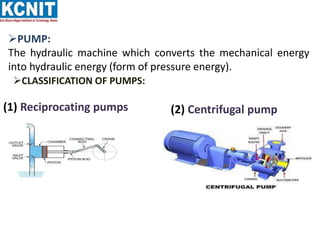
PUMP:
The hydraulic machine which converts the mechanical energy
into hydraulic energy (form of pressure energy).
CLASSIFICATION OF PUMPS:
(1) Reciprocating pumps (2) Centrifugal pump
CENTRIFUGAL PUMP:
The hydraulic machine which converts mechanical
energy into pressure energy by mean of centrifugal
force acting on the fluid.
The centrifugal pump acts as a reverse of an inward
radial flow reaction turbine.
The centrifugal pump works on the principle of
forced vortex flow in pressure head on the rotating
liquid take place.
The rise of pressure head at any point is proportional
to square of tangential velocity of the liquid at that
point.
Due to high pressure head, the liquid can be lifted to
a high level
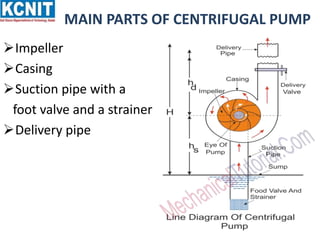
MAIN PARTS OF CENTRIFUGAL PUMP
Impeller
Casing
Suction pipe with a
foot valve and a strainer
Delivery pipe
MAIN PARTS OF CENTRIFUGAL PUMP
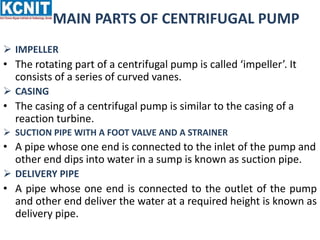
 IMPELLER
• The rotating part of a centrifugal pump is called ‘impeller’. It
consists of a series of curved vanes.
 CASING
• The casing of a centrifugal pump is similar to the casing of a
reaction turbine.
 SUCTION PIPE WITH A FOOT VALVE AND A STRAINER
• A pipe whose one end is connected to the inlet of the pump and
other end dips into water in a sump is known as suction pipe.
 DELIVERY PIPE
• A pipe whose one end is connected to the outlet of the pump
and other end deliver the water at a required height is known as
delivery pipe.
WORK DONE BY THE CENTRIFUGAL PUMP
ON WATER
• The water enters the impeller
radially at inlet for best
efficiency of the pump.
• Hence α = 90o and Vw1=0
• Let N = Speed of the impeller
in r.p.m.
• D1 = Diameter of impeller at
inlet
• u1= Tangential velocity of
impeller at inlet =
• D2 = Diameter of impeller at
outlet
• u2= Tangential velocity of
impeller at inlet =
WORK DONE BY THE CENTRIFUGAL
PUMP ON WATER
• V1 = Absolute velocity of water at inlet
• Vr1 = Relative velocity of water at inlet
• α = Angle made by absolute velocity
• θ = Angle made by relative velocity
• Work done by the water on the runner per second per unit weight of the water
striking per second is given by equation as
=
• Work done by the impeller on the water per second per unit weight of water
striking per second
= - [ work done in case of turbine]
= -
=
=
WORK DONE BY THE CENTRIFUGAL PUMP
ON WATER
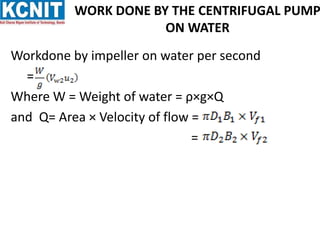
Workdone by impeller on water per second
=
Where W = Weight of water = ρ×g×Q
and Q= Area × Velocity of flow =
=
DEFINITIONS OF HEADS AND EFFICIENCIES
OF A CENTRIFUGAL PUMP
Suction head (hs) : It is vertical height of the centre
line of the centrifugal pump above the water surface
of the tank or pump form which water is to be lifted .
This height is also called suction lift and is denoted by
‘(hs)’.
Delivery head (hd): The vertical distance between the
centre line of the pump and the water surface in the
tank to which water is delivered is known as delivery
head.
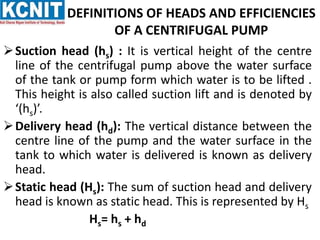
Static head (Hs): The sum of suction head and delivery
head is known as static head. This is represented by Hs
Hs= hs + hd
DEFINITIONS OF HEADS AND EFFICIENCIES
OF A CENTRIFUGAL PUMP
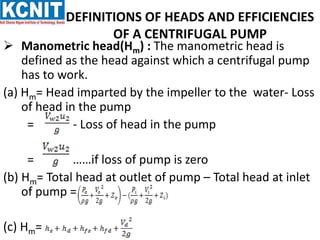
 Manometric head(Hm) : The manometric head is
defined as the head against which a centrifugal pump
has to work.
(a) Hm= Head imparted by the impeller to the water- Loss
of head in the pump
= - Loss of head in the pump
= ……if loss of pump is zero
(b) Hm= Total head at outlet of pump – Total head at inlet
of pump =
(c) Hm=
THANK YOU

PPT ON PUMP.pptx

  • 1.
    KALI CHARAN NIGAMINSTITUTE OF TECHNOLOGY, BANDA LECTURE ON CENTRIFUGAL PUMP FLUID MECHANICS AND FLUID MACHINE (KME302) BY : DEEPAK KUMAR YADAV ME DEPARTMENT
  • 2.
    PUMP: The hydraulic machinewhich converts the mechanical energy into hydraulic energy (form of pressure energy). CLASSIFICATION OF PUMPS: (1) Reciprocating pumps (2) Centrifugal pump
  • 3.
    CENTRIFUGAL PUMP: The hydraulicmachine which converts mechanical energy into pressure energy by mean of centrifugal force acting on the fluid. The centrifugal pump acts as a reverse of an inward radial flow reaction turbine. The centrifugal pump works on the principle of forced vortex flow in pressure head on the rotating liquid take place. The rise of pressure head at any point is proportional to square of tangential velocity of the liquid at that point. Due to high pressure head, the liquid can be lifted to a high level
  • 4.
    MAIN PARTS OFCENTRIFUGAL PUMP Impeller Casing Suction pipe with a foot valve and a strainer Delivery pipe
  • 5.
    MAIN PARTS OFCENTRIFUGAL PUMP  IMPELLER • The rotating part of a centrifugal pump is called ‘impeller’. It consists of a series of curved vanes.  CASING • The casing of a centrifugal pump is similar to the casing of a reaction turbine.  SUCTION PIPE WITH A FOOT VALVE AND A STRAINER • A pipe whose one end is connected to the inlet of the pump and other end dips into water in a sump is known as suction pipe.  DELIVERY PIPE • A pipe whose one end is connected to the outlet of the pump and other end deliver the water at a required height is known as delivery pipe.
  • 6.
    WORK DONE BYTHE CENTRIFUGAL PUMP ON WATER • The water enters the impeller radially at inlet for best efficiency of the pump. • Hence α = 90o and Vw1=0 • Let N = Speed of the impeller in r.p.m. • D1 = Diameter of impeller at inlet • u1= Tangential velocity of impeller at inlet = • D2 = Diameter of impeller at outlet • u2= Tangential velocity of impeller at inlet =
  • 7.
    WORK DONE BYTHE CENTRIFUGAL PUMP ON WATER • V1 = Absolute velocity of water at inlet • Vr1 = Relative velocity of water at inlet • α = Angle made by absolute velocity • θ = Angle made by relative velocity • Work done by the water on the runner per second per unit weight of the water striking per second is given by equation as = • Work done by the impeller on the water per second per unit weight of water striking per second = - [ work done in case of turbine] = - = =
  • 8.
    WORK DONE BYTHE CENTRIFUGAL PUMP ON WATER Workdone by impeller on water per second = Where W = Weight of water = ρ×g×Q and Q= Area × Velocity of flow = =
  • 9.
    DEFINITIONS OF HEADSAND EFFICIENCIES OF A CENTRIFUGAL PUMP Suction head (hs) : It is vertical height of the centre line of the centrifugal pump above the water surface of the tank or pump form which water is to be lifted . This height is also called suction lift and is denoted by ‘(hs)’. Delivery head (hd): The vertical distance between the centre line of the pump and the water surface in the tank to which water is delivered is known as delivery head. Static head (Hs): The sum of suction head and delivery head is known as static head. This is represented by Hs Hs= hs + hd
  • 10.
    DEFINITIONS OF HEADSAND EFFICIENCIES OF A CENTRIFUGAL PUMP  Manometric head(Hm) : The manometric head is defined as the head against which a centrifugal pump has to work. (a) Hm= Head imparted by the impeller to the water- Loss of head in the pump = - Loss of head in the pump = ……if loss of pump is zero (b) Hm= Total head at outlet of pump – Total head at inlet of pump = (c) Hm=
  • 11.