Downloaded 75 times



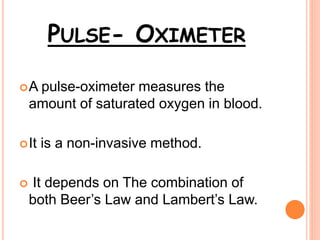
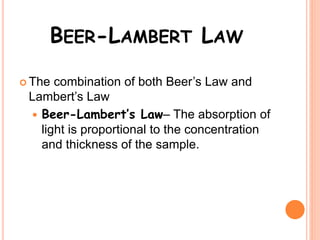
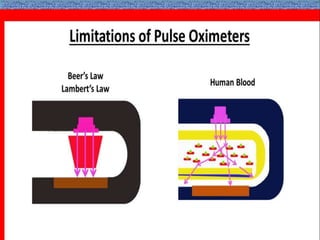
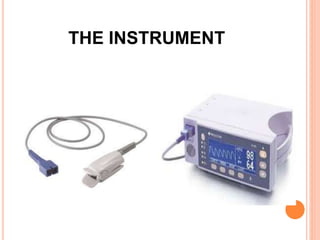

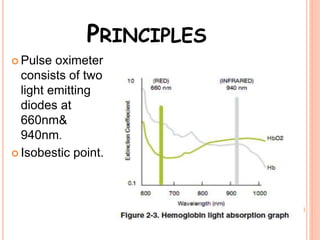
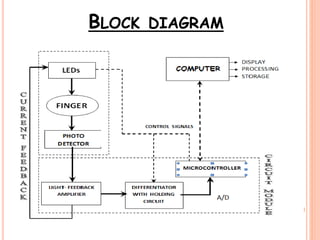
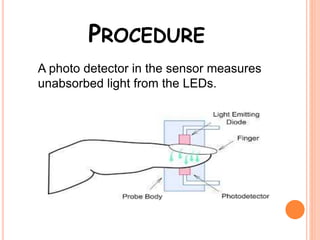
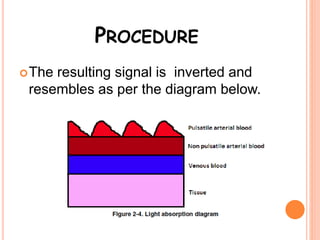
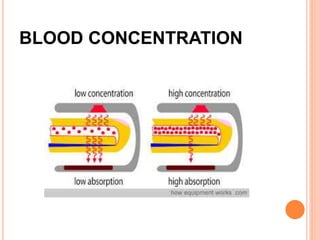
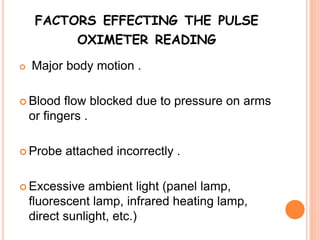
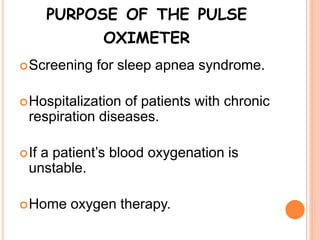


This document discusses pulse oximetry, which measures the amount of oxygenated hemoglobin in the blood. It describes how the first oximeter was introduced in 1935 and improved upon in 1972. A pulse oximeter uses light-emitting diodes and photodetectors to measure how much red and infrared light is absorbed by oxygenated and deoxygenated hemoglobin, allowing it to calculate blood oxygen saturation levels in a non-invasive manner based on Beer-Lambert law. The principles, components, procedure, factors affecting readings, and purposes of pulse oximetry are outlined.


![Pulseox[1]](https://cdn.slidesharecdn.com/ss_thumbnails/pulseox1-100604162535-phpapp01-thumbnail.jpg?width=640&height=640&fit=bounds)


![PERI-PROSTHETIC FRACTURE NAIL-PLATE CONSTRUCT [NPC].pptx](https://cdn.slidesharecdn.com/ss_thumbnails/drarunkumardrmohamedashrafperiprostheticfrasturenail-plateconstructnpc-260209164459-7e9d15a1-thumbnail.jpg?width=640&height=640&fit=bounds)


