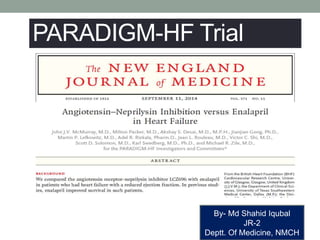
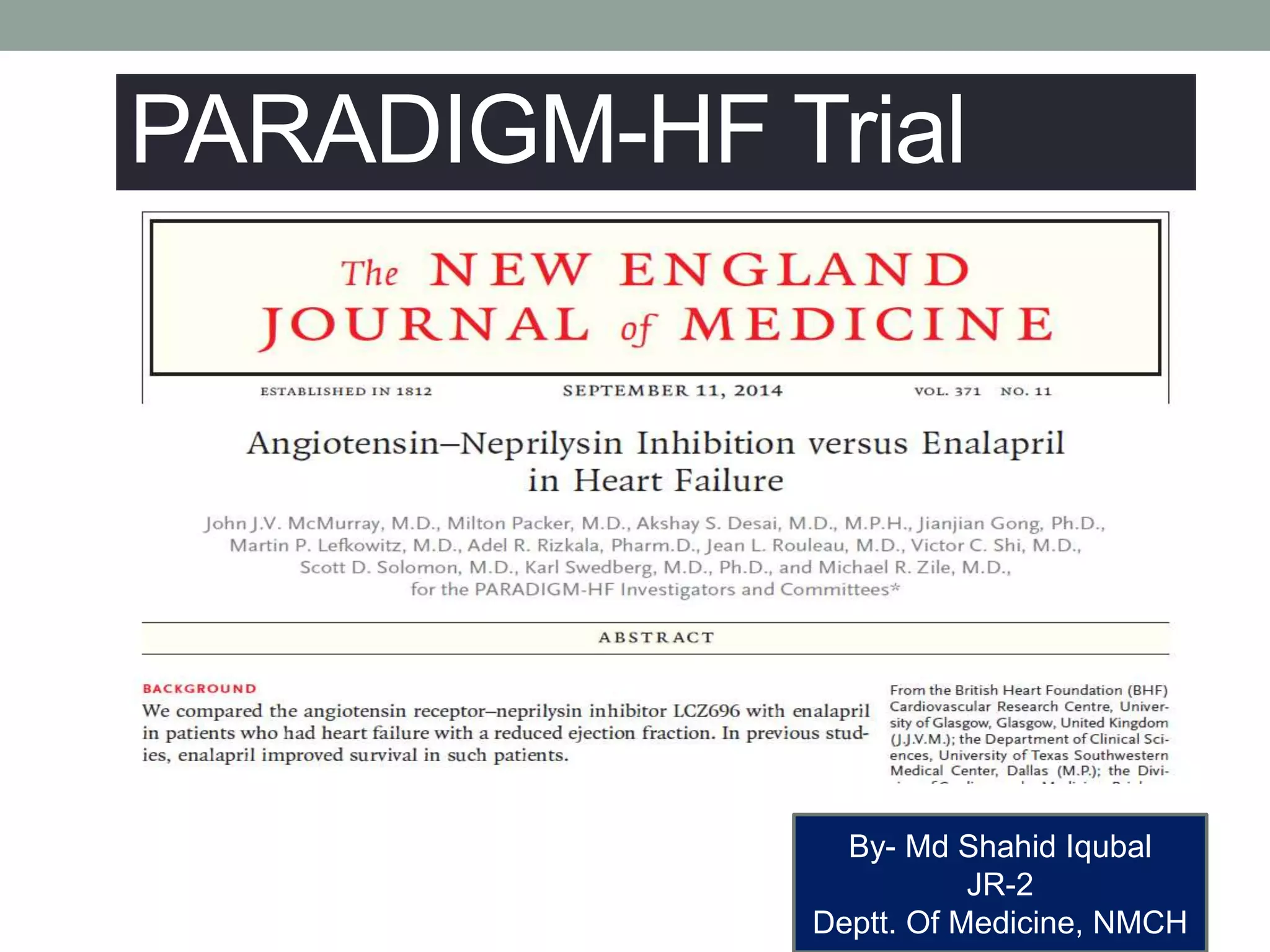
PARADIGM-HF Trial
By- Md Shahid Iqubal
JR-2
Deptt. Of Medicine, NMCH
Heart failure
• HF as a complex clinical syndrome that results from
structural or functional impairment of ventricular filling or
ejection of blood, which in turn leads to the cardinal
clinical symptoms of dyspnea and fatigue and signs of HF,
namely edema and rales.
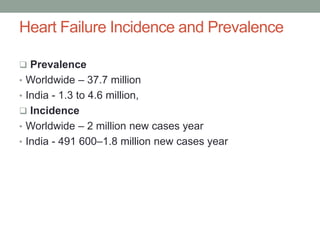
Heart Failure Incidence and Prevalence
 Prevalence
• Worldwide – 37.7 million
• India - 1.3 to 4.6 million,
 Incidence
• Worldwide – 2 million new cases year
• India - 491 600–1.8 million new cases year
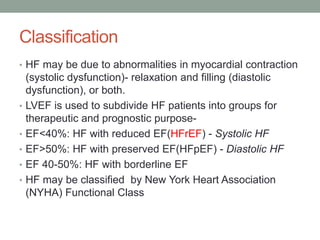
Classification
• HF may be due to abnormalities in myocardial contraction
(systolic dysfunction)- relaxation and filling (diastolic
dysfunction), or both.
• LVEF is used to subdivide HF patients into groups for
therapeutic and prognostic purpose-
• EF<40%: HF with reduced EF(HFrEF) - Systolic HF
• EF>50%: HF with preserved EF(HFpEF) - Diastolic HF
• EF 40-50%: HF with borderline EF
• HF may be classified by New York Heart Association
(NYHA) Functional Class
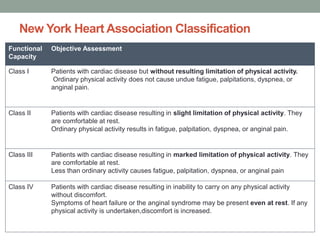
New York Heart Association Classification
Functional
Capacity
Objective Assessment
Class I Patients with cardiac disease but without resulting limitation of physical activity.
Ordinary physical activity does not cause undue fatigue, palpitations, dyspnea, or
anginal pain.
Class II Patients with cardiac disease resulting in slight limitation of physical activity. They
are comfortable at rest.
Ordinary physical activity results in fatigue, palpitation, dyspnea, or anginal pain.
Class III Patients with cardiac disease resulting in marked limitation of physical activity. They
are comfortable at rest.
Less than ordinary activity causes fatigue, palpitation, dyspnea, or anginal pain
Class IV Patients with cardiac disease resulting in inability to carry on any physical activity
without discomfort.
Symptoms of heart failure or the anginal syndrome may be present even at rest. If any
physical activity is undertaken,discomfort is increased.
PARADIGM HF Trial
Prospective Comparison of ARNI [Angiotensin Receptor -
Neprilysin Inhibitor] with ACEI [Angiotensin Converting
Enzyme Inhibitor] to Determine Impact on Global Mortality
and Morbidity in Heart Failure Trial.
ANGIOTENSIN Receptor –NEPRILYSIN Inhibition
versus
ENALAPRIL in Heart Failure
Clinical Question
• Among patients with HFrEF, does treatment with an
angiotensin receptor-neprilysin inhibitor (ARNI) reduce CV
mortality or HF hospitalizations when compared to ACE
inhibitor therapy?
Major Points
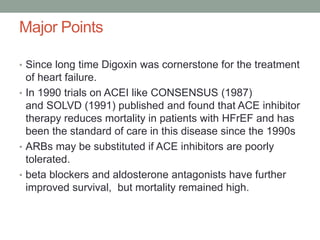
• Since long time Digoxin was cornerstone for the treatment
of heart failure.
• In 1990 trials on ACEI like CONSENSUS (1987)
and SOLVD (1991) published and found that ACE inhibitor
therapy reduces mortality in patients with HFrEF and has
been the standard of care in this disease since the 1990s
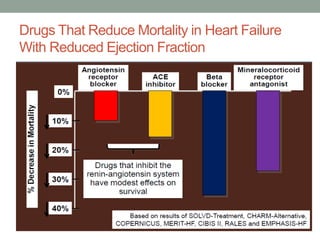
• ARBs may be substituted if ACE inhibitors are poorly
tolerated.
• beta blockers and aldosterone antagonists have further
improved survival, but mortality remained high.
Drugs That Reduce Mortality in Heart Failure
With Reduced Ejection Fraction
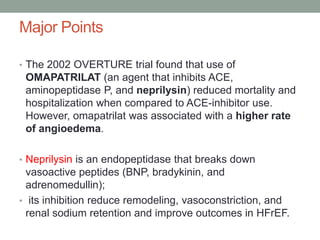
• The 2002 OVERTURE trial found that use of
OMAPATRILAT (an agent that inhibits ACE,
aminopeptidase P, and neprilysin) reduced mortality and
hospitalization when compared to ACE-inhibitor use.
However, omapatrilat was associated with a higher rate
of angioedema.
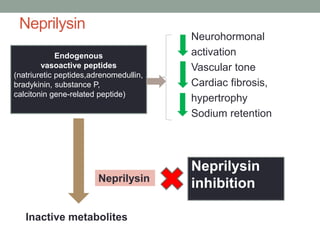
• Neprilysin is an endopeptidase that breaks down
vasoactive peptides (BNP, bradykinin, and
adrenomedullin);
• its inhibition reduce remodeling, vasoconstriction, and
renal sodium retention and improve outcomes in HFrEF.
Major Points
Neprilysin
Neurohormonal
activation
Vascular tone
Cardiac fibrosis,
hypertrophy
Sodium retention
Endogenous
vasoactive peptides
(natriuretic peptides,adrenomedullin,
bradykinin, substance P,
calcitonin gene-related peptide)
Inactive metabolites
Neprilysin
Neprilysin
inhibition
LCZ696: Angiotensin Receptor Neprilysin
Inhibition
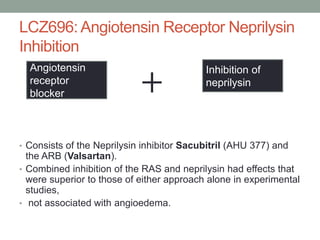
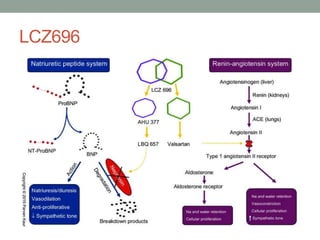
• Consists of the Neprilysin inhibitor Sacubitril (AHU 377) and
the ARB (Valsartan).
• Combined inhibition of the RAS and neprilysin had effects that
were superior to those of either approach alone in experimental
studies,
• not associated with angioedema.
Angiotensin
receptor
blocker
Inhibition of
neprilysin
+
LCZ696
Bottom Line
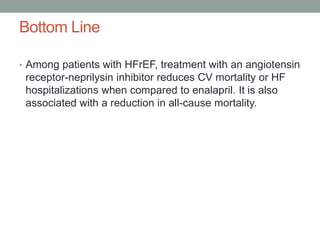
• Among patients with HFrEF, treatment with an angiotensin
receptor-neprilysin inhibitor reduces CV mortality or HF
hospitalizations when compared to enalapril. It is also
associated with a reduction in all-cause mortality.
Guidelines
ACC/AHA/HFSA Guideline for the Management of
Heart Failure (2016, adapted)
• In patients with NYHA Stage II-III HFrEF tolerating ACE-
inhibitor or ARB, replacement with ARNI is recommended
to improved morbidity and mortality ( LOE B-R)
• Do not prescribe ARNI therapy concomitantly with ACE-
inhibitors or within 36 hours of last dose of an ACE-
inhibitor ( LOE B-R)
• Do not prescribe ARNI therapy to patients with prior
angioedema ( LOE C-EO)
Design
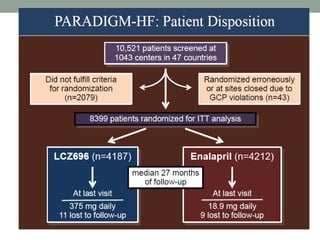
• Multicenter, prospective, randomized, comparative trial
• N= 8,399
• ARNI (n=4,187)
• Enalapril (n=4,212)
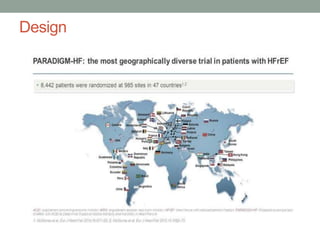
• Setting: 1,043 centers in 47 countries
• Enrollment: 2009-2012
• Median follow-up: 27 months (stopped after 3rd interim
analysis)
• Analysis: Intention-to-treat
• Primary outcome: CV mortality or HF hospitalization
Design
Inclusion Criteria
• Age ≥18 years
• NYHA class II-IV symptoms
• LVEF ≤40% until 2010 at which point this was reduced to
≤35%
• If no HF hospitalizations in prior year: BNP ≥150 pg/mL or
NT proBNP ≥600 pg/mL
• If a HF hospitalization in prior year: BNP ≥100 pg/mL or
NT proBNP ≥400 pg/mL
• ACE-inhibitor or ARB therapy with stable dose for prior 4
weeks, equivalent to enalapril ≥ 10 mg/day
• Beta blocker with stable dose for prior 4 weeks
Exclusion Criteria
• Symptomatic hypotension
• SBP <100 mmHg at screening or <95 mmHg at
randomization
• eGFR <30 mL/min/1.73 m2
• Reduction in eGFR >25% from screening to
randomization (amended to >35%)
• Potassium >5.2 mmol/L at screening or >5.4 mmol/L at
randomization
• History of angioedema
• "Unacceptable side effects" with ACE-inhibitors or ARBs
Interventions
Screening
• Single-blind run-in period, patients with significant side effects did
not continue on
• All patients received enalapril 10 mg PO BID for two weeks then held
for a day then
• All patients received the ARNI (LCZ696) at 100 mg PO BID then 200
mg PO BID for 4-6 weeks
Main trial
• Randomization to a group with concealed assignments
• ARNI - LCZ696 (later known as sacubitril/valsartan) 200 mg PO BID
• Enalapril - Enalapril 10 mg PO BID
• Follow-up q2-8 weeks in the first 4 months then every 4 months
• The study medication dosing could be reduced if side effects
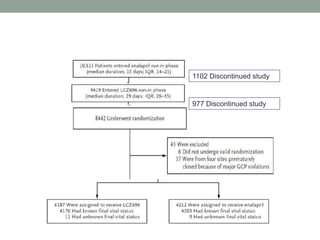
1102 Discontinued study
977 Discontinued study
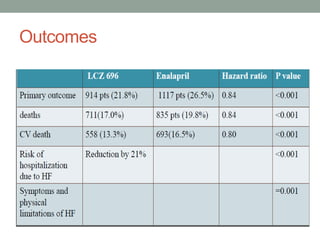
Outcomes
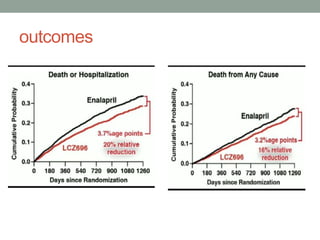
outcomes
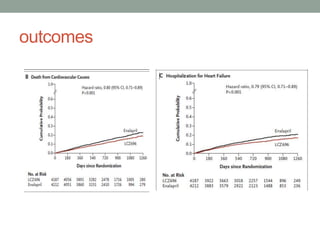
outcomes
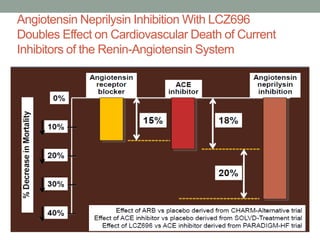
Angiotensin Neprilysin Inhibition With LCZ696
Doubles Effect on Cardiovascular Death of Current
Inhibitors of the Renin-Angiotensin System
Subgroup Analysis
• For the primary outcome.
• NYHA class I or II: ARNI better
• III or IV: No difference
P value for interaction 0.03
• There were no significant interactions for other subgroups
including age, sex, race, region, eGFR, diabetes, SBP,
LVEF, AF, NT-proBNP, HTN, prior use of ACE, prior use of
aldosterone antagonist, prior HF hospitalization, or time
since HF diagnosis.
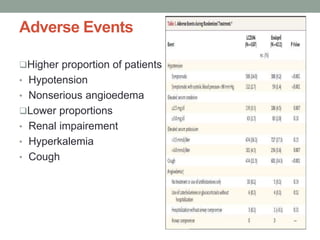
Adverse Events
Higher proportion of patients
• Hypotension
• Nonserious angioedema
Lower proportions
• Renal impairement
• Hyperkalemia
• Cough
Criticisms
• Enalapril dosing differed from that used in clinical practice.
• Included patients with NYHA I heart failure in analysis
although they did not meet inclusion criteria.
• Neprilysin also breaks down beta-amyloid, which builds
up in the brain in Alzheimer's disease. This study was too
short to evaluate for cognitive outcomes.
• The control arm tested an ACE inhibitor, whereas it may
have been more appropriate to study an ARB since the
experimental arm tested neprilysin inhibitor plus ARB.
Funding
• Novartis, the manufacturer of Diovan (the brand name of
valsartan) and Entresto (valsartan/sacubitril), collected,
managed, and analyzed the data.
PARADIGM-HF Conclusion
Angiotensin receptor-neprilysin inhibition:
• Reduces cardiovascular deaths and
hospitalization for heart failure
• Reduces overall mortality
• Reduces symptoms and improves physical
function
Thank you

Paradigm HF trial

  • 1.
    PARADIGM-HF Trial By- MdShahid Iqubal JR-2 Deptt. Of Medicine, NMCH
  • 2.
    Heart failure • HFas a complex clinical syndrome that results from structural or functional impairment of ventricular filling or ejection of blood, which in turn leads to the cardinal clinical symptoms of dyspnea and fatigue and signs of HF, namely edema and rales.
  • 3.
    Heart Failure Incidenceand Prevalence  Prevalence • Worldwide – 37.7 million • India - 1.3 to 4.6 million,  Incidence • Worldwide – 2 million new cases year • India - 491 600–1.8 million new cases year
  • 4.
    Classification • HF maybe due to abnormalities in myocardial contraction (systolic dysfunction)- relaxation and filling (diastolic dysfunction), or both. • LVEF is used to subdivide HF patients into groups for therapeutic and prognostic purpose- • EF<40%: HF with reduced EF(HFrEF) - Systolic HF • EF>50%: HF with preserved EF(HFpEF) - Diastolic HF • EF 40-50%: HF with borderline EF • HF may be classified by New York Heart Association (NYHA) Functional Class
  • 5.
    New York HeartAssociation Classification Functional Capacity Objective Assessment Class I Patients with cardiac disease but without resulting limitation of physical activity. Ordinary physical activity does not cause undue fatigue, palpitations, dyspnea, or anginal pain. Class II Patients with cardiac disease resulting in slight limitation of physical activity. They are comfortable at rest. Ordinary physical activity results in fatigue, palpitation, dyspnea, or anginal pain. Class III Patients with cardiac disease resulting in marked limitation of physical activity. They are comfortable at rest. Less than ordinary activity causes fatigue, palpitation, dyspnea, or anginal pain Class IV Patients with cardiac disease resulting in inability to carry on any physical activity without discomfort. Symptoms of heart failure or the anginal syndrome may be present even at rest. If any physical activity is undertaken,discomfort is increased.
  • 6.
    PARADIGM HF Trial ProspectiveComparison of ARNI [Angiotensin Receptor - Neprilysin Inhibitor] with ACEI [Angiotensin Converting Enzyme Inhibitor] to Determine Impact on Global Mortality and Morbidity in Heart Failure Trial. ANGIOTENSIN Receptor –NEPRILYSIN Inhibition versus ENALAPRIL in Heart Failure
  • 7.
    Clinical Question • Amongpatients with HFrEF, does treatment with an angiotensin receptor-neprilysin inhibitor (ARNI) reduce CV mortality or HF hospitalizations when compared to ACE inhibitor therapy?
  • 8.
    Major Points • Sincelong time Digoxin was cornerstone for the treatment of heart failure. • In 1990 trials on ACEI like CONSENSUS (1987) and SOLVD (1991) published and found that ACE inhibitor therapy reduces mortality in patients with HFrEF and has been the standard of care in this disease since the 1990s • ARBs may be substituted if ACE inhibitors are poorly tolerated. • beta blockers and aldosterone antagonists have further improved survival, but mortality remained high.
  • 9.
    Drugs That ReduceMortality in Heart Failure With Reduced Ejection Fraction
  • 10.
    • The 2002OVERTURE trial found that use of OMAPATRILAT (an agent that inhibits ACE, aminopeptidase P, and neprilysin) reduced mortality and hospitalization when compared to ACE-inhibitor use. However, omapatrilat was associated with a higher rate of angioedema. • Neprilysin is an endopeptidase that breaks down vasoactive peptides (BNP, bradykinin, and adrenomedullin); • its inhibition reduce remodeling, vasoconstriction, and renal sodium retention and improve outcomes in HFrEF. Major Points
  • 11.
    Neprilysin Neurohormonal activation Vascular tone Cardiac fibrosis, hypertrophy Sodiumretention Endogenous vasoactive peptides (natriuretic peptides,adrenomedullin, bradykinin, substance P, calcitonin gene-related peptide) Inactive metabolites Neprilysin Neprilysin inhibition
  • 12.
    LCZ696: Angiotensin ReceptorNeprilysin Inhibition • Consists of the Neprilysin inhibitor Sacubitril (AHU 377) and the ARB (Valsartan). • Combined inhibition of the RAS and neprilysin had effects that were superior to those of either approach alone in experimental studies, • not associated with angioedema. Angiotensin receptor blocker Inhibition of neprilysin +
  • 13.
  • 14.
    Bottom Line • Amongpatients with HFrEF, treatment with an angiotensin receptor-neprilysin inhibitor reduces CV mortality or HF hospitalizations when compared to enalapril. It is also associated with a reduction in all-cause mortality.
  • 15.
    Guidelines ACC/AHA/HFSA Guideline forthe Management of Heart Failure (2016, adapted) • In patients with NYHA Stage II-III HFrEF tolerating ACE- inhibitor or ARB, replacement with ARNI is recommended to improved morbidity and mortality ( LOE B-R) • Do not prescribe ARNI therapy concomitantly with ACE- inhibitors or within 36 hours of last dose of an ACE- inhibitor ( LOE B-R) • Do not prescribe ARNI therapy to patients with prior angioedema ( LOE C-EO)
  • 16.
    Design • Multicenter, prospective,randomized, comparative trial • N= 8,399 • ARNI (n=4,187) • Enalapril (n=4,212) • Setting: 1,043 centers in 47 countries • Enrollment: 2009-2012 • Median follow-up: 27 months (stopped after 3rd interim analysis) • Analysis: Intention-to-treat • Primary outcome: CV mortality or HF hospitalization
  • 17.
  • 18.
    Inclusion Criteria • Age≥18 years • NYHA class II-IV symptoms • LVEF ≤40% until 2010 at which point this was reduced to ≤35% • If no HF hospitalizations in prior year: BNP ≥150 pg/mL or NT proBNP ≥600 pg/mL • If a HF hospitalization in prior year: BNP ≥100 pg/mL or NT proBNP ≥400 pg/mL • ACE-inhibitor or ARB therapy with stable dose for prior 4 weeks, equivalent to enalapril ≥ 10 mg/day • Beta blocker with stable dose for prior 4 weeks
  • 19.
    Exclusion Criteria • Symptomatichypotension • SBP <100 mmHg at screening or <95 mmHg at randomization • eGFR <30 mL/min/1.73 m2 • Reduction in eGFR >25% from screening to randomization (amended to >35%) • Potassium >5.2 mmol/L at screening or >5.4 mmol/L at randomization • History of angioedema • "Unacceptable side effects" with ACE-inhibitors or ARBs
  • 20.
    Interventions Screening • Single-blind run-inperiod, patients with significant side effects did not continue on • All patients received enalapril 10 mg PO BID for two weeks then held for a day then • All patients received the ARNI (LCZ696) at 100 mg PO BID then 200 mg PO BID for 4-6 weeks Main trial • Randomization to a group with concealed assignments • ARNI - LCZ696 (later known as sacubitril/valsartan) 200 mg PO BID • Enalapril - Enalapril 10 mg PO BID • Follow-up q2-8 weeks in the first 4 months then every 4 months • The study medication dosing could be reduced if side effects
  • 21.
    1102 Discontinued study 977Discontinued study
  • 23.
  • 24.
  • 25.
  • 26.
    Angiotensin Neprilysin InhibitionWith LCZ696 Doubles Effect on Cardiovascular Death of Current Inhibitors of the Renin-Angiotensin System
  • 27.
    Subgroup Analysis • Forthe primary outcome. • NYHA class I or II: ARNI better • III or IV: No difference P value for interaction 0.03 • There were no significant interactions for other subgroups including age, sex, race, region, eGFR, diabetes, SBP, LVEF, AF, NT-proBNP, HTN, prior use of ACE, prior use of aldosterone antagonist, prior HF hospitalization, or time since HF diagnosis.
  • 28.
    Adverse Events Higher proportionof patients • Hypotension • Nonserious angioedema Lower proportions • Renal impairement • Hyperkalemia • Cough
  • 29.
    Criticisms • Enalapril dosingdiffered from that used in clinical practice. • Included patients with NYHA I heart failure in analysis although they did not meet inclusion criteria. • Neprilysin also breaks down beta-amyloid, which builds up in the brain in Alzheimer's disease. This study was too short to evaluate for cognitive outcomes. • The control arm tested an ACE inhibitor, whereas it may have been more appropriate to study an ARB since the experimental arm tested neprilysin inhibitor plus ARB.
  • 30.
    Funding • Novartis, themanufacturer of Diovan (the brand name of valsartan) and Entresto (valsartan/sacubitril), collected, managed, and analyzed the data.
  • 31.
    PARADIGM-HF Conclusion Angiotensin receptor-neprilysininhibition: • Reduces cardiovascular deaths and hospitalization for heart failure • Reduces overall mortality • Reduces symptoms and improves physical function
  • 32.