OSC
Office of Scholarly Communication
Open Research 101:
An Introduction for STEM
PhD students
Marta Teperek
Office of Scholarly Communication
mt446@cam.ac.uk
@martateperek
24 October 2016
All images are under CC0, unless
indicated otherwise
OSCLearning-by-doing
‘Click’ along:
http://bit.ly/OpenResearch20161024
OSCSlides are available
Slides are available – no
need to write everything
down
http://bit.ly/OpenResearchSlides
OSCTo start with…
• What are your expectations of today?
• Do you have any questions?
OSC
• Transparency with the research process
• Ethical research
• Making research available fairly
• Making the whole research process available – not just the pdf of
the publication
• Rewarding researchers for working reproducibly
Today we will talk about the various elements of Open Research
What is Open Research?
OSCContents
Why Share?
• Being open means being online
• How do you want to present yourself to the outside
world?
• Benefits of sharing
• ORCiDs
How to share: Repositories
• What are repositories?
• Apollo – the institutional repository
Copyright
University services
OSCSo, let’s find out who you are
• Take a piece of paper
• Write your name on it in clear lettering
• Fold in quarters & give it to the person next to you
• You have two minutes to Google the person
• Write down four things about them
• Refold the paper & give the note back to the ‘owner’
OSCWhat’s Google saying about you?
• Have a look at your piece of paper
• Is this surprising?
• Anything you would like to talk about?
OSCSharing your work
Sharing your work means managing your online
presence
Manage it well!
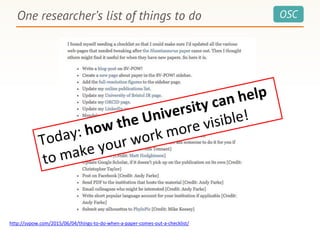
OSCOne researcher’s list of things to do
http://svpow.com/2015/06/04/things-to-do-when-a-paper-comes-out-a-checklist/
OSCWhat’s this sharing business all about?
Research relies on the principle that we share our
findings
Ideas and arguments need to be shared to move
human knowledge forward
Without the supporting evidence, publications are just
claims
Sharing is fundamental to being a good academic
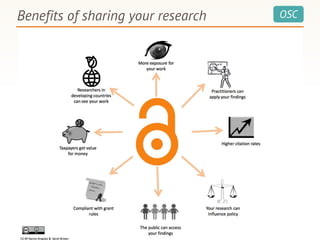
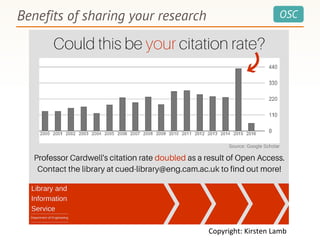
OSCBenefits of sharing your research
Copyright: Kirsten Lamb
OSC
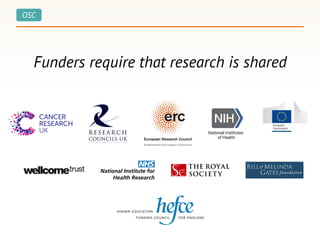
Funders require that research is shared
OSCAnd of course… your VISIBILITY
OSC
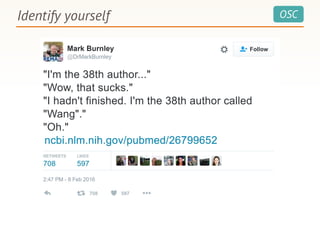
• Did you find information about the right
person?
But coming back to Googling
OSCIdentify yourself
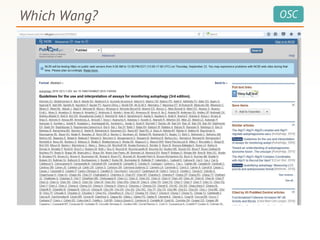
OSCWhich Wang?
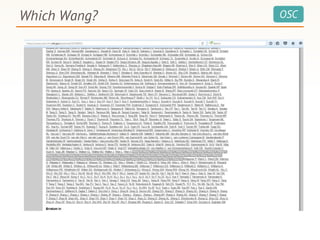
OSCWhich Wang?
OSCAre you unique?
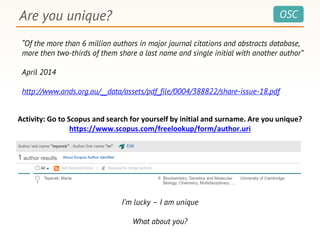
“Of the more than 6 million authors in major journal citations and abstracts database,
more then two-thirds of them share a last name and single initial with another author”
April 2014
http://www.ands.org.au/__data/assets/pdf_file/0004/388822/share-issue-18.pdf
I’m lucky – I am unique
What about you?
Activity: Go to Scopus and search for yourself by initial and surname. Are you unique?
https://www.scopus.com/freelookup/form/author.uri
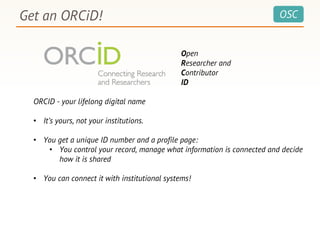
OSCGet an ORCiD!
Open
Researcher and
Contributor
ID
ORCID - your lifelong digital name
• It’s yours, not your institutions.
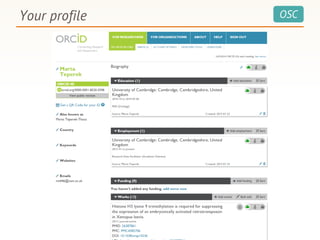
• You get a unique ID number and a profile page:
• You control your record, manage what information is connected and decide
how it is shared
• You can connect it with institutional systems!
OSCYour profile
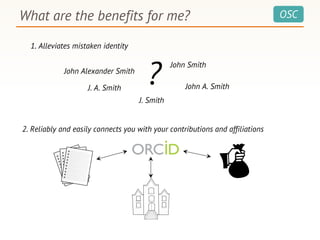
OSCWhat are the benefits for me?
2. Reliably and easily connects you with your contributions and affiliations
1. Alleviates mistaken identity
John A. SmithJ. A. Smith
John Alexander Smith
J. Smith
?
John Smith
OSCWhat are the benefits for me?
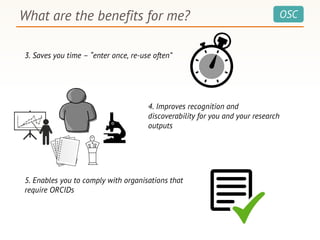
3. Saves you time – “enter once, re-use often”
4. Improves recognition and
discoverability for you and your research
outputs
5. Enables you to comply with organisations that
require ORCIDs
OSC
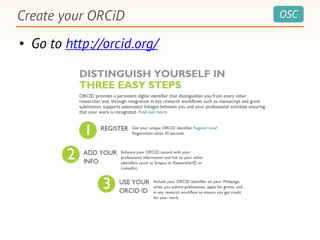
• Go to http://orcid.org/
Create your ORCiD
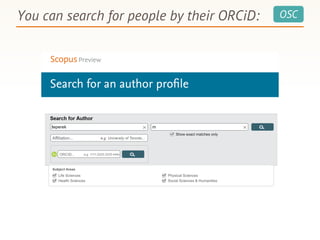
OSCYou can search for people by their ORCiD:
OSCHow to Share
“Can’t I just share my research
on ResearchGate?”
OSCHow to share
28
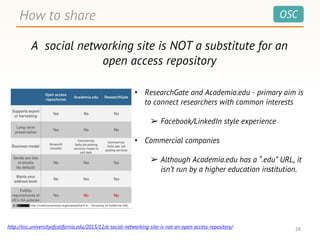
A social networking site is NOT a substitute for an
open access repository
http://osc.universityofcalifornia.edu/2015/12/a-social-networking-site-is-not-an-open-access-repository/
• ResearchGate and Academia.edu - primary aim is
to connect researchers with common interests
➢ Facebook/LinkedIn style experience
• Commercial companies
➢ Although Academia.edu has a “.edu” URL, it
isn’t run by a higher education institution.
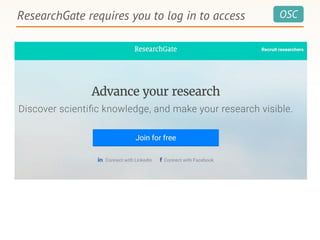
OSCResearchGate requires you to log in to access
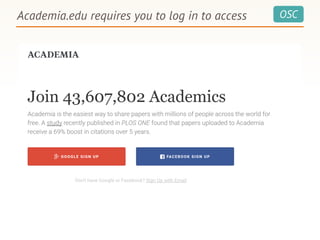
OSCAcademia.edu requires you to log in to access
OSC
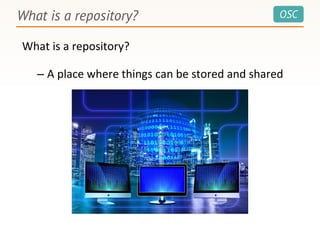
– A place where things can be stored and shared
What is a repository?
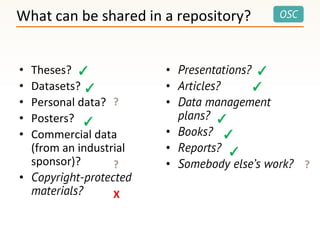
OSCWhat can be shared in a repository?
• Theses?
• Datasets?
• Personal data?
• Posters?
• Commercial data
(from an industrial
sponsor)?
• Copyright-protected
materials?
• Presentations?
• Articles?
• Data management
plans?
• Books?
• Reports?
• Somebody else’s work?
✓
✓
✓
✓
✓
✓
✓
✓
? ?
?
X
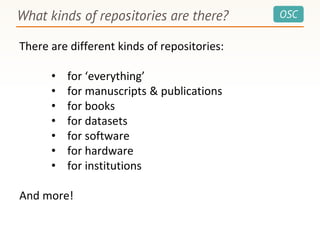
OSCWhat kinds of repositories are there?
There are different kinds of repositories:
• for ‘everything’
• for manuscripts & publications
• for books
• for datasets
• for software
• for hardware
• for institutions
And more!
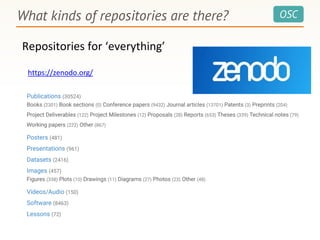
OSCWhat kinds of repositories are there?
Repositories for ‘everything’
https://zenodo.org/
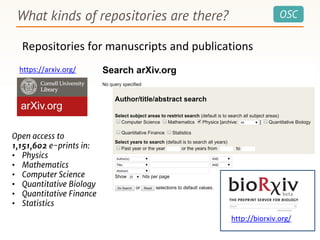
OSCWhat kinds of repositories are there?
Repositories for manuscripts and publications
https://arxiv.org/
Open access to
1,151,602 e-prints in:
• Physics
• Mathematics
• Computer Science
• Quantitative Biology
• Quantitative Finance
• Statistics
http://biorxiv.org/
OSCWhat kinds of repositories are there?
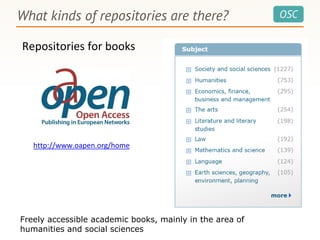
Repositories for books
http://www.oapen.org/home
Freely accessible academic books, mainly in the area of
humanities and social sciences
OSCWhat kinds of repositories are there?
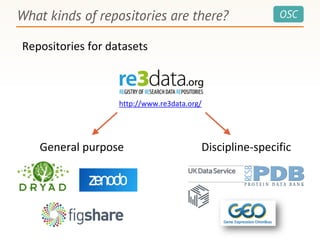
Repositories for datasets
http://www.re3data.org/
General purpose Discipline-specific
OSCWhat kinds of repositories are there?
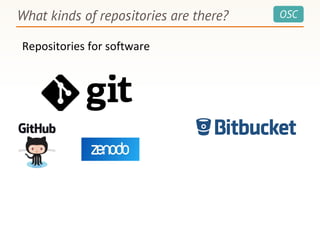
Repositories for software
OSCWhat kinds of repositories are there?
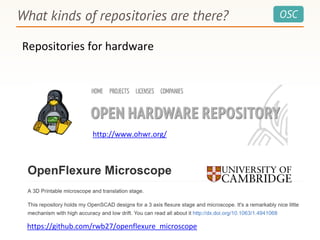
Repositories for hardware
http://www.ohwr.org/
https://github.com/rwb27/openflexure_microscope
OSCWhat kinds of repositories are there?
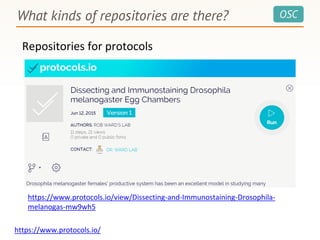
Repositories for protocols
https://www.protocols.io/
https://www.protocols.io/view/Dissecting-and-Immunostaining-Drosophila-
melanogas-mw9wh5
OSCWhat kinds of repositories are there?
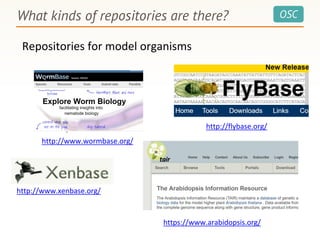
Repositories for model organisms
http://www.wormbase.org/
http://flybase.org/
http://www.xenbase.org/
https://www.arabidopsis.org/
OSCWhat kinds of repositories are there?
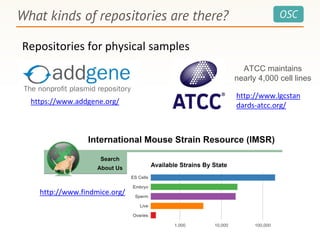
Repositories for physical samples
https://www.addgene.org/
http://www.findmice.org/
ATCC maintains
nearly 4,000 cell lines
http://www.lgcstan
dards-atcc.org/
OSC
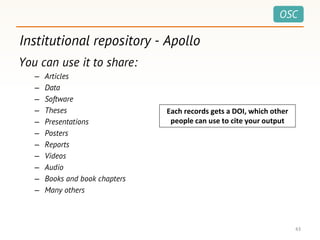
Institutional repository - Apollo
43
You can use it to share:
– Articles
– Data
– Software
– Theses
– Presentations
– Posters
– Reports
– Videos
– Audio
– Books and book chapters
– Many others
Each records gets a DOI, which other
people can use to cite your output
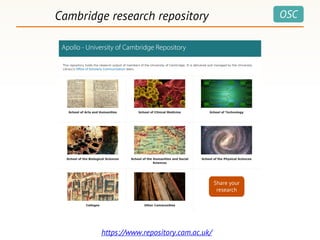
OSCCambridge research repository
https://www.repository.cam.ac.uk/
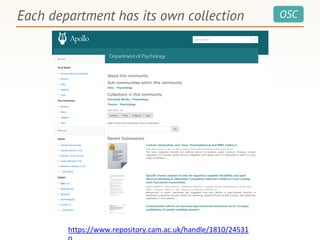
OSCEach department has its own collection
https://www.repository.cam.ac.uk/handle/1810/24531
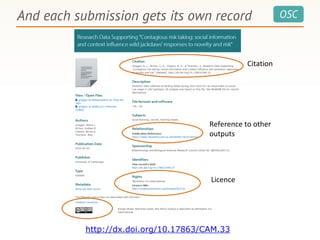
OSCAnd each submission gets its own record
http://dx.doi.org/10.17863/CAM.33
Citation
Reference to other
outputs
Licence
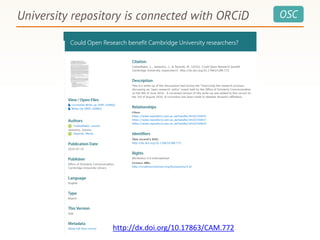
OSCUniversity repository is connected with ORCiD
http://dx.doi.org/10.17863/CAM.772
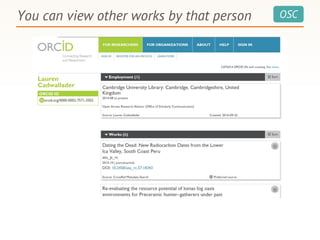
OSCYou can view other works by that person
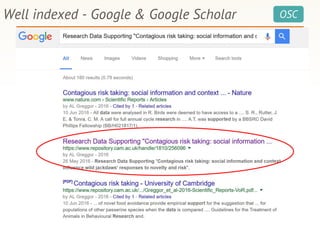
OSCWell indexed - Google & Google Scholar
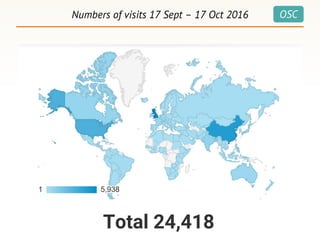
OSCNumbers of visits 17 Sept – 17 Oct 2016
Total 24,418
OSCYour VISIBILITY
OSC
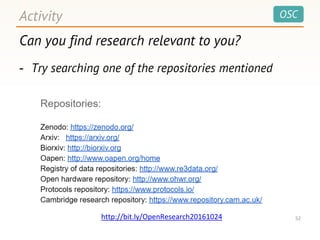
Can you find research relevant to you?
- Try searching one of the repositories mentioned
Activity
52http://bit.ly/OpenResearch20161024
OSC
Warning!
Check the copyright conditions before you use
or share!
OSCLet’s start with a quiz…
www.slido.com
Code: #6910
Quiz adapted from:
• https://umanitoba.ca/admin/vp_admin/ofp/copyri
ght/media/Copyright_Quiz.pdf
• https://blogs.otago.ac.nz/grs/2015/07/24/take-
the-copyright-quiz-for-research-students-2/
OSCWhat if I want to re-use an image from the internet in my work?
You need to seek permission from the rights
holder
• If granted:
– Keep a copy of the correspondence
• If not given (or there is no response):
– you cannot make work available
OSC
• How do I let others know they can re-use my
work?
This is extremely complicated!
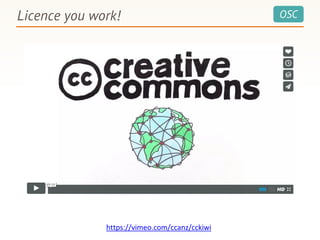
OSCLicence you work!
https://vimeo.com/ccanz/cckiwi
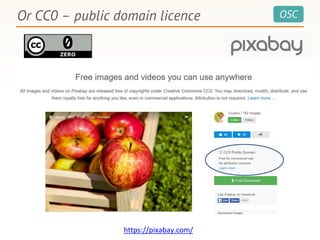
OSCOr CC0 – public domain licence
https://pixabay.com/
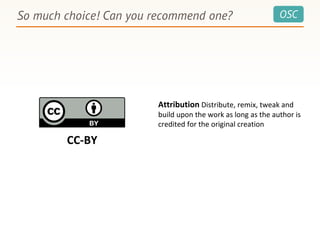
OSCSo much choice! Can you recommend one?
Attribution Distribute, remix, tweak and
build upon the work as long as the author is
credited for the original creation
CC-BY
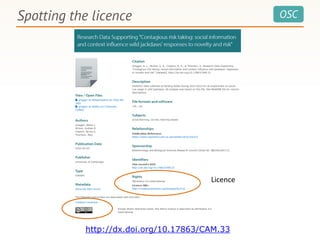
OSCSpotting the licence
http://dx.doi.org/10.17863/CAM.33
Licence
OSCCambridge support for sharing research
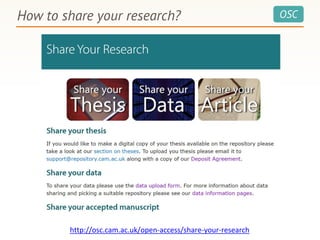
OSCHow to share your research?
http://osc.cam.ac.uk/open-access/share-your-research
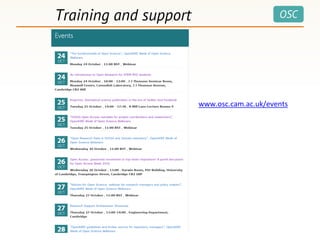
OSCTraining and support
www.osc.cam.ac.uk/events
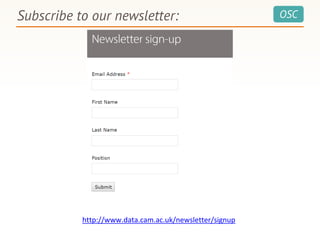
OSCSubscribe to our newsletter:
http://www.data.cam.ac.uk/newsletter/signup
OSCLost?
Dedicated support mailboxes:
• Publications: info@openaccess.cam.ac.uk
• Data: info@data.cam.ac.uk
• Theses: support@repository.cam.ac.uk
• Not sure? info@osc.cam.ac.uk
OSCHow does this all fit with Open Research?
OSC
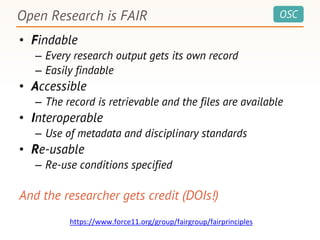
• Findable
– Every research output gets its own record
– Easily findable
• Accessible
– The record is retrievable and the files are available
• Interoperable
– Use of metadata and disciplinary standards
• Re-usable
– Re-use conditions specified
And the researcher gets credit (DOIs!)
Open Research is FAIR
https://www.force11.org/group/fairgroup/fairprinciples
OSC
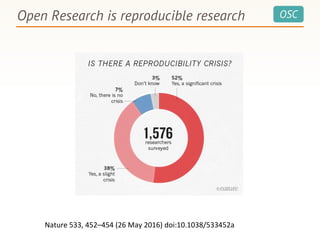
Nature 533, 452–454 (26 May 2016) doi:10.1038/533452a
Open Research is reproducible research
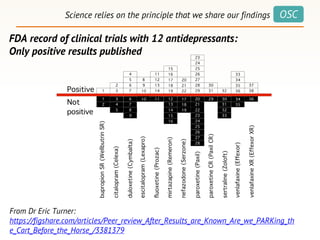
OSCScience relies on the principle that we share our findings
From Dr Eric Turner:
https://figshare.com/articles/Peer_review_After_Results_are_Known_Are_we_PARKing_th
e_Cart_Before_the_Horse_/3381379
FDA record of clinical trials with 12 antidepressants:
Only positive results published
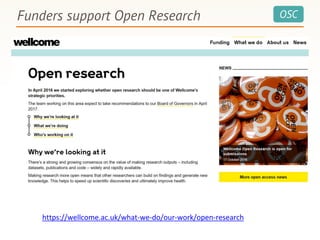
OSCFunders support Open Research
https://wellcome.ac.uk/what-we-do/our-work/open-research
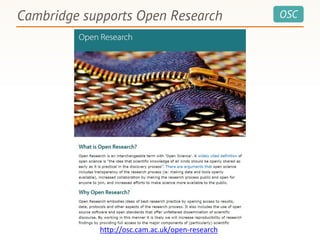
OSCCambridge supports Open Research
http://osc.cam.ac.uk/open-research
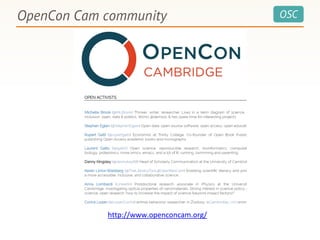
OSCOpenCon Cam community
http://www.openconcam.org/
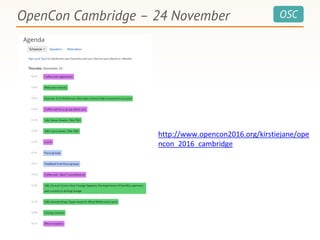
OSCOpenCon Cambridge – 24 November
http://www.opencon2016.org/kirstiejane/ope
ncon_2016_cambridge
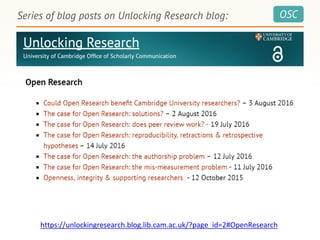
OSCSeries of blog posts on Unlocking Research blog:
https://unlockingresearch.blog.lib.cam.ac.uk/?page_id=2#OpenResearch
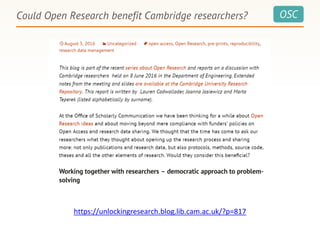
OSCCould Open Research benefit Cambridge researchers?
https://unlockingresearch.blog.lib.cam.ac.uk/?p=817
OSC
Lead by example
What can you do today?
OSC
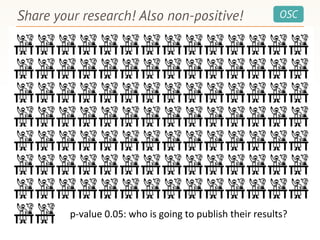
p-value 0.05: who is going to publish their results?
Share your research! Also non-positive!
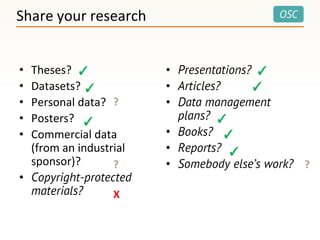
OSCShare your research
• Theses?
• Datasets?
• Personal data?
• Posters?
• Commercial data
(from an industrial
sponsor)?
• Copyright-protected
materials?
• Presentations?
• Articles?
• Data management
plans?
• Books?
• Reports?
• Somebody else’s work?
✓
✓
✓
✓
✓
✓
✓
✓
? ?
?
X
OSCJoin Open Con Cam community
https://groups.google.com/forum/#%21forum/openconcam
If you are not sure it is for you, join the mailing list first:
Meeting every months on Wednesdays
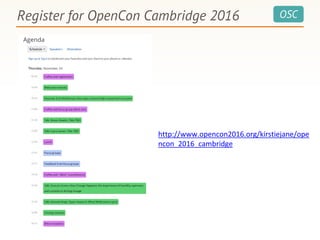
OSCRegister for OpenCon Cambridge 2016
http://www.opencon2016.org/kirstiejane/ope
ncon_2016_cambridge
OSC
Questions
Feedback forms
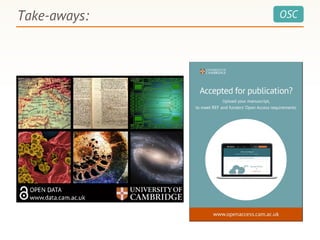
OSCTake-aways:
OSC
@CamOpenData
@CamOpenAccess
Thank you
http://bit.ly/OpenResearchSlides

20170222 ku-librarians勉強会 #211 :海外研修報告:英国大学図書館を北から南へ巡る旅

  • 1.
    OSC Office of ScholarlyCommunication Open Research 101: An Introduction for STEM PhD students Marta Teperek Office of Scholarly Communication mt446@cam.ac.uk @martateperek 24 October 2016 All images are under CC0, unless indicated otherwise
  • 2.
  • 3.
    OSCSlides are available Slidesare available – no need to write everything down http://bit.ly/OpenResearchSlides
  • 4.
    OSCTo start with… •What are your expectations of today? • Do you have any questions?
  • 5.
    OSC • Transparency withthe research process • Ethical research • Making research available fairly • Making the whole research process available – not just the pdf of the publication • Rewarding researchers for working reproducibly Today we will talk about the various elements of Open Research What is Open Research?
  • 6.
    OSCContents Why Share? • Beingopen means being online • How do you want to present yourself to the outside world? • Benefits of sharing • ORCiDs How to share: Repositories • What are repositories? • Apollo – the institutional repository Copyright University services
  • 7.
    OSCSo, let’s findout who you are • Take a piece of paper • Write your name on it in clear lettering • Fold in quarters & give it to the person next to you • You have two minutes to Google the person • Write down four things about them • Refold the paper & give the note back to the ‘owner’
  • 8.
    OSCWhat’s Google sayingabout you? • Have a look at your piece of paper • Is this surprising? • Anything you would like to talk about?
  • 9.
    OSCSharing your work Sharingyour work means managing your online presence Manage it well!
  • 10.
    OSCOne researcher’s listof things to do http://svpow.com/2015/06/04/things-to-do-when-a-paper-comes-out-a-checklist/
  • 11.
    OSCWhat’s this sharingbusiness all about? Research relies on the principle that we share our findings Ideas and arguments need to be shared to move human knowledge forward Without the supporting evidence, publications are just claims Sharing is fundamental to being a good academic
  • 12.
  • 13.
    OSCBenefits of sharingyour research Copyright: Kirsten Lamb
  • 14.
    OSC Funders require thatresearch is shared
  • 15.
    OSCAnd of course…your VISIBILITY
  • 16.
    OSC • Did youfind information about the right person? But coming back to Googling
  • 17.
  • 18.
  • 19.
  • 20.
    OSCAre you unique? “Ofthe more than 6 million authors in major journal citations and abstracts database, more then two-thirds of them share a last name and single initial with another author” April 2014 http://www.ands.org.au/__data/assets/pdf_file/0004/388822/share-issue-18.pdf I’m lucky – I am unique What about you? Activity: Go to Scopus and search for yourself by initial and surname. Are you unique? https://www.scopus.com/freelookup/form/author.uri
  • 21.
    OSCGet an ORCiD! Open Researcherand Contributor ID ORCID - your lifelong digital name • It’s yours, not your institutions. • You get a unique ID number and a profile page: • You control your record, manage what information is connected and decide how it is shared • You can connect it with institutional systems!
  • 22.
  • 23.
    OSCWhat are thebenefits for me? 2. Reliably and easily connects you with your contributions and affiliations 1. Alleviates mistaken identity John A. SmithJ. A. Smith John Alexander Smith J. Smith ? John Smith
  • 24.
    OSCWhat are thebenefits for me? 3. Saves you time – “enter once, re-use often” 4. Improves recognition and discoverability for you and your research outputs 5. Enables you to comply with organisations that require ORCIDs
  • 25.
    OSC • Go tohttp://orcid.org/ Create your ORCiD
  • 26.
    OSCYou can searchfor people by their ORCiD:
  • 27.
    OSCHow to Share “Can’tI just share my research on ResearchGate?”
  • 28.
    OSCHow to share 28 Asocial networking site is NOT a substitute for an open access repository http://osc.universityofcalifornia.edu/2015/12/a-social-networking-site-is-not-an-open-access-repository/ • ResearchGate and Academia.edu - primary aim is to connect researchers with common interests ➢ Facebook/LinkedIn style experience • Commercial companies ➢ Although Academia.edu has a “.edu” URL, it isn’t run by a higher education institution.
  • 29.
    OSCResearchGate requires youto log in to access
  • 30.
    OSCAcademia.edu requires youto log in to access
  • 31.
    OSC – A placewhere things can be stored and shared What is a repository? What is a repository?
  • 32.
    OSCWhat can beshared in a repository? • Theses? • Datasets? • Personal data? • Posters? • Commercial data (from an industrial sponsor)? • Copyright-protected materials? • Presentations? • Articles? • Data management plans? • Books? • Reports? • Somebody else’s work? ✓ ✓ ✓ ✓ ✓ ✓ ✓ ✓ ? ? ? X
  • 33.
    OSCWhat kinds ofrepositories are there? There are different kinds of repositories: • for ‘everything’ • for manuscripts & publications • for books • for datasets • for software • for hardware • for institutions And more!
  • 34.
    OSCWhat kinds ofrepositories are there? Repositories for ‘everything’ https://zenodo.org/
  • 35.
    OSCWhat kinds ofrepositories are there? Repositories for manuscripts and publications https://arxiv.org/ Open access to 1,151,602 e-prints in: • Physics • Mathematics • Computer Science • Quantitative Biology • Quantitative Finance • Statistics http://biorxiv.org/
  • 36.
    OSCWhat kinds ofrepositories are there? Repositories for books http://www.oapen.org/home Freely accessible academic books, mainly in the area of humanities and social sciences
  • 37.
    OSCWhat kinds ofrepositories are there? Repositories for datasets http://www.re3data.org/ General purpose Discipline-specific
  • 38.
    OSCWhat kinds ofrepositories are there? Repositories for software
  • 39.
    OSCWhat kinds ofrepositories are there? Repositories for hardware http://www.ohwr.org/ https://github.com/rwb27/openflexure_microscope
  • 40.
    OSCWhat kinds ofrepositories are there? Repositories for protocols https://www.protocols.io/ https://www.protocols.io/view/Dissecting-and-Immunostaining-Drosophila- melanogas-mw9wh5
  • 41.
    OSCWhat kinds ofrepositories are there? Repositories for model organisms http://www.wormbase.org/ http://flybase.org/ http://www.xenbase.org/ https://www.arabidopsis.org/
  • 42.
    OSCWhat kinds ofrepositories are there? Repositories for physical samples https://www.addgene.org/ http://www.findmice.org/ ATCC maintains nearly 4,000 cell lines http://www.lgcstan dards-atcc.org/
  • 43.
    OSC Institutional repository -Apollo 43 You can use it to share: – Articles – Data – Software – Theses – Presentations – Posters – Reports – Videos – Audio – Books and book chapters – Many others Each records gets a DOI, which other people can use to cite your output
  • 44.
  • 45.
    OSCEach department hasits own collection https://www.repository.cam.ac.uk/handle/1810/24531
  • 46.
    OSCAnd each submissiongets its own record http://dx.doi.org/10.17863/CAM.33 Citation Reference to other outputs Licence
  • 47.
    OSCUniversity repository isconnected with ORCiD http://dx.doi.org/10.17863/CAM.772
  • 48.
    OSCYou can viewother works by that person
  • 49.
    OSCWell indexed -Google & Google Scholar
  • 50.
    OSCNumbers of visits17 Sept – 17 Oct 2016 Total 24,418
  • 51.
  • 52.
    OSC Can you findresearch relevant to you? - Try searching one of the repositories mentioned Activity 52http://bit.ly/OpenResearch20161024
  • 53.
    OSC Warning! Check the copyrightconditions before you use or share!
  • 54.
    OSCLet’s start witha quiz… www.slido.com Code: #6910 Quiz adapted from: • https://umanitoba.ca/admin/vp_admin/ofp/copyri ght/media/Copyright_Quiz.pdf • https://blogs.otago.ac.nz/grs/2015/07/24/take- the-copyright-quiz-for-research-students-2/
  • 55.
    OSCWhat if Iwant to re-use an image from the internet in my work? You need to seek permission from the rights holder • If granted: – Keep a copy of the correspondence • If not given (or there is no response): – you cannot make work available
  • 56.
    OSC • How doI let others know they can re-use my work? This is extremely complicated!
  • 57.
  • 58.
    OSCOr CC0 –public domain licence https://pixabay.com/
  • 59.
    OSCSo much choice!Can you recommend one? Attribution Distribute, remix, tweak and build upon the work as long as the author is credited for the original creation CC-BY
  • 60.
  • 61.
    OSCCambridge support forsharing research
  • 62.
    OSCHow to shareyour research? http://osc.cam.ac.uk/open-access/share-your-research
  • 63.
  • 64.
    OSCSubscribe to ournewsletter: http://www.data.cam.ac.uk/newsletter/signup
  • 65.
    OSCLost? Dedicated support mailboxes: •Publications: info@openaccess.cam.ac.uk • Data: info@data.cam.ac.uk • Theses: support@repository.cam.ac.uk • Not sure? info@osc.cam.ac.uk
  • 66.
    OSCHow does thisall fit with Open Research?
  • 67.
    OSC • Findable – Everyresearch output gets its own record – Easily findable • Accessible – The record is retrievable and the files are available • Interoperable – Use of metadata and disciplinary standards • Re-usable – Re-use conditions specified And the researcher gets credit (DOIs!) Open Research is FAIR https://www.force11.org/group/fairgroup/fairprinciples
  • 68.
    OSC Nature 533, 452–454(26 May 2016) doi:10.1038/533452a Open Research is reproducible research
  • 69.
    OSCScience relies onthe principle that we share our findings From Dr Eric Turner: https://figshare.com/articles/Peer_review_After_Results_are_Known_Are_we_PARKing_th e_Cart_Before_the_Horse_/3381379 FDA record of clinical trials with 12 antidepressants: Only positive results published
  • 70.
    OSCFunders support OpenResearch https://wellcome.ac.uk/what-we-do/our-work/open-research
  • 71.
    OSCCambridge supports OpenResearch http://osc.cam.ac.uk/open-research
  • 72.
  • 73.
    OSCOpenCon Cambridge –24 November http://www.opencon2016.org/kirstiejane/ope ncon_2016_cambridge
  • 74.
    OSCSeries of blogposts on Unlocking Research blog: https://unlockingresearch.blog.lib.cam.ac.uk/?page_id=2#OpenResearch
  • 75.
    OSCCould Open Researchbenefit Cambridge researchers? https://unlockingresearch.blog.lib.cam.ac.uk/?p=817
  • 76.
    OSC Lead by example Whatcan you do today?
  • 77.
    OSC p-value 0.05: whois going to publish their results? Share your research! Also non-positive!
  • 78.
    OSCShare your research •Theses? • Datasets? • Personal data? • Posters? • Commercial data (from an industrial sponsor)? • Copyright-protected materials? • Presentations? • Articles? • Data management plans? • Books? • Reports? • Somebody else’s work? ✓ ✓ ✓ ✓ ✓ ✓ ✓ ✓ ? ? ? X
  • 79.
    OSCJoin Open ConCam community https://groups.google.com/forum/#%21forum/openconcam If you are not sure it is for you, join the mailing list first: Meeting every months on Wednesdays
  • 80.
    OSCRegister for OpenConCambridge 2016 http://www.opencon2016.org/kirstiejane/ope ncon_2016_cambridge
  • 81.
  • 82.
  • 83.