History of
publishing
Traditional techniques, technology and printing
Publishing
• Publishing first started around the 15th
century.
• The techniques used to make this possible was
etchings (drawings on a metal plate), screen prints,
letter prints and lithography.
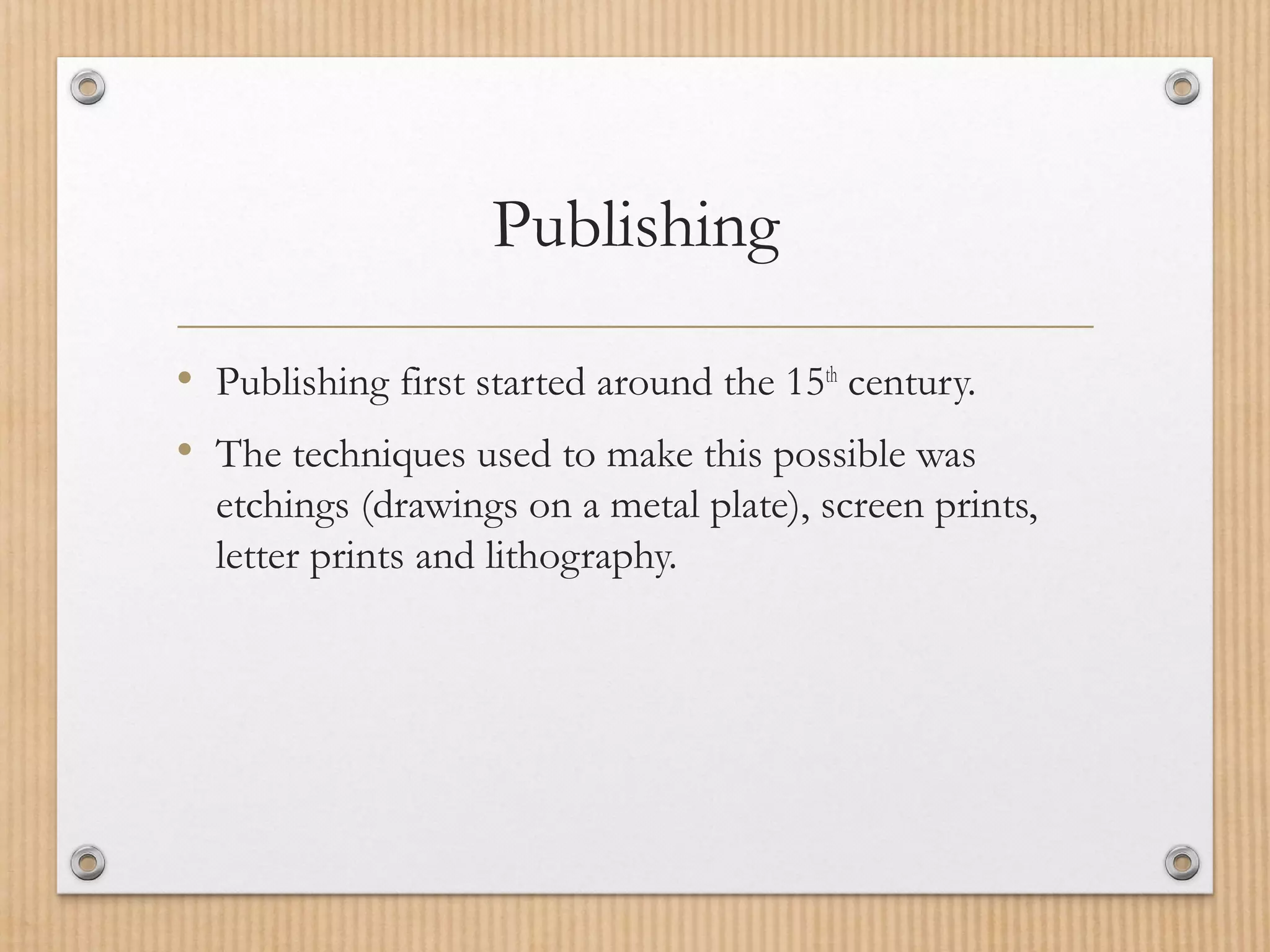
Letterpress
• Letterpress is a technique of relief printing using a
printing press.
• A worker composes and locks movable letters into
the bed of a press, inks it, and presses paper against
it to transfer the ink from the letters which creates an
impression on the paper.
• Letter press was used until the mid to late 20th
century
when is was replaced by the cheaper lithography.
Letter pressing is still used today.
Lithographs
• A lithogram is an artists drawing made on a prepared
surface like vivarium limestone or specially prepared
aluminium that is textured and designed to have an
artists make a drawing then process that drawing and
hand print using a press.
• Offset lithography books today have been published
since the 1960’s.
photocopy
• Most current photocopiers use a technology called xerography, a dry process
that uses electrostatic charges on a light sensitive photoreceptor to first attract
and then transfer toner particles (a powder) onto paper in the form of an image.
Heat, pressure or a combination of both is then used to fuse the toner onto the
paper.
• Laser printing created in 1960 is also used in photocopy. It is a digital printing
process. It very rapidly produces high-quality text and graphics by repeatedly
passing a laser beam back & forth over an electron-charged, cylindrical drum, to
define a differentially-charged image. The drum then selectively collects
electrically-charged, powdered ink (i.e., toner), and transfers the image to the
loaded paper.
Desk top publishing
• Started in the 1980’s and was adapted in the late 1980’s and early 1990’s and is
now used by many magazine and newspaper companies.
• Desktop publishing (abbreviated DTP) is the creation of documents using page
layout skills on a personal computer. Desktop publishing software can generate
layouts and produce typographic quality text and images comparable to
traditional typography and printing. This technology allows individuals,
businesses, and other organizations to self-publish a wide range of printed
matter. Desktop publishing is also the main reference for digital typography.
When used skillfully, desktop publishing allows the user to produce a wide
variety of materials, from menus to magazines and books, without the expense
of commercial printing.
Desk top publishing
• Started in the 1980’s and was adapted in the late 1980’s and early 1990’s and is
now used by many magazine and newspaper companies.
• Desktop publishing (abbreviated DTP) is the creation of documents using page
layout skills on a personal computer. Desktop publishing software can generate
layouts and produce typographic quality text and images comparable to
traditional typography and printing. This technology allows individuals,
businesses, and other organizations to self-publish a wide range of printed
matter. Desktop publishing is also the main reference for digital typography.
When used skillfully, desktop publishing allows the user to produce a wide
variety of materials, from menus to magazines and books, without the expense
of commercial printing.
Publishing

  • 1.
  • 2.
    Publishing • Publishing firststarted around the 15th century. • The techniques used to make this possible was etchings (drawings on a metal plate), screen prints, letter prints and lithography.
  • 3.
    Letterpress • Letterpress isa technique of relief printing using a printing press. • A worker composes and locks movable letters into the bed of a press, inks it, and presses paper against it to transfer the ink from the letters which creates an impression on the paper. • Letter press was used until the mid to late 20th century when is was replaced by the cheaper lithography. Letter pressing is still used today.
  • 4.
    Lithographs • A lithogramis an artists drawing made on a prepared surface like vivarium limestone or specially prepared aluminium that is textured and designed to have an artists make a drawing then process that drawing and hand print using a press. • Offset lithography books today have been published since the 1960’s.
  • 5.
    photocopy • Most currentphotocopiers use a technology called xerography, a dry process that uses electrostatic charges on a light sensitive photoreceptor to first attract and then transfer toner particles (a powder) onto paper in the form of an image. Heat, pressure or a combination of both is then used to fuse the toner onto the paper. • Laser printing created in 1960 is also used in photocopy. It is a digital printing process. It very rapidly produces high-quality text and graphics by repeatedly passing a laser beam back & forth over an electron-charged, cylindrical drum, to define a differentially-charged image. The drum then selectively collects electrically-charged, powdered ink (i.e., toner), and transfers the image to the loaded paper.
  • 6.
    Desk top publishing •Started in the 1980’s and was adapted in the late 1980’s and early 1990’s and is now used by many magazine and newspaper companies. • Desktop publishing (abbreviated DTP) is the creation of documents using page layout skills on a personal computer. Desktop publishing software can generate layouts and produce typographic quality text and images comparable to traditional typography and printing. This technology allows individuals, businesses, and other organizations to self-publish a wide range of printed matter. Desktop publishing is also the main reference for digital typography. When used skillfully, desktop publishing allows the user to produce a wide variety of materials, from menus to magazines and books, without the expense of commercial printing.
  • 7.
    Desk top publishing •Started in the 1980’s and was adapted in the late 1980’s and early 1990’s and is now used by many magazine and newspaper companies. • Desktop publishing (abbreviated DTP) is the creation of documents using page layout skills on a personal computer. Desktop publishing software can generate layouts and produce typographic quality text and images comparable to traditional typography and printing. This technology allows individuals, businesses, and other organizations to self-publish a wide range of printed matter. Desktop publishing is also the main reference for digital typography. When used skillfully, desktop publishing allows the user to produce a wide variety of materials, from menus to magazines and books, without the expense of commercial printing.