Education
BLS
2013
Education
Sources
National Assessment of Educational Progress (NAEP)
“Nation’s Report Card”
Census
Educational Attainment
Public School System Finances
Issues in Education
High School Completion
(# of graduates/# of students)
Who represents “graduates”? Equivalency exam? > 4 years?
Modified study?
Who represents “students”? Those that started HS 4 years
prior? Size of senior class?
What is the study for? Diploma count? Workforce qualification?
School performance?
Beginning 2010/11 school year, No Child Left Behind
legislation improved consistency across states by requiring
graduation rates be reported as: (# of students who graduate in
four years with a HS diploma/ # of students who entered school
4 years prior).
Graduation Rates
High school graduation rates have increased since the 1960
across all races.
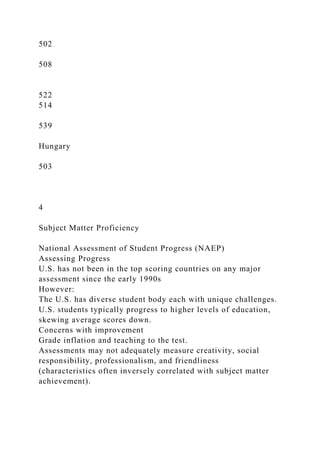
Cross-Country Comparison Math Scores
The mathematics achievement scores of eighth grade American
students lag behind those of many other countries.
Canada
Australia
Germany
South Korea
Belgium
Poland
Average 8th Grade Mathematics Achievement Score: 2009
Ireland
Netherlands
U.K.
Japan
529
527
520
538
507
508
U.S.
502
508
522
514
539
Hungary
503
4
Subject Matter Proficiency
National Assessment of Student Progress (NAEP)
Assessing Progress
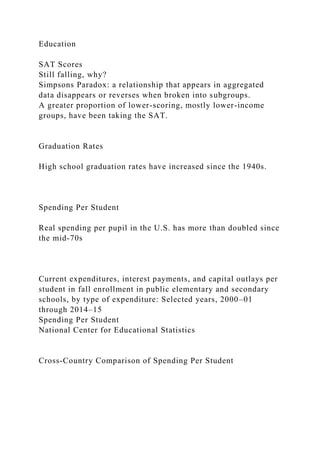
U.S. has not been in the top scoring countries on any major
assessment since the early 1990s
However:
The U.S. has diverse student body each with unique challenges.
U.S. students typically progress to higher levels of education,
skewing average scores down.
Concerns with improvement
Grade inflation and teaching to the test.
Assessments may not adequately measure creativity, social
responsibility, professionalism, and friendliness
(characteristics often inversely correlated with subject matter
achievement).
Education
SAT Scores
Still falling, why?
Simpsons Paradox: a relationship that appears in aggregated
data disappears or reverses when broken into subgroups.
A greater proportion of lower-scoring, mostly lower-income
groups, have been taking the SAT.
Graduation Rates
High school graduation rates have increased since the 1940s.
Spending Per Student
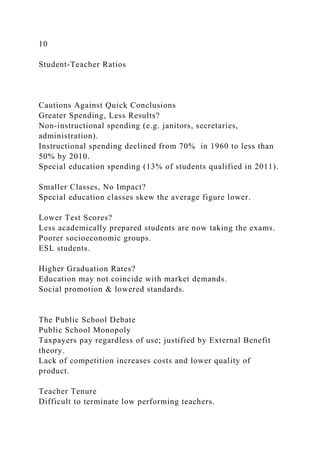
Real spending per pupil in the U.S. has more than doubled since
the mid-70s
Current expenditures, interest payments, and capital outlays per
student in fall enrollment in public elementary and secondary
schools, by type of expenditure: Selected years, 2000–01
through 2014–15
Spending Per Student
National Center for Educational Statistics
Cross-Country Comparison of Spending Per Student
10
Student-Teacher Ratios
Cautions Against Quick Conclusions
Greater Spending, Less Results?
Non-instructional spending (e.g. janitors, secretaries,
administration).
Instructional spending declined from 70% in 1960 to less than
50% by 2010.
Special education spending (13% of students qualified in 2011).
Smaller Classes, No Impact?
Special education classes skew the average figure lower.
Lower Test Scores?
Less academically prepared students are now taking the exams.
Poorer socioeconomic groups.
ESL students.
Higher Graduation Rates?
Education may not coincide with market demands.
Social promotion & lowered standards.
The Public School Debate
Public School Monopoly
Taxpayers pay regardless of use; justified by External Benefit
theory.
Lack of competition increases costs and lower quality of
product.
Teacher Tenure
Difficult to terminate low performing teachers.
Collective Bargaining
In most states teachers have relatively lucrative pensions.
“Rule of 85”
Age + Years = 85 qualify for full pension.
On average receive 75% of salary.
Last-in-first-out provisions protect seniority at the expense of
younger teachers.
Lack of Merit Pay
Pay based on education and experience.
Evidence indicates teaching quality matters but without merit
pay schools may not be able t to attract higher quality teachers.
Little financial reward for improved performance.
Teacher CompensationBLS Occ. Handbook2015Median
Hourly WageFull-time equivalentHigh School
Teachers$57,200$38.23$76,458.33Jr. High School
Teachers$55,860$37.10$74,208.33Elementary School
Teachers$54,550$37.08$74,166.67Web
Developers$30.37Psychologists$33.42Chemists$34.79Detective
s$36.89Statisticians$38.12Computer Programers$38.60Civil
Engineers$38.83Chemical Engineers$46.02Optomitrists$48.70
Private Schools
Outperform public schools with less spending per student.
Cherry Picking: Selecting students that are easier to educate
leaving the remainder for the public schools.
Students from higher socioeconomic households.
Less students with physical and academic disabilities.
Even after adjusting for these factors, private schools still
outperform public schools.
Charter Schools (public provision)
Public funded but have more discretion in administration.
Cannot be religious based since publicly funded.
Cannot charge students but may use non-price rationing such as
lotteries for entry.
The Public School Debate
School Vouchers (private provision)
Proponents:
Parental choice.
Competition among schools and teachers fuels quality
improvements and lower costs.
Greater diversity of students.
Educational techniques cater to student specific needs.
Greater financial accountability for school performance.
Opponents:
High-income families with children in private schools benefit
from an effective “tax refund”.
Wealthier families have greater transportation options causing
socioeconomic and racial imbalances to worsen.
Funds are drained from low income areas toward higher income
areas.
Limits centralization of standards (private schools free to teach
whatever they desire).
The Public School Debate
No Child Left Behind (2001)
Federal-led effort that requires all K-12 public schools
receiving federal funding to administer a state-wide
standardized test annually to all students.
Each state sets its own standards for math, reading, & science
and determines “Adequate Yearly Progress” goals for each
school.
States produce report cards on each school and district and if
required improvements are not made, the schools face decreased
funding or other punishments.
All teachers must be highly qualified (i.e. bachelors degree,
subject matter competency, and teaching credential).
Common Core (2010)
State-led effort intended to provide more clarity and
consistency with regard to expected student learning outcomes
across K-12 public schools in the U.S.
46 of 50 states have adopted the initiative.
Standards:
Are internationally benchmarked for global competitiveness.
Are college and career focused.
Expect increased reasoning and problem solving skill-sets to
ensure “deep conceptual comprehension” of the material.
Argumentative and explanatory skill-set in non-mathematical
disciplines.
Important Legislation in Public Education
Post-Secondary Education
College graduation rates have increased since the 1960 across
all races.
College Completion
Time-frame matters
Norway uses graduation rates within 10 years of starting
program whereas U.S. uses 6 years.
Among OECD countries the U.S. is low at 57.2% graduation
rates for bachelor-seeking students graduating within 6 years.
U.S ranks #1 in share of population with bachelor’s degrees.
Demographics matter
U.S admits a more diverse pool of students than many other
countries lowering graduation rates and making our colleges
appear deficient.
Post-Secondary Education
College Stats
$471 Billion Annually
21 million students
$22,429/student
Tuition, Room and Board have risen 629% since 1981 (overall
CPI 131%)
Costs are higher than K-12
Professors are more expensive than K-12 teachers.
Professors spend less time in the classroom (3-15 hours per
week) and more time researching and
developing expertise in their field.
Libraries, equipment, and lab costs for research are
substantially more expensive.
Subsidies increase demand relative to supply; justified by
External Benefit theory.
Name:
Date: 02-29-16
Section:
The Road to Shaking
Specific Purpose Statement: To inform my audience about the
causes and effects of earthquakes and about the “big one” that
Southern California is expecting.
Central Idea: Earthquakes in Southern California are a common
occurrence due to the factors that go into the cause of an
earthquake, the effects and the frequent activity of our San
Andreas fault.
INTRODUCTION
Seismophobia. A word that may be uncommon to some of
you, but to me, I know quite well. It is defined as the
overwhelming fear of earthquakes. I bear this phobia and I
thought that perhaps a good way to overcome this fear was to
learn about the way they work—such as their causes and effects.
And that is what I am currently doing; this quarter I am taking
an Earthquake class called Geology 210: Earthquakes and their
effects on society. Today I am here to share with you my
knowledge on earthquakes, more specifically the causes of
earthquakes, the effects of earthquakes and about how
extremely close the San Andreas fault is to us.
(Connective: First off, we will talk about the various causes of
earthquakes.)
BODY
1. There are several reasons as to why the earth shakes, the
most common causes are ones that you may never have
expected.
We can first start off with how our ancestors attempted to
explain the occurrence of earthquakes.
1. For example, as stated in David S. Brumbaugh’s 2010 book
titled Earthquakes: Science and Society, according to Japanese
folklore, “earthquakes were caused by a giant catfish beneath
the ground,” and “when the catfish flailed about, the ground
shook” (Brumbaugh).
2. Another belief as to why the earth shook came from India,
where it was thought that the earth was held up by four
elephants that stood on the back of a giant turtle, which in turn
stood on a cobra and whenever any of these animals moved, the
earth trembled (Brumbaugh).
Now some common causes of earthquakes could consist of the
following: explosions, large landslides, the collapse of a cavern
or mine, movement of magma underground, a meteorite impact
or most commonly, a slip along a fault plane.
1. According to the 2011 Southern California
Earthquake Center handbook
titled Putting Down Roots in Earthquake
Country, authors Lucile M.
Jones and Mark Benthien state that a fault
is defined as “a thin zone of
crushed rock separating blocks of the earth’s
crust.”
2. When an earthquake occurs on one of these faults, the rock
on one side of the fault slips alongside the other (Lucile M.
Jones and Mark Benthien).
3. A slip along a fault is caused by the movement of
tectonic plates and when this
occurs, it produces seismic waves which is the proper
name for what we call
shaking and for what wakes us up in the middle of the
night.
(Connective: Now that we have an understanding as to the
causes of earthquakes, we can now delve into the effects.)
I. Earthquakes can have several effects such as the effects on
our natural environment, on our buildings and structures and on
our society.
One effect that an earthquake can have on our natural
environment is it can cause tsunamis and landslides.
1. A tsunami is a series of waves that is produced when a body
of water is dislodged by an earthquake; tsunamis can frequently
result in a major catastrophe.
An effect that an earthquake can have on our buildings and
structures is that they can severely damage our nuclear power
plants which could lead to exposure to radioactivity and it can
also damage our roads and electrical lines which can lead to the
severity of our communication.
C. Another effect an earthquake can have, is on our society
which can involve an
escalating death and injury toll as well as an
overwhelming wave of homelessness
due to the damage done by severe shaking.
(Connective: The last thing that I wanted to inform you all on
was the San Andreas fault and how we are expecting what
scientists are calling “the big one.”)
II. The Southern San Andreas Fault is the closest fault to the
Inland Empire and we happen to live right smack next to it.
The fault is about 800 miles long, and because of this, the
biggest earthquake that can possibly be produced on this fault is
around a magnitude 8.25.
1. It is important to know that the last major earthquake on the
southernmost San Andreas fault occurred in 1857, more than
159 years ago and there has not been an actual rupture along the
southernmost end since 1690, which was about 326 years ago.
2. On average, large earthquakes recur on the San Andreas Fault
about every 150 years, so I would say that this this “big one” is
approaching very soon.
3. Most of us are unknown to the fact that an earthquake of
this size can be very
detrimental to our community.
So that is why in 2008, the California Geological Survey and
Southern California Earthquake Center teamed up to create an
earthquake scenario called ‘The California Shakeout Scenario’,
in which a hypothetical 7.8M earthquake occurred along the
southernmost San Andreas fault.
3. The results were devastating and it opened many eyes as to
what the effect of an actual earthquake of that size could do
Southern California.
4. According to the 2008 narrative titled, The ShakeOut
Earthquake Scenario—A Story That Southern Californians Are
Writing, written by Suzanne Perry, the results of this size of an
earthquake would include roughly 2,000 deaths, 50,000 injuries,
270,000 homeless and over $200 billion in damages.
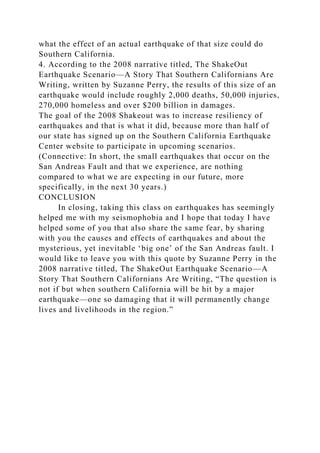
The goal of the 2008 Shakeout was to increase resiliency of
earthquakes and that is what it did, because more than half of
our state has signed up on the Southern California Earthquake
Center website to participate in upcoming scenarios.
(Connective: In short, the small earthquakes that occur on the
San Andreas Fault and that we experience, are nothing
compared to what we are expecting in our future, more
specifically, in the next 30 years.)
CONCLUSION
In closing, taking this class on earthquakes has seemingly
helped me with my seismophobia and I hope that today I have
helped some of you that also share the same fear, by sharing
with you the causes and effects of earthquakes and about the
mysterious, yet inevitable ‘big one’ of the San Andreas fault. I
would like to leave you with this quote by Suzanne Perry in the
2008 narrative titled, The ShakeOut Earthquake Scenario—A
Story That Southern Californians Are Writing, “The question is
not if but when southern California will be hit by a major
earthquake—one so damaging that it will permanently change
lives and livelihoods in the region.”
References
Brumbaugh, D. S. Earthquakes: Science and Society. Ed.
Nicole Folchetti. 2nd Ed. Upper
Saddle River: Pearson Education, 2010. Print.
Jones, L. M., and Benthien, M. Putting Down Roots in
Earthquake Country.
California: U of Southern California P, 2011. Print.
Perry, S., et al. The ShakeOut Earthquake Scenario—A Story
That Southern Californians Are
Writing. Reston: U.S. Geological Survey, 2008. PDF file.
158
160
1
Preparation Outline Guide
The following is a guide to use as you develop preparation
outlines for your speeches. For purposes of illustration, this
guide has three main points in the body of the speech. In your
speeches, of course, the number and organization of main
points, subpoints, and sub-subpoints will vary depending on the
topic and purpose of any given speech. However, the elements
needed in the outline—title, specific purpose statement, central
idea, introduction, body, conclusion, connectives, and
bibliography—will remain the same. For more information,
check the guidelines for preparation outlines and the sample
preparation outline with commentary on pages 206–213 of your
textbook.
Name:
Date:
Section:
TITLE
Specific Purpose Statement: [Should fit the criteria for specific
purpose statements on pages 82–88 of your textbook]
Central Idea: [Should fit the criteria for central ideas on pages
89–92 of your textbook]
INTRODUCTION
[Make sure your introduction fulfills all four major objectives
of an introduction explained on pages 186–195 of your
textbook: (1) Gain the attention and interest of the audience; (2)
Reveal the topic of the speech; (3) Establish credibility and
goodwill; (4) Preview the body of the speech.]
(Connective: Make sure the audience knows you are moving
from the introduction into the first main point of the body. For
information on connectives, review pages 177–180 of your
textbook.)
BODY
1. A single complete sentence expressing the main point of this
section of the speech.
Subpoint [As with main points, subpoints should be written in
full sentences.]
1. Sub-subpoint [Check with your instructor to see whether
sub-subpoints need to be written as full sentences.]
2. Sub-subpoint
Subpoint
(Connective: Use a transition or other connective to help the
audience move with you from one main point to the next.)
I. A single complete sentence expressing the main point of this
section of the speech.
Subpoint
Subpoint
1. Sub-subpoint
Sub-sub-subpoint
Sub-sub-subpoint
2. Sub-subpoint
(Connective: Use a transition or other connective to help the
audience move with you from one main point to the next.)
II. A single complete sentence expressing the main point of this
section of the speech.
Subpoint
1. Sub-subpoint
2. Sub-subpoint
Subpoint
3. Sub-subpoint
4. Sub-subpoint
5. Sub-subpoint
Subpoint
(Connective: Use a transition or other connective to help the
audience move with you from the body of your speech to the
conclusion.)
CONCLUSION
[Both major objectives of a conclusion is explained on pages
196–201 of your textbook: (1) Let the audience know you are
ending the speech; (2) Reinforce the audience’s understanding
of, or commitment to, the central idea (be sure to close with
impact).]
References
[Here you list complete citations for the research materials used
in preparing your speech. You will be required to follow
American Psychological Association (APA) format. Sample
citations are provided on page 135 of your textbook. This must
be a separate, stand-alone page.]
158
160
1
Speech: Informative Speech
What should you do?
1. Read the following instruction and please let me know the
speech’s topic and three resource ASAP ( Check the part of
Topic card, No late before on October 21 at 10 AM)
2. Meet the outline requirement and using outline template,
outline example documents (check the attachment) to finish the
speech’s outline first.
3. Following the outline, please complete one speech draft by
700 words.
1. Purpose:
The purpose of this assignment is to examine a topic that
interests you and inform you audience about this topic. In
selecting your topic, be thoughtful and creative. Select a topic
that would either interest or benefit your audience or teach them
about something new. This speech is meant only to inform, so
you should not be demonstrating an activity or persuading the
audience. Please organize your main points using one of the
organizational patterns we discuss in class. There are sample
informative speech videos provided for you on Blackboard.
This speech is research-based, so you will need support your
main points with credible/scholarly sources within the context
of your speech. You are highly encouraged to use the college
library and/or library database to find supporting scholarly
sources. You may also turn to resources such as Google Scholar,
and ".gov" “.edu" and ".org" websites.
2. Speech Requirements:
· Must be within 5-7 minutes, almost 700 words.
· Must have at least one visual aid (visual aids must serve a
purpose/clarify understanding)
· Introduction must meet all four components (includes an
attention-getter, reveals topic, establishes credibility, and
includes a preview statement)
· Conclusion must be signaled, reinforce the central
idea/summarize main points, and end with an impactful final
statement
· Must include three verbal citations from different sources
(only one may be a website, and citations must come from
different sources); you may include more than three verbal
citations if you wish
· Verbal citations must reference author, and publication year
(unless not provided by the source)
· Must organize main points logically, and incorporate
connectives
· Must follow your outline for content
· Must be delivered extemporaneously/without heavy
dependence on notes
3. Outline Requirement (Please check the template in
attachment)
· A typed, complete- sentence outline must be turned in at the
time of delivery (outlines will not be accepted at any other
time).
· Must be in 12pt Times New Roman font
· Must be free of spelling and grammatical errors
· Must include a title
· Must include specific purpose statement and central idea.
· Introduction, body and conclusion must be labeled
· Connectives must be labeled
· Must maintain proper symbolization and indentation
· Must include a reference page that adheres to APA format
4. Topic Card
List your name, speech topic, and include the author and title
(or link if a website) for three potential scholarly sources you
might use in your speech.
5. Topic Ideas (this list is not exhaustive; get creative)
· Famous/historical figure
· Genres of music/art/film
· Historical event/place
· Social movements/current event.
Crime
Crime
Uniform Crime Report (UCR)
Summary data compiled by the FBI from local police
departments.
Issues
Legal definitions of crime.
“Downgrading crimes” by agencies to create more favorable
stats.
Hierarchy rule (only the most serious offense recorded).
National Incident-Based Reporting System (NIBRS)
More detailed incident-based data on offense, offender, victim,
property, location, etc.
Compiled by the FBI beginning in 1989 to replace the UCR by
2021.
Records 52 major crimes classifications and up to 10 offenses
per incident (no hierarchy rule).
Issues: still in development and lacking data to study national
crime patterns.
National Crime Victimization Survey (NCVS)
Annual household survey compiled by the Census Bureau on
behalf of the Justice Department.
Includes both reported and unreported crimes.
Issues:
Excludes murder, commercial burglary and robbery, victimless
crimes, and white-collar crimes.
Excludes crimes against the homeless.
One household respondent: may exaggerate their own, versus
other HH members, victimizations.
Telescoping: bringing past victimizations closer to the present.
Crime
Lower Crime Rates
1991-2000: U.S. experienced a 44% drop in homicides, 47%
drop in robberies, and a 42% drop in burglaries.
2001-2008: stabilized, then dropped again in 2009 and 2010.
Explanations:
Good economic conditions
Higher incarceration rates
Improved policing efforts
Expanded availability of abortions after 1973
Increased Ratio of Female Criminals
Since the mid-1990s the ratio of offenses committed by women
relative to men has increased.
The number of women offenders decreased but not as fast as
that for men.
Explanations:
Higher single (vs. collaborative) offender incidents.
More equal gender roles and increased freedom of women.
Welfare reform.
Crime
Highest Crime Regions
Adjusted vs. Unadjusted Statistics
Adjusted Data: correlated variables such as poverty, income,
and unemployment are controlled for to better evaluate law
enforcement counter-crime policies.
Unadjusted Data: Appropriate for evaluating quality of
neighborhood and overall safety.
Population Count Matters
Crime typically measured per 100,000 people.
Overestimates of population can artificially lower crime rate.
Underestimates can artificially raise crime rate.
Rape
Unreliable data: deficient reporting and lack of a clear
definition.
2012 & prior: UCR: “The carnal knowledge of a female forcibly
and against her will”.
Post-2012 UCR: “Penetration, no matter how slight, of the
vagina or anus with any body part or object, or oral penetration
by a sex organ of another person, without the consent of the
victim”
Includes: attempts of such, male-male rape, and non-
consensual/non-violent rape
Excludes: statutory rape and incest
Crime
Poverty & Crime
Correlated at group level (city, neighborhood, etc.) but not at
individual level.
Implications: government policy designed to counter poverty
may not reduce crime.
Correlation not consistent with the Great Depression and Great
Recession.
Offsetting factors: less to steal, decreased mobility, and greater
unity in extreme economic conditions.
High Black Crime
Despite being 13% of population, 27% of arrestees and 39% of
prison population are black.
Blacks age 25-44 are 8 times more likely to be murdered than
whites.
Disproportionate black on black crime.
Type of crime may increase probability of being arrested
Blacks more likely to commit conspicuous street crimes.
Whites more likely to commit inconspicuous burglary and drunk
driving.
“Crime” in UCR omits white-collar crimes.
May be discrimination and bias in the law enforcement and
judicial system.
Crime
Does Prison Pay
Federal Bureau of Prisons
World Prison Brief
US has the highest incarceration rate in world.
In 2008 over 2% of US males age 18-64 were incarcerated.
Cost-benefit analysis
Cost to imprison an individual per year (approximately $30-$40
thousand).
Benefit is the value of reduced crime.
Criminals often commit a larger number of crimes than they are
apprehended for, raising benefits.
3-strikes law increased imprisonment rates and costs but did it
decrease crime?
Gun Control
Small Arms Survey
Estimates indicated there are over 300 million guns in America.
Highly concentrated: half of households do not own guns.
Correlation studies are difficult since ownership is both legal
and illegal.
Who kills and would gun control stop them?
≈15% of homicides are committed by family members.
≈55% of homicides are committed by individuals known to the
victim (includes family).
≈12% of homicides are committed by strangers.
Health
Health
Infant Mortality
CDC
CIA Factbook
Measured as infant deaths prior to first year after birth per
1,000 live births.
Often used to evaluate various health care systems and
technologies.
Perceived by many to be highly responsive to improvements and
failures in health care.
Differences exist across states, countries, race, and time?
Data Considerations when comparing countries:
Some countries count early births as “miscarriages” and do not
include loss in infant mortality statistics, lowering their infant
mortality rate.
Countries with a higher ratio of pre-term births, like the U.S.,
register higher infant mortality.
Abortion
Data: Guttmacher Foundation
Opinions: Gallup
Measuring
Abortion Rate per 1000 Women, percent of pregnancies ending
in abortion, demographic characteristics, etc..
Influencing Factors: income, race, age, etc..
Health
Life Expectancy
CIA FactBook
World Health Organization
SSA
Often used to compare various health care systems and
technologies.
U.S has lower life expectancy than many European nations.
U.S. has higher deaths unrelated to the health care system such
as homicides, suicides, and accidents, skewing the average
lower.
Critics point out these factors are not completely unrelated to
the health care system.
U.S. Hispanics live longer (especially immigrants from Mexico)
Ironically, Hispanics have characteristics correlated with lower
life expectancy (i.e. higher poverty, less education, and
health insurance).
Explained by “return migration” and lower smoking rates.
Blacks have lower life expectancy than Whites (≈4 years
difference)
Gap increased in 1980s due to higher homicide rates in the inner
cities.
After age 75 the gap diminishes to <1 year.
Black youth have twice the probability of death compared to
whites.
Health
Life Expectancy
CDC
Very Elderly data may be unreliable
<21 and >70 years of age tend to exaggerate their age causing
an upward bias.
Measuring Longevity: Mean vs. Median statistics.
Longevity is skewed left due to high infant mortality rates.
Median may be a better statistic when measuring the “typical”
life span.
Leading Causes of Death
CDC
Health
Cancer
National Cancer Institute
American Cancer Society
Type of cancer matters for rates
Lung cancer has highest mortality and contributes to the
increasing death rates seen post 1950s.
When lung cancer is excluded, death rate falls for cancer.
“War on cancer” may be difficult to track if lung cancer is
included since it is primarily caused by smoking rather than
insufficient health care advancements.
Survival Rates
Skewed upward: the half that survive the median time-frame can
expect to live many years longer than the median would
suggest.
Incidence rate
Changes with both actual cases and rates of detection.
1974 breast examination campaign led to higher incidence as
women rushed out to get checked.
1982-1992 the PSA blood count test for prostate cancer caused
the incidence of prostate cancer in men to rise as more got
tested.
Health
Cost/Benefit Analysis:
Valuing human life
Life-income-lost earnings approach
Problem: certain categories of people are valued differently
(i.e. children and high income earners are valued higher)
Willingness to pay approach
Greater salary for higher risk job.
Problem: large range from $300K-$8 million.
Cost effectiveness approach
No value placed on life.
Analyzes the cost per life saved of a particular policy.
Traffic Fatalities
Insurance Institute for Highway Safety (IIHS)
Overall rates have declined but important trends are masked.
#1 cause of death among teenagers (ages 16-19).
3x the fatal crash rate of adults.
Alcohol is present in about one-third of all traffic fatalities.
Motorcycle deaths are about 15% of vehicular fatalities but
constitute 28x the death rate per mile driven in automobiles.
Increased motorcycle deaths due to greater middle-
aged/inexperienced riders.
>90% of all motorcycle fatalities are males.
Project 1
Econ 301
Hang Liu
What are the home prices per region in the USA?
Price
CA SFH (SAAR) CA Condo/Townhomes Los Angeles
Metropolitan Area Central Coast Central Valley Inland
Empire S.F. Bay Area Alameda Contra Costa Marin
NapaSan Francisco San Mateo Santa Clara Solano
Sonoma Los Angeles Orange Riverside San
Bernardino San DiegoVentura 607990 470000 550000
685000 345250 380000 950000 950000 660000
1257000 685000 1600000 1562500 1298000 465000
655000 611230 839450 420000 312000 650000
685000
What is the racial composition of homeless people in the USA?
Racial Composition of homeless people in USA
White African-American Asian Native American
Pacific Islander Multiple races 260979 224937
6760 16796 8525 35745
Have divorce rates in the US reduced since 2000?
Divorce Rate per 1,000 total population 2017 1 2016 2
2015 3 2014 3 2013 3 2012 4 2011 4 2010 4
2009 4 2008 4 2007 4 2006 4 2005 4 2004 5
2003 6 2002 7 2001 8 2000 8 2.9
3.0099818169937818 3.1 3.2 3.3 3.4 3.6 3.6
3.5 3.5 3.6 3.7 3.6 3.7 3.8 3.9 4 4
Has the population in the US increased since 2000?
Histogram showing US population since 2000
Year 2017 2016 2015 2014 1 2013 1 2012 2011 2010 2009
2008 2007 2006 2 2005 2004 200 3 2002 2001 2000
2017 2016 2015 0 0 2012 2011 2010 2009 2008 2007 0
2005 2004 2003 2002 2001 2000 Population 2017 2016
2015 2014 1 2013 1 2012 2011 2010 2009 2008 2007
2006 2 2005 2004 2003 2002 2001 2000 325719178
323127513 321418820 308759713 306136672
313914040 311591917 308745538 306771529
304093966 301231207 294077247 295516599
292805298 290107933 287625193 284968955
281421906
What is the average monthly house price in 2018 in the US?
Average monthly house price in 2018 in the US
PriceJan Feb Mar Apr May Jun Jul Aug Sept Oct Nov
Dec 282800 281300 290600 298700 305200
313600 309200 305500 297300 295300 297300
294600 Jan Feb Mar Apr May Jun Jul Aug Sept
Oct Nov Dec
Thank You
Data Analysis Project 1
For this project each student will learn and demonstrate
competency in researching economics; that is, creatively
designing a research question, locating pertinent and credible
data to support an answer, and presenting results in a
professional and articulate manner. The skill set practiced in
this project is highly valued in business and government
occupations. Follow these steps to complete the project:
1. Using the data covered in the Demography and Housing
slides, generate five research questions to study (e.g. “Have
home prices in the U.S. increased since 2010?”, “What is the
racial composition of U.S. males?”). You are to create two
research questions from Demography, two from Housing, and
one from either category. You are to use at least 3 different data
sources (e.g. census, CDC, NAR, etc.) in the overall project.
2. Excel File: For each research question create an Excel sheet
with your data set and one graph. You are to use each of the
following graphs once in the overall project:
· Bar chart(horizontal or vertical)
· Pie chart
· Histogram
· Frequency table,
· Scatterplot (lined or unlined).
3. PowerPoint Presentation: For each question, create a
PowerPoint slide containing one graph, up to three bullet points
(optional), and hyperlinks to your data source website (make
sure the links works). The PowerPoint should also contain an
introduction slide (e.g. name, project #, and
class).
4. Submission: Upload the Excel and PowerPoint file into the
link provided in Blackboard by the due date (no e-mailed
copies).
5. Grading: Project grade is weighted 50/50 for
Excel/PowerPoint; however, both must be submitted to receive a
score. Excel graphs must be derived from the data input in
Excel. The PowerPoint is graded subjectively as a presentation
to your fellow classmates so cosmetics, spelling, character size,
color, creativity all matter.
6. Academic Integrity: Do not copy graphs from websites nor
replicate another student’s work.
Research Q1What are the home prices per region in the
USA?State/Region/CountyPriceCA SFH (SAAR)$607,990CA
Condo/Townhomes$470,000Los Angeles Metropolitan
Area$550,000Central Coast$685,000Central
Valley$345,250Inland Empire$380,000S.F. Bay
Area$950,000Alameda$950,000Contra
Costa$660,000Marin$1,257,000Napa$685,000San
Francisco$1,600,000San Mateo$1,562,500Santa
Clara$1,298,000Solano$465,000Sonoma$655,000Los
Angeles$611,230Orange $839,450Riverside $420,000San
Bernardino$312,000San Diego$650,000Ventura$685,000
Price
CA SFH (SAAR) CA Condo/Townhomes Los Angeles
Metropolitan Area Central Coast Central Valley Inland
Empire S.F. Bay Area Alameda Contra Costa Marin
NapaSan Francisco San Mateo Santa Clara Solano
Sonoma Los Angeles Orange Riverside San
Bernardino San DiegoVentura 607990 470000 550000
685000 345250 380000 950000 950000 660000
1257000 685000 1600000 1562500 1298000 465000
655000 611230 839450 420000 312000 650000
685000
Research Q2What is the racial composition of homeless people
in the USA? White260,979African-
American224,937Asian6,760Native American16,796Pacific
Islander8,525Multiple races35,745
Racial Composition of homeless people in USA
White African-American Asian Native American
Pacific Islander Multiple races 260979 224937
6760 16796 8525 35745
Research Q3Have divorce rates in the US reduced since 2000?
YearDivorce Rate per 1,000 total population2017 12.92016
23.02015 33.12014 33.22013 33.32012 43.42011 43.62010
43.62009 43.52008 43.52007 43.62006 43.72005 43.62004
53.72003 63.82002 73.92001 84.02000 84.0
Divorce Rate per 1,000 total population 2017 1 2016 2
2015 3 2014 3 2013 3 2012 4 2011 4 2010 4
2009 4 2008 4 2007 4 2006 4 2005 4 2004 5
2003 6 2002 7 2001 8 2000 8 2.9
3.0099818169937818 3.1 3.2 3.3 3.4 3.6 3.6
3.5 3.5 3.6 3.7 3.6 3.7 3.8 3.9 4 4
Research Q4Has the population in the US increased since 2000?
YearPopulation2017325,719,1782016323,127,5132015321,418,8
202014 1308,759,7132013
1306,136,6722012313,914,0402011311,591,9172010308,745,53
82009306,771,5292008304,093,9662007301,231,2072006
2294,077,2472005295,516,5992004292,805,2982003290,107,93
32002287,625,1932001284,968,9552000281,421,906
Histogram showing US population since 2000
Year 2017 2016 2015 2014 1 2013 1 2012 2011 2010 2009
2008 2007 2006 2 2005 2004 200 3 2002 2001 2000
2017 2016 2015 0 0 2012 2011 2010 2009 2008 2007 0
2005 2004 2003 2002 2001 2000 Population 2017 2016
2015 2014 1 2013 1 2012 2011 2010 2009 2008 2007
2006 2 2005 2004 2003 2002 2001 2000 325719178
323127513 321418820 308759713 306136672
313914040 311591917 308745538 306771529
304093966 301231207 294077247 295516599
292805298 290107933 287625193 284968955
281421906
Research Q5What is the average monthly house price in 2018 in
the
US?MonthsPriceJan282800Feb281300Mar290600Apr298700Ma
y305200Jun313600Jul309200Aug305500Sept297300Oct295300
Nov297300Dec294600
Average monthly house price in 2018 in the US
PriceJan Feb Mar Apr May Jun Jul Aug Sept Oct Nov
Dec 282800 281300 290600 298700 305200
313600 309200 305500 297300 295300 297300
294600 Jan Feb Mar Apr May Jun Jul Aug Sept
Oct Nov Dec
Data Analysis Project 2
For this project you will demonstrate competency in researching
economics; that is, creatively designing a research question,
locating pertinent and credible data to support an answer, and
presenting results in a professional and articulate manner.
Furthermore, you will also be applying fundamental statistical
concepts to your data sets to more quantitively answer your
research questions. Follow these steps to complete the project:
1. Using the data covered in the Health, Education, and Crime
slides, generate six research questions to study (e.g. “Have
thyroid cancer rates have increased since 2000?”, “What is the
educational attainment across races in California?”). You are to
create two research questions from Health, two from Education,
and two from Crime. You are to use a different data source for
each research question (e.g. CDC, FBI, NAEP, etc.) in the
overall project. Raw data in excel form is necessary for this
project (google “data source, subject, Excel” for fastest results).
All research question must utilize a minimum of 30 data points
(n>=30).
2. Excel File: For each research question create an Excel sheet
with your data set, one graph and the statistical metrics listed
below. For the overall project you are to use each of the
statistical concepts at least once and construct at least three
different types of graphs. All statistical metrics are to be
calculated in Excel using the functions reviewed in class.
· Mean (weighted, arithmetic, or geometric)
· Median
· Sample Variance
· Standard Deviation
· Coefficient of Variation
· Range
· 90th Percentile
· Quintiles
· Skewness
· Z-score for data points
· Discrete probability distribution histogram
3. PowerPoint Presentation: For each question, create a
PowerPoint slide containing one graph, your statistical metrics,
up to three bullet points (optional), and hyperlinks to your data
source website (make sure the links work). The PowerPoint
should also contain an introduction slide (e.g. name, project #,
and class).
4. Submission: Upload the Excel and PowerPoint file into the
link provided in Blackboard by the due date (no e-mailed
copies).
5. Grading: Project grade is weighted 50/50 for
Excel/PowerPoint; however, both must be submitted to receive a
score. Excel graphs must be derived from the data input in
Excel. The PowerPoint is graded subjectively as a presentation
to your fellow classmates so cosmetics, spelling, character size,
color, creativity all matter.
6. Academic Integrity: Do not copy graphs from websites nor
replicate another student’s work.

EducationBLS2013EducationSourcesNational A.docx

  • 1.
    Education BLS 2013 Education Sources National Assessment ofEducational Progress (NAEP) “Nation’s Report Card” Census Educational Attainment Public School System Finances Issues in Education High School Completion (# of graduates/# of students) Who represents “graduates”? Equivalency exam? > 4 years? Modified study? Who represents “students”? Those that started HS 4 years prior? Size of senior class? What is the study for? Diploma count? Workforce qualification? School performance? Beginning 2010/11 school year, No Child Left Behind legislation improved consistency across states by requiring graduation rates be reported as: (# of students who graduate in four years with a HS diploma/ # of students who entered school 4 years prior).
  • 2.
    Graduation Rates High schoolgraduation rates have increased since the 1960 across all races. Cross-Country Comparison Math Scores The mathematics achievement scores of eighth grade American students lag behind those of many other countries. Canada Australia Germany South Korea Belgium Poland Average 8th Grade Mathematics Achievement Score: 2009 Ireland Netherlands U.K. Japan 529 527 520 538 507 508 U.S.
  • 3.
    502 508 522 514 539 Hungary 503 4 Subject Matter Proficiency NationalAssessment of Student Progress (NAEP) Assessing Progress U.S. has not been in the top scoring countries on any major assessment since the early 1990s However: The U.S. has diverse student body each with unique challenges. U.S. students typically progress to higher levels of education, skewing average scores down. Concerns with improvement Grade inflation and teaching to the test. Assessments may not adequately measure creativity, social responsibility, professionalism, and friendliness (characteristics often inversely correlated with subject matter achievement).
  • 4.
    Education SAT Scores Still falling,why? Simpsons Paradox: a relationship that appears in aggregated data disappears or reverses when broken into subgroups. A greater proportion of lower-scoring, mostly lower-income groups, have been taking the SAT. Graduation Rates High school graduation rates have increased since the 1940s. Spending Per Student Real spending per pupil in the U.S. has more than doubled since the mid-70s Current expenditures, interest payments, and capital outlays per student in fall enrollment in public elementary and secondary schools, by type of expenditure: Selected years, 2000–01 through 2014–15 Spending Per Student National Center for Educational Statistics Cross-Country Comparison of Spending Per Student
  • 5.
    10 Student-Teacher Ratios Cautions AgainstQuick Conclusions Greater Spending, Less Results? Non-instructional spending (e.g. janitors, secretaries, administration). Instructional spending declined from 70% in 1960 to less than 50% by 2010. Special education spending (13% of students qualified in 2011). Smaller Classes, No Impact? Special education classes skew the average figure lower. Lower Test Scores? Less academically prepared students are now taking the exams. Poorer socioeconomic groups. ESL students. Higher Graduation Rates? Education may not coincide with market demands. Social promotion & lowered standards. The Public School Debate Public School Monopoly Taxpayers pay regardless of use; justified by External Benefit theory. Lack of competition increases costs and lower quality of product. Teacher Tenure Difficult to terminate low performing teachers.
  • 6.
    Collective Bargaining In moststates teachers have relatively lucrative pensions. “Rule of 85” Age + Years = 85 qualify for full pension. On average receive 75% of salary. Last-in-first-out provisions protect seniority at the expense of younger teachers. Lack of Merit Pay Pay based on education and experience. Evidence indicates teaching quality matters but without merit pay schools may not be able t to attract higher quality teachers. Little financial reward for improved performance. Teacher CompensationBLS Occ. Handbook2015Median Hourly WageFull-time equivalentHigh School Teachers$57,200$38.23$76,458.33Jr. High School Teachers$55,860$37.10$74,208.33Elementary School Teachers$54,550$37.08$74,166.67Web Developers$30.37Psychologists$33.42Chemists$34.79Detective s$36.89Statisticians$38.12Computer Programers$38.60Civil Engineers$38.83Chemical Engineers$46.02Optomitrists$48.70 Private Schools Outperform public schools with less spending per student. Cherry Picking: Selecting students that are easier to educate leaving the remainder for the public schools. Students from higher socioeconomic households. Less students with physical and academic disabilities. Even after adjusting for these factors, private schools still outperform public schools. Charter Schools (public provision)
  • 7.
    Public funded buthave more discretion in administration. Cannot be religious based since publicly funded. Cannot charge students but may use non-price rationing such as lotteries for entry. The Public School Debate School Vouchers (private provision) Proponents: Parental choice. Competition among schools and teachers fuels quality improvements and lower costs. Greater diversity of students. Educational techniques cater to student specific needs. Greater financial accountability for school performance. Opponents: High-income families with children in private schools benefit from an effective “tax refund”. Wealthier families have greater transportation options causing socioeconomic and racial imbalances to worsen. Funds are drained from low income areas toward higher income areas. Limits centralization of standards (private schools free to teach whatever they desire). The Public School Debate
  • 8.
    No Child LeftBehind (2001) Federal-led effort that requires all K-12 public schools receiving federal funding to administer a state-wide standardized test annually to all students. Each state sets its own standards for math, reading, & science and determines “Adequate Yearly Progress” goals for each school. States produce report cards on each school and district and if required improvements are not made, the schools face decreased funding or other punishments. All teachers must be highly qualified (i.e. bachelors degree, subject matter competency, and teaching credential). Common Core (2010) State-led effort intended to provide more clarity and consistency with regard to expected student learning outcomes across K-12 public schools in the U.S. 46 of 50 states have adopted the initiative. Standards: Are internationally benchmarked for global competitiveness. Are college and career focused. Expect increased reasoning and problem solving skill-sets to ensure “deep conceptual comprehension” of the material. Argumentative and explanatory skill-set in non-mathematical disciplines. Important Legislation in Public Education Post-Secondary Education College graduation rates have increased since the 1960 across all races.
  • 9.
    College Completion Time-frame matters Norwayuses graduation rates within 10 years of starting program whereas U.S. uses 6 years. Among OECD countries the U.S. is low at 57.2% graduation rates for bachelor-seeking students graduating within 6 years. U.S ranks #1 in share of population with bachelor’s degrees. Demographics matter U.S admits a more diverse pool of students than many other countries lowering graduation rates and making our colleges appear deficient. Post-Secondary Education Post-Secondary Education College Stats $471 Billion Annually 21 million students $22,429/student Tuition, Room and Board have risen 629% since 1981 (overall CPI 131%) Costs are higher than K-12 Professors are more expensive than K-12 teachers. Professors spend less time in the classroom (3-15 hours per week) and more time researching and developing expertise in their field. Libraries, equipment, and lab costs for research are substantially more expensive. Subsidies increase demand relative to supply; justified by External Benefit theory.
  • 10.
    Name: Date: 02-29-16 Section: The Roadto Shaking Specific Purpose Statement: To inform my audience about the causes and effects of earthquakes and about the “big one” that Southern California is expecting. Central Idea: Earthquakes in Southern California are a common occurrence due to the factors that go into the cause of an earthquake, the effects and the frequent activity of our San Andreas fault. INTRODUCTION Seismophobia. A word that may be uncommon to some of you, but to me, I know quite well. It is defined as the overwhelming fear of earthquakes. I bear this phobia and I thought that perhaps a good way to overcome this fear was to learn about the way they work—such as their causes and effects. And that is what I am currently doing; this quarter I am taking an Earthquake class called Geology 210: Earthquakes and their effects on society. Today I am here to share with you my knowledge on earthquakes, more specifically the causes of earthquakes, the effects of earthquakes and about how extremely close the San Andreas fault is to us. (Connective: First off, we will talk about the various causes of earthquakes.) BODY 1. There are several reasons as to why the earth shakes, the most common causes are ones that you may never have expected. We can first start off with how our ancestors attempted to explain the occurrence of earthquakes. 1. For example, as stated in David S. Brumbaugh’s 2010 book titled Earthquakes: Science and Society, according to Japanese folklore, “earthquakes were caused by a giant catfish beneath the ground,” and “when the catfish flailed about, the ground
  • 11.
    shook” (Brumbaugh). 2. Anotherbelief as to why the earth shook came from India, where it was thought that the earth was held up by four elephants that stood on the back of a giant turtle, which in turn stood on a cobra and whenever any of these animals moved, the earth trembled (Brumbaugh). Now some common causes of earthquakes could consist of the following: explosions, large landslides, the collapse of a cavern or mine, movement of magma underground, a meteorite impact or most commonly, a slip along a fault plane. 1. According to the 2011 Southern California Earthquake Center handbook titled Putting Down Roots in Earthquake Country, authors Lucile M. Jones and Mark Benthien state that a fault is defined as “a thin zone of crushed rock separating blocks of the earth’s crust.” 2. When an earthquake occurs on one of these faults, the rock on one side of the fault slips alongside the other (Lucile M. Jones and Mark Benthien). 3. A slip along a fault is caused by the movement of tectonic plates and when this occurs, it produces seismic waves which is the proper name for what we call shaking and for what wakes us up in the middle of the night. (Connective: Now that we have an understanding as to the causes of earthquakes, we can now delve into the effects.) I. Earthquakes can have several effects such as the effects on our natural environment, on our buildings and structures and on our society. One effect that an earthquake can have on our natural environment is it can cause tsunamis and landslides. 1. A tsunami is a series of waves that is produced when a body
  • 12.
    of water isdislodged by an earthquake; tsunamis can frequently result in a major catastrophe. An effect that an earthquake can have on our buildings and structures is that they can severely damage our nuclear power plants which could lead to exposure to radioactivity and it can also damage our roads and electrical lines which can lead to the severity of our communication. C. Another effect an earthquake can have, is on our society which can involve an escalating death and injury toll as well as an overwhelming wave of homelessness due to the damage done by severe shaking. (Connective: The last thing that I wanted to inform you all on was the San Andreas fault and how we are expecting what scientists are calling “the big one.”) II. The Southern San Andreas Fault is the closest fault to the Inland Empire and we happen to live right smack next to it. The fault is about 800 miles long, and because of this, the biggest earthquake that can possibly be produced on this fault is around a magnitude 8.25. 1. It is important to know that the last major earthquake on the southernmost San Andreas fault occurred in 1857, more than 159 years ago and there has not been an actual rupture along the southernmost end since 1690, which was about 326 years ago. 2. On average, large earthquakes recur on the San Andreas Fault about every 150 years, so I would say that this this “big one” is approaching very soon. 3. Most of us are unknown to the fact that an earthquake of this size can be very detrimental to our community. So that is why in 2008, the California Geological Survey and Southern California Earthquake Center teamed up to create an earthquake scenario called ‘The California Shakeout Scenario’, in which a hypothetical 7.8M earthquake occurred along the southernmost San Andreas fault. 3. The results were devastating and it opened many eyes as to
  • 13.
    what the effectof an actual earthquake of that size could do Southern California. 4. According to the 2008 narrative titled, The ShakeOut Earthquake Scenario—A Story That Southern Californians Are Writing, written by Suzanne Perry, the results of this size of an earthquake would include roughly 2,000 deaths, 50,000 injuries, 270,000 homeless and over $200 billion in damages. The goal of the 2008 Shakeout was to increase resiliency of earthquakes and that is what it did, because more than half of our state has signed up on the Southern California Earthquake Center website to participate in upcoming scenarios. (Connective: In short, the small earthquakes that occur on the San Andreas Fault and that we experience, are nothing compared to what we are expecting in our future, more specifically, in the next 30 years.) CONCLUSION In closing, taking this class on earthquakes has seemingly helped me with my seismophobia and I hope that today I have helped some of you that also share the same fear, by sharing with you the causes and effects of earthquakes and about the mysterious, yet inevitable ‘big one’ of the San Andreas fault. I would like to leave you with this quote by Suzanne Perry in the 2008 narrative titled, The ShakeOut Earthquake Scenario—A Story That Southern Californians Are Writing, “The question is not if but when southern California will be hit by a major earthquake—one so damaging that it will permanently change lives and livelihoods in the region.”
  • 14.
    References Brumbaugh, D. S.Earthquakes: Science and Society. Ed. Nicole Folchetti. 2nd Ed. Upper Saddle River: Pearson Education, 2010. Print. Jones, L. M., and Benthien, M. Putting Down Roots in Earthquake Country. California: U of Southern California P, 2011. Print. Perry, S., et al. The ShakeOut Earthquake Scenario—A Story That Southern Californians Are Writing. Reston: U.S. Geological Survey, 2008. PDF file. 158 160 1 Preparation Outline Guide The following is a guide to use as you develop preparation outlines for your speeches. For purposes of illustration, this guide has three main points in the body of the speech. In your speeches, of course, the number and organization of main points, subpoints, and sub-subpoints will vary depending on the topic and purpose of any given speech. However, the elements needed in the outline—title, specific purpose statement, central idea, introduction, body, conclusion, connectives, and bibliography—will remain the same. For more information, check the guidelines for preparation outlines and the sample
  • 15.
    preparation outline withcommentary on pages 206–213 of your textbook. Name: Date: Section: TITLE Specific Purpose Statement: [Should fit the criteria for specific purpose statements on pages 82–88 of your textbook] Central Idea: [Should fit the criteria for central ideas on pages 89–92 of your textbook] INTRODUCTION [Make sure your introduction fulfills all four major objectives of an introduction explained on pages 186–195 of your textbook: (1) Gain the attention and interest of the audience; (2) Reveal the topic of the speech; (3) Establish credibility and goodwill; (4) Preview the body of the speech.] (Connective: Make sure the audience knows you are moving from the introduction into the first main point of the body. For information on connectives, review pages 177–180 of your textbook.) BODY 1. A single complete sentence expressing the main point of this section of the speech. Subpoint [As with main points, subpoints should be written in full sentences.] 1. Sub-subpoint [Check with your instructor to see whether sub-subpoints need to be written as full sentences.] 2. Sub-subpoint Subpoint (Connective: Use a transition or other connective to help the audience move with you from one main point to the next.) I. A single complete sentence expressing the main point of this section of the speech. Subpoint Subpoint 1. Sub-subpoint
  • 16.
    Sub-sub-subpoint Sub-sub-subpoint 2. Sub-subpoint (Connective: Usea transition or other connective to help the audience move with you from one main point to the next.) II. A single complete sentence expressing the main point of this section of the speech. Subpoint 1. Sub-subpoint 2. Sub-subpoint Subpoint 3. Sub-subpoint 4. Sub-subpoint 5. Sub-subpoint Subpoint (Connective: Use a transition or other connective to help the audience move with you from the body of your speech to the conclusion.) CONCLUSION [Both major objectives of a conclusion is explained on pages 196–201 of your textbook: (1) Let the audience know you are ending the speech; (2) Reinforce the audience’s understanding of, or commitment to, the central idea (be sure to close with impact).] References [Here you list complete citations for the research materials used in preparing your speech. You will be required to follow American Psychological Association (APA) format. Sample citations are provided on page 135 of your textbook. This must be a separate, stand-alone page.] 158 160 1
  • 17.
    Speech: Informative Speech Whatshould you do? 1. Read the following instruction and please let me know the speech’s topic and three resource ASAP ( Check the part of Topic card, No late before on October 21 at 10 AM) 2. Meet the outline requirement and using outline template, outline example documents (check the attachment) to finish the speech’s outline first. 3. Following the outline, please complete one speech draft by 700 words. 1. Purpose: The purpose of this assignment is to examine a topic that interests you and inform you audience about this topic. In selecting your topic, be thoughtful and creative. Select a topic that would either interest or benefit your audience or teach them about something new. This speech is meant only to inform, so you should not be demonstrating an activity or persuading the audience. Please organize your main points using one of the organizational patterns we discuss in class. There are sample informative speech videos provided for you on Blackboard. This speech is research-based, so you will need support your main points with credible/scholarly sources within the context of your speech. You are highly encouraged to use the college library and/or library database to find supporting scholarly sources. You may also turn to resources such as Google Scholar, and ".gov" “.edu" and ".org" websites. 2. Speech Requirements:
  • 18.
    · Must bewithin 5-7 minutes, almost 700 words. · Must have at least one visual aid (visual aids must serve a purpose/clarify understanding) · Introduction must meet all four components (includes an attention-getter, reveals topic, establishes credibility, and includes a preview statement) · Conclusion must be signaled, reinforce the central idea/summarize main points, and end with an impactful final statement · Must include three verbal citations from different sources (only one may be a website, and citations must come from different sources); you may include more than three verbal citations if you wish · Verbal citations must reference author, and publication year (unless not provided by the source) · Must organize main points logically, and incorporate connectives · Must follow your outline for content · Must be delivered extemporaneously/without heavy dependence on notes 3. Outline Requirement (Please check the template in attachment) · A typed, complete- sentence outline must be turned in at the time of delivery (outlines will not be accepted at any other time).
  • 19.
    · Must bein 12pt Times New Roman font · Must be free of spelling and grammatical errors · Must include a title · Must include specific purpose statement and central idea. · Introduction, body and conclusion must be labeled · Connectives must be labeled · Must maintain proper symbolization and indentation · Must include a reference page that adheres to APA format 4. Topic Card List your name, speech topic, and include the author and title (or link if a website) for three potential scholarly sources you might use in your speech. 5. Topic Ideas (this list is not exhaustive; get creative) · Famous/historical figure · Genres of music/art/film · Historical event/place · Social movements/current event. Crime
  • 20.
    Crime Uniform Crime Report(UCR) Summary data compiled by the FBI from local police departments. Issues Legal definitions of crime. “Downgrading crimes” by agencies to create more favorable stats. Hierarchy rule (only the most serious offense recorded). National Incident-Based Reporting System (NIBRS) More detailed incident-based data on offense, offender, victim, property, location, etc. Compiled by the FBI beginning in 1989 to replace the UCR by 2021. Records 52 major crimes classifications and up to 10 offenses per incident (no hierarchy rule). Issues: still in development and lacking data to study national crime patterns. National Crime Victimization Survey (NCVS)
  • 21.
    Annual household surveycompiled by the Census Bureau on behalf of the Justice Department. Includes both reported and unreported crimes. Issues: Excludes murder, commercial burglary and robbery, victimless crimes, and white-collar crimes. Excludes crimes against the homeless. One household respondent: may exaggerate their own, versus other HH members, victimizations. Telescoping: bringing past victimizations closer to the present. Crime Lower Crime Rates 1991-2000: U.S. experienced a 44% drop in homicides, 47% drop in robberies, and a 42% drop in burglaries. 2001-2008: stabilized, then dropped again in 2009 and 2010. Explanations: Good economic conditions Higher incarceration rates Improved policing efforts Expanded availability of abortions after 1973 Increased Ratio of Female Criminals Since the mid-1990s the ratio of offenses committed by women relative to men has increased. The number of women offenders decreased but not as fast as that for men. Explanations: Higher single (vs. collaborative) offender incidents. More equal gender roles and increased freedom of women.
  • 22.
    Welfare reform. Crime Highest CrimeRegions Adjusted vs. Unadjusted Statistics Adjusted Data: correlated variables such as poverty, income, and unemployment are controlled for to better evaluate law enforcement counter-crime policies. Unadjusted Data: Appropriate for evaluating quality of neighborhood and overall safety. Population Count Matters Crime typically measured per 100,000 people. Overestimates of population can artificially lower crime rate. Underestimates can artificially raise crime rate. Rape Unreliable data: deficient reporting and lack of a clear definition. 2012 & prior: UCR: “The carnal knowledge of a female forcibly and against her will”. Post-2012 UCR: “Penetration, no matter how slight, of the vagina or anus with any body part or object, or oral penetration by a sex organ of another person, without the consent of the victim” Includes: attempts of such, male-male rape, and non- consensual/non-violent rape Excludes: statutory rape and incest
  • 23.
    Crime Poverty & Crime Correlatedat group level (city, neighborhood, etc.) but not at individual level. Implications: government policy designed to counter poverty may not reduce crime. Correlation not consistent with the Great Depression and Great Recession. Offsetting factors: less to steal, decreased mobility, and greater unity in extreme economic conditions. High Black Crime Despite being 13% of population, 27% of arrestees and 39% of prison population are black. Blacks age 25-44 are 8 times more likely to be murdered than whites. Disproportionate black on black crime. Type of crime may increase probability of being arrested Blacks more likely to commit conspicuous street crimes. Whites more likely to commit inconspicuous burglary and drunk driving. “Crime” in UCR omits white-collar crimes. May be discrimination and bias in the law enforcement and judicial system.
  • 24.
    Crime Does Prison Pay FederalBureau of Prisons World Prison Brief US has the highest incarceration rate in world. In 2008 over 2% of US males age 18-64 were incarcerated. Cost-benefit analysis Cost to imprison an individual per year (approximately $30-$40 thousand). Benefit is the value of reduced crime. Criminals often commit a larger number of crimes than they are apprehended for, raising benefits. 3-strikes law increased imprisonment rates and costs but did it decrease crime? Gun Control Small Arms Survey Estimates indicated there are over 300 million guns in America. Highly concentrated: half of households do not own guns. Correlation studies are difficult since ownership is both legal and illegal. Who kills and would gun control stop them? ≈15% of homicides are committed by family members. ≈55% of homicides are committed by individuals known to the victim (includes family). ≈12% of homicides are committed by strangers.
  • 25.
    Health Health Infant Mortality CDC CIA Factbook Measuredas infant deaths prior to first year after birth per 1,000 live births. Often used to evaluate various health care systems and technologies. Perceived by many to be highly responsive to improvements and failures in health care. Differences exist across states, countries, race, and time? Data Considerations when comparing countries: Some countries count early births as “miscarriages” and do not include loss in infant mortality statistics, lowering their infant mortality rate. Countries with a higher ratio of pre-term births, like the U.S., register higher infant mortality. Abortion Data: Guttmacher Foundation Opinions: Gallup Measuring Abortion Rate per 1000 Women, percent of pregnancies ending in abortion, demographic characteristics, etc.. Influencing Factors: income, race, age, etc..
  • 26.
    Health Life Expectancy CIA FactBook WorldHealth Organization SSA Often used to compare various health care systems and technologies. U.S has lower life expectancy than many European nations. U.S. has higher deaths unrelated to the health care system such as homicides, suicides, and accidents, skewing the average lower. Critics point out these factors are not completely unrelated to the health care system. U.S. Hispanics live longer (especially immigrants from Mexico) Ironically, Hispanics have characteristics correlated with lower life expectancy (i.e. higher poverty, less education, and health insurance). Explained by “return migration” and lower smoking rates. Blacks have lower life expectancy than Whites (≈4 years difference) Gap increased in 1980s due to higher homicide rates in the inner cities. After age 75 the gap diminishes to <1 year. Black youth have twice the probability of death compared to whites. Health Life Expectancy CDC Very Elderly data may be unreliable <21 and >70 years of age tend to exaggerate their age causing an upward bias. Measuring Longevity: Mean vs. Median statistics. Longevity is skewed left due to high infant mortality rates.
  • 27.
    Median may bea better statistic when measuring the “typical” life span. Leading Causes of Death CDC Health Cancer National Cancer Institute American Cancer Society Type of cancer matters for rates Lung cancer has highest mortality and contributes to the increasing death rates seen post 1950s. When lung cancer is excluded, death rate falls for cancer. “War on cancer” may be difficult to track if lung cancer is included since it is primarily caused by smoking rather than insufficient health care advancements. Survival Rates Skewed upward: the half that survive the median time-frame can expect to live many years longer than the median would suggest. Incidence rate Changes with both actual cases and rates of detection. 1974 breast examination campaign led to higher incidence as women rushed out to get checked. 1982-1992 the PSA blood count test for prostate cancer caused the incidence of prostate cancer in men to rise as more got tested. Health Cost/Benefit Analysis:
  • 28.
    Valuing human life Life-income-lostearnings approach Problem: certain categories of people are valued differently (i.e. children and high income earners are valued higher) Willingness to pay approach Greater salary for higher risk job. Problem: large range from $300K-$8 million. Cost effectiveness approach No value placed on life. Analyzes the cost per life saved of a particular policy. Traffic Fatalities Insurance Institute for Highway Safety (IIHS) Overall rates have declined but important trends are masked. #1 cause of death among teenagers (ages 16-19). 3x the fatal crash rate of adults. Alcohol is present in about one-third of all traffic fatalities. Motorcycle deaths are about 15% of vehicular fatalities but constitute 28x the death rate per mile driven in automobiles. Increased motorcycle deaths due to greater middle- aged/inexperienced riders. >90% of all motorcycle fatalities are males. Project 1 Econ 301 Hang Liu What are the home prices per region in the USA? Price
  • 29.
    CA SFH (SAAR)CA Condo/Townhomes Los Angeles Metropolitan Area Central Coast Central Valley Inland Empire S.F. Bay Area Alameda Contra Costa Marin NapaSan Francisco San Mateo Santa Clara Solano Sonoma Los Angeles Orange Riverside San Bernardino San DiegoVentura 607990 470000 550000 685000 345250 380000 950000 950000 660000 1257000 685000 1600000 1562500 1298000 465000 655000 611230 839450 420000 312000 650000 685000 What is the racial composition of homeless people in the USA? Racial Composition of homeless people in USA White African-American Asian Native American Pacific Islander Multiple races 260979 224937 6760 16796 8525 35745 Have divorce rates in the US reduced since 2000? Divorce Rate per 1,000 total population 2017 1 2016 2 2015 3 2014 3 2013 3 2012 4 2011 4 2010 4 2009 4 2008 4 2007 4 2006 4 2005 4 2004 5 2003 6 2002 7 2001 8 2000 8 2.9 3.0099818169937818 3.1 3.2 3.3 3.4 3.6 3.6
  • 30.
    3.5 3.5 3.63.7 3.6 3.7 3.8 3.9 4 4 Has the population in the US increased since 2000? Histogram showing US population since 2000 Year 2017 2016 2015 2014 1 2013 1 2012 2011 2010 2009 2008 2007 2006 2 2005 2004 200 3 2002 2001 2000 2017 2016 2015 0 0 2012 2011 2010 2009 2008 2007 0 2005 2004 2003 2002 2001 2000 Population 2017 2016 2015 2014 1 2013 1 2012 2011 2010 2009 2008 2007 2006 2 2005 2004 2003 2002 2001 2000 325719178 323127513 321418820 308759713 306136672 313914040 311591917 308745538 306771529 304093966 301231207 294077247 295516599 292805298 290107933 287625193 284968955 281421906 What is the average monthly house price in 2018 in the US? Average monthly house price in 2018 in the US PriceJan Feb Mar Apr May Jun Jul Aug Sept Oct Nov Dec 282800 281300 290600 298700 305200 313600 309200 305500 297300 295300 297300 294600 Jan Feb Mar Apr May Jun Jul Aug Sept Oct Nov Dec
  • 31.
    Thank You Data AnalysisProject 1 For this project each student will learn and demonstrate competency in researching economics; that is, creatively designing a research question, locating pertinent and credible data to support an answer, and presenting results in a professional and articulate manner. The skill set practiced in this project is highly valued in business and government occupations. Follow these steps to complete the project: 1. Using the data covered in the Demography and Housing slides, generate five research questions to study (e.g. “Have home prices in the U.S. increased since 2010?”, “What is the racial composition of U.S. males?”). You are to create two research questions from Demography, two from Housing, and one from either category. You are to use at least 3 different data sources (e.g. census, CDC, NAR, etc.) in the overall project. 2. Excel File: For each research question create an Excel sheet with your data set and one graph. You are to use each of the following graphs once in the overall project: · Bar chart(horizontal or vertical) · Pie chart · Histogram · Frequency table, · Scatterplot (lined or unlined). 3. PowerPoint Presentation: For each question, create a PowerPoint slide containing one graph, up to three bullet points
  • 32.
    (optional), and hyperlinksto your data source website (make sure the links works). The PowerPoint should also contain an introduction slide (e.g. name, project #, and class). 4. Submission: Upload the Excel and PowerPoint file into the link provided in Blackboard by the due date (no e-mailed copies). 5. Grading: Project grade is weighted 50/50 for Excel/PowerPoint; however, both must be submitted to receive a score. Excel graphs must be derived from the data input in Excel. The PowerPoint is graded subjectively as a presentation to your fellow classmates so cosmetics, spelling, character size, color, creativity all matter. 6. Academic Integrity: Do not copy graphs from websites nor replicate another student’s work. Research Q1What are the home prices per region in the USA?State/Region/CountyPriceCA SFH (SAAR)$607,990CA Condo/Townhomes$470,000Los Angeles Metropolitan Area$550,000Central Coast$685,000Central Valley$345,250Inland Empire$380,000S.F. Bay Area$950,000Alameda$950,000Contra Costa$660,000Marin$1,257,000Napa$685,000San Francisco$1,600,000San Mateo$1,562,500Santa Clara$1,298,000Solano$465,000Sonoma$655,000Los Angeles$611,230Orange $839,450Riverside $420,000San Bernardino$312,000San Diego$650,000Ventura$685,000 Price CA SFH (SAAR) CA Condo/Townhomes Los Angeles
  • 33.
    Metropolitan Area CentralCoast Central Valley Inland Empire S.F. Bay Area Alameda Contra Costa Marin NapaSan Francisco San Mateo Santa Clara Solano Sonoma Los Angeles Orange Riverside San Bernardino San DiegoVentura 607990 470000 550000 685000 345250 380000 950000 950000 660000 1257000 685000 1600000 1562500 1298000 465000 655000 611230 839450 420000 312000 650000 685000 Research Q2What is the racial composition of homeless people in the USA? White260,979African- American224,937Asian6,760Native American16,796Pacific Islander8,525Multiple races35,745 Racial Composition of homeless people in USA White African-American Asian Native American Pacific Islander Multiple races 260979 224937 6760 16796 8525 35745 Research Q3Have divorce rates in the US reduced since 2000? YearDivorce Rate per 1,000 total population2017 12.92016 23.02015 33.12014 33.22013 33.32012 43.42011 43.62010 43.62009 43.52008 43.52007 43.62006 43.72005 43.62004 53.72003 63.82002 73.92001 84.02000 84.0 Divorce Rate per 1,000 total population 2017 1 2016 2 2015 3 2014 3 2013 3 2012 4 2011 4 2010 4 2009 4 2008 4 2007 4 2006 4 2005 4 2004 5 2003 6 2002 7 2001 8 2000 8 2.9 3.0099818169937818 3.1 3.2 3.3 3.4 3.6 3.6 3.5 3.5 3.6 3.7 3.6 3.7 3.8 3.9 4 4
  • 34.
    Research Q4Has thepopulation in the US increased since 2000? YearPopulation2017325,719,1782016323,127,5132015321,418,8 202014 1308,759,7132013 1306,136,6722012313,914,0402011311,591,9172010308,745,53 82009306,771,5292008304,093,9662007301,231,2072006 2294,077,2472005295,516,5992004292,805,2982003290,107,93 32002287,625,1932001284,968,9552000281,421,906 Histogram showing US population since 2000 Year 2017 2016 2015 2014 1 2013 1 2012 2011 2010 2009 2008 2007 2006 2 2005 2004 200 3 2002 2001 2000 2017 2016 2015 0 0 2012 2011 2010 2009 2008 2007 0 2005 2004 2003 2002 2001 2000 Population 2017 2016 2015 2014 1 2013 1 2012 2011 2010 2009 2008 2007 2006 2 2005 2004 2003 2002 2001 2000 325719178 323127513 321418820 308759713 306136672 313914040 311591917 308745538 306771529 304093966 301231207 294077247 295516599 292805298 290107933 287625193 284968955 281421906 Research Q5What is the average monthly house price in 2018 in the US?MonthsPriceJan282800Feb281300Mar290600Apr298700Ma y305200Jun313600Jul309200Aug305500Sept297300Oct295300 Nov297300Dec294600 Average monthly house price in 2018 in the US PriceJan Feb Mar Apr May Jun Jul Aug Sept Oct Nov Dec 282800 281300 290600 298700 305200 313600 309200 305500 297300 295300 297300
  • 35.
    294600 Jan FebMar Apr May Jun Jul Aug Sept Oct Nov Dec Data Analysis Project 2 For this project you will demonstrate competency in researching economics; that is, creatively designing a research question, locating pertinent and credible data to support an answer, and presenting results in a professional and articulate manner. Furthermore, you will also be applying fundamental statistical concepts to your data sets to more quantitively answer your research questions. Follow these steps to complete the project: 1. Using the data covered in the Health, Education, and Crime slides, generate six research questions to study (e.g. “Have thyroid cancer rates have increased since 2000?”, “What is the educational attainment across races in California?”). You are to create two research questions from Health, two from Education, and two from Crime. You are to use a different data source for each research question (e.g. CDC, FBI, NAEP, etc.) in the overall project. Raw data in excel form is necessary for this project (google “data source, subject, Excel” for fastest results). All research question must utilize a minimum of 30 data points (n>=30). 2. Excel File: For each research question create an Excel sheet with your data set, one graph and the statistical metrics listed below. For the overall project you are to use each of the statistical concepts at least once and construct at least three different types of graphs. All statistical metrics are to be calculated in Excel using the functions reviewed in class. · Mean (weighted, arithmetic, or geometric) · Median · Sample Variance
  • 36.
    · Standard Deviation ·Coefficient of Variation · Range · 90th Percentile · Quintiles · Skewness · Z-score for data points · Discrete probability distribution histogram 3. PowerPoint Presentation: For each question, create a PowerPoint slide containing one graph, your statistical metrics, up to three bullet points (optional), and hyperlinks to your data source website (make sure the links work). The PowerPoint should also contain an introduction slide (e.g. name, project #, and class). 4. Submission: Upload the Excel and PowerPoint file into the link provided in Blackboard by the due date (no e-mailed copies). 5. Grading: Project grade is weighted 50/50 for Excel/PowerPoint; however, both must be submitted to receive a score. Excel graphs must be derived from the data input in Excel. The PowerPoint is graded subjectively as a presentation to your fellow classmates so cosmetics, spelling, character size, color, creativity all matter. 6. Academic Integrity: Do not copy graphs from websites nor replicate another student’s work.