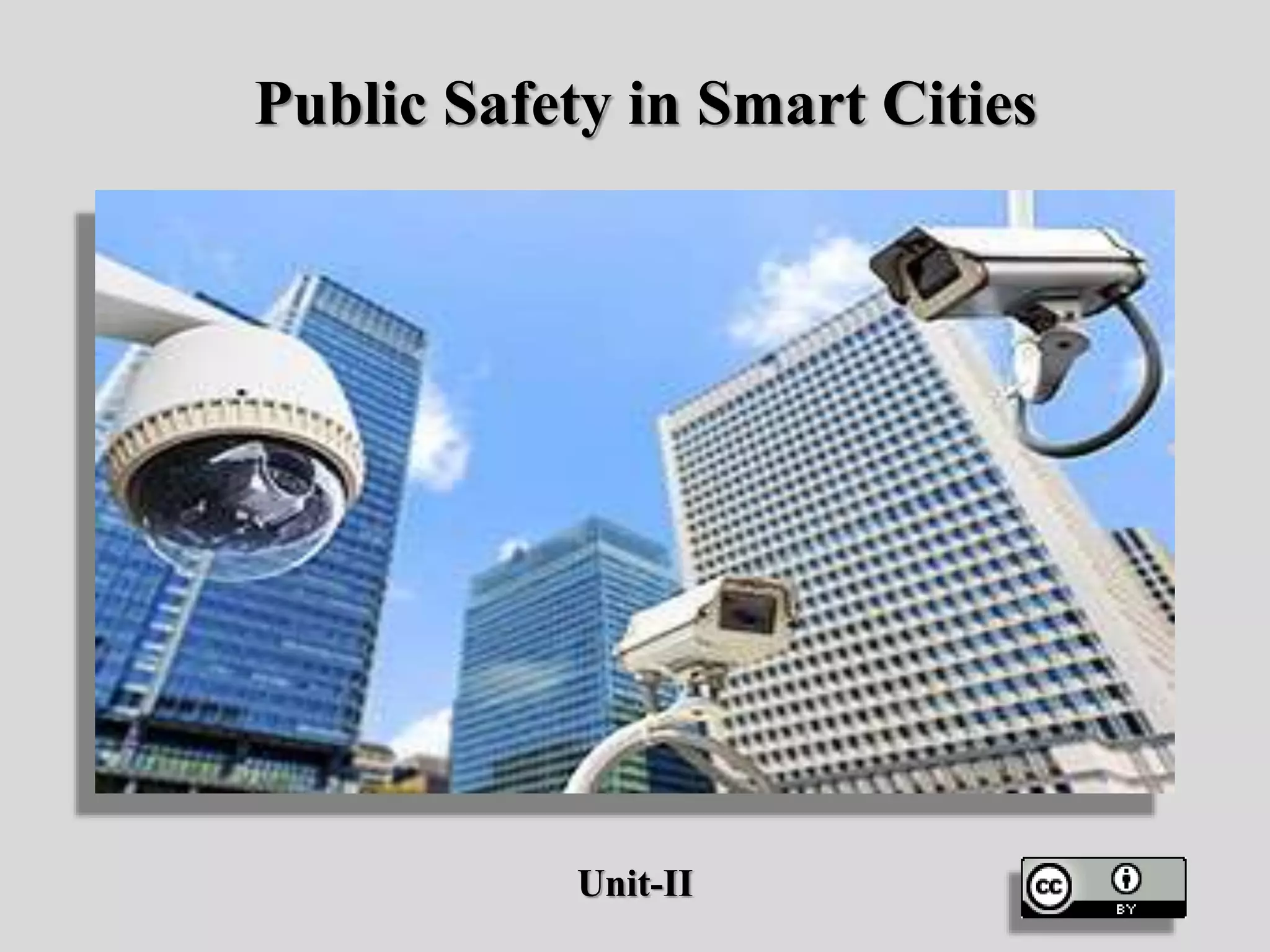
Public Safety in Smart Cities
Unit-II
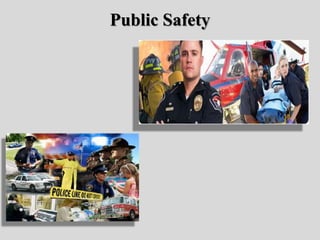
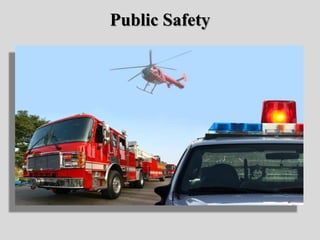
Public Safety
• A "smart city" is also a "Safe city" which
must enhance city performance on safety and
security for citizens to thrive as a city. A 'Safe'
city is a pre-requisite to create an attractive
economic and social environment for the
citizens, and to attract the investments for
the growth of smart city
Public Safety
Public Safety
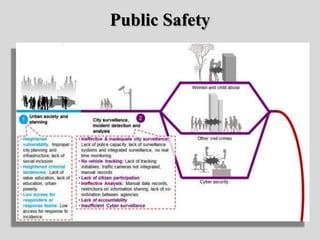
• With rapid urbanization due to increasing
population and urban migration, public safety and
security has become a key issue which needs urgent
attention as it is key pillar for quality of life in cities.
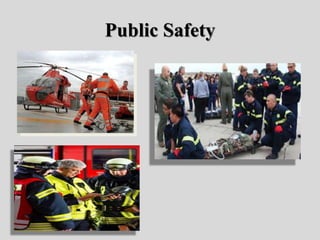
• In India, we have multiple public safety agencies like
the police for citizen safety and security, fire agency
for fire safety; disaster management agencies to
handle disasters; multiple public and private
emergency management services to handle medical
emergencies; NGOs and other agencies for women &
child safety; other domestic public safety issues like gas
leakage is handled by local gas dealers at city level.
Public Safety
Public Safety
• There needs to be greater collaboration
among these agencies which can improve
delayed responses for a public safety
situation and loss of life/property.
• In some cases, there have been reported
instances when critical public safety
advisory and alerts raised by various
international/national/state level agencies
have been missed.
Public Safety
• Providing a safe environment to live and
work for citizens and business is the key
responsibility of city government. India can
benefit from an even more integrated approach
to manage public safety and security.
• All agencies at national, state and local level
need to work together in close collaboration
to ensure provision of safe environment to
citizen and business.
Public Safety
Public Safety
Public Safety
• Safe City/Public Safety is a key pillar for
any Smart City. With the integration of smart
citizen-centric services with the safety and
security infrastructure, the city would be able
to ensure sustainability and socio-economic
growth.
Public Safety
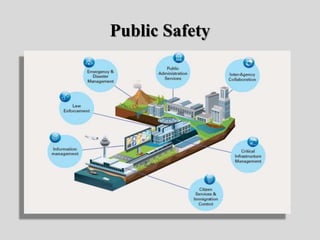
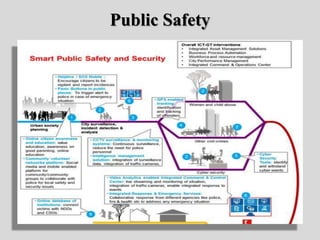
• Safe city services include policing services,
traffic management and mass transportation
systems, incident response, community
policing, emergency and disaster management,
surveillance and monitoring, safety and
security of critical infrastructure and security
of public places.
• All this city services needs to be integrated to
increasing collaboration among various public
safety and security agencies to provide integrated
response for any incident
Public Safety
Public Safety
Public Safety
Some of the key Smart City technologies
relevant for Safe City include
• Some of the key Smart City technologies
relevant for Safe City include:
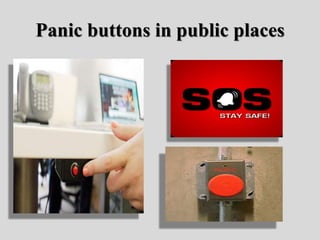
• 1. Panic buttons in public places and SoS
mobile application: To trigger alert to police in
case of emergency situation. Panic buttons can
be provided as physical buttons at key public
places. SoS mobile application can trigger
alerts and incident reporting with geo location
to provide effective response during an
emergency situation. The alerts could not just be
routed to the Police Control Room but also to
certain selected numbers from the phone book.
Panic buttons in public places
Some of the key Smart City technologies
relevant for Safe City include
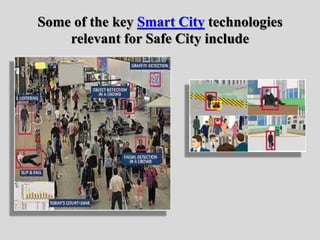
• 2. Video analytics-enabled integrated city
command and operations centre: Video
surveillance cameras are used to monitor the
city. But it become practically difficult for
public safety agencies to 24X7 monitor these
thousands of cameras in a command center for
any incidents. So most of the time, video
surveillance is used only for post
investigation purpose only.
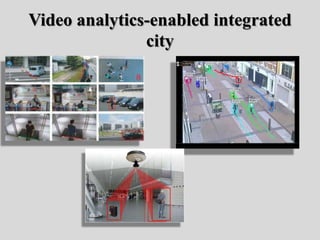
Video analytics-enabled integrated
city
Some of the key Smart City technologies
relevant for Safe City include
• Video analytics runs on live camera feeds and
automatically detects and raise alerts for
public safety issues like left object, suspicious
behavior etc. which makes it easier for public
safety agencies to proactively detect public safety
issues and take action to avoid incidents. Video
analytics enabled Integrated city command
and operations centre can monitor emergencies
and disasters to provide effective collaborative
response in case of emergency.
Some of the key Smart City technologies
relevant for Safe City include
Some of the key Smart City technologies
relevant for Safe City include
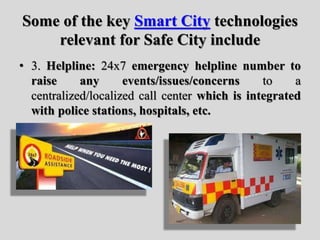
• 3. Helpline: 24x7 emergency helpline number to
raise any events/issues/concerns to a
centralized/localized call center which is integrated
with police stations, hospitals, etc.
Some of the key Smart City technologies
relevant for Safe City include
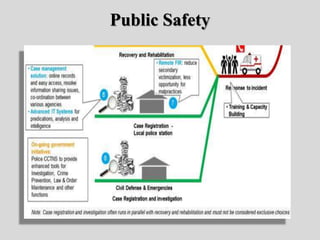
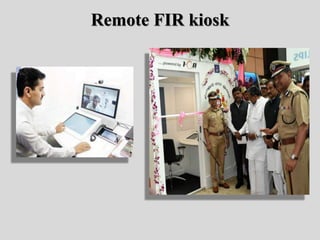
• 4. Remote FIR centers: Many times First
Information Report (FIR)/Police complaint
is not registered due to various reasons.
Kiosks/systems to help citizens file a First
Information Report (FIR) remotely,
irrespective of the location of the jurisdiction
where the offence has occurred in the city.
The complainant can sign, print and scan
documents virtually as part of the
experience .
Remote FIR kiosk
Some of the key Smart City technologies
relevant for Safe City include
• 5. Community volunteer networks platform:
Social media and mobile enabled platform for
community/community groups to collaborate
with police for local safety and security issues.
• A safe city/public safety is a key pillar for a
Smart City. With increasing crime in cities and
additional pressure due to rapid urbanization, it
has become very important for modernize and
take integrated approach towards public safety
to provide safe and secure environment for
citizens and business in a Smart City.
Some of the key Smart City technologies
relevant for Safe City include
Smart cities or safe cities?
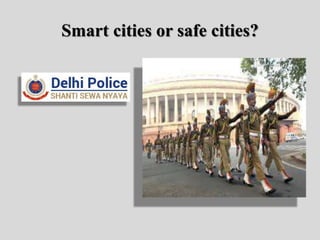
• In various cities across India, police officers
and public safety administrators’ work
round the clock to make sure millions of its
residents are safe — an unnerving thought,
actually. It is interesting to note that the one of
the world’s largest municipal police forces —
the Delhi Police — has more than 84,500
officers.
Smart cities or safe cities?
• The Delhi Police is perhaps the largest
metropolitan police in the world, larger
than London, Paris, New York and Tokyo,
and yet the ratio of officers to the city’s 20
million citizens is 1: 253! This reality leaves
officers hard put to keep up with citizens on
both routine days and during emergencies
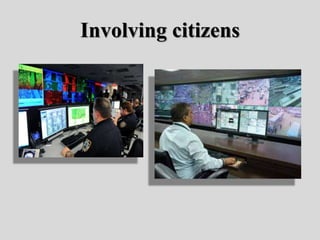
Involving citizens
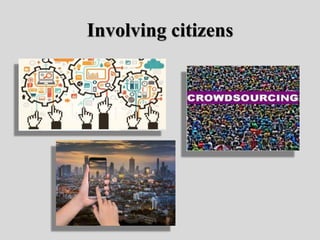
• A growing number of administrators realise
the possible benefits of including citizens in
public safety initiatives. One of the best ways
to work this is through “crowdsourcing,”
which involves engaging and empowering
private citizens to help public safety
professionals address daily hazards and
suspicious activities, natural calamities,
terrorist activities, crime and vandalism by
reporting information using their smartphones.
Involving citizens
Involving citizens
• India is witnessing a nationwide awareness
campaign initiated by the government,
leveraging various tools to keep the masses
informed. Television and radio advertisements
are one of the popular means through which
the Centre is aggressively pushing the public
to report instances, suspicious activity or
crime to a crime command centre or nearby
police stations.
Involving citizens
Involving citizens
• Active citizen engagement is extremely
essential in monitoring and these places as
well as keeping the police updated of
suspicious activities.
• This is the ideal time to harness the
potential of crowdsourcing. More and more
people are using smartphones and social
media technology than ever before.
Smart Reporting
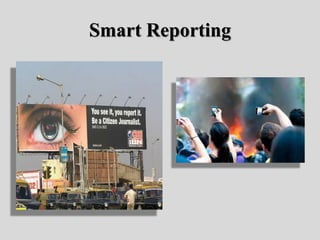
In many initiatives, citizens can submit
reports and updates anonymously using a
laptop or desktop computer. With the third
largest smartphone market in the world, India
is predicted to see the number of mobile internet
users reach 314 million by 2017. India is making
the leap from features phones to smartphones
quickly, an important factor that makes
citizen engagement possible.
Smart Reporting
Smart Reporting
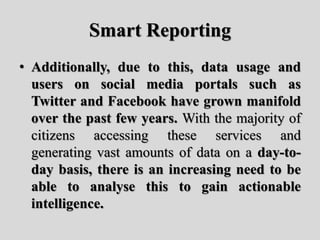
• Additionally, due to this, data usage and
users on social media portals such as
Twitter and Facebook have grown manifold
over the past few years. With the majority of
citizens accessing these services and
generating vast amounts of data on a day-to-
day basis, there is an increasing need to be
able to analyse this to gain actionable
intelligence.
Smart Reporting
Social Tools
India should take advantage of the smart city
initiative and restructure accordingly in this
time of change. Today, there are command-and-
control platforms that can provide officials with
intelligence and insights from social media
sites, anonymous tips and even public safety
apps that enable real-time event reporting and
live streaming directly, which can then be sent to
first responders in the field.
Social Tools
• Correlating these citizen reports with
incoming data from other systems, such as
video surveillance, traffic monitoring, gunshot
detection sensors, and weather reports allows
officials to gain a better understanding of
what is happening at any moment, as well as
trends that may emerge over time.
Social Tools
• Correlating these citizen reports with
incoming data from other systems, such as
video surveillance, traffic monitoring,
gunshot detection sensors, and weather
reports allows officials to gain a better
understanding of what is happening at any
moment, as well as trends that may emerge
over time.
Social Tools
• Crowdsourcing is also useful for personal
protection and real-time response. Given the
growing concern around female safety in India,
several developers in the country have created
apps in this regard. Through this, women, in
case of an emergency, can send a distress signal to
police control rooms in the vicinity informing
them of their geo location. This would help the
police respond faster and more effectively in
high risk areas.
References
 (Vishvesh Prabhakar is MD Sustainability, Sanjeev
Gupta MD Health & Public Services and Rajul
Mehrotra Smart Cities and Technology Subject
Matter Expert at Accenture in India)
• http://www.smartcitieschallenge.in/
• http://smartcitiescouncil.com/
• http://smartcitiesofindia.in/
Thanks..

Public Safety

  • 1.
    Public Safety inSmart Cities Unit-II
  • 2.
    Public Safety • A"smart city" is also a "Safe city" which must enhance city performance on safety and security for citizens to thrive as a city. A 'Safe' city is a pre-requisite to create an attractive economic and social environment for the citizens, and to attract the investments for the growth of smart city
  • 3.
  • 4.
    Public Safety • Withrapid urbanization due to increasing population and urban migration, public safety and security has become a key issue which needs urgent attention as it is key pillar for quality of life in cities. • In India, we have multiple public safety agencies like the police for citizen safety and security, fire agency for fire safety; disaster management agencies to handle disasters; multiple public and private emergency management services to handle medical emergencies; NGOs and other agencies for women & child safety; other domestic public safety issues like gas leakage is handled by local gas dealers at city level.
  • 5.
  • 6.
    Public Safety • Thereneeds to be greater collaboration among these agencies which can improve delayed responses for a public safety situation and loss of life/property. • In some cases, there have been reported instances when critical public safety advisory and alerts raised by various international/national/state level agencies have been missed.
  • 7.
    Public Safety • Providinga safe environment to live and work for citizens and business is the key responsibility of city government. India can benefit from an even more integrated approach to manage public safety and security. • All agencies at national, state and local level need to work together in close collaboration to ensure provision of safe environment to citizen and business.
  • 8.
  • 9.
  • 10.
    Public Safety • SafeCity/Public Safety is a key pillar for any Smart City. With the integration of smart citizen-centric services with the safety and security infrastructure, the city would be able to ensure sustainability and socio-economic growth.
  • 11.
    Public Safety • Safecity services include policing services, traffic management and mass transportation systems, incident response, community policing, emergency and disaster management, surveillance and monitoring, safety and security of critical infrastructure and security of public places. • All this city services needs to be integrated to increasing collaboration among various public safety and security agencies to provide integrated response for any incident
  • 12.
  • 13.
  • 14.
  • 15.
    Some of thekey Smart City technologies relevant for Safe City include • Some of the key Smart City technologies relevant for Safe City include: • 1. Panic buttons in public places and SoS mobile application: To trigger alert to police in case of emergency situation. Panic buttons can be provided as physical buttons at key public places. SoS mobile application can trigger alerts and incident reporting with geo location to provide effective response during an emergency situation. The alerts could not just be routed to the Police Control Room but also to certain selected numbers from the phone book.
  • 16.
    Panic buttons inpublic places
  • 17.
    Some of thekey Smart City technologies relevant for Safe City include • 2. Video analytics-enabled integrated city command and operations centre: Video surveillance cameras are used to monitor the city. But it become practically difficult for public safety agencies to 24X7 monitor these thousands of cameras in a command center for any incidents. So most of the time, video surveillance is used only for post investigation purpose only.
  • 18.
  • 19.
    Some of thekey Smart City technologies relevant for Safe City include • Video analytics runs on live camera feeds and automatically detects and raise alerts for public safety issues like left object, suspicious behavior etc. which makes it easier for public safety agencies to proactively detect public safety issues and take action to avoid incidents. Video analytics enabled Integrated city command and operations centre can monitor emergencies and disasters to provide effective collaborative response in case of emergency.
  • 20.
    Some of thekey Smart City technologies relevant for Safe City include
  • 21.
    Some of thekey Smart City technologies relevant for Safe City include • 3. Helpline: 24x7 emergency helpline number to raise any events/issues/concerns to a centralized/localized call center which is integrated with police stations, hospitals, etc.
  • 22.
    Some of thekey Smart City technologies relevant for Safe City include • 4. Remote FIR centers: Many times First Information Report (FIR)/Police complaint is not registered due to various reasons. Kiosks/systems to help citizens file a First Information Report (FIR) remotely, irrespective of the location of the jurisdiction where the offence has occurred in the city. The complainant can sign, print and scan documents virtually as part of the experience .
  • 23.
  • 24.
    Some of thekey Smart City technologies relevant for Safe City include • 5. Community volunteer networks platform: Social media and mobile enabled platform for community/community groups to collaborate with police for local safety and security issues. • A safe city/public safety is a key pillar for a Smart City. With increasing crime in cities and additional pressure due to rapid urbanization, it has become very important for modernize and take integrated approach towards public safety to provide safe and secure environment for citizens and business in a Smart City.

  • 25.
    Some of thekey Smart City technologies relevant for Safe City include
  • 26.
    Smart cities orsafe cities? • In various cities across India, police officers and public safety administrators’ work round the clock to make sure millions of its residents are safe — an unnerving thought, actually. It is interesting to note that the one of the world’s largest municipal police forces — the Delhi Police — has more than 84,500 officers.
  • 27.
    Smart cities orsafe cities?
  • 28.
    Smart cities orsafe cities? • The Delhi Police is perhaps the largest metropolitan police in the world, larger than London, Paris, New York and Tokyo, and yet the ratio of officers to the city’s 20 million citizens is 1: 253! This reality leaves officers hard put to keep up with citizens on both routine days and during emergencies
  • 29.
    Involving citizens • Agrowing number of administrators realise the possible benefits of including citizens in public safety initiatives. One of the best ways to work this is through “crowdsourcing,” which involves engaging and empowering private citizens to help public safety professionals address daily hazards and suspicious activities, natural calamities, terrorist activities, crime and vandalism by reporting information using their smartphones.
  • 30.
  • 31.
    Involving citizens • Indiais witnessing a nationwide awareness campaign initiated by the government, leveraging various tools to keep the masses informed. Television and radio advertisements are one of the popular means through which the Centre is aggressively pushing the public to report instances, suspicious activity or crime to a crime command centre or nearby police stations.
  • 32.
  • 33.
    Involving citizens • Activecitizen engagement is extremely essential in monitoring and these places as well as keeping the police updated of suspicious activities. • This is the ideal time to harness the potential of crowdsourcing. More and more people are using smartphones and social media technology than ever before.
  • 34.
    Smart Reporting In manyinitiatives, citizens can submit reports and updates anonymously using a laptop or desktop computer. With the third largest smartphone market in the world, India is predicted to see the number of mobile internet users reach 314 million by 2017. India is making the leap from features phones to smartphones quickly, an important factor that makes citizen engagement possible.
  • 35.
  • 36.
    Smart Reporting • Additionally,due to this, data usage and users on social media portals such as Twitter and Facebook have grown manifold over the past few years. With the majority of citizens accessing these services and generating vast amounts of data on a day-to- day basis, there is an increasing need to be able to analyse this to gain actionable intelligence.
  • 37.
  • 38.
    Social Tools India shouldtake advantage of the smart city initiative and restructure accordingly in this time of change. Today, there are command-and- control platforms that can provide officials with intelligence and insights from social media sites, anonymous tips and even public safety apps that enable real-time event reporting and live streaming directly, which can then be sent to first responders in the field.
  • 39.
    Social Tools • Correlatingthese citizen reports with incoming data from other systems, such as video surveillance, traffic monitoring, gunshot detection sensors, and weather reports allows officials to gain a better understanding of what is happening at any moment, as well as trends that may emerge over time.
  • 40.
    Social Tools • Correlatingthese citizen reports with incoming data from other systems, such as video surveillance, traffic monitoring, gunshot detection sensors, and weather reports allows officials to gain a better understanding of what is happening at any moment, as well as trends that may emerge over time.
  • 41.
    Social Tools • Crowdsourcingis also useful for personal protection and real-time response. Given the growing concern around female safety in India, several developers in the country have created apps in this regard. Through this, women, in case of an emergency, can send a distress signal to police control rooms in the vicinity informing them of their geo location. This would help the police respond faster and more effectively in high risk areas.
  • 42.
    References  (Vishvesh Prabhakaris MD Sustainability, Sanjeev Gupta MD Health & Public Services and Rajul Mehrotra Smart Cities and Technology Subject Matter Expert at Accenture in India) • http://www.smartcitieschallenge.in/ • http://smartcitiescouncil.com/ • http://smartcitiesofindia.in/
  • 43.