CORE 601 ORGANIZATION AND MANAGEMENT 7:00 AM – 10:00 AM SILONGAN, DATU MOHAMMAD E. KADIL, SYYEDBRIEN ABAS.
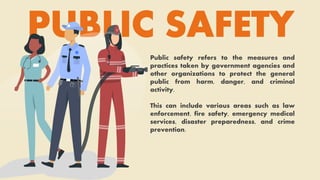
Public safety refers to the measures and
practices taken by government agencies and
other organizations to protect the general
public from harm, danger, and criminal
activity.
This can include various areas such as law
enforcement, fire safety, emergency medical
services, disaster preparedness, and crime
prevention.
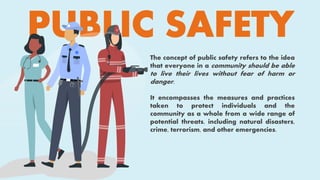
The concept of public safety refers to the idea
that everyone in a community should be able
to live their lives without fear of harm or
danger.
It encompasses the measures and practices
taken to protect individuals and the
community as a whole from a wide range of
potential threats, including natural disasters,
crime, terrorism, and other emergencies.
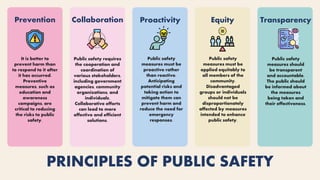
PRINCIPLES OF PUBLIC SAFETY
Prevention Collaboration Proactivity Equity Transparency
It is better to
prevent harm than
to respond to it after
it has occurred.
Preventive
measures, such as
education and
awareness
campaigns, are
critical to reducing
the risks to public
safety.
Public safety requires
the cooperation and
coordination of
various stakeholders,
including government
agencies, community
organizations, and
individuals.
Collaborative efforts
can lead to more
effective and efficient
solutions.
Public safety
measures must be
proactive rather
than reactive.
Anticipating
potential risks and
taking action to
mitigate them can
prevent harm and
reduce the need for
emergency
responses.
Public safety
measures must be
applied equitably to
all members of the
community.
Disadvantaged
groups or individuals
should not be
disproportionately
affected by measures
intended to enhance
public safety.
Public safety
measures should
be transparent
and accountable.
The public should
be informed about
the measures
being taken and
their effectiveness.
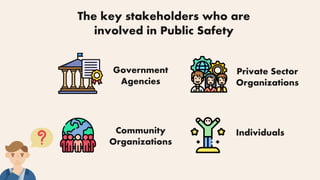
The key stakeholders who are
involved in Public Safety
The key stakeholders who are
involved in Public Safety
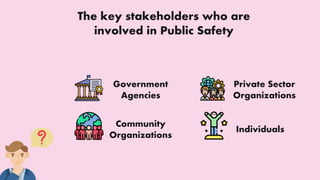
Government
Agencies
Community
Organizations
Private Sector
Organizations
Individuals
Community
Organizations
Private Sector
Organizations
Individuals
The key stakeholders who are
involved in Public Safety
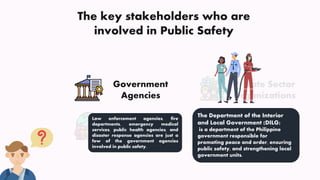
Government
Agencies
Law enforcement agencies, fire
departments, emergency medical
services, public health agencies, and
disaster response agencies are just a
few of the government agencies
involved in public safety.
The Department of the Interior
and Local Government (DILG)
is a department of the Philippine
government responsible for
promoting peace and order, ensuring
public safety, and strengthening local
government units.
Private Sector
Organizations
Individuals
Government
Agencies
The key stakeholders who are
involved in Public Safety
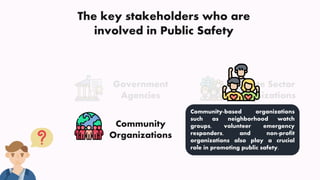
Community-based organizations
such as neighborhood watch
groups, volunteer emergency
responders, and non-profit
organizations also play a crucial
role in promoting public safety.
Community
Organizations
Individuals
Government
Agencies
Community
Organizations
Private Sector
Organizations
The key stakeholders who are
involved in Public Safety
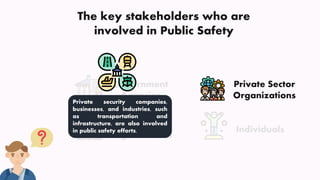
Private security companies,
businesses, and industries, such
as transportation and
infrastructure, are also involved
in public safety efforts.
Government
Agencies
Community
Organizations
Private Sector
Organizations
Individuals
The key stakeholders who are
involved in Public Safety
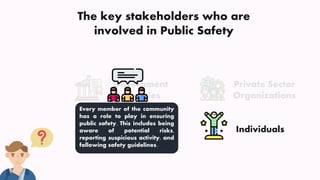
Every member of the community
has a role to play in ensuring
public safety. This includes being
aware of potential risks,
reporting suspicious activity, and
following safety guidelines.
Government
Agencies
Community
Organizations
Private Sector
Organizations
Individuals
The key stakeholders who are
involved in Public Safety
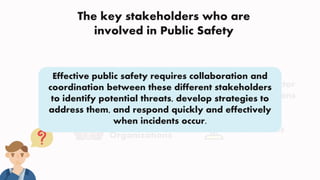
Effective public safety requires collaboration and
coordination between these different stakeholders
to identify potential threats, develop strategies to
address them, and respond quickly and effectively
when incidents occur.
Government
Agencies
Community
Organizations
Private Sector
Organizations
Individuals
The key stakeholders who are
involved in Public Safety
KEY AREAS OF PUBLIC SAFETY IN THE
PHILIPPINES
Law Enforcement
“Public safety is a significant concern in the Philippines, and the government has established various measures and
agencies to address the different aspects of public safety. Some of the key areas of public safety in the Philippines
include’’
Fire Safety
Emergency Medical
Services
Disaster
Preparedness
Crime
Prevention
KEY AREAS OF PUBLIC SAFETY IN THE
PHILIPPINES
Fire Safety
Emergency Medical
Services
Disaster
Preparedness
“Public safety is a significant concern in the Philippines, and the government has established various measures and
agencies to address the different aspects of public safety. Some of the key areas of public safety in the Philippines
include’’
Crime
Prevention
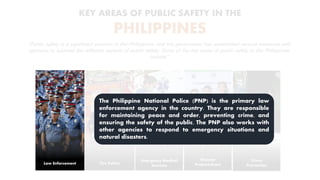
The Philippine National Police (PNP) is the primary law
enforcement agency in the country. They are responsible
for maintaining peace and order, preventing crime, and
ensuring the safety of the public. The PNP also works with
other agencies to respond to emergency situations and
natural disasters.
Law Enforcement
KEY AREAS OF PUBLIC SAFETY IN THE
PHILIPPINES
Law Enforcement
Emergency Medical
Services
Disaster
Preparedness
Crime
Prevention
“Public safety is a significant concern in the Philippines, and the government has established various measures and
agencies to address the different aspects of public safety. Some of the key areas of public safety in the Philippines
include’’
The Bureau of Fire Protection (BFP) is responsible
for fire prevention, suppression, and investigation.
They also provide fire safety education and
training to the public.
Fire Safety
KEY AREAS OF PUBLIC SAFETY IN THE
PHILIPPINES
Law Enforcement Fire Safety
Disaster
Preparedness
Crime
Prevention
“Public safety is a significant concern in the Philippines, and the government has established various measures and
agencies to address the different aspects of public safety. Some of the key areas of public safety in the Philippines
include’’
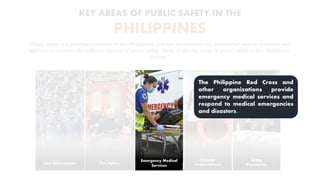
The Philippine Red Cross and
other organizations provide
emergency medical services and
respond to medical emergencies
and disasters.
Emergency Medical
Services
KEY AREAS OF PUBLIC SAFETY IN THE
PHILIPPINES
Law Enforcement Fire Safety
Emergency Medical
Services
Crime
Prevention
“Public safety is a significant concern in the Philippines, and the government has established various measures and
agencies to address the different aspects of public safety. Some of the key areas of public safety in the Philippines
include’’
The National Disaster Risk Reduction and
Management Council (NDRRMC) is responsible for
disaster preparedness, response, and recovery.
They coordinate with other agencies to develop
disaster management plans and implement
measures to reduce the impact of natural
disasters.
Disaster
Preparedness
KEY AREAS OF PUBLIC SAFETY IN THE
PHILIPPINES
Law Enforcement Fire Safety
Emergency Medical
Services
Disaster
Preparedness
“Public safety is a significant concern in the Philippines, and the government has established various measures and
agencies to address the different aspects of public safety. Some of the key areas of public safety in the Philippines
include’’
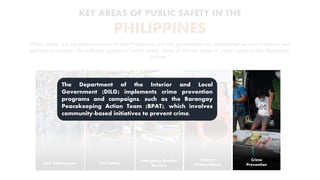
The Department of the Interior and Local
Government (DILG) implements crime prevention
programs and campaigns, such as the Barangay
Peacekeeping Action Team (BPAT), which involves
community-based initiatives to prevent crime.
Crime
Prevention
KEY AREAS OF PUBLIC SAFETY IN THE
PHILIPPINES
Law Enforcement Fire Safety
Emergency Medical
Services
Disaster
Preparedness
“Public safety is a significant concern in the Philippines, and the government has established various measures and
agencies to address the different aspects of public safety. Some of the key areas of public safety in the Philippines
include’’
Crime
Prevention
The Department of the Interior and Local
Government (DILG) implements crime prevention
programs and campaigns, such as the Barangay
Peacekeeping Action Team (BPAT), which involves
community-based initiatives to prevent crime.
In recent years, the Philippine government has also implemented various
initiatives to improve public safety, such as increasing the number of
police officers and firefighters, enhancing emergency response
capabilities, and improving disaster management systems. However,
there is still room for improvement, and public safety remains a significant
concern in the Philippines.
KEY AREAS OF PUBLIC SAFETY IN THE
PHILIPPINES
Law Enforcement Fire Safety
Emergency Medical
Services
Disaster
Preparedness
Crime
Prevention
“Public safety is a significant concern in the Philippines, and the government has established various measures and
agencies to address the different aspects of public safety. Some of the key areas of public safety in the Philippines
include’’
VARIOUS PROGRAMS AND INITIATIVES RELATED TO PUBLIC SAFETY IN THE
PHILIPPINES
Oplan Kalasag
This is the national disaster preparedness program that
aims to enhance the country's capacity to prevent, prepare
for, and respond to disasters. It includes measures such as
hazard mapping, community-based disaster preparedness,
and early warning systems.
Safe Philippines Project
This is a comprehensive public safety program launched
by the Philippine National Police in 2018. It includes
measures such as crime prevention, anti-terrorism, road
safety, and disaster response.
VARIOUS PROGRAMS AND INITIATIVES RELATED TO PUBLIC SAFETY IN THE
PHILIPPINES
Bantay Krimen
This is a crime prevention program implemented by the
Department of the Interior and Local Government (DILG)
that aims to involve local communities in preventing
crime. It involves the establishment of Barangay
Peacekeeping Action Teams (BPAT) composed of
volunteers who help maintain peace and order in their
respective communities.
Fire Code of the Philippines
This is a law that regulates fire safety in the country. It
includes provisions for the prevention of fires, the
establishment of fire safety requirements for buildings
and structures, and the regulation of fire safety
equipment.
VARIOUS PROGRAMS AND INITIATIVES RELATED TO PUBLIC SAFETY IN THE
PHILIPPINES
National Anti-Drug Abuse
Campaign
This is a comprehensive program that aims to address
the drug problem in the country. It includes measures
such as drug prevention, education, and rehabilitation,
as well as law enforcement operations against drug
syndicates.
These are just some examples of the programs and
initiatives related to public safety in the Philippines.
Other programs and initiatives include
- road safety programs,
- anti-human trafficking
- programs, and disaster
response programs.
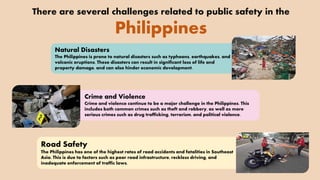
There are several challenges related to public safety in the
Philippines
Natural Disasters
The Philippines is prone to natural disasters such as typhoons, earthquakes, and
volcanic eruptions. These disasters can result in significant loss of life and
property damage, and can also hinder economic development.
Crime and Violence
Crime and violence continue to be a major challenge in the Philippines. This
includes both common crimes such as theft and robbery, as well as more
serious crimes such as drug trafficking, terrorism, and political violence.
Road Safety
The Philippines has one of the highest rates of road accidents and fatalities in Southeast
Asia. This is due to factors such as poor road infrastructure, reckless driving, and
inadequate enforcement of traffic laws.
Cybersecurity
With the increasing use of digital technologies in the country, cybersecurity has
become a growing concern. The Philippines has experienced a rise in
cybercrime, including online scams, identity theft, and hacking.
Resource Constraints
The government's ability to address public safety challenges is limited by
resource constraints, including limited funding, personnel, and equipment.
Public Awareness
There is a need to increase public awareness and participation in promoting public safety.
This includes educating the public on disaster preparedness, crime prevention, road safety,
and cybersecurity, as well as encouraging community participation in maintaining peace
and order.
There are several challenges related to public safety in the
Philippines
POLICIES
▪ Republic Act No. 10121 or the Philippine Disaster
Risk Reduction and Management Act of 2010
▪ Republic Act No. 11469 or the Bayanihan to Heal as
One Act:
▪ Executive Order No. 70 or the Whole-of-Nation
Approach to End Local Communist Armed Conflict
▪ Land Transportation and Traffic Code
▪ Anti-Terrorism Act of 2020
▪ Republic Act No. 10121 or the Philippine Disaster
Risk Reduction and Management Act of 2010
▪ Republic Act No. 11469 or the Bayanihan to Heal as
One Act:
▪ Executive Order No. 70 or the Whole-of-Nation
Approach to End Local Communist Armed Conflict
▪ Land Transportation and Traffic Code
▪ Anti-Terrorism Act of 2020
POLICIES
This law institutionalizes the framework and system for disaster risk
reduction and management in the Philippines. It outlines the roles and
responsibilities of various government agencies, local government units, and
stakeholders in disaster preparedness, response, and recovery.
▪ Republic Act No. 10121 or the Philippine Disaster
Risk Reduction and Management Act of 2010
▪ Republic Act No. 11469 or the Bayanihan to Heal as
One Act:
▪ Executive Order No. 70 or the Whole-of-Nation
Approach to End Local Communist Armed Conflict
▪ Land Transportation and Traffic Code
▪ Anti-Terrorism Act of 2020
POLICIES
This law provides emergency powers to the President of the Philippines to
address the COVID-19 pandemic. It includes provisions for social amelioration
programs, the provision of medical supplies and equipment, and the
implementation of measures to prevent the spread of the virus.
▪ Republic Act No. 10121 or the Philippine Disaster
Risk Reduction and Management Act of 2010
▪ Republic Act No. 11469 or the Bayanihan to Heal as
One Act:
▪ Executive Order No. 70 or the Whole-of-Nation
Approach to End Local Communist Armed Conflict
▪ Land Transportation and Traffic Code
▪ Anti-Terrorism Act of 2020
POLICIES
This executive order provides for a coordinated and integrated approach to
address the root causes of insurgency and other armed conflicts in the country. It
aims to strengthen the delivery of basic services, promote peace and security,
and ensure sustainable development in conflict-affected areas.
▪ Republic Act No. 10121 or the Philippine Disaster
Risk Reduction and Management Act of 2010
▪ Republic Act No. 11469 or the Bayanihan to Heal as
One Act:
▪ Executive Order No. 70 or the Whole-of-Nation
Approach to End Local Communist Armed Conflict
▪ Land Transportation and Traffic Code
▪ Anti-Terrorism Act of 2020
POLICIES
This law regulates the use of motor vehicles and other modes of
transportation on public roads in the Philippines. It includes provisions on
traffic rules and regulations, vehicle registration and inspection, and
penalties for traffic violations.
▪ Republic Act No. 10121 or the Philippine Disaster
Risk Reduction and Management Act of 2010
▪ Republic Act No. 11469 or the Bayanihan to Heal as
One Act:
▪ Executive Order No. 70 or the Whole-of-Nation
Approach to End Local Communist Armed Conflict
▪ Land Transportation and Traffic Code
▪ Anti-Terrorism Act of 2020
POLICIES
This law seeks to address the threat of terrorism in the Philippines by providing a
comprehensive legal framework for the prevention, prosecution, and
suppression of terrorist acts. It includes provisions on surveillance, detention,
and asset freezing of suspected terrorists, as well as penalties for individuals and
organizations involved in terrorism.
POLICIES
▪ Republic Act No. 10121 or the Philippine Disaster
Risk Reduction and Management Act of 2010
▪ Republic Act No. 11469 or the Bayanihan to Heal as
One Act:
▪ Executive Order No. 70 or the Whole-of-Nation
Approach to End Local Communist Armed Conflict
▪ Land Transportation and Traffic Code
▪ Anti-Terrorism Act of 2020
Here are some sources and references related to public safety in the Philippines:
1.Philippine Development Plan 2017-2022:
https://www.neda.gov.ph/wp-content/uploads/2017/02/PDP-2017-2022.pdf
https://pdp.neda.gov.ph/wp-content/uploads/2023/01/PDP-2023-2028.pdf
1.National Disaster Risk Reduction and Management Plan:
https://ndrrmc.gov.ph/attachments/article/291/NDRRMP%202019-2028.pdf
2.Road Safety Action Plan: https://www.neda.gov.ph/wp-content/uploads/2019/11/Road-Safety-Action-Plan.pdf
3.Cybersecurity issues in the Philippines: https://www.mccarthy.com.ph/insights/cybersecurity-issues-and-
implications-philippines
4.Philippine National Police: https://www.pnp.gov.ph/
5.Department of Transportation: https://dotr.gov.ph/
6.National Disaster Risk Reduction and Management Council: https://ndrrmc.gov.ph/
7.Department of Information and Communications Technology: https://dict.gov.ph/
SOURCES & REFERENCES

PUBLIC SAFETY

  • 1.
    CORE 601 ORGANIZATIONAND MANAGEMENT 7:00 AM – 10:00 AM SILONGAN, DATU MOHAMMAD E. KADIL, SYYEDBRIEN ABAS.
  • 2.
    Public safety refersto the measures and practices taken by government agencies and other organizations to protect the general public from harm, danger, and criminal activity. This can include various areas such as law enforcement, fire safety, emergency medical services, disaster preparedness, and crime prevention.
  • 3.
    The concept ofpublic safety refers to the idea that everyone in a community should be able to live their lives without fear of harm or danger. It encompasses the measures and practices taken to protect individuals and the community as a whole from a wide range of potential threats, including natural disasters, crime, terrorism, and other emergencies.
  • 4.
    PRINCIPLES OF PUBLICSAFETY Prevention Collaboration Proactivity Equity Transparency It is better to prevent harm than to respond to it after it has occurred. Preventive measures, such as education and awareness campaigns, are critical to reducing the risks to public safety. Public safety requires the cooperation and coordination of various stakeholders, including government agencies, community organizations, and individuals. Collaborative efforts can lead to more effective and efficient solutions. Public safety measures must be proactive rather than reactive. Anticipating potential risks and taking action to mitigate them can prevent harm and reduce the need for emergency responses. Public safety measures must be applied equitably to all members of the community. Disadvantaged groups or individuals should not be disproportionately affected by measures intended to enhance public safety. Public safety measures should be transparent and accountable. The public should be informed about the measures being taken and their effectiveness.
  • 5.
    The key stakeholderswho are involved in Public Safety
  • 6.
    The key stakeholderswho are involved in Public Safety Government Agencies Community Organizations Private Sector Organizations Individuals
  • 7.
    Community Organizations Private Sector Organizations Individuals The keystakeholders who are involved in Public Safety Government Agencies Law enforcement agencies, fire departments, emergency medical services, public health agencies, and disaster response agencies are just a few of the government agencies involved in public safety. The Department of the Interior and Local Government (DILG) is a department of the Philippine government responsible for promoting peace and order, ensuring public safety, and strengthening local government units.
  • 8.
    Private Sector Organizations Individuals Government Agencies The keystakeholders who are involved in Public Safety Community-based organizations such as neighborhood watch groups, volunteer emergency responders, and non-profit organizations also play a crucial role in promoting public safety. Community Organizations
  • 9.
    Individuals Government Agencies Community Organizations Private Sector Organizations The keystakeholders who are involved in Public Safety Private security companies, businesses, and industries, such as transportation and infrastructure, are also involved in public safety efforts.
  • 10.
    Government Agencies Community Organizations Private Sector Organizations Individuals The keystakeholders who are involved in Public Safety Every member of the community has a role to play in ensuring public safety. This includes being aware of potential risks, reporting suspicious activity, and following safety guidelines.
  • 11.
    Government Agencies Community Organizations Private Sector Organizations Individuals The keystakeholders who are involved in Public Safety Effective public safety requires collaboration and coordination between these different stakeholders to identify potential threats, develop strategies to address them, and respond quickly and effectively when incidents occur.
  • 12.
  • 13.
    KEY AREAS OFPUBLIC SAFETY IN THE PHILIPPINES Law Enforcement “Public safety is a significant concern in the Philippines, and the government has established various measures and agencies to address the different aspects of public safety. Some of the key areas of public safety in the Philippines include’’ Fire Safety Emergency Medical Services Disaster Preparedness Crime Prevention
  • 14.
    KEY AREAS OFPUBLIC SAFETY IN THE PHILIPPINES Fire Safety Emergency Medical Services Disaster Preparedness “Public safety is a significant concern in the Philippines, and the government has established various measures and agencies to address the different aspects of public safety. Some of the key areas of public safety in the Philippines include’’ Crime Prevention The Philippine National Police (PNP) is the primary law enforcement agency in the country. They are responsible for maintaining peace and order, preventing crime, and ensuring the safety of the public. The PNP also works with other agencies to respond to emergency situations and natural disasters. Law Enforcement
  • 15.
    KEY AREAS OFPUBLIC SAFETY IN THE PHILIPPINES Law Enforcement Emergency Medical Services Disaster Preparedness Crime Prevention “Public safety is a significant concern in the Philippines, and the government has established various measures and agencies to address the different aspects of public safety. Some of the key areas of public safety in the Philippines include’’ The Bureau of Fire Protection (BFP) is responsible for fire prevention, suppression, and investigation. They also provide fire safety education and training to the public. Fire Safety
  • 16.
    KEY AREAS OFPUBLIC SAFETY IN THE PHILIPPINES Law Enforcement Fire Safety Disaster Preparedness Crime Prevention “Public safety is a significant concern in the Philippines, and the government has established various measures and agencies to address the different aspects of public safety. Some of the key areas of public safety in the Philippines include’’ The Philippine Red Cross and other organizations provide emergency medical services and respond to medical emergencies and disasters. Emergency Medical Services
  • 17.
    KEY AREAS OFPUBLIC SAFETY IN THE PHILIPPINES Law Enforcement Fire Safety Emergency Medical Services Crime Prevention “Public safety is a significant concern in the Philippines, and the government has established various measures and agencies to address the different aspects of public safety. Some of the key areas of public safety in the Philippines include’’ The National Disaster Risk Reduction and Management Council (NDRRMC) is responsible for disaster preparedness, response, and recovery. They coordinate with other agencies to develop disaster management plans and implement measures to reduce the impact of natural disasters. Disaster Preparedness
  • 18.
    KEY AREAS OFPUBLIC SAFETY IN THE PHILIPPINES Law Enforcement Fire Safety Emergency Medical Services Disaster Preparedness “Public safety is a significant concern in the Philippines, and the government has established various measures and agencies to address the different aspects of public safety. Some of the key areas of public safety in the Philippines include’’ The Department of the Interior and Local Government (DILG) implements crime prevention programs and campaigns, such as the Barangay Peacekeeping Action Team (BPAT), which involves community-based initiatives to prevent crime. Crime Prevention
  • 19.
    KEY AREAS OFPUBLIC SAFETY IN THE PHILIPPINES Law Enforcement Fire Safety Emergency Medical Services Disaster Preparedness “Public safety is a significant concern in the Philippines, and the government has established various measures and agencies to address the different aspects of public safety. Some of the key areas of public safety in the Philippines include’’ Crime Prevention The Department of the Interior and Local Government (DILG) implements crime prevention programs and campaigns, such as the Barangay Peacekeeping Action Team (BPAT), which involves community-based initiatives to prevent crime. In recent years, the Philippine government has also implemented various initiatives to improve public safety, such as increasing the number of police officers and firefighters, enhancing emergency response capabilities, and improving disaster management systems. However, there is still room for improvement, and public safety remains a significant concern in the Philippines.
  • 20.
    KEY AREAS OFPUBLIC SAFETY IN THE PHILIPPINES Law Enforcement Fire Safety Emergency Medical Services Disaster Preparedness Crime Prevention “Public safety is a significant concern in the Philippines, and the government has established various measures and agencies to address the different aspects of public safety. Some of the key areas of public safety in the Philippines include’’
  • 21.
    VARIOUS PROGRAMS ANDINITIATIVES RELATED TO PUBLIC SAFETY IN THE PHILIPPINES Oplan Kalasag This is the national disaster preparedness program that aims to enhance the country's capacity to prevent, prepare for, and respond to disasters. It includes measures such as hazard mapping, community-based disaster preparedness, and early warning systems. Safe Philippines Project This is a comprehensive public safety program launched by the Philippine National Police in 2018. It includes measures such as crime prevention, anti-terrorism, road safety, and disaster response.
  • 22.
    VARIOUS PROGRAMS ANDINITIATIVES RELATED TO PUBLIC SAFETY IN THE PHILIPPINES Bantay Krimen This is a crime prevention program implemented by the Department of the Interior and Local Government (DILG) that aims to involve local communities in preventing crime. It involves the establishment of Barangay Peacekeeping Action Teams (BPAT) composed of volunteers who help maintain peace and order in their respective communities. Fire Code of the Philippines This is a law that regulates fire safety in the country. It includes provisions for the prevention of fires, the establishment of fire safety requirements for buildings and structures, and the regulation of fire safety equipment.
  • 23.
    VARIOUS PROGRAMS ANDINITIATIVES RELATED TO PUBLIC SAFETY IN THE PHILIPPINES National Anti-Drug Abuse Campaign This is a comprehensive program that aims to address the drug problem in the country. It includes measures such as drug prevention, education, and rehabilitation, as well as law enforcement operations against drug syndicates. These are just some examples of the programs and initiatives related to public safety in the Philippines. Other programs and initiatives include - road safety programs, - anti-human trafficking - programs, and disaster response programs.
  • 24.
    There are severalchallenges related to public safety in the Philippines Natural Disasters The Philippines is prone to natural disasters such as typhoons, earthquakes, and volcanic eruptions. These disasters can result in significant loss of life and property damage, and can also hinder economic development. Crime and Violence Crime and violence continue to be a major challenge in the Philippines. This includes both common crimes such as theft and robbery, as well as more serious crimes such as drug trafficking, terrorism, and political violence. Road Safety The Philippines has one of the highest rates of road accidents and fatalities in Southeast Asia. This is due to factors such as poor road infrastructure, reckless driving, and inadequate enforcement of traffic laws.
  • 25.
    Cybersecurity With the increasinguse of digital technologies in the country, cybersecurity has become a growing concern. The Philippines has experienced a rise in cybercrime, including online scams, identity theft, and hacking. Resource Constraints The government's ability to address public safety challenges is limited by resource constraints, including limited funding, personnel, and equipment. Public Awareness There is a need to increase public awareness and participation in promoting public safety. This includes educating the public on disaster preparedness, crime prevention, road safety, and cybersecurity, as well as encouraging community participation in maintaining peace and order. There are several challenges related to public safety in the Philippines
  • 26.
    POLICIES ▪ Republic ActNo. 10121 or the Philippine Disaster Risk Reduction and Management Act of 2010 ▪ Republic Act No. 11469 or the Bayanihan to Heal as One Act: ▪ Executive Order No. 70 or the Whole-of-Nation Approach to End Local Communist Armed Conflict ▪ Land Transportation and Traffic Code ▪ Anti-Terrorism Act of 2020
  • 27.
    ▪ Republic ActNo. 10121 or the Philippine Disaster Risk Reduction and Management Act of 2010 ▪ Republic Act No. 11469 or the Bayanihan to Heal as One Act: ▪ Executive Order No. 70 or the Whole-of-Nation Approach to End Local Communist Armed Conflict ▪ Land Transportation and Traffic Code ▪ Anti-Terrorism Act of 2020 POLICIES This law institutionalizes the framework and system for disaster risk reduction and management in the Philippines. It outlines the roles and responsibilities of various government agencies, local government units, and stakeholders in disaster preparedness, response, and recovery.
  • 28.
    ▪ Republic ActNo. 10121 or the Philippine Disaster Risk Reduction and Management Act of 2010 ▪ Republic Act No. 11469 or the Bayanihan to Heal as One Act: ▪ Executive Order No. 70 or the Whole-of-Nation Approach to End Local Communist Armed Conflict ▪ Land Transportation and Traffic Code ▪ Anti-Terrorism Act of 2020 POLICIES This law provides emergency powers to the President of the Philippines to address the COVID-19 pandemic. It includes provisions for social amelioration programs, the provision of medical supplies and equipment, and the implementation of measures to prevent the spread of the virus.
  • 29.
    ▪ Republic ActNo. 10121 or the Philippine Disaster Risk Reduction and Management Act of 2010 ▪ Republic Act No. 11469 or the Bayanihan to Heal as One Act: ▪ Executive Order No. 70 or the Whole-of-Nation Approach to End Local Communist Armed Conflict ▪ Land Transportation and Traffic Code ▪ Anti-Terrorism Act of 2020 POLICIES This executive order provides for a coordinated and integrated approach to address the root causes of insurgency and other armed conflicts in the country. It aims to strengthen the delivery of basic services, promote peace and security, and ensure sustainable development in conflict-affected areas.
  • 30.
    ▪ Republic ActNo. 10121 or the Philippine Disaster Risk Reduction and Management Act of 2010 ▪ Republic Act No. 11469 or the Bayanihan to Heal as One Act: ▪ Executive Order No. 70 or the Whole-of-Nation Approach to End Local Communist Armed Conflict ▪ Land Transportation and Traffic Code ▪ Anti-Terrorism Act of 2020 POLICIES This law regulates the use of motor vehicles and other modes of transportation on public roads in the Philippines. It includes provisions on traffic rules and regulations, vehicle registration and inspection, and penalties for traffic violations.
  • 31.
    ▪ Republic ActNo. 10121 or the Philippine Disaster Risk Reduction and Management Act of 2010 ▪ Republic Act No. 11469 or the Bayanihan to Heal as One Act: ▪ Executive Order No. 70 or the Whole-of-Nation Approach to End Local Communist Armed Conflict ▪ Land Transportation and Traffic Code ▪ Anti-Terrorism Act of 2020 POLICIES This law seeks to address the threat of terrorism in the Philippines by providing a comprehensive legal framework for the prevention, prosecution, and suppression of terrorist acts. It includes provisions on surveillance, detention, and asset freezing of suspected terrorists, as well as penalties for individuals and organizations involved in terrorism.
  • 32.
    POLICIES ▪ Republic ActNo. 10121 or the Philippine Disaster Risk Reduction and Management Act of 2010 ▪ Republic Act No. 11469 or the Bayanihan to Heal as One Act: ▪ Executive Order No. 70 or the Whole-of-Nation Approach to End Local Communist Armed Conflict ▪ Land Transportation and Traffic Code ▪ Anti-Terrorism Act of 2020
  • 34.
    Here are somesources and references related to public safety in the Philippines: 1.Philippine Development Plan 2017-2022: https://www.neda.gov.ph/wp-content/uploads/2017/02/PDP-2017-2022.pdf https://pdp.neda.gov.ph/wp-content/uploads/2023/01/PDP-2023-2028.pdf 1.National Disaster Risk Reduction and Management Plan: https://ndrrmc.gov.ph/attachments/article/291/NDRRMP%202019-2028.pdf 2.Road Safety Action Plan: https://www.neda.gov.ph/wp-content/uploads/2019/11/Road-Safety-Action-Plan.pdf 3.Cybersecurity issues in the Philippines: https://www.mccarthy.com.ph/insights/cybersecurity-issues-and- implications-philippines 4.Philippine National Police: https://www.pnp.gov.ph/ 5.Department of Transportation: https://dotr.gov.ph/ 6.National Disaster Risk Reduction and Management Council: https://ndrrmc.gov.ph/ 7.Department of Information and Communications Technology: https://dict.gov.ph/ SOURCES & REFERENCES