Smart Connected
Cities
M.N.Krishnamurthy IPS
Director General of Police
(Administration , Community Policing &
Gender Justice)
Police Headquarters, KERALA
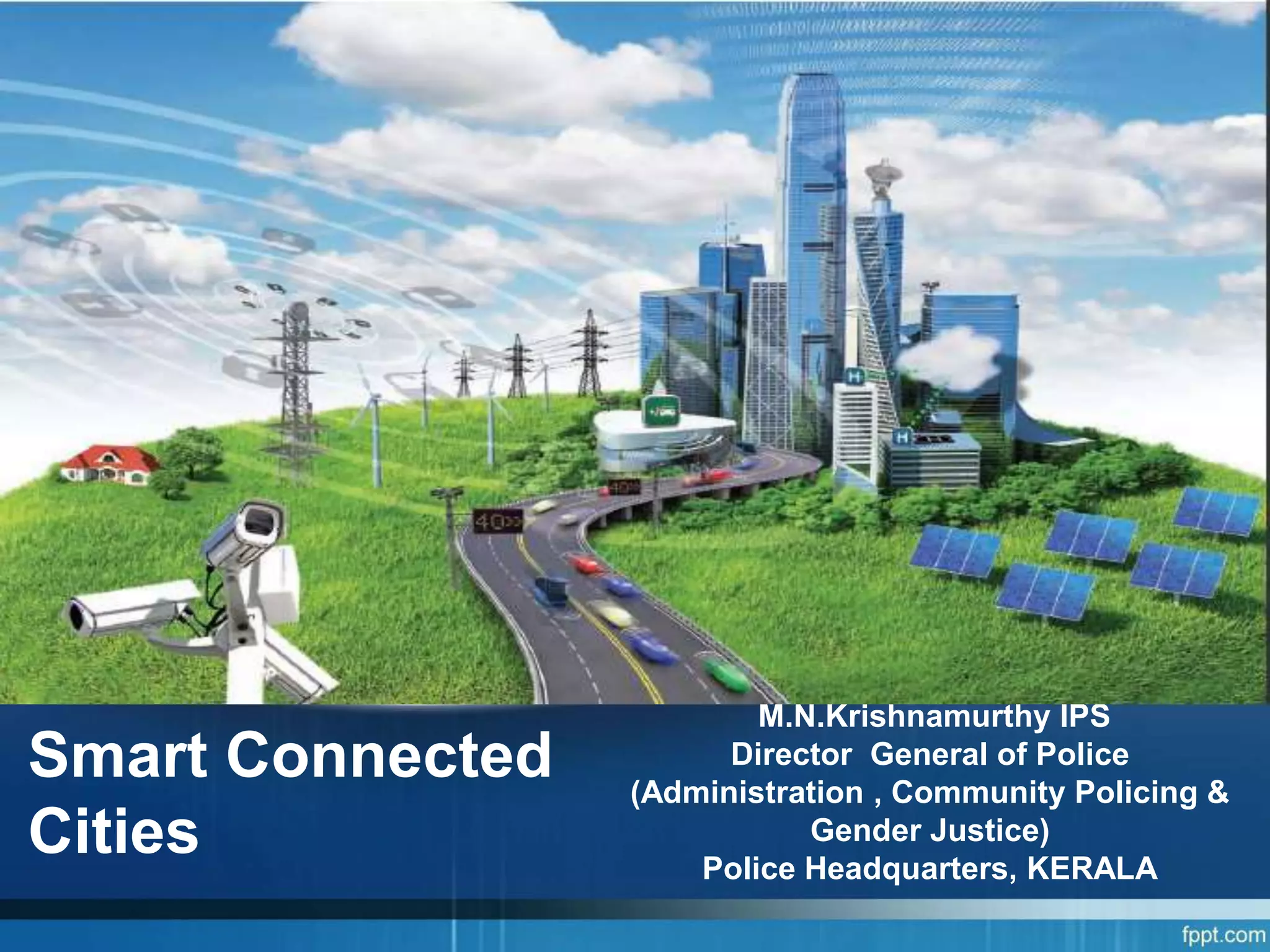
Smart Connected Cities
You think cities are crowded now? By 2030,
more than 5 Billion people will live in urban settings.
But before we get to that kind of population density,
we have to optimize our cities. We need to make them
smarter and better; technology can help.
Cities all around the world work with
developers and contractors to make city living better,
whether it's improving the timing of traffic lights or
creating a useful app, which becomes more powerful
as smartphone penetration continues to increase.
Apps and well-implemented technology can help
cash-strapped governments save money and, be
more efficient.
Public safety and security
• Above all, cities need to be safe. Public safety and
security has become paramount for city administrations,
whether protecting against crime, natural disasters,
accidents or terrorism.
• From conventional street violence to complex financial
offences, identity thefts or data breaches, a dynamic
crime horizon can only be tackled by increasingly
sophisticated technologies and processes.
Public safety and security
• Telesurveillance systems are becoming increasingly
pervasive in urban settings and, coupled with real-time
communication capabilities, can help emergency
services intervene promptly in incidents.
• In the immediate aftermath of a serious accident or
catastrophic event, the ability to share information
between agencies, to operate sophisticated
telesurveillance systems, to guarantee connectivity to
incident response teams and first responders, to gather
and analyse heterogeneous intelligence and data about
incidents in real time, all in a reliable and secure way,
allows municipalities and their emergency services to
increase safety for citizens, businesses, assets and
infrastructure.
I put together a list of the technology that we want
to see in every major city.
 Parking apps that show
drivers where the nearest
available parking spot it.
These will save
commuters time, gas,
emissions and money,
while also easing the flow
of traffic.
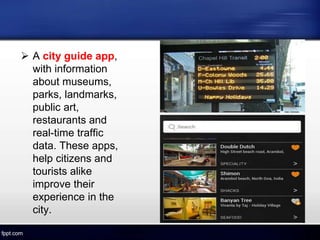
 A city guide app,
with information
about museums,
parks, landmarks,
public art,
restaurants and
real-time traffic
data. These apps,
help citizens and
tourists alike
improve their
experience in the
city.
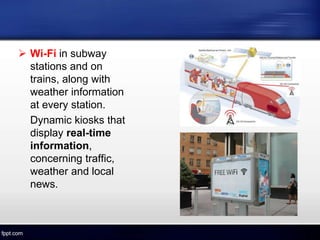
 Wi-Fi in subway
stations and on
trains, along with
weather information
at every station.
Dynamic kiosks that
display real-time
information,
concerning traffic,
weather and local
news.
 App or social media (like face book, twitter ) -based
emergency alert and crisis response systems —
every citizen should have access to vital information.
Whether it's an alert about a crime that just happened
or advice for a storm approaching the city.
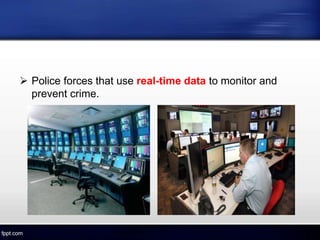
 Police forces that use real-time data to monitor and
prevent crime.
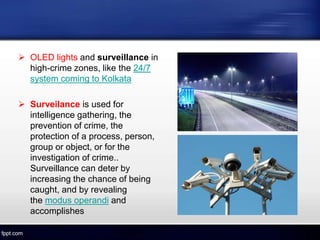
 OLED lights and surveillance in
high-crime zones, like the 24/7
system coming to Kolkata
 Surveilance is used for
intelligence gathering, the
prevention of crime, the
protection of a process, person,
group or object, or for the
investigation of crime..
Surveillance can deter by
increasing the chance of being
caught, and by revealing
the modus operandi and
accomplishes
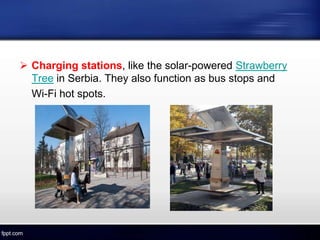
 Charging stations, like the solar-powered Strawberry
Tree in Serbia. They also function as bus stops and
Wi-Fi hot spots.
 In modern times, Police organisations too need to be adequately
equipped with latest technological equipment and gadgets so as to
effectively tackle the challenges of internal security and keeping this
in view a plan for Mega City Policing (MCP) has been included as a
sub-component of the overall Scheme of Modernization of State
Police Forces (MPF).
 Continuous upgradation of technology and integration of various
technological components of urban policing lies at the heart of an
effective Mega City Policing Plan. Apart from technological up
scaling, measures for development of a citizen friendly police,
involvement of students in appreciation of safety and security,
attitudinal changes in policemen, recruitment of larger numbers of
women in police will also help Mega Cities to develop an effective
policing system and better handle emergencies.
 Following are the technological and non-technological components
of Mega City Policing Plan:
Mega City Policing
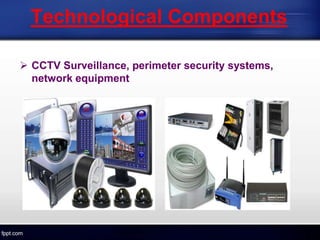
 CCTV Surveillance, perimeter security systems,
network equipment
Technological Components
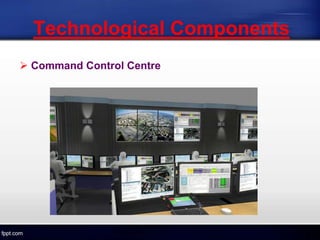
 Command Control Centre
Technological Components
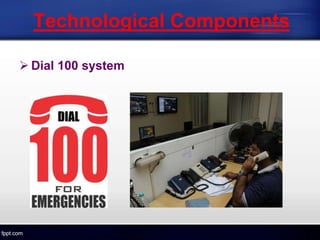
 Dial 100 system
Technological Components
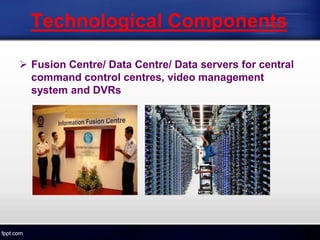
 Fusion Centre/ Data Centre/ Data servers for central
command control centres, video management
system and DVRs
Technological Components
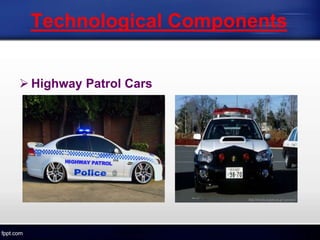
 Highway Patrol Cars
Technological Components
 Aerial Surveillance (UAV/ Helicopters, etc.)
Technological Components
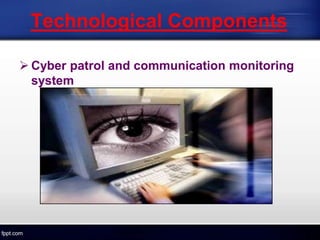
 Cyber patrol and communication monitoring
system
Technological Components
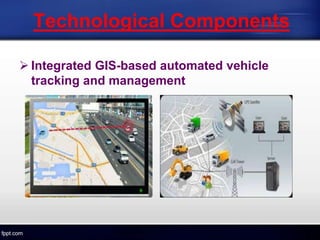
 Integrated GIS-based automated vehicle
tracking and management
Non-Technological Components
(Resilient)
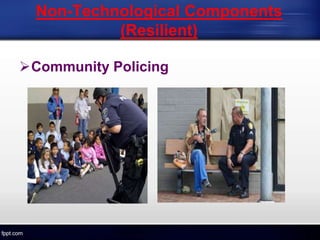
Community Policing
Non-Technological Components
(Resilient)
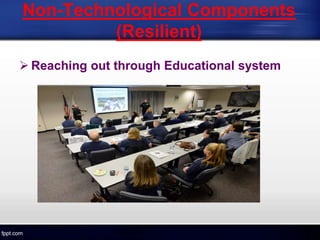
 Reaching out through Educational system
Non-Technological Components
(Resilient)
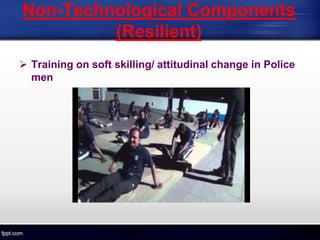
 Training on soft skilling/ attitudinal change in Police
men
Non-Technological Components
(Resilient)
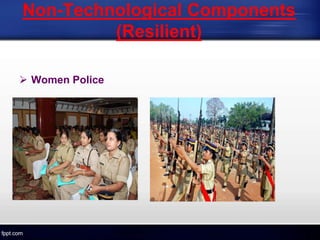
 Women Police
Elements of safe city
Integrated city surveillance
There is a growing recognition of the
interconnectedness and the interaction between factors
that spark and drive crises and the ecosystem of security
management that handles these factors. Furthermore,
there is greater focus on the high economic and social
costs because of the lack of a robust security
management methodology. There are four entities that
collectively form a part for a smart public safety and
security work flow as defined below:
Detection and Integration
Cameras and sensors
• CCTV cameras
• ANPR
• Gun shot detection
• Sensors
Analysis
Real time alerts
• Analyse and index
• Searchable video
• Event search
• Pattern analysis
Decision
Coordination center
• Dashboards
• Command center
• Incident management
• Investigative analysis
Action
First responders
• On ground action
• Police or medical
• Riot control
• Bomb disposal
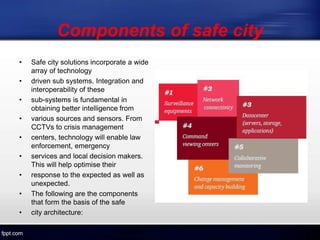
Components of safe city
• Safe city solutions incorporate a wide
array of technology
• driven sub systems. Integration and
interoperability of these
• sub-systems is fundamental in
obtaining better intelligence from
• various sources and sensors. From
CCTVs to crisis management
• centers, technology will enable law
enforcement, emergency
• services and local decision makers.
This will help optimise their
• response to the expected as well as
unexpected.
• The following are the components
that form the basis of the safe
• city architecture:
THANK YOU

M.N.Krishnamurthy IPS Director General of Police (Administration , Community Policing & Gender Justice)

  • 1.
    Smart Connected Cities M.N.Krishnamurthy IPS DirectorGeneral of Police (Administration , Community Policing & Gender Justice) Police Headquarters, KERALA
  • 2.
    Smart Connected Cities Youthink cities are crowded now? By 2030, more than 5 Billion people will live in urban settings. But before we get to that kind of population density, we have to optimize our cities. We need to make them smarter and better; technology can help. Cities all around the world work with developers and contractors to make city living better, whether it's improving the timing of traffic lights or creating a useful app, which becomes more powerful as smartphone penetration continues to increase. Apps and well-implemented technology can help cash-strapped governments save money and, be more efficient.
  • 3.
    Public safety andsecurity • Above all, cities need to be safe. Public safety and security has become paramount for city administrations, whether protecting against crime, natural disasters, accidents or terrorism. • From conventional street violence to complex financial offences, identity thefts or data breaches, a dynamic crime horizon can only be tackled by increasingly sophisticated technologies and processes.
  • 4.
    Public safety andsecurity • Telesurveillance systems are becoming increasingly pervasive in urban settings and, coupled with real-time communication capabilities, can help emergency services intervene promptly in incidents. • In the immediate aftermath of a serious accident or catastrophic event, the ability to share information between agencies, to operate sophisticated telesurveillance systems, to guarantee connectivity to incident response teams and first responders, to gather and analyse heterogeneous intelligence and data about incidents in real time, all in a reliable and secure way, allows municipalities and their emergency services to increase safety for citizens, businesses, assets and infrastructure.
  • 5.
    I put togethera list of the technology that we want to see in every major city.  Parking apps that show drivers where the nearest available parking spot it. These will save commuters time, gas, emissions and money, while also easing the flow of traffic.
  • 6.
     A cityguide app, with information about museums, parks, landmarks, public art, restaurants and real-time traffic data. These apps, help citizens and tourists alike improve their experience in the city.
  • 7.
     Wi-Fi insubway stations and on trains, along with weather information at every station. Dynamic kiosks that display real-time information, concerning traffic, weather and local news.
  • 8.
     App orsocial media (like face book, twitter ) -based emergency alert and crisis response systems — every citizen should have access to vital information. Whether it's an alert about a crime that just happened or advice for a storm approaching the city.
  • 9.
     Police forcesthat use real-time data to monitor and prevent crime.
  • 10.
     OLED lightsand surveillance in high-crime zones, like the 24/7 system coming to Kolkata  Surveilance is used for intelligence gathering, the prevention of crime, the protection of a process, person, group or object, or for the investigation of crime.. Surveillance can deter by increasing the chance of being caught, and by revealing the modus operandi and accomplishes
  • 11.
     Charging stations,like the solar-powered Strawberry Tree in Serbia. They also function as bus stops and Wi-Fi hot spots.
  • 12.
     In moderntimes, Police organisations too need to be adequately equipped with latest technological equipment and gadgets so as to effectively tackle the challenges of internal security and keeping this in view a plan for Mega City Policing (MCP) has been included as a sub-component of the overall Scheme of Modernization of State Police Forces (MPF).  Continuous upgradation of technology and integration of various technological components of urban policing lies at the heart of an effective Mega City Policing Plan. Apart from technological up scaling, measures for development of a citizen friendly police, involvement of students in appreciation of safety and security, attitudinal changes in policemen, recruitment of larger numbers of women in police will also help Mega Cities to develop an effective policing system and better handle emergencies.  Following are the technological and non-technological components of Mega City Policing Plan: Mega City Policing
  • 13.
     CCTV Surveillance,perimeter security systems, network equipment Technological Components
  • 14.
  • 15.
  • 16.
    Technological Components  FusionCentre/ Data Centre/ Data servers for central command control centres, video management system and DVRs
  • 17.
  • 18.
    Technological Components  AerialSurveillance (UAV/ Helicopters, etc.)
  • 19.
    Technological Components  Cyberpatrol and communication monitoring system
  • 20.
    Technological Components  IntegratedGIS-based automated vehicle tracking and management
  • 21.
  • 22.
  • 23.
    Non-Technological Components (Resilient)  Trainingon soft skilling/ attitudinal change in Police men
  • 24.
  • 25.
    Elements of safecity Integrated city surveillance There is a growing recognition of the interconnectedness and the interaction between factors that spark and drive crises and the ecosystem of security management that handles these factors. Furthermore, there is greater focus on the high economic and social costs because of the lack of a robust security management methodology. There are four entities that collectively form a part for a smart public safety and security work flow as defined below:
  • 26.
    Detection and Integration Camerasand sensors • CCTV cameras • ANPR • Gun shot detection • Sensors
  • 27.
    Analysis Real time alerts •Analyse and index • Searchable video • Event search • Pattern analysis
  • 28.
    Decision Coordination center • Dashboards •Command center • Incident management • Investigative analysis
  • 29.
    Action First responders • Onground action • Police or medical • Riot control • Bomb disposal
  • 30.
    Components of safecity • Safe city solutions incorporate a wide array of technology • driven sub systems. Integration and interoperability of these • sub-systems is fundamental in obtaining better intelligence from • various sources and sensors. From CCTVs to crisis management • centers, technology will enable law enforcement, emergency • services and local decision makers. This will help optimise their • response to the expected as well as unexpected. • The following are the components that form the basis of the safe • city architecture:
  • 31.