A Review of the Evolution, MeaningA Review of the Evolution, Meaning
and Operationalization of a keyand Operationalization of a key
Concept in Public AdministrationConcept in Public Administration
A Report in PA 848A Report in PA 848
Prof. Rex B. Buac, CSEEProf. Rex B. Buac, CSEE
(Instructor)(Instructor)
AdministrativeAdministrative
AccountabilityAccountability
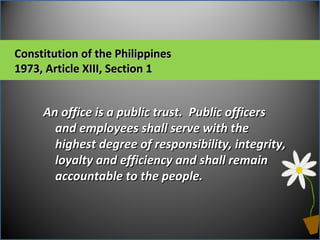
An office is a public trust. Public officersAn office is a public trust. Public officers
and employees shall serve with theand employees shall serve with the
highest degree of responsibility, integrity,highest degree of responsibility, integrity,
loyalty and efficiency and shall remainloyalty and efficiency and shall remain
accountable to the people.accountable to the people.
Constitution of the PhilippinesConstitution of the Philippines
1973, Article XIII, Section 11973, Article XIII, Section 1
This study is an attempt to realizeThis study is an attempt to realize
the partnership not only on publicthe partnership not only on public
administration and auditing butadministration and auditing but
also of public administration andalso of public administration and
democratic theory where peopledemocratic theory where people
have self governing principles.have self governing principles.
If indeed people are the mastersIf indeed people are the masters
of the society, their means ofof the society, their means of
maintaining that supremacy must bemaintaining that supremacy must be
scrutinized and sharpened .scrutinized and sharpened .
This means are embodied in theThis means are embodied in the
forms and standards of accountabilityforms and standards of accountability
which, have not remained static overwhich, have not remained static over
time rather they have undergone antime rather they have undergone an
evolution so that one can contrastevolution so that one can contrast
“traditional” accountability with new“traditional” accountability with new
variants.variants.
o The changes are responsive to the social andThe changes are responsive to the social and
political forces that vary with a country’spolitical forces that vary with a country’s
development.development.
o As Foster (1981) states: as the publicAs Foster (1981) states: as the public
becomes better educated, they also becomebecomes better educated, they also become
more aware more demanding, lessmore aware more demanding, less
understanding, and less willing to acceptunderstanding, and less willing to accept
average performanceaverage performance
IntroductionIntroduction
AccountabilityAccountability
is a central problem for governments which
are or claim to be democratic. The activities
of civil servants and public agencies must
follow the will of the people to whom they
are ultimately responsible. The publicness
of their employment and goals thus
prescribes their behavior and circumscribes
their choices.
Three Phases of Classical Cycle of PublicThree Phases of Classical Cycle of Public
AdministrationAdministration
 Planning
received disproportionate attention in traditional
public administration
 Evaluation
 - is more of under thought sometimes taught along with
survey methods and rarely transferring from the realm of
methodology into substance.
Implementation
came into its own much later.
Types of AccountabilityTypes of Accountability
Four standard questions are central
to accountability
o who is considered accountable?
oto whom he is considered accountable?
oto what standard or values is he
accountable?
oby what means is he made
accountable?
Types of AccountabilityTypes of Accountability
 Traditional Accountability
focuses on the regularity of fiscal
transactions and the faithful compliance
to legal requirements and administrative
policies (Mckinney1981:144 as cited by
Cariño 2003: 808)
Types of AccountabilityTypes of Accountability
– -
 Traditional Accountability
The standards by which one is judged are those of
legality and regularity set by controllers external to the
person responsible
odetermining if an act is within the provisions of laws
and regulations governing the agency;
oif the person/s who performed it have the authority to
do so;
oeach agency set up procedures for each transactions
and following the Weberian rule, expects these
procedures to be followed fairly and equitably without
regard to individual characteristics of the clients
interested in the transactions.
Types of AccountabilityTypes of Accountability
Traditional Accountability
 In having to account for detailed use of inputs, official sometimes protect themselves by making they commit no violation, thus little encouragement of initiative and innovative performance
Types of AccountabilityTypes of Accountability
concerns with efficiency and economy in the use of
public funds, property and manpower (Tantuico
1982:8 as cited by Cariño 2003:808);
As its name implies, the administrator is
responsible to his superiors, and external
controllers which provides the resources for the
operation of the agency;
It recognizes that government officials are
responsible for more than just compliance but the
need for the constant concern to avoid waste and
unnecessary expenditures and to promote the
judicious use of public resources
 this promoted by programs which cut the “red
tape” of government procedures;
Managerial Accountability
Types of AccountabilityTypes of Accountability
These programs range from attempt at work
simplification and revision of forms all the way to
systems improvements and agency reorganization;
Operational audits had long been done by agencies
concerned with management under such names as
management analysis, methods (O and M) studies and
systems improvements;
 All calling attentions to how government agencies
can reduce waste and effect savings in their operation
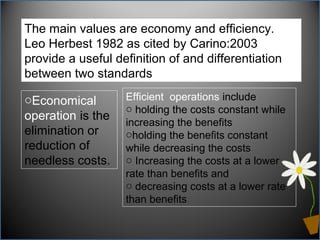
The main values are economy and efficiency.
Leo Herbest 1982 as cited by Carino:2003
provide a useful definition of and differentiation
between two standards:
oEconomical
operation is the
elimination or
reduction of
needless costs.
Efficient operations include
o holding the costs constant while
increasing the benefits
oholding the benefits constant
while decreasing the costs
o Increasing the costs at a lower
rate than benefits and
o decreasing costs at a lower rate
than benefits
Program Accountability
 is concerned with the results of government operations.
Accountability is the property of units as well as the individual bureaucrats whose activities together make the effectiveness of
a program
To secure its attainment, a comprehensive performance audit on the financial and operational performance using the
standard 3Es.
Types of AccountabilityTypes of Accountability
A complete performance audits involves inquiry
into the following:
Program Accountability
o Whether the government unit is carrying out only
authorized activities or programs in the manner
contemplated and whether they are accomplishing
their objectives.
o Whether the programs and activities are
conducted and expenditures are made in an
effective, efficient and economical manner and in
compliance with applicable laws and regulations.
Types of AccountabilityTypes of Accountability
Program Accountability
o Whether resources are being adequately controlled
and used effectively, efficiently and economically
o Whether all revenues and receipts from the
operations under examinations are being collected
and properly accounted for
o Whether the entity’s accounting system complies
with applicable accounting principles, standards and
related requirements ; and
o the entity’s financial statements and operating
reports properly disclose the information required
(Tantuico 1982:12 as cited by Cariño 2003:810).
Social Accountability
Types of AccountabilityTypes of Accountability
 the main inquiry is whether the administrative
activities inspire general confidence and secure
what are widely regarded as desirable social ends
(Normanton 1981:34 and cited by Cariño
2003:911)
Recently the program manager’s arsenal has been
augmented by such tools as human recourse
accounting, social accounting, and the analysis of
economic and social impact of programs
Process Accountability.
Types of AccountabilityTypes of Accountability
It implies emphasizes on procedures and methods of
operation and focuses on the black box inside systems
which transforms inputs (the concern of traditional and
managerial accountability).
This type of accountability recognizes that some goals
may not be measurable directly and surrogates,
representing how goal directed activity may be
performed, are used instead.
Process Accountability
Types of AccountabilityTypes of Accountability
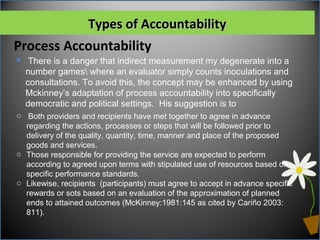
o Both providers and recipients have met together to agree in advance
regarding the actions, processes or steps that will be followed prior to
delivery of the quality, quantity, time, manner and place of the proposed
goods and services.
o Those responsible for providing the service are expected to perform
according to agreed upon terms with stipulated use of resources based on
specific performance standards.
o Likewise, recipients (participants) must agree to accept in advance specific
rewards or sots based on an evaluation of the approximation of planned
ends to attained outcomes (McKinney:1981:145 as cited by Cariño 2003:
811).
 There is a danger that indirect measurement my degenerate into a
number games where an evaluator simply counts inoculations and
consultations. To avoid this, the concept may be enhanced by using
Mckinney’s adaptation of process accountability into specifically
democratic and political settings. His suggestion is to
Process Accountability
Types of AccountabilityTypes of Accountability
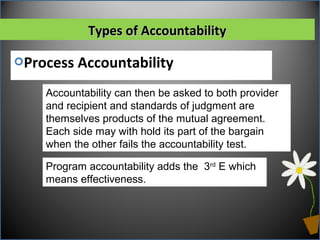
Accountability can then be asked to both provider
and recipient and standards of judgment are
themselves products of the mutual agreement.
Each side may with hold its part of the bargain
when the other fails the accountability test.
Program accountability adds the 3rd
E which
means effectiveness.
Comparison ofComparison of
Different Kinds ofDifferent Kinds of
AdministrativeAdministrative
AccountabilityAccountability
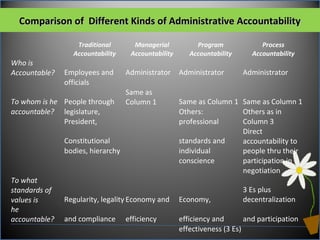
Comparison of Different Kinds of Administrative AccountabilityComparison of Different Kinds of Administrative Accountability
  Traditional Managerial Program Process
  Accountability Accountability Accountability Accountability
Who is
Accountable? Employees and Administrator Administrator Administrator
officials      
To whom is he People through
Same as 
Column 1 Same as Column 1 Same as Column 1
accountable? legislature,   Others: Others as in
President,   professional Column 3
Constitutional   standards and
Direct 
accountability to
bodies, hierarchy   individual people thru their 
    conscience participation in
      negotiation
To what
standards of
values is Regularity, legality Economy and Economy,
3 Es plus 
decentralization
he
accountable? and compliance efficiency efficiency and and participation
    effectiveness (3 Es)  
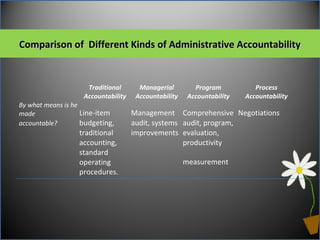
Comparison of Different Kinds of Administrative AccountabilityComparison of Different Kinds of Administrative Accountability
  Traditional Managerial Program Process
  Accountability Accountability Accountability Accountability
By what means is he
made Line-item Management Comprehensive  Negotiations
accountable? budgeting, audit, systems audit, program, 
traditional improvements evaluation,  
  accounting,   productivity  
 
standard 
operating   measurement  
  procedures.      
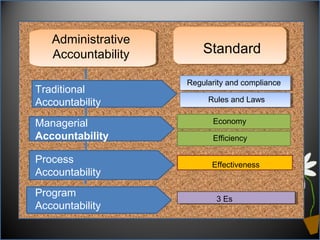
Regularity and compliance
Rules and Laws
Economy
Efficiency
Effectiveness
Standards & Values
Traditional
Accountability
Managerial
Accountability
Process
Accountability
3 Es
Program
Accountability
Administrative
Accountability Standard
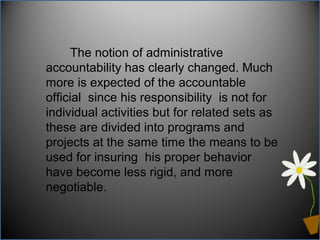
The notion of administrative
accountability has clearly changed. Much
more is expected of the accountable
official since his responsibility is not for
individual activities but for related sets as
these are divided into programs and
projects at the same time the means to be
used for insuring his proper behavior
have become less rigid, and more
negotiable.
The Varieties ofThe Varieties of
PublicPublic
AdministrationAdministration
The discipline of PA has changedThe discipline of PA has changed
overtime both as response to changingovertime both as response to changing
currents of thought within the socialcurrents of thought within the social
science community as well as the eventsscience community as well as the events
in the country and the world which pressin the country and the world which press
on both our understanding of theon both our understanding of the
discipline and on its practice.discipline and on its practice.
Each of the four varieties of PA offers a
distinct emphasis and relates to the people and
the society in a different way. They maybe
identified as:
1. Traditional Public Administration
2. Development Administration
3. New Public Administration and
4. Development Public Administration. The
last variety has been called by various
authors as “Social Science
Administration”, Social Development
Management”, “ Development
Administration for Equity”
 Traditional Public Administration
 Traditional  accountability  practically  demands  doctrine  of 
politics  administration  dichotomy,  where  decisions  are  made 
elsewhere by policy makers who were not in the bureaucracy
Main Varieties of AccountabilityMain Varieties of Accountability
and Public Administrationand Public Administration
Main Varieties of AccountabilityMain Varieties of Accountability
and Public Administrationand Public Administration
 Teaching in traditional PA centered on the inputs to the system. 
 Thus, the main resources  became the major focus  of subfields 
–  personnel  administration,  fiscal  administration,    and 
organization and management (O & M).
 As  a  discipline,  traditional  PA    constituted  the  main  doctrine   
until  the  late  fifties.    As  an  actual  activity,  many  of  its  main 
features persist to this day.
Main Varieties of AccountabilityMain Varieties of Accountability
and Public Administrationand Public Administration
Development Public Administration
 The variety that gained currency when colonies called the ThIrd 
World  got political independence and set their sights on the 
development of the economy following the examples of the west-
 With the western experience as the model, DA became involved 
in looking for tools that can improve the planning process and 
the performance of staff functions.
 The main task of DA is the search for theories that can describe 
and  explain  the  management  of  economic  growth.   
Behavioralism,  logical  positivism,  structural-functionalism  and 
quantification  entered  the  discipline  through  the  influence  of 
the social sciences especially sociology and economics
  The Bell Mission ushered DA in the Philippines  for use in its 
own development effort .  This included management tools like 
Planning, Programming and Budgeting System (PPBS).
Main Varieties of AccountabilityMain Varieties of Accountability
and Public Administrationand Public Administration
 New Public Administration
NPA  was  born  in  the  70’s  in  United  States  where 
restive scholars found traditional PA largely irrelevant 
to  a  turbulent  technological  society  crying  for  equity 
and social justice. 
NPA advocated project management and the modular 
organization  in  lieu  of  the  bureaucracy      It  either 
moved away from economic to philosophy, or sought a 
blending  of  both.  Just  prior  to  the  birth  of  NPA,  PA 
scholars  discovered  implementation  and  service 
delivery as just as worthy of attention as planning and 
the  merit  system.    These  blended  to  make 
responsiveness  and effectiveness of programs as the 
main foci of concern.
Main Varieties of AccountabilityMain Varieties of Accountability
and Public Administrationand Public Administration
 Development Public Administration (DPA)
The product of the 1980’s with emphasis on the goals of 
social  justice,  equity  and  the  centrality  of  the  human 
person and its focus on the problems of the third world.  
NPA was born in the 70’s in United States where restive 
scholars  found  traditional  PA  largely  irrelevant  to  a 
turbulent  technological  society  crying  for  equity  and 
social justice. 
DPA  locates  its  bureaucracy  not  only  within  its  own 
society but also in context of a global system, not against 
bureaucracy  or  the  toppling  of  large  scale  hierarchical 
structures  but  their  modification  through  bureaucratic 
reorientation.    
Main Varieties of AccountabilityMain Varieties of Accountability
and Public Administrationand Public Administration
 Development Public Administration (DPA)
DPA  searches  for  smaller  possibly  ad  hoc 
organization  of  trying  out  new  approaches  for 
coordinating  the  activities  of  similar  agencies  and 
for involving  those outside  of the organization in 
planning, implementation, and evaluation.
Particularly in the Philippines, an important aspect 
of DA is decentralization, a value reemphasized by 
DPA  as it seeks harmony between central direction 
and responsiveness to particular needs.
Accountability andAccountability and
Public AdministrationPublic Administration
Traditional PA and Accountability of Regularity
 Traditional accountability demands the 
doctrine of the politics –administration 
dichotomy where decisions are made 
outside the bureaucracy and compliance is 
compelled  all through the hierarchy but has 
its ultimate arbiter in bodies external to the 
bureaucracy like the legislature and the 
court.  Rules and procedures are set 
elsewhere and are rigid, thus receiving the 
checks on performance on a line-by-line and 
strict pesos-and-centavos accounting
Traditional PA, Development Administration and
Managerial Accountability
 The first variety of PA has encouraged the start of managerial accountability through its emphasis on the economy and efficiency of organizations.
 A number of management tools developed in the United States under the DA period still tended to focus on inputs and the staff functions. Their applicability to a
third world country at the first stages of development was hardly addressed. The techniques were regarded as capable of being useful regardless of social conditions
 The shift of development goals from simple economic growth to more humanly appropriate objectives.
 A better suited technique is program evaluation. A better suited technique can also fulfil the NPA need for equity to the extent that social impact especially on
income distribution and poverty alleviation is made part of the framework.
 The project checks out its program accountability at the evaluation stage of its life.
 Its effectiveness and responsiveness as it embraces a learning process rather than a blue print approach (Korten 1980:450-511 as cited by Cariño 2003: 819).
NPA and Program Accountability
 Its effectiveness and responsiveness as it embraces a
learning process rather than a blue print approach
(Korten 1980:450-511 as cited by (Cariño 2003: 819.
 Unfortunately, few managers have regarded these works
from the perspective of accountability and have not
used them for the purpose of pinpointing responsibility
for bottlenecks or failures and for improving program
attainment. The shortcoming maybe blamed on both
sides : on the evaluator or researcher for his inability to
disseminate his findings to the appropriate administrator
and to write actionable recommendations based on the
findings and on the administrator for his tendency to shy
away from critiques of his agency and not pass up
learning points from the criticisms
Development PA and Process Accountability
 Process accountability has practically the same 
building blocks  a lot in common with DPA where the 
features are reacceptance of the necessity of 
bureaucracy as long as it is oriented to include the 
participation of client and recipients in the process of 
administration and the decentralization of decision 
making to local areas.
 Example ate the LGUs  an experiment to classify them 
 according to their administrative capability and 
which will be the basis  for providing funds and 
technical assistance
Development PA and Process Accountability
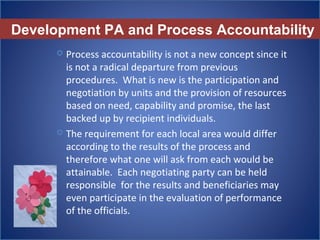
 Process accountability is not a new concept since it 
is not a radical departure from previous 
procedures.  What is new is the participation and 
negotiation by units and the provision of resources 
based on need, capability and promise, the last 
backed up by recipient individuals.
 The requirement for each local area would differ  
according to the results of the process and 
therefore what one will ask from each would be 
attainable.  Each negotiating party can be held 
responsible  for the results and beneficiaries may 
even participate in the evaluation of performance 
of the officials. 
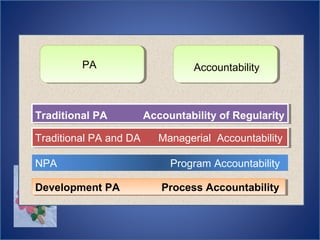
PA Accountability
Traditional PA Accountability of Regularity
Traditional PA and DA Managerial AccountabilityTraditional PA and DA Managerial Accountability
NPA Program Accountability
Development PA Process AccountabilityDevelopment PA Process Accountability
The Process ofThe Process of
Regulating BehaviorRegulating Behavior
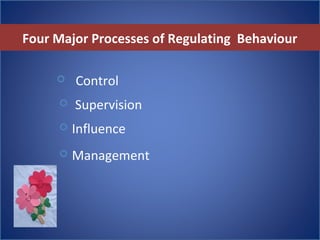
Four Major Processes of Regulating Behaviour
 Control
 Influence
 Management
 Supervision
 May be external to or internalized by the regulated.
 External sources may be laws or bureaucratic rules which are imposed as standards of conduct of subordinates. Disobedience to these rules may result in
sanctions by the controllers.
 Kernagham (1973:581-584) defines control as the authority to command and direct
Control
Influence
 When A is molded by and conforms to the behavior
of B without the issuance of a command
 The implicit source of influence seems to lie outside
the bureaucracy and may be rooted in one’s
profession, ethical commitments and organizational
affiliations
 The influence is predicated not so much on his
commands and orders as on the congruence of the
commitments of his subordinates and himself which
is exerted through moral and other extra
bureaucratic modes
Supervision
 is more open minded allowing officials greater latitude of their actions
 Its both regulatory and assistory dimensions
 The concept can be applied to any pair of agencies where one sets the guidelines within which the other formulates its rules of action
Sosmeña :1982:9
Management
 The regulator take action as a hypothesis with certainty ruled out and allow the regulated some discretion in his approach to the program.
 This would mean an accountability that would face up errors and even embrace them as learning points for later growth
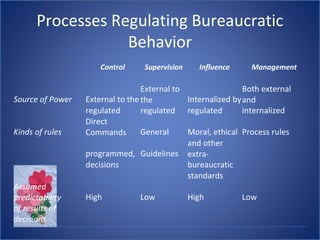
Processes Regulating Bureaucratic
Behavior
Control Supervision Influence Management
     
Source of Power External to the
External to
the Internalized by
Both external
and
regulated regulated regulated internalized
Kinds of rules
Direct
Commands General Moral, ethical Process rules
programmed, Guidelines
and other
extra-
decisions bureaucratic
standards
Assumed
predictability High Low High Low
of results of
decisions
Management
 The regulator take action as a hypothesis with certainty ruled out and allow the regulated some discretion in his approach to the program.
 This would mean an accountability that would face up errors and even embrace them as learning points for later growth
Management
 The regulator take action as a hypothesis with certainty ruled out and allow the regulated some discretion in his approach to the program.
 This would mean an accountability that would face up errors and even embrace them as learning points for later growth
Management
 The regulator take action as a hypothesis with certainty ruled out and allow the regulated some discretion in his approach to the program.
 This would mean an accountability that would face up errors and even embrace them as learning points for later growth
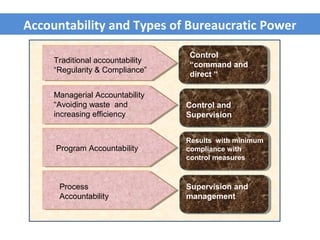
Accountability and Types of Bureaucratic Power
Traditional accountability
“Regularity & Compliance”
Control
“command and
direct “
Managerial Accountability
“Avoiding waste and
increasing efficiency
Control and
Supervision
Program Accountability
Results with minimum
compliance with
control measures
Process
Accountability
Supervision and
management
Discretion andDiscretion and
AccountabilityAccountability
 When bureaucratic rules are deficient , the bureaucrat may be forced to choose
between the criteria of his agency or those of his profession
 Ex of bureaucratic rules on punctuality, eight hours days as well as targets, and persons
to be served per week. While professional norms as well as individual conscience as
appropriate judges of a person or agency’s performance
 In the computer age, year of the blog, routine cases are machine programmed, the computer being uninfluenced by
specific character traits of a client which the rules do not recognize as material and relevant..
 The treatment of exceptional circumstances can not be programmed since the rules wood generally provide for the
exercise of a discretionary rather than a ministerial function
Bureaucratic Norms versus Professional Norms
 Moral decisions are value-based decisions that
content and context specific (Foster 1981:31).
 In an effort to be more regular and legal bureaucrats may instead
become more legalistic, stressing formal compliance with the letter
of the law. That in turn may lead to displacement where rules
become the master while bureaucrats are reduced to timidry,
conservatism, and technicism (Metro et al: 1952). Too much
legalism may even become a major factor inhibiting the move
towards development (Pye 1966)
Legal and Moral Decisions
Situation: Loose gun control guns illegally circulating or
stricter gun control Colorado Movie theater massacre
Extrabureaucratic Standards and Irresponsible Behavior
There are several answers to this question
 Nature of the human being – when a person wants to please a
person not qualified to receive a service, he may disregard
these rules or go around them in order to suit this person
(accommodation).
 The complexity of the society - its no longer a homogenous
mass. The demands and pressures on government can not be
easily transformed to SOPs which brook no exceptions.
 Inefficiency of the legalistic Approach – A third answer leads to
the empirical record: the enactment of one of the strictest sets
of laws on record has not been able to hold down the incidents
of graft and corruption. The inefficiency stems from a) the
systemic nature of corruption, b) the formation in the laws (a
society has formalistic laws they are not expected to be fully
implemented, and c) lack of political will to implement law
vigorously and fairly.
LOGO
Reporter: Ms. Gretchel G. Magallanes
The Political-
Administrative
Accountability
Continuum in
Philippine Public
Service
LOGO
Contents
Introduction1
Political and Administrative Dimensions
Of Public Accountability
Conclusion
2
3
LOGO
INTRODUCTION
 This article argues that public
accountability implies that there are
defined limits to the use of governmental
power in any society; and, power holders
must be able to explain and answer to a
higher authority on how they use power to
promote the public welfare.
LOGO
 In order to continue search for ways to explain
and understand the responsible uses of power
and other manifestations of the abuse or misuse
of power Dr. de Guzman has authored different
books, research reports and articles which led to
contributions to the literature on a)bureaucratic
corruption and b)the conduct of election, in the
Philippines and a number of Asian countries, in
the comparative multi-country studies on these
topics.
LOGO
The study on bureaucratic corruption identifies
and analyzes the causes, control measures, and
consequences of the lack of administrative
accountability.
The election study with its focus on the
administration of elections, the political party
systems and the role of the bureaucracy and
citizens’ movements in elections, dwells more on
the integrity of the process through which
citizens in their exercise of the right of suffrage,
select and pass judgment on public officials- the
concern of political accountability.
LOGO
 Bureaucratic Corruption and Elections are
theoretically linked through the central concept
that underlies them: public accountability,
particularly its two interrelated aspects, political
and administrative accountability.
OBJECTIVES
LOGO
 The above-mentioned study attempts to develop
themes in two parts.
 First part will seek to show the interrelationship
between political and administrative
accountability in the context of a representative
democracy.
 Second part relates the findings of studies on
bureaucratic corruption and conduct of elections
to support the argument that the nature and the
process of political selection inevitably influence
the relationship between the political leaders and
the bureaucracy.
LOGO
Political and Administrative Dimensions of
Public Accountability
 Accountability is defined as a condition in which
individuals who exercise power are constrained
by external means and by internal norms.
 It refers to the institution of checks and balances
in an organization thru which an administrator
accounts for his stewardship of resources or
authority.
LOGO
 Accountability is a synonym for responsibility. It
is a type of relationship that comes to existence
when an obligation is taken on by an individual
(or entity), such as the responsibility to assume
a role or discharge a task.(Timothy W. Plumptre,
Beyond the Bottomline, Management in
Government, 1988, 182)
LOGO
The Political-Administrative Accountability
Continuum
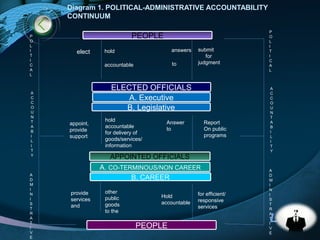
 The political-administrative continuum means
that elected officials are politically accountable to
the electorate or their constituencies who voted
them to their positions. These elected officials
are held responsible thru regular elections and
other means, i.e. recall and referendum.
Appointive public officials answer to the people
thru the elected officials who appointed them and
directly to the public whom they serve.
LOGO
Diagram 1. POLITICAL-ADMINISTRATIVE ACCOUNTABILITY
CONTINUUM
PEOPLE
ELECTED OFFICIALS
PEOPLE
APPOINTED OFFICIALS
A. Executive
B. Legislative
B. CAREER
A. CO-TERMINOUS/NON CAREER
P
O
L
I
T
I
C
A
L
A
C
C
O
U
N
T
A
B
I
L
I
T
Y
A
D
M
I
N
I
S
T
R
A
T
I
V
E
P
O
L
I
T
I
C
A
L
A
C
C
O
U
N
T
A
B
I
L
I
T
Y
A
D
M
I
N
I
S
T
R
A
T
I
V
E
elect hold
accountable
answers
to
submit
for
judgment
appoint,
provide
support
hold
accountable
for delivery of
goods/services/
information
Answer
to
Report
On public
programs
provide
services
and
other
public
goods
to the
Hold
accountable
for efficient/
responsive
services
LOGO
 Administrative Accountability refers to the extent
to which appointed public employees are made
answerable for the responsible, efficient and
effective performance of their official tasks, while
administrators are accountable for their
stewardship of the administrative authority,
resources and knowledge placed at their
disposal as trustees of the public.
LOGO
 Political accountability, on the other hand, can be
concretized through the accountability of public
institutions which must collectively answer for
their institution mandates, particularly s they form
part of the incumbent government’s development
goals. National leadership, specifically elected
national officials, must answer for their
performance in pursuing their avowed program
of government and their use of national
resources, given the authority and resources
vested in them by their constituency.
LOGO
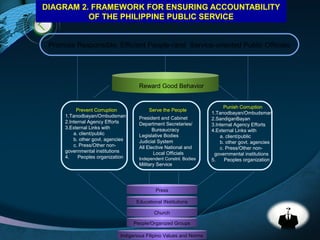
DIAGRAM 2. FRAMEWORK FOR ENSURING ACCOUNTABILITY
OF THE PHILIPPINE PUBLIC SERVICE
Promote Responsible, Efficient People-/and Service-oriented Public Officials
Reward Good Behavior
Prevent Corruption
1.Tanodbayan/Ombudsman
2.Internal Agency Efforts
3.External Links with
a. client/public
b. other govt. agencies
c. Press/Other non-
governmental institutions
4. Peoples organization
Serve the People
President and Cabinet
Department Secretaries/
Bureaucracy
Legislative Bodies
Judicial System
All Elective National and
Local Officials
Independent Constnl. Bodies
Military Service
Punish Corruption
1.Tanodbayan/Ombudsman
2.SandiganBayan
3.Internal Agency Efforts
4.External Links with
a. client/public
b. other govt. agencies
c. Press/Other non-
governmental institutions
5. Peoples organization
Church
Educational INstitutions
Press
People/Organized Groups
Indigenous Filipino Values and Norms
LOGO
Factors for Strong Accountability
Mechanisms
The following factors help in building capable
political accountability mechanisms:
• Political competition, fair distribution of
power and informed participation
• Legal system with the capability to enforce
the law and to make the rulers obey the law.
LOGO
LOGO
Dilemmas and challenges
 One of the hurdles in the practice of social accountability is the
inability or unwillingness of the society to call powerful and prominent
people in their wrongdoings.
LOGO
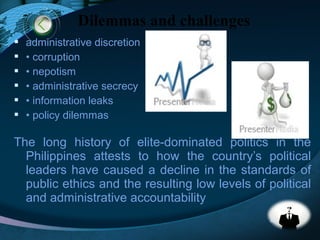
 administrative discretion
 • corruption
 • nepotism
 • administrative secrecy
 • information leaks
 • policy dilemmas
The long history of elite-dominated politics in the
Philippines attests to how the country’s political
leaders have caused a decline in the standards of
public ethics and the resulting low levels of political
and administrative accountability
Dilemmas and challenges
LOGO
In the recent assessment of the process of participation of
the people in the electoral process, the Philippine Human
Development Report concludes that suffrage is still not
translated into genuine participation of the Filipino People
in the process of governance. It cites four reasons for this
conclusion:
A. .The dominance of the elite in setting the political agenda
B. The issue of votes not reflecting the genuine preference
and will of the people because of vote buying and selling,
a reflection of the absence of democratic choice in a
society noted for poverty and extreme inequality in wealth
and power
LOGO
C. The scarcity of public resources and the vast
discretionary power given to those who can exercise this
power, and
D. The sad lack of information and meaningful
education which may be a means of breaking the “cycle
of parochial politics”.
LOGO
Conclusions
The concept of public accountability implies that:
There are defined limits to the use of
governmental power in any society
Power holders must be able to explain and
answer to a higher force on how they use this
power to promote the cause of this higher force.
LOGO
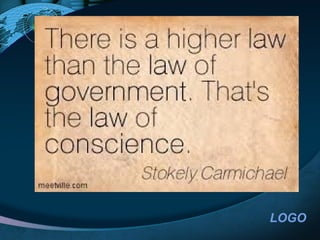
 A sense of public accountability cannot exist if
those who are entrusted this power do not feel
there is a greater force beyond them which can
legitimately hold them responsible for their use of
this power. By this, we mean that for as long as
the Filipino people are unable to exert any form
of compelling pressure on their leaders and
government officials ti promote and protect their
interest, e.g. through formal means like elections,
then there can be no effective way of holding
these officials accountable to them.
LOGO
LOGO
LOGO
Reference:
Introduction to Public Administration in the Philippines: A Reader 2003
NCPAG
University of the Philippines
Diliman ,Quezon City
LOGO
TO GOD BE THE GLORY FOREVER
AND EVER!

Administrative Accountability

  • 1.
    A Review ofthe Evolution, MeaningA Review of the Evolution, Meaning and Operationalization of a keyand Operationalization of a key Concept in Public AdministrationConcept in Public Administration A Report in PA 848A Report in PA 848 Prof. Rex B. Buac, CSEEProf. Rex B. Buac, CSEE (Instructor)(Instructor) AdministrativeAdministrative AccountabilityAccountability
  • 2.
    An office isa public trust. Public officersAn office is a public trust. Public officers and employees shall serve with theand employees shall serve with the highest degree of responsibility, integrity,highest degree of responsibility, integrity, loyalty and efficiency and shall remainloyalty and efficiency and shall remain accountable to the people.accountable to the people. Constitution of the PhilippinesConstitution of the Philippines 1973, Article XIII, Section 11973, Article XIII, Section 1
  • 3.
    This study isan attempt to realizeThis study is an attempt to realize the partnership not only on publicthe partnership not only on public administration and auditing butadministration and auditing but also of public administration andalso of public administration and democratic theory where peopledemocratic theory where people have self governing principles.have self governing principles. If indeed people are the mastersIf indeed people are the masters of the society, their means ofof the society, their means of maintaining that supremacy must bemaintaining that supremacy must be scrutinized and sharpened .scrutinized and sharpened .
  • 4.
    This means areembodied in theThis means are embodied in the forms and standards of accountabilityforms and standards of accountability which, have not remained static overwhich, have not remained static over time rather they have undergone antime rather they have undergone an evolution so that one can contrastevolution so that one can contrast “traditional” accountability with new“traditional” accountability with new variants.variants.
  • 5.
    o The changesare responsive to the social andThe changes are responsive to the social and political forces that vary with a country’spolitical forces that vary with a country’s development.development. o As Foster (1981) states: as the publicAs Foster (1981) states: as the public becomes better educated, they also becomebecomes better educated, they also become more aware more demanding, lessmore aware more demanding, less understanding, and less willing to acceptunderstanding, and less willing to accept average performanceaverage performance
  • 6.
    IntroductionIntroduction AccountabilityAccountability is a centralproblem for governments which are or claim to be democratic. The activities of civil servants and public agencies must follow the will of the people to whom they are ultimately responsible. The publicness of their employment and goals thus prescribes their behavior and circumscribes their choices.
  • 7.
    Three Phases ofClassical Cycle of PublicThree Phases of Classical Cycle of Public AdministrationAdministration  Planning received disproportionate attention in traditional public administration  Evaluation  - is more of under thought sometimes taught along with survey methods and rarely transferring from the realm of methodology into substance. Implementation came into its own much later.
  • 8.
    Types of AccountabilityTypesof Accountability Four standard questions are central to accountability o who is considered accountable? oto whom he is considered accountable? oto what standard or values is he accountable? oby what means is he made accountable?
  • 9.
    Types of AccountabilityTypesof Accountability  Traditional Accountability focuses on the regularity of fiscal transactions and the faithful compliance to legal requirements and administrative policies (Mckinney1981:144 as cited by Cariño 2003: 808)
  • 10.
    Types of AccountabilityTypesof Accountability – -  Traditional Accountability The standards by which one is judged are those of legality and regularity set by controllers external to the person responsible odetermining if an act is within the provisions of laws and regulations governing the agency; oif the person/s who performed it have the authority to do so; oeach agency set up procedures for each transactions and following the Weberian rule, expects these procedures to be followed fairly and equitably without regard to individual characteristics of the clients interested in the transactions.
  • 11.
    Types of AccountabilityTypesof Accountability Traditional Accountability  In having to account for detailed use of inputs, official sometimes protect themselves by making they commit no violation, thus little encouragement of initiative and innovative performance
  • 12.
    Types of AccountabilityTypesof Accountability concerns with efficiency and economy in the use of public funds, property and manpower (Tantuico 1982:8 as cited by Cariño 2003:808); As its name implies, the administrator is responsible to his superiors, and external controllers which provides the resources for the operation of the agency; It recognizes that government officials are responsible for more than just compliance but the need for the constant concern to avoid waste and unnecessary expenditures and to promote the judicious use of public resources  this promoted by programs which cut the “red tape” of government procedures;
  • 13.
    Managerial Accountability Types ofAccountabilityTypes of Accountability These programs range from attempt at work simplification and revision of forms all the way to systems improvements and agency reorganization; Operational audits had long been done by agencies concerned with management under such names as management analysis, methods (O and M) studies and systems improvements;  All calling attentions to how government agencies can reduce waste and effect savings in their operation
  • 14.
    The main valuesare economy and efficiency. Leo Herbest 1982 as cited by Carino:2003 provide a useful definition of and differentiation between two standards: oEconomical operation is the elimination or reduction of needless costs. Efficient operations include o holding the costs constant while increasing the benefits oholding the benefits constant while decreasing the costs o Increasing the costs at a lower rate than benefits and o decreasing costs at a lower rate than benefits
  • 15.
    Program Accountability  isconcerned with the results of government operations. Accountability is the property of units as well as the individual bureaucrats whose activities together make the effectiveness of a program To secure its attainment, a comprehensive performance audit on the financial and operational performance using the standard 3Es. Types of AccountabilityTypes of Accountability
  • 16.
    Types of AccountabilityTypesof Accountability A complete performance audits involves inquiry into the following: Program Accountability o Whether the government unit is carrying out only authorized activities or programs in the manner contemplated and whether they are accomplishing their objectives. o Whether the programs and activities are conducted and expenditures are made in an effective, efficient and economical manner and in compliance with applicable laws and regulations.
  • 17.
    Types of AccountabilityTypesof Accountability Program Accountability o Whether resources are being adequately controlled and used effectively, efficiently and economically o Whether all revenues and receipts from the operations under examinations are being collected and properly accounted for o Whether the entity’s accounting system complies with applicable accounting principles, standards and related requirements ; and o the entity’s financial statements and operating reports properly disclose the information required (Tantuico 1982:12 as cited by Cariño 2003:810).
  • 18.
    Social Accountability Types ofAccountabilityTypes of Accountability  the main inquiry is whether the administrative activities inspire general confidence and secure what are widely regarded as desirable social ends (Normanton 1981:34 and cited by Cariño 2003:911) Recently the program manager’s arsenal has been augmented by such tools as human recourse accounting, social accounting, and the analysis of economic and social impact of programs
  • 19.
    Process Accountability. Types ofAccountabilityTypes of Accountability It implies emphasizes on procedures and methods of operation and focuses on the black box inside systems which transforms inputs (the concern of traditional and managerial accountability). This type of accountability recognizes that some goals may not be measurable directly and surrogates, representing how goal directed activity may be performed, are used instead.
  • 20.
    Process Accountability Types ofAccountabilityTypes of Accountability o Both providers and recipients have met together to agree in advance regarding the actions, processes or steps that will be followed prior to delivery of the quality, quantity, time, manner and place of the proposed goods and services. o Those responsible for providing the service are expected to perform according to agreed upon terms with stipulated use of resources based on specific performance standards. o Likewise, recipients (participants) must agree to accept in advance specific rewards or sots based on an evaluation of the approximation of planned ends to attained outcomes (McKinney:1981:145 as cited by Cariño 2003: 811).  There is a danger that indirect measurement my degenerate into a number games where an evaluator simply counts inoculations and consultations. To avoid this, the concept may be enhanced by using Mckinney’s adaptation of process accountability into specifically democratic and political settings. His suggestion is to
  • 21.
    Process Accountability Types ofAccountabilityTypes of Accountability Accountability can then be asked to both provider and recipient and standards of judgment are themselves products of the mutual agreement. Each side may with hold its part of the bargain when the other fails the accountability test. Program accountability adds the 3rd E which means effectiveness.
  • 22.
    Comparison ofComparison of DifferentKinds ofDifferent Kinds of AdministrativeAdministrative AccountabilityAccountability
  • 23.
    Comparison of DifferentKinds of Administrative AccountabilityComparison of Different Kinds of Administrative Accountability   Traditional Managerial Program Process   Accountability Accountability Accountability Accountability Who is Accountable? Employees and Administrator Administrator Administrator officials       To whom is he People through Same as  Column 1 Same as Column 1 Same as Column 1 accountable? legislature,   Others: Others as in President,   professional Column 3 Constitutional   standards and Direct  accountability to bodies, hierarchy   individual people thru their      conscience participation in       negotiation To what standards of values is Regularity, legality Economy and Economy, 3 Es plus  decentralization he accountable? and compliance efficiency efficiency and and participation     effectiveness (3 Es)  
  • 24.
    Comparison of DifferentKinds of Administrative AccountabilityComparison of Different Kinds of Administrative Accountability   Traditional Managerial Program Process   Accountability Accountability Accountability Accountability By what means is he made Line-item Management Comprehensive  Negotiations accountable? budgeting, audit, systems audit, program,  traditional improvements evaluation,     accounting,   productivity     standard  operating   measurement     procedures.      
  • 25.
    Regularity and compliance Rulesand Laws Economy Efficiency Effectiveness Standards & Values Traditional Accountability Managerial Accountability Process Accountability 3 Es Program Accountability Administrative Accountability Standard
  • 26.
    The notion ofadministrative accountability has clearly changed. Much more is expected of the accountable official since his responsibility is not for individual activities but for related sets as these are divided into programs and projects at the same time the means to be used for insuring his proper behavior have become less rigid, and more negotiable.
  • 27.
    The Varieties ofTheVarieties of PublicPublic AdministrationAdministration
  • 28.
    The discipline ofPA has changedThe discipline of PA has changed overtime both as response to changingovertime both as response to changing currents of thought within the socialcurrents of thought within the social science community as well as the eventsscience community as well as the events in the country and the world which pressin the country and the world which press on both our understanding of theon both our understanding of the discipline and on its practice.discipline and on its practice.
  • 29.
    Each of thefour varieties of PA offers a distinct emphasis and relates to the people and the society in a different way. They maybe identified as: 1. Traditional Public Administration 2. Development Administration 3. New Public Administration and 4. Development Public Administration. The last variety has been called by various authors as “Social Science Administration”, Social Development Management”, “ Development Administration for Equity”
  • 30.
     Traditional PublicAdministration  Traditional  accountability  practically  demands  doctrine  of  politics  administration  dichotomy,  where  decisions  are  made  elsewhere by policy makers who were not in the bureaucracy Main Varieties of AccountabilityMain Varieties of Accountability and Public Administrationand Public Administration Main Varieties of AccountabilityMain Varieties of Accountability and Public Administrationand Public Administration  Teaching in traditional PA centered on the inputs to the system.   Thus, the main resources  became the major focus  of subfields  –  personnel  administration,  fiscal  administration,    and  organization and management (O & M).  As  a  discipline,  traditional  PA    constituted  the  main  doctrine    until  the  late  fifties.    As  an  actual  activity,  many  of  its  main  features persist to this day.
  • 31.
    Main Varieties ofAccountabilityMain Varieties of Accountability and Public Administrationand Public Administration Development Public Administration  The variety that gained currency when colonies called the ThIrd  World  got political independence and set their sights on the  development of the economy following the examples of the west-  With the western experience as the model, DA became involved  in looking for tools that can improve the planning process and  the performance of staff functions.  The main task of DA is the search for theories that can describe  and  explain  the  management  of  economic  growth.    Behavioralism,  logical  positivism,  structural-functionalism  and  quantification  entered  the  discipline  through  the  influence  of  the social sciences especially sociology and economics   The Bell Mission ushered DA in the Philippines  for use in its  own development effort .  This included management tools like  Planning, Programming and Budgeting System (PPBS).
  • 32.
    Main Varieties ofAccountabilityMain Varieties of Accountability and Public Administrationand Public Administration  New Public Administration NPA  was  born  in  the  70’s  in  United  States  where  restive scholars found traditional PA largely irrelevant  to  a  turbulent  technological  society  crying  for  equity  and social justice.  NPA advocated project management and the modular  organization  in  lieu  of  the  bureaucracy      It  either  moved away from economic to philosophy, or sought a  blending  of  both.  Just  prior  to  the  birth  of  NPA,  PA  scholars  discovered  implementation  and  service  delivery as just as worthy of attention as planning and  the  merit  system.    These  blended  to  make  responsiveness  and effectiveness of programs as the  main foci of concern.
  • 33.
    Main Varieties ofAccountabilityMain Varieties of Accountability and Public Administrationand Public Administration  Development Public Administration (DPA) The product of the 1980’s with emphasis on the goals of  social  justice,  equity  and  the  centrality  of  the  human  person and its focus on the problems of the third world.   NPA was born in the 70’s in United States where restive  scholars  found  traditional  PA  largely  irrelevant  to  a  turbulent  technological  society  crying  for  equity  and  social justice.  DPA  locates  its  bureaucracy  not  only  within  its  own  society but also in context of a global system, not against  bureaucracy  or  the  toppling  of  large  scale  hierarchical  structures  but  their  modification  through  bureaucratic  reorientation.    
  • 34.
    Main Varieties ofAccountabilityMain Varieties of Accountability and Public Administrationand Public Administration  Development Public Administration (DPA) DPA  searches  for  smaller  possibly  ad  hoc  organization  of  trying  out  new  approaches  for  coordinating  the  activities  of  similar  agencies  and  for involving  those outside  of the organization in  planning, implementation, and evaluation. Particularly in the Philippines, an important aspect  of DA is decentralization, a value reemphasized by  DPA  as it seeks harmony between central direction  and responsiveness to particular needs.
  • 35.
    Accountability andAccountability and PublicAdministrationPublic Administration
  • 36.
    Traditional PA andAccountability of Regularity  Traditional accountability demands the  doctrine of the politics –administration  dichotomy where decisions are made  outside the bureaucracy and compliance is  compelled  all through the hierarchy but has  its ultimate arbiter in bodies external to the  bureaucracy like the legislature and the  court.  Rules and procedures are set  elsewhere and are rigid, thus receiving the  checks on performance on a line-by-line and  strict pesos-and-centavos accounting
  • 37.
    Traditional PA, DevelopmentAdministration and Managerial Accountability  The first variety of PA has encouraged the start of managerial accountability through its emphasis on the economy and efficiency of organizations.  A number of management tools developed in the United States under the DA period still tended to focus on inputs and the staff functions. Their applicability to a third world country at the first stages of development was hardly addressed. The techniques were regarded as capable of being useful regardless of social conditions
  • 38.
     The shiftof development goals from simple economic growth to more humanly appropriate objectives.  A better suited technique is program evaluation. A better suited technique can also fulfil the NPA need for equity to the extent that social impact especially on income distribution and poverty alleviation is made part of the framework.  The project checks out its program accountability at the evaluation stage of its life.  Its effectiveness and responsiveness as it embraces a learning process rather than a blue print approach (Korten 1980:450-511 as cited by Cariño 2003: 819). NPA and Program Accountability
  • 39.
    NPA and ProgramAccountability  Its effectiveness and responsiveness as it embraces a learning process rather than a blue print approach (Korten 1980:450-511 as cited by (Cariño 2003: 819.  Unfortunately, few managers have regarded these works from the perspective of accountability and have not used them for the purpose of pinpointing responsibility for bottlenecks or failures and for improving program attainment. The shortcoming maybe blamed on both sides : on the evaluator or researcher for his inability to disseminate his findings to the appropriate administrator and to write actionable recommendations based on the findings and on the administrator for his tendency to shy away from critiques of his agency and not pass up learning points from the criticisms
  • 40.
    Development PA andProcess Accountability  Process accountability has practically the same  building blocks  a lot in common with DPA where the  features are reacceptance of the necessity of  bureaucracy as long as it is oriented to include the  participation of client and recipients in the process of  administration and the decentralization of decision  making to local areas.  Example ate the LGUs  an experiment to classify them   according to their administrative capability and  which will be the basis  for providing funds and  technical assistance
  • 41.
    Development PA andProcess Accountability  Process accountability is not a new concept since it  is not a radical departure from previous  procedures.  What is new is the participation and  negotiation by units and the provision of resources  based on need, capability and promise, the last  backed up by recipient individuals.  The requirement for each local area would differ   according to the results of the process and  therefore what one will ask from each would be  attainable.  Each negotiating party can be held  responsible  for the results and beneficiaries may  even participate in the evaluation of performance  of the officials. 
  • 42.
    PA Accountability Traditional PAAccountability of Regularity Traditional PA and DA Managerial AccountabilityTraditional PA and DA Managerial Accountability NPA Program Accountability Development PA Process AccountabilityDevelopment PA Process Accountability
  • 43.
    The Process ofTheProcess of Regulating BehaviorRegulating Behavior
  • 44.
    Four Major Processesof Regulating Behaviour  Control  Influence  Management  Supervision
  • 45.
     May beexternal to or internalized by the regulated.  External sources may be laws or bureaucratic rules which are imposed as standards of conduct of subordinates. Disobedience to these rules may result in sanctions by the controllers.  Kernagham (1973:581-584) defines control as the authority to command and direct Control
  • 46.
    Influence  When Ais molded by and conforms to the behavior of B without the issuance of a command  The implicit source of influence seems to lie outside the bureaucracy and may be rooted in one’s profession, ethical commitments and organizational affiliations  The influence is predicated not so much on his commands and orders as on the congruence of the commitments of his subordinates and himself which is exerted through moral and other extra bureaucratic modes
  • 47.
    Supervision  is moreopen minded allowing officials greater latitude of their actions  Its both regulatory and assistory dimensions  The concept can be applied to any pair of agencies where one sets the guidelines within which the other formulates its rules of action Sosmeña :1982:9
  • 48.
    Management  The regulatortake action as a hypothesis with certainty ruled out and allow the regulated some discretion in his approach to the program.  This would mean an accountability that would face up errors and even embrace them as learning points for later growth
  • 49.
    Processes Regulating Bureaucratic Behavior ControlSupervision Influence Management       Source of Power External to the External to the Internalized by Both external and regulated regulated regulated internalized Kinds of rules Direct Commands General Moral, ethical Process rules programmed, Guidelines and other extra- decisions bureaucratic standards Assumed predictability High Low High Low of results of decisions
  • 50.
    Management  The regulatortake action as a hypothesis with certainty ruled out and allow the regulated some discretion in his approach to the program.  This would mean an accountability that would face up errors and even embrace them as learning points for later growth
  • 51.
    Management  The regulatortake action as a hypothesis with certainty ruled out and allow the regulated some discretion in his approach to the program.  This would mean an accountability that would face up errors and even embrace them as learning points for later growth
  • 52.
    Management  The regulatortake action as a hypothesis with certainty ruled out and allow the regulated some discretion in his approach to the program.  This would mean an accountability that would face up errors and even embrace them as learning points for later growth
  • 53.
    Accountability and Typesof Bureaucratic Power Traditional accountability “Regularity & Compliance” Control “command and direct “ Managerial Accountability “Avoiding waste and increasing efficiency Control and Supervision Program Accountability Results with minimum compliance with control measures Process Accountability Supervision and management
  • 54.
  • 55.
     When bureaucraticrules are deficient , the bureaucrat may be forced to choose between the criteria of his agency or those of his profession  Ex of bureaucratic rules on punctuality, eight hours days as well as targets, and persons to be served per week. While professional norms as well as individual conscience as appropriate judges of a person or agency’s performance  In the computer age, year of the blog, routine cases are machine programmed, the computer being uninfluenced by specific character traits of a client which the rules do not recognize as material and relevant..  The treatment of exceptional circumstances can not be programmed since the rules wood generally provide for the exercise of a discretionary rather than a ministerial function Bureaucratic Norms versus Professional Norms
  • 56.
     Moral decisionsare value-based decisions that content and context specific (Foster 1981:31).  In an effort to be more regular and legal bureaucrats may instead become more legalistic, stressing formal compliance with the letter of the law. That in turn may lead to displacement where rules become the master while bureaucrats are reduced to timidry, conservatism, and technicism (Metro et al: 1952). Too much legalism may even become a major factor inhibiting the move towards development (Pye 1966) Legal and Moral Decisions Situation: Loose gun control guns illegally circulating or stricter gun control Colorado Movie theater massacre
  • 57.
    Extrabureaucratic Standards andIrresponsible Behavior There are several answers to this question  Nature of the human being – when a person wants to please a person not qualified to receive a service, he may disregard these rules or go around them in order to suit this person (accommodation).  The complexity of the society - its no longer a homogenous mass. The demands and pressures on government can not be easily transformed to SOPs which brook no exceptions.  Inefficiency of the legalistic Approach – A third answer leads to the empirical record: the enactment of one of the strictest sets of laws on record has not been able to hold down the incidents of graft and corruption. The inefficiency stems from a) the systemic nature of corruption, b) the formation in the laws (a society has formalistic laws they are not expected to be fully implemented, and c) lack of political will to implement law vigorously and fairly.
  • 58.
    LOGO Reporter: Ms. GretchelG. Magallanes The Political- Administrative Accountability Continuum in Philippine Public Service
  • 59.
    LOGO Contents Introduction1 Political and AdministrativeDimensions Of Public Accountability Conclusion 2 3
  • 60.
    LOGO INTRODUCTION  This articleargues that public accountability implies that there are defined limits to the use of governmental power in any society; and, power holders must be able to explain and answer to a higher authority on how they use power to promote the public welfare.
  • 61.
    LOGO  In orderto continue search for ways to explain and understand the responsible uses of power and other manifestations of the abuse or misuse of power Dr. de Guzman has authored different books, research reports and articles which led to contributions to the literature on a)bureaucratic corruption and b)the conduct of election, in the Philippines and a number of Asian countries, in the comparative multi-country studies on these topics.
  • 62.
    LOGO The study onbureaucratic corruption identifies and analyzes the causes, control measures, and consequences of the lack of administrative accountability. The election study with its focus on the administration of elections, the political party systems and the role of the bureaucracy and citizens’ movements in elections, dwells more on the integrity of the process through which citizens in their exercise of the right of suffrage, select and pass judgment on public officials- the concern of political accountability.
  • 63.
    LOGO  Bureaucratic Corruptionand Elections are theoretically linked through the central concept that underlies them: public accountability, particularly its two interrelated aspects, political and administrative accountability. OBJECTIVES
  • 64.
    LOGO  The above-mentionedstudy attempts to develop themes in two parts.  First part will seek to show the interrelationship between political and administrative accountability in the context of a representative democracy.  Second part relates the findings of studies on bureaucratic corruption and conduct of elections to support the argument that the nature and the process of political selection inevitably influence the relationship between the political leaders and the bureaucracy.
  • 65.
    LOGO Political and AdministrativeDimensions of Public Accountability  Accountability is defined as a condition in which individuals who exercise power are constrained by external means and by internal norms.  It refers to the institution of checks and balances in an organization thru which an administrator accounts for his stewardship of resources or authority.
  • 66.
    LOGO  Accountability isa synonym for responsibility. It is a type of relationship that comes to existence when an obligation is taken on by an individual (or entity), such as the responsibility to assume a role or discharge a task.(Timothy W. Plumptre, Beyond the Bottomline, Management in Government, 1988, 182)
  • 67.
    LOGO The Political-Administrative Accountability Continuum The political-administrative continuum means that elected officials are politically accountable to the electorate or their constituencies who voted them to their positions. These elected officials are held responsible thru regular elections and other means, i.e. recall and referendum. Appointive public officials answer to the people thru the elected officials who appointed them and directly to the public whom they serve.
  • 68.
    LOGO Diagram 1. POLITICAL-ADMINISTRATIVEACCOUNTABILITY CONTINUUM PEOPLE ELECTED OFFICIALS PEOPLE APPOINTED OFFICIALS A. Executive B. Legislative B. CAREER A. CO-TERMINOUS/NON CAREER P O L I T I C A L A C C O U N T A B I L I T Y A D M I N I S T R A T I V E P O L I T I C A L A C C O U N T A B I L I T Y A D M I N I S T R A T I V E elect hold accountable answers to submit for judgment appoint, provide support hold accountable for delivery of goods/services/ information Answer to Report On public programs provide services and other public goods to the Hold accountable for efficient/ responsive services
  • 69.
    LOGO  Administrative Accountabilityrefers to the extent to which appointed public employees are made answerable for the responsible, efficient and effective performance of their official tasks, while administrators are accountable for their stewardship of the administrative authority, resources and knowledge placed at their disposal as trustees of the public.
  • 70.
    LOGO  Political accountability,on the other hand, can be concretized through the accountability of public institutions which must collectively answer for their institution mandates, particularly s they form part of the incumbent government’s development goals. National leadership, specifically elected national officials, must answer for their performance in pursuing their avowed program of government and their use of national resources, given the authority and resources vested in them by their constituency.
  • 71.
    LOGO DIAGRAM 2. FRAMEWORKFOR ENSURING ACCOUNTABILITY OF THE PHILIPPINE PUBLIC SERVICE Promote Responsible, Efficient People-/and Service-oriented Public Officials Reward Good Behavior Prevent Corruption 1.Tanodbayan/Ombudsman 2.Internal Agency Efforts 3.External Links with a. client/public b. other govt. agencies c. Press/Other non- governmental institutions 4. Peoples organization Serve the People President and Cabinet Department Secretaries/ Bureaucracy Legislative Bodies Judicial System All Elective National and Local Officials Independent Constnl. Bodies Military Service Punish Corruption 1.Tanodbayan/Ombudsman 2.SandiganBayan 3.Internal Agency Efforts 4.External Links with a. client/public b. other govt. agencies c. Press/Other non- governmental institutions 5. Peoples organization Church Educational INstitutions Press People/Organized Groups Indigenous Filipino Values and Norms
  • 72.
    LOGO Factors for StrongAccountability Mechanisms The following factors help in building capable political accountability mechanisms: • Political competition, fair distribution of power and informed participation • Legal system with the capability to enforce the law and to make the rulers obey the law.
  • 73.
  • 74.
    LOGO Dilemmas and challenges One of the hurdles in the practice of social accountability is the inability or unwillingness of the society to call powerful and prominent people in their wrongdoings.
  • 75.
    LOGO  administrative discretion • corruption  • nepotism  • administrative secrecy  • information leaks  • policy dilemmas The long history of elite-dominated politics in the Philippines attests to how the country’s political leaders have caused a decline in the standards of public ethics and the resulting low levels of political and administrative accountability Dilemmas and challenges
  • 76.
    LOGO In the recentassessment of the process of participation of the people in the electoral process, the Philippine Human Development Report concludes that suffrage is still not translated into genuine participation of the Filipino People in the process of governance. It cites four reasons for this conclusion: A. .The dominance of the elite in setting the political agenda B. The issue of votes not reflecting the genuine preference and will of the people because of vote buying and selling, a reflection of the absence of democratic choice in a society noted for poverty and extreme inequality in wealth and power
  • 77.
    LOGO C. The scarcityof public resources and the vast discretionary power given to those who can exercise this power, and D. The sad lack of information and meaningful education which may be a means of breaking the “cycle of parochial politics”.
  • 78.
    LOGO Conclusions The concept ofpublic accountability implies that: There are defined limits to the use of governmental power in any society Power holders must be able to explain and answer to a higher force on how they use this power to promote the cause of this higher force.
  • 79.
    LOGO  A senseof public accountability cannot exist if those who are entrusted this power do not feel there is a greater force beyond them which can legitimately hold them responsible for their use of this power. By this, we mean that for as long as the Filipino people are unable to exert any form of compelling pressure on their leaders and government officials ti promote and protect their interest, e.g. through formal means like elections, then there can be no effective way of holding these officials accountable to them.
  • 80.
  • 81.
  • 82.
    LOGO Reference: Introduction to PublicAdministration in the Philippines: A Reader 2003 NCPAG University of the Philippines Diliman ,Quezon City
  • 83.
    LOGO TO GOD BETHE GLORY FOREVER AND EVER!

Editor's Notes

  • #47 Special assignment for a special contractual period
  • #54 Managerial may restrict the way funds and resources are utilized and system may reign supreme without regard to their effects on programs