History, Territory and Japan’s
growing isolation in East Asia

                  Thomas U Berger
                 Associate Professor
        Department of International relations
                  Boston University
     For Presentation at Temple University, Tokyo
                 November 27, 2012
The Basic Problem
• Despite:
     A) growing regional interdependence, and
     B) a military balance that strongly favors the
US and its allies

We have growing regional acrimony, fueled by
tensions over history and minor territorial issues

Why?
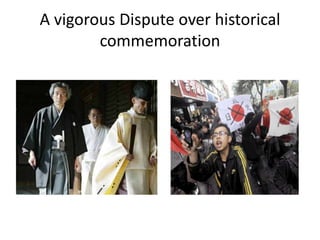
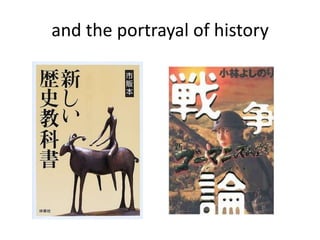
A vigorous Dispute over historical
        commemoration
and the portrayal of history
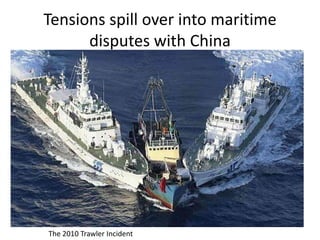
Tensions spill over into maritime
      disputes with China


The 2010 Trawler Incident
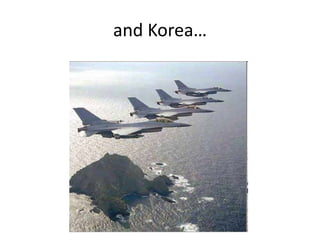
and Korea…
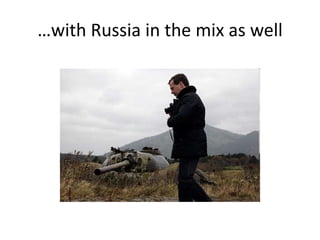
…with Russia in the mix as well
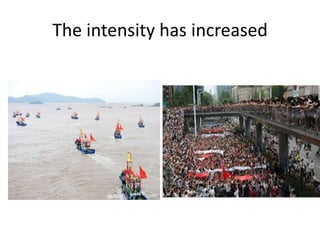
The intensity has increased
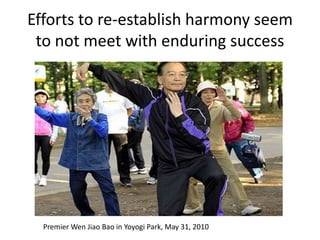
Efforts to re-establish harmony seem
 to not meet with enduring success


  Premier Wen Jiao Bao in Yoyogi Park, May 31, 2010
Three Questions:
• What is the basis of the ways countries think
  about history and territory (the Official
  Narrative)?
• When and why do differing historical
  narratives become the source of inter-state
  conflict?
• What – if anything – can be done about it?
Forces shaping the Official Narrative
• Historical Determinist – historical memory
  based on individual experiences
• Instrumentalist – historical memory
  manipulated by cynical elites for their own
  gain
• Culturalist – historical memory part of the
  larger political culture of a society
• Combination of the above
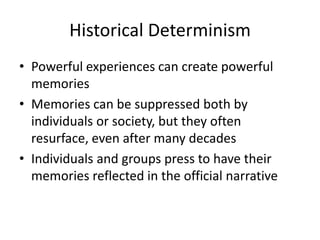
Historical Determinism
• Powerful experiences can create powerful
  memories
• Memories can be suppressed both by
  individuals or society, but they often
  resurface, even after many decades
• Individuals and groups press to have their
  memories reflected in the official narrative
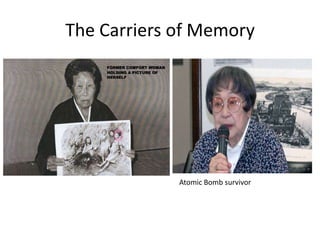
The Carriers of Memory


             Atomic Bomb survivor
Instrumentalism
• Politicians and other elites manipulate official
  narrative to promote their own agendas
• The balance of power between politicians and
  interest groups determines the official
  narrative
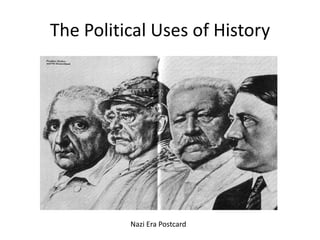
The Political Uses of History


          Nazi Era Postcard
Culturalism
• The interpretation of events and interest are
  central elements of a society’s political culture
• Each generation is socialized with a particular
  historical narrative – through
  education, movies, plays, etc.
• Over time, the historical narrative evolves as each
  generation reinterprets events in its own way
• The existing historical narrative set the boundarie
  for the kind of historical narrative a state can
  adopt
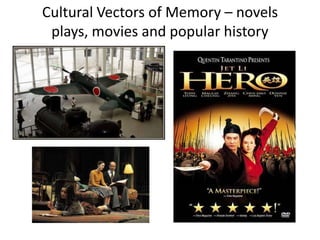
Cultural Vectors of Memory – novels
 plays, movies and popular history
The History of the History issue in Asia
• 1945-1951 – Initial Settlement
• 1951-1982 – Successful Japanese damage
  control
• 1982 – 1992 – the beginning of the “history
  issue”
• 1992-2002 – era of apology diplomacy
• 2002 –Deadlock over history – apology fatigue
Period 1 - Initial Settlement
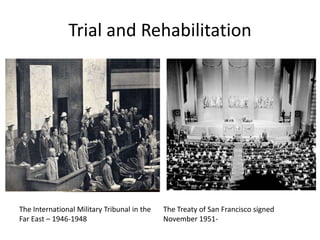
• The Tokyo War Crimes Tribunal
• Reverse Course in US occupation policy
• Ascent of the Conservative LDP in Japan
• The Treaty of San Francisco –
Article 11 – Japan accepts the IMTFE Verdict
Articles 14-21 – limited reparations
regime, Western Allies give up further claims
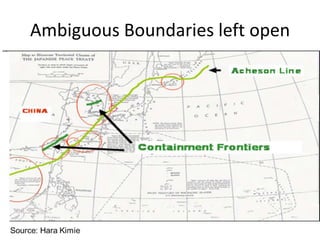
• Ambiguous Boundaries created
Trial and Rehabilitation


The International Military Tribunal in the   The Treaty of San Francisco signed
Far East – 1946-1948                         November 1951-
Ambiguous Boundaries left open
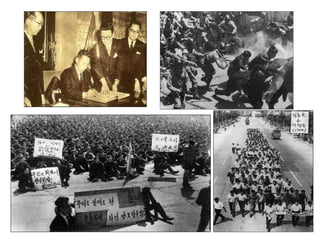
Period 2 - 1951-1978 Successful
       Japanese Damage Control
• Japan chooses to focus on damage control
• Taiwan and South Korea unsuccessfully push
  for compensation and concessions by Japan
• Japan signs normalization treaties with all
  major Asian nations except the DPRK
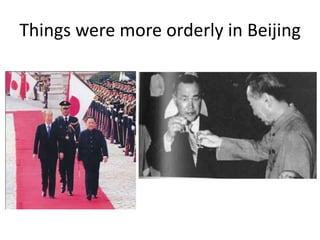
       1952 Taiwan
       1965 South Korea
       1978 The PRC
Things were more orderly in Beijing
Reasons for First Equilibrium
• Politics in Command - Instrumental factors
  predominate historical memory and cultural
  discourse
• PRC, ROK, Taiwan all authoritarian states
• The Left in Japan focuses on Japanese
  victimization
• Japanese conservatives not interested in
  pursuing “War Responsibility”
Period III – History Issue Resurfaces
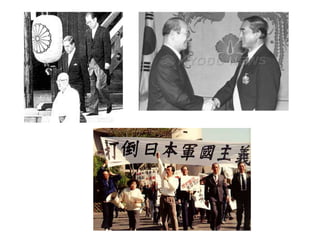
•   1982 – The First textbook Controversy
•   New MOE guidelines on textbooks
•   Nakasone apology in Korea
•   1985 – Nakasone visits Yasukuni
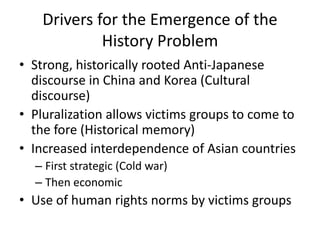
Drivers for the Emergence of the
             History Problem
• Strong, historically rooted Anti-Japanese
  discourse in China and Korea (Cultural
  discourse)
• Pluralization allows victims groups to come to
  the fore (Historical memory)
• Increased interdependence of Asian countries
  – First strategic (Cold war)
  – Then economic
• Use of human rights norms by victims groups
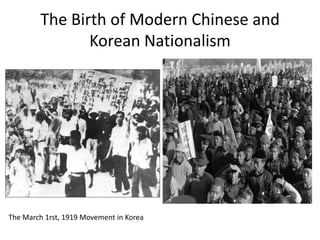
The Birth of Modern Chinese and
               Korean Nationalism


The March 1rst, 1919 Movement in Korea
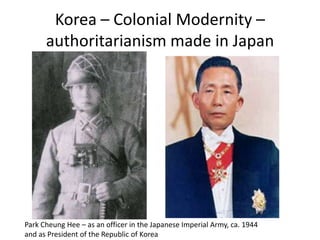
Korea – Colonial Modernity –
      authoritarianism made in Japan


Park Cheung Hee – as an officer in the Japanese Imperial Army, ca. 1944
and as President of the Republic of Korea
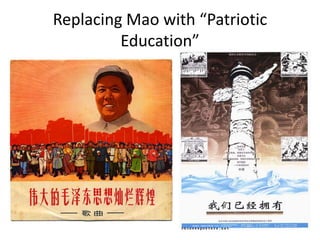
Replacing Mao with “Patriotic
         Education”
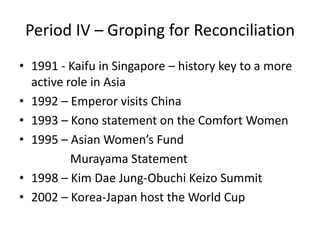
Period IV – Groping for Reconciliation
• 1991 - Kaifu in Singapore – history key to a more
  active role in Asia
• 1992 – Emperor visits China
• 1993 – Kono statement on the Comfort Women
• 1995 – Asian Women’s Fund
          Murayama Statement
• 1998 – Kim Dae Jung-Obuchi Keizo Summit
• 2002 – Korea-Japan host the World Cup
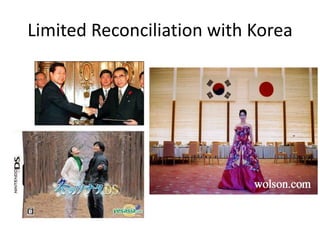
Limited Reconciliation with Korea
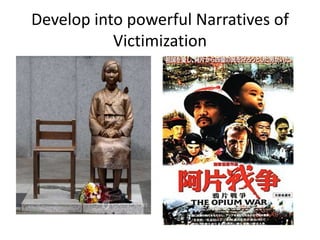
Develop into powerful Narratives of
           Victimization
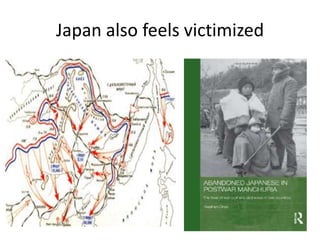
Japan also feels victimized
Period IV – Deadlock over history
• 2001-2006 Under Koizumi tensions flare up
• Collapse of territorial negotiations with Russia
• Korean-Japanese reconciliation founders
  under Lee Myun Bak
• Anti-Japanese riots in 2005 in China
• Japanese Apology fatigue
• Escalates into territorial disputes
Reasons for Deadlock
• Japanese conservative backlash and “apology
  fatigue”
• Lack of active support for reconciliation from the
  Korean government
• Lack of interest in reconciliation by the Chinese
  government
• Temptation to utilize popular sentiments for
  domestic political agenda
• Inability of governments (China, Korea and Japan)
  to re-establish control over the diplomatic
  agenda
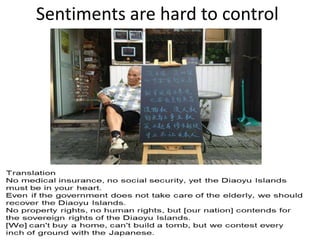
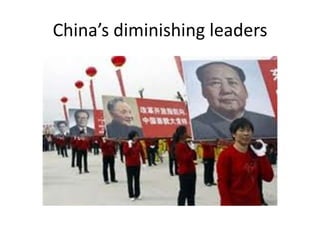
China’s diminishing leaders
Aggressively Patriotic Sentiments


    Translation: Even if the whole of China is covered with tombs, [we]
    must kill all Japanese; even if no grass grows in China, we must
    recover Diaoyudao [the Senkakus]
Sentiments are hard to control
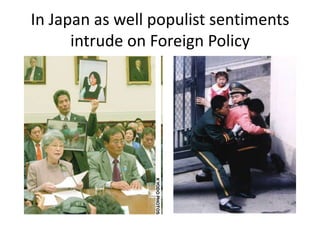
In Japan as well populist sentiments
      intrude on Foreign Policy
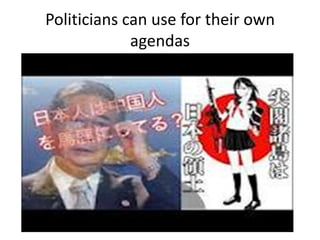
Politicians can use for their own
             agendas
Bottom Line – a Paradox
• The broad framework of international
  relations – balance of power and
  interdependence - favors general stability
• The political dynamics of the history issue –
  the combination of historical memory, cultural
  discourse and instrumental use of the issue by
  opportunistic politicians – creates volatility
Risks for Japan and the US-Japan
              Relationship
• Japan risks diplomatic isolation in East Asia
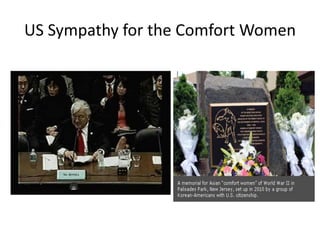
• Lack of sympathy on the part of the US –
  especially with regard to the Comfort women
  issue
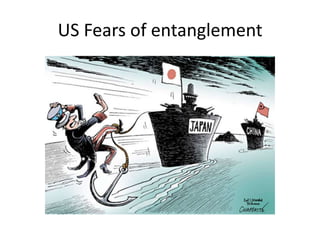
• Danger of accidental escalation in the
  Senkakus
US Sympathy for the Comfort Women
US Fears of entanglement
Possible Counter measures
• Greater flexibility on territorial issues
• Damage control on history with China/
  reconciliation with Korea – if Korea is ready
• CSBMs on Senkakus – when China is ready
• Is this politically possible for Japan and its
  neighbors?

Public Lecture Presentation Slides (11.27.2012)

  • 1.
    History, Territory andJapan’s growing isolation in East Asia Thomas U Berger Associate Professor Department of International relations Boston University For Presentation at Temple University, Tokyo November 27, 2012
  • 2.
    The Basic Problem •Despite: A) growing regional interdependence, and B) a military balance that strongly favors the US and its allies We have growing regional acrimony, fueled by tensions over history and minor territorial issues Why?
  • 3.
    A vigorous Disputeover historical commemoration
  • 4.
  • 5.
    Tensions spill overinto maritime disputes with China The 2010 Trawler Incident
  • 6.
  • 7.
    …with Russia inthe mix as well
  • 8.
  • 9.
    Efforts to re-establishharmony seem to not meet with enduring success Premier Wen Jiao Bao in Yoyogi Park, May 31, 2010
  • 10.
    Three Questions: • Whatis the basis of the ways countries think about history and territory (the Official Narrative)? • When and why do differing historical narratives become the source of inter-state conflict? • What – if anything – can be done about it?
  • 11.
    Forces shaping theOfficial Narrative • Historical Determinist – historical memory based on individual experiences • Instrumentalist – historical memory manipulated by cynical elites for their own gain • Culturalist – historical memory part of the larger political culture of a society • Combination of the above
  • 12.
    Historical Determinism • Powerfulexperiences can create powerful memories • Memories can be suppressed both by individuals or society, but they often resurface, even after many decades • Individuals and groups press to have their memories reflected in the official narrative
  • 13.
    The Carriers ofMemory Atomic Bomb survivor
  • 14.
    Instrumentalism • Politicians andother elites manipulate official narrative to promote their own agendas • The balance of power between politicians and interest groups determines the official narrative
  • 15.
    The Political Usesof History Nazi Era Postcard
  • 16.
    Culturalism • The interpretationof events and interest are central elements of a society’s political culture • Each generation is socialized with a particular historical narrative – through education, movies, plays, etc. • Over time, the historical narrative evolves as each generation reinterprets events in its own way • The existing historical narrative set the boundarie for the kind of historical narrative a state can adopt
  • 17.
    Cultural Vectors ofMemory – novels plays, movies and popular history
  • 18.
    The History ofthe History issue in Asia • 1945-1951 – Initial Settlement • 1951-1982 – Successful Japanese damage control • 1982 – 1992 – the beginning of the “history issue” • 1992-2002 – era of apology diplomacy • 2002 –Deadlock over history – apology fatigue
  • 19.
    Period 1 -Initial Settlement • The Tokyo War Crimes Tribunal • Reverse Course in US occupation policy • Ascent of the Conservative LDP in Japan • The Treaty of San Francisco – Article 11 – Japan accepts the IMTFE Verdict Articles 14-21 – limited reparations regime, Western Allies give up further claims • Ambiguous Boundaries created
  • 20.
    Trial and Rehabilitation TheInternational Military Tribunal in the The Treaty of San Francisco signed Far East – 1946-1948 November 1951-
  • 21.
  • 22.
    Period 2 -1951-1978 Successful Japanese Damage Control • Japan chooses to focus on damage control • Taiwan and South Korea unsuccessfully push for compensation and concessions by Japan • Japan signs normalization treaties with all major Asian nations except the DPRK 1952 Taiwan 1965 South Korea 1978 The PRC
  • 24.
    Things were moreorderly in Beijing
  • 25.
    Reasons for FirstEquilibrium • Politics in Command - Instrumental factors predominate historical memory and cultural discourse • PRC, ROK, Taiwan all authoritarian states • The Left in Japan focuses on Japanese victimization • Japanese conservatives not interested in pursuing “War Responsibility”
  • 26.
    Period III –History Issue Resurfaces • 1982 – The First textbook Controversy • New MOE guidelines on textbooks • Nakasone apology in Korea • 1985 – Nakasone visits Yasukuni
  • 28.
    Drivers for theEmergence of the History Problem • Strong, historically rooted Anti-Japanese discourse in China and Korea (Cultural discourse) • Pluralization allows victims groups to come to the fore (Historical memory) • Increased interdependence of Asian countries – First strategic (Cold war) – Then economic • Use of human rights norms by victims groups
  • 29.
    The Birth ofModern Chinese and Korean Nationalism The March 1rst, 1919 Movement in Korea
  • 30.
    Korea – ColonialModernity – authoritarianism made in Japan Park Cheung Hee – as an officer in the Japanese Imperial Army, ca. 1944 and as President of the Republic of Korea
  • 31.
    Replacing Mao with“Patriotic Education”
  • 32.
    Period IV –Groping for Reconciliation • 1991 - Kaifu in Singapore – history key to a more active role in Asia • 1992 – Emperor visits China • 1993 – Kono statement on the Comfort Women • 1995 – Asian Women’s Fund Murayama Statement • 1998 – Kim Dae Jung-Obuchi Keizo Summit • 2002 – Korea-Japan host the World Cup
  • 33.
  • 34.
    Develop into powerfulNarratives of Victimization
  • 35.
    Japan also feelsvictimized
  • 36.
    Period IV –Deadlock over history • 2001-2006 Under Koizumi tensions flare up • Collapse of territorial negotiations with Russia • Korean-Japanese reconciliation founders under Lee Myun Bak • Anti-Japanese riots in 2005 in China • Japanese Apology fatigue • Escalates into territorial disputes
  • 37.
    Reasons for Deadlock •Japanese conservative backlash and “apology fatigue” • Lack of active support for reconciliation from the Korean government • Lack of interest in reconciliation by the Chinese government • Temptation to utilize popular sentiments for domestic political agenda • Inability of governments (China, Korea and Japan) to re-establish control over the diplomatic agenda
  • 38.
  • 39.
    Aggressively Patriotic Sentiments Translation: Even if the whole of China is covered with tombs, [we] must kill all Japanese; even if no grass grows in China, we must recover Diaoyudao [the Senkakus]
  • 40.
  • 41.
    In Japan aswell populist sentiments intrude on Foreign Policy
  • 42.
    Politicians can usefor their own agendas
  • 43.
    Bottom Line –a Paradox • The broad framework of international relations – balance of power and interdependence - favors general stability • The political dynamics of the history issue – the combination of historical memory, cultural discourse and instrumental use of the issue by opportunistic politicians – creates volatility
  • 44.
    Risks for Japanand the US-Japan Relationship • Japan risks diplomatic isolation in East Asia • Lack of sympathy on the part of the US – especially with regard to the Comfort women issue • Danger of accidental escalation in the Senkakus
  • 45.
    US Sympathy forthe Comfort Women
  • 46.
    US Fears ofentanglement
  • 47.
    Possible Counter measures •Greater flexibility on territorial issues • Damage control on history with China/ reconciliation with Korea – if Korea is ready • CSBMs on Senkakus – when China is ready • Is this politically possible for Japan and its neighbors?