INSTITUTE OF
CONTEMPORARY
ASIAN STUDIES
FALL 2019 PROGRAM
HELLO,
SANGEN-JAYA!
2019 秋学期プログラム
現代アジア研究所
1
The Institute of Contemporary Asian Studies (ICAS) began as the Pacific
Rim Lecture Series in the 1990s, led by former TUJ Associate Dean and Main
Campus Professor of Sociology Bob Kidder, followed by Jeff Kingston, professor
and advisor of TUJ’s Asian Studies Program.
At the time, Japanese economics, bureaucratic organization and politics
were of primary interest in academia. TUJ had recently moved its campus from
the outskirts of Tokyo to Azabujuban, and the central location presented growth
opportunities for our graduate programs. The academic focus of the Pacific Rim
lecture series not only appealed to TUJ faculty and students, but also supported
the expanding graduate programs.
In Azabujuban, the Pacific Rim lecture series was a success due in part to
TUJ’s growth and the nearby international community. This success led to the
lecture series becoming the Institute of Contemporary Japanese Studies (ICJS) in
2004, as other issues were coming to the forefront in academia. Japanese culture
itself (its values rather than its institutional byproducts) and youth subcultures
gained attention, which helped create the “Japan Wave,” of a uniquely
post-modern society with an unmatched consumer society. Interest in Japanese
pop culture around the globe, especially anime and manga, drew the attention
of study abroad students looking for alternatives to their home societies, and ICJS
programming came to include such cultural topics in addition to its prior political
focus. The university and ICJS grew in tandem, with TUJ receiving a historic desig-
nation as the first Foreign University, Japan Campus by the Ministry of Education in
2005.
Following these developments, institute programming further broadened
from a focus on Japanese studies to Asian studies in general, becoming the
Institute of Contemporary Asian Studies (ICAS) in 2010. This reflected the changing
demographics of Japan and its status in Asia, as Japan’s international relations
with its Asian neighbors became even more politically contentious and a primary
focus of U.S. foreign policy.
A few years after morphing into ICAS, Robert Dujarric took over the direc-
torship of the institute, replacing founding director Kyle Cleveland (now Associate
Director). Under Robert’s leadership, the institute has evolved into a platform for
examining Japanese politics, the U.S.-Japan Alliance, security issues and Japan’s
fraught international relations (especially with Korea and China).
Now that TUJ has moved to Sangen-jaya, we at ICAS are excited to
expand institute activities and develop collaborative programs with Showa
Women’s University (SWU) and other universities. Here we hope to continue to
cultivate the kind of academic excellence and diverse perspectives that have
characterized ICAS since its inception.
ICAS Over the Years
September 2019
Institute of Contemporary Asian Studies (ICAS)
Temple University Japan Campus
www.tuj.ac.jp |icas@tuj.temple.edu | 03-5441-9800
The Institute for Contemporary Asian Studies (ICAS) is a forum for intellec-
tual and cultural exchange operating under Temple University, Japan
Campus (TUJ).
Our mission is to provide a platform for academics, journalists, business
executives, students and others from all over the world to present inno-
vative ideas and stimulate debate. ICAS sessions are interactive: speak-
ers provide audiences with a starting point for discussion and likewise,
audience participants raise new ideas that shape our programming.
Notable Programs include:
To learn more, please visit: www.tuj.ac.jp/icas/the-institute.
• Evening Lecture Series, which features discussions, book
talks, film screenings, and other public events throughout
the year.
• Adjunct Fellowship program, in which ICAS fellows facili
tate speaking engagements with the Evening Lecture
Series, and share research & networking opportunities.
• Student Summer Fellowship program, which provides
opportunities for student fellows to work with TUJ faculty
members on collaborative research projects.
The Institute of Contemporary
Asian Studies (ICAS) at Temple
University, Japan Campus
現代アジア研究所 (ICAS - Institute of Contemporary Asian Studies)
はテンプル大学ジャパンキャンパスにおいて、研究者はもとより
ジャーナリスト、ビジネス・政府関係者、学生から一般の社会人まで
幅広い層に開かれたアジア研究の知力・活動拠点として位置づけられ
ています。政治、外交、教育、防衛、福祉、環境問題、またフィルム
上映など様々なテーマを取り上げ、通年にわたり第一線の専門家や
研究者による講演・公開討論を開催しています。また国内外の研究者
をICAS客員研究員として迎え入れ、意見交換、情報収集、ネットワー
キングの場を設けて人的交流の推進を図っています。夏学期には外部
の大学・大学院生を対象とした夏期フェローシッププログラムを実施、
次世代のオピニオンリーダーの育成にも努めています。
2 3
In November 2013, Marinel Ubaldo was 16 years old
when Typhoon Yolanda swept away her village in
the Philippines, killing over 6,000 people. She and
her family survived, huddled together without food
for days, waiting for help from the outside world.
This is when Marinel realized that it was the same
outside world—and global warming—that was the
cause of their misery. Join us to hear Marinel's story,
and discuss how to be effective activists ourselves.
This event is co-sponsored by Amnesty International
Japan.
“I survived the climate crisis so far,
but what’s next?”
Marinel Sumook Ubaldo
7:00 pm
Oct. 8
We are pleased to invite you to a welcome recep-
tion at the new TUJ campus. With a warm welcome
from Robert Dujarric and Kyle Cleveland, the event
will feature remarks from Jesper Koll, one of Tokyo's
best known economic commentators. Join us for a
celebration of the new venue and the future of
ICAS!
Jesper Koll
ICAS Reception:
15 Year Celebration &
New Campus Welcome
6:30 pm
Oct. 4
Fall 2019 Program
Selected events from the
All ICAS events are held in English, open to the public, and free admission unless otherwise noted.
For more details, please visit: www.tuj.ac.jp/icas/events
David Leheny
7:30 pm The efficacy of Japan’s strategies to build “soft
power” through support for its “content indus-
tries” has been widely debated. David Leheny
draws from his 2018 book Empire of Hope: The
Sentimental Politics of Japanese Decline to
argue situating these policies in a larger
post-Bubble emotional frame for the state
unlocks a more persuasive way to engage how
the idea of soft power took root and what it has
represented for Japan.
Cool Optimism in the
Empire of Hope
Oct. 1
The Olympic Games have become synonymous
with massive infrastructure projects, yet the
question of whether such environmental costs
are justified has been surprisingly understudied.
Robin Kietlinski will take a close and critical look
at these endeavors through a historical lens,
and consider the full scope of the costs of
hosting the Olympics.
Trash Islands: The Olympic
Games and Japan’s
Changing Environment
Robin Keitlinski
7:30 pm
Sept. 27
Tensions between Washington and Beijing have
been growing for many years. In a twist, the
Trump administration announced increased
tariffs targeting Chinese corporations, and
China no longer shies away from responding to
such measures. As a major trade partner of both
the USA and the PRC, Japan finds itself in a
tricky position if the trade war continues to
escalate.
Our panel will discuss the conflict and its impli-
cations for Japan & the rest of the world.
Robert Dujarric
Alexander Dmitrenko
Hiromi Murakami
Trade Wars & Sanctions:
The Sino-American
Confrontation and Japan
7:00 pm
Sept. 25
Fall 2019 Program
Selected events from the
4 5
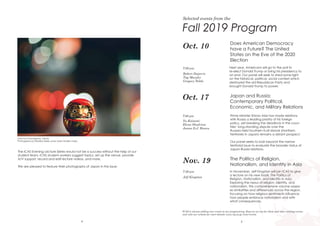
Daruma in Kanagawa, Japan.
Photography by Bradley Meier, junior Asian Studies major.
The ICAS Evening Lecture Series would not be a success without the help of our
student team. ICAS student workers suggest topics, set up the venue, provide
A/V support, record and edit lecture videos, and more.
We are pleased to feature their photographs of Japan in this issue.
ICAS is always adding new events to our progamming. Keep an eye out for these and other exciting events,
and visit our website for more details: www.tuj.ac.jp/icas/events
In November, Jeff Kingston will join ICAS to give
a lecture on his new book, The Politics of
Religion, Nationalism, and Identity in Asia.
Exploring the nexus of religion, identity, and
nationalism, this comprehensive volume assess-
es similarities and differences across the region,
focusing on how religious sentiments influence
how people embrace nationalism and with
what consequences.
Jeff Kingston
The Politics of Religion,
Nationalism, and Identity in Asia
7:30 pm
Nov. 19
Prime Minister Shinzo Abe has made relations
with Russia a leading priority of his foreign
policy, yet breaking the deadlock in the coun-
tries’ long-standing dispute over the
Russian-held Southern Kuril Islands (Northern
Territories in Japan) remains a distant prospect.
Our panel seeks to look beyond the narrow
territorial issue to evaluate the broader status of
Japan-Russia relations.
Japan and Russia:
Contemporary Political,
Economic, and Military Relations
Yu Koizumi
Elena Shadrina
James D.J. Brown
7:00 pm
Oct. 17
Next year, Americans will go to the poll to
re-elect Donald Trump or bring his presidency to
an end. Our panel will seek to shed some light
on the historical, political, social context which
destroyed the old Republican Party and
brought Donald Trump to power.
Robert Dujarric
Tag Murphy
Gregory Noble
Does American Democracy
have a Future? The United
States on the Eve of the 2020
Election
7:00 pm
Oct. 10
Fall 2019 Program
Selected events from the
6 7
In September of 2015, I attended a splashy gathering in Tokyo with
a clunky title: “Unearthing the History of Japan and the United Nations
through Audiovisual Archives.” The event, hosted by the Public Relations
Office of the Government of Japan, was to unveil the digital archiving of
Japan’s close history with the intergovernmental organization that is
tasked with maintaining international order and promoting international
cooperation. That organization, the United Nations, is featured prominent-
ly in Tokyo through the United Nations University, whose global headquar-
ters is located in the Shibuya ward of Tokyo.
Nearly four years later, I still marvel at the interpersonal encounter I
had that day with a woman whose global leadership at the United
Nations makes her a national treasure. The nonagenarian Dr. Sadako
Ogata, was at one time the most recognized shining light of Japanese
women’s empowerment. Certainly for those of us in international relations
study and practice, we knew her long stint (1991-2000) as the United
Nations High Commissioner for Refugees. When most would have faded
away in retirement, Dr. Ogata followed that high profile position by hold-
ing the presidency of the Japan International Cooperation Agency (JICA)
from 2003-2012. She is now a senior adviser to the Japan Model United
Nations program that is quite popular among university students.
I had known about Dr. Ogata since the 1990s when I was a young
pup bureaucrat at the Department of State in Washington, D.C. where I
served as the government liaison between DOS and Capitol Hill on refu-
gees. To meet her in person was my national treasure.
Japan Needs to “Go for the Gold”
in Global Media Leadership
Spotlight on the ICAS Adjunct Fellowship: Nancy Snow
Nancy Snow is an ICAS Adjunct Fellow and Pax
Mundi Professor of Public Diplomacy at Kyoto
University of Foreign Studies. She is Emeritus Professor
of Communications from California State University,
Fullerton. Her forthcoming books are The Sage
Handbook of Propaganda, the second edition of
the Routledge Handbook of Public Diplomacy, and
a Japanese translation of Japan’s Information War.
Reach her at http://www.nancysnow.com.
When Japan joined the UN in 1956, it did so with great enthusiasm
and broad public support, for the international organization was
seen to embody the pacified country's hopes for a peaceful world
order. Membership was welcomed by many Japanese who saw
the UN as a guarantor of a policy of unarmed neutrality for their
nation, in addition to the security arrangement they concluded
with US in 1951. To others, support for the UN would be useful in
masking or diluting Japan's almost total dependence on the United
States for its security. The government saw the UN as an ideal arena
for its risk minimizing, omnidirectional foreign policy.
That UNU day, I celebrated along with prominent government
officials, including Urasenke Grand Master Dr. Genshitsu Sen, UNESCO
Goodwill Ambassador, appointed for his contribution to peace and
culture through the traditional Japanese tea ceremony; Kiyotaka Akasa-
ka: President of the Foreign Press Center Japan (FPCJ); Kaoru Nemoto:
Director of the UN Information Centre, Tokyo; and Tomohiko Taniguchi:
Special Advisor to the Cabinet of Prime Minister Shinzo Abe. These people
have become professional or personal contacts who have guided my
understanding about Japan’s role with not only the United Nations but
also the world.
There is no doubt that the UN figures prominently as an intergovern-
mental organization. Many Japanese I have met wax nostalgically about
how the UN helped to assist an impoverished postwar Japan. Others
relate Japan’s relationship to the UN as kindred spirit international peace
brands. Even this Wikipedia entry about Japan and the United Nations
reflects this special relationship:
Spotlight on the ICAS Adjunct Fellowship
Where one does not hear about Japan’s tie to the United Nations
so much, if ever, is in Japan’s role as a global communicator. Officially at
the government level, or unofficially at the press level, Japan’s global
dialogue is relatively weak, conditioned as it is by press clubs, self-censor-
ship, and poor media relations. Recently I visited Osaka during the G20
Summit. I was there on invitation to do live on-air analysis with various
international media such as Doha’s Al Jazeera and Istanbul’s TRT World. I
made my way to the Government of Japan’s media relations office adja-
cent to the International Exhibition Center, Osaka (INTEX) where the G20
was taking place.
Despite showing my bona fides, a press credential from the G7
Summit in Ise-Shima, passport, and university meishi, I was unsuccessful in
securing any temporary access to the international media center. My
hopes were raised when a media relations staff person said that I could
obtain temporary media access if I had someone senior from the Ministry
of Foreign Affairs call on my behalf. I quickly emailed my contact, she
8 9
called the contact number of the press center, only to be told that there
is no suchthing as temporary media access.
I ended up doing media interviews outside the venue via Skype. I
had hoped to discuss with a number of international media in atten-
dance Japan’s self-designated leadership in reducing plastics in the
oceans. This eco-conscious initiative by the summit host was not promi-
nent at a G20 dominated by superpowers on display, including the Amer-
ican president and his Russian and Chinese counterparts. Even the
post-G20 Summit handshake at the DMZ overshadowed the sustainability
conversation.
The G20 Osaka media relations experience is a first in my professional
career where I’ve been denied access for media interviews. It reflected
what could be a major challenge for the Japanese government during
the 2020 Summer Olympics and Paralympics. No other global event invites
the hot spotlight of international media attention than the spectacle of
the Olympics, to say nothing of all the activist citizens and citizen bloggers
with their own respective agendas. Is Japan ready for the heat of interna-
tional public opinion?
The “BBC of Japan” known as NHK will be the host national broadcaster
during Tokyo 2020. As I write at length in the current issue of the Asian
Journal of Journalism and Media Studies¹, NHK is best known for its
enabling relationship with the Abe administration, as has been written
about by a number of prominent critical scholars, including Koichi
Nakano at Sophia and Jeff Kingston at Temple University, Japan Campus.
When the eyes of the world descend on Japan next summer, other
stories—inspiring, inquiring, and investigative—will come on display and
Japan’s media relations better be ready to feed a global media beast
that will pull no punches in coverage.
¹Nancy Snow, “NHK, Abe and the World: Japan’s Pressing Needs in the Path to 2020,” Asian Journal of
Journalism and Media Studies, No. 2, 2019, https://doi.org/10.33664/ajjms.2.0_15.
Spotlight on the ICAS Adjunct Fellowship
Is Japan ready for the heat of
international public opinion?
Can North Korea
‘Reform and Open Up’?
The situation the international community is facing regarding North Korea increas-
ingly looks like an overly constrained set of equations perhaps without solution.
T.W. Kang, Managing Director of Global Synergy Associates joined ICAS in June to
provide the perspective from the Korean peninsula. Given his past visits to former
socialist countries that transitioned, he provided analysis of the prospects of a
North Korean transition to a market economy.
Makiko Terahara of Marriage for All Japan explains key ideas of the lawsuit for same-sex marriage.
In February 2019, multiple lawsuits were filed seeking equal marriage rights in
Japan. Makiko Terahara, one of the lawyers in the case, spoke on a panel at
ICAS in June.
“Every single individual on earth is a minority in some aspects,” she said. “So in
that sense, I think these lawsuits are for all people, not just for same sex couples.”
Alexander Dmitrenko of Lawyers for LGBT & Allies Network (LLAN), provided
international perspective by focusing on the movement in Canada and Taiwan
as case studies. Naosuke Fujita, also of LLAN, described why marriage equality is
good for business and how businesses can support LGBT acceptance in Japan.
Marriage Equality in Asia
Highlights from our recent summer program
10 11
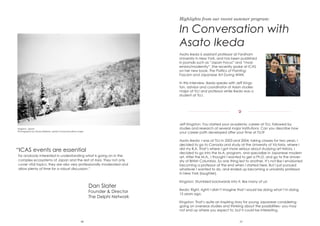
for anybody interested in understanding what is going on in the
complex ecosystems of Japan and the rest of Asia. They not only
cover vital topics, they are also very professionally moderated and
allow plenty of time for a robust discussion.”
Nagano, Japan.
Photography by Grace Bellamy, senior Communications major.
“ICAS events are essential
Dan Slater
Founder & Director
The Delphi Network
Asato Ikeda is assistant professor at Fordham
University in New York, and has been published
in journals such as “Japan Focus” and “mod-
ernism/modernity”. She recently spoke at ICAS
on her new book, The Politics of Painting:
Fascism and Japanese Art During WWII.
In this interview, Ikeda speaks with Jeff Kings-
ton, advisor and coordinator of Asian studies
major at TUJ and professor while Ikeda was a
student at TUJ.
In Conversation with
Asato Ikeda
Highlights from our recent summer program:
Jeff Kingston: You started your academic career at TUJ, followed by
studies and research at several major institutions. Can you describe how
your career path developed after your time at TUJ?
Asato Ikeda: I was at TUJ in 2003 and 2004, taking classes for two years. I
decided to go to Canada and study at the University of Victoria, where I
did my B.A. That’s where I got more serious about studying art history. I
decided to go into the M.A. program, and specialize in Japanese modern
art. After the M.A., I thought I wanted to get a Ph.D. and go to the Univer-
sity of British Columbia. So one thing led to another. It’s not like I envisioned
becoming a professor at the end when I started here. But I just pursued
whatever I wanted to do, and ended up becoming a university professor
in New York (laughter).
Kingston: Stumbled backwards into it, like many of us!
Ikeda: Right, right! I didn’t imagine that I would be doing what I’m doing
15 years ago.
Kingston: That’s quite an inspiring story for young Japanese considering
going on overseas studies and thinking about the possibilities– you may
not end up where you expect to, but it could be interesting.
12 13
Ikeda: In retrospect, I think I was pretty ambitious and adventurous, but
you know I was younger, too (laughter).
Kingston: Much of your work is relevant to broad themes of social rele-
vance, from politics to gender studies. How do you see your work within
current sociopolitical trends?
Ikeda: Right. I think the reason why I’m interested in history and the past is
that I could find something that is meaningful or helpful when thinking
about the present. When it comes to my research, I tend to think about
the politics and how to understand World War II now, which is still a rele-
vant and recurring topic. That’s what became my book.
When it comes to “A Third Gender” also-- things are relevant to us again in
retrospect, and it’s very useful. Especially when I’m teaching, because
often I’m teaching students who are taking my class because it’s required
(laughter).
Right? They’re not necessarily interested in the things I’m talking about. But
because my research touches on more general topics like gender and
politics, that’s a connecting point. The students could think more compar-
atively about their country or their history, and could articulate their opin-
ions.
Kingston: Connecting the dots over the arc of history.
Ikeda: Yes, yes, exactly.
Kingston: These days, there’s a great interest in LGBTQ, and so your third
gender exhibit clearly could resonate with students who might be taking
your course only because it is required.
Ikeda: Yes, and come to think of it, I used my article in which I wrote about
how to understand the Edo period gender practices from our contempo-
rary perspective. That was the first time two students came out and identi-
fied themselves as gay and bisexual in front of other students. And you
know, I’m teaching at a Jesuit Christian university (laughter).
So I thought this was a pretty magical moment. I was very glad to see that
kind of thing happening in my class.
Kingston: Your lecture tonight at ICAS is related to your most recent book,
“The Politics of Painting”, which analyzes paintings from the WWII period
through the lens of fascism. What was the starting point for this project?
Ikeda: Things I learned at TUJ were really the starting point. In particular, I
In Conversation with Asato Ikeda
state ideology. But really, my project came from things that I studied at
TUJ.
Kingston: That’s an interesting lens, looking at it from the counterculture of
the 60s and music, and looking at what was going on in Japan in the 30s
and 40s.
Ikeda: Right.
Kingston: That’s quite fascinating.
Ikeda: My question was really, why didn’t that happen in the 30s and 40s,
right? Why didn’t people protest against the state?
Kingston: What kind of connections did you find between fascism and art
in say, Germany and Italy and Japan? Did you notice anything particular-
ly striking?
Ikeda: Because I’m talking about this concept of fascism, I’m basically
looking at their connections and similarities. Visually speaking, they’re
mostly modernist because the 1930s and 40s came after modernism as a
movement. But they look back to the past, and in the case of Japan it
could be various things. It could be about Mt. Fuji, or rural customs, or the
beautiful women or bijin-ga from the Edo period.
In Germany and Italy, they mainly look at more of a Greco-Roman antiq-
uity. If you look at the paintings and visual arts, they may look slightly
different because they’re looking at a different kind of history. But in the
sense that they’re looking at the past and glorifying it in order to justify
The reason why I’m interested in
history is that I could find something
meaningful to think about the present.
would point to your class, where we talked about things like war responsi-
bility, right-wing conservative and history revisionists, things like that. And
also, Dr. Horton’s class about music and politics. We talked about the
1960s counterculture and the Vietnam War. What I wrote about was the
opposite of counterculture, because it’s more about the imposition of the
In Conversation with Asato Ikeda
14 15
violence—I think that’s where we could see the similarities between those
movements.
Kingston: In 2017, you curated an exhibit with the Royal Ontario Museum
in Toronto on wakashu prints of Japan's "third gender" during the Edo
period. How did you become interested in this work? How does this work
challenge modern notions of binary gender?
Ikeda: This is something that I did in the capacity of curator, but the proj-
ect really comes from my collaborator, Joshua Mostow, at the University
of British Colombia who specializes in the topic. I was fortunate enough to
work on this with him.
Generally speaking today, people are questioning this kind of gender
binary and heteronormative sexuality to begin with, so it fit very well with
the current social climate. That was why the exhibition was very success-
ful, I think. People were interested in different kinds of practices around sex
and gender and sexuality.
Kingston: You took ROM
[Royal Ontario Museum] into
unexplored territory.
Ikeda: I hope so!
Kingston: There is a lot of
discussion around the decline
of area studies. What do you
think is lost in this decline?
Ikeda: Temple University Japan is in a very unique position to offer this
program of Asian Studies to, you know, American students who could
come here and study things firsthand.
Kingston: And Japanese students like you!
Ikeda: That is true! Definitely, it offers a lot to Japanese students who want
to study in English but do not have the means to go abroad yet. I don’t
know what to say about the decline of Asian studies, but I think it gives
students a sense of community. Networking, and also a sense of commu-
nity.
Kingston: Well, thank you for spending time and sharing your insights.
Ikeda: Thank you!
Ikeda presenting her research at ICAS on July 16, 2019.
In Conversation with Asato Ikeda
ICAS hosted the book launch of “Beyond the Gender Gap in Japan”, a collec-
tion of essays on various aspects of women’s lives in Japan. Gill Steel, the editor,
presented on the central question in the book: why do Japanese women statisti-
cally express a high sense of well-being in a context of inequality?
Steel was joined by four authors of essays in the book: Mito Akiyoshi of Senshu
University, Kumiko Nemoto of the Kyoto University of Foreign Studies, Hiroko
Takeda of Nagoya University, and Yuki Tsuji of Tokai University. Each spoke about
their research on women’s lives. The panel was followed by a lively Q&A session.
“Beyond the Gender Gap in Japan” was published in May 2019. It is available in
bookstores and from online retailers.
Beyond the Gender Gap in Japan
Hiroko Takeda of Nagoya University presents on 'Life' as a Political Agenda
Highlights from our recent summer program
"Even though [Abe Shinzo] has delivered virtually none of the promises that he has
made to them, he is still beloved by the right-wing. Who else can make that
claim? … Who else can assuage their fears and their desires, and still end up
giving them nothing?"
Michael Cucek, adjunct professor at TUJ and adjunct fellow at ICAS, took the
stage to provide his yearly update on the current state of Japanese politics. His
analysis covered key issues in the July election, priorities of the Abe administration
and Abe Shinzo's legacy -- with insight, nuance and humor.
Reiwa One:
A Political Outlook
The comments, opinions and statements expressed in ICAS events,
lectures and publications are solely those of the presenters, and do
not constitute comments, opinions, or statements of ICAS, TUJ or
Temple University, which do not verify, sanction or endorse such
comments, opinions, or statements.
Founded in 1920 in the turbulent aftermath of the First World War, Showa
Women’s University is one of the top academic institutions for women in
Tokyo. With a number of globally-oriented programs such as the campus
in Boston, Showa provides students with the skills and knowledge neces-
sary to meet the challenges of a globalized world. The university’s motto
“Be a light to the world” reflects its commitment to educating women
who can initiate meaningful changes in society.
ICAS is proud to have collaborated with Showa Women’s University on a
number of events over the years.
Showa Women’s University
Spotlight on our Collaborators
SWU Chancellor Mariko Bando and ICAS
Director Robert Dujarric at the ICAS-SWU joint
lecture on March 7, 2017.
Professor Naohiro Yashiro speaks at TUJ about
Japanese immigration policy on May 28, 2019.
Ms. Yumiko Murakami and Professor Akiko Imai
present on ”How Can Japan “Activate”
Women?” at SWU campus on June 12, 2018.
Professor Toshio Takagi explains the problems
and solutions to Japan's exploitative enterprises
(ブラック企業) on November 28, 2017.
Through these cooperative efforts, TUJ-SWU joint initatives have been a
great success over the years.
We look forward to our continued collaboration going forward!
16
www.tuj.ac.jp/icas/the-institute/contact-us/join
www.tuj.ac.jp
instagram.com/tuj_icas
youtube.com/user/tujcomm
facebook.com/tuj.icas
twitter.com/icastuj
Keep in touch with ICAS:
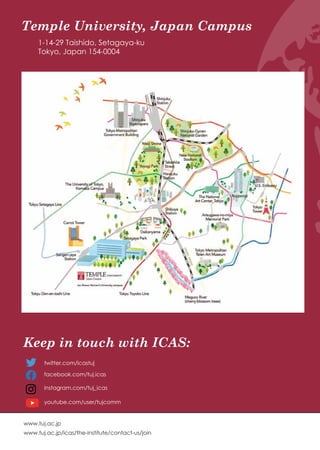
Temple University, Japan Campus
1-14-29 Taishido, Setagaya-ku
Tokyo, Japan 154-0004

ICAS Program Book Vol. 2: Fall 2019

  • 1.
    INSTITUTE OF CONTEMPORARY ASIAN STUDIES FALL2019 PROGRAM HELLO, SANGEN-JAYA! 2019 秋学期プログラム 現代アジア研究所
  • 2.
    1 The Institute ofContemporary Asian Studies (ICAS) began as the Pacific Rim Lecture Series in the 1990s, led by former TUJ Associate Dean and Main Campus Professor of Sociology Bob Kidder, followed by Jeff Kingston, professor and advisor of TUJ’s Asian Studies Program. At the time, Japanese economics, bureaucratic organization and politics were of primary interest in academia. TUJ had recently moved its campus from the outskirts of Tokyo to Azabujuban, and the central location presented growth opportunities for our graduate programs. The academic focus of the Pacific Rim lecture series not only appealed to TUJ faculty and students, but also supported the expanding graduate programs. In Azabujuban, the Pacific Rim lecture series was a success due in part to TUJ’s growth and the nearby international community. This success led to the lecture series becoming the Institute of Contemporary Japanese Studies (ICJS) in 2004, as other issues were coming to the forefront in academia. Japanese culture itself (its values rather than its institutional byproducts) and youth subcultures gained attention, which helped create the “Japan Wave,” of a uniquely post-modern society with an unmatched consumer society. Interest in Japanese pop culture around the globe, especially anime and manga, drew the attention of study abroad students looking for alternatives to their home societies, and ICJS programming came to include such cultural topics in addition to its prior political focus. The university and ICJS grew in tandem, with TUJ receiving a historic desig- nation as the first Foreign University, Japan Campus by the Ministry of Education in 2005. Following these developments, institute programming further broadened from a focus on Japanese studies to Asian studies in general, becoming the Institute of Contemporary Asian Studies (ICAS) in 2010. This reflected the changing demographics of Japan and its status in Asia, as Japan’s international relations with its Asian neighbors became even more politically contentious and a primary focus of U.S. foreign policy. A few years after morphing into ICAS, Robert Dujarric took over the direc- torship of the institute, replacing founding director Kyle Cleveland (now Associate Director). Under Robert’s leadership, the institute has evolved into a platform for examining Japanese politics, the U.S.-Japan Alliance, security issues and Japan’s fraught international relations (especially with Korea and China). Now that TUJ has moved to Sangen-jaya, we at ICAS are excited to expand institute activities and develop collaborative programs with Showa Women’s University (SWU) and other universities. Here we hope to continue to cultivate the kind of academic excellence and diverse perspectives that have characterized ICAS since its inception. ICAS Over the Years September 2019 Institute of Contemporary Asian Studies (ICAS) Temple University Japan Campus www.tuj.ac.jp |icas@tuj.temple.edu | 03-5441-9800 The Institute for Contemporary Asian Studies (ICAS) is a forum for intellec- tual and cultural exchange operating under Temple University, Japan Campus (TUJ). Our mission is to provide a platform for academics, journalists, business executives, students and others from all over the world to present inno- vative ideas and stimulate debate. ICAS sessions are interactive: speak- ers provide audiences with a starting point for discussion and likewise, audience participants raise new ideas that shape our programming. Notable Programs include: To learn more, please visit: www.tuj.ac.jp/icas/the-institute. • Evening Lecture Series, which features discussions, book talks, film screenings, and other public events throughout the year. • Adjunct Fellowship program, in which ICAS fellows facili tate speaking engagements with the Evening Lecture Series, and share research & networking opportunities. • Student Summer Fellowship program, which provides opportunities for student fellows to work with TUJ faculty members on collaborative research projects. The Institute of Contemporary Asian Studies (ICAS) at Temple University, Japan Campus 現代アジア研究所 (ICAS - Institute of Contemporary Asian Studies) はテンプル大学ジャパンキャンパスにおいて、研究者はもとより ジャーナリスト、ビジネス・政府関係者、学生から一般の社会人まで 幅広い層に開かれたアジア研究の知力・活動拠点として位置づけられ ています。政治、外交、教育、防衛、福祉、環境問題、またフィルム 上映など様々なテーマを取り上げ、通年にわたり第一線の専門家や 研究者による講演・公開討論を開催しています。また国内外の研究者 をICAS客員研究員として迎え入れ、意見交換、情報収集、ネットワー キングの場を設けて人的交流の推進を図っています。夏学期には外部 の大学・大学院生を対象とした夏期フェローシッププログラムを実施、 次世代のオピニオンリーダーの育成にも努めています。
  • 3.
    2 3 In November2013, Marinel Ubaldo was 16 years old when Typhoon Yolanda swept away her village in the Philippines, killing over 6,000 people. She and her family survived, huddled together without food for days, waiting for help from the outside world. This is when Marinel realized that it was the same outside world—and global warming—that was the cause of their misery. Join us to hear Marinel's story, and discuss how to be effective activists ourselves. This event is co-sponsored by Amnesty International Japan. “I survived the climate crisis so far, but what’s next?” Marinel Sumook Ubaldo 7:00 pm Oct. 8 We are pleased to invite you to a welcome recep- tion at the new TUJ campus. With a warm welcome from Robert Dujarric and Kyle Cleveland, the event will feature remarks from Jesper Koll, one of Tokyo's best known economic commentators. Join us for a celebration of the new venue and the future of ICAS! Jesper Koll ICAS Reception: 15 Year Celebration & New Campus Welcome 6:30 pm Oct. 4 Fall 2019 Program Selected events from the All ICAS events are held in English, open to the public, and free admission unless otherwise noted. For more details, please visit: www.tuj.ac.jp/icas/events David Leheny 7:30 pm The efficacy of Japan’s strategies to build “soft power” through support for its “content indus- tries” has been widely debated. David Leheny draws from his 2018 book Empire of Hope: The Sentimental Politics of Japanese Decline to argue situating these policies in a larger post-Bubble emotional frame for the state unlocks a more persuasive way to engage how the idea of soft power took root and what it has represented for Japan. Cool Optimism in the Empire of Hope Oct. 1 The Olympic Games have become synonymous with massive infrastructure projects, yet the question of whether such environmental costs are justified has been surprisingly understudied. Robin Kietlinski will take a close and critical look at these endeavors through a historical lens, and consider the full scope of the costs of hosting the Olympics. Trash Islands: The Olympic Games and Japan’s Changing Environment Robin Keitlinski 7:30 pm Sept. 27 Tensions between Washington and Beijing have been growing for many years. In a twist, the Trump administration announced increased tariffs targeting Chinese corporations, and China no longer shies away from responding to such measures. As a major trade partner of both the USA and the PRC, Japan finds itself in a tricky position if the trade war continues to escalate. Our panel will discuss the conflict and its impli- cations for Japan & the rest of the world. Robert Dujarric Alexander Dmitrenko Hiromi Murakami Trade Wars & Sanctions: The Sino-American Confrontation and Japan 7:00 pm Sept. 25 Fall 2019 Program Selected events from the
  • 4.
    4 5 Daruma inKanagawa, Japan. Photography by Bradley Meier, junior Asian Studies major. The ICAS Evening Lecture Series would not be a success without the help of our student team. ICAS student workers suggest topics, set up the venue, provide A/V support, record and edit lecture videos, and more. We are pleased to feature their photographs of Japan in this issue. ICAS is always adding new events to our progamming. Keep an eye out for these and other exciting events, and visit our website for more details: www.tuj.ac.jp/icas/events In November, Jeff Kingston will join ICAS to give a lecture on his new book, The Politics of Religion, Nationalism, and Identity in Asia. Exploring the nexus of religion, identity, and nationalism, this comprehensive volume assess- es similarities and differences across the region, focusing on how religious sentiments influence how people embrace nationalism and with what consequences. Jeff Kingston The Politics of Religion, Nationalism, and Identity in Asia 7:30 pm Nov. 19 Prime Minister Shinzo Abe has made relations with Russia a leading priority of his foreign policy, yet breaking the deadlock in the coun- tries’ long-standing dispute over the Russian-held Southern Kuril Islands (Northern Territories in Japan) remains a distant prospect. Our panel seeks to look beyond the narrow territorial issue to evaluate the broader status of Japan-Russia relations. Japan and Russia: Contemporary Political, Economic, and Military Relations Yu Koizumi Elena Shadrina James D.J. Brown 7:00 pm Oct. 17 Next year, Americans will go to the poll to re-elect Donald Trump or bring his presidency to an end. Our panel will seek to shed some light on the historical, political, social context which destroyed the old Republican Party and brought Donald Trump to power. Robert Dujarric Tag Murphy Gregory Noble Does American Democracy have a Future? The United States on the Eve of the 2020 Election 7:00 pm Oct. 10 Fall 2019 Program Selected events from the
  • 5.
    6 7 In Septemberof 2015, I attended a splashy gathering in Tokyo with a clunky title: “Unearthing the History of Japan and the United Nations through Audiovisual Archives.” The event, hosted by the Public Relations Office of the Government of Japan, was to unveil the digital archiving of Japan’s close history with the intergovernmental organization that is tasked with maintaining international order and promoting international cooperation. That organization, the United Nations, is featured prominent- ly in Tokyo through the United Nations University, whose global headquar- ters is located in the Shibuya ward of Tokyo. Nearly four years later, I still marvel at the interpersonal encounter I had that day with a woman whose global leadership at the United Nations makes her a national treasure. The nonagenarian Dr. Sadako Ogata, was at one time the most recognized shining light of Japanese women’s empowerment. Certainly for those of us in international relations study and practice, we knew her long stint (1991-2000) as the United Nations High Commissioner for Refugees. When most would have faded away in retirement, Dr. Ogata followed that high profile position by hold- ing the presidency of the Japan International Cooperation Agency (JICA) from 2003-2012. She is now a senior adviser to the Japan Model United Nations program that is quite popular among university students. I had known about Dr. Ogata since the 1990s when I was a young pup bureaucrat at the Department of State in Washington, D.C. where I served as the government liaison between DOS and Capitol Hill on refu- gees. To meet her in person was my national treasure. Japan Needs to “Go for the Gold” in Global Media Leadership Spotlight on the ICAS Adjunct Fellowship: Nancy Snow Nancy Snow is an ICAS Adjunct Fellow and Pax Mundi Professor of Public Diplomacy at Kyoto University of Foreign Studies. She is Emeritus Professor of Communications from California State University, Fullerton. Her forthcoming books are The Sage Handbook of Propaganda, the second edition of the Routledge Handbook of Public Diplomacy, and a Japanese translation of Japan’s Information War. Reach her at http://www.nancysnow.com. When Japan joined the UN in 1956, it did so with great enthusiasm and broad public support, for the international organization was seen to embody the pacified country's hopes for a peaceful world order. Membership was welcomed by many Japanese who saw the UN as a guarantor of a policy of unarmed neutrality for their nation, in addition to the security arrangement they concluded with US in 1951. To others, support for the UN would be useful in masking or diluting Japan's almost total dependence on the United States for its security. The government saw the UN as an ideal arena for its risk minimizing, omnidirectional foreign policy. That UNU day, I celebrated along with prominent government officials, including Urasenke Grand Master Dr. Genshitsu Sen, UNESCO Goodwill Ambassador, appointed for his contribution to peace and culture through the traditional Japanese tea ceremony; Kiyotaka Akasa- ka: President of the Foreign Press Center Japan (FPCJ); Kaoru Nemoto: Director of the UN Information Centre, Tokyo; and Tomohiko Taniguchi: Special Advisor to the Cabinet of Prime Minister Shinzo Abe. These people have become professional or personal contacts who have guided my understanding about Japan’s role with not only the United Nations but also the world. There is no doubt that the UN figures prominently as an intergovern- mental organization. Many Japanese I have met wax nostalgically about how the UN helped to assist an impoverished postwar Japan. Others relate Japan’s relationship to the UN as kindred spirit international peace brands. Even this Wikipedia entry about Japan and the United Nations reflects this special relationship: Spotlight on the ICAS Adjunct Fellowship Where one does not hear about Japan’s tie to the United Nations so much, if ever, is in Japan’s role as a global communicator. Officially at the government level, or unofficially at the press level, Japan’s global dialogue is relatively weak, conditioned as it is by press clubs, self-censor- ship, and poor media relations. Recently I visited Osaka during the G20 Summit. I was there on invitation to do live on-air analysis with various international media such as Doha’s Al Jazeera and Istanbul’s TRT World. I made my way to the Government of Japan’s media relations office adja- cent to the International Exhibition Center, Osaka (INTEX) where the G20 was taking place. Despite showing my bona fides, a press credential from the G7 Summit in Ise-Shima, passport, and university meishi, I was unsuccessful in securing any temporary access to the international media center. My hopes were raised when a media relations staff person said that I could obtain temporary media access if I had someone senior from the Ministry of Foreign Affairs call on my behalf. I quickly emailed my contact, she
  • 6.
    8 9 called thecontact number of the press center, only to be told that there is no suchthing as temporary media access. I ended up doing media interviews outside the venue via Skype. I had hoped to discuss with a number of international media in atten- dance Japan’s self-designated leadership in reducing plastics in the oceans. This eco-conscious initiative by the summit host was not promi- nent at a G20 dominated by superpowers on display, including the Amer- ican president and his Russian and Chinese counterparts. Even the post-G20 Summit handshake at the DMZ overshadowed the sustainability conversation. The G20 Osaka media relations experience is a first in my professional career where I’ve been denied access for media interviews. It reflected what could be a major challenge for the Japanese government during the 2020 Summer Olympics and Paralympics. No other global event invites the hot spotlight of international media attention than the spectacle of the Olympics, to say nothing of all the activist citizens and citizen bloggers with their own respective agendas. Is Japan ready for the heat of interna- tional public opinion? The “BBC of Japan” known as NHK will be the host national broadcaster during Tokyo 2020. As I write at length in the current issue of the Asian Journal of Journalism and Media Studies¹, NHK is best known for its enabling relationship with the Abe administration, as has been written about by a number of prominent critical scholars, including Koichi Nakano at Sophia and Jeff Kingston at Temple University, Japan Campus. When the eyes of the world descend on Japan next summer, other stories—inspiring, inquiring, and investigative—will come on display and Japan’s media relations better be ready to feed a global media beast that will pull no punches in coverage. ¹Nancy Snow, “NHK, Abe and the World: Japan’s Pressing Needs in the Path to 2020,” Asian Journal of Journalism and Media Studies, No. 2, 2019, https://doi.org/10.33664/ajjms.2.0_15. Spotlight on the ICAS Adjunct Fellowship Is Japan ready for the heat of international public opinion? Can North Korea ‘Reform and Open Up’? The situation the international community is facing regarding North Korea increas- ingly looks like an overly constrained set of equations perhaps without solution. T.W. Kang, Managing Director of Global Synergy Associates joined ICAS in June to provide the perspective from the Korean peninsula. Given his past visits to former socialist countries that transitioned, he provided analysis of the prospects of a North Korean transition to a market economy. Makiko Terahara of Marriage for All Japan explains key ideas of the lawsuit for same-sex marriage. In February 2019, multiple lawsuits were filed seeking equal marriage rights in Japan. Makiko Terahara, one of the lawyers in the case, spoke on a panel at ICAS in June. “Every single individual on earth is a minority in some aspects,” she said. “So in that sense, I think these lawsuits are for all people, not just for same sex couples.” Alexander Dmitrenko of Lawyers for LGBT & Allies Network (LLAN), provided international perspective by focusing on the movement in Canada and Taiwan as case studies. Naosuke Fujita, also of LLAN, described why marriage equality is good for business and how businesses can support LGBT acceptance in Japan. Marriage Equality in Asia Highlights from our recent summer program
  • 7.
    10 11 for anybodyinterested in understanding what is going on in the complex ecosystems of Japan and the rest of Asia. They not only cover vital topics, they are also very professionally moderated and allow plenty of time for a robust discussion.” Nagano, Japan. Photography by Grace Bellamy, senior Communications major. “ICAS events are essential Dan Slater Founder & Director The Delphi Network Asato Ikeda is assistant professor at Fordham University in New York, and has been published in journals such as “Japan Focus” and “mod- ernism/modernity”. She recently spoke at ICAS on her new book, The Politics of Painting: Fascism and Japanese Art During WWII. In this interview, Ikeda speaks with Jeff Kings- ton, advisor and coordinator of Asian studies major at TUJ and professor while Ikeda was a student at TUJ. In Conversation with Asato Ikeda Highlights from our recent summer program: Jeff Kingston: You started your academic career at TUJ, followed by studies and research at several major institutions. Can you describe how your career path developed after your time at TUJ? Asato Ikeda: I was at TUJ in 2003 and 2004, taking classes for two years. I decided to go to Canada and study at the University of Victoria, where I did my B.A. That’s where I got more serious about studying art history. I decided to go into the M.A. program, and specialize in Japanese modern art. After the M.A., I thought I wanted to get a Ph.D. and go to the Univer- sity of British Columbia. So one thing led to another. It’s not like I envisioned becoming a professor at the end when I started here. But I just pursued whatever I wanted to do, and ended up becoming a university professor in New York (laughter). Kingston: Stumbled backwards into it, like many of us! Ikeda: Right, right! I didn’t imagine that I would be doing what I’m doing 15 years ago. Kingston: That’s quite an inspiring story for young Japanese considering going on overseas studies and thinking about the possibilities– you may not end up where you expect to, but it could be interesting.
  • 8.
    12 13 Ikeda: Inretrospect, I think I was pretty ambitious and adventurous, but you know I was younger, too (laughter). Kingston: Much of your work is relevant to broad themes of social rele- vance, from politics to gender studies. How do you see your work within current sociopolitical trends? Ikeda: Right. I think the reason why I’m interested in history and the past is that I could find something that is meaningful or helpful when thinking about the present. When it comes to my research, I tend to think about the politics and how to understand World War II now, which is still a rele- vant and recurring topic. That’s what became my book. When it comes to “A Third Gender” also-- things are relevant to us again in retrospect, and it’s very useful. Especially when I’m teaching, because often I’m teaching students who are taking my class because it’s required (laughter). Right? They’re not necessarily interested in the things I’m talking about. But because my research touches on more general topics like gender and politics, that’s a connecting point. The students could think more compar- atively about their country or their history, and could articulate their opin- ions. Kingston: Connecting the dots over the arc of history. Ikeda: Yes, yes, exactly. Kingston: These days, there’s a great interest in LGBTQ, and so your third gender exhibit clearly could resonate with students who might be taking your course only because it is required. Ikeda: Yes, and come to think of it, I used my article in which I wrote about how to understand the Edo period gender practices from our contempo- rary perspective. That was the first time two students came out and identi- fied themselves as gay and bisexual in front of other students. And you know, I’m teaching at a Jesuit Christian university (laughter). So I thought this was a pretty magical moment. I was very glad to see that kind of thing happening in my class. Kingston: Your lecture tonight at ICAS is related to your most recent book, “The Politics of Painting”, which analyzes paintings from the WWII period through the lens of fascism. What was the starting point for this project? Ikeda: Things I learned at TUJ were really the starting point. In particular, I In Conversation with Asato Ikeda state ideology. But really, my project came from things that I studied at TUJ. Kingston: That’s an interesting lens, looking at it from the counterculture of the 60s and music, and looking at what was going on in Japan in the 30s and 40s. Ikeda: Right. Kingston: That’s quite fascinating. Ikeda: My question was really, why didn’t that happen in the 30s and 40s, right? Why didn’t people protest against the state? Kingston: What kind of connections did you find between fascism and art in say, Germany and Italy and Japan? Did you notice anything particular- ly striking? Ikeda: Because I’m talking about this concept of fascism, I’m basically looking at their connections and similarities. Visually speaking, they’re mostly modernist because the 1930s and 40s came after modernism as a movement. But they look back to the past, and in the case of Japan it could be various things. It could be about Mt. Fuji, or rural customs, or the beautiful women or bijin-ga from the Edo period. In Germany and Italy, they mainly look at more of a Greco-Roman antiq- uity. If you look at the paintings and visual arts, they may look slightly different because they’re looking at a different kind of history. But in the sense that they’re looking at the past and glorifying it in order to justify The reason why I’m interested in history is that I could find something meaningful to think about the present. would point to your class, where we talked about things like war responsi- bility, right-wing conservative and history revisionists, things like that. And also, Dr. Horton’s class about music and politics. We talked about the 1960s counterculture and the Vietnam War. What I wrote about was the opposite of counterculture, because it’s more about the imposition of the In Conversation with Asato Ikeda
  • 9.
    14 15 violence—I thinkthat’s where we could see the similarities between those movements. Kingston: In 2017, you curated an exhibit with the Royal Ontario Museum in Toronto on wakashu prints of Japan's "third gender" during the Edo period. How did you become interested in this work? How does this work challenge modern notions of binary gender? Ikeda: This is something that I did in the capacity of curator, but the proj- ect really comes from my collaborator, Joshua Mostow, at the University of British Colombia who specializes in the topic. I was fortunate enough to work on this with him. Generally speaking today, people are questioning this kind of gender binary and heteronormative sexuality to begin with, so it fit very well with the current social climate. That was why the exhibition was very success- ful, I think. People were interested in different kinds of practices around sex and gender and sexuality. Kingston: You took ROM [Royal Ontario Museum] into unexplored territory. Ikeda: I hope so! Kingston: There is a lot of discussion around the decline of area studies. What do you think is lost in this decline? Ikeda: Temple University Japan is in a very unique position to offer this program of Asian Studies to, you know, American students who could come here and study things firsthand. Kingston: And Japanese students like you! Ikeda: That is true! Definitely, it offers a lot to Japanese students who want to study in English but do not have the means to go abroad yet. I don’t know what to say about the decline of Asian studies, but I think it gives students a sense of community. Networking, and also a sense of commu- nity. Kingston: Well, thank you for spending time and sharing your insights. Ikeda: Thank you! Ikeda presenting her research at ICAS on July 16, 2019. In Conversation with Asato Ikeda ICAS hosted the book launch of “Beyond the Gender Gap in Japan”, a collec- tion of essays on various aspects of women’s lives in Japan. Gill Steel, the editor, presented on the central question in the book: why do Japanese women statisti- cally express a high sense of well-being in a context of inequality? Steel was joined by four authors of essays in the book: Mito Akiyoshi of Senshu University, Kumiko Nemoto of the Kyoto University of Foreign Studies, Hiroko Takeda of Nagoya University, and Yuki Tsuji of Tokai University. Each spoke about their research on women’s lives. The panel was followed by a lively Q&A session. “Beyond the Gender Gap in Japan” was published in May 2019. It is available in bookstores and from online retailers. Beyond the Gender Gap in Japan Hiroko Takeda of Nagoya University presents on 'Life' as a Political Agenda Highlights from our recent summer program "Even though [Abe Shinzo] has delivered virtually none of the promises that he has made to them, he is still beloved by the right-wing. Who else can make that claim? … Who else can assuage their fears and their desires, and still end up giving them nothing?" Michael Cucek, adjunct professor at TUJ and adjunct fellow at ICAS, took the stage to provide his yearly update on the current state of Japanese politics. His analysis covered key issues in the July election, priorities of the Abe administration and Abe Shinzo's legacy -- with insight, nuance and humor. Reiwa One: A Political Outlook
  • 10.
    The comments, opinionsand statements expressed in ICAS events, lectures and publications are solely those of the presenters, and do not constitute comments, opinions, or statements of ICAS, TUJ or Temple University, which do not verify, sanction or endorse such comments, opinions, or statements. Founded in 1920 in the turbulent aftermath of the First World War, Showa Women’s University is one of the top academic institutions for women in Tokyo. With a number of globally-oriented programs such as the campus in Boston, Showa provides students with the skills and knowledge neces- sary to meet the challenges of a globalized world. The university’s motto “Be a light to the world” reflects its commitment to educating women who can initiate meaningful changes in society. ICAS is proud to have collaborated with Showa Women’s University on a number of events over the years. Showa Women’s University Spotlight on our Collaborators SWU Chancellor Mariko Bando and ICAS Director Robert Dujarric at the ICAS-SWU joint lecture on March 7, 2017. Professor Naohiro Yashiro speaks at TUJ about Japanese immigration policy on May 28, 2019. Ms. Yumiko Murakami and Professor Akiko Imai present on ”How Can Japan “Activate” Women?” at SWU campus on June 12, 2018. Professor Toshio Takagi explains the problems and solutions to Japan's exploitative enterprises (ブラック企業) on November 28, 2017. Through these cooperative efforts, TUJ-SWU joint initatives have been a great success over the years. We look forward to our continued collaboration going forward! 16
  • 11.