NORTH EAST ASIA'S UNDERCURRENTS OF CONFLICT
Asia Report N°108 – 15 December 2005
TABLE OF CONTENTS
EXECUTIVE SUMMARY AND RECOMMENDATIONS................................................. i
I. INTRODUCTION .......................................................................................................... 1
II. TERRITORIAL DISPUTES ......................................................................................... 2
A. TOKDO/TAKESHIMA..............................................................................................................2
B. SENKAKU/DIAOYU................................................................................................................4
C. KANDO .................................................................................................................................6
III. THE SHADOW OF HISTORY..................................................................................... 8
A. WAR CRIMES ........................................................................................................................8
B. THE U.S. ROLE .....................................................................................................................9
C. YASUKUNI SHRINE VISITS...................................................................................................11
D. TEXTBOOKS ........................................................................................................................12
E. CLASHING HISTORIES: A COMPARISON OF HISTORICAL MUSEUMS .....................................14
1. Japan ........................................................................................................................14
2. Korea........................................................................................................................15
3. China........................................................................................................................16
IV. SORRY SEEMS TO BE THE HARDEST WORD.................................................. 17
V. RISING NATIONALISM............................................................................................ 20
A. CHINA.................................................................................................................................20
B. SOUTH KOREA ....................................................................................................................21
C. JAPAN .................................................................................................................................22
VI. SOLUTIONS................................................................................................................. 26
A. TERRITORIAL DISPUTES ......................................................................................................26
B. HISTORICAL DISPUTES ........................................................................................................26
C. CONFIDENCE-BUILDING MEASURES....................................................................................27
D. INSTITUTION BUILDING.......................................................................................................28
APPENDICES
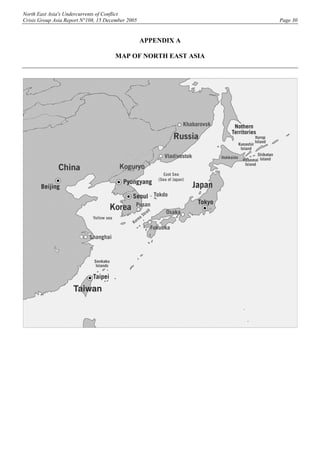
A. MAP OF NORTH EAST ASIA.................................................................................................30
B. ABOUT THE INTERNATIONAL CRISIS GROUP .......................................................................31
C. CRISIS GROUP REPORTS AND BRIEFINGS ON ASIA...............................................................32
D. CRISIS GROUP BOARD OF TRUSTEES ...................................................................................35
Asia Report N°108 15 December 2005
NORTH EAST ASIA'S UNDERCURRENTS OF CONFLICT
EXECUTIVE SUMMARY AND RECOMMENDATIONS
Shifting power relations in North East Asia are spurring
rising nationalism in China, Japan and South Korea,
aggravating long-standing disputes over territorial claims
and differing interpretations of history. Failure to bridge
these differences could raise tensions and impede efforts to
tackle the security and economic challenges confronting
the region. While finding lasting solutions will be difficult,
a series of practical confidence and institution-building
steps should be taken immediately by the three states to
keep the simmering disputes from boiling over.
The economic rise of China, generational shifts in South
Korea, and the waning of Japan’s economic dominance
have spurred xenophobia that occasionally spills over into
violence. All three need to work together to address their
major challenges in security, non-proliferation, energy
procurement and environmental protection, but North
East Asia remains one of the least integrated regions, with
no effective institutions to address its common political
and security problems.
A number of events in 2005 illustrate the simmering
tensions. In March, South Korean demonstrators cut off
their fingers in protest over Japanese claims to a pair of
small islets. The next month, Chinese demonstrators
attacked Japanese businesses and diplomatic missions
over a Japanese history textbook, while in June, Japanese
Prime Minister Koizumi Junichiro and South Korean
President Roh Moo-hyun spent most of a two-hour
meeting discussing history, rather than current issues.
China began drilling for oil in September in a disputed
area of the East China Sea, over Japanese protests, and
in November, as a result of the visit Koizumi paid to the
Yasukuni Shrine, where Japanese war criminals are among
the millions of honoured dead, President Hu Jintao
refused to have a one-on-one meeting with Koizumi on
the margins of the Asia-Pacific Economic Cooperation
summit.
Most territorial disputes in the region are over uninhabited
islands and partially submerged rocks, whose status
remains ambiguous under international law, including
Tokdo/Takeshima, jointly claimed by South Korea and
Japan; Senkaku/Diaoyu, jointly claimed by China, Taiwan,
and Japan; and the Kuril/Northern Territories, jointly
claimed by Russia and Japan. The importance of most of
these lies not so much in their intrinsic value, but in the
surrounding economic zones. The best way to address the
problems, therefore, would be to leave aside territorial
issues and focus on joint exploitation and, as appropriate,
conservation of the natural resources. A lesser, but longer-
term, dispute involves the area in North East China (Kando
in Korean, Jiangdao in Chinese) populated by ethnic
Koreans and to which some groups in South Korea have
begun to advance a historical claim that they hope to
make good when Korea is reunified. In reality, however,
ethnic Koreans in China have little interest in joining a
unified Korea, and Seoul will likely need to renounce any
such interests if it wants to gain Chinese support for any
eventual unification of the peninsula.
Prime Minister Koizumi’s visits to Yasukuni Shrine and
attempts by right-wing groups to produce revisionist
history textbooks have prompted alarm in both China and
South Korea and added to the emotion with which they
accuse Japan of failing to show contrition for its World
War II crimes. While Tokyo has offered numerous official
apologies and provided billions of dollars of aid to help
spur the development of South Korea and China, it has
failed to offer direct compensation to individual victims,
and, unlike Germany, has shown little interest in continued,
critical examination of its history.
Combined with Japan’s moves to become a more “normal”
nation in terms of defence capabilities, these battles over
history increase regional fears of reviving Japanese
militarism. Japan has passed legislation to allow it to play
a stronger role within the U.S. military alliance and in
international peacekeeping operations, and the ruling
Liberal Democratic Party is backing a constitutional
amendment that would remove most of the restrictions
imposed on the country’s military after 1945. Hostile
reactions to these moves by China and South Korea have
created a backlash in Japan that goes beyond the extreme
right.
History is an equally troubling subject, though in different
ways, in South Korea, which is in the midst of leadership
change and a re-examination of its relationship with the
U.S. at the same time as it re-examines the national myths
North East Asia's Undercurrents of Conflict
Crisis Group Asia Report N°108, 15 December 2005 Page iv
surrounding politically sensitive collaboration with and
resistance to imperial Japan. And in China, history, not
least the memory of the military struggle against that
imperial Japan, is used to provide the legitimacy for its
political order that communist ideology no longer can.
Attempts to address these emotion-laden and intertwined
problems have led to some encouraging instances of inter-
regional cooperation among scholars and civil society
groups that suggest North East Asia’s problems can be
managed. Promising proactive measures include codes of
conducts – one has already been effective in reducing
tensions over the Spratly Islands; agreements on joint
management of off-shore resources; regional institutions
to address energy and historical issues; increased military-
to-military exchanges; and historical memorials that focus
on the universal suffering of war victims, rather than on
national glory or shame.
Definitively resolving territorial and historical disputes
that have been building for decades will not be easy or
quick but failure at least to ameliorate them risks
undermining the peace and prosperity of the region.
RECOMMENDATIONS:
To the Governments of Japan, China, South
Korea and the United States:
1. De-link history issues from diplomacy by
continuing contact among officials at all levels
regardless of the fluctuating state of public opinion.
2. Refrain from unilateral military exercises in
disputed areas.
3. Increase military-to-military exchanges, training
and confidence-building measures.
4. Establish a regional institution for energy security
and cooperation that would explore such issues as
establishing a depository for spent nuclear fuel.
5. Set up regional cooperative mechanisms for
disaster relief and environmental protection.
6. Start an East Asia Peace Institute for sustained
Track Two dialogue, joint inquiries, scholarship
and conferences.
7. Convene a committee of museum curators and
scholars to develop agreed standards for historical
exhibitions, with the goal of focusing displays on
universal human suffering and accomplishment,
rather than nationalism.
8. Increase support for NGO activity that promotes
regional dialogue.
To the Government of Japan:
9. Set up a fund that uses public money to assist
remaining individual victims of Japanese war
crimes, in particular “comfort women”, forced
labourers, and subjects of biological warfare
experiments.
10. Release into the public domain any remaining
documents on World War II and colonial activities.
11. Build a new memorial to Japanese war dead to
provide an alternative to official visits to Yasukuni
Shrine.
12. Have cabinet members refrain from making public
statements which praise or downplay Japan’s
colonial exploits.
To the Government of South Korea:
13. Conclude an agreement on allowable catches by
South Korean and Japanese fishing boats in the
median fishing zone around Tokdo/Takeshima.
14. Clearly state that the South accepts existing border
treaties and will pursue peaceful reunification on
this basis.
15. Establish a public fund to provide compensation
for the victims of Japanese colonialism who were
under-compensated or not compensated by the
1965 Normalisation Treaty.
16. Publicly acknowledge and thank Japan for the
economic aid provided under the Normalisation
Treaty.
To the Government of the People’s Republic of
China:
17. Allow Chinese internet users greater access to
Japanese and Western media to provide alternative
views.
18. Accept in principle Japanese offers on joint
development of oil and gas deposits in the East
China Sea.
19. Develop a Code of Conduct with Japan over the
Senkaku/Diaoyu dispute, using the China-ASEAN
Code of Conduct on the Spratlys as a model.
20. Publicly acknowledge Japan’s role in China’s
economic development.
To the Government of the United States:
21. Strengthen trilateral policy planning coordination
with Japan and South Korea to develop more
North East Asia's Undercurrents of Conflict
Crisis Group Asia Report N°108, 15 December 2005 Page v
direct discussion on security issues between Seoul
and Tokyo.
22. Release to bona fide researchers documents related
to Japanese war crimes seized at the end of World
War II and which until now have been withheld.
Seoul/Brussels, 15 December 2005
Asia Report N°108 15 December 2005
NORTH EAST ASIA'S UNDERCURRENTS OF CONFLICT
I. INTRODUCTION
The rapid of rise of China over the past decade and South
Korea’s emergence as a dynamic developed economy have
challenged Japan’s economic hegemony in the region.
China’s emergence as a global economic power is creating
new security, energy and environmental challenges. At
the same time, the combination of democratisation and
demographic shifts have transformed South Korea from a
pro-American bulwark of anti-communism into a country
increasingly grappling with its identity while it seeks
reconciliation with its estranged brother to the north.1
These changes have spurred rising nationalism in all three
countries. China’s new-found assertiveness is matched by
Japan’s desire to become a “normal country” and the
South Korean government’s aspiration to be a “balancer”
in the region and avoid the fate that befell the nation
a century ago: colonisation. Such changes have proven all
too tempting for political leaders to take advantage of and
the media to amplify and distort.
Rising nationalism in turn exacerbates long-standing
disputes over territory and history in the three countries.
While none of these alone are likely to lead to armed
conflict, they negatively affect popular views of neighbours
within each country. Dealing with the larger problems
produced by the power shifts is complicated by the
obsession with these lesser issues. This can be seen in the
refusal of Chinese President Hu Jintao to meet with
Japanese Prime Minister Koizumi Junichiro during the
November 2005 Asia-Pacific Economic Cooperation
(APEC) summit and in South Korean President Roh Moo-
hyun’s decision to devote nearly three quarters of a
two-hour session with Koizumi in June 2005 to history
questions, leaving little time to discuss the North Korean
nuclear threat. State Councillor Tang Jiaxuan told visiting
Democratic Party of Japan head Maehara Seiji on 11
December that “China-Japan relations are at their lowest
point since normalisation in 1972”.2
Official contacts are
1
Crisis Group Asia Report N°89, Korea Backgrounder: How
the South Views its Brother from Another Planet, 14 December
2004.
2
“China-Japan Relations at Worst Point Since Normalisation”,
Chosun Ilbo, 13 December 2005 (in Korean).
insufficient at the working level due to the lack of regional
institutions.
Much like the lava in an active volcano, these tensions
remain just below the surface, ready to erupt in response
to events. For example, in February 2005, the Japanese
ambassador to South Korea, Takano Toshiyuki, made
a statement that Takeshima was an integral part of Japan.
On 16 March 2005, the assembly of Japan’s Shimane
Prefecture declared 22 February Takeshima Day, asserting
a claim to the disputed islets known in South Korea
as Tokdo.3
South Korea responded by cancelling a trip to
Japan by Foreign Minister Ban Ki-moon and some events
to mark “Korea-Japan Friendship Year” and easing
restrictions on South Korean tourist visits to the islets.
Protestors burned the Japanese flag in front of the embassy
in Seoul, and two even cut off their own fingers.4
South
Koreans posted scatological and belligerent images on the
internet relating to Japan and Prime Minister Koizumi.5
Nakamoto Yoshihiko, an international relations scholar at
Shizuoka University, noted: “My students were rather
shocked to see how much Chinese and Koreans hated
them”.6
Japanese nationalists retaliated by hacking into
the South Korean government’s Tokdo website7
to post
a statement that “Takeshima is the original domain of
Japan”.8
In April, mass protests held across China in opposition to
Japan’s bid for a permanent seat on the UN Security
Council turned violent when demonstrators attacked
Japanese businesses and diplomatic compounds. The
Japanese Foreign Ministry responded by summoning
China’s ambassador and demanding an apology, which
3
“Shimane Touts ‘Takeshima Day’”, Japan Times, 17 March
2005.
4
“S. Korea Protest over Japan Claim”, BBC News, 16 March
2005.
5
“‘Ultranationalist’ Witch Hunt Reaches Climax”, Sisa Journal,
5 April 2005, pp. 92-94 (in Korean). Among the images were
those showing Koizumi as a dog wallowing in excrement and
several depicting attacks on Japan with nuclear weapons.
6
Crisis Group interview, Tokyo, 25 August 2005.
7
http://www.dokdo.go.kr.
8
“Japanese Hackers Attack ‘Cyber Tokdo’ Site”, Chosun
Ilbo, 24 October 2005, p. A8 (in Korean).
North East Asia's Undercurrents of Conflict
Crisis Group Asia Report N°108, 15 December 2005 Page 2
was refused.9
Both China and South Korea reacted
negatively to Koizumi’s visit to the controversial Yasukuni
Shrine on 17 October 2005,10
while Japan protested when
China began drilling in September for oil in a disputed
area of the East China Sea.11
Although China-South Korea relations have been relatively
calmer than those of either country with Japan, they are
not without their controversies. A dispute over whose
history ancient kingdom of Koguryo should properly
“belong” to has led them to form separate study groups
to press their claims. In September 2004, a group from the
South Korean National Assembly submitted a resolution
asserting that a 1909 treaty between China and Japan
which set the border between Korea and Manchuria was
null and void.12
The focus on these issues actually works against each
country’s best interest. Japan cannot realise its Security
Council ambition without the support of China. China’s
goal to have the world accept its rise as peaceful is
undermined by scenes of protestors attacking Japanese
consulates. South Korea needs strong economic and
political support from its neighbours to achieve its goal of
reconciliation and eventual reunification with North Korea.
While appeals to nationalism and ancient grudges may
help politicians get elected, they detract from long-term
diplomatic objectives.
Excessive nationalism can be likened to a chronic disease
for which no cure has yet been found. But even if we
cannot cure the disease, we can at least seek to minimise
the sources of inflammation. Finding ways to restrict the
negative effects of seemingly intractable territorial and
historical disputes would free policymakers to focus on
the vital task of building a new regional order.
9
“China Won’t Apologise to Japan Over Protests”, Associated
Press, 18 April 2005.
10
“Japan PM Visits Yasukuni Shrine”, BBC News, 17 October
2005.
11
Anthony Faiola, “Japan-China Dispute Escalates”, The
Washington Post, 22 October 2005, p. A17.
12
Yoon Won-sup, “Gando New Source of Friction”, Korea
Times, 8 September 2004.
II. TERRITORIAL DISPUTES
Territorial disputes in North East Asia are by no means
as intense as in some other areas, such as the India-
Pakistan dispute over Kashmir. For the most part, they
involve the ownership of small, uninhabited islands
between the countries, whose value lies in the resources
of the surrounding waters rather than in the land itself.
Nonetheless, these disputes have the ability to stir
nationalistic sentiments to a degree that far outweighs
their intrinsic worth. The vagueness of international law
governing ownership of uninhabited off-shore islands
adds to the difficulty of resolving the competing claims.
The 1951 San Francisco Peace Treaty, which formally
ended the Pacific War and restored sovereignty to Japan,
left unresolved the ownership of a number of small islands
in North East Asia.13
These territorial disputes have
recently become more salient due to competition for
resources and rising nationalism. Years of over-fishing
have greatly reduced stocks worldwide,14
while the
establishment of 200-mile Exclusive Economic Zones
(EEZ) under the 1982 UN Convention on the Law of the
Seas has left nearly 99 per cent of the world’s fisheries
under the jurisdiction of a state.15
The depletion of global
oil reserves has prompted coastal nations to explore for oil
and gas deposits on the ocean floor, based on their right to
exclusive use of the continental shelf contiguous to their
territory. This has created incentives to push claims to
ownership over small, uninhabited islands and rocks
in order to extend EEZs where territorial waters overlap.
In North East Asia, this problem is exacerbated by the
connections, real or imagined, of the territorial disputes
with Japanese imperialism.
A. TOKDO/TAKESHIMA
The territory known as Tokdo in Korean, Takeshima in
Japanese, consists of two rocky islets with an area of 186
square metres in the East Sea/Sea of Japan, 93 kilometres
east of the South Korean island of Ulleung and 157
13
Seokwoo Lee, “The 1951 San Francisco Peace Treaty with
Japan and the Territorial Disputes in East Asia”, Pacific Rim
Law & Policy Journal, vol. 11, no. 1 (January 2002), pp. 64-
146.
14
Mark Valencia, “Maritime Regime Building: Lessons
Learned and Their Relevance for Northeast Asia”, Publications
on Ocean Development, vol. 36 (21 June 2001), p. 87 and passim.
15
See the website of the UN Division for Ocean Affairs and
Law of the Sea: http://www.un.org/Depts/los/convention_
agreements/convention_historical_perspective.htm#Exclusiv
e%20Economic%20Zone.
North East Asia's Undercurrents of Conflict
Crisis Group Asia Report N°108, 15 December 2005 Page 3
kilometres west of the Japanese island of Oki.16
Lacking
fresh water, the islets historically have been uninhabited,
although South Korea has posted a few guards on the
barren rocks to reinforce its claim. Without a record of
habitation to point to, the ownership debate revolves
around ancient documents and archaic usage patterns.
Koreans point to the incorporation of the island state
of Usanguk – the islands of Ulleung and Tokdo – by the
Korean kingdom of Silla in the year 512 as the basis for
their historic claim to the islets. They produce numerous
old documents and maps that purport to show Tokdo as
belonging to Korea.17
They also point to a seventeenth
century incident, when a Korean fisherman protested
the incursion of Japanese fishermen into the area around
Tokdo, resulting in Japanese authorities affirming Korean
claims to the island.18
Conversely, Japan claims that in 1483 the Korean king
banned his subjects from travelling to Ulleung island, to
prevent criminals and tax evaders from taking refuge
there. Japan maintains that from that point forward,
Ulleung was ungoverned territory. In the seventeenth
century, the Tokugawa Shogunate allowed Japanese
fisherman to visit Ulleung. On the way, many would stop
at Takeshima, to rest or hunt seals. Thus, Japan claims
that it was actually ruling both territories during this
period.19
In January 1905, at the request of a Japanese fisherman,
the Meiji government formally incorporated Takeshima
into the territory of Oki Island.20
Japan argues that
this act designated the islets as Japanese territory under
international law. Koreans, however, see this move as
one of the opening acts of imperial aggression, pointing
out that the Korean government, having been forced to
sign a treaty accepting Japanese advisers the year before,
was in no position to protest.21
Thus, what for the Japanese
is purely a legal issue, stirs bitter memories for Koreans
of Japanese colonialism.22
“For any country, whether
here or in Africa, it’s important to get rid of the legacy
of colonialism”, argues Kim Sol-a, who heads a non-
16
See map at Appendix A below.
17
“Compendium of Tokdo Documents”, Bureau of Maritime
Affairs and Fisheries, 2004 March (in Korean).
18
Shin Yong-ha, “A Historical Study of Korea’s Title to
Tokdo”, Korea Observer, Autumn 1997, pp. 333-358.
19
Website of Shimane prefectural government: http://www.pref.
shimane.jp/section/takesima/eng/take4.html.
20
http://www.pref.shimane.jp/section/takesima/eng/take6.html.
21
South Korean Ministry of Foreign Affairs and Trade, 18
July 2005.
22
Crisis Group interview, Yanada Takayuki, former special
adviser to the speaker of the Japanese House of Representatives,
Tokyo, 27 June 2005.
governmental organisation (NGO) dedicated to
“protecting” Tokdo.23
At the end of World War II, the victorious allies declared
that Japan would have to relinquish all its former colonies,
including Korea. Early drafts of the San Francisco Peace
Treaty alternated in awarding Tokdo/Takeshima (referred
to by the name given by French explorers, Liancourt
Rocks) to Korea or Japan. In the end, the islets were left
out of the treaty altogether.24
In 1952, as the U.S. prepared
to return sovereignty to occupied Japan, South Korean
President Syngman Rhee acted pre-emptively by declaring
a sea boundary that included Tokdo. This so-called “Rhee
Line” remains the area of South Korean territorial claims
in the East Sea/Sea of Japan but has never been accepted
by Japan. During negotiations on Japan-South Korea
diplomatic normalisation in 1965, South Korean President
Park Chung-hee complained to U.S. Secretary of State
Dean Rusk that Tokdo remained “an irritating problem”
and that “he would like to bomb the island out of existence
to resolve the problem”.25
A South Korean diplomat who
was at the meeting emphasised that the proposal was not
serious, but that it represented Park’s frustration with the
difficulties in normalising relations.26
Subsequent South
Korean governments have been more protective of the
country’s claim, reinforcing sovereignty over the islets by
building a landing dock, stationing police, and organising
boat tours.
According to the Law of the Sea Convention, disputes
that can not be settled by peaceful negotiation should be
submitted to “a court or tribunal having jurisdiction in this
regard”, such as the International Tribunal for the Law of
the Sea or the International Court of Justice. While Japan
has expressed willingness,27
South Korea refuses to
acknowledge the area as in dispute. From the Korean
standpoint, since Tokdo is already de facto Korean land,
there is nothing to be gained by submitting the issue to
international arbitration and potentially everything to lose
if a capricious court rules in Japan’s favour.28
“Even
though South Korea may have a better historical claim,
the International Court of Justice tends to favour the
intention of colonisers in settling territorial disputes”,
23
Crisis Group interview, Kim Sol-a, General Affairs, Party
for Tokdo Protection, Seoul, 24 August 2005.
24
Seokwoo Lee, “The 1951 San Francisco Peace Treaty with
Japan and the Territorial Disputes in East Asia”, Pacific Rim
Law & Policy Journal, vol. 11, no. 1 (January 2002), pp. 127-
144.
25
Quoted in ibid, p. 126.
26
Crisis Group interview, Chung Hae-young, 5 November
2005.
27
Crisis Group interview, Yanada Takayuki, former special
adviser to the speaker of the Japanese House of Representatives,
Tokyo, 27 June 2005.
28
Crisis Group interview, Tokyo, 27 July 2005.
North East Asia's Undercurrents of Conflict
Crisis Group Asia Report N°108, 15 December 2005 Page 4
argues Lee Seok-woo, an expert on international law at
Inha University in South Korea. “So because the U.S.
planned to give Tokdo to Japan in some earlier drafts of
the Peace Treaty, there’s a good chance that they would
rule in favour of Japan”.29
The main tangible value of Tokdo/Takeshima relates
to fisheries. Japan and South Korea have agreed on a
“median zone” that includes waters around the islet where
fishermen are allowed to operate, though they have yet
to agree on rules for governing the area, and Japanese
fishermen complain that South Korean boats monopolise
the fishing grounds.30
According to an editorial in the
Yomiuri Shimbun, Japan’s leading daily newspaper,
“behind the passage of the Takeshima Day ordinance is
strong discontent among those in the fishing industry”.31
The dispute over fishing rights has occasionally led to
clashes. On 1-2 June 2005, South Korean and Japanese
coast guard vessels held a literal tug-of-war for 30 hours,
attaching themselves to either side of a South Korean
fishing trawler that Japanese patrol boats accused of
violating Japan’s EEZ. The standoff was finally settled
when South Korea agreed to try the ship’s owner under
its own laws.32
This appears, however, to have been an
isolated incident caused by the actions of the ship’s
captain and the tension over the Tokdo issue and does
not generally reflect the state of Japan-South Korean
cooperation on fishing issues.
For Japan, the islets also have some strategic value as a
potential site for a radar station to monitor the movements
of Chinese, North Korean, and Russian planes and
warships.33
Inha University’s Lee Seok-woo argues that
the Tokdo issue is less important to Japan than its disputes
with China and Taiwan over the Senkaku (Diaoyu) islands,
or with Russia over the Kuril islands, which Moscow
seized in 1945. But because all are related to the San
Francisco Peace Treaty, Japan cannot give up its claim to
Tokdo, for fear it will damage the other claims.34
29
Crisis Group interview, Lee Seok-woo, Seoul, 25 August
2005.
30
Crisis Group interview, Yamaoka Kunihiko, Yomiuri
Shimbun, Tokyo, 7 November 2005 (in Japanese).
31
“Time for Straight Talk on Takeshima Issue”, Yomiuri
Shimbun, 17 March 2005 (in Japanese).
32
“Agreement Reached on Korea-Japan Maritime
Confrontation”, Chosun Ilbo, 2 June 2005 (in Korean).
33
Crisis Group interview, Kim Byung-ryull, Presidential
Commission on True History for Peace in Northeast Asia,
Seoul, 24 August 2005. This was cited during the drafting of the
San Francisco Peace Treaty by U.S. Political Advisor William
Sebold as a reason to award the islets to Japan. Seokwoo Lee,
“The 1951 San Francisco Peace Treaty”, op. cit., p. 130.
34
Crisis Group interview, Lee Seok-woo, Seoul, 25 August
2005.
Despite the limited utility of the islets, the issue can rouse
Korean nationalist sentiments like nothing else. Every
Korean knows the tune, if not the lyrics, to the popular
song “Tokdo Is Our Land”, which has had numerous
releases, including an extended dance-mix version.
Companies such as the telecommunications provider KTF
have used Tokdo in their marketing campaigns.35
A Seoul
taxi driver interviewed shortly after Shimane Prefecture’s
declaration of Takeshima Day stated: “My customers are
all talking about the possibility of war with Japan”.36
In
June 2005, an exhibit of middle school students’ drawings
of Tokdo in Seoul subway stations included many
belligerent nationalistic images.37
Another exhibition, in
the Gwanghwamun subway station, was notably devoid
of anti-Japanese sentiments, instead focusing on “love
of Tokdo”. All the taxis on the island of Ulleung have
bumper stickers that read, “Tokdo belongs to Korea, and
so does Tsushima” (the closest inhabited Japanese island
to Korea). A guide at the Tokdo museum on Ulleung-do
said that daily visitors have doubled to 200 since the
Shimane Prefecture’s act.38
For the most part, the Tokdo/Takeshima issue follows the
state of South Korean-Japanese relations, however, rather
than acting as a driver.39
When tensions arise in other
areas, the territorial dispute returns to the surface; when
bilateral relations are going well, the issue is dormant.40
Japanese observers also argue that the current problem
stems from the actions of a local entity, over which the
central government has no control.41
Indeed, the foreign
ministry had tried to dissuade Shimane Prefecture.42
B. SENKAKU/DIAOYU
Another set of eight small islets in the East China Sea,
known as Senkaku in Japan and Diaoyu in China, is the
35
“‘Tokdo Marketing’ Takes Off”, Sisa Journal, 5 April
2005, p. 94 (in Korean).
36
Crisis Group interview, Seoul, April 2005.
37
The pictures can be viewed at http://aog.2y.net/forums/
index.php?showtopic=1558.
38
Crisis Group interview, Ulleung-do, 22 October 2005.
39
For an evaluation of the state of Korea-Japan relations, see
Kim Ho-seop, “Evaluation and Prospects of Two Years of the
Roh Moo-hyun Administration’s Japan Policy”, paper presented
at the International Conference Commemorating the 40th
Anniversary of the Normalisation of Korea-Japan Relations,
Seoul, 2-4 June 2005 (in Korean).
40
Crisis Group interview, Yanada Takayuki, former special
adviser to the Speaker of the Japanese House of Representatives,
Tokyo, 27 June 2005.
41
Crisis Group interview, Kobayashi Yutaka, House of
Councillors, Tokyo, 27 June 2005.
42
“Local Assembly Joins International Dispute”, Asahi
Shimbun, 10 March 2005 (in Japanese).
North East Asia's Undercurrents of Conflict
Crisis Group Asia Report N°108, 15 December 2005 Page 5
subject of a sovereignty row among those two countries
and Taiwan. The islets total 6.32 kilometres in area, and
are located roughly 200 kilometres north east of Taiwan,
300 kilometres west of Okinawa, and 300 kilometres
east of mainland China.43
Senkaku/Diaoyu have more
economic potential than Tokdo/Takeshima due to the
likelihood of significant underwater deposits of oil and
gas. The dispute is also complicated by the ambiguous
status of Taiwan.
Japan says the islands were unclaimed until 1885, when
its government, through Okinawa Prefecture, surveyed
them. On 14 January 1895 Japan erected a marker on the
islands to incorporate them formally. Therefore, Tokyo
claims the islands were not part of the land ceded from
China to Japan under the Treaty of Shimonoseki ending
the First Sino-Japanese War, which came into effect in
May 1895.44
Chinese claims to ownership of the islets date to the
sixteenth century, when Ming dynasty envoys charted
them on their tribute voyages to the Ryukus (Okinawa).
When the U.S. placed Okinawa under trusteeship in the
San Francisco Peace Treaty, it specifically included the
Senkaku/Diaoyu islets in the territory of Okinawa. While
neither Taiwan nor China signed the treaty, neither raised
any objections until 1968, when a UN survey suggested
there might be significant petroleum deposits in the area.
When the U.S. restored Okinawa to Japanese sovereignty
in 1971, it explicitly included the Senkaku/Diaoyu,
against strong protests from both China and Taiwan.45
The official U.S. position is that the revision treaty “does
not affect the legal status of those islands at all”, and
Washington takes a neutral position on ownership.46
Japanese nationalists built lighthouses on the islets in 1990
and 1996 to reinforce Tokyo’s claim.
While China has been consistent in claiming Diaoyu,
Taiwan’s status has hampered it in pressing its case.
Taiwanese students in the 1970s held large demonstrations
43
These distances are computed to the centre of the island
chain. If computed to the largest island, Jotsuri/Diaoyu, the
distancesare approximately 170 km. from Taiwan and 410 km.
from Okinawa. Information available at http://www.global
security.org/military/world/war/senkaku.htm.
44
Information from Japanese Ministry of Foreign Affairs
website: http://www.mofa.go.jp/region/asia-paci/senkaku/
senkaku.html.
45
Seokwoo Lee, “The 1951 San Francisco Peace Treaty”,
op. cit., pp. 88-91.
46
Larry A. Niksch, “Senkaku (Diaoyu) Dispute: The U.S. Legal
Relationship and Obligations”, Congressional Research Service
(CRS), 30 September 1996. CRS’s Mark Manyin brought this
report to Crisis Group’s attention.
to protest the granting of the islands to Japan.47
The
Legislative Yuan included Diaoyu as its territory in its
1999 Act of Territorial Sea and Contiguous Zone. More
recently, Japanese Coast Guard patrols have chased away
Taiwanese fishing vessels that approached the island,
leading the fishermen to complain that their government
is not doing enough to protect them. Because Japan’s
declared EEZ comes close to Taiwanese territory,
Taiwanese fishing boats are often seized by Japanese
patrols and only released after paying a large fine.48
In
retaliation, Taiwanese fishermen have threatened to seize
any Japanese fishing boats crossing into Taiwan’s EEZ.49
Some have even threatened to start flying the PRC flag.50
Part of the problem is that Japan, like most countries, does
not recognise Taiwanese sovereignty, making diplomatic
negotiations problematic. A second reason for Taiwan’s
relative quiescence is that pro-independence politicians
want to maintain good relations with Japan as a bulwark
against China, and thus avoid antagonising it over the
territorial dispute.51
In addition to the island dispute, Japan and China also
disagree over their EEZ border in the East China Sea, with
Japan claiming the midpoint between the two countries’
territory, approximately 180 nautical miles between the
two countries, and China claiming that its territory extends
to the limit of the continental shelf, which comes within
130 nautical miles of Japan. Japan has also attempted to
extend its territorial claims to other rocky outcroppings. In
the case of Okinotori, it has built concrete barriers for $280
million to keep the reef above sea level in hopes that the
territory can continue to be defined as an “island” under
international law.52
Tensions have also been exacerbated
by Chinese submarine incursions into Japanese waters.53
Over the last few years, the two sides have engaged in
a tit-for-tat energy exploration contest. In 2003, China
began construction on an oil rig that Japan argued could
be used to tap into reserves on the Japanese side, even
though it was within Chinese territorial waters. In April
2005, Japan announced that it would begin taking bids for
47
“Reflections on the Diaoyutai Movement”, Taiwan News,
23 April 2001.
48
“Fishing Boats to Protest Against Patrols”, Central News
Agency, 9 June 2005.
49
“Fishermen Threaten to Seize Intruding Japanese Fishing
Boats”, China Post, 17 June 2005.
50
“Xenophobic Government”, China Post, 15 June 2005.
51
For example, on 25 June 2005, Democratic Progressive
Party lawmaker Tsai Chi-Fang stated: “Diaoyutai does not
belong to Taiwan, and Taiwan should not argue with Japan”.
UND News, 23 June 2005.
52
Norimitsu Onishi, “Two Rocks in Hard Place for Japan
and China”, International Herald Tribune, 11 July 2005.
53
“Japan Demands Apology over Chinese Submarine
Incursion”, Agence France Presse, 14 November 2004.
North East Asia's Undercurrents of Conflict
Crisis Group Asia Report N°108, 15 December 2005 Page 6
drilling rights in the disputed area, and in July it granted
permission to Teikoku Oil Company to begin exploratory
drilling.54
China completed its platform in September 2005
and may have begun actual drilling in October.55
During
September talks, Japan suggested joint development.56
China has not accepted, arguing that the two sides should
focus on demarcation of the boundary while continuing
to discuss joint development.57
C. KANDO
A more long-term dispute is over the Kando (Chinese:
Jiandao) region of Manchuria, along the Sino-North
Korean border. There are nebulous claims about Kando’s
territory, with the most extensive including most of North
East China; a more modest version includes only the area
around the Tumen River known as the Yanbian Korean
Autonomous Region.
The dispute over Kando dates back to the 1712 border
demarcation between the Choson Dynasty Korea and the
Qing Dynasty China, which set their border at the Yalu
and Tumen rivers. The ambiguity stems from whether the
term “Tumen” referred to the river which now forms the
border of North Korea or a similarly named tributary of
the Songhua river to the north. “Tumen” derives from a
Manchu word, and the 1712 documents used phonetic
Chinese characters that are not the same as those now
used to write the river name, contributing to the
confusion.58
In the late nineteenth century, Koreans began immigrating
in large numbers to the area, which had been left
largely unpopulated due to the Qing government’s
policy of banning Han Chinese settlement in Manchuria.
Negotiations to clarify the border in 1885 and 1887 made
little progress. When Japan assumed control over Korean
foreign policy in the 1905 protectorate treaty, some
Japanese officers in the Kwantung Army investigated the
history and argued that there was a basis for claiming
Kando as part of Korea. After protests from China, Japan
and China signed an agreement in 1909 recognising the
present border. Korean activists maintain that the treaty is
illegitimate, as it was imposed upon Korea – technically
then still a sovereign country – by the colonial power.
54
“Japan Approves Oil Drilling, China Protests”, China
Daily, 14 July 2005.
55
Anthony Faiola, “Japan-China Oil Dispute Escalates”, The
Washington Post, 22 October 2005, p. A17.
56
“China, Japan Resume Talks on Disputed Gas Drilling”,
Associated Press, 30 September 2005.
57
Crisis Group interview by email, Chinese official, 30
November 2005.
58
“Tomun River and Tuman River Are Different”, Chosun
Ilbo, 26 August 2005 (in Korean).
China claims that Japan’s actions created a dispute where
previously there had been a well-understood demarcation.
A recently revealed Japanese government document has
added to the debate. Written in October 1950, it declares
that the 1909 treaty was invalid because it amounted to
one country giving away another’s territory and that
the Korean claim to the Kando territory was correct.
According to Jin Chang-su, a researcher at the Sejong
Institute, “[t]he opinion of an unrelated country that Kando
is our territory is of great historical importance”.59
Japan’s
motivation for producing that document gives pause,
however. In 1950, Japan was still under U.S. occupation.
U.S.-led UN forces had crossed the 38th
parallel in an
attempt to reunify Korea under South Korean control on 7
October. The U.S. would thus need to know the location
of the China-Korea border, both to know where to halt its
army and for the purpose of drafting the San Francisco
Peace Treaty. It makes sense that the U.S. occupation
authorities would have asked the Japanese government
for this information. “This document wouldn’t legally
affect Korea’s claim to the territory, since the South
Korean government has not made any official claim to the
territory up till the present time”, argues legal scholar Lee
Seok-woo.60
A 1962 treaty between China and North Korea also
recognised the current border at the current location.
Officially, neither South Korea nor North Korea claim
Kando as Korean territory. However, a number of activist
groups in South Korea have called for repudiating both
the 1909 and 1962 treaties. On 3 September 2004, 59
lawmakers from South Korea’s ruling party submitted a
bill to the National Assembly calling for nullification of
the 1909 Kando Convention. The move was not supported
by the Roh Moo-hyun government, and the foreign
ministry warned that it would only aggravate ties with
China.61
Connected with the Kando issue is a dispute between
China and both Koreas over the historical “ownership”
of the ancient kingdom of Koguryo, which occupied the
northern part of the Korean Peninsula and large parts
of Manchuria from the first century BCE to the seventh
century CE.62
Korean historiography has traditionally
viewed Koguryo as one of the “Three Kingdoms” that
ruled ancient Korea before unification of the peninsula by
59
“’Kando is Our Land … The China-Japan Treaty is Invalid’”,
Chosun Ilbo, 27 August 2005, p. 5 (in Korean).
60
Crisis Group interview, Seoul, 23 August 2005.
61
“Kando Convention Nullification Convention ‘Throws Cold
Water on China Policy’”, Dong-a Ilbo, 3 September 2004 (in
Korean).
62
BCE refers to before the “common era”; CE to the “common
era”.
North East Asia's Undercurrents of Conflict
Crisis Group Asia Report N°108, 15 December 2005 Page 7
Silla in the late seventh century. In recent years, however,
China has begun to claim Koguryo as a “local minority
government within China”. Since 1999, Chinese textbooks
have taught that Koguryo was part of China.63
The
government in 2002 launched the “North East Asia
Project”, under the stewardship of the Chinese Academy
of Social Sciences and the three North East provinces, to
study the history of the region. China also applied in 2003
to have the Koguryo tombs on its territory listed by
UNESCO as “World Heritage Sites”, causing uproar
in both Koreas, which had applied two years earlier to
register the Koguryo-era tombs in their territory.
On the face of it, the debate over Koguryo’s historical
“status” is anachronistic. Nationalistic concepts of being
“Chinese” or “Korean” surely did not exist in the seventh
century, and the debate is really more about the present –
and future – than about the past. China’s current territory
is roughly that controlled by the Qing Dynasty, which
was established by Manchu invaders who conquered
Ming China in the seventeenth century. It includes large
pockets of minority groups, many of whom – like the
Uighurs in Xinjiang and the Mongolians in Inner Mongolia
– have strong ethnic ties with groups in neighbouring
countries. To counter the possibility of ethnic separatism,
the Chinese government pushes the idea of a continuous
Chinese “unified multinational state” occupying the current
territory of China since time immemorial, with minority
groups within that territory as part of that state, regardless
of whether they had distinct governments, languages
or cultures.64
This conflicts with the Korean belief
that the inhabitants of the peninsula make up a single,
homogenous ethnic group with 5,000 years of history.
The Chinese concern over ethnic separatism calls into
question how the government would view Korean
unification. According to Yun Hwy-tak, who has studied
Chinese strategic documents in his position as a researcher
with the Koguryo Foundation, China is not fearful of
Korean reunification per se, but does worry about U.S.-
South Korean joint intervention in the case of North
Korean collapse. “If the U.S. and South Korea unilaterally
occupied North Korea, China might try to claim that the
northern part of North Korea has been Chinese since the
Han dynasty and that the Korean Choson Dynasty then
expanded northward. Some scholars talk about the
possibility that if the U.S. and South Korea enter North
Korea, China needs a legitimate reason to send troops
63
Crisis Group interview, Yun Hwy-tak, senior research
fellow, Koguryo Research Institute, Seoul, 2 September 2005.
64
Ibid. For China’s official position toward minority groups
within its territory, see the Government White Paper, “Regional
Autonomy for Ethnic Minorities in China”, available at
http://www.china.org.cn/e-white/20050301/index.htm.
in to protect its interests.”65
Yun sees this as creating a
volatile situation, post-unification:
The unification of the Korean Peninsula could
lead to a situation in which South Koreans, North
Koreans, ethnic Korean Chinese, and North
Korean defectors will commingle on the Korean
Peninsula and in the northeast region of China.
Such a human network among ethnic Koreans
would obliterate the borders between the Korean
Peninsula and the northeast region of China,
transforming the northeast region into a base
for ethnic Koreans. Couple[d] with the idea of
Manchuria as part of Korean territory, it would
drastically increase the influence of unified Korea
on China’s northeast region as well as on ethnic
Korean Chinese.66
However, extensive interviews with ethnic Koreans in the
region paint a very different picture. On the one hand, they
have maintained a strong cultural identity, with the
vast majority of even the fifth generation speaking fluent
Korean and less than 5 per cent marrying non-ethnic
Koreans. On the other hand, none of those interviewed
showed any interest in becoming part of a “Greater Korea”.
Part of the reason is economic: relatively well-off in China,
Chinese-Koreans would become “poor cousins” if joined
with their wealthier counterparts in the south of the
peninsula.67
Another is the less-than-hospitable reception
Chinese-Koreans who have gone to South Korea have
received. “Ethnic Koreans feel intense discrimination
when they visit South Korea. In contrast, they feel no
discrimination in China”, argues Kim Kang-il, a professor
of political science at Yanbian University.68
Ethnic
Koreans also enjoy privileges that are not shared by Han
Chinese, such as not being subject to China’s one-child
rule.69
Nevertheless, the proportion of ethnic Koreans
among the residents of Yanbian has been falling, from
a peak of around 70 per cent during the 1940s and 50s
to less than 40 per cent today.70
As long as the two Koreas remain divided, it is unlikely
that any South Korean government would advance a claim
on Kando, especially as it involves the border between
65
Crisis Group interview, Yun Hwy-tak, senior research fellow,
Koguryo Research Institute, Seoul, 2 September 2005.
66
Yoon Hwy-tak, “China’s Northeast Project: Defensive or
Offensive Strategy?”, East Asian Review, vol. 16, no. 4 (Winter
2004), pp. 99-121.
67
Crisis Group interviews, Yanbian Autonomous Region, 16-
24 September, 2005.
68
Crisis Group interview, Yanji, 16 September 2005.
69
Crisis Group interviews, Yanbian Autonomous Region, 16-
24 September, 2005.
70
Crisis Group interview, Cui Gen-jia, chairman, Ryongjeong
March 13 Association, Yanji, 24 September 2005.
North East Asia's Undercurrents of Conflict
Crisis Group Asia Report N°108, 15 December 2005 Page 8
North Korea and China, over which Seoul has no say.
But there is always the possibility that a rise in nationalist
sentiments at the time of reunification could prompt
revanchist claims. Doing so, however, would undoubtedly
lessen China’s enthusiasm for supporting reunification.
Much as Germany had to accept the Oder-Neisse line
definitively before Poland and its other neighbours would
sign off on reunification, South Korea may in the future
have to pledge to abide by the current border agreements
to ensure Chinese acquiescence to its national ambitions.
III. THE SHADOW OF HISTORY
In contrast to Europe, the wounds of World War II in
North East Asia still have not fully healed, 60 years after
the close of hostilities. Questions of responsibility for
atrocities, compensation for victims, and the adequacy
and sincerity of apologies continue to bedevil Japan’s
relations with its neighbours. In the absence of true
reconciliation among former enemies, Japanese attempts
to strengthen the country’s military posture and seek a
permanent seat on the UN Security Council generate
fears of renewed militarism in China and the Korean
Peninsula. The relative equanimity with which most of
Europe accepted German reunification contrasted with
the anxiety with which much of Asia views Japanese
rearmament is largely due to the fact that Germany has
come to terms with its past in a way that Japan has not.
A. WAR CRIMES
There can be no doubt that Japan committed horrible
atrocities during its expansion in the first part of the
twentieth century. The 1937 capture of Nanjing resulted
in the wholesale rape and massacre of Chinese civilians
and soldiers, with estimates running anywhere from
40,000 to upwards of 200,000 deaths.71
Around 80,000 to
100,000 Korean, Taiwanese, Filipina and other women
were forced to serve as sex slaves (“comfort women”) in
Japanese military brothels,72
while many thousands of
both men and women were mobilised for forced labour in
wartime industries. Japan also conducted chemical and
biological weapons experiments on live subjects drawn
from prisoners of war camps and the Chinese civilian
populations, most notably in the notorious Unit 731 facility
in Harbin.73
In contrast to the German case, responsibility for such
actions remains muddied in the popular mind. One reason
is the different approach taken by the victorious allies in
the Nuremberg and Tokyo war crimes trials. While both
trials included charges of conspiracy to wage aggressive
war and of crimes against humanity, historian John Dower
71
Honda Katsuichi, The Nanjing Massacre (Armonk, New
York, 1999); see also Iris Chang, The Rape of Nanking (Penguin,
1997). Several Western scholars of Japan, while not denying
that the massacre took place, have criticised Chang’s research
and overly simplistic portrayals of Japanese. See, for example,
Peter Hays Gries, China’s New Nationalism: Pride, Politics,
and Diplomacy (Berkeley, 2004), pp. 81-84.
72
Tanaka Yuki, Hidden Horrors: Japanese War Crimes in
World War II (Westview Press, 1996), pp. 92-100.
73
Sheldon H. Harris, Factories of Death: Japanese Biological
Warfare, 1932-1945, and the American Cover-up (New York,
2002).
North East Asia's Undercurrents of Conflict
Crisis Group Asia Report N°108, 15 December 2005 Page 9
points out that the Tokyo trials put much more emphasis
on the former charge. The Tokyo trials were perhaps
more likely to be dismissed by the Japanese as merely
“victors’ justice” because three of the countries that sat
in judgement – the UK, France and the Netherlands –
were actively engaged in suppressing independence
movements in some of the very countries that the Japanese
leaders were being prosecuted for invading.74
Shortly after the restoration of sovereignty following
the 1952 San Francisco Peace Treaty, Japan pardoned
all remaining war criminals. The last war criminal was
released from Sugamo Prison in 1958, the same year that
West Germany set up a central office to investigate Nazi
crimes. Since that time, Germany has charged about
100,000 people, of whom 6,500 were found guilty.75
In
Japan, not a single person has been charged with war
crimes since the 1950s, and many who were earlier
accused became prominent members of post-war society,
taking up major posts in business, foundations and the
ruling Liberal Democratic Party (LDP). Most prominent
of all was Kishi Nobusuke, who became prime minister in
1957.76
This is not to say that all Japanese have completely
forgotten their country’s war crimes. A vocal core of
civil society groups and left-wing politicians – primarily
in the Socialist Party of Japan (SPJ) – have continued to
push for Japan to take responsibility. Kono Yohei, chief
cabinet secretary under Prime Minister Murayama
Tomiichi, oversaw a government study on wartime sexual
slavery which concluded that the Japanese military was
“directly or indirectly, involved in the establishment and
management of the comfort stations and the transfer of
comfort women”.77
He was instrumental in setting up the
“Asia Women’s Fund” to compensate victims, although
many former comfort women refused the money on the
grounds that it came from private sources and thus evaded
government responsibility.78
Japanese women’s groups
joined with civil society organisations from the invaded
countries to hold “The Women’s International War Crimes
Tribunal for the Trial of Japan’s Military Sexual Slavery”
in 2000. It concluded that Japan’s wartime leaders,
including Emperor Hirohito, bear personal responsibility
74
John W. Dower, Embracing Defeat: Japan in the Wake of
World War II (New York, 1999).
75
Karasaki Taro, “Why Japanese Wartime Apologies Fail: A
German Perspective”, International Herald Tribune/Asahi
Shimbun, 9 May 2005.
76
Ian Buruma, Inventing Japan: 1853-1964 (New York, 2004).
77
“Statement by the Chief Cabinet Secretary Yohei Kono on the
result of the study on the issue of ‘comfort women’”, 4 August
1993, http://www.mofa.go.jp/policy/women/fund/state9308.html.
78
Crisis Group interview, Nishino Rumiko, Violence Against
Women in War Network Japan, Tokyo, 28 June 2005.
for instituting sexual slavery.79
Organisers complained,
however, that the Japanese media refused to cover the
event.80
Such gestures from the left inevitably generate a backlash
from the Japanese right. In one example, an individual
with ties to a right-wing group was arrested on 26 July
2005 attempting to deface the cenotaph in Hiroshima
Peace Park to remove the pledge that Japan “will never
again repeat this mistake” of waging war.81
This also
contrasts with West Germany, where conservatives
avoided justifying Nazism lest they anger especially
their new allies in Western Europe.82
Due to the national
division, they needed the aid of former enemies more than
Japan, which could rely entirely on its bilateral relationship
with the U.S. for its security needs. Also, West Germany
was reconciling with democratic countries, which were
naturally more responsive to popular opinion. Countries
like South Korea were run by dictators when they signed
treaties with Japan. Now that democracy has taken hold,
the decisions of former authoritarian regimes are naturally
coming under question.83
B. THE U.S. ROLE
The United States’ post-war occupation of Japan was an
essential element in the country’s transition to democracy.
The occupiers wrote the new constitution, which enshrined
democracy, provided greater rights for women and labour
unions, and most famously included a clause, Article 9,
under which Japan renounced the right to use force for
settling disputes. As Japan watcher Ian Buruma points
out, however, the American authorities made some crucial
mistakes, such as giving the power they took away from
business conglomerates to the entrenched bureaucrats,
who were generally the most conservative element of
the Japanese power structure.84
But even while it attempted this transformation, the U.S.
was highly selective in how it forced Japan to account
for past misdeeds. The Tokyo trials focused on the actions
79
Information about the tribunal is available at http://www1.jca.
apc.org/vaww-net-japan/english/womenstribunal2000/whats
tribunal.html.
80
Crisis Group interview, Shin Hae-su, Committee for Victims
of Japanese Sexual Slavery, Seoul, 30 September 2005.
81
“Repairs Begin on Defaced Cenotaph Ahead of Rites”,
Japan Times, 2 August 2005.
82
Jennifer M. Lind, “Apologies and Threat Reduction in Postwar
Europe”, presented at the Memory of Violence Workshop,
Massachusetts Institute of Technology, 24-25 January 2003,
available at http://web.mit.edu/rpeters/papers/lind_apologies.pdf.
83
Crisis Group interview by email, Funabashi Yoichi, Asahi
Shimbun, 2 December 2005.
84
Buruma, Inventing Japan, op. cit.
North East Asia's Undercurrents of Conflict
Crisis Group Asia Report N°108, 15 December 2005 Page 10
that most directly affected the Western allies – the planning
of the attack on Pearl Harbour and mistreatment of
prisoners of war – while largely ignoring crimes committed
against Asians. No Koreans, for example, were at the
trials.85
In the most egregious case, the U.S. deliberately
covered up evidence of Japan’s chemical warfare
experiments in exchange for information about the
results.86
Japanese war guilt was also complicated by the conscious
American decision to shield Emperor Hirohito from any
personal responsibility for the war. The U.S. occupation,
led by General Douglas MacArthur, had decided to rule
through the emperor in the belief that this would engender
less opposition. In one notorious case, the prosecutor at
the Tokyo trials even stopped the trial when Tojo Hideki,
the war-time prime minister, made a statement under cross-
examination that appeared to implicate the emperor. The
trial was resumed the following day, and Tojo was
allowed to change his testimony.87
To this day, documents
in both Japanese and American archives that would shed
light on the emperor’s responsibility remain off-limits to
researchers.88
Many experts believe that the decision to shield the
emperor, while it may have facilitated acceptance of the
occupation by the Japanese people, played a major role in
preventing them from coming to grips with their wartime
responsibility. Japanese historian Tanaka Yuki argues that
wartime propaganda emphasising unquestioning loyalty
toward the emperor shielded individuals from any sense
of personal responsibility for their actions.89
But the
absolution of the emperor left the country without anyone
to blame. “People think if the emperor wasn’t guilty, how
can the people who did things in his name be guilty?”,
notes Okamoto Mitsuo, a professor of peace studies at
Hiroshima Shudo University. Okamoto believes this has
allowed nostalgia for the pre-war system to survive in
certain circles: if no one is to blame, then what was done
could not have been wrong.90
According to Tawara
Yoshifuma, director of an NGO that focuses on history
textbooks, the emperor’s responsibility has been
historically proven but awareness has not spread to the
general populace because the media will not cover it. “The
right-wing controls a lot of the media that could expose
this. The type of books people like me would write about
wartime atrocities will be rejected by large publishing
houses and won’t appear in large bookstores”.91
Tawara’s
85
Dower, Embracing Defeat, op. cit.
86
Harris, Factories of Death, op. cit.
87
Dower, Embracing Defeat, op. cit.
88
Harris, Factories of Death, p. xv.
89
Tanaka, Hidden Horrors, op. cit., pp. 201-206.
90
Crisis Group interview, Okamoto Mitsuo, Hiroshima Shudo
University, Hiroshima, 30 July 2005.
91
Crisis Group interview, Tawara Yoshifuma, director, Children
claim was borne out in visits to Japanese bookstores in
August 2005. There were dozens of books on Japan’s
military prowess, but only one which focused on the dark
side of the war.
After the outbreak of the Korean War in June 1950, the
U.S. lost any interest in further transformation of Japanese
society and began focusing instead on building up Japan
as a bulwark against communism in Asia.92
In doing so, it
eschewed the kind of multilateral arrangements that were
crucial in promoting reconciliation in Europe in favour of
a series of bilateral ties with various allies in the region.93
Although Washington did push South Korea and Japan to
sign a peace treaty, that involved more pressuring Seoul
to come to the table than inducing Tokyo to show
contrition. The victory of the Communists in the Chinese
Civil War precluded any possibility of reconciliation
between China and Japan, which found themselves on
opposite sides in the Cold War. Any interest in the hunt
for war criminals was quickly dropped. In the 1952 San
Francisco Peace Treaty, the U.S. absolved Japan of any
further war claims by individual Americans, setting a
precedent that would be followed in Japan’s peace treaties
with South Korea and China.94
According to Asahi
Shimbun columnist Funabashi Yoichi, the U.S. was also
likely motivated by the desire not to have its morality
questioned for having dropped two atomic bombs.95
Recently, as the U.S. has sought to convert its military for
more flexible responses to global contingencies, it has
encouraged Japan to increase its military role.96
This has
added momentum to the movement in Japan to scrap
Article 9 (renouncing war), which has already been greatly
watered down by a series of laws and reinterpretations.
In 2004, U.S. Secretary of State Colin Powell argued that
Japan must revise Article 9 to realise its goal of permanent
membership in the UN Security Council,97
even though
some American officials see Article 9 as having an
important “capping the bottle” effect.98
and Textbooks Japan Network, Tokyo, 28 July 2005.
92
Buruma, Inventing Japan, op. cit.
93
For a discussion of the reasons, see Amitav Acharya, “Why is
There No NATO in Asia? The Normative Origins of Asian
Multilateralism”, Weatherhead Center for International Affairs,
Working Paper 05-05, 22 July 2005, at http://www.wcfia.harvard.
edu/rsrchpapsum.asp?ID=1049.
94
The text of the treaty is available at http://www.taiwan
documents.org/sanfrancisco01.htm.
95
Crisis Group interview by email, 2 December 2005.
96
Crisis Group Asia Report N°100, Japan and North Korea:
Bones of Contention, 27 June 2005.
97
“State Department Roundtable with Japanese Journalists”, 12
August 2004, Washington DC, http://www.state.gov/secretary/
former/powell/remarks/35204.htm.
98
Crisis Group interview by email, Funabashi Yoichi, Asahi
Shimbun, 2 December 2005.
North East Asia's Undercurrents of Conflict
Crisis Group Asia Report N°108, 15 December 2005 Page 11
The close U.S.-Japanese alliance is in some ways a
remarkable example of trust and reconciliation among
former adversaries.99
At the same time, it is a measure of
the failure of regional reconciliation that Japanese moves
are viewed with trepidation not only in China and North
Korea, but even in South Korea, which remains within
the U.S. alliance system. Meanwhile, lack of U.S. interest
in maintaining the full force of Japan’s renunciation of
military activity has, ironically, contributed to the growing
popularity of Japanese Gaullists like Tokyo Governor
Ishihara Shintaro, who want to end the country’s
dependence on Washington altogether.
C. YASUKUNI SHRINE VISITS
The issue of Japanese contrition is most strongly
symbolised by the controversy over the prime minister’s
visits to Yasukuni Shrine, a Shinto memorial that honours
Japan’s war dead, including fourteen Class-A war
criminals. Yasukuni Shrine was built in 1870 as a festival
ground for soldiers. In 1888, it began to be used for
honouring the dead from the victorious side of the Meiji
Restoration civil war.100
The shrine quickly became the
centre of National Shintoism, the new national religion
based by the Meiji leaders on traditional Japanese animistic
beliefs.101
The shrine honours all who “died for the country’; not only
soldiers but also nurses, telecommunications operators,
civilians killed in bombing raids, etc. Nearly 2.5 million
people are commemorated there. The Ministry of Justice
is responsible for approving the admission of new
honorees.102
The Class-A war criminals were added in
1978. Supporters of the move argue that it is reasonable to
consider them as war dead because they were executed
under the U.S. occupation in unfair trials.103
Shrine officials
maintain that, as the 1953 law establishing pensions for
bereaved families included Class-A war criminals, they
are not considered criminals under domestic law.104
While
shrine officials profess to take no position on the fairness of
the trials, Radhabinod Pal, the Indian justice at the trials
who was highly critical of the proceedings, is honoured
with a prominent display on the shrine grounds. “The
99
Ibid.
100
Crisis Group interview, Ooyama Shingo, Public Relations,
Yasukuni Shrine, Tokyo, 28 June 2005.
101
Buruma, Inventing Japan, op. cit.
102
Crisis Group interview, Ooyama Shingo, Public Relations,
Yasukuni Shrine, Tokyo, 28 June 2005.
103
Kase Hideaki, “The Problem of Yasukuni Shrine”, at
http://www.nipponkaigi.org/reidai02/Key%20Issues/History/
Yasukuni%20by%20Kase%20htm.htm.
104
“Japan: ‘A-Class Criminals’ Not Guilty”, Chosun Ilbo, 27
June 2005 (in Korean).
official assertion that it is a private organisation and
therefore immune from official pressure is laughable
for anyone that knows how Japan works”, argues Pacific
Forum-CSIS’s Brad Glosserman.105
Numerous Japanese prime ministers have visited since
World War II, as did Emperor Hirohito,106
who, however,
stopped visiting after the Class-A war criminals were
inducted. His successor, Akihito, has never visited.107
Prime Minister Ohira went in 1979, and several prime
ministers since then, but China and South Korea did not
complain until 1985, when Prime Minister Nakasone paid
an official visit.108
As a result of these protests, Nakasone
did not return. Japanese critics complained that this gave
China the message that if it protested loudly enough, it
could make Japan do what it wanted.109
Koizumi’s visits are largely seen as an attempt to appease
the right wing of the LDP and families who have relatives
honoured there.110
Conservatives in Japan are well-
organised to put pressure on Koizumi to keep visiting,
while the left is comparatively weak and divided.111
Polls
show that the public is split on the issue, which may
account for Koizumi’s decision to forego a visit on the
60th
anniversary of Japan’s surrender, shortly after calling
for parliamentary elections.112
Even Japanese officials are
quietly beginning to chafe under the prime minister’s
repeated visits, “Every time Prime Minister Koizumi
visits Yasukuni Shrine, it makes my job more difficult”,
complained one diplomat.113
After his re-election, Koizumi visited the shrine on 17
October 2005, setting off predictable criticisms in China
and Japan.114
As a senior Japanese journalist pointed out,
however, he made some concession to foreign opinion by
wearing a suit instead of a Shinto robe, using a Buddhist-
style bow, and avoiding going on a national holiday.115
105
Crisis Group interview by email, 8 December 2005.
106
Kase Hideaki, “The Problem of Yasukuni Shrine”.
107
Crisis Group interview, Okamoto Mitsuo, Hiroshima Shudo
University, Hiroshima, 30 July 2005.
108
Syukan Daiyamondo, 25 June 2005 (in Japanese).
109
“’Private Citizen’ Koizumi’s Visits to Yasukuni Shrine and
Japanese Diplomacy: A Call for a New Nonreligious War
Memorial”, Yomiuri Shinmun, 4 June 2005 (in Japanese).
110
Crisis Group interview, Abe Tomoko, Japan House of
Representatives, 28 June 2005.
111
Crisis Group interview, Yanada Takayuki, former special
adviser to the speaker of the Japanese House of Representatives,
Tokyo, 27 June 2005.
112
“52% Polled Say Koizumi Should Halt Shrine Visits”,
Asahi Shimbun, 27 June 2005 (in Japanese).
113
Crisis Group interview, April 2005.
114
“Increase in Friendship Impossible While Shrine Visits
Continue”, Chosun Ilbo, 25 October 2005 (in Korean).
115
Crisis Group interview, Tokyo, 9 November 2005.
North East Asia's Undercurrents of Conflict
Crisis Group Asia Report N°108, 15 December 2005 Page 12
One possible solution that has been put forth is to create
an alternative memorial to the war dead, which would
not honour specific individuals, but rather be a place to
“remember the dead and pray for peace”, but be non-
religious in character. This idea was first proposed by a
private panel convened by then-Chief Cabinet Secretary
Fukuda Yasuo. While declining to discuss details about
what the memorial would look like, it argued that it
should avoid controversial topics:
It is important for Japan as a state not to stipulate
any single interpretation of history and the past….
Accordingly, by visiting a symbolic facility
provided by the state for remembering the dead
and praying for peace, the people will have an
opportunity to review their personal thoughts about
war and peace, which are carried in the mind of
each and every individual.116
On 9 November 2005, a non-partisan group of lawmakers
led by former LDP Vice President Yamasaki Taku began
work on the topic. The alternative memorial has been
endorsed even by conservatives like Yomiuri Group
Chairman Watanabe Tsuneo.117
Others have suggested
that the spirits of the Class-A war criminals cease to be
commemorated at the Yasukuni Shrine or that leaders
could simply visit another war memorial located near the
shrine. The real question is which of these options would
be the most palatable to future Japanese leaders.
Ironically, the Yasukuni Shrine itself contains the potential
to serve such a purpose. Included on its grounds is the
Chinreisha (Spirit Pacifying Shrine), a structure meant for
appeasing the spirits of those who fought against Japan in
the various wars. This suggests a more nuanced view of
war that accords the spirits of the enemy equal place with
the spirits of Japanese dead. While rites are performed by
Shinto priests on regular occasions at the Chinreisha, the
structure is enclosed by a steel fence and its presence
largely unknown to the general public.118
D. TEXTBOOKS
The way Japanese history textbooks portray the country’s
past aggressions has been an enduring bone of contention.
On one side of the debate are Chinese and South Korean
critics, Japanese liberals, and teachers’ unions, who believe
116
Report of the Advisory Group to Consider a Memorial
Facility for Remembering the Dead and Praying for Peace, 24
December 2002, http://www.kantei.go.jp/foreign/policy/2002/
1224houkoku_e.html.
117
“Yasukuni and Yomiuri”, Chosun Ilbo, 28 July 2005 (in
Korean).
118
John Breen, “Yasukuni Shrine: Ritual and Memory”, Japan
Focus, 3 June 2005, http://japanfocus.org/article.asp?id=293.
the textbooks should give a proper accounting of past
crimes. On the other side are right-wing activists, who with
support from some officials, politicians, and bureaucrats,
argue that Japan should abandon what they see as self-
flagellation and embrace a more patriotic education.
Textbooks have to be based on Ministry of Education
guidelines. Pre-war textbooks were made by the
government, so only one version of war history was
taught. Until the first half of the 1960s, they included
some recognition of Japanese responsibility for the war.
Upon coming to power in 1955, the LDP launched a
movement to change this. All references to war against
other Asian countries were erased. In 1965, Japanese
historian Ienaga Saburo sued the government to try to
end this practice. The first judgment, rendered in 1970,
came down in his favour.119
In 1980, however, the LDP again undertook a campaign
to change textbooks. As part of this, the ministry’s
authority was strengthened. Among the changes was the
deletion of the word “invasion” from discussions of the
war against China. In 1982, China and South Korea
protested the revisions. In response, the government
promised not to soften the image of Japan’s actions in
Asia, and from the mid-1980s, more balanced textbooks
appeared. The 1984 version for middle schools contained
the first reference to the Nanjing massacre; in 1987, this
appeared in all high school textbooks. From 1994 all
textbooks had references to the comfort women. Also
in 1995, references were added to high school textbooks
about the reparations controversy. In 1997, all middle
school textbooks added references to reparations for
comfort women.120
The onset of historical amnesia soon returned. In the
summer of 1996, the LDP and private interest groups
started pressing for removal of those references. The civic
group Tsukurukai (Japanese Society for Textbook Reform)
got approval in 2001 to put out its own textbook, which
was published by Fusosha Publishing Company. It has
been criticised for ignoring Japanese war crimes and
presenting an emperor-centred version of Japanese
history.121
For instance, mention of the Nanjing “incident”
is relegated to a footnote which says that “many Chinese
soldiers and civilians were killed or wounded by Japanese
troops” but “documentary evidence has raised doubts
119
Crisis Group interview, Tawara Yoshifuma, director,
Children and Textbooks Japan Network.
120
Crisis Group interview, Tawara Yoshifuma, Director,
Children and Textbooks Japan Network
121
Ahn Byung-woo, “Japan’s Inclination to the Right and the
Problems of the Japanese History Textbooks”, paper presented
at the International Symposium “From Conflict to Trust-
Building: A Discussion of Japan’s New History Textbook”,
18 July 2005, Columbia University.
North East Asia's Undercurrents of Conflict
Crisis Group Asia Report N°108, 15 December 2005 Page 13
about the number of victims”.122
A battle ensued over
whether to adopt this textbook in individual school
districts.123
The Ministry of Education uses discretion to
give regional committees the power to choose textbooks.
The local education committee selects the teachers.
“There’s no similar system anywhere else; it’s a very
backward system”, argues Tawara Yoshifuma, who heads
a civil society group that fights to keep the references
to the war crimes in the textbooks.124
On 13 July 2005,
Otawara, Tochigi Prefecture, became the first municipality
to adopt the Fusosha textbook.125
Japanese and South Korean civil society groups have
worked closely together to lobby local governments against
adopting this textbook.126
South Korean politicians got
into the act as well, helping to raise more than $600,000
for advertisements against the textbook.127
Suginami
district in Tokyo was bombarded with over 4,500 letters
on the issue, with almost three against adoption to every
one supporting it. 83 came from Korea, including some
from the Seocho district office in Seoul, which has a sister
relationship with Suginami.128
While Suginami did adopt
the Fusosha textbook, overall lobbying efforts were
highly successful. Tsukurukai had set a goal of getting its
textbook adopted by 10 per cent of all school districts, but
only 0.4 per cent actually chose it. Perhaps more important
was the publicity generated by the campaign, which spread
awareness of the historical dispute in Japanese society.
“They had to think about why Asian countries reacted the
way that they did, and whether or not Japan had done
enough to solve historical issues. They learned what Japan
needs to do to play a bigger role in the world”, argues
Bong Young-shik, an expert on Japan-Korea relations at
Williams College.129
Attempts to solve the textbook disputes have also led to
greater collaboration among scholars in Japan, China and
South Korea. At a summit in 2001, then-South Korean
122
New History Textbook (Tokyo, Fusosha Publishing
Company, 2005), p. 49 (English translation of Japanese original).
123
Tawara Yoshifuma, “Textbooks Cycles and Historical
Perceptions”, in Korean, Chinese, and Japanese Historical
Perceptions and Textbooks, Movement for Correcting Japanese
Textbooks (Seoul, 2004, in Korean).
124
Crisis Group interview, Tawara Yoshifuma, director,
Children and Textbooks Japan Network
125
“City Opts to Use Revisionist Texts”, Japan Times, 14 July
2005.
126
Crisis Group interview, Yang Mi-Kang, co-chairperson,
Asia Peace and History Network, Seoul, 19 August 2005.
127
Crisis Group interview, Representative Kwon Sun-taik,
Seoul, 22 August 2005.
128
Crisis Group interview, Suginami-ku officials, Tokyo, 26
August 2005.
129
Crisis Group interview, Bong Young-shik, Williams
College, Seoul, 31 August 2005.
President Kim Dae-jung and Japanese Prime Minister
Koizumi agreed to form a joint committee for studying
shared history.130
It encountered many areas of
disagreement, primarily over whether the colonial period
had been all bad or had helped Korea to modernise. In
many cases the scholars were able to reach consensus,
while relegating to footnotes those on which they could
not.131
The committee finished its first phase, publishing
research papers, in May 2005 and plans to reconvene
to begin to write a joint textbook.132
A separate, non-
governmental effort involving South Korea, Japan, and
China resulted in a book published in all three languages,
History that Opens the Future. The project faced problems
at the beginning, particularly from the relative lack of
independence of the Chinese scholars. But through their
participation, the Chinese government gradually saw the
value in such joint research and began giving the Chinese
participants greater support.133
While the focus has been on the textbooks, Japanese
students learn very little about any modern history. The
subject is taught for about three hours per week in middle
school. In high school, world history is required, but
Japanese history is an elective. Even for those who take it,
ancient history predominates; the modern era is barely
touched upon.134
Students tend to focus on the college
entrance exam, which emphasises names and dates rather
than interpretation.135
All ages have weak awareness of
Japanese war history. According to an Asahi Shimbun
survey, 35 per cent said they learned about the war from
their own experiences and those close to them, while only
29 per cent learned at school.136
Thus, as the generation
with personal memories fades away, public awareness is
going with them. The same survey found that 58 per cent
said they seldom or never talk about the war.137
Only one
in a group of Japanese students from Kyoto Women’s
University on a field trip to Seoul to look into the comfort
women issue had learned about the issue before college.138
130
Crisis Group interview, Choi Jeong-rye, Joint History
Research Committee, Seoul, 29 August 2005.
131
Crisis Group interview, Cho Gwang, dean, College of
Humanities, Korea University, Seoul, 6 September 2005.
132
Crisis Group interview, Choi Jeong-rye, Joint History
Research Committee, Seoul, 29 August 2005.
133
Crisis Group interview, Yun Hwy-tak, senior research
fellow, Koguryo Research Institute, 2 September 2005.
134
Crisis Group interview, Yagi Ryuji, Forum for Peace,
Human Rights, and Environment, Tokyo, 28 June 2005.
135
Crisis Group interview, Abe Tomoko, Japan House of
Representatives, 28 June 2005.
136
“52% Polled Say Koizumi Should Halt Shrine Visits”,
Asahi Shimbun, 27 June 2005 (in Japanese).
137
Ibid.
138
Crisis Group interview, Seoul, 14 September 2005.
North East Asia's Undercurrents of Conflict
Crisis Group Asia Report N°108, 15 December 2005 Page 14
The reliance on private publishing companies for textbooks
– in contrast to South Korea, where they are produced by
the ministry of education – provides an opportunity for
the conservative movement to influence education.139
Only two of the eight textbook companies are now
publishing textbooks that refer to the comfort women.140
“The right wing controls a lot of the media that would
expose war crimes or the responsibility of the emperor, so
there are certain kinds of movies that can’t get made”,
argues Tawara. For example, in 1997, when a Hong Kong
production called Nanjing 1937 was shown in Japan, right-
wingers slashed the movie screens. As a result, theatres
cancelled the showings, so it was only available for private
screenings.141
Films based on the novels of Fukui
Harutoshi, which emphasise the feeling that Japan was
“emasculated” by the U.S. occupation, have been setting
box office records.142
Liberals see these moves as an attempt to lay the
groundwork for Japan to take a stronger military posture.
“If Article 9 is changed, the Self-Defence Forces can go
anywhere, get involved in any kind of conflict. Tsukurukai
is laying the groundwork to build a population that’s more
accepting of war”, argues Tawara.143
Yang Mi-kang, who
runs the leading South Korean NGO dealing with the
textbook issue, echoes these concerns. “The textbooks
reflect change in the society. We can’t tell Japanese how
much history to study, but we can influence the way they
write their textbooks”.144
Okamoto Mitsuo, a professor
at Hiroshima Shudo University, points out that the
conservative movement does not limit itself to textbooks.
A push has also been underway to force teachers to lead
their students in singing the national anthem and saluting
the flag, which many see as relics of the pre-war system.145
Over the past year, 291 teachers were reprimanded for
refusing to sing the national anthem.146
139
Crisis Group interview, Cho Gwang, dean, College of
Humanities, Korea University, Seoul, 6 September 2005.
140
Crisis Group interview, Tawara Yoshifuma, director,
Children and Textbooks Japan Network.
141
Ibid.
142
Norimitsu Onishi, “For a Hungry Audience, a Japanese
Tom Clancy”, New York Times, 9 July 2005.
143
Crisis Group interview, Tawara Yoshifuma, director,
Children and Textbooks Japan Network, Tokyo, 28 July 2005.
144
Crisis Group interview, Yang Mi-Kang, co-chairperson,
Asia Peace and History Network, Seoul, 19 August 2005.
145
Crisis Group interview, Okamoto Mitsuo, Hiroshima Shudo
University, Hiroshima, 30 July 2005.
146
Norimitsu Onishi and Howard French, “Ill Will Rising
Between China and Japan”, New York Times, 3 August 2005.
E. CLASHING HISTORIES: A COMPARISON
OF HISTORICAL MUSEUMS
1. Japan
Museums in Japan demonstrate the dichotomous
interpretation of the war experience among Japanese.
For many on the right, Japan’s defeat was a national
humiliation that must be overcome by reclaiming its
past glory and rightful place among nations. For many
on the left, the war proved the folly of militarism and
the necessity of peaceful settlements of disputes. The
competition over these understandings is fought out in
the museums that commemorate the war.
Located within the grounds of the Yasukuni Shrine is the
Yushukan, a museum covering all of Japan’s wars from
the 1868 Meiji Restoration through the Pacific War, with
a separate room dedicated to each. While the brochure
asserts that the museum shows Japan’s “true history”, the
displays distort the record in order to justify Japan’s
actions. They can be broadly divided into two categories;
memorabilia from soldiers fill one wall of the exhibition
rooms, while another wall discusses the history of the
wars, at least as it is understood by right-wing ideologues.
The Yushukan whitewashes Japanese aggression. The
advance into China is described as a self-defence reaction
to attacks on Japanese troops by “terrorists”, while the
question of why Japan had hundreds of thousands of
troops deep inside Chinese territory is not addressed. The
display admits that the 1931 Mukden incident was staged
by members of Japan’s Kwantung Army147
but justifies
their response as “self-defence” against Chinese
encroachments on Japanese interests. In the most egregious
distortion, the display on the Nanjing attack claims that
the army set up the “safety zone” to separate civilians from
Chinese soldiers. In fact, it was established by foreigners
in Nanjing to help protect the Chinese; the Japanese
soldiers felt free to rape and murder civilians outside the
zone (and within it when they could get away with it).148
As John Breen, the head of the Japanese and Korean
Department at the School of Oriental and African Studies
in London puts it, “the Yushunkan remembers a war that
was only ever glorious; it obliterates the possibility that
not all the Japanese war dead died glorious deaths, that
147
Japanese agents placed a bomb on the tracks of the Japanese-
owned Manchurian Railway and used the alleged attack as the
pretence to invade Manchuria. See W.G. Beasley, Japanese
Imperialism: 1894-1945 (Oxford, 1987), pp. 188-194.
148
Chang, Rape of Nanking, op. cit., pp. 106-108.
North East Asia's Undercurrents of Conflict
Crisis Group Asia Report N°108, 15 December 2005 Page 15
lives lost (Japanese or others) were lives wasted, and that
war was brutal and squalid”.149
If the Yushukan glosses over Japan’s victimisation of
others, the Hiroshima Peace Museum commemorates
the victimisation of Japanese by the dropping of the first
atomic bomb. However, it strives to avoid nationalistic
spin. The display on pre-bombing Hiroshima discusses its
role as a military support centre. A photograph of residents
celebrating the capture of Nanjing includes a caption
stating how Japanese soldiers massacred Chinese civilians.
The presence of many Korean forced labourers among
the bomb’s victims is frequently mentioned throughout
the museum.
In the past, there was controversy over the placement of
a memorial to Korean victims outside the peace park,
which Koreans saw as discrimination. According to
the museum director, Hataguchi Minoru, however, the
monument was originally placed by Koreans at the site
where the body of the son of the last Korean king was
discovered after the bombing.150
The monument was
moved inside the park in 1999 when South Korean
President Kim Dae-jung visited Japan.
The purpose of the museum, according to its director, is to
highlight the horrors of nuclear weapons. Thus the focus
is on the humanity of the victims, not nationalism.151
Survivors and their descendants have used the experience
to build an anti-nuclear movement, and the moral authority
they command helps to account for the continued strength
of Japan’s “nuclear allergy”. In the past, however, some
visitors complained that the museum concentrated on the
suffering of the victims, and ignored the suffering that
Japan had caused others. In response, the museum added
a display on the reasons for the bombing, which includes
discussions of Japan’s actions during the war.152
2. Korea
South Korean museums generally provide a single
interpretation of the colonial period – that of predatory
Japanese invaders and gallant Korean defenders. Questions
regarding Korean collaboration with Japan, Japan’s
contribution to Korean economic development, or the role
of communists in the independence movement are dealt
with summarily or not at all. The museums thus gloss
149
John Breen, “Yasukuni Shrine: Ritual and Memory”, Japan
Focus, 3 June 2005, http://japanfocus.org/article.asp?id=293.
150
Crisis Group interview, Hataguchi Minoru, director,
Hiroshima Peace Museum, Hiroshima, 1 July 2005.
151
Ibid.
152
Crisis Group interview, Mizumoto Kazumi, associate
professor, Hiroshima Peace Institute, Hiroshima, 1 July 2005.
over the differences that continue to divide South Korean
society by focusing on Japan as the cause of all problems.
South Korea’s Independence Memorial Hall is dedicated
to the history of the Japanese colonial period and Korean
resistance. A committee was formed to create the memorial
in response to the revision of Japanese history textbooks in
1982. The government donated the land, with remaining
costs paid by donations. The museum was opened on the
42nd
anniversary of Korean liberation, 15 August 1987.153
The displays emphasise the brutality of Japanese
imperialism. Many include photographs of torture and
executions. Others, however, are panoramic recreations of
Koreans being tortured, killed, and generally brutalised by
sadistic soldiers. They purport to be based on documentary
evidence, such as eyewitness accounts, and indeed the
preponderance of evidence suggests the barbarity of the
occupation. Still, the museum has come under fire as
nationalistic and anti-Japanese. Park Geol-sun, director of
the memorial’s planning department, acknowledges the
criticism but argues that the purpose of the displays is to
demonstrate the realities of imperial aggression to prevent
such a thing from happening again.154
He notes that some
20,000 of the approximately 1 million annual visitors are
Japanese, primarily school children on field trips. Former
Prime Minister Murayama has visited twice, as have
numerous Japanese legislators.155
If anything is distorted in Independence Memorial Hall, it
is the actions of the colonised rather than the coloniser.
According to the museum guidebook, “The entire [Korean]
people … led by the patriotic independence fighters who
risked their lives to regain national sovereignty, turned the
period of shame under foreign rule into a proud struggle
for independence”. In support, the museum plays down
the very strong fissures of class and ideology that split
Koreans and facilitated the Japanese takeover. The
suppression of the Tonghak peasant rebellion in the late
nineteenth century by Japanese troops is heavily discussed,
while earlier attacks on the movement by the Korean
government with the aid of Chinese troops are de-
emphasised. Discussion of collaboration is limited to a
few notorious traitors, mostly at the time of Japan’s
takeover in 1905. The acute differences and frequent
infighting among independence activists are played down,
and the role of communists is ignored. Guerrilla resistance
to Japanese colonialism, which in reality was small-scale
and mostly ineffective, is converted into a full-fledged
resistance war.
153
Crisis Group interview, Park Geol-sun, director of planning
department, Independence Hall of Korea, Cheonan, 7 September
2005.
154
Ibid.
155
Ibid.
North East Asia's Undercurrents of Conflict
Crisis Group Asia Report N°108, 15 December 2005 Page 16
The Seodaemun Prison Museum in Seoul shows how
selective historical memories can be. Although South
Korea’s authoritarian leaders continued to imprison
dissidents there until the 1980s, the exhibits focus entirely
on use by the Japanese colonial government for interning
independence activists.156
3. China
The proliferation of museums in China with an anti-
Japanese theme developed recently in response to domestic
and diplomatic changes. During the Cold War, Chinese
propaganda focused on the victory of the Communists
over the Nationalists in the Civil War. The war against
Japan was de-emphasised, and discussion of war atrocities
forbidden, largely due to China’s need to maintain cordial
relations with Japan during the standoff with the Soviet
Union. After the Tiananmen Square massacre, the Chinese
Communist Party (CCP) instituted “patriotic education”
to fill the void left by the decline of ideology. By 1993,
the State Education Commission had instituted guidelines
for this campaign.157
In keeping with the renewed emphasis
on nationalism, the CCP’s victory over the Nationalists was
given less attention, while its role in defeating the Japanese
invasion was placed in the forefront. The discovery of a
joint CCP-Kuomintang interest in unification with Taiwan
and the deterioration of relations with Japan reinforced
this shift. This campaign has included the creation of
books, magazines, films, television shows, and more
recently video games.158
Museums are a central part of
the effort.
Although the government has been the primary sponsor
of museum construction, private efforts are becoming
increasingly important. James Reilly, a Dalian-based
NGO representative who has studied Chinese nationalism,
argues that “history activists” play a major role in
promoting these developments.159
With the opening up of
discussions that were previously taboo, many scholars,
museum curators, and activists took up the cause of
commemorating the suffering of the Chinese people
in the “Anti-Japanese War of Resistance”. The activities
of these private individuals have created a dilemma for
156
Crisis Group interview, Cho Hyo-je, Sung Kong Hoe
University, 28 November 2005.
157
“Program for China’s Education Reform and Development,”
the State Education Commission, January 1993.
158
PowerNet Technology and the Chinese Communist Youth
League (CCYL) developed a game entitled, “Anti-Japan War
Game Online.” The game simulates Japan’s invasion in 1937,
however the players can only play the Chinese side. The CCYL
dubbed the game interesting and instructive. It is scheduled
to be released at the end of 2005. Xinhua, 31 August, 2005.
159
James Reilly, “China’s History Activists and the War of
Resistance against Japan”, Asian Survey, Vol. XLIV, No. 2
(March/April 2004), pp. 276-294.
the government: While the leadership uses the history issue
to claim the moral high ground in disputes with Japan, it
tries to turn the spigot off when relations take a more
cordial turn. Private individuals tend to display more moral
rigidity, but as long as they adhere relatively closely to the
party line, it becomes difficult to curtail their activities.
“The CCP has emphasised its role in the resistance against
Japan, so it would be rather awkward for them to tell
people you can’t commemorate that”, argues Reilly.160
The largest, state-sponsored museums commemorate the
major events of the war: the Nanjing Massacre Museum
in Nanjing, the Marco Polo Bridge Museum in Beijing,
and the 18 September Museum in Shenyang, which
focuses on the incident that led to the Japanese conquest
of Manchuria. A number of smaller museums have sprung
up through the collaboration of private individuals and
local officials. In many cases, these are focused on events
of local significance, such as the Unit 731 Museum in
Harbin. In Shanghai, a local scholar raised funds to restore
former comfort women stations, and arranges guided
tours for visitors.161
The largest private museum in China
is the War of Resistance against Japanese Aggression
Museum, which opened outside of Chengdu on 15 August
2005 to house the vast collection of war relics accumulated
over the years by Fan Jianchuan, a former soldier, local
official, and real estate developer.162
The Nanjing Massacre remains Exhibit A in China’s case
against Japanese atrocities. All residents of the city know
about the massacre, and all Chinese over sixteen learn of
it in school.163
The official Chinese figure is 400,000
deaths, although many historians dispute this. Regardless
of the exact number, however, there is no doubt about the
brutality of what happened when Japanese troops entered
the wartime capital of China.
Despite the massacre’s power to stir righteous indignation
among average Chinese, the museum carefully treads
the fine line between tasteful commemoration and
inflammatory propaganda. Relatively few photographs of
atrocities are on display, and they are presented tactfully.
A large section covering the International Safety Zone
includes detailed explanations, with profiles of the most
prominent foreigners involved. A good deal of space is
given to discussing the apologies by Japanese politicians
160
Crisis Group interview by phone, James Reilly, American
Friends’ Service Committee (AFSC), 11 December 2005.
161
Crisis Group interview, James Reilly, AFSC, 11 December
2005.
162
“Joint Efforts to Tell the Truth”, People’s Liberation Army
Daily, 8 July 2004. See also Benjamin Kang Lim, “Chinese
Communists Reassess World War Two Victory”, Reuters, 14
July 2005.
163
Crisis Group interview, Chinese journalist, Nanjing, 3
September 2005.
North East Asia's Undercurrents of Conflict
Crisis Group Asia Report N°108, 15 December 2005 Page 17
for the massacre. As one Chinese visitor to the museum
put it, “to be forgiven, sometimes it's good, but under one
condition – that you know what you have done and I
know what you have done. We should both know what
has happened”.164
In contrast to the rather understated presentation in
Nanjing, other museums embrace a sensationalism that
often crosses over into the macabre. A special exhibit on
the massacre held in Beijing for twenty days in August
2005 consisted mostly of detailed testimony of each
atrocity the Japanese committed. Gory photographs
depicting graphic scenes of slaughter were widely
displayed. At the Unit 731 museum in Harbin, the message
regarding Japanese biological experiments is conveyed not
only through text on the wall but with amplified moans
and screams of wax villagers dying of Japanese inflicted
typhus.165
164
Crisis Group interview, Nanjing, 3 September 2005.
165
Ian Buruma, “The Rest is History”, Financial Times, 22
January, 2005.
IV. SORRY SEEMS TO BE THE
HARDEST WORD
One of the major regional disputes is over whether Japan
has sufficiently accepted responsibility for its past deeds.
It is not true, as is sometimes asserted, that Japan has
never acknowledged its crimes or apologised. Since the
1970s, ten Japanese prime ministers, the last two emperors,
and several chief cabinet secretaries have issued apologies
for Japan’s mistreatment of its neighbours.
Apologies made in the 1970s and 1980s by Prime
Ministers Tanaka, Suzuki, Miyazawa, and Nakasone, and
by Emperor Hirohito himself, tended to express “regret”
(tuukan) and “remorse” (hansei) for the suffering of
Japan’s neighbours, but without really taking
responsibility. The 24 August 1982 apology of Prime
Minister Suzuki Zenko, for instance, stated that Japan
“needs to recognise that there are criticisms that condemn
[Japan’s occupation] as an invasion”.166
Emperor Hirohito,
meeting with South Korean President Chun Doo-hwan on
6 September 1984, stated "It is indeed regrettable that there
was an unfortunate past between us for a period in this
century and I believe that it should not be repeated
again".167
Starting in the 1990s, Japan’s apologies became more
comprehensive, with the word owabi (apology) coming
into use.168
The most comprehensive is generally regarded
to be that made by Socialist Prime Minister Murayama
Tomiichi on the 50th
anniversary of the war’s end, 15
August 1995:
During a certain period in the not-too-distant past,
Japan, through its colonial rule and aggression,
caused tremendous damage and suffering to the
people of many countries, particularly those of
Asia. In the hope that no such mistake will be
made in the future, I regard, in a spirit of humanity,
these irrefutable facts of history, and express here
once again my feelings of deep remorse and state
my heartfelt apology.169
Subsequent Japanese officials have reiterated Murayama’s
statement. Foreign Minister Tanaka Makiko stated on 8
September 2001 that the Japanese government reaffirms
Murayama’s apology, and Prime Minister Koizumi
166
Cited in Tahara Soichiro, Japan’s War (Tokyo, 2001), p.
161 (in Japanese).
167
Time, 17 September 1984.
168
It is worth noting that Japanese do not generally use
the phrase “I am sorry” (mousiwakegozaimasen) in formal
situations.
169
The text of Murayama’s apology is available at
http://www.mofa.go.jp/announce/press/pm/murayama/9508.html.
North East Asia's Undercurrents of Conflict
Crisis Group Asia Report N°108, 15 December 2005 Page 18
repeated it almost word-for-word on the 60th
anniversary
in 2005.170
On 4 August 1993, Chief Cabinet Secretary Kono Yohei
became the first to officially apologise for a specific act
when he extended the government’s “sincere apologies
and remorse” to the comfort women, while also noting
“the involvement of the military authorities of the day”.171
Every prime minister since 1995 has signed a letter of
apology to the comfort women. Other than that, the
Japanese government has not officially addressed any
specific war crimes, such as the Nanjing Massacre or Unit
731 experiments. Japan has apologised specifically to
South Korea eleven times, China three times, and North
Korea once, with all other apologies directed at “Asian
peoples” or “neighbouring countries”. The language of
the apologies has not differed significantly by country,
although the apologies to Korea have more often
mentioned specific issues (such as forcing Koreans to
speak Japanese), while those to China have been more
general apologies for “suffering” and “invasion”.
Critics remain dissatisfied not so much with the wording
of Japan’s apologies, but Japanese leaders’ actions and
often contradictory statements, leaving the apologies seen
as virtually meaningless.172
A Crisis Group survey of South
Korean undergraduates found that 95 per cent believed
Japan has not sufficiently apologised for its colonial rule.173
Emperor Akihito, visiting Saipan to commemorate the
anniversary of the battle on that island, made an unexpected
pilgrimage to a shrine for Korean war dead. Instead of
welcoming this gesture, however, many Koreans criticised
him for not allowing photographs or laying a wreath. His
silent head bow was compared unfavourably to how
German Chancellor Willy Brandt fell to his knees in 1970
at the memorial in the Warsaw Ghetto.174
It was also
noted that Akihito did not acknowledge his father’s war
responsibility.175
The main reason Japanese apologies are rejected so often
is that they frequently produce a domestic backlash, with
prominent people, including high officials, making
170
Text available at http://www.mofa.go.jp/announce/
announce/2005/8/0815.html.
171
Statement by the Chief Cabinet Secretary Yohei Kono on
the result of the study on the issue of “comfort women”,
http://www.mofa.go.jp/policy/women/fund/state9308.html.
172
Taeju Kim, “The Politics of International Apology”,
master’s thesis, University of Chicago, 2004.
173
Crisis Group survey conducted 26 September 2005 at
Yonsei and Ehwa Woman’s University campuses.
174
“Japanese Emperor’s Cramped Visit to Saipan Korean
Memorial”, Joongang Ilbo, 29 June 2005 (in Korean).
175
“Japanese Emperor Silent on War Responsibility, Only Pays
Face-Saving Respects”, Donga Ilbo, 28 June 2005 (in Korean).
contrary statements.176
This in turn leads victims to
question whether the Japanese have really accepted
responsibility. “Japanese apologies haven’t been sincere;
they used circumlocution to avoid accepting responsibility”,
argues Shin Hae-su, who runs a South Korean group
devoted to the comfort women issue.177
Even some
Japanese criticise the sincerity of apologies. “Koizumi’s
apology is meaningless if he then visits Yasukuni Shrine”,
argues opposition Democratic Party member Kobayashi
Chiyomi.178
While Murayama, as a socialist, had no
problems in making a clear statement of apology, many
members of the LDP have more difficulty because their
family backgrounds include people who were high officials
in the imperial government. This did not, however, prevent
Japanese Foreign Minister Aso Taro, whose father
employed slave labour in Korea, from urging Japanese to
“maintain continuously a spirit of deep remorse”.179
Another point of criticism has been Japan’s refusal to
compensate individual victims of war crimes. In contrast
to Germany, which has paid over €58 billion to individual
victims of Nazi war crimes,180
Japan asserts that all
compensation questions were settled under the bilateral
treaties establishing diplomatic relations with South Korea
(1965) and China (1972). It points out that it has given
billions of dollars in loans and grants to the countries it
invaded, capital that has been vital to the region’s economic
development. “From the Japanese standpoint, South Korea
accepted the peace treaty which exempted Japan from any
compensation claims, so it’s their responsibility to deal with
the victims”, states a senior Japanese journalist who
requested anonymity.181
While some Japanese lower courts
have awarded compensation to victims, those judgements
have consistently been overturned. “Japan’s reliance on
legal explanations on why it should not be held accountable
rather than moral explanations is hard to swallow,
particularly given the argument that their culture is less
legalistic than the West”, notes Brad Glosserman.182
In contrast, Germany has been seen as a model for post-
war repentance. More importantly than gestures like
176
Jennifer M. Lind, “Sorry States: Apologies in International
Politics”, Ph.D. dissertation, Department of Political Science,
Massachusetts Institute of Technology, 2004. Crisis Group
interview, Abe Tomoko, Japan House of Representatives, 28
June 2005.
177
Crisis Group interview, Shin Hae-su, Committee for Victims
of Japanese Sexual Slavery, Seoul, 30 September 2005.
178
Crisis Group interview, Tokyo, 25 July 2005.
179
James Brooke, “Remorse from Japan in Face of Isolation”,
International Herald Tribune, 8 December 2005.
180
http://www.germany-info.org/relaunch/info/archives/back
ground/ns_crimes.html. The money has come from both
government and corporate sources.
181
Crisis Group interview, Tokyo, 9 November 2005.
182
Crisis Group interview by email, 8 December 2005.
North East Asia's Undercurrents of Conflict
Crisis Group Asia Report N°108, 15 December 2005 Page 19
Brandt’s in Warsaw, Germany has embraced communal
responsibility in a way that Japan has not. As Chancellor
Gerhard Schroeder argued on the occasion of the
60th
anniversary of the liberation of Auschwitz, “the
overwhelming majority of Germans living today do not
bear guilt for the Holocaust….But they do bear a special
responsibility”. He noted: “The Nazi ideology was willed
by people and carried out by people".183
Despite continuing anger over the apology issue, few South
Koreans see the possibility of renewed Japanese aggression.
A study by a U.S. scholar found that South Koreans are
able to separate their feelings about Japanese contrition
and the perception of threat. In particular, the continuation
of the U.S.-Japan security alliance is seen as a constraint.184
Discussions with Koreans from various walks of life tend
to bear this out. “Right now Japan is not imperialistic, but
if the alliance with the U.S. ends, it could become that
way”, argues Kim Byung-ryull, who leads studies on
Tokdo for a government-run commission.185
A 25-year-
old tour guide at the Korean Independence Memorial Hall,
who makes a living telling visitors about Japanese atrocities,
evinced no fear of a future attack.186
Nevertheless, the
benign view of Japan is far from universal. A former
parliamentarian warned: “We know the Japanese much
better than you do. They could attack again”.187
In China, however, the relationship between past apologies
and future aggression is more clearly drawn. A poll
conducted jointly by Japanese and Chinese academics
and NGOs found that 63 per cent of Chinese had a “bad”
or “very bad” impression of Japan.188
A visitor to the
Nanjing Massacre Museum argued that Japan had to make
compensation for its past deeds for “prevention of the
recurrence of these kinds of invasions in the future”.189
A
poster to an anti-Japanese website wrote: “Most Japanese
have the idea of expanding their territory while those who
have conscience and the feeling of justice must be few;
otherwise there will not be a Japanese government like
the one [that] exists today…and [there] will not be the
repudiation of the Nanjing Massacre”.190
A common theme
in discussions is the need for China to remain strong to
prevent a recurrence of such predations.191
A Chinese
183
“Schroeder admits ordinary Germans' role”, The Age, 27
January 2005.
184
Lind, “Sorry States”, op. cit.
185
Crisis Group interview, Kim Byung-ryull, director general,
Tokdo Affairs Team, Presidential Commission on True History
for Peace in Northeast Asia, Seoul, 24 August 2005.
186
Crisis Group interview, Chonan, 7 September 2005.
187
Crisis Group Interview, Seoul, 23 June 2005.
188
“Nearly 63% Chinese Feel Bad about Japan: Poll”, Xinhua,
24 August 2005 (in Chinese).
189
Crisis Group interview, Nanjing, 3 September 2005.
190
http://www.china918.net/en/wfr/wfr03.htm,
191
Crisis Group interviews, Beijing, 28 August 2005, Nanjing,
expert on international relations argued that the dual
perceptions of Japan as a rising military and declining
economic power fuel anti-Japanese sentiment. “Chinese
have a new image of Japan…[they] say this Japan has
a tradition of hate, [is] a bad Japan…that China in the
future has to overawe Japan”.192
Japanese see a difference in South Korean and Chinese
reactions to their apologies. When South Korean President
Kim Dae-jung visited in 1998 for a summit meeting with
Prime Minister Obuchi Keizo, he expressed his country’s
forgiveness and praised Japan’s peaceful development. “I
think this really resonates – strikes a chord – with Japanese
leaders and the public”, argues Funabashi Yoichi, editorial
writer for Asahi Shimbun.193
Kim also lifted the ban on
Japanese cultural imports, opening the door for a flood of
pop cultural exchanges. The so-called “Korean Wave” of
pop-stars and soap operas has become a multi-billion dollar
industry in Japan, while South Korean children eagerly
consume the latest Japanese cartoons and video games.
While expressing the belief that Japan has never
apologised, middle school students attending the weekly
protest over the comfort women issue at the Japanese
embassy nonetheless cited not militarism but Japanese
cartoons like Digimon, Tottoro, and Sailor Moon when
asked for their main images of the country.194
In contrast,
Japanese increasingly feel that China will never forgive,
particularly as long as it is under communist rule.195
Certainly Japan can do more to make amends for its past.
Compensating individual victims – in particular the
comfort women – would go a long way toward softening
criticism. But no amount of apologising, however sincere,
will lead to reconciliation on its own. Franco-German
reconciliation was actually well underway before Germany
began the process of apologising and compensation,
because of the mutual interest in developing European
integration.196
The problem in North East Asia is finding
the same level of mutual interest. While Japan and South
Korea are still both under the U.S. security umbrella, they
are increasingly headed in opposite directions, with Tokyo
placing greater emphasis on the alliance and Seoul
focusing more on regional diplomacy. They have also been
at odds over the best approach to North Korea, with South
Korea emphasising engagement and reconciliation while
Japan stays closer to the more confrontational U.S.
approach.197
3 September 2005.
192
Crisis Group interview, Beijing, 26 August 2005.
193
Crisis Group interview by email, 2 December 2005.
194
Crisis Group interview, Seoul, 14 September 2005.
195
Crisis Group interview by email, Funabashi Yoichi, 2
December 2005.
196
Lind, “Apologies and Threat Reduction”, op. cit.
197
For South Korea’s approach to North Korea, see Crisis
Group Report, How the South Views its Brother from Another
North East Asia's Undercurrents of Conflict
Crisis Group Asia Report N°108, 15 December 2005 Page 20
V. RISING NATIONALISM
The underlying cause of all these simmering disputes is
rising nationalism throughout the region. China and South
Korea have undergone enormous economic and social
changes in recent decades, leading to a re-evaluation of
national identity. In the Chinese case, nationalism has
largely taken the place of communism as the glue for
maintaining national integrity. In South Korea, economic
development and democratisation have led to a re-
examination of the authoritarian past. In Japan, meanwhile,
the relative decline from regional leader status has triggered
a conservative backlash. In all cases, domestic politics help
stimulate nationalistic sentiments. Convincing people in
the three countries to eschew nationalism in favour of more
cooperative approaches to regional problems will be
difficult.
A. CHINA
China’s rapid economic rise has in one generation lifted
the country from poverty into one of the world’s most
vital powers. While economic growth has vastly
improved the lives of a large portion of the population, it
has also contributed to grumblings about the desirability
of continued one-party rule. With the declining appeal
of ideology, the government has turned to nationalism,
emphasising the Communist Party’s role in restoring
China to global prominence, after centuries of colonial
depredations.
For Chinese, the watershed event in the restoration
of national greatness was the victory in the “War of
Resistance against Japanese Aggression”. The defeat of
Japan halted China’s long decline and allowed it to begin
regaining its “lost” territories, which according to Chinese
thinking include Tibet, Hong Kong, and Taiwan. The
centrality of this experience can be seen in the intensity of
the celebration of the 60th
anniversary of Japan’s defeat.
Over 60 films were released in the past year on the
subject.198
The theme most frequently evoked during the
celebrations was that a weak, divided China becomes
subject to colonial rule, while a strong, united China can
stand up to any foe. In this sense, the “enemy” is less any
specific country, or even imperialism itself, than disunity.
As an article by Cao Gangchuan, a member of the Political
Bureau of the Central Committee of the Communist Party
(CPC), published on 1 August 2005, put it:
Planet, op. cit. For Japan and North Korea, see Crisis Group
Report, Japan and North Korea, op. cit.
198
Yoichi Funabashi, “China’s New Thinking on North Korean
Policy?”, Social Science Research Council, 12 July 2005.
The War of Resistance Against Japanese
Aggression launched by the Chinese people is a
war of the whole nation, in which the CPC is the
backbone….the victory of the war against the
Japanese aggressors indicates that [the] CPC is the
most staunch guard of the interests of the whole
nation; patriotism will remain the precious spiritual
treasure of the Chinese nation forever; people's war
has always been a magic weapon for us to defeat
the enemies and win the war; and strong national
defence is a reliable guarantee in safeguarding the
sovereignty, security and territorial integration of
our country.199
On the popular level, however, the distinction between
“pro-Chinese” and “anti-Japanese” is easily blurred. A
number of recent incidents have demonstrated the depth of
anti-Japanese sentiment. A Chinese-Japanese qualifying
match for the football World Cup in Beijing was marred
by hostility toward the visiting players. A poll conducted
by China Youth Daily found that 99 per cent of all Chinese
felt that the war against Japan should never be forgotten,
while more than half said that Japan should not be forgiven
even if it repents.200
A debate rages over the degree to which the government
is responsible for, or even capable of, controlling the
demonstrations. Certainly, the caustic reactions to
Koizumi’s Yasukuni visits in the government-controlled
press contributed to the rise of popular sentiment. At the
same time, the government has reason to fear that popular
anger at Japan could quickly turn against it. A contributor
to an anti-Japanese website reflected this potential:
Every time the Chinese government asks other
nations to stop harming Chinese feelings and
national interests, I get angry. Can you Communists
act up, stop corruption, and act like a man! We
have given you 50 years of time to make China
a strong and rich nation, and you failed to deliver
the promises! If you communists can’t do it, let
someone else do it!201
The government has moved to limit demonstrations and
censor the internet; the website where that message was
posted has been shut down.202
But the ability to police the
population is limited. Increased use of cell phones and
199
“Patriotism is Spiritual Treasure of Chinese Nation:
Minister”, People’s Daily, 2 August 2005.
200
“Japan Invasion Stays Fresh in Chinese Despite Time”,
Xinhua, Beijing, 16 August 2005 (in Chinese).
201
http://www.china918.net.
202
Anti-Japanese websites that remain accessible include
www.1931-9-18.org and http://www.aichina.cn.
North East Asia's Undercurrents of Conflict
Crisis Group Asia Report N°108, 15 December 2005 Page 21
internet allows word of protests to spread faster than the
government can move to suppress them.203
While anti-Japanese feelings are growing, a small but
increasingly vocal group of Chinese intellectuals
criticise this focus. Chief among these is Ma Licheng, a
commentator for People’s Daily and co-author of the best-
selling book Crossed Swords, which analysed the internal
party debate over economic reform. Ma argues that anti-
Japanese nationalism distracts China from urgent domestic
tasks and increases fears abroad of a growing “China
threat”. He also notes that Chinese nationalism feeds
the backlash from Japanese nationalists such as Tokyo
Governor Ishihara Shintaro. He calls on China to accept
Japan’s apologies and development assistance and move
toward greater cooperation.204
His sentiments were echoed
by Shi Yinhong, Director of American Studies at Renmin
University, in an interview with Japan’s Jiji Press.205
Ma,
Shi, and their colleagues have been viciously attacked as
traitors in some circles but that they have been allowed to
express such views demonstrates at least some widening
of the room for debate.
B. SOUTH KOREA
South Korea has undergone profound social and
demographic changes since its transition to democracy in
1987. The generation that fought against communism and
achieved economic development has been supplanted
by the generation that fought dictatorship and achieved
democracy.206
This sea change has led to questioning of
everything from the proper approach to North Korea to the
assessment of the country’s modern history. Throughout
the Cold War, North Korea emphasised its leadership’s
role in the anti-colonial struggle as the source of its
legitimacy, while South Korea gave pride of place to
its superior economy and glossed over questions of
collaboration during colonial times. The generation of
South Koreans that came of age during the pro-democracy
movement of the 1980s is attempting to develop a more
nationalistic consciousness. The “liquidation of history”
(as the Roh Moo-hyun administration frequently puts it)
gained added resonance in 2005, the 100th
anniversary of
Japan’s colonisation of Korea and the 60th
anniversary of
Korea’s liberation from Japanese rule.
203
Edward Cody, “China Grows More Wary over Rash of
Protests”, The Washington Post, 10 August 2005, p. A11.
204
Ma Licheng, “New Thinking on Sino-Japanese Relations”,
Japan Echo, vol. 30, Issue 3, pp. 35-40.
205
“Chinese Intellectuals Call for Change in Japan Policy”,
Jiji Press English News Service, Tokyo, 5 April 2005, p. 1.
206
See Crisis Group Report, How the South Views its Brother
from Another Planet, op. cit.
The new leaders, many of whom served prison terms under
past military regimes, seek to re-evaluate South Korea’s
modern history. This includes looking not only at the past
dictatorships, but also at the question of collaboration with
the colonisers. The “pro-Japanese activities” of such
prominent Koreans as the founders of the three leading
newspapers and former President Park Chung-hee, who
served as an officer in the Japanese army, have received
much media attention. For some observers, it is no
coincidence that those three newspapers – all with roots
in the colonial era – and President Park’s daughter, Park
Geun-hye, are among the current government’s leading
antagonists. The leading liberal newspaper, Hankyoreh
Shinmun, has focused particular attention on the
collaboration issue, devoting more than three pages to it
when a commission released a new list of collaborators.207
In 2004, the National Assembly passed a “Special Law
on Truths Concerning Anti-Korean Activities during
Forcible Japanese Occupation”. In his speech on the 60th
anniversary of national liberation on 15 August 2005,
President Roh Moo-hyun emphasised the issue and called
on the National Assembly to pass a law confiscating
property from the families of former collaborators.208
President Roh’s interest in questioning the nationalist
credentials of the traditional ruling elite stems from his
status as an outsider. A self-educated former labour lawyer,
he has none of the family or school ties that have been
the basis of power in South Korea. Critics accuse him
of pushing the history issue to distract attention from his
low popularity. According to a November 2005 Gallop
survey, South Koreans felt that social stability was more
important than correcting history by nearly a four to one
margin.209
While the motivations for re-evaluating the colonial period
are primarily domestic, they inevitably impact upon present
grievances against Japan. Playing the Japan card is by no
means an innovation of the current government, however.
Previous regimes often used the Tokdo issue to burnish
nationalist credentials.210
The Independence Memorial
Hall was founded at the height of the pro-democracy
protests against the Chun Doo-hwan dictatorship. But
the current arguments are over the nationalist credentials
of past leaders. Thus, the focus on anti- or pro-Japanese
207
See, for example, “Kim Seong-su Actively Engaged in
‘Pro-Japanese” Activities”, Hankyoreh Shinmun, 3 September
2005.
208
“Address on the 60th
Anniversary of National Liberation”, 15
August 2005, available at http://english.president.go.kr/warp/app
/en_speeches/list?group_id=en_archive&meta_id=en_speeches.
209
“Social Stability 78 per cent, Correcting History 22 per
cent”, Joongang Ilbo, 30 November 2005 (in Korean).
210
Crisis Group interview, Bong Young-shik, Williams College,
Seoul, 31 August 2005.
North East Asia's Undercurrents of Conflict
Crisis Group Asia Report N°108, 15 December 2005 Page 22
activities has less to do with South Koreans’ contemporary
view of Japan than with their perception of their own
social structure, and the ongoing “South-South conflict”.
Nonetheless, evoking colonial collaboration does shine
the spotlight again on the difficulties of the past, even at
a time when cultural exchanges and tourism between the
countries is at an all-time high.
Despite the dramatic protests in front of the Japanese
embassy, one long-time observer of Japan-Korea relations,
Sawada Katsumi of Mainichi Shimbun, thinks that anti-
Japanese sentiment is actually on the decline. He argues
that the protestors are much fewer than in the past. He
believes that as the economic gap has narrowed, South
Koreans no longer feel intimidated by the Japanese. “Japan
does not really exist in Korean peoples’ minds now, so
the anti-Japanese movement isn’t really strong”.211
C. JAPAN
Japan has always had its share of xenophobic nationalists.
Throughout the Meiji and Showa periods, and even during
the brief flourishing of “Taisho democracy” in the 1920s,
government officials who were seen as insufficiently
aggressive in pushing national interests risked
assassination.212
In post-war Japan, the zealots are reduced
to the somewhat less intimidating method of riding through
the streets in sound trucks bellowing slogans. Although
extreme right-wing nationalism remains on the margins,
the country as a whole has been moving in a more
conservative direction. Comic books attacking Korea and
China and with titles like “Hating the Korean Wave” have
become best-sellers.213
Among other things, the anti-Korea
comic book justifies Japanese colonialism of Korea,
stating: “What we truly did in Korea is we tried to make
Korea a better country”.214
One reason is the demographic shift. Japan has the oldest
population in the world; in 2005 the death rate surpassed
the birth rate, which will lead to an inexorable population
decline. Coupled with this, a decade of economic
stagnation, while recently reversed, reduced the self-
confidence Japan had built up as the second-largest
economy in the world. At the same time, the rise of China
and North Korea’s nuclear program and missile tests have
contributed to a sense among Japanese that the region
is more dangerous than they previously thought, and that
211
Crisis Group interview, Sawada Katsumi, Mainichi
Shimbun, Tokyo, 28 June 2005.
212
Buruma, Inventing Japan, op. cit.
213
Norimitsu Onishi, “Ugly Images of Asian Rivals Become
Best Sellers in Japan”, New York Times, 19 November 2005.
214
Yamano Sharin, Hating the Korea Wave, Shinyusha Mukku
Publishing Co., 2005 (in Japanese).
international institutions will not protect them.215
The end
of the Cold War and the decline of the Socialist Party of
Japan have deprived left-leaning groups of an institutional
presence to counter moves toward the right.216
A primary manifestation of the changing attitude is Japan’s
move toward acquiring military power, or as it is often
referred to, becoming a “normal” country. Thus far, this
has involved building up the ability to contribute to
international peacekeeping operations and aid the U.S.
in regional contingencies.217
Nakamoto Yoshihiko, an
international relations scholar at Shizuoka University,
denies that such moves threaten Japan’s neighbours.
“Sending troops to Iraq, Cambodia, and East Timor for
peacekeeping operations is remilitarisation? That’s
ridiculous – all they’re doing is carrying water”.218
On 28 October 2005 the ruling LDP endorsed a draft
constitutional amendment to amend Article 9 to remove
the language under which Japan renounced the sovereign
right to war.219
Japan is also seeking recognition for its
contributions to world governance through permanent
membership on the United Nations Security Council and
threatened to reduce its contributions to the UN after its
aspirations were rebuffed in 2005.220
The backlash is growing over South Korean “whining”
and Chinese “bullying” over the Yasukuni Shrine and
textbook issues. A study group on policy toward China
sponsored by the right-of-centre Tokyo Foundation
argued: "The visit to Yasukuni Shrine never leads to
a revival of militarism in Japan", and concluded that
"conciliatory policies toward China have later resulted
in a confrontational state between the two nations, [and
therefore] we recommend that Japan should change its
policy stance in a reciprocal and non-accommodative
direction”.221
According to Kurosawa Akira, executive committee
member of Peace Boat, one of Japan’s leading
progressive NGOs, the best way to counter the
conservative drift is to develop an alternative form of
national pride:
215
Crisis Group interview by email, Brad Glosserman, Pacific
Forum, 8 December 2005.
216
Crisis Group interview, Kurasawa Akira, Peace Depot,
Tokyo, 7 November 2005.
217
See Crisis Group Report, Japan and North Korea, op. cit.
218
Crisis Group interview, Tokyo, 25 August 2005.
219
Kajimoto Tetsuji, “LDP Revises Article 9 in Draft
Constitution”, Japan Times, 29 October 2005.
220
“Japan Threatens Dues Cut over UNSC Seat”, Japan Times,
19 October 2005.
221
“Policy Recommendations on Japan’s Diplomacy for
China”, Tokyo Foundation, July 2005.
North East Asia's Undercurrents of Conflict
Crisis Group Asia Report N°108, 15 December 2005 Page 23
Based on our experiences in Hiroshima, Nagasaki,
Okinawa, we can take up the mantle of peace.
We should utilise this to lead the international
community in a more peace-oriented direction. We
need to carefully develop our way of presentation
to avoid accusations of being anti-Japanese; this is
a very positive and constructive way of looking at
it.222
Even some conservatives, such as Yomiuri Shimbun
international affairs editor Yamaoka Kunihiko, believe
that peaceful coexistence is in Japan’s best interest. “Japan
has nothing to gain by seeking hegemony again. Free trade
and democracy is in Japan’s best interest. Militarisation
would cause Japan to lose everything”.223
Members of
the business community are also growing concerned
that battles over historical issues distract from the more
important economic relations with neighbours. A
businessman interviewed in Shanghai said: “Of course
this Yasukuni Shrine issue is a hot topic between China
and Japan. But at the business level, we don't think this is
a big issue.”224
Following his landslide re-election victory in October
2005, Prime Minister Koizumi appeared to take a turn
toward the right, appointing noted conservatives Abe
Shinzo and Taro Aso chief cabinet secretary and foreign
minister, respectively. Many observers, however, are
rather sanguine about the foreign policy implications. Lee
Jong-won, an expert on Japan-Korea relations at Tokyo’s
Rikkyo University, argued that bringing Abe and Taro into
positions of such prominence could be Koizumi’s way
to ensure conservative support for his plans to improve
relations with China and North Korea.225
Another observer
pointed out that all members of the current administration
were already in the cabinet and had merely been shuffled
to different positions.226
The new head of the ministry of
economy, trade and industry, Nikai Toshihiro, has good
relations with China and has pledged to seek an amicable
resolution of disputes over energy reserves.227
Koizumi has said he will step down at the end of 2006,
and while many pundits question whether he really will,
given his resounding victory, he has yet to back away
from that pledge. Most observers agree that he has
succeeded in his ambition to reshape politics so that the
222
Crisis Group interview, Tokyo, 7 November 2005.
223
Crisis Group interview, Tokyo, 7 November 2005.
224
Crisis Group interview, Shanghai, 1 September 2005.
225
Lee Jong-won, “Reinforce Diplomacy with Japan”,
Joongang Daily, 7 November 2005.
226
Crisis Group interview, senior journalist, Tokyo, 9
November 2005.
227
David Pilling, “Japan Softens Attitude toward China”,
Financial Times, 7 November 2005.
old, faction-driven LDP system cannot return.228
The next
prime minister will have to be able to appeal directly
to voters, as Koizumi did, instead of relying on the LDP
machine. The ruling party candidate most widely expected
to succeed Koizumi is Abe Shinzo, a conservative who
has pledged to continue Yasukuni Shrine visits. At least
one observer, however, thinks that he will not want to be
Koizumi’s direct successor, lest his popularity suffer in
comparison, and that the LDP will instead nominate a
transition figure, which would allow Abe more easily to
moderate his position if he eventually does take power.229
A victory by the main opposition Democratic Party of
Japan (DPJ) can also not be ruled out. Before the 2005
election, Okada Katsuya, then party president, published
a manifesto on foreign policy that called for improved
diplomacy with Asian neighbours and more say for Japan
within the U.S. alliance.230
Following the loss, however,
Okada was replaced by Maehara Seiji. “The Democratic
Party’s foreign policy has no solid ground yet”, argues
Umebayashi Hiroshi, director of Peace Depot, a leading
non-proliferation NGO. “But more restraint is likely if
the DPJ takes power. Significant elements in the party
are more oriented toward Asia”.231
228
Crisis Group interviews, Tokyo, 7-9 November 2005.
229
Crisis Group interview, Tokyo, 9 November 2005.
230
Available at http://www.dpj.or.jp/vision/vision-e/index.html.
231
Crisis Group interview, Yokohama, 8 November 2005.
North East Asia's Undercurrents of Conflict
Crisis Group Asia Report N°108, 15 December 2005 Page 24
JAPANESE AND KOREAN LEADERS SPEAK OUT
Haku Shinkun, House of Councillors (Democratic Party): As the only Korean-Japanese member of Japan’s parliament,
Haku has focused his political activities on trying to bridge the differences between Japan and Korea. With a Korean father
and Japanese mother, he overcame intense discrimination growing up to become a television personality before joining
Japan’s House of Councillors in 2004. Haku believes that Prime Minister Koizumi is using tensions with Korea for
domestic political benefit. He thinks the best way to resolve the Yasukuni Shrine controversy is to build a new war
memorial. He also favours the creation of a joint commission of historians to examine competing textbook claims. He
believes that few Japanese have an interest in focusing on their dark wartime history, so the best way to reach the public is
though humour and culture. Rubbing Japanese noses in history will be much less effective than rubbing them in kimchi and
kalbi (ribs). According to Haku, once Japanese develop an appreciation for Korean culture, they will be more
open to Korean viewpoints.232
Kobayashi Chiyomi, House of Representatives (Democratic Party-Hokkaido): Kobayashi became aware of the
plight of Koreans in Japan through her work for a human rights NGO in the northern island of Hokkaido. Thousands of
Koreans were forced to work in the mines on the island, with as many as 20,000 losing their lives. Upon joining the
House in 2003, she placed pressure on Koizumi to return all Korean remains, apologise to the miners’ descendants,
and provide monetary compensation. However, she believes apologies are meaningless if the prime minister continues
to visit Yasukuni Shrine. She thinks the solution to the shrine issue is to cease to commemorate the Class-A war
criminals, as Koizumi will continue to visit Yasukuni even if a new memorial is built. She thinks it was a serious
mistake for the ministry of education to approve the Fusosha textbook. Kobayashi made Korea a pillar of her re-
election campaign but lost to then-Foreign Minister Machimura in October 2005.233
Kobayashi Yutaka, House of Councillors (Liberal Democratic Party): Kobayashi Yutaka (no relation to Kobayashi
Chiyomi) has long experience working on relations with Korea. He thinks that tensions were higher in 2005 because so
many anniversaries were being marked, such as the 60th
of the end of the Pacific War, and the 100th
of Japan’s colonisation
of Korea. He believes that the priority given to historical issues varies over time. Since Chinese and Korean leaders gain
some legitimacy by raising these issues, their priorities toward them differ from those of their Japanese counterparts. He
worries that Korea-Japan relations are at risk because the new leadership in South Korea does not include many people
who understand Japan, in contrast with that of Kim Dae-jung, who had many Japanese experts on his team of advisers
and thus was able to greatly improve relations.234
Abe Tomoko, House of Representatives (Social Democratic Party of Japan): Abe blames Koizumi’s visits to Yasukuni
for the deterioration of relations with China and South Korea. She feels that a big problem with Japan’s attempts at apology
is that they were always top-down; the Japanese people do not feel collective guilt for their country’s past, unlike in
Germany. She worries that young people in Japan do not know much about World War II and thus cannot understand the
reactions of Chinese and Koreans. She also believes that more must be done to compensate individual victims of Japanese
war crimes.235
Kwon Chul-hyun, National Assembly (Grand National Party-Busan): Kwon went to Japan in the early 1980s and
received his Ph.D there. As the executive director of the Korea-Japan Parliamentarian Association, he has been dismayed
by the deterioration in bilateral relations. He believes that unless both Koizumi and Roh Mu-hyun can resist populist
appeals, relations will remain strained. In particular, Kwon thinks it is inappropriate for President Roh to speak personally
about the Tokdo/Takeshima issue. According to Kwon, the islets “are in our pocket. It is like someone saying your wife is
their wife”. Kwon insists: “We must be more careful of what we say, and focus on the future rather than be obsessed with
the past”. He notes that the average Japanese was not aware of the Tokdo issue until Koreans started to emphasise it. Kwon
has focused his efforts on working quietly behind the scenes through the over 500-member parliamentarian group. For
example, Japanese parliamentarians insist that Shimane Prefecture’s declaration of Takeshima Day was focused on the
central government in Tokyo rather than Korea. Less than ten of his colleagues speak Japanese, which makes frank, free-
232
Crisis Group interview, Tokyo, 24 July 2005.
233
Crisis Group interview, Tokyo, 25 July 2005.
234
Crisis Group interview, Tokyo, 27 June 2005.
235
Crisis Group interview, Tokyo, 28 June 2005.
North East Asia's Undercurrents of Conflict
Crisis Group Asia Report N°108, 15 December 2005 Page 25
flowing exchanges difficult. Kwon proposes creating an East Asia Peace Centre with its headquarters in Seoul since Korea
has never invaded a foreign country.236
Kang Chang-il, National Assembly (Uri Party-Cheju-do): Like Rep. Kwon, Kang went to Japan in the early 1980s,
where he wrote his Ph.D. dissertation on Japan’s annexation of Korea. Despite calling himself a member of the “Japan
Lovers Faction”, Kang is a member of the Tokdo Textbook Special Committee in the National Assembly. For Kang,
President Roh is principled in standing up to Japan, while Prime Minister Koizumi is Janus-faced for apologising to Korea
one day and visiting Yasukuni Shrine the next. Kang is also a member of the Korea-Japan Parliamentary Association, but
he thinks the group is largely symbolic. He argues: “Our meetings are just friendly drinking parties. We avoid difficult
subjects”. Kang does not believe his counterparts’ denial of the claim that the LDP put pressure on the ministry of education
to approve the Fusosha textbooks. He believes China and Japan are waging a struggle for hegemony and the only solution
is for the United States to intervene as a neutral third party. Kang also believes the threat of a military clash between Korea
and Japan over Tokdo is real.237
Kwon Sun-taik, National Assembly (Uri Party-Taejeon): Kwon played a leading role in helping raise funds for an
alliance of Korean and Japanese civic groups to take out advertisements in Japan’s leading newspapers to discourage school
districts from adopting the Fusosha textbooks. He believes President Roh’s statements are in response to public sentiment
and agrees with Kang that the United States should play a more active role in helping China, Japan and Korea overcome
their differences. In his district, relations with Japan are second only to local economic development in the minds of voters,
outpacing both political reform and North-South relations. Kwon believes Japan is a much bigger threat to Korea than
China and is worried that it is ready to discard its peace constitution.238
236
Crisis Group Interview, Seoul, 22 August 2005.
237
Crisis Group Interview, Seoul, 16 August 2005.
238
Crisis Group Interview, Seoul, 22 August 2005.
North East Asia's Undercurrents of Conflict
Crisis Group Asia Report N°108, 15 December 2005 Page 26
VI. SOLUTIONS
To “solve” the problems described in this report may be
virtually impossible, given the long-term and symbolic
nature of the issues. Rather, the best approach is to develop
confidence-building and institution-building measures that
will reduce tensions and allow the countries in the region
to focus on more important issues, such as the North
Korean nuclear problem.
A. TERRITORIAL DISPUTES
Disputes over uninhabited islets are difficult to solve
in part due to the ambiguity of international law when
it comes to ownership of such assets. But the islets
themselves have minimal intrinsic value. Thus, the best
approach for lessening their impact on bilateral relations
may be to focus on the natural resources dimension.
In the East China Sea, the crux of the dispute is over
deposits of oil and natural gas. China in particular has
rapidly rising energy demands and is seeking new sources
far and wide. Japan, even though it has a significantly
flatter energy demand curve, is also constantly looking for
new sources. One possible solution would be to agree to
joint exploration among China, Japan, and Taiwan, taking
advantage of the comparative advantages of each in
technology, capital, and labour costs, and with the three
splitting profits according to an agreed formula. China
already has similar agreements with some of its
neighbours. In September 2003, it signed a declaration
with other claimants to the Spratly Islands for promoting
peaceful development of resources. In March 2005, the
national oil companies of China, the Philippines, and
Vietnam signed an agreement to conduct joint seismic
tests for economic purposes.239
Other countries that jointly
share oil resources include Saudi Arabia and Kuwait, and
Australia and East Timor.240
Since it would be a purely
business venture, China should have less reason to object
to Taiwan’s participation. It would also not require
addressing ownership questions.
A second measure that should be taken is negotiation
of a code of conduct requiring all parties to refrain
from actions that increase tension, such as building new
facilities on the islets. A similar code of conduct was
239
Information from http://www.globalsecurity.org/military/
world/war/spratly.htm.
240
Crisis Group interview by email, David Fridley, Lawrence
Livermore National Laboratory, 6 December 2005. For a
discussion of the challenges involved in such agreements, see
“Joint Development Zones and Cross-Border Unitisations”,
November 2003, available at www.kendallfreeman.com.
signed between China and the ASEAN countries in
2002. Under it, all parties have pledged to settle disputes
peacefully, avoid actions that might escalate tensions, and
cooperate in such areas as environmental protection and
combating piracy.241
Since the code was signed, there
have been no major incidents. A new code could either
take the form of a general agreement among all countries
in North East Asia, or separate agreements for the East
China Sea and the East Sea/Sea of Japan.
A reduction of tension over the potentially resource-rich
East China Sea would lessen Japan’s concern over the far
less valuable Tokdo/Takeshima claim. Japan and South
Korea began joint talks in December 2005 on the fisheries
question, with the expectation of reaching agreement over
management of the joint area in 2006.242
If the question of
the allowable catch for Korean and Japanese fishing boats
in the median zone is solved, local elements in Japan
would be less likely to make noise over the territory. South
Korea would no doubt continue to claim Tokdo as an
integral part of its territory, but as long as Japan did not
press the issue, it would be less likely to erupt. It should
be noted that many other countries, such as Canada and
Denmark, have similar disputes over uninhabited islands
(Hans Island) that fail to generate the same degree of
bilateral anxiety.243
Because Kando involves the border between China and
North Korea, South Korea is not in a position to press or
renounce a claim. But future governments in Seoul will
need to realise that any attempt to push a Korean claim to
any part of Manchuria would only complicate the goal of
peaceful reunification. Thus if and when reunification
occurs, an all-Korean government should be prepared to
make a statement respecting any existing border treaties,
much as Germany did upon reunification. In the meantime,
the South Korean government should refrain from giving
any encouragement to private groups that endorse
revanchism.
B. HISTORICAL DISPUTES
Continuing to bash Japan is not going to solve the
problems of history but will continue to invite a backlash
in that country. Attempts to reach joint understandings on
history have been somewhat effective and should be
continued. But little progress has been made in addressing
the more basic questions of contrition and compensation.
241
“Declaration on the Conduct of Parties in the South China
Sea”, http://www.aseansec.org/13163.htm.
242
Crisis Group interview, Seoul, 1 December 2005.
243
For the government of Canada’s explanation of the
Hans Island dispute, see http://www.canadiangeographic.ca/
hansisland/.
North East Asia's Undercurrents of Conflict
Crisis Group Asia Report N°108, 15 December 2005 Page 27
South Korea and China need to make a more concerted
effort to acknowledge Japan’s past apologies and to
express gratitude for the role that Japan’s substantial
development aid has played in the economic development
of both. In exchange, Japan should agree to provide direct
compensation to surviving individual victims of war
crimes, including comfort women, forced labourers, and
subjects of biological experiments.
Japan can also do more to clarify the debate by releasing
historical materials from the war era. Prime Minister
Murayama promised in 1996 to publish all historical
material remaining in government archives but little has
been done to fulfil this pledge.244
While Japan does have a
Freedom of Information law, in practice it has not been
very effective. A prominent Japanese researcher notes
that he gets more information about the Japanese military
from U.S. sources than from his government.245
Releasing
historical materials would in no way harm the country’s
security, but would undercut the apologists who attempt
to deny war-time atrocities.
Further efforts can be made to separate disagreements
over history from other aspects of bilateral relationships.
Japan has made at least one positive recent gesture on
the historical front. In October 2005, on the eve of the
opening of a new national history museum in Seoul, it
returned to Korea a stele memorialising a sixteenth
century victory over Japanese invaders that had been
taken to Yasukuni Shrine during the colonial era.246
Ongoing research collaboration among historians of the
three countries is encouraging and should be further
supported with both government and private funds.247
U.S. Deputy Secretary of State Robert Zoellick has
suggested starting a similar project involving Japanese,
American, and Chinese historians in order to correct
Chinese ignorance of U.S. involvement in the defeat of
Japan.248
In addition to producing their own textbooks,
these commissions should develop mutually agreed
guidelines for textbooks. The Georg Eckert Institute on
International Textbook Research in Germany has done
much work on these issues and could be helpful.249
244
Mizuno Naoki, “The Importance of Sharing Historical
Material”, Sekai, July 2005, pp. 116-123 (in Japanese).
245
Crisis Group interview, Umebayashi Hiroshi, Yokohama,
8 November 2005.
246
“Bukgwandaecheopbi Returns to Homeland”, Joongang
Ilbo, 21 October 2005 (in Korean).
247
Crisis Group interview, South Korean government official,
Seoul, 5 December 2005.
248
Robert Zoellick, “Whither China? From Membership to
Responsibility”, Remarks to National Committee on U.S.-China
Relations, 21 September 2005, at http://www.state.gov/s/d/rem/
53682.htm.
249
http://www.gei.de/english/index1.shtml.
Debates over historical interpretation should be the
purview of scholars, not politicians.
One concrete way to narrow the gap in perceptions and
ultimately forge a common approach to the interpretation
of history would be to create an East Asian Peace Institute.
It could be funded equally by the Chinese, Japanese and
South Korean governments and have both government
officials serving a fixed term of two or three years and
scholars and researchers who would spend from several
months to several years in residence. The institute would
not only provide a venue for informal (Track Two)
dialogue between the three governments but also serve
as a clearing house for joint research projects, conferences
and programs for the general public. The secretariat would
rotate every few years between Beijing, Tokyo and Seoul,
with each location ultimately having a permanent library
and research staff.
The idea to build a new war memorial in Japan that
honours the war dead without glorifying the war itself
should be carried forward. The Vietnam War Memorial in
Washington is a good example of a memorial that focuses
on the sacrifice of the soldiers while leaving aside questions
of how and why the war was fought. Citing the U.S. Tomb
of the Unknown Soldier in Arlington National Cemetery
as a model, Yomiuri Shimbun, Japan’s highest circulation
daily newspaper, has endorsed building an outdoor
monument at Shinjuku National Garden in central
Tokyo.250
The prime minister then would not need to
renounce Yasukuni visits and so invite criticism of caving
in to Chinese bullying. He could simply halt such visits
and let the issue fade away naturally. “The advantage
of Koizumi’s stupidity on this issue is that the next prime
minister can easily solve it just by not going”, argued
a senior journalist.251
The three countries should also
convene joint commissions of museum curators, along
the lines of the historians’ collaboration, to develop joint
guidelines for historical displays.
C. CONFIDENCE-BUILDING MEASURES
Lack of trust and insufficient dialogue are major reasons
for continuing tensions in the region. Between China and
Japan in particular, there is a pressing need for greater
communication of intentions to reduce mutual fear of each
other’s military development. Increasing Track Two and
Track One-and-a-Half exchanges,252
on both bilateral and
250
See also “Govt Must Expedite New War Memorial”,
Yomiuri Shimbun, 4 June 2005 (in Japanese).
251
Crisis Group interview, Tokyo, 9 November 2005.
252
Track Two dialogue refers to dialogue among non-
government parties. Track One-and-a-Half involves a mixture
North East Asia's Undercurrents of Conflict
Crisis Group Asia Report N°108, 15 December 2005 Page 28
multilateral levels, could help the sides understand each
other’s positions better. It is vitally important to get
government officials into a forum where they can speak
frankly in their private capacities.
Military exchanges are also a vital element of confidence-
building. China could help alleviate regional fears of its
development through greater transparency regarding its
military budget. Officially, China spends 1.5 per cent of
its GDP on the military, $29.9 billion in 2005. Foreign
experts, however, believe that accounting measures hide
many military functions in the budgets of other state
agencies as well as the People’s Liberation Army’s
income from extra-budgetary sources. The U.S. Central
Intelligence Agency estimates actual Chinese defence
spending at around three times the official figure.253
Japan
and the U.S. have both publicly called for greater
transparency in China’s military budget.254
Jing-dong
Yuan, an expert on Chinese military issues with the Centre
for Non-Proliferation Studies at the Monterey Institute,
believes that China’s continuing ambiguity may conceal a
lack of confidence in its military capabilities and a desire
to hide its weaknesses.255
An informal dialogue including participants from the
U.S., China, Japan, South Korea and Russia concluded
that military-confidence building measures may be too
narrowly focused for the region, and suggested instead
Mutual Reassurance Measures (MRMs) including non-
military areas of cooperation.256
Areas such as energy
security, environmental protection, and disaster relief
will become increasingly vital in the coming years and
cannot be easily addressed by individual countries.
Working on these less controversial issues would be a
good way to build trust over the short term.
Over the longer term, increased dialogue and
communication is vital to prevent miscalculation and
misperception. The primary obstacle to such dialogue at
the moment is the insular nature of the Chinese military.
Regularised dialogue and training programs with younger
officers could help make China’s future military leadership
more outwardly focused. Lessons learned in engagement
of private citizens and government officials participating in a
private capacity.
253
Information from http://www.globalsecurity.org/military/
world/china/budget.htm. See also U.S. Department of Defence,
“Annual Report to Congress: The Military Power of the People’s
Republic of China 2005”, available at http://www.defenselink.
mil/news/Jul2005/d20050719china.pdf.
254
“Japan Defence Minister Calls for Transparent Chinese
Military Budget”, Agence France-Presse, 27 June 2005; Donna
Miles, “Rumsfeld Urges More Transparency from Chinese
Military”, American Forces Press Service, 20 October 2005.
255
Crisis Group interview by email, 2 December 2005.
256
Information from http://www.wiredforpeace.org/about.php.
with the Soviet Union through the Organisation of Security
and Cooperation in Europe (OSCE) may be applicable.
China has already been exposed to some of these methods
in its own confidence-building exercises with Russia.257
Such increased exchange is ultimately in China’s best
interests, given the difficulty it faces in matching U.S.
military power in the region.258
Japan could also help reduce regional concern of its
remilitarisation by abandoning its policy of stockpiling
plutonium. While politically a nuclear Japan is highly
unlikely,259
the stockpiling of plutonium (currently 45
metric tons, in contrast to North Korea’s estimated 24
kilograms) gives Tokyo the capability to build a large
nuclear arsenal relatively quickly. Japan originally planned
to re-cycle the plutonium from its spent fuel for reactor
use but that has proven impractical and expensive.260
If North Korea’s nuclear program is dismantled, Japan
would be the only non-nuclear state in the region with
a plutonium reprocessing capability. Giving up this
provocative and unnecessary program would help alleviate
regional concerns about Japan’s attempts to become a
“normal” country. Instead, Japan should lead efforts to
build a regional nuclear waste depository to store spent
fuel safely.
D. INSTITUTION BUILDING
North East Asia lacks meaningful regional institutions.261
In contrast to Europe, which has such organisations as
NATO, OSCE, and the EU, its only multilateral institutions
are the ASEAN Regional Forum (ARF) and APEC. ARF,
however, is more focused on facilitating dialogue between
North East and South East Asia, such as the development
of the code of conduct for the South China Sea, than
on problems within the former, while APEC is a
geographically broad forum for economic discussions.
While these institutions have their uses, their breadth of
membership and need to operate on a consensual basis
tend to dilute their capacity to deal with specific problems.
No organisation exists that focuses specifically on the
problems within the North East Asian sub-region and
257
Crisis Group interview by email, Jing-dong Yuan, 2
December 2005.
258
John Feffer, “Grave Threats and Grand Bargains: The
United States and Regional Order in East Asia”, paper presented
at the International Conference on New Directions for Korea’s
Foreign Policy and the East Asian Community, Seoul, 22 July
2005.
259
Crisis Group Report, Japan and North Korea, op. cit.
260
Frank Barnaby and Shaun Burnie, “Thinking the Unthinkable:
Japanese Nuclear Power and Proliferation in East Asia”, Oxford
Research Group, August 2005, http://www.oxfordresearchgroup.
org.uk/publications/briefings/Japanreport.htm.
261
Acharya, “Why is There No NATO in Asia?”, op. cit.
North East Asia's Undercurrents of Conflict
Crisis Group Asia Report N°108, 15 December 2005 Page 29
seeks to bridge the gap between bilateral relations and
broader multinational institutions.
Some Track Two and Track One-and-a-Half dialogues
have taken place, notably the Northeast Asia Cooperation
Dialogue, which has met annually since 1993. The
meetings usually consist of five representatives from each
country, including a policy-level official each from the
foreign and defence ministries, a uniformed military
officer, and two think tank or university participants.262
The Council for Security and Cooperation in the Asia
Pacific (CSCAP), a Track Two group of scholars and
practitioners from across the region, has a study group
on Northeast Asian security.263
However, it has focused
on the Korean Peninsula; a separate or parallel group
looking at wider foundations for regional military tension
could be invaluable.
Such activities are important for enhancing dialogue, but
they lack the decision-making power of direct government
contacts. The one serious effort at governmental
cooperation in the region has been the Tumen River
Development Program (TRADP), which brought together
China, both Koreas, Japan, Russia, and Mongolia for
economic development of the trilateral border area of
China, Russia, and North Korea.264
It has not had any
real accomplishments, however, due to the standoff over
North Korea’s nuclear program and the differing interests
of the parties. Regional institution-building is also
hampered by the difficulty of getting North Korea to
participate fully in multilateral arrangements.
To avoid these pitfalls, the countries in the region should
focus on building institutions for dealing with limited
problems of mutual interest that are not hostage to the
whims of North Korea. European integration, as is often
pointed out, began with a bilateral agreement between
France and Germany over sharing of coal and steel
resources. Energy is one area that appears ripe for
cooperation in North East Asia. The region’s appetite
and lack of resources almost guarantee future clashes
over energy if the individual countries continue to pursue
autarkic policies. On the other hand, cooperative
approaches could be invaluable in helping all achieve
energy security.265
A regional institution might be formed
to help manage such issues as resource development,
energy trading, security of supply, and nuclear waste
management. Another potential area for cooperation
might be regional disaster management, which is likely
262
http://www.wiredforpeace.org/about.php.
263
http://www.cscap.org/.
264
http://www.tumenprogramme.org/.
265
The Nautilus Institute has conducted several workshops
on this issue: http://www.nautilus.org/energy/2005/beijing
workshop/index.html.
to become increasingly important due to the effects of
global climate change.
It is possible that the ongoing six-party process aimed at
solving the North Korean nuclear crisis, if ultimately
successful, could be transformed into a regional security
dialogue. However, that possibility is well in the future
and is contingent on a host of uncertainties. Japan, South
Korea, and China should not wait for a solution of the
region’s most difficult problem to make progress among
themselves in other areas. A “G-5” dialogue involving
those three countries, the U.S. and Russia should be
convened to address the region’s security concerns
without regard to North Korean obstructionism.
Japan certainly should take the sensitivities of its
neighbours into greater consideration. At the same time,
China and South Korea should develop a more nuanced
understanding of Japanese domestic politics. South
Koreans especially need to learn to distinguish between
true right-wing nationalism and legitimate debate over
Japan’s future role. By indiscriminately lumping all
Japanese desires for change into the categories of “ultra-
nationalism” or “revived militarism”, Koreans and Chinese
only invite a backlash and push moderate conservatives
into the arms of the right-wingers. A more sober, rational
dialogue that avoids extreme rhetoric on all sides is needed.
Seoul/Brussels, 15 December 2005
North East Asia's Undercurrents of Conflict
Crisis Group Asia Report N°108, 15 December 2005 Page 30
APPENDIX A
MAP OF NORTH EAST ASIA
North East Asia's Undercurrents of Conflict
Crisis Group Asia Report N°108, 15 December 2005 Page 31
APPENDIX B
ABOUT THE INTERNATIONAL CRISIS GROUP
The International Crisis Group (Crisis Group) is an
independent, non-profit, non-governmental organisation,
with over 110 staff members on five continents, working
through field-based analysis and high-level advocacy
to prevent and resolve deadly conflict.
Crisis Group's approach is grounded in field research.
Teams of political analysts are located within or close by
countries at risk of outbreak, escalation or recurrence of
violent conflict. Based on information and assessments
from the field, it produces analytical reports containing
practical recommendations targeted at key international
decision-takers. Crisis Group also publishes CrisisWatch,
a twelve-page monthly bulletin, providing a succinct
regular update on the state of play in all the most significant
situations of conflict or potential conflict around the world.
Crisis Group's reports and briefing papers are distributed
widely by email and printed copy to officials in
foreign ministries and international organisations and
made available simultaneously on the website,
www.crisisgroup.org. Crisis Group works closely with
governments and those who influence them, including
the media, to highlight its crisis analyses and to generate
support for its policy prescriptions.
The Crisis Group Board – which includes prominent
figures from the fields of politics, diplomacy, business
and the media – is directly involved in helping to bring
the reports and recommendations to the attention of senior
policy-makers around the world. Crisis Group is chaired
by Lord Patten of Barnes, former European Commissioner
for External Relations. President and Chief Executive
since January 2000 is former Australian Foreign Minister
Gareth Evans.
Crisis Group's international headquarters are in Brussels,
with advocacy offices in Washington DC (where it is
based as a legal entity), New York, London and Moscow.
The organisation currently operates fifteen field offices
(in Amman, Belgrade, Bishkek, Dakar, Dushanbe,
Islamabad, Jakarta, Kabul, Nairobi, Pretoria, Pristina,
Quito, Seoul, Skopje and Tbilisi), with analysts working
in over 50 crisis-affected countries and territories across
four continents. In Africa, this includes Angola, Burundi,
Côte d'Ivoire, Democratic Republic of the Congo, Eritrea,
Ethiopia, Guinea, Liberia, Rwanda, the Sahel region,
Sierra Leone, Somalia, Sudan, Uganda and Zimbabwe;
in Asia, Afghanistan, Indonesia, Kashmir, Kazakhstan,
Kyrgyzstan, Myanmar/Burma, Nepal, North Korea,
Pakistan, Tajikistan, Turkmenistan and Uzbekistan; in
Europe, Albania, Armenia, Azerbaijan, Bosnia and
Herzegovina, Georgia, Kosovo, Macedonia, Moldova,
Montenegro and Serbia; in the Middle East, the whole
region from North Africa to Iran; and in Latin America,
Colombia, the Andean region and Haiti.
Crisis Group raises funds from governments, charitable
foundations, companies and individual donors. The
following governmental departments and agencies
currently provide funding: Agence Intergouvernementale
de la francophonie, Australian Agency for International
Development, Austrian Federal Ministry of Foreign
Affairs, Belgian Ministry of Foreign Affairs, Canadian
Department of Foreign Affairs and International Trade,
Canadian International Development Agency, Canadian
International Development Research Centre, Czech
Ministry of Foreign Affairs, Dutch Ministry of Foreign
Affairs, Finnish Ministry of Foreign Affairs, French
Ministry of Foreign Affairs, German Foreign Office, Irish
Department of Foreign Affairs, Japanese International
Cooperation Agency, Principality of Liechtenstein Ministry
of Foreign Affairs, Luxembourg Ministry of Foreign
Affairs, New Zealand Agency for International
Development, Republic of China (Taiwan) Ministry of
Foreign Affairs, Royal Danish Ministry of Foreign Affairs,
Royal Norwegian Ministry of Foreign Affairs, Swedish
Ministry for Foreign Affairs, Swiss Federal Department of
Foreign Affairs, Turkish Ministry of Foreign Affairs,
United Kingdom Foreign and Commonwealth Office,
United Kingdom Department for International
Development, U.S. Agency for International Development.
Foundation and private sector donors include Atlantic
Philanthropies, Carnegie Corporation of New York,
Compton Foundation, Ford Foundation, Fundação Oriente,
Fundación DARA Internacional, Bill & Melinda Gates
Foundation, William & Flora Hewlett Foundation, Hunt
Alternatives Fund, Korea Foundation, John D. & Catherine
T. MacArthur Foundation, Moriah Fund, Charles Stewart
Mott Foundation, Open Society Institute, Pierre and
Pamela Omidyar Fund, David and Lucile Packard
Foundation, Ploughshares Fund, Sigrid Rausing Trust,
Rockefeller Foundation, Rockefeller Philanthropy
Advisors and Sarlo Foundation of the Jewish Community
Endowment Fund.
December 2005
Further information about Crisis Group can be obtained from our website: www.crisisgroup.org
North East Asia's Undercurrents of Conflict
Crisis Group Asia Report N°108, 15 December 2005 Page 32
APPENDIX C
CRISIS GROUP REPORTS AND BRIEFINGS ON ASIA SINCE 2002
CENTRAL ASIA
The IMU and the Hizb-ut-Tahrir: Implications of the
Afghanistan Campaign, Asia Briefing Nº11, 30 January 2002
(also available in Russian)
Central Asia: Border Disputes and Conflict Potential, Asia
Report N°33, 4 April 2002
Central Asia: Water and Conflict, Asia Report N°34, 30 May
2002
Kyrgyzstan’s Political Crisis: An Exit Strategy, Asia Report
N°37, 20 August 2002
The OSCE in Central Asia: A New Strategy, Asia Report
N°38, 11 September 2002
Central Asia: The Politics of Police Reform, Asia Report N°42,
10 December 2002
Cracks in the Marble: Turkmenistan’s Failing Dictatorship,
Asia Report N°44, 17 January 2003
Uzbekistan’s Reform Program: Illusion or Reality?, Asia
Report N°46, 18 February 2003 (also available in Russian)
Tajikistan: A Roadmap for Development, Asia Report N°51,
24 April 2003
Central Asia: Last Chance for Change, Asia Briefing Nº25, 29
April 2003
Radical Islam in Central Asia: Responding to Hizb ut-Tahrir,
Asia Report N°58, 30 June 2003
Central Asia: Islam and the State, Asia Report N°59, 10 July
2003
Youth in Central Asia: Losing the New Generation, Asia
Report N°66, 31 October 2003
Is Radical Islam Inevitable in Central Asia? Priorities for
Engagement, Asia Report N°72, 22 December 2003
The Failure of Reform in Uzbekistan: Ways Forward for the
International Community, Asia Report N°76, 11 March 2004
Tajikistan's Politics: Confrontation or Consolidation?, Asia
Briefing Nº33, 19 May 2004
Political Transition in Kyrgyzstan: Problems and Prospects,
Asia Report N°81, 11 August 2004
Repression and Regression in Turkmenistan: A New
International Strategy, Asia Report N°85, 4 November 2004
(also available in Russian)
The Curse of Cotton: Central Asia's Destructive Monoculture,
Asia Report N°93, 28 February 2005 (also available in Russian)
Kyrgyzstan: After the Revolution, Asia Report N°97, 4 May
2005 (also available in Russian)
Uzbekistan: The Andijon Uprising, Asia Briefing N°38, 25
May 2005 (also available in Russian)
NORTH EAST ASIA
Taiwan Strait I: What’s Left of “One China”?, Asia Report
N°53, 6 June 2003
Taiwan Strait II: The Risk of War, Asia Report N°54, 6 June
2003
Taiwan Strait III: The Chance of Peace, Asia Report N°55, 6
June 2003
North Korea: A Phased Negotiation Strategy, Asia Report N°61,
1 August 2003
Taiwan Strait IV: How an Ultimate Political Settlement Might
Look, Asia Report N°75, 26 February 2004
North Korea: Where Next for the Nuclear Talks?, Asia Report
N°87, 15 November 2004 (also available in Korean and in
Russian)
Korea Backgrounder: How the South Views its Brother from
Another Planet, Asia Report N°89, 14 December 2004 (also
available in Korean and in Russian)
North Korea: Can the Iron Fist Accept the Invisible Hand?,
Asia Report N°96, 25 April 2005 (also available in Korean and
in Russian)
Japan and North Korea: Bones of Contention, Asia Report
Nº100, 27 June 2005 (also available in Korean)
China and Taiwan: Uneasy Détente, Asia Briefing N°42, 21
September 2005
SOUTH ASIA
Pakistan: The Dangers of Conventional Wisdom, Pakistan
Briefing Nº12, 12 March 2002
Securing Afghanistan: The Need for More International
Action, Afghanistan Briefing Nº13, 15 March 2002
The Loya Jirga: One Small Step Forward? Afghanistan &
Pakistan Briefing Nº17, 16 May 2002
Kashmir: Confrontation and Miscalculation, Asia Report
N°35, 11 July 2002
Pakistan: Madrasas, Extremism and the Military, Asia Report
N°36, 29 July 2002
The Afghan Transitional Administration: Prospects and
Perils, Afghanistan Briefing Nº19, 30 July 2002
Pakistan: Transition to Democracy? Asia Report N°40, 3
October 2002
Kashmir: The View From Srinagar, Asia Report N°41, 21
November 2002
Afghanistan: Judicial Reform and Transitional Justice, Asia
Report N°45, 28 January 2003
Afghanistan: Women and Reconstruction, Asia Report N°48.
14 March 2003 (also available in Dari)
Pakistan: The Mullahs and the Military, Asia Report N°49,
20 March 2003
Nepal Backgrounder: Ceasefire – Soft Landing or Strategic
Pause?, Asia Report N°50, 10 April 2003
Afghanistan’s Flawed Constitutional Process, Asia Report
N°56, 12 June 2003 (also available in Dari)
Nepal: Obstacles to Peace, Asia Report N°57, 17 June 2003
Afghanistan: The Problem of Pashtun Alienation, Asia
Report N°62, 5 August 2003
Peacebuilding in Afghanistan, Asia Report N°64, 29 September
2003
North East Asia's Undercurrents of Conflict
Crisis Group Asia Report N°108, 15 December 2005 Page 33
Disarmament and Reintegration in Afghanistan, Asia Report
N°65, 30 September 2003
Nepal: Back to the Gun, Asia Briefing Nº28, 22 October 2003
Kashmir: The View from Islamabad, Asia Report N°68, 4
December 2003
Kashmir: The View from New Delhi, Asia Report N°69, 4
December 2003
Kashmir: Learning from the Past, Asia Report N°70, 4
December 2003
Afghanistan: The Constitutional Loya Jirga, Afghanistan
Briefing Nº29, 12 December 2003
Unfulfilled Promises: Pakistan’s Failure to Tackle Extremism,
Asia Report N°73, 16 January 2004
Nepal: Dangerous Plans for Village Militias, Asia Briefing
Nº30, 17 February 2004 (also available in Nepali)
Devolution in Pakistan: Reform or Regression?, Asia Report
N°77, 22 March 2004
Elections and Security in Afghanistan, Asia Briefing Nº31, 30
March 2004
India/Pakistan Relations and Kashmir: Steps toward Peace,
Asia Report Nº79, 24 June 2004
Pakistan: Reforming the Education Sector, Asia Report N°84,
7 October 2004
Building Judicial Independence in Pakistan, Asia Report
N°86, 10 November 2004
Afghanistan: From Presidential to Parliamentary Elections,
Asia Report N°88, 23 November 2004
Nepal's Royal Coup: Making a Bad Situation Worse, Asia
Report N°91, 9 February 2005
Afghanistan: Getting Disarmament Back on Track, Asia
Briefing N°35, 23 February 2005
Nepal: Responding to the Royal Coup, Asia Briefing N°35,
24 February 2005
Nepal: Dealing with a Human Rights Crisis, Asia Report N°94,
24 March 2005
The State of Sectarianism in Pakistan, Asia Report N°95, 18
April 2005
Political Parties in Afghanistan, Asia Briefing N°39, 2 June
2005
Towards a Lasting Peace in Nepal: The Constitutional
Issues, Asia Report N°99, 15 June 2005
Afghanistan Elections: Endgame or New Beginning?, Asia
Report N°101, 21 July 2005
Nepal: Beyond Royal Rule, Asia Briefing N°41, 15 September
2005
Authoritarianism and Political Party Reform in Pakistan¸
Asia Report N°102, 28 September 2005
Nepal's Maoists: Their Aims, Structure and Strategy, Asia
Report N°104, 27 October 2005
Pakistan's Local Polls: Shoring Up Military Rule, Asia Briefing
N°43, 22 November 2005
Nepal’s New Alliance: The Mainstream Parties and the Maoists,
Asia Report 106, 28 November 2005
Rebuilding the Afghan State: The European Union’s Role,
Asia Report N°107, 30 November 2005
SOUTH EAST ASIA
Indonesia: The Search for Peace in Maluku, Asia Report
N°31, 8 February 2002
Aceh: Slim Chance for Peace, Indonesia Briefing, 27 March 2002
Myanmar: The Politics of Humanitarian Aid, Asia Report
N°32, 2 April 2002
Myanmar: The HIV/AIDS Crisis, Myanmar Briefing Nº15, 2
April 2002
Indonesia: The Implications of the Timor Trials, Indonesia
Briefing Nº16, 8 May 2002
Resuming U.S.-Indonesia Military Ties, Indonesia Briefing
Nº18, 21 May 2002
Al-Qaeda in Southeast Asia: The case of the “Ngruki
Network” in Indonesia, Indonesia Briefing Nº20, 8 August
2002
Indonesia: Resources and Conflict in Papua, Asia Report
N°39, 13 September 2002
Myanmar: The Future of the Armed Forces, Asia Briefing
Nº21, 27 September 2002
Tensions on Flores: Local Symptoms of National Problems,
Indonesia Briefing Nº22, 10 October 2002
Impact of the Bali Bombings, Indonesia Briefing Nº23, 24
October 2002
Indonesia Backgrounder: How the Jemaah Islamiyah
Terrorist Network Operates, Asia Report N°43, 11 December
2002
Aceh: A Fragile Peace, Asia Report N°47, 27 February 2003
(also available in Indonesian)
Dividing Papua: How Not to Do It, Asia Briefing Nº24, 9
April 2003
Myanmar Backgrounder: Ethnic Minority Politics, Asia Report
N°52, 7 May 2003
Aceh: Why the Military Option Still Won’t Work, Indonesia
Briefing Nº26, 9 May 2003 (also available in Indonesian)
Indonesia: Managing Decentralisation and Conflict in
South Sulawesi, Asia Report N°60, 18 July 2003
Aceh: How Not to Win Hearts and Minds, Indonesia Briefing
Nº27, 23 July 2003
Jemaah Islamiyah in South East Asia: Damaged but Still
Dangerous, Asia Report N°63, 26 August 2003
The Perils of Private Security in Indonesia: Guards and
Militias on Bali and Lombok, Asia Report N°67, 7 November
2003
Indonesia Backgrounder: A Guide to the 2004 Elections, Asia
Report N°71, 18 December 2003
Indonesia Backgrounder: Jihad in Central Sulawesi, Asia
Report N°74, 3 February 2004
Myanmar: Sanctions, Engagement or Another Way Forward?,
Asia Report N°78, 26 April 2004
Indonesia: Violence Erupts Again in Ambon, Asia Briefing
N°32, 17 May 2004
Southern Philippines Backgrounder: Terrorism and the Peace
Process, Asia Report N°80, 13 July 2004 (also available in Bahasa)
Myanmar: Aid to the Border Areas, Asia Report N°82, 9
September 2004
Indonesia Backgrounder: Why Salafism and Terrorism Mostly
Don't Mix, Asia Report N°83, 13 September 2004
North East Asia's Undercurrents of Conflict
Crisis Group Asia Report N°108, 15 December 2005 Page 34
Burma/Myanmar: Update on HIV/AIDS policy, Asia Briefing
Nº34, 16 December 2004
Indonesia: Rethinking Internal Security Strategy, Asia Report
N°90, 20 December 2004
Recycling Militants in Indonesia: Darul Islam and the
Australian Embassy Bombing, Asia Report N°92, 22 February
2005
Decentralisation and Conflict in Indonesia: The Mamasa
Case, Asia Briefing N°37, 3 May 2005
Southern Thailand: Insurgency, Not Jihad, Asia Report N°98,
18 May 2005
Aceh: A New Chance for Peace, Asia Briefing N°40, 15 August
2005
Weakening Indonesia's Mujahidin Networks: Lessons from
Maluku and Poso, Asia Report N°103, 13 October 2005
Thailand's Emergency Decree: No Solution, Asia Report
N°105, 18 November 2005
Aceh: So far, So Good, Asia Update Briefing N°44, 13
December 2005
OTHER REPORTS AND BRIEFINGS
For Crisis Group reports and briefing papers on:
• Africa
• Europe
• Latin America and Caribbean
• Middle East and North Africa
• Thematic Issues
• CrisisWatch
please visit our website www.crisisgroup.org
North East Asia's Undercurrents of Conflict
Crisis Group Asia Report N°108, 15 December 2005 Page 35
APPENDIX D
CRISIS GROUP BOARD OF TRUSTEES
Chair
Lord Patten of Barnes
Former European Commissioner for External Relations, UK
President & CEO
Gareth Evans
Former Foreign Minister of Australia
Executive Committee
Morton Abramowitz
Former U.S. Assistant Secretary of State and Ambassador to Turkey
Emma Bonino
Member of European Parliament; former European Commissioner
Cheryl Carolus
Former South African High Commissioner to the UK; former Secretary
General of the ANC
Maria Livanos Cattaui*
Former Secretary-General, International Chamber of Commerce
Yoichi Funabashi
Chief Diplomatic Correspondent & Columnist, The Asahi Shimbun,
Japan
William Shawcross
Journalist and author, UK
Stephen Solarz*
Former U.S. Congressman
George Soros
Chairman, Open Society Institute
William O. Taylor
Chairman Emeritus, The Boston Globe, U.S.
*Vice-Chair
Adnan Abu-Odeh
Former Political Adviser to King Abdullah II and to King Hussein;
former Jordan Permanent Representative to UN
Kenneth Adelman
Former U.S. Ambassador and Director of the Arms Control and
Disarmament Agency
Ersin Arioglu
Member of Parliament, Turkey; Chairman Emeritus, Yapi Merkezi
Group
Diego Arria
Former Ambassador of Venezuela to the UN
Zbigniew Brzezinski
Former U.S. National Security Advisor to the President
Kim Campbell
Secretary General, Club of Madrid; former Prime Minister of Canada
Victor Chu
Chairman, First Eastern Investment Group, Hong Kong
Wesley Clark
Former NATO Supreme Allied Commander, Europe
Pat Cox
Former President of European Parliament
Ruth Dreifuss
Former President, Switzerland
Uffe Ellemann-Jensen
Former Minister of Foreign Affairs, Denmark
Mark Eyskens
Former Prime Minister of Belgium
Leslie H. Gelb
President Emeritus of Council on Foreign Relations, U.S.
Bronislaw Geremek
Former Minister of Foreign Affairs, Poland
Frank Giustra
Chairman, Endeavour Financial, Canada
I.K. Gujral
Former Prime Minister of India
Carla Hills
Former U.S. Secretary of Housing; former U.S. Trade Representative
Lena Hjelm-Wallén
Former Deputy Prime Minister and Foreign Affairs Minister, Sweden
James C.F. Huang
Deputy Secretary General to the President, Taiwan
Swanee Hunt
Chair of Inclusive Security: Women Waging Peace; former U.S.
Ambassador to Austria
Asma Jahangir
UN Special Rapporteur on Extrajudicial, Summary or Arbitrary
Executions; former Chair Human Rights Commission of Pakistan
Shiv Vikram Khemka
Founder and Executive Director (Russia) of SUN Group, India
James V. Kimsey
Founder and Chairman Emeritus of America Online, Inc. (AOL)
Bethuel Kiplagat
Former Permanent Secretary, Ministry of Foreign Affairs, Kenya
Wim Kok
Former Prime Minister, Netherlands
Trifun Kostovski
Member of Parliament, Macedonia; founder of Kometal Trade Gmbh
Elliott F. Kulick
Chairman, Pegasus International, U.S.
Joanne Leedom-Ackerman
Novelist and journalist, U.S.
Todung Mulya Lubis
Human rights lawyer and author, Indonesia
North East Asia's Undercurrents of Conflict
Crisis Group Asia Report N°108, 15 December 2005 Page 36
Ayo Obe
Chair of Steering Committee of World Movement for Democracy,
Nigeria
Christine Ockrent
Journalist and author, France
Friedbert Pflüger
Foreign Policy Spokesman of the CDU/CSU Parliamentary Group
in the German Bundestag
Victor M. Pinchuk
Member of Parliament, Ukraine; founder of Interpipe Scientific and
Industrial Production Group
Surin Pitsuwan
Former Minister of Foreign Affairs, Thailand
Itamar Rabinovich
President of Tel Aviv University; former Israeli Ambassador to the
U.S. and Chief Negotiator with Syria
Fidel V. Ramos
Former President of the Philippines
Lord Robertson of Port Ellen
Former Secretary General of NATO; former Defence Secretary, UK
Mohamed Sahnoun
Special Adviser to the United Nations Secretary-General on Africa
Ghassan Salamé
Former Minister Lebanon, Professor of International Relations, Paris
Salim A. Salim
Former Prime Minister of Tanzania; former Secretary General of
the Organisation of African Unity
Douglas Schoen
Founding Partner of Penn, Schoen & Berland Associates, U.S.
Pär Stenbäck
Former Minister of Foreign Affairs, Finland
Thorvald Stoltenberg
Former Minister of Foreign Affairs, Norway
Grigory Yavlinsky
Chairman of Yabloko Party and its Duma faction, Russia
Uta Zapf
Chairperson of the German Bundestag Subcommittee on
Disarmament, Arms Control and Non-proliferation
Ernesto Zedillo
Former President of Mexico; Director, Yale Center for the Study
of Globalization
INTERNATIONAL ADVISORY BOARD
Crisis Group's International Advisory Board comprises major individual and corporate donors who contribute their advice and
experience to Crisis Group on a regular basis.
Rita E. Hauser (Chair)
Marc Abramowitz
Anglo American PLC
APCO Worldwide Inc.
Patrick E. Benzie
BHP Billiton
John Chapman Chester
Chevron
Peter Corcoran
Credit Suisse Group
John Ehara
Equinox Partners
Iara Lee & George Gund III
Foundation
JP Morgan Global Foreign
Exchange and Commodities
George Kellner
George Loening
Douglas Makepeace
Anna Luisa Ponti
Quantm
Baron Ullens
Michael L. Riordan
Sarlo Foundation of the Jewish
Community Endowment Fund
Tilleke & Gibbins
Stanley Weiss
Westfield Group
Don Xia
Yasuyo Yamazaki
Sunny Yoon
SENIOR ADVISERS
Crisis Group's Senior Advisers are former Board Members (not presently holding executive office) who maintain an association
with Crisis Group, and whose advice and support are called on from time to time.
Oscar Arias
Zainab Bangura
Christoph Bertram
Jorge Castañeda
Eugene Chien
Gianfranco Dell'Alba
Alain Destexhe
Marika Fahlen
Stanley Fischer
Malcolm Fraser
Max Jakobson
Mong Joon Chung
Allan J. MacEachen
Barbara McDougall
Matt McHugh
George J. Mitchell
Cyril Ramaphosa
Michel Rocard
Volker Ruehe
Simone Veil
Michael Sohlman
Leo Tindemans
Ed van Thijn
Shirley Williams
As at December 2005

International Crisis Group Project

  • 1.
    NORTH EAST ASIA'SUNDERCURRENTS OF CONFLICT Asia Report N°108 – 15 December 2005
  • 2.
    TABLE OF CONTENTS EXECUTIVESUMMARY AND RECOMMENDATIONS................................................. i I. INTRODUCTION .......................................................................................................... 1 II. TERRITORIAL DISPUTES ......................................................................................... 2 A. TOKDO/TAKESHIMA..............................................................................................................2 B. SENKAKU/DIAOYU................................................................................................................4 C. KANDO .................................................................................................................................6 III. THE SHADOW OF HISTORY..................................................................................... 8 A. WAR CRIMES ........................................................................................................................8 B. THE U.S. ROLE .....................................................................................................................9 C. YASUKUNI SHRINE VISITS...................................................................................................11 D. TEXTBOOKS ........................................................................................................................12 E. CLASHING HISTORIES: A COMPARISON OF HISTORICAL MUSEUMS .....................................14 1. Japan ........................................................................................................................14 2. Korea........................................................................................................................15 3. China........................................................................................................................16 IV. SORRY SEEMS TO BE THE HARDEST WORD.................................................. 17 V. RISING NATIONALISM............................................................................................ 20 A. CHINA.................................................................................................................................20 B. SOUTH KOREA ....................................................................................................................21 C. JAPAN .................................................................................................................................22 VI. SOLUTIONS................................................................................................................. 26 A. TERRITORIAL DISPUTES ......................................................................................................26 B. HISTORICAL DISPUTES ........................................................................................................26 C. CONFIDENCE-BUILDING MEASURES....................................................................................27 D. INSTITUTION BUILDING.......................................................................................................28 APPENDICES A. MAP OF NORTH EAST ASIA.................................................................................................30 B. ABOUT THE INTERNATIONAL CRISIS GROUP .......................................................................31 C. CRISIS GROUP REPORTS AND BRIEFINGS ON ASIA...............................................................32 D. CRISIS GROUP BOARD OF TRUSTEES ...................................................................................35
  • 3.
    Asia Report N°10815 December 2005 NORTH EAST ASIA'S UNDERCURRENTS OF CONFLICT EXECUTIVE SUMMARY AND RECOMMENDATIONS Shifting power relations in North East Asia are spurring rising nationalism in China, Japan and South Korea, aggravating long-standing disputes over territorial claims and differing interpretations of history. Failure to bridge these differences could raise tensions and impede efforts to tackle the security and economic challenges confronting the region. While finding lasting solutions will be difficult, a series of practical confidence and institution-building steps should be taken immediately by the three states to keep the simmering disputes from boiling over. The economic rise of China, generational shifts in South Korea, and the waning of Japan’s economic dominance have spurred xenophobia that occasionally spills over into violence. All three need to work together to address their major challenges in security, non-proliferation, energy procurement and environmental protection, but North East Asia remains one of the least integrated regions, with no effective institutions to address its common political and security problems. A number of events in 2005 illustrate the simmering tensions. In March, South Korean demonstrators cut off their fingers in protest over Japanese claims to a pair of small islets. The next month, Chinese demonstrators attacked Japanese businesses and diplomatic missions over a Japanese history textbook, while in June, Japanese Prime Minister Koizumi Junichiro and South Korean President Roh Moo-hyun spent most of a two-hour meeting discussing history, rather than current issues. China began drilling for oil in September in a disputed area of the East China Sea, over Japanese protests, and in November, as a result of the visit Koizumi paid to the Yasukuni Shrine, where Japanese war criminals are among the millions of honoured dead, President Hu Jintao refused to have a one-on-one meeting with Koizumi on the margins of the Asia-Pacific Economic Cooperation summit. Most territorial disputes in the region are over uninhabited islands and partially submerged rocks, whose status remains ambiguous under international law, including Tokdo/Takeshima, jointly claimed by South Korea and Japan; Senkaku/Diaoyu, jointly claimed by China, Taiwan, and Japan; and the Kuril/Northern Territories, jointly claimed by Russia and Japan. The importance of most of these lies not so much in their intrinsic value, but in the surrounding economic zones. The best way to address the problems, therefore, would be to leave aside territorial issues and focus on joint exploitation and, as appropriate, conservation of the natural resources. A lesser, but longer- term, dispute involves the area in North East China (Kando in Korean, Jiangdao in Chinese) populated by ethnic Koreans and to which some groups in South Korea have begun to advance a historical claim that they hope to make good when Korea is reunified. In reality, however, ethnic Koreans in China have little interest in joining a unified Korea, and Seoul will likely need to renounce any such interests if it wants to gain Chinese support for any eventual unification of the peninsula. Prime Minister Koizumi’s visits to Yasukuni Shrine and attempts by right-wing groups to produce revisionist history textbooks have prompted alarm in both China and South Korea and added to the emotion with which they accuse Japan of failing to show contrition for its World War II crimes. While Tokyo has offered numerous official apologies and provided billions of dollars of aid to help spur the development of South Korea and China, it has failed to offer direct compensation to individual victims, and, unlike Germany, has shown little interest in continued, critical examination of its history. Combined with Japan’s moves to become a more “normal” nation in terms of defence capabilities, these battles over history increase regional fears of reviving Japanese militarism. Japan has passed legislation to allow it to play a stronger role within the U.S. military alliance and in international peacekeeping operations, and the ruling Liberal Democratic Party is backing a constitutional amendment that would remove most of the restrictions imposed on the country’s military after 1945. Hostile reactions to these moves by China and South Korea have created a backlash in Japan that goes beyond the extreme right. History is an equally troubling subject, though in different ways, in South Korea, which is in the midst of leadership change and a re-examination of its relationship with the U.S. at the same time as it re-examines the national myths
  • 4.
    North East Asia'sUndercurrents of Conflict Crisis Group Asia Report N°108, 15 December 2005 Page iv surrounding politically sensitive collaboration with and resistance to imperial Japan. And in China, history, not least the memory of the military struggle against that imperial Japan, is used to provide the legitimacy for its political order that communist ideology no longer can. Attempts to address these emotion-laden and intertwined problems have led to some encouraging instances of inter- regional cooperation among scholars and civil society groups that suggest North East Asia’s problems can be managed. Promising proactive measures include codes of conducts – one has already been effective in reducing tensions over the Spratly Islands; agreements on joint management of off-shore resources; regional institutions to address energy and historical issues; increased military- to-military exchanges; and historical memorials that focus on the universal suffering of war victims, rather than on national glory or shame. Definitively resolving territorial and historical disputes that have been building for decades will not be easy or quick but failure at least to ameliorate them risks undermining the peace and prosperity of the region. RECOMMENDATIONS: To the Governments of Japan, China, South Korea and the United States: 1. De-link history issues from diplomacy by continuing contact among officials at all levels regardless of the fluctuating state of public opinion. 2. Refrain from unilateral military exercises in disputed areas. 3. Increase military-to-military exchanges, training and confidence-building measures. 4. Establish a regional institution for energy security and cooperation that would explore such issues as establishing a depository for spent nuclear fuel. 5. Set up regional cooperative mechanisms for disaster relief and environmental protection. 6. Start an East Asia Peace Institute for sustained Track Two dialogue, joint inquiries, scholarship and conferences. 7. Convene a committee of museum curators and scholars to develop agreed standards for historical exhibitions, with the goal of focusing displays on universal human suffering and accomplishment, rather than nationalism. 8. Increase support for NGO activity that promotes regional dialogue. To the Government of Japan: 9. Set up a fund that uses public money to assist remaining individual victims of Japanese war crimes, in particular “comfort women”, forced labourers, and subjects of biological warfare experiments. 10. Release into the public domain any remaining documents on World War II and colonial activities. 11. Build a new memorial to Japanese war dead to provide an alternative to official visits to Yasukuni Shrine. 12. Have cabinet members refrain from making public statements which praise or downplay Japan’s colonial exploits. To the Government of South Korea: 13. Conclude an agreement on allowable catches by South Korean and Japanese fishing boats in the median fishing zone around Tokdo/Takeshima. 14. Clearly state that the South accepts existing border treaties and will pursue peaceful reunification on this basis. 15. Establish a public fund to provide compensation for the victims of Japanese colonialism who were under-compensated or not compensated by the 1965 Normalisation Treaty. 16. Publicly acknowledge and thank Japan for the economic aid provided under the Normalisation Treaty. To the Government of the People’s Republic of China: 17. Allow Chinese internet users greater access to Japanese and Western media to provide alternative views. 18. Accept in principle Japanese offers on joint development of oil and gas deposits in the East China Sea. 19. Develop a Code of Conduct with Japan over the Senkaku/Diaoyu dispute, using the China-ASEAN Code of Conduct on the Spratlys as a model. 20. Publicly acknowledge Japan’s role in China’s economic development. To the Government of the United States: 21. Strengthen trilateral policy planning coordination with Japan and South Korea to develop more
  • 5.
    North East Asia'sUndercurrents of Conflict Crisis Group Asia Report N°108, 15 December 2005 Page v direct discussion on security issues between Seoul and Tokyo. 22. Release to bona fide researchers documents related to Japanese war crimes seized at the end of World War II and which until now have been withheld. Seoul/Brussels, 15 December 2005
  • 6.
    Asia Report N°10815 December 2005 NORTH EAST ASIA'S UNDERCURRENTS OF CONFLICT I. INTRODUCTION The rapid of rise of China over the past decade and South Korea’s emergence as a dynamic developed economy have challenged Japan’s economic hegemony in the region. China’s emergence as a global economic power is creating new security, energy and environmental challenges. At the same time, the combination of democratisation and demographic shifts have transformed South Korea from a pro-American bulwark of anti-communism into a country increasingly grappling with its identity while it seeks reconciliation with its estranged brother to the north.1 These changes have spurred rising nationalism in all three countries. China’s new-found assertiveness is matched by Japan’s desire to become a “normal country” and the South Korean government’s aspiration to be a “balancer” in the region and avoid the fate that befell the nation a century ago: colonisation. Such changes have proven all too tempting for political leaders to take advantage of and the media to amplify and distort. Rising nationalism in turn exacerbates long-standing disputes over territory and history in the three countries. While none of these alone are likely to lead to armed conflict, they negatively affect popular views of neighbours within each country. Dealing with the larger problems produced by the power shifts is complicated by the obsession with these lesser issues. This can be seen in the refusal of Chinese President Hu Jintao to meet with Japanese Prime Minister Koizumi Junichiro during the November 2005 Asia-Pacific Economic Cooperation (APEC) summit and in South Korean President Roh Moo- hyun’s decision to devote nearly three quarters of a two-hour session with Koizumi in June 2005 to history questions, leaving little time to discuss the North Korean nuclear threat. State Councillor Tang Jiaxuan told visiting Democratic Party of Japan head Maehara Seiji on 11 December that “China-Japan relations are at their lowest point since normalisation in 1972”.2 Official contacts are 1 Crisis Group Asia Report N°89, Korea Backgrounder: How the South Views its Brother from Another Planet, 14 December 2004. 2 “China-Japan Relations at Worst Point Since Normalisation”, Chosun Ilbo, 13 December 2005 (in Korean). insufficient at the working level due to the lack of regional institutions. Much like the lava in an active volcano, these tensions remain just below the surface, ready to erupt in response to events. For example, in February 2005, the Japanese ambassador to South Korea, Takano Toshiyuki, made a statement that Takeshima was an integral part of Japan. On 16 March 2005, the assembly of Japan’s Shimane Prefecture declared 22 February Takeshima Day, asserting a claim to the disputed islets known in South Korea as Tokdo.3 South Korea responded by cancelling a trip to Japan by Foreign Minister Ban Ki-moon and some events to mark “Korea-Japan Friendship Year” and easing restrictions on South Korean tourist visits to the islets. Protestors burned the Japanese flag in front of the embassy in Seoul, and two even cut off their own fingers.4 South Koreans posted scatological and belligerent images on the internet relating to Japan and Prime Minister Koizumi.5 Nakamoto Yoshihiko, an international relations scholar at Shizuoka University, noted: “My students were rather shocked to see how much Chinese and Koreans hated them”.6 Japanese nationalists retaliated by hacking into the South Korean government’s Tokdo website7 to post a statement that “Takeshima is the original domain of Japan”.8 In April, mass protests held across China in opposition to Japan’s bid for a permanent seat on the UN Security Council turned violent when demonstrators attacked Japanese businesses and diplomatic compounds. The Japanese Foreign Ministry responded by summoning China’s ambassador and demanding an apology, which 3 “Shimane Touts ‘Takeshima Day’”, Japan Times, 17 March 2005. 4 “S. Korea Protest over Japan Claim”, BBC News, 16 March 2005. 5 “‘Ultranationalist’ Witch Hunt Reaches Climax”, Sisa Journal, 5 April 2005, pp. 92-94 (in Korean). Among the images were those showing Koizumi as a dog wallowing in excrement and several depicting attacks on Japan with nuclear weapons. 6 Crisis Group interview, Tokyo, 25 August 2005. 7 http://www.dokdo.go.kr. 8 “Japanese Hackers Attack ‘Cyber Tokdo’ Site”, Chosun Ilbo, 24 October 2005, p. A8 (in Korean).
  • 7.
    North East Asia'sUndercurrents of Conflict Crisis Group Asia Report N°108, 15 December 2005 Page 2 was refused.9 Both China and South Korea reacted negatively to Koizumi’s visit to the controversial Yasukuni Shrine on 17 October 2005,10 while Japan protested when China began drilling in September for oil in a disputed area of the East China Sea.11 Although China-South Korea relations have been relatively calmer than those of either country with Japan, they are not without their controversies. A dispute over whose history ancient kingdom of Koguryo should properly “belong” to has led them to form separate study groups to press their claims. In September 2004, a group from the South Korean National Assembly submitted a resolution asserting that a 1909 treaty between China and Japan which set the border between Korea and Manchuria was null and void.12 The focus on these issues actually works against each country’s best interest. Japan cannot realise its Security Council ambition without the support of China. China’s goal to have the world accept its rise as peaceful is undermined by scenes of protestors attacking Japanese consulates. South Korea needs strong economic and political support from its neighbours to achieve its goal of reconciliation and eventual reunification with North Korea. While appeals to nationalism and ancient grudges may help politicians get elected, they detract from long-term diplomatic objectives. Excessive nationalism can be likened to a chronic disease for which no cure has yet been found. But even if we cannot cure the disease, we can at least seek to minimise the sources of inflammation. Finding ways to restrict the negative effects of seemingly intractable territorial and historical disputes would free policymakers to focus on the vital task of building a new regional order. 9 “China Won’t Apologise to Japan Over Protests”, Associated Press, 18 April 2005. 10 “Japan PM Visits Yasukuni Shrine”, BBC News, 17 October 2005. 11 Anthony Faiola, “Japan-China Dispute Escalates”, The Washington Post, 22 October 2005, p. A17. 12 Yoon Won-sup, “Gando New Source of Friction”, Korea Times, 8 September 2004. II. TERRITORIAL DISPUTES Territorial disputes in North East Asia are by no means as intense as in some other areas, such as the India- Pakistan dispute over Kashmir. For the most part, they involve the ownership of small, uninhabited islands between the countries, whose value lies in the resources of the surrounding waters rather than in the land itself. Nonetheless, these disputes have the ability to stir nationalistic sentiments to a degree that far outweighs their intrinsic worth. The vagueness of international law governing ownership of uninhabited off-shore islands adds to the difficulty of resolving the competing claims. The 1951 San Francisco Peace Treaty, which formally ended the Pacific War and restored sovereignty to Japan, left unresolved the ownership of a number of small islands in North East Asia.13 These territorial disputes have recently become more salient due to competition for resources and rising nationalism. Years of over-fishing have greatly reduced stocks worldwide,14 while the establishment of 200-mile Exclusive Economic Zones (EEZ) under the 1982 UN Convention on the Law of the Seas has left nearly 99 per cent of the world’s fisheries under the jurisdiction of a state.15 The depletion of global oil reserves has prompted coastal nations to explore for oil and gas deposits on the ocean floor, based on their right to exclusive use of the continental shelf contiguous to their territory. This has created incentives to push claims to ownership over small, uninhabited islands and rocks in order to extend EEZs where territorial waters overlap. In North East Asia, this problem is exacerbated by the connections, real or imagined, of the territorial disputes with Japanese imperialism. A. TOKDO/TAKESHIMA The territory known as Tokdo in Korean, Takeshima in Japanese, consists of two rocky islets with an area of 186 square metres in the East Sea/Sea of Japan, 93 kilometres east of the South Korean island of Ulleung and 157 13 Seokwoo Lee, “The 1951 San Francisco Peace Treaty with Japan and the Territorial Disputes in East Asia”, Pacific Rim Law & Policy Journal, vol. 11, no. 1 (January 2002), pp. 64- 146. 14 Mark Valencia, “Maritime Regime Building: Lessons Learned and Their Relevance for Northeast Asia”, Publications on Ocean Development, vol. 36 (21 June 2001), p. 87 and passim. 15 See the website of the UN Division for Ocean Affairs and Law of the Sea: http://www.un.org/Depts/los/convention_ agreements/convention_historical_perspective.htm#Exclusiv e%20Economic%20Zone.
  • 8.
    North East Asia'sUndercurrents of Conflict Crisis Group Asia Report N°108, 15 December 2005 Page 3 kilometres west of the Japanese island of Oki.16 Lacking fresh water, the islets historically have been uninhabited, although South Korea has posted a few guards on the barren rocks to reinforce its claim. Without a record of habitation to point to, the ownership debate revolves around ancient documents and archaic usage patterns. Koreans point to the incorporation of the island state of Usanguk – the islands of Ulleung and Tokdo – by the Korean kingdom of Silla in the year 512 as the basis for their historic claim to the islets. They produce numerous old documents and maps that purport to show Tokdo as belonging to Korea.17 They also point to a seventeenth century incident, when a Korean fisherman protested the incursion of Japanese fishermen into the area around Tokdo, resulting in Japanese authorities affirming Korean claims to the island.18 Conversely, Japan claims that in 1483 the Korean king banned his subjects from travelling to Ulleung island, to prevent criminals and tax evaders from taking refuge there. Japan maintains that from that point forward, Ulleung was ungoverned territory. In the seventeenth century, the Tokugawa Shogunate allowed Japanese fisherman to visit Ulleung. On the way, many would stop at Takeshima, to rest or hunt seals. Thus, Japan claims that it was actually ruling both territories during this period.19 In January 1905, at the request of a Japanese fisherman, the Meiji government formally incorporated Takeshima into the territory of Oki Island.20 Japan argues that this act designated the islets as Japanese territory under international law. Koreans, however, see this move as one of the opening acts of imperial aggression, pointing out that the Korean government, having been forced to sign a treaty accepting Japanese advisers the year before, was in no position to protest.21 Thus, what for the Japanese is purely a legal issue, stirs bitter memories for Koreans of Japanese colonialism.22 “For any country, whether here or in Africa, it’s important to get rid of the legacy of colonialism”, argues Kim Sol-a, who heads a non- 16 See map at Appendix A below. 17 “Compendium of Tokdo Documents”, Bureau of Maritime Affairs and Fisheries, 2004 March (in Korean). 18 Shin Yong-ha, “A Historical Study of Korea’s Title to Tokdo”, Korea Observer, Autumn 1997, pp. 333-358. 19 Website of Shimane prefectural government: http://www.pref. shimane.jp/section/takesima/eng/take4.html. 20 http://www.pref.shimane.jp/section/takesima/eng/take6.html. 21 South Korean Ministry of Foreign Affairs and Trade, 18 July 2005. 22 Crisis Group interview, Yanada Takayuki, former special adviser to the speaker of the Japanese House of Representatives, Tokyo, 27 June 2005. governmental organisation (NGO) dedicated to “protecting” Tokdo.23 At the end of World War II, the victorious allies declared that Japan would have to relinquish all its former colonies, including Korea. Early drafts of the San Francisco Peace Treaty alternated in awarding Tokdo/Takeshima (referred to by the name given by French explorers, Liancourt Rocks) to Korea or Japan. In the end, the islets were left out of the treaty altogether.24 In 1952, as the U.S. prepared to return sovereignty to occupied Japan, South Korean President Syngman Rhee acted pre-emptively by declaring a sea boundary that included Tokdo. This so-called “Rhee Line” remains the area of South Korean territorial claims in the East Sea/Sea of Japan but has never been accepted by Japan. During negotiations on Japan-South Korea diplomatic normalisation in 1965, South Korean President Park Chung-hee complained to U.S. Secretary of State Dean Rusk that Tokdo remained “an irritating problem” and that “he would like to bomb the island out of existence to resolve the problem”.25 A South Korean diplomat who was at the meeting emphasised that the proposal was not serious, but that it represented Park’s frustration with the difficulties in normalising relations.26 Subsequent South Korean governments have been more protective of the country’s claim, reinforcing sovereignty over the islets by building a landing dock, stationing police, and organising boat tours. According to the Law of the Sea Convention, disputes that can not be settled by peaceful negotiation should be submitted to “a court or tribunal having jurisdiction in this regard”, such as the International Tribunal for the Law of the Sea or the International Court of Justice. While Japan has expressed willingness,27 South Korea refuses to acknowledge the area as in dispute. From the Korean standpoint, since Tokdo is already de facto Korean land, there is nothing to be gained by submitting the issue to international arbitration and potentially everything to lose if a capricious court rules in Japan’s favour.28 “Even though South Korea may have a better historical claim, the International Court of Justice tends to favour the intention of colonisers in settling territorial disputes”, 23 Crisis Group interview, Kim Sol-a, General Affairs, Party for Tokdo Protection, Seoul, 24 August 2005. 24 Seokwoo Lee, “The 1951 San Francisco Peace Treaty with Japan and the Territorial Disputes in East Asia”, Pacific Rim Law & Policy Journal, vol. 11, no. 1 (January 2002), pp. 127- 144. 25 Quoted in ibid, p. 126. 26 Crisis Group interview, Chung Hae-young, 5 November 2005. 27 Crisis Group interview, Yanada Takayuki, former special adviser to the speaker of the Japanese House of Representatives, Tokyo, 27 June 2005. 28 Crisis Group interview, Tokyo, 27 July 2005.
  • 9.
    North East Asia'sUndercurrents of Conflict Crisis Group Asia Report N°108, 15 December 2005 Page 4 argues Lee Seok-woo, an expert on international law at Inha University in South Korea. “So because the U.S. planned to give Tokdo to Japan in some earlier drafts of the Peace Treaty, there’s a good chance that they would rule in favour of Japan”.29 The main tangible value of Tokdo/Takeshima relates to fisheries. Japan and South Korea have agreed on a “median zone” that includes waters around the islet where fishermen are allowed to operate, though they have yet to agree on rules for governing the area, and Japanese fishermen complain that South Korean boats monopolise the fishing grounds.30 According to an editorial in the Yomiuri Shimbun, Japan’s leading daily newspaper, “behind the passage of the Takeshima Day ordinance is strong discontent among those in the fishing industry”.31 The dispute over fishing rights has occasionally led to clashes. On 1-2 June 2005, South Korean and Japanese coast guard vessels held a literal tug-of-war for 30 hours, attaching themselves to either side of a South Korean fishing trawler that Japanese patrol boats accused of violating Japan’s EEZ. The standoff was finally settled when South Korea agreed to try the ship’s owner under its own laws.32 This appears, however, to have been an isolated incident caused by the actions of the ship’s captain and the tension over the Tokdo issue and does not generally reflect the state of Japan-South Korean cooperation on fishing issues. For Japan, the islets also have some strategic value as a potential site for a radar station to monitor the movements of Chinese, North Korean, and Russian planes and warships.33 Inha University’s Lee Seok-woo argues that the Tokdo issue is less important to Japan than its disputes with China and Taiwan over the Senkaku (Diaoyu) islands, or with Russia over the Kuril islands, which Moscow seized in 1945. But because all are related to the San Francisco Peace Treaty, Japan cannot give up its claim to Tokdo, for fear it will damage the other claims.34 29 Crisis Group interview, Lee Seok-woo, Seoul, 25 August 2005. 30 Crisis Group interview, Yamaoka Kunihiko, Yomiuri Shimbun, Tokyo, 7 November 2005 (in Japanese). 31 “Time for Straight Talk on Takeshima Issue”, Yomiuri Shimbun, 17 March 2005 (in Japanese). 32 “Agreement Reached on Korea-Japan Maritime Confrontation”, Chosun Ilbo, 2 June 2005 (in Korean). 33 Crisis Group interview, Kim Byung-ryull, Presidential Commission on True History for Peace in Northeast Asia, Seoul, 24 August 2005. This was cited during the drafting of the San Francisco Peace Treaty by U.S. Political Advisor William Sebold as a reason to award the islets to Japan. Seokwoo Lee, “The 1951 San Francisco Peace Treaty”, op. cit., p. 130. 34 Crisis Group interview, Lee Seok-woo, Seoul, 25 August 2005. Despite the limited utility of the islets, the issue can rouse Korean nationalist sentiments like nothing else. Every Korean knows the tune, if not the lyrics, to the popular song “Tokdo Is Our Land”, which has had numerous releases, including an extended dance-mix version. Companies such as the telecommunications provider KTF have used Tokdo in their marketing campaigns.35 A Seoul taxi driver interviewed shortly after Shimane Prefecture’s declaration of Takeshima Day stated: “My customers are all talking about the possibility of war with Japan”.36 In June 2005, an exhibit of middle school students’ drawings of Tokdo in Seoul subway stations included many belligerent nationalistic images.37 Another exhibition, in the Gwanghwamun subway station, was notably devoid of anti-Japanese sentiments, instead focusing on “love of Tokdo”. All the taxis on the island of Ulleung have bumper stickers that read, “Tokdo belongs to Korea, and so does Tsushima” (the closest inhabited Japanese island to Korea). A guide at the Tokdo museum on Ulleung-do said that daily visitors have doubled to 200 since the Shimane Prefecture’s act.38 For the most part, the Tokdo/Takeshima issue follows the state of South Korean-Japanese relations, however, rather than acting as a driver.39 When tensions arise in other areas, the territorial dispute returns to the surface; when bilateral relations are going well, the issue is dormant.40 Japanese observers also argue that the current problem stems from the actions of a local entity, over which the central government has no control.41 Indeed, the foreign ministry had tried to dissuade Shimane Prefecture.42 B. SENKAKU/DIAOYU Another set of eight small islets in the East China Sea, known as Senkaku in Japan and Diaoyu in China, is the 35 “‘Tokdo Marketing’ Takes Off”, Sisa Journal, 5 April 2005, p. 94 (in Korean). 36 Crisis Group interview, Seoul, April 2005. 37 The pictures can be viewed at http://aog.2y.net/forums/ index.php?showtopic=1558. 38 Crisis Group interview, Ulleung-do, 22 October 2005. 39 For an evaluation of the state of Korea-Japan relations, see Kim Ho-seop, “Evaluation and Prospects of Two Years of the Roh Moo-hyun Administration’s Japan Policy”, paper presented at the International Conference Commemorating the 40th Anniversary of the Normalisation of Korea-Japan Relations, Seoul, 2-4 June 2005 (in Korean). 40 Crisis Group interview, Yanada Takayuki, former special adviser to the Speaker of the Japanese House of Representatives, Tokyo, 27 June 2005. 41 Crisis Group interview, Kobayashi Yutaka, House of Councillors, Tokyo, 27 June 2005. 42 “Local Assembly Joins International Dispute”, Asahi Shimbun, 10 March 2005 (in Japanese).
  • 10.
    North East Asia'sUndercurrents of Conflict Crisis Group Asia Report N°108, 15 December 2005 Page 5 subject of a sovereignty row among those two countries and Taiwan. The islets total 6.32 kilometres in area, and are located roughly 200 kilometres north east of Taiwan, 300 kilometres west of Okinawa, and 300 kilometres east of mainland China.43 Senkaku/Diaoyu have more economic potential than Tokdo/Takeshima due to the likelihood of significant underwater deposits of oil and gas. The dispute is also complicated by the ambiguous status of Taiwan. Japan says the islands were unclaimed until 1885, when its government, through Okinawa Prefecture, surveyed them. On 14 January 1895 Japan erected a marker on the islands to incorporate them formally. Therefore, Tokyo claims the islands were not part of the land ceded from China to Japan under the Treaty of Shimonoseki ending the First Sino-Japanese War, which came into effect in May 1895.44 Chinese claims to ownership of the islets date to the sixteenth century, when Ming dynasty envoys charted them on their tribute voyages to the Ryukus (Okinawa). When the U.S. placed Okinawa under trusteeship in the San Francisco Peace Treaty, it specifically included the Senkaku/Diaoyu islets in the territory of Okinawa. While neither Taiwan nor China signed the treaty, neither raised any objections until 1968, when a UN survey suggested there might be significant petroleum deposits in the area. When the U.S. restored Okinawa to Japanese sovereignty in 1971, it explicitly included the Senkaku/Diaoyu, against strong protests from both China and Taiwan.45 The official U.S. position is that the revision treaty “does not affect the legal status of those islands at all”, and Washington takes a neutral position on ownership.46 Japanese nationalists built lighthouses on the islets in 1990 and 1996 to reinforce Tokyo’s claim. While China has been consistent in claiming Diaoyu, Taiwan’s status has hampered it in pressing its case. Taiwanese students in the 1970s held large demonstrations 43 These distances are computed to the centre of the island chain. If computed to the largest island, Jotsuri/Diaoyu, the distancesare approximately 170 km. from Taiwan and 410 km. from Okinawa. Information available at http://www.global security.org/military/world/war/senkaku.htm. 44 Information from Japanese Ministry of Foreign Affairs website: http://www.mofa.go.jp/region/asia-paci/senkaku/ senkaku.html. 45 Seokwoo Lee, “The 1951 San Francisco Peace Treaty”, op. cit., pp. 88-91. 46 Larry A. Niksch, “Senkaku (Diaoyu) Dispute: The U.S. Legal Relationship and Obligations”, Congressional Research Service (CRS), 30 September 1996. CRS’s Mark Manyin brought this report to Crisis Group’s attention. to protest the granting of the islands to Japan.47 The Legislative Yuan included Diaoyu as its territory in its 1999 Act of Territorial Sea and Contiguous Zone. More recently, Japanese Coast Guard patrols have chased away Taiwanese fishing vessels that approached the island, leading the fishermen to complain that their government is not doing enough to protect them. Because Japan’s declared EEZ comes close to Taiwanese territory, Taiwanese fishing boats are often seized by Japanese patrols and only released after paying a large fine.48 In retaliation, Taiwanese fishermen have threatened to seize any Japanese fishing boats crossing into Taiwan’s EEZ.49 Some have even threatened to start flying the PRC flag.50 Part of the problem is that Japan, like most countries, does not recognise Taiwanese sovereignty, making diplomatic negotiations problematic. A second reason for Taiwan’s relative quiescence is that pro-independence politicians want to maintain good relations with Japan as a bulwark against China, and thus avoid antagonising it over the territorial dispute.51 In addition to the island dispute, Japan and China also disagree over their EEZ border in the East China Sea, with Japan claiming the midpoint between the two countries’ territory, approximately 180 nautical miles between the two countries, and China claiming that its territory extends to the limit of the continental shelf, which comes within 130 nautical miles of Japan. Japan has also attempted to extend its territorial claims to other rocky outcroppings. In the case of Okinotori, it has built concrete barriers for $280 million to keep the reef above sea level in hopes that the territory can continue to be defined as an “island” under international law.52 Tensions have also been exacerbated by Chinese submarine incursions into Japanese waters.53 Over the last few years, the two sides have engaged in a tit-for-tat energy exploration contest. In 2003, China began construction on an oil rig that Japan argued could be used to tap into reserves on the Japanese side, even though it was within Chinese territorial waters. In April 2005, Japan announced that it would begin taking bids for 47 “Reflections on the Diaoyutai Movement”, Taiwan News, 23 April 2001. 48 “Fishing Boats to Protest Against Patrols”, Central News Agency, 9 June 2005. 49 “Fishermen Threaten to Seize Intruding Japanese Fishing Boats”, China Post, 17 June 2005. 50 “Xenophobic Government”, China Post, 15 June 2005. 51 For example, on 25 June 2005, Democratic Progressive Party lawmaker Tsai Chi-Fang stated: “Diaoyutai does not belong to Taiwan, and Taiwan should not argue with Japan”. UND News, 23 June 2005. 52 Norimitsu Onishi, “Two Rocks in Hard Place for Japan and China”, International Herald Tribune, 11 July 2005. 53 “Japan Demands Apology over Chinese Submarine Incursion”, Agence France Presse, 14 November 2004.
  • 11.
    North East Asia'sUndercurrents of Conflict Crisis Group Asia Report N°108, 15 December 2005 Page 6 drilling rights in the disputed area, and in July it granted permission to Teikoku Oil Company to begin exploratory drilling.54 China completed its platform in September 2005 and may have begun actual drilling in October.55 During September talks, Japan suggested joint development.56 China has not accepted, arguing that the two sides should focus on demarcation of the boundary while continuing to discuss joint development.57 C. KANDO A more long-term dispute is over the Kando (Chinese: Jiandao) region of Manchuria, along the Sino-North Korean border. There are nebulous claims about Kando’s territory, with the most extensive including most of North East China; a more modest version includes only the area around the Tumen River known as the Yanbian Korean Autonomous Region. The dispute over Kando dates back to the 1712 border demarcation between the Choson Dynasty Korea and the Qing Dynasty China, which set their border at the Yalu and Tumen rivers. The ambiguity stems from whether the term “Tumen” referred to the river which now forms the border of North Korea or a similarly named tributary of the Songhua river to the north. “Tumen” derives from a Manchu word, and the 1712 documents used phonetic Chinese characters that are not the same as those now used to write the river name, contributing to the confusion.58 In the late nineteenth century, Koreans began immigrating in large numbers to the area, which had been left largely unpopulated due to the Qing government’s policy of banning Han Chinese settlement in Manchuria. Negotiations to clarify the border in 1885 and 1887 made little progress. When Japan assumed control over Korean foreign policy in the 1905 protectorate treaty, some Japanese officers in the Kwantung Army investigated the history and argued that there was a basis for claiming Kando as part of Korea. After protests from China, Japan and China signed an agreement in 1909 recognising the present border. Korean activists maintain that the treaty is illegitimate, as it was imposed upon Korea – technically then still a sovereign country – by the colonial power. 54 “Japan Approves Oil Drilling, China Protests”, China Daily, 14 July 2005. 55 Anthony Faiola, “Japan-China Oil Dispute Escalates”, The Washington Post, 22 October 2005, p. A17. 56 “China, Japan Resume Talks on Disputed Gas Drilling”, Associated Press, 30 September 2005. 57 Crisis Group interview by email, Chinese official, 30 November 2005. 58 “Tomun River and Tuman River Are Different”, Chosun Ilbo, 26 August 2005 (in Korean). China claims that Japan’s actions created a dispute where previously there had been a well-understood demarcation. A recently revealed Japanese government document has added to the debate. Written in October 1950, it declares that the 1909 treaty was invalid because it amounted to one country giving away another’s territory and that the Korean claim to the Kando territory was correct. According to Jin Chang-su, a researcher at the Sejong Institute, “[t]he opinion of an unrelated country that Kando is our territory is of great historical importance”.59 Japan’s motivation for producing that document gives pause, however. In 1950, Japan was still under U.S. occupation. U.S.-led UN forces had crossed the 38th parallel in an attempt to reunify Korea under South Korean control on 7 October. The U.S. would thus need to know the location of the China-Korea border, both to know where to halt its army and for the purpose of drafting the San Francisco Peace Treaty. It makes sense that the U.S. occupation authorities would have asked the Japanese government for this information. “This document wouldn’t legally affect Korea’s claim to the territory, since the South Korean government has not made any official claim to the territory up till the present time”, argues legal scholar Lee Seok-woo.60 A 1962 treaty between China and North Korea also recognised the current border at the current location. Officially, neither South Korea nor North Korea claim Kando as Korean territory. However, a number of activist groups in South Korea have called for repudiating both the 1909 and 1962 treaties. On 3 September 2004, 59 lawmakers from South Korea’s ruling party submitted a bill to the National Assembly calling for nullification of the 1909 Kando Convention. The move was not supported by the Roh Moo-hyun government, and the foreign ministry warned that it would only aggravate ties with China.61 Connected with the Kando issue is a dispute between China and both Koreas over the historical “ownership” of the ancient kingdom of Koguryo, which occupied the northern part of the Korean Peninsula and large parts of Manchuria from the first century BCE to the seventh century CE.62 Korean historiography has traditionally viewed Koguryo as one of the “Three Kingdoms” that ruled ancient Korea before unification of the peninsula by 59 “’Kando is Our Land … The China-Japan Treaty is Invalid’”, Chosun Ilbo, 27 August 2005, p. 5 (in Korean). 60 Crisis Group interview, Seoul, 23 August 2005. 61 “Kando Convention Nullification Convention ‘Throws Cold Water on China Policy’”, Dong-a Ilbo, 3 September 2004 (in Korean). 62 BCE refers to before the “common era”; CE to the “common era”.
  • 12.
    North East Asia'sUndercurrents of Conflict Crisis Group Asia Report N°108, 15 December 2005 Page 7 Silla in the late seventh century. In recent years, however, China has begun to claim Koguryo as a “local minority government within China”. Since 1999, Chinese textbooks have taught that Koguryo was part of China.63 The government in 2002 launched the “North East Asia Project”, under the stewardship of the Chinese Academy of Social Sciences and the three North East provinces, to study the history of the region. China also applied in 2003 to have the Koguryo tombs on its territory listed by UNESCO as “World Heritage Sites”, causing uproar in both Koreas, which had applied two years earlier to register the Koguryo-era tombs in their territory. On the face of it, the debate over Koguryo’s historical “status” is anachronistic. Nationalistic concepts of being “Chinese” or “Korean” surely did not exist in the seventh century, and the debate is really more about the present – and future – than about the past. China’s current territory is roughly that controlled by the Qing Dynasty, which was established by Manchu invaders who conquered Ming China in the seventeenth century. It includes large pockets of minority groups, many of whom – like the Uighurs in Xinjiang and the Mongolians in Inner Mongolia – have strong ethnic ties with groups in neighbouring countries. To counter the possibility of ethnic separatism, the Chinese government pushes the idea of a continuous Chinese “unified multinational state” occupying the current territory of China since time immemorial, with minority groups within that territory as part of that state, regardless of whether they had distinct governments, languages or cultures.64 This conflicts with the Korean belief that the inhabitants of the peninsula make up a single, homogenous ethnic group with 5,000 years of history. The Chinese concern over ethnic separatism calls into question how the government would view Korean unification. According to Yun Hwy-tak, who has studied Chinese strategic documents in his position as a researcher with the Koguryo Foundation, China is not fearful of Korean reunification per se, but does worry about U.S.- South Korean joint intervention in the case of North Korean collapse. “If the U.S. and South Korea unilaterally occupied North Korea, China might try to claim that the northern part of North Korea has been Chinese since the Han dynasty and that the Korean Choson Dynasty then expanded northward. Some scholars talk about the possibility that if the U.S. and South Korea enter North Korea, China needs a legitimate reason to send troops 63 Crisis Group interview, Yun Hwy-tak, senior research fellow, Koguryo Research Institute, Seoul, 2 September 2005. 64 Ibid. For China’s official position toward minority groups within its territory, see the Government White Paper, “Regional Autonomy for Ethnic Minorities in China”, available at http://www.china.org.cn/e-white/20050301/index.htm. in to protect its interests.”65 Yun sees this as creating a volatile situation, post-unification: The unification of the Korean Peninsula could lead to a situation in which South Koreans, North Koreans, ethnic Korean Chinese, and North Korean defectors will commingle on the Korean Peninsula and in the northeast region of China. Such a human network among ethnic Koreans would obliterate the borders between the Korean Peninsula and the northeast region of China, transforming the northeast region into a base for ethnic Koreans. Couple[d] with the idea of Manchuria as part of Korean territory, it would drastically increase the influence of unified Korea on China’s northeast region as well as on ethnic Korean Chinese.66 However, extensive interviews with ethnic Koreans in the region paint a very different picture. On the one hand, they have maintained a strong cultural identity, with the vast majority of even the fifth generation speaking fluent Korean and less than 5 per cent marrying non-ethnic Koreans. On the other hand, none of those interviewed showed any interest in becoming part of a “Greater Korea”. Part of the reason is economic: relatively well-off in China, Chinese-Koreans would become “poor cousins” if joined with their wealthier counterparts in the south of the peninsula.67 Another is the less-than-hospitable reception Chinese-Koreans who have gone to South Korea have received. “Ethnic Koreans feel intense discrimination when they visit South Korea. In contrast, they feel no discrimination in China”, argues Kim Kang-il, a professor of political science at Yanbian University.68 Ethnic Koreans also enjoy privileges that are not shared by Han Chinese, such as not being subject to China’s one-child rule.69 Nevertheless, the proportion of ethnic Koreans among the residents of Yanbian has been falling, from a peak of around 70 per cent during the 1940s and 50s to less than 40 per cent today.70 As long as the two Koreas remain divided, it is unlikely that any South Korean government would advance a claim on Kando, especially as it involves the border between 65 Crisis Group interview, Yun Hwy-tak, senior research fellow, Koguryo Research Institute, Seoul, 2 September 2005. 66 Yoon Hwy-tak, “China’s Northeast Project: Defensive or Offensive Strategy?”, East Asian Review, vol. 16, no. 4 (Winter 2004), pp. 99-121. 67 Crisis Group interviews, Yanbian Autonomous Region, 16- 24 September, 2005. 68 Crisis Group interview, Yanji, 16 September 2005. 69 Crisis Group interviews, Yanbian Autonomous Region, 16- 24 September, 2005. 70 Crisis Group interview, Cui Gen-jia, chairman, Ryongjeong March 13 Association, Yanji, 24 September 2005.
  • 13.
    North East Asia'sUndercurrents of Conflict Crisis Group Asia Report N°108, 15 December 2005 Page 8 North Korea and China, over which Seoul has no say. But there is always the possibility that a rise in nationalist sentiments at the time of reunification could prompt revanchist claims. Doing so, however, would undoubtedly lessen China’s enthusiasm for supporting reunification. Much as Germany had to accept the Oder-Neisse line definitively before Poland and its other neighbours would sign off on reunification, South Korea may in the future have to pledge to abide by the current border agreements to ensure Chinese acquiescence to its national ambitions. III. THE SHADOW OF HISTORY In contrast to Europe, the wounds of World War II in North East Asia still have not fully healed, 60 years after the close of hostilities. Questions of responsibility for atrocities, compensation for victims, and the adequacy and sincerity of apologies continue to bedevil Japan’s relations with its neighbours. In the absence of true reconciliation among former enemies, Japanese attempts to strengthen the country’s military posture and seek a permanent seat on the UN Security Council generate fears of renewed militarism in China and the Korean Peninsula. The relative equanimity with which most of Europe accepted German reunification contrasted with the anxiety with which much of Asia views Japanese rearmament is largely due to the fact that Germany has come to terms with its past in a way that Japan has not. A. WAR CRIMES There can be no doubt that Japan committed horrible atrocities during its expansion in the first part of the twentieth century. The 1937 capture of Nanjing resulted in the wholesale rape and massacre of Chinese civilians and soldiers, with estimates running anywhere from 40,000 to upwards of 200,000 deaths.71 Around 80,000 to 100,000 Korean, Taiwanese, Filipina and other women were forced to serve as sex slaves (“comfort women”) in Japanese military brothels,72 while many thousands of both men and women were mobilised for forced labour in wartime industries. Japan also conducted chemical and biological weapons experiments on live subjects drawn from prisoners of war camps and the Chinese civilian populations, most notably in the notorious Unit 731 facility in Harbin.73 In contrast to the German case, responsibility for such actions remains muddied in the popular mind. One reason is the different approach taken by the victorious allies in the Nuremberg and Tokyo war crimes trials. While both trials included charges of conspiracy to wage aggressive war and of crimes against humanity, historian John Dower 71 Honda Katsuichi, The Nanjing Massacre (Armonk, New York, 1999); see also Iris Chang, The Rape of Nanking (Penguin, 1997). Several Western scholars of Japan, while not denying that the massacre took place, have criticised Chang’s research and overly simplistic portrayals of Japanese. See, for example, Peter Hays Gries, China’s New Nationalism: Pride, Politics, and Diplomacy (Berkeley, 2004), pp. 81-84. 72 Tanaka Yuki, Hidden Horrors: Japanese War Crimes in World War II (Westview Press, 1996), pp. 92-100. 73 Sheldon H. Harris, Factories of Death: Japanese Biological Warfare, 1932-1945, and the American Cover-up (New York, 2002).
  • 14.
    North East Asia'sUndercurrents of Conflict Crisis Group Asia Report N°108, 15 December 2005 Page 9 points out that the Tokyo trials put much more emphasis on the former charge. The Tokyo trials were perhaps more likely to be dismissed by the Japanese as merely “victors’ justice” because three of the countries that sat in judgement – the UK, France and the Netherlands – were actively engaged in suppressing independence movements in some of the very countries that the Japanese leaders were being prosecuted for invading.74 Shortly after the restoration of sovereignty following the 1952 San Francisco Peace Treaty, Japan pardoned all remaining war criminals. The last war criminal was released from Sugamo Prison in 1958, the same year that West Germany set up a central office to investigate Nazi crimes. Since that time, Germany has charged about 100,000 people, of whom 6,500 were found guilty.75 In Japan, not a single person has been charged with war crimes since the 1950s, and many who were earlier accused became prominent members of post-war society, taking up major posts in business, foundations and the ruling Liberal Democratic Party (LDP). Most prominent of all was Kishi Nobusuke, who became prime minister in 1957.76 This is not to say that all Japanese have completely forgotten their country’s war crimes. A vocal core of civil society groups and left-wing politicians – primarily in the Socialist Party of Japan (SPJ) – have continued to push for Japan to take responsibility. Kono Yohei, chief cabinet secretary under Prime Minister Murayama Tomiichi, oversaw a government study on wartime sexual slavery which concluded that the Japanese military was “directly or indirectly, involved in the establishment and management of the comfort stations and the transfer of comfort women”.77 He was instrumental in setting up the “Asia Women’s Fund” to compensate victims, although many former comfort women refused the money on the grounds that it came from private sources and thus evaded government responsibility.78 Japanese women’s groups joined with civil society organisations from the invaded countries to hold “The Women’s International War Crimes Tribunal for the Trial of Japan’s Military Sexual Slavery” in 2000. It concluded that Japan’s wartime leaders, including Emperor Hirohito, bear personal responsibility 74 John W. Dower, Embracing Defeat: Japan in the Wake of World War II (New York, 1999). 75 Karasaki Taro, “Why Japanese Wartime Apologies Fail: A German Perspective”, International Herald Tribune/Asahi Shimbun, 9 May 2005. 76 Ian Buruma, Inventing Japan: 1853-1964 (New York, 2004). 77 “Statement by the Chief Cabinet Secretary Yohei Kono on the result of the study on the issue of ‘comfort women’”, 4 August 1993, http://www.mofa.go.jp/policy/women/fund/state9308.html. 78 Crisis Group interview, Nishino Rumiko, Violence Against Women in War Network Japan, Tokyo, 28 June 2005. for instituting sexual slavery.79 Organisers complained, however, that the Japanese media refused to cover the event.80 Such gestures from the left inevitably generate a backlash from the Japanese right. In one example, an individual with ties to a right-wing group was arrested on 26 July 2005 attempting to deface the cenotaph in Hiroshima Peace Park to remove the pledge that Japan “will never again repeat this mistake” of waging war.81 This also contrasts with West Germany, where conservatives avoided justifying Nazism lest they anger especially their new allies in Western Europe.82 Due to the national division, they needed the aid of former enemies more than Japan, which could rely entirely on its bilateral relationship with the U.S. for its security needs. Also, West Germany was reconciling with democratic countries, which were naturally more responsive to popular opinion. Countries like South Korea were run by dictators when they signed treaties with Japan. Now that democracy has taken hold, the decisions of former authoritarian regimes are naturally coming under question.83 B. THE U.S. ROLE The United States’ post-war occupation of Japan was an essential element in the country’s transition to democracy. The occupiers wrote the new constitution, which enshrined democracy, provided greater rights for women and labour unions, and most famously included a clause, Article 9, under which Japan renounced the right to use force for settling disputes. As Japan watcher Ian Buruma points out, however, the American authorities made some crucial mistakes, such as giving the power they took away from business conglomerates to the entrenched bureaucrats, who were generally the most conservative element of the Japanese power structure.84 But even while it attempted this transformation, the U.S. was highly selective in how it forced Japan to account for past misdeeds. The Tokyo trials focused on the actions 79 Information about the tribunal is available at http://www1.jca. apc.org/vaww-net-japan/english/womenstribunal2000/whats tribunal.html. 80 Crisis Group interview, Shin Hae-su, Committee for Victims of Japanese Sexual Slavery, Seoul, 30 September 2005. 81 “Repairs Begin on Defaced Cenotaph Ahead of Rites”, Japan Times, 2 August 2005. 82 Jennifer M. Lind, “Apologies and Threat Reduction in Postwar Europe”, presented at the Memory of Violence Workshop, Massachusetts Institute of Technology, 24-25 January 2003, available at http://web.mit.edu/rpeters/papers/lind_apologies.pdf. 83 Crisis Group interview by email, Funabashi Yoichi, Asahi Shimbun, 2 December 2005. 84 Buruma, Inventing Japan, op. cit.
  • 15.
    North East Asia'sUndercurrents of Conflict Crisis Group Asia Report N°108, 15 December 2005 Page 10 that most directly affected the Western allies – the planning of the attack on Pearl Harbour and mistreatment of prisoners of war – while largely ignoring crimes committed against Asians. No Koreans, for example, were at the trials.85 In the most egregious case, the U.S. deliberately covered up evidence of Japan’s chemical warfare experiments in exchange for information about the results.86 Japanese war guilt was also complicated by the conscious American decision to shield Emperor Hirohito from any personal responsibility for the war. The U.S. occupation, led by General Douglas MacArthur, had decided to rule through the emperor in the belief that this would engender less opposition. In one notorious case, the prosecutor at the Tokyo trials even stopped the trial when Tojo Hideki, the war-time prime minister, made a statement under cross- examination that appeared to implicate the emperor. The trial was resumed the following day, and Tojo was allowed to change his testimony.87 To this day, documents in both Japanese and American archives that would shed light on the emperor’s responsibility remain off-limits to researchers.88 Many experts believe that the decision to shield the emperor, while it may have facilitated acceptance of the occupation by the Japanese people, played a major role in preventing them from coming to grips with their wartime responsibility. Japanese historian Tanaka Yuki argues that wartime propaganda emphasising unquestioning loyalty toward the emperor shielded individuals from any sense of personal responsibility for their actions.89 But the absolution of the emperor left the country without anyone to blame. “People think if the emperor wasn’t guilty, how can the people who did things in his name be guilty?”, notes Okamoto Mitsuo, a professor of peace studies at Hiroshima Shudo University. Okamoto believes this has allowed nostalgia for the pre-war system to survive in certain circles: if no one is to blame, then what was done could not have been wrong.90 According to Tawara Yoshifuma, director of an NGO that focuses on history textbooks, the emperor’s responsibility has been historically proven but awareness has not spread to the general populace because the media will not cover it. “The right-wing controls a lot of the media that could expose this. The type of books people like me would write about wartime atrocities will be rejected by large publishing houses and won’t appear in large bookstores”.91 Tawara’s 85 Dower, Embracing Defeat, op. cit. 86 Harris, Factories of Death, op. cit. 87 Dower, Embracing Defeat, op. cit. 88 Harris, Factories of Death, p. xv. 89 Tanaka, Hidden Horrors, op. cit., pp. 201-206. 90 Crisis Group interview, Okamoto Mitsuo, Hiroshima Shudo University, Hiroshima, 30 July 2005. 91 Crisis Group interview, Tawara Yoshifuma, director, Children claim was borne out in visits to Japanese bookstores in August 2005. There were dozens of books on Japan’s military prowess, but only one which focused on the dark side of the war. After the outbreak of the Korean War in June 1950, the U.S. lost any interest in further transformation of Japanese society and began focusing instead on building up Japan as a bulwark against communism in Asia.92 In doing so, it eschewed the kind of multilateral arrangements that were crucial in promoting reconciliation in Europe in favour of a series of bilateral ties with various allies in the region.93 Although Washington did push South Korea and Japan to sign a peace treaty, that involved more pressuring Seoul to come to the table than inducing Tokyo to show contrition. The victory of the Communists in the Chinese Civil War precluded any possibility of reconciliation between China and Japan, which found themselves on opposite sides in the Cold War. Any interest in the hunt for war criminals was quickly dropped. In the 1952 San Francisco Peace Treaty, the U.S. absolved Japan of any further war claims by individual Americans, setting a precedent that would be followed in Japan’s peace treaties with South Korea and China.94 According to Asahi Shimbun columnist Funabashi Yoichi, the U.S. was also likely motivated by the desire not to have its morality questioned for having dropped two atomic bombs.95 Recently, as the U.S. has sought to convert its military for more flexible responses to global contingencies, it has encouraged Japan to increase its military role.96 This has added momentum to the movement in Japan to scrap Article 9 (renouncing war), which has already been greatly watered down by a series of laws and reinterpretations. In 2004, U.S. Secretary of State Colin Powell argued that Japan must revise Article 9 to realise its goal of permanent membership in the UN Security Council,97 even though some American officials see Article 9 as having an important “capping the bottle” effect.98 and Textbooks Japan Network, Tokyo, 28 July 2005. 92 Buruma, Inventing Japan, op. cit. 93 For a discussion of the reasons, see Amitav Acharya, “Why is There No NATO in Asia? The Normative Origins of Asian Multilateralism”, Weatherhead Center for International Affairs, Working Paper 05-05, 22 July 2005, at http://www.wcfia.harvard. edu/rsrchpapsum.asp?ID=1049. 94 The text of the treaty is available at http://www.taiwan documents.org/sanfrancisco01.htm. 95 Crisis Group interview by email, 2 December 2005. 96 Crisis Group Asia Report N°100, Japan and North Korea: Bones of Contention, 27 June 2005. 97 “State Department Roundtable with Japanese Journalists”, 12 August 2004, Washington DC, http://www.state.gov/secretary/ former/powell/remarks/35204.htm. 98 Crisis Group interview by email, Funabashi Yoichi, Asahi Shimbun, 2 December 2005.
  • 16.
    North East Asia'sUndercurrents of Conflict Crisis Group Asia Report N°108, 15 December 2005 Page 11 The close U.S.-Japanese alliance is in some ways a remarkable example of trust and reconciliation among former adversaries.99 At the same time, it is a measure of the failure of regional reconciliation that Japanese moves are viewed with trepidation not only in China and North Korea, but even in South Korea, which remains within the U.S. alliance system. Meanwhile, lack of U.S. interest in maintaining the full force of Japan’s renunciation of military activity has, ironically, contributed to the growing popularity of Japanese Gaullists like Tokyo Governor Ishihara Shintaro, who want to end the country’s dependence on Washington altogether. C. YASUKUNI SHRINE VISITS The issue of Japanese contrition is most strongly symbolised by the controversy over the prime minister’s visits to Yasukuni Shrine, a Shinto memorial that honours Japan’s war dead, including fourteen Class-A war criminals. Yasukuni Shrine was built in 1870 as a festival ground for soldiers. In 1888, it began to be used for honouring the dead from the victorious side of the Meiji Restoration civil war.100 The shrine quickly became the centre of National Shintoism, the new national religion based by the Meiji leaders on traditional Japanese animistic beliefs.101 The shrine honours all who “died for the country’; not only soldiers but also nurses, telecommunications operators, civilians killed in bombing raids, etc. Nearly 2.5 million people are commemorated there. The Ministry of Justice is responsible for approving the admission of new honorees.102 The Class-A war criminals were added in 1978. Supporters of the move argue that it is reasonable to consider them as war dead because they were executed under the U.S. occupation in unfair trials.103 Shrine officials maintain that, as the 1953 law establishing pensions for bereaved families included Class-A war criminals, they are not considered criminals under domestic law.104 While shrine officials profess to take no position on the fairness of the trials, Radhabinod Pal, the Indian justice at the trials who was highly critical of the proceedings, is honoured with a prominent display on the shrine grounds. “The 99 Ibid. 100 Crisis Group interview, Ooyama Shingo, Public Relations, Yasukuni Shrine, Tokyo, 28 June 2005. 101 Buruma, Inventing Japan, op. cit. 102 Crisis Group interview, Ooyama Shingo, Public Relations, Yasukuni Shrine, Tokyo, 28 June 2005. 103 Kase Hideaki, “The Problem of Yasukuni Shrine”, at http://www.nipponkaigi.org/reidai02/Key%20Issues/History/ Yasukuni%20by%20Kase%20htm.htm. 104 “Japan: ‘A-Class Criminals’ Not Guilty”, Chosun Ilbo, 27 June 2005 (in Korean). official assertion that it is a private organisation and therefore immune from official pressure is laughable for anyone that knows how Japan works”, argues Pacific Forum-CSIS’s Brad Glosserman.105 Numerous Japanese prime ministers have visited since World War II, as did Emperor Hirohito,106 who, however, stopped visiting after the Class-A war criminals were inducted. His successor, Akihito, has never visited.107 Prime Minister Ohira went in 1979, and several prime ministers since then, but China and South Korea did not complain until 1985, when Prime Minister Nakasone paid an official visit.108 As a result of these protests, Nakasone did not return. Japanese critics complained that this gave China the message that if it protested loudly enough, it could make Japan do what it wanted.109 Koizumi’s visits are largely seen as an attempt to appease the right wing of the LDP and families who have relatives honoured there.110 Conservatives in Japan are well- organised to put pressure on Koizumi to keep visiting, while the left is comparatively weak and divided.111 Polls show that the public is split on the issue, which may account for Koizumi’s decision to forego a visit on the 60th anniversary of Japan’s surrender, shortly after calling for parliamentary elections.112 Even Japanese officials are quietly beginning to chafe under the prime minister’s repeated visits, “Every time Prime Minister Koizumi visits Yasukuni Shrine, it makes my job more difficult”, complained one diplomat.113 After his re-election, Koizumi visited the shrine on 17 October 2005, setting off predictable criticisms in China and Japan.114 As a senior Japanese journalist pointed out, however, he made some concession to foreign opinion by wearing a suit instead of a Shinto robe, using a Buddhist- style bow, and avoiding going on a national holiday.115 105 Crisis Group interview by email, 8 December 2005. 106 Kase Hideaki, “The Problem of Yasukuni Shrine”. 107 Crisis Group interview, Okamoto Mitsuo, Hiroshima Shudo University, Hiroshima, 30 July 2005. 108 Syukan Daiyamondo, 25 June 2005 (in Japanese). 109 “’Private Citizen’ Koizumi’s Visits to Yasukuni Shrine and Japanese Diplomacy: A Call for a New Nonreligious War Memorial”, Yomiuri Shinmun, 4 June 2005 (in Japanese). 110 Crisis Group interview, Abe Tomoko, Japan House of Representatives, 28 June 2005. 111 Crisis Group interview, Yanada Takayuki, former special adviser to the speaker of the Japanese House of Representatives, Tokyo, 27 June 2005. 112 “52% Polled Say Koizumi Should Halt Shrine Visits”, Asahi Shimbun, 27 June 2005 (in Japanese). 113 Crisis Group interview, April 2005. 114 “Increase in Friendship Impossible While Shrine Visits Continue”, Chosun Ilbo, 25 October 2005 (in Korean). 115 Crisis Group interview, Tokyo, 9 November 2005.
  • 17.
    North East Asia'sUndercurrents of Conflict Crisis Group Asia Report N°108, 15 December 2005 Page 12 One possible solution that has been put forth is to create an alternative memorial to the war dead, which would not honour specific individuals, but rather be a place to “remember the dead and pray for peace”, but be non- religious in character. This idea was first proposed by a private panel convened by then-Chief Cabinet Secretary Fukuda Yasuo. While declining to discuss details about what the memorial would look like, it argued that it should avoid controversial topics: It is important for Japan as a state not to stipulate any single interpretation of history and the past…. Accordingly, by visiting a symbolic facility provided by the state for remembering the dead and praying for peace, the people will have an opportunity to review their personal thoughts about war and peace, which are carried in the mind of each and every individual.116 On 9 November 2005, a non-partisan group of lawmakers led by former LDP Vice President Yamasaki Taku began work on the topic. The alternative memorial has been endorsed even by conservatives like Yomiuri Group Chairman Watanabe Tsuneo.117 Others have suggested that the spirits of the Class-A war criminals cease to be commemorated at the Yasukuni Shrine or that leaders could simply visit another war memorial located near the shrine. The real question is which of these options would be the most palatable to future Japanese leaders. Ironically, the Yasukuni Shrine itself contains the potential to serve such a purpose. Included on its grounds is the Chinreisha (Spirit Pacifying Shrine), a structure meant for appeasing the spirits of those who fought against Japan in the various wars. This suggests a more nuanced view of war that accords the spirits of the enemy equal place with the spirits of Japanese dead. While rites are performed by Shinto priests on regular occasions at the Chinreisha, the structure is enclosed by a steel fence and its presence largely unknown to the general public.118 D. TEXTBOOKS The way Japanese history textbooks portray the country’s past aggressions has been an enduring bone of contention. On one side of the debate are Chinese and South Korean critics, Japanese liberals, and teachers’ unions, who believe 116 Report of the Advisory Group to Consider a Memorial Facility for Remembering the Dead and Praying for Peace, 24 December 2002, http://www.kantei.go.jp/foreign/policy/2002/ 1224houkoku_e.html. 117 “Yasukuni and Yomiuri”, Chosun Ilbo, 28 July 2005 (in Korean). 118 John Breen, “Yasukuni Shrine: Ritual and Memory”, Japan Focus, 3 June 2005, http://japanfocus.org/article.asp?id=293. the textbooks should give a proper accounting of past crimes. On the other side are right-wing activists, who with support from some officials, politicians, and bureaucrats, argue that Japan should abandon what they see as self- flagellation and embrace a more patriotic education. Textbooks have to be based on Ministry of Education guidelines. Pre-war textbooks were made by the government, so only one version of war history was taught. Until the first half of the 1960s, they included some recognition of Japanese responsibility for the war. Upon coming to power in 1955, the LDP launched a movement to change this. All references to war against other Asian countries were erased. In 1965, Japanese historian Ienaga Saburo sued the government to try to end this practice. The first judgment, rendered in 1970, came down in his favour.119 In 1980, however, the LDP again undertook a campaign to change textbooks. As part of this, the ministry’s authority was strengthened. Among the changes was the deletion of the word “invasion” from discussions of the war against China. In 1982, China and South Korea protested the revisions. In response, the government promised not to soften the image of Japan’s actions in Asia, and from the mid-1980s, more balanced textbooks appeared. The 1984 version for middle schools contained the first reference to the Nanjing massacre; in 1987, this appeared in all high school textbooks. From 1994 all textbooks had references to the comfort women. Also in 1995, references were added to high school textbooks about the reparations controversy. In 1997, all middle school textbooks added references to reparations for comfort women.120 The onset of historical amnesia soon returned. In the summer of 1996, the LDP and private interest groups started pressing for removal of those references. The civic group Tsukurukai (Japanese Society for Textbook Reform) got approval in 2001 to put out its own textbook, which was published by Fusosha Publishing Company. It has been criticised for ignoring Japanese war crimes and presenting an emperor-centred version of Japanese history.121 For instance, mention of the Nanjing “incident” is relegated to a footnote which says that “many Chinese soldiers and civilians were killed or wounded by Japanese troops” but “documentary evidence has raised doubts 119 Crisis Group interview, Tawara Yoshifuma, director, Children and Textbooks Japan Network. 120 Crisis Group interview, Tawara Yoshifuma, Director, Children and Textbooks Japan Network 121 Ahn Byung-woo, “Japan’s Inclination to the Right and the Problems of the Japanese History Textbooks”, paper presented at the International Symposium “From Conflict to Trust- Building: A Discussion of Japan’s New History Textbook”, 18 July 2005, Columbia University.
  • 18.
    North East Asia'sUndercurrents of Conflict Crisis Group Asia Report N°108, 15 December 2005 Page 13 about the number of victims”.122 A battle ensued over whether to adopt this textbook in individual school districts.123 The Ministry of Education uses discretion to give regional committees the power to choose textbooks. The local education committee selects the teachers. “There’s no similar system anywhere else; it’s a very backward system”, argues Tawara Yoshifuma, who heads a civil society group that fights to keep the references to the war crimes in the textbooks.124 On 13 July 2005, Otawara, Tochigi Prefecture, became the first municipality to adopt the Fusosha textbook.125 Japanese and South Korean civil society groups have worked closely together to lobby local governments against adopting this textbook.126 South Korean politicians got into the act as well, helping to raise more than $600,000 for advertisements against the textbook.127 Suginami district in Tokyo was bombarded with over 4,500 letters on the issue, with almost three against adoption to every one supporting it. 83 came from Korea, including some from the Seocho district office in Seoul, which has a sister relationship with Suginami.128 While Suginami did adopt the Fusosha textbook, overall lobbying efforts were highly successful. Tsukurukai had set a goal of getting its textbook adopted by 10 per cent of all school districts, but only 0.4 per cent actually chose it. Perhaps more important was the publicity generated by the campaign, which spread awareness of the historical dispute in Japanese society. “They had to think about why Asian countries reacted the way that they did, and whether or not Japan had done enough to solve historical issues. They learned what Japan needs to do to play a bigger role in the world”, argues Bong Young-shik, an expert on Japan-Korea relations at Williams College.129 Attempts to solve the textbook disputes have also led to greater collaboration among scholars in Japan, China and South Korea. At a summit in 2001, then-South Korean 122 New History Textbook (Tokyo, Fusosha Publishing Company, 2005), p. 49 (English translation of Japanese original). 123 Tawara Yoshifuma, “Textbooks Cycles and Historical Perceptions”, in Korean, Chinese, and Japanese Historical Perceptions and Textbooks, Movement for Correcting Japanese Textbooks (Seoul, 2004, in Korean). 124 Crisis Group interview, Tawara Yoshifuma, director, Children and Textbooks Japan Network 125 “City Opts to Use Revisionist Texts”, Japan Times, 14 July 2005. 126 Crisis Group interview, Yang Mi-Kang, co-chairperson, Asia Peace and History Network, Seoul, 19 August 2005. 127 Crisis Group interview, Representative Kwon Sun-taik, Seoul, 22 August 2005. 128 Crisis Group interview, Suginami-ku officials, Tokyo, 26 August 2005. 129 Crisis Group interview, Bong Young-shik, Williams College, Seoul, 31 August 2005. President Kim Dae-jung and Japanese Prime Minister Koizumi agreed to form a joint committee for studying shared history.130 It encountered many areas of disagreement, primarily over whether the colonial period had been all bad or had helped Korea to modernise. In many cases the scholars were able to reach consensus, while relegating to footnotes those on which they could not.131 The committee finished its first phase, publishing research papers, in May 2005 and plans to reconvene to begin to write a joint textbook.132 A separate, non- governmental effort involving South Korea, Japan, and China resulted in a book published in all three languages, History that Opens the Future. The project faced problems at the beginning, particularly from the relative lack of independence of the Chinese scholars. But through their participation, the Chinese government gradually saw the value in such joint research and began giving the Chinese participants greater support.133 While the focus has been on the textbooks, Japanese students learn very little about any modern history. The subject is taught for about three hours per week in middle school. In high school, world history is required, but Japanese history is an elective. Even for those who take it, ancient history predominates; the modern era is barely touched upon.134 Students tend to focus on the college entrance exam, which emphasises names and dates rather than interpretation.135 All ages have weak awareness of Japanese war history. According to an Asahi Shimbun survey, 35 per cent said they learned about the war from their own experiences and those close to them, while only 29 per cent learned at school.136 Thus, as the generation with personal memories fades away, public awareness is going with them. The same survey found that 58 per cent said they seldom or never talk about the war.137 Only one in a group of Japanese students from Kyoto Women’s University on a field trip to Seoul to look into the comfort women issue had learned about the issue before college.138 130 Crisis Group interview, Choi Jeong-rye, Joint History Research Committee, Seoul, 29 August 2005. 131 Crisis Group interview, Cho Gwang, dean, College of Humanities, Korea University, Seoul, 6 September 2005. 132 Crisis Group interview, Choi Jeong-rye, Joint History Research Committee, Seoul, 29 August 2005. 133 Crisis Group interview, Yun Hwy-tak, senior research fellow, Koguryo Research Institute, 2 September 2005. 134 Crisis Group interview, Yagi Ryuji, Forum for Peace, Human Rights, and Environment, Tokyo, 28 June 2005. 135 Crisis Group interview, Abe Tomoko, Japan House of Representatives, 28 June 2005. 136 “52% Polled Say Koizumi Should Halt Shrine Visits”, Asahi Shimbun, 27 June 2005 (in Japanese). 137 Ibid. 138 Crisis Group interview, Seoul, 14 September 2005.
  • 19.
    North East Asia'sUndercurrents of Conflict Crisis Group Asia Report N°108, 15 December 2005 Page 14 The reliance on private publishing companies for textbooks – in contrast to South Korea, where they are produced by the ministry of education – provides an opportunity for the conservative movement to influence education.139 Only two of the eight textbook companies are now publishing textbooks that refer to the comfort women.140 “The right wing controls a lot of the media that would expose war crimes or the responsibility of the emperor, so there are certain kinds of movies that can’t get made”, argues Tawara. For example, in 1997, when a Hong Kong production called Nanjing 1937 was shown in Japan, right- wingers slashed the movie screens. As a result, theatres cancelled the showings, so it was only available for private screenings.141 Films based on the novels of Fukui Harutoshi, which emphasise the feeling that Japan was “emasculated” by the U.S. occupation, have been setting box office records.142 Liberals see these moves as an attempt to lay the groundwork for Japan to take a stronger military posture. “If Article 9 is changed, the Self-Defence Forces can go anywhere, get involved in any kind of conflict. Tsukurukai is laying the groundwork to build a population that’s more accepting of war”, argues Tawara.143 Yang Mi-kang, who runs the leading South Korean NGO dealing with the textbook issue, echoes these concerns. “The textbooks reflect change in the society. We can’t tell Japanese how much history to study, but we can influence the way they write their textbooks”.144 Okamoto Mitsuo, a professor at Hiroshima Shudo University, points out that the conservative movement does not limit itself to textbooks. A push has also been underway to force teachers to lead their students in singing the national anthem and saluting the flag, which many see as relics of the pre-war system.145 Over the past year, 291 teachers were reprimanded for refusing to sing the national anthem.146 139 Crisis Group interview, Cho Gwang, dean, College of Humanities, Korea University, Seoul, 6 September 2005. 140 Crisis Group interview, Tawara Yoshifuma, director, Children and Textbooks Japan Network. 141 Ibid. 142 Norimitsu Onishi, “For a Hungry Audience, a Japanese Tom Clancy”, New York Times, 9 July 2005. 143 Crisis Group interview, Tawara Yoshifuma, director, Children and Textbooks Japan Network, Tokyo, 28 July 2005. 144 Crisis Group interview, Yang Mi-Kang, co-chairperson, Asia Peace and History Network, Seoul, 19 August 2005. 145 Crisis Group interview, Okamoto Mitsuo, Hiroshima Shudo University, Hiroshima, 30 July 2005. 146 Norimitsu Onishi and Howard French, “Ill Will Rising Between China and Japan”, New York Times, 3 August 2005. E. CLASHING HISTORIES: A COMPARISON OF HISTORICAL MUSEUMS 1. Japan Museums in Japan demonstrate the dichotomous interpretation of the war experience among Japanese. For many on the right, Japan’s defeat was a national humiliation that must be overcome by reclaiming its past glory and rightful place among nations. For many on the left, the war proved the folly of militarism and the necessity of peaceful settlements of disputes. The competition over these understandings is fought out in the museums that commemorate the war. Located within the grounds of the Yasukuni Shrine is the Yushukan, a museum covering all of Japan’s wars from the 1868 Meiji Restoration through the Pacific War, with a separate room dedicated to each. While the brochure asserts that the museum shows Japan’s “true history”, the displays distort the record in order to justify Japan’s actions. They can be broadly divided into two categories; memorabilia from soldiers fill one wall of the exhibition rooms, while another wall discusses the history of the wars, at least as it is understood by right-wing ideologues. The Yushukan whitewashes Japanese aggression. The advance into China is described as a self-defence reaction to attacks on Japanese troops by “terrorists”, while the question of why Japan had hundreds of thousands of troops deep inside Chinese territory is not addressed. The display admits that the 1931 Mukden incident was staged by members of Japan’s Kwantung Army147 but justifies their response as “self-defence” against Chinese encroachments on Japanese interests. In the most egregious distortion, the display on the Nanjing attack claims that the army set up the “safety zone” to separate civilians from Chinese soldiers. In fact, it was established by foreigners in Nanjing to help protect the Chinese; the Japanese soldiers felt free to rape and murder civilians outside the zone (and within it when they could get away with it).148 As John Breen, the head of the Japanese and Korean Department at the School of Oriental and African Studies in London puts it, “the Yushunkan remembers a war that was only ever glorious; it obliterates the possibility that not all the Japanese war dead died glorious deaths, that 147 Japanese agents placed a bomb on the tracks of the Japanese- owned Manchurian Railway and used the alleged attack as the pretence to invade Manchuria. See W.G. Beasley, Japanese Imperialism: 1894-1945 (Oxford, 1987), pp. 188-194. 148 Chang, Rape of Nanking, op. cit., pp. 106-108.
  • 20.
    North East Asia'sUndercurrents of Conflict Crisis Group Asia Report N°108, 15 December 2005 Page 15 lives lost (Japanese or others) were lives wasted, and that war was brutal and squalid”.149 If the Yushukan glosses over Japan’s victimisation of others, the Hiroshima Peace Museum commemorates the victimisation of Japanese by the dropping of the first atomic bomb. However, it strives to avoid nationalistic spin. The display on pre-bombing Hiroshima discusses its role as a military support centre. A photograph of residents celebrating the capture of Nanjing includes a caption stating how Japanese soldiers massacred Chinese civilians. The presence of many Korean forced labourers among the bomb’s victims is frequently mentioned throughout the museum. In the past, there was controversy over the placement of a memorial to Korean victims outside the peace park, which Koreans saw as discrimination. According to the museum director, Hataguchi Minoru, however, the monument was originally placed by Koreans at the site where the body of the son of the last Korean king was discovered after the bombing.150 The monument was moved inside the park in 1999 when South Korean President Kim Dae-jung visited Japan. The purpose of the museum, according to its director, is to highlight the horrors of nuclear weapons. Thus the focus is on the humanity of the victims, not nationalism.151 Survivors and their descendants have used the experience to build an anti-nuclear movement, and the moral authority they command helps to account for the continued strength of Japan’s “nuclear allergy”. In the past, however, some visitors complained that the museum concentrated on the suffering of the victims, and ignored the suffering that Japan had caused others. In response, the museum added a display on the reasons for the bombing, which includes discussions of Japan’s actions during the war.152 2. Korea South Korean museums generally provide a single interpretation of the colonial period – that of predatory Japanese invaders and gallant Korean defenders. Questions regarding Korean collaboration with Japan, Japan’s contribution to Korean economic development, or the role of communists in the independence movement are dealt with summarily or not at all. The museums thus gloss 149 John Breen, “Yasukuni Shrine: Ritual and Memory”, Japan Focus, 3 June 2005, http://japanfocus.org/article.asp?id=293. 150 Crisis Group interview, Hataguchi Minoru, director, Hiroshima Peace Museum, Hiroshima, 1 July 2005. 151 Ibid. 152 Crisis Group interview, Mizumoto Kazumi, associate professor, Hiroshima Peace Institute, Hiroshima, 1 July 2005. over the differences that continue to divide South Korean society by focusing on Japan as the cause of all problems. South Korea’s Independence Memorial Hall is dedicated to the history of the Japanese colonial period and Korean resistance. A committee was formed to create the memorial in response to the revision of Japanese history textbooks in 1982. The government donated the land, with remaining costs paid by donations. The museum was opened on the 42nd anniversary of Korean liberation, 15 August 1987.153 The displays emphasise the brutality of Japanese imperialism. Many include photographs of torture and executions. Others, however, are panoramic recreations of Koreans being tortured, killed, and generally brutalised by sadistic soldiers. They purport to be based on documentary evidence, such as eyewitness accounts, and indeed the preponderance of evidence suggests the barbarity of the occupation. Still, the museum has come under fire as nationalistic and anti-Japanese. Park Geol-sun, director of the memorial’s planning department, acknowledges the criticism but argues that the purpose of the displays is to demonstrate the realities of imperial aggression to prevent such a thing from happening again.154 He notes that some 20,000 of the approximately 1 million annual visitors are Japanese, primarily school children on field trips. Former Prime Minister Murayama has visited twice, as have numerous Japanese legislators.155 If anything is distorted in Independence Memorial Hall, it is the actions of the colonised rather than the coloniser. According to the museum guidebook, “The entire [Korean] people … led by the patriotic independence fighters who risked their lives to regain national sovereignty, turned the period of shame under foreign rule into a proud struggle for independence”. In support, the museum plays down the very strong fissures of class and ideology that split Koreans and facilitated the Japanese takeover. The suppression of the Tonghak peasant rebellion in the late nineteenth century by Japanese troops is heavily discussed, while earlier attacks on the movement by the Korean government with the aid of Chinese troops are de- emphasised. Discussion of collaboration is limited to a few notorious traitors, mostly at the time of Japan’s takeover in 1905. The acute differences and frequent infighting among independence activists are played down, and the role of communists is ignored. Guerrilla resistance to Japanese colonialism, which in reality was small-scale and mostly ineffective, is converted into a full-fledged resistance war. 153 Crisis Group interview, Park Geol-sun, director of planning department, Independence Hall of Korea, Cheonan, 7 September 2005. 154 Ibid. 155 Ibid.
  • 21.
    North East Asia'sUndercurrents of Conflict Crisis Group Asia Report N°108, 15 December 2005 Page 16 The Seodaemun Prison Museum in Seoul shows how selective historical memories can be. Although South Korea’s authoritarian leaders continued to imprison dissidents there until the 1980s, the exhibits focus entirely on use by the Japanese colonial government for interning independence activists.156 3. China The proliferation of museums in China with an anti- Japanese theme developed recently in response to domestic and diplomatic changes. During the Cold War, Chinese propaganda focused on the victory of the Communists over the Nationalists in the Civil War. The war against Japan was de-emphasised, and discussion of war atrocities forbidden, largely due to China’s need to maintain cordial relations with Japan during the standoff with the Soviet Union. After the Tiananmen Square massacre, the Chinese Communist Party (CCP) instituted “patriotic education” to fill the void left by the decline of ideology. By 1993, the State Education Commission had instituted guidelines for this campaign.157 In keeping with the renewed emphasis on nationalism, the CCP’s victory over the Nationalists was given less attention, while its role in defeating the Japanese invasion was placed in the forefront. The discovery of a joint CCP-Kuomintang interest in unification with Taiwan and the deterioration of relations with Japan reinforced this shift. This campaign has included the creation of books, magazines, films, television shows, and more recently video games.158 Museums are a central part of the effort. Although the government has been the primary sponsor of museum construction, private efforts are becoming increasingly important. James Reilly, a Dalian-based NGO representative who has studied Chinese nationalism, argues that “history activists” play a major role in promoting these developments.159 With the opening up of discussions that were previously taboo, many scholars, museum curators, and activists took up the cause of commemorating the suffering of the Chinese people in the “Anti-Japanese War of Resistance”. The activities of these private individuals have created a dilemma for 156 Crisis Group interview, Cho Hyo-je, Sung Kong Hoe University, 28 November 2005. 157 “Program for China’s Education Reform and Development,” the State Education Commission, January 1993. 158 PowerNet Technology and the Chinese Communist Youth League (CCYL) developed a game entitled, “Anti-Japan War Game Online.” The game simulates Japan’s invasion in 1937, however the players can only play the Chinese side. The CCYL dubbed the game interesting and instructive. It is scheduled to be released at the end of 2005. Xinhua, 31 August, 2005. 159 James Reilly, “China’s History Activists and the War of Resistance against Japan”, Asian Survey, Vol. XLIV, No. 2 (March/April 2004), pp. 276-294. the government: While the leadership uses the history issue to claim the moral high ground in disputes with Japan, it tries to turn the spigot off when relations take a more cordial turn. Private individuals tend to display more moral rigidity, but as long as they adhere relatively closely to the party line, it becomes difficult to curtail their activities. “The CCP has emphasised its role in the resistance against Japan, so it would be rather awkward for them to tell people you can’t commemorate that”, argues Reilly.160 The largest, state-sponsored museums commemorate the major events of the war: the Nanjing Massacre Museum in Nanjing, the Marco Polo Bridge Museum in Beijing, and the 18 September Museum in Shenyang, which focuses on the incident that led to the Japanese conquest of Manchuria. A number of smaller museums have sprung up through the collaboration of private individuals and local officials. In many cases, these are focused on events of local significance, such as the Unit 731 Museum in Harbin. In Shanghai, a local scholar raised funds to restore former comfort women stations, and arranges guided tours for visitors.161 The largest private museum in China is the War of Resistance against Japanese Aggression Museum, which opened outside of Chengdu on 15 August 2005 to house the vast collection of war relics accumulated over the years by Fan Jianchuan, a former soldier, local official, and real estate developer.162 The Nanjing Massacre remains Exhibit A in China’s case against Japanese atrocities. All residents of the city know about the massacre, and all Chinese over sixteen learn of it in school.163 The official Chinese figure is 400,000 deaths, although many historians dispute this. Regardless of the exact number, however, there is no doubt about the brutality of what happened when Japanese troops entered the wartime capital of China. Despite the massacre’s power to stir righteous indignation among average Chinese, the museum carefully treads the fine line between tasteful commemoration and inflammatory propaganda. Relatively few photographs of atrocities are on display, and they are presented tactfully. A large section covering the International Safety Zone includes detailed explanations, with profiles of the most prominent foreigners involved. A good deal of space is given to discussing the apologies by Japanese politicians 160 Crisis Group interview by phone, James Reilly, American Friends’ Service Committee (AFSC), 11 December 2005. 161 Crisis Group interview, James Reilly, AFSC, 11 December 2005. 162 “Joint Efforts to Tell the Truth”, People’s Liberation Army Daily, 8 July 2004. See also Benjamin Kang Lim, “Chinese Communists Reassess World War Two Victory”, Reuters, 14 July 2005. 163 Crisis Group interview, Chinese journalist, Nanjing, 3 September 2005.
  • 22.
    North East Asia'sUndercurrents of Conflict Crisis Group Asia Report N°108, 15 December 2005 Page 17 for the massacre. As one Chinese visitor to the museum put it, “to be forgiven, sometimes it's good, but under one condition – that you know what you have done and I know what you have done. We should both know what has happened”.164 In contrast to the rather understated presentation in Nanjing, other museums embrace a sensationalism that often crosses over into the macabre. A special exhibit on the massacre held in Beijing for twenty days in August 2005 consisted mostly of detailed testimony of each atrocity the Japanese committed. Gory photographs depicting graphic scenes of slaughter were widely displayed. At the Unit 731 museum in Harbin, the message regarding Japanese biological experiments is conveyed not only through text on the wall but with amplified moans and screams of wax villagers dying of Japanese inflicted typhus.165 164 Crisis Group interview, Nanjing, 3 September 2005. 165 Ian Buruma, “The Rest is History”, Financial Times, 22 January, 2005. IV. SORRY SEEMS TO BE THE HARDEST WORD One of the major regional disputes is over whether Japan has sufficiently accepted responsibility for its past deeds. It is not true, as is sometimes asserted, that Japan has never acknowledged its crimes or apologised. Since the 1970s, ten Japanese prime ministers, the last two emperors, and several chief cabinet secretaries have issued apologies for Japan’s mistreatment of its neighbours. Apologies made in the 1970s and 1980s by Prime Ministers Tanaka, Suzuki, Miyazawa, and Nakasone, and by Emperor Hirohito himself, tended to express “regret” (tuukan) and “remorse” (hansei) for the suffering of Japan’s neighbours, but without really taking responsibility. The 24 August 1982 apology of Prime Minister Suzuki Zenko, for instance, stated that Japan “needs to recognise that there are criticisms that condemn [Japan’s occupation] as an invasion”.166 Emperor Hirohito, meeting with South Korean President Chun Doo-hwan on 6 September 1984, stated "It is indeed regrettable that there was an unfortunate past between us for a period in this century and I believe that it should not be repeated again".167 Starting in the 1990s, Japan’s apologies became more comprehensive, with the word owabi (apology) coming into use.168 The most comprehensive is generally regarded to be that made by Socialist Prime Minister Murayama Tomiichi on the 50th anniversary of the war’s end, 15 August 1995: During a certain period in the not-too-distant past, Japan, through its colonial rule and aggression, caused tremendous damage and suffering to the people of many countries, particularly those of Asia. In the hope that no such mistake will be made in the future, I regard, in a spirit of humanity, these irrefutable facts of history, and express here once again my feelings of deep remorse and state my heartfelt apology.169 Subsequent Japanese officials have reiterated Murayama’s statement. Foreign Minister Tanaka Makiko stated on 8 September 2001 that the Japanese government reaffirms Murayama’s apology, and Prime Minister Koizumi 166 Cited in Tahara Soichiro, Japan’s War (Tokyo, 2001), p. 161 (in Japanese). 167 Time, 17 September 1984. 168 It is worth noting that Japanese do not generally use the phrase “I am sorry” (mousiwakegozaimasen) in formal situations. 169 The text of Murayama’s apology is available at http://www.mofa.go.jp/announce/press/pm/murayama/9508.html.
  • 23.
    North East Asia'sUndercurrents of Conflict Crisis Group Asia Report N°108, 15 December 2005 Page 18 repeated it almost word-for-word on the 60th anniversary in 2005.170 On 4 August 1993, Chief Cabinet Secretary Kono Yohei became the first to officially apologise for a specific act when he extended the government’s “sincere apologies and remorse” to the comfort women, while also noting “the involvement of the military authorities of the day”.171 Every prime minister since 1995 has signed a letter of apology to the comfort women. Other than that, the Japanese government has not officially addressed any specific war crimes, such as the Nanjing Massacre or Unit 731 experiments. Japan has apologised specifically to South Korea eleven times, China three times, and North Korea once, with all other apologies directed at “Asian peoples” or “neighbouring countries”. The language of the apologies has not differed significantly by country, although the apologies to Korea have more often mentioned specific issues (such as forcing Koreans to speak Japanese), while those to China have been more general apologies for “suffering” and “invasion”. Critics remain dissatisfied not so much with the wording of Japan’s apologies, but Japanese leaders’ actions and often contradictory statements, leaving the apologies seen as virtually meaningless.172 A Crisis Group survey of South Korean undergraduates found that 95 per cent believed Japan has not sufficiently apologised for its colonial rule.173 Emperor Akihito, visiting Saipan to commemorate the anniversary of the battle on that island, made an unexpected pilgrimage to a shrine for Korean war dead. Instead of welcoming this gesture, however, many Koreans criticised him for not allowing photographs or laying a wreath. His silent head bow was compared unfavourably to how German Chancellor Willy Brandt fell to his knees in 1970 at the memorial in the Warsaw Ghetto.174 It was also noted that Akihito did not acknowledge his father’s war responsibility.175 The main reason Japanese apologies are rejected so often is that they frequently produce a domestic backlash, with prominent people, including high officials, making 170 Text available at http://www.mofa.go.jp/announce/ announce/2005/8/0815.html. 171 Statement by the Chief Cabinet Secretary Yohei Kono on the result of the study on the issue of “comfort women”, http://www.mofa.go.jp/policy/women/fund/state9308.html. 172 Taeju Kim, “The Politics of International Apology”, master’s thesis, University of Chicago, 2004. 173 Crisis Group survey conducted 26 September 2005 at Yonsei and Ehwa Woman’s University campuses. 174 “Japanese Emperor’s Cramped Visit to Saipan Korean Memorial”, Joongang Ilbo, 29 June 2005 (in Korean). 175 “Japanese Emperor Silent on War Responsibility, Only Pays Face-Saving Respects”, Donga Ilbo, 28 June 2005 (in Korean). contrary statements.176 This in turn leads victims to question whether the Japanese have really accepted responsibility. “Japanese apologies haven’t been sincere; they used circumlocution to avoid accepting responsibility”, argues Shin Hae-su, who runs a South Korean group devoted to the comfort women issue.177 Even some Japanese criticise the sincerity of apologies. “Koizumi’s apology is meaningless if he then visits Yasukuni Shrine”, argues opposition Democratic Party member Kobayashi Chiyomi.178 While Murayama, as a socialist, had no problems in making a clear statement of apology, many members of the LDP have more difficulty because their family backgrounds include people who were high officials in the imperial government. This did not, however, prevent Japanese Foreign Minister Aso Taro, whose father employed slave labour in Korea, from urging Japanese to “maintain continuously a spirit of deep remorse”.179 Another point of criticism has been Japan’s refusal to compensate individual victims of war crimes. In contrast to Germany, which has paid over €58 billion to individual victims of Nazi war crimes,180 Japan asserts that all compensation questions were settled under the bilateral treaties establishing diplomatic relations with South Korea (1965) and China (1972). It points out that it has given billions of dollars in loans and grants to the countries it invaded, capital that has been vital to the region’s economic development. “From the Japanese standpoint, South Korea accepted the peace treaty which exempted Japan from any compensation claims, so it’s their responsibility to deal with the victims”, states a senior Japanese journalist who requested anonymity.181 While some Japanese lower courts have awarded compensation to victims, those judgements have consistently been overturned. “Japan’s reliance on legal explanations on why it should not be held accountable rather than moral explanations is hard to swallow, particularly given the argument that their culture is less legalistic than the West”, notes Brad Glosserman.182 In contrast, Germany has been seen as a model for post- war repentance. More importantly than gestures like 176 Jennifer M. Lind, “Sorry States: Apologies in International Politics”, Ph.D. dissertation, Department of Political Science, Massachusetts Institute of Technology, 2004. Crisis Group interview, Abe Tomoko, Japan House of Representatives, 28 June 2005. 177 Crisis Group interview, Shin Hae-su, Committee for Victims of Japanese Sexual Slavery, Seoul, 30 September 2005. 178 Crisis Group interview, Tokyo, 25 July 2005. 179 James Brooke, “Remorse from Japan in Face of Isolation”, International Herald Tribune, 8 December 2005. 180 http://www.germany-info.org/relaunch/info/archives/back ground/ns_crimes.html. The money has come from both government and corporate sources. 181 Crisis Group interview, Tokyo, 9 November 2005. 182 Crisis Group interview by email, 8 December 2005.
  • 24.
    North East Asia'sUndercurrents of Conflict Crisis Group Asia Report N°108, 15 December 2005 Page 19 Brandt’s in Warsaw, Germany has embraced communal responsibility in a way that Japan has not. As Chancellor Gerhard Schroeder argued on the occasion of the 60th anniversary of the liberation of Auschwitz, “the overwhelming majority of Germans living today do not bear guilt for the Holocaust….But they do bear a special responsibility”. He noted: “The Nazi ideology was willed by people and carried out by people".183 Despite continuing anger over the apology issue, few South Koreans see the possibility of renewed Japanese aggression. A study by a U.S. scholar found that South Koreans are able to separate their feelings about Japanese contrition and the perception of threat. In particular, the continuation of the U.S.-Japan security alliance is seen as a constraint.184 Discussions with Koreans from various walks of life tend to bear this out. “Right now Japan is not imperialistic, but if the alliance with the U.S. ends, it could become that way”, argues Kim Byung-ryull, who leads studies on Tokdo for a government-run commission.185 A 25-year- old tour guide at the Korean Independence Memorial Hall, who makes a living telling visitors about Japanese atrocities, evinced no fear of a future attack.186 Nevertheless, the benign view of Japan is far from universal. A former parliamentarian warned: “We know the Japanese much better than you do. They could attack again”.187 In China, however, the relationship between past apologies and future aggression is more clearly drawn. A poll conducted jointly by Japanese and Chinese academics and NGOs found that 63 per cent of Chinese had a “bad” or “very bad” impression of Japan.188 A visitor to the Nanjing Massacre Museum argued that Japan had to make compensation for its past deeds for “prevention of the recurrence of these kinds of invasions in the future”.189 A poster to an anti-Japanese website wrote: “Most Japanese have the idea of expanding their territory while those who have conscience and the feeling of justice must be few; otherwise there will not be a Japanese government like the one [that] exists today…and [there] will not be the repudiation of the Nanjing Massacre”.190 A common theme in discussions is the need for China to remain strong to prevent a recurrence of such predations.191 A Chinese 183 “Schroeder admits ordinary Germans' role”, The Age, 27 January 2005. 184 Lind, “Sorry States”, op. cit. 185 Crisis Group interview, Kim Byung-ryull, director general, Tokdo Affairs Team, Presidential Commission on True History for Peace in Northeast Asia, Seoul, 24 August 2005. 186 Crisis Group interview, Chonan, 7 September 2005. 187 Crisis Group Interview, Seoul, 23 June 2005. 188 “Nearly 63% Chinese Feel Bad about Japan: Poll”, Xinhua, 24 August 2005 (in Chinese). 189 Crisis Group interview, Nanjing, 3 September 2005. 190 http://www.china918.net/en/wfr/wfr03.htm, 191 Crisis Group interviews, Beijing, 28 August 2005, Nanjing, expert on international relations argued that the dual perceptions of Japan as a rising military and declining economic power fuel anti-Japanese sentiment. “Chinese have a new image of Japan…[they] say this Japan has a tradition of hate, [is] a bad Japan…that China in the future has to overawe Japan”.192 Japanese see a difference in South Korean and Chinese reactions to their apologies. When South Korean President Kim Dae-jung visited in 1998 for a summit meeting with Prime Minister Obuchi Keizo, he expressed his country’s forgiveness and praised Japan’s peaceful development. “I think this really resonates – strikes a chord – with Japanese leaders and the public”, argues Funabashi Yoichi, editorial writer for Asahi Shimbun.193 Kim also lifted the ban on Japanese cultural imports, opening the door for a flood of pop cultural exchanges. The so-called “Korean Wave” of pop-stars and soap operas has become a multi-billion dollar industry in Japan, while South Korean children eagerly consume the latest Japanese cartoons and video games. While expressing the belief that Japan has never apologised, middle school students attending the weekly protest over the comfort women issue at the Japanese embassy nonetheless cited not militarism but Japanese cartoons like Digimon, Tottoro, and Sailor Moon when asked for their main images of the country.194 In contrast, Japanese increasingly feel that China will never forgive, particularly as long as it is under communist rule.195 Certainly Japan can do more to make amends for its past. Compensating individual victims – in particular the comfort women – would go a long way toward softening criticism. But no amount of apologising, however sincere, will lead to reconciliation on its own. Franco-German reconciliation was actually well underway before Germany began the process of apologising and compensation, because of the mutual interest in developing European integration.196 The problem in North East Asia is finding the same level of mutual interest. While Japan and South Korea are still both under the U.S. security umbrella, they are increasingly headed in opposite directions, with Tokyo placing greater emphasis on the alliance and Seoul focusing more on regional diplomacy. They have also been at odds over the best approach to North Korea, with South Korea emphasising engagement and reconciliation while Japan stays closer to the more confrontational U.S. approach.197 3 September 2005. 192 Crisis Group interview, Beijing, 26 August 2005. 193 Crisis Group interview by email, 2 December 2005. 194 Crisis Group interview, Seoul, 14 September 2005. 195 Crisis Group interview by email, Funabashi Yoichi, 2 December 2005. 196 Lind, “Apologies and Threat Reduction”, op. cit. 197 For South Korea’s approach to North Korea, see Crisis Group Report, How the South Views its Brother from Another
  • 25.
    North East Asia'sUndercurrents of Conflict Crisis Group Asia Report N°108, 15 December 2005 Page 20 V. RISING NATIONALISM The underlying cause of all these simmering disputes is rising nationalism throughout the region. China and South Korea have undergone enormous economic and social changes in recent decades, leading to a re-evaluation of national identity. In the Chinese case, nationalism has largely taken the place of communism as the glue for maintaining national integrity. In South Korea, economic development and democratisation have led to a re- examination of the authoritarian past. In Japan, meanwhile, the relative decline from regional leader status has triggered a conservative backlash. In all cases, domestic politics help stimulate nationalistic sentiments. Convincing people in the three countries to eschew nationalism in favour of more cooperative approaches to regional problems will be difficult. A. CHINA China’s rapid economic rise has in one generation lifted the country from poverty into one of the world’s most vital powers. While economic growth has vastly improved the lives of a large portion of the population, it has also contributed to grumblings about the desirability of continued one-party rule. With the declining appeal of ideology, the government has turned to nationalism, emphasising the Communist Party’s role in restoring China to global prominence, after centuries of colonial depredations. For Chinese, the watershed event in the restoration of national greatness was the victory in the “War of Resistance against Japanese Aggression”. The defeat of Japan halted China’s long decline and allowed it to begin regaining its “lost” territories, which according to Chinese thinking include Tibet, Hong Kong, and Taiwan. The centrality of this experience can be seen in the intensity of the celebration of the 60th anniversary of Japan’s defeat. Over 60 films were released in the past year on the subject.198 The theme most frequently evoked during the celebrations was that a weak, divided China becomes subject to colonial rule, while a strong, united China can stand up to any foe. In this sense, the “enemy” is less any specific country, or even imperialism itself, than disunity. As an article by Cao Gangchuan, a member of the Political Bureau of the Central Committee of the Communist Party (CPC), published on 1 August 2005, put it: Planet, op. cit. For Japan and North Korea, see Crisis Group Report, Japan and North Korea, op. cit. 198 Yoichi Funabashi, “China’s New Thinking on North Korean Policy?”, Social Science Research Council, 12 July 2005. The War of Resistance Against Japanese Aggression launched by the Chinese people is a war of the whole nation, in which the CPC is the backbone….the victory of the war against the Japanese aggressors indicates that [the] CPC is the most staunch guard of the interests of the whole nation; patriotism will remain the precious spiritual treasure of the Chinese nation forever; people's war has always been a magic weapon for us to defeat the enemies and win the war; and strong national defence is a reliable guarantee in safeguarding the sovereignty, security and territorial integration of our country.199 On the popular level, however, the distinction between “pro-Chinese” and “anti-Japanese” is easily blurred. A number of recent incidents have demonstrated the depth of anti-Japanese sentiment. A Chinese-Japanese qualifying match for the football World Cup in Beijing was marred by hostility toward the visiting players. A poll conducted by China Youth Daily found that 99 per cent of all Chinese felt that the war against Japan should never be forgotten, while more than half said that Japan should not be forgiven even if it repents.200 A debate rages over the degree to which the government is responsible for, or even capable of, controlling the demonstrations. Certainly, the caustic reactions to Koizumi’s Yasukuni visits in the government-controlled press contributed to the rise of popular sentiment. At the same time, the government has reason to fear that popular anger at Japan could quickly turn against it. A contributor to an anti-Japanese website reflected this potential: Every time the Chinese government asks other nations to stop harming Chinese feelings and national interests, I get angry. Can you Communists act up, stop corruption, and act like a man! We have given you 50 years of time to make China a strong and rich nation, and you failed to deliver the promises! If you communists can’t do it, let someone else do it!201 The government has moved to limit demonstrations and censor the internet; the website where that message was posted has been shut down.202 But the ability to police the population is limited. Increased use of cell phones and 199 “Patriotism is Spiritual Treasure of Chinese Nation: Minister”, People’s Daily, 2 August 2005. 200 “Japan Invasion Stays Fresh in Chinese Despite Time”, Xinhua, Beijing, 16 August 2005 (in Chinese). 201 http://www.china918.net. 202 Anti-Japanese websites that remain accessible include www.1931-9-18.org and http://www.aichina.cn.
  • 26.
    North East Asia'sUndercurrents of Conflict Crisis Group Asia Report N°108, 15 December 2005 Page 21 internet allows word of protests to spread faster than the government can move to suppress them.203 While anti-Japanese feelings are growing, a small but increasingly vocal group of Chinese intellectuals criticise this focus. Chief among these is Ma Licheng, a commentator for People’s Daily and co-author of the best- selling book Crossed Swords, which analysed the internal party debate over economic reform. Ma argues that anti- Japanese nationalism distracts China from urgent domestic tasks and increases fears abroad of a growing “China threat”. He also notes that Chinese nationalism feeds the backlash from Japanese nationalists such as Tokyo Governor Ishihara Shintaro. He calls on China to accept Japan’s apologies and development assistance and move toward greater cooperation.204 His sentiments were echoed by Shi Yinhong, Director of American Studies at Renmin University, in an interview with Japan’s Jiji Press.205 Ma, Shi, and their colleagues have been viciously attacked as traitors in some circles but that they have been allowed to express such views demonstrates at least some widening of the room for debate. B. SOUTH KOREA South Korea has undergone profound social and demographic changes since its transition to democracy in 1987. The generation that fought against communism and achieved economic development has been supplanted by the generation that fought dictatorship and achieved democracy.206 This sea change has led to questioning of everything from the proper approach to North Korea to the assessment of the country’s modern history. Throughout the Cold War, North Korea emphasised its leadership’s role in the anti-colonial struggle as the source of its legitimacy, while South Korea gave pride of place to its superior economy and glossed over questions of collaboration during colonial times. The generation of South Koreans that came of age during the pro-democracy movement of the 1980s is attempting to develop a more nationalistic consciousness. The “liquidation of history” (as the Roh Moo-hyun administration frequently puts it) gained added resonance in 2005, the 100th anniversary of Japan’s colonisation of Korea and the 60th anniversary of Korea’s liberation from Japanese rule. 203 Edward Cody, “China Grows More Wary over Rash of Protests”, The Washington Post, 10 August 2005, p. A11. 204 Ma Licheng, “New Thinking on Sino-Japanese Relations”, Japan Echo, vol. 30, Issue 3, pp. 35-40. 205 “Chinese Intellectuals Call for Change in Japan Policy”, Jiji Press English News Service, Tokyo, 5 April 2005, p. 1. 206 See Crisis Group Report, How the South Views its Brother from Another Planet, op. cit. The new leaders, many of whom served prison terms under past military regimes, seek to re-evaluate South Korea’s modern history. This includes looking not only at the past dictatorships, but also at the question of collaboration with the colonisers. The “pro-Japanese activities” of such prominent Koreans as the founders of the three leading newspapers and former President Park Chung-hee, who served as an officer in the Japanese army, have received much media attention. For some observers, it is no coincidence that those three newspapers – all with roots in the colonial era – and President Park’s daughter, Park Geun-hye, are among the current government’s leading antagonists. The leading liberal newspaper, Hankyoreh Shinmun, has focused particular attention on the collaboration issue, devoting more than three pages to it when a commission released a new list of collaborators.207 In 2004, the National Assembly passed a “Special Law on Truths Concerning Anti-Korean Activities during Forcible Japanese Occupation”. In his speech on the 60th anniversary of national liberation on 15 August 2005, President Roh Moo-hyun emphasised the issue and called on the National Assembly to pass a law confiscating property from the families of former collaborators.208 President Roh’s interest in questioning the nationalist credentials of the traditional ruling elite stems from his status as an outsider. A self-educated former labour lawyer, he has none of the family or school ties that have been the basis of power in South Korea. Critics accuse him of pushing the history issue to distract attention from his low popularity. According to a November 2005 Gallop survey, South Koreans felt that social stability was more important than correcting history by nearly a four to one margin.209 While the motivations for re-evaluating the colonial period are primarily domestic, they inevitably impact upon present grievances against Japan. Playing the Japan card is by no means an innovation of the current government, however. Previous regimes often used the Tokdo issue to burnish nationalist credentials.210 The Independence Memorial Hall was founded at the height of the pro-democracy protests against the Chun Doo-hwan dictatorship. But the current arguments are over the nationalist credentials of past leaders. Thus, the focus on anti- or pro-Japanese 207 See, for example, “Kim Seong-su Actively Engaged in ‘Pro-Japanese” Activities”, Hankyoreh Shinmun, 3 September 2005. 208 “Address on the 60th Anniversary of National Liberation”, 15 August 2005, available at http://english.president.go.kr/warp/app /en_speeches/list?group_id=en_archive&meta_id=en_speeches. 209 “Social Stability 78 per cent, Correcting History 22 per cent”, Joongang Ilbo, 30 November 2005 (in Korean). 210 Crisis Group interview, Bong Young-shik, Williams College, Seoul, 31 August 2005.
  • 27.
    North East Asia'sUndercurrents of Conflict Crisis Group Asia Report N°108, 15 December 2005 Page 22 activities has less to do with South Koreans’ contemporary view of Japan than with their perception of their own social structure, and the ongoing “South-South conflict”. Nonetheless, evoking colonial collaboration does shine the spotlight again on the difficulties of the past, even at a time when cultural exchanges and tourism between the countries is at an all-time high. Despite the dramatic protests in front of the Japanese embassy, one long-time observer of Japan-Korea relations, Sawada Katsumi of Mainichi Shimbun, thinks that anti- Japanese sentiment is actually on the decline. He argues that the protestors are much fewer than in the past. He believes that as the economic gap has narrowed, South Koreans no longer feel intimidated by the Japanese. “Japan does not really exist in Korean peoples’ minds now, so the anti-Japanese movement isn’t really strong”.211 C. JAPAN Japan has always had its share of xenophobic nationalists. Throughout the Meiji and Showa periods, and even during the brief flourishing of “Taisho democracy” in the 1920s, government officials who were seen as insufficiently aggressive in pushing national interests risked assassination.212 In post-war Japan, the zealots are reduced to the somewhat less intimidating method of riding through the streets in sound trucks bellowing slogans. Although extreme right-wing nationalism remains on the margins, the country as a whole has been moving in a more conservative direction. Comic books attacking Korea and China and with titles like “Hating the Korean Wave” have become best-sellers.213 Among other things, the anti-Korea comic book justifies Japanese colonialism of Korea, stating: “What we truly did in Korea is we tried to make Korea a better country”.214 One reason is the demographic shift. Japan has the oldest population in the world; in 2005 the death rate surpassed the birth rate, which will lead to an inexorable population decline. Coupled with this, a decade of economic stagnation, while recently reversed, reduced the self- confidence Japan had built up as the second-largest economy in the world. At the same time, the rise of China and North Korea’s nuclear program and missile tests have contributed to a sense among Japanese that the region is more dangerous than they previously thought, and that 211 Crisis Group interview, Sawada Katsumi, Mainichi Shimbun, Tokyo, 28 June 2005. 212 Buruma, Inventing Japan, op. cit. 213 Norimitsu Onishi, “Ugly Images of Asian Rivals Become Best Sellers in Japan”, New York Times, 19 November 2005. 214 Yamano Sharin, Hating the Korea Wave, Shinyusha Mukku Publishing Co., 2005 (in Japanese). international institutions will not protect them.215 The end of the Cold War and the decline of the Socialist Party of Japan have deprived left-leaning groups of an institutional presence to counter moves toward the right.216 A primary manifestation of the changing attitude is Japan’s move toward acquiring military power, or as it is often referred to, becoming a “normal” country. Thus far, this has involved building up the ability to contribute to international peacekeeping operations and aid the U.S. in regional contingencies.217 Nakamoto Yoshihiko, an international relations scholar at Shizuoka University, denies that such moves threaten Japan’s neighbours. “Sending troops to Iraq, Cambodia, and East Timor for peacekeeping operations is remilitarisation? That’s ridiculous – all they’re doing is carrying water”.218 On 28 October 2005 the ruling LDP endorsed a draft constitutional amendment to amend Article 9 to remove the language under which Japan renounced the sovereign right to war.219 Japan is also seeking recognition for its contributions to world governance through permanent membership on the United Nations Security Council and threatened to reduce its contributions to the UN after its aspirations were rebuffed in 2005.220 The backlash is growing over South Korean “whining” and Chinese “bullying” over the Yasukuni Shrine and textbook issues. A study group on policy toward China sponsored by the right-of-centre Tokyo Foundation argued: "The visit to Yasukuni Shrine never leads to a revival of militarism in Japan", and concluded that "conciliatory policies toward China have later resulted in a confrontational state between the two nations, [and therefore] we recommend that Japan should change its policy stance in a reciprocal and non-accommodative direction”.221 According to Kurosawa Akira, executive committee member of Peace Boat, one of Japan’s leading progressive NGOs, the best way to counter the conservative drift is to develop an alternative form of national pride: 215 Crisis Group interview by email, Brad Glosserman, Pacific Forum, 8 December 2005. 216 Crisis Group interview, Kurasawa Akira, Peace Depot, Tokyo, 7 November 2005. 217 See Crisis Group Report, Japan and North Korea, op. cit. 218 Crisis Group interview, Tokyo, 25 August 2005. 219 Kajimoto Tetsuji, “LDP Revises Article 9 in Draft Constitution”, Japan Times, 29 October 2005. 220 “Japan Threatens Dues Cut over UNSC Seat”, Japan Times, 19 October 2005. 221 “Policy Recommendations on Japan’s Diplomacy for China”, Tokyo Foundation, July 2005.
  • 28.
    North East Asia'sUndercurrents of Conflict Crisis Group Asia Report N°108, 15 December 2005 Page 23 Based on our experiences in Hiroshima, Nagasaki, Okinawa, we can take up the mantle of peace. We should utilise this to lead the international community in a more peace-oriented direction. We need to carefully develop our way of presentation to avoid accusations of being anti-Japanese; this is a very positive and constructive way of looking at it.222 Even some conservatives, such as Yomiuri Shimbun international affairs editor Yamaoka Kunihiko, believe that peaceful coexistence is in Japan’s best interest. “Japan has nothing to gain by seeking hegemony again. Free trade and democracy is in Japan’s best interest. Militarisation would cause Japan to lose everything”.223 Members of the business community are also growing concerned that battles over historical issues distract from the more important economic relations with neighbours. A businessman interviewed in Shanghai said: “Of course this Yasukuni Shrine issue is a hot topic between China and Japan. But at the business level, we don't think this is a big issue.”224 Following his landslide re-election victory in October 2005, Prime Minister Koizumi appeared to take a turn toward the right, appointing noted conservatives Abe Shinzo and Taro Aso chief cabinet secretary and foreign minister, respectively. Many observers, however, are rather sanguine about the foreign policy implications. Lee Jong-won, an expert on Japan-Korea relations at Tokyo’s Rikkyo University, argued that bringing Abe and Taro into positions of such prominence could be Koizumi’s way to ensure conservative support for his plans to improve relations with China and North Korea.225 Another observer pointed out that all members of the current administration were already in the cabinet and had merely been shuffled to different positions.226 The new head of the ministry of economy, trade and industry, Nikai Toshihiro, has good relations with China and has pledged to seek an amicable resolution of disputes over energy reserves.227 Koizumi has said he will step down at the end of 2006, and while many pundits question whether he really will, given his resounding victory, he has yet to back away from that pledge. Most observers agree that he has succeeded in his ambition to reshape politics so that the 222 Crisis Group interview, Tokyo, 7 November 2005. 223 Crisis Group interview, Tokyo, 7 November 2005. 224 Crisis Group interview, Shanghai, 1 September 2005. 225 Lee Jong-won, “Reinforce Diplomacy with Japan”, Joongang Daily, 7 November 2005. 226 Crisis Group interview, senior journalist, Tokyo, 9 November 2005. 227 David Pilling, “Japan Softens Attitude toward China”, Financial Times, 7 November 2005. old, faction-driven LDP system cannot return.228 The next prime minister will have to be able to appeal directly to voters, as Koizumi did, instead of relying on the LDP machine. The ruling party candidate most widely expected to succeed Koizumi is Abe Shinzo, a conservative who has pledged to continue Yasukuni Shrine visits. At least one observer, however, thinks that he will not want to be Koizumi’s direct successor, lest his popularity suffer in comparison, and that the LDP will instead nominate a transition figure, which would allow Abe more easily to moderate his position if he eventually does take power.229 A victory by the main opposition Democratic Party of Japan (DPJ) can also not be ruled out. Before the 2005 election, Okada Katsuya, then party president, published a manifesto on foreign policy that called for improved diplomacy with Asian neighbours and more say for Japan within the U.S. alliance.230 Following the loss, however, Okada was replaced by Maehara Seiji. “The Democratic Party’s foreign policy has no solid ground yet”, argues Umebayashi Hiroshi, director of Peace Depot, a leading non-proliferation NGO. “But more restraint is likely if the DPJ takes power. Significant elements in the party are more oriented toward Asia”.231 228 Crisis Group interviews, Tokyo, 7-9 November 2005. 229 Crisis Group interview, Tokyo, 9 November 2005. 230 Available at http://www.dpj.or.jp/vision/vision-e/index.html. 231 Crisis Group interview, Yokohama, 8 November 2005.
  • 29.
    North East Asia'sUndercurrents of Conflict Crisis Group Asia Report N°108, 15 December 2005 Page 24 JAPANESE AND KOREAN LEADERS SPEAK OUT Haku Shinkun, House of Councillors (Democratic Party): As the only Korean-Japanese member of Japan’s parliament, Haku has focused his political activities on trying to bridge the differences between Japan and Korea. With a Korean father and Japanese mother, he overcame intense discrimination growing up to become a television personality before joining Japan’s House of Councillors in 2004. Haku believes that Prime Minister Koizumi is using tensions with Korea for domestic political benefit. He thinks the best way to resolve the Yasukuni Shrine controversy is to build a new war memorial. He also favours the creation of a joint commission of historians to examine competing textbook claims. He believes that few Japanese have an interest in focusing on their dark wartime history, so the best way to reach the public is though humour and culture. Rubbing Japanese noses in history will be much less effective than rubbing them in kimchi and kalbi (ribs). According to Haku, once Japanese develop an appreciation for Korean culture, they will be more open to Korean viewpoints.232 Kobayashi Chiyomi, House of Representatives (Democratic Party-Hokkaido): Kobayashi became aware of the plight of Koreans in Japan through her work for a human rights NGO in the northern island of Hokkaido. Thousands of Koreans were forced to work in the mines on the island, with as many as 20,000 losing their lives. Upon joining the House in 2003, she placed pressure on Koizumi to return all Korean remains, apologise to the miners’ descendants, and provide monetary compensation. However, she believes apologies are meaningless if the prime minister continues to visit Yasukuni Shrine. She thinks the solution to the shrine issue is to cease to commemorate the Class-A war criminals, as Koizumi will continue to visit Yasukuni even if a new memorial is built. She thinks it was a serious mistake for the ministry of education to approve the Fusosha textbook. Kobayashi made Korea a pillar of her re- election campaign but lost to then-Foreign Minister Machimura in October 2005.233 Kobayashi Yutaka, House of Councillors (Liberal Democratic Party): Kobayashi Yutaka (no relation to Kobayashi Chiyomi) has long experience working on relations with Korea. He thinks that tensions were higher in 2005 because so many anniversaries were being marked, such as the 60th of the end of the Pacific War, and the 100th of Japan’s colonisation of Korea. He believes that the priority given to historical issues varies over time. Since Chinese and Korean leaders gain some legitimacy by raising these issues, their priorities toward them differ from those of their Japanese counterparts. He worries that Korea-Japan relations are at risk because the new leadership in South Korea does not include many people who understand Japan, in contrast with that of Kim Dae-jung, who had many Japanese experts on his team of advisers and thus was able to greatly improve relations.234 Abe Tomoko, House of Representatives (Social Democratic Party of Japan): Abe blames Koizumi’s visits to Yasukuni for the deterioration of relations with China and South Korea. She feels that a big problem with Japan’s attempts at apology is that they were always top-down; the Japanese people do not feel collective guilt for their country’s past, unlike in Germany. She worries that young people in Japan do not know much about World War II and thus cannot understand the reactions of Chinese and Koreans. She also believes that more must be done to compensate individual victims of Japanese war crimes.235 Kwon Chul-hyun, National Assembly (Grand National Party-Busan): Kwon went to Japan in the early 1980s and received his Ph.D there. As the executive director of the Korea-Japan Parliamentarian Association, he has been dismayed by the deterioration in bilateral relations. He believes that unless both Koizumi and Roh Mu-hyun can resist populist appeals, relations will remain strained. In particular, Kwon thinks it is inappropriate for President Roh to speak personally about the Tokdo/Takeshima issue. According to Kwon, the islets “are in our pocket. It is like someone saying your wife is their wife”. Kwon insists: “We must be more careful of what we say, and focus on the future rather than be obsessed with the past”. He notes that the average Japanese was not aware of the Tokdo issue until Koreans started to emphasise it. Kwon has focused his efforts on working quietly behind the scenes through the over 500-member parliamentarian group. For example, Japanese parliamentarians insist that Shimane Prefecture’s declaration of Takeshima Day was focused on the central government in Tokyo rather than Korea. Less than ten of his colleagues speak Japanese, which makes frank, free- 232 Crisis Group interview, Tokyo, 24 July 2005. 233 Crisis Group interview, Tokyo, 25 July 2005. 234 Crisis Group interview, Tokyo, 27 June 2005. 235 Crisis Group interview, Tokyo, 28 June 2005.
  • 30.
    North East Asia'sUndercurrents of Conflict Crisis Group Asia Report N°108, 15 December 2005 Page 25 flowing exchanges difficult. Kwon proposes creating an East Asia Peace Centre with its headquarters in Seoul since Korea has never invaded a foreign country.236 Kang Chang-il, National Assembly (Uri Party-Cheju-do): Like Rep. Kwon, Kang went to Japan in the early 1980s, where he wrote his Ph.D. dissertation on Japan’s annexation of Korea. Despite calling himself a member of the “Japan Lovers Faction”, Kang is a member of the Tokdo Textbook Special Committee in the National Assembly. For Kang, President Roh is principled in standing up to Japan, while Prime Minister Koizumi is Janus-faced for apologising to Korea one day and visiting Yasukuni Shrine the next. Kang is also a member of the Korea-Japan Parliamentary Association, but he thinks the group is largely symbolic. He argues: “Our meetings are just friendly drinking parties. We avoid difficult subjects”. Kang does not believe his counterparts’ denial of the claim that the LDP put pressure on the ministry of education to approve the Fusosha textbooks. He believes China and Japan are waging a struggle for hegemony and the only solution is for the United States to intervene as a neutral third party. Kang also believes the threat of a military clash between Korea and Japan over Tokdo is real.237 Kwon Sun-taik, National Assembly (Uri Party-Taejeon): Kwon played a leading role in helping raise funds for an alliance of Korean and Japanese civic groups to take out advertisements in Japan’s leading newspapers to discourage school districts from adopting the Fusosha textbooks. He believes President Roh’s statements are in response to public sentiment and agrees with Kang that the United States should play a more active role in helping China, Japan and Korea overcome their differences. In his district, relations with Japan are second only to local economic development in the minds of voters, outpacing both political reform and North-South relations. Kwon believes Japan is a much bigger threat to Korea than China and is worried that it is ready to discard its peace constitution.238 236 Crisis Group Interview, Seoul, 22 August 2005. 237 Crisis Group Interview, Seoul, 16 August 2005. 238 Crisis Group Interview, Seoul, 22 August 2005.
  • 31.
    North East Asia'sUndercurrents of Conflict Crisis Group Asia Report N°108, 15 December 2005 Page 26 VI. SOLUTIONS To “solve” the problems described in this report may be virtually impossible, given the long-term and symbolic nature of the issues. Rather, the best approach is to develop confidence-building and institution-building measures that will reduce tensions and allow the countries in the region to focus on more important issues, such as the North Korean nuclear problem. A. TERRITORIAL DISPUTES Disputes over uninhabited islets are difficult to solve in part due to the ambiguity of international law when it comes to ownership of such assets. But the islets themselves have minimal intrinsic value. Thus, the best approach for lessening their impact on bilateral relations may be to focus on the natural resources dimension. In the East China Sea, the crux of the dispute is over deposits of oil and natural gas. China in particular has rapidly rising energy demands and is seeking new sources far and wide. Japan, even though it has a significantly flatter energy demand curve, is also constantly looking for new sources. One possible solution would be to agree to joint exploration among China, Japan, and Taiwan, taking advantage of the comparative advantages of each in technology, capital, and labour costs, and with the three splitting profits according to an agreed formula. China already has similar agreements with some of its neighbours. In September 2003, it signed a declaration with other claimants to the Spratly Islands for promoting peaceful development of resources. In March 2005, the national oil companies of China, the Philippines, and Vietnam signed an agreement to conduct joint seismic tests for economic purposes.239 Other countries that jointly share oil resources include Saudi Arabia and Kuwait, and Australia and East Timor.240 Since it would be a purely business venture, China should have less reason to object to Taiwan’s participation. It would also not require addressing ownership questions. A second measure that should be taken is negotiation of a code of conduct requiring all parties to refrain from actions that increase tension, such as building new facilities on the islets. A similar code of conduct was 239 Information from http://www.globalsecurity.org/military/ world/war/spratly.htm. 240 Crisis Group interview by email, David Fridley, Lawrence Livermore National Laboratory, 6 December 2005. For a discussion of the challenges involved in such agreements, see “Joint Development Zones and Cross-Border Unitisations”, November 2003, available at www.kendallfreeman.com. signed between China and the ASEAN countries in 2002. Under it, all parties have pledged to settle disputes peacefully, avoid actions that might escalate tensions, and cooperate in such areas as environmental protection and combating piracy.241 Since the code was signed, there have been no major incidents. A new code could either take the form of a general agreement among all countries in North East Asia, or separate agreements for the East China Sea and the East Sea/Sea of Japan. A reduction of tension over the potentially resource-rich East China Sea would lessen Japan’s concern over the far less valuable Tokdo/Takeshima claim. Japan and South Korea began joint talks in December 2005 on the fisheries question, with the expectation of reaching agreement over management of the joint area in 2006.242 If the question of the allowable catch for Korean and Japanese fishing boats in the median zone is solved, local elements in Japan would be less likely to make noise over the territory. South Korea would no doubt continue to claim Tokdo as an integral part of its territory, but as long as Japan did not press the issue, it would be less likely to erupt. It should be noted that many other countries, such as Canada and Denmark, have similar disputes over uninhabited islands (Hans Island) that fail to generate the same degree of bilateral anxiety.243 Because Kando involves the border between China and North Korea, South Korea is not in a position to press or renounce a claim. But future governments in Seoul will need to realise that any attempt to push a Korean claim to any part of Manchuria would only complicate the goal of peaceful reunification. Thus if and when reunification occurs, an all-Korean government should be prepared to make a statement respecting any existing border treaties, much as Germany did upon reunification. In the meantime, the South Korean government should refrain from giving any encouragement to private groups that endorse revanchism. B. HISTORICAL DISPUTES Continuing to bash Japan is not going to solve the problems of history but will continue to invite a backlash in that country. Attempts to reach joint understandings on history have been somewhat effective and should be continued. But little progress has been made in addressing the more basic questions of contrition and compensation. 241 “Declaration on the Conduct of Parties in the South China Sea”, http://www.aseansec.org/13163.htm. 242 Crisis Group interview, Seoul, 1 December 2005. 243 For the government of Canada’s explanation of the Hans Island dispute, see http://www.canadiangeographic.ca/ hansisland/.
  • 32.
    North East Asia'sUndercurrents of Conflict Crisis Group Asia Report N°108, 15 December 2005 Page 27 South Korea and China need to make a more concerted effort to acknowledge Japan’s past apologies and to express gratitude for the role that Japan’s substantial development aid has played in the economic development of both. In exchange, Japan should agree to provide direct compensation to surviving individual victims of war crimes, including comfort women, forced labourers, and subjects of biological experiments. Japan can also do more to clarify the debate by releasing historical materials from the war era. Prime Minister Murayama promised in 1996 to publish all historical material remaining in government archives but little has been done to fulfil this pledge.244 While Japan does have a Freedom of Information law, in practice it has not been very effective. A prominent Japanese researcher notes that he gets more information about the Japanese military from U.S. sources than from his government.245 Releasing historical materials would in no way harm the country’s security, but would undercut the apologists who attempt to deny war-time atrocities. Further efforts can be made to separate disagreements over history from other aspects of bilateral relationships. Japan has made at least one positive recent gesture on the historical front. In October 2005, on the eve of the opening of a new national history museum in Seoul, it returned to Korea a stele memorialising a sixteenth century victory over Japanese invaders that had been taken to Yasukuni Shrine during the colonial era.246 Ongoing research collaboration among historians of the three countries is encouraging and should be further supported with both government and private funds.247 U.S. Deputy Secretary of State Robert Zoellick has suggested starting a similar project involving Japanese, American, and Chinese historians in order to correct Chinese ignorance of U.S. involvement in the defeat of Japan.248 In addition to producing their own textbooks, these commissions should develop mutually agreed guidelines for textbooks. The Georg Eckert Institute on International Textbook Research in Germany has done much work on these issues and could be helpful.249 244 Mizuno Naoki, “The Importance of Sharing Historical Material”, Sekai, July 2005, pp. 116-123 (in Japanese). 245 Crisis Group interview, Umebayashi Hiroshi, Yokohama, 8 November 2005. 246 “Bukgwandaecheopbi Returns to Homeland”, Joongang Ilbo, 21 October 2005 (in Korean). 247 Crisis Group interview, South Korean government official, Seoul, 5 December 2005. 248 Robert Zoellick, “Whither China? From Membership to Responsibility”, Remarks to National Committee on U.S.-China Relations, 21 September 2005, at http://www.state.gov/s/d/rem/ 53682.htm. 249 http://www.gei.de/english/index1.shtml. Debates over historical interpretation should be the purview of scholars, not politicians. One concrete way to narrow the gap in perceptions and ultimately forge a common approach to the interpretation of history would be to create an East Asian Peace Institute. It could be funded equally by the Chinese, Japanese and South Korean governments and have both government officials serving a fixed term of two or three years and scholars and researchers who would spend from several months to several years in residence. The institute would not only provide a venue for informal (Track Two) dialogue between the three governments but also serve as a clearing house for joint research projects, conferences and programs for the general public. The secretariat would rotate every few years between Beijing, Tokyo and Seoul, with each location ultimately having a permanent library and research staff. The idea to build a new war memorial in Japan that honours the war dead without glorifying the war itself should be carried forward. The Vietnam War Memorial in Washington is a good example of a memorial that focuses on the sacrifice of the soldiers while leaving aside questions of how and why the war was fought. Citing the U.S. Tomb of the Unknown Soldier in Arlington National Cemetery as a model, Yomiuri Shimbun, Japan’s highest circulation daily newspaper, has endorsed building an outdoor monument at Shinjuku National Garden in central Tokyo.250 The prime minister then would not need to renounce Yasukuni visits and so invite criticism of caving in to Chinese bullying. He could simply halt such visits and let the issue fade away naturally. “The advantage of Koizumi’s stupidity on this issue is that the next prime minister can easily solve it just by not going”, argued a senior journalist.251 The three countries should also convene joint commissions of museum curators, along the lines of the historians’ collaboration, to develop joint guidelines for historical displays. C. CONFIDENCE-BUILDING MEASURES Lack of trust and insufficient dialogue are major reasons for continuing tensions in the region. Between China and Japan in particular, there is a pressing need for greater communication of intentions to reduce mutual fear of each other’s military development. Increasing Track Two and Track One-and-a-Half exchanges,252 on both bilateral and 250 See also “Govt Must Expedite New War Memorial”, Yomiuri Shimbun, 4 June 2005 (in Japanese). 251 Crisis Group interview, Tokyo, 9 November 2005. 252 Track Two dialogue refers to dialogue among non- government parties. Track One-and-a-Half involves a mixture
  • 33.
    North East Asia'sUndercurrents of Conflict Crisis Group Asia Report N°108, 15 December 2005 Page 28 multilateral levels, could help the sides understand each other’s positions better. It is vitally important to get government officials into a forum where they can speak frankly in their private capacities. Military exchanges are also a vital element of confidence- building. China could help alleviate regional fears of its development through greater transparency regarding its military budget. Officially, China spends 1.5 per cent of its GDP on the military, $29.9 billion in 2005. Foreign experts, however, believe that accounting measures hide many military functions in the budgets of other state agencies as well as the People’s Liberation Army’s income from extra-budgetary sources. The U.S. Central Intelligence Agency estimates actual Chinese defence spending at around three times the official figure.253 Japan and the U.S. have both publicly called for greater transparency in China’s military budget.254 Jing-dong Yuan, an expert on Chinese military issues with the Centre for Non-Proliferation Studies at the Monterey Institute, believes that China’s continuing ambiguity may conceal a lack of confidence in its military capabilities and a desire to hide its weaknesses.255 An informal dialogue including participants from the U.S., China, Japan, South Korea and Russia concluded that military-confidence building measures may be too narrowly focused for the region, and suggested instead Mutual Reassurance Measures (MRMs) including non- military areas of cooperation.256 Areas such as energy security, environmental protection, and disaster relief will become increasingly vital in the coming years and cannot be easily addressed by individual countries. Working on these less controversial issues would be a good way to build trust over the short term. Over the longer term, increased dialogue and communication is vital to prevent miscalculation and misperception. The primary obstacle to such dialogue at the moment is the insular nature of the Chinese military. Regularised dialogue and training programs with younger officers could help make China’s future military leadership more outwardly focused. Lessons learned in engagement of private citizens and government officials participating in a private capacity. 253 Information from http://www.globalsecurity.org/military/ world/china/budget.htm. See also U.S. Department of Defence, “Annual Report to Congress: The Military Power of the People’s Republic of China 2005”, available at http://www.defenselink. mil/news/Jul2005/d20050719china.pdf. 254 “Japan Defence Minister Calls for Transparent Chinese Military Budget”, Agence France-Presse, 27 June 2005; Donna Miles, “Rumsfeld Urges More Transparency from Chinese Military”, American Forces Press Service, 20 October 2005. 255 Crisis Group interview by email, 2 December 2005. 256 Information from http://www.wiredforpeace.org/about.php. with the Soviet Union through the Organisation of Security and Cooperation in Europe (OSCE) may be applicable. China has already been exposed to some of these methods in its own confidence-building exercises with Russia.257 Such increased exchange is ultimately in China’s best interests, given the difficulty it faces in matching U.S. military power in the region.258 Japan could also help reduce regional concern of its remilitarisation by abandoning its policy of stockpiling plutonium. While politically a nuclear Japan is highly unlikely,259 the stockpiling of plutonium (currently 45 metric tons, in contrast to North Korea’s estimated 24 kilograms) gives Tokyo the capability to build a large nuclear arsenal relatively quickly. Japan originally planned to re-cycle the plutonium from its spent fuel for reactor use but that has proven impractical and expensive.260 If North Korea’s nuclear program is dismantled, Japan would be the only non-nuclear state in the region with a plutonium reprocessing capability. Giving up this provocative and unnecessary program would help alleviate regional concerns about Japan’s attempts to become a “normal” country. Instead, Japan should lead efforts to build a regional nuclear waste depository to store spent fuel safely. D. INSTITUTION BUILDING North East Asia lacks meaningful regional institutions.261 In contrast to Europe, which has such organisations as NATO, OSCE, and the EU, its only multilateral institutions are the ASEAN Regional Forum (ARF) and APEC. ARF, however, is more focused on facilitating dialogue between North East and South East Asia, such as the development of the code of conduct for the South China Sea, than on problems within the former, while APEC is a geographically broad forum for economic discussions. While these institutions have their uses, their breadth of membership and need to operate on a consensual basis tend to dilute their capacity to deal with specific problems. No organisation exists that focuses specifically on the problems within the North East Asian sub-region and 257 Crisis Group interview by email, Jing-dong Yuan, 2 December 2005. 258 John Feffer, “Grave Threats and Grand Bargains: The United States and Regional Order in East Asia”, paper presented at the International Conference on New Directions for Korea’s Foreign Policy and the East Asian Community, Seoul, 22 July 2005. 259 Crisis Group Report, Japan and North Korea, op. cit. 260 Frank Barnaby and Shaun Burnie, “Thinking the Unthinkable: Japanese Nuclear Power and Proliferation in East Asia”, Oxford Research Group, August 2005, http://www.oxfordresearchgroup. org.uk/publications/briefings/Japanreport.htm. 261 Acharya, “Why is There No NATO in Asia?”, op. cit.
  • 34.
    North East Asia'sUndercurrents of Conflict Crisis Group Asia Report N°108, 15 December 2005 Page 29 seeks to bridge the gap between bilateral relations and broader multinational institutions. Some Track Two and Track One-and-a-Half dialogues have taken place, notably the Northeast Asia Cooperation Dialogue, which has met annually since 1993. The meetings usually consist of five representatives from each country, including a policy-level official each from the foreign and defence ministries, a uniformed military officer, and two think tank or university participants.262 The Council for Security and Cooperation in the Asia Pacific (CSCAP), a Track Two group of scholars and practitioners from across the region, has a study group on Northeast Asian security.263 However, it has focused on the Korean Peninsula; a separate or parallel group looking at wider foundations for regional military tension could be invaluable. Such activities are important for enhancing dialogue, but they lack the decision-making power of direct government contacts. The one serious effort at governmental cooperation in the region has been the Tumen River Development Program (TRADP), which brought together China, both Koreas, Japan, Russia, and Mongolia for economic development of the trilateral border area of China, Russia, and North Korea.264 It has not had any real accomplishments, however, due to the standoff over North Korea’s nuclear program and the differing interests of the parties. Regional institution-building is also hampered by the difficulty of getting North Korea to participate fully in multilateral arrangements. To avoid these pitfalls, the countries in the region should focus on building institutions for dealing with limited problems of mutual interest that are not hostage to the whims of North Korea. European integration, as is often pointed out, began with a bilateral agreement between France and Germany over sharing of coal and steel resources. Energy is one area that appears ripe for cooperation in North East Asia. The region’s appetite and lack of resources almost guarantee future clashes over energy if the individual countries continue to pursue autarkic policies. On the other hand, cooperative approaches could be invaluable in helping all achieve energy security.265 A regional institution might be formed to help manage such issues as resource development, energy trading, security of supply, and nuclear waste management. Another potential area for cooperation might be regional disaster management, which is likely 262 http://www.wiredforpeace.org/about.php. 263 http://www.cscap.org/. 264 http://www.tumenprogramme.org/. 265 The Nautilus Institute has conducted several workshops on this issue: http://www.nautilus.org/energy/2005/beijing workshop/index.html. to become increasingly important due to the effects of global climate change. It is possible that the ongoing six-party process aimed at solving the North Korean nuclear crisis, if ultimately successful, could be transformed into a regional security dialogue. However, that possibility is well in the future and is contingent on a host of uncertainties. Japan, South Korea, and China should not wait for a solution of the region’s most difficult problem to make progress among themselves in other areas. A “G-5” dialogue involving those three countries, the U.S. and Russia should be convened to address the region’s security concerns without regard to North Korean obstructionism. Japan certainly should take the sensitivities of its neighbours into greater consideration. At the same time, China and South Korea should develop a more nuanced understanding of Japanese domestic politics. South Koreans especially need to learn to distinguish between true right-wing nationalism and legitimate debate over Japan’s future role. By indiscriminately lumping all Japanese desires for change into the categories of “ultra- nationalism” or “revived militarism”, Koreans and Chinese only invite a backlash and push moderate conservatives into the arms of the right-wingers. A more sober, rational dialogue that avoids extreme rhetoric on all sides is needed. Seoul/Brussels, 15 December 2005
  • 35.
    North East Asia'sUndercurrents of Conflict Crisis Group Asia Report N°108, 15 December 2005 Page 30 APPENDIX A MAP OF NORTH EAST ASIA
  • 36.
    North East Asia'sUndercurrents of Conflict Crisis Group Asia Report N°108, 15 December 2005 Page 31 APPENDIX B ABOUT THE INTERNATIONAL CRISIS GROUP The International Crisis Group (Crisis Group) is an independent, non-profit, non-governmental organisation, with over 110 staff members on five continents, working through field-based analysis and high-level advocacy to prevent and resolve deadly conflict. Crisis Group's approach is grounded in field research. Teams of political analysts are located within or close by countries at risk of outbreak, escalation or recurrence of violent conflict. Based on information and assessments from the field, it produces analytical reports containing practical recommendations targeted at key international decision-takers. Crisis Group also publishes CrisisWatch, a twelve-page monthly bulletin, providing a succinct regular update on the state of play in all the most significant situations of conflict or potential conflict around the world. Crisis Group's reports and briefing papers are distributed widely by email and printed copy to officials in foreign ministries and international organisations and made available simultaneously on the website, www.crisisgroup.org. Crisis Group works closely with governments and those who influence them, including the media, to highlight its crisis analyses and to generate support for its policy prescriptions. The Crisis Group Board – which includes prominent figures from the fields of politics, diplomacy, business and the media – is directly involved in helping to bring the reports and recommendations to the attention of senior policy-makers around the world. Crisis Group is chaired by Lord Patten of Barnes, former European Commissioner for External Relations. President and Chief Executive since January 2000 is former Australian Foreign Minister Gareth Evans. Crisis Group's international headquarters are in Brussels, with advocacy offices in Washington DC (where it is based as a legal entity), New York, London and Moscow. The organisation currently operates fifteen field offices (in Amman, Belgrade, Bishkek, Dakar, Dushanbe, Islamabad, Jakarta, Kabul, Nairobi, Pretoria, Pristina, Quito, Seoul, Skopje and Tbilisi), with analysts working in over 50 crisis-affected countries and territories across four continents. In Africa, this includes Angola, Burundi, Côte d'Ivoire, Democratic Republic of the Congo, Eritrea, Ethiopia, Guinea, Liberia, Rwanda, the Sahel region, Sierra Leone, Somalia, Sudan, Uganda and Zimbabwe; in Asia, Afghanistan, Indonesia, Kashmir, Kazakhstan, Kyrgyzstan, Myanmar/Burma, Nepal, North Korea, Pakistan, Tajikistan, Turkmenistan and Uzbekistan; in Europe, Albania, Armenia, Azerbaijan, Bosnia and Herzegovina, Georgia, Kosovo, Macedonia, Moldova, Montenegro and Serbia; in the Middle East, the whole region from North Africa to Iran; and in Latin America, Colombia, the Andean region and Haiti. Crisis Group raises funds from governments, charitable foundations, companies and individual donors. The following governmental departments and agencies currently provide funding: Agence Intergouvernementale de la francophonie, Australian Agency for International Development, Austrian Federal Ministry of Foreign Affairs, Belgian Ministry of Foreign Affairs, Canadian Department of Foreign Affairs and International Trade, Canadian International Development Agency, Canadian International Development Research Centre, Czech Ministry of Foreign Affairs, Dutch Ministry of Foreign Affairs, Finnish Ministry of Foreign Affairs, French Ministry of Foreign Affairs, German Foreign Office, Irish Department of Foreign Affairs, Japanese International Cooperation Agency, Principality of Liechtenstein Ministry of Foreign Affairs, Luxembourg Ministry of Foreign Affairs, New Zealand Agency for International Development, Republic of China (Taiwan) Ministry of Foreign Affairs, Royal Danish Ministry of Foreign Affairs, Royal Norwegian Ministry of Foreign Affairs, Swedish Ministry for Foreign Affairs, Swiss Federal Department of Foreign Affairs, Turkish Ministry of Foreign Affairs, United Kingdom Foreign and Commonwealth Office, United Kingdom Department for International Development, U.S. Agency for International Development. Foundation and private sector donors include Atlantic Philanthropies, Carnegie Corporation of New York, Compton Foundation, Ford Foundation, Fundação Oriente, Fundación DARA Internacional, Bill & Melinda Gates Foundation, William & Flora Hewlett Foundation, Hunt Alternatives Fund, Korea Foundation, John D. & Catherine T. MacArthur Foundation, Moriah Fund, Charles Stewart Mott Foundation, Open Society Institute, Pierre and Pamela Omidyar Fund, David and Lucile Packard Foundation, Ploughshares Fund, Sigrid Rausing Trust, Rockefeller Foundation, Rockefeller Philanthropy Advisors and Sarlo Foundation of the Jewish Community Endowment Fund. December 2005 Further information about Crisis Group can be obtained from our website: www.crisisgroup.org
  • 37.
    North East Asia'sUndercurrents of Conflict Crisis Group Asia Report N°108, 15 December 2005 Page 32 APPENDIX C CRISIS GROUP REPORTS AND BRIEFINGS ON ASIA SINCE 2002 CENTRAL ASIA The IMU and the Hizb-ut-Tahrir: Implications of the Afghanistan Campaign, Asia Briefing Nº11, 30 January 2002 (also available in Russian) Central Asia: Border Disputes and Conflict Potential, Asia Report N°33, 4 April 2002 Central Asia: Water and Conflict, Asia Report N°34, 30 May 2002 Kyrgyzstan’s Political Crisis: An Exit Strategy, Asia Report N°37, 20 August 2002 The OSCE in Central Asia: A New Strategy, Asia Report N°38, 11 September 2002 Central Asia: The Politics of Police Reform, Asia Report N°42, 10 December 2002 Cracks in the Marble: Turkmenistan’s Failing Dictatorship, Asia Report N°44, 17 January 2003 Uzbekistan’s Reform Program: Illusion or Reality?, Asia Report N°46, 18 February 2003 (also available in Russian) Tajikistan: A Roadmap for Development, Asia Report N°51, 24 April 2003 Central Asia: Last Chance for Change, Asia Briefing Nº25, 29 April 2003 Radical Islam in Central Asia: Responding to Hizb ut-Tahrir, Asia Report N°58, 30 June 2003 Central Asia: Islam and the State, Asia Report N°59, 10 July 2003 Youth in Central Asia: Losing the New Generation, Asia Report N°66, 31 October 2003 Is Radical Islam Inevitable in Central Asia? Priorities for Engagement, Asia Report N°72, 22 December 2003 The Failure of Reform in Uzbekistan: Ways Forward for the International Community, Asia Report N°76, 11 March 2004 Tajikistan's Politics: Confrontation or Consolidation?, Asia Briefing Nº33, 19 May 2004 Political Transition in Kyrgyzstan: Problems and Prospects, Asia Report N°81, 11 August 2004 Repression and Regression in Turkmenistan: A New International Strategy, Asia Report N°85, 4 November 2004 (also available in Russian) The Curse of Cotton: Central Asia's Destructive Monoculture, Asia Report N°93, 28 February 2005 (also available in Russian) Kyrgyzstan: After the Revolution, Asia Report N°97, 4 May 2005 (also available in Russian) Uzbekistan: The Andijon Uprising, Asia Briefing N°38, 25 May 2005 (also available in Russian) NORTH EAST ASIA Taiwan Strait I: What’s Left of “One China”?, Asia Report N°53, 6 June 2003 Taiwan Strait II: The Risk of War, Asia Report N°54, 6 June 2003 Taiwan Strait III: The Chance of Peace, Asia Report N°55, 6 June 2003 North Korea: A Phased Negotiation Strategy, Asia Report N°61, 1 August 2003 Taiwan Strait IV: How an Ultimate Political Settlement Might Look, Asia Report N°75, 26 February 2004 North Korea: Where Next for the Nuclear Talks?, Asia Report N°87, 15 November 2004 (also available in Korean and in Russian) Korea Backgrounder: How the South Views its Brother from Another Planet, Asia Report N°89, 14 December 2004 (also available in Korean and in Russian) North Korea: Can the Iron Fist Accept the Invisible Hand?, Asia Report N°96, 25 April 2005 (also available in Korean and in Russian) Japan and North Korea: Bones of Contention, Asia Report Nº100, 27 June 2005 (also available in Korean) China and Taiwan: Uneasy Détente, Asia Briefing N°42, 21 September 2005 SOUTH ASIA Pakistan: The Dangers of Conventional Wisdom, Pakistan Briefing Nº12, 12 March 2002 Securing Afghanistan: The Need for More International Action, Afghanistan Briefing Nº13, 15 March 2002 The Loya Jirga: One Small Step Forward? Afghanistan & Pakistan Briefing Nº17, 16 May 2002 Kashmir: Confrontation and Miscalculation, Asia Report N°35, 11 July 2002 Pakistan: Madrasas, Extremism and the Military, Asia Report N°36, 29 July 2002 The Afghan Transitional Administration: Prospects and Perils, Afghanistan Briefing Nº19, 30 July 2002 Pakistan: Transition to Democracy? Asia Report N°40, 3 October 2002 Kashmir: The View From Srinagar, Asia Report N°41, 21 November 2002 Afghanistan: Judicial Reform and Transitional Justice, Asia Report N°45, 28 January 2003 Afghanistan: Women and Reconstruction, Asia Report N°48. 14 March 2003 (also available in Dari) Pakistan: The Mullahs and the Military, Asia Report N°49, 20 March 2003 Nepal Backgrounder: Ceasefire – Soft Landing or Strategic Pause?, Asia Report N°50, 10 April 2003 Afghanistan’s Flawed Constitutional Process, Asia Report N°56, 12 June 2003 (also available in Dari) Nepal: Obstacles to Peace, Asia Report N°57, 17 June 2003 Afghanistan: The Problem of Pashtun Alienation, Asia Report N°62, 5 August 2003 Peacebuilding in Afghanistan, Asia Report N°64, 29 September 2003
  • 38.
    North East Asia'sUndercurrents of Conflict Crisis Group Asia Report N°108, 15 December 2005 Page 33 Disarmament and Reintegration in Afghanistan, Asia Report N°65, 30 September 2003 Nepal: Back to the Gun, Asia Briefing Nº28, 22 October 2003 Kashmir: The View from Islamabad, Asia Report N°68, 4 December 2003 Kashmir: The View from New Delhi, Asia Report N°69, 4 December 2003 Kashmir: Learning from the Past, Asia Report N°70, 4 December 2003 Afghanistan: The Constitutional Loya Jirga, Afghanistan Briefing Nº29, 12 December 2003 Unfulfilled Promises: Pakistan’s Failure to Tackle Extremism, Asia Report N°73, 16 January 2004 Nepal: Dangerous Plans for Village Militias, Asia Briefing Nº30, 17 February 2004 (also available in Nepali) Devolution in Pakistan: Reform or Regression?, Asia Report N°77, 22 March 2004 Elections and Security in Afghanistan, Asia Briefing Nº31, 30 March 2004 India/Pakistan Relations and Kashmir: Steps toward Peace, Asia Report Nº79, 24 June 2004 Pakistan: Reforming the Education Sector, Asia Report N°84, 7 October 2004 Building Judicial Independence in Pakistan, Asia Report N°86, 10 November 2004 Afghanistan: From Presidential to Parliamentary Elections, Asia Report N°88, 23 November 2004 Nepal's Royal Coup: Making a Bad Situation Worse, Asia Report N°91, 9 February 2005 Afghanistan: Getting Disarmament Back on Track, Asia Briefing N°35, 23 February 2005 Nepal: Responding to the Royal Coup, Asia Briefing N°35, 24 February 2005 Nepal: Dealing with a Human Rights Crisis, Asia Report N°94, 24 March 2005 The State of Sectarianism in Pakistan, Asia Report N°95, 18 April 2005 Political Parties in Afghanistan, Asia Briefing N°39, 2 June 2005 Towards a Lasting Peace in Nepal: The Constitutional Issues, Asia Report N°99, 15 June 2005 Afghanistan Elections: Endgame or New Beginning?, Asia Report N°101, 21 July 2005 Nepal: Beyond Royal Rule, Asia Briefing N°41, 15 September 2005 Authoritarianism and Political Party Reform in Pakistan¸ Asia Report N°102, 28 September 2005 Nepal's Maoists: Their Aims, Structure and Strategy, Asia Report N°104, 27 October 2005 Pakistan's Local Polls: Shoring Up Military Rule, Asia Briefing N°43, 22 November 2005 Nepal’s New Alliance: The Mainstream Parties and the Maoists, Asia Report 106, 28 November 2005 Rebuilding the Afghan State: The European Union’s Role, Asia Report N°107, 30 November 2005 SOUTH EAST ASIA Indonesia: The Search for Peace in Maluku, Asia Report N°31, 8 February 2002 Aceh: Slim Chance for Peace, Indonesia Briefing, 27 March 2002 Myanmar: The Politics of Humanitarian Aid, Asia Report N°32, 2 April 2002 Myanmar: The HIV/AIDS Crisis, Myanmar Briefing Nº15, 2 April 2002 Indonesia: The Implications of the Timor Trials, Indonesia Briefing Nº16, 8 May 2002 Resuming U.S.-Indonesia Military Ties, Indonesia Briefing Nº18, 21 May 2002 Al-Qaeda in Southeast Asia: The case of the “Ngruki Network” in Indonesia, Indonesia Briefing Nº20, 8 August 2002 Indonesia: Resources and Conflict in Papua, Asia Report N°39, 13 September 2002 Myanmar: The Future of the Armed Forces, Asia Briefing Nº21, 27 September 2002 Tensions on Flores: Local Symptoms of National Problems, Indonesia Briefing Nº22, 10 October 2002 Impact of the Bali Bombings, Indonesia Briefing Nº23, 24 October 2002 Indonesia Backgrounder: How the Jemaah Islamiyah Terrorist Network Operates, Asia Report N°43, 11 December 2002 Aceh: A Fragile Peace, Asia Report N°47, 27 February 2003 (also available in Indonesian) Dividing Papua: How Not to Do It, Asia Briefing Nº24, 9 April 2003 Myanmar Backgrounder: Ethnic Minority Politics, Asia Report N°52, 7 May 2003 Aceh: Why the Military Option Still Won’t Work, Indonesia Briefing Nº26, 9 May 2003 (also available in Indonesian) Indonesia: Managing Decentralisation and Conflict in South Sulawesi, Asia Report N°60, 18 July 2003 Aceh: How Not to Win Hearts and Minds, Indonesia Briefing Nº27, 23 July 2003 Jemaah Islamiyah in South East Asia: Damaged but Still Dangerous, Asia Report N°63, 26 August 2003 The Perils of Private Security in Indonesia: Guards and Militias on Bali and Lombok, Asia Report N°67, 7 November 2003 Indonesia Backgrounder: A Guide to the 2004 Elections, Asia Report N°71, 18 December 2003 Indonesia Backgrounder: Jihad in Central Sulawesi, Asia Report N°74, 3 February 2004 Myanmar: Sanctions, Engagement or Another Way Forward?, Asia Report N°78, 26 April 2004 Indonesia: Violence Erupts Again in Ambon, Asia Briefing N°32, 17 May 2004 Southern Philippines Backgrounder: Terrorism and the Peace Process, Asia Report N°80, 13 July 2004 (also available in Bahasa) Myanmar: Aid to the Border Areas, Asia Report N°82, 9 September 2004 Indonesia Backgrounder: Why Salafism and Terrorism Mostly Don't Mix, Asia Report N°83, 13 September 2004
  • 39.
    North East Asia'sUndercurrents of Conflict Crisis Group Asia Report N°108, 15 December 2005 Page 34 Burma/Myanmar: Update on HIV/AIDS policy, Asia Briefing Nº34, 16 December 2004 Indonesia: Rethinking Internal Security Strategy, Asia Report N°90, 20 December 2004 Recycling Militants in Indonesia: Darul Islam and the Australian Embassy Bombing, Asia Report N°92, 22 February 2005 Decentralisation and Conflict in Indonesia: The Mamasa Case, Asia Briefing N°37, 3 May 2005 Southern Thailand: Insurgency, Not Jihad, Asia Report N°98, 18 May 2005 Aceh: A New Chance for Peace, Asia Briefing N°40, 15 August 2005 Weakening Indonesia's Mujahidin Networks: Lessons from Maluku and Poso, Asia Report N°103, 13 October 2005 Thailand's Emergency Decree: No Solution, Asia Report N°105, 18 November 2005 Aceh: So far, So Good, Asia Update Briefing N°44, 13 December 2005 OTHER REPORTS AND BRIEFINGS For Crisis Group reports and briefing papers on: • Africa • Europe • Latin America and Caribbean • Middle East and North Africa • Thematic Issues • CrisisWatch please visit our website www.crisisgroup.org
  • 40.
    North East Asia'sUndercurrents of Conflict Crisis Group Asia Report N°108, 15 December 2005 Page 35 APPENDIX D CRISIS GROUP BOARD OF TRUSTEES Chair Lord Patten of Barnes Former European Commissioner for External Relations, UK President & CEO Gareth Evans Former Foreign Minister of Australia Executive Committee Morton Abramowitz Former U.S. Assistant Secretary of State and Ambassador to Turkey Emma Bonino Member of European Parliament; former European Commissioner Cheryl Carolus Former South African High Commissioner to the UK; former Secretary General of the ANC Maria Livanos Cattaui* Former Secretary-General, International Chamber of Commerce Yoichi Funabashi Chief Diplomatic Correspondent & Columnist, The Asahi Shimbun, Japan William Shawcross Journalist and author, UK Stephen Solarz* Former U.S. Congressman George Soros Chairman, Open Society Institute William O. Taylor Chairman Emeritus, The Boston Globe, U.S. *Vice-Chair Adnan Abu-Odeh Former Political Adviser to King Abdullah II and to King Hussein; former Jordan Permanent Representative to UN Kenneth Adelman Former U.S. Ambassador and Director of the Arms Control and Disarmament Agency Ersin Arioglu Member of Parliament, Turkey; Chairman Emeritus, Yapi Merkezi Group Diego Arria Former Ambassador of Venezuela to the UN Zbigniew Brzezinski Former U.S. National Security Advisor to the President Kim Campbell Secretary General, Club of Madrid; former Prime Minister of Canada Victor Chu Chairman, First Eastern Investment Group, Hong Kong Wesley Clark Former NATO Supreme Allied Commander, Europe Pat Cox Former President of European Parliament Ruth Dreifuss Former President, Switzerland Uffe Ellemann-Jensen Former Minister of Foreign Affairs, Denmark Mark Eyskens Former Prime Minister of Belgium Leslie H. Gelb President Emeritus of Council on Foreign Relations, U.S. Bronislaw Geremek Former Minister of Foreign Affairs, Poland Frank Giustra Chairman, Endeavour Financial, Canada I.K. Gujral Former Prime Minister of India Carla Hills Former U.S. Secretary of Housing; former U.S. Trade Representative Lena Hjelm-Wallén Former Deputy Prime Minister and Foreign Affairs Minister, Sweden James C.F. Huang Deputy Secretary General to the President, Taiwan Swanee Hunt Chair of Inclusive Security: Women Waging Peace; former U.S. Ambassador to Austria Asma Jahangir UN Special Rapporteur on Extrajudicial, Summary or Arbitrary Executions; former Chair Human Rights Commission of Pakistan Shiv Vikram Khemka Founder and Executive Director (Russia) of SUN Group, India James V. Kimsey Founder and Chairman Emeritus of America Online, Inc. (AOL) Bethuel Kiplagat Former Permanent Secretary, Ministry of Foreign Affairs, Kenya Wim Kok Former Prime Minister, Netherlands Trifun Kostovski Member of Parliament, Macedonia; founder of Kometal Trade Gmbh Elliott F. Kulick Chairman, Pegasus International, U.S. Joanne Leedom-Ackerman Novelist and journalist, U.S. Todung Mulya Lubis Human rights lawyer and author, Indonesia
  • 41.
    North East Asia'sUndercurrents of Conflict Crisis Group Asia Report N°108, 15 December 2005 Page 36 Ayo Obe Chair of Steering Committee of World Movement for Democracy, Nigeria Christine Ockrent Journalist and author, France Friedbert Pflüger Foreign Policy Spokesman of the CDU/CSU Parliamentary Group in the German Bundestag Victor M. Pinchuk Member of Parliament, Ukraine; founder of Interpipe Scientific and Industrial Production Group Surin Pitsuwan Former Minister of Foreign Affairs, Thailand Itamar Rabinovich President of Tel Aviv University; former Israeli Ambassador to the U.S. and Chief Negotiator with Syria Fidel V. Ramos Former President of the Philippines Lord Robertson of Port Ellen Former Secretary General of NATO; former Defence Secretary, UK Mohamed Sahnoun Special Adviser to the United Nations Secretary-General on Africa Ghassan Salamé Former Minister Lebanon, Professor of International Relations, Paris Salim A. Salim Former Prime Minister of Tanzania; former Secretary General of the Organisation of African Unity Douglas Schoen Founding Partner of Penn, Schoen & Berland Associates, U.S. Pär Stenbäck Former Minister of Foreign Affairs, Finland Thorvald Stoltenberg Former Minister of Foreign Affairs, Norway Grigory Yavlinsky Chairman of Yabloko Party and its Duma faction, Russia Uta Zapf Chairperson of the German Bundestag Subcommittee on Disarmament, Arms Control and Non-proliferation Ernesto Zedillo Former President of Mexico; Director, Yale Center for the Study of Globalization INTERNATIONAL ADVISORY BOARD Crisis Group's International Advisory Board comprises major individual and corporate donors who contribute their advice and experience to Crisis Group on a regular basis. Rita E. Hauser (Chair) Marc Abramowitz Anglo American PLC APCO Worldwide Inc. Patrick E. Benzie BHP Billiton John Chapman Chester Chevron Peter Corcoran Credit Suisse Group John Ehara Equinox Partners Iara Lee & George Gund III Foundation JP Morgan Global Foreign Exchange and Commodities George Kellner George Loening Douglas Makepeace Anna Luisa Ponti Quantm Baron Ullens Michael L. Riordan Sarlo Foundation of the Jewish Community Endowment Fund Tilleke & Gibbins Stanley Weiss Westfield Group Don Xia Yasuyo Yamazaki Sunny Yoon SENIOR ADVISERS Crisis Group's Senior Advisers are former Board Members (not presently holding executive office) who maintain an association with Crisis Group, and whose advice and support are called on from time to time. Oscar Arias Zainab Bangura Christoph Bertram Jorge Castañeda Eugene Chien Gianfranco Dell'Alba Alain Destexhe Marika Fahlen Stanley Fischer Malcolm Fraser Max Jakobson Mong Joon Chung Allan J. MacEachen Barbara McDougall Matt McHugh George J. Mitchell Cyril Ramaphosa Michel Rocard Volker Ruehe Simone Veil Michael Sohlman Leo Tindemans Ed van Thijn Shirley Williams As at December 2005