Chapter 2
Politics in Public
Administration
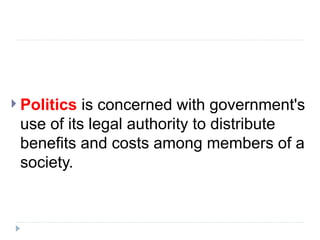
 Politics is concerned with government's
use of its legal authority to distribute
benefits and costs among members of a
society.
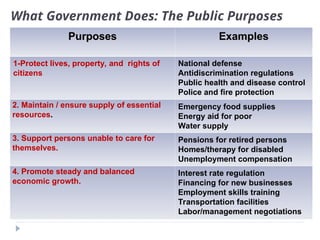
What Government Does: The Public Purposes
Purposes
Purposes Examples
Examples
1-Protect lives, property, and rights of
citizens
National defense
Antidiscrimination regulations
Public health and disease control
Police and fire protection
2. Maintain / ensure supply of essential
resources.
Emergency food supplies
Energy aid for poor
Water supply
3. Support persons unable to care for
themselves.
Pensions for retired persons
Homes/therapy for disabled
Unemployment compensation
4. Promote steady and balanced
economic growth.
Interest rate regulation
Financing for new businesses
Employment skills training
Transportation facilities
Labor/management negotiations
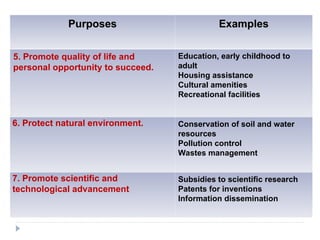
Purposes
Purposes Examples
Examples
5. Promote quality of life and
personal opportunity to succeed.
Education, early childhood to
adult
Housing assistance
Cultural amenities
Recreational facilities
6. Protect natural environment. Conservation of soil and water
resources
Pollution control
Wastes management
7. Promote scientific and
technological advancement
Subsidies to scientific research
Patents for inventions
Information dissemination
How Government Organizes to Serve the
Public Purposes ?
 To carry out its mandates, governments organize into
departments and agencies with specific legal powers
 EX. Environmental Protection Agency (EPA) has a
mandate to test chemicals currently in use for their
effects on human health and the natural environment
 For these studies it employs a committee of scientists
from several National agencies to run whatever tests
are necessary and to recommend action to the EPA
administrator
 The agency is then empowered to make rules that carry
the force of law that can restrict a chemical use or ban it
altogether.
Failures of the Administrative Process
 Governments do not always succeed in fulfilling
these purposes.
 Administrative shortcomings are also apparent in
examples ranging from bacterially or chemically
contaminated drinking water to miscalculated
unemployment benefits.
The Growth of Government : How and Why?
 There are many possible explanations for this growth,
those are:
1) Factors that make up one category of growth
stimulants include industrialization, urbanization, and
the rise of technologies that closely link widely
dispersed areas.
2) Government programs may also grow from a sense of
moral obligation to help the poor and the victims of
discrimination.
Public Policy
 The task of administration is to carry out
policies that represent government’s
choices of action in a fashion that
serves the public purposes
The Cycle
of Public
Administration
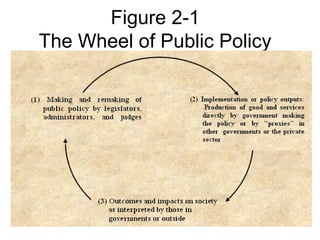
Figure 2-1
The Wheel of Public Policy
The Tools of
Implementation
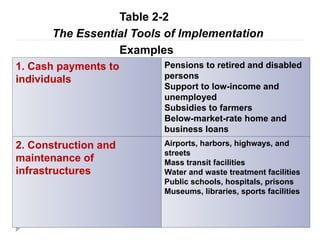
Table 2-2
The Essential Tools of Implementation
Examples
1. Cash payments to
individuals
Pensions to retired and disabled
persons
Support to low-income and
unemployed
Subsidies to farmers
Below-market-rate home and
business loans
2. Construction and
maintenance of
infrastructures
Airports, harbors, highways, and
streets
Mass transit facilities
Water and waste treatment facilities
Public schools, hospitals, prisons
Museums, libraries, sports facilities
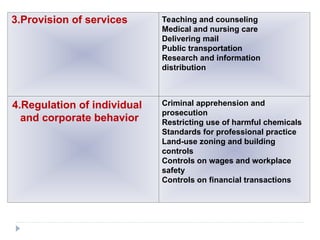
3.Provision of services Teaching and counseling
Medical and nursing care
Delivering mail
Public transportation
Research and information
distribution
4.Regulation of individual
and corporate behavior
Criminal apprehension and
prosecution
Restricting use of harmful chemicals
Standards for professional practice
Land-use zoning and building
controls
Controls on wages and workplace
safety
Controls on financial transactions
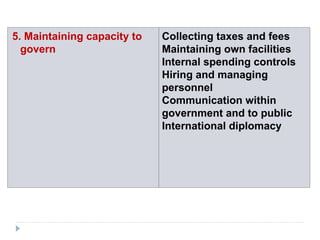
5. Maintaining capacity to
govern
Collecting taxes and fees
Maintaining own facilities
Internal spending controls
Hiring and managing
personnel
Communication within
government and to public
International diplomacy
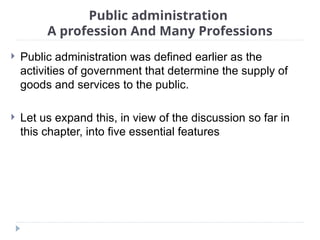
Public administration
A profession And Many Professions
 Public administration was defined earlier as the
activities of government that determine the supply of
goods and services to the public.
 Let us expand this, in view of the discussion so far in
this chapter, into five essential features
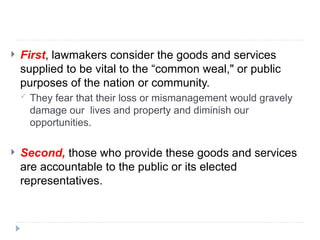
 First, lawmakers consider the goods and services
supplied to be vital to the “common weal," or public
purposes of the nation or community.
 They fear that their loss or mismanagement would gravely
damage our lives and property and diminish our
opportunities.
 Second, those who provide these goods and services
are accountable to the public or its elected
representatives.
 Third, this accountability requires a capacity for
management:
 obtaining and deploying money
 Personnel
 Information and ,
 technology for producing these goods and services.
 Fourth, public administration is based on
organizations, primarily governmental ones but also
many private associations, from electric utilities to foster
homes.
 Fifth, because people disagree about how these
essential goods and services are distributed, their
complaints and demands spark conflict
 Public administration thus becomes political when individuals
or groups seek to win and when government organizations
use power to apply and enforce their policies.
 We can now more fully define public administration
as
“ The process by which government organizations supply
essential goods, services, and regulations, managing
resources and resolving conflicts under a mandate of
efficiency and fairness, while accounting to the public
for both means and outcomes ."
A Sampling of Professions in Government
Accountants :
Botanists:
 maintain gardens in public parks, monitor endangered
plant species, and experiment with corn genetics.
Clergy:
 conduct religious services and counsel in prisons,
hospitals, and the armed forces.
Engineers:
 plan and oversee drainage systems, highway
construction, airports, and space flights.
Geologists:
 locate mineral deposits and seek to forecast
earthquakes.
Historians:
 maintain archives and direct museums.
International lawyers:
 advise government on trade, immigration, and military
issues.
Librarian's:
 research issues for government and help children pick
out books they are able to read.
Mediators
 help to settle labor management disputes.
Pediatricians:
 care for children in public hospitals and clinics and do
research on childhood diseases.
Reading specialists:
 design public school programs for students with reading
disabilities.
Systems analysts:
 set up and manage complex computer and communications
networks essential to all units of government.
Urban planners:
 enforce zoning codes and design neighborhood housing
rehabilitation programs.
Zoologists:
 manage fish and wildlife sanctuaries and research cattle
diseases.
Public Administration Today
Specialization and Fragmentation
 The nature of public administration has changed from
clerkship, to profession, to cluster of professions.
 Despite this specializing and fragmenting of public
management, the "generalist' administrator provides a
common core.
 Exercising responsibility for agencies and departments, and
 making sure that all the specialties act together effectively for
the public mission.
Public Administration: A Global Practice
 Public administration is being transformed by global
demands and forces. Those forces include :
(1) Economic and technological competition among
the different countries compel each country to marshal
its resources to increase efficiency and productivity.
(2) Each nation must manage its balance of imports
and exports for maximum economic health and
currency value.
(3) A global governance system of money flows and
credit has gradually appeared, tightly linking the
governments and private financial institutions of each
nation.
(4) Governmental relations with multinational corporations
and foreign-based investors have proliferated.
(5) Public demands have grown for international action to
guard the natural environment by controlling toxic
wastes
(6) International movement of refugees and immigrants
presents challenges of controlling entry- and providing
social services.
(7) Travel between nations for business, scientific,
cultural, educational and pleasure purposes further
multiplies interpersonal contacts that require responses
by national institutions of all kinds.
(8) Continued efforts by the affluent nations to promote
development and relieve distress in the developing
countries raise questions of allocation of funds among
many worthy causes.
Chapter 2.ppt-business- Public administration

Chapter 2.ppt-business- Public administration

  • 1.
    Chapter 2 Politics inPublic Administration
  • 2.
     Politics isconcerned with government's use of its legal authority to distribute benefits and costs among members of a society.
  • 3.
    What Government Does:The Public Purposes Purposes Purposes Examples Examples 1-Protect lives, property, and rights of citizens National defense Antidiscrimination regulations Public health and disease control Police and fire protection 2. Maintain / ensure supply of essential resources. Emergency food supplies Energy aid for poor Water supply 3. Support persons unable to care for themselves. Pensions for retired persons Homes/therapy for disabled Unemployment compensation 4. Promote steady and balanced economic growth. Interest rate regulation Financing for new businesses Employment skills training Transportation facilities Labor/management negotiations
  • 4.
    Purposes Purposes Examples Examples 5. Promotequality of life and personal opportunity to succeed. Education, early childhood to adult Housing assistance Cultural amenities Recreational facilities 6. Protect natural environment. Conservation of soil and water resources Pollution control Wastes management 7. Promote scientific and technological advancement Subsidies to scientific research Patents for inventions Information dissemination
  • 5.
    How Government Organizesto Serve the Public Purposes ?  To carry out its mandates, governments organize into departments and agencies with specific legal powers  EX. Environmental Protection Agency (EPA) has a mandate to test chemicals currently in use for their effects on human health and the natural environment  For these studies it employs a committee of scientists from several National agencies to run whatever tests are necessary and to recommend action to the EPA administrator  The agency is then empowered to make rules that carry the force of law that can restrict a chemical use or ban it altogether.
  • 6.
    Failures of theAdministrative Process  Governments do not always succeed in fulfilling these purposes.  Administrative shortcomings are also apparent in examples ranging from bacterially or chemically contaminated drinking water to miscalculated unemployment benefits.
  • 7.
    The Growth ofGovernment : How and Why?  There are many possible explanations for this growth, those are: 1) Factors that make up one category of growth stimulants include industrialization, urbanization, and the rise of technologies that closely link widely dispersed areas. 2) Government programs may also grow from a sense of moral obligation to help the poor and the victims of discrimination.
  • 8.
    Public Policy  Thetask of administration is to carry out policies that represent government’s choices of action in a fashion that serves the public purposes
  • 9.
  • 10.
    Figure 2-1 The Wheelof Public Policy
  • 11.
  • 12.
    Table 2-2 The EssentialTools of Implementation Examples 1. Cash payments to individuals Pensions to retired and disabled persons Support to low-income and unemployed Subsidies to farmers Below-market-rate home and business loans 2. Construction and maintenance of infrastructures Airports, harbors, highways, and streets Mass transit facilities Water and waste treatment facilities Public schools, hospitals, prisons Museums, libraries, sports facilities
  • 13.
    3.Provision of servicesTeaching and counseling Medical and nursing care Delivering mail Public transportation Research and information distribution 4.Regulation of individual and corporate behavior Criminal apprehension and prosecution Restricting use of harmful chemicals Standards for professional practice Land-use zoning and building controls Controls on wages and workplace safety Controls on financial transactions
  • 14.
    5. Maintaining capacityto govern Collecting taxes and fees Maintaining own facilities Internal spending controls Hiring and managing personnel Communication within government and to public International diplomacy
  • 15.
    Public administration A professionAnd Many Professions  Public administration was defined earlier as the activities of government that determine the supply of goods and services to the public.  Let us expand this, in view of the discussion so far in this chapter, into five essential features
  • 16.
     First, lawmakersconsider the goods and services supplied to be vital to the “common weal," or public purposes of the nation or community.  They fear that their loss or mismanagement would gravely damage our lives and property and diminish our opportunities.  Second, those who provide these goods and services are accountable to the public or its elected representatives.
  • 17.
     Third, thisaccountability requires a capacity for management:  obtaining and deploying money  Personnel  Information and ,  technology for producing these goods and services.  Fourth, public administration is based on organizations, primarily governmental ones but also many private associations, from electric utilities to foster homes.
  • 18.
     Fifth, becausepeople disagree about how these essential goods and services are distributed, their complaints and demands spark conflict  Public administration thus becomes political when individuals or groups seek to win and when government organizations use power to apply and enforce their policies.
  • 19.
     We cannow more fully define public administration as “ The process by which government organizations supply essential goods, services, and regulations, managing resources and resolving conflicts under a mandate of efficiency and fairness, while accounting to the public for both means and outcomes ."
  • 20.
    A Sampling ofProfessions in Government Accountants : Botanists:  maintain gardens in public parks, monitor endangered plant species, and experiment with corn genetics. Clergy:  conduct religious services and counsel in prisons, hospitals, and the armed forces. Engineers:  plan and oversee drainage systems, highway construction, airports, and space flights.
  • 21.
    Geologists:  locate mineraldeposits and seek to forecast earthquakes. Historians:  maintain archives and direct museums. International lawyers:  advise government on trade, immigration, and military issues.
  • 22.
    Librarian's:  research issuesfor government and help children pick out books they are able to read. Mediators  help to settle labor management disputes. Pediatricians:  care for children in public hospitals and clinics and do research on childhood diseases.
  • 23.
    Reading specialists:  designpublic school programs for students with reading disabilities. Systems analysts:  set up and manage complex computer and communications networks essential to all units of government. Urban planners:  enforce zoning codes and design neighborhood housing rehabilitation programs. Zoologists:  manage fish and wildlife sanctuaries and research cattle diseases.
  • 24.
    Public Administration Today Specializationand Fragmentation  The nature of public administration has changed from clerkship, to profession, to cluster of professions.  Despite this specializing and fragmenting of public management, the "generalist' administrator provides a common core.  Exercising responsibility for agencies and departments, and  making sure that all the specialties act together effectively for the public mission.
  • 25.
    Public Administration: AGlobal Practice  Public administration is being transformed by global demands and forces. Those forces include : (1) Economic and technological competition among the different countries compel each country to marshal its resources to increase efficiency and productivity. (2) Each nation must manage its balance of imports and exports for maximum economic health and currency value.
  • 26.
    (3) A globalgovernance system of money flows and credit has gradually appeared, tightly linking the governments and private financial institutions of each nation. (4) Governmental relations with multinational corporations and foreign-based investors have proliferated. (5) Public demands have grown for international action to guard the natural environment by controlling toxic wastes
  • 27.
    (6) International movementof refugees and immigrants presents challenges of controlling entry- and providing social services. (7) Travel between nations for business, scientific, cultural, educational and pleasure purposes further multiplies interpersonal contacts that require responses by national institutions of all kinds.
  • 28.
    (8) Continued effortsby the affluent nations to promote development and relieve distress in the developing countries raise questions of allocation of funds among many worthy causes.