Global Strategy for Asthma
Management and Prevention
(2019 update)
Dr. Md. Shafiqul Islam Dewan
Phase-A Resident (Pulmonology)
Medicine Unit - VIII
Dhaka Medical College Hospital
About GINA
GINA stands for Global Initiative for Asthma.
Established in 1993.
Work with health care professionals and public
health officials around the world.
To reduce asthma prevalence, morbidity, and
mortality.
Asthma
Asthma is a heterogeneous disease.
Characterized by chronic airway inflammation.
Causing symptoms such as wheezing, shortness of
breath, chest tightness and cough.
That varies in frequency and intensity together
with variable expiratory airflow limitation.
Phenotypes of Asthma
Many phenotypes have been identified. Most
common phenotypes are:
Allergic asthma
Non-allergic asthma
Adult-onset (Late onset) asthma
Asthma with fixed airway limitation
Asthma with obesity
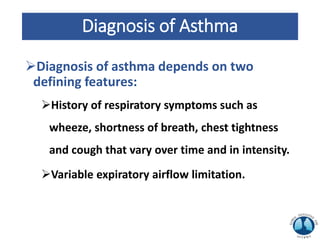
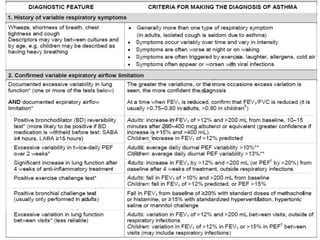
Diagnosis of Asthma
Diagnosis of asthma depends on two
defining features:
History of respiratory symptoms such as
wheeze, shortness of breath, chest tightness
and cough that vary over time and in intensity.
Variable expiratory airflow limitation.
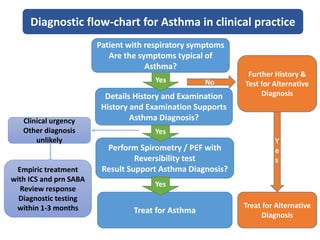
Patient with respiratory symptoms
Are the symptoms typical of
Asthma?
Details History and Examination
History and Examination Supports
Asthma Diagnosis?
Perform Spirometry / PEF with
Reversibility test
Result Support Asthma Diagnosis?
Treat for Asthma
Yes
Yes
Yes
Empiric treatment
with ICS and prn SABA
Review response
Diagnostic testing
within 1-3 months Treat for Alternative
Diagnosis
Further History &
Test for Alternative
Diagnosis
Clinical urgency
Other diagnosis
unlikely
No
Y
e
s
Diagnostic flow-chart for Asthma in clinical practice
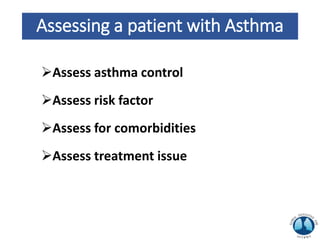
Assessing a patient with Asthma
Assess asthma control
Assess risk factor
Assess for comorbidities
Assess treatment issue
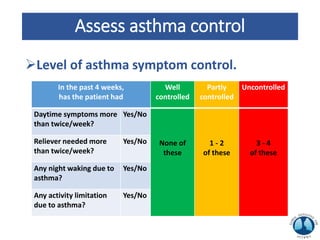
Assess asthma control
Level of asthma symptom control.
In the past 4 weeks,
has the patient had
Well
controlled
Partly
controlled
Uncontrolled
Daytime symptoms more
than twice/week?
Yes/No
None of
these
1 - 2
of these
3 - 4
of these
Reliever needed more
than twice/week?
Yes/No
Any night waking due to
asthma?
Yes/No
Any activity limitation
due to asthma?
Yes/No
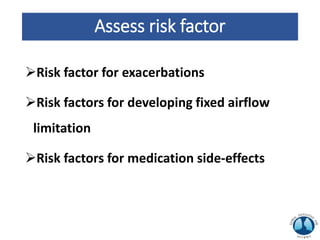
Assess risk factor
Risk factor for exacerbations
Risk factors for developing fixed airflow
limitation
Risk factors for medication side-effects
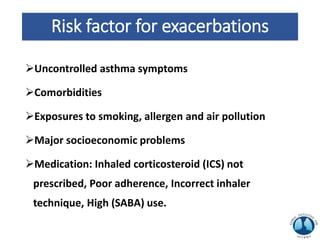
Risk factor for exacerbations
Uncontrolled asthma symptoms
Comorbidities
Exposures to smoking, allergen and air pollution
Major socioeconomic problems
Medication: Inhaled corticosteroid (ICS) not
prescribed, Poor adherence, Incorrect inhaler
technique, High (SABA) use.
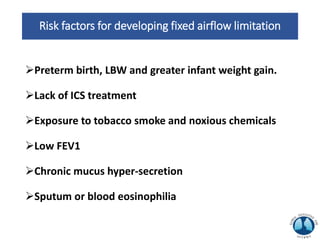
Risk factors for developing fixed airflow limitation
Preterm birth, LBW and greater infant weight gain.
Lack of ICS treatment
Exposure to tobacco smoke and noxious chemicals
Low FEV1
Chronic mucus hyper-secretion
Sputum or blood eosinophilia
Risk factors for medication side-effects
Frequent oral corticosteroid use.
Long term high-dose or potent ICS use.
Poor inhaler technique.
Assess for comorbidities
Rhinitis
Chronic Rhinosinusitis
Gastroesophageal reflux(GERD)
Obesity
Obstructive sleep apnea
Depression and anxiety
Pregnancy
Assess treatment issue
Record the patient’s treatment and ask about side
effects.
Check that the patient has a written asthma
action plan.
Ask the patient about their attitudes and goals for
their asthma.
Written asthma action plan
The written asthma action plan should
include:
The patient’s usual asthma medications
When and how to increase medications and
start oral corticosteroid(OCS)
How to access medical care if symptoms fail to
respond
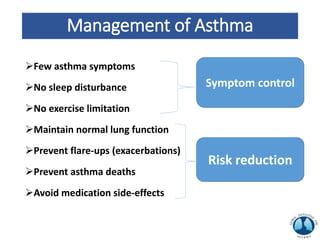
Management of Asthma
Few asthma symptoms
No sleep disturbance
No exercise limitation
Maintain normal lung function
Prevent flare-ups (exacerbations)
Prevent asthma deaths
Avoid medication side-effects
Symptom control
Risk reduction
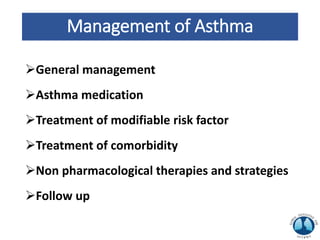
Management of Asthma
General management
Asthma medication
Treatment of modifiable risk factor
Treatment of comorbidity
Non pharmacological therapies and strategies
Follow up
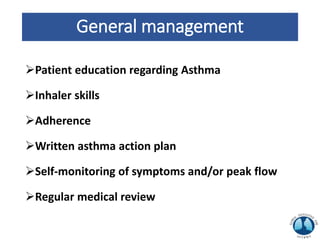
General management
Patient education regarding Asthma
Inhaler skills
Adherence
Written asthma action plan
Self-monitoring of symptoms and/or peak flow
Regular medical review
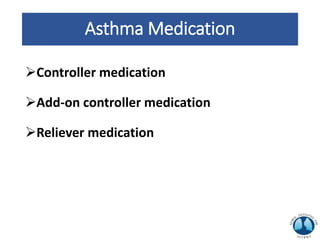
Asthma Medication
Controller medication
Add-on controller medication
Reliever medication
Controller Medication
Inhaled corticosteroids (ICS)
ICS and long-acting beta2 agonist (LABA)
bronchodilator combinations (ICS- LABA )
Leukotriene modifiers
Chromones
Controller Medication
Inhaled corticosteroids (ICS)
Beclomethasone dipropionate
Budesonide
Fluticasone propionate
Fluticasone furoate
Ciclesonide
Triamcinolone
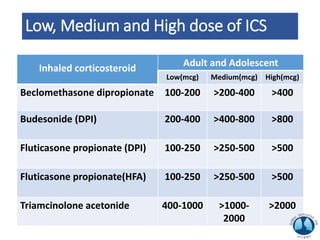
Low, Medium and High dose of ICS
Inhaled corticosteroid
Adult and Adolescent
Low(mcg) Medium(mcg) High(mcg)
Beclomethasone dipropionate 100-200 >200-400 >400
Budesonide (DPI) 200-400 >400-800 >800
Fluticasone propionate (DPI) 100-250 >250-500 >500
Fluticasone propionate(HFA) 100-250 >250-500 >500
Triamcinolone acetonide 400-1000 >1000-
2000
>2000
Controller Medication
ICS and long-acting beta2 agonist
bronchodilator combinations (ICS-LABA)
Beclometasone-formoterol
Budesonide-formoterol
Fluticasone propionate-formoterol
Fluticasone propionate-salmeterol
Fluticasone furoate-vilanterol
Controller Medication
Leukotriene modifiers
Montelukast
Pranlukast
Zafirlukast
Zileuton
Chromones
Sodium cromoglycate
Nedocromil sodium
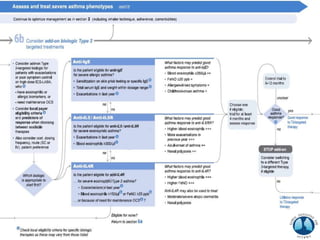
Add-on Controller Medication
Long-acting anticholinergic
Anti-IgE
Anti-IL5
Anti-IL5R
Anti-IL4R
Systemic corticosteroids
Add-on Controller Medication
Long-acting anticholinergic (At Step 4 or 5 with a
history of exacerbations despite ICS ± LABA)
Tiotropium
Anti-IgE (with severe allergic asthma uncontrolled
on high dose ICS-LABA)
Omalizumab
Add-on Controller Medication
 Anti-IL5 & Anti-IL5R (Severe eosinophilic asthma
uncontrolled on high dose ICS-LABA)
Mepolizumab & Reslizumab
Benralizumab
 Anti-IL4R (Severe eosinophilic asthma uncontrolled on
high dose ICS-LABA, or requiring maintenance OCS)
 Dupilumab
Add-on Controller Medication
Systemic corticosteroids
Prednisolone
Hydrocortisone
Methylprednisolone
Reliever Medication
Short-acting inhaled beta2-agonist
bronchodilators (SABA)
Low-dose ICS-formoterol
Short-acting anticholinergics
Reliever Medication
Short-acting inhaled beta2-agonist
bronchodilators (SABA)
Salbutamol
Terbutaline
Reliever Medication
• Low-dose ICS-formoterol
• Beclometasone-formoterol
• Budesonide-formoterol
• Short-acting anticholinergics
• Ipratropium bromide
• Oxitropium bromide
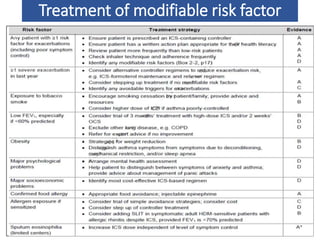
Treatment of modifiable risk factor
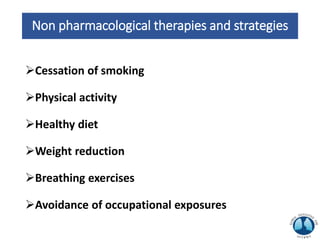
Non pharmacological therapies and strategies
Cessation of smoking
Physical activity
Healthy diet
Weight reduction
Breathing exercises
Avoidance of occupational exposures
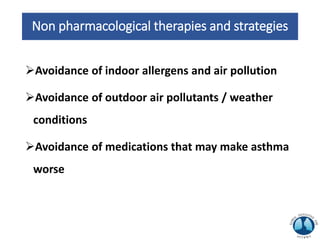
Non pharmacological therapies and strategies
Avoidance of indoor allergens and air pollution
Avoidance of outdoor air pollutants / weather
conditions
Avoidance of medications that may make asthma
worse
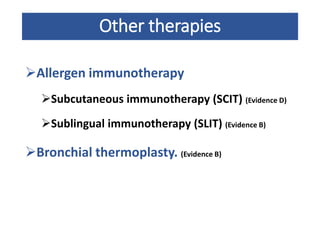
Other therapies
Allergen immunotherapy
Subcutaneous immunotherapy (SCIT) (Evidence D)
Sublingual immunotherapy (SLIT) (Evidence B)
Bronchial thermoplasty. (Evidence B)
Starting asthma treatment
ICS-containing treatment should be initiated as soon
as possible after the diagnosis of asthma is made.
Consider starting at a higher step (e.g. medium/high
dose ICS, or low-dose ICS-LABA) if on most days the
patient has troublesome asthma symptoms; or is
waking from asthma once or more a week.
Starting asthma treatment
If the initial asthma presentation is with severely
uncontrolled asthma, or with an acute exacerbation,
give a short course of OCS and start regular controller
treatment (e.g. medium dose ICS-LABA).
Consider stepping down after asthma has been well-
controlled for 3 months. However, in adults and
adolescents, ICS should not be completely stopped.
Before starting initial controller treatment
Record evidence for the diagnosis of asthma, if
possible.
Document symptom control and risk factors.
Assess lung function, when possible.
Train the patient to use the inhaler correctly and
check their technique.
Schedule a follow-up visit.
After starting initial controller treatment
Review response after 2–3 months, or according
to clinical urgency.
Review for ongoing treatment and other key
management issues.
Consider step down when asthma has been well-
controlled for 3 months
Reviewing response and adjusting treatment
Patients should preferably be seen 1–3 months
after starting treatment
Every 3–12 months after that, but in pregnancy,
asthma should be reviewed every 4–6 weeks.
After an exacerbation, a review visit within 1
week should be scheduled
Stepping up asthma treatment
• Sustained step-up (for at least 2–3 months): if symptoms
and/or exacerbations persist despite 2–3 months of
controller treatment, assess the following common
issues before considering a step-up
• Incorrect inhaler technique
• Poor adherence
• Modifiable risk factors
• Comorbid conditions
Stepping up asthma treatment
Short-term step-up (for 1–2 weeks) by
clinician or by patient with written asthma
action plan, e.g. during viral infection or
allergen exposure.
Stepping up asthma treatment
• Day-to-day adjustment by patient for those
who prescribed as-needed low dose ICS-
formoterol for mild asthma, or low dose
ICS-formoterol as maintenance and reliever
therapy.
Stepping down asthma treatment
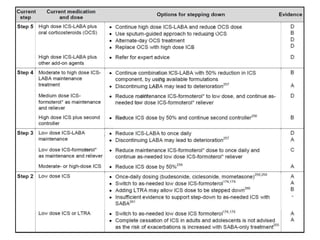
Consider stepping down treatment once
good asthma control has been achieved and
maintained for 3 months, to find the lowest
treatment that controls both symptoms and
exacerbations, and minimizes side-effects.
Stepping down asthma treatment
Choose an appropriate time for step-down (no
respiratory infection, patient not travelling, not
pregnant).
Document baseline status (symptom control and
lung function), provide a written asthma action
plan, monitor closely and book a follow-up visit.
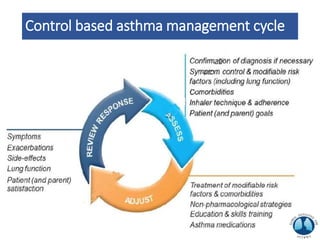
Control based asthma management cycle
GINA 2019 – Changes in asthma management
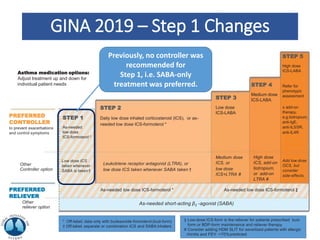
For safety, GINA no longer recommends SABA-
only treatment for Step 1
This decision was based on evidence that SABA-only
treatment increases the risk of severe exacerbations,
and that adding any ICS significantly reduces the risk
GINA now recommends that all adults and
adolescents with asthma should receive symptom-
driven or regular low dose ICS-containing
controller treatment, to reduce the risk of serious
exacerbations
This is a population-level risk reduction strategy, e.g.
statins, anti-hypertensives.
Background to changes in 2019
Risks of mild asthma
Patients with apparently mild asthma are at risk
of serious adverse events
30–37% of adults with acute asthma
16% of patients with near-fatal asthma
15–20% of adults dying of asthma
Exacerbation triggers are variable (viruses,
pollens, pollution, poor adherence)
had symptoms less
than weekly in previous
3 months (Dusser,
Allergy 2007)
Background to changes in 2019
risks of SABA-only treatment
Inhaled SABA has been first-line treatment for
asthma for 50 years
Patient satisfaction with, and reliance on, SABA
treatment is reinforced by its rapid relief of symptoms,
its prominence in emergency department and hospital
management of exacerbations, and low cost
Patients commonly believe that “My reliever gives me
control over my asthma”, so they often don’t see the
need for additional treatment
Background to changes in 2019
risks of SABA-only treatment
Regular or frequent use of SABA is associated
with adverse effects
β-receptor downregulation, decreased
bronchoprotection, rebound hyperresponsiveness,
decreased bronchodilator response (Hancox, Respir Med 2000)
Increased allergic response, and increased eosinophilic
airway inflammation (Aldridge, AJRCCM 2000)
Background to changes in 2019
risks of SABA-only treatment
Higher use of SABA is associated with adverse
clinical outcomes
Dispensing of ≥3 canisters per year (average 1.7
puffs/day) is associated with higher risk of emergency
department presentations (Stanford, AAAI 2012)
Dispensing of ≥12 canisters per year is associated with
higher risk of death (Suissa, AJRCCM 1994)
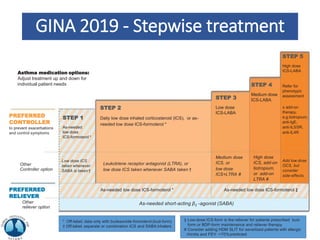
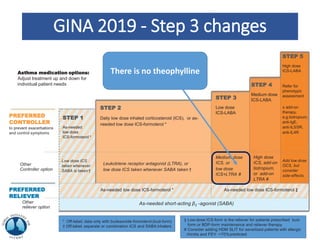
GINA 2019 - Stepwise treatment
PREFERRED
CONTROLLER
to prevent exacerbations
and control symptoms
PREFERRED
RELIEVER
Other
reliever option
STEP 1
As-needed
low dose
ICS-formoterol *
Low dose ICS
taken whenever
SABA is taken†
STEP 2
Daily low dose inhaled corticosteroid (ICS), or as-
needed low dose ICS-formoterol *
Leukotriene receptor antagonist (LTRA), or
low dose ICS taken whenever SABA taken †
STEP 3
Low dose
ICS-LABA
Medium dose
ICS, or
low dose
ICS+LTRA #
STEP 4
Medium dose
ICS-LABA
High dose
ICS, add-on
tiotropium,
or add-on
LTRA #
STEP 5
High dose
ICS-LABA
Refer for
phenotypic
assessment
± add-on
therapy,
e.g.tiotropium,
anti-IgE,
anti-IL5/5R,
anti-IL4R
Add low dose
OCS, but
consider
side-effects
As-needed low dose ICS-formoterol * As-needed low dose ICS-formoterol ‡
As-needed short-acting β2 -agonist (SABA)
* Off-label; data only with budesonide-formoterol (bud-form)
† Off-label; separate or combination ICS and SABA inhalers
‡ Low-dose ICS-form is the reliever for patients prescribed bud-
form or BDP-form maintenance and reliever therapy
# Consider adding HDM SLIT for sensitized patients with allergic
rhinitis and FEV >70%predicted
Asthma medication options:
Adjust treatment up and down for
individual patient needs
Other
Controller option
Step 1
Rationale for changes
in GINA 2019
GINA 2019 – Step 1 Changes
PREFERRED
CONTROLLER
to prevent exacerbations
and control symptoms
PREFERRED
RELIEVER
Other
reliever option
STEP 1
As-needed
low dose
ICS-formoterol *
Low dose ICS
taken whenever
SABA is taken†
STEP 2
Daily low dose inhaled corticosteroid (ICS), or as-
needed low dose ICS-formoterol *
Leukotriene receptor antagonist (LTRA), or
low dose ICS taken whenever SABA taken †
STEP 3
Low dose
ICS-LABA
Medium dose
ICS, or
low dose
ICS+LTRA #
STEP 4
Medium dose
ICS-LABA
High dose
ICS, add-on
tiotropium,
or add-on
LTRA #
STEP 5
High dose
ICS-LABA
Refer for
phenotypic
assessment
± add-on
therapy,
e.g.tiotropium,
anti-IgE,
anti-IL5/5R,
anti-IL4R
Add low dose
OCS, but
consider
side-effects
As-needed low dose ICS-formoterol * As-needed low dose ICS-formoterol ‡
As-needed short-acting β2 -agonist (SABA)
* Off-label; data only with budesonide-formoterol (bud-form)
† Off-label; separate or combination ICS and SABA inhalers
‡ Low-dose ICS-form is the reliever for patients prescribed bud-
form or BDP-form maintenance and reliever therapy
# Consider adding HDM SLIT for sensitized patients with allergic
rhinitis and FEV >70%predicted
Asthma medication options:
Adjust treatment up and down for
individual patient needs
Other
Controller option
Previously, no controller was
recommended for
Step 1, i.e. SABA-only
treatment was preferred.
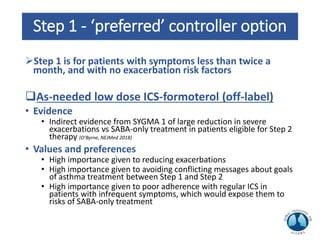
Step 1 - ‘preferred’ controller option
Step 1 is for patients with symptoms less than twice a
month, and with no exacerbation risk factors
As-needed low dose ICS-formoterol (off-label)
• Evidence
• Indirect evidence from SYGMA 1 of large reduction in severe
exacerbations vs SABA-only treatment in patients eligible for Step 2
therapy (O’Byrne, NEJMed 2018)
• Values and preferences
• High importance given to reducing exacerbations
• High importance given to avoiding conflicting messages about goals
of asthma treatment between Step 1 and Step 2
• High importance given to poor adherence with regular ICS in
patients with infrequent symptoms, which would expose them to
risks of SABA-only treatment
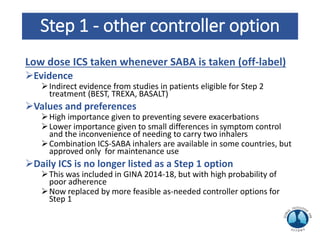
Step 1 - other controller option
Low dose ICS taken whenever SABA is taken (off-label)
Evidence
Indirect evidence from studies in patients eligible for Step 2
treatment (BEST, TREXA, BASALT)
Values and preferences
High importance given to preventing severe exacerbations
Lower importance given to small differences in symptom control
and the inconvenience of needing to carry two inhalers
Combination ICS-SABA inhalers are available in some countries, but
approved only for maintenance use
Daily ICS is no longer listed as a Step 1 option
This was included in GINA 2014-18, but with high probability of
poor adherence
Now replaced by more feasible as-needed controller options for
Step 1
Step 2
Rationale for changes
in GINA 2019
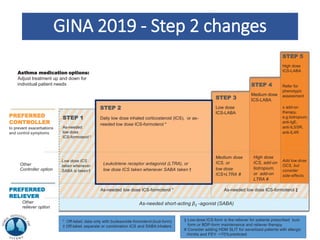
GINA 2019 - Step 2 changes
PREFERRED
CONTROLLER
to prevent exacerbations
and control symptoms
PREFERRED
RELIEVER
Other
reliever option
STEP 1
As-needed
low dose
ICS-formoterol *
Low dose ICS
taken whenever
SABA is taken†
STEP 2
Daily low dose inhaled corticosteroid (ICS), or as-
needed low dose ICS-formoterol *
Leukotriene receptor antagonist (LTRA), or
low dose ICS taken whenever SABA taken †
STEP 3
Low dose
ICS-LABA
Medium dose
ICS, or
low dose
ICS+LTRA #
STEP 4
Medium dose
ICS-LABA
High dose
ICS, add-on
tiotropium,
or add-on
LTRA #
STEP 5
High dose
ICS-LABA
Refer for
phenotypic
assessment
± add-on
therapy,
e.g.tiotropium,
anti-IgE,
anti-IL5/5R,
anti-IL4R
Add low dose
OCS, but
consider
side-effects
As-needed low dose ICS-formoterol * As-needed low dose ICS-formoterol ‡
As-needed short-acting β2 -agonist (SABA)
* Off-label; data only with budesonide-formoterol (bud-form)
† Off-label; separate or combination ICS and SABA inhalers
‡ Low-dose ICS-form is the reliever for patients prescribed bud-
form or BDP-form maintenance and reliever therapy
# Consider adding HDM SLIT for sensitized patients with allergic
rhinitis and FEV >70%predicted
Asthma medication options:
Adjust treatment up and down for
individual patient needs
Other
Controller option
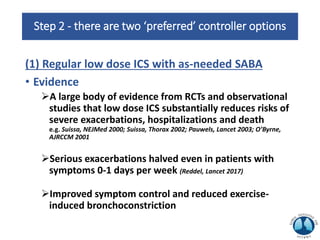
Step 2 - there are two ‘preferred’ controller options
(1) Regular low dose ICS with as-needed SABA
• Evidence
A large body of evidence from RCTs and observational
studies that low dose ICS substantially reduces risks of
severe exacerbations, hospitalizations and death
e.g. Suissa, NEJMed 2000; Suissa, Thorax 2002; Pauwels, Lancet 2003; O’Byrne,
AJRCCM 2001
Serious exacerbations halved even in patients with
symptoms 0-1 days per week (Reddel, Lancet 2017)
Improved symptom control and reduced exercise-
induced bronchoconstriction
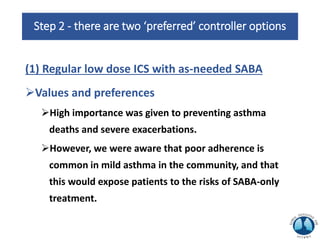
Step 2 - there are two ‘preferred’ controller options
(1) Regular low dose ICS with as-needed SABA
Values and preferences
High importance was given to preventing asthma
deaths and severe exacerbations.
However, we were aware that poor adherence is
common in mild asthma in the community, and that
this would expose patients to the risks of SABA-only
treatment.
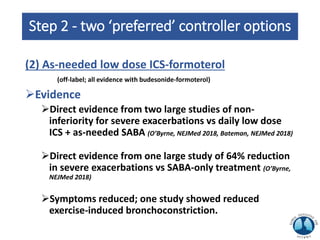
Step 2 - two ‘preferred’ controller options
(2) As-needed low dose ICS-formoterol
(off-label; all evidence with budesonide-formoterol)
Evidence
Direct evidence from two large studies of non-
inferiority for severe exacerbations vs daily low dose
ICS + as-needed SABA (O’Byrne, NEJMed 2018, Bateman, NEJMed 2018)
Direct evidence from one large study of 64% reduction
in severe exacerbations vs SABA-only treatment (O’Byrne,
NEJMed 2018)
Symptoms reduced; one study showed reduced
exercise-induced bronchoconstriction.
Step 2 - two ‘preferred’ controller options
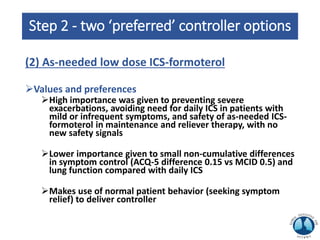
(2) As-needed low dose ICS-formoterol
Values and preferences
High importance was given to preventing severe
exacerbations, avoiding need for daily ICS in patients with
mild or infrequent symptoms, and safety of as-needed ICS-
formoterol in maintenance and reliever therapy, with no
new safety signals
Lower importance given to small non-cumulative differences
in symptom control (ACQ-5 difference 0.15 vs MCID 0.5) and
lung function compared with daily ICS
Makes use of normal patient behavior (seeking symptom
relief) to deliver controller
Step 2 - other controller options
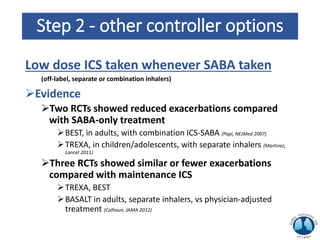
Low dose ICS taken whenever SABA taken
(off-label, separate or combination inhalers)
Evidence
Two RCTs showed reduced exacerbations compared
with SABA-only treatment
BEST, in adults, with combination ICS-SABA (Papi, NEJMed 2007)
TREXA, in children/adolescents, with separate inhalers (Martinez,
Lancet 2011)
Three RCTs showed similar or fewer exacerbations
compared with maintenance ICS
TREXA, BEST
BASALT in adults, separate inhalers, vs physician-adjusted
treatment (Calhoun, JAMA 2012)
Step 2 - other controller options
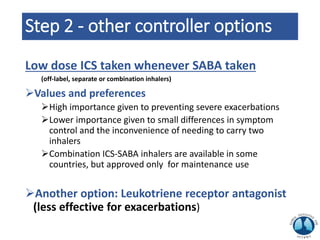
Low dose ICS taken whenever SABA taken
(off-label, separate or combination inhalers)
Values and preferences
High importance given to preventing severe exacerbations
Lower importance given to small differences in symptom
control and the inconvenience of needing to carry two
inhalers
Combination ICS-SABA inhalers are available in some
countries, but approved only for maintenance use
Another option: Leukotriene receptor antagonist
(less effective for exacerbations)
Other changes in GINA 2019
Steps 3-5
for adults and adolescents
GINA 2019 - Step 3 changes
PREFERRED
CONTROLLER
to prevent exacerbations
and control symptoms
PREFERRED
RELIEVER
Other
reliever option
STEP 1
As-needed
low dose
ICS-formoterol *
Low dose ICS
taken whenever
SABA is taken†
STEP 2
Daily low dose inhaled corticosteroid (ICS), or as-
needed low dose ICS-formoterol *
Leukotriene receptor antagonist (LTRA), or
low dose ICS taken whenever SABA taken †
STEP 3
Low dose
ICS-LABA
Medium dose
ICS, or
low dose
ICS+LTRA #
STEP 4
Medium dose
ICS-LABA
High dose
ICS, add-on
tiotropium,
or add-on
LTRA #
STEP 5
High dose
ICS-LABA
Refer for
phenotypic
assessment
± add-on
therapy,
e.g.tiotropium,
anti-IgE,
anti-IL5/5R,
anti-IL4R
Add low dose
OCS, but
consider
side-effects
As-needed low dose ICS-formoterol * As-needed low dose ICS-formoterol ‡
As-needed short-acting β2 -agonist (SABA)
* Off-label; data only with budesonide-formoterol (bud-form)
† Off-label; separate or combination ICS and SABA inhalers
‡ Low-dose ICS-form is the reliever for patients prescribed bud-
form or BDP-form maintenance and reliever therapy
# Consider adding HDM SLIT for sensitized patients with allergic
rhinitis and FEV >70%predicted
Asthma medication options:
Adjust treatment up and down for
individual patient needs
Other
Controller option
There is no theophylline
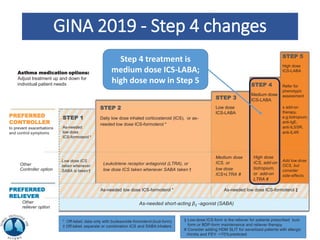
GINA 2019 - Step 4 changes
PREFERRED
CONTROLLER
to prevent exacerbations
and control symptoms
PREFERRED
RELIEVER
Other
reliever option
STEP 1
As-needed
low dose
ICS-formoterol *
Low dose ICS
taken whenever
SABA is taken†
STEP 2
Daily low dose inhaled corticosteroid (ICS), or as-
needed low dose ICS-formoterol *
Leukotriene receptor antagonist (LTRA), or
low dose ICS taken whenever SABA taken †
STEP 3
Low dose
ICS-LABA
Medium dose
ICS, or
low dose
ICS+LTRA #
STEP 4
Medium dose
ICS-LABA
High dose
ICS, add-on
tiotropium,
or add-on
LTRA #
STEP 5
High dose
ICS-LABA
Refer for
phenotypic
assessment
± add-on
therapy,
e.g.tiotropium,
anti-IgE,
anti-IL5/5R,
anti-IL4R
Add low dose
OCS, but
consider
side-effects
As-needed low dose ICS-formoterol * As-needed low dose ICS-formoterol ‡
As-needed short-acting β2 -agonist (SABA)
* Off-label; data only with budesonide-formoterol (bud-form)
† Off-label; separate or combination ICS and SABA inhalers
‡ Low-dose ICS-form is the reliever for patients prescribed bud-
form or BDP-form maintenance and reliever therapy
# Consider adding HDM SLIT for sensitized patients with allergic
rhinitis and FEV >70%predicted
Asthma medication options:
Adjust treatment up and down for
individual patient needs
Other
Controller option
Step 4 treatment is
medium dose ICS-LABA;
high dose now in Step 5
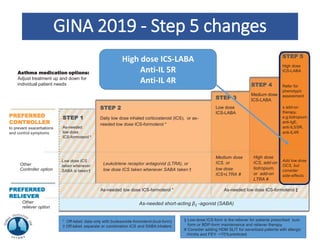
GINA 2019 - Step 5 changes
PREFERRED
CONTROLLER
to prevent exacerbations
and control symptoms
PREFERRED
RELIEVER
Other
reliever option
STEP 1
As-needed
low dose
ICS-formoterol *
Low dose ICS
taken whenever
SABA is taken†
STEP 2
Daily low dose inhaled corticosteroid (ICS), or as-
needed low dose ICS-formoterol *
Leukotriene receptor antagonist (LTRA), or
low dose ICS taken whenever SABA taken †
STEP 3
Low dose
ICS-LABA
Medium dose
ICS, or
low dose
ICS+LTRA #
STEP 4
Medium dose
ICS-LABA
High dose
ICS, add-on
tiotropium,
or add-on
LTRA #
STEP 5
High dose
ICS-LABA
Refer for
phenotypic
assessment
± add-on
therapy,
e.g.tiotropium,
anti-IgE,
anti-IL5/5R,
anti-IL4R
Add low dose
OCS, but
consider
side-effects
As-needed low dose ICS-formoterol * As-needed low dose ICS-formoterol ‡
As-needed short-acting β2 -agonist (SABA)
* Off-label; data only with budesonide-formoterol (bud-form)
† Off-label; separate or combination ICS and SABA inhalers
‡ Low-dose ICS-form is the reliever for patients prescribed bud-
form or BDP-form maintenance and reliever therapy
# Consider adding HDM SLIT for sensitized patients with allergic
rhinitis and FEV >70%predicted
Asthma medication options:
Adjust treatment up and down for
individual patient needs
Other
Controller option
High dose ICS-LABA
Anti-IL 5R
Anti-IL 4R
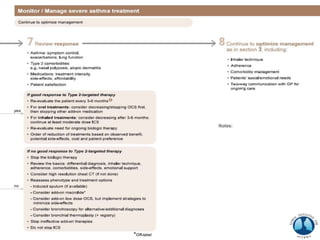
Management of asthma
exacerbations
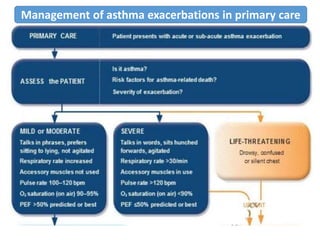
Management of asthma exacerbations in primary care
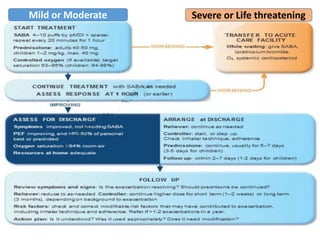
Mild or Moderate Severe or Life threatening
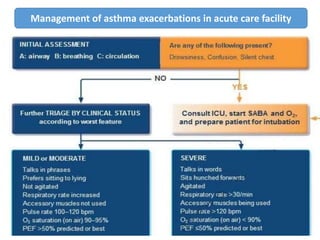
Management of asthma exacerbations in acute care facility
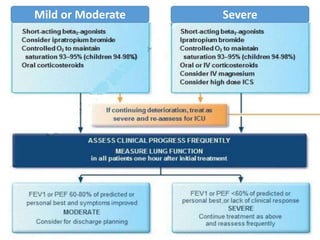
Mild or Moderate Severe
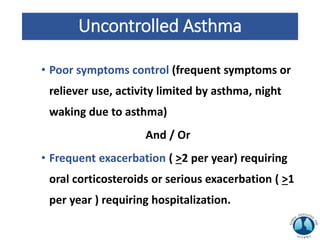
Uncontrolled Asthma
• Poor symptoms control (frequent symptoms or
reliever use, activity limited by asthma, night
waking due to asthma)
And / Or
• Frequent exacerbation ( >2 per year) requiring
oral corticosteroids or serious exacerbation ( >1
per year ) requiring hospitalization.
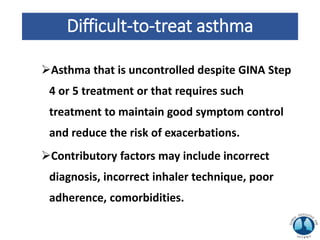
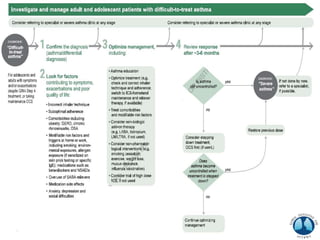
Difficult-to-treat asthma
Asthma that is uncontrolled despite GINA Step
4 or 5 treatment or that requires such
treatment to maintain good symptom control
and reduce the risk of exacerbations.
Contributory factors may include incorrect
diagnosis, incorrect inhaler technique, poor
adherence, comorbidities.
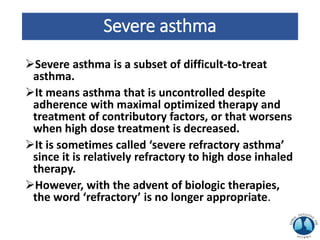
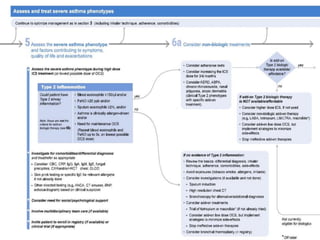
Severe asthma
Severe asthma is a subset of difficult-to-treat
asthma.
It means asthma that is uncontrolled despite
adherence with maximal optimized therapy and
treatment of contributory factors, or that worsens
when high dose treatment is decreased.
It is sometimes called ‘severe refractory asthma’
since it is relatively refractory to high dose inhaled
therapy.
However, with the advent of biologic therapies,
the word ‘refractory’ is no longer appropriate.
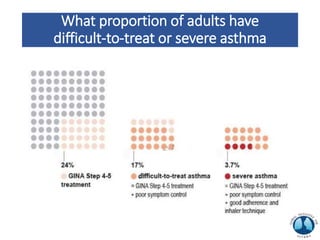
What proportion of adults have
difficult-to-treat or severe asthma
Management of
difficult-to-treat
and severe asthma
Asthma with Pregnancy
Asthma control often changes during pregnancy.
For baby and mother, the advantages of actively
treating asthma markedly outweigh any potential
risks of usual controller and reliever medications.
Down-titration has a low priority in pregnancy.
Exacerbations should be treated aggressively.
Surgical Procedure in Asthma patient
Whenever possible, good asthma control should be
achieved preoperatively.
Ensure that controller therapy is maintained
throughout the perioperative period.
Patients on long-term high dose ICS, or having more
than 2 weeks’ OCS in the past 6 months, should
receive intra-operative hydrocortisone to reduce the
risk of adrenal crisis.
Take home message
No longer recommends starting with SABA
only treatment.
All adults and adolescents with asthma
should receive ICS-containing controller
treatment, to reduce their risk of serious
exacerbations and to control symptoms.
Ptt 2

Ptt 2

  • 1.
    Global Strategy forAsthma Management and Prevention (2019 update) Dr. Md. Shafiqul Islam Dewan Phase-A Resident (Pulmonology) Medicine Unit - VIII Dhaka Medical College Hospital
  • 2.
    About GINA GINA standsfor Global Initiative for Asthma. Established in 1993. Work with health care professionals and public health officials around the world. To reduce asthma prevalence, morbidity, and mortality.
  • 3.
    Asthma Asthma is aheterogeneous disease. Characterized by chronic airway inflammation. Causing symptoms such as wheezing, shortness of breath, chest tightness and cough. That varies in frequency and intensity together with variable expiratory airflow limitation.
  • 4.
    Phenotypes of Asthma Manyphenotypes have been identified. Most common phenotypes are: Allergic asthma Non-allergic asthma Adult-onset (Late onset) asthma Asthma with fixed airway limitation Asthma with obesity
  • 5.
    Diagnosis of Asthma Diagnosisof asthma depends on two defining features: History of respiratory symptoms such as wheeze, shortness of breath, chest tightness and cough that vary over time and in intensity. Variable expiratory airflow limitation.
  • 7.
    Patient with respiratorysymptoms Are the symptoms typical of Asthma? Details History and Examination History and Examination Supports Asthma Diagnosis? Perform Spirometry / PEF with Reversibility test Result Support Asthma Diagnosis? Treat for Asthma Yes Yes Yes Empiric treatment with ICS and prn SABA Review response Diagnostic testing within 1-3 months Treat for Alternative Diagnosis Further History & Test for Alternative Diagnosis Clinical urgency Other diagnosis unlikely No Y e s Diagnostic flow-chart for Asthma in clinical practice
  • 8.
    Assessing a patientwith Asthma Assess asthma control Assess risk factor Assess for comorbidities Assess treatment issue
  • 9.
    Assess asthma control Levelof asthma symptom control. In the past 4 weeks, has the patient had Well controlled Partly controlled Uncontrolled Daytime symptoms more than twice/week? Yes/No None of these 1 - 2 of these 3 - 4 of these Reliever needed more than twice/week? Yes/No Any night waking due to asthma? Yes/No Any activity limitation due to asthma? Yes/No
  • 10.
    Assess risk factor Riskfactor for exacerbations Risk factors for developing fixed airflow limitation Risk factors for medication side-effects
  • 11.
    Risk factor forexacerbations Uncontrolled asthma symptoms Comorbidities Exposures to smoking, allergen and air pollution Major socioeconomic problems Medication: Inhaled corticosteroid (ICS) not prescribed, Poor adherence, Incorrect inhaler technique, High (SABA) use.
  • 12.
    Risk factors fordeveloping fixed airflow limitation Preterm birth, LBW and greater infant weight gain. Lack of ICS treatment Exposure to tobacco smoke and noxious chemicals Low FEV1 Chronic mucus hyper-secretion Sputum or blood eosinophilia
  • 13.
    Risk factors formedication side-effects Frequent oral corticosteroid use. Long term high-dose or potent ICS use. Poor inhaler technique.
  • 14.
    Assess for comorbidities Rhinitis ChronicRhinosinusitis Gastroesophageal reflux(GERD) Obesity Obstructive sleep apnea Depression and anxiety Pregnancy
  • 15.
    Assess treatment issue Recordthe patient’s treatment and ask about side effects. Check that the patient has a written asthma action plan. Ask the patient about their attitudes and goals for their asthma.
  • 16.
    Written asthma actionplan The written asthma action plan should include: The patient’s usual asthma medications When and how to increase medications and start oral corticosteroid(OCS) How to access medical care if symptoms fail to respond
  • 17.
    Management of Asthma Fewasthma symptoms No sleep disturbance No exercise limitation Maintain normal lung function Prevent flare-ups (exacerbations) Prevent asthma deaths Avoid medication side-effects Symptom control Risk reduction
  • 18.
    Management of Asthma Generalmanagement Asthma medication Treatment of modifiable risk factor Treatment of comorbidity Non pharmacological therapies and strategies Follow up
  • 19.
    General management Patient educationregarding Asthma Inhaler skills Adherence Written asthma action plan Self-monitoring of symptoms and/or peak flow Regular medical review
  • 20.
    Asthma Medication Controller medication Add-oncontroller medication Reliever medication
  • 21.
    Controller Medication Inhaled corticosteroids(ICS) ICS and long-acting beta2 agonist (LABA) bronchodilator combinations (ICS- LABA ) Leukotriene modifiers Chromones
  • 22.
    Controller Medication Inhaled corticosteroids(ICS) Beclomethasone dipropionate Budesonide Fluticasone propionate Fluticasone furoate Ciclesonide Triamcinolone
  • 23.
    Low, Medium andHigh dose of ICS Inhaled corticosteroid Adult and Adolescent Low(mcg) Medium(mcg) High(mcg) Beclomethasone dipropionate 100-200 >200-400 >400 Budesonide (DPI) 200-400 >400-800 >800 Fluticasone propionate (DPI) 100-250 >250-500 >500 Fluticasone propionate(HFA) 100-250 >250-500 >500 Triamcinolone acetonide 400-1000 >1000- 2000 >2000
  • 24.
    Controller Medication ICS andlong-acting beta2 agonist bronchodilator combinations (ICS-LABA) Beclometasone-formoterol Budesonide-formoterol Fluticasone propionate-formoterol Fluticasone propionate-salmeterol Fluticasone furoate-vilanterol
  • 25.
  • 26.
    Add-on Controller Medication Long-actinganticholinergic Anti-IgE Anti-IL5 Anti-IL5R Anti-IL4R Systemic corticosteroids
  • 27.
    Add-on Controller Medication Long-actinganticholinergic (At Step 4 or 5 with a history of exacerbations despite ICS ± LABA) Tiotropium Anti-IgE (with severe allergic asthma uncontrolled on high dose ICS-LABA) Omalizumab
  • 28.
    Add-on Controller Medication Anti-IL5 & Anti-IL5R (Severe eosinophilic asthma uncontrolled on high dose ICS-LABA) Mepolizumab & Reslizumab Benralizumab  Anti-IL4R (Severe eosinophilic asthma uncontrolled on high dose ICS-LABA, or requiring maintenance OCS)  Dupilumab
  • 29.
    Add-on Controller Medication Systemiccorticosteroids Prednisolone Hydrocortisone Methylprednisolone
  • 30.
    Reliever Medication Short-acting inhaledbeta2-agonist bronchodilators (SABA) Low-dose ICS-formoterol Short-acting anticholinergics
  • 31.
    Reliever Medication Short-acting inhaledbeta2-agonist bronchodilators (SABA) Salbutamol Terbutaline
  • 32.
    Reliever Medication • Low-doseICS-formoterol • Beclometasone-formoterol • Budesonide-formoterol • Short-acting anticholinergics • Ipratropium bromide • Oxitropium bromide
  • 33.
  • 34.
    Non pharmacological therapiesand strategies Cessation of smoking Physical activity Healthy diet Weight reduction Breathing exercises Avoidance of occupational exposures
  • 35.
    Non pharmacological therapiesand strategies Avoidance of indoor allergens and air pollution Avoidance of outdoor air pollutants / weather conditions Avoidance of medications that may make asthma worse
  • 36.
    Other therapies Allergen immunotherapy Subcutaneousimmunotherapy (SCIT) (Evidence D) Sublingual immunotherapy (SLIT) (Evidence B) Bronchial thermoplasty. (Evidence B)
  • 37.
    Starting asthma treatment ICS-containingtreatment should be initiated as soon as possible after the diagnosis of asthma is made. Consider starting at a higher step (e.g. medium/high dose ICS, or low-dose ICS-LABA) if on most days the patient has troublesome asthma symptoms; or is waking from asthma once or more a week.
  • 38.
    Starting asthma treatment Ifthe initial asthma presentation is with severely uncontrolled asthma, or with an acute exacerbation, give a short course of OCS and start regular controller treatment (e.g. medium dose ICS-LABA). Consider stepping down after asthma has been well- controlled for 3 months. However, in adults and adolescents, ICS should not be completely stopped.
  • 39.
    Before starting initialcontroller treatment Record evidence for the diagnosis of asthma, if possible. Document symptom control and risk factors. Assess lung function, when possible. Train the patient to use the inhaler correctly and check their technique. Schedule a follow-up visit.
  • 40.
    After starting initialcontroller treatment Review response after 2–3 months, or according to clinical urgency. Review for ongoing treatment and other key management issues. Consider step down when asthma has been well- controlled for 3 months
  • 41.
    Reviewing response andadjusting treatment Patients should preferably be seen 1–3 months after starting treatment Every 3–12 months after that, but in pregnancy, asthma should be reviewed every 4–6 weeks. After an exacerbation, a review visit within 1 week should be scheduled
  • 42.
    Stepping up asthmatreatment • Sustained step-up (for at least 2–3 months): if symptoms and/or exacerbations persist despite 2–3 months of controller treatment, assess the following common issues before considering a step-up • Incorrect inhaler technique • Poor adherence • Modifiable risk factors • Comorbid conditions
  • 43.
    Stepping up asthmatreatment Short-term step-up (for 1–2 weeks) by clinician or by patient with written asthma action plan, e.g. during viral infection or allergen exposure.
  • 44.
    Stepping up asthmatreatment • Day-to-day adjustment by patient for those who prescribed as-needed low dose ICS- formoterol for mild asthma, or low dose ICS-formoterol as maintenance and reliever therapy.
  • 45.
    Stepping down asthmatreatment Consider stepping down treatment once good asthma control has been achieved and maintained for 3 months, to find the lowest treatment that controls both symptoms and exacerbations, and minimizes side-effects.
  • 46.
    Stepping down asthmatreatment Choose an appropriate time for step-down (no respiratory infection, patient not travelling, not pregnant). Document baseline status (symptom control and lung function), provide a written asthma action plan, monitor closely and book a follow-up visit.
  • 48.
    Control based asthmamanagement cycle
  • 49.
    GINA 2019 –Changes in asthma management For safety, GINA no longer recommends SABA- only treatment for Step 1 This decision was based on evidence that SABA-only treatment increases the risk of severe exacerbations, and that adding any ICS significantly reduces the risk GINA now recommends that all adults and adolescents with asthma should receive symptom- driven or regular low dose ICS-containing controller treatment, to reduce the risk of serious exacerbations This is a population-level risk reduction strategy, e.g. statins, anti-hypertensives.
  • 50.
    Background to changesin 2019 Risks of mild asthma Patients with apparently mild asthma are at risk of serious adverse events 30–37% of adults with acute asthma 16% of patients with near-fatal asthma 15–20% of adults dying of asthma Exacerbation triggers are variable (viruses, pollens, pollution, poor adherence) had symptoms less than weekly in previous 3 months (Dusser, Allergy 2007)
  • 51.
    Background to changesin 2019 risks of SABA-only treatment Inhaled SABA has been first-line treatment for asthma for 50 years Patient satisfaction with, and reliance on, SABA treatment is reinforced by its rapid relief of symptoms, its prominence in emergency department and hospital management of exacerbations, and low cost Patients commonly believe that “My reliever gives me control over my asthma”, so they often don’t see the need for additional treatment
  • 52.
    Background to changesin 2019 risks of SABA-only treatment Regular or frequent use of SABA is associated with adverse effects β-receptor downregulation, decreased bronchoprotection, rebound hyperresponsiveness, decreased bronchodilator response (Hancox, Respir Med 2000) Increased allergic response, and increased eosinophilic airway inflammation (Aldridge, AJRCCM 2000)
  • 53.
    Background to changesin 2019 risks of SABA-only treatment Higher use of SABA is associated with adverse clinical outcomes Dispensing of ≥3 canisters per year (average 1.7 puffs/day) is associated with higher risk of emergency department presentations (Stanford, AAAI 2012) Dispensing of ≥12 canisters per year is associated with higher risk of death (Suissa, AJRCCM 1994)
  • 54.
    GINA 2019 -Stepwise treatment PREFERRED CONTROLLER to prevent exacerbations and control symptoms PREFERRED RELIEVER Other reliever option STEP 1 As-needed low dose ICS-formoterol * Low dose ICS taken whenever SABA is taken† STEP 2 Daily low dose inhaled corticosteroid (ICS), or as- needed low dose ICS-formoterol * Leukotriene receptor antagonist (LTRA), or low dose ICS taken whenever SABA taken † STEP 3 Low dose ICS-LABA Medium dose ICS, or low dose ICS+LTRA # STEP 4 Medium dose ICS-LABA High dose ICS, add-on tiotropium, or add-on LTRA # STEP 5 High dose ICS-LABA Refer for phenotypic assessment ± add-on therapy, e.g.tiotropium, anti-IgE, anti-IL5/5R, anti-IL4R Add low dose OCS, but consider side-effects As-needed low dose ICS-formoterol * As-needed low dose ICS-formoterol ‡ As-needed short-acting β2 -agonist (SABA) * Off-label; data only with budesonide-formoterol (bud-form) † Off-label; separate or combination ICS and SABA inhalers ‡ Low-dose ICS-form is the reliever for patients prescribed bud- form or BDP-form maintenance and reliever therapy # Consider adding HDM SLIT for sensitized patients with allergic rhinitis and FEV >70%predicted Asthma medication options: Adjust treatment up and down for individual patient needs Other Controller option
  • 55.
    Step 1 Rationale forchanges in GINA 2019
  • 56.
    GINA 2019 –Step 1 Changes PREFERRED CONTROLLER to prevent exacerbations and control symptoms PREFERRED RELIEVER Other reliever option STEP 1 As-needed low dose ICS-formoterol * Low dose ICS taken whenever SABA is taken† STEP 2 Daily low dose inhaled corticosteroid (ICS), or as- needed low dose ICS-formoterol * Leukotriene receptor antagonist (LTRA), or low dose ICS taken whenever SABA taken † STEP 3 Low dose ICS-LABA Medium dose ICS, or low dose ICS+LTRA # STEP 4 Medium dose ICS-LABA High dose ICS, add-on tiotropium, or add-on LTRA # STEP 5 High dose ICS-LABA Refer for phenotypic assessment ± add-on therapy, e.g.tiotropium, anti-IgE, anti-IL5/5R, anti-IL4R Add low dose OCS, but consider side-effects As-needed low dose ICS-formoterol * As-needed low dose ICS-formoterol ‡ As-needed short-acting β2 -agonist (SABA) * Off-label; data only with budesonide-formoterol (bud-form) † Off-label; separate or combination ICS and SABA inhalers ‡ Low-dose ICS-form is the reliever for patients prescribed bud- form or BDP-form maintenance and reliever therapy # Consider adding HDM SLIT for sensitized patients with allergic rhinitis and FEV >70%predicted Asthma medication options: Adjust treatment up and down for individual patient needs Other Controller option Previously, no controller was recommended for Step 1, i.e. SABA-only treatment was preferred.
  • 57.
    Step 1 -‘preferred’ controller option Step 1 is for patients with symptoms less than twice a month, and with no exacerbation risk factors As-needed low dose ICS-formoterol (off-label) • Evidence • Indirect evidence from SYGMA 1 of large reduction in severe exacerbations vs SABA-only treatment in patients eligible for Step 2 therapy (O’Byrne, NEJMed 2018) • Values and preferences • High importance given to reducing exacerbations • High importance given to avoiding conflicting messages about goals of asthma treatment between Step 1 and Step 2 • High importance given to poor adherence with regular ICS in patients with infrequent symptoms, which would expose them to risks of SABA-only treatment
  • 58.
    Step 1 -other controller option Low dose ICS taken whenever SABA is taken (off-label) Evidence Indirect evidence from studies in patients eligible for Step 2 treatment (BEST, TREXA, BASALT) Values and preferences High importance given to preventing severe exacerbations Lower importance given to small differences in symptom control and the inconvenience of needing to carry two inhalers Combination ICS-SABA inhalers are available in some countries, but approved only for maintenance use Daily ICS is no longer listed as a Step 1 option This was included in GINA 2014-18, but with high probability of poor adherence Now replaced by more feasible as-needed controller options for Step 1
  • 59.
    Step 2 Rationale forchanges in GINA 2019
  • 60.
    GINA 2019 -Step 2 changes PREFERRED CONTROLLER to prevent exacerbations and control symptoms PREFERRED RELIEVER Other reliever option STEP 1 As-needed low dose ICS-formoterol * Low dose ICS taken whenever SABA is taken† STEP 2 Daily low dose inhaled corticosteroid (ICS), or as- needed low dose ICS-formoterol * Leukotriene receptor antagonist (LTRA), or low dose ICS taken whenever SABA taken † STEP 3 Low dose ICS-LABA Medium dose ICS, or low dose ICS+LTRA # STEP 4 Medium dose ICS-LABA High dose ICS, add-on tiotropium, or add-on LTRA # STEP 5 High dose ICS-LABA Refer for phenotypic assessment ± add-on therapy, e.g.tiotropium, anti-IgE, anti-IL5/5R, anti-IL4R Add low dose OCS, but consider side-effects As-needed low dose ICS-formoterol * As-needed low dose ICS-formoterol ‡ As-needed short-acting β2 -agonist (SABA) * Off-label; data only with budesonide-formoterol (bud-form) † Off-label; separate or combination ICS and SABA inhalers ‡ Low-dose ICS-form is the reliever for patients prescribed bud- form or BDP-form maintenance and reliever therapy # Consider adding HDM SLIT for sensitized patients with allergic rhinitis and FEV >70%predicted Asthma medication options: Adjust treatment up and down for individual patient needs Other Controller option
  • 61.
    Step 2 -there are two ‘preferred’ controller options (1) Regular low dose ICS with as-needed SABA • Evidence A large body of evidence from RCTs and observational studies that low dose ICS substantially reduces risks of severe exacerbations, hospitalizations and death e.g. Suissa, NEJMed 2000; Suissa, Thorax 2002; Pauwels, Lancet 2003; O’Byrne, AJRCCM 2001 Serious exacerbations halved even in patients with symptoms 0-1 days per week (Reddel, Lancet 2017) Improved symptom control and reduced exercise- induced bronchoconstriction
  • 62.
    Step 2 -there are two ‘preferred’ controller options (1) Regular low dose ICS with as-needed SABA Values and preferences High importance was given to preventing asthma deaths and severe exacerbations. However, we were aware that poor adherence is common in mild asthma in the community, and that this would expose patients to the risks of SABA-only treatment.
  • 63.
    Step 2 -two ‘preferred’ controller options (2) As-needed low dose ICS-formoterol (off-label; all evidence with budesonide-formoterol) Evidence Direct evidence from two large studies of non- inferiority for severe exacerbations vs daily low dose ICS + as-needed SABA (O’Byrne, NEJMed 2018, Bateman, NEJMed 2018) Direct evidence from one large study of 64% reduction in severe exacerbations vs SABA-only treatment (O’Byrne, NEJMed 2018) Symptoms reduced; one study showed reduced exercise-induced bronchoconstriction.
  • 64.
    Step 2 -two ‘preferred’ controller options (2) As-needed low dose ICS-formoterol Values and preferences High importance was given to preventing severe exacerbations, avoiding need for daily ICS in patients with mild or infrequent symptoms, and safety of as-needed ICS- formoterol in maintenance and reliever therapy, with no new safety signals Lower importance given to small non-cumulative differences in symptom control (ACQ-5 difference 0.15 vs MCID 0.5) and lung function compared with daily ICS Makes use of normal patient behavior (seeking symptom relief) to deliver controller
  • 65.
    Step 2 -other controller options Low dose ICS taken whenever SABA taken (off-label, separate or combination inhalers) Evidence Two RCTs showed reduced exacerbations compared with SABA-only treatment BEST, in adults, with combination ICS-SABA (Papi, NEJMed 2007) TREXA, in children/adolescents, with separate inhalers (Martinez, Lancet 2011) Three RCTs showed similar or fewer exacerbations compared with maintenance ICS TREXA, BEST BASALT in adults, separate inhalers, vs physician-adjusted treatment (Calhoun, JAMA 2012)
  • 66.
    Step 2 -other controller options Low dose ICS taken whenever SABA taken (off-label, separate or combination inhalers) Values and preferences High importance given to preventing severe exacerbations Lower importance given to small differences in symptom control and the inconvenience of needing to carry two inhalers Combination ICS-SABA inhalers are available in some countries, but approved only for maintenance use Another option: Leukotriene receptor antagonist (less effective for exacerbations)
  • 67.
    Other changes inGINA 2019 Steps 3-5 for adults and adolescents
  • 68.
    GINA 2019 -Step 3 changes PREFERRED CONTROLLER to prevent exacerbations and control symptoms PREFERRED RELIEVER Other reliever option STEP 1 As-needed low dose ICS-formoterol * Low dose ICS taken whenever SABA is taken† STEP 2 Daily low dose inhaled corticosteroid (ICS), or as- needed low dose ICS-formoterol * Leukotriene receptor antagonist (LTRA), or low dose ICS taken whenever SABA taken † STEP 3 Low dose ICS-LABA Medium dose ICS, or low dose ICS+LTRA # STEP 4 Medium dose ICS-LABA High dose ICS, add-on tiotropium, or add-on LTRA # STEP 5 High dose ICS-LABA Refer for phenotypic assessment ± add-on therapy, e.g.tiotropium, anti-IgE, anti-IL5/5R, anti-IL4R Add low dose OCS, but consider side-effects As-needed low dose ICS-formoterol * As-needed low dose ICS-formoterol ‡ As-needed short-acting β2 -agonist (SABA) * Off-label; data only with budesonide-formoterol (bud-form) † Off-label; separate or combination ICS and SABA inhalers ‡ Low-dose ICS-form is the reliever for patients prescribed bud- form or BDP-form maintenance and reliever therapy # Consider adding HDM SLIT for sensitized patients with allergic rhinitis and FEV >70%predicted Asthma medication options: Adjust treatment up and down for individual patient needs Other Controller option There is no theophylline
  • 69.
    GINA 2019 -Step 4 changes PREFERRED CONTROLLER to prevent exacerbations and control symptoms PREFERRED RELIEVER Other reliever option STEP 1 As-needed low dose ICS-formoterol * Low dose ICS taken whenever SABA is taken† STEP 2 Daily low dose inhaled corticosteroid (ICS), or as- needed low dose ICS-formoterol * Leukotriene receptor antagonist (LTRA), or low dose ICS taken whenever SABA taken † STEP 3 Low dose ICS-LABA Medium dose ICS, or low dose ICS+LTRA # STEP 4 Medium dose ICS-LABA High dose ICS, add-on tiotropium, or add-on LTRA # STEP 5 High dose ICS-LABA Refer for phenotypic assessment ± add-on therapy, e.g.tiotropium, anti-IgE, anti-IL5/5R, anti-IL4R Add low dose OCS, but consider side-effects As-needed low dose ICS-formoterol * As-needed low dose ICS-formoterol ‡ As-needed short-acting β2 -agonist (SABA) * Off-label; data only with budesonide-formoterol (bud-form) † Off-label; separate or combination ICS and SABA inhalers ‡ Low-dose ICS-form is the reliever for patients prescribed bud- form or BDP-form maintenance and reliever therapy # Consider adding HDM SLIT for sensitized patients with allergic rhinitis and FEV >70%predicted Asthma medication options: Adjust treatment up and down for individual patient needs Other Controller option Step 4 treatment is medium dose ICS-LABA; high dose now in Step 5
  • 70.
    GINA 2019 -Step 5 changes PREFERRED CONTROLLER to prevent exacerbations and control symptoms PREFERRED RELIEVER Other reliever option STEP 1 As-needed low dose ICS-formoterol * Low dose ICS taken whenever SABA is taken† STEP 2 Daily low dose inhaled corticosteroid (ICS), or as- needed low dose ICS-formoterol * Leukotriene receptor antagonist (LTRA), or low dose ICS taken whenever SABA taken † STEP 3 Low dose ICS-LABA Medium dose ICS, or low dose ICS+LTRA # STEP 4 Medium dose ICS-LABA High dose ICS, add-on tiotropium, or add-on LTRA # STEP 5 High dose ICS-LABA Refer for phenotypic assessment ± add-on therapy, e.g.tiotropium, anti-IgE, anti-IL5/5R, anti-IL4R Add low dose OCS, but consider side-effects As-needed low dose ICS-formoterol * As-needed low dose ICS-formoterol ‡ As-needed short-acting β2 -agonist (SABA) * Off-label; data only with budesonide-formoterol (bud-form) † Off-label; separate or combination ICS and SABA inhalers ‡ Low-dose ICS-form is the reliever for patients prescribed bud- form or BDP-form maintenance and reliever therapy # Consider adding HDM SLIT for sensitized patients with allergic rhinitis and FEV >70%predicted Asthma medication options: Adjust treatment up and down for individual patient needs Other Controller option High dose ICS-LABA Anti-IL 5R Anti-IL 4R
  • 71.
  • 72.
    Management of asthmaexacerbations in primary care
  • 73.
    Mild or ModerateSevere or Life threatening
  • 74.
    Management of asthmaexacerbations in acute care facility
  • 75.
  • 76.
    Uncontrolled Asthma • Poorsymptoms control (frequent symptoms or reliever use, activity limited by asthma, night waking due to asthma) And / Or • Frequent exacerbation ( >2 per year) requiring oral corticosteroids or serious exacerbation ( >1 per year ) requiring hospitalization.
  • 77.
    Difficult-to-treat asthma Asthma thatis uncontrolled despite GINA Step 4 or 5 treatment or that requires such treatment to maintain good symptom control and reduce the risk of exacerbations. Contributory factors may include incorrect diagnosis, incorrect inhaler technique, poor adherence, comorbidities.
  • 78.
    Severe asthma Severe asthmais a subset of difficult-to-treat asthma. It means asthma that is uncontrolled despite adherence with maximal optimized therapy and treatment of contributory factors, or that worsens when high dose treatment is decreased. It is sometimes called ‘severe refractory asthma’ since it is relatively refractory to high dose inhaled therapy. However, with the advent of biologic therapies, the word ‘refractory’ is no longer appropriate.
  • 79.
    What proportion ofadults have difficult-to-treat or severe asthma
  • 80.
  • 85.
    Asthma with Pregnancy Asthmacontrol often changes during pregnancy. For baby and mother, the advantages of actively treating asthma markedly outweigh any potential risks of usual controller and reliever medications. Down-titration has a low priority in pregnancy. Exacerbations should be treated aggressively.
  • 86.
    Surgical Procedure inAsthma patient Whenever possible, good asthma control should be achieved preoperatively. Ensure that controller therapy is maintained throughout the perioperative period. Patients on long-term high dose ICS, or having more than 2 weeks’ OCS in the past 6 months, should receive intra-operative hydrocortisone to reduce the risk of adrenal crisis.
  • 87.
    Take home message Nolonger recommends starting with SABA only treatment. All adults and adolescents with asthma should receive ICS-containing controller treatment, to reduce their risk of serious exacerbations and to control symptoms.