ASTHMA
MANAGEMENT
AND GINA
GUIDELINES
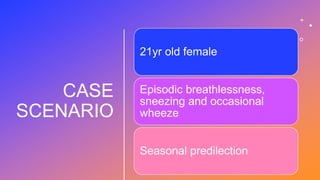
CASE
SCENARIO
21yr old female
Episodic breathlessness,
sneezing and occasional
wheeze
Seasonal predilection
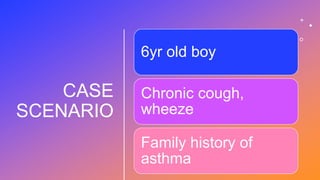
CASE
SCENARIO
6yr old boy
Chronic cough,
wheeze
Family history of
asthma
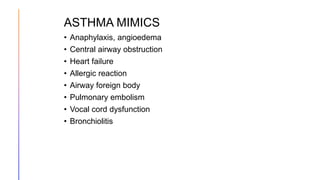
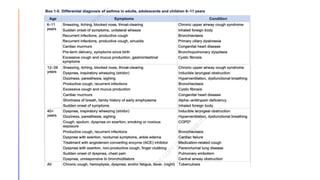
ASTHMA MIMICS
• Anaphylaxis, angioedema
• Central airway obstruction
• Heart failure
• Allergic reaction
• Airway foreign body
• Pulmonary embolism
• Vocal cord dysfunction
• Bronchiolitis
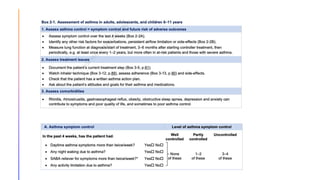
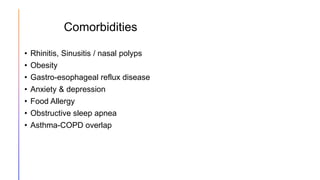
Comorbidities
• Rhinitis, Sinusitis / nasal polyps
• Obesity
• Gastro-esophageal reflux disease
• Anxiety & depression
• Food Allergy
• Obstructive sleep apnea
• Asthma-COPD overlap
WHAT ARE THE INVESTIGATIONS YOU
WOULD ORDER FOR AN ASTHMATIC ON
INITIAL EVALUATION
Usual Workup
• CBC, DLC
• IgE
• Xray Chest
• Xray PNS
• 2D ECHO/NT-ProBNP
ASTHMA MIMICS
• Anaphylaxis, angioedema
• Central airway obstruction
• Heart failure
• Allergic reaction
• Airway foreign body
• Pulmonary embolism
• Vocal cord dysfunction
• Bronchiolitis
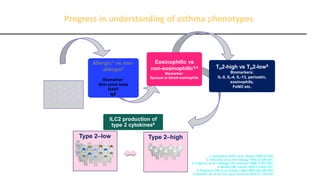
ILC2 production of
type 2 cytokines6
Type 2–low Type 2–high
Progress in understanding of asthma phenotypes
TH2-high vs TH2-low5
Biomarkers:
IL-5, IL-4, IL-13, periostin,
eosinophils,
FeNO etc.
Asthma
population
Eosinophilic vs
non-eosinophilic3,4
Biomarker:
Sputum or blood eosinophils
Allergic1 vs non-
allergic2
Biomarker:
Skin prick tests
RAST
IgE
1. Johansson SGO, et al, Thorax 1969;24:510;
2. Khan AU, et al, Ann Allergy 1974;32:245-251;
3. Frigas E, et al, J Allergy Clin Immunol 1986;77:527-537;
4. Brown HM, Lancet 1958;2:1245-1247;
5. Robinson DS, et al, N Engl J Med 1992;326:298-304;
6. Bernink JH, et al, Curr Opin Immunol 2014;31:115-120.
ADVANCED LAB / IMMUNOLOGICAL TESTING
• For patients with severe persistent asthma, a CBC and differential (to evaluate
the presence/absence of eosinophils and exclude anemia as a cause of
dyspnea) and a total serum immunoglobulin E (IgE) level (eg, for allergic
bronchopulmonary aspergillosis [ABPA] or for identification of candidates for
anti-IgE therapy) are usually obtained.
• Specific testing for aspergillus sensitization (skin test or immunoassay) and an
antineutrophil cytoplasmic antibody (ANCA) are performed in those with high
blood eosinophils to evaluate for ABPA and eosinophilic granulomatosis with
polyangiitis (EGPA, Churg-Strauss), respectively
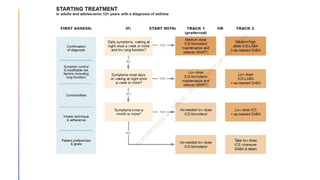
UPON DIAGNOSIS OF ASTHMA IN THE
ABOVE PATIENT, WHAT WOULD BE THE
FIRST CHOICE OF TREATMENT?
HOW TO DECIDE THE BEST INHALER?
THE BEST ONE YET!
17
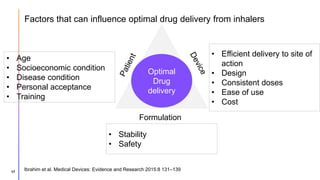
Factors that can influence optimal drug delivery from inhalers
Optimal
Drug
delivery
Formulation
• Efficient delivery to site of
action
• Design
• Consistent doses
• Ease of use
• Cost
• Age
• Socioeconomic condition
• Disease condition
• Personal acceptance
• Training
• Stability
• Safety
Ibrahim et al. Medical Devices: Evidence and Research 2015:8 131–139
18
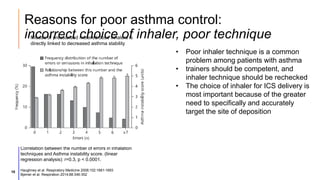
Reasons for poor asthma control:
incorrect choice of inhaler, poor technique
Correlation between the number of errors in inhalation
techniques and Asthma instability score. (linear
regression analysis): r=0.3, p < 0.0001.
Haughney et al. Respiratory Medicine 2008;102:1681-1693
Bjemer et al. Respiration 2014;88:346-352
Misuse of pressurised metered dose inhalers is
directly linked to decreased asthma stability
• Poor inhaler technique is a common
problem among patients with asthma
• trainers should be competent, and
inhaler technique should be rechecked
• The choice of inhaler for ICS delivery is
most important because of the greater
need to specifically and accurately
target the site of deposition
19
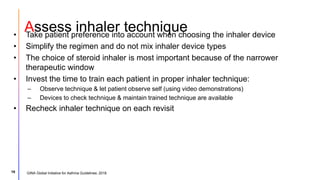
Assess inhaler technique
• Take patient preference into account when choosing the inhaler device
• Simplify the regimen and do not mix inhaler device types
• The choice of steroid inhaler is most important because of the narrower
therapeutic window
• Invest the time to train each patient in proper inhaler technique:
– Observe technique & let patient observe self (using video demonstrations)
– Devices to check technique & maintain trained technique are available
• Recheck inhaler technique on each revisit
GINA Global Initiative for Asthma Guidelines: 2018
CASE
SCENARIO
• Middle aged male
• On regular ICS/LABA
• Regular follow up
• Comes back within
3weeks with night
awakenings
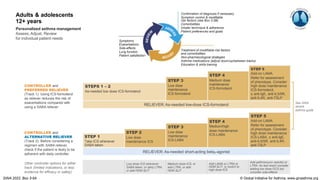
Low dose ICS whenever
SABA taken, or daily LTRA,
or add HDM SLIT
Medium dose ICS, or
add LTRA, or add
HDM SLIT
Add LAMA or LTRA or
HDM SLIT, or switch to
high dose ICS
Add azithromycin (adults) or
LTRA. As last resort consider
adding low dose OCS but
consider side-effects
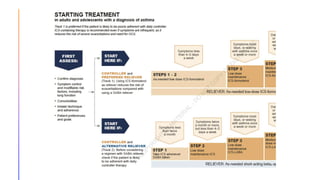
RELIEVER: As-needed short-acting beta2-agonist
STEP 1
Take ICS whenever
SABA taken
STEP 2
Low dose
maintenance ICS
STEP 3
Low dose
maintenance
ICS-LABA
STEP 4
Medium/high
dose maintenance
ICS-LABA
STEP 5
Add-on LAMA
Refer for assessment
of phenotype. Consider
high dose maintenance
ICS-LABA, ± anti-IgE,
anti-IL5/5R, anti-IL4R,
anti-TSLP
RELIEVER: As-needed low-dose ICS-formoterol
STEPS 1 – 2
As-needed low dose ICS-formoterol
STEP 3
Low dose
maintenance
ICS-formoterol
STEP 4
Medium dose
maintenance
ICS-formoterol
STEP 5
Add-on LAMA
Refer for assessment
of phenotype. Consider
high dose maintenance
ICS-formoterol,
± anti-IgE, anti-IL5/5R,
anti-IL4R, anti-TSLP
Treatment of modifiable risk factors
and comorbidities
Non-pharmacological strategies
Asthma medications (adjust down/up/between tracks)
Education & skills training
Adults & adolescents
12+ years
Personalized asthma management
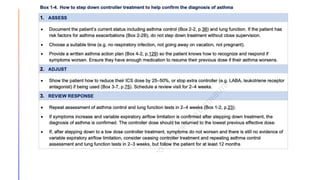
Assess, Adjust, Review
for individual patient needs
Symptoms
Exacerbations
Side-effects
Lung function
Patient satisfaction
Confirmation of diagnosis if necessary
Symptom control & modifiable
risk factors (see Box 2-2B)
Comorbidities
Inhaler technique & adherence
Patient preferences and goals
CONTROLLER and
PREFERRED RELIEVER
(Track 1). Using ICS-formoterol
as reliever reduces the risk of
exacerbations compared with
using a SABA reliever
Other controller options for either
track (limited indications, or less
evidence for efficacy or safety)
CONTROLLER and
ALTERNATIVE RELIEVER
(Track 2). Before considering a
regimen with SABA reliever,
check if the patient is likely to be
adherent with daily controller
See GINA
severe
asthma guide
© Global Initiative for Asthma, www.ginasthma.org
GINA 2022, Box 3-5A
Comorbidities
• Rhinitis, Sinusitis / nasal polyps
• Obesity
• Gastro-esophageal reflux disease
• Anxiety & depression
• Food Allergy
• Obstructive sleep apnea
• Asthma-COPD overlap
WHAT IS A GOOD TIME TO DECREASE
THERAPY?
HOW CAN WE PREDICT FUTURE
RISK OF EXACERBATIONS?
WHY IS IT IMPORTANT TO PREVENT
EXACERBATIONS?
1. Cost to patient and healthcare system
2. To prevent Lung function decline
3. Improve quality of life
4. All of above
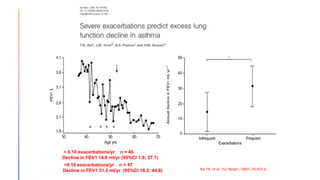
Bai TR, et al. Eur Respir J 2007; 30:452-6
>0.10 exacerbations/yr n = 47
Decline in FEV1 31.5 ml/yr (95%CI 18.2; 44.8)
< 0.10 exacerbations/yr n = 46
Decline in FEV1 14.6 ml/yr (95%CI 1.9; 27.1)
Image is used for educational purpose only. AstraZeneca is not responsible for data and copyrights
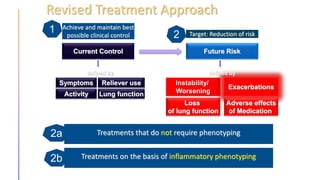
Revised Treatment Approach
Current Control
Achieve and maintain best
possible clinical control
Symptoms
Activity
Reliever use
Lung function
defined by
1
Future Risk
Instability/
Worsening
Loss
of lung function
Exacerbations
Adverse effects
of Medication
defined by
Target: Reduction of risk
2
2a Treatments that do not require phenotyping
2b Treatments on the basis of inflammatory phenotyping
Based on Bateman ED. J Allergy Clin Immunol 2010;125:600–8.
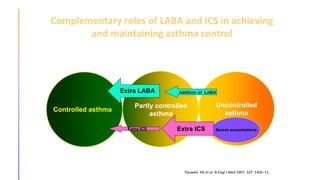
Complementary roles of LABA and ICS in achieving
and maintaining asthma control
Controlled asthma
Partly
controlled
asthma
Uncontrolled
asthma
Severe exacerbations
Extra ICS
Addition of LABA
Extra ICS
Extra LABA
Partly controlled
asthma
Pauwels RA et al. N Engl J Med 1997; 337: 1405–11.
WHEN SHOULD A PATIENT BE
REFERRED TO A DEDICATED
ASTHMA CLINIC?
IS IT THAT IMPORTANT?
WHAT IS THE RELATION OF
ASTHMA WITH COVID
DO WE VACCINATE?
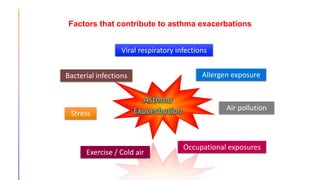
Factors that contribute to asthma exacerbations
Viral respiratory infections
Allergen exposure
Air pollution
Exercise / Cold air
Stress
Bacterial infections
Occupational exposures
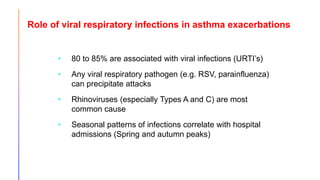
Role of viral respiratory infections in asthma exacerbations
• 80 to 85% are associated with viral infections (URTI’s)
• Any viral respiratory pathogen (e.g. RSV, parainfluenza)
can precipitate attacks
• Rhinoviruses (especially Types A and C) are most
common cause
• Seasonal patterns of infections correlate with hospital
admissions (Spring and autumn peaks)
Johnston SL, el al. BMJ 1995;310:1225-9.
Johnston SL, et al. Am J Respir Crit Care Med 1996;154:656-60.
Asthma management and GINA.pptx

Asthma management and GINA.pptx

  • 1.
  • 2.
    CASE SCENARIO 21yr old female Episodicbreathlessness, sneezing and occasional wheeze Seasonal predilection
  • 3.
    CASE SCENARIO 6yr old boy Chroniccough, wheeze Family history of asthma
  • 6.
    ASTHMA MIMICS • Anaphylaxis,angioedema • Central airway obstruction • Heart failure • Allergic reaction • Airway foreign body • Pulmonary embolism • Vocal cord dysfunction • Bronchiolitis
  • 9.
    Comorbidities • Rhinitis, Sinusitis/ nasal polyps • Obesity • Gastro-esophageal reflux disease • Anxiety & depression • Food Allergy • Obstructive sleep apnea • Asthma-COPD overlap
  • 10.
    WHAT ARE THEINVESTIGATIONS YOU WOULD ORDER FOR AN ASTHMATIC ON INITIAL EVALUATION
  • 11.
    Usual Workup • CBC,DLC • IgE • Xray Chest • Xray PNS • 2D ECHO/NT-ProBNP
  • 12.
    ASTHMA MIMICS • Anaphylaxis,angioedema • Central airway obstruction • Heart failure • Allergic reaction • Airway foreign body • Pulmonary embolism • Vocal cord dysfunction • Bronchiolitis
  • 13.
    ILC2 production of type2 cytokines6 Type 2–low Type 2–high Progress in understanding of asthma phenotypes TH2-high vs TH2-low5 Biomarkers: IL-5, IL-4, IL-13, periostin, eosinophils, FeNO etc. Asthma population Eosinophilic vs non-eosinophilic3,4 Biomarker: Sputum or blood eosinophils Allergic1 vs non- allergic2 Biomarker: Skin prick tests RAST IgE 1. Johansson SGO, et al, Thorax 1969;24:510; 2. Khan AU, et al, Ann Allergy 1974;32:245-251; 3. Frigas E, et al, J Allergy Clin Immunol 1986;77:527-537; 4. Brown HM, Lancet 1958;2:1245-1247; 5. Robinson DS, et al, N Engl J Med 1992;326:298-304; 6. Bernink JH, et al, Curr Opin Immunol 2014;31:115-120.
  • 14.
    ADVANCED LAB /IMMUNOLOGICAL TESTING • For patients with severe persistent asthma, a CBC and differential (to evaluate the presence/absence of eosinophils and exclude anemia as a cause of dyspnea) and a total serum immunoglobulin E (IgE) level (eg, for allergic bronchopulmonary aspergillosis [ABPA] or for identification of candidates for anti-IgE therapy) are usually obtained. • Specific testing for aspergillus sensitization (skin test or immunoassay) and an antineutrophil cytoplasmic antibody (ANCA) are performed in those with high blood eosinophils to evaluate for ABPA and eosinophilic granulomatosis with polyangiitis (EGPA, Churg-Strauss), respectively
  • 15.
    UPON DIAGNOSIS OFASTHMA IN THE ABOVE PATIENT, WHAT WOULD BE THE FIRST CHOICE OF TREATMENT? HOW TO DECIDE THE BEST INHALER?
  • 16.
  • 17.
    17 Factors that caninfluence optimal drug delivery from inhalers Optimal Drug delivery Formulation • Efficient delivery to site of action • Design • Consistent doses • Ease of use • Cost • Age • Socioeconomic condition • Disease condition • Personal acceptance • Training • Stability • Safety Ibrahim et al. Medical Devices: Evidence and Research 2015:8 131–139
  • 18.
    18 Reasons for poorasthma control: incorrect choice of inhaler, poor technique Correlation between the number of errors in inhalation techniques and Asthma instability score. (linear regression analysis): r=0.3, p < 0.0001. Haughney et al. Respiratory Medicine 2008;102:1681-1693 Bjemer et al. Respiration 2014;88:346-352 Misuse of pressurised metered dose inhalers is directly linked to decreased asthma stability • Poor inhaler technique is a common problem among patients with asthma • trainers should be competent, and inhaler technique should be rechecked • The choice of inhaler for ICS delivery is most important because of the greater need to specifically and accurately target the site of deposition
  • 19.
    19 Assess inhaler technique •Take patient preference into account when choosing the inhaler device • Simplify the regimen and do not mix inhaler device types • The choice of steroid inhaler is most important because of the narrower therapeutic window • Invest the time to train each patient in proper inhaler technique: – Observe technique & let patient observe self (using video demonstrations) – Devices to check technique & maintain trained technique are available • Recheck inhaler technique on each revisit GINA Global Initiative for Asthma Guidelines: 2018
  • 22.
    CASE SCENARIO • Middle agedmale • On regular ICS/LABA • Regular follow up • Comes back within 3weeks with night awakenings
  • 23.
    Low dose ICSwhenever SABA taken, or daily LTRA, or add HDM SLIT Medium dose ICS, or add LTRA, or add HDM SLIT Add LAMA or LTRA or HDM SLIT, or switch to high dose ICS Add azithromycin (adults) or LTRA. As last resort consider adding low dose OCS but consider side-effects RELIEVER: As-needed short-acting beta2-agonist STEP 1 Take ICS whenever SABA taken STEP 2 Low dose maintenance ICS STEP 3 Low dose maintenance ICS-LABA STEP 4 Medium/high dose maintenance ICS-LABA STEP 5 Add-on LAMA Refer for assessment of phenotype. Consider high dose maintenance ICS-LABA, ± anti-IgE, anti-IL5/5R, anti-IL4R, anti-TSLP RELIEVER: As-needed low-dose ICS-formoterol STEPS 1 – 2 As-needed low dose ICS-formoterol STEP 3 Low dose maintenance ICS-formoterol STEP 4 Medium dose maintenance ICS-formoterol STEP 5 Add-on LAMA Refer for assessment of phenotype. Consider high dose maintenance ICS-formoterol, ± anti-IgE, anti-IL5/5R, anti-IL4R, anti-TSLP Treatment of modifiable risk factors and comorbidities Non-pharmacological strategies Asthma medications (adjust down/up/between tracks) Education & skills training Adults & adolescents 12+ years Personalized asthma management Assess, Adjust, Review for individual patient needs Symptoms Exacerbations Side-effects Lung function Patient satisfaction Confirmation of diagnosis if necessary Symptom control & modifiable risk factors (see Box 2-2B) Comorbidities Inhaler technique & adherence Patient preferences and goals CONTROLLER and PREFERRED RELIEVER (Track 1). Using ICS-formoterol as reliever reduces the risk of exacerbations compared with using a SABA reliever Other controller options for either track (limited indications, or less evidence for efficacy or safety) CONTROLLER and ALTERNATIVE RELIEVER (Track 2). Before considering a regimen with SABA reliever, check if the patient is likely to be adherent with daily controller See GINA severe asthma guide © Global Initiative for Asthma, www.ginasthma.org GINA 2022, Box 3-5A
  • 25.
    Comorbidities • Rhinitis, Sinusitis/ nasal polyps • Obesity • Gastro-esophageal reflux disease • Anxiety & depression • Food Allergy • Obstructive sleep apnea • Asthma-COPD overlap
  • 26.
    WHAT IS AGOOD TIME TO DECREASE THERAPY?
  • 28.
    HOW CAN WEPREDICT FUTURE RISK OF EXACERBATIONS?
  • 29.
    WHY IS ITIMPORTANT TO PREVENT EXACERBATIONS? 1. Cost to patient and healthcare system 2. To prevent Lung function decline 3. Improve quality of life 4. All of above
  • 30.
    Bai TR, etal. Eur Respir J 2007; 30:452-6 >0.10 exacerbations/yr n = 47 Decline in FEV1 31.5 ml/yr (95%CI 18.2; 44.8) < 0.10 exacerbations/yr n = 46 Decline in FEV1 14.6 ml/yr (95%CI 1.9; 27.1) Image is used for educational purpose only. AstraZeneca is not responsible for data and copyrights
  • 31.
    Revised Treatment Approach CurrentControl Achieve and maintain best possible clinical control Symptoms Activity Reliever use Lung function defined by 1 Future Risk Instability/ Worsening Loss of lung function Exacerbations Adverse effects of Medication defined by Target: Reduction of risk 2 2a Treatments that do not require phenotyping 2b Treatments on the basis of inflammatory phenotyping Based on Bateman ED. J Allergy Clin Immunol 2010;125:600–8.
  • 32.
    Complementary roles ofLABA and ICS in achieving and maintaining asthma control Controlled asthma Partly controlled asthma Uncontrolled asthma Severe exacerbations Extra ICS Addition of LABA Extra ICS Extra LABA Partly controlled asthma Pauwels RA et al. N Engl J Med 1997; 337: 1405–11.
  • 34.
    WHEN SHOULD APATIENT BE REFERRED TO A DEDICATED ASTHMA CLINIC? IS IT THAT IMPORTANT?
  • 36.
    WHAT IS THERELATION OF ASTHMA WITH COVID DO WE VACCINATE?
  • 37.
    Factors that contributeto asthma exacerbations Viral respiratory infections Allergen exposure Air pollution Exercise / Cold air Stress Bacterial infections Occupational exposures
  • 38.
    Role of viralrespiratory infections in asthma exacerbations • 80 to 85% are associated with viral infections (URTI’s) • Any viral respiratory pathogen (e.g. RSV, parainfluenza) can precipitate attacks • Rhinoviruses (especially Types A and C) are most common cause • Seasonal patterns of infections correlate with hospital admissions (Spring and autumn peaks) Johnston SL, el al. BMJ 1995;310:1225-9. Johnston SL, et al. Am J Respir Crit Care Med 1996;154:656-60.