PRINCIPLES OF PSYCHOSOCIAL
REHABILITATION AND DISABILITY ASSESSMENT
PRESENTED BY-
DISHA SINHA
M.SC.NURSING 2nd YEAR
ROLL-2088011
• Rehabilitation work undertaken by rehabilitation professionals, psychiatrists,
social workers and other mental health professionals, like psychologists,
community support workers and occupational therapists seek to affect changes
in a person’s environment and in a person’s ability to deal with his or her
environment, so as to facilitate improvement in symptoms or personal
distresses.
• There is often a focus on challenging stigma and prejudice to enable social
inclusion, on working collaboratively in order to empower clients, and
sometimes on a goal of full psychosocial recovery.
DEFINITION
• According to APA, “ the process of enhancing the recovery of individuals with
severe mental illness by teaching or restoring psychological, behavioral, social,
and vocational skills that will enable them to function in their community and
by facilitating that endeavor through a continuum of services such as
psychotherapy, family psychoeducation, illness management, and supported
employment is called psychosocial rehabilitation.”
CHARACTERISTICS
1. A person is considered to have disabilities when he or she persistently
cannot perform up to the standards expected by society.
2. Psychiatric patients have three kinds of disabilities:
• Impairment of function directly due to psychiatric symptoms.
• Social disadvantages.
• Adverse psychological reactions.
CONTD.
3. Psychiatric rehabilitation includes 2 processes:
• Identifying, preventing, or minimizing the above 3 disabilities.
• Helping the person to develop and use his or her assets.
PRINCIPLES
1. Full human capacity is often under-utilised.
2. Equipping people with skills.
3. Self-determination.
4. Services in normal development.
5. Differential care and needs.
6. The commitment of staff.
PRINCIPLES
7. No professional barriers or Shields.
8. Early intervention
9. Environment approach.
10. Change in the environment.
11. Work-centred process.
12. No limits to participation.
13. Social rather than a medical model.
14. emphasis on the client’s strength rather than on the pathologies
15. Emphasis on the here and now rather than on the problems of the past
APPROACHES TO PSYCHOSOCIAL
REHABILITATION
• Psychoeducation
• Working with families
• Group therapy
• Social skills
• Rehabilitation team
STEPS IN PSYCHIATRIC REHABILITATION
Reduction of impairment
Remediation of disabilities through skills
training
Remediation of disabilities through
supportive interventions
Remediation of handicap
DISABILITY ASSESSMENT
Disability assessments also called “fit to work”
assessments, take place within a great deal of legal
context that is designed to prevent unfair
discrimination against disabled workers.
STEPS OF DISABILITY ASSESSMENT
identifying needs
matching treatments and interventions
measuring outcomes and effectiveness
setting priorities
allocating resources
INTERVENTIONS
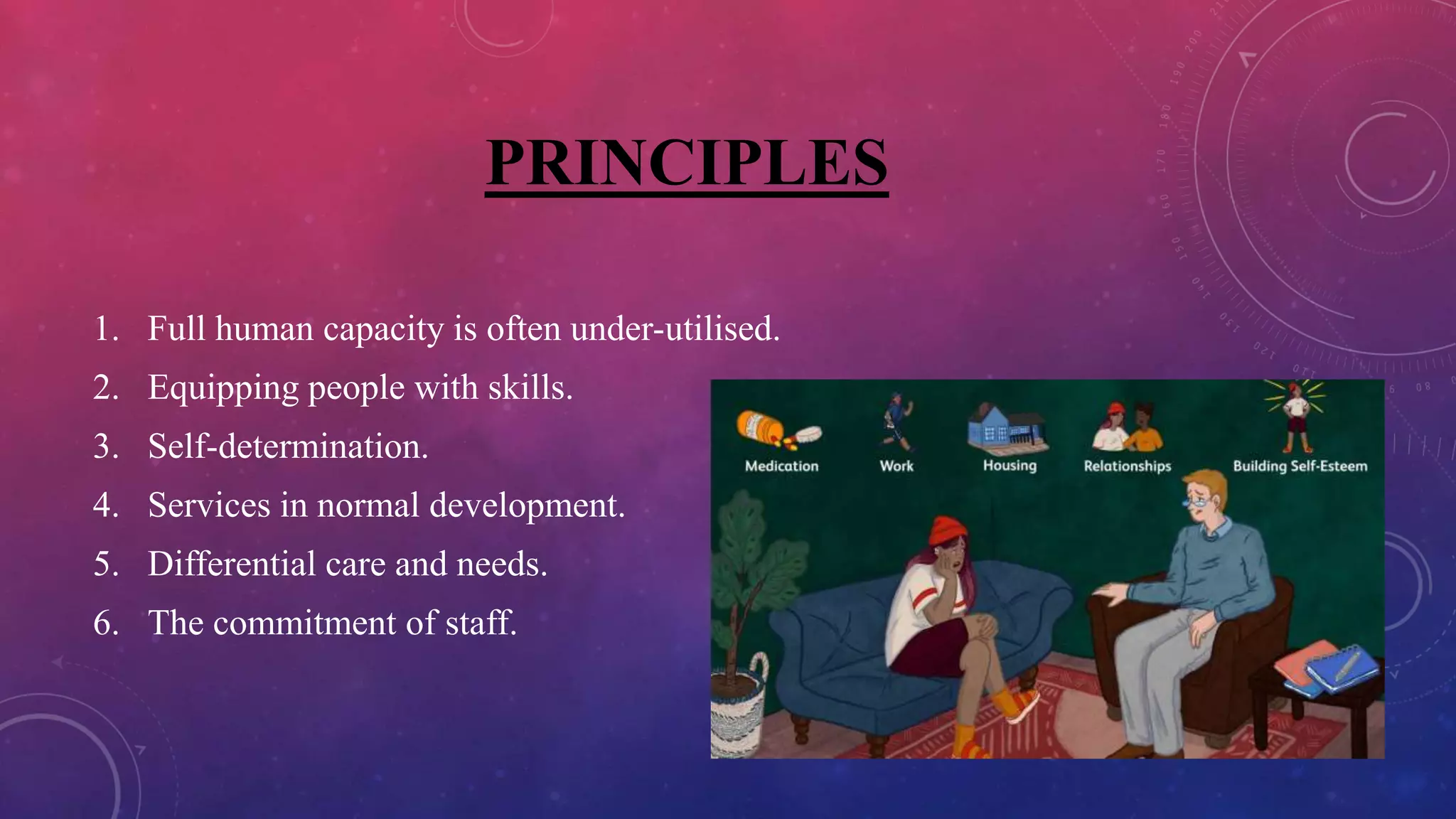
• Current approaches
• Housing
• Work
• Building relationships
• Keeping relationships
• Participation in community life with full rights
CONCLUSION
Mental health problems are common worldwide and the process of taking care in
the long term by the families of the individuals is of the utmost importance. The
correct assessment of the disabilities of the individuals suffering and the right
rehabilitation treatment are very much necessary for the individuals suffering
from mental illness to become independent and earn their livelihoods.
BIBLIOGRAPHY
• Townsend, M. C. (2002). Essentials of psychiatric/mental health nursing, 2nd edition, F.A. Davis
Company., pp- 438-502.
• Keltner, N. L. (2013). Psychiatric Nursing, 6th edition, Mosby, pp-254-281.
• Stuart, G. W., & Laraia, M. (2004). Principles and practice of psychiatric nursing, 8th edition,
Mosby, pp- 564-569.
• Wikipedia contributors. (2022, July 2), Psychiatric rehabilitation. Wikipedia, The Free
Encyclopedia. From:
https://en.wikipedia.org/w/index.php?title=Psychiatric_rehabilitation&oldid=1096075617
• Teerthanker Mahaveer College of Nursing, Psychosocial rehabilitation. Slideshare.net. Retrieved
September 30, 2022, from: https://www.slideshare.net/MahimaEliazer/psychosocial-rehabilitation-
88237283
• McWhorter, B. (2018, November 27). Disability Assessment. Safeopedia.com; What is a Disability
Assessment? - Definition from Safeopedia. https://www.safeopedia.com/definition/5729/disability-
assessment
psychosocial rehab.pptx

psychosocial rehab.pptx

  • 2.
    PRINCIPLES OF PSYCHOSOCIAL REHABILITATIONAND DISABILITY ASSESSMENT PRESENTED BY- DISHA SINHA M.SC.NURSING 2nd YEAR ROLL-2088011
  • 4.
    • Rehabilitation workundertaken by rehabilitation professionals, psychiatrists, social workers and other mental health professionals, like psychologists, community support workers and occupational therapists seek to affect changes in a person’s environment and in a person’s ability to deal with his or her environment, so as to facilitate improvement in symptoms or personal distresses. • There is often a focus on challenging stigma and prejudice to enable social inclusion, on working collaboratively in order to empower clients, and sometimes on a goal of full psychosocial recovery.
  • 5.
    DEFINITION • According toAPA, “ the process of enhancing the recovery of individuals with severe mental illness by teaching or restoring psychological, behavioral, social, and vocational skills that will enable them to function in their community and by facilitating that endeavor through a continuum of services such as psychotherapy, family psychoeducation, illness management, and supported employment is called psychosocial rehabilitation.”
  • 6.
    CHARACTERISTICS 1. A personis considered to have disabilities when he or she persistently cannot perform up to the standards expected by society. 2. Psychiatric patients have three kinds of disabilities: • Impairment of function directly due to psychiatric symptoms. • Social disadvantages. • Adverse psychological reactions.
  • 7.
    CONTD. 3. Psychiatric rehabilitationincludes 2 processes: • Identifying, preventing, or minimizing the above 3 disabilities. • Helping the person to develop and use his or her assets.
  • 8.
    PRINCIPLES 1. Full humancapacity is often under-utilised. 2. Equipping people with skills. 3. Self-determination. 4. Services in normal development. 5. Differential care and needs. 6. The commitment of staff.
  • 9.
    PRINCIPLES 7. No professionalbarriers or Shields. 8. Early intervention 9. Environment approach. 10. Change in the environment. 11. Work-centred process. 12. No limits to participation. 13. Social rather than a medical model. 14. emphasis on the client’s strength rather than on the pathologies 15. Emphasis on the here and now rather than on the problems of the past
  • 10.
    APPROACHES TO PSYCHOSOCIAL REHABILITATION •Psychoeducation • Working with families • Group therapy • Social skills • Rehabilitation team
  • 11.
    STEPS IN PSYCHIATRICREHABILITATION Reduction of impairment Remediation of disabilities through skills training Remediation of disabilities through supportive interventions Remediation of handicap
  • 12.
    DISABILITY ASSESSMENT Disability assessmentsalso called “fit to work” assessments, take place within a great deal of legal context that is designed to prevent unfair discrimination against disabled workers.
  • 13.
    STEPS OF DISABILITYASSESSMENT identifying needs matching treatments and interventions measuring outcomes and effectiveness setting priorities allocating resources
  • 14.
    INTERVENTIONS • Current approaches •Housing • Work • Building relationships • Keeping relationships • Participation in community life with full rights
  • 17.
    CONCLUSION Mental health problemsare common worldwide and the process of taking care in the long term by the families of the individuals is of the utmost importance. The correct assessment of the disabilities of the individuals suffering and the right rehabilitation treatment are very much necessary for the individuals suffering from mental illness to become independent and earn their livelihoods.
  • 18.
    BIBLIOGRAPHY • Townsend, M.C. (2002). Essentials of psychiatric/mental health nursing, 2nd edition, F.A. Davis Company., pp- 438-502. • Keltner, N. L. (2013). Psychiatric Nursing, 6th edition, Mosby, pp-254-281. • Stuart, G. W., & Laraia, M. (2004). Principles and practice of psychiatric nursing, 8th edition, Mosby, pp- 564-569. • Wikipedia contributors. (2022, July 2), Psychiatric rehabilitation. Wikipedia, The Free Encyclopedia. From: https://en.wikipedia.org/w/index.php?title=Psychiatric_rehabilitation&oldid=1096075617 • Teerthanker Mahaveer College of Nursing, Psychosocial rehabilitation. Slideshare.net. Retrieved September 30, 2022, from: https://www.slideshare.net/MahimaEliazer/psychosocial-rehabilitation- 88237283 • McWhorter, B. (2018, November 27). Disability Assessment. Safeopedia.com; What is a Disability Assessment? - Definition from Safeopedia. https://www.safeopedia.com/definition/5729/disability- assessment