ACADEMIC WRITING
APPLICATION NUMBER :
039e97cae78f11e9bf398de29dd6fdfb
NAME UJJWALA YADAV
BANARAS HINDU UNIVERSITY
Acknowledgement
I would like to express my special thanks of gratitude to
my psychology teacher pro. Richa singh ma’’am as
well as our swayam UGC course who gave me the
golden opportunity to do this wonderful project on the
topic Academic writing , which also helped me in
doing a lot of research and I come to know about so
many new things .
Secondly I would also like a thank my Dr. Subash
meena sir who helped me a lot in finishing this project
within the limited time
It helped me increase my knowledge and skills .
THANKS AGAIN TO ALL WHO SUPPORTED
 What is Psychodiagnostic Assessment
(NATURE)
 Aim
 Types of Pschodiagnostic Assessment
 Scope of Psychodiagnostic Testings
 Stages
PSYCHODIAGNOSTIC
TECHNIQUE
NATURE, SCOPE, & STAGE
NATURE
What is Psychodiagnostics?
 Psychodiagnostic is the science or art of
making a personality evaluation.
 The diagnosis of mental disorder.
 Psychodiagnostic testing is used to help
diagnose and clarify concerns regarding
behavior, personality traits, mood,
emotional functioning, and cognitive
processes.
Aims of Psychodiagnostic
Techniques
 Answer diagnostic questions and make decisions
 Ascertain difficulties
 Make predictions about an individual’s behaviour
 Measure cognitive ability, strengths and weaknesses
 Make evaluative judgments about an individual’s state of
functioning
 Take account of an individual’s history, background
information, clinical impressions, observations
 Take considerations of individual characteristics, such
as age, physical/mental limitations, education level,
culture and language, medical conditions
 Have application to treatment interventions, to
optimize outcomes and provide relief from
psychological difficulties
 Have application to forensic evaluations
 Determine diagnoses based on the Diagnostic
Statistical Manual (5th edition)
 Make recommendations about alternative
approaches/treatments available to the individual
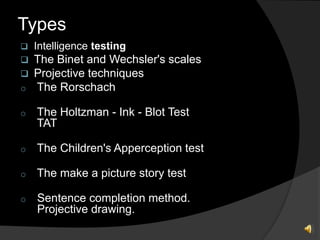
Types
 Intelligence testing
 The Binet and Wechsler's scales
 Projective techniques
o The Rorschach
o The Holtzman - Ink - Blot Test
TAT
o The Children's Apperception test
o The make a picture story test
o Sentence completion method.
Projective drawing.
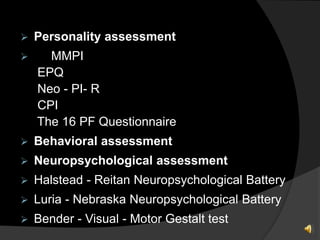
 Personality assessment
 MMPI
EPQ
Neo - PI- R
CPI
The 16 PF Questionnaire
 Behavioral assessment
 Neuropsychological assessment
 Halstead - Reitan Neuropsychological Battery
 Luria - Nebraska Neuropsychological Battery
 Bender - Visual - Motor Gestalt test
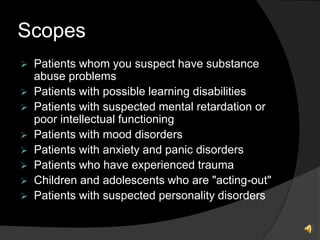
Scopes
 Patients whom you suspect have substance
abuse problems
 Patients with possible learning disabilities
 Patients with suspected mental retardation or
poor intellectual functioning
 Patients with mood disorders
 Patients with anxiety and panic disorders
 Patients who have experienced trauma
 Children and adolescents who are "acting-out"
 Patients with suspected personality disorders
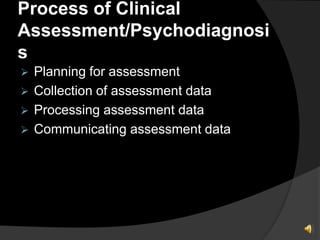
Process of Clinical
Assessment/Psychodiagnosi
s
 Planning for assessment
 Collection of assessment data
 Processing assessment data
 Communicating assessment data
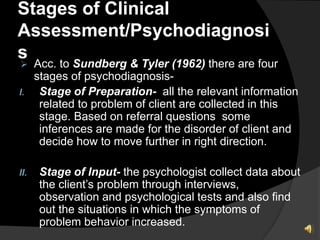
Stages of Clinical
Assessment/Psychodiagnosi
s
 Acc. to Sundberg & Tyler (1962) there are four
stages of psychodiagnosis-
I. Stage of Preparation- all the relevant information
related to problem of client are collected in this
stage. Based on referral questions some
inferences are made for the disorder of client and
decide how to move further in right direction.
II. Stage of Input- the psychologist collect data about
the client’s problem through interviews,
observation and psychological tests and also find
out the situations in which the symptoms of
problem behavior increased.
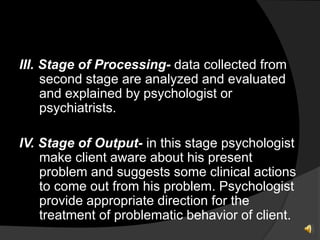
III. Stage of Processing- data collected from
second stage are analyzed and evaluated
and explained by psychologist or
psychiatrists.
IV. Stage of Output- in this stage psychologist
make client aware about his present
problem and suggests some clinical actions
to come out from his problem. Psychologist
provide appropriate direction for the
treatment of problematic behavior of client.
Psychodiagnostic technique

Psychodiagnostic technique

  • 1.
    ACADEMIC WRITING APPLICATION NUMBER: 039e97cae78f11e9bf398de29dd6fdfb NAME UJJWALA YADAV BANARAS HINDU UNIVERSITY
  • 2.
    Acknowledgement I would liketo express my special thanks of gratitude to my psychology teacher pro. Richa singh ma’’am as well as our swayam UGC course who gave me the golden opportunity to do this wonderful project on the topic Academic writing , which also helped me in doing a lot of research and I come to know about so many new things . Secondly I would also like a thank my Dr. Subash meena sir who helped me a lot in finishing this project within the limited time It helped me increase my knowledge and skills . THANKS AGAIN TO ALL WHO SUPPORTED
  • 3.
     What isPsychodiagnostic Assessment (NATURE)  Aim  Types of Pschodiagnostic Assessment  Scope of Psychodiagnostic Testings  Stages PSYCHODIAGNOSTIC TECHNIQUE NATURE, SCOPE, & STAGE
  • 4.
    NATURE What is Psychodiagnostics? Psychodiagnostic is the science or art of making a personality evaluation.  The diagnosis of mental disorder.  Psychodiagnostic testing is used to help diagnose and clarify concerns regarding behavior, personality traits, mood, emotional functioning, and cognitive processes.
  • 5.
    Aims of Psychodiagnostic Techniques Answer diagnostic questions and make decisions  Ascertain difficulties  Make predictions about an individual’s behaviour  Measure cognitive ability, strengths and weaknesses  Make evaluative judgments about an individual’s state of functioning  Take account of an individual’s history, background information, clinical impressions, observations
  • 6.
     Take considerationsof individual characteristics, such as age, physical/mental limitations, education level, culture and language, medical conditions  Have application to treatment interventions, to optimize outcomes and provide relief from psychological difficulties  Have application to forensic evaluations  Determine diagnoses based on the Diagnostic Statistical Manual (5th edition)  Make recommendations about alternative approaches/treatments available to the individual
  • 7.
    Types  Intelligence testing The Binet and Wechsler's scales  Projective techniques o The Rorschach o The Holtzman - Ink - Blot Test TAT o The Children's Apperception test o The make a picture story test o Sentence completion method. Projective drawing.
  • 8.
     Personality assessment MMPI EPQ Neo - PI- R CPI The 16 PF Questionnaire  Behavioral assessment  Neuropsychological assessment  Halstead - Reitan Neuropsychological Battery  Luria - Nebraska Neuropsychological Battery  Bender - Visual - Motor Gestalt test
  • 9.
    Scopes  Patients whomyou suspect have substance abuse problems  Patients with possible learning disabilities  Patients with suspected mental retardation or poor intellectual functioning  Patients with mood disorders  Patients with anxiety and panic disorders  Patients who have experienced trauma  Children and adolescents who are "acting-out"  Patients with suspected personality disorders
  • 10.
    Process of Clinical Assessment/Psychodiagnosi s Planning for assessment  Collection of assessment data  Processing assessment data  Communicating assessment data
  • 11.
    Stages of Clinical Assessment/Psychodiagnosi s Acc. to Sundberg & Tyler (1962) there are four stages of psychodiagnosis- I. Stage of Preparation- all the relevant information related to problem of client are collected in this stage. Based on referral questions some inferences are made for the disorder of client and decide how to move further in right direction. II. Stage of Input- the psychologist collect data about the client’s problem through interviews, observation and psychological tests and also find out the situations in which the symptoms of problem behavior increased.
  • 12.
    III. Stage ofProcessing- data collected from second stage are analyzed and evaluated and explained by psychologist or psychiatrists. IV. Stage of Output- in this stage psychologist make client aware about his present problem and suggests some clinical actions to come out from his problem. Psychologist provide appropriate direction for the treatment of problematic behavior of client.