Revised 2/17/14. Email Justin.berk@ttuhsc.edu with any feedback.
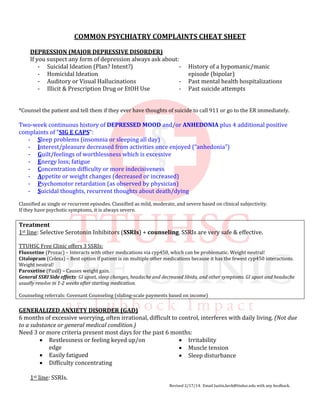
COMMON PSYCHIATRY COMPLAINTS CHEAT SHEET
DEPRESSION (MAJOR DEPRESSIVE DISORDER)
If you suspect any form of depression always ask about:
- Suicidal Ideation (Plan? Intent?)
- Homicidal Ideation
- Auditory or Visual Hallucinations
- Illicit & Prescription Drug or EtOH Use
- History of a hypomanic/manic
episode (bipolar)
- Past mental health hospitalizations
- Past suicide attempts
*Counsel the patient and tell them if they ever have thoughts of suicide to call 911 or go to the ER immediately.
Two-week continuous history of DEPRESSED MOOD and/or ANHEDONIA plus 4 additional positive
complaints of “SIG E CAPS”:
- Sleep problems (insomnia or sleeping all day)
- Interest/pleasure decreased from activities once enjoyed (“anhedonia”)
- Guilt/feelings of worthlessness which is excessive
- Energy loss; fatigue
- Concentration difficulty or more indecisiveness
- Appetite or weight changes (decreased or increased)
- Psychomotor retardation (as observed by physician)
- Suicidal thoughts, recurrent thoughts about death/dying
Classified as single or recurrent episodes. Classified as mild, moderate, and severe based on clinical subjectivity.
If they have psychotic symptoms, it is always severe.
Treatment
1st line: Selective Serotonin Inhibitors (SSRIs) + counseling. SSRIs are very safe & effective.
TTUHSC Free Clinic offers 3 SSRIs:
Fluoxetine (Prozac) – Interacts with other medications via cyp450, which can be problematic. Weight neutral!
Citalopram (Celexa) – Best option if patient is on multiple other medications because it has the fewest cyp450 interactions.
Weight neutral!
Paroxetine (Paxil) – Causes weight gain.
General SSRI Side effects: GI upset, sleep changes, headache and decreased libido, and other symptoms. GI upset and headache
usually resolve in 1-2 weeks after starting medication.
Counseling referrals: Covenant Counseling (sliding-scale payments based on income)
GENERALIZED ANXIETY DISORDER (GAD)
6 months of excessive worrying, often irrational, difficult to control, interferes with daily living. (Not due
to a substance or general medical condition.)
Need 3 or more criteria present most days for the past 6 months:
 Restlessness or feeling keyed up/on
edge
 Easily fatigued
 Difficulty concentrating
 Irritability
 Muscle tension
 Sleep disturbance
1st line: SSRIs.
Revised 2/17/14. Email Justin.berk@ttuhsc.edu with any feedback.
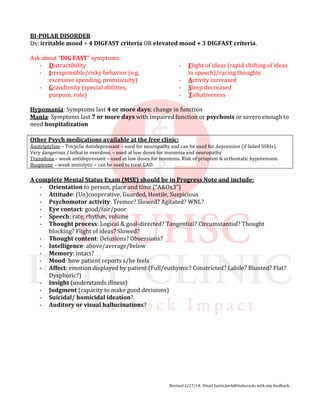
BI-POLAR DISORDER
Dx: irritable mood + 4 DIGFAST criteria OR elevated mood + 3 DIGFAST criteria.
Ask about “DIG FAST” symptoms:
- Distractibility
- Irresponsible/risky behavior (e.g.
excessive spending, promiscuity)
- Grandiosity (special abilities,
purpose, role)
- Flight of ideas (rapid shifting of ideas
in speech)/racing thoughts
- Activity increased
- Sleep decreased
- Talkativeness
Hypomania: Symptoms last 4 or more days; change in function
Mania: Symptoms last 7 or more days with impaired function or psychosis or severe enough to
need hospitalization
Other Psych medications available at the free clinic:
Amitriptyline – Tricyclic Antidepressant – used for neuropathy and can be used for depression (if failed SSRIs).
Very dangerous / lethal in overdose. – used at low doses for insomnia and neuropathy
Trazodone – weak antidepressant – used at low doses for insomnia. Risk of priapism & orthostatic hypotension.
Buspirone – weak anxiolytic – can be used to treat GAD.
A complete Mental Status Exam (MSE) should be in Progress Note and include:
- Orientation to person, place and time (“A&Ox3”)
- Attitude: (Un)cooperative, Guarded, Hostile, Suspicious
- Psychomotor activity: Tremor? Slowed? Agitated? WNL?
- Eye contact: good/fair/poor
- Speech: rate, rhythm, volume
- Thought process: Logical & goal-directed? Tangential? Circumstantial? Thought
blocking? Flight of ideas? Slowed?
- Thought content: Delusions? Obsessions?
- Intelligence: above/average/below
- Memory: intact?
- Mood: how patient reports s/he feels
- Affect: emotion displayed by patient (Full/euthymic? Constricted? Labile? Blunted? Flat?
Dysphoric?)
- Insight (understands illness)
- Judgment (capacity to make good decisions)
- Suicidal/ homicidal ideation?
- Auditory or visual hallucinations?

Psychiatry Cheat Sheet (MDD, GAD, Bipolar)

  • 1.
    Revised 2/17/14. EmailJustin.berk@ttuhsc.edu with any feedback. COMMON PSYCHIATRY COMPLAINTS CHEAT SHEET DEPRESSION (MAJOR DEPRESSIVE DISORDER) If you suspect any form of depression always ask about: - Suicidal Ideation (Plan? Intent?) - Homicidal Ideation - Auditory or Visual Hallucinations - Illicit & Prescription Drug or EtOH Use - History of a hypomanic/manic episode (bipolar) - Past mental health hospitalizations - Past suicide attempts *Counsel the patient and tell them if they ever have thoughts of suicide to call 911 or go to the ER immediately. Two-week continuous history of DEPRESSED MOOD and/or ANHEDONIA plus 4 additional positive complaints of “SIG E CAPS”: - Sleep problems (insomnia or sleeping all day) - Interest/pleasure decreased from activities once enjoyed (“anhedonia”) - Guilt/feelings of worthlessness which is excessive - Energy loss; fatigue - Concentration difficulty or more indecisiveness - Appetite or weight changes (decreased or increased) - Psychomotor retardation (as observed by physician) - Suicidal thoughts, recurrent thoughts about death/dying Classified as single or recurrent episodes. Classified as mild, moderate, and severe based on clinical subjectivity. If they have psychotic symptoms, it is always severe. Treatment 1st line: Selective Serotonin Inhibitors (SSRIs) + counseling. SSRIs are very safe & effective. TTUHSC Free Clinic offers 3 SSRIs: Fluoxetine (Prozac) – Interacts with other medications via cyp450, which can be problematic. Weight neutral! Citalopram (Celexa) – Best option if patient is on multiple other medications because it has the fewest cyp450 interactions. Weight neutral! Paroxetine (Paxil) – Causes weight gain. General SSRI Side effects: GI upset, sleep changes, headache and decreased libido, and other symptoms. GI upset and headache usually resolve in 1-2 weeks after starting medication. Counseling referrals: Covenant Counseling (sliding-scale payments based on income) GENERALIZED ANXIETY DISORDER (GAD) 6 months of excessive worrying, often irrational, difficult to control, interferes with daily living. (Not due to a substance or general medical condition.) Need 3 or more criteria present most days for the past 6 months:  Restlessness or feeling keyed up/on edge  Easily fatigued  Difficulty concentrating  Irritability  Muscle tension  Sleep disturbance 1st line: SSRIs.
  • 2.
    Revised 2/17/14. EmailJustin.berk@ttuhsc.edu with any feedback. BI-POLAR DISORDER Dx: irritable mood + 4 DIGFAST criteria OR elevated mood + 3 DIGFAST criteria. Ask about “DIG FAST” symptoms: - Distractibility - Irresponsible/risky behavior (e.g. excessive spending, promiscuity) - Grandiosity (special abilities, purpose, role) - Flight of ideas (rapid shifting of ideas in speech)/racing thoughts - Activity increased - Sleep decreased - Talkativeness Hypomania: Symptoms last 4 or more days; change in function Mania: Symptoms last 7 or more days with impaired function or psychosis or severe enough to need hospitalization Other Psych medications available at the free clinic: Amitriptyline – Tricyclic Antidepressant – used for neuropathy and can be used for depression (if failed SSRIs). Very dangerous / lethal in overdose. – used at low doses for insomnia and neuropathy Trazodone – weak antidepressant – used at low doses for insomnia. Risk of priapism & orthostatic hypotension. Buspirone – weak anxiolytic – can be used to treat GAD. A complete Mental Status Exam (MSE) should be in Progress Note and include: - Orientation to person, place and time (“A&Ox3”) - Attitude: (Un)cooperative, Guarded, Hostile, Suspicious - Psychomotor activity: Tremor? Slowed? Agitated? WNL? - Eye contact: good/fair/poor - Speech: rate, rhythm, volume - Thought process: Logical & goal-directed? Tangential? Circumstantial? Thought blocking? Flight of ideas? Slowed? - Thought content: Delusions? Obsessions? - Intelligence: above/average/below - Memory: intact? - Mood: how patient reports s/he feels - Affect: emotion displayed by patient (Full/euthymic? Constricted? Labile? Blunted? Flat? Dysphoric?) - Insight (understands illness) - Judgment (capacity to make good decisions) - Suicidal/ homicidal ideation? - Auditory or visual hallucinations?