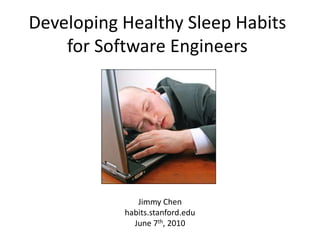
Developing Healthy Sleep Habits for Software EngineersJimmy Chen habits.stanford.eduJune 7th, 2010
OutlineI. The Impact of SleepII. Computers and SleepIII. Changing Sleep HabitsIV. Proposed SolutionsJimmy Chen • habits.stanford.edu • June 7th, 2010
I. The Impact of SleepII. Computers and SleepIII. Changing Sleep HabitsIV. Proposed SolutionsJimmy Chen • habits.stanford.edu • June 7th, 2010
A new miracle drug…Be happier!Lose weight!Be more productive!Fight cancer!
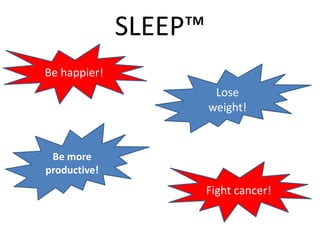
SLEEP™Be happier!Lose weight!Be more productive!Fight cancer!
University of Michigan study:"Making $60,000 more in annual income has less of an effect on your daily happiness than getting one extra hour of sleep a night," says study author Norbert Schwarz, Ph.D., a professor of psychology.“How to be a happier mom”: http://www.cnn.com/2007/HEALTH/parenting/02/15/par.happier.mom/index.html
SLEEP™Be happier!Lose weight!Be more productive!Fight cancer!
Columbia University 2004 study:Specifically, the study found that subjects who slept four hours or less per night were 73 percent more likely to be obese than those who slept between seven and nine hours each night.“Sleep a lot to avoid burn-out from stress and to stay skinny”: http://www.futurepundit.com/archives/002475.html
SLEEP™Be happier!Lose weight!Be more productive!Fight cancer!
National Sleep Foundation:Sleep research has shown that sleeping too little can not only inhibit your productivity and ability to remember and consolidate information, but lack of sleep can also lead to serious health consequences and jeopardize your safety and the safety of individuals around you.“How much sleep do we really need?”: http://www.sleepfoundation.org/article/how-sleep-works/how-much-sleep-do-we-really-need
SLEEP™Be happier!Lose weight!Be more productive!Fight cancer!
I. The Impact of SleepII. Computers and SleepIII. Changing Sleep HabitsIV. Proposed SolutionsJimmy Chen • habits.stanford.edu • June 7th, 2010
School of Medical Sciences, Capinas, Brazil (2007) :“Nocturnal computer use impairs good sleep…irregular sleep patterns associated with nightly computer use deteriorate good sleep quality.”Jimmy Chen • habits.stanford.edu • June 7th, 2010
Computer programmers…1234Intense workUnpredictable schedules and frequent deadlinesWork from anywhereArtificial lightJimmy Chen • habits.stanford.edu • June 7th, 2010
Melatonin
I. The Impact of SleepII. Computers and SleepIII. Changing Sleep HabitsIV. Proposed SolutionsJimmy Chen • habits.stanford.edu • June 7th, 2010
Three components to a habit:MotivationAbilityTrigger123Jimmy Chen • habits.stanford.edu • June 7th, 2010
What works?Attaching to existing habitsProviding “hot triggers”Aiming to change small behaviorsJimmy Chen • habits.stanford.edu • June 7th, 2010
What doesn’t work?Jimmy Chen • habits.stanford.edu • June 7th, 2010
I. The Impact of SleepII. Computers and SleepIII. Changing Sleep HabitsIV. Proposed SolutionsJimmy Chen • habits.stanford.edu • June 7th, 2010
Promote NappingBerkeley study (2010): Hippocampus function improved with a 90-minute nap111http://www.geek.com/articles/news/research-shows-a-nap-can-help-you-study-20100223/
Promote NappingDr. Sara Mednick, author of “Take a nap, change your life”THE NANO-NAP: 10 to 20 seconds. Benefits unclear.THE MICRO-NAP: two to five minutes. Shown to be surprisingly effective at shedding sleepiness. THE MINI-NAP: five to 20 minutes. Increases alertness, stamina, motor learning, and motor performance. THE ORIGINAL POWER NAP: 20 minutes. Includes the benefits of the micro and the mini, but additionally improves muscle memory and clears the brain of useless built-up information, which helps with long-term memory (remembering facts, events, and names). THE LAZY MAN’S NAP: 50 to 90 minutes. Includes slow-wave plus REM sleep; good for improving perceptual processing; also when the system is flooded with human growth hormone, great for repairing bones and muscles.1Jimmy Chen • habits.stanford.edu • June 7th, 2010
Natural LightThose exposed to more natural sunlight have more consistent Circadian rhythmsStanford Medical School: “After 16 weeks in a moderate intensity exercise program, subjects were able to fall asleep 15 minutes earlier and sleep about 45 minutes longer at night.”2http://www.healthy.net/scr/article.aspx?Id=424
f.lux3Jimmy Chen • habits.stanford.edu • June 7th, 2010
Thank You!Questions?Jimmy Chen • habits.stanford.edu • June 7th, 2010

Developing Healthy Sleep Habits for Software Engineers

  • 1.
    Developing Healthy SleepHabits for Software EngineersJimmy Chen habits.stanford.eduJune 7th, 2010
  • 3.
    OutlineI. The Impactof SleepII. Computers and SleepIII. Changing Sleep HabitsIV. Proposed SolutionsJimmy Chen • habits.stanford.edu • June 7th, 2010
  • 4.
    I. The Impactof SleepII. Computers and SleepIII. Changing Sleep HabitsIV. Proposed SolutionsJimmy Chen • habits.stanford.edu • June 7th, 2010
  • 6.
    A new miracledrug…Be happier!Lose weight!Be more productive!Fight cancer!
  • 7.
    SLEEP™Be happier!Lose weight!Bemore productive!Fight cancer!
  • 8.
    University of Michiganstudy:"Making $60,000 more in annual income has less of an effect on your daily happiness than getting one extra hour of sleep a night," says study author Norbert Schwarz, Ph.D., a professor of psychology.“How to be a happier mom”: http://www.cnn.com/2007/HEALTH/parenting/02/15/par.happier.mom/index.html
  • 9.
    SLEEP™Be happier!Lose weight!Bemore productive!Fight cancer!
  • 10.
    Columbia University 2004study:Specifically, the study found that subjects who slept four hours or less per night were 73 percent more likely to be obese than those who slept between seven and nine hours each night.“Sleep a lot to avoid burn-out from stress and to stay skinny”: http://www.futurepundit.com/archives/002475.html
  • 11.
    SLEEP™Be happier!Lose weight!Bemore productive!Fight cancer!
  • 12.
    National Sleep Foundation:Sleepresearch has shown that sleeping too little can not only inhibit your productivity and ability to remember and consolidate information, but lack of sleep can also lead to serious health consequences and jeopardize your safety and the safety of individuals around you.“How much sleep do we really need?”: http://www.sleepfoundation.org/article/how-sleep-works/how-much-sleep-do-we-really-need
  • 13.
    SLEEP™Be happier!Lose weight!Bemore productive!Fight cancer!
  • 15.
    I. The Impactof SleepII. Computers and SleepIII. Changing Sleep HabitsIV. Proposed SolutionsJimmy Chen • habits.stanford.edu • June 7th, 2010
  • 16.
    School of MedicalSciences, Capinas, Brazil (2007) :“Nocturnal computer use impairs good sleep…irregular sleep patterns associated with nightly computer use deteriorate good sleep quality.”Jimmy Chen • habits.stanford.edu • June 7th, 2010
  • 17.
    Computer programmers…1234Intense workUnpredictableschedules and frequent deadlinesWork from anywhereArtificial lightJimmy Chen • habits.stanford.edu • June 7th, 2010
  • 18.
    Computer programmers…1234Intense workUnpredictableschedules and frequent deadlinesWork from anywhereArtificial lightJimmy Chen • habits.stanford.edu • June 7th, 2010
  • 19.
  • 20.
    I. The Impactof SleepII. Computers and SleepIII. Changing Sleep HabitsIV. Proposed SolutionsJimmy Chen • habits.stanford.edu • June 7th, 2010
  • 21.
    Three components toa habit:MotivationAbilityTrigger123Jimmy Chen • habits.stanford.edu • June 7th, 2010
  • 22.
    What works?Attaching toexisting habitsProviding “hot triggers”Aiming to change small behaviorsJimmy Chen • habits.stanford.edu • June 7th, 2010
  • 23.
    What doesn’t work?JimmyChen • habits.stanford.edu • June 7th, 2010
  • 24.
    I. The Impactof SleepII. Computers and SleepIII. Changing Sleep HabitsIV. Proposed SolutionsJimmy Chen • habits.stanford.edu • June 7th, 2010
  • 25.
    Promote NappingBerkeley study(2010): Hippocampus function improved with a 90-minute nap111http://www.geek.com/articles/news/research-shows-a-nap-can-help-you-study-20100223/
  • 26.
    Promote NappingDr. SaraMednick, author of “Take a nap, change your life”THE NANO-NAP: 10 to 20 seconds. Benefits unclear.THE MICRO-NAP: two to five minutes. Shown to be surprisingly effective at shedding sleepiness. THE MINI-NAP: five to 20 minutes. Increases alertness, stamina, motor learning, and motor performance. THE ORIGINAL POWER NAP: 20 minutes. Includes the benefits of the micro and the mini, but additionally improves muscle memory and clears the brain of useless built-up information, which helps with long-term memory (remembering facts, events, and names). THE LAZY MAN’S NAP: 50 to 90 minutes. Includes slow-wave plus REM sleep; good for improving perceptual processing; also when the system is flooded with human growth hormone, great for repairing bones and muscles.1Jimmy Chen • habits.stanford.edu • June 7th, 2010
  • 27.
    Natural LightThose exposedto more natural sunlight have more consistent Circadian rhythmsStanford Medical School: “After 16 weeks in a moderate intensity exercise program, subjects were able to fall asleep 15 minutes earlier and sleep about 45 minutes longer at night.”2http://www.healthy.net/scr/article.aspx?Id=424
  • 28.
    f.lux3Jimmy Chen •habits.stanford.edu • June 7th, 2010
  • 29.
    Thank You!Questions?Jimmy Chen• habits.stanford.edu • June 7th, 2010

Editor's Notes

  • #6 “Sleep is a highly underrated activity.” – Psychology Today MagazinePoor sleep quality is strongly associated with reduced quality of life (Pilcher 1997)
  • #15 Circadian rhythms regulate melatonin production, which usually happens at night.
  • #16 Two reasons why I was so excited to present at Google: first, it’s a big computer company. Second, it really cares about its employees!
  • #19 Remember back to the CNN article!
  • #26 One of the myths about sleep is that you need eight hours of consecutive sleep every night. Provide “Ability”
  • #27 One of the myths about sleep is that you need eight hours of consecutive sleep every night. Provide “Ability”