Aspects of Gravitational Clustering
Jayanti Prasad
National Centre for Radio Astronomy
Pune, India (411007)
September 23, 2009
Jayanti Prasad (NCRA-TIFR, Pune) Aspects of Gravitational Clustering September 23, 2009 1 / 30
Plan of the Talk
Nonlinear Gravitational Clustering
Role of substructure
Finite Volume Effects In N-body Simulations
Summary & Conclusions
Jayanti Prasad (NCRA-TIFR, Pune) Aspects of Gravitational Clustering September 23, 2009 2 / 30
Introduction
Matter distribution in the Universe
Large scale (earlier time) Small scales (recent time)
Smooth Clumpy
Question: How structures in the Universe formed ?
Answer : Gravitational Instability
Jayanti Prasad (NCRA-TIFR, Pune) Aspects of Gravitational Clustering September 23, 2009 3 / 30
Basic Equations
Density Contrast:
δ(x, t) =
ρ(x, t) − ρb(t)
ρb(t)
δk(t) =
Z
d3x
V
δ(x, t) exp(−ik.x) (1)
Equation of motion:
ẍi + 2
ȧ
a
ẋi = −
1
a2
∇iϕ
∇2
ϕ = 4πGa2
(ρ − ρ̄) =
3
2
δ
a3
H2
0 Ωnr
ρ(x) =
1
a3
X
i
miδD
(x − xi) (2)
Jayanti Prasad (NCRA-TIFR, Pune) Aspects of Gravitational Clustering September 23, 2009 4 / 30
Mode coupling:
δ̈k + 2
ȧ
a
δ̇k =
3
2
δk
a3
H2
0 + Ak − Bk (3)
where
Ak =
3
4
1
a3
H2
0
X
k06=0,k
"
k.k0
k02
+
k. (k − k0
)
|k − k0|
2
#
δk0 δk−k0
and
Bk =
1
M
X
i
mi (k.ẋi )
2
exp [ik.xi ] ; M =
X
i
mi
Jayanti Prasad (NCRA-TIFR, Pune) Aspects of Gravitational Clustering September 23, 2009 5 / 30
Two problems addressed in the thesis
Structure formation in a cold dark matter dominated universe
takes place hierarchically. In this situation it becomes relevant to
ask:
what role perturbations at small scales (substructure) play in the
collapse of perturbations at larger scales ?.
–Transverse motions can help in relaxation.
It is well knows that there are strong effects of perturbations at
large scales on the growth of perturbations at small scales. In
cosmological N-body simulations perturbations at scales larger
than the size of simulation volume are ignored:
How the size of simulation volume affect various physical
quantities in N-body simulations ?
–Can modify clustering properties.
Jayanti Prasad (NCRA-TIFR, Pune) Aspects of Gravitational Clustering September 23, 2009 6 / 30
STUDY 1
A. Gravitational collapse in an expanding background and the
role of substructure
References:
Bagla, J. S., Prasad, Jayanti and Ray, Suryadeep, 2005,
MNRAS, 360, 194, ( astro-ph/0408429) Gravitational collapse in
an expanding background and the role of substructure I: Planar
collapse
Bagla, J. S., Prasad, Jayanti 2008, MNRAS, 1365, 2966
(arXiv:0802.2796 [astro-ph]), Gravitational collapse in an
expanding background and the role of substructure II: Excess
power at small scales and its effect of collapse of structures at
larger scales.
Jayanti Prasad (NCRA-TIFR, Pune) Aspects of Gravitational Clustering September 23, 2009 7 / 30
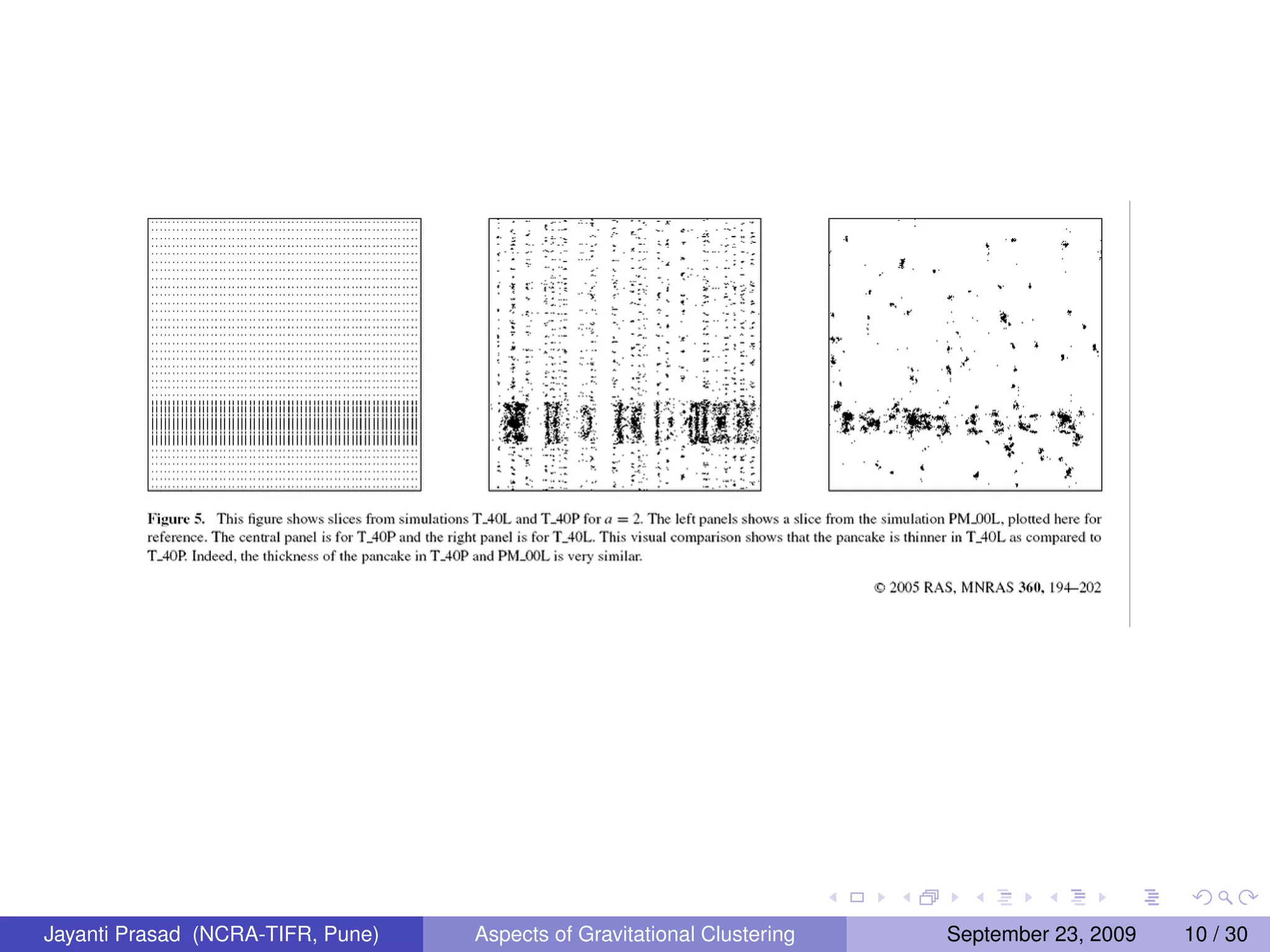
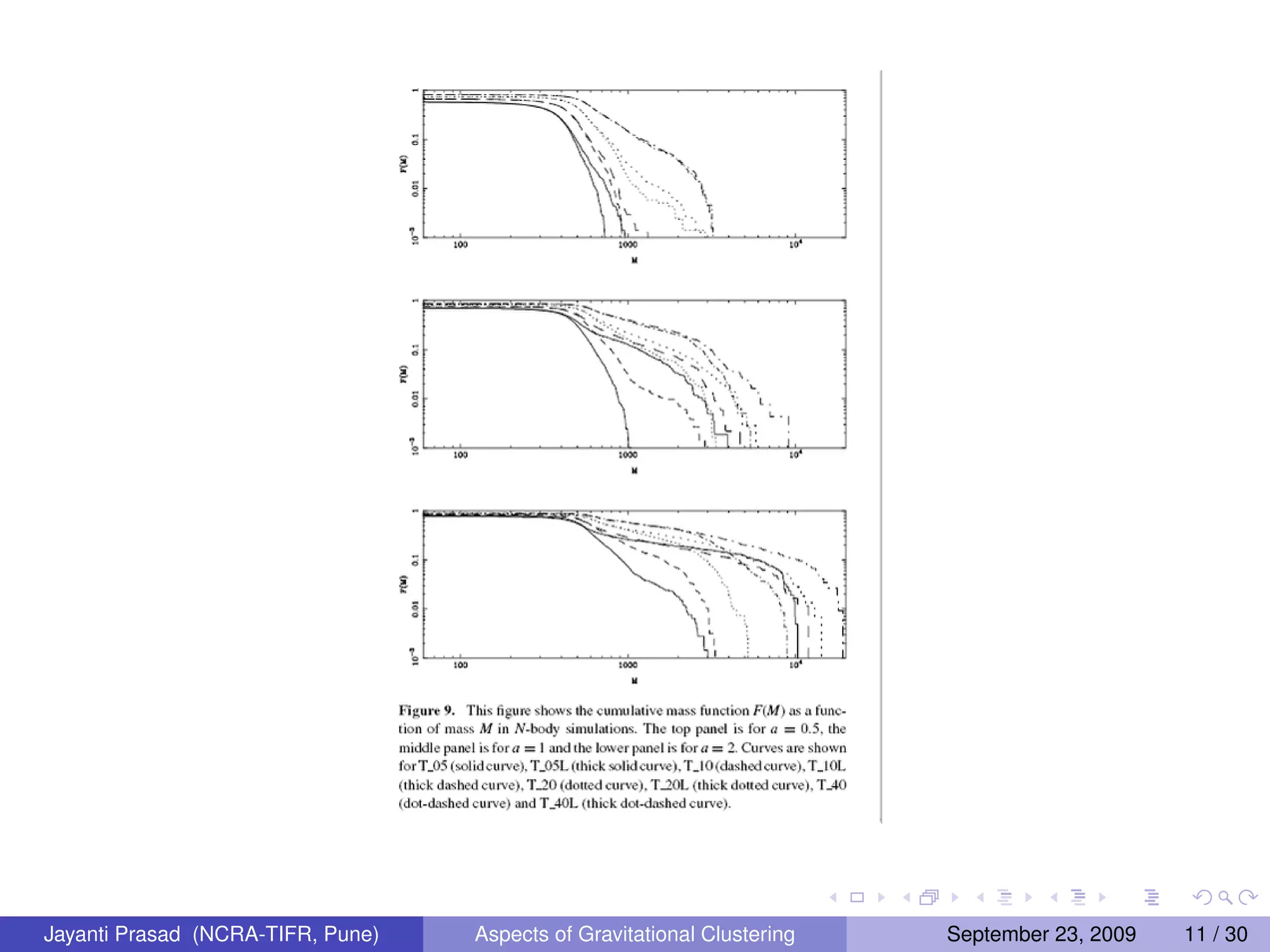
Planar Collapse
Jayanti Prasad (NCRA-TIFR, Pune) Aspects of Gravitational Clustering September 23, 2009 8 / 30
Jayanti Prasad (NCRA-TIFR, Pune) Aspects of Gravitational Clustering September 23, 2009 9 / 30
Jayanti Prasad (NCRA-TIFR, Pune) Aspects of Gravitational Clustering September 23, 2009 10 / 30
Jayanti Prasad (NCRA-TIFR, Pune) Aspects of Gravitational Clustering September 23, 2009 11 / 30
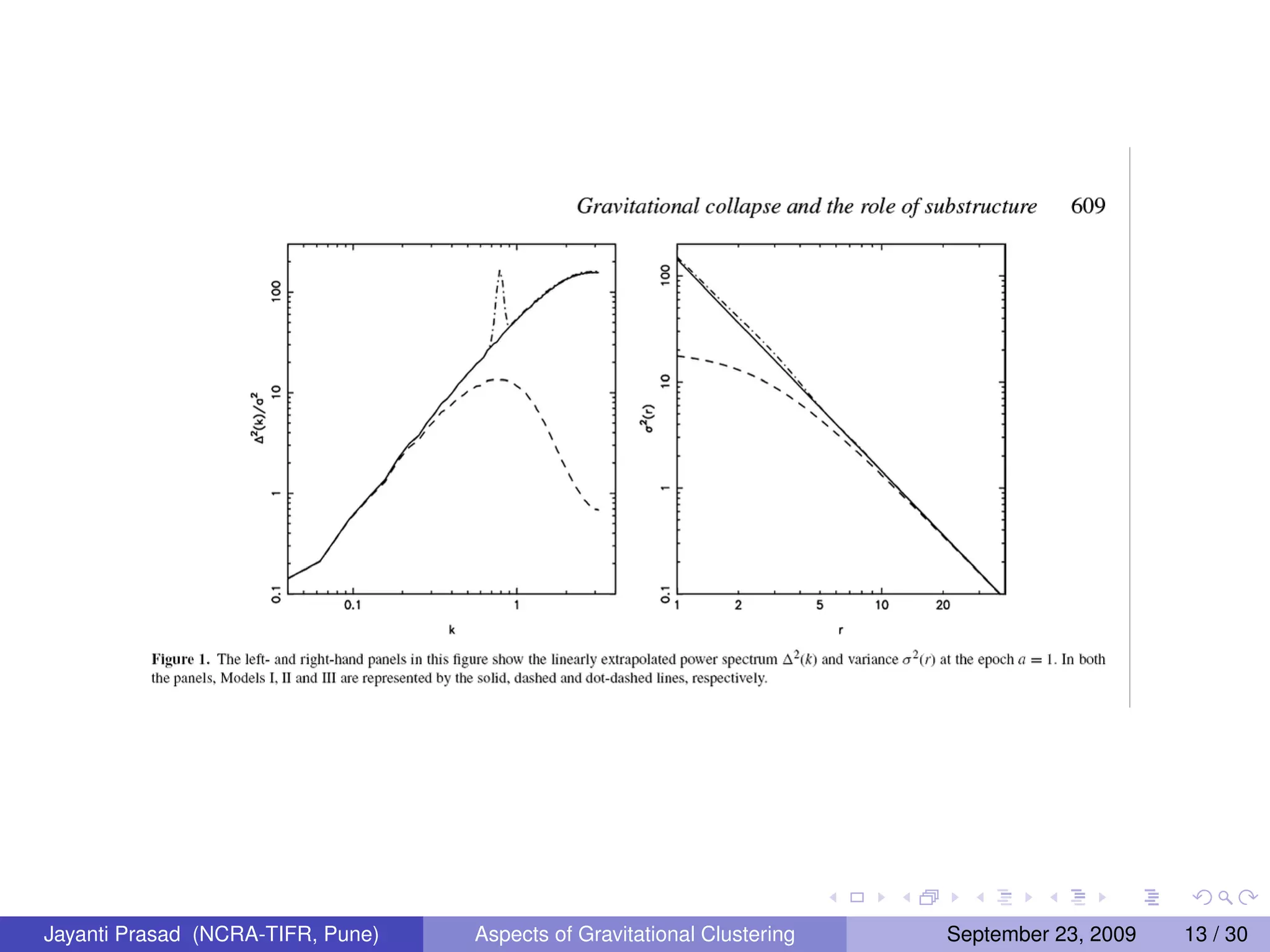
B. Features in P(k)
Models:
P(k) =









Ak−1, for Model I
Ak−1e
− k2
2k2
c , for Model II
Ak−1 + Aαk−1
c e
(k−kc)
2σ2
k for Model III
(4)
Parameters:
σk = 2π/Lbox , kc = 4kf = 4(2π/Lbpx ), α = 4
rnl(a = 1) = 12, Npart = 2003, Lbox = 200
Code: TreePM(Bagla 2002, Bagla & Ray 2003).
Jayanti Prasad (NCRA-TIFR, Pune) Aspects of Gravitational Clustering September 23, 2009 12 / 30
Jayanti Prasad (NCRA-TIFR, Pune) Aspects of Gravitational Clustering September 23, 2009 13 / 30
Jayanti Prasad (NCRA-TIFR, Pune) Aspects of Gravitational Clustering September 23, 2009 14 / 30
Jayanti Prasad (NCRA-TIFR, Pune) Aspects of Gravitational Clustering September 23, 2009 15 / 30
STUDY 2
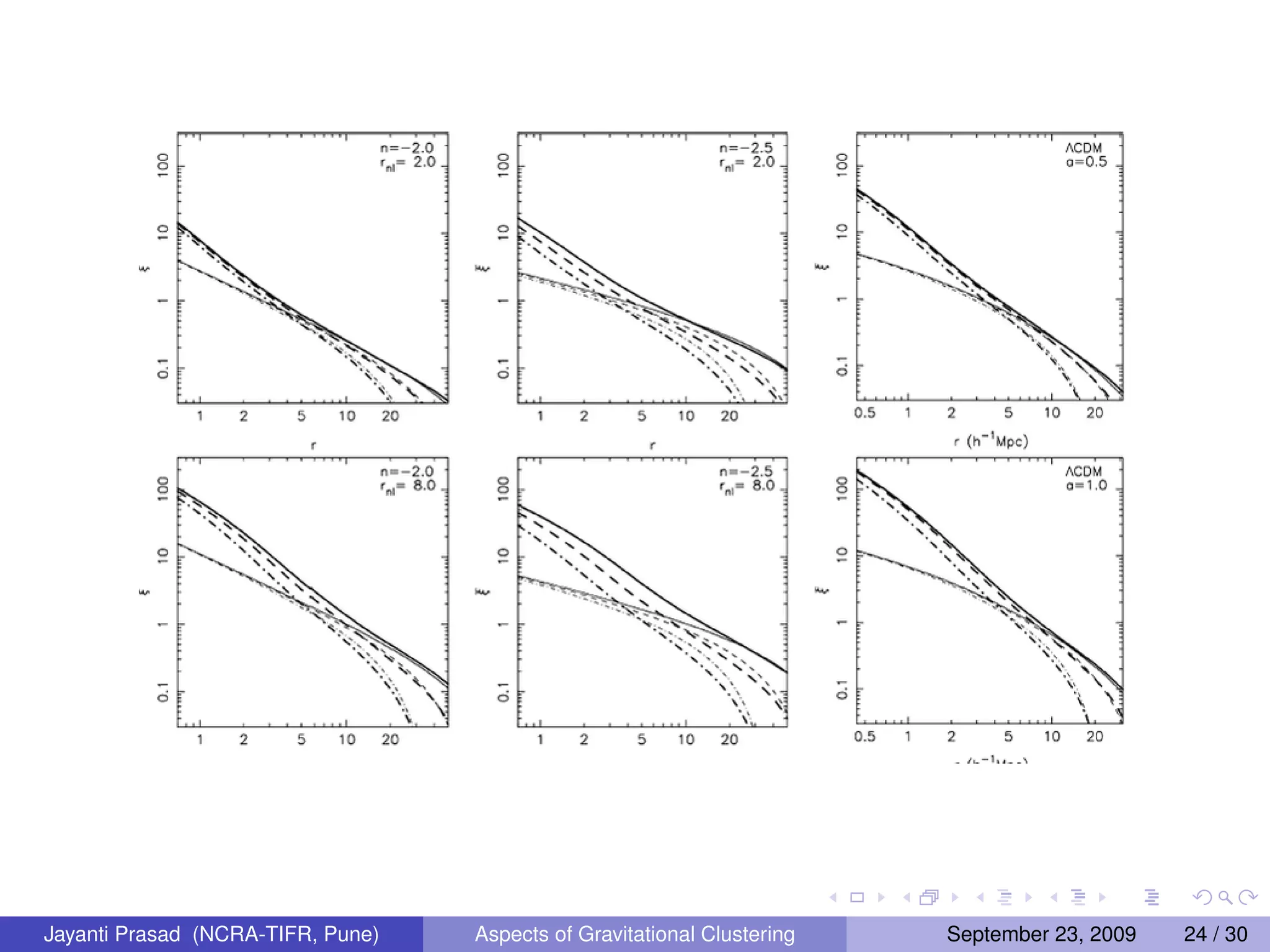
Effects of the size of cosmological N-Body simulations on
physical quantities
Bagla, J. S., Prasad, Jayanti , 2006, MNRAS, 370, 993,
(astro-ph/0601320 ), Effects of the size of cosmological N-Body
simulations on physical quantities – I: Mass Function
Prasad, Jayanti 2007, J. Astrophys.Astron. 28, 117
(astro-ph/0702557), Effects of the size of cosmological N-Body
simulations on physical quantities – II: Halo Formation and
Destruction rate
J.S. Bagla, Jayanti Prasad, Nishikanta Khandai 2009,
MNRAS,395,2 (arXiv:0804.1197 [astro-ph]), Effects of the size of
cosmological N-Body simulations on physical quantities - III:
Skewness
Jayanti Prasad (NCRA-TIFR, Pune) Aspects of Gravitational Clustering September 23, 2009 16 / 30
In cosmological N-body simulations the initial power spectrum is
sampled at discrete points in k space in the range
[2π/Lbox , 2π/Lgrid ].
Perturbations k > 2π/Lbox can be ignored since there are no
significant effects or perturbations at small scales on large scale.
However, that is not the case of k < 2π/Lbox perturbations at
scales larger than the simulation volume can affect physical
quantities significantly.
Jayanti Prasad (NCRA-TIFR, Pune) Aspects of Gravitational Clustering September 23, 2009 17 / 30
Our formalism
In theory:
σ2
(r) =
∞
Z
0
dk
k
∆2
(k)W2
(kr)
where: ∆2
(k) =
k3
P(k)
2π2
; W(kr) = 3

sin kr − kr cos kr
k3r3

(5)
In simulations:
σ2
(r, Lbox ) =
2π/Lgrid
Z
2π/Lbox
dk
k
∆2
(k)W2
(kr) ≈
∞
Z
2π/Lbox
dk
k
∆2
(k)W2
(kr)
=
∞
Z
0
dk
k
∆2
(k)W2
(kr) −
2π/Lbox
Z
0
dk
k
∆2
(k)W2
(kr)
= σ2
0(r) − σ2
1(r) (6)
Jayanti Prasad (NCRA-TIFR, Pune) Aspects of Gravitational Clustering September 23, 2009 18 / 30
Results:Correction in clustering amplitude
σ2
1(r, Lbox ) =
2π/Lbox
Z
0
dk
k
∆2
(k)W2
(kr)
≈ C1 −
1
5
C2r2
+
3
175
C3r4
+ O(r6
) (7)
where
Cn =
2π/Lbox
Z
0
dk
k
k2(n−1)
∆2
(k) (8)
For power law model:P(k) = Akn
C1 =
A
2π2(n + 3)

2π
Lbox
(n+3)
(9)
Jayanti Prasad (NCRA-TIFR, Pune) Aspects of Gravitational Clustering September 23, 2009 19 / 30
Results:Correction in Mass function
The Press-Schechter mass function:
F(M) = F0(M) = 2
Z ∞
δc
1
p
2πσ0(M)
exp

−
δ2
2σ2
0(M)

dδ (10)
In N-body simulations we get:
F(M, Lbox ) = 2
Z ∞
δc
1
p
2πσ(M, Lbox )
exp

−
δ2
2σ2(M, Lbox )

dδ (11)
Correction :
F1(M, Lbox ) = F0 − F =
2
√
π
Z δc
σ(M,Lbox )
√
2
δc
σ0(M)
√
2
exp(−x2
)
≈
δc
√
2π
σ2
1
σ3
0
exp

−
δ2
c
2σ2
0

(12)
Jayanti Prasad (NCRA-TIFR, Pune) Aspects of Gravitational Clustering September 23, 2009 20 / 30
Jayanti Prasad (NCRA-TIFR, Pune) Aspects of Gravitational Clustering September 23, 2009 21 / 30
Jayanti Prasad (NCRA-TIFR, Pune) Aspects of Gravitational Clustering September 23, 2009 22 / 30
Jayanti Prasad (NCRA-TIFR, Pune) Aspects of Gravitational Clustering September 23, 2009 23 / 30
Jayanti Prasad (NCRA-TIFR, Pune) Aspects of Gravitational Clustering September 23, 2009 24 / 30
Jayanti Prasad (NCRA-TIFR, Pune) Aspects of Gravitational Clustering September 23, 2009 25 / 30
Jayanti Prasad (NCRA-TIFR, Pune) Aspects of Gravitational Clustering September 23, 2009 26 / 30
Jayanti Prasad (NCRA-TIFR, Pune) Aspects of Gravitational Clustering September 23, 2009 27 / 30
Summary  Conclusions
In the first part of this study we have tried to understand the role
played by substructure in non linear gravitational clustering.
Since in cold dark matter models of structure formation
perturbations at small scales (substructure) collapse first and lead
to clustering of matter at larger scales. Therefore it becomes
important to understand what role substructure can play in
subsequent collapse of perturbations at larger scales.
In cosmological N-body simulations perturbations at sub-grid
scales are assumed to be zero. Our study can help to understand
the effects of pre-initial condition in cosmological N-body
simulations.
Jayanti Prasad (NCRA-TIFR, Pune) Aspects of Gravitational Clustering September 23, 2009 28 / 30
Summary cont...
In the second part of our study we presented a prescription for
estimating the corrections in various physical quantities of interest
due to the finite size of the simulation box.
We showed that the amplitude of clustering is underestimated at
all scales when the size of the simulation volume is reduced.
We presented explicit expressions for corrections in mass
function, multiplicity function, number density and formation and
destruction rate due to the finite size of the simulation box.
We showed that the correction in mass function is maximum at
scales of nonlinearity and it decreases at large as well as small
scales.
We showed that the number density of low mass haloes is
overestimated and that of large mass haloes is underestimated
when the size of the simulation box is reduced.
Jayanti Prasad (NCRA-TIFR, Pune) Aspects of Gravitational Clustering September 23, 2009 29 / 30
THANK YOU !
Jayanti Prasad (NCRA-TIFR, Pune) Aspects of Gravitational Clustering September 23, 2009 30 / 30

thesis_seminar.pdf

  • 1.
    Aspects of GravitationalClustering Jayanti Prasad National Centre for Radio Astronomy Pune, India (411007) September 23, 2009 Jayanti Prasad (NCRA-TIFR, Pune) Aspects of Gravitational Clustering September 23, 2009 1 / 30
  • 2.
    Plan of theTalk Nonlinear Gravitational Clustering Role of substructure Finite Volume Effects In N-body Simulations Summary & Conclusions Jayanti Prasad (NCRA-TIFR, Pune) Aspects of Gravitational Clustering September 23, 2009 2 / 30
  • 3.
    Introduction Matter distribution inthe Universe Large scale (earlier time) Small scales (recent time) Smooth Clumpy Question: How structures in the Universe formed ? Answer : Gravitational Instability Jayanti Prasad (NCRA-TIFR, Pune) Aspects of Gravitational Clustering September 23, 2009 3 / 30
  • 4.
    Basic Equations Density Contrast: δ(x,t) = ρ(x, t) − ρb(t) ρb(t) δk(t) = Z d3x V δ(x, t) exp(−ik.x) (1) Equation of motion: ẍi + 2 ȧ a ẋi = − 1 a2 ∇iϕ ∇2 ϕ = 4πGa2 (ρ − ρ̄) = 3 2 δ a3 H2 0 Ωnr ρ(x) = 1 a3 X i miδD (x − xi) (2) Jayanti Prasad (NCRA-TIFR, Pune) Aspects of Gravitational Clustering September 23, 2009 4 / 30
  • 5.
    Mode coupling: δ̈k +2 ȧ a δ̇k = 3 2 δk a3 H2 0 + Ak − Bk (3) where Ak = 3 4 1 a3 H2 0 X k06=0,k " k.k0 k02 + k. (k − k0 ) |k − k0| 2 # δk0 δk−k0 and Bk = 1 M X i mi (k.ẋi ) 2 exp [ik.xi ] ; M = X i mi Jayanti Prasad (NCRA-TIFR, Pune) Aspects of Gravitational Clustering September 23, 2009 5 / 30
  • 6.
    Two problems addressedin the thesis Structure formation in a cold dark matter dominated universe takes place hierarchically. In this situation it becomes relevant to ask: what role perturbations at small scales (substructure) play in the collapse of perturbations at larger scales ?. –Transverse motions can help in relaxation. It is well knows that there are strong effects of perturbations at large scales on the growth of perturbations at small scales. In cosmological N-body simulations perturbations at scales larger than the size of simulation volume are ignored: How the size of simulation volume affect various physical quantities in N-body simulations ? –Can modify clustering properties. Jayanti Prasad (NCRA-TIFR, Pune) Aspects of Gravitational Clustering September 23, 2009 6 / 30
  • 7.
    STUDY 1 A. Gravitationalcollapse in an expanding background and the role of substructure References: Bagla, J. S., Prasad, Jayanti and Ray, Suryadeep, 2005, MNRAS, 360, 194, ( astro-ph/0408429) Gravitational collapse in an expanding background and the role of substructure I: Planar collapse Bagla, J. S., Prasad, Jayanti 2008, MNRAS, 1365, 2966 (arXiv:0802.2796 [astro-ph]), Gravitational collapse in an expanding background and the role of substructure II: Excess power at small scales and its effect of collapse of structures at larger scales. Jayanti Prasad (NCRA-TIFR, Pune) Aspects of Gravitational Clustering September 23, 2009 7 / 30
  • 8.
    Planar Collapse Jayanti Prasad(NCRA-TIFR, Pune) Aspects of Gravitational Clustering September 23, 2009 8 / 30
  • 9.
    Jayanti Prasad (NCRA-TIFR,Pune) Aspects of Gravitational Clustering September 23, 2009 9 / 30
  • 10.
    Jayanti Prasad (NCRA-TIFR,Pune) Aspects of Gravitational Clustering September 23, 2009 10 / 30
  • 11.
    Jayanti Prasad (NCRA-TIFR,Pune) Aspects of Gravitational Clustering September 23, 2009 11 / 30
  • 12.
    B. Features inP(k) Models: P(k) =          Ak−1, for Model I Ak−1e − k2 2k2 c , for Model II Ak−1 + Aαk−1 c e (k−kc) 2σ2 k for Model III (4) Parameters: σk = 2π/Lbox , kc = 4kf = 4(2π/Lbpx ), α = 4 rnl(a = 1) = 12, Npart = 2003, Lbox = 200 Code: TreePM(Bagla 2002, Bagla & Ray 2003). Jayanti Prasad (NCRA-TIFR, Pune) Aspects of Gravitational Clustering September 23, 2009 12 / 30
  • 13.
    Jayanti Prasad (NCRA-TIFR,Pune) Aspects of Gravitational Clustering September 23, 2009 13 / 30
  • 14.
    Jayanti Prasad (NCRA-TIFR,Pune) Aspects of Gravitational Clustering September 23, 2009 14 / 30
  • 15.
    Jayanti Prasad (NCRA-TIFR,Pune) Aspects of Gravitational Clustering September 23, 2009 15 / 30
  • 16.
    STUDY 2 Effects ofthe size of cosmological N-Body simulations on physical quantities Bagla, J. S., Prasad, Jayanti , 2006, MNRAS, 370, 993, (astro-ph/0601320 ), Effects of the size of cosmological N-Body simulations on physical quantities – I: Mass Function Prasad, Jayanti 2007, J. Astrophys.Astron. 28, 117 (astro-ph/0702557), Effects of the size of cosmological N-Body simulations on physical quantities – II: Halo Formation and Destruction rate J.S. Bagla, Jayanti Prasad, Nishikanta Khandai 2009, MNRAS,395,2 (arXiv:0804.1197 [astro-ph]), Effects of the size of cosmological N-Body simulations on physical quantities - III: Skewness Jayanti Prasad (NCRA-TIFR, Pune) Aspects of Gravitational Clustering September 23, 2009 16 / 30
  • 17.
    In cosmological N-bodysimulations the initial power spectrum is sampled at discrete points in k space in the range [2π/Lbox , 2π/Lgrid ]. Perturbations k > 2π/Lbox can be ignored since there are no significant effects or perturbations at small scales on large scale. However, that is not the case of k < 2π/Lbox perturbations at scales larger than the simulation volume can affect physical quantities significantly. Jayanti Prasad (NCRA-TIFR, Pune) Aspects of Gravitational Clustering September 23, 2009 17 / 30
  • 18.
    Our formalism In theory: σ2 (r)= ∞ Z 0 dk k ∆2 (k)W2 (kr) where: ∆2 (k) = k3 P(k) 2π2 ; W(kr) = 3 sin kr − kr cos kr k3r3 (5) In simulations: σ2 (r, Lbox ) = 2π/Lgrid Z 2π/Lbox dk k ∆2 (k)W2 (kr) ≈ ∞ Z 2π/Lbox dk k ∆2 (k)W2 (kr) = ∞ Z 0 dk k ∆2 (k)W2 (kr) − 2π/Lbox Z 0 dk k ∆2 (k)W2 (kr) = σ2 0(r) − σ2 1(r) (6) Jayanti Prasad (NCRA-TIFR, Pune) Aspects of Gravitational Clustering September 23, 2009 18 / 30
  • 19.
    Results:Correction in clusteringamplitude σ2 1(r, Lbox ) = 2π/Lbox Z 0 dk k ∆2 (k)W2 (kr) ≈ C1 − 1 5 C2r2 + 3 175 C3r4 + O(r6 ) (7) where Cn = 2π/Lbox Z 0 dk k k2(n−1) ∆2 (k) (8) For power law model:P(k) = Akn C1 = A 2π2(n + 3) 2π Lbox (n+3) (9) Jayanti Prasad (NCRA-TIFR, Pune) Aspects of Gravitational Clustering September 23, 2009 19 / 30
  • 20.
    Results:Correction in Massfunction The Press-Schechter mass function: F(M) = F0(M) = 2 Z ∞ δc 1 p 2πσ0(M) exp − δ2 2σ2 0(M) dδ (10) In N-body simulations we get: F(M, Lbox ) = 2 Z ∞ δc 1 p 2πσ(M, Lbox ) exp − δ2 2σ2(M, Lbox ) dδ (11) Correction : F1(M, Lbox ) = F0 − F = 2 √ π Z δc σ(M,Lbox ) √ 2 δc σ0(M) √ 2 exp(−x2 ) ≈ δc √ 2π σ2 1 σ3 0 exp − δ2 c 2σ2 0 (12) Jayanti Prasad (NCRA-TIFR, Pune) Aspects of Gravitational Clustering September 23, 2009 20 / 30
  • 21.
    Jayanti Prasad (NCRA-TIFR,Pune) Aspects of Gravitational Clustering September 23, 2009 21 / 30
  • 22.
    Jayanti Prasad (NCRA-TIFR,Pune) Aspects of Gravitational Clustering September 23, 2009 22 / 30
  • 23.
    Jayanti Prasad (NCRA-TIFR,Pune) Aspects of Gravitational Clustering September 23, 2009 23 / 30
  • 24.
    Jayanti Prasad (NCRA-TIFR,Pune) Aspects of Gravitational Clustering September 23, 2009 24 / 30
  • 25.
    Jayanti Prasad (NCRA-TIFR,Pune) Aspects of Gravitational Clustering September 23, 2009 25 / 30
  • 26.
    Jayanti Prasad (NCRA-TIFR,Pune) Aspects of Gravitational Clustering September 23, 2009 26 / 30
  • 27.
    Jayanti Prasad (NCRA-TIFR,Pune) Aspects of Gravitational Clustering September 23, 2009 27 / 30
  • 28.
    Summary Conclusions Inthe first part of this study we have tried to understand the role played by substructure in non linear gravitational clustering. Since in cold dark matter models of structure formation perturbations at small scales (substructure) collapse first and lead to clustering of matter at larger scales. Therefore it becomes important to understand what role substructure can play in subsequent collapse of perturbations at larger scales. In cosmological N-body simulations perturbations at sub-grid scales are assumed to be zero. Our study can help to understand the effects of pre-initial condition in cosmological N-body simulations. Jayanti Prasad (NCRA-TIFR, Pune) Aspects of Gravitational Clustering September 23, 2009 28 / 30
  • 29.
    Summary cont... In thesecond part of our study we presented a prescription for estimating the corrections in various physical quantities of interest due to the finite size of the simulation box. We showed that the amplitude of clustering is underestimated at all scales when the size of the simulation volume is reduced. We presented explicit expressions for corrections in mass function, multiplicity function, number density and formation and destruction rate due to the finite size of the simulation box. We showed that the correction in mass function is maximum at scales of nonlinearity and it decreases at large as well as small scales. We showed that the number density of low mass haloes is overestimated and that of large mass haloes is underestimated when the size of the simulation box is reduced. Jayanti Prasad (NCRA-TIFR, Pune) Aspects of Gravitational Clustering September 23, 2009 29 / 30
  • 30.
    THANK YOU ! JayantiPrasad (NCRA-TIFR, Pune) Aspects of Gravitational Clustering September 23, 2009 30 / 30