Social and Cultural Impacts of Large Dams:  the Case-study of the Merowe Dam in Sudan   Jean-Gabriel Leturcq (CEDEJ-Cairo)  Porto 2 nd -3 rd  of October 2008
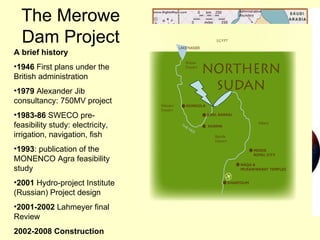
The Merowe Dam Project A brief history 1946  First plans under the British administration  1979  Alexander Jib consultancy: 750MV project 1983-86  SWECO pre-feasibility study: electricity, irrigation, navigation, fish 1993 : publication of the MONENCO Agra feasibility study 2001  Hydro-project Institute (Russian) Project design 2001-2002  Lahmeyer final Review 2002-2008 Construction (
International investment Total cost: US$1,96 billion Funding :  The Arab Fund for Economical and Social Development (US$250 million) Diverse Arab funds (US$620 million) Government of Sudan (US$575 million) Government of China (US$520 million) Construction companies: Lahmeyer international (Germany) Alstom (France) The China International Water and Electric Corporation CWE and CCMD Consortium (China) Harbin Power Engineering Company Ltd. (China)
Fact sheet Dam structure :  9,2 km long (maximum length)  earth core rockfill dam  Hydro-Power Plant:   1250 MW (maximum capacity):10 Francis turbines of 125 MW capacity each  7 power stations 1500km of transmission lines -500kV Reservoir:  12,5 km3 175km long (20% Nile’s annual flows)
Benefits  Economic development:   “The Hydro-electric plant will cover 50% of the national needs of the economic development of Sudan” (governmental source) Structural development of Sudan:  New roads, new bridges New hospitals New cultivable land  Merowe Dam: The ultimate solution?!?
Social and cultural impacts More than 3.000 archaeological sites submerged  – the Merowe Archaeological Salvage mission was launched in 2002 55.000 to 70.000 inhabitants displaced:  3 groups displaced 4 resettlement areas  -2003 and 2006 clashes between local communities and governmental armed forces  Collateral  damages?
Collateral  damages?
Criticism:  LOHAP and International Rivers Network  weakness of 1993 Monenco Agra   feasibility studies Canadian: Out dated assessment studies Inadequacies of the resettlement issues or the environmental and cultural impacts studies  Lack of transparency Disregard of the international principles Violation of Human and Community rights?
The « Rights and Risks » approach World Commission on Dams’ report 2000:   “Recognition of rights and assessment of risks are the basis for the identification and inclusion of stakeholders in decision-making on energy and water resources development” Relevant rights :  constitutional rights  customary rights  rights codified through legislation  property rights  rights of developers and investors  … and the risks include: voluntary risk takers (developers, investors, governments..)  involuntary risk bearers (displaced people, those whose livelihoods are affected..)  Negotiated approach?
Damming Sudan…  Which model of dam construction? Inclusion of local communities?  Respect of international standards?
…  towards a model of fair dams?  2008:  Khartoum statement on future dams and development on the Nile  provides:  «a provision of advice and direction on  engaging civil society and local communities in dams and development processes . This should take place  from the conception of all the projects  » An Hydro-optimistic vision?
Thanks!

Social and Cultural impacts of Large Dam: the case study of the Merowe dam in Sudan

  • 1.
    Social and CulturalImpacts of Large Dams: the Case-study of the Merowe Dam in Sudan Jean-Gabriel Leturcq (CEDEJ-Cairo) Porto 2 nd -3 rd of October 2008
  • 2.
    The Merowe DamProject A brief history 1946 First plans under the British administration 1979 Alexander Jib consultancy: 750MV project 1983-86 SWECO pre-feasibility study: electricity, irrigation, navigation, fish 1993 : publication of the MONENCO Agra feasibility study 2001 Hydro-project Institute (Russian) Project design 2001-2002 Lahmeyer final Review 2002-2008 Construction (
  • 3.
    International investment Totalcost: US$1,96 billion Funding : The Arab Fund for Economical and Social Development (US$250 million) Diverse Arab funds (US$620 million) Government of Sudan (US$575 million) Government of China (US$520 million) Construction companies: Lahmeyer international (Germany) Alstom (France) The China International Water and Electric Corporation CWE and CCMD Consortium (China) Harbin Power Engineering Company Ltd. (China)
  • 4.
    Fact sheet Damstructure : 9,2 km long (maximum length) earth core rockfill dam Hydro-Power Plant: 1250 MW (maximum capacity):10 Francis turbines of 125 MW capacity each 7 power stations 1500km of transmission lines -500kV Reservoir: 12,5 km3 175km long (20% Nile’s annual flows)
  • 5.
    Benefits Economicdevelopment: “The Hydro-electric plant will cover 50% of the national needs of the economic development of Sudan” (governmental source) Structural development of Sudan: New roads, new bridges New hospitals New cultivable land Merowe Dam: The ultimate solution?!?
  • 6.
    Social and culturalimpacts More than 3.000 archaeological sites submerged – the Merowe Archaeological Salvage mission was launched in 2002 55.000 to 70.000 inhabitants displaced: 3 groups displaced 4 resettlement areas -2003 and 2006 clashes between local communities and governmental armed forces Collateral damages?
  • 7.
  • 8.
    Criticism: LOHAPand International Rivers Network weakness of 1993 Monenco Agra feasibility studies Canadian: Out dated assessment studies Inadequacies of the resettlement issues or the environmental and cultural impacts studies Lack of transparency Disregard of the international principles Violation of Human and Community rights?
  • 9.
    The « Rightsand Risks » approach World Commission on Dams’ report 2000: “Recognition of rights and assessment of risks are the basis for the identification and inclusion of stakeholders in decision-making on energy and water resources development” Relevant rights : constitutional rights customary rights rights codified through legislation property rights rights of developers and investors … and the risks include: voluntary risk takers (developers, investors, governments..) involuntary risk bearers (displaced people, those whose livelihoods are affected..) Negotiated approach?
  • 10.
    Damming Sudan… Which model of dam construction? Inclusion of local communities? Respect of international standards?
  • 11.
    … towardsa model of fair dams? 2008: Khartoum statement on future dams and development on the Nile provides: «a provision of advice and direction on engaging civil society and local communities in dams and development processes . This should take place from the conception of all the projects » An Hydro-optimistic vision?
  • 12.

Editor's Notes

  • #2 Large dams’ construction is back in Africa. This paper analyses the frictions between potential economic benefits generated by large-scale dams and the social and cultural impacts, for the specific case of the Merowe Dam in the Nile River, Northern Sudan. This paper focuses on the controversies surrounding the Merowe Dam planning and construction (2002-2008) and its impacts on society and culture. The friction between different visions of development will be analysed in order to assess the prospects of an equitable socio-economic development related to large-scale dams’ projects, an ideal hydro-optimistic vision.