Proximate analysis
• It is quantitative analysis of feed to determine the percentage of fat, carbohydrates, proteins,
moisture and ash.
• Come up in 1865 by Henneberg and Stohmann at Weende’s Experiment Station in Germany.
• It is often referred to as the Weende’s System of Analysis
• And is principally devised to separate carbohydrates into two broad classifications; crude fibre and
nitrogen free extract (NFE).
Principle:
To separate the feed components into groups or fractions in accordance with their feeding value This
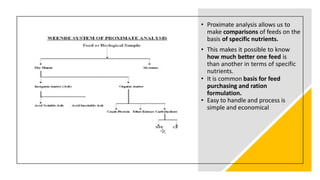
system of analysis divides the food into six fractions:
– moisture,
– ash,
– crude protein (CP),
– ether extract (EE),
– crude fibre (CF) and
– Nitrogen-free extractives (NFE).
Importance
• It provides firsthand information about the potentiality of the feed to fulfill the required nutrient
• To ensure that feed products meet the appropriate requirements as well as the safety aspects
of the end products when released to the end animals.
• Proximate analysis allows us to
make comparisons of feeds on the
basis of specific nutrients.
• This makes it possible to know
how much better one feed is
than another in terms of specific
nutrients.
• It is common basis for feed
purchasing and ration
formulation.
• Easy to handle and process is
simple and economical
Proximate analysis .pptx

Proximate analysis .pptx

  • 1.
    Proximate analysis • Itis quantitative analysis of feed to determine the percentage of fat, carbohydrates, proteins, moisture and ash. • Come up in 1865 by Henneberg and Stohmann at Weende’s Experiment Station in Germany. • It is often referred to as the Weende’s System of Analysis • And is principally devised to separate carbohydrates into two broad classifications; crude fibre and nitrogen free extract (NFE). Principle: To separate the feed components into groups or fractions in accordance with their feeding value This system of analysis divides the food into six fractions: – moisture, – ash, – crude protein (CP), – ether extract (EE), – crude fibre (CF) and – Nitrogen-free extractives (NFE). Importance • It provides firsthand information about the potentiality of the feed to fulfill the required nutrient • To ensure that feed products meet the appropriate requirements as well as the safety aspects of the end products when released to the end animals.
  • 2.
    • Proximate analysisallows us to make comparisons of feeds on the basis of specific nutrients. • This makes it possible to know how much better one feed is than another in terms of specific nutrients. • It is common basis for feed purchasing and ration formulation. • Easy to handle and process is simple and economical