A Look at Language Service Providers


                                  2009
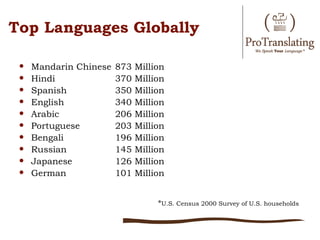
Top Languages Globally

    Mandarin Chinese   873   Million
    Hindi              370   Million
    Spanish            350   Million
    English            340   Million
    Arabic             206   Million
    Portuguese         203   Million
    Bengali            196   Million
    Russian            145   Million
    Japanese           126   Million
    German             101   Million


                                   *U.S. Census 2000 Survey of U.S. households
Why Use an LSP

    You will have registered & certified linguists familiar with legal
     & specialized terminology.
    The testimony will be translated clearly, fluently &
     professionally.
    Can render expert witness testimony on language issues.
    Minimizes possible costly misunderstandings & saves you
     hours of work.
What to Look for in an LSP

    Language Proficiency:
      Inquire about number of yrs. in the industry, language
       and coverage radius.
    Reputation:
      Quality and experience should be top priority.
      References should always be available
    Quality control:
        Inquire if ISO 9001:2000 certified or if they have a
         quality management process in place.
        Inquire if editing and proofreading are done in-house
         for better quality control.
        Inquire if interpreters that will service your account are
         certified and what experience they have in your field.
What to Look for in an LSP

    Accuracy:
      A reputable LSP should provide proof-reading/editing and
       DTP in addition to translation.
    Customer Service:
      An AE or PM should manage your project from beginning to
       end and be ready to answer any questions.
    Scope of Services:
      An experienced LSP should cover all areas of language
       services:
          Consecutive interpretation for legal proceedings
          Simultaneous interpretation for conferences/legal proceedings,
           technicians/equipment.
          Translation of documents (certified/uncertified) and website
           translations.
Different Types of Certification
    Certified by the State Consortium.
        Required component of the court interpreter training and
         testing program for State Court in Florida since 2002.
    Certified by the U.S. Administrative Office of the Courts.
        Interpreters are qualified to interpret in Federal Court.
    Certifications by the American Translators Assoc. (ATA)
     or National Assoc. Judiciary Interpreters & Translators
     (NAJIT).
Interpreting vs. Translation

   Interpreters interpret the           Translators translate the
    spoken word.                          written word.
   An interpreter has to be able        Translators do not do a final
    to translate language in two          output in real-time and may
    directions.                           consult reference material &
   The interpreter acts as a             resources: dictionaries, etc.
    bridge between people,               Translators only work into
    relaying tone, intentions and         their native language to
    emotions.                             assure accuracy in linguistic
   Their roles require a different       and cultural terms.
    mindset as they have to deal         Translations go through an
    with both language and                editing and proofreading
    people.                               process because of the
                                          nature of the medium.
Consecutive vs. Simultaneous


    Simultaneous interpreting involves interpreting in 'real
     time'. Simultaneous interpreters quickly absorb what one
     person is saying and immediately interpret it to others.
     They must think quickly and on their feet.

    Consecutive interpreting is carried out in face-to-face
     meetings or court cases. A speaker will usually stop at
     regular junctures, say a few sentences, and have the
     interpreter translate, before proceeding. A key skill
     involved in consecutive interpreting is the ability to
     remember what has been said without paraphrasing.
Website Localization


    Crosses language barriers
    Builds credibility
    Increases revenue
      Billions of dollars in potential revenue are lost each year
        due to lack of investment in website localization.


                                                              *TRNMag.com
                                       *Common Sense Advisory Research Firm
Benefits of a Reliable LSP

    Interpreters have native fluency in the target language,
     expertise in the subject matter, and years of professional
     experience.
    Linguists work for you and with you.
    Translated materials & interpretations represent your
     company in the global marketplace and in a legal
     environment.
    Choose from professional translation services that are
     reliable, credible and experienced.
    Do your homework before hiring, visit their websites,
     compare & ask for samples, credentials and references.
QUESTIONS?

Please contact:
Ximena Vazquez
Interpreting Sales Manager
xvazquez@protranslating.com
44 West Flagler Street, Suite 1800
Miami, FL 33130
305.371.7887 Phone
305.371.8366 Fax
www.protranslating.com

Pro Translating Presentation

  • 1.
    A Look atLanguage Service Providers 2009
  • 2.
    Top Languages Globally  Mandarin Chinese 873 Million  Hindi 370 Million  Spanish 350 Million  English 340 Million  Arabic 206 Million  Portuguese 203 Million  Bengali 196 Million  Russian 145 Million  Japanese 126 Million  German 101 Million *U.S. Census 2000 Survey of U.S. households
  • 3.
    Why Use anLSP  You will have registered & certified linguists familiar with legal & specialized terminology.  The testimony will be translated clearly, fluently & professionally.  Can render expert witness testimony on language issues.  Minimizes possible costly misunderstandings & saves you hours of work.
  • 4.
    What to Lookfor in an LSP  Language Proficiency:  Inquire about number of yrs. in the industry, language and coverage radius.  Reputation:  Quality and experience should be top priority.  References should always be available  Quality control:  Inquire if ISO 9001:2000 certified or if they have a quality management process in place.  Inquire if editing and proofreading are done in-house for better quality control.  Inquire if interpreters that will service your account are certified and what experience they have in your field.
  • 5.
    What to Lookfor in an LSP  Accuracy:  A reputable LSP should provide proof-reading/editing and DTP in addition to translation.  Customer Service:  An AE or PM should manage your project from beginning to end and be ready to answer any questions.  Scope of Services:  An experienced LSP should cover all areas of language services:  Consecutive interpretation for legal proceedings  Simultaneous interpretation for conferences/legal proceedings, technicians/equipment.  Translation of documents (certified/uncertified) and website translations.
  • 6.
    Different Types ofCertification  Certified by the State Consortium.  Required component of the court interpreter training and testing program for State Court in Florida since 2002.  Certified by the U.S. Administrative Office of the Courts.  Interpreters are qualified to interpret in Federal Court.  Certifications by the American Translators Assoc. (ATA) or National Assoc. Judiciary Interpreters & Translators (NAJIT).
  • 7.
    Interpreting vs. Translation  Interpreters interpret the  Translators translate the spoken word. written word.  An interpreter has to be able  Translators do not do a final to translate language in two output in real-time and may directions. consult reference material &  The interpreter acts as a resources: dictionaries, etc. bridge between people,  Translators only work into relaying tone, intentions and their native language to emotions. assure accuracy in linguistic  Their roles require a different and cultural terms. mindset as they have to deal  Translations go through an with both language and editing and proofreading people. process because of the nature of the medium.
  • 8.
    Consecutive vs. Simultaneous  Simultaneous interpreting involves interpreting in 'real time'. Simultaneous interpreters quickly absorb what one person is saying and immediately interpret it to others. They must think quickly and on their feet.  Consecutive interpreting is carried out in face-to-face meetings or court cases. A speaker will usually stop at regular junctures, say a few sentences, and have the interpreter translate, before proceeding. A key skill involved in consecutive interpreting is the ability to remember what has been said without paraphrasing.
  • 9.
    Website Localization  Crosses language barriers  Builds credibility  Increases revenue  Billions of dollars in potential revenue are lost each year due to lack of investment in website localization. *TRNMag.com *Common Sense Advisory Research Firm
  • 10.
    Benefits of aReliable LSP  Interpreters have native fluency in the target language, expertise in the subject matter, and years of professional experience.  Linguists work for you and with you.  Translated materials & interpretations represent your company in the global marketplace and in a legal environment.  Choose from professional translation services that are reliable, credible and experienced.  Do your homework before hiring, visit their websites, compare & ask for samples, credentials and references.
  • 11.
    QUESTIONS? Please contact: Ximena Vazquez InterpretingSales Manager xvazquez@protranslating.com 44 West Flagler Street, Suite 1800 Miami, FL 33130 305.371.7887 Phone 305.371.8366 Fax www.protranslating.com