Prototype Pattern
           (The last Creational Pattern)

Others were: Singleton, Factory Method,
               Abstract Factory, Builder
Prototype
Motivation
 Sometimes, it becomes necessary to copy or clone an “already grown” object rather
  than instantiating it and setting its values.

 Consider the case of Photoshop. A graphics designer add an image to the canvas.
  Then, he adds a border to it. Then, he gives it a bevel effect. Finally, he sets its
  transparency to 50%. Now, he selects this image, presses Ctrl+C, and presses
  Ctrl+V 5 times.

 What will happen? The same image will be pasted 5 times. So, there will be 6
  identical images on the canvas at different locations.

 How will you achieve this programmatically? “New”-ing from scratch at client
  side? Use a factory?

 Prototype pattern solves this!!!!!
Applicability
Use the Prototype pattern when a system should be
 independent of how its products are created, composed, and
 represented; and

   when the classes to instantiate are specified at run-time, for example, by
    dynamic loading; or

   to avoid building a class hierarchy of factories that parallels the class hierarchy
    of products; or

   when instances of a class can have one of only a few different combinations of
    state. It may be more convenient to install a corresponding number of
    prototypes and clone them rather than instantiating the class manually, each
    time with the appropriate state.
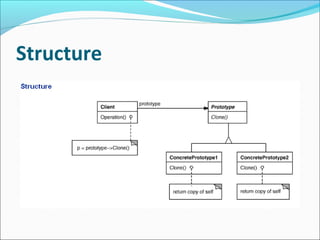
Structure
Participants
Prototype
  declares an interface for cloning itself.
ConcretePrototype
  implements an operation for cloning itself.
Client
  creates a new object by asking a prototype to clone
   itself.
Collaborations
A client asks a prototype to clone itself.
Consequences
 Prototype has many of the same consequences that Abstract Factory and Builder have: It
  hides the concrete product classes from the client, thereby reducing the number of
  names clients know about. Moreover, these patterns let a client work with application-
  specific classes without modification.
 Additional benefits of the Prototype pattern are listed below.


 Adding and removing products at run-time. Prototypes let you incorporate a new
   concrete product class into a system simply by registering a prototypical instance with
   the client.

 Specifying new objects by varying values. Highly dynamic systems let you define new
   behavior through object composition—by specifying values for an object's variables, for
   example—and not by defining new classes. You effectively define new kinds of objects
   by instantiating existing classes and registering the instances as prototypes of client
   objects.

 Specifying new objects by varying structure. Many applications build objects from parts
   and subparts. Editors for circuit design, for example, build circuits out of subcircuits. 1
Consequences
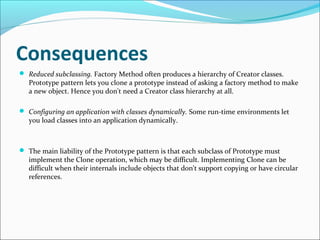
 Reduced subclassing. Factory Method often produces a hierarchy of Creator classes.
   Prototype pattern lets you clone a prototype instead of asking a factory method to make
   a new object. Hence you don't need a Creator class hierarchy at all.

 Configuring an application with classes dynamically. Some run-time environments let
   you load classes into an application dynamically.


 The main liability of the Prototype pattern is that each subclass of Prototype must
   implement the Clone operation, which may be difficult. Implementing Clone can be
   difficult when their internals include objects that don't support copying or have circular
   references.
Implementation
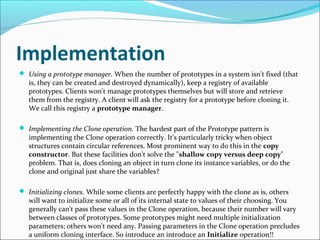
 Using a prototype manager. When the number of prototypes in a system isn't fixed (that
   is, they can be created and destroyed dynamically), keep a registry of available
   prototypes. Clients won't manage prototypes themselves but will store and retrieve
   them from the registry. A client will ask the registry for a prototype before cloning it.
   We call this registry a prototype manager.

 Implementing the Clone operation. The hardest part of the Prototype pattern is
   implementing the Clone operation correctly. It's particularly tricky when object
   structures contain circular references. Most prominent way to do this in the copy
   constructor. But these facilities don't solve the "shallow copy versus deep copy"
   problem. That is, does cloning an object in turn clone its instance variables, or do the
   clone and original just share the variables?

 Initializing clones. While some clients are perfectly happy with the clone as is, others
   will want to initialize some or all of its internal state to values of their choosing. You
   generally can't pass these values in the Clone operation, because their number will vary
   between classes of prototypes. Some prototypes might need multiple initialization
   parameters; others won't need any. Passing parameters in the Clone operation precludes
   a uniform cloning interface. So introduce an introduce an Initialize operation!!
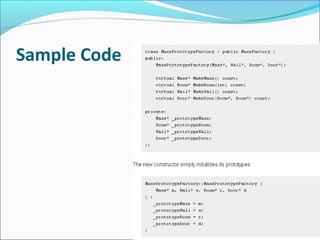
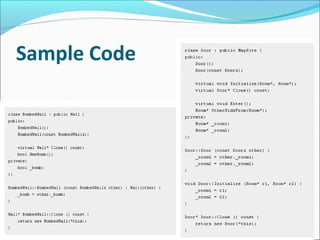
Sample Code
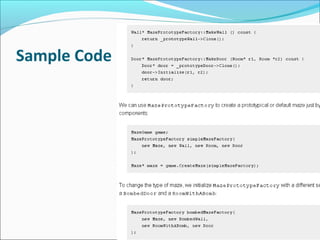
Sample Code
Sample Code
Assignment
 We need a car decorating application. This application lets user to
  choose from a pool of cars, and then decorate its body, wheel and
  engine with various colors and accessories as we see in the NFS
  game.

 At any point of designing – the user can
    Create a copy of the car
    Keep the half designed car aside
    Continue to design on the newly created one
    Compare these differently designed cars at the final stage so that he can
     efficiently pick the one that looks best.

Prototype pattern

  • 1.
    Prototype Pattern (The last Creational Pattern) Others were: Singleton, Factory Method, Abstract Factory, Builder
  • 2.
  • 3.
    Motivation  Sometimes, itbecomes necessary to copy or clone an “already grown” object rather than instantiating it and setting its values.  Consider the case of Photoshop. A graphics designer add an image to the canvas. Then, he adds a border to it. Then, he gives it a bevel effect. Finally, he sets its transparency to 50%. Now, he selects this image, presses Ctrl+C, and presses Ctrl+V 5 times.  What will happen? The same image will be pasted 5 times. So, there will be 6 identical images on the canvas at different locations.  How will you achieve this programmatically? “New”-ing from scratch at client side? Use a factory?  Prototype pattern solves this!!!!!
  • 4.
    Applicability Use the Prototypepattern when a system should be independent of how its products are created, composed, and represented; and  when the classes to instantiate are specified at run-time, for example, by dynamic loading; or  to avoid building a class hierarchy of factories that parallels the class hierarchy of products; or  when instances of a class can have one of only a few different combinations of state. It may be more convenient to install a corresponding number of prototypes and clone them rather than instantiating the class manually, each time with the appropriate state.
  • 5.
  • 6.
    Participants Prototype declaresan interface for cloning itself. ConcretePrototype implements an operation for cloning itself. Client creates a new object by asking a prototype to clone itself.
  • 7.
    Collaborations A client asksa prototype to clone itself.
  • 8.
    Consequences  Prototype hasmany of the same consequences that Abstract Factory and Builder have: It hides the concrete product classes from the client, thereby reducing the number of names clients know about. Moreover, these patterns let a client work with application- specific classes without modification.  Additional benefits of the Prototype pattern are listed below.  Adding and removing products at run-time. Prototypes let you incorporate a new concrete product class into a system simply by registering a prototypical instance with the client.  Specifying new objects by varying values. Highly dynamic systems let you define new behavior through object composition—by specifying values for an object's variables, for example—and not by defining new classes. You effectively define new kinds of objects by instantiating existing classes and registering the instances as prototypes of client objects.  Specifying new objects by varying structure. Many applications build objects from parts and subparts. Editors for circuit design, for example, build circuits out of subcircuits. 1
  • 9.
    Consequences  Reduced subclassing.Factory Method often produces a hierarchy of Creator classes. Prototype pattern lets you clone a prototype instead of asking a factory method to make a new object. Hence you don't need a Creator class hierarchy at all.  Configuring an application with classes dynamically. Some run-time environments let you load classes into an application dynamically.  The main liability of the Prototype pattern is that each subclass of Prototype must implement the Clone operation, which may be difficult. Implementing Clone can be difficult when their internals include objects that don't support copying or have circular references.
  • 10.
    Implementation  Using aprototype manager. When the number of prototypes in a system isn't fixed (that is, they can be created and destroyed dynamically), keep a registry of available prototypes. Clients won't manage prototypes themselves but will store and retrieve them from the registry. A client will ask the registry for a prototype before cloning it. We call this registry a prototype manager.  Implementing the Clone operation. The hardest part of the Prototype pattern is implementing the Clone operation correctly. It's particularly tricky when object structures contain circular references. Most prominent way to do this in the copy constructor. But these facilities don't solve the "shallow copy versus deep copy" problem. That is, does cloning an object in turn clone its instance variables, or do the clone and original just share the variables?  Initializing clones. While some clients are perfectly happy with the clone as is, others will want to initialize some or all of its internal state to values of their choosing. You generally can't pass these values in the Clone operation, because their number will vary between classes of prototypes. Some prototypes might need multiple initialization parameters; others won't need any. Passing parameters in the Clone operation precludes a uniform cloning interface. So introduce an introduce an Initialize operation!!
  • 11.
  • 12.
  • 13.
  • 14.
    Assignment  We needa car decorating application. This application lets user to choose from a pool of cars, and then decorate its body, wheel and engine with various colors and accessories as we see in the NFS game.  At any point of designing – the user can  Create a copy of the car  Keep the half designed car aside  Continue to design on the newly created one  Compare these differently designed cars at the final stage so that he can efficiently pick the one that looks best.