Proteomics—A Major
New Technology for
Drug Discovery
Proteomics and pharmacoproteomics
Proteomics is a discipline that analyzes the dynamics of protein components, including expression
levels and modification states from a holistic perspective, understands the interactions and
connections between proteins, reveals the function of proteins and the laws of cell life, and studies
all proteins in cells and their behaviors. The concept of proteomics has been used in the field of
pharmaceutical research, thereby developing pharmacoproteomics. This field includes: discovery
of all possible drug targets and all possible compounds for these targets; study of drug action
mechanisms and toxicology; drug screening. It is also possible to classify patients according to
protein profiles, to provide individualized treatment, and to predict drug efficacy. Nowadays, the
pharmaceutical proteomics has penetrated into all aspects of drug discovery and clinical
application.
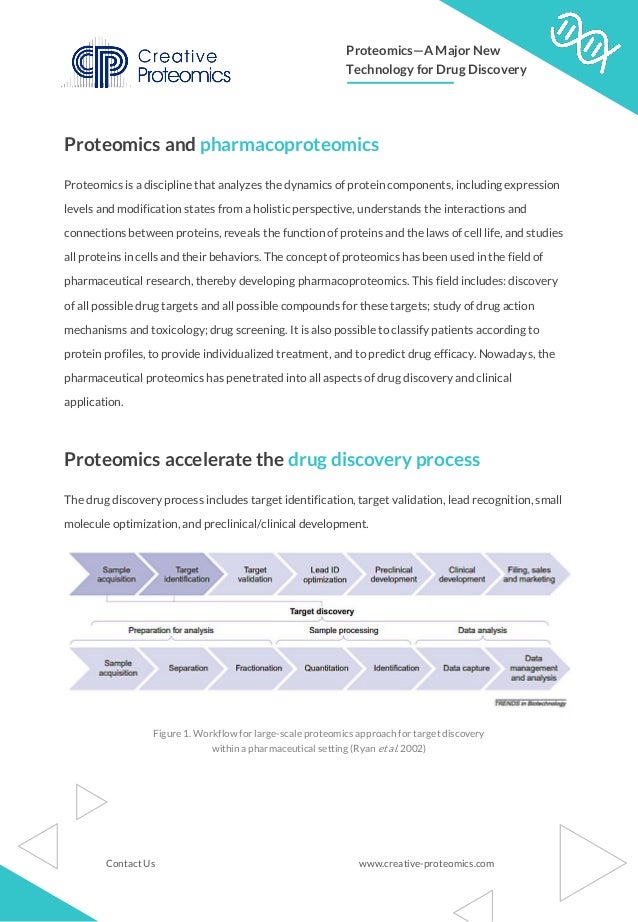
Figure 1. Workflow for large-scale proteomics approach for target discovery
within a pharmaceutical setting (Ryan et al. 2002)
Proteomics accelerate the drug discovery process
The drug discovery process includes target identification, target validation, lead recognition, small
molecule optimization, and preclinical/clinical development.
Proteomics—A Major New
Technology for Drug Discovery
www.creative-proteomics.com
Contact Us
◆ Proteomics for drug target recognition
Finding effective drugs and drug targets is one of the most widely used applications of proteomics.
Proteomics can provide abundant protein expression in cells or tissues. Find differentially
expressed proteins by comparing divergences in protein expression profiles between healthy and
diseased tissues, cells, or body fluids, which may be potential biomarkers or drug targets.
◆ Proteomics for drug target validation
The detection of only disease-associated proteins (targets) is not sufficient to begin the drug
screening. Verifying the function of these proteins, and determining the role of proteins in the
pathogenesis of the disease are critical to the process of drug discovery. Proteomics can be
used in target validation to detect potential efficacy of drug candidates, to evaluate structure-
activity relationships of drug analogues in combination with combinatorial chemistry, to study
protein interactions, and to explore phenotypic changes when protein expression is excessive
or inhibited.
◆ Proteomics for the recognition and optimization of lead compounds
Proteomics technology can provide a high-throughput method for identifying and optimizing
suitable lead compounds. For example, the identification of protein-protein interactions can be
used to screen for lead compounds based on in vivo physiological responses, i.e., activity
interference. Functional protein microarray can be used in vitro to detect protein-protein
interactions, in the presence or absence of protein lead compounds, and to quickly identify
molecules that prevent proteins from binding normally, which can change significantly by
interfering with protein interactions in living cells. The same strategy can also be used to
optimize lead compounds when suitable lead compounds are identified. In this case, protein
interactions can be used to determine the presence of a chemical derivative of the lead
compound to identify the most likely affected protein.
www.creative-proteomics.com
Contact Us
Proteomics—A Major New
Technology for Drug Discovery
Proteomics technologies in drug discovery
1. Two-dimensional gel electrophoresis
Two-dimensional gel electrophoresis (2DE) is the
main means of protein separation and currently the
most commonly applied technique for studying
proteomics, which first separates proteins by
isoelectric point and molecular weight by 2D
polypropylene gel electrophoresis, and then
analyzes the formed 2D gel electropherogram by
software. The desired protein spots are then cleaved
from the gel and subjected to mass spectrometry
(MS) after enzymatic digestion. The 2DE has been
able to isolate more than one thousand protein spots
after several years of development.
However, it still has certain defects. For example,
quantitative comparisons are not allowed
between samples with extremely small minimal
proteins, very basic acid proteins, hydrophobic
proteins, and poorly isolated proteins with low
abundance. While, it is estimated that more than
50% of the proteins in the cells are low abundance.
Furthermore, it is time-consuming, labor-
consuming, and the reproducibility is not
satisfactory. Therefore, the next step is to
optimize the technology or to find innovative
ways to measure protein abundance and activity.
2. Mass spectrometry
Mass spectrometry is the fastest developing and
most potential technique for protein identification at
present, with the characteristics of high sensitivity,
high accuracy and automation. The most commonly
adopted ones are matrix-assisted laser desorption
ionization time-of-flight mass spectrometry
(MALDI-TOF-MS) and electrospray ionization
tandem time-of-flight mass spectrometry (ESI-TOF-
MS). In addition, new methods such as shotgun mass
spectrometry (Shotgun-MS) and capillary
electrophoresis-mass spectrometry (CE-MS) have
been developed for direct identification of protein
hydrolysates. In recent years, tandem mass
spectrometry (TMS) has been used for protein
sequencing and identification.
In addition, high performance liquid
chromatography (HPLC) separation combined
with mass spectrometry (MS) identification can
effectively make up for the deficiency of 2DE,
with a wide range of fixed phases and
applications. Multidimensional protein
identification (MUDPIT) and isotope affinity
labeling (ICAT) are two technologies developed
on the basis of LC-MS-MS. MUDPIT is suitable
for large-scale protein isolation and
identification, and it can detect low-abundance
proteins. ICAT is suitable for detecting and
quantitating low abundance proteins.
www.creative-proteomics.com
Contact Us
Proteomics—A Major New
Technology for Drug Discovery
3. Protein microarray
The principle of the protein microarray is to arrange various purified proteins in an orderly manner on a filter
or a slide, and then use a fluorescently labeled protein or small molecule as a probe to incubate the protein
microarray, rinse to remove the unbound probe, and detect fluorescence signals. Protein microarray is a
high-throughput screening method similar to gene microarray. Its applications in drug development mainly
include: (i). screening of lead compounds for drug targets; (ii). detection of substances binding to small
molecules (such as drugs, lead compounds); (iii). study of interactions between small molecules and proteins.
Figure 2. Protein microarraytechnologies in drug discovery (Huang et al, 2017)
www.creative-proteomics.com
Contact Us
Proteomics—A Major New
Technology for Drug Discovery
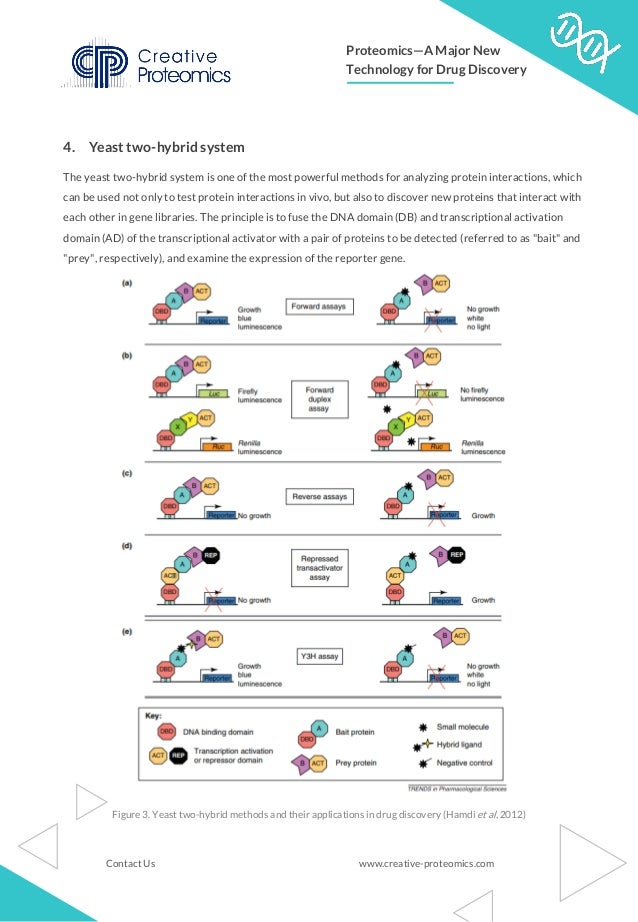
4. Yeast two-hybrid system
The yeast two-hybrid system is one of the most powerful methods for analyzing protein interactions, which
can be used not only to test protein interactions in vivo, but also to discover new proteins that interact with
each other in gene libraries. The principle is to fuse the DNA domain (DB) and transcriptional activation
domain (AD) of the transcriptional activator with a pair of proteins to be detected (referred to as "bait" and
"prey", respectively), and examine the expression of the reporter gene.
Figure 3. Yeast two-hybrid methods and their applications in drug discovery (Hamdi et al, 2012)
www.creative-proteomics.com
Contact Us
Proteomics—A Major New
Technology for Drug Discovery
Creative Proteomics can provide a comprehensive range of proteomics services to help you better
conduct research in the drug discovery process, which include: protein gel and imaging analysis,
protein identification, protein quantification, top-down proteomics, peptidomics, post-translational
modification analysis, and protein-protein interaction. Our technical staff will work closely with you
from experimental design to report delivery. If you have any questions or order, please feel free to
contact us.
References:
1. Schirle M, Bantscheff M, Kuster B. Mass spectrometry-based proteomics in preclinical drug discovery. Chemistry
& biology, 2012, 19(1): 72-84.
2. Burbaum J, Tobal G M. Proteomics in drug discovery. Current Opinion in Chemical Biology, 2002, 6(4): 427-433.
3. Wang J H, Hewick R M. Proteomics in drug discovery. Drug discovery today, 1999, 4(3): 129-133.
4. Grey J L, Thompson D H. Challenges and opportunities for new protein crystallization strategies in structure-
based drug design. Expert opinion on drug discovery, 2010, 5(11): 1039-1045.
5. Chambliss A B, Chan D W. Precision medicine: from pharmacogenomics to pharmacoproteomics. Clinical
proteomics, 2016, 13(1): 25.
6. Hamdi A, Colas P. Yeast two-hybrid methods and their applications in drug discovery. Trends in pharmacological
sciences, 2012, 33(2): 109-118.
Our comprehensive proteomics services and products
protein gel and imaging analysis
protein identification protein quantification top-down proteomics peptidomics post-translational
modification analysis protein-protein interaction
www.creative-proteomics.com
Contact Us
Proteomics—A Major New
Technology for Drug Discovery

Proteomics accelerates the drug discovery process

  • 1.
  • 2.
    Proteomics and pharmacoproteomics Proteomicsis a discipline that analyzes the dynamics of protein components, including expression levels and modification states from a holistic perspective, understands the interactions and connections between proteins, reveals the function of proteins and the laws of cell life, and studies all proteins in cells and their behaviors. The concept of proteomics has been used in the field of pharmaceutical research, thereby developing pharmacoproteomics. This field includes: discovery of all possible drug targets and all possible compounds for these targets; study of drug action mechanisms and toxicology; drug screening. It is also possible to classify patients according to protein profiles, to provide individualized treatment, and to predict drug efficacy. Nowadays, the pharmaceutical proteomics has penetrated into all aspects of drug discovery and clinical application. Figure 1. Workflow for large-scale proteomics approach for target discovery within a pharmaceutical setting (Ryan et al. 2002) Proteomics accelerate the drug discovery process The drug discovery process includes target identification, target validation, lead recognition, small molecule optimization, and preclinical/clinical development. Proteomics—A Major New Technology for Drug Discovery www.creative-proteomics.com Contact Us
  • 3.
    ◆ Proteomics fordrug target recognition Finding effective drugs and drug targets is one of the most widely used applications of proteomics. Proteomics can provide abundant protein expression in cells or tissues. Find differentially expressed proteins by comparing divergences in protein expression profiles between healthy and diseased tissues, cells, or body fluids, which may be potential biomarkers or drug targets. ◆ Proteomics for drug target validation The detection of only disease-associated proteins (targets) is not sufficient to begin the drug screening. Verifying the function of these proteins, and determining the role of proteins in the pathogenesis of the disease are critical to the process of drug discovery. Proteomics can be used in target validation to detect potential efficacy of drug candidates, to evaluate structure- activity relationships of drug analogues in combination with combinatorial chemistry, to study protein interactions, and to explore phenotypic changes when protein expression is excessive or inhibited. ◆ Proteomics for the recognition and optimization of lead compounds Proteomics technology can provide a high-throughput method for identifying and optimizing suitable lead compounds. For example, the identification of protein-protein interactions can be used to screen for lead compounds based on in vivo physiological responses, i.e., activity interference. Functional protein microarray can be used in vitro to detect protein-protein interactions, in the presence or absence of protein lead compounds, and to quickly identify molecules that prevent proteins from binding normally, which can change significantly by interfering with protein interactions in living cells. The same strategy can also be used to optimize lead compounds when suitable lead compounds are identified. In this case, protein interactions can be used to determine the presence of a chemical derivative of the lead compound to identify the most likely affected protein. www.creative-proteomics.com Contact Us Proteomics—A Major New Technology for Drug Discovery
  • 4.
    Proteomics technologies indrug discovery 1. Two-dimensional gel electrophoresis Two-dimensional gel electrophoresis (2DE) is the main means of protein separation and currently the most commonly applied technique for studying proteomics, which first separates proteins by isoelectric point and molecular weight by 2D polypropylene gel electrophoresis, and then analyzes the formed 2D gel electropherogram by software. The desired protein spots are then cleaved from the gel and subjected to mass spectrometry (MS) after enzymatic digestion. The 2DE has been able to isolate more than one thousand protein spots after several years of development. However, it still has certain defects. For example, quantitative comparisons are not allowed between samples with extremely small minimal proteins, very basic acid proteins, hydrophobic proteins, and poorly isolated proteins with low abundance. While, it is estimated that more than 50% of the proteins in the cells are low abundance. Furthermore, it is time-consuming, labor- consuming, and the reproducibility is not satisfactory. Therefore, the next step is to optimize the technology or to find innovative ways to measure protein abundance and activity. 2. Mass spectrometry Mass spectrometry is the fastest developing and most potential technique for protein identification at present, with the characteristics of high sensitivity, high accuracy and automation. The most commonly adopted ones are matrix-assisted laser desorption ionization time-of-flight mass spectrometry (MALDI-TOF-MS) and electrospray ionization tandem time-of-flight mass spectrometry (ESI-TOF- MS). In addition, new methods such as shotgun mass spectrometry (Shotgun-MS) and capillary electrophoresis-mass spectrometry (CE-MS) have been developed for direct identification of protein hydrolysates. In recent years, tandem mass spectrometry (TMS) has been used for protein sequencing and identification. In addition, high performance liquid chromatography (HPLC) separation combined with mass spectrometry (MS) identification can effectively make up for the deficiency of 2DE, with a wide range of fixed phases and applications. Multidimensional protein identification (MUDPIT) and isotope affinity labeling (ICAT) are two technologies developed on the basis of LC-MS-MS. MUDPIT is suitable for large-scale protein isolation and identification, and it can detect low-abundance proteins. ICAT is suitable for detecting and quantitating low abundance proteins. www.creative-proteomics.com Contact Us Proteomics—A Major New Technology for Drug Discovery
  • 5.
    3. Protein microarray Theprinciple of the protein microarray is to arrange various purified proteins in an orderly manner on a filter or a slide, and then use a fluorescently labeled protein or small molecule as a probe to incubate the protein microarray, rinse to remove the unbound probe, and detect fluorescence signals. Protein microarray is a high-throughput screening method similar to gene microarray. Its applications in drug development mainly include: (i). screening of lead compounds for drug targets; (ii). detection of substances binding to small molecules (such as drugs, lead compounds); (iii). study of interactions between small molecules and proteins. Figure 2. Protein microarraytechnologies in drug discovery (Huang et al, 2017) www.creative-proteomics.com Contact Us Proteomics—A Major New Technology for Drug Discovery
  • 6.
    4. Yeast two-hybridsystem The yeast two-hybrid system is one of the most powerful methods for analyzing protein interactions, which can be used not only to test protein interactions in vivo, but also to discover new proteins that interact with each other in gene libraries. The principle is to fuse the DNA domain (DB) and transcriptional activation domain (AD) of the transcriptional activator with a pair of proteins to be detected (referred to as "bait" and "prey", respectively), and examine the expression of the reporter gene. Figure 3. Yeast two-hybrid methods and their applications in drug discovery (Hamdi et al, 2012) www.creative-proteomics.com Contact Us Proteomics—A Major New Technology for Drug Discovery
  • 7.
    Creative Proteomics canprovide a comprehensive range of proteomics services to help you better conduct research in the drug discovery process, which include: protein gel and imaging analysis, protein identification, protein quantification, top-down proteomics, peptidomics, post-translational modification analysis, and protein-protein interaction. Our technical staff will work closely with you from experimental design to report delivery. If you have any questions or order, please feel free to contact us. References: 1. Schirle M, Bantscheff M, Kuster B. Mass spectrometry-based proteomics in preclinical drug discovery. Chemistry & biology, 2012, 19(1): 72-84. 2. Burbaum J, Tobal G M. Proteomics in drug discovery. Current Opinion in Chemical Biology, 2002, 6(4): 427-433. 3. Wang J H, Hewick R M. Proteomics in drug discovery. Drug discovery today, 1999, 4(3): 129-133. 4. Grey J L, Thompson D H. Challenges and opportunities for new protein crystallization strategies in structure- based drug design. Expert opinion on drug discovery, 2010, 5(11): 1039-1045. 5. Chambliss A B, Chan D W. Precision medicine: from pharmacogenomics to pharmacoproteomics. Clinical proteomics, 2016, 13(1): 25. 6. Hamdi A, Colas P. Yeast two-hybrid methods and their applications in drug discovery. Trends in pharmacological sciences, 2012, 33(2): 109-118. Our comprehensive proteomics services and products protein gel and imaging analysis protein identification protein quantification top-down proteomics peptidomics post-translational modification analysis protein-protein interaction www.creative-proteomics.com Contact Us Proteomics—A Major New Technology for Drug Discovery