CIRCULAR DICHROISM
MOLECULAR STRUCTURE ANALYSIS
Introduction to Circular Dichroism
Electronic Circular Dichroism
A chiral substance can rotate its polarization plan when plane-polarized light passes through
it. This phenomenon is called optical rotation. Here is the reason for the optical rotation:
when the left-handed light and the right-handed light that make up the plane polarized
light propagate through a chiral material, their refractive indices are different (nR≠nL). There-
fore, the propagation speed of the circularly polarized light in the two directions in the chiral
material is different (vR≠vL), which leads to the rotation of the polarization plane.
The absorption coefficient (ε) of the left-handed and right-handed circularly polarized lights
composed of the optically active material is not equal (εL≠εR). The difference in light absorp-
tion ΔA (Al-Ad) is the circular dichroism of the substance.
The instrument can record the difference Δε between the left-handed circularly polarized
light and the right-handed circularly polarized light passing through the chiral compound
solution. The circular dichroism (CD) can be obtained by changing ∆ε with wavelength.
Circular dichroism is a technique that analyzes the molecular structure using the different
absorption of circular polarized light by asymmetric molecules. Here are two commonly
used circular dichroism techniques: electronic circular dichroism and vibrating circular
dichroism.
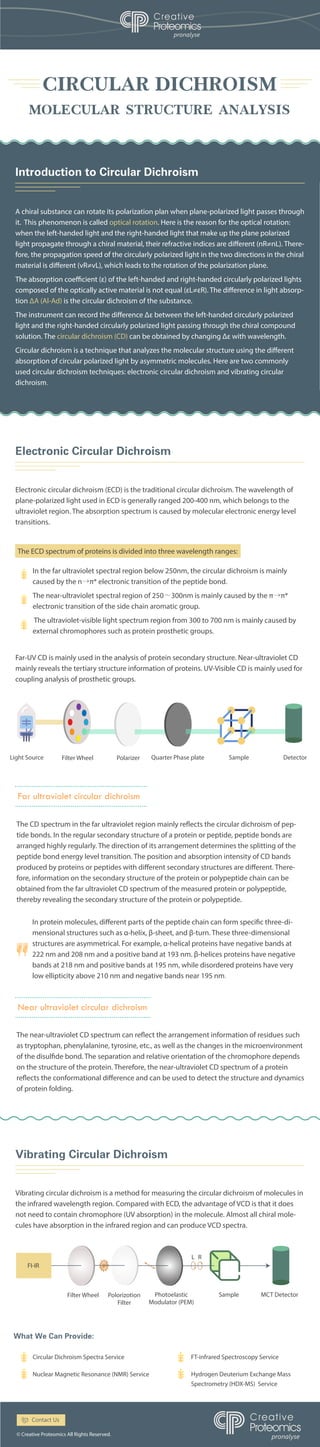
Electronic circular dichroism (ECD) is the traditional circular dichroism. The wavelength of
plane-polarized light used in ECD is generally ranged 200-400 nm, which belongs to the
ultraviolet region. The absorption spectrum is caused by molecular electronic energy level
transitions.
Far-UV CD is mainly used in the analysis of protein secondary structure. Near-ultraviolet CD
mainly reveals the tertiary structure information of proteins. UV-Visible CD is mainly used for
coupling analysis of prosthetic groups.
© Creative Proteomics All Rights Reserved.
Vibrating Circular Dichroism
What We Can Provide:
The ECD spectrum of proteins is divided into three wavelength ranges:
In the far ultraviolet spectral region below 250nm, the circular dichroism is mainly
caused by the n→π* electronic transition of the peptide bond.
The near-ultraviolet spectral region of 250~300nm is mainly caused by the π→π*
electronic transition of the side chain aromatic group.
The ultraviolet-visible light spectrum region from 300 to 700 nm is mainly caused by
external chromophores such as protein prosthetic groups.
Far ultraviolet circular dichroism
The CD spectrum in the far ultraviolet region mainly reflects the circular dichroism of pep-
tide bonds. In the regular secondary structure of a protein or peptide, peptide bonds are
arranged highly regularly. The direction of its arrangement determines the splitting of the
peptide bond energy level transition. The position and absorption intensity of CD bands
produced by proteins or peptides with different secondary structures are different. There-
fore, information on the secondary structure of the protein or polypeptide chain can be
obtained from the far ultraviolet CD spectrum of the measured protein or polypeptide,
thereby revealing the secondary structure of the protein or polypeptide.
Near ultraviolet circular dichroism
The near-ultraviolet CD spectrum can reflect the arrangement information of residues such
as tryptophan, phenylalanine, tyrosine, etc., as well as the changes in the microenvironment
of the disulfide bond. The separation and relative orientation of the chromophore depends
on the structure of the protein. Therefore, the near-ultraviolet CD spectrum of a protein
reflects the conformational difference and can be used to detect the structure and dynamics
of protein folding.
Light Source Filter Wheel Polarizer Quarter Phase plate Sample Detector
In protein molecules, different parts of the peptide chain can form specific three-di-
mensional structures such as α-helix, β-sheet, and β-turn. These three-dimensional
structures are asymmetrical. For example, α-helical proteins have negative bands at
222 nm and 208 nm and a positive band at 193 nm. β-helices proteins have negative
bands at 218 nm and positive bands at 195 nm, while disordered proteins have very
low ellipticity above 210 nm and negative bands near 195 nm.
Vibrating circular dichroism is a method for measuring the circular dichroism of molecules in
the infrared wavelength region. Compared with ECD, the advantage of VCD is that it does
not need to contain chromophore (UV absorption) in the molecule. Almost all chiral mole-
cules have absorption in the infrared region and can produce VCD spectra.
FI-IR
Filter Wheel Polorizotion
Filter
Photoelastic
Modulator (PEM)
Sample
L R
MCT Detector
Circular Dichroism Spectra Service FT-infrared Spectroscopy Service
Nuclear Magnetic Resonance (NMR) Service Hydrogen Deuterium Exchange Mass
Spectrometry (HDX-MS) Service
Contact Us

Electronic circular dichroism(ECD).pdf

  • 1.
    CIRCULAR DICHROISM MOLECULAR STRUCTUREANALYSIS Introduction to Circular Dichroism Electronic Circular Dichroism A chiral substance can rotate its polarization plan when plane-polarized light passes through it. This phenomenon is called optical rotation. Here is the reason for the optical rotation: when the left-handed light and the right-handed light that make up the plane polarized light propagate through a chiral material, their refractive indices are different (nR≠nL). There- fore, the propagation speed of the circularly polarized light in the two directions in the chiral material is different (vR≠vL), which leads to the rotation of the polarization plane. The absorption coefficient (ε) of the left-handed and right-handed circularly polarized lights composed of the optically active material is not equal (εL≠εR). The difference in light absorp- tion ΔA (Al-Ad) is the circular dichroism of the substance. The instrument can record the difference Δε between the left-handed circularly polarized light and the right-handed circularly polarized light passing through the chiral compound solution. The circular dichroism (CD) can be obtained by changing ∆ε with wavelength. Circular dichroism is a technique that analyzes the molecular structure using the different absorption of circular polarized light by asymmetric molecules. Here are two commonly used circular dichroism techniques: electronic circular dichroism and vibrating circular dichroism. Electronic circular dichroism (ECD) is the traditional circular dichroism. The wavelength of plane-polarized light used in ECD is generally ranged 200-400 nm, which belongs to the ultraviolet region. The absorption spectrum is caused by molecular electronic energy level transitions. Far-UV CD is mainly used in the analysis of protein secondary structure. Near-ultraviolet CD mainly reveals the tertiary structure information of proteins. UV-Visible CD is mainly used for coupling analysis of prosthetic groups. © Creative Proteomics All Rights Reserved. Vibrating Circular Dichroism What We Can Provide: The ECD spectrum of proteins is divided into three wavelength ranges: In the far ultraviolet spectral region below 250nm, the circular dichroism is mainly caused by the n→π* electronic transition of the peptide bond. The near-ultraviolet spectral region of 250~300nm is mainly caused by the π→π* electronic transition of the side chain aromatic group. The ultraviolet-visible light spectrum region from 300 to 700 nm is mainly caused by external chromophores such as protein prosthetic groups. Far ultraviolet circular dichroism The CD spectrum in the far ultraviolet region mainly reflects the circular dichroism of pep- tide bonds. In the regular secondary structure of a protein or peptide, peptide bonds are arranged highly regularly. The direction of its arrangement determines the splitting of the peptide bond energy level transition. The position and absorption intensity of CD bands produced by proteins or peptides with different secondary structures are different. There- fore, information on the secondary structure of the protein or polypeptide chain can be obtained from the far ultraviolet CD spectrum of the measured protein or polypeptide, thereby revealing the secondary structure of the protein or polypeptide. Near ultraviolet circular dichroism The near-ultraviolet CD spectrum can reflect the arrangement information of residues such as tryptophan, phenylalanine, tyrosine, etc., as well as the changes in the microenvironment of the disulfide bond. The separation and relative orientation of the chromophore depends on the structure of the protein. Therefore, the near-ultraviolet CD spectrum of a protein reflects the conformational difference and can be used to detect the structure and dynamics of protein folding. Light Source Filter Wheel Polarizer Quarter Phase plate Sample Detector In protein molecules, different parts of the peptide chain can form specific three-di- mensional structures such as α-helix, β-sheet, and β-turn. These three-dimensional structures are asymmetrical. For example, α-helical proteins have negative bands at 222 nm and 208 nm and a positive band at 193 nm. β-helices proteins have negative bands at 218 nm and positive bands at 195 nm, while disordered proteins have very low ellipticity above 210 nm and negative bands near 195 nm. Vibrating circular dichroism is a method for measuring the circular dichroism of molecules in the infrared wavelength region. Compared with ECD, the advantage of VCD is that it does not need to contain chromophore (UV absorption) in the molecule. Almost all chiral mole- cules have absorption in the infrared region and can produce VCD spectra. FI-IR Filter Wheel Polorizotion Filter Photoelastic Modulator (PEM) Sample L R MCT Detector Circular Dichroism Spectra Service FT-infrared Spectroscopy Service Nuclear Magnetic Resonance (NMR) Service Hydrogen Deuterium Exchange Mass Spectrometry (HDX-MS) Service Contact Us